EP0724753B1 - Verfahren und einrichtungen zur ermittlung auf einem substrat aufgezeichneter zeichen - Google Patents
Verfahren und einrichtungen zur ermittlung auf einem substrat aufgezeichneter zeichen Download PDFInfo
- Publication number
- EP0724753B1 EP0724753B1 EP94931618A EP94931618A EP0724753B1 EP 0724753 B1 EP0724753 B1 EP 0724753B1 EP 94931618 A EP94931618 A EP 94931618A EP 94931618 A EP94931618 A EP 94931618A EP 0724753 B1 EP0724753 B1 EP 0724753B1
- Authority
- EP
- European Patent Office
- Prior art keywords
- characters
- angle
- plane
- planar surface
- substrates
- Prior art date
- Legal status (The legal status is an assumption and is not a legal conclusion. Google has not performed a legal analysis and makes no representation as to the accuracy of the status listed.)
- Expired - Lifetime
Links
Images


Classifications
-
- G—PHYSICS
- G06—COMPUTING OR CALCULATING; COUNTING
- G06V—IMAGE OR VIDEO RECOGNITION OR UNDERSTANDING
- G06V10/00—Arrangements for image or video recognition or understanding
- G06V10/10—Image acquisition
-
- H—ELECTRICITY
- H10—SEMICONDUCTOR DEVICES; ELECTRIC SOLID-STATE DEVICES NOT OTHERWISE PROVIDED FOR
- H10P—GENERIC PROCESSES OR APPARATUS FOR THE MANUFACTURE OR TREATMENT OF DEVICES COVERED BY CLASS H10
- H10P72/00—Handling or holding of wafers, substrates or devices during manufacture or treatment thereof
- H10P72/06—Apparatus for monitoring, sorting, marking, testing or measuring
- H10P72/0618—Apparatus for monitoring, sorting, marking, testing or measuring using identification means, e.g. labels on substrates or labels on containers
-
- G—PHYSICS
- G06—COMPUTING OR CALCULATING; COUNTING
- G06K—GRAPHICAL DATA READING; PRESENTATION OF DATA; RECORD CARRIERS; HANDLING RECORD CARRIERS
- G06K7/00—Methods or arrangements for sensing record carriers, e.g. for reading patterns
- G06K7/10—Methods or arrangements for sensing record carriers, e.g. for reading patterns by electromagnetic radiation, e.g. optical sensing; by corpuscular radiation
- G06K7/10544—Methods or arrangements for sensing record carriers, e.g. for reading patterns by electromagnetic radiation, e.g. optical sensing; by corpuscular radiation by scanning of the records by radiation in the optical part of the electromagnetic spectrum
- G06K7/10821—Methods or arrangements for sensing record carriers, e.g. for reading patterns by electromagnetic radiation, e.g. optical sensing; by corpuscular radiation by scanning of the records by radiation in the optical part of the electromagnetic spectrum further details of bar or optical code scanning devices
- G06K7/10861—Methods or arrangements for sensing record carriers, e.g. for reading patterns by electromagnetic radiation, e.g. optical sensing; by corpuscular radiation by scanning of the records by radiation in the optical part of the electromagnetic spectrum further details of bar or optical code scanning devices sensing of data fields affixed to objects or articles, e.g. coded labels
-
- G—PHYSICS
- G06—COMPUTING OR CALCULATING; COUNTING
- G06V—IMAGE OR VIDEO RECOGNITION OR UNDERSTANDING
- G06V10/00—Arrangements for image or video recognition or understanding
- G06V10/10—Image acquisition
- G06V10/12—Details of acquisition arrangements; Constructional details thereof
- G06V10/14—Optical characteristics of the device performing the acquisition or on the illumination arrangements
- G06V10/145—Illumination specially adapted for pattern recognition, e.g. using gratings
Definitions
- the present invention relates to the fields of manufacturing electronic components, in particular the manufacture of integrated circuits from substrates or wafers made of materials semiconductors, and more particularly to identification methods and devices or recognition of these substrates, at all times during automated manufacturing processes, from distinctive characters, in particular in alphanumeric form or codes bars, inscribed on each substrate.
- Prior Art teaches us a widely used process for identifying characters engraved on platelet-shaped substrates, more precisely on one side of each plate, which consists in moving by means of a manipulator arm each plate horizontally, the latter being arranged in line one behind the other in grooves respective of a basket arranged vertically, to remove the plate from the basket, then orient it angularly thanks to a location on its perimeter in the form of a notch or flat, so as to present the surface portion bearing the characters to be identified in the alignment of the optical axis of a camera and a lighting system, and perpendicular to them.
- This process has many drawbacks, including a relatively long time character identification cycle, of the order of 4 to 6 minutes to process 25 platelets, due in particular when handling the pads, a large bulk due to the arm manipulator, an increase in particulate contamination of platelets due to the presence mechanical elements above these plates, such as the lighting system and the camera, finally a relatively high investment and operating cost, in particular by the presence of a manipulator arm.
- said first and second angles are understood between 35 ° and 65 ° and preferably equal to 45 °
- said third angle is between 40 ° and 60 ° and preferably equal to 48 °.
- the method according to the invention makes it possible to obtain, by means of a bias lighting of the characters, an image of these independent of the lines of exclusively vertical engravings and horizontal which appear on the wafers during the manufacturing steps they follow, and which sometimes cover the surface portion on which the identification characters are inscribed of each plate.
- These lines of vertical and horizontal engravings could induce with the devices of the Prior Art a disturbance of the image observed and therefore cause an increased error rate in character identification, itself causing a rate higher platelet waste.
- Bias lighting also provides contrast higher of the characters observed compared to the surface on which they are engraved. Indeed, the incident light rays reflected on said surface are not in the optical axis of observation as is particularly the case when the light rays and the optical axis are perpendicular to the writing surface of the characters.
- the bias lighting, as well as the bias position of the optical axis of the camera allow observation of the characters of each plate without displacement thereof by compared to others, when placed in a basket. Character identification as well lit and observed is made possible in particular thanks to network recognition software of neurons.
- the method according to the invention is characterized in that said characters are illuminated by means of at least one second symmetrical light source to said first light source with respect to said second plane.
- This feature allows symmetrical lighting relative to the optical axis of the camera hence a simpler image processing for character identification.
- the method according to the invention is characterized in that said characters are illuminated by means of a plurality of light sources located in a plurality of planes passing through said planar surface, and defining a plurality of respective angles with a perpendicular to said flat surface.
- the plurality of light sources allows greater modulation of the lighting, by variation in the light intensity of each source as required, in particular in function of the appearance of the surface inscribing the characters which may in particular present deposits dark oxide or reflective randomly.
- the subject of the invention is also a device for identifying characters, engraved on substrates, comprising means for positioning said substrates, lighting means said characters, means of observation of said characters, and means of identification of said characters, characterized in that said lighting means comprise at least one first light source located in a foreground passing through a minimal planar surface which inscribes all of said characters from a substrate and defining a first angle with a perpendicular to said flat surface, said first light source being located on a straight line passing through said flat surface and forming a second angle with a second perpendicular plane to said plane surface and perpendicular to said foreground, and in that said observation means include an electronic camera transmitting at least one image to said identification means and comprising an optical axis at least parallel to said second plane, determining a third angle with said perpendicular to said plane surface, and forming with said foreground an angle less than or equal to 25 °, and in that said device comprises means for translational movement of said means lighting and said observation means parallel to an alignment axi
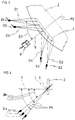
- Figure 1 shows schematically in profile view a first example of a mode of realization of the geometry of the lighting and observation means of a device according to the invention.
- Figure 2 shows schematically in front view along F2 the example illustrated on the Figure 1.
- Figure 3 schematically shows in top view according to F1 the example illustrated on Figure 1.
- Figure 4 shows schematically in profile view a second example of a realization of the geometry of the lighting means of a device according to the invention.
- Figure 5 is a schematic, functional, and partial representation in profile view of an exemplary embodiment of a device according to the invention comprising means lighting and observation means according to Figures 1, 2, and 3.
- Figure 6 shows a side view of an exemplary embodiment of a device according to the invention according to Figure 5.
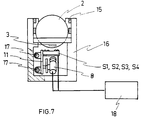
- Figure 7 shows in front view the exemplary embodiment of a device according to the invention according to Figure 6.
- the geometry of the lighting and observation means of the device according to the invention illustrated partially in FIG. 1 is shown in profile view parallel to a first plane P1, and in a position for identifying the characters 1 of a wafer-shaped substrate 2.
- the lighting means advantageously comprise a first S1, second S2, third S3, and fourth S4 light sources, provided in particular by means of four light-emitting diodes (LED).
- the four light sources S1, S2, S3, and S4 are placed substantially in the plane P1 passing through a minimal plane surface 3 which inscribes all the characters 1 of the substrate.
- the plane P1 defines a first angle ⁇ 1, advantageously of the order of 45 °, with a perpendicular 4 to the surface 3, and advantageously contains one of the largest axes of surface 3, as shown in Figure 1.
- the plate 2 is of a type commonly used in the electronic industry, in the form of thin disc on one side of which are engraved the identity characters of the plate in an area close to its circumference, as illustrated in Figure 2.
- the examples of plate 2 and characters 1 illustrated in the Figures are not to scale, are representative of those commonly encountered but in no way restrictive, all other character modes, for example example of bar codes, written on all other types of labels, which can be identified with the device according to the present invention.
- each of the first S1, second S2, third S3, and fourth S4 light sources is respectively located substantially on first D1, second D2, third D3, and fourth straight D4 passing through the surface 3 and forming in particular a second angle ⁇ 2, advantageously of the order of 45 °, with a second plane P2 perpendicular to the surface 3 and perpendicular to the foreground P1, as shown in Figure 3 which is a view along F1 of Figure 1 (view perpendicular to the foreground P1).
- the first S1 and third S3 light sources are advantageously respectively symmetrical of the second S2 and fourth S4 light sources with respect to the second plane P2, as shown in Figures 2 and 3.
- the four light sources S1, S2, S3, and S4 direct their light beams, in particular conical, in the direction of characters 1, and are advantageously located at a distance substantially equal to the surface 3.
- the distance between the light sources from the second plane P2 is advantageously such that the light beams they emit are at least intersecting at the surface 3, for example as shown in Figures 2 and 3.
- Figures 1, 2, and 3 also illustrate the geometry of the observation means comprising advantageously an electronic camera 8 provided with an optical axis 9.
- the camera 8 observes characters 1 illuminated by the four light sources S1, S2, S3, and S4 along its axis optics 9 advantageously merged with the second plane P2 and forming a third angle ⁇ 3 with perpendicular 4 to surface 3, as shown in Figures 1, 2, and 3.
- the third angle ⁇ 3 is advantageously adjustable, in particular between the values of 40 ° and 60 °, like this will be described more fully with the help of Figures 5, 6, and 7.
- FIG. 4 A second example of an embodiment of the geometry of the lighting means of the device according to the invention is illustrated schematically in Figure 4.
- the lighting means comprise a plurality of light sources Sn located in a plurality of planes Pn passing by said surface 3 and defining a plurality of respective angles ⁇ n, advantageously of about 45 °, with a perpendicular 4 to the surface 3.
- Each of the planes of the plurality of planes Pn is advantageously arranged in a similar manner to that described in FIGS. 1, 2, and 3, as well as each of the light sources of the plurality of light sources Sn in each plans.
- Figure 5 illustrates an example of the kinematics of the lighting means and the means of observation advantageously having the geometry described according to Figures 1, 2, and 3 of an exemplary embodiment of a device according to the invention.
- the plates 2 are stationary and arranged so that the identity characters that they carry are aligned, the surfaces 3 being substantially parallel, as will be described later with Figures 6 and 7.
- the four light sources S1, S2, S3, and S4 are fixed on a support 11 advantageously movable, relative to the plates, in translation in a direction 12 parallel to a perpendicular 4 to the flat surfaces 3.
- the camera 8 is fixed on the support 11 advantageously so as to be able to move in translation relative to to the latter in a direction 14 parallel to its optical axis 9 and also in rotation by relative to the support 11 substantially around the axis of greatest length of the surface 3, along a direction 13.
- the translational movement of the support 11 in the direction 12 allows the lighting and the observation of the characters of each plate
- the movement of the camera 8 in translation following direction 14 allows an optimization of the observation
- the movement of the camera 8 in rotation in direction 13 makes it possible to adjust the observation in particular as a function of the interval 10 separating each plate, by an appropriate adjustment of the third angle ⁇ 3.
- the lighting and observation means are advantageously designed to act by being placed under the pads, the pads remaining stationary for throughout the identification process, according to the invention, of all the platelets. This immobility of the plates and the positioning below them of the lighting means and observation means make it possible in particular to minimize the particulate contamination of platelets.
- Figures 6 and 7 show respectively in side view and in front view a example of embodiment of the device according to the invention according to FIG. 5.
- the device comprises means for positioning the plates 2 including, a structure 16 able to advantageously maintain in a horizontal position a basket 15 comprising the plates 2 each arranged vertically one behind the other in a groove at an interval regular variable according to the format of the plates, and a mechanism (not shown) for angularly orient all the plates 2 around their axis of alignment advantageously so that the identity characters of each plate are aligned in the position the lower compared to basket 15, as shown in Figure 7.
- the mechanism angular orientation of platelets is a known mechanism commonly encountered allowing to align the notches or flats (not shown) that the plates bear on their circumferences.
- This mechanism is advantageously placed inside the structure 16 and below the basket 15, and can advantageously be controlled from a central unit 18, which allows the possibility of automatic control of said mechanism.
- the device also includes lighting means and observation means advantageously as defined in Figures 1, 2, 3, and 5.
- the support 11 is for example guided in translation along two guide bars 17 parallel to an alignment axis of the platelets.
- the guides in translation and in rotation of the camera 8 relative to the support 11 are provided in any known way, for example by slide systems (not shown), and the movements of the camera 8 relative to the support 11 are in particular carried out manually.
- the position of the camera 8 relative to the support 11 is adjusted before a process identification.
- the movements of the support 11 are advantageously motorized (not shown) anyway known, and controllable through the central unit 18 of so as to ensure the possibility of automatic control of the movements of the lighting means and observation.
- the operations of the camera 8 and of the light sources S1, S2, S3, and S4 are advantageously controllable via the central unit 18, so as to ensure the possibility of complete automatic control of the lighting means and observation and / or monitoring of the identification of characters through a monitor (not shown).
- the device also includes means for identifying the characters based of the image observed and advantageously transmitted by the camera 8 to the latter, including in particular image processing software, and network character recognition software of neurons.
- the image processing software advantageously makes it possible to rough the transmitted image, and neural network recognition software advantageously allows an operator to visualize and identify the characters, for example through a monitor (not represented).
- Neural network recognition software also converts an image transmitted in information suitable for being processed by computer processing on network.
- the central unit is advantageously provided a platelet identification cycle management software adapted as needed to a process step or to a specific manufacturing process.
- the device according to the invention thus offers the possibility of fully automatic piloting.
- Neural network recognition software notably brings an advantage of speed character recognition therefore a productivity gain, and a rate of identification errors low characters therefore a low rate of manufacturing rejects.
- the means for positioning the plates and the lighting means and observation of the characters of the device according to the invention are inserted in a volume relatively compact, in particular due to the immobility of the platelets during the identification processes and due to the integration of the lighting means, observation means, and the platelet orientation mechanism below the basket. Intensive use of materials plastics makes it possible to obtain a weight of less than 15 kg which allows movement and easy transport. Finally, IT integration allows the device to be used according to the invention in communication with a network.
Landscapes
- Engineering & Computer Science (AREA)
- Physics & Mathematics (AREA)
- General Physics & Mathematics (AREA)
- Theoretical Computer Science (AREA)
- Multimedia (AREA)
- Computer Vision & Pattern Recognition (AREA)
- Artificial Intelligence (AREA)
- Electromagnetism (AREA)
- Toxicology (AREA)
- General Health & Medical Sciences (AREA)
- Health & Medical Sciences (AREA)
- Character Input (AREA)
- Investigating Materials By The Use Of Optical Means Adapted For Particular Applications (AREA)
- Image Analysis (AREA)
- Image Processing (AREA)
- Image Input (AREA)
- Devices For Indicating Variable Information By Combining Individual Elements (AREA)
Claims (14)
- Verfahren zur Identifizierung von Zeichen, die auf einer Vielzahl von Substraten graviert sind, die vertikal und unbeweglich angeordnet sind,
dadurch gekennzeichnet, daß es mindestens die folgenden Schritte aufweist:Direktes Beleuchten der Zeichen (1) eines ersten Substrats (2) der Vielzahl von Substraten mittels mindestens einer ersten Lichtquelle (S1), die unter der Vielzahl von Substraten und in einer ersten Ebene (P1) liegt, die durch eine minimale ebene Fläche (3) verläuft, die die Gesamtheit der Zeichen des ersten Substrats erfaßt und welche erste Ebene (P1) einen ersten Winkel (β1) mit einer Senkrechten (4) zu der ebenen Fläche festlegt, wobei die erste Lichtquelle auf einer Geraden (D1) liegt, die durch die ebene Fläche verläuft und einen zweiten Winkel (β2) mit einer zweiten Ebene (P2) bildet, die senkrecht zu der ebenen Fläche und senkrecht zu der ersten Ebene (P1) ist,Beobachten der Zeichen mit elektronischen Beobachtungsmitteln (8), die unter der Vielzahl von Substraten liegen und eine optische Achse (9) aufweisen, die mindestens zu der zweiten Ebene (P2) parallel ist und einen dritten Winkel (β3) mit der zu der ebenen Fläche (3) verlaufenden Senkrechten (4) bestimmt, wobei die optische Achse (9) mit der ersten Ebene (P1) einen Winkel kleiner oder gleich 25° bildet;Identifizieren der Zeichen des ersten Substrats mindestens mit einer Erkennungssoftware mit Neuronennetzen undVerlagern von mindestens der ersten Lichtquelle und der Beobachtungsmittel durch Parallelverschiebung zu einer Achse, in der die Vielzahl der Substrate ausgerichtet sind, um sie in die Position zur Identifizierung der Zeichen eines zweiten Substrats der Vielzahl der Substrate zu bringen. - Verfahren nach Anspruch 1,
dadurch gekennzeichnet, daß der erste Winkel (β1) zwischen 35° und 65° und vorzugsweise gleich 45° beträgt. - Verfahren nach Anspruch 1 oder 2,
dadurch gekennzeichnet, daß der zweite Winkel (β2) zwischen 35° und 65° und vorzugsweise gleich 45° beträgt. - Verfahren nach einem der Ansprüche 1 bis 3,
dadurch gekennzeichnet, daß der dritte Winkel (β3) zwischen 40° und 60° und vorzugsweise gleich 48° beträgt. - Verfahren nach einem der Ansprüche 1 bis 4,
dadurch gekennzeichnet, daß die Zeichen (1) mittels mindestens einer zweiten Lichtquelle (S2) beleuchtet werden, die zu der ersten Lichtquelle (S1) symmetrisch ist bezogen auf die zweite Ebene (P2). - Verfahren nach einem der Ansprüche 1 bis 5,
dadurch gekennzeichnet, daß die Zeichen mittels einer Vielzahl von Lichtquellen (Sn) beleuchtet werden, die in einer Vielzahl von Ebenen (Pn) liegen, die durch die ebene Fläche (3) verlaufen und eine Vielzahl von entsprechenden Winkeln (βn) mit einer Senkrechten (4) zu der ebenen Fläche festlegen. - Vorrichtung zur Identifizierung von Zeichen (1), die auf Substrate (2) graviert sind, die Mittel zur Positionierung der Substrate, Mittel zur Beleuchtung der Zeichen, Mittel zur Beobachtung der Zeichen, Mittel zur Identifizierung der Zeichen aufweist,
dadurch gekennzeichnet, daß die Positionierungsmittel einen Korb (15) aufweisen, der geeignet ist, die Substrate in vertikaler Position und unbeweglich zu halten, wobei die Positionierungsmittel mindestens eine minimale ebene Fläche (3) festlegen, die geeignet ist, die Gesamtheit der Zeichen eines Substrats zu erfassen, daß die Beleuchtungsmittel mindestens eine erste Lichtquelle (S1) aufweisen, die in einer ersten Ebene (P1) liegt, die durch die minimale ebene Fläche (3) verläuft und einen ersten Winkel (β1) mit einer Senkrechten (4) zu der ebenen Fläche festlegt, wobei die erste Lichtquelle auf einer Geraden (D1) liegt, die durch die ebene Fläche verläuft und einen zweiten Winkel (β2) mit einer zweiten Ebene (P2) bildet, die senkrecht zu der ebenen Fläche und senkrecht zu der ersten Ebene verläuft, daß die Beobachtungsmittel eine elektronische Kamera (8) aufweisen, die mindestens ein Bild an die Identifizierungsmittel überträgt und eine optische Achse (9) aufweist, die mindestens parallel zu der zweiten Ebene ist, wobei die optische Achse (9) einen dritten Winkel (β3) mit der Senkrechten (4) zu der ebenen Fläche (3) bestimmt und mit der ersten Ebene einen Winkel kleiner oder gleich 25° bildet, und daß die Vorrichtung Mittel (11, 17) zur Verlagerung der Beleuchtungsmittel und Beobachtungsmittel durch Parallelverschiebung zu einer Achse aufweist, in der die Substrate ausgerichtet sind. - Vorrichtung nach Anspruch 7,
dadurch gekennzeichnet, daß der erste Winkel (β1) zwischen 35° und 65° und vorzugsweise gleich 45° beträgt. - Vorrichtung nach Anspruch 7 oder 8,
dadurch gekennzeichnet, daß der zweite Winkel (β2) zwischen 35° und 65° und vorzugsweise gleich 45° beträgt. - Vorrichtung nach einem der Ansprüche 7 bis 9,
dadurch gekennzeichnet, daß der dritte Winkel (β3) zwischen 40° und 60° und vorzugsweise gleich 48° beträgt. - Vorrichtung nach einem der Ansprüche 7 bis 10,
dadurch gekennzeichnet, daß die Beleuchtungsmittel mindestens eine zweite Lichtquelle (S2) aufweisen, die zu der ersten Lichtquelle (S1) symmetrisch ist bezogen auf die zweite Ebene (P2). - Vorrichtung nach einem der Ansprüche 7 bis 11,
dadurch gekennzeichnet, daß sie eine Vielzahl von Lichtquellen (Sn) aufweist, die in einer Vielzahl von Ebenen (Pn) liegen, die durch die ebene Fläche (3) verlaufen und eine Vielzahl von entsprechenden Winkeln (βn) mit einer Senkrechten (4) zu der ebenen Fläche festlegen. - Vorrichtung nach einem der Ansprüche 7 bis 12,
dadurch gekennzeichnet, daß die Positionierungsmittel, die Beleuchtungsmittel und die Beobachtungsmittel sich mindestens unter den Substraten (2) erstrecken. - Vorrichtung nach einem der Ansprüche 7 bis 13,
dadurch gekennzeichnet, daß die Mittel zur Identifizierung der Zeichen mindestens eine Erkennungssoftware mit Neuronennetzen aufweisen, um die durch die Beobachtungsmittel übertragenen Bilder zu interpretieren.
Applications Claiming Priority (3)
| Application Number | Priority Date | Filing Date | Title |
|---|---|---|---|
| FR9312770A FR2711824B1 (fr) | 1993-10-21 | 1993-10-21 | Procédés et dispositifs d'identification de caractères inscrits sur des substrats. |
| FR9312770 | 1993-10-21 | ||
| PCT/FR1994/001228 WO1995011491A1 (fr) | 1993-10-21 | 1994-10-21 | Procedes et dispositifs d'identification de caracteres inscrits sur des substrats |
Publications (2)
| Publication Number | Publication Date |
|---|---|
| EP0724753A1 EP0724753A1 (de) | 1996-08-07 |
| EP0724753B1 true EP0724753B1 (de) | 1998-04-01 |
Family
ID=9452230
Family Applications (1)
| Application Number | Title | Priority Date | Filing Date |
|---|---|---|---|
| EP94931618A Expired - Lifetime EP0724753B1 (de) | 1993-10-21 | 1994-10-21 | Verfahren und einrichtungen zur ermittlung auf einem substrat aufgezeichneter zeichen |
Country Status (8)
| Country | Link |
|---|---|
| EP (1) | EP0724753B1 (de) |
| JP (1) | JP3252327B2 (de) |
| KR (1) | KR100346828B1 (de) |
| AT (1) | ATE164697T1 (de) |
| DE (1) | DE69409395T2 (de) |
| ES (1) | ES2115266T3 (de) |
| FR (1) | FR2711824B1 (de) |
| WO (1) | WO1995011491A1 (de) |
Families Citing this family (11)
| Publication number | Priority date | Publication date | Assignee | Title |
|---|---|---|---|---|
| FR2751769B1 (fr) * | 1996-07-29 | 1998-10-09 | Recif Sa | Procede et appareil d'identification de caracteres formes sur une pluralite de plaquettes de silicium |
| US7016539B1 (en) | 1998-07-13 | 2006-03-21 | Cognex Corporation | Method for fast, robust, multi-dimensional pattern recognition |
| FR2835337B1 (fr) | 2002-01-29 | 2004-08-20 | Recif Sa | Procede et dispositif d'identification de caracteres inscrits sur une plaque de semi-conducteur comportant au moins une marque d'orientation |
| US8081820B2 (en) | 2003-07-22 | 2011-12-20 | Cognex Technology And Investment Corporation | Method for partitioning a pattern into optimized sub-patterns |
| US7639861B2 (en) | 2005-09-14 | 2009-12-29 | Cognex Technology And Investment Corporation | Method and apparatus for backlighting a wafer during alignment |
| US9734419B1 (en) | 2008-12-30 | 2017-08-15 | Cognex Corporation | System and method for validating camera calibration in a vision system |
| US9533418B2 (en) | 2009-05-29 | 2017-01-03 | Cognex Corporation | Methods and apparatus for practical 3D vision system |
| US9393694B2 (en) | 2010-05-14 | 2016-07-19 | Cognex Corporation | System and method for robust calibration between a machine vision system and a robot |
| US9124873B2 (en) | 2010-12-08 | 2015-09-01 | Cognex Corporation | System and method for finding correspondence between cameras in a three-dimensional vision system |
| DE202012003661U1 (de) * | 2012-04-12 | 2013-07-15 | Mühlbauer Ag | Vorrichtung zum Erkennen von Codes |
| US9679224B2 (en) | 2013-06-28 | 2017-06-13 | Cognex Corporation | Semi-supervised method for training multiple pattern recognition and registration tool models |
Family Cites Families (3)
| Publication number | Priority date | Publication date | Assignee | Title |
|---|---|---|---|---|
| US3899687A (en) * | 1972-07-10 | 1975-08-12 | Identicon Corp | Optical label scanning |
| FR2594982A1 (fr) * | 1986-02-21 | 1987-08-28 | Eram Sarl Manuf Fse Chaussures | Mode de realisation de codes a lecture optique, procede de lecture desdits codes et installation pour la mise en oeuvre du procede |
| DE3742485A1 (de) * | 1987-12-15 | 1989-06-29 | Sick Optik Elektronik Erwin | Optische abtastvorrichtung |
-
1993
- 1993-10-21 FR FR9312770A patent/FR2711824B1/fr not_active Expired - Fee Related
-
1994
- 1994-10-21 EP EP94931618A patent/EP0724753B1/de not_active Expired - Lifetime
- 1994-10-21 JP JP51142395A patent/JP3252327B2/ja not_active Expired - Fee Related
- 1994-10-21 WO PCT/FR1994/001228 patent/WO1995011491A1/fr not_active Ceased
- 1994-10-21 ES ES94931618T patent/ES2115266T3/es not_active Expired - Lifetime
- 1994-10-21 AT AT94931618T patent/ATE164697T1/de not_active IP Right Cessation
- 1994-10-21 KR KR1019960701383A patent/KR100346828B1/ko not_active Expired - Fee Related
- 1994-10-21 DE DE69409395T patent/DE69409395T2/de not_active Expired - Fee Related
Also Published As
| Publication number | Publication date |
|---|---|
| JP3252327B2 (ja) | 2002-02-04 |
| WO1995011491A1 (fr) | 1995-04-27 |
| ES2115266T3 (es) | 1998-06-16 |
| FR2711824B1 (fr) | 1996-01-05 |
| KR100346828B1 (ko) | 2002-11-13 |
| JPH09504892A (ja) | 1997-05-13 |
| FR2711824A1 (fr) | 1995-05-05 |
| ATE164697T1 (de) | 1998-04-15 |
| KR960705282A (ko) | 1996-10-09 |
| DE69409395T2 (de) | 1998-10-15 |
| EP0724753A1 (de) | 1996-08-07 |
| DE69409395D1 (de) | 1998-05-07 |
Similar Documents
| Publication | Publication Date | Title |
|---|---|---|
| EP0724753B1 (de) | Verfahren und einrichtungen zur ermittlung auf einem substrat aufgezeichneter zeichen | |
| EP0401351B1 (de) | Verfahren und vorrichtung für optische messungen | |
| WO1998044330A3 (en) | Optical inspection module and method for detecting particles and defects on substrates in integrated process tools | |
| EP1602001B1 (de) | Optische einrichtung und inspektionsmodul | |
| CA2003847A1 (fr) | Machine a microfaisceau laser d'intervention sur des objets a couche mince, en particulier pour la gravure ou le depot de matiere par voie chimique en presence d'un gaz reactif | |
| WO2011138524A1 (fr) | Dispositif et procede d'inspection de plaquettes semi-conductrices en mouvement | |
| EP0665951A1 (de) | Vorrichtung und verfahren zur inspektion transparenten materials. | |
| FR2874424A1 (fr) | Dispositif d'analyse optique de produits tels que des fruits a eclairage indirect | |
| EP0076182B1 (de) | Verfahren, Gerät und Verwendung mit Wahlmöglichkeit zwischen einer Menge von Paketen und deren Transport | |
| EP0086143A1 (de) | Verfahren und Einrichtung zur Detektion von Fremdteilchen in einer Flüssigkeit | |
| FR2562249A1 (fr) | Cellule humide tres radio-active, blindee, pour une installation nucleaire, avec un dispositif pour la reconnaissance des fuites et procede pour l'utilisation d'une telle cellule | |
| EP3728990A1 (de) | Dreidimensionales ziel mit dualer struktur, vorrichtung und verfahren zur optischen messung mit solch einem ziel | |
| CA2173062C (fr) | Dispositif d'analyse en vue du tri automatique de produits, notamment de fruits ou legumes | |
| CA2223263A1 (fr) | Dispositif de lecture de reliefs sur un recipient transparent | |
| EP0692714A1 (de) | Verfahren und Vorrichtung zur Erkennung von geometrischen Eigenheiten von quaderförmigen Teilen mit polygonalem Querschnitt | |
| EP2981807B1 (de) | Optisches verfahren zur charakterisierung einer lichtbrechenden oberfläche und vorrichtung zur durchführung solch eines verfahrens | |
| CN1809744A (zh) | 用光学方法控制较佳的具有圆形边缘物件的质量的方法和装置 | |
| EP0857336B1 (de) | Verfahren und gerät zum identifizieren von zeichen auf mehreren siliziumplättchen | |
| WO1997024607A1 (en) | Substrate reading device and method | |
| WO1997024607A9 (en) | Substrate reading device and method | |
| FR2538142A1 (fr) | Procede d'identification de produits metallurgiques et dispositif de mise en oeuvre | |
| CN210108519U (zh) | 用于产生高光谱影像的光谱影像获取装置 | |
| EP0229581A1 (de) | Einrichtung zum automatischen Fokussieren eines Mikroskops | |
| EP2962085A1 (de) | Verfahren und vorrichtung zur charakterisierung einer diffraktiven oberfläche | |
| EP0711427B1 (de) | Gerät zum erkennen von informationen auf gegenständen |
Legal Events
| Date | Code | Title | Description |
|---|---|---|---|
| PUAI | Public reference made under article 153(3) epc to a published international application that has entered the european phase |
Free format text: ORIGINAL CODE: 0009012 |
|
| 17P | Request for examination filed |
Effective date: 19960410 |
|
| AK | Designated contracting states |
Kind code of ref document: A1 Designated state(s): AT BE CH DE ES FR GB IE IT LI NL SE |
|
| GRAG | Despatch of communication of intention to grant |
Free format text: ORIGINAL CODE: EPIDOS AGRA |
|
| GRAG | Despatch of communication of intention to grant |
Free format text: ORIGINAL CODE: EPIDOS AGRA |
|
| GRAH | Despatch of communication of intention to grant a patent |
Free format text: ORIGINAL CODE: EPIDOS IGRA |
|
| 17Q | First examination report despatched |
Effective date: 19970905 |
|
| GRAH | Despatch of communication of intention to grant a patent |
Free format text: ORIGINAL CODE: EPIDOS IGRA |
|
| GRAA | (expected) grant |
Free format text: ORIGINAL CODE: 0009210 |
|
| AK | Designated contracting states |
Kind code of ref document: B1 Designated state(s): AT BE CH DE ES FR GB IE IT LI NL SE |
|
| REF | Corresponds to: |
Ref document number: 164697 Country of ref document: AT Date of ref document: 19980415 Kind code of ref document: T |
|
| REG | Reference to a national code |
Ref country code: CH Ref legal event code: EP |
|
| REF | Corresponds to: |
Ref document number: 69409395 Country of ref document: DE Date of ref document: 19980507 |
|
| REG | Reference to a national code |
Ref country code: ES Ref legal event code: FG2A Ref document number: 2115266 Country of ref document: ES Kind code of ref document: T3 |
|
| ITF | It: translation for a ep patent filed | ||
| REG | Reference to a national code |
Ref country code: CH Ref legal event code: NV Representative=s name: HUG INTERLIZENZ AG |
|
| GBT | Gb: translation of ep patent filed (gb section 77(6)(a)/1977) |
Effective date: 19980622 |
|
| REG | Reference to a national code |
Ref country code: IE Ref legal event code: FG4D Free format text: 79637 |
|
| PLBE | No opposition filed within time limit |
Free format text: ORIGINAL CODE: 0009261 |
|
| STAA | Information on the status of an ep patent application or granted ep patent |
Free format text: STATUS: NO OPPOSITION FILED WITHIN TIME LIMIT |
|
| 26N | No opposition filed | ||
| REG | Reference to a national code |
Ref country code: GB Ref legal event code: IF02 |
|
| PGFP | Annual fee paid to national office [announced via postgrant information from national office to epo] |
Ref country code: GB Payment date: 20041018 Year of fee payment: 11 |
|
| PGFP | Annual fee paid to national office [announced via postgrant information from national office to epo] |
Ref country code: DE Payment date: 20041020 Year of fee payment: 11 |
|
| PGFP | Annual fee paid to national office [announced via postgrant information from national office to epo] |
Ref country code: NL Payment date: 20041021 Year of fee payment: 11 Ref country code: CH Payment date: 20041021 Year of fee payment: 11 |
|
| PGFP | Annual fee paid to national office [announced via postgrant information from national office to epo] |
Ref country code: SE Payment date: 20041022 Year of fee payment: 11 Ref country code: AT Payment date: 20041022 Year of fee payment: 11 |
|
| PGFP | Annual fee paid to national office [announced via postgrant information from national office to epo] |
Ref country code: IE Payment date: 20041027 Year of fee payment: 11 Ref country code: ES Payment date: 20041027 Year of fee payment: 11 |
|
| PGFP | Annual fee paid to national office [announced via postgrant information from national office to epo] |
Ref country code: FR Payment date: 20041029 Year of fee payment: 11 |
|
| PGFP | Annual fee paid to national office [announced via postgrant information from national office to epo] |
Ref country code: BE Payment date: 20041117 Year of fee payment: 11 |
|
| PG25 | Lapsed in a contracting state [announced via postgrant information from national office to epo] |
Ref country code: IT Free format text: LAPSE BECAUSE OF NON-PAYMENT OF DUE FEES;WARNING: LAPSES OF ITALIAN PATENTS WITH EFFECTIVE DATE BEFORE 2007 MAY HAVE OCCURRED AT ANY TIME BEFORE 2007. THE CORRECT EFFECTIVE DATE MAY BE DIFFERENT FROM THE ONE RECORDED. Effective date: 20051021 Ref country code: IE Free format text: LAPSE BECAUSE OF NON-PAYMENT OF DUE FEES Effective date: 20051021 Ref country code: GB Free format text: LAPSE BECAUSE OF NON-PAYMENT OF DUE FEES Effective date: 20051021 Ref country code: AT Free format text: LAPSE BECAUSE OF NON-PAYMENT OF DUE FEES Effective date: 20051021 |
|
| PG25 | Lapsed in a contracting state [announced via postgrant information from national office to epo] |
Ref country code: SE Free format text: LAPSE BECAUSE OF NON-PAYMENT OF DUE FEES Effective date: 20051022 Ref country code: ES Free format text: LAPSE BECAUSE OF NON-PAYMENT OF DUE FEES Effective date: 20051022 |
|
| PG25 | Lapsed in a contracting state [announced via postgrant information from national office to epo] |
Ref country code: LI Free format text: LAPSE BECAUSE OF NON-PAYMENT OF DUE FEES Effective date: 20051031 Ref country code: CH Free format text: LAPSE BECAUSE OF NON-PAYMENT OF DUE FEES Effective date: 20051031 Ref country code: BE Free format text: LAPSE BECAUSE OF NON-PAYMENT OF DUE FEES Effective date: 20051031 |
|
| PG25 | Lapsed in a contracting state [announced via postgrant information from national office to epo] |
Ref country code: NL Free format text: LAPSE BECAUSE OF NON-PAYMENT OF DUE FEES Effective date: 20060501 |
|
| PG25 | Lapsed in a contracting state [announced via postgrant information from national office to epo] |
Ref country code: DE Free format text: LAPSE BECAUSE OF NON-PAYMENT OF DUE FEES Effective date: 20060503 |
|
| REG | Reference to a national code |
Ref country code: CH Ref legal event code: PL |
|
| EUG | Se: european patent has lapsed | ||
| GBPC | Gb: european patent ceased through non-payment of renewal fee |
Effective date: 20051021 |
|
| PG25 | Lapsed in a contracting state [announced via postgrant information from national office to epo] |
Ref country code: FR Free format text: LAPSE BECAUSE OF NON-PAYMENT OF DUE FEES Effective date: 20060630 |
|
| NLV4 | Nl: lapsed or anulled due to non-payment of the annual fee |
Effective date: 20060501 |
|
| REG | Reference to a national code |
Ref country code: IE Ref legal event code: MM4A |
|
| REG | Reference to a national code |
Ref country code: FR Ref legal event code: ST Effective date: 20060630 |
|
| REG | Reference to a national code |
Ref country code: ES Ref legal event code: FD2A Effective date: 20051022 |
|
| BERE | Be: lapsed |
Owner name: S.A. *RECIF Effective date: 20051031 |