EP0724468B1 - Entsorgung von hydrazin-treibmitteln - Google Patents
Entsorgung von hydrazin-treibmitteln Download PDFInfo
- Publication number
- EP0724468B1 EP0724468B1 EP94931397A EP94931397A EP0724468B1 EP 0724468 B1 EP0724468 B1 EP 0724468B1 EP 94931397 A EP94931397 A EP 94931397A EP 94931397 A EP94931397 A EP 94931397A EP 0724468 B1 EP0724468 B1 EP 0724468B1
- Authority
- EP
- European Patent Office
- Prior art keywords
- hydrazine
- ammonia
- hydrogen
- reaction
- metal
- Prior art date
- Legal status (The legal status is an assumption and is not a legal conclusion. Google has not performed a legal analysis and makes no representation as to the accuracy of the status listed.)
- Expired - Lifetime
Links
- OAKJQQAXSVQMHS-UHFFFAOYSA-N Hydrazine Chemical compound NN OAKJQQAXSVQMHS-UHFFFAOYSA-N 0.000 title claims abstract description 118
- 239000003380 propellant Substances 0.000 title description 4
- QGZKDVFQNNGYKY-UHFFFAOYSA-N Ammonia Chemical compound N QGZKDVFQNNGYKY-UHFFFAOYSA-N 0.000 claims abstract description 55
- 229910021529 ammonia Inorganic materials 0.000 claims abstract description 27
- 238000000034 method Methods 0.000 claims abstract description 27
- 150000001412 amines Chemical class 0.000 claims abstract description 16
- 229910052751 metal Inorganic materials 0.000 claims abstract description 12
- 239000002184 metal Substances 0.000 claims abstract description 12
- DIIIISSCIXVANO-UHFFFAOYSA-N 1,2-Dimethylhydrazine Chemical compound CNNC DIIIISSCIXVANO-UHFFFAOYSA-N 0.000 claims abstract description 5
- 239000001257 hydrogen Substances 0.000 claims description 27
- 229910052739 hydrogen Inorganic materials 0.000 claims description 27
- UFHFLCQGNIYNRP-UHFFFAOYSA-N Hydrogen Chemical compound [H][H] UFHFLCQGNIYNRP-UHFFFAOYSA-N 0.000 claims description 23
- 239000007788 liquid Substances 0.000 claims description 13
- XLYOFNOQVPJJNP-UHFFFAOYSA-N water Substances O XLYOFNOQVPJJNP-UHFFFAOYSA-N 0.000 claims description 9
- UAEPNZWRGJTJPN-UHFFFAOYSA-N methylcyclohexane Chemical group CC1CCCCC1 UAEPNZWRGJTJPN-UHFFFAOYSA-N 0.000 claims description 8
- IJGRMHOSHXDMSA-UHFFFAOYSA-N Atomic nitrogen Chemical compound N#N IJGRMHOSHXDMSA-UHFFFAOYSA-N 0.000 claims description 7
- GWEVSGVZZGPLCZ-UHFFFAOYSA-N Titan oxide Chemical compound O=[Ti]=O GWEVSGVZZGPLCZ-UHFFFAOYSA-N 0.000 claims description 6
- 239000012159 carrier gas Substances 0.000 claims description 6
- 229930195733 hydrocarbon Natural products 0.000 claims description 6
- 150000002430 hydrocarbons Chemical class 0.000 claims description 6
- 150000001298 alcohols Chemical class 0.000 claims description 5
- VYPSYNLAJGMNEJ-UHFFFAOYSA-N Silicium dioxide Chemical compound O=[Si]=O VYPSYNLAJGMNEJ-UHFFFAOYSA-N 0.000 claims description 4
- 238000001816 cooling Methods 0.000 claims description 4
- 238000007327 hydrogenolysis reaction Methods 0.000 claims description 4
- GYNNXHKOJHMOHS-UHFFFAOYSA-N methyl-cycloheptane Natural products CC1CCCCCC1 GYNNXHKOJHMOHS-UHFFFAOYSA-N 0.000 claims description 4
- 239000000203 mixture Substances 0.000 claims description 4
- 229910052757 nitrogen Inorganic materials 0.000 claims description 4
- OKTJSMMVPCPJKN-UHFFFAOYSA-N Carbon Chemical compound [C] OKTJSMMVPCPJKN-UHFFFAOYSA-N 0.000 claims description 3
- PNEYBMLMFCGWSK-UHFFFAOYSA-N aluminium oxide Inorganic materials [O-2].[O-2].[O-2].[Al+3].[Al+3] PNEYBMLMFCGWSK-UHFFFAOYSA-N 0.000 claims description 3
- 229910052799 carbon Inorganic materials 0.000 claims description 3
- 238000006356 dehydrogenation reaction Methods 0.000 claims description 2
- 239000000377 silicon dioxide Substances 0.000 claims description 2
- 238000001704 evaporation Methods 0.000 claims 1
- 239000002904 solvent Substances 0.000 abstract description 25
- 150000002429 hydrazines Chemical class 0.000 abstract description 18
- 239000003054 catalyst Substances 0.000 abstract description 16
- 238000005984 hydrogenation reaction Methods 0.000 abstract description 6
- 238000010574 gas phase reaction Methods 0.000 abstract description 2
- 238000000926 separation method Methods 0.000 abstract description 2
- 238000006243 chemical reaction Methods 0.000 description 30
- ROSDSFDQCJNGOL-UHFFFAOYSA-N Dimethylamine Chemical compound CNC ROSDSFDQCJNGOL-UHFFFAOYSA-N 0.000 description 19
- 239000000047 product Substances 0.000 description 9
- YXFVVABEGXRONW-UHFFFAOYSA-N Toluene Chemical compound CC1=CC=CC=C1 YXFVVABEGXRONW-UHFFFAOYSA-N 0.000 description 6
- 239000007789 gas Substances 0.000 description 6
- 239000012071 phase Substances 0.000 description 6
- -1 Platinum Metals Chemical class 0.000 description 5
- RHUYHJGZWVXEHW-UHFFFAOYSA-N 1,1-Dimethyhydrazine Chemical compound CN(C)N RHUYHJGZWVXEHW-UHFFFAOYSA-N 0.000 description 4
- 239000006227 byproduct Substances 0.000 description 4
- WFPZPJSADLPSON-UHFFFAOYSA-N dinitrogen tetraoxide Chemical compound [O-][N+](=O)[N+]([O-])=O WFPZPJSADLPSON-UHFFFAOYSA-N 0.000 description 4
- 239000000463 material Substances 0.000 description 4
- LFQSCWFLJHTTHZ-UHFFFAOYSA-N Ethanol Chemical compound CCO LFQSCWFLJHTTHZ-UHFFFAOYSA-N 0.000 description 3
- OKKJLVBELUTLKV-UHFFFAOYSA-N Methanol Chemical compound OC OKKJLVBELUTLKV-UHFFFAOYSA-N 0.000 description 3
- 230000003197 catalytic effect Effects 0.000 description 3
- 150000001875 compounds Chemical class 0.000 description 3
- 239000002360 explosive Substances 0.000 description 3
- 150000002431 hydrogen Chemical class 0.000 description 3
- 150000002736 metal compounds Chemical class 0.000 description 3
- 229910000510 noble metal Inorganic materials 0.000 description 3
- 229910052763 palladium Inorganic materials 0.000 description 3
- 239000012808 vapor phase Substances 0.000 description 3
- 235000015842 Hesperis Nutrition 0.000 description 2
- 235000012633 Iberis amara Nutrition 0.000 description 2
- KFZMGEQAYNKOFK-UHFFFAOYSA-N Isopropanol Chemical compound CC(C)O KFZMGEQAYNKOFK-UHFFFAOYSA-N 0.000 description 2
- PXHVJJICTQNCMI-UHFFFAOYSA-N Nickel Chemical compound [Ni] PXHVJJICTQNCMI-UHFFFAOYSA-N 0.000 description 2
- 239000002253 acid Substances 0.000 description 2
- 238000004458 analytical method Methods 0.000 description 2
- NNBZCPXTIHJBJL-UHFFFAOYSA-N decalin Chemical compound C1CCCC2CCCCC21 NNBZCPXTIHJBJL-UHFFFAOYSA-N 0.000 description 2
- 238000000354 decomposition reaction Methods 0.000 description 2
- 238000010438 heat treatment Methods 0.000 description 2
- 239000007791 liquid phase Substances 0.000 description 2
- QJGQUHMNIGDVPM-UHFFFAOYSA-N nitrogen group Chemical group [N] QJGQUHMNIGDVPM-UHFFFAOYSA-N 0.000 description 2
- BASFCYQUMIYNBI-UHFFFAOYSA-N platinum Substances [Pt] BASFCYQUMIYNBI-UHFFFAOYSA-N 0.000 description 2
- 239000000243 solution Substances 0.000 description 2
- IFZHGQSUNAKKSN-UHFFFAOYSA-N 1,1-diethylhydrazine Chemical compound CCN(N)CC IFZHGQSUNAKKSN-UHFFFAOYSA-N 0.000 description 1
- MWOODERJGVWYJE-UHFFFAOYSA-N 1-methyl-1-phenylhydrazine Chemical compound CN(N)C1=CC=CC=C1 MWOODERJGVWYJE-UHFFFAOYSA-N 0.000 description 1
- 229910002651 NO3 Inorganic materials 0.000 description 1
- NHNBFGGVMKEFGY-UHFFFAOYSA-N Nitrate Chemical compound [O-][N+]([O-])=O NHNBFGGVMKEFGY-UHFFFAOYSA-N 0.000 description 1
- NPXOKRUENSOPAO-UHFFFAOYSA-N Raney nickel Chemical class [Al].[Ni] NPXOKRUENSOPAO-UHFFFAOYSA-N 0.000 description 1
- 230000002411 adverse Effects 0.000 description 1
- 125000000217 alkyl group Chemical group 0.000 description 1
- 125000003118 aryl group Chemical group 0.000 description 1
- 230000015572 biosynthetic process Effects 0.000 description 1
- 238000009903 catalytic hydrogenation reaction Methods 0.000 description 1
- 238000006555 catalytic reaction Methods 0.000 description 1
- 238000000975 co-precipitation Methods 0.000 description 1
- 239000012809 cooling fluid Substances 0.000 description 1
- 230000006378 damage Effects 0.000 description 1
- 230000009849 deactivation Effects 0.000 description 1
- 238000010790 dilution Methods 0.000 description 1
- 239000012895 dilution Substances 0.000 description 1
- 150000004656 dimethylamines Chemical class 0.000 description 1
- 238000004821 distillation Methods 0.000 description 1
- 230000000694 effects Effects 0.000 description 1
- 238000000605 extraction Methods 0.000 description 1
- 239000012530 fluid Substances 0.000 description 1
- 238000011010 flushing procedure Methods 0.000 description 1
- 238000004817 gas chromatography Methods 0.000 description 1
- 125000004435 hydrogen atom Chemical group [H]* 0.000 description 1
- 238000005470 impregnation Methods 0.000 description 1
- 238000004255 ion exchange chromatography Methods 0.000 description 1
- 239000003350 kerosene Substances 0.000 description 1
- 238000004949 mass spectrometry Methods 0.000 description 1
- 150000002739 metals Chemical class 0.000 description 1
- VNWKTOKETHGBQD-UHFFFAOYSA-N methane Chemical class C VNWKTOKETHGBQD-UHFFFAOYSA-N 0.000 description 1
- 238000002156 mixing Methods 0.000 description 1
- 229910052759 nickel Inorganic materials 0.000 description 1
- 125000000449 nitro group Chemical group [O-][N+](*)=O 0.000 description 1
- 229910000069 nitrogen hydride Inorganic materials 0.000 description 1
- 239000007800 oxidant agent Substances 0.000 description 1
- HKOOXMFOFWEVGF-UHFFFAOYSA-N phenylhydrazine Chemical compound NNC1=CC=CC=C1 HKOOXMFOFWEVGF-UHFFFAOYSA-N 0.000 description 1
- 229940067157 phenylhydrazine Drugs 0.000 description 1
- 229910052697 platinum Inorganic materials 0.000 description 1
- 229920001296 polysiloxane Polymers 0.000 description 1
- 238000011084 recovery Methods 0.000 description 1
- 239000007787 solid Substances 0.000 description 1
- 239000011949 solid catalyst Substances 0.000 description 1
- 238000003756 stirring Methods 0.000 description 1
- 238000006467 substitution reaction Methods 0.000 description 1
- PXXNTAGJWPJAGM-UHFFFAOYSA-N vertaline Natural products C1C2C=3C=C(OC)C(OC)=CC=3OC(C=C3)=CC=C3CCC(=O)OC1CC1N2CCCC1 PXXNTAGJWPJAGM-UHFFFAOYSA-N 0.000 description 1
- 239000002699 waste material Substances 0.000 description 1
Images

Classifications
-
- A—HUMAN NECESSITIES
- A62—LIFE-SAVING; FIRE-FIGHTING
- A62D—CHEMICAL MEANS FOR EXTINGUISHING FIRES OR FOR COMBATING OR PROTECTING AGAINST HARMFUL CHEMICAL AGENTS; CHEMICAL MATERIALS FOR USE IN BREATHING APPARATUS
- A62D3/00—Processes for making harmful chemical substances harmless or less harmful, by effecting a chemical change in the substances
- A62D3/30—Processes for making harmful chemical substances harmless or less harmful, by effecting a chemical change in the substances by reacting with chemical agents
- A62D3/37—Processes for making harmful chemical substances harmless or less harmful, by effecting a chemical change in the substances by reacting with chemical agents by reduction, e.g. hydrogenation
-
- A—HUMAN NECESSITIES
- A62—LIFE-SAVING; FIRE-FIGHTING
- A62D—CHEMICAL MEANS FOR EXTINGUISHING FIRES OR FOR COMBATING OR PROTECTING AGAINST HARMFUL CHEMICAL AGENTS; CHEMICAL MATERIALS FOR USE IN BREATHING APPARATUS
- A62D2101/00—Harmful chemical substances made harmless, or less harmful, by effecting chemical change
- A62D2101/06—Explosives, propellants or pyrotechnics, e.g. rocket fuel or napalm
-
- A—HUMAN NECESSITIES
- A62—LIFE-SAVING; FIRE-FIGHTING
- A62D—CHEMICAL MEANS FOR EXTINGUISHING FIRES OR FOR COMBATING OR PROTECTING AGAINST HARMFUL CHEMICAL AGENTS; CHEMICAL MATERIALS FOR USE IN BREATHING APPARATUS
- A62D2101/00—Harmful chemical substances made harmless, or less harmful, by effecting chemical change
- A62D2101/20—Organic substances
- A62D2101/26—Organic substances containing nitrogen or phosphorus
-
- A—HUMAN NECESSITIES
- A62—LIFE-SAVING; FIRE-FIGHTING
- A62D—CHEMICAL MEANS FOR EXTINGUISHING FIRES OR FOR COMBATING OR PROTECTING AGAINST HARMFUL CHEMICAL AGENTS; CHEMICAL MATERIALS FOR USE IN BREATHING APPARATUS
- A62D2101/00—Harmful chemical substances made harmless, or less harmful, by effecting chemical change
- A62D2101/40—Inorganic substances
- A62D2101/45—Inorganic substances containing nitrogen or phosphorus
Definitions
- the invention relates generally to the disposal of energetic materials and more particularly to the deactivation of hydrazines, such as unsymmetric dimethyl hydrazine (UDMH) which are used as propellants.
- hydrazines such as unsymmetric dimethyl hydrazine (UDMH) which are used as propellants.
- N 2 O 4 nitrogen tetroxide
- the reaction with UDMH releases a great amount of energy by the reaction: N 2 H 2 (CH 3 ) 2 + 2N 2 O 4 ⁇ 3 N 2 + 4H 2 O + 2 CO 2
- Hydrazines alone may also be used as propellants where they are catalytically decomposed without oxidizers being present.
- UDMH could be disposed of by incineration, decomposition in supercritical water, or by the above reactions, but it would be preferable if the products of the disposal method had commercial value. It was the purpose of the present inventors to develop a method for convenient disposal of hydrazine (N 2 H 4 ) and substituted hydrazines such as UDMH which has the least adverse impact on the environment while at the same time produces valuable by-products.
- German patent publication DE 413147-A1 discusses the hydrogenation of nitro-aromatic explosives in the presence of a solvent, hydrogen, and a catalyst at a temperature of 40-100°C.
- U.S. 4,661,179 discloses a process for destroying waste explosives containing nitro, nitrate, or nitroamino groups.
- the invention is a method for disposal of hydrazine and substituted hydrazines to ammonia (from hydrazine) or ammonia and the corresponding amines (e.g. dimethyl amine from UDMH).
- the present invention is used to convert unsymmetrical dimethyl hydrazine (UDMH) to dimethyl amine and ammonia, thereby producing valuable products and at the same time providing a means of disposing of UDMH.
- UDMH unsymmetrical dimethyl hydrazine
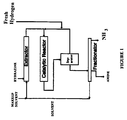
- Figure 1 is a flow sheet illustrating one process of the invention.
- Figure 2 is a flow sheet illustrating an alternative process of the invention.
- hydrazine not only the specific compound which is so-named and has the formula N 2 H 4 , but substituted hydrazines are subjects of the present invention.
- the later compounds may be generally described by the formula R 1 R 2 NNR 3 R 4 , where R 1 , R 2 , R 3 , and R 4 are independently selected from hydrogen, alkyl, or aryl.
- substituted hydrazines include alkyl hydrazines, for example, dimethyl hydrazine, diethyl hydrazine, and the like, aryl hydrazines for example, phenyl hydrazine or mixed substitutions such as methyl phenyl hydrazine.
- the most important substituted hydrazine is unsymmetrical dimethyl hydrazine (CH 3 ) 2 NNH 2 since it is used as a propellant in large liquid-fueled rockets, either alone or in combination with hydrazine itself (N 2 H 4 ). It will be appreciated that large amounts of such hydrazines have been produced. It has been an objective of the present inventors to provide a safe and convenient method of disposing of such materials. The present process has the additional advantage of producing commercially saleable products.
- the catalysts for use in the present invention comprise supported Pt and/or Pd metal, Pd is preferred.
- the catalytic metals are supported on solids such as carbon, alumina, silica or titania.
- the metal is deposited on a support in an amount between about 0.5 and 5 wt.% based on the finished catalyst. This may be accomplished by various techniques known to those skilled in the art, such as impregnation of the support with a solution of a noble metal compound followed by heating to decompose the metal compound, leaving a finely dispersed metal. Other methods may also be used such as coprecipitation of the metal compound and the support material from solution.
- a solvent is used to dissolve and dilute the hydrazine or substituted hydrazine.
- the solvent chosen preferably will be selected from a group generally consisting of water, alcohols, and hydrocarbons. More particularly, the solvent should be capable of dissolving up to at least 50 wt.% of hydrazine, although typically the solvent will contain less than 30 wt.% hydrazine. Higher concentrations of hydrazine may be used if desired, up to substantially solvent-free hydrazines. Since the solvent among other things, serves to moderate the effect of the exothermic heat of reaction, it will be appreciated that selection of the amount of solvent will involve the design of the entire process.
- the solvent should be inert with respect to the hydrazine so that it acts as a carrier for the hydrazine and produces no undesirable by-products with it. Additionally, the solvent should not react significantly with hydrogen under conditions of the invention so that it can be recovered and recycled to the reaction without a need to remove hydrogenated by-products.
- the solvents which are preferred for the hydrogenation of hydrazine are hydrocarbons such as kerosine, naphtha, methylcyclohexane, decalin, and the like or alcohols such as methanol, ethanol and isopropanol, most preferably methylcyclohexane.
- Hydrocarbons such as kerosine, naphtha, methylcyclohexane, decalin, and the like or alcohols such as methanol, ethanol and isopropanol, most preferably methylcyclohexane.
- Water is useful although less preferred since the products will contain water and may have to be dried.
- solvents will ordinarily be selected because they are inert, it is possible to use a solvent which undergoes a reaction with hydrogen or which produces hydrogen.
- An example is methylcyclohexane, which can dehydrogenate when exposed to a noble metal catalyst, thus producing hydrogen for use in the reaction with the hydrazine, but also balancing the exothermic heat of reaction with the endothermic heat of the dehydrogenation.
- the reaction is carried out in the vapor phase so that the solvents are no longer present, but instead a carrier gas such as nitrogen, steam, hydrocarbons, or alcohols are used to dilute the hydrazine or substituted hydrazine.
- a carrier gas such as nitrogen, steam, hydrocarbons, or alcohols
- the hydrazine and carrier gas mixture is combined with hydrogen and passed over the catalyst as in the preferred embodiment.
- reaction of a hydrogen with hydrazine produces ammonia and the corresponding amine where the hydrazine is substituted.
- the reaction of UDMH with hydrogen may be written as follows: N 2 H 2 (CH 3 ) 2 + H 2 ⁇ NH(CH 3 ) 2 + NH 3 Hydrazine itself, N 2 H 4 , yields only ammonia.
- Hydrogenation of the hydrazine is carried out at a temperature of about 0° to 250°C, preferably 100° to 150 °C. A low temperature is preferred to avoid undue hydrogenation of the dimethyl amine and ammonia. However, practical considerations may require higher temperatures be used to obtain the optimum conversion of the hydrazine and selectivity to the desired products..
- the reaction is carried out with a positive pressure, between about 50 to 500 psig (345-3450 kPa).
- Hydrogen will be maintained at mol ratio of about 0.1 to 10/1 relative to the hydrazine. Although the reaction requires one mol of hydrogen for each mol of hydrazine reacted, lower amounts of hydrogen may be used to control the reaction, although the conversion necessarily is reduced. Under the reaction temperature and pressure the hydrazine containing solvent will be liquid and the hydrogen a gas so that a two-phase mixture will be passed over the supported catalyst at a liquid hourly space velocity based on the hydrazine of about 0.1 to 10 hr -1 , preferably between 1 and 5 hr -1 .
- a single phase will be passed over the catalyst at a liquid hourly space velocity based on the hydrazine of about 0.1 to 10 hr -1 , preferably between 1 and 5 hr -1 .
- Figure 1 illustrates generally the process of the invention where a liquid carrier is used.
- the hydrazine to be converted to less energetic materials that is, ammonia and the corresponding amine
- the hydrazines of interest generally will be liquids at ambient conditions and can be pumped into an extraction column as shown or similar mixing vessel.
- the dilution of the hydrazine will assist in controlling the exothermic heat of the hydrogenolysis reaction. Accordingly, the hydrazine and the solvent will be metered to provide the desired concentration, generally up to about 30 weight percent at the outlet of the extractor.
- the recycled solvent will contain a significant amount of the unreacted hydrazine.
- the fresh hydrazine would be added at the rate needed to makeup for the hydrazine converted and to provide a constant concentration at the inlet of the catalytic reactor.
- the solvent containing diluted hydrazine is passed to a catalytic reactor along with added hydrogen over the supported metal catalyst to convert the hydrazine to ammonia and the corresponding amine (where the hydrazine was substituted).
- the amount of hydrogen is metered to provide the desired mol ratio of hydrogen to hydrazine, that is 0.1/1 to 10/1. If desired, the amount of hydrogen may be limited to only that required to react with the hydrazine. However, in most cases an excess will be used and the unreacted hydrogen will be separated at the outlet of the reactor and recycled as shown.
- the reactor may be of various types known in the art where solid catalysts are contacted with liquid, gas, or mixed phase streams. Since the heat of reaction is substantial, it must be removed to control the reaction and to assure that the desired products are obtained. Thus, heat removal means are preferred which could include internal cooling coils, but preferably the reactor is constructed in the form of a shell and tube heat exchanger. The catalyst would be disposed within the tubes and the shell side would be filled with the cooling fluid. Since the reaction temperature is relatively low (about 100° to 150°C) cooling by water may be sufficient. Alternatively, silicone fluids, hydrocarbons, and the like could be used.
- the mixed-phase stream passes to a separator where excess hydrogen is removed and the liquid phase then is passed to a fractionator for removing the ammonia and any amines produced.
- a fractionator for removing the ammonia and any amines produced.
- a distillation column will be used. The solvent is removed from the bottom of the column to dissolve fresh hydrazine.
- FIG. 2 illustrates an alternative embodiment where a gas phase reaction is used.
- Fresh hydrazine and hydrogen are added to a circulating gas stream which is principally the carrier gas plus hydrogen, and unreacted hydrazine.
- the effluent stream is condensed and separated, with the gas phase being recycled and the liquid phase being fractionated to separate the ammonia from the amine product.
- the effluent stream might be scrubbed, for example with water to separate the ammonia from the recycled gases.
- UDMH unsymmetrical dimethylhydrazine
- the reactor then was cooled to less than 10°C in an ice bath and then emptied for analysis.
- the reactor was vented to atmospheric pressure with the gases passing through an acid scrubber containing 2 wt.% HCl.
- the dimethylamines were measured by ion chromatography of the liquids in the reactor and the acid scrubber. The yield of dimethyl amine was calculated from the amount of dimethylamine (DMA) found by analysis.
- Example 1 The procedure of Example 1 was repeated using toluene as the solvent. Test 8 was carried out for 6 hours and Test 9 for 2 hours rather than 3 hours as in the previous seven tests and the concentration of UDMH was increased to 5 wt.%. Here, dimethylamine was analyzed by gas chromatography and mass spectroscopy.
- the actual temperature used for large scale applications of the process would be selected depending on various factors, such as the extent of byproduct formation, costs of utilities for heating and cooling, and ease of separation of the products from the solvent.
- the catalyst, solvent, and hydrazine concentration would be selected based on similar considerations.
Landscapes
- Health & Medical Sciences (AREA)
- General Health & Medical Sciences (AREA)
- Toxicology (AREA)
- Chemical & Material Sciences (AREA)
- Chemical Kinetics & Catalysis (AREA)
- General Chemical & Material Sciences (AREA)
- Business, Economics & Management (AREA)
- Emergency Management (AREA)
- Organic Low-Molecular-Weight Compounds And Preparation Thereof (AREA)
- Fire-Extinguishing Compositions (AREA)
- Processing Of Solid Wastes (AREA)
- Catalysts (AREA)
- Exhaust Gas Treatment By Means Of Catalyst (AREA)
Claims (11)
- Verfahren zur Umwandlung eines Hydrazins in Ammoniak bzw. Ammoniak und das entsprechende Amin, bei dem man:(a) das Hydrazin in einem geeigneten flüssigen Träger auflöst;(b) das gelöste Hydrazin aus (a) bei einer Temperatur von 0°C bis 250°C und einem Druck von 345-3450 kPa unter Zusatz von 0,1-10 mol Wasserstoff pro mol Hydrazin über ein geträgertes Pt- und/oder Pd-Metall leitet, wobei durch Hydrogenolyse Ammoniak bzw. Ammoniak und das entsprechende Amin entstehen; und(c) das Ammoniak bzw. das Ammoniak und das entsprechende Amin aus dem Produkt aus (b) gewinnt und gegebenenfalls den flüssigen Träger und überschüssigen Wasserstoff in Schritt (a) zurückzuführt.
- Verfahren nach Anspruch 1, bei dem man als Hydrazin Hydrazin, Dimethylhydrazin oder ein Gemisch daraus einsetzt.
- Verfahren nach Anspruch 1, bei dem man ein auf einem Mitglied der Gruppe bestehend aus Kohlenstoff, Aluminiumoxid, Siliciumdioxid und Titandioxid geträgertes Pt- und/oder Pd-Metall einsetzt.
- Verfahren nach Anspruch 1, bei dem man als flüssigen Träger mindestens ein Mitglied der Gruppe bestehend aus Wasser, Kohlenwasserstoffen und Alkoholen einsetzt.
- Verfahren nach Anspruch 1, bei dem man den flüssigen Träger unter Erzeugung von Wasserstoff dehydriert und durch die endotherme Dehydrierungsreaktion für Kühlung sorgt.
- Verfahren nach Anspruch 5, bei dem man als flüssigen Träger Methylcyclohexan einsetzt.
- Verfahren zur Umwandlung eines Hydrazins in Ammoniak bzw. Ammoniak und das entsprechende Amin, bei dem man:(a) das Hydrazin in einem geeigneten Trägergas verdampft;(b) das verdampfte Hydrazin aus (a) bei einer Temperatur von 0°C bis 250°C und einem Druck von 345-3450 kPa unter Zusatz von mindestens 0,1 mol Wasserstoff pro mol Hydrazin über ein geträgertes Pt- und/oder Pd-Metall leitet, wobei durch Hydrogenolyse Ammoniak bzw. Ammoniak und das entsprechende Amin entstehen; und(c) das Ammoniak und das Amin aus dem Produkt aus (b) gewinnt und gegebenenfalls das Trägergas in Schritt (a) zurückzuführt.
- Verfahren nach Anspruch 7, bei dem man als Trägergas mindestens ein Mitglied der Gruppe bestehend aus Stickstoff, Wasserdampf, Kohlenwasserstoffen und Alkoholen einsetzt.
- Verfahren nach Anspruch 7, bei dem man das Produkt aus (b) zur Gewinnung des Ammoniaks und des Amins kondensiert.
- Verfahren anch Anspruch 7, bei dem man als Hydrazin Hydrazin, Dimethylhydrazin oder ein Gemisch daraus einsetzt.
- Verfahren nach Anspruch 7, bei dem man ein auf einem Mitglied der Gruppe bestehend aus Kohlenstoff, Aluminiumoxid, Siliciumdioxid und Titandioxid geträgertes Pt- und/oder Pd-Metall einsetzt.
Applications Claiming Priority (3)
| Application Number | Priority Date | Filing Date | Title |
|---|---|---|---|
| US08/140,589 US5437853A (en) | 1993-10-21 | 1993-10-21 | Disposal of hydrazine propellants |
| US140589 | 1993-10-21 | ||
| PCT/US1994/011811 WO1995011062A1 (en) | 1993-10-21 | 1994-10-18 | Disposal of hydrazine propellants |
Publications (2)
| Publication Number | Publication Date |
|---|---|
| EP0724468A1 EP0724468A1 (de) | 1996-08-07 |
| EP0724468B1 true EP0724468B1 (de) | 1998-05-20 |
Family
ID=22491931
Family Applications (1)
| Application Number | Title | Priority Date | Filing Date |
|---|---|---|---|
| EP94931397A Expired - Lifetime EP0724468B1 (de) | 1993-10-21 | 1994-10-18 | Entsorgung von hydrazin-treibmitteln |
Country Status (7)
| Country | Link |
|---|---|
| US (2) | US5437853A (de) |
| EP (1) | EP0724468B1 (de) |
| JP (1) | JPH08511034A (de) |
| AT (1) | ATE166241T1 (de) |
| DE (1) | DE69410479T2 (de) |
| RU (1) | RU2149139C1 (de) |
| WO (1) | WO1995011062A1 (de) |
Cited By (1)
| Publication number | Priority date | Publication date | Assignee | Title |
|---|---|---|---|---|
| US7074959B2 (en) | 2002-08-01 | 2006-07-11 | New Mexico Highlands University | Methods and systems for remediating hydrazine-contaminated equipment and/or surfaces |
Families Citing this family (8)
| Publication number | Priority date | Publication date | Assignee | Title |
|---|---|---|---|---|
| US5929282A (en) * | 1997-03-17 | 1999-07-27 | Alliedsignal Inc. | System and method for disposal of hydrazine propellants and other energetic materials |
| US6080906A (en) * | 1997-09-18 | 2000-06-27 | Alliedsignal, Inc. | Demilitarization of chemical munitions |
| CN1286640A (zh) * | 1998-09-14 | 2001-03-07 | 联合讯号公司 | 化学军火的非军事化 |
| GB9907458D0 (en) * | 1999-03-31 | 1999-05-26 | Rhone Poulenc Agrochimie | Processes for preparing pesticidal intermediates |
| GB9911180D0 (en) * | 1999-05-13 | 1999-07-14 | Rhone Poulenc Agrochimie | Processes for preparing pesticidal intermediates |
| AU7756900A (en) | 1999-08-06 | 2001-03-05 | Honeywell | Treatment of chemical hydrolysates |
| EP2726413B1 (de) * | 2011-07-01 | 2017-03-08 | AlzChem AG | Ammoniakgasgenerator zur erzeugung von ammoniak zur reduzierung von stickoxiden in abgasen |
| RU2744736C1 (ru) * | 2020-04-27 | 2021-03-15 | Андрей Владимирович Иванов | Многоразовая первая ступень ракеты-носителя |
Family Cites Families (9)
| Publication number | Priority date | Publication date | Assignee | Title |
|---|---|---|---|---|
| US4122671A (en) * | 1962-10-26 | 1978-10-31 | Shell Oil Company | Hydrazine decomposition and other reactions |
| DE1767411A1 (de) * | 1968-05-08 | 1971-09-02 | Varta Ag | Mischkatalysator fuer die Zersetzung von Hydrazin |
| JPS5229720B2 (de) * | 1972-03-31 | 1977-08-03 | ||
| FR2211002A5 (de) * | 1972-12-20 | 1974-07-12 | Rhone Progil | |
| US3996225A (en) * | 1975-12-09 | 1976-12-07 | Fmc Corporation | Manufacture of cyanuric acid |
| ATE2069T1 (de) * | 1979-03-27 | 1983-01-15 | F. Hoffmann-La Roche & Co. Aktiengesellschaft | Verfahren zur herstellung von cyclohexenderivaten sowie ein zwischenprodukt in diesem verfahren. |
| NL8402837A (nl) * | 1984-09-14 | 1986-04-01 | Kinetics Technology | Werkwijze voor het zuiveren en/of onschadelijk maken van een door halogeen-, stikstof- en/of zwavel (verbindingen) verontreinigde vloeibare koolwaterstofstroom. |
| US4661179A (en) * | 1986-07-24 | 1987-04-28 | The United States Of America As Represented By The Secretary Of The Army | Destruction of waste explosive by hydrogenolysis |
| DE4131471A1 (de) * | 1991-09-21 | 1993-03-25 | Rheinmetall Gmbh | Verfahren zur hydrierung von nitroaromatischen sprengstoffen |
-
1993
- 1993-10-21 US US08/140,589 patent/US5437853A/en not_active Expired - Lifetime
-
1994
- 1994-10-18 RU RU96112155A patent/RU2149139C1/ru not_active IP Right Cessation
- 1994-10-18 EP EP94931397A patent/EP0724468B1/de not_active Expired - Lifetime
- 1994-10-18 DE DE69410479T patent/DE69410479T2/de not_active Expired - Lifetime
- 1994-10-18 JP JP7512146A patent/JPH08511034A/ja active Pending
- 1994-10-18 AT AT94931397T patent/ATE166241T1/de not_active IP Right Cessation
- 1994-10-18 WO PCT/US1994/011811 patent/WO1995011062A1/en not_active Ceased
-
1995
- 1995-04-11 US US08/419,795 patent/US5498401A/en not_active Expired - Lifetime
Cited By (1)
| Publication number | Priority date | Publication date | Assignee | Title |
|---|---|---|---|---|
| US7074959B2 (en) | 2002-08-01 | 2006-07-11 | New Mexico Highlands University | Methods and systems for remediating hydrazine-contaminated equipment and/or surfaces |
Also Published As
| Publication number | Publication date |
|---|---|
| JPH08511034A (ja) | 1996-11-19 |
| ATE166241T1 (de) | 1998-06-15 |
| US5437853A (en) | 1995-08-01 |
| RU2149139C1 (ru) | 2000-05-20 |
| US5498401A (en) | 1996-03-12 |
| WO1995011062A1 (en) | 1995-04-27 |
| EP0724468A1 (de) | 1996-08-07 |
| DE69410479D1 (de) | 1998-06-25 |
| DE69410479T2 (de) | 1998-10-01 |
Similar Documents
| Publication | Publication Date | Title |
|---|---|---|
| CA2332372C (en) | Process for preparing 4-aminodiphenylamines | |
| US5498401A (en) | Disposal of hydrazine propellants | |
| KR20080011265A (ko) | 방향족 아민의 제조 방법 | |
| US7157605B2 (en) | Method for preparing 4-aminodiphenylamine | |
| US5811604A (en) | Continuous production of 1,1,1,3,3,3-hexafluoropropane and 1-chloro-1,1,3,3,3-pentafluoropropane | |
| Karakaya et al. | Aqueous solubility and alkaline hydrolysis of the novel high explosive hexanitrohexaazaisowurtzitane (CL-20) | |
| US4123466A (en) | Process for nitrating aromatic hydrocarbons | |
| US5530175A (en) | Disposal of explosive D | |
| EP0597151A1 (de) | Verfahren zur Herstellung von Ameisensäure | |
| US2174498A (en) | Hydrogenation of nitroparaffins | |
| US4038321A (en) | Process for production of unsymmetrical dimethylhydrazine by nitrosation of dimethylamine and hydrogenation of the nitroso dimethylamine to the distillation of unsymmetrical dimethylhydrazine | |
| CA2178700A1 (en) | Process for producing aromatic amines by gas phase hydrogenation and a catalyst useful therefor | |
| US5990354A (en) | Conversion of ammonium picrate to m-phenylenediamine, aniline, and primary amines | |
| US3485875A (en) | Production of primary amines | |
| JPH02279657A (ja) | アニリンの製造方法 | |
| Ayo et al. | Platinum—rhenium/alumina catalyst III. Mechanism of C6-ring hydrogenation/dehydrogenation reactions | |
| JPH0449549B2 (de) | ||
| US4097524A (en) | Process for the preparation of formamides | |
| US4222959A (en) | Process for the preparation of aromatic formamides | |
| US5929282A (en) | System and method for disposal of hydrazine propellants and other energetic materials | |
| US4479009A (en) | Amination process | |
| US5126497A (en) | Catalyst and process for the preparation of trifluoromethyltoluenes | |
| US6268536B1 (en) | Conversion of ammonium picrate to various useful chemical products | |
| EP0534412B1 (de) | Verfahren zur Herstellung von 4-Chlor-Trichlormethylbenzol | |
| WO1998046063A9 (en) | System and method for disposal of hydrazine propellants and other energetic materials |
Legal Events
| Date | Code | Title | Description |
|---|---|---|---|
| PUAI | Public reference made under article 153(3) epc to a published international application that has entered the european phase |
Free format text: ORIGINAL CODE: 0009012 |
|
| 17P | Request for examination filed |
Effective date: 19960402 |
|
| AK | Designated contracting states |
Kind code of ref document: A1 Designated state(s): AT BE DE FR GB NL |
|
| 17Q | First examination report despatched |
Effective date: 19970325 |
|
| GRAG | Despatch of communication of intention to grant |
Free format text: ORIGINAL CODE: EPIDOS AGRA |
|
| GRAG | Despatch of communication of intention to grant |
Free format text: ORIGINAL CODE: EPIDOS AGRA |
|
| GRAH | Despatch of communication of intention to grant a patent |
Free format text: ORIGINAL CODE: EPIDOS IGRA |
|
| GRAH | Despatch of communication of intention to grant a patent |
Free format text: ORIGINAL CODE: EPIDOS IGRA |
|
| GRAA | (expected) grant |
Free format text: ORIGINAL CODE: 0009210 |
|
| AK | Designated contracting states |
Kind code of ref document: B1 Designated state(s): AT BE DE FR GB NL |
|
| REF | Corresponds to: |
Ref document number: 166241 Country of ref document: AT Date of ref document: 19980615 Kind code of ref document: T |
|
| ET | Fr: translation filed | ||
| REF | Corresponds to: |
Ref document number: 69410479 Country of ref document: DE Date of ref document: 19980625 |
|
| PLBE | No opposition filed within time limit |
Free format text: ORIGINAL CODE: 0009261 |
|
| STAA | Information on the status of an ep patent application or granted ep patent |
Free format text: STATUS: NO OPPOSITION FILED WITHIN TIME LIMIT |
|
| 26N | No opposition filed | ||
| REG | Reference to a national code |
Ref country code: GB Ref legal event code: IF02 |
|
| PGFP | Annual fee paid to national office [announced via postgrant information from national office to epo] |
Ref country code: AT Payment date: 20080915 Year of fee payment: 15 |
|
| PGFP | Annual fee paid to national office [announced via postgrant information from national office to epo] |
Ref country code: BE Payment date: 20081031 Year of fee payment: 15 |
|
| BERE | Be: lapsed |
Owner name: *ALLIEDSIGNAL INC. Effective date: 20091031 |
|
| PG25 | Lapsed in a contracting state [announced via postgrant information from national office to epo] |
Ref country code: AT Free format text: LAPSE BECAUSE OF NON-PAYMENT OF DUE FEES Effective date: 20091018 |
|
| PG25 | Lapsed in a contracting state [announced via postgrant information from national office to epo] |
Ref country code: BE Free format text: LAPSE BECAUSE OF NON-PAYMENT OF DUE FEES Effective date: 20091031 |
|
| PGFP | Annual fee paid to national office [announced via postgrant information from national office to epo] |
Ref country code: DE Payment date: 20101029 Year of fee payment: 17 |
|
| PGFP | Annual fee paid to national office [announced via postgrant information from national office to epo] |
Ref country code: FR Payment date: 20111005 Year of fee payment: 18 Ref country code: GB Payment date: 20110930 Year of fee payment: 18 |
|
| PGFP | Annual fee paid to national office [announced via postgrant information from national office to epo] |
Ref country code: NL Payment date: 20111020 Year of fee payment: 18 |
|
| REG | Reference to a national code |
Ref country code: NL Ref legal event code: V1 Effective date: 20130501 |
|
| GBPC | Gb: european patent ceased through non-payment of renewal fee |
Effective date: 20121018 |
|
| REG | Reference to a national code |
Ref country code: FR Ref legal event code: ST Effective date: 20130628 |
|
| PG25 | Lapsed in a contracting state [announced via postgrant information from national office to epo] |
Ref country code: GB Free format text: LAPSE BECAUSE OF NON-PAYMENT OF DUE FEES Effective date: 20121018 Ref country code: DE Free format text: LAPSE BECAUSE OF NON-PAYMENT OF DUE FEES Effective date: 20130501 |
|
| REG | Reference to a national code |
Ref country code: DE Ref legal event code: R119 Ref document number: 69410479 Country of ref document: DE Effective date: 20130501 |
|
| PG25 | Lapsed in a contracting state [announced via postgrant information from national office to epo] |
Ref country code: FR Free format text: LAPSE BECAUSE OF NON-PAYMENT OF DUE FEES Effective date: 20121031 Ref country code: NL Free format text: LAPSE BECAUSE OF NON-PAYMENT OF DUE FEES Effective date: 20130501 |