EP0720985B1 - Phosphorhaltige Organosiliciumverbindungen - Google Patents
Phosphorhaltige Organosiliciumverbindungen Download PDFInfo
- Publication number
- EP0720985B1 EP0720985B1 EP95119828A EP95119828A EP0720985B1 EP 0720985 B1 EP0720985 B1 EP 0720985B1 EP 95119828 A EP95119828 A EP 95119828A EP 95119828 A EP95119828 A EP 95119828A EP 0720985 B1 EP0720985 B1 EP 0720985B1
- Authority
- EP
- European Patent Office
- Prior art keywords
- radical
- formula
- organosilicon compounds
- carbon atoms
- atoms per
- Prior art date
- Legal status (The legal status is an assumption and is not a legal conclusion. Google has not performed a legal analysis and makes no representation as to the accuracy of the status listed.)
- Expired - Lifetime
Links
Classifications
-
- C—CHEMISTRY; METALLURGY
- C08—ORGANIC MACROMOLECULAR COMPOUNDS; THEIR PREPARATION OR CHEMICAL WORKING-UP; COMPOSITIONS BASED THEREON
- C08G—MACROMOLECULAR COMPOUNDS OBTAINED OTHERWISE THAN BY REACTIONS ONLY INVOLVING UNSATURATED CARBON-TO-CARBON BONDS
- C08G77/00—Macromolecular compounds obtained by reactions forming a linkage containing silicon with or without sulfur, nitrogen, oxygen or carbon in the main chain of the macromolecule
- C08G77/04—Polysiloxanes
- C08G77/38—Polysiloxanes modified by chemical after-treatment
- C08G77/382—Polysiloxanes modified by chemical after-treatment containing atoms other than carbon, hydrogen, oxygen or silicon
- C08G77/395—Polysiloxanes modified by chemical after-treatment containing atoms other than carbon, hydrogen, oxygen or silicon containing phosphorus
-
- C—CHEMISTRY; METALLURGY
- C07—ORGANIC CHEMISTRY
- C07F—ACYCLIC, CARBOCYCLIC OR HETEROCYCLIC COMPOUNDS CONTAINING ELEMENTS OTHER THAN CARBON, HYDROGEN, HALOGEN, OXYGEN, NITROGEN, SULFUR, SELENIUM OR TELLURIUM
- C07F9/00—Compounds containing elements of Groups 5 or 15 of the Periodic Table
- C07F9/02—Phosphorus compounds
- C07F9/28—Phosphorus compounds with one or more P—C bonds
- C07F9/30—Phosphinic acids [R2P(=O)(OH)]; Thiophosphinic acids ; [R2P(=X1)(X2H) (X1, X2 are each independently O, S or Se)]
- C07F9/301—Acyclic saturated acids which can have further substituents on alkyl
-
- C—CHEMISTRY; METALLURGY
- C07—ORGANIC CHEMISTRY
- C07F—ACYCLIC, CARBOCYCLIC OR HETEROCYCLIC COMPOUNDS CONTAINING ELEMENTS OTHER THAN CARBON, HYDROGEN, HALOGEN, OXYGEN, NITROGEN, SULFUR, SELENIUM OR TELLURIUM
- C07F9/00—Compounds containing elements of Groups 5 or 15 of the Periodic Table
- C07F9/02—Phosphorus compounds
- C07F9/28—Phosphorus compounds with one or more P—C bonds
- C07F9/38—Phosphonic acids [RP(=O)(OH)2]; Thiophosphonic acids ; [RP(=X1)(X2H)2(X1, X2 are each independently O, S or Se)]
- C07F9/3804—Phosphonic acids [RP(=O)(OH)2]; Thiophosphonic acids ; [RP(=X1)(X2H)2(X1, X2 are each independently O, S or Se)] not used, see subgroups
- C07F9/3808—Acyclic saturated acids which can have further substituents on alkyl
- C07F9/3821—Acyclic saturated acids which can have further substituents on alkyl substituted by B, Si, P or a metal
-
- C—CHEMISTRY; METALLURGY
- C07—ORGANIC CHEMISTRY
- C07F—ACYCLIC, CARBOCYCLIC OR HETEROCYCLIC COMPOUNDS CONTAINING ELEMENTS OTHER THAN CARBON, HYDROGEN, HALOGEN, OXYGEN, NITROGEN, SULFUR, SELENIUM OR TELLURIUM
- C07F9/00—Compounds containing elements of Groups 5 or 15 of the Periodic Table
- C07F9/02—Phosphorus compounds
- C07F9/28—Phosphorus compounds with one or more P—C bonds
- C07F9/48—Phosphonous acids [RP(OH)2] including [RHP(=O)(OH)]; Thiophosphonous acids including [RP(SH)2], [RHP(=S)(SH)]; Derivatives thereof
- C07F9/4808—Phosphonous acids [RP(OH)2] including [RHP(=O)(OH)]; Thiophosphonous acids including [RP(SH)2], [RHP(=S)(SH)]; Derivatives thereof the acid moiety containing a substituent or structure which is considered as characteristic
- C07F9/4816—Acyclic saturated acids or derivatices which can have further substituents on alkyl
-
- C—CHEMISTRY; METALLURGY
- C08—ORGANIC MACROMOLECULAR COMPOUNDS; THEIR PREPARATION OR CHEMICAL WORKING-UP; COMPOSITIONS BASED THEREON
- C08G—MACROMOLECULAR COMPOUNDS OBTAINED OTHERWISE THAN BY REACTIONS ONLY INVOLVING UNSATURATED CARBON-TO-CARBON BONDS
- C08G77/00—Macromolecular compounds obtained by reactions forming a linkage containing silicon with or without sulfur, nitrogen, oxygen or carbon in the main chain of the macromolecule
- C08G77/48—Macromolecular compounds obtained by reactions forming a linkage containing silicon with or without sulfur, nitrogen, oxygen or carbon in the main chain of the macromolecule in which at least two but not all the silicon atoms are connected by linkages other than oxygen atoms
Definitions
- Phosphorous silanes and organo (poly) siloxanes with pentavalent Phosphorus are already known.
- a number of phosphorus-containing Silanes and organo (poly) siloxanes, starting from Esters of phosphonic or phosphinic acid is already known.
- the radical initiated hydrophosphorylation reaction leads to phosphonic acid ester residues and phophic acid ester residues containing organosilicon compounds.
- GB-A 885 466, DE-B 22 19 983 and US-A 3,912,774 are different Process for the preparation of phosphorus Silanes and organo (poly) siloxanes are described.
- the task was to use phosphorus-containing organosilicon compounds provide that in a simple process manufactured using easily accessible starting materials can be that are hydrophilic to water soluble and their hydrophilicity or water solubility by modification of phosphorus-containing organosilicon compounds can be controlled.
- the object is achieved by the invention solved.
- the invention relates to a process for the preparation of phosphorus-containing organosilicon compounds, characterized in that organosilicon compounds (1) having aliphatic multiple bonds have units of the formula B a R b SiX c O 4- (a + b + c) 2nd where B is a monovalent, aliphatic multiple bond, hydrocarbon radical having 2 to 18 carbon atoms per radical, R, X, a, b and c have the meaning given above, with alkali metal or alkaline earth metal salts of phosphine or phosphonic acid (2) of the formula wherein R 3 represents a hydrogen atom, a hydroxyl group or a monovalent hydrocarbon radical having 1 to 18 carbon atoms per radical and M is an alkali or alkaline earth metal, in the presence of free radical-forming catalysts (3).
- organosilicon compounds (1) having aliphatic multiple bonds have units of the formula B a R b SiX c O 4- (a + b + c) 2nd where B is a mono
- the organosilicon compounds according to the invention preferably have a molecular weight of 100 to 1000000 g / mol, preferably 300 to 90000 g / mol and are preferably solids or have a viscosity of 100 to 100000 mm 2 ⁇ s -1 at 25 ° C., preferably 1000 to 5000 mm 2 ⁇ s -1 at 25 ° C.
- radical R examples include alkyl radicals, such as the methyl, Ethyl, n-propyl, iso-propyl, 1-n-butyl, 2-n-butyl, iso-butyl, tert-butyl, n-pentyl, iso-pentyl, neo-pentyl, tert.
- Pentyl radical Hexyl radicals, such as the n-hexyl radical; Heptyl residues, such as the n-heptyl residue; Octyl residues like that n-octyl radical and iso-octyl radicals, such as the 2,2,4-trimethylpentyl; Nonyl radicals, such as the n-nonyl radical; Decyl radicals, such as the n-decyl radical; Dodecyl residues like that n-dodecyl residue; Octadecyl radicals, such as the n-octadecyl radical; Cycloalkyl radicals, such as the cyclopentyl, cyclohexyl, Cycloheptyl and methylcyclohexyl; Aryl residues, like the phenyl, naphthyl and anthryl and phenanthryl radical; Alkaryl radicals, such as o-, m-,
- halogenated radicals R are haloalkyl radicals, like the 3,3,3-trifluoro-n-propyl radical, the 2,2,2,2 ', 2', 2'-hexafluoroisopropyl radical, the heptafluoroisopropyl radical and haloaryl radicals, like the o-, m- and p-chlorophenyl radical.
- hydrocarbon radicals R apply in full to hydrocarbon radicals R 1 .
- R 1 is preferably a hydrogen atom, a hydroxyl group or a radical of the formula -Z-SiR b X c O 4- (a + b + c) 2nd where Z, X, R, a, b and c have the meaning given above.
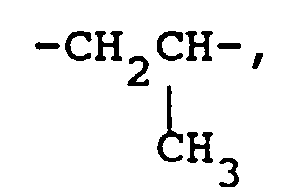
- divalent hydrocarbon radicals Z are linear and branched alkylene radicals, such as radicals of the formula -CH 2 CH 2 -, -CH 2 CH 2 CH 2 -, and - (CH 2 ) 6 -, and cycloalkylene radicals, such as the radical of the formula -C 6 H 10 -.
- the radical of the formula -CH 2 CH 2 - is preferred.
- alkali or alkaline earth metals M are lithium, Sodium, potassium, rubidium, cesium, magnesium, calcium, Strontium and barium.
- Alkali metals and f is preferred therefore preferred 1.
- halogen atoms X are chlorine and bromine.
- alkyl radicals R 2 are methyl, ethyl, n-propyl, iso-propyl, 1-n-butyl, 2-n-butyl, iso-butyl, tert-butyl radicals.
- the methyl and ethyl radicals are preferred.
- alkyl radicals R 2 which are substituted by an ether oxygen atom are the methoxyethyl and ethoxyethyl radical.
- Hydrocarbon radicals B in the formula (II) are alkenyl radicals, such as the vinyl, allyl, 1-butenyl, 1-pentenyl, 1-hexenyl, divinylcyclohexyl, norbornenyl and cycloheptadienyl.
- the vinyl radical is preferred.
- hydrocarbon residues R 1 apply in full to hydrocarbon residues R 3 .
- R 3 is preferably a hydrogen atom or a hydroxyl group.
- the phosphorus-containing ones according to the invention are preferably Organosilicon compounds containing phosphorus silanes or Organo (poly) siloxanes containing phosphorus.
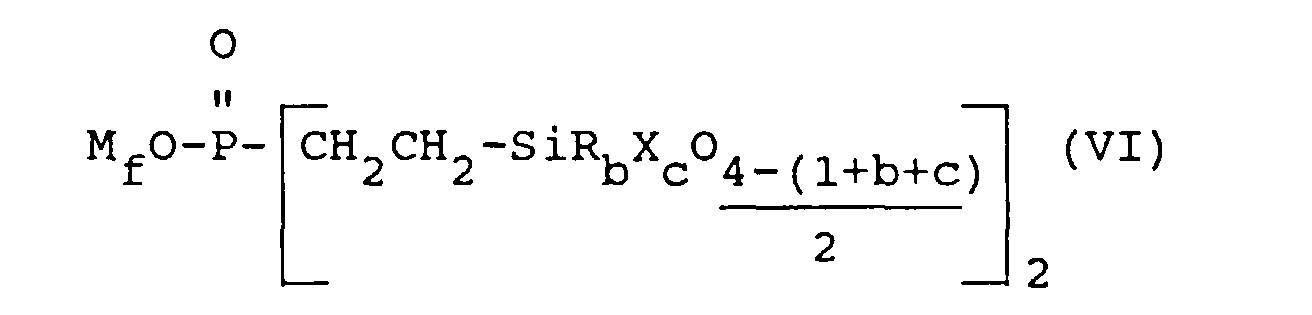
- Examples of phosphorus-containing organosilicon compounds are those which are units of the formulas or or contain, where M, R, X, b, f and c have the meaning given above, M preferably sodium, R preferably a methyl radical, b preferably 2, c preferably 0 and f preferably 1.
- salts (2) which are used in the process according to the invention are those of the formula where M has the meaning given above, preferably sodium and potassium, particularly preferably sodium.
- Catalysts (3) forming radicals are used in the process according to the invention Process preferably peroxide compounds and azo compounds are used.
- peroxide compounds are ditertiary butyl peroxide, Dibenzoyl peroxide, diacetyl peroxide, dicumyl peroxide, Tertiary butyl peracetate and tertiary butyl perbenzoate.
- azo compounds are azoisobutyronitrile, 4,4'-azobis (4-cyanopentanoic acid), 2,2'-azobis (2-cyanopropanol) and phenylazoethane-1,1-dinitrile.
- Radical catalysts (3) are in the inventive Process preferably in amounts from 0.1 to 10 % By weight, preferably in amounts of 2 to 8% by weight, based on the total weight of organosilicon compound (1) and Salt (2) used.
- the process according to the invention for the production of phosphorus Organosilicon compounds are preferably in the presence of organic solvents such as methanol, ethanol, Isopropanol, n-butanol, acetone, tetrahydrofuran, dimethylformamide, Dimethyl sulfoxide, N-methylpyrrolidone, ethyl acetate and dimethoxyethane or in the presence of a mixture Water and the organic solvent performed.
- organic solvents such as methanol, ethanol, Isopropanol, n-butanol, acetone, tetrahydrofuran, dimethylformamide, Dimethyl sulfoxide, N-methylpyrrolidone, ethyl acetate and dimethoxyethane
- the method according to the invention is preferably used in printing the surrounding atmosphere, i.e. at around 1020 hPa (abs.) performed, but it can also be done at higher or lower Printing can be done. Furthermore, the invention Process preferably at a temperature of 50 ° C up to 150 ° C, preferably 80 ° C to 110 ° C.
- phosphorus-containing organosilicon compounds are preferred if appropriate, also used inert organic Solvent or water removed by distillation.
- the process according to the invention can be carried out batchwise, semi-continuously or be carried out continuously.
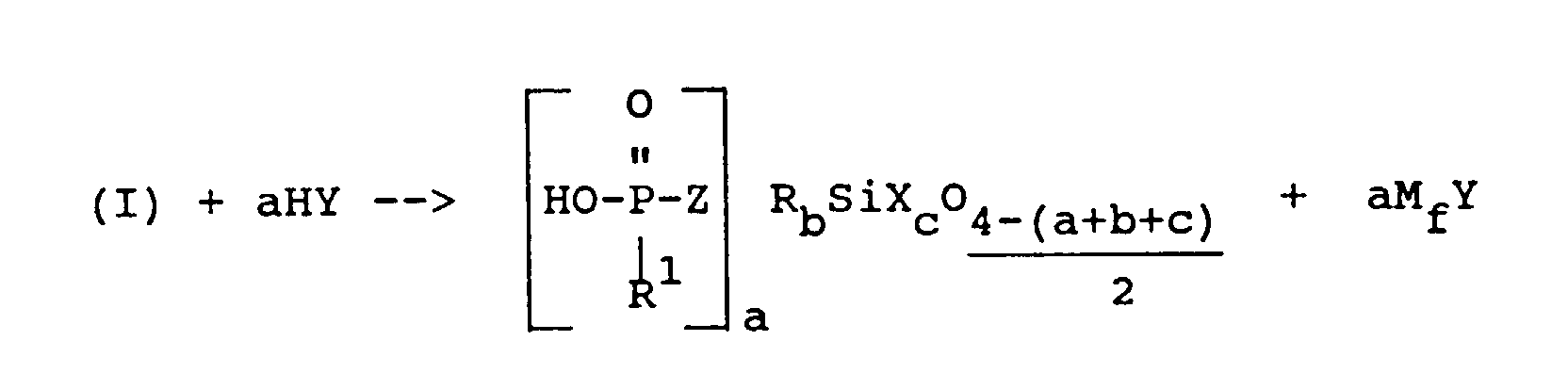
- the phosphorus-containing organosilicon compounds obtained by the process according to the invention can be treated with acids (4) which have a lower pK value than the phosphine or.
- Phosphonic acid have to be implemented according to the following equation where R, R 1 , X, Z, M, a, b, f and c have the meaning given above.
- acids HY are those of the formula H 2 SO 4 , HCl, HClO 4 , CF 3 COOH, H 3 PO 4 and CF 3 SO 3 H.
- the low molecular weight organosilicon compounds containing phosphorus according to the invention are mostly solids and readily soluble in water.
- acids which have a lower pK value than the phosphinic or phosphonic acid By adding acids which have a lower pK value than the phosphinic or phosphonic acid, the phosphorus-containing organosilicon compound with the HOP (O) R 1 Z radical precipitates and can thus be obtained in a simple manner.
- the phosphorus-containing organosilicon compounds according to the invention with higher molecular weights are mostly liquids and mostly self-emulsifying, ie an emulsion is formed by adding water and by rapid stirring - the use of an emulsifying agent is not necessary.
- This emulsion is obtained by adding an acid that has a lower pK than the phosphine or. Has phosphonic acid, broken and the phosphorus-containing organosilicon compound with the HOP (O) R 1 Z radical can be obtained in a simple manner.
- phosphorus-containing organosilicon compound can make hydrophilicity or water solubility specifically changed as required become. This property is for example in the application advantageous in the textile sector.
- the organosilicon compounds (5) with at least one Si-bonded hydrogen atom per molecule preferably contain at least 0.04% by weight, preferably 0.1 to 1.6% by weight of Si-bonded hydrogen, and their average viscosity is preferably 5 to 20 000 mm 2 ⁇ s -1 at 25 ° C, preferably 10 to 10,000 mm 2 ⁇ s -1 at 25 ° C, particularly preferably 10 to 1,000 mm 2 ⁇ s -1 at 25 ° C.
- catalysts (6) promoting the attachment of Si-bonded hydrogen to aliphatic multiple bonds the same catalysts can also be used in the process according to the invention which could previously also be used to promote the attachment of Si-bonded hydrogen to aliphatic multiple bonds.
- the catalysts are preferably a metal from the group of platinum metals or a compound or a complex from the group of platinum metals.
- platinum halides for example PtCl 4 , H 2 PtCl 6 * 6H 2 O, Na 2 PtCl 4 * 4H 2 O, platinum-olefin complexes, platinum-alcohol complexes, platinum-alcoholate complexes, platinum-ester complexes, platinum-aldehyde complexes, platinum-ketone complexes, including reaction products of H 2 PtCl 6 * 6H 2 O and cyclohexanone, platinum-vinylsiloxane complexes, such as platinum-1,3-divinyl-1,1,3,3-tetra-methyldi-siloxane complexes with or without content of detectable inorganic halogen, bis (gamma-picolin) platinum dichloride, trimethylene dipyridine platinum dichloride , Dicyclopentadiene platinum
- the catalyst (6) is preferably used in amounts of 2 to 200 ppm by weight (parts by weight per million parts by weight) is preferred in amounts of 5 to 50 ppm by weight, calculated in each case as elemental platinum and based on the total weight of phosphorus-containing organosilicon compound and organosilicon compound with at least one Si-bonded hydrogen atom per molecule.
- the hydrosilylation reaction is preferably carried out under pressure the surrounding atmosphere, i.e. at around 1020 hPa (abs.) performed, but it can also be done at higher or lower Pressures are carried out. Furthermore, the hydrosilylation reaction preferably at a temperature of 80 ° C to 150 ° C, preferably 110 ° C to 125 ° C, carried out.
- inert, organic Solvents can be used, although the use of inert, organic solvents is not preferred.
- inert organic solvents are Toluene, isopropanol, xylene, isophorone, octane isomers and Butyl acetate.
- organopolysiloxanes (7) selected from the group consisting of from linear, terminal triorganosiloxy groups Organopolysiloxanes, linear, terminal hydroxyl groups having organopolysiloxanes, cyclic Organopolysiloxanes and copolymers made from diorganosiloxane and monoorganosiloxane units are equilibrated.
- Preferred linear organopolysiloxanes having triorganosiloxy groups are those of the formula R 3 SiO (SiR 2 O) r SiR 3 where R has the meaning given above and r is 0 or an integer from 1 to 1500, as linear, terminal hydroxyl-containing organopolysiloxanes of the formula HO (SiR 2 O) s H where R has the meaning given above and s is an integer from 1 to 1500, as cyclic organopolysiloxanes those of the formula (R 2 SiO) t where R has the meaning given above and t is an integer from 3 to 12, and as copolymers from units of the formula R 2 SiO and RSiO 3/2 , where R has the meaning given above.
- basic catalysts which promote the equilibration are preferably used.
- catalysts are alkali metal hydroxides, in particular potassium and cesium hydroxide, alkali metal alcoholates, quaternary ammonium hydroxides, such as tetramethylammonium hydroxide, tetrabutylammonium hydroxide, benzyltrimethylammonium hydroxide, benzyltriethylammonium hydroxide, benzyltrimethylammoniumhydroxyethylammonium phosphate, 2-hydroxyethyl, beta-methylate-3-hydroxyethyl, -butylate-3 -butyl-3- [tris (trimethylsiloxy) silyl] -n-propyl-phosphonium hydroxide, alkali siloxanolates and ammonium organosiloxanolates, such as benzyltrimethylammoniumethylsiloxanolate.
- Basic catalysts are preferably used in amounts of 200 to 5000 ppm by weight, preferably 500 to 1500 ppm by weight, in each case based on the total weight of the organosilicon compounds used.
- the use of acidic equilibration catalysts is possible, but not preferred. Acidic catalysts are preferred for the equilibration of the corresponding free acid derivatives, ie the phosphorus-containing organopolysiloxanes with the HOP (O) R 1 Z radical.
- acidic catalysts are sulfuric acid, phosphoric acid, phosphoronitride chlorides and solid under the reaction conditions, acidic catalysts such as acid-activated bleaching earth, acidic zeolites, sulfonated carbon and sulfonated styrene-divinylbenzene copolymer.
- Any equilibration that is carried out is preferred at 80 ° C to 150 ° C and when printing the surrounding Atmosphere, i.e. at about 1020 hPa (abs.). If desired, however, higher or lower ones can also be used Pressures are applied.
- the equilibration is preferably obtained in 5 to 20% by weight on the total weight of the organosilicon compounds used in each case, in water miscible or not miscible solvent, such as isopropanol or toluene, carried out. Before working on the equilibration The mixture obtained can render the catalyst ineffective become.
- the phosphorus-containing organosilicon compounds according to the invention are particularly suitable for use as hydrophilic modifiers, Flame retardant, antistatic, antibactericide and for introducing polar groups into and on substrates.
Landscapes
- Chemical & Material Sciences (AREA)
- Organic Chemistry (AREA)
- Health & Medical Sciences (AREA)
- Life Sciences & Earth Sciences (AREA)
- Biochemistry (AREA)
- General Health & Medical Sciences (AREA)
- Molecular Biology (AREA)
- Chemical Kinetics & Catalysis (AREA)
- Medicinal Chemistry (AREA)
- Polymers & Plastics (AREA)
- General Chemical & Material Sciences (AREA)
- Silicon Polymers (AREA)
Description
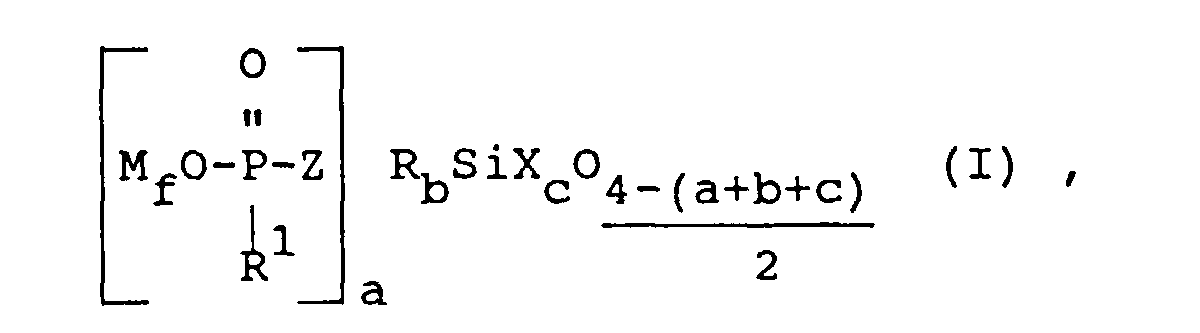
R1 ein Wasserstoffatom, einen einwertigen Kohlenwasserstoffrest mit 1 bis 18 Kohlenstoffatom(en) je Rest oder einen Rest der Formel
- a 0, 1, 2, 3 oder 4,
- b 0, 1, 2 oder 3,
- c 0, 1, 2 oder 3,
f 0,5 oder 1 ist.
R, X, a, b und c die oben dafür angegebene Bedeutung haben, mit Alkali- oder Erdalkalisalzen der Phosphin- oder Phosphonsäure (2) der Formel

M ein Alkali- oder Erdalkalimetall ist,
in Gegenwart von freie Radikale bildenden Katalysatoren (3) umgesetzt werden.



H2SO4, HCl, HClO4, CF3COOH, H3PO4 und CF3SO3H.
in Gegenwart von sogenannten Hydrosilylierungskatalysatoren, also solchen Katalysatoren (6), die die Anlagerung von Si-gebundenen Wasserstoff an aliphatische Mehrfachbindung fördern, umgesetzt werden.
als cyclische Organopolysiloxane solche der Formel
t eine ganze Zahl von 3 bis 12 ist,
und als Mischpolymerisate solche aus Einheiten der Formel
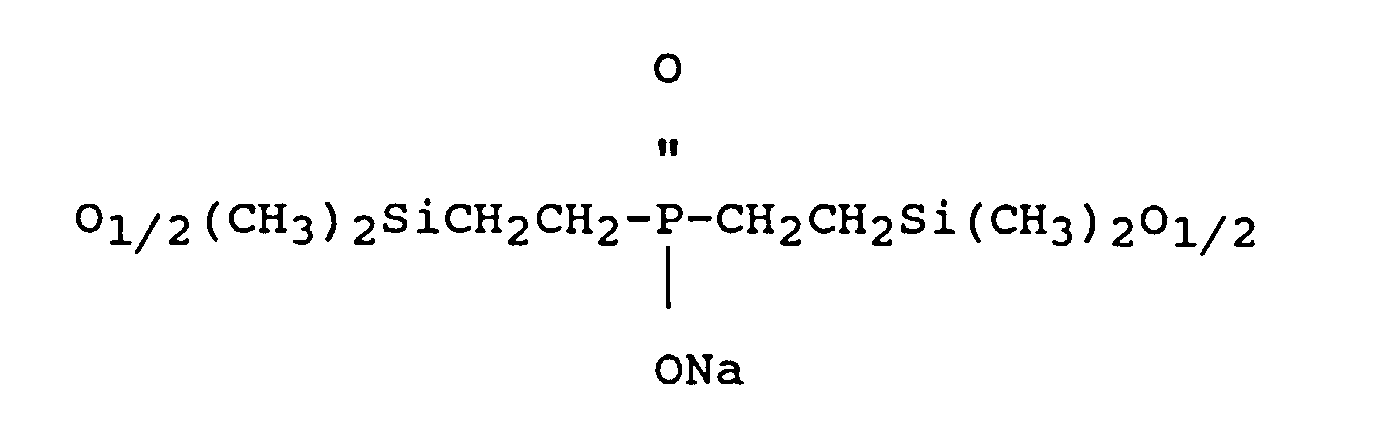


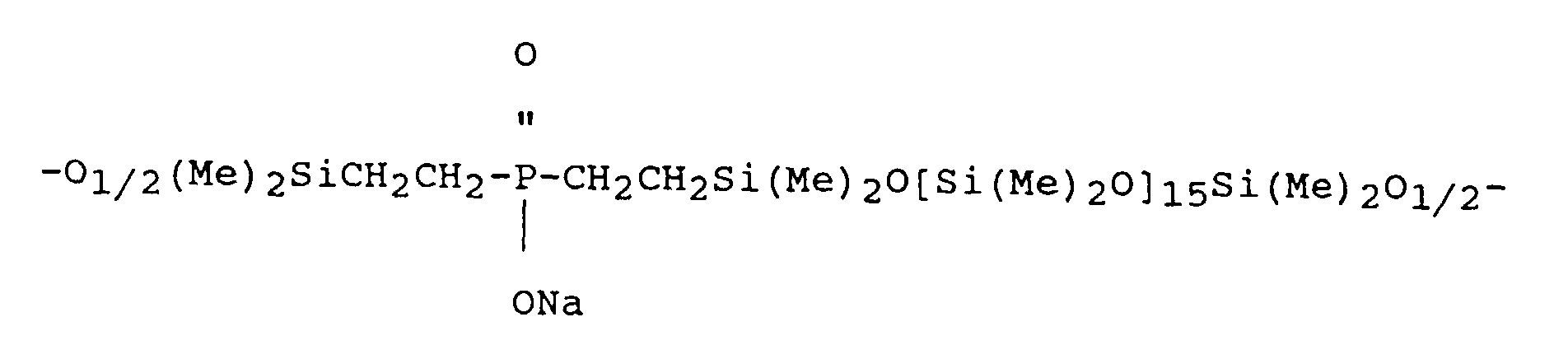
erhalten.


Claims (5)
- Phosphorhaltige Organosiliciumverbindungen mit Einheiten der Formelwobei R gleich oder verschieden ist, einen einwertigen, gegebenenfalls halogenierten Kohlenwasserstoffrest mit 1 bis 18 Kohlenstoffatom(en) je Rest bedeutet,

R1 ein Wasserstoffatom, einen einwertigen Kohlenwasserstoffrest mit 1 bis 18 Kohlenstoffatom(en) je Rest oder einen Rest der Formelwobei R2 einen Alkylrest mit 1 bis 8 Kohlenstoffatom(en) je Rest, der durch ein Ethersauerstoffatom unterbrochen sein kann, bedeutet,Z einen zweiwertigen Kohlenwasserstoffrest mit 2 bis 18 Kohlenstoffatomen je Rest bedeutet,M ein Alkali- oder Erdalkalimetall ist,X gleich oder verschieden ist, ein Halogenatom oder ein Rest der Formel -OR2 ist,die Summe a+b+c ≤ 4 unda 0, 1, 2, 3 oder 4,b 0, 1, 2 oder 3,c 0, 1, 2 oder 3,
f 0,5 oder 1 ist. - Verfahren zur Herstellung von phosphorhaltigen Organosiliciumverbindungen, dadurch gekennzeichnet, daß Organosiliciumverbindungen (1) mit Einheiten der Formelwobei R2 einen Alkylrest mit 1 bis 8 Kohlenstoffatom(en) je Rest, der durch ein Ethersauerstoffatom unterbrochen sein kann, bedeutet,B einen einwertigen, aliphatische Mehrfachbindungen aufweisenden Kohlenwasserstoffrest mit 2 bis 18 Kohlenstoffatomen je Rest bedeutet,X gleich oder verschieden ist, ein Halogenatom oder ein Rest der Formel -OR2 ist,und die Summe a+b+c ≤ 4a 0, 1, 2, 3 oder 4,b 0, 1, 2 oder 3,c 0, 1, 2 oder 3
ist,
mit Alkali- oder Erdalkalisalzen der Phosphin- oder Phosphonsäure (2) der Formelwobei R3 ein Wasserstoffatom, eine Hydroxylgruppe, einen einwertigen Kohlenwasserstoffrest mit 1 bis 18 Kohlenstoffatom(en) je Rest, in Gegenwart von freie Radikale bildenden Katalysatoren (3) umgesetzt werden.M ein Alkali- oder Erdalkalimetall undf 0,5 oder 1 ist,
 - Verfahren nach Anspruch 2, dadurch gekennzeichnet, daß die so erhaltenen phosphorhaltigen Organosiliciumverbindungen mit Säuren (4), die einen niedrigeren pK-Wert als die Phosphin- bzw. Phosphonsäure besitzen, umgesetzt werden.
- Verfahren nach Anspruch 2, dadurch gekennzeichnet, daß die so erhaltenen phosphorhaltigen Organosiliciumverbindungen, die noch Si-gebundene, aliphatische Mehrfachbindungen aufweisende Gruppen enthalten, mit Organosiliciumverbindungen (5) mit mindestens einem Si-gebundenen Wasserstoffatom je Molekül in Gegenwart von die Anlagerung von Si-gebundenen Wasserstoff an aliphatische Mehrfachbindungen fördernde Katalysatoren (6) umgesetzt werden.
- Verfahren nach Anspruch 2, 3 oder 4, dadurch gekennzeichnet, daß die so erhaltenen phosphorhaltigen Organosiliciumverbindungen mit Organopolysiloxanen (7) ausgewählt aus der Gruppe bestehend aus linearen, endständige Triorganosiloxygruppen aufweisenden Organopolysiloxanen, linearen, endständige Hydroxylgruppen aufweisenden Organopolysiloxanen, cyclischen Organopolysiloxanen und Mischpolymerisaten aus Diorganosiloxan- und Monoorganosiloxaneinheiten equilibriert werden.
Applications Claiming Priority (2)
| Application Number | Priority Date | Filing Date | Title |
|---|---|---|---|
| DE19500253A DE19500253A1 (de) | 1995-01-05 | 1995-01-05 | Phosphorhaltige Organosiliciumverbindungen |
| DE19500253 | 1995-01-05 |
Publications (2)
| Publication Number | Publication Date |
|---|---|
| EP0720985A1 EP0720985A1 (de) | 1996-07-10 |
| EP0720985B1 true EP0720985B1 (de) | 2000-07-19 |
Family
ID=7751063
Family Applications (1)
| Application Number | Title | Priority Date | Filing Date |
|---|---|---|---|
| EP95119828A Expired - Lifetime EP0720985B1 (de) | 1995-01-05 | 1995-12-15 | Phosphorhaltige Organosiliciumverbindungen |
Country Status (7)
| Country | Link |
|---|---|
| US (1) | US5627296A (de) |
| EP (1) | EP0720985B1 (de) |
| JP (1) | JPH08231574A (de) |
| AT (1) | ATE194842T1 (de) |
| CA (1) | CA2162783A1 (de) |
| DE (2) | DE19500253A1 (de) |
| FI (1) | FI960020A7 (de) |
Families Citing this family (12)
| Publication number | Priority date | Publication date | Assignee | Title |
|---|---|---|---|---|
| US6087517A (en) * | 1999-12-13 | 2000-07-11 | Phoenix Research Co. | Fluorinated dimethicone copolyol phosphate |
| US6175028B1 (en) * | 2000-02-28 | 2001-01-16 | O'lenick, Jr. Anthony J. | Silicone alkyl phosphate esters |
| GB0100470D0 (en) * | 2001-01-09 | 2001-02-21 | Queen Mary & Westfield College | Organopolysiloxanes containing phosphonic groups, methods for the production and use thereof |
| GB0315201D0 (en) * | 2003-06-28 | 2003-08-06 | Queen Mary & Westfield College | Substituted organopolysiloxanes, methods for the production and use thereof |
| US7183370B2 (en) | 2003-09-11 | 2007-02-27 | Toyota Technical Center Usa, Inc | Phosphonic-acid grafted hybrid inorganic-organic proton electrolyte membranes (PEMs) |
| US7576165B2 (en) * | 2004-01-27 | 2009-08-18 | Georgia Institute Of Technology | Heterocycle grafted monomers and related polymers and hybrid inorganic-organic polymer membranes |
| US20050277302A1 (en) * | 2004-05-28 | 2005-12-15 | Nguyen Son V | Advanced low dielectric constant barrier layers |
| DE102006016753A1 (de) | 2006-04-10 | 2007-10-11 | Wacker Chemie Ag | Vernetzbare Massen auf der Basis von Organosiliciumverbindungen |
| US7915436B2 (en) * | 2008-11-03 | 2011-03-29 | 3M Innovative Properties Company | Phosphorus-containing silsesquioxane derivatives as flame retardants |
| CN103068886A (zh) | 2010-08-23 | 2013-04-24 | 道康宁公司 | 磷硅氧烷树脂以及包含磷硅氧烷树脂的可固化有机硅组合物、自立式膜和层合物 |
| US11505637B1 (en) | 2019-09-24 | 2022-11-22 | 3M Innovative Properties Company | Block copolymers with a polydiorganosiloxane block and a phosphate or phosphonate containing block |
| CN119955105B (zh) * | 2025-01-14 | 2025-11-28 | 北京工商大学 | 一种纳米级有机硅系簇状次膦酸阻燃剂及其制备方法 |
Family Cites Families (11)
| Publication number | Priority date | Publication date | Assignee | Title |
|---|---|---|---|---|
| US2889349A (en) * | 1955-11-07 | 1959-06-02 | Ici Ltd | Organosiloxy aryl phosphonates |
| GB836241A (en) * | 1956-05-31 | 1960-06-01 | Gen Electric | Improvements in organophosphorus-silicon compounds |
| GB885466A (en) * | 1957-05-14 | 1961-12-28 | Bataafsche Petroleum | Process for the preparation of polymers with chains containing phosphorus, carbon and silicon |
| US2963503A (en) * | 1958-12-23 | 1960-12-06 | Union Carbide Corp | Process for producing phosphorus-containing organosilicon compounds |
| US3122581A (en) * | 1961-10-27 | 1964-02-25 | Union Carbide Corp | Preparation of phosphorus-containing organosilicon compounds |
| DE2304554C3 (de) * | 1973-01-31 | 1979-07-12 | Dynamit Nobel Ag, 5210 Troisdorf | Phosphororganosilanester tertiärer Alkohole |
| DE3000768A1 (de) * | 1980-01-10 | 1981-07-16 | Wacker-Chemie GmbH, 8000 München | Verfahren zum anlagern von si-gebundenem wasserstoff an aliphatische mehrfachbindung |
| AU1910783A (en) * | 1982-11-29 | 1984-06-07 | Sws Silicones Corp. | Organopolysiloxane composition |
| DE3612192A1 (de) * | 1986-04-11 | 1987-10-22 | Hoechst Ag | Verfahren zur herstellung von (alpha)-aminoalkylphosphonsaeuren |
| US4772408A (en) * | 1987-05-06 | 1988-09-20 | First Brands Corporation | Silicate-containing antifreeze with phosphonate silane stabilizer |
| DE3744121A1 (de) * | 1987-12-24 | 1989-07-06 | Basf Ag | Befeuchtungsloesung fuer den offsetdruck |
-
1995
- 1995-01-05 DE DE19500253A patent/DE19500253A1/de not_active Withdrawn
- 1995-11-14 CA CA002162783A patent/CA2162783A1/en not_active Abandoned
- 1995-11-15 US US08/559,269 patent/US5627296A/en not_active Expired - Fee Related
- 1995-12-15 DE DE59508586T patent/DE59508586D1/de not_active Expired - Fee Related
- 1995-12-15 AT AT95119828T patent/ATE194842T1/de not_active IP Right Cessation
- 1995-12-15 EP EP95119828A patent/EP0720985B1/de not_active Expired - Lifetime
-
1996
- 1996-01-03 FI FI960020A patent/FI960020A7/fi unknown
- 1996-01-05 JP JP8000223A patent/JPH08231574A/ja active Pending
Also Published As
| Publication number | Publication date |
|---|---|
| DE19500253A1 (de) | 1996-07-11 |
| ATE194842T1 (de) | 2000-08-15 |
| CA2162783A1 (en) | 1996-07-06 |
| EP0720985A1 (de) | 1996-07-10 |
| JPH08231574A (ja) | 1996-09-10 |
| FI960020A7 (fi) | 1996-07-06 |
| US5627296A (en) | 1997-05-06 |
| DE59508586D1 (de) | 2000-08-24 |
| FI960020A0 (fi) | 1996-01-03 |
Similar Documents
| Publication | Publication Date | Title |
|---|---|---|
| EP0720985B1 (de) | Phosphorhaltige Organosiliciumverbindungen | |
| DE3837397A1 (de) | Neue organooligosilsesquioxane | |
| EP0018624B1 (de) | Verfahren zur Herstellung von vernetzten Organopolysiloxanen und deren Verwendung als Wirkstoff für abhäsive Beschichtungsmassen für flächige Träger | |
| EP0415204A2 (de) | Anhydridfunktionelle Organo(poly)siloxane, Verfahren zu ihrer Herstellung und Verwendung dieser Organo(poly)siloxane | |
| DE2335118B2 (de) | Acrylat- oder substituierte Acrylatgruppen enthaltende Organopolysiloxane und Verfahren zu ihrer Herstellung | |
| EP0646616B1 (de) | Organopolysiloxane mit bifunktionellen endständigen Siloxaneinheiten | |
| EP0831111B1 (de) | Aminogruppen aufweisende Organosiliciumverbindungen, deren Herstellung und Verwendung | |
| EP0849307B1 (de) | Ionische Organosiliciumverbindungen, deren Herstellung und Verwendung | |
| DE4234846A1 (de) | Organo(poly)siloxane und Verfahren zu deren Herstellung | |
| EP0439778A2 (de) | Alkenylgruppen aufweisende Siloxancopolymere, deren Herstellung und Verwendung | |
| DE19960291A1 (de) | Mehrphasige Zubereitungen von Organosiliciumverbindungen | |
| EP0508491A1 (de) | (Meth)acryloxygruppen aufweisende Organosiliciumverbindungen, deren Herstellung und Verwendung | |
| DE3315060A1 (de) | Verfahren zum vernetzen von organopolysiloxanmassen | |
| EP2029661B1 (de) | Verfahren zur herstellung von hochmolekularen organopolysiloxanen | |
| EP0431609B1 (de) | Sulfosuccinatgruppen enthaltende Organopolysiloxane | |
| EP0924237B1 (de) | Amino-alkylenoxidfunktionelle Organosiliciumverbindungen, deren Herstellung und Verwendung | |
| DE3935775A1 (de) | Alkenylgruppen aufweisende organosiliciumverbindungen, verfahren zu ihrer herstellung und verwendung dieser organosiliciumverbindungen | |
| EP0818495B1 (de) | Hydrophile, permanente Organosiliciumverbindungen | |
| EP0690062A1 (de) | Furanylgruppen aufweisende Organosiliciumverbindungen | |
| EP0881250B1 (de) | Verfahren zur Herstellung von Si-gebundene Wasserstoffatome aufweisenden Organosiliciumverbindungen | |
| EP0538868B1 (de) | Buntesalzgruppen aufweisende Organosiliciumverbindungen, Verfahren zu ihrer Herstellung sowie ihre Verwendung | |
| DE19628017A1 (de) | Permanente Organosiliciumverbindungen, deren Herstellung und Verwendung | |
| DE19637466A1 (de) | Mit permanenten Organosiliciumverbindungen ausgerüstete Fasern |
Legal Events
| Date | Code | Title | Description |
|---|---|---|---|
| PUAI | Public reference made under article 153(3) epc to a published international application that has entered the european phase |
Free format text: ORIGINAL CODE: 0009012 |
|
| 17P | Request for examination filed |
Effective date: 19951215 |
|
| AK | Designated contracting states |
Kind code of ref document: A1 Designated state(s): AT BE DE FR GB IT NL |
|
| 17Q | First examination report despatched |
Effective date: 19990216 |
|
| GRAG | Despatch of communication of intention to grant |
Free format text: ORIGINAL CODE: EPIDOS AGRA |
|
| GRAG | Despatch of communication of intention to grant |
Free format text: ORIGINAL CODE: EPIDOS AGRA |
|
| GRAH | Despatch of communication of intention to grant a patent |
Free format text: ORIGINAL CODE: EPIDOS IGRA |
|
| GRAH | Despatch of communication of intention to grant a patent |
Free format text: ORIGINAL CODE: EPIDOS IGRA |
|
| GRAA | (expected) grant |
Free format text: ORIGINAL CODE: 0009210 |
|
| AK | Designated contracting states |
Kind code of ref document: B1 Designated state(s): AT BE DE FR GB IT NL |
|
| PG25 | Lapsed in a contracting state [announced via postgrant information from national office to epo] |
Ref country code: NL Free format text: LAPSE BECAUSE OF FAILURE TO SUBMIT A TRANSLATION OF THE DESCRIPTION OR TO PAY THE FEE WITHIN THE PRESCRIBED TIME-LIMIT Effective date: 20000719 Ref country code: IT Free format text: LAPSE BECAUSE OF FAILURE TO SUBMIT A TRANSLATION OF THE DESCRIPTION OR TO PAY THE FEE WITHIN THE PRE;WARNING: LAPSES OF ITALIAN PATENTS WITH EFFECTIVE DATE BEFORE 2007 MAY HAVE OCCURRED AT ANY TIME BEFORE 2007. THE CORRECT EFFECTIVE DATE MAY BE DIFFERENT FROM THE ONE RECORDED.SCRIBED TIME-LIMIT Effective date: 20000719 Ref country code: GB Free format text: LAPSE BECAUSE OF FAILURE TO SUBMIT A TRANSLATION OF THE DESCRIPTION OR TO PAY THE FEE WITHIN THE PRESCRIBED TIME-LIMIT Effective date: 20000719 Ref country code: FR Free format text: LAPSE BECAUSE OF FAILURE TO SUBMIT A TRANSLATION OF THE DESCRIPTION OR TO PAY THE FEE WITHIN THE PRESCRIBED TIME-LIMIT Effective date: 20000719 |
|
| REF | Corresponds to: |
Ref document number: 194842 Country of ref document: AT Date of ref document: 20000815 Kind code of ref document: T |
|
| REF | Corresponds to: |
Ref document number: 59508586 Country of ref document: DE Date of ref document: 20000824 |
|
| EN | Fr: translation not filed | ||
| PG25 | Lapsed in a contracting state [announced via postgrant information from national office to epo] |
Ref country code: AT Free format text: LAPSE BECAUSE OF NON-PAYMENT OF DUE FEES Effective date: 20001215 |
|
| PG25 | Lapsed in a contracting state [announced via postgrant information from national office to epo] |
Ref country code: BE Free format text: LAPSE BECAUSE OF NON-PAYMENT OF DUE FEES Effective date: 20001231 |
|
| NLV1 | Nl: lapsed or annulled due to failure to fulfill the requirements of art. 29p and 29m of the patents act | ||
| GBV | Gb: ep patent (uk) treated as always having been void in accordance with gb section 77(7)/1977 [no translation filed] |
Effective date: 20000719 |
|
| PLBE | No opposition filed within time limit |
Free format text: ORIGINAL CODE: 0009261 |
|
| STAA | Information on the status of an ep patent application or granted ep patent |
Free format text: STATUS: NO OPPOSITION FILED WITHIN TIME LIMIT |
|
| BERE | Be: lapsed |
Owner name: WACKER-CHEMIE G.M.B.H. Effective date: 20001231 |
|
| 26N | No opposition filed | ||
| PG25 | Lapsed in a contracting state [announced via postgrant information from national office to epo] |
Ref country code: DE Free format text: LAPSE BECAUSE OF NON-PAYMENT OF DUE FEES Effective date: 20011002 |