EP0716018A2 - Knotmaschine mit einzelnem Ende - Google Patents
Knotmaschine mit einzelnem Ende Download PDFInfo
- Publication number
- EP0716018A2 EP0716018A2 EP95118360A EP95118360A EP0716018A2 EP 0716018 A2 EP0716018 A2 EP 0716018A2 EP 95118360 A EP95118360 A EP 95118360A EP 95118360 A EP95118360 A EP 95118360A EP 0716018 A2 EP0716018 A2 EP 0716018A2
- Authority
- EP
- European Patent Office
- Prior art keywords
- string
- spool
- pins
- machine according
- same
- Prior art date
- Legal status (The legal status is an assumption and is not a legal conclusion. Google has not performed a legal analysis and makes no representation as to the accuracy of the status listed.)
- Granted
Links
- 230000033001 locomotion Effects 0.000 claims abstract description 20
- 230000002093 peripheral effect Effects 0.000 claims description 21
- 238000004804 winding Methods 0.000 claims description 8
- 230000015572 biosynthetic process Effects 0.000 claims description 6
- 230000008878 coupling Effects 0.000 claims description 6
- 238000010168 coupling process Methods 0.000 claims description 6
- 238000005859 coupling reaction Methods 0.000 claims description 6
- 238000011084 recovery Methods 0.000 claims description 5
- 230000003042 antagnostic effect Effects 0.000 claims description 4
- 230000000452 restraining effect Effects 0.000 claims 3
- 230000000295 complement effect Effects 0.000 claims 1
- 230000001360 synchronised effect Effects 0.000 claims 1
- 241001237745 Salamis Species 0.000 description 5
- 235000013351 cheese Nutrition 0.000 description 5
- 235000013305 food Nutrition 0.000 description 5
- 235000015175 salami Nutrition 0.000 description 5
- 235000013580 sausages Nutrition 0.000 description 4
- 235000013372 meat Nutrition 0.000 description 3
- 235000015277 pork Nutrition 0.000 description 2
- 238000002360 preparation method Methods 0.000 description 2
- 240000002129 Malva sylvestris Species 0.000 description 1
- 235000006770 Malva sylvestris Nutrition 0.000 description 1
- 239000004744 fabric Substances 0.000 description 1
- 239000002421 finishing Substances 0.000 description 1
- 239000011810 insulating material Substances 0.000 description 1
- 238000004519 manufacturing process Methods 0.000 description 1
- 238000012856 packing Methods 0.000 description 1
- 230000001105 regulatory effect Effects 0.000 description 1
- 230000000284 resting effect Effects 0.000 description 1
- 238000009958 sewing Methods 0.000 description 1
- 239000000126 substance Substances 0.000 description 1
Images



Classifications
-
- B—PERFORMING OPERATIONS; TRANSPORTING
- B65—CONVEYING; PACKING; STORING; HANDLING THIN OR FILAMENTARY MATERIAL
- B65B—MACHINES, APPARATUS OR DEVICES FOR, OR METHODS OF, PACKAGING ARTICLES OR MATERIALS; UNPACKING
- B65B13/00—Bundling articles
- B65B13/02—Applying and securing binding material around articles or groups of articles, e.g. using strings, wires, strips, bands or tapes
- B65B13/04—Applying and securing binding material around articles or groups of articles, e.g. using strings, wires, strips, bands or tapes with means for guiding the binding material around the articles prior to severing from supply
- B65B13/10—Carriers travelling completely around the articles while holding the free end of material
- B65B13/12—Carriers travelling completely around the articles while holding the free end of material attached to rotating rings
-
- A—HUMAN NECESSITIES
- A22—BUTCHERING; MEAT TREATMENT; PROCESSING POULTRY OR FISH
- A22C—PROCESSING MEAT, POULTRY, OR FISH
- A22C11/00—Sausage making ; Apparatus for handling or conveying sausage products during manufacture
- A22C11/001—Machines for making skinless sausages, e.g. Frankfurters, Wieners
- A22C11/005—Apparatus for binding or tying sausages or meat, e.g. salami, rollades; Filling sausage products into sleeve netting
Definitions
- the invention relates to a single end, knot-tying machine, substantially formed by a central tying head, comprising a tubular guide duct wherein the bodies to be tied are caused to slide both longitudinally and peripherally, with several turns.
- the bodies to be tied are guided through the tubular duct, while a tying element, for instance a string, a rope, a cable, a ribbon or the like is at first caused to adhere to a side of the same bodies during the longitudinal sliding, then is caused to adhere to the opposite site, in alternation with circular, peripheral turns.
- a tying element for instance a string, a rope, a cable, a ribbon or the like is at first caused to adhere to a side of the same bodies during the longitudinal sliding, then is caused to adhere to the opposite site, in alternation with circular, peripheral turns.
- the longitudinal tying develops at the same time as the perimetric tying, step by step, with knot superpositions obtained through a rotatory wrapping up movement of the string at each turn, with a raising and overtaking movement of the spool unwinding the same string.
- the tubular duct is formed by at least a couple of opposite tiles with a spacing channel, with possible longitudinal runways and at least a peripheral slit for the passing of the tying strings or the like in both directions.
- rods or pushers suitable to guide and push the bodies to be tied, which may be indifferently: meats, salami, sacks, carpet packings, provolone cheese, or other wrapped up products and so on.
- the tyings obtainable mechanically are not of the type with knots, with the evident drawback of a poor quality of the preparation.
- the object of this invention is to eliminate the above drawbacks.
- the invention such as is characterized by the claims, solves the problem by means of a single end knot-tying machine, through which the following results are obtained: the tying is carried out in a substantially automatic manner, both longitudinally and perimetrically, step-by-step, with knot-tying at each turn; the machine comprises a tubular duct of adjustable size for tying bodies having different dimensions; the tying is obtained by the combination of a rotatory alternate motion around the body and an alternate step-by-step advancing motion; the wrapping up in the longitudinal and the peripheral directions is obtained by means of a continuous, single end tying element, a string or the like; the body to be tied is guided longitudinally with the possible help of adjustable automatically advancing rods or pushers.
- the advantages obtained through this invention lie essentially in that the complete tying operation is carried out in a substantially automatic manner, in short times, in a simple and functional way and in adantageous conditions from both the general economic viewpoint and the particular health viewpoint, with reference to the treatment of food; the tying of food takes place by a combined system of wrapping up of the tying element, string or the like, by means of knotting of the peripheral turns with at least one of the longitudinal turns, with ensuing perfect tying and resistance of the same in the time.
- the central tying head is applicable and utilizable for any application where the knotting of a thread-like element and the like is required, such as for instance tubular elements with an external covering wrapped up and restrainable by means of a knot-tying, salami and other food with continous external tying, fabrics in which buttons or the like are previously or sequentially sewn, sausages with sequential step-by-step knottings such as sausages and the like, and so on.
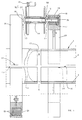
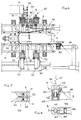
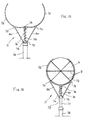
- the figures show a single end knot-tying machine, substantially formed by a central head 48 composed by a tubular duct 1 constituted by at least a couple of tiles 2, which may be radially adjusted according to the sizes of bodies 6 to be tied.
- Tiles 2 may be configurated with a circular development for cylindrical bodies 6, or with other profiles for products having different sections.
- tiles 2 may be configurated with one only couple, for a two-string longitudinal tying, or with two couples for a four-string longitudinal tying.
- the tubular duct 1 comprises a central adjustment and trueing rod 4 and a back pusher 6.
- the provolone 6 introduced into duct 1 is kept in position and pushed forwards (leftwards in the drawing) between said rod 4 and said pusher 5.
- the first fixed side pliers 7 lock end 8 of a string 9 near the side of product 6, in alignment with the longitudinal cavity 10 circumscribed by the approaching of the two opposite tiles 2.
- the second pliers 12 grip string 9 near a peripheral cavity 13 of tiles 2, in correspndence of wich cavity a spool 14 is provided on which the rest of the string is wound.
- the second pliers 12 are positioned opposite to the first pliers 7, and spool 14, provided with a potential minidivider 15, is mounted on at least a couple of pins 16, which elastically engage, by means of springs 17, in seats 18 obtained in as many circular plate wheels 19.
- the plate wheels 19 slide within fixed seats coaxially mounted relatively to the tubular duct 1.
- Seats 20 are provided with circumferential slits 21 through which pins 16 supporting spool 14 protrude.
- Seats 20 are suitably connected to the loadbearing structure of the machine, while plate wheels 19 are kept in position, with sliding rotation within said seats, by a number of pinions 23 which engage with the same through peripheral openings 24.
- pinions 23 are moved by one only movement means, constituted, for instance, by pulleys activated by one motor-belt, or other suitable device.
- spool 14 is caused to rotate around the tubular duct 1 and string 9 which unwinds from it wraps up product 6, through the peripheral cavity 13.
- equidistant tying loops 28 create which align for the whole length of product 6, which loops restrain on one side the first longitudinal tying obtained by the first side pliers 7, and create on the opposite side the second longitudinal tying constituted by the lenghts reformed step-by-step by the second pliers 12, between each loop and the following one.
- the first end 8, disengaged from the first side pliers 7, and the end engaged by the second pliers 12, are gathered and knotted 30 in correspondence of the second bottom 29.
- pins 16 on which said spool is supported are alternately retractable. For this reason, they are located within seats 18 obtained in plate wheels 19, and are provided with antagonistic springs 17 which exercize their pressure against caps 32, integral with the pins.
- cam-grooves or openings 33 coupled to external cams 34 are obtained.
- a first pin 16 for instance the one on the left side in the drawings, goes back, as its cap 32 aligns with opening 33 of its corresponding seat 20, and its spring 17 releases.
- pin 16 disengages from spool 14 the moment when string 9, pulled by pliers 20, enters throat 35 between said seat 20 and the spool. Immediately after the passage of the string, the corresponding cam 34 compresses cap 32, which is obliged to re-enter recess 18, and pin 16 protrudes again from the same seat, reassuming its starting engagement position on the spool.
- spool 14 is provided with side truncated-cone conveyors 37.
- pin 16 has a polygonal shape and engage in corresponding seats of spool 14, so as to form an engagement adequate to the restraint and the support of the same spool.
- the axle of spool 14 instead of being directly engaged with the mobile pins 16, is engaged on two intermediate side plates 37', which substitute the coaxial truncated-cone elements 37.
- a plate 37' is provided having several profiled seats wherein engage as many mobile pins 16, one for each side, relatively to the support of the axle of the same spool.
- pins 16 support and guide plates 37' on which the ends of spool 14 are engaged.
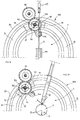
- the plate wheels stop temporary, together with the spool; the second pliers 12 go back, dragging along the part of string on which they hold grip; they raise it and cause it to pass above the same spool.
- Figs. 11 and 12 show the support system of spool 14 with several side pins, for instance three for each side, engaged in as many seats 158 obtained in the support side stirrups 37'.
- string 9 overcomes step-by-step first from one side, then from the opposite side, the various pins which go back to allow it to pass, to return then to the engagement position with stirrups 37', after each passage.
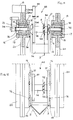
- FIGs. 6 through 11 show different alternative embodiments of the same central working head 48, of its components and its working.
- end 8 of string 9 is caused to advance along the axis of the machine by means of a mobile arm 40, whose translation is controlled by a piston 41 or a corresponding means.
- Grip 42 comprises upper pliers 43 and a friction pusher 44 with back spring 45.
- the jaws of pliers 43 form an annular space 46 wherein small pliers 47 may insert orthogonally having an alternate motion, orthogonal to the one of the mobile arm 40.
- end 8 of string 9 to align with the central head 48, substantially formed by the fixed seats and circular sectors 20, the related circular sector plate wheels 20, the related circular sector plate wheels 19, and the wrapping up spool 14 with its support and translation means.
- pliers 47 advance until they engage with the above end 8 of string 9, hook up with it and go back to their starting position, dragging along the same string which slips off from the friction grip 42, keeping its tautness.
- the jaws of the upper pliers 43 open elastically, under the traction action of the small pliers 47, being hinged on a fulcrum 155 provided with a return elastic means. In this way the string may be causes to slide easily.
- the small pliers 47 work in the aforementioned way through a guide duct 49 obtained in the front part of a front elastic pusher 50, provided with opposite openable jaws 51.
- end 8 of string 9 engages between the radial grooves 52 of said fan, the small pliers 47 let go their hold, and the string rotatingly winds on spool 14, for a prefixed and planned length, according to the type, dimensions of the tying and the advancing rate of the product to be treated and/or the number of products of a prefixed configuration to be wrapped up and tied in the production sequence.
- a friction 54 keeps the string taut, both during the wrapping up and the recoveries.
- string 9 remains longitudinally taut on a side of body 6 of grip 42 up to its aforementioned diametral frontal part, or bottom 11, and beyond, on the opposite longitudinal side, up to the alignment point substantially located in the middle of head 48, in correspondence of the circumferential cavity 13.
- the second pliers 12 grip string 3 near said peripheral cavity 13, between tiles 2, in correspondence of which cavity spool 14 on which the tying string is wound is aligned.
- pinion 59 of the spool winding motor is retracted by means of any known mechanical or electromechanical system, so as to unhook from the coupling with gear 60.
- the above condition is indispensable to allow the overtaking stage of the spool by the string.
- the engament of pinion 50 with gear 60 is realized during the winding stage of the string on spool 14 and at each end of orbital rotation of the same spool around the product to be tied, to perform the necessary recovery and mantain the right tautness of the string, after which the toothed wheels are disconnected for the above mentioned reason: the tautness of the string is mantained by means of friction 54.
- a coupling with friction wheels may be utilized instead of a coupling with tothed wheels.
- a pulley is keyed on the motor shaft 15, on which pulley a belt holds grip which has a high friction coefficient.
- the belts wraps up on a second idle lag pulley, and a third pulley with the function of idler.
- the system is caused to translate, with a mechanical or electromechanical device, until the lag pulley is aligned with the friction wheel mounted on the same spool, instead of pinion 60.
- the lag pulley and the friction wheel engage with one another by friction, through the interposition of the belt. In this way, the spool is caused to rotate.
- hooking means or hook 58 which gather the unwound part of string 9 and keeps it taut orthogonally towards the back to an extent sufficient and adequate to allow its passing above spool 14. As the string is caused to pass beyond the spool, hook 58 returns gradually, yielding the fullness of the same.
- body 6 is caused to advance at a prefixed rate and the above described operations are repeated up to the full circumferential tying.
- end restrained in the friction grip 42 is still kept in its position, while around it several sequential knotting stages are performed, proceeding in the same way as described.
- body 6 is fully knotted also in closure: end 8 detaches from fan 53, as the string has fully unwound, and the end of grip 42 is cut, releasing the finished body 6.
- the mobile arm 40 is provided with a fixed tubular body 61 in which a tubular stock 62 is placed and pushed forwards by a spring 63. Beyond body 61 two friction wheels 64 are provided, kept in touch by elastic means, such as springs.
- End 8 of string 9 is friction-engaged betweem wheels 64, while the back part is kept taut by pneumatic pliers, or the like.
- the end of the tubular stock 62 is caused to rest against a shell 65, provided with a side hole 66, alignable with the above tubular stock 62.
- a piston 67 provided in shell 65, lowers and restrains end 8 of the string, after which the same shell is retracted from such position, dragging along the string until it is aligned with the radial grooves 52 for the automatic hooking of fan 53.
- shell 65 is oriented in correspondence of cavity 13, of head 48, in alignment with said spool 14.
- string 9 After the winding on spool 14 for a prefixed length, string 9, always stretched by the back pliers, is cut by a suitably positioned blade, so that head 8 is aligned anew with the tubular stock 62.
- said head is coupleable with supporting and shifting means from tiles 2, as described, or to conveyor belts or rollers or the like for bodies 6 extended in the length, or also to flat supporting means, in which head 48 is orientable also parallelly with or without automatic product loaders.
- head 48' utilizes a circular sector fixed seat or a continuous round seat 20, with spool 14 cantilever-supported on one only side strap 37', possibly with a more extended development, which is supported by a plurality of pins 16' protruding from one of the sides of said seat 20.
- the grip of bodies 69 in grooves 68 is so regulated as to ensure the position stability of strap 37' and the related spool 14, relatively to the fixed seat 20 and the rotating plate wheel 19.
- pins 16' behave the same way as described above, retracting from seats 158' to allow the passage of the string.
- both springs 17 and cams 34 are so size as to overcome in either direction the force exercized by the pressure springs 70 on bodies 69, to disengage or engage the same from or in grooves 68.
- An accessory tool applicable to the described and illustrated tying machines, especially designed and prepared for tying products 6 with both longitudinal and circumferential turns, such as for instance, pressed pork neck, salami, provolone cheese and the like, consists of a peripheral gripping means 71, substantially formed by one or two or more couples of half-rings 72 hinged in an intermediate point of theirs 73 and having the fulcrum at one common end 74 on a retractable rod 75, with antagonistic spring 76.
- Rod 75 engages telescopically in stem 77 of a piston 78. At the end of said stem also the end parts 79 of arms 80 are connected, whose opposite ends constitute the above hinges 73 of the half-rings 72.
- the so configurated gripping means is preferably but not limitedly arranged in alignment with cavity 13 of the central head 48, with the half-rings 72 located astride the zone in which string 9 wraps up circumferentially body 6 at each knot formation.
- the pressure exercized by piston 78 causes the backwards motion of rod 75, with ensuing closing rotation of the half-rings 72 around hinges 73.
- the half-rings 72 close in this way on body 6 pressing on the same and imprisoning the longitudinal tying turns in the wished position.
- the sequential recovery of the string by spool 1 finds the longitudinal tying turns perfectly held and caused not to be in condition of sliding transversally due to the friction exercized on the same by the circumferential turn of the knot being formed, which is subject to traction.
- piston 78 causes the return of stem 77; the antagonistic spring 76 expands, pushing outwards the common fulcrum 74, and the half-rings 72 open rotating around their hinges 73.
- Body 6, freed from the grip of means 71, can in this way advance by a step, and prepare for the automatic execution of the following knot.
- the working head 48 as a whole constitutes in itself a real tying machine, independent and suitable for any type of knotting operation, independently on the type, shape, size and structure of the product to be treated.
- the versatility of the central head 48 is such as to allow wrapping ups with knottings on any type of products: from food, sausages and meats and other ones, such as pressed pork, salami, cheese submitted to step-by-step wrapping: from the most specific ones, with end knotting for hams, or with alternate constriction knotting for sausages; from those relating to any product, even of great length, such as piping sections to be covered with insulating materials or the like, peripherally tied; from those relating to clothing, where the sewing of buttons or the like require a consistent knot fixing; from any other application requiring the presence of thread-like elements, such as thread, string, rope or the like, to be engaged with knots.
Landscapes
- Engineering & Computer Science (AREA)
- Life Sciences & Earth Sciences (AREA)
- Wood Science & Technology (AREA)
- Zoology (AREA)
- Food Science & Technology (AREA)
- Mechanical Engineering (AREA)
- Basic Packing Technique (AREA)
- Braiding, Manufacturing Of Bobbin-Net Or Lace, And Manufacturing Of Nets By Knotting (AREA)
- Binders And Loading Units For Sheaves (AREA)
Applications Claiming Priority (4)
| Application Number | Priority Date | Filing Date | Title |
|---|---|---|---|
| ITRE940101 IT1268857B1 (it) | 1994-12-01 | 1994-12-01 | Macchina legatrice a nodo ad unico capo |
| ITRE940101 | 1994-12-01 | ||
| ITRE950039 | 1995-07-13 | ||
| ITRE950039 IT1280086B1 (it) | 1995-07-13 | 1995-07-13 | Perfezionamenti a macchine legatrici a nodo ad unico capo |
Publications (3)
| Publication Number | Publication Date |
|---|---|
| EP0716018A2 true EP0716018A2 (de) | 1996-06-12 |
| EP0716018A3 EP0716018A3 (de) | 1996-09-04 |
| EP0716018B1 EP0716018B1 (de) | 1999-02-10 |
Family
ID=26331972
Family Applications (1)
| Application Number | Title | Priority Date | Filing Date |
|---|---|---|---|
| EP95118360A Expired - Lifetime EP0716018B1 (de) | 1994-12-01 | 1995-11-22 | Knotmaschine mit einzelnem Ende |
Country Status (3)
| Country | Link |
|---|---|
| EP (1) | EP0716018B1 (de) |
| AT (1) | ATE176642T1 (de) |
| DE (1) | DE69507780D1 (de) |
Cited By (3)
| Publication number | Priority date | Publication date | Assignee | Title |
|---|---|---|---|---|
| ITPR20110040A1 (it) * | 2011-05-17 | 2012-11-18 | Fipal S R L | Macchina legatrice per prodotti sostanzialmente oblunghi da avvolgere e annodare. |
| EP3491928A1 (de) * | 2017-11-29 | 2019-06-05 | INOX Meccanica S.R.L. | Maschine zum binden von lebensmittelprodukten |
| CN112074192A (zh) * | 2018-03-29 | 2020-12-11 | 伊诺泰克机器开发与销售有限公司 | 用于捆扎填充到外皮中的团块的设备和方法 |
Family Cites Families (4)
| Publication number | Priority date | Publication date | Assignee | Title |
|---|---|---|---|---|
| US2328085A (en) * | 1941-12-12 | 1943-08-31 | Maccarini Carlo | Application of cords to food products |
| DE3219163A1 (de) * | 1982-05-21 | 1983-11-24 | Willi 6935 Waldbrunn Benz | Ueberlastsicherung fuer eine schnuermaschine |
| IT1159209B (it) * | 1982-07-21 | 1987-02-25 | Claudio Ronchei | Perfezionamenti a macchine imbrigliatrici per prodotti alimentari,quali carni,formaggi e simili |
| DE8906233U1 (de) * | 1989-05-20 | 1989-08-17 | Maschinenfabrik Gerd Mosca Gmbh, 6931 Zwingenberg | Maschine zum Umschnüren von Packgut |
-
1995
- 1995-11-22 AT AT95118360T patent/ATE176642T1/de not_active IP Right Cessation
- 1995-11-22 DE DE69507780T patent/DE69507780D1/de not_active Expired - Lifetime
- 1995-11-22 EP EP95118360A patent/EP0716018B1/de not_active Expired - Lifetime
Non-Patent Citations (1)
| Title |
|---|
| None |
Cited By (4)
| Publication number | Priority date | Publication date | Assignee | Title |
|---|---|---|---|---|
| ITPR20110040A1 (it) * | 2011-05-17 | 2012-11-18 | Fipal S R L | Macchina legatrice per prodotti sostanzialmente oblunghi da avvolgere e annodare. |
| EP3491928A1 (de) * | 2017-11-29 | 2019-06-05 | INOX Meccanica S.R.L. | Maschine zum binden von lebensmittelprodukten |
| CN112074192A (zh) * | 2018-03-29 | 2020-12-11 | 伊诺泰克机器开发与销售有限公司 | 用于捆扎填充到外皮中的团块的设备和方法 |
| CN112074192B (zh) * | 2018-03-29 | 2022-05-27 | 伊诺泰克机器开发与销售有限公司 | 用于捆扎填充到外皮中的团块的设备和方法 |
Also Published As
| Publication number | Publication date |
|---|---|
| ATE176642T1 (de) | 1999-02-15 |
| DE69507780D1 (de) | 1999-03-25 |
| EP0716018A3 (de) | 1996-09-04 |
| EP0716018B1 (de) | 1999-02-10 |
Similar Documents
| Publication | Publication Date | Title |
|---|---|---|
| KR101295409B1 (ko) | 해초류 포자 끈 결속장치 | |
| EP0120948A1 (de) | Bindemaschine und verfahren. | |
| EP0716018B1 (de) | Knotmaschine mit einzelnem Ende | |
| JPS61236346A (ja) | 固定子コイルレーシングコードの固定装置及び固定方法 | |
| CA2891963A1 (en) | High-precision bundle-tying machine and tying process | |
| CN107313174A (zh) | 一种打结方法 | |
| CA1095554A (en) | Machine for automatically tying the ends of sausages and the like | |
| US6601880B2 (en) | Method and apparatus for making a knot with flexible material wrapped around an article | |
| JPS5917609B2 (ja) | 端コイルを紐でくゝる方法及び装置 | |
| US4406109A (en) | Automatic cord hanking machine | |
| EP1964475B1 (de) | Vorrichtung zur Befestigung einer Aufhängeschlaufe | |
| US2944752A (en) | Machine for packing pile fabrics | |
| US1196466A (en) | Machine for crimping and tying sacks. | |
| US4014570A (en) | Knot tying assistance contrivance | |
| US3670783A (en) | Cable tying machine | |
| CN106968048A (zh) | 一种双股绳一次多结的打结方法 | |
| DE926295C (de) | Maschine zum Abbinden von Wursthautenden u. dgl. | |
| CA2383430C (en) | Method and apparatus for making a knot with flexible material wrapped around an article | |
| GB2332615A (en) | Method and machine for trussing slaughtered fowl | |
| JP2644394B2 (ja) | 汎用結束機 | |
| ITRE940101A1 (it) | Macchina legatrice a nodo ad unico capo | |
| ITRE950039A1 (it) | Perfezionamenti a macchine legatrici a nodo ad unico capo | |
| RU2588544C2 (ru) | Узловязальное устройство и картриджная система для подачи к этому устройству обвязывающей нити | |
| KR100437128B1 (ko) | 주낙용 아릿줄 제작기 및 제작방법 | |
| JPH01279014A (ja) | 結束方法および装置 |
Legal Events
| Date | Code | Title | Description |
|---|---|---|---|
| PUAI | Public reference made under article 153(3) epc to a published international application that has entered the european phase |
Free format text: ORIGINAL CODE: 0009012 |
|
| AK | Designated contracting states |
Kind code of ref document: A2 Designated state(s): AT BE CH DE DK ES FR GB GR IE LI LU NL PT SE |
|
| PUAL | Search report despatched |
Free format text: ORIGINAL CODE: 0009013 |
|
| AK | Designated contracting states |
Kind code of ref document: A3 Designated state(s): AT BE CH DE DK ES FR GB GR IE LI LU NL PT SE |
|
| 17P | Request for examination filed |
Effective date: 19970127 |
|
| GRAG | Despatch of communication of intention to grant |
Free format text: ORIGINAL CODE: EPIDOS AGRA |
|
| 17Q | First examination report despatched |
Effective date: 19980513 |
|
| GRAG | Despatch of communication of intention to grant |
Free format text: ORIGINAL CODE: EPIDOS AGRA |
|
| GRAH | Despatch of communication of intention to grant a patent |
Free format text: ORIGINAL CODE: EPIDOS IGRA |
|
| GRAH | Despatch of communication of intention to grant a patent |
Free format text: ORIGINAL CODE: EPIDOS IGRA |
|
| GRAH | Despatch of communication of intention to grant a patent |
Free format text: ORIGINAL CODE: EPIDOS IGRA |
|
| GRAA | (expected) grant |
Free format text: ORIGINAL CODE: 0009210 |
|
| AK | Designated contracting states |
Kind code of ref document: B1 Designated state(s): AT BE CH DE DK ES FR GB GR IE LI LU NL PT SE |
|
| PG25 | Lapsed in a contracting state [announced via postgrant information from national office to epo] |
Ref country code: SE Free format text: THE PATENT HAS BEEN ANNULLED BY A DECISION OF A NATIONAL AUTHORITY Effective date: 19990210 Ref country code: NL Free format text: LAPSE BECAUSE OF FAILURE TO SUBMIT A TRANSLATION OF THE DESCRIPTION OR TO PAY THE FEE WITHIN THE PRESCRIBED TIME-LIMIT Effective date: 19990210 Ref country code: LI Free format text: LAPSE BECAUSE OF FAILURE TO SUBMIT A TRANSLATION OF THE DESCRIPTION OR TO PAY THE FEE WITHIN THE PRESCRIBED TIME-LIMIT Effective date: 19990210 Ref country code: GR Free format text: LAPSE BECAUSE OF NON-PAYMENT OF DUE FEES Effective date: 19990210 Ref country code: ES Free format text: THE PATENT HAS BEEN ANNULLED BY A DECISION OF A NATIONAL AUTHORITY Effective date: 19990210 Ref country code: CH Free format text: LAPSE BECAUSE OF FAILURE TO SUBMIT A TRANSLATION OF THE DESCRIPTION OR TO PAY THE FEE WITHIN THE PRESCRIBED TIME-LIMIT Effective date: 19990210 Ref country code: BE Free format text: LAPSE BECAUSE OF FAILURE TO SUBMIT A TRANSLATION OF THE DESCRIPTION OR TO PAY THE FEE WITHIN THE PRESCRIBED TIME-LIMIT Effective date: 19990210 Ref country code: AT Free format text: LAPSE BECAUSE OF FAILURE TO SUBMIT A TRANSLATION OF THE DESCRIPTION OR TO PAY THE FEE WITHIN THE PRESCRIBED TIME-LIMIT Effective date: 19990210 |
|
| REF | Corresponds to: |
Ref document number: 176642 Country of ref document: AT Date of ref document: 19990215 Kind code of ref document: T |
|
| REG | Reference to a national code |
Ref country code: CH Ref legal event code: EP |
|
| REG | Reference to a national code |
Ref country code: IE Ref legal event code: FG4D |
|
| ET | Fr: translation filed | ||
| REF | Corresponds to: |
Ref document number: 69507780 Country of ref document: DE Date of ref document: 19990325 |
|
| PG25 | Lapsed in a contracting state [announced via postgrant information from national office to epo] |
Ref country code: PT Free format text: LAPSE BECAUSE OF FAILURE TO SUBMIT A TRANSLATION OF THE DESCRIPTION OR TO PAY THE FEE WITHIN THE PRESCRIBED TIME-LIMIT Effective date: 19990510 Ref country code: DK Free format text: LAPSE BECAUSE OF FAILURE TO SUBMIT A TRANSLATION OF THE DESCRIPTION OR TO PAY THE FEE WITHIN THE PRESCRIBED TIME-LIMIT Effective date: 19990510 |
|
| PG25 | Lapsed in a contracting state [announced via postgrant information from national office to epo] |
Ref country code: DE Free format text: LAPSE BECAUSE OF FAILURE TO SUBMIT A TRANSLATION OF THE DESCRIPTION OR TO PAY THE FEE WITHIN THE PRESCRIBED TIME-LIMIT Effective date: 19990511 |
|
| NLV1 | Nl: lapsed or annulled due to failure to fulfill the requirements of art. 29p and 29m of the patents act | ||
| REG | Reference to a national code |
Ref country code: CH Ref legal event code: PL |
|
| PGFP | Annual fee paid to national office [announced via postgrant information from national office to epo] |
Ref country code: FR Payment date: 19991019 Year of fee payment: 5 |
|
| PG25 | Lapsed in a contracting state [announced via postgrant information from national office to epo] |
Ref country code: LU Free format text: LAPSE BECAUSE OF NON-PAYMENT OF DUE FEES Effective date: 19991122 Ref country code: IE Free format text: LAPSE BECAUSE OF NON-PAYMENT OF DUE FEES Effective date: 19991122 Ref country code: GB Free format text: LAPSE BECAUSE OF NON-PAYMENT OF DUE FEES Effective date: 19991122 |
|
| PLBE | No opposition filed within time limit |
Free format text: ORIGINAL CODE: 0009261 |
|
| STAA | Information on the status of an ep patent application or granted ep patent |
Free format text: STATUS: NO OPPOSITION FILED WITHIN TIME LIMIT |
|
| 26N | No opposition filed | ||
| GBPC | Gb: european patent ceased through non-payment of renewal fee |
Effective date: 19991122 |
|
| REG | Reference to a national code |
Ref country code: IE Ref legal event code: MM4A |
|
| PG25 | Lapsed in a contracting state [announced via postgrant information from national office to epo] |
Ref country code: FR Free format text: LAPSE BECAUSE OF NON-PAYMENT OF DUE FEES Effective date: 20010731 |
|
| REG | Reference to a national code |
Ref country code: FR Ref legal event code: ST |