EP0712435B1 - Trocken-aktivierte gewebekonditionierungs- und antistatische zusammensetzungen die biologisch abbaubare, ungesättigte verbindungen enthalten - Google Patents
Trocken-aktivierte gewebekonditionierungs- und antistatische zusammensetzungen die biologisch abbaubare, ungesättigte verbindungen enthalten Download PDFInfo
- Publication number
- EP0712435B1 EP0712435B1 EP94924583A EP94924583A EP0712435B1 EP 0712435 B1 EP0712435 B1 EP 0712435B1 EP 94924583 A EP94924583 A EP 94924583A EP 94924583 A EP94924583 A EP 94924583A EP 0712435 B1 EP0712435 B1 EP 0712435B1
- Authority
- EP
- European Patent Office
- Prior art keywords
- mixtures
- composition
- formula
- group
- sorbitan
- Prior art date
- Legal status (The legal status is an assumption and is not a legal conclusion. Google has not performed a legal analysis and makes no representation as to the accuracy of the status listed.)
- Expired - Lifetime
Links
Classifications
-
- C—CHEMISTRY; METALLURGY
- C11—ANIMAL OR VEGETABLE OILS, FATS, FATTY SUBSTANCES OR WAXES; FATTY ACIDS THEREFROM; DETERGENTS; CANDLES
- C11D—DETERGENT COMPOSITIONS; USE OF SINGLE SUBSTANCES AS DETERGENTS; SOAP OR SOAP-MAKING; RESIN SOAPS; RECOVERY OF GLYCEROL
- C11D1/00—Detergent compositions based essentially on surface-active compounds; Use of these compounds as a detergent
- C11D1/38—Cationic compounds
- C11D1/645—Mixtures of compounds all of which are cationic
-
- C—CHEMISTRY; METALLURGY
- C11—ANIMAL OR VEGETABLE OILS, FATS, FATTY SUBSTANCES OR WAXES; FATTY ACIDS THEREFROM; DETERGENTS; CANDLES
- C11D—DETERGENT COMPOSITIONS; USE OF SINGLE SUBSTANCES AS DETERGENTS; SOAP OR SOAP-MAKING; RESIN SOAPS; RECOVERY OF GLYCEROL
- C11D1/00—Detergent compositions based essentially on surface-active compounds; Use of these compounds as a detergent
- C11D1/66—Non-ionic compounds
- C11D1/835—Mixtures of non-ionic with cationic compounds
-
- C—CHEMISTRY; METALLURGY
- C11—ANIMAL OR VEGETABLE OILS, FATS, FATTY SUBSTANCES OR WAXES; FATTY ACIDS THEREFROM; DETERGENTS; CANDLES
- C11D—DETERGENT COMPOSITIONS; USE OF SINGLE SUBSTANCES AS DETERGENTS; SOAP OR SOAP-MAKING; RESIN SOAPS; RECOVERY OF GLYCEROL
- C11D3/00—Other compounding ingredients of detergent compositions covered in group C11D1/00
- C11D3/0005—Other compounding ingredients characterised by their effect
- C11D3/001—Softening compositions
-
- C—CHEMISTRY; METALLURGY
- C11—ANIMAL OR VEGETABLE OILS, FATS, FATTY SUBSTANCES OR WAXES; FATTY ACIDS THEREFROM; DETERGENTS; CANDLES
- C11D—DETERGENT COMPOSITIONS; USE OF SINGLE SUBSTANCES AS DETERGENTS; SOAP OR SOAP-MAKING; RESIN SOAPS; RECOVERY OF GLYCEROL
- C11D1/00—Detergent compositions based essentially on surface-active compounds; Use of these compounds as a detergent
- C11D1/38—Cationic compounds
- C11D1/62—Quaternary ammonium compounds
-
- C—CHEMISTRY; METALLURGY
- C11—ANIMAL OR VEGETABLE OILS, FATS, FATTY SUBSTANCES OR WAXES; FATTY ACIDS THEREFROM; DETERGENTS; CANDLES
- C11D—DETERGENT COMPOSITIONS; USE OF SINGLE SUBSTANCES AS DETERGENTS; SOAP OR SOAP-MAKING; RESIN SOAPS; RECOVERY OF GLYCEROL
- C11D1/00—Detergent compositions based essentially on surface-active compounds; Use of these compounds as a detergent
- C11D1/66—Non-ionic compounds
- C11D1/667—Neutral esters, e.g. sorbitan esters
-
- Y—GENERAL TAGGING OF NEW TECHNOLOGICAL DEVELOPMENTS; GENERAL TAGGING OF CROSS-SECTIONAL TECHNOLOGIES SPANNING OVER SEVERAL SECTIONS OF THE IPC; TECHNICAL SUBJECTS COVERED BY FORMER USPC CROSS-REFERENCE ART COLLECTIONS [XRACs] AND DIGESTS
- Y10—TECHNICAL SUBJECTS COVERED BY FORMER USPC
- Y10T—TECHNICAL SUBJECTS COVERED BY FORMER US CLASSIFICATION
- Y10T442/00—Fabric [woven, knitted, or nonwoven textile or cloth, etc.]
- Y10T442/20—Coated or impregnated woven, knit, or nonwoven fabric which is not [a] associated with another preformed layer or fiber layer or, [b] with respect to woven and knit, characterized, respectively, by a particular or differential weave or knit, wherein the coating or impregnation is neither a foamed material nor a free metal or alloy layer
- Y10T442/2279—Coating or impregnation improves soil repellency, soil release, or anti- soil redeposition qualities of fabric
- Y10T442/2295—Linear polyether group chain containing
-
- Y—GENERAL TAGGING OF NEW TECHNOLOGICAL DEVELOPMENTS; GENERAL TAGGING OF CROSS-SECTIONAL TECHNOLOGIES SPANNING OVER SEVERAL SECTIONS OF THE IPC; TECHNICAL SUBJECTS COVERED BY FORMER USPC CROSS-REFERENCE ART COLLECTIONS [XRACs] AND DIGESTS
- Y10—TECHNICAL SUBJECTS COVERED BY FORMER USPC
- Y10T—TECHNICAL SUBJECTS COVERED BY FORMER US CLASSIFICATION
- Y10T442/00—Fabric [woven, knitted, or nonwoven textile or cloth, etc.]
- Y10T442/20—Coated or impregnated woven, knit, or nonwoven fabric which is not [a] associated with another preformed layer or fiber layer or, [b] with respect to woven and knit, characterized, respectively, by a particular or differential weave or knit, wherein the coating or impregnation is neither a foamed material nor a free metal or alloy layer
- Y10T442/2352—Coating or impregnation functions to soften the feel of or improve the "hand" of the fabric
-
- Y—GENERAL TAGGING OF NEW TECHNOLOGICAL DEVELOPMENTS; GENERAL TAGGING OF CROSS-SECTIONAL TECHNOLOGIES SPANNING OVER SEVERAL SECTIONS OF THE IPC; TECHNICAL SUBJECTS COVERED BY FORMER USPC CROSS-REFERENCE ART COLLECTIONS [XRACs] AND DIGESTS
- Y10—TECHNICAL SUBJECTS COVERED BY FORMER USPC
- Y10T—TECHNICAL SUBJECTS COVERED BY FORMER US CLASSIFICATION
- Y10T442/00—Fabric [woven, knitted, or nonwoven textile or cloth, etc.]
- Y10T442/20—Coated or impregnated woven, knit, or nonwoven fabric which is not [a] associated with another preformed layer or fiber layer or, [b] with respect to woven and knit, characterized, respectively, by a particular or differential weave or knit, wherein the coating or impregnation is neither a foamed material nor a free metal or alloy layer
- Y10T442/2418—Coating or impregnation increases electrical conductivity or anti-static quality
- Y10T442/2459—Nitrogen containing
Definitions
- the present invention relates to an improvement in dryer activated, e.g., dryer-added, softening products, compositions, and/or the process of making these compositions.
- dryer activated e.g., dryer-added, softening products, compositions, and/or the process of making these compositions.
- These products and/or compositions are either in particulate form, compounded with other material s in solid form, e.g., tablets, pellets and agglomerates, or preferably attached to a substrate.
- the present invention relates to dryer-activated fabric softening compositions and articles having improved biodegradability, softness, delivery from sheet (lower m.p. range), and/or antistatic effects, for use in an automatic clothes dryer.
- These compositions and/or articles comprise, as essential ingredients:
- the active components contain unsaturation to provide improved antistatic benefits.
- the Iodine Value (IV) of the composition is from 3 to 60, preferably from 8 to 50, more preferably from 12 to 40.
- the IV of the composition represents the IV of the total fatty acyl groups present in components (A), (B), and (C)(1).
- the unsaturation may be present in one or more of the active components of (A), (B), and/or (C)(l) described below.
- the present invention relates to fabric softening compositions and articles having improved biodegradability, softness, delivery from the sheet, and/or antistatic effects, for use in an automatic clothes dryer.
- These compositions comprise, as essential ingredients:
- the active components contain unsaturation to provide antistatic benefits.
- the unsaturation of the active components provides in-dryer melting of these active components and provides high efficient transfer for improved performance, especially at lower dryer temperatures, while minimizing stickiness of the articles.
- the IV of the composition is from 3 to 60, preferably from 8 to 50, more preferably from 12 to 40.
- the IV of the composition represents the IV of the total fatty acyl groups present in components (A), (B), and (C).
- the unsaturation may be present in one or more of the active components of (A), (B), or (C)(1).
- the selection of the components is such that the resulting fabric treatment composition has a thermal softening point above 38°C and is transferable at dryer operating temperatures.
- the ratio of (A):(B):(C) is 5:3:2.
- compositions of the present invention contain from 10% to 95%, preferably from 15% to 90%, more preferably from 30% to 85%, and even more preferably from 30% to 55%, of an ester quaternary ammonium compound (EQA).
- EQA ester quaternary ammonium compound
- the EQA of the present invention is selected from Formulas I, II, III, IV, and mixtures thereof.
- Formula I comprises: (R) 4-m - N ⁇ - [(CH 2 ) n - Y - R 2 ] m X ⁇ wherein
- substituents R and R 2 of Formula I can optionally be substituted with various groups such as alkoxyl or hydroxyl groups.
- the preferred compounds can be considered to be diester (DEQA) variations of ditallow dimethyl ammonium methyl sulfate (DTDMAMS), which is a widely used fabric softener. At least 80% of the DEQA is in the diester form, and from 0% to 20%, preferably less than 10%, more preferably less than 5%, can be EQA monoester (e.g., only one -Y- R2 group).
- the diester when specified, it will include the monoester that is normally present.
- the percentage of monoester should be as low as possible, preferably less than 2.5%.
- the level of monoester present can be controlled in the manufacturing of the EQA.
- EQA compounds prepared with fully saturated acyl groups are rapidly biodegradable and excellent softeners.
- compounds prepared with at least partially unsaturated acyl groups have advantages (i.e., antistatic benefits) and are highly acceptable for consumer products when certain conditions are met.
- IV Iodine Value
- Antistatic effects are especially important where the fabrics are dried in a tumble dryer, and/or where synthetic materials which generate static are used. As the IV is raised, there is a potential for odor problems.
- Some highly desirable, readily available sources of fatty acids such as tallow possess odors that remain with the compound EQA despite the chemical and mechanical processing steps which convert the raw tallow to finished EQA.
- Such sources must be deodorized, e.g., by absorption, distillation (including stripping such as steam stripping), as is well known in the art.
- care must be taken to minimize contact of the resulting fatty acyl groups to oxygen and/or bacteria by adding antioxidants, antibacterial agents. The additional expense and effort associated with the unsaturated fatty acyl groups is justified by the superior performance which has not been recognized.
- diester compounds derived from fatty acyl groups having low IV values can be made by mixing fully hydrogenated fatty acid with touch hydrogenated fatty acid at a ratio which provides an IV of from 3 to 60.
- the polyunsaturation content of the touch hardened fatty acid should be less than 5%, preferably less than 1%.
- touch hardening the cis/trans isomer weight ratios are controlled by methods known in the art such as by optimal mixing, using specific catalysts and providing high H 2 availability.
- a solvent may be used to facilitate processing of the Formula I EQA and/or of the fabric softening composition containing the Formula I EQA.
- Possible solvents include C 1 -C 30 alcohols, with secondary and tertiary alcohols preferred, e.g., isopropanol, and C 8 -C 30 fatty acids.
- compositions and articles of the present invention comprise EQA compounds of Formula II: wherein, for any molecule: each Q is or each R 1 is C 1 -C 4 alkyl or hydroxy alkyl; R 2 and n are defined hereinbefore for Formula I; and wherein preferably R 1 is a methyl group, n is 1, Q is each R 2 is C 14 -C 18 , and X ⁇ is methyl sulfate.
- the straight or branched alkyl or alkenyl chains, R 2 have from 8 to 30 carbon atoms, preferably from 14 to 18 carbon atoms, more preferably straight chains having from 14 to 18 carbon atoms.
- Tallow is a convenient and inexpensive source of long chain alkyl and alkenyl materials.
- a specific example of a biodegradable Formula II EQA compound suitable for use in the aqueous fabric softening compositions herein is: 1,2-bis(tallowyl oxy)-3-trimethyl ammoniopropane methylsulfate(DTTMAPMS).
- Formula II EQA compounds of this invention are obtained by, e.g., replacing "tallowyl” in the above compounds with, for example, cocoyl, lauryl, oleyl, stearyl, palmityl;
- compositions and articles of the present invention comprise EQA compounds of Formula III: wherein
- a specific example of a biodegradable Formula III compound suitable for use in the fabric softening compositions herein is N-methyl-N,N.di-( ⁇ -C 14 -C 18 -acyloxy ethyl), N- ⁇ -hydroxyethyl ammonium methylsulfate.
- a preferred compound is N-methyl, N,N-di-(2-oleyloxyethyl) N-2-hydroxyethyl ammonium methylsulfate.
- Component (A) of the present invention is a biodegradable quaternary ammonium compound.
- the compounds herein can be prepared by standard esterification and quaternization reactions, using readily available starting materials. General methods for preparation are disclosed in U.S. Pat. No. 4,137,180.
- Fabric softening compositions employed herein contain as an essential component, at a level of from 5 to 95%, preferably from 20% to 75%, more preferably from 20% to 60%, a carboxylic acid salt of a tertiary amine and/or ester amine which has the formula: wherein R 5 is a long chain aliphatic group containing from 8 to 30 carbon atoms; R 6 and R 4 are the same or different from each other and are selected from the group consisting of aliphatic groups containing containing from 1 to 30 carbon atoms, hydroxyalkyl groups of the Formula R 8 OH wherein R 8 is an alkylene group of from 2 to 30 carbon atoms, and alkyl ether groups of the formula R 9 O(C n H 2n O)m wherein R 9 is alkyl and alkenyl of from 1 to 30 carbon atoms and hydrogen, n is 2 or 3, and m is from 1 to 30; wherein R 4 , R 5 , R 6 , R 8 , and R 9 chains
- This essential component provides the following benefits: superior odor, and/or improved fabric softening performance, compared to similar articles which utilize primary amine or ammonium compounds as the sole fabric conditioning agent.
- tertiary amine salts of carboxylic acids have superior chemical stability, compared to primary and secondary amine carboxylate salts.
- primary and secondary amine carboxylates tend to form amides when heated, e.g., during processing or use in the dryer. Also, they absorb carbon dioxide, thereby forming high melting carbamates which build up as an undesirable residue on treated fabrics.
- R 5 is an aliphatic chain containing from 12 to 30 carbon atoms
- R 6 is an aliphatic chain of from 1 to 30 carbon atoms
- R 4 is an aliphatic chain of from 1 to 30 carbon atoms.
- Particularly preferred tertiary amines for static control performance are those containing unsaturation; e.g., oleyldimethylamine and/or soft tallowdimethylamine.
- Examples of preferred tertiary amines as starting material for the reaction between the amine and carboxylic acid to form the tertiary amine salts are: lauryldimethylamine, myristyldimethylamine, stearyldimethylamine, tallowdimethylamine, coconutdimethylamine, dilauryl ⁇ ethylamine distearylmethylamine, ditallowmethylamine, oleyldimethylamine, dioleylmethylamine, lauryldi(3-hydroxypropyl)amine, stearyldi(2-hydroxyethyl)amine, trilaurylamine, laurylethylmethylamine, and Preferred fatty acids are those wherein R 7 is a long chain, unsubstituted alkyl or alkenyl group of from 8 to 30 carbon atoms, more preferably from 11 to 17 carbon atoms.
- Examples of specific carboxylic acids as a starting material are: formic acid, acetic acid, lauric acid, myristic acid, palmitic acid, stearic acid, oleic acid, oxalic acid, adipic acid, 12-hydroxy stearic acid, benzoic acid, 4-hydroxy benzoic acid, 3-chloro benzoic acid, 4-nitro benzoic acid, 4-ethyl benzoic acid, 4-(2-chloroethyl)benzoic acid, phenylacetic acid, (4-chlorophenyl)acetic acid, (4-hydroxyphenyl)acetic acid, and phthalic acid.
- Preferred carboxylic acids are stearic, oleic, lauric, myristic, palmitic, and mixtures thereof.
- the amine salt can be formed by a simple addition reaction, well known in the art, disclosed in U.S. Pat. No. 4,237,155, Kardouche, issued Dec. 2, 1980. Excessive levels of free amines may result in odor problems, and generally free amines provide poorer softening performance than the amine salts.
- Preferred amine salts for use herein are those wherein the amine moiety is a C 8 -C 30 alkyl or alkenyl dimethyl amine or a di-C 8 -C 30 alkyl or alkenyl methyl amine, and the acid moiety is a C 8 -C 30 alkyl or alkenyl monocarboxylic acid.
- the mine and the acid, respectively, used to form the amine salt will often be of mixed chain lengths rather than single chain lengths, since these materials are normally derived from natural fats and oils, or synthetic processed which produce a mixture of chain lengths. Also, it is often desirable to utilize mixtures of different chain lengths in order to modify the physical or performance characteristics of the softening composition.
- Specific preferred amine salts for use in the present invention are oleyldimethylamine stearate, stearyldimethylamine stearate, stearyldlmethylamine myristate, stearyldimethylamine oleate, stearyldimethylamine palmitate, distearylmethylamine palmitate, distearylmethylamine laurate, and mixtures thereof.
- a particularly preferred mixture is oleyldimethylamine stearate and distearylmethylamine myristate, in a ratio of 1:10 to 10:1, preferably 1:1.
- An optional softening agent of the present invention is a nonionic fabric softener material.
- nonionic fabric softener materials typically have an HLB of from 2 to 9, more typically from 3 to 7.
- the materials selected should be relatively crystalline, higher melting, (e.g., >25°C).
- the level of optional nonionic softener in the solid composition is typically from 10% to 50%, preferably from 15% to 40%.
- Preferred nonionic softeners are fatty acid partial esters of polyhydric alcohols, or anhydrides thereof, wherein the alcohol, or anhydride, contains from 2 to 18, preferably from 2 to 8, carbon atoms, and each fatty acid moiety contains from 8 to 30, preferably from 12 to 20, carbon atoms.
- such softeners contain from one to 3, preferably 2 fatty acid groups per molecule.
- the polyhydric alcohol portion of the ester can be ethylene glycol, glycerol, poly (e.g., di-, tri-, tetra, penta-, and/or hexa-) glycerol, xylitol, sucrose, erythritol, pentaerythritol, sorbitol or sorbitan.
- the fatty acid portion of the ester is normally derived from fatty acids having from 8 to 30, preferably from 12 to 22, carbon atoms. Typical examples of said fatty acids being lauric acid, myristic acid, palmitic acid, stearic acid, oleic acid, and behenic acid.
- Highly preferred optional nonionic softening agents for use in the present invention are C 10 -C 26 acyl sorbitan esters and polyglycerol monostearate.
- Sorbitan esters are esterified dehydration products of sorbitol.
- the preferred sorbitan ester comprises a member selected from the group consisting of C 10 -C 26 acyl sorbitan monoesters and C 10 -C 26 acyl sorbitan diesters and ethoxylates of said esters wherein one or more of the unesterified hydroxyl groups in said esters contain from 1 to 6 oxyethylene units, and mixtures thereof.
- sorbitan esters containing unsaturation e.g., sorbitan monooleate
- Sorbitol which is typically prepared by the catalytic hydrogenation of glucose, can be dehydrated in well known fashion to form mixtures of 1,4- and 1,5-sorbitol anhydrides and small amounts of isosorbides. (See U.S. Pat. No. 2,322,821, Brown, issued June 29, 1943.)
- sorbitan complex mixtures of anhydrides of sorbitol are collectively referred to herein as "sorbitan.” It will be recognized that this "sorbitan" mixture will also contain some free, uncyclized sorbitol.
- the preferred sorbitan softening agents of the type employed herein can be prepared by esterifying the "sorbitan" mixture with a fatty acyl group in standard fashion, e.g., by reaction with a fatty acid halide, fatty acid ester, and/or fatty acid.
- the esterification reaction can occur at any of the available hydroxyl groups, and various mono-, di-, etc., esters can be prepared. In fact, mixtures of mono-, di-, tri-, esters almost always result from such reactions, and the stoichiometric ratios of the reactants can be simply adjusted to favor the desired reaction product.
- etherification and esterification are generally accomplished in the same processing step by reacting sorbitol directly with fatty acids.
- Such a method of sorbitan ester preparation is described more fully in MacDonald; "Emulsifiers:” Processing and Quality Control:, Journal of the American Oil Chemists' Society , Vol. 45, October 1968.
- sorbitan esters herein, especially the "lower” ethoxylates thereof (i.e., mono-, di-, and tri-esters wherein one or more of the unesterified -OH groups contain one to twenty oxyethylene moieties [Tweens®] are also useful in the composition of the present invention. Therefore, for purposes of the present invention, the term "sorbitan ester" includes such derivatives.
- ester mixtures having from 20-50% mono-ester, 25-50% di-ester and 10-35% of tri- and tetra-esters are preferred.
- sorbitan mono-ester e.g., monostearate
- sorbitan monostearate does in fact contain significant amounts of di- and tri-esters and a typical analysis of sorbitan monostearate indicates that it comprises 27% mono-, 32% di-and 30% tri- and tetra-esters.
- Commercial sorbitan monostearate therefore is a preferred material.
- Mixtures of sorbitan stearate and sorbitan palmitate having stearate/palmitate weight ratios varying between 10:1 and 1:10, and 1,5-sorbitan esters are useful. Both the 1,4- and 1,5-sorbitan esters are useful herein.
- alkyl sorbitan esters for use in the softening compositions herein include sorbitan monolaurate, sorbitan mono-myristate, sorbitan monopalmitate, sorbitan monobehenate, sorbitan monooleate, sorbitan dilaurate, sorbitan dimyristate, sorbitan dipalmitate, sorbitan distearate, sorbitan dibehenate, sorbitan dioleate, and mixtures thereof, and mixed tallowalkyl sorbitan mono- and di-esters.
- Such mixtures are readily prepared by reacting the foregoing hydroxy-substituted sorbitans, particularly the 1,4- and 1,5-sorbitans, with the corresponding acid, ester, or acid chloride in a simple esterification reaction. It is to be recognized, of course, that commercial materials prepared in this manner will comprise mixtures usually containing minor proportions of uncyclized sorbitol, fatty acids, polymers and isosorbide structures. In the present invention, it is preferred that such impurities are present at as low a level as possible.
- the preferred sorbitan esters employed herein can contain up to 15% by weight of esters of the C 20 -C 26 , and higher, fatty acids, as well as minor amounts of C 8 , and lower, fatty esters.
- Glycerol and polyglycerol esters are also preferred herein (e.g., polyglycerol monostearate with a trade name of Radiasurf 7248).
- Glycerol esters can be prepared from naturally occurring triglycerides by normal extraction, purification and/or interesterification processes or by esterification processes of the type set forth hereinbefore for sorbitan esters. Partial esters of glycerin can also be ethoxylated to form usable derivatives that are included within the term "glycerol esters.”
- Useful glycerol and polyglycerol esters include mono-esters with stearic, oleic, palmitic, lauric, isostearic, myristic, and/or behenic acids and the diesters of stearic, oleic, palmitic, lauric, isostearic, behenic, and/or myristic acids. It is understood that the typical mono-ester contains some di- and tri-ester.
- the "glycerol esters” also include the polyglycerol, e.g., diglycerol through octaglycerol esters.
- the polyglycerol polyols are formed by condensing glycerin or epichlorohydrin together to link the glycerol moieties via ether linkages.
- the mono- and/or diesters of the polyglycerol polyols are preferred, the fatty acyl groups typically being those described hereinbefore for the sorbitan and glycerol esters.
- compositions herein contain from 0% to 10%, preferably from 0.1% to 5%, more preferably from 0.1% to 2%, of a soil release agent.
- a soil release agent is a polymer.
- Polymeric soil release agents useful in the present invention include copolymeric blocks of terephthalate and polyethylene oxide or polypropylene oxide.
- a preferred soil release agent is a copolymer having blocks of terephthalate and polyethylene oxide. More specifically, these polymers are comprised of repeating units of ethylene and/or propylene terephthalate and polyethylene oxide terephthalate at a molar ratio of ethylene terephthalate units to polyethylene oxide terephthalate units of from 25:75 to 35:65, said polyethylene oxide terephthalate containing polyethylene oxide blocks having molecular weights of from 300 to 2000. The molecular weight of this polymeric soil release agent is in the range of from 5,000 to 55,000.
- Another preferred polymeric soil release agent is a crystallizable polyester with repeat units of ethylene terephthalate units containing from 10% to 15% by weight of ethylene terephthalate units together with from 10% to 50% by weight of polyoxyethylene terephthalate units, derived from a polyoxyethylene glycol of average molecular weight of from 300 to 6,000, and the molar ratio of ethylene terephthalate units to polyoxyethylene terephthalate units in the crystallizable polymeric compound is between 2:1 and 6:1.
- this polymer include the commercially available materials Zelcon® 4780 (from DuPont) and Milease® T (from ICI).
- the products herein can also contain from 0.5% to 60%, preferably from 1% to 50%, cyclodextrin/perfume inclusion complexes and/or free perfume, as disclosed in U.S. Pat. Nos. 5,139,687, Borcher et al., issued Aug. 18, 1992; and 5,234,610, Gardlik et al., to issue Aug. 10, 1993.
- Perfumes are highly desirable, can usually benefit from protection, and can be complexed with cyclodextrin.
- Fabric softening products typically contain perfume to provide an olfactory aesthetic benefit and/or to serve as a signal that the product is effective.
- perfume ingredients and compositions of this invention are the conventional ones known in the art. Selection of any perfume component, or amount of perfume, is based solely on aesthetic considerations. Suitable perfume compounds and compositions can be found in the art including U.S. Pat. Nos.: 4,145,184, Brain and Cummins, issued Mar. 20, 1979; 4,209,417, Whyte, issued June 24, 1980; 4,515,705, Woeddel, issued May 7, 1985; and 4,152,272, Young, issued May 1, 1979. Many of the art recognized perfume compositions are relatively substantive to maximize their odor effect on substrates. However, it is a special advantage of perfume delivery via the perfume/cyclodextrin complexes that nonsubstantive perfumes are also effective.
- Stabilizers can be present in the compositions of the present invention.
- the term "stabilizer,” as used herein, includes antioxidants and reductive agents. These agents are present at a level of from 0% to 2%, preferably from 0.01% to 0.2%, more preferably from 0.05% to 0.1% for antioxidants and more preferably from 0.01% to 0.2% for reductive agents. These assure good odor stability under long term stbrage conditions for the compositions. Use of antioxidants and reductive agent stabilizers is especially critical for unscented or low scent products (no or low perfume).
- antioxidants examples include a mixture of ascorbic acid, ascorbic palmitate, propyl gallate, available from Eastman Chemical Products, Inc., under the trade names Tenox® PG and Tenox S-1; a mixture of BHT, BHA, propyl gallate, and citric acid available from Eastman Chemicals Products, Inc., under the trade name Tenox-6; butylated hydroxytoluene, available from UOP Process Division under the trade name Sustane® BHT; tertiary butylhydroquinone, Eastman Chemical Products, Inc., as Tenox.TBHQ; natural tocopherols, Eastman Chemical Products, Inc., as Tenox GT-1/GT-2; and butylated hydroxyanisole, Eastman Chemical Products, Inc., as BHA.
- reductive agents examples include sodium borohydride, hypophosphorous acid, and mixtures thereof.
- the present invention can include other optional components (minor components) conventionally used in textile treatment compositions, for example, colorants, preservatives, optical brighteners, opacifiers, stabilizers such as guar gum and polyethylene glycol, anti-shrinkage agents, anti-wrinkle agents, fabric crisping agents, spotting agents, germicides, fungicides, anti-corrosion agents and antifoam agents.
- colorants for example, colorants, preservatives, optical brighteners, opacifiers, stabilizers such as guar gum and polyethylene glycol, anti-shrinkage agents, anti-wrinkle agents, fabric crisping agents, spotting agents, germicides, fungicides, anti-corrosion agents and antifoam agents.
- the present invention encompasses articles of manufacture.
- Representative articles are those that are adapted to soften fabrics in an automatic laundry dryer, of the types disclosed in U.S. Pat. Nos.: 3,989,631 Marsan, issued Nov. 2, 1976; 4,055,248, Marsan, issued Oct. 25, 1977; 4,073,996, Bedenk et al., issued Feb. 14, 1978; 4,022,938, Zaki et al., issued May 10, 1977; 4,764,289, Trinh, issued Aug. 16, 1988; 4,808,086, Evans et al., issued Feb.
- the fabric treatment compositions are provided as an article of manufacture in combination with a dispensing means such as a flexible substrate which effectively releases the composition in an automatic laundry (clothes) dryer.
- a dispensing means such as a flexible substrate which effectively releases the composition in an automatic laundry (clothes) dryer.
- Such dispensing means can be designed for single usage or for multiple uses.
- the dispensing means can also be a "carrier material" that releases the fabric softener composition and then is dispersed and/or exhausted from the dryer.
- the dispensing means will normally carry an effective amount of fabric treatment composition.
- Such effective amount typically provides sufficient fabric conditioning/antistatic agent and/or anionic polymeric soil release agent for at least one treatment of a minimum load in an automatic laundry dryer.
- Amounts of fabric treatment composition for multiple uses, e.g., up to 30, can be used.
- Typical amounts for a single article can vary from 0.25 g to 100 g, preferably from 0.5 g to 20 g, most preferably from 1 g to 10 g.
- Another article comprises a sponge material releasably enclosing enough fabric treatment composition to effectively impart fabric soil release, antistatic effect and/or softness benefits during several cycles of clothes.
- This multi-use article can be made by filling a hollow sponge with 20 grams of the fabric treatment composition.
- the substrate embodiment of this invention can be used for imparting the above-described fabric treatment composition to fabric to provide softening and/or antistatic effects to fabric in an automatic laundry dryer.
- the method of using the composition of the present invention comprises: commingling pieces of damp fabric by tumbling said fabric under heat in an automatic clothes dryer with an effective amount of the fabric treatment composition. At least the continuous phase of said composition has a melting point greater than 35°C and the composition is flowable at dryer operating temperature.
- This composition comprises from 10% to 95%, preferably from 15% to 90%, of the quaternary ammonium agent selected from the above-defined cationic fabric softeners and mixtures thereof, from 10% to 95%, preferably from 20% to 75%, more preferably from 20% to 60% of the above-defined co-softener.
- the present invention relates to improved solid dryer-activated fabric softener compositions which are either (A) incorporated into articles of manufacture in which the compositions are, e.g., on a substrate, or are (B) in the form of particles (including, where appropriate, agglomerates, pellets, and tablets of said particles).
- Such compositions contain from 30% to 95% of normally solid, dryer-softenable material , typically fabric softening agent, containing an effective amount of unsaturation.
- An approximately 200g batch of the coating mix is prepared as follows. An amount of 110g of co-softener and 78g of oleyl DEEDMANS (diethanol ester dimethyl ammonium methylsulfate) are melted separately at 80°C. They are then combined with high shear mixing. During the mixing, the mixture is kept molten in a hot water bath at 70-80°C. The calcium bentonite clay (8g) is slowly added to the mixture with high shear mixing until the desired viscosity is achieved. The perfume (3g) is added to the mixture, and the formula is mixed until the mixture is smooth and homogeneous.
- the coating mixture is applied to preweighed substrate sheets of 6.75 inches x 12 inches (approximately 17 cm x 30 cm) dimensions.
- the substrate sheets are comprised of 0.45Tex (4-denier) spun bonded polyester.
- a small amount of the formula is placed on a heated metal plate with a spatula and then is spread evenly with a wire metal rod.
- a substrate sheet is placed on the metal plate to absorb the coating mixture.
- the sheet is then removed from the heated metal plate and allowed to cool to room temperature so that the coating mix can solidify.
- the sheet is weighed to determine the amount of coating mixture on the sheet.
- the target sheet weight is 3.49g. If the weight is in excess of the target weight, the sheet is placed back on the heated metal plate to remelt the coating mixture and remove some of the excess. If the weight is under the target weight, the sheet is also placed on the heated metal plate and more coating mixture is added.
- the coating mix preparation and the making of the fabric conditioning sheets are similar to those in Example 1, except that DTTMAPMS is used instead of oleyl DEEDMAMS.
- the coating mix preparation and the making of the fabric conditioning sheets are similar to those in Example 1, except that N-methyl, N,N-di-(2-oleyloxyethyl) N-2-hydroxyethyl ammonium methylsulfate is used instead of oleyl DEEDMAMS.
- the coating mix preparation and the making of the fabric conditioning sheets are similar to those in Example 1, except that soft tallow choline ester methylsulfate is used instead of oleyl DEEDMAMS.
- the coating mix preparation and the making of the fabric conditioning sheets are similar to those in Example 1, except that the co-softener consists of soft tallow dimethylamine rather than stearyldimethylamine and soft tallow DEEDMAMS is used instead of oleyl DEEDMAMS.
- the coating mix preparation and the making of the fabric conditioning sheets are similar to those in Example 1, except that the sorbitan monooleate (Lonza) is melted with the softener blend in the initial step and soft tallow DEEDMAMS is used instead of oleyl DEEDMAMS.
Landscapes
- Chemical & Material Sciences (AREA)
- Life Sciences & Earth Sciences (AREA)
- Engineering & Computer Science (AREA)
- Chemical Kinetics & Catalysis (AREA)
- Oil, Petroleum & Natural Gas (AREA)
- Wood Science & Technology (AREA)
- Organic Chemistry (AREA)
- Treatments For Attaching Organic Compounds To Fibrous Goods (AREA)
- Dental Preparations (AREA)
- Materials For Medical Uses (AREA)
- Detergent Compositions (AREA)
Claims (10)
- Trockner-aktivierte gewebekonditionierende Zusammensetzung, umfassend:(A) 10 % bis 95 % von einer quaternären Ammoniumverbindung, welche von der aus den Verbindungen der Formeln I, II, III, IV bestehenden Gruppe und Gemischen hievon ausgewählt ist;(B) 5 % bis 95 % von einem Co-Weichmacher, umfassend ein Carbonsäuresalz von einem tertiären Amin, einem tertiären Aminester oder Gemische hievon;(c) 0 % bis 50 % von einem nichtionischen Weichmacher; worin die Iodzahl (IV) aller in (A), (B) und (C) vorhandenen Fettacylgruppen 3 bis 60, vorzugsweise 8 bis 50 beträgt; undworin die Formel I:

worin die Formel II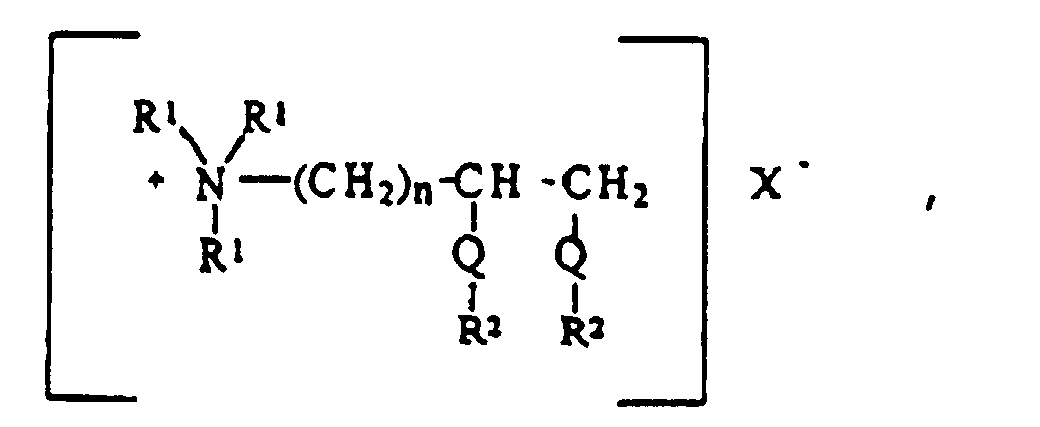
worin die Formel III
worin die Formel IV
- Zusammensetzung nach Anspruch 1, worin die quaternäre Ammoniumverbindung eine vollständig gesättigte Verbindung der Formel I ist, vorzugsweise Dimethylbis(talg-yl-oxyethyl)ammoniumnethylsulfat, welches aus gehärtetem Talg erhalten wird.
- Zusammensetzung nach Anspruch 1, worin die quaternäre Ammoniumverbindung von der Gruppe ausgewählt ist, welche aus Dimethylbis (oxyethyl) ammoniummethylsulfatderivaten von C8-C30-Fettsäuren; Dimethylbis(oleyloxyethyl)ammoniummethylsulfat; Dimethylbis(kokoyloxyethyl)ammoniummethylsulfat; 1,2-Bis(talg-yl-oxy)-3-trimethylammoniummethylsulfat; 1,2-Bis(oleyloxy)-3-trimethylammoniummethylsulfat; 1,2-Bis(kokoyloxy)-3-trimethylammoniummethylsulfat; N-Methyl-N,N-di-(β-C8-C30-acyloxyethyl), N-β-hydroxyethylammoniummethylsulfat; und Gemischen hievon besteht; vorzugsweise Dimethylbis (talg-yl-oxyethyl)ammoniummethylsulfat ist.
- Zusammensetzung nach Anspruch 3, worin der das Carbonsäuresalz ausbildende anionische Rest des Co-Weichmachers von der aus Laurinsäure, Myristinsäure, Palmitinsäure, Stearinsäure, Ölsäure und Gemischen hievon bestehenden Gruppe ausgewählt ist.
- Zusammensetzung nach Anspruch 4, worin der Co-Weichmacher von der Gruppe ausgewählt ist, welche aus Oleyldimethylaminstearat, Dioleylmethylaminstearat, Linoleyldimethylaminstearat, Dilinoleylmethylaminstearat, Stearyldimethylaminstearat, Distearylmethylaminmyristat, Stearyldimethylaminpalmitat, Distearylmethylaminpalmitat, Distearylmethylaminmyristat, Distearylmethylaminpalmitat, Distearylmethylaminlaurat, Dioleyldistearylmethylaminoleat, Distearylmethylaminoleat und Gemischen hievon besteht.
- Zusammensetzung nach Anspruch 5, worin der Co-Weichmacher ein Gemisch aus Oleyldimethylaminstearat und Distearylmethylaminmyristat in einem Gewichtsverhältnis von 1:10 bis 10:1 umfaßt.
- zusammensetzung nach Anspruch 6, worin die Zusammensetzung zusätzlich(A) 0 % bis 2 % von einem Stabilisator, welcher von der aus Ascorbinsäure, Ascorbinsäurepalmitat, Propylgallat, Zitronensäure, butyliertem Hydroxytoluol, tertiärem Butylhydrochinon, natürlichen Tocopherolen, butyliertem Hydroxyanisol und Gemischen hievon bestehenden Gruppe ausgewählt ist; und(B) 0 % bis 10 %, vorzugsweise 0,1 % bis 5 % von einem Schmutzlösepolymer umfaßt.
- Zusammensetzung nach Anspruch 1, umfassend:(A) 30 % bis 85 % einer quaternären Ammoniumverbindung, welche von der Gruppe ausgewählt ist, die aus Dimethylbis(talgyl-oxyethyl) ammoniummethylsulfat, Dimethylbis(oleyloxyethyl)ammmoniummethylsulfat, Dimethylbis(kokoyloxyethyl)ammoniummethylsulfat und Gemischen hievon besteht;(B) 20 % bis 75 % Oleyldimethylaminstearat, Distearylmethylaminmyristat und von Gemischen hievon, vorzugsweise einem Gemisch aus Oleyldimethylaminstearat und Distearylmethylaminmyristat in einem Gewichtsverhältnis von 1:10 bis 10:1; und(C) 15 % bis 40 % C10-C26-Acylsorbitanmonoester, C10-C26-Acylsorbitandiester und von Gemischen hievon;wobei die Zusammensetzung einen thermischen Erweichungspunkt von 35°C bis 100°C aufweist.
- Zusammensetzung nach Anepruch 8, worin der Acylsorbitanester von der aus Sorbitanmonooleat, Sorbitanmonostearat und Gemischen hievon bestehenden Gruppe ausgewählt ist.
- Zusammensetzung nach Anspruch 1 oder 8, worin das Verhältnis von A:B:C 5:3:2 beträgt.
Applications Claiming Priority (3)
| Application Number | Priority Date | Filing Date | Title |
|---|---|---|---|
| US10288093A | 1993-08-06 | 1993-08-06 | |
| US102880 | 1993-08-06 | ||
| PCT/US1994/008839 WO1995004802A1 (en) | 1993-08-06 | 1994-08-05 | Dryer-activated fabric conditioning and antistatic compositions containing biodegradable compounds having unsaturation |
Publications (2)
| Publication Number | Publication Date |
|---|---|
| EP0712435A1 EP0712435A1 (de) | 1996-05-22 |
| EP0712435B1 true EP0712435B1 (de) | 1997-11-12 |
Family
ID=22292164
Family Applications (1)
| Application Number | Title | Priority Date | Filing Date |
|---|---|---|---|
| EP94924583A Expired - Lifetime EP0712435B1 (de) | 1993-08-06 | 1994-08-05 | Trocken-aktivierte gewebekonditionierungs- und antistatische zusammensetzungen die biologisch abbaubare, ungesättigte verbindungen enthalten |
Country Status (7)
| Country | Link |
|---|---|
| US (1) | US5476599A (de) |
| EP (1) | EP0712435B1 (de) |
| JP (1) | JP3877760B2 (de) |
| AT (1) | ATE160167T1 (de) |
| CA (1) | CA2168875C (de) |
| DE (1) | DE69406797T2 (de) |
| WO (1) | WO1995004802A1 (de) |
Families Citing this family (40)
| Publication number | Priority date | Publication date | Assignee | Title |
|---|---|---|---|---|
| GB9406824D0 (en) * | 1994-04-07 | 1994-06-01 | Unilever Plc | Fabric softening composition |
| US5510042A (en) * | 1994-07-08 | 1996-04-23 | The Procter & Gamble Company | Fabric softening bar compositions containing fabric softener, nonionic phase mofifier and water |
| US5474691A (en) * | 1994-07-26 | 1995-12-12 | The Procter & Gamble Company | Dryer-added fabric treatment article of manufacture containing antioxidant and sunscreen compounds for sun fade protection of fabrics |
| US5503756A (en) * | 1994-09-20 | 1996-04-02 | The Procter & Gamble Company | Dryer-activated fabric conditioning compositions containing unsaturated fatty acid |
| GB9517432D0 (en) * | 1995-08-25 | 1995-10-25 | Unilever Plc | Fabric softening composition |
| US6169067B1 (en) | 1995-10-13 | 2001-01-02 | The Procter & Gamble Company | Dryer-activated fabric conditioning compositions with improved stability containing sugar derivatives |
| AU1693197A (en) * | 1996-01-05 | 1997-08-01 | Stepan Company | Articles and methods for treating fabrics based on acyloxyalkyl quaternary ammonium compositions |
| US6906025B2 (en) | 1996-01-05 | 2005-06-14 | Stepan Company | Articles and methods for treating fabrics based on acyloxyalkyl quaternary ammonium compositions |
| US5830843A (en) * | 1996-01-31 | 1998-11-03 | The Procter & Gamble Company | Fabric care compositions including dispersible polyolefin and method for using same |
| US5883069A (en) * | 1996-05-02 | 1999-03-16 | The Procter & Gamble Company | Dryer-activated fabric conditioning articles with improved substrate |
| US5916863A (en) | 1996-05-03 | 1999-06-29 | Akzo Nobel Nv | High di(alkyl fatty ester) quaternary ammonium compound from triethanol amine |
| US6494921B1 (en) | 2000-02-10 | 2002-12-17 | M. Catherine Bennett | Method of removing particulate debris, especially dust mite fecal material from fabric articles in a conventional clothes dryer |
| US20050014673A1 (en) * | 2002-06-24 | 2005-01-20 | Reemay, Inc. | Fabric softener dryer sheet substrate |
| US20060189497A1 (en) * | 2002-07-30 | 2006-08-24 | Earl Jenevein | Wood preservative |
| US7045492B2 (en) * | 2002-07-30 | 2006-05-16 | Earl Jenevein | Cleaning composition comprising cationic surfactants, chelant, and an alcohol solvent mixture |
| US7026274B2 (en) * | 2002-07-30 | 2006-04-11 | Earl Jenevein | Cleaning composition for neutralizing biological and chemical weapons removal agents |
| US6511950B1 (en) | 2002-07-30 | 2003-01-28 | Earl Jenevein | Cleaning composition comprising a salt, chelant, and polyvinyl alcohol |
| US20050109827A1 (en) * | 2003-11-24 | 2005-05-26 | Martin Chris L. | Dryer sheet and cleansing article dispensing cartons and die-cut blanks for making the same |
| BRPI0711721A2 (pt) * | 2006-05-31 | 2011-11-29 | Akzo Nobel Nv | composições detergentes aquosas para lavanderia tendo propriedades antiestáticas e amaciantes melhoradas |
| US7943566B2 (en) * | 2006-06-21 | 2011-05-17 | Wausau Paper Mills, Llc | Dryer sheet and methods for manufacturing and using a dryer sheet |
| US7947644B2 (en) * | 2006-09-26 | 2011-05-24 | Wausau Paper Mills, Llc | Dryer sheet and methods for manufacturing and using a dryer sheet |
| US7749952B2 (en) * | 2006-12-05 | 2010-07-06 | The Procter & Gamble Company | Fabric care compositions for softening, static control and fragrance benefits |
| CA2686129C (en) | 2007-06-15 | 2015-03-31 | Ecolab Inc. | Liquid fabric conditioner composition and method of use |
| US8338360B2 (en) | 2009-07-30 | 2012-12-25 | The Procter & Gamble Company | Fabric conditioning fabric care articles comprising a particulate lubricant agent |
| EP2529001B1 (de) | 2010-01-29 | 2018-09-19 | The Procter and Gamble Company | Neue lineare polydimethylsiloxan-polyether-copolymere mit amino- und/oder quaternären ammoniak-gruppen und verwendung davon |
| DE102010001350A1 (de) | 2010-01-29 | 2011-08-04 | Evonik Goldschmidt GmbH, 45127 | Neuartige lineare Polydimethylsiloxan-Polyether-Copolymere mit Amino- und/oder quaternären Ammoniumgruppen und deren Verwendung |
| US20110201532A1 (en) | 2010-02-12 | 2011-08-18 | Jennifer Beth Ponder | Benefit compositions comprising crosslinked polyglycerol esters |
| US20110201534A1 (en) | 2010-02-12 | 2011-08-18 | Jennifer Beth Ponder | Benefit compositions comprising polyglycerol esters |
| WO2011100411A1 (en) | 2010-02-12 | 2011-08-18 | The Procter & Gamble Company | Benefit compositions comprising polyglycerol esters |
| US20110201537A1 (en) | 2010-02-12 | 2011-08-18 | Jennifer Beth Ponder | Benefit compositions comprising crosslinked polyglycerol esters |
| US8232239B2 (en) * | 2010-03-09 | 2012-07-31 | Ecolab Usa Inc. | Liquid concentrated fabric softener composition |
| MX2012012340A (es) * | 2010-04-28 | 2012-11-21 | Evonik Degussa Gmbh | Composicion suavizante de telas. |
| US8673838B2 (en) | 2011-06-22 | 2014-03-18 | Ecolab Usa Inc. | Solid concentrated fabric softener composition |
| KR101694599B1 (ko) | 2012-05-07 | 2017-01-09 | 에보니크 데구사 게엠베하 | 섬유 유연제 활성 조성물 및 그의 제조 방법 |
| BR102014025172B1 (pt) | 2013-11-05 | 2020-03-03 | Evonik Degussa Gmbh | Método para fabricação de um éster de ácido graxo de metisulfato de tris-(2-hidroxietil)-metilamônio, e composição ativa de amaciante de roupa |
| UA119182C2 (uk) | 2014-10-08 | 2019-05-10 | Евонік Дегусса Гмбх | Активна композиція для пом'якшувача тканини |
| US9725679B2 (en) | 2014-11-21 | 2017-08-08 | Ecolab Usa Inc. | Compositions to boost fabric softener performance |
| US9506015B2 (en) | 2014-11-21 | 2016-11-29 | Ecolab Usa Inc. | Compositions to boost fabric softener performance |
| US9688945B2 (en) | 2014-11-21 | 2017-06-27 | Ecolab Usa Inc. | Compositions to boost fabric softener performance |
| US10221380B2 (en) | 2016-04-01 | 2019-03-05 | The Procter & Gamble Company | Dryer-activated fabric conditioning products having frangible boundaries and methods |
Family Cites Families (17)
| Publication number | Priority date | Publication date | Assignee | Title |
|---|---|---|---|---|
| GB1567947A (en) * | 1976-07-02 | 1980-05-21 | Unilever Ltd | Esters of quaternised amino-alcohols for treating fabrics |
| US4237155A (en) * | 1979-04-30 | 1980-12-02 | The Procter & Gamble Company | Articles and methods for treating fabrics |
| DE3271167D1 (en) * | 1981-09-11 | 1986-06-19 | Procter & Gamble | Fabric softening detergent additive products and use thereof in detergent compositions |
| GB2188653A (en) * | 1986-04-02 | 1987-10-07 | Procter & Gamble | Biodegradable fabric softeners |
| DE3877422T2 (de) * | 1987-05-01 | 1993-05-13 | Procter & Gamble | Quaternaere isopropylesterammonium-verbindungen als faser- und gewebebehandlungsmittel. |
| JPH01229877A (ja) * | 1988-03-04 | 1989-09-13 | Lion Corp | 液体柔軟剤組成物 |
| DE3818013A1 (de) * | 1988-05-27 | 1989-11-30 | Henkel Kgaa | Gewebeweichmachungsmittel |
| US5102564A (en) * | 1989-04-12 | 1992-04-07 | The Procter & Gamble Company | Treatment of fabric with perfume/cyclodextrin complexes |
| US4970008A (en) * | 1988-12-20 | 1990-11-13 | Kandathil Thomas V | Fabric conditioner comprising a mixture of quaternary ammonium compounds and select tertiary amines |
| US5066414A (en) * | 1989-03-06 | 1991-11-19 | The Procter & Gamble Co. | Stable biodegradable fabric softening compositions containing linear alkoxylated alcohols |
| US5094761A (en) * | 1989-04-12 | 1992-03-10 | The Procter & Gamble Company | Treatment of fabric with perfume/cyclodextrin complexes |
| GB8914054D0 (en) * | 1989-06-19 | 1989-08-09 | Unilever Plc | Fabric softening composition |
| GB8916307D0 (en) * | 1989-07-17 | 1989-08-31 | Unilever Plc | Fabric softening composition |
| US5139687A (en) * | 1990-05-09 | 1992-08-18 | The Proctor & Gamble Company | Non-destructive carriers for cyclodextrin complexes |
| US5080810A (en) * | 1991-02-08 | 1992-01-14 | Ethyl Corporation | Fabric softener for laundry dryer sheet |
| GB9114540D0 (en) * | 1991-07-05 | 1991-08-21 | Unilever Plc | Fabric softening composition |
| US5236615A (en) * | 1991-08-28 | 1993-08-17 | The Procter & Gamble Company | Solid, particulate detergent composition with protected, dryer-activated, water sensitive material |
-
1994
- 1994-08-05 JP JP50652895A patent/JP3877760B2/ja not_active Expired - Fee Related
- 1994-08-05 EP EP94924583A patent/EP0712435B1/de not_active Expired - Lifetime
- 1994-08-05 WO PCT/US1994/008839 patent/WO1995004802A1/en not_active Ceased
- 1994-08-05 AT AT94924583T patent/ATE160167T1/de not_active IP Right Cessation
- 1994-08-05 CA CA002168875A patent/CA2168875C/en not_active Expired - Lifetime
- 1994-08-05 DE DE69406797T patent/DE69406797T2/de not_active Expired - Fee Related
- 1994-12-15 US US08/358,032 patent/US5476599A/en not_active Expired - Lifetime
Also Published As
| Publication number | Publication date |
|---|---|
| CA2168875A1 (en) | 1995-02-16 |
| ATE160167T1 (de) | 1997-11-15 |
| DE69406797D1 (de) | 1997-12-18 |
| EP0712435A1 (de) | 1996-05-22 |
| US5476599A (en) | 1995-12-19 |
| JP3877760B2 (ja) | 2007-02-07 |
| JPH09501198A (ja) | 1997-02-04 |
| CA2168875C (en) | 1999-09-14 |
| WO1995004802A1 (en) | 1995-02-16 |
| DE69406797T2 (de) | 1998-06-10 |
Similar Documents
| Publication | Publication Date | Title |
|---|---|---|
| US5476599A (en) | Dryer-activated fabric conditioning and antistatic compositions containing biodegradable compounds having unsaturation | |
| US5376287A (en) | Dryer-activated fabric conditioning compositions containing ethoxylated/propoxylated sugar derivatives | |
| US5578234A (en) | Dryer-activated fabric conditioning compositions containing unsaturated fatty acid | |
| EP0843717B1 (de) | Trockner aktivierte gewebekonditionierungs- und antistatische zusammensetzungen mit verbesserter lebensdauer von riechstoffen | |
| US5562847A (en) | Dryer-activated fabric conditioning and antistatic compositions with improved perfume longevity | |
| US5929026A (en) | Dryer-activated fabricated conditioning articles with improved substrate | |
| US5470492A (en) | Dryer-activated fabric conditioning articles with soft polyester substrate | |
| US5733855A (en) | Dryer-added fabric treatment article of manufacture containing antioxidant and sunscreen compounds for sun fade protection of fabrics | |
| EP0970177B1 (de) | Trockneraktivierte wäschezusatzzusammensetzungen mit farbe-schützenden mitteln | |
| US5716918A (en) | Sulfonate perfumes for dryer-activated fabric conditioning and antistatic compositions | |
| US6169067B1 (en) | Dryer-activated fabric conditioning compositions with improved stability containing sugar derivatives | |
| EP0712441B1 (de) | Trockneraktivierte wäscheweichmacherzusammensetzungen enthaltend ethoxylierte/propoxylierte zückerderivate | |
| CA2233041C (en) | Dryer-activated fabric conditioning articles with improved substrate | |
| MXPA99008011A (en) | Dryer-activated laundry additive compositions with color care agents |
Legal Events
| Date | Code | Title | Description |
|---|---|---|---|
| PUAI | Public reference made under article 153(3) epc to a published international application that has entered the european phase |
Free format text: ORIGINAL CODE: 0009012 |
|
| 17P | Request for examination filed |
Effective date: 19960215 |
|
| AK | Designated contracting states |
Kind code of ref document: A1 Designated state(s): AT DE FR GB IE SE |
|
| 17Q | First examination report despatched |
Effective date: 19960509 |
|
| GRAG | Despatch of communication of intention to grant |
Free format text: ORIGINAL CODE: EPIDOS AGRA |
|
| GRAH | Despatch of communication of intention to grant a patent |
Free format text: ORIGINAL CODE: EPIDOS IGRA |
|
| GRAH | Despatch of communication of intention to grant a patent |
Free format text: ORIGINAL CODE: EPIDOS IGRA |
|
| RBV | Designated contracting states (corrected) |
Designated state(s): AT DE FR GB IE SE |
|
| GRAH | Despatch of communication of intention to grant a patent |
Free format text: ORIGINAL CODE: EPIDOS IGRA |
|
| GRAA | (expected) grant |
Free format text: ORIGINAL CODE: 0009210 |
|
| AK | Designated contracting states |
Kind code of ref document: B1 Designated state(s): AT DE FR GB IE SE |
|
| REF | Corresponds to: |
Ref document number: 160167 Country of ref document: AT Date of ref document: 19971115 Kind code of ref document: T |
|
| REF | Corresponds to: |
Ref document number: 69406797 Country of ref document: DE Date of ref document: 19971218 |
|
| ET | Fr: translation filed | ||
| PLBE | No opposition filed within time limit |
Free format text: ORIGINAL CODE: 0009261 |
|
| STAA | Information on the status of an ep patent application or granted ep patent |
Free format text: STATUS: NO OPPOSITION FILED WITHIN TIME LIMIT |
|
| 26N | No opposition filed | ||
| PGFP | Annual fee paid to national office [announced via postgrant information from national office to epo] |
Ref country code: IE Payment date: 19990714 Year of fee payment: 6 |
|
| PG25 | Lapsed in a contracting state [announced via postgrant information from national office to epo] |
Ref country code: IE Free format text: LAPSE BECAUSE OF NON-PAYMENT OF DUE FEES Effective date: 20000805 |
|
| REG | Reference to a national code |
Ref country code: IE Ref legal event code: MM4A |
|
| PGFP | Annual fee paid to national office [announced via postgrant information from national office to epo] |
Ref country code: AT Payment date: 20010629 Year of fee payment: 8 |
|
| PGFP | Annual fee paid to national office [announced via postgrant information from national office to epo] |
Ref country code: SE Payment date: 20010803 Year of fee payment: 8 |
|
| REG | Reference to a national code |
Ref country code: GB Ref legal event code: IF02 |
|
| PG25 | Lapsed in a contracting state [announced via postgrant information from national office to epo] |
Ref country code: AT Free format text: LAPSE BECAUSE OF NON-PAYMENT OF DUE FEES Effective date: 20020805 |
|
| PG25 | Lapsed in a contracting state [announced via postgrant information from national office to epo] |
Ref country code: SE Free format text: LAPSE BECAUSE OF NON-PAYMENT OF DUE FEES Effective date: 20020806 |
|
| EUG | Se: european patent has lapsed | ||
| PGFP | Annual fee paid to national office [announced via postgrant information from national office to epo] |
Ref country code: DE Payment date: 20080829 Year of fee payment: 15 |
|
| PGFP | Annual fee paid to national office [announced via postgrant information from national office to epo] |
Ref country code: FR Payment date: 20080807 Year of fee payment: 15 |
|
| PGFP | Annual fee paid to national office [announced via postgrant information from national office to epo] |
Ref country code: GB Payment date: 20080708 Year of fee payment: 15 |
|
| GBPC | Gb: european patent ceased through non-payment of renewal fee |
Effective date: 20090805 |
|
| REG | Reference to a national code |
Ref country code: FR Ref legal event code: ST Effective date: 20100430 |
|
| PG25 | Lapsed in a contracting state [announced via postgrant information from national office to epo] |
Ref country code: FR Free format text: LAPSE BECAUSE OF NON-PAYMENT OF DUE FEES Effective date: 20090831 Ref country code: DE Free format text: LAPSE BECAUSE OF NON-PAYMENT OF DUE FEES Effective date: 20100302 |
|
| PG25 | Lapsed in a contracting state [announced via postgrant information from national office to epo] |
Ref country code: GB Free format text: LAPSE BECAUSE OF NON-PAYMENT OF DUE FEES Effective date: 20090805 |