EP0702011A1 - Wasserlösliche Piperidin-Triazinverbindungen und ihre Verwendung zur Stabilisierung von Polyamidfasern - Google Patents
Wasserlösliche Piperidin-Triazinverbindungen und ihre Verwendung zur Stabilisierung von Polyamidfasern Download PDFInfo
- Publication number
- EP0702011A1 EP0702011A1 EP95810518A EP95810518A EP0702011A1 EP 0702011 A1 EP0702011 A1 EP 0702011A1 EP 95810518 A EP95810518 A EP 95810518A EP 95810518 A EP95810518 A EP 95810518A EP 0702011 A1 EP0702011 A1 EP 0702011A1
- Authority
- EP
- European Patent Office
- Prior art keywords
- alkyl
- substituted
- unsubstituted
- phenyl
- halogen
- Prior art date
- Legal status (The legal status is an assumption and is not a legal conclusion. Google has not performed a legal analysis and makes no representation as to the accuracy of the status listed.)
- Granted
Links
- 239000004952 Polyamide Substances 0.000 title claims description 20
- 229920002647 polyamide Polymers 0.000 title claims description 20
- 239000000835 fiber Substances 0.000 title description 10
- XLYOFNOQVPJJNP-UHFFFAOYSA-N water Substances O XLYOFNOQVPJJNP-UHFFFAOYSA-N 0.000 title description 6
- 239000003381 stabilizer Substances 0.000 title description 3
- YPSLATCYOGSFDU-UHFFFAOYSA-N piperidine;triazine Chemical class C1CCNCC1.C1=CN=NN=C1 YPSLATCYOGSFDU-UHFFFAOYSA-N 0.000 title 1
- -1 phenylsulphonyl Chemical group 0.000 claims abstract description 77
- 229910052736 halogen Inorganic materials 0.000 claims abstract description 32
- 150000002367 halogens Chemical class 0.000 claims abstract description 32
- 125000002887 hydroxy group Chemical group [H]O* 0.000 claims abstract description 27
- 125000001997 phenyl group Chemical group [H]C1=C([H])C([H])=C(*)C([H])=C1[H] 0.000 claims abstract description 25
- 125000003178 carboxy group Chemical group [H]OC(*)=O 0.000 claims abstract description 19
- 125000000217 alkyl group Chemical group 0.000 claims abstract description 17
- 125000003545 alkoxy group Chemical group 0.000 claims abstract description 16
- 125000003236 benzoyl group Chemical group [H]C1=C([H])C([H])=C(C([H])=C1[H])C(*)=O 0.000 claims abstract description 16
- 125000001589 carboacyl group Chemical group 0.000 claims abstract description 13
- 239000002657 fibrous material Substances 0.000 claims abstract description 12
- QGZKDVFQNNGYKY-UHFFFAOYSA-O Ammonium Chemical compound [NH4+] QGZKDVFQNNGYKY-UHFFFAOYSA-O 0.000 claims abstract description 9
- 125000000000 cycloalkoxy group Chemical group 0.000 claims abstract description 8
- 125000002924 primary amino group Chemical group [H]N([H])* 0.000 claims abstract description 8
- 125000005504 styryl group Chemical group 0.000 claims abstract description 7
- 125000003917 carbamoyl group Chemical group [H]N([H])C(*)=O 0.000 claims abstract description 6
- 125000001797 benzyl group Chemical group [H]C1=C([H])C([H])=C(C([H])=C1[H])C([H])([H])* 0.000 claims abstract description 5
- 125000003302 alkenyloxy group Chemical group 0.000 claims abstract description 4
- 125000004414 alkyl thio group Chemical group 0.000 claims abstract description 4
- 125000001951 carbamoylamino group Chemical group C(N)(=O)N* 0.000 claims abstract description 4
- 125000005366 cycloalkylthio group Chemical group 0.000 claims abstract description 4
- 125000003356 phenylsulfanyl group Chemical group [*]SC1=C([H])C([H])=C([H])C([H])=C1[H] 0.000 claims abstract description 4
- 125000006527 (C1-C5) alkyl group Chemical group 0.000 claims description 36
- 150000001875 compounds Chemical class 0.000 claims description 25
- 239000001257 hydrogen Substances 0.000 claims description 24
- 229910052739 hydrogen Inorganic materials 0.000 claims description 24
- 150000003918 triazines Chemical class 0.000 claims description 23
- 238000000034 method Methods 0.000 claims description 17
- 125000004435 hydrogen atom Chemical group [H]* 0.000 claims description 15
- 125000006729 (C2-C5) alkenyl group Chemical group 0.000 claims description 11
- 238000004043 dyeing Methods 0.000 claims description 11
- 238000006243 chemical reaction Methods 0.000 claims description 9
- PAYRUJLWNCNPSJ-UHFFFAOYSA-N Aniline Chemical compound NC1=CC=CC=C1 PAYRUJLWNCNPSJ-UHFFFAOYSA-N 0.000 claims description 6
- 125000003170 phenylsulfonyl group Chemical group C1(=CC=CC=C1)S(=O)(=O)* 0.000 claims description 6
- NQRYJNQNLNOLGT-UHFFFAOYSA-N tetrahydropyridine hydrochloride Natural products C1CCNCC1 NQRYJNQNLNOLGT-UHFFFAOYSA-N 0.000 claims description 6
- 125000003277 amino group Chemical group 0.000 claims description 5
- 125000002490 anilino group Chemical group [H]N(*)C1=C([H])C([H])=C([H])C([H])=C1[H] 0.000 claims description 5
- 125000002496 methyl group Chemical group [H]C([H])([H])* 0.000 claims description 5
- 230000006641 stabilisation Effects 0.000 claims description 5
- 238000011105 stabilization Methods 0.000 claims description 5
- 125000001424 substituent group Chemical group 0.000 claims description 5
- 125000004178 (C1-C4) alkyl group Chemical group 0.000 claims description 4
- UFHFLCQGNIYNRP-UHFFFAOYSA-N Hydrogen Chemical compound [H][H] UFHFLCQGNIYNRP-UHFFFAOYSA-N 0.000 claims description 4
- 125000006310 cycloalkyl amino group Chemical group 0.000 claims description 4
- 125000001495 ethyl group Chemical group [H]C([H])([H])C([H])([H])* 0.000 claims description 4
- 238000002360 preparation method Methods 0.000 claims description 4
- CIUQDSCDWFSTQR-UHFFFAOYSA-N [C]1=CC=CC=C1 Chemical compound [C]1=CC=CC=C1 CIUQDSCDWFSTQR-UHFFFAOYSA-N 0.000 claims description 3
- 229910052783 alkali metal Inorganic materials 0.000 claims description 3
- 150000001340 alkali metals Chemical class 0.000 claims description 3
- 229910052784 alkaline earth metal Inorganic materials 0.000 claims description 3
- 150000001342 alkaline earth metals Chemical class 0.000 claims description 3
- 125000005236 alkanoylamino group Chemical group 0.000 claims description 3
- 125000004093 cyano group Chemical group *C#N 0.000 claims description 3
- 125000000449 nitro group Chemical group [O-][N+](*)=O 0.000 claims description 3
- 125000004430 oxygen atom Chemical group O* 0.000 claims description 3
- 125000002023 trifluoromethyl group Chemical group FC(F)(F)* 0.000 claims description 3
- ISWSIDIOOBJBQZ-UHFFFAOYSA-M phenolate Chemical compound [O-]C1=CC=CC=C1 ISWSIDIOOBJBQZ-UHFFFAOYSA-M 0.000 claims description 2
- 229940031826 phenolate Drugs 0.000 claims description 2
- 125000000587 piperidin-1-yl group Chemical group [H]C1([H])N(*)C([H])([H])C([H])([H])C([H])([H])C1([H])[H] 0.000 claims description 2
- 150000002431 hydrogen Chemical group 0.000 claims 5
- 125000000484 butyl group Chemical group [H]C([*])([H])C([H])([H])C([H])([H])C([H])([H])[H] 0.000 claims 1
- 125000003342 alkenyl group Chemical group 0.000 abstract 3
- JYEUMXHLPRZUAT-UHFFFAOYSA-N 1,2,3-triazine Chemical compound C1=CN=NN=C1 JYEUMXHLPRZUAT-UHFFFAOYSA-N 0.000 abstract 1
- 239000003513 alkali Substances 0.000 abstract 1
- 125000004453 alkoxycarbonyl group Chemical group 0.000 abstract 1
- 125000004390 alkyl sulfonyl group Chemical group 0.000 abstract 1
- RTZKZFJDLAIYFH-UHFFFAOYSA-N ether Substances CCOCC RTZKZFJDLAIYFH-UHFFFAOYSA-N 0.000 abstract 1
- 239000002184 metal Substances 0.000 abstract 1
- 125000004573 morpholin-4-yl group Chemical group N1(CCOCC1)* 0.000 abstract 1
- 125000000951 phenoxy group Chemical group [H]C1=C([H])C([H])=C(O*)C([H])=C1[H] 0.000 abstract 1
- 125000003944 tolyl group Chemical group 0.000 abstract 1
- 239000000243 solution Substances 0.000 description 16
- FAPWRFPIFSIZLT-UHFFFAOYSA-M Sodium chloride Chemical compound [Na+].[Cl-] FAPWRFPIFSIZLT-UHFFFAOYSA-M 0.000 description 10
- 239000000975 dye Substances 0.000 description 10
- 239000000463 material Substances 0.000 description 7
- 239000011541 reaction mixture Substances 0.000 description 7
- VEXZGXHMUGYJMC-UHFFFAOYSA-N Hydrochloric acid Chemical compound Cl VEXZGXHMUGYJMC-UHFFFAOYSA-N 0.000 description 6
- CDBYLPFSWZWCQE-UHFFFAOYSA-L Sodium Carbonate Chemical compound [Na+].[Na+].[O-]C([O-])=O CDBYLPFSWZWCQE-UHFFFAOYSA-L 0.000 description 6
- HEMHJVSKTPXQMS-UHFFFAOYSA-M Sodium hydroxide Chemical compound [OH-].[Na+] HEMHJVSKTPXQMS-UHFFFAOYSA-M 0.000 description 6
- 239000011780 sodium chloride Substances 0.000 description 5
- FTVFPPFZRRKJIH-UHFFFAOYSA-N 2,2,6,6-tetramethylpiperidin-4-amine Chemical compound CC1(C)CC(N)CC(C)(C)N1 FTVFPPFZRRKJIH-UHFFFAOYSA-N 0.000 description 4
- 125000003903 2-propenyl group Chemical group [H]C([*])([H])C([H])=C([H])[H] 0.000 description 4
- 125000002777 acetyl group Chemical group [H]C([H])([H])C(*)=O 0.000 description 4
- 125000002485 formyl group Chemical group [H]C(*)=O 0.000 description 4
- FDAKZQLBIFPGSV-UHFFFAOYSA-N n-butyl-2,2,6,6-tetramethylpiperidin-4-amine Chemical compound CCCCNC1CC(C)(C)NC(C)(C)C1 FDAKZQLBIFPGSV-UHFFFAOYSA-N 0.000 description 4
- 125000001501 propionyl group Chemical group O=C([*])C([H])([H])C([H])([H])[H] 0.000 description 4
- 239000007858 starting material Substances 0.000 description 4
- LFNDYJSTRUOHKX-UHFFFAOYSA-N 2-[(4,6-dichloro-1,3,5-triazin-2-yl)amino]benzene-1,4-disulfonic acid Chemical compound OS(=O)(=O)C1=CC=C(S(O)(=O)=O)C(NC=2N=C(Cl)N=C(Cl)N=2)=C1 LFNDYJSTRUOHKX-UHFFFAOYSA-N 0.000 description 3
- QTBSBXVTEAMEQO-UHFFFAOYSA-N Acetic acid Chemical compound CC(O)=O QTBSBXVTEAMEQO-UHFFFAOYSA-N 0.000 description 3
- ZMANZCXQSJIPKH-UHFFFAOYSA-N Triethylamine Chemical compound CCN(CC)CC ZMANZCXQSJIPKH-UHFFFAOYSA-N 0.000 description 3
- 239000004744 fabric Substances 0.000 description 3
- 125000000959 isobutyl group Chemical group [H]C([H])([H])C([H])(C([H])([H])[H])C([H])([H])* 0.000 description 3
- 125000001972 isopentyl group Chemical group [H]C([H])([H])C([H])(C([H])([H])[H])C([H])([H])C([H])([H])* 0.000 description 3
- 125000001449 isopropyl group Chemical group [H]C([H])([H])C([H])(*)C([H])([H])[H] 0.000 description 3
- 239000000203 mixture Substances 0.000 description 3
- 125000004108 n-butyl group Chemical group [H]C([H])([H])C([H])([H])C([H])([H])C([H])([H])* 0.000 description 3
- 125000000740 n-pentyl group Chemical group [H]C([H])([H])C([H])([H])C([H])([H])C([H])([H])C([H])([H])* 0.000 description 3
- 125000004123 n-propyl group Chemical group [H]C([H])([H])C([H])([H])C([H])([H])* 0.000 description 3
- 239000000843 powder Substances 0.000 description 3
- 239000002244 precipitate Substances 0.000 description 3
- 125000002914 sec-butyl group Chemical group [H]C([H])([H])C([H])([H])C([H])(*)C([H])([H])[H] 0.000 description 3
- 239000011734 sodium Substances 0.000 description 3
- 229910000029 sodium carbonate Inorganic materials 0.000 description 3
- 125000000999 tert-butyl group Chemical group [H]C([H])([H])C(*)(C([H])([H])[H])C([H])([H])[H] 0.000 description 3
- IJGRMHOSHXDMSA-UHFFFAOYSA-N Atomic nitrogen Chemical compound N#N IJGRMHOSHXDMSA-UHFFFAOYSA-N 0.000 description 2
- WKBOTKDWSSQWDR-UHFFFAOYSA-N Bromine atom Chemical compound [Br] WKBOTKDWSSQWDR-UHFFFAOYSA-N 0.000 description 2
- ZAMOUSCENKQFHK-UHFFFAOYSA-N Chlorine atom Chemical compound [Cl] ZAMOUSCENKQFHK-UHFFFAOYSA-N 0.000 description 2
- PXGOKWXKJXAPGV-UHFFFAOYSA-N Fluorine Chemical compound FF PXGOKWXKJXAPGV-UHFFFAOYSA-N 0.000 description 2
- 229920002292 Nylon 6 Polymers 0.000 description 2
- 229910019142 PO4 Inorganic materials 0.000 description 2
- 229910000288 alkali metal carbonate Inorganic materials 0.000 description 2
- 150000008041 alkali metal carbonates Chemical class 0.000 description 2
- 125000005336 allyloxy group Chemical group 0.000 description 2
- 150000001412 amines Chemical class 0.000 description 2
- GDTBXPJZTBHREO-UHFFFAOYSA-N bromine Substances BrBr GDTBXPJZTBHREO-UHFFFAOYSA-N 0.000 description 2
- 229910052794 bromium Inorganic materials 0.000 description 2
- 125000004369 butenyl group Chemical group C(=CCC)* 0.000 description 2
- 239000000460 chlorine Substances 0.000 description 2
- 229910052801 chlorine Inorganic materials 0.000 description 2
- 238000004040 coloring Methods 0.000 description 2
- 238000009833 condensation Methods 0.000 description 2
- 230000005494 condensation Effects 0.000 description 2
- 238000010924 continuous production Methods 0.000 description 2
- 239000006185 dispersion Substances 0.000 description 2
- 229910052731 fluorine Inorganic materials 0.000 description 2
- 239000011737 fluorine Substances 0.000 description 2
- 238000010438 heat treatment Methods 0.000 description 2
- RZXMPPFPUUCRFN-UHFFFAOYSA-N p-toluidine Chemical compound CC1=CC=C(N)C=C1 RZXMPPFPUUCRFN-UHFFFAOYSA-N 0.000 description 2
- NBIIXXVUZAFLBC-UHFFFAOYSA-K phosphate Chemical compound [O-]P([O-])([O-])=O NBIIXXVUZAFLBC-UHFFFAOYSA-K 0.000 description 2
- 239000010452 phosphate Substances 0.000 description 2
- 238000003756 stirring Methods 0.000 description 2
- 125000000391 vinyl group Chemical group [H]C([*])=C([H])[H] 0.000 description 2
- 229920002554 vinyl polymer Polymers 0.000 description 2
- RYHBNJHYFVUHQT-UHFFFAOYSA-N 1,4-Dioxane Chemical compound C1COCCO1 RYHBNJHYFVUHQT-UHFFFAOYSA-N 0.000 description 1
- RXELBMYKBFKHSM-UHFFFAOYSA-N 2-phenyl-1,3,5-triazine Chemical compound C1=CC=CC=C1C1=NC=NC=N1 RXELBMYKBFKHSM-UHFFFAOYSA-N 0.000 description 1
- 125000000094 2-phenylethyl group Chemical group [H]C1=C([H])C([H])=C(C([H])=C1[H])C([H])([H])C([H])([H])* 0.000 description 1
- KVFQMAZOBTXCAZ-UHFFFAOYSA-N 3,4-Hexanedione Chemical group CCC(=O)C(=O)CC KVFQMAZOBTXCAZ-UHFFFAOYSA-N 0.000 description 1
- VHUUQVKOLVNVRT-UHFFFAOYSA-N Ammonium hydroxide Chemical compound [NH4+].[OH-] VHUUQVKOLVNVRT-UHFFFAOYSA-N 0.000 description 1
- AWLMDMPNRVGHAU-UHFFFAOYSA-N CC(C)(C1)NC(C)(C)CC1N(C)c1nc(Nc2ccc(C)cc2)nc(Nc(cc(cc2)S(O)(=O)=O)c2S(O)(=O)=O)n1 Chemical compound CC(C)(C1)NC(C)(C)CC1N(C)c1nc(Nc2ccc(C)cc2)nc(Nc(cc(cc2)S(O)(=O)=O)c2S(O)(=O)=O)n1 AWLMDMPNRVGHAU-UHFFFAOYSA-N 0.000 description 1
- FTCSJUKZCPZUSE-UHFFFAOYSA-N CC(C)(C1)NC(C)(C)CC1N(C)c1nc(Nc2ccccc2)nc(Nc(cc(cc2)S(O)(=O)=O)c2S(O)(=O)=O)n1 Chemical compound CC(C)(C1)NC(C)(C)CC1N(C)c1nc(Nc2ccccc2)nc(Nc(cc(cc2)S(O)(=O)=O)c2S(O)(=O)=O)n1 FTCSJUKZCPZUSE-UHFFFAOYSA-N 0.000 description 1
- NKOAJMXEMBTJQH-UHFFFAOYSA-N CC(C)(C1)NC(C)(C)CC1Nc1nc(Nc2ccccc2)nc(Nc(cc(cc2)S(O)(=O)=O)c2S(O)(=O)=O)n1 Chemical compound CC(C)(C1)NC(C)(C)CC1Nc1nc(Nc2ccccc2)nc(Nc(cc(cc2)S(O)(=O)=O)c2S(O)(=O)=O)n1 NKOAJMXEMBTJQH-UHFFFAOYSA-N 0.000 description 1
- 0 CC1(C)N(*)C(C)(C)CC(*)C1 Chemical compound CC1(C)N(*)C(C)(C)CC(*)C1 0.000 description 1
- OYPRJOBELJOOCE-UHFFFAOYSA-N Calcium Chemical compound [Ca] OYPRJOBELJOOCE-UHFFFAOYSA-N 0.000 description 1
- VYZAMTAEIAYCRO-UHFFFAOYSA-N Chromium Chemical compound [Cr] VYZAMTAEIAYCRO-UHFFFAOYSA-N 0.000 description 1
- QSJXEFYPDANLFS-UHFFFAOYSA-N Diacetyl Chemical group CC(=O)C(C)=O QSJXEFYPDANLFS-UHFFFAOYSA-N 0.000 description 1
- DGAQECJNVWCQMB-PUAWFVPOSA-M Ilexoside XXIX Chemical compound C[C@@H]1CC[C@@]2(CC[C@@]3(C(=CC[C@H]4[C@]3(CC[C@@H]5[C@@]4(CC[C@@H](C5(C)C)OS(=O)(=O)[O-])C)C)[C@@H]2[C@]1(C)O)C)C(=O)O[C@H]6[C@@H]([C@H]([C@@H]([C@H](O6)CO)O)O)O.[Na+] DGAQECJNVWCQMB-PUAWFVPOSA-M 0.000 description 1
- WHXSMMKQMYFTQS-UHFFFAOYSA-N Lithium Chemical compound [Li] WHXSMMKQMYFTQS-UHFFFAOYSA-N 0.000 description 1
- AFBPFSWMIHJQDM-UHFFFAOYSA-N N-methyl-N-phenylamine Natural products CNC1=CC=CC=C1 AFBPFSWMIHJQDM-UHFFFAOYSA-N 0.000 description 1
- 229920000299 Nylon 12 Polymers 0.000 description 1
- 229920002302 Nylon 6,6 Polymers 0.000 description 1
- NPYPAHLBTDXSSS-UHFFFAOYSA-N Potassium ion Chemical compound [K+] NPYPAHLBTDXSSS-UHFFFAOYSA-N 0.000 description 1
- FKNQFGJONOIPTF-UHFFFAOYSA-N Sodium cation Chemical compound [Na+] FKNQFGJONOIPTF-UHFFFAOYSA-N 0.000 description 1
- 229920002334 Spandex Polymers 0.000 description 1
- 239000002253 acid Substances 0.000 description 1
- 239000000980 acid dye Substances 0.000 description 1
- 239000000654 additive Substances 0.000 description 1
- 150000008044 alkali metal hydroxides Chemical class 0.000 description 1
- 229910001413 alkali metal ion Inorganic materials 0.000 description 1
- 229910001420 alkaline earth metal ion Inorganic materials 0.000 description 1
- QGZKDVFQNNGYKY-UHFFFAOYSA-N ammonia Natural products N QGZKDVFQNNGYKY-UHFFFAOYSA-N 0.000 description 1
- 239000007864 aqueous solution Substances 0.000 description 1
- 239000007900 aqueous suspension Substances 0.000 description 1
- 239000002585 base Substances 0.000 description 1
- 125000004063 butyryl group Chemical group O=C([*])C([H])([H])C([H])([H])C([H])([H])[H] 0.000 description 1
- 229910052791 calcium Inorganic materials 0.000 description 1
- 239000011575 calcium Substances 0.000 description 1
- BVKZGUZCCUSVTD-UHFFFAOYSA-N carbonic acid Chemical class OC(O)=O BVKZGUZCCUSVTD-UHFFFAOYSA-N 0.000 description 1
- 125000002057 carboxymethyl group Chemical group [H]OC(=O)C([H])([H])[*] 0.000 description 1
- 239000007795 chemical reaction product Substances 0.000 description 1
- 229910052804 chromium Inorganic materials 0.000 description 1
- 239000011651 chromium Substances 0.000 description 1
- 150000004700 cobalt complex Chemical class 0.000 description 1
- 238000006482 condensation reaction Methods 0.000 description 1
- MGNCLNQXLYJVJD-UHFFFAOYSA-N cyanuric chloride Chemical compound ClC1=NC(Cl)=NC(Cl)=N1 MGNCLNQXLYJVJD-UHFFFAOYSA-N 0.000 description 1
- 125000002933 cyclohexyloxy group Chemical group C1(CCCCC1)O* 0.000 description 1
- 230000001419 dependent effect Effects 0.000 description 1
- 125000004915 dibutylamino group Chemical group C(CCC)N(CCCC)* 0.000 description 1
- 239000000839 emulsion Substances 0.000 description 1
- LEQAOMBKQFMDFZ-UHFFFAOYSA-N glyoxal Chemical group O=CC=O LEQAOMBKQFMDFZ-UHFFFAOYSA-N 0.000 description 1
- 229910052744 lithium Inorganic materials 0.000 description 1
- 229910052749 magnesium Inorganic materials 0.000 description 1
- 239000011777 magnesium Substances 0.000 description 1
- 239000000434 metal complex dye Substances 0.000 description 1
- 125000000250 methylamino group Chemical group [H]N(*)C([H])([H])[H] 0.000 description 1
- 238000002156 mixing Methods 0.000 description 1
- GMIARZNQLSJFCP-UHFFFAOYSA-N n,2,2,6,6-pentamethylpiperidin-4-amine Chemical compound CNC1CC(C)(C)NC(C)(C)C1 GMIARZNQLSJFCP-UHFFFAOYSA-N 0.000 description 1
- 230000007935 neutral effect Effects 0.000 description 1
- 229910052757 nitrogen Inorganic materials 0.000 description 1
- 150000007530 organic bases Chemical class 0.000 description 1
- 239000003960 organic solvent Substances 0.000 description 1
- 239000001301 oxygen Substances 0.000 description 1
- 229910052760 oxygen Inorganic materials 0.000 description 1
- 125000004344 phenylpropyl group Chemical group 0.000 description 1
- 229920002635 polyurethane Polymers 0.000 description 1
- 239000004814 polyurethane Substances 0.000 description 1
- 239000000047 product Substances 0.000 description 1
- 230000035484 reaction time Effects 0.000 description 1
- 239000000985 reactive dye Substances 0.000 description 1
- 230000009257 reactivity Effects 0.000 description 1
- 229910052708 sodium Inorganic materials 0.000 description 1
- 159000000000 sodium salts Chemical class 0.000 description 1
- 238000010025 steaming Methods 0.000 description 1
- 239000004753 textile Substances 0.000 description 1
- 238000009988 textile finishing Methods 0.000 description 1
- ZMANZCXQSJIPKH-UHFFFAOYSA-O triethylammonium ion Chemical compound CC[NH+](CC)CC ZMANZCXQSJIPKH-UHFFFAOYSA-O 0.000 description 1
- GETQZCLCWQTVFV-UHFFFAOYSA-N trimethylamine Chemical compound CN(C)C GETQZCLCWQTVFV-UHFFFAOYSA-N 0.000 description 1
Classifications
-
- C—CHEMISTRY; METALLURGY
- C07—ORGANIC CHEMISTRY
- C07D—HETEROCYCLIC COMPOUNDS
- C07D401/00—Heterocyclic compounds containing two or more hetero rings, having nitrogen atoms as the only ring hetero atoms, at least one ring being a six-membered ring with only one nitrogen atom
- C07D401/02—Heterocyclic compounds containing two or more hetero rings, having nitrogen atoms as the only ring hetero atoms, at least one ring being a six-membered ring with only one nitrogen atom containing two hetero rings
- C07D401/12—Heterocyclic compounds containing two or more hetero rings, having nitrogen atoms as the only ring hetero atoms, at least one ring being a six-membered ring with only one nitrogen atom containing two hetero rings linked by a chain containing hetero atoms as chain links
-
- C—CHEMISTRY; METALLURGY
- C07—ORGANIC CHEMISTRY
- C07D—HETEROCYCLIC COMPOUNDS
- C07D401/00—Heterocyclic compounds containing two or more hetero rings, having nitrogen atoms as the only ring hetero atoms, at least one ring being a six-membered ring with only one nitrogen atom
- C07D401/14—Heterocyclic compounds containing two or more hetero rings, having nitrogen atoms as the only ring hetero atoms, at least one ring being a six-membered ring with only one nitrogen atom containing three or more hetero rings
-
- D—TEXTILES; PAPER
- D06—TREATMENT OF TEXTILES OR THE LIKE; LAUNDERING; FLEXIBLE MATERIALS NOT OTHERWISE PROVIDED FOR
- D06M—TREATMENT, NOT PROVIDED FOR ELSEWHERE IN CLASS D06, OF FIBRES, THREADS, YARNS, FABRICS, FEATHERS OR FIBROUS GOODS MADE FROM SUCH MATERIALS
- D06M13/00—Treating fibres, threads, yarns, fabrics or fibrous goods made from such materials, with non-macromolecular organic compounds; Such treatment combined with mechanical treatment
- D06M13/322—Treating fibres, threads, yarns, fabrics or fibrous goods made from such materials, with non-macromolecular organic compounds; Such treatment combined with mechanical treatment with compounds containing nitrogen
- D06M13/35—Heterocyclic compounds
- D06M13/355—Heterocyclic compounds having six-membered heterocyclic rings
-
- D—TEXTILES; PAPER
- D06—TREATMENT OF TEXTILES OR THE LIKE; LAUNDERING; FLEXIBLE MATERIALS NOT OTHERWISE PROVIDED FOR
- D06M—TREATMENT, NOT PROVIDED FOR ELSEWHERE IN CLASS D06, OF FIBRES, THREADS, YARNS, FABRICS, FEATHERS OR FIBROUS GOODS MADE FROM SUCH MATERIALS
- D06M13/00—Treating fibres, threads, yarns, fabrics or fibrous goods made from such materials, with non-macromolecular organic compounds; Such treatment combined with mechanical treatment
- D06M13/322—Treating fibres, threads, yarns, fabrics or fibrous goods made from such materials, with non-macromolecular organic compounds; Such treatment combined with mechanical treatment with compounds containing nitrogen
- D06M13/35—Heterocyclic compounds
- D06M13/355—Heterocyclic compounds having six-membered heterocyclic rings
- D06M13/358—Triazines
-
- D—TEXTILES; PAPER
- D06—TREATMENT OF TEXTILES OR THE LIKE; LAUNDERING; FLEXIBLE MATERIALS NOT OTHERWISE PROVIDED FOR
- D06P—DYEING OR PRINTING TEXTILES; DYEING LEATHER, FURS OR SOLID MACROMOLECULAR SUBSTANCES IN ANY FORM
- D06P1/00—General processes of dyeing or printing textiles, or general processes of dyeing leather, furs, or solid macromolecular substances in any form, classified according to the dyes, pigments, or auxiliary substances employed
- D06P1/44—General processes of dyeing or printing textiles, or general processes of dyeing leather, furs, or solid macromolecular substances in any form, classified according to the dyes, pigments, or auxiliary substances employed using insoluble pigments or auxiliary substances, e.g. binders
- D06P1/64—General processes of dyeing or printing textiles, or general processes of dyeing leather, furs, or solid macromolecular substances in any form, classified according to the dyes, pigments, or auxiliary substances employed using insoluble pigments or auxiliary substances, e.g. binders using compositions containing low-molecular-weight organic compounds without sulfate or sulfonate groups
- D06P1/642—Compounds containing nitrogen
- D06P1/6426—Heterocyclic compounds
Definitions
- the present invention relates to new water-soluble triazine compounds, processes for their preparation and their use for the photochemical and thermal stabilization of polyamide fiber materials and dyeings.
- the new water-soluble triazine compounds are characterized by a particularly good affinity for the fiber and a good degree of exhaustion, especially in the neutral pH range.
- the invention thus relates to new water-soluble triazine compounds of the general formula wherein R is hydrogen; Hydroxy; Halogen; unsubstituted or substituted by carboxy C1-C5 alkyl; C1-C5 alkoxy; C1-C5 alkanoyl; Benzoyl; Mono- or di-C1-C5 alkanoylamino; Carboxy; Carbamoyl or an unsubstituted or through Is C1-C5 alkyl or halogen substituted phenylsulfonyl, phenoxy, phenylthio or styryl; R1 is hydrogen; Oxyl; Hydroxy; C1-C5 alkyl; C2-C5 alkenyl; C1-C5 alkoxy; C1-C5 alkanoyl; Is benzoyl or benzyl; R2 halogen; unsubstituted or substituted by phenyl C1-C5 alkyl; amino which is
- R as halogen means, for example, fluorine, bromine and preferably chlorine.
- R as C1-C5-alkyl is, for example, methyl, ethyl, n-propyl, isopropyl, n-butyl, isobutyl, sec-butyl, tert-butyl, amyl or isoamyl.
- R as C1-C5-alkoxy is, for example, methoxy, ethoxy, isopropoxy, isobutoxy, tert-butoxy or tert-amyloxy.
- R as C1-C5 alkanoyl is, for example, formyl, acetyl, propionyl or n-butyryl.
- R1 as C1-C5-alkyl is, for example, methyl, ethyl, n-propyl, isopropyl, n-butyl, isobutyl, sec-butyl, tert-butyl, amyl or isoamyl.
- R1 as C1-C5-alkoxy is, for example, methoxy, ethoxy, isopropoxy, isobutoxy, tert-butoxy or tert-amyloxy.
- R1 as C1-C5 alkanoyl is, for example, formyl, acetyl, propionyl or n-butyryl.
- R1 as C2-C5 alkenyl is, for example, vinyl, butenyl or preferably allyl.
- R1 as oxyl is an oxygen radical bound to the nitrogen.
- R2 as halogen means, for example, fluorine, bromine and preferably chlorine.
- R2 as C1-C5-alkyl is, for example, methyl, ethyl, n-propyl, isopropyl, n-butyl, isobutyl, sec-butyl, tert-butyl, amyl or isoamyl.
- R2 as C1-C5 alkoxy is, for example, methoxy, ethoxy, isopropoxy, isobutoxy, tert-butoxy or tert-amyloxy.
- R2 as C1-C5 alkanoyl is, for example, formyl, acetyl, propionyl or n-butyryl.
- R2 as C1-C5-alkylthio is, for example, methylthio, ethylthio, propylthio or butylthio.
- R2 as mono- and di-C1-C5-alkylamino are, for example, N-methylamino, N, N-dimethylamino, N-ethylamino, N, N-diethylamino, N, N-dipropylamino or N-methyl-N-ethylamino.
- R2 as mono- or di-C1-C5-alkanoylamino are, for example, formyl, acetyl, propionyl, butyryl, diformyl, diacetyl, dipropionyl, dibutyryl or Formyl acetyl amino.
- R2 as C4-C8-cycloalkyloxy is, for example, cyclobutyloxy, cyclopentyloxy, methylcyclohexyloxy, ethylcyclohexyloxy, cycloheptyloxy, cyclooctyloxy or preferably cyclohexyloxy.
- R2 as mono- or di-C4-C8-cycloalkylamino is, for example, monocyclohexylamino or preferably dicyclohexylamino.
- R2 as C4-C8-cycloalkylthio is, for example, cycloheptylthio or preferably cyclohexylthio.
- R2 as C2-C5-alkenyl, C2-C5-alkenyloxy, mono- or di-C2-C5-alkenylamino is, for example, vinyl, butenyl, allyl, butenyloxy, allyloxy, monobutenylamino, monoallylamino, diallylamino or dibutylamino.
- R2 as phenyl-C1-C5-alkyl is, for example, phenethyl, phenylpropyl, phenylbutyl or preferably benzyl.
- R2 as 1-azocycloalkyl is, for example, 1-pyrrolidyl or piperidino.
- R2 as phenyl-C1-C5-alkoxy, mono- or di (phenyl-C1-C5-alkyl) amino and phenyl-C1-C5-alkylthio are, for example, phenylmethoxy, phenylethoxy, phenylpropoxy, monobenzylamino, monophenethylamino, dibenzylamino, diphenethylamino, Benzylphenethylamino, Benzylthio or Phenethylthio.
- R2 as carboxy-C1-C5-alkyl are, for example, carboxymethyl, carboxyethyl, carboxypropyl, carboxyisopropyl, carboxybutyl, carboxyisobutyl, carboxy-sec-butyl, carboxy-tert-butyl, carboxyamyl or carboxyisoamyl.
- alkali metal ions M and M ' are the lithium, sodium or potassium cation.
- the sodium cation is preferred.
- alkaline earth metal ions are calcium and magnesium cations.
- ammonium cation corresponding to the formula (C1-C4-alkyl) n (H) m N+ trimethylammonium or preferably triethylammonium is suitable.
- R in formula (1) is hydrogen, halogen, hydroxy or C1-C5-alkyl.
- R1 is hydrogen or C1-C5-alkyl.
- R2 is mono-C1-C5-alkylamino, di-C1-C5-alkylamino, phenyl-C1-C5-alkylamino, cycloalkylamino and phenylamino.
- R is hydrogen, halogen, hydroxyl or C1-C oder-alkyl, R1 hydrogen or C1-C5-alkyl, R2 is a radical of the formula (3), mono-C1-C alkyl-alkylamino are very particularly preferred , Di-C1-C5-alkylamino, phenyl-C1-C5-alkylamino, cycloalkylamino or phenylamino unsubstituted or substituted by C1-C5-alkyl and Z - (NR3) - and the two substituents -SO3M and -SO3M 'am Benzene ring in positions 2 and 5 are bound to the amino group.
- Another object of the invention is the process for the preparation of the new triazine compounds of the formula (1).
- the water-soluble triazine compounds of the formula (1) can be prepared in various ways.
- the starting compound is generally a 2,4,6-trihalo-s-triazine compound.
- R2 is C1-C5-alkyl or phenyl, it is advantageous to start from 2,4-dihalo-6-C1-C5-alkyl or 6-phenyl-s-triazine.
- the water-soluble triazine compounds of the formula (1) according to the invention are prepared, for example, by adding one mole of a 2,4,6-trihalogen-s-triazine compound in succession with one mole of the compound of the formula wherein M, M ', Z, R and x have the meaning given in formula (1), as with one or two moles of the piperidine compound of the formula wherein R1 and Z have the meaning given in formula (1), and, if only one mole of the piperidine compound of the formula (4) is used, optionally, for example, with one mole of a C1-C5 alkanolate, cycloalkanolate, phenolate , C1-C5-alkylthiolate, cycloalkylthiolate or a phenylthiolate compound, a mono-C1-C5-alkylamine, di-C1-C5-alkylamine, cycloalkylamine, phenylamine, a 1-azacycloalkyl or
- the reaction temperature is between 0 and 100 ° C, preferably between 20 and 80 ° C, the reaction time between 1 and 20, preferably between 1 and 4 hours.
- the hydrohalic acid formed in the condensation reactions can be trapped by the end product itself or by adding a further base, such as, for example, aqueous ammonia, alkali metal hydroxides, alkali metal carbonates, hydrogen carbonates or an organic base, such as, for example, triethylamine.
- a further base such as, for example, aqueous ammonia, alkali metal hydroxides, alkali metal carbonates, hydrogen carbonates or an organic base, such as, for example, triethylamine.
- Alkali metal carbonate e.g. Sodium carbonate.
- the reactions are expediently carried out in aqueous solution without the addition of organic solvents.
- the 2,4,6-trihalo-s-triazine compounds used as starting compounds are generally known. They are preferably used as aqueous suspensions.
- a particularly preferred starting compound is cyanuric chloride.
- the other starting compounds used for the preparation of the compounds of the formula (1) such as, for example, the compounds of the formulas (3) or (4), are likewise generally known.
- All compounds according to formula (1) are preferably prepared as sodium salts. For this purpose, they are dissolved, for example, with the equivalent amount of sodium hydroxide solution and formulated as a solution, dispersion or emulsion for an application.
- the new water-soluble triazine compounds of the formula (1) according to the invention are suitable for increasing the thermal and photochemical stability of undyed and dyed polyamide fiber materials.
- the use of the compounds according to the invention for increasing the thermal and photochemical stability of polyamide fibers and dyeings thus represents a further subject of the present invention.
- novel compounds represent representatives of the class of sterically hindered amines ("HALS" stabilizers) and can be integrated into conventional textile finishing processes for polyamide fibers.
- HALS sterically hindered amines
- the compounds of the formula (1) are applied from an aqueous bath which contains the compounds in an amount of 0.005 to 10% by weight, preferably 0.05 to 2% by weight.
- the compounds are preferably added to the dyebath.
- the application can take place before, during or after dyeing, using an exhaust or continuous process. Application during dyeing is preferred.
- the liquor ratio can be selected within a wide range, e.g. 1: 5 to 1: 300, preferably 1:10 to 1:50. It is convenient to work at a temperature of 30 to 130 ° C, preferably 50 to 110 ° C.
- the liquor application is expediently 30-400% by weight, preferably 75-250% by weight.
- the fiber material is subjected to a heat treatment.
- the fixing process can also be carried out using the cold dwell method.
- the heat treatment is preferably carried out by a steaming process with treatment in a steamer with optionally superheated steam at a temperature of 98 to 105 ° C. for for example 1 to 7, preferably 1 to 5 minutes.
- the dyes and the compounds of the formula (1) can be fixed in accordance with the cold residence process by storing the impregnated and preferably rolled-up goods at room temperature (15 to 30 ° C.), for example for 3 to 24 hours, the cold residence time being known to depend on the type of product applied dye is dependent.
- the dyeings produced are rinsed and dried in the customary manner.
- the process according to the invention gives polyamide dyeings and fibers with good thermal and photochemical stability.
- Colorings to be stabilized according to the invention are those which are formed by acid or metal complex dyes, e.g. 1: 2 chromium, 1: 2 cobalt complex dyes or Cu complex dyes, but also dispersion and reactive dyes.
- Synthetic polyamide e.g. Polyamide 6, polyamide 6,6 or polyamide 12, as well as modified polyamide, e.g. understood basic dyeable polyamide.
- fiber mixtures made of polyurethane and polyamide are also considered, e.g. Jersey material made of polyamide / elastane fiber in a mixing ratio of 70:30.
- the pure or mixed polyamide fiber material can be in a wide variety of processing forms, such as as fiber, yarn, fabric, knitted fabric, fleece or pile material.
- the present method is particularly advantageous for the treatment of polyamide fiber material which is exposed to light and heat and e.g. used as car upholstery or carpet.
- the liquor is heated to 45 ° C. After the textile material has been added, the mixture is treated at this temperature for 10 minutes and heated to 95 ° C. at 2 ° C./minute. After a dyeing time of 15 minutes at 95 ° C., 2% by weight, based on the material to be dyeed, 80% acetic acid are added and the dyeing is continued for 30 minutes. Then you cool to 60 ° C, rinse the colored material with hot water and dry it. Colorings with very good light fastness are obtained.
Landscapes
- Chemical & Material Sciences (AREA)
- Organic Chemistry (AREA)
- Engineering & Computer Science (AREA)
- Textile Engineering (AREA)
- Plural Heterocyclic Compounds (AREA)
- Treatments For Attaching Organic Compounds To Fibrous Goods (AREA)
- Coloring (AREA)
Abstract
Description
- Die vorliegende Erfindung betrifft neue wasserlösliche Triazinverbindungen, Verfahren zu deren Herstellung und ihre Verwendung zur photochemischen und thermischen Stabilisierung von Polyamid-Fasermaterialien und -Färbungen.
- Es ist bereits z.B. aus der EP-A-0 466 647 oder EP-A-O 459 950 bekannt, Polyamidfasern photochemisch und thermisch zu stabilisieren, indem man sie mit bestimmten Verbindungen aus der Klasse der sterisch gehinderten Amine, sogenannten "HALS"-Stabilisatoren, behandelt. Es hat sich jedoch gezeigt, dass die damit erreichte Stabilisierung höchsten Ansprüchen nicht immer vollauf genügt. Es besteht daher Bedarf nach Verbindungen, die einen verbesserten Schutz der Polyamid-Fasermaterialien gegen Licht und Wärmeeinwirkung bieten.
- Es wurde nun gefunden, dass man mit den nachfolgend beschriebenen speziellen Triazinverbindungen eine bessere Stabilisierung von Polyamidfasermaterialien erreichen kann.
- Die neuen wasserlöslichen Triazinverbindungen zeichnen sich durch eine besonders gute Affinität zur Faser und einen guten Ausziehgrad, vor allem in neutralem pH-Bereich, aus.
- Gegenstand der Erfindung sind somit neue wasserlösliche Triazinverbindungen der allgemeinen Formel

worin
R Wasserstoff; Hydroxy; Halogen; unsubstituiertes oder durch Carboxy substituiertes C₁-C₅-Alkyl; C₁-C₅-Alkoxy; C₁-C₅-Alkanoyl; Benzoyl; Mono- oder Di-C₁-C₅-alkanoylamino; Carboxy; Carbamoyl oder ein unsubstituierter oder durch C₁-C₅-Alkyl oder Halogen substituierter Phenylsulfonyl-, Phenoxy-, Phenylthio- oder Styrylrest ist;
R₁ Wasserstoff; Oxyl; Hydroxy; C₁-C₅-Alkyl; C₂-C₅-Alkenyl; C₁-C₅-Alkoxy;
C₁-C₅-Alkanoyl; Benzoyl oder Benzyl ist;
R₂ Halogen; unsubstituiertes oder durch Phenyl substituiertes C₁-C₅-Alkyl;
unsubstituiertes oder durch C₂-C₅-Alkenyl, Phenyl oder Diphenyl-C₁-C₅-alkyl substituiertes Amino, wobei der Phenylrest durch Halogen, Cyano, Nitro, Trifluormethyl, Amino, Mono- oder Di-C₁-C₅-alkylamino, Carbamoylamino, C₁-C₅-Alkylsulfonyl, unsubstituiertes oder durch C₁-C₅-Alkyl, C₁-C₅-Hydroxyalkyl, Phenyl oder Tolyl N-substituiertes Sulfamoyl, unsubstituiertes oder durch Hydroxy oder Carboxy substituiertes C₁-C₅-Alkyl, unsubstituiertes oder durch Hydroxy oder C₁-C₅-Alkoxy substituiertes C₁-C₅-Alkoxy, C₁-C₅-Alkanoyl, Benzoyl, Mono- oder Di-C₁-C₅-alkanoylamino, Carboxy, Carbamoyl, C₁-C₅-Alkoxycarbonyl oder einen unsubstituierten oder durch Halogen oder C₁-C₅-Alkyl substituierten Phenylsulfonyl-, Phenoxy-, Phenylthio- oder Styrylrest weiter substituiert sein kann; unsubstituiertes oder durch Hydroxy oder Carboxy substituiertes Mono- oder Di-C₁-C₅-alkylamino, wobei die Alkylkette durch ein Sauerstoffatom unterbrochen sein kann; unsubstituiertes oder durch C₁-C₅-Alkyl substituiertes Mono- oder Di-C₄-C₈-cycloalkylamino; unsubstituiertes oder durch Phenyl substituiertes C₁-C₅-Alkoxy; C₂-C₅-Alkenyl; C₂-C₅-Alkenyloxy;
C₄-C₈-Cycloalkoxy; unsubstituiertes oder durch Halogen, C₁-C₅-Alkyl, Carboxy-C₁-C₅-alkyl, C₁-C₅-Alkoxy, Carboxy, Carbamoyl, C₁-C₅-Alkanoyl, Benzoyl, Hydroxy, Mono- oder Di-C₁-C₅-alkanoylamino, oder einen unsubstituierten oder durch Halogen substituierten Phenylsulfonyl-, Phenoxy-, Phenylthio- oder Styrylrest substituiertes Phenoxy; C₄-C₈-Cycloalkoxy; Phenyl; Phenylthio; Phenyl-C₁-C₅-alkylthio;
C₁-C₅-Alkylthio; C₄-C₈-Cycloalkylthio; unsubstituiertes oder durch Hydroxy, C₁-C₅-Alkyl oder Carboxy substituiertes 1-Azacycloalkyl; unsubstituiertes oder durch C₁-C₅-Alkyl substituiertes Morpholino oder ein Rest der Formel
ist;
Z -O- oder -(NR₃)- ist, wobei R₃ Wasserstoff oder C₁-C₅-Alkyl bedeutet;
M und M' voneinander unabhängig Wasserstoff; ein Alkalimetall-; Erdalkalimetall- oder Ammonium-Kation oder ein organisches Ammonium-Kation der Formel
(C₁-C₄-Alkyl)n(H)mN⁺
sind;
m 0 bis 3;
n 1 bis 4; und die Summe m + n = 4 und
x 1 oder 2 ist. - R als Halogen bedeutet z.B. Fluor, Brom und vorzugsweise Chlor.
R als C₁-C₅-Alkyl ist z.B. Methyl, Ethyl, n-Propyl, Isopropyl, n-Butyl, Isobutyl, sek.Butyl, tert.Butyl, Amyl oder Isoamyl.
R als C₁-C₅-Alkoxy ist z.B. Methoxy, Ethoxy, Isopropoxy, Isobutoxy, tert.Butoxy oder tert.Amyloxy.
R als C₁-C₅-Alkanoyl ist z.B. Formyl, Acetyl, Propionyl oder n-Butyryl. - R₁ als C₁-C₅-Alkyl ist z.B. Methyl, Ethyl, n-Propyl, Isopropyl, n-Butyl, Isobutyl, sek.Butyl, tert.Butyl, Amyl oder Isoamyl.
R₁ als C₁-C₅-Alkoxy ist z.B. Methoxy, Ethoxy, Isopropoxy, Isobutoxy, tert.Butoxy oder tert.Amyloxy.
R₁ als C₁-C₅-Alkanoyl ist z.B. Formyl, Acetyl, Propionyl oder n-Butyryl.
R₁ als C₂-C₅-Alkenyl ist z.B. Vinyl, Butenyl oder vorzugsweise Allyl.
Unter R₁ als Oxyl ist ein an den Stickstoff gebundenes Sauerstoff-radikal zu verstehen. - R₂ als Halogen bedeutet z.B. Fluor, Brom und vorzugsweise Chlor.
R₂ als C₁-C₅-Alkyl ist z.B. Methyl, Ethyl, n-Propyl, Isopropyl, n-Butyl, Isobutyl, sek.Butyl, tert.Butyl, Amyl oder Isoamyl.
R₂ als C₁-C₅-Alkoxy ist z.B. Methoxy, Ethoxy, Isopropoxy, Isobutoxy, tert.Butoxy oder tert.Amyloxy.
R₂ als C₁-C₅-Alkanoyl ist z.B. Formyl, Acetyl, Propionyl oder n-Butyryl.
R₂ als C₁-C₅-Alkylthio ist z.B. Methylthio, Ethylthio, Propylthio oder Butylthio zu verstehen.
Beispiele für R₂ als Mono- und Di-C₁-C₅-alkylamino sind z.B. N-Methylamino, N,N-Dimethylamino, N-Ethylamino, N,N-Diethylamino, N,N-Dipropylamino oder N-Methyl-N-ethylamino.
Beispiele für R₂ als Mono-oder Di-C₁-C₅-alkanoylamino sind z.B. Formyl-, Acetyl-, Propionyl-, Butyryl-, Diformyl-, Diacetyl-, Dipropionyl-, Dibutyryl- oder Formyl-acetyl-amino.
R₂ als C₄-C₈-Cycloalkyloxy ist z.B. Cyclobutyloxy, Cyclopentyloxy, Methylcyclohexyloxy, Ethylcyclohexyloxy, Cycloheptyloxy, Cyclooctyloxy oder bevorzugt Cyclohexyloxy.
R₂ als Mono- oder Di-C₄-C₈-cycloalkylamino ist z.B. Monocyclohexylamino oder bevorzugt Dicyclohexylamino.
R₂ als C₄-C₈-Cycloalkylthio ist z.B. Cycloheptylthio oder bevorzugt Cyclohexylthio.
R₂ als C₂-C₅-Alkenyl, C₂-C₅-Alkenyloxy, Mono- oder Di-C₂-C₅-alkenylamino ist zum Beispiel Vinyl, Butenyl, Allyl, Butenyloxy, Allyloxy, Monobutenylamino, Monoallylamino, Diallylamino oder Dibutylamino. Bevorzugte Reste sind dabei Allyl, Allyloxy, Monallylamino und Diallylamino. Besonders bevorzugt ist Allyl.
R₂ als Phenyl-C₁-C₅-alkyl ist z.B. Phenethyl, Phenylpropyl, Phenylbutyl oder vorzugsweise Benzyl.
R₂ als 1-Azocycloalkyl ist z.B. 1-Pyrrolidyl oder Piperidino.
Beispiele für R₂ als Phenyl-C₁-C₅-alkoxy, Mono- oder Di(Phenyl-C₁-C₅-alkyl)amino und Phenyl-C₁-C₅-alkylthio sind z.B. Phenylmethoxy, Phenylethoxy, Phenylpropoxy, Monobenzylamino, Monophenethylamino, Dibenzylamino, Diphenethylamino, Benzylphenethylamino, Benzylthio oder Phenethylthio.
Beispiele für R₂ als Carboxy-C₁-C₅-alkyl sind z.B. Carboxymethyl, Carboxyethyl, Carboxypropyl, Carboxyisopropyl, Carboxybutyl, Carboxyisobutyl, Carboxy-sek.Butyl, Carboxy-tert.Butyl, Carboxyamyl oder Carboxyisoamyl. - Als Beispiele für Alkalimetallionen M und M' seien das Lithium-, Natrium- oder Kalium-Kation genannt. Bevorzugt ist das Natrium-Kation. Beispiele für Erdalkalimetallionen sind Calcium- und Magnesium-Kation.
Für M bzw. M' als Ammonium-Kation entsprechend der Formel (C₁-C₄-Alkyl)n(H)mN⁺ kommt Trimethylammonium oder vorzugsweise Triethylammonium in Betracht. - Von besonderem Interesse sind wasserlösliche Triazinverbindungen, bei denen in Formel (1) Z -(NR₃)- bedeutet.
- Ebenfalls von besonderem Interesse sind wasserlösliche Triazinverbindungen, bei denen in Formel (1) R Wasserstoff, Halogen, Hydroxy oder C₁-C₅-Alkyl bedeuten.
- Ebenfalls von besonderem Interesse sind wasserlösliche Triazinverbindungen, bei denen in Formel (1) R₁ Wasserstoff oder C₁-C₅-Alkyl bedeuten.
- Weiterhin bevorzugt sind Verbindungen, bei denen in Formel (1) R₂ Mono-C₁-C₅-alkylamino, Di-C₁-C₅-alkylamino, Phenyl-C₁-C₅-alkylamino, Cycloalkylamino und Phenylamino bedeuten.
- Besonders bevorzugt sind Verbindungen, bei denen in Formel (1) die beiden Substituenten -SO₃M und -SO₃M' am Benzolring in Positionen 2 und 5 zur Aminogruppe gebunden sind.
- Ganz besonders bevorzugt sind Verbindungen der Formel (1), worin R Wasserstoff, Halogen, Hydroxy oder C₁-C₅-Alkyl, R₁ Wasserstoff oder C₁-C₅-Alkyl, R₂ ein Rest der Formel (3), Mono-C₁-C₅-alkylamino, Di-C₁-C₅-alkylamino, Phenyl-C₁-C₅-alkylamino, Cycloalkylamino oder im Phenylrest unsubstituiertes oder mit C₁-C₅-Alkyl substituiertes Phenylamino und Z -(NR₃)- bedeuten und die beiden Substituenten -SO₃M und -SO₃M' am Benzolring in Positionen 2 und 5 zur Aminogruppe gebunden sind.
- Einen weiteren Gegenstand der Erfindung stellt das Verfahren zur Herstellung der neuen Triazinverbindungen der Formel (1) dar.
- Die Herstellung der wasserlöslichen Triazinverbindungen der Formel (1) kann auf verschiedene Art und Weise erfolgen. Ausgangsverbindung ist im allgemeinen eine 2,4,6-Trihalogen-s-triazinverbindung. In den Fällen, wo R₂ C₁-C₅-Alkyl oder Phenyl ist, ist es von Vorteil vom 2,4-Dihalogen-6-C₁-C₅-alkyl- bzw. 6-phenyl-s-triazin auszugehen.
- Die Herstellung der erfindungsgemässen wasserlöslichen Triazinverbindungen der Formel (1) erfolgt z.B. dadurch, dass man ein Mol einer 2,4,6-Trihalogen-s-triazinverbindung nacheinander mit einem Mol der Verbindung der Formel

worin M, M', Z, R und x die in Formel (1) angegebene Bedeutung haben, so wie mit einem oder zwei Mol der Piperidinverbindung der Formel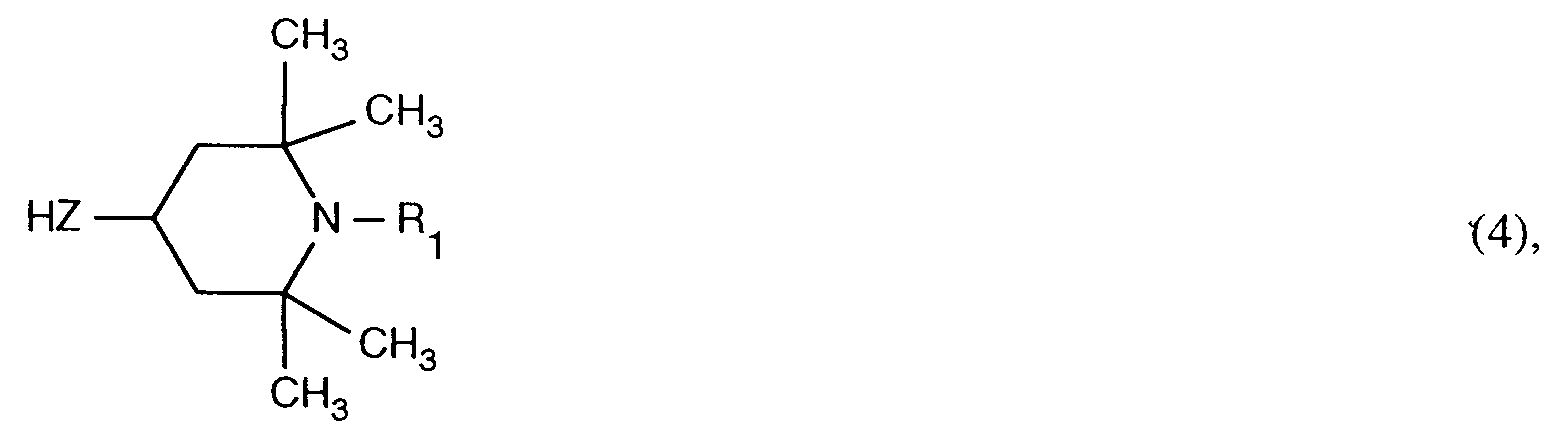
worin R₁ und Z die in Formel (1) angegebene Bedeutung haben, umsetzt, und, wenn man nur ein Mol der Piperidinverbindung der Formel (4) einsetzt, gegebenenfalls z.B. mit einem Mol einer C₁-C₅-Alkanolat-, Cycloalkanolat-, Phenolat-, C₁-C₅-Alkylthiolat-, Cycloalkylthiolat- oder einer Phenylthiolatverbindung, eines Mono-C₁-C₅-alkylamins, Di-C₁-C₅-alkylamins, Cycloalkylamins, Phenylamins, einer 1-Azacycloalkyl- oder einer Morpholinoverbindung umsetzt, wobei die Reihenfolge der einzelnen Reaktionsschritte beliebig ist.
In der Regel geht man so vor, dass man im ersten Reaktionsschritt die 2,4,6-Trihalogens-triazinverbindung mit der Verbindung umsetzt, die die geringere Reaktivität aufweist. - Die Reaktionstemperatur liegt zwischen 0 und 100°C, vorzugsweise zwischen 20 und 80°C, die Reaktionszeit zwischen 1 und 20, vorzugsweise zwischen 1 und 4 Stunden.
- Die bei den Kondensationsreaktionen entstehende Halogenwasserstoffsäure kann durch das Endprodukt selbst oder durch Hinzufügen einer weiteren Base, wie beispielsweise wässrigem Ammoniak, Alkalimetallhydroxiden, Alkalimetallcarbonaten, -hydrogencarbonaten oder einer organischen Base, wie beispielsweise Triethylamin, abgefangen werden. Vorzugsweise wird als Base Alkalimetallcarbonat, wie z.B. Natriumcarbonat, verwendet.
- Die Umsetzungen erfolgen zweckmässigerweise in wässriger Lösung ohne den Zusatz von organischen Lösungsmitteln. Die als Ausgangsverbindungen verwendeten 2,4,6-Trihalogen-s-triazinverbindungen sind allgemein bekannt. Sie werden dabei vorzugsweise als wässrige Suspensionen eingesetzt. Eine besonders bevorzugte Ausgangsverbindung ist Cyanurchlorid.
Die übrigen für die Herstellung der Verbindungen der Formel (1) verwendeten Ausgangsverbindungen wie z.B. die Verbindungen der Formeln (3) oder (4) sind ebenfalls allgemein bekannt. - Alle Verbindungen gemäss Formel (1) werden vorzugsweise als Natriumsalze hergestellt. Dazu werden sie beispielsweise mit der äquivalenten Menge Natronlauge gelöst und als Lösung, Dispersion oder Emulsion für eine Anwendung formuliert.
- Die neuen erfindungsgemässen wasserlöslichen Triazinverbindungen gemäss Formel (1) eignen sich dazu, die thermische und photochemische Stabilität von ungefärbten und gefärbten Polyamid-Fasermaterialien zu erhöhen. Die Verwendung der erfindungsgemässen Verbindungen zur Erhöhung der thermischen und photochemischen Stabilität von Polyamidfasern und -färbungen stellt somit einen weiteren Gegenstand der vorliegenden Erfindung dar.
- Die neuartigen Verbindungen stellen Vertreter der Klasse der sterisch gehinderten Amine ("HALS"-Stabilisatoren) dar und können in übliche Textilveredlungsprozesse für Polyamidfasern integriert werden.
Die Verbindungen der Formel (1 ) werden erfindungsgemäss aus wässrigem Bad appliziert, das die Verbindungen in einer Menge von 0,005 bis 10 Gew.-%, vorzugsweise 0,05 bis 2 Gew.-% enthält. Vorzugsweise werden die Verbindungen dem Färbebad zugefügt. Die Applikation kann dabei vor, während oder nach dem Färben, nach einem Auszieh- oder Kontinueverfahren erfolgen. Die Applikation während des Färbens ist bevorzugt. - Beim Ausziehverfahren kann das Flottenverhältnis innerhalb eines weiten Bereiches gewählt werden, z.B. 1:5 bis 1:300, vorzugsweise 1:10 bis 1:50. Man arbeitet zweckmässig bei einer Temperatur von 30 bis 130°C, vorzugsweise 50 bis 110°C.
- Beim Kontinue-Verfahren beträgt der Flottenauftrag zweckmässig 30-400 Gew.-%, vorzugsweise 75-250 Gew.-%. Zur Fixierung der applizierten Farbstoffe und der bekannten und neuen Verbindungen wird das Fasermaterial einer Hitzebehandlung unterworfen. Der Fixierprozess kann auch nach der Kaltverweilmethode erfolgen.
- Die Hitzebehandlung erfolgt vorzugsweise durch ein Dämpfverfahren unter Behandlung in einem Dämpfer mit gegebenenfalls überhitztem Dampf bei einer Temperatur von 98 bis 105°C während z.B. 1 bis 7, vorzugsweise 1 bis 5 Minuten. Die Fixierung der Farbstoffe und der Verbindungen der Formel (1) gemäss dem Kaltverweilverfahren kann durch Lagerung der imprägnierten und vorzugsweise aufgerollten Ware bei Raumtemperatur (15 bis 30°C), z.B. während 3 bis 24 Stunden erfolgen, wobei die Kaltverweilzeit bekanntlich von der Art des applizierten Farbstoffes abhängig ist.
- Nach Beendigung des Färbeprozesses bzw. der Fixierung werden die hergestellten Färbungen auf übliche Weise gespült und getrocknet.
- Man erhält mit dem erfindungsgemässen Verfahren Polyamid-Färbungen und -fasern mit guter thermischer und photochemischer Stabilität.
- Als erfindungsgemäss zu stabilisierende Färbungen kommen solche in Betracht, die durch Säure- oder Metallkomplexfarbstoffe, z.B. 1:2-Chrom-, 1:2-Kobaltkomplexfarbstoffe oder Cu-Komplexfarbstoffe aber auch Dispersions- und Reaktivfarbstoffe erzeugt werden.
- Beispiele für solche Farbstoffe sind in Colour Index, 3. Auflage, 1971, Band 4, beschrieben.
- Unter Polyamidfasermaterial wird synthetisches Polyamid, wie z.B. Polyamid 6, Polyamid 6,6 oder Polyamid 12, sowie modifiziertes Polyamid, z.B. basisch anfärbbares Polyamid verstanden. Neben den reinen Polyamidfasern kommen vor allem auch Fasermischungen aus Polyurethan und Polyamid in Betracht, so z.B. Trikotmaterial aus Polyamid/Elastan-faser im Mischungsverhältnis 70:30. Grundsätzlich kann das reine oder gemischte Polyamidfasermaterial in den verschiedensten Verarbeitungsformen vorliegen, wie z.B. als Faser, Garn, Gewebe, Gewirke, Vlies oder Flormaterial.
- Das vorliegende Verfahren eignet sich besonders vorteilhaft zur Behandlung von Polyamidfasermaterial, das Licht und Hitze ausgesetzt wird und z.B. als Autopolsterstoff oder Teppich Verwendung findet.
- Die folgenden Beispiele veranschaulichen die Erfindung. Teile bedeuten Gewichtsteile und Prozente Gewichtsprozente.
-
- a) In eine pH-neutrale Lösung von 0,025 Mol 2-(2,4-Dichlor-s-triazin-6-ylamino)benzol-1,4-disulfonsäure in 90 ml Wasser werden 2,13 g Piperidin eingetragen, wobei der pH-Wert bis über 9 ansteigt, jedoch rasch wieder abfällt. Durch Zutropfen von 15%-iger Sodalösung hält man schliesslich ein pH-Wert von 7 ein und erwärmt die Reaktionsmischung gleichzeitig auf 38-41° C. Man rührt, bis die Kondensation beendet ist.
- b) Zu der oben beschriebenen Lösung werden rasch 5,31 g 4-Butylamino-2,2,6,6-tetramethylpiperidin eingetragen und die Reaktionstemperatur auf 85-89° C erhöht. Man rührt die Reaktionsmischung während 17 Stunden aus, kühlt auf 10° C ab und säuert man mit 2M Salzsäure bis zu einem pH-Wert von 4 an und anschliessend salzt mit 18 g NaCl in vier Portionen aus. Der Niederschlag wird abfiltriert, mit 50 ml einer 10%-igen und 25 ml einer 1%-igen Natriumchlorid-Lösung gewaschen und im Vacuum bei 80° C getrocknet. Man erhält ein Pulver der Formel

-
- a) In eine pH-neutrale Lösung von 0,05 Mol 2-(2,4-Dichlor-s-triazin-6-ylamino)benzol-1,4-disulfonsäure in 150 ml Wasser werden 4,65 g Anilin eingetragen. Man erwärmt die Reaktionsmischung unter Rühren auf 35° C und hält den pH-Wert durch gleichzeitiges Zutropfen von 2M Natronlauge bei etwa 7. Man rührt solange, bis die Kondensation beendet ist, und kein Anilin mehr nachgewiesen werden kann.
- b) Zu der oben beschriebenen Lösung trägt man 10,61 g 4-Butylamino-2,2,6,6-tetramethylpiperidin ein, erhitzt die Reaktionsmischung auf 85° C und hält sie bei dieser Temperatur während 20 Stunden. Anschliessend wird der Kolbeninhalt auf 40° C abgekühlt, mit 2M Salzsäure bis zu einem pH-Wert von 5 angesäuert und mit 40 g NaCl ausgesalzt. Der Niederschlag wird abfiltriert, mit 60 ml einer 15%-igen Natriumchlorid-Lösung portionensweise gewaschen und im Vacuum bei 70° C getrocknet. Man erhält ein Pulver der Formel

- Verfährt man wie in Beispiel 2 beschrieben, setzt jedoch im Schitt b) anstelle von 10,61 g 4-Butylamino-2,2,6,6-tetramethylpiperidin 7,88 g 4-Amino-2,2,6,6-tetramethylpiperidin ein, so erhält man eine Verbindung der Formel

-
- a) Zu einer Lösung von 0,1 Mol 2-(2,4-Dichlor-s-triazin-6-ylamino)benzol-1,4-disulfonsäure in 300 ml Wasser wird innerhalb von 20 Minuten eine Lösung von 10,7 g p-Toluidin in 50 ml Dioxan zugetropft. Durch gleichzeitiges Zutropfen von 15%-iger Sodalösung hält man einen pH-Wert von ungefähr 7 ein. Zur Vervollständigung der Reaktion rührt man die Reaktionsmischung während einer Stunde bei 35° C nach. Anschliessend kühlt man den Kolbeninhalt auf Raumtemperatur ab und teilt die Reaktionslösung in 3 gleiche Teile auf.
- b) Zu einem Teil der oben beschriebenen Lösung werden rasch 5,2 g 4-Amino-2,2,6,6-tetramethylpiperidin eingetragen und die Reaktionstemperatur auf 80-85° C erhöht. Man rührt die Reaktionsmischung während 16 Stunden aus, kühlt auf 10° C ab und säuert mit 2M Salzsäure bis zu einem pH-Wert von 3 an. Anschliessend wird die Reaktionsmischung mit 50 ml einer 10%-igen Natriumchlorid-Lösung versetzt. Der entstandene Niederschlag wird abfiltriert, mit wenig Wasser gewaschen und im Vacuum bei 70° C getrocknet. Man erhält ein Pulver der Formel

- Verfährt man wie in Beispiel 4b beschrieben, setzt jedoch anstelle von 5,2 g 4-Amino-2,2,6,6-tetramethylpiperidin 5,6 g 4-Methylamino-2,2,6,6-tetramethylpiperidin ein, so erhält man eine Verbindung der Formel

- Verfährt man wie in Beispiel 4b beschrieben, setzt jedoch anstelle von 5,2 g 4-Amino-2,2,6,6-tetramethylpiperidin 7,0 g 4-Butylamino-2,2,6,6-tetramethylpiperidin ein, so erhält man eine Verbindung der Formel

- Auf analoge Weise wie in den Beispielen 1 bis 6 beschrieben können auch folgende Verbindungen hergestellt werden:


- In einem ®AHIBA-Färbeapparat wird bei einem Flottenverhältnis von 1:30 ein Muster von 10 g einer Polyamid 6-Maschenware gefärbt. Die Färbeflotte enthält folgende Zusätze: 0,5g/l Mono-Na-phosphat, 1,5 g/l Di-Na-phosphat, 0,04 Gew.-% Farbstoff der Formel (I), 0,002 Gew.-% Farbstoff der Formel (II) und 0,001 %, jeweils bezogen auf das zu färbende Material, Farbstoff der Formel (III) in gelöster Form:
- (I)

- (II)

- (III) ein 1:2-Co-Mischkomplex bestehend aus


- Die Flotte wird auf 45°C erwärmt. Nach Zugabe des Textilmaterials behandelt man 10 Minuten bei dieser Temperatur und erwärmt mit 2°C/Minute auf 95°C. Nach einer Färbezeit von 15 Minuten bei 95°C werden 2 Gew.-%, bezogen auf das Färbegut, 80 %ige Essigsäure zugesetzt und weitere 30 Minuten gefärbt. Danach kühlt man auf 60°C ab, spült das gefärbte Material mit heissem Wasser und trocknet es.
Man erhält Färbungen mit sehr guten Lichtechtheiten.
Claims (12)
- Wasserlösliche Triazinverbindungen der Formel
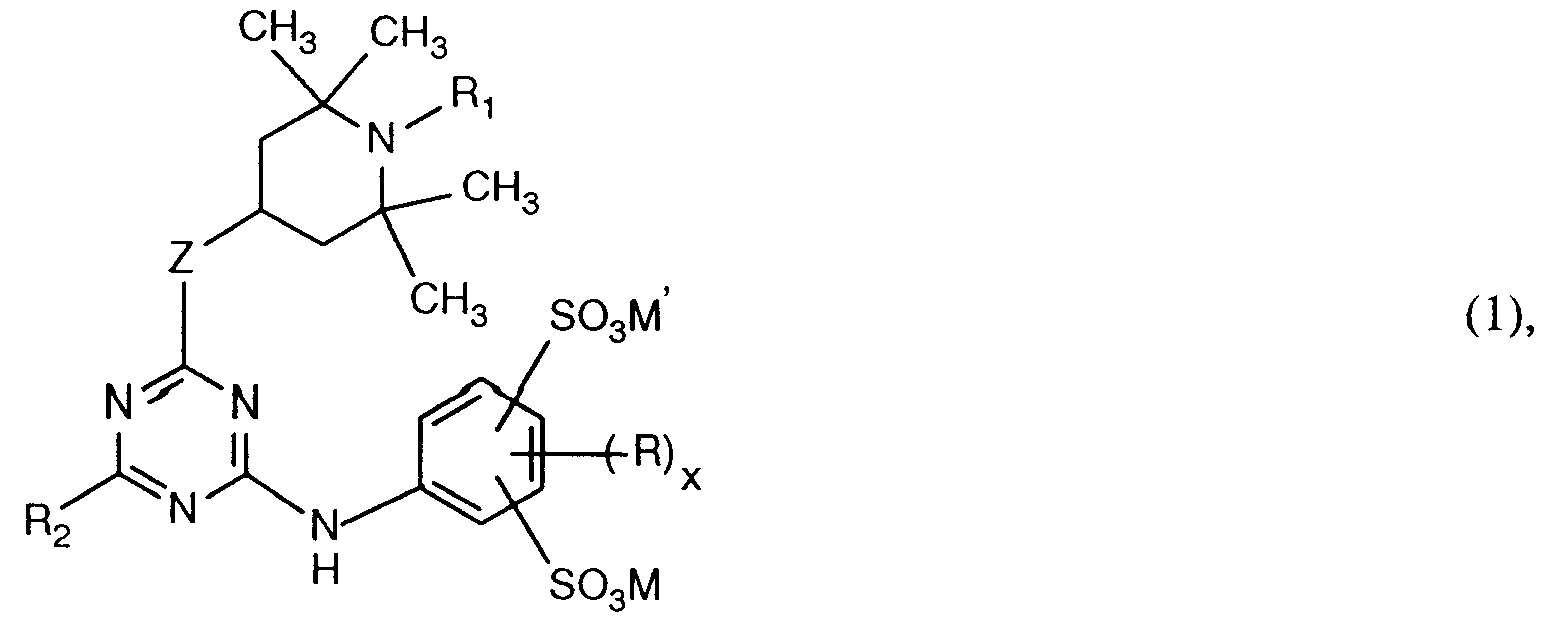
R Wasserstoff; Hydroxy; Halogen; unsubstituiertes oder durch Carboxy substituiertes C₁-C₅-Alkyl; C₁-C₅-Alkoxy; C₁-C₅-Alkanoyl; Benzoyl; Mono- oder Di-C₁-C₅-alkanoylamino; Carboxy; Carbamoyl oder ein unsubstituierter oder durch C₁-C₅-Alkyl oder Halogen substituierter Phenylsulfonyl-, Phenoxy-, Phenylthio- oder Styrylrest ist;
R₁ Wasserstoff; Oxyl; Hydroxy; C₁-C₅-Alkyl; C₂-C₅-Alkenyl; C₁-C₅-Alkoxy; C₁-C₅-Alkanoyl; Benzoyl oder Benzyl ist;
R₂ Halogen; unsubstituiertes oder durch Phenyl substituiertes C₁-C₅-Alkyl;
unsubstituiertes oder durch C₂-C₅-Alkenyl, Phenyl oder Diphenyl-C₁-C₅-alkyl substituiertes Amino, wobei der Phenylrest durch Halogen, Cyano, Nitro, Trifluormethyl, Amino, Mono- oder Di-C₁-C₅-alkylamino, Carbamoylamino, C₁-C₅-Alkylsulfon, unsubstituiertes oder durch C₁-C₅-Alkyl, C₁-C₅-Hydroxyalkyl, Phenyl oder Tolyl N-substituiertes Sulfamoyl, unsubstituiertes oder durch Hydroxy oder Carboxy substituiertes C₁-C₅-Alkyl, unsubstituiertes oder durch Hydroxy oder C₁-C₅-Alkoxy substituiertes C₁-C₅-Alkoxy, C₁-C₅-Alkanoyl, Benzoyl, Mono- oder Di-C₁-C₅-alkanoylamino, Carboxy, Carbamoyl, C₁-C₅-Alkoxycarbonyl oder einen unsubstituierten oder durch Halogen oder C₁-C₅-Alkyl substituierten Phenylsulfonyl-, Phenoxy-, Phenylthio- oder Styrylrest weiter substituiert sein kann; unsubstituiertes oder durch Hydroxy oder Carboxy substituiertes Mono- oder Di-C₁-C₅-alkylamino, wobei die Alkylkette durch ein Sauerstoffatom unterbrochen sein kann; unsubstituiertes oder durch C₁-C₅-Alkyl substituiertes Mono- oder Di-C₄-C₈-cycloalkylamino; unsubstituiertes oder durch Phenyl substituiertes C₁-C₅-Alkoxy; C₂-C₅-Alkenyl; C₂-C₅-Alkenyloxy;
C₄-C₈-Cycloalkoxy; unsubstituiertes oder durch Halogen, C₁-C₅-Alkyl, Carboxy-C₁-C₅-alkyl, C₁-C₅-Alkoxy, Carboxy, Carbamoyl, C₁-C₅-Alkanoyl, Benzoyl, Hydroxy, Mono- oder Di-C₁-C₅-alkanoylamino, oder einen unsubstituierten oder durch Halogen substituierten Phenylsulfonyl-, Phenoxy-, Phenylthio- oder Styrylrest substituiertes Phenoxy; C₄-C₈-Cycloalkoxy; Phenyl; Phenylthio; Phenyl-C₁-C₅-alkylthio;
C₁-C₅-Alkylthio; C₄-C₈-Cycloalkylthio; unsubstituiertes oder durch Hydroxy, C₁-C₅-Alkyl oder Carboxy substituiertes 1-Azacycloalkyl; unsubstituiertes oder durch C₁-C₅-Alkyl substituiertes Morpholino oder ein Rest der Formel
Z -O- oder -(NR₃)- ist, wobei R₃ Wasserstoff oder C₁-C₅-Alkyl bedeutet;
M und M' voneinander unabhängig Wasserstoff; ein Alkalimetall-; Erdalkalimetall- oder Ammonium-Kation oder ein organisches Ammonium-Kation der Formel
(C₁-C₄-Alkyl)n(H)mN⁺
sind;
m 0 bis 3;
n 1 bis 4; und die Summe m + n = 4 und
x 1 oder 2 ist. - Wasserlösliche Triazinverbindungen gemäss Anspruch 1, dadurch gekennzeichnet, dass R Wasserstoff, Halogen, Hydroxy oder C₁-C₅-Alkyl ist.
- Wasserlösliche Triazinverbindungen gemäss einem der Ansprüche 1 oder 2, dadurch gekennzeichnet, dass R₁ Wasserstoff oder C₁-C₅-Alkyl ist.
- Wasserlösliche Triazinverbindungen gemäss einem der Ansprüche 1 bis 3, dadurch gekennzeichnet, dass R₂ Mono-C₁-C₅-alkylamino, Di-C₁-C₅-alkylamino, Phenyl-C₁-C₅-alkylamino, Cycloalkylamino oder Phenylamino bedeutet.
- Wasserlösliche Triazinverbindungen gemäss einem der Ansprüche 1 bis 5, dadurch gekennzeichnet, dass Z -(NR₃)- bedeutet, wobei R₃ Wasserstoff oder C₁-C₅-Alkyl ist.
- Wasserlösliche Triazinverbindungen gemäss einem der Ansprüche 1 bis 5, dadurch gekennzeichnet, dass die beiden Substituenten -SO₃M und -SO₃M' am Benzolring in Positionen 2 und 5 zur Aminogruppe gebunden sind.
- Wasserlösliche Triazinverbindungen gemäss Anspruch 1, dadurch gekennzeichnet, dass R Wasserstoff, Halogen, Hydroxy oder C₁-C₅-Alkyl, R₁ Wasserstoff oder C₁-C₅-Alkyl, R₂ Mono-C₁-C₅-alkylamino, Di-C₁-C₅-alkylamino, Phenyl-C₁-C₅-alkylamino, Cycloalkylamino oder im Phenylrest unsubstituiertes oder mit C₁-C₅-Alkyl substituiertes Phenylamino und Z -(NR₃)- bedeuten und die beiden Substituenten -SO₃M und -SO₃M' am Benzolring in Positionen 2 und 5 zur Aminogruppe gebunden sind.
- Wasserlösliche Triazinverbindungen gemäss Anspruch 1, dadurch gekennzeichnet, dass R Wasserstoff, Halogen, Hydroxy, Methyl oder Ethyl, R₁ Wasserstoff, R₂ Piperidino oder im Phenylrest unsubstituiertes oder mit C₁-C₅-Alkyl substituiertes Phenylamino und Z -(NR₃)-, worin R₃ Wasserstoff, Methyl oder Butyl bedeutet, sind und die beiden Substituenten -SO₃M und -SO₃M' am Benzolring in Positionen 2 und 5 oder 2 und 4 oder 3 und 5 zur Aminogruppe gebunden sind.
- Verfahren zur Herstellung der Triazinverbindungen der Formel

R Wasserstoff; Hydroxy; Halogen; unsubstituiertes oder durch Carboxy substituiertes C₁-C₅-Alkyl; C₁-C₅-Alkoxy; C₁-C₅-Alkanoyl; Benzoyl; Mono- oder Di-C₁-C₅-alkanoylamino; Carboxy; Carbamoyl oder ein unsubstituierter oder durch C₁-C₅-Alkyl oder Halogen substituierter Phenylsulfonyl-, Phenoxy-, Phenylthio- oder Styrylrest ist;
R₁ Wasserstoff; Oxyl; Hydroxy; C₁-C₅-Alkyl; C₂-C₅-Alkenyl; C₁-C₅-Alkoxy; C₁-C₅-Alkanoyl; Benzoyl oder Benzyl ist;
R₂ Halogen; unsubstituiertes oder durch Phenyl substituiertes C₁-C₅-Alkyl;
unsubstituiertes oder durch C₂-C₅-Alkenyl, Phenyl oder Diphenyl-C₁-C₅-alkyl substituiertes Amino, wobei der Phenylrest durch Halogen, Cyano, Nitro, Trifluormethyl, Amino, Mono- oder Di-C₁-C₅-alkylamino, Carbamoylamino, C₁-C₅-Alkylsulfon, unsubstituiertes oder durch C₁-C₅-Alkyl, C₁-C₅-Hydroxyalkyl, Phenyl oder Tolyl N-substituiertes Sulfamoyl, unsubstituiertes oder durch Hydroxy oder Carboxy substituiertes C₁-C₅-Alkyl, unsubstituiertes oder durch Hydroxy oder C₁-C₅-Alkoxy substituiertes C₁-C₅-Alkoxy, C₁-C₅-Alkanoyl, Benzoyl, Mono- oder Di-C₁-C₅-alkanoylamino, Carboxy, Carbamoyl, C₁-C₅-Alkoxycarbonyl oder einen unsubstituierten oder durch Halogen oder C₁-C₅-Alkyl substituierten Phenylsulfonyl-, Phenoxy-, Phenylthio- oder Styrylrest weiter substituiert sein kann; unsubstituiertes oder durch Hydroxy oder Carboxy substituiertes Mono- oder Di-C₁-C₅-alkylamino, wobei die Alkylkette durch ein Sauerstoffatom unterbrochen sein kann; unsubstituiertes oder durch C₁-C₅-Alkyl substituiertes Mono- oder Di-C₄-C₈-cycloalkylamino; unsubstituiertes oder durch Phenyl substituiertes C₁-C₅-Alkoxy; C₂-C₅-Alkenyl; C₂-C₅-Alkenyloxy;
C₄-C₈-Cycloalkoxy; unsubstituiertes oder durch Halogen, C₁-C₅-Alkyl, Carboxy-C₁-C₅-alkyl, C₁-C₅-Alkoxy, Carboxy, Carbamoyl, C₁-C₅-Alkanoyl, Benzoyl, Hydroxy, Mono- oder Di-C₁-C₅-alkanoylamino, oder einen unsubstituierten oder durch Halogen substituierten Phenylsulfonyl-, Phenoxy-, Phenylthio- oder Styrylrest substituiertes Phenoxy; C₄-C₈-Cycloalkoxy; Phenyl; Phenylthio; Phenyl-C₁-C₅-alkylthio;
C₁-C₅-Alkylthio; C₄-C₈-Cycloalkylthio; unsubstituiertes oder durch Hydroxy, C₁-C₅-Alkyl oder Carboxy substituiertes 1-Azacycloalkyl; unsubstituiertes oder durch C₁-C₅-Alkyl substituiertes Morpholino oder ein Rest der Formel
Z -O- oder -(NR₃)- ist, wobei R₃ Wasserstoff oder C₁-C₅-Alkyl bedeutet;
M und M' voneinander unabhängig Wasserstoff; ein Alkalimetall-; Erdalkalimetall- oder Ammonium-Kation oder ein organisches Ammonium-Kation der Formel
(C₁-C₄-Alkyl)n(H)mN⁺
sind;
m 0 bis 3;
n 1 bis 4; und die Summe m + n = 4 und
x 1 oder 2 ist,
dadurch gekennzeichnet, dass man ein Mol einer 2,4,6-Trihalogen-s-triazinverbindung nacheinander mit einem Mol der Verbindung der Formel

umsetzt, wobei die Reihenfolge der einzelnen Reaktionsschritte beliebig ist. - Verfahren zur photochemischen und thermischen Stabilisierung von Polyamidfasermaterialien, dadurch gekennzeichnet, dass man gefärbte oder ungefärbte Polyamid-Fasermaterialien mit wasserlöslichen Triazinverbindungen der Formel (1) gemäss Anspruch 1 behandelt.
- Verwendung der Triazinverbindungen gemäss einem der Ansprüche 1 bis 8 zur photochemischen und thermischen Stabilisierung von Polyamid-Fasermaterialien und -Färbungen.
- Das mit den Triazinverbindungen gemäss einem der Ansprüche 1 bis 8 behandelte Fasermaterial.
Applications Claiming Priority (3)
| Application Number | Priority Date | Filing Date | Title |
|---|---|---|---|
| CH260694 | 1994-08-25 | ||
| CH2606/94 | 1994-08-25 | ||
| CH260694 | 1994-08-25 |
Publications (2)
| Publication Number | Publication Date |
|---|---|
| EP0702011A1 true EP0702011A1 (de) | 1996-03-20 |
| EP0702011B1 EP0702011B1 (de) | 2001-03-28 |
Family
ID=4237547
Family Applications (1)
| Application Number | Title | Priority Date | Filing Date |
|---|---|---|---|
| EP95810518A Expired - Lifetime EP0702011B1 (de) | 1994-08-25 | 1995-08-16 | Wasserlösliche Piperidin-Triazinverbindungen und ihre Verwendung zur Stabilisierung von Polyamidfasern |
Country Status (4)
| Country | Link |
|---|---|
| US (1) | US5696262A (de) |
| EP (1) | EP0702011B1 (de) |
| JP (1) | JPH0859659A (de) |
| DE (1) | DE59509122D1 (de) |
Cited By (1)
| Publication number | Priority date | Publication date | Assignee | Title |
|---|---|---|---|---|
| WO2005049914A1 (en) * | 2003-11-19 | 2005-06-02 | Ciba Specialty Chemicals Holding Inc. | Method of increasing depth of shade |
Families Citing this family (1)
| Publication number | Priority date | Publication date | Assignee | Title |
|---|---|---|---|---|
| JP4760695B2 (ja) * | 2006-12-13 | 2011-08-31 | 三菱化学株式会社 | 異方性膜用材料、異方性膜用組成物、異方性膜及び光学素子 |
Citations (7)
| Publication number | Priority date | Publication date | Assignee | Title |
|---|---|---|---|---|
| DE2730449A1 (de) * | 1976-07-08 | 1978-01-12 | Ciba Geigy Ag | Neue 1,3-pyrimidine und 1,3,5-triazine |
| EP0094048A2 (de) * | 1982-05-07 | 1983-11-16 | ADEKA ARGUS CHEMICAL CO., Ltd. | Poly(piperidylamino)alkane und mit diesen stabilisierte Kunstharzmischungen |
| EP0209127A2 (de) * | 1985-07-17 | 1987-01-21 | ADEKA ARGUS CHEMICAL CO., Ltd. | Poly(2,2,6,6-tetramethylpiperidinylamino)-1,3,5-triazines als Stabilisatoren für Kunststoffzusammensetzungen |
| EP0209126A2 (de) * | 1985-07-16 | 1987-01-21 | ADEKA ARGUS CHEMICAL CO., Ltd. | Hydrocarbyl(polyphenol)-poly(2,2,6,6-tetramethylpiperidyl-1,3,5-triazines)als Stabilisatoren für Kunststoffzusammensetzungen |
| EP0389428A2 (de) * | 1989-03-21 | 1990-09-26 | Ciba-Geigy Ag | N,N-Bis(1-hydroxycarbyloxy-2,2,6,6-tetramethyl-piperidin-4-yl) aminotriazine und damit stabilisierte Mischungen |
| EP0459950A1 (de) | 1990-05-31 | 1991-12-04 | Ciba-Geigy Ag | Stabilisierung von Färbungen auf Polyamidfasern |
| EP0466647A1 (de) | 1990-07-12 | 1992-01-15 | Ciba-Geigy Ag | Verfahren zur photochemischen und thermischen Stabilisierung von Polyamid-Fasermaterialien |
-
1995
- 1995-08-16 EP EP95810518A patent/EP0702011B1/de not_active Expired - Lifetime
- 1995-08-16 DE DE59509122T patent/DE59509122D1/de not_active Expired - Lifetime
- 1995-08-22 US US08/517,861 patent/US5696262A/en not_active Expired - Lifetime
- 1995-08-22 JP JP7213146A patent/JPH0859659A/ja active Pending
Patent Citations (7)
| Publication number | Priority date | Publication date | Assignee | Title |
|---|---|---|---|---|
| DE2730449A1 (de) * | 1976-07-08 | 1978-01-12 | Ciba Geigy Ag | Neue 1,3-pyrimidine und 1,3,5-triazine |
| EP0094048A2 (de) * | 1982-05-07 | 1983-11-16 | ADEKA ARGUS CHEMICAL CO., Ltd. | Poly(piperidylamino)alkane und mit diesen stabilisierte Kunstharzmischungen |
| EP0209126A2 (de) * | 1985-07-16 | 1987-01-21 | ADEKA ARGUS CHEMICAL CO., Ltd. | Hydrocarbyl(polyphenol)-poly(2,2,6,6-tetramethylpiperidyl-1,3,5-triazines)als Stabilisatoren für Kunststoffzusammensetzungen |
| EP0209127A2 (de) * | 1985-07-17 | 1987-01-21 | ADEKA ARGUS CHEMICAL CO., Ltd. | Poly(2,2,6,6-tetramethylpiperidinylamino)-1,3,5-triazines als Stabilisatoren für Kunststoffzusammensetzungen |
| EP0389428A2 (de) * | 1989-03-21 | 1990-09-26 | Ciba-Geigy Ag | N,N-Bis(1-hydroxycarbyloxy-2,2,6,6-tetramethyl-piperidin-4-yl) aminotriazine und damit stabilisierte Mischungen |
| EP0459950A1 (de) | 1990-05-31 | 1991-12-04 | Ciba-Geigy Ag | Stabilisierung von Färbungen auf Polyamidfasern |
| EP0466647A1 (de) | 1990-07-12 | 1992-01-15 | Ciba-Geigy Ag | Verfahren zur photochemischen und thermischen Stabilisierung von Polyamid-Fasermaterialien |
Non-Patent Citations (2)
| Title |
|---|
| BORZATTA,V. ET AL.: "HALS as Light Stabilizer Agents Against Photodegradation of Polymers", SEM. ORG. SYNTH. SUMMER SCH., "A.CORBELLA",18TH, pages 135 - 153 * |
| VALET,A.: "HALS light stabilizers: New Developments", PAINT INDIA, vol. 42, no. 7, pages 35 - 39 * |
Cited By (2)
| Publication number | Priority date | Publication date | Assignee | Title |
|---|---|---|---|---|
| WO2005049914A1 (en) * | 2003-11-19 | 2005-06-02 | Ciba Specialty Chemicals Holding Inc. | Method of increasing depth of shade |
| US8007546B2 (en) | 2003-11-19 | 2011-08-30 | Huntsman International Llc | Method of increasing depth shade |
Also Published As
| Publication number | Publication date |
|---|---|
| JPH0859659A (ja) | 1996-03-05 |
| US5696262A (en) | 1997-12-09 |
| EP0702011B1 (de) | 2001-03-28 |
| DE59509122D1 (de) | 2001-05-03 |
Similar Documents
| Publication | Publication Date | Title |
|---|---|---|
| EP0466647B1 (de) | Verfahren zur photochemischen und thermischen Stabilisierung von Polyamid-Fasermaterialien | |
| EP0459950B1 (de) | Stabilisierung von Färbungen auf Polyamidfasern | |
| DE4209261B4 (de) | Anionische Disazoverbindungen | |
| EP0511166A1 (de) | Verfahren zur photochemischen und thermischen Stabilisierung von Polyamid-Fasermaterial mit einer faseraffinen Kupferkomplexverbindung und einem Oxalsäurediarylamid | |
| EP0719838A1 (de) | Azofarbstoffe | |
| EP0200843A1 (de) | Verfahren zur fotochemischen Stabilisierung von ungefärbtem und gefärbtem Polyamidfasermaterial und dessen Mischungen | |
| DE3440777C2 (de) | Neue sulfonsäuregruppenhaltige, basische Azoverbindungen, deren Herstellung und Verwendung als Farbstoffe | |
| DE2726432A1 (de) | Verfahren zur verbesserung der farbausbeute und der echtheiten von mit anionischen farbstoffen auf cellulosefasermaterial erzeugten faerbungen, fluorhaltige verbindungen und ihre herstellung | |
| EP0707002A1 (de) | UV-Absorber, ihre Herstellung und Verwendung | |
| DE3043915C2 (de) | ||
| EP0704444B1 (de) | UV-Absorber, ihre Herstellung und Verwendung | |
| EP0826743A2 (de) | Farbstoffmischungen, Verfahren zu deren Herstellung und deren Verwendung | |
| EP0546993A1 (de) | Wasserlöschliche Triazinderivate zur photochemischen und thermischen Stabilisierung von Polyamidfasermaterialien | |
| EP0794234B1 (de) | Farbstoffmischungen, Verfahren zu deren Herstellung und deren Verwendung | |
| EP0702011B1 (de) | Wasserlösliche Piperidin-Triazinverbindungen und ihre Verwendung zur Stabilisierung von Polyamidfasern | |
| EP0618205A1 (de) | Wasserlösliche Triazinderivate zur photochemischen und thermischen Stabilisierung von Polyamidfasermaterialien | |
| EP0621266A1 (de) | Sterisch gehinderte Phenole und ihre Verwendung zur Stabilisierung von Polyamid-Fasermaterialen | |
| EP0703227A1 (de) | Wasserlösliche Antioxidantien, Verfahren zu deren Herstellung und deren Verwendung zur photochemischen und thermischen Stabilisierung von Polyamid-Fasermaterialien | |
| EP0794233B1 (de) | Anionische Säurefarbstoffe, Verfahren zu deren Herstellung und deren Verwendung | |
| DE2544550B2 (de) | Phosphonsäureester und ihre Verwendung zur flammfesten Ausrüstung | |
| EP0507732B1 (de) | Asymmetrisches Oxalsäure-diarylamid | |
| DE1644611C3 (de) | Anthrachinon-Reaktivfarbstoffe | |
| EP0651028A1 (de) | Verfahren zum Trichromie-Färben oder -Bedrucken | |
| EP0690103A1 (de) | Azofarbstoffe, Verfahren zu deren Herstellung und deren Verwendung | |
| DE19720683A1 (de) | Verwendung von triazinhaltigen Verbindungen als UV-Absorber |
Legal Events
| Date | Code | Title | Description |
|---|---|---|---|
| PUAI | Public reference made under article 153(3) epc to a published international application that has entered the european phase |
Free format text: ORIGINAL CODE: 0009012 |
|
| AK | Designated contracting states |
Kind code of ref document: A1 Designated state(s): BE CH DE FR GB IT LI NL |
|
| 17P | Request for examination filed |
Effective date: 19960814 |
|
| RAP1 | Party data changed (applicant data changed or rights of an application transferred) |
Owner name: CIBA SC HOLDING AG |
|
| RAP3 | Party data changed (applicant data changed or rights of an application transferred) |
Owner name: CIBA SPECIALTY CHEMICALS HOLDING INC. |
|
| 17Q | First examination report despatched |
Effective date: 19970902 |
|
| GRAG | Despatch of communication of intention to grant |
Free format text: ORIGINAL CODE: EPIDOS AGRA |
|
| GRAG | Despatch of communication of intention to grant |
Free format text: ORIGINAL CODE: EPIDOS AGRA |
|
| GRAH | Despatch of communication of intention to grant a patent |
Free format text: ORIGINAL CODE: EPIDOS IGRA |
|
| GRAH | Despatch of communication of intention to grant a patent |
Free format text: ORIGINAL CODE: EPIDOS IGRA |
|
| GRAA | (expected) grant |
Free format text: ORIGINAL CODE: 0009210 |
|
| AK | Designated contracting states |
Kind code of ref document: B1 Designated state(s): BE CH DE FR GB IT LI NL |
|
| REG | Reference to a national code |
Ref country code: CH Ref legal event code: EP |
|
| ITF | It: translation for a ep patent filed | ||
| REF | Corresponds to: |
Ref document number: 59509122 Country of ref document: DE Date of ref document: 20010503 |
|
| GBT | Gb: translation of ep patent filed (gb section 77(6)(a)/1977) |
Effective date: 20010418 |
|
| PGFP | Annual fee paid to national office [announced via postgrant information from national office to epo] |
Ref country code: CH Payment date: 20010629 Year of fee payment: 7 |
|
| ET | Fr: translation filed | ||
| PGFP | Annual fee paid to national office [announced via postgrant information from national office to epo] |
Ref country code: NL Payment date: 20010717 Year of fee payment: 7 |
|
| REG | Reference to a national code |
Ref country code: GB Ref legal event code: IF02 |
|
| PLBE | No opposition filed within time limit |
Free format text: ORIGINAL CODE: 0009261 |
|
| STAA | Information on the status of an ep patent application or granted ep patent |
Free format text: STATUS: NO OPPOSITION FILED WITHIN TIME LIMIT |
|
| 26N | No opposition filed | ||
| PG25 | Lapsed in a contracting state [announced via postgrant information from national office to epo] |
Ref country code: LI Free format text: LAPSE BECAUSE OF NON-PAYMENT OF DUE FEES Effective date: 20020831 Ref country code: CH Free format text: LAPSE BECAUSE OF NON-PAYMENT OF DUE FEES Effective date: 20020831 |
|
| PG25 | Lapsed in a contracting state [announced via postgrant information from national office to epo] |
Ref country code: NL Free format text: LAPSE BECAUSE OF NON-PAYMENT OF DUE FEES Effective date: 20030301 |
|
| REG | Reference to a national code |
Ref country code: CH Ref legal event code: PL |
|
| NLV4 | Nl: lapsed or anulled due to non-payment of the annual fee |
Effective date: 20030301 |
|
| PGFP | Annual fee paid to national office [announced via postgrant information from national office to epo] |
Ref country code: BE Payment date: 20031009 Year of fee payment: 9 |
|
| PG25 | Lapsed in a contracting state [announced via postgrant information from national office to epo] |
Ref country code: BE Free format text: LAPSE BECAUSE OF NON-PAYMENT OF DUE FEES Effective date: 20040831 |
|
| BERE | Be: lapsed |
Owner name: *CIBA SPECIALTY CHEMICALS HOLDING INC. Effective date: 20040831 |
|
| BERE | Be: lapsed |
Owner name: *CIBA SPECIALTY CHEMICALS HOLDING INC. Effective date: 20040831 |
|
| PGFP | Annual fee paid to national office [announced via postgrant information from national office to epo] |
Ref country code: GB Payment date: 20120726 Year of fee payment: 18 |
|
| PGFP | Annual fee paid to national office [announced via postgrant information from national office to epo] |
Ref country code: DE Payment date: 20120831 Year of fee payment: 18 Ref country code: FR Payment date: 20120809 Year of fee payment: 18 Ref country code: IT Payment date: 20120810 Year of fee payment: 18 |
|
| GBPC | Gb: european patent ceased through non-payment of renewal fee |
Effective date: 20130816 |
|
| PG25 | Lapsed in a contracting state [announced via postgrant information from national office to epo] |
Ref country code: DE Free format text: LAPSE BECAUSE OF NON-PAYMENT OF DUE FEES Effective date: 20140301 |
|
| REG | Reference to a national code |
Ref country code: FR Ref legal event code: ST Effective date: 20140430 |
|
| PG25 | Lapsed in a contracting state [announced via postgrant information from national office to epo] |
Ref country code: IT Free format text: LAPSE BECAUSE OF NON-PAYMENT OF DUE FEES Effective date: 20130816 |
|
| REG | Reference to a national code |
Ref country code: DE Ref legal event code: R119 Ref document number: 59509122 Country of ref document: DE Effective date: 20140301 |
|
| PG25 | Lapsed in a contracting state [announced via postgrant information from national office to epo] |
Ref country code: GB Free format text: LAPSE BECAUSE OF NON-PAYMENT OF DUE FEES Effective date: 20130816 |
|
| PG25 | Lapsed in a contracting state [announced via postgrant information from national office to epo] |
Ref country code: FR Free format text: LAPSE BECAUSE OF NON-PAYMENT OF DUE FEES Effective date: 20130902 |