EP0698677A2 - Method for gold plating of stripped material, especially for leadframes - Google Patents
Method for gold plating of stripped material, especially for leadframes Download PDFInfo
- Publication number
- EP0698677A2 EP0698677A2 EP95111826A EP95111826A EP0698677A2 EP 0698677 A2 EP0698677 A2 EP 0698677A2 EP 95111826 A EP95111826 A EP 95111826A EP 95111826 A EP95111826 A EP 95111826A EP 0698677 A2 EP0698677 A2 EP 0698677A2
- Authority
- EP
- European Patent Office
- Prior art keywords
- current density
- gold
- layer
- partial layer
- thickness
- Prior art date
- Legal status (The legal status is an assumption and is not a legal conclusion. Google has not performed a legal analysis and makes no representation as to the accuracy of the status listed.)
- Granted
Links
- 238000000034 method Methods 0.000 title claims abstract description 17
- PCHJSUWPFVWCPO-UHFFFAOYSA-N gold Chemical compound [Au] PCHJSUWPFVWCPO-UHFFFAOYSA-N 0.000 title claims description 38
- 239000010931 gold Substances 0.000 title claims description 38
- 229910052737 gold Inorganic materials 0.000 title claims description 38
- 238000007747 plating Methods 0.000 title claims description 5
- 239000000463 material Substances 0.000 title 1
- 239000011265 semifinished product Substances 0.000 claims description 8
- 239000004065 semiconductor Substances 0.000 claims description 3
- 239000010410 layer Substances 0.000 description 22
- 238000000151 deposition Methods 0.000 description 6
- 230000008021 deposition Effects 0.000 description 5
- PXHVJJICTQNCMI-UHFFFAOYSA-N Nickel Chemical compound [Ni] PXHVJJICTQNCMI-UHFFFAOYSA-N 0.000 description 4
- 239000002344 surface layer Substances 0.000 description 4
- 230000002349 favourable effect Effects 0.000 description 3
- 238000004519 manufacturing process Methods 0.000 description 3
- 239000000126 substance Substances 0.000 description 3
- 239000011248 coating agent Substances 0.000 description 2
- 238000000576 coating method Methods 0.000 description 2
- 239000004020 conductor Substances 0.000 description 2
- 238000011161 development Methods 0.000 description 2
- 230000018109 developmental process Effects 0.000 description 2
- 239000000203 mixture Substances 0.000 description 2
- 229910052759 nickel Inorganic materials 0.000 description 2
- 238000000926 separation method Methods 0.000 description 2
- RYGMFSIKBFXOCR-UHFFFAOYSA-N Copper Chemical compound [Cu] RYGMFSIKBFXOCR-UHFFFAOYSA-N 0.000 description 1
- 229910000881 Cu alloy Inorganic materials 0.000 description 1
- 229910045601 alloy Inorganic materials 0.000 description 1
- 239000000956 alloy Substances 0.000 description 1
- NHFMFALCHGVCPP-UHFFFAOYSA-M azanium;gold(1+);sulfite Chemical compound [NH4+].[Au+].[O-]S([O-])=O NHFMFALCHGVCPP-UHFFFAOYSA-M 0.000 description 1
- 230000004888 barrier function Effects 0.000 description 1
- 238000004140 cleaning Methods 0.000 description 1
- 229910052802 copper Inorganic materials 0.000 description 1
- 239000010949 copper Substances 0.000 description 1
- 230000007547 defect Effects 0.000 description 1
- 230000001419 dependent effect Effects 0.000 description 1
- 238000009792 diffusion process Methods 0.000 description 1
- 238000009713 electroplating Methods 0.000 description 1
- 239000007788 liquid Substances 0.000 description 1
- 229910052751 metal Inorganic materials 0.000 description 1
- 239000002184 metal Substances 0.000 description 1
- XTFKWYDMKGAZKK-UHFFFAOYSA-N potassium;gold(1+);dicyanide Chemical compound [K+].[Au+].N#[C-].N#[C-] XTFKWYDMKGAZKK-UHFFFAOYSA-N 0.000 description 1
- 238000004080 punching Methods 0.000 description 1
- 238000003466 welding Methods 0.000 description 1
Images
Classifications
-
- C—CHEMISTRY; METALLURGY
- C25—ELECTROLYTIC OR ELECTROPHORETIC PROCESSES; APPARATUS THEREFOR
- C25D—PROCESSES FOR THE ELECTROLYTIC OR ELECTROPHORETIC PRODUCTION OF COATINGS; ELECTROFORMING; APPARATUS THEREFOR
- C25D5/00—Electroplating characterised by the process; Pretreatment or after-treatment of workpieces
- C25D5/60—Electroplating characterised by the structure or texture of the layers
- C25D5/623—Porosity of the layers
-
- C—CHEMISTRY; METALLURGY
- C25—ELECTROLYTIC OR ELECTROPHORETIC PROCESSES; APPARATUS THEREFOR
- C25D—PROCESSES FOR THE ELECTROLYTIC OR ELECTROPHORETIC PRODUCTION OF COATINGS; ELECTROFORMING; APPARATUS THEREFOR
- C25D5/00—Electroplating characterised by the process; Pretreatment or after-treatment of workpieces
- C25D5/10—Electroplating with more than one layer of the same or of different metals
-
- C—CHEMISTRY; METALLURGY
- C25—ELECTROLYTIC OR ELECTROPHORETIC PROCESSES; APPARATUS THEREFOR
- C25D—PROCESSES FOR THE ELECTROLYTIC OR ELECTROPHORETIC PRODUCTION OF COATINGS; ELECTROFORMING; APPARATUS THEREFOR
- C25D5/00—Electroplating characterised by the process; Pretreatment or after-treatment of workpieces
- C25D5/60—Electroplating characterised by the structure or texture of the layers
- C25D5/605—Surface topography of the layers, e.g. rough, dendritic or nodular layers
Definitions
- the invention relates to a method for the continuous, selective, galvanic gilding of band-shaped semi-finished products, in particular for lead frames for semiconductor technology.
- bond flags the surface of which is designed to be bondable, for example by galvanic gold plating is.
- Bonding is a friction welding process, with which thin wires are connected to the bonding lugs.
- the requirements for galvanic gold plating are, for example, in the MIL Specif. G-45204B.
- the gold layer that is bonded to is usually deposited from high-purity fine gold baths on a nickel underlayer.
- the present invention is based on the object of demonstrating a way in which reliable high-quality bondable surfaces can be obtained under series production conditions, namely with strip electroplating running at high speed, which enable more reliable bond connections.
- the semi-finished product is in a first step with a gold bath at a higher current density and then in a further step with a gold bath treated at a lower current density. It has been shown that gold surfaces are obtained in this way which are outstandingly suitable for wire bonding and which lead to failures in the bond connections much less frequently. It is a further great advantage of the method according to the invention that the surface properties of the gold layer can be set independently of their volume properties. However, this in no way means that the only thing that matters for the bondability is the surface properties. The surface properties and the volume properties of the gold layer rather both influence the bondability in combination.
- the layer growth is slow. This is undesirable for efficient series production.
- the prior art therefore works with the highest possible separation speed and therefore with the highest possible current density (high speed conditions).
- the use of a deposition step at a low current density does not result in the process becoming uneconomical, because the majority of the layer structure still takes place at a high current density and therefore at a correspondingly high deposition speed.
- Preferably about 75 to 90% of the thickness of the gold layer is produced at a higher current density, only the rest at a lower current density; in terms of numbers a layer structure is preferred in which 0.6 to 1.2 ⁇ m gold are deposited at a high current density and 0.15 to 0.4 ⁇ m gold at a low current density.
- a layer structure in which 0.8 ⁇ m is deposited at a high current density and 0.2 ⁇ m at a low current density has proven particularly useful.
- the thicker partial layer deposited first influences the bondability primarily through its hardness, thickness and purity, while the surface layer deposited next determines the bondability primarily through its surface structure, roughness, the coefficient of friction with the bonding wire and also through it Purity. Volume properties and surface properties can be set independently of one another, thereby optimizing the bondability.
- a gold layer deposited with a high current density is not only economical to deposit, but also has a low hardness which is favorable for bonding. It is disadvantageous, however, that more undesirable foreign substances are also deposited and embedded in the gold layer at high speed and that the layer is more porous than a gold layer deposited slowly with a low current density.
- the surface layer deposited at low speed is denser, has fewer defects and is characterized by fewer foreign inclusions, which is favorable for bonding, and shows a different friction behavior which is more favorable for bonding.
- the current density with which the lower sub-layer is deposited is preferably a factor of 10 to 30 above the current density with which the thinner surface layer is deposited.
- the deposition can be carried out in such a way that the strip-shaped semifinished product passes through the same bath twice, the bath being operated with a high current density the first time and with a low current density the second time.
- Suitable devices for coating are, for example, the device disclosed in DE-A-40 19 643 for depositing gold strips on strips of metal, the position and width of the gold strips being determined by mask strips, or a device for spot gilding in which one to be coated Band lies with this mask band running along, which has individual windows which determine the position and size of the spots to be separated.
- the coating apparatus shown in EP 370 239 which has an elongated nozzle head, over which a felt is stretched, which is impregnated with the gold bath liquid, and over which the band-shaped semi-finished product is pulled away for selective gilding.
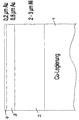
- the accompanying drawing shows schematically the typical structure of a bond flag, consisting of a carrier 1 made of a copper-based alloy, which is first nickel-plated in a conventional manner with a layer thickness of 2 to 3 ⁇ m; the nickel layer is designated by the reference number 2 and serves as a diffusion barrier between the copper alloy and the gold layer, which is applied in two steps according to the invention: in a first step, at a current density of 3 to 100 A / dm 2, preferably at a current density of 5 to 7 A / dm2, a 0.8 .mu.m thick gold layer 3, onto which a 0 in a second step at a lower current density, for example at 0.3 to 1 A / dm2, preferably at a current density of 0.6 A / dm2 , 2 ⁇ m thick surface layer 4 of gold is deposited.
- the separation takes place from a Fine gold bath of conventional composition, for example from a bath based on potassium gold cyanide or from a cyanide-free bath based
Landscapes
- Chemical & Material Sciences (AREA)
- Engineering & Computer Science (AREA)
- Chemical Kinetics & Catalysis (AREA)
- Electrochemistry (AREA)
- Materials Engineering (AREA)
- Metallurgy (AREA)
- Organic Chemistry (AREA)
- Electroplating Methods And Accessories (AREA)
- Battery Electrode And Active Subsutance (AREA)
Abstract
Description
Die Erfindung befaßt sich mit einem Verfahren zum fortlaufenden, selektiven, galvanischen Vergolden von bandförmigem Halbzeug, insbesondere für Leadframes für die Halbleitertechnologie.The invention relates to a method for the continuous, selective, galvanic gilding of band-shaped semi-finished products, in particular for lead frames for semiconductor technology.
Bei elektronischen und mikromechanischen Bauelementen besteht häufig die Aufgabe, sie durch Drähte mit Leiterbahnen zu verbinden, die Bestandteil ihrer Träger oder Gehäuse sind. Dazu besitzen diese Leiterbahnen sogenannte Bondfahnen, deren Oberfläche z.B. durch galvanische Vergoldung bondbar ausgebildet ist. Das Bonden ist ein Reibschweißverfahren, mit welchem dünne Drähte mit den Bondfahnen verbunden werden. Die Anforderungen an die galvanische Vergoldung sind z.B. in der MIL-Specif. G-45204B festgelegt. Die Goldschicht, auf welcher gebondet wird, wird üblicherweise aus hochreinen Feingoldbädern auf einer Nickel-Unterschicht abgeschieden.In electronic and micromechanical components, there is often the task of connecting them to conductors which are part of their carrier or housing by means of wires. For this purpose, these conductor tracks have so-called bond flags, the surface of which is designed to be bondable, for example by galvanic gold plating is. Bonding is a friction welding process, with which thin wires are connected to the bonding lugs. The requirements for galvanic gold plating are, for example, in the MIL Specif. G-45204B. The gold layer that is bonded to is usually deposited from high-purity fine gold baths on a nickel underlayer.
Trotz Erfüllung der MIL-Specification gibt es in der industriellen Serienfertigung immer wieder schwer zu erklärende Probleme mit der Festigkeit der Bondverbindungen.Despite meeting the MIL specification, there are always problems with the strength of the bond connections that are difficult to explain in industrial series production.
Der vorliegenden Erfindung liegt die Aufgabe zugrunde, einen Weg aufzuzeigen, wie man unter Serienfertigungsbedingungen, nämlich bei mit hoher Geschwindigkeit ablaufender Bandgalvanik, prozeßsicher zu qualitativ hochwertigeren bondbaren Oberflächen kommt, welche zuverlässigere Bondverbindungen ermöglichen.The present invention is based on the object of demonstrating a way in which reliable high-quality bondable surfaces can be obtained under series production conditions, namely with strip electroplating running at high speed, which enable more reliable bond connections.
Diese Aufgabe wird gelöst durch ein Verfahren mit den im Anspruch 1 angegebenen Merkmalen. Vorteilhafte Weiterbildungen der Erfindung sind Gegenstand der abhängigen Ansprüche.This object is achieved by a method with the features specified in claim 1. Advantageous developments of the invention are the subject of the dependent claims.
Erfindungsgemäss wird das Halbzeug in einem ersten Schritt mit einem Goldbad bei höherer Stromdichte und danach in einem weiteren Schritt mit einem Goldbad bei einer niedrigeren Stromdichte behandelt. Es hat sich gezeigt, dass man auf diese Weise Goldoberflächen erhält, die sich hervorragend für das Drahtbonden eignen und bei den Bondverbindungen viel seltener zu Ausfällen führen. Es ist ein weiterer großer Vorteil des erfindungsgemässen Verfahrens, dass die Oberflächeneigenschaften der Goldschicht unabhängig von ihren Volumeneigenschaften eingestellt werden können. Das bedeutet aber keineswegs, dass es für die Bondbarkeit allein auf die Oberflächeneigenschaften ankäme. Die Oberflächeneigenschaften und die Volumeneigenschaften der Goldschicht beeinflussen vielmehr beide in Kombination die Bondbarkeit.According to the invention, the semi-finished product is in a first step with a gold bath at a higher current density and then in a further step with a gold bath treated at a lower current density. It has been shown that gold surfaces are obtained in this way which are outstandingly suitable for wire bonding and which lead to failures in the bond connections much less frequently. It is a further great advantage of the method according to the invention that the surface properties of the gold layer can be set independently of their volume properties. However, this in no way means that the only thing that matters for the bondability is the surface properties. The surface properties and the volume properties of the gold layer rather both influence the bondability in combination.
Beim Arbeiten mit niedrigerer Stromdichte erfolgt das Schichtwachstum nur langsam. Für eine rationelle Serienfertigung ist das unerwünscht. Beim Stand der Technik arbeitet man deshalb mit möglichst hoher Abscheidegeschwindigkeit und deshalb mit möglichst hoher Stromdichte (high speed-Bedingungen). Erfindungsgemäss führt die Anwendung eines Abscheideschrittes bei niedriger Stromdichte aber nicht dazu, dass das Verfahren unwirtschaftlich wird, weil der größte Teil des Schichtaufbaus nach wie vor bei hoher Stromdichte und deshalb bei entsprechend hoher Abscheidegeschwindigkeit erfolgt. Vorzugsweise werden etwa 75 bis 90% der Dicke der Goldschicht bei höherer Stromdichte erzeugt, lediglich der Rest bei niedriger Stromdichte; zahlenmässig ausgedrückt wird ein Schichtaufbau bevorzugt, bei welchem 0,6 bis 1,2 µm Gold bei hoher Stromdichte und 0,15 bis 0,4 µm Gold bei niedriger Stromdichte abgeschieden werden. Besonders bewährt hat sich ein Schichtaufbau, bei welchem 0,8 µm bei hoher Stromdichte und 0,2 µm bei niedriger Stromdichte abgeschieden werden.When working with a lower current density, the layer growth is slow. This is undesirable for efficient series production. The prior art therefore works with the highest possible separation speed and therefore with the highest possible current density (high speed conditions). According to the invention, however, the use of a deposition step at a low current density does not result in the process becoming uneconomical, because the majority of the layer structure still takes place at a high current density and therefore at a correspondingly high deposition speed. Preferably about 75 to 90% of the thickness of the gold layer is produced at a higher current density, only the rest at a lower current density; in terms of numbers a layer structure is preferred in which 0.6 to 1.2 μm gold are deposited at a high current density and 0.15 to 0.4 μm gold at a low current density. A layer structure in which 0.8 μm is deposited at a high current density and 0.2 μm at a low current density has proven particularly useful.
Bei einem erfindungsgemässen Aufbau der Goldschicht beeinflußt die zuerst abgeschiedene dickere Teilschicht die Bondbarkeit vor allem durch ihre Härte, Dicke und Reinheit, die als nächstes abgeschiedene Oberflächenschicht hingegen bestimmt die Bondbarkeit in erster Linie durch ihre Oberflächenstruktur, Rauhigkeit, den Reibungskoeffizienten zum Bonddraht und auch durch ihre Reinheit. Volumeneigenschaften und Oberflächeneigenschaften können unabhängig voneinander eingestellt und dadurch die Bondbarkeit optimiert werden. Erfreulicherweise ist eine mit hoher Stromdichte abgeschiedene Goldschicht nicht nur wirtschaftlich abzuscheiden, sondern hat auch eine für das Bonden günstige niedrige Härte. Nachteilig dabei ist jedoch, dass bei hoher Geschwindigkeit mehr unerwünschte Fremdsubstanzen mit abgeschieden und in die Goldschicht eingelagert werden und dass die Schicht poröser ist als eine langsam, mit niedriger Stromdichte abgeschiedene Goldschicht. Die mit niedriger Geschwindigkeit abgeschiedene Oberflächenschicht ist demgegenüber dichter, hat weniger Fehlstellen und zeichnet sich durch weniger Fremdeinschlüsse aus, was für das Bonden günstig ist, und zeigt ein anderes für das Bonden günstigeres Reibverhalten.When the gold layer is built up according to the invention, the thicker partial layer deposited first influences the bondability primarily through its hardness, thickness and purity, while the surface layer deposited next determines the bondability primarily through its surface structure, roughness, the coefficient of friction with the bonding wire and also through it Purity. Volume properties and surface properties can be set independently of one another, thereby optimizing the bondability. Fortunately, a gold layer deposited with a high current density is not only economical to deposit, but also has a low hardness which is favorable for bonding. It is disadvantageous, however, that more undesirable foreign substances are also deposited and embedded in the gold layer at high speed and that the layer is more porous than a gold layer deposited slowly with a low current density. In contrast, the surface layer deposited at low speed is denser, has fewer defects and is characterized by fewer foreign inclusions, which is favorable for bonding, and shows a different friction behavior which is more favorable for bonding.
Die Stromdichte, mit welcher man die untere Teilschicht abscheidet, liegt vorzugsweise um einen Faktor 10 bis 30 über der Stromdichte, mit welcher die dünnere Oberflächenschicht abgeschieden wird. Die Abscheidung kann so erfolgen, dass das bandförmige Halbzeug ein und dasselbe Bad zweimal durchläuft, wobei das Bad beim ersten Mal mit hoher und beim zweiten Mal mit niedriger Stromdichte betrieben wird. Es ist aber auch durchaus möglich, das bandförmige Halbzeug in einem Gang zwei hintereinander angeordnete Goldbäder durchlaufen zu lassen, wobei die Goldbäder in der chemischen Zusammensetzung gleich, zur gezielten Einstellung von Schichteigenschaften aber auch unterschiedlich zusammengesetzt sein können. Als Beschichtungsapparat eignen sich z.B. die in der DE-A-40 19 643 offenbarte Vorrichtung zum Abscheiden von Goldstreifen auf Bänder aus Metall, wobei die Lage und Breite der Goldstreifen durch Maskenbänder bestimmt wird, oder ein Apparat zur Spotvergoldung, bei der auf einem zu beschichtenden Band ein mit diesem mitlaufendes Maskenband liegt, welches einzelne Fenster hat, die die Lage und Größe der abzuscheidenden Spots bestimmen. Ferner eignet sich der in der EP 370 239 dargestellte Beschichtungsapparat, welcher einen langgestreckten Düsenkopf hat, über welchen ein Filz gespannt ist, der mit der Goldbadflüssigkeit getränkt ist und über welchen das bandförmige Halbzeug zum selektiven Vergolden hinweggezogen wird. Schließlich sind auch Kombinationen der Arbeitsweisen mit den vorgenannten Apparaten möglich.The current density with which the lower sub-layer is deposited is preferably a factor of 10 to 30 above the current density with which the thinner surface layer is deposited. The deposition can be carried out in such a way that the strip-shaped semifinished product passes through the same bath twice, the bath being operated with a high current density the first time and with a low current density the second time. However, it is also entirely possible to let the band-shaped semifinished product pass through two gold baths arranged one behind the other in one pass, the gold baths having the same chemical composition, but also being able to be composed differently for the targeted adjustment of layer properties. Suitable devices for coating are, for example, the device disclosed in DE-A-40 19 643 for depositing gold strips on strips of metal, the position and width of the gold strips being determined by mask strips, or a device for spot gilding in which one to be coated Band lies with this mask band running along, which has individual windows which determine the position and size of the spots to be separated. Also suitable is the coating apparatus shown in EP 370 239, which has an elongated nozzle head, over which a felt is stretched, which is impregnated with the gold bath liquid, and over which the band-shaped semi-finished product is pulled away for selective gilding. Finally, combinations of the working methods with the aforementioned devices are also possible.
In vorteilhafter Weiterbildung des erfindungsgemässen Verfahrens ist es auch möglich, zwischen der mit hoher Stromdichte erfolgenden Abscheidung und der mit niedriger Stromdichte erfolgenden Abscheidung mechanische Bearbeitungen am Halbzeug vorzunehmen, z.B. Stanzvorgänge; Fremdsubstanzen, die dadurch auf oder in die Goldschicht gelangen und sich durch übliche Reinigungsverfahren nicht vollständig entfernen lassen, können durch die nachträgliche dünne Vergoldung, welche mit niedriger Stromdichte erfolgt, überdeckt werden, so dass auch in diesem Fall Goldschichten erhalten werden, die sich hervorragend zum Drahtbonden eignen.In an advantageous further development of the method according to the invention, it is also possible to carry out mechanical processing on the semi-finished product between the deposition taking place with a high current density and the deposition taking place with a low current density. Punching operations; Foreign substances that get on or into the gold layer and cannot be completely removed by conventional cleaning processes can be covered by the subsequent thin gold plating, which is carried out with a low current density, so that gold layers are obtained in this case that are excellent for Wire bonding are suitable.
Die beigefügte Zeichnung zeigt schematisch den typischen Aufbau einer Bondfahne, bestehend aus einem Träger 1 aus einer Kupfer-Basislegierung, welche zunächst auf übliche Weise mit einer Schichtdicke von 2 bis 3 µm vernickelt wird; die Nickelschicht ist mit der Bezugszahl 2 bezeichnet und dient als Diffusionsbarriere zwischen der Kupferlegierung und der Goldschicht, welche erfindungsgemäss in zwei Schritten aufgetragen wird: In einem ersten Schritt wird bei einer Stromdichte von 3 bis 100 A/dm², vorzugsweise bei einer Stromdichte von 5 bis 7 A/dm², eine 0,8 µm dicke Goldschicht 3 gebildete, auf welche in einem zweiten Schritt bei einer niedrigeren Stromdichte, z.B. bei 0,3 bis 1 A/dm², vorzugsweise bei einer Stromdichte von 0,6 A/dm² eine 0,2 µm dicke Oberflächenschicht 4 aus Gold abgeschieden wird. Die Abscheidung erfolgt aus einem Feingoldbad üblicher Zusammensetzung, z.B. aus einem Bad auf Kalium-Goldzyanid-Basis oder aus einem zyanidfreien Bad auf Ammonium-Goldsulfit-Basis.The accompanying drawing shows schematically the typical structure of a bond flag, consisting of a carrier 1 made of a copper-based alloy, which is first nickel-plated in a conventional manner with a layer thickness of 2 to 3 μm; the nickel layer is designated by the
Claims (11)
dadurch gekennzeichnet, dass das Halbzeug in einem ersten Schritt mit einem Goldbad bei höherer Stromdichte und danach in einem weiteren Schritt mit einem Goldbad bei nierigerer Stromdichte behandelt wird.Process for the continuous, selective, galvanic gold plating of strip-shaped semi-finished products, in particular for lead frames for semiconductor technology,
characterized in that the semi-finished product is treated in a first step with a gold bath at a higher current density and then in a further step with a gold bath at a lower current density.
Applications Claiming Priority (4)
| Application Number | Priority Date | Filing Date | Title |
|---|---|---|---|
| DE4426862 | 1994-07-28 | ||
| DE4426862 | 1994-07-28 | ||
| DE4436071A DE4436071C2 (en) | 1994-07-28 | 1994-10-10 | Process for gilding band-shaped semi-finished products, in particular for lead frames, and lead frames gold-plated according to the process |
| DE4436071 | 1994-10-10 |
Publications (3)
| Publication Number | Publication Date |
|---|---|
| EP0698677A2 true EP0698677A2 (en) | 1996-02-28 |
| EP0698677A3 EP0698677A3 (en) | 1998-08-26 |
| EP0698677B1 EP0698677B1 (en) | 2002-10-09 |
Family
ID=25938782
Family Applications (1)
| Application Number | Title | Priority Date | Filing Date |
|---|---|---|---|
| EP95111826A Expired - Lifetime EP0698677B1 (en) | 1994-07-28 | 1995-07-28 | Method for gold plating of stripped material, especially for leadframes |
Country Status (2)
| Country | Link |
|---|---|
| EP (1) | EP0698677B1 (en) |
| ES (1) | ES2184776T3 (en) |
Family Cites Families (3)
| Publication number | Priority date | Publication date | Assignee | Title |
|---|---|---|---|---|
| GB2147311B (en) * | 1983-09-29 | 1987-10-21 | Hara J B O | Electrodepositing precious metal alloys |
| DE3683595D1 (en) * | 1985-11-11 | 1992-03-05 | Electroplating Eng | DEVICE FOR SELECTIVE METAL COATING OF CONNECTOR CONTACT PINS. |
| DE3839223C2 (en) * | 1988-11-19 | 1994-10-20 | Degussa | Selective electroplating device |
-
1995
- 1995-07-28 ES ES95111826T patent/ES2184776T3/en not_active Expired - Lifetime
- 1995-07-28 EP EP95111826A patent/EP0698677B1/en not_active Expired - Lifetime
Non-Patent Citations (1)
| Title |
|---|
| None |
Also Published As
| Publication number | Publication date |
|---|---|
| EP0698677B1 (en) | 2002-10-09 |
| EP0698677A3 (en) | 1998-08-26 |
| ES2184776T3 (en) | 2003-04-16 |
Similar Documents
| Publication | Publication Date | Title |
|---|---|---|
| DE3688840T2 (en) | METHOD AND DEVICE FOR ELECTROPLATING A COPPER BLADE. | |
| DE19640256B4 (en) | Lead frame, method for precious metal plating of the lead frame and semiconductor device with lead frame | |
| DE69025500T2 (en) | Process for producing a copper-clad laminate | |
| DE2419157C3 (en) | Metallic carrier for semiconductor components and process for its manufacture | |
| DE69023858T2 (en) | Integrated circuit arrangement with improved connections between the connector pins and the semiconductor material chips. | |
| DE3305952A1 (en) | Method of mounting an integrated circuit panel on a substrate | |
| DE69003333T2 (en) | Thermocompression connection for I.C. packaging. | |
| DE102004019877A1 (en) | Adhesive layer for gluing resin to a copper surface | |
| CH664107A5 (en) | ELECTRODE FOR WIRE CUTTING SPARK EDM. | |
| DE3312713A1 (en) | Silver-coated electrical materials and process for their production | |
| DE10136890B4 (en) | Method and apparatus for producing a crystal textured textured metal strip and ribbon | |
| DE3100634A1 (en) | "DEVICE FOR GALVANIZING A BAND" | |
| EP0698677B1 (en) | Method for gold plating of stripped material, especially for leadframes | |
| DE4436071C2 (en) | Process for gilding band-shaped semi-finished products, in particular for lead frames, and lead frames gold-plated according to the process | |
| DE4123911C1 (en) | ||
| CH635871A5 (en) | PARTIAL GALVANIZING METHOD. | |
| DE3618751A1 (en) | COPPER TAPE (LADDER FRAME TAPE) | |
| DE3151557C2 (en) | ||
| EP0859071B1 (en) | Process for selective galvanic coating of electrical contact elements | |
| EP0088220B1 (en) | Contact member and method for its manufacture | |
| DE3029277C2 (en) | Build-up of metal layers | |
| WO2001086018A2 (en) | Method for producing workpieces, which serve to conduct electric current and which are coated with a predominantly metallic material | |
| DE102019119348B4 (en) | Coated carrier tape and use of the same for bonding power electronics | |
| DD273862A5 (en) | COPPER FOIL WITH TWO-SIDED MATERIAL SURFACE AND METHOD FOR PRODUCING A DRAWING FOIL | |
| DE2730625A1 (en) | Copper wire with thick electroplated tin coatings - where wire is annealed below the m. pt. of tin and has good solderability |
Legal Events
| Date | Code | Title | Description |
|---|---|---|---|
| PUAI | Public reference made under article 153(3) epc to a published international application that has entered the european phase |
Free format text: ORIGINAL CODE: 0009012 |
|
| AK | Designated contracting states |
Kind code of ref document: A2 Designated state(s): DE DK ES FR GB IT SE |
|
| RAP1 | Party data changed (applicant data changed or rights of an application transferred) |
Owner name: DODUCO GMBH + CO DR. EUGEN DUERRWAECHTER I.K. |
|
| RAP1 | Party data changed (applicant data changed or rights of an application transferred) |
Owner name: DODUCO GMBH |
|
| PUAL | Search report despatched |
Free format text: ORIGINAL CODE: 0009013 |
|
| AK | Designated contracting states |
Kind code of ref document: A3 Designated state(s): DE DK ES FR GB IT SE |
|
| 17P | Request for examination filed |
Effective date: 19981005 |
|
| RAP1 | Party data changed (applicant data changed or rights of an application transferred) |
Owner name: AMI DODUCO GMBH |
|
| 17Q | First examination report despatched |
Effective date: 19991026 |
|
| GRAG | Despatch of communication of intention to grant |
Free format text: ORIGINAL CODE: EPIDOS AGRA |
|
| GRAG | Despatch of communication of intention to grant |
Free format text: ORIGINAL CODE: EPIDOS AGRA |
|
| GRAH | Despatch of communication of intention to grant a patent |
Free format text: ORIGINAL CODE: EPIDOS IGRA |
|
| GRAH | Despatch of communication of intention to grant a patent |
Free format text: ORIGINAL CODE: EPIDOS IGRA |
|
| GRAA | (expected) grant |
Free format text: ORIGINAL CODE: 0009210 |
|
| AK | Designated contracting states |
Kind code of ref document: B1 Designated state(s): DE DK ES FR GB IT SE |
|
| REG | Reference to a national code |
Ref country code: GB Ref legal event code: FG4D Free format text: NOT ENGLISH |
|
| REF | Corresponds to: |
Ref document number: 59510414 Country of ref document: DE Date of ref document: 20021114 |
|
| PG25 | Lapsed in a contracting state [announced via postgrant information from national office to epo] |
Ref country code: SE Free format text: LAPSE BECAUSE OF FAILURE TO SUBMIT A TRANSLATION OF THE DESCRIPTION OR TO PAY THE FEE WITHIN THE PRESCRIBED TIME-LIMIT Effective date: 20030109 Ref country code: DK Free format text: LAPSE BECAUSE OF FAILURE TO SUBMIT A TRANSLATION OF THE DESCRIPTION OR TO PAY THE FEE WITHIN THE PRESCRIBED TIME-LIMIT Effective date: 20030109 |
|
| GBT | Gb: translation of ep patent filed (gb section 77(6)(a)/1977) |
Effective date: 20030120 |
|
| ET | Fr: translation filed | ||
| REG | Reference to a national code |
Ref country code: ES Ref legal event code: FG2A Ref document number: 2184776 Country of ref document: ES Kind code of ref document: T3 |
|
| PLBE | No opposition filed within time limit |
Free format text: ORIGINAL CODE: 0009261 |
|
| STAA | Information on the status of an ep patent application or granted ep patent |
Free format text: STATUS: NO OPPOSITION FILED WITHIN TIME LIMIT |
|
| 26N | No opposition filed |
Effective date: 20030710 |
|
| PGFP | Annual fee paid to national office [announced via postgrant information from national office to epo] |
Ref country code: GB Payment date: 20050628 Year of fee payment: 11 |
|
| PGFP | Annual fee paid to national office [announced via postgrant information from national office to epo] |
Ref country code: DE Payment date: 20050701 Year of fee payment: 11 |
|
| PGFP | Annual fee paid to national office [announced via postgrant information from national office to epo] |
Ref country code: FR Payment date: 20050719 Year of fee payment: 11 |
|
| PGFP | Annual fee paid to national office [announced via postgrant information from national office to epo] |
Ref country code: ES Payment date: 20050721 Year of fee payment: 11 |
|
| PG25 | Lapsed in a contracting state [announced via postgrant information from national office to epo] |
Ref country code: GB Free format text: LAPSE BECAUSE OF NON-PAYMENT OF DUE FEES Effective date: 20060728 |
|
| PGFP | Annual fee paid to national office [announced via postgrant information from national office to epo] |
Ref country code: IT Payment date: 20060731 Year of fee payment: 12 |
|
| PG25 | Lapsed in a contracting state [announced via postgrant information from national office to epo] |
Ref country code: DE Free format text: LAPSE BECAUSE OF NON-PAYMENT OF DUE FEES Effective date: 20070201 |
|
| GBPC | Gb: european patent ceased through non-payment of renewal fee |
Effective date: 20060728 |
|
| REG | Reference to a national code |
Ref country code: FR Ref legal event code: ST Effective date: 20070330 |
|
| REG | Reference to a national code |
Ref country code: ES Ref legal event code: FD2A Effective date: 20060729 |
|
| PG25 | Lapsed in a contracting state [announced via postgrant information from national office to epo] |
Ref country code: ES Free format text: LAPSE BECAUSE OF NON-PAYMENT OF DUE FEES Effective date: 20060729 |
|
| PG25 | Lapsed in a contracting state [announced via postgrant information from national office to epo] |
Ref country code: FR Free format text: LAPSE BECAUSE OF NON-PAYMENT OF DUE FEES Effective date: 20060731 |
|
| PG25 | Lapsed in a contracting state [announced via postgrant information from national office to epo] |
Ref country code: IT Free format text: LAPSE BECAUSE OF NON-PAYMENT OF DUE FEES Effective date: 20070728 |