EP0698667B1 - Xylanase, microorganismes la produisant, molécules d'ADN, procédés de préparation de cette xylanase et utilisations de celle-ci - Google Patents
Xylanase, microorganismes la produisant, molécules d'ADN, procédés de préparation de cette xylanase et utilisations de celle-ci Download PDFInfo
- Publication number
- EP0698667B1 EP0698667B1 EP95201976A EP95201976A EP0698667B1 EP 0698667 B1 EP0698667 B1 EP 0698667B1 EP 95201976 A EP95201976 A EP 95201976A EP 95201976 A EP95201976 A EP 95201976A EP 0698667 B1 EP0698667 B1 EP 0698667B1
- Authority
- EP
- European Patent Office
- Prior art keywords
- xylanase
- seq
- bacillus
- sequence
- codes
- Prior art date
- Legal status (The legal status is an assumption and is not a legal conclusion. Google has not performed a legal analysis and makes no representation as to the accuracy of the status listed.)
- Expired - Lifetime
Links
- 101710121765 Endo-1,4-beta-xylanase Proteins 0.000 title claims abstract description 302
- 238000000034 method Methods 0.000 title claims description 78
- 238000004519 manufacturing process Methods 0.000 title claims description 14
- 238000002360 preparation method Methods 0.000 title claims description 7
- 244000005700 microbiome Species 0.000 title description 19
- 230000008569 process Effects 0.000 title description 6
- 241000194110 Bacillus sp. (in: Bacteria) Species 0.000 claims abstract description 66
- 241000194103 Bacillus pumilus Species 0.000 claims abstract description 61
- 239000013598 vector Substances 0.000 claims abstract description 61
- 108090000623 proteins and genes Proteins 0.000 claims abstract description 60
- 241000193830 Bacillus <bacterium> Species 0.000 claims abstract description 50
- 239000013604 expression vector Substances 0.000 claims abstract description 29
- 102000004190 Enzymes Human genes 0.000 claims abstract description 27
- 108090000790 Enzymes Proteins 0.000 claims abstract description 27
- 230000010354 integration Effects 0.000 claims abstract description 14
- 239000000203 mixture Substances 0.000 claims abstract description 13
- 230000002759 chromosomal effect Effects 0.000 claims abstract description 12
- 239000000654 additive Substances 0.000 claims abstract description 6
- 230000000996 additive effect Effects 0.000 claims abstract description 4
- 108020004414 DNA Proteins 0.000 claims description 74
- 239000002773 nucleotide Substances 0.000 claims description 69
- 125000003729 nucleotide group Chemical group 0.000 claims description 69
- 239000012634 fragment Substances 0.000 claims description 46
- 150000001413 amino acids Chemical class 0.000 claims description 44
- 102000053602 DNA Human genes 0.000 claims description 37
- 241000194108 Bacillus licheniformis Species 0.000 claims description 33
- 108010076504 Protein Sorting Signals Proteins 0.000 claims description 27
- 108090000765 processed proteins & peptides Proteins 0.000 claims description 15
- 238000011282 treatment Methods 0.000 claims description 15
- 239000002243 precursor Substances 0.000 claims description 12
- 229910052799 carbon Inorganic materials 0.000 claims description 7
- IJGRMHOSHXDMSA-UHFFFAOYSA-N Atomic nitrogen Chemical compound N#N IJGRMHOSHXDMSA-UHFFFAOYSA-N 0.000 claims description 6
- 210000000349 chromosome Anatomy 0.000 claims description 6
- 238000003306 harvesting Methods 0.000 claims description 6
- 229920001184 polypeptide Polymers 0.000 claims description 6
- 102000004196 processed proteins & peptides Human genes 0.000 claims description 6
- 238000002955 isolation Methods 0.000 claims description 5
- 235000015097 nutrients Nutrition 0.000 claims description 5
- 150000003839 salts Chemical class 0.000 claims description 5
- 241001465754 Metazoa Species 0.000 claims description 4
- 229920001131 Pulp (paper) Polymers 0.000 claims description 4
- OKTJSMMVPCPJKN-UHFFFAOYSA-N Carbon Chemical compound [C] OKTJSMMVPCPJKN-UHFFFAOYSA-N 0.000 claims description 3
- 229910052757 nitrogen Inorganic materials 0.000 claims description 3
- 238000003780 insertion Methods 0.000 claims description 2
- 230000037431 insertion Effects 0.000 claims description 2
- 238000012258 culturing Methods 0.000 claims 2
- 125000003275 alpha amino acid group Chemical group 0.000 claims 1
- 239000013612 plasmid Substances 0.000 description 54
- 239000000725 suspension Substances 0.000 description 43
- 102000039446 nucleic acids Human genes 0.000 description 37
- 108020004707 nucleic acids Proteins 0.000 description 37
- 150000007523 nucleic acids Chemical class 0.000 description 37
- 239000002609 medium Substances 0.000 description 34
- 235000001014 amino acid Nutrition 0.000 description 31
- 229940024606 amino acid Drugs 0.000 description 31
- 108091034117 Oligonucleotide Proteins 0.000 description 29
- 239000000243 solution Substances 0.000 description 28
- 229940088598 enzyme Drugs 0.000 description 25
- FAPWRFPIFSIZLT-UHFFFAOYSA-M Sodium chloride Chemical compound [Na+].[Cl-] FAPWRFPIFSIZLT-UHFFFAOYSA-M 0.000 description 24
- 230000002255 enzymatic effect Effects 0.000 description 23
- 230000000694 effects Effects 0.000 description 22
- CSCPPACGZOOCGX-UHFFFAOYSA-N Acetone Chemical compound CC(C)=O CSCPPACGZOOCGX-UHFFFAOYSA-N 0.000 description 21
- 229920001817 Agar Polymers 0.000 description 21
- 239000008272 agar Substances 0.000 description 21
- 210000004027 cell Anatomy 0.000 description 20
- 229920001221 xylan Polymers 0.000 description 20
- HEMHJVSKTPXQMS-UHFFFAOYSA-M Sodium hydroxide Chemical compound [OH-].[Na+] HEMHJVSKTPXQMS-UHFFFAOYSA-M 0.000 description 18
- JLCPHMBAVCMARE-UHFFFAOYSA-N [3-[[3-[[3-[[3-[[3-[[3-[[3-[[3-[[3-[[3-[[3-[[5-(2-amino-6-oxo-1H-purin-9-yl)-3-[[3-[[3-[[3-[[3-[[3-[[5-(2-amino-6-oxo-1H-purin-9-yl)-3-[[5-(2-amino-6-oxo-1H-purin-9-yl)-3-hydroxyoxolan-2-yl]methoxy-hydroxyphosphoryl]oxyoxolan-2-yl]methoxy-hydroxyphosphoryl]oxy-5-(5-methyl-2,4-dioxopyrimidin-1-yl)oxolan-2-yl]methoxy-hydroxyphosphoryl]oxy-5-(6-aminopurin-9-yl)oxolan-2-yl]methoxy-hydroxyphosphoryl]oxy-5-(6-aminopurin-9-yl)oxolan-2-yl]methoxy-hydroxyphosphoryl]oxy-5-(6-aminopurin-9-yl)oxolan-2-yl]methoxy-hydroxyphosphoryl]oxy-5-(6-aminopurin-9-yl)oxolan-2-yl]methoxy-hydroxyphosphoryl]oxyoxolan-2-yl]methoxy-hydroxyphosphoryl]oxy-5-(5-methyl-2,4-dioxopyrimidin-1-yl)oxolan-2-yl]methoxy-hydroxyphosphoryl]oxy-5-(4-amino-2-oxopyrimidin-1-yl)oxolan-2-yl]methoxy-hydroxyphosphoryl]oxy-5-(5-methyl-2,4-dioxopyrimidin-1-yl)oxolan-2-yl]methoxy-hydroxyphosphoryl]oxy-5-(5-methyl-2,4-dioxopyrimidin-1-yl)oxolan-2-yl]methoxy-hydroxyphosphoryl]oxy-5-(6-aminopurin-9-yl)oxolan-2-yl]methoxy-hydroxyphosphoryl]oxy-5-(6-aminopurin-9-yl)oxolan-2-yl]methoxy-hydroxyphosphoryl]oxy-5-(4-amino-2-oxopyrimidin-1-yl)oxolan-2-yl]methoxy-hydroxyphosphoryl]oxy-5-(4-amino-2-oxopyrimidin-1-yl)oxolan-2-yl]methoxy-hydroxyphosphoryl]oxy-5-(4-amino-2-oxopyrimidin-1-yl)oxolan-2-yl]methoxy-hydroxyphosphoryl]oxy-5-(6-aminopurin-9-yl)oxolan-2-yl]methoxy-hydroxyphosphoryl]oxy-5-(4-amino-2-oxopyrimidin-1-yl)oxolan-2-yl]methyl [5-(6-aminopurin-9-yl)-2-(hydroxymethyl)oxolan-3-yl] hydrogen phosphate Polymers Cc1cn(C2CC(OP(O)(=O)OCC3OC(CC3OP(O)(=O)OCC3OC(CC3O)n3cnc4c3nc(N)[nH]c4=O)n3cnc4c3nc(N)[nH]c4=O)C(COP(O)(=O)OC3CC(OC3COP(O)(=O)OC3CC(OC3COP(O)(=O)OC3CC(OC3COP(O)(=O)OC3CC(OC3COP(O)(=O)OC3CC(OC3COP(O)(=O)OC3CC(OC3COP(O)(=O)OC3CC(OC3COP(O)(=O)OC3CC(OC3COP(O)(=O)OC3CC(OC3COP(O)(=O)OC3CC(OC3COP(O)(=O)OC3CC(OC3COP(O)(=O)OC3CC(OC3COP(O)(=O)OC3CC(OC3COP(O)(=O)OC3CC(OC3COP(O)(=O)OC3CC(OC3COP(O)(=O)OC3CC(OC3COP(O)(=O)OC3CC(OC3CO)n3cnc4c(N)ncnc34)n3ccc(N)nc3=O)n3cnc4c(N)ncnc34)n3ccc(N)nc3=O)n3ccc(N)nc3=O)n3ccc(N)nc3=O)n3cnc4c(N)ncnc34)n3cnc4c(N)ncnc34)n3cc(C)c(=O)[nH]c3=O)n3cc(C)c(=O)[nH]c3=O)n3ccc(N)nc3=O)n3cc(C)c(=O)[nH]c3=O)n3cnc4c3nc(N)[nH]c4=O)n3cnc4c(N)ncnc34)n3cnc4c(N)ncnc34)n3cnc4c(N)ncnc34)n3cnc4c(N)ncnc34)O2)c(=O)[nH]c1=O JLCPHMBAVCMARE-UHFFFAOYSA-N 0.000 description 16
- 238000010276 construction Methods 0.000 description 16
- OSVXSBDYLRYLIG-UHFFFAOYSA-N dioxidochlorine(.) Chemical compound O=Cl=O OSVXSBDYLRYLIG-UHFFFAOYSA-N 0.000 description 16
- XLYOFNOQVPJJNP-UHFFFAOYSA-N water Chemical compound O XLYOFNOQVPJJNP-UHFFFAOYSA-N 0.000 description 16
- 238000005119 centrifugation Methods 0.000 description 14
- 239000000047 product Substances 0.000 description 14
- 241000588724 Escherichia coli Species 0.000 description 12
- 239000011780 sodium chloride Substances 0.000 description 12
- ZAMOUSCENKQFHK-UHFFFAOYSA-N Chlorine atom Chemical compound [Cl] ZAMOUSCENKQFHK-UHFFFAOYSA-N 0.000 description 11
- 238000004458 analytical method Methods 0.000 description 11
- 239000000872 buffer Substances 0.000 description 11
- 239000000460 chlorine Substances 0.000 description 11
- 229910052801 chlorine Inorganic materials 0.000 description 11
- 238000013519 translation Methods 0.000 description 11
- 150000004823 xylans Chemical class 0.000 description 11
- AVKUERGKIZMTKX-NJBDSQKTSA-N ampicillin Chemical compound C1([C@@H](N)C(=O)N[C@H]2[C@H]3SC([C@@H](N3C2=O)C(O)=O)(C)C)=CC=CC=C1 AVKUERGKIZMTKX-NJBDSQKTSA-N 0.000 description 9
- 229960000723 ampicillin Drugs 0.000 description 9
- 229930027917 kanamycin Natural products 0.000 description 9
- 229960000318 kanamycin Drugs 0.000 description 9
- SBUJHOSQTJFQJX-NOAMYHISSA-N kanamycin Chemical compound O[C@@H]1[C@@H](O)[C@H](O)[C@@H](CN)O[C@@H]1O[C@H]1[C@H](O)[C@@H](O[C@@H]2[C@@H]([C@@H](N)[C@H](O)[C@@H](CO)O2)O)[C@H](N)C[C@@H]1N SBUJHOSQTJFQJX-NOAMYHISSA-N 0.000 description 9
- 229930182823 kanamycin A Natural products 0.000 description 9
- 241000894006 Bacteria Species 0.000 description 8
- 239000004155 Chlorine dioxide Substances 0.000 description 8
- MHAJPDPJQMAIIY-UHFFFAOYSA-N Hydrogen peroxide Chemical compound OO MHAJPDPJQMAIIY-UHFFFAOYSA-N 0.000 description 8
- 238000004061 bleaching Methods 0.000 description 8
- 235000019398 chlorine dioxide Nutrition 0.000 description 8
- 230000007062 hydrolysis Effects 0.000 description 8
- 238000006460 hydrolysis reaction Methods 0.000 description 8
- 235000018102 proteins Nutrition 0.000 description 8
- 102000004169 proteins and genes Human genes 0.000 description 8
- 238000012360 testing method Methods 0.000 description 8
- 244000063299 Bacillus subtilis Species 0.000 description 7
- 235000014469 Bacillus subtilis Nutrition 0.000 description 7
- 244000166124 Eucalyptus globulus Species 0.000 description 7
- 239000006142 Luria-Bertani Agar Substances 0.000 description 7
- 238000004520 electroporation Methods 0.000 description 7
- 239000006228 supernatant Substances 0.000 description 7
- LENZDBCJOHFCAS-UHFFFAOYSA-N tris Chemical compound OCC(N)(CO)CO LENZDBCJOHFCAS-UHFFFAOYSA-N 0.000 description 7
- FWMNVWWHGCHHJJ-SKKKGAJSSA-N 4-amino-1-[(2r)-6-amino-2-[[(2r)-2-[[(2r)-2-[[(2r)-2-amino-3-phenylpropanoyl]amino]-3-phenylpropanoyl]amino]-4-methylpentanoyl]amino]hexanoyl]piperidine-4-carboxylic acid Chemical compound C([C@H](C(=O)N[C@H](CC(C)C)C(=O)N[C@H](CCCCN)C(=O)N1CCC(N)(CC1)C(O)=O)NC(=O)[C@H](N)CC=1C=CC=CC=1)C1=CC=CC=C1 FWMNVWWHGCHHJJ-SKKKGAJSSA-N 0.000 description 6
- PEDCQBHIVMGVHV-UHFFFAOYSA-N Glycerine Chemical compound OCC(O)CO PEDCQBHIVMGVHV-UHFFFAOYSA-N 0.000 description 6
- DNIAPMSPPWPWGF-UHFFFAOYSA-N Propylene glycol Chemical compound CC(O)CO DNIAPMSPPWPWGF-UHFFFAOYSA-N 0.000 description 6
- 239000000499 gel Substances 0.000 description 6
- 238000010369 molecular cloning Methods 0.000 description 6
- 230000010076 replication Effects 0.000 description 6
- 238000000108 ultra-filtration Methods 0.000 description 6
- WQZGKKKJIJFFOK-GASJEMHNSA-N Glucose Natural products OC[C@H]1OC(O)[C@H](O)[C@@H](O)[C@@H]1O WQZGKKKJIJFFOK-GASJEMHNSA-N 0.000 description 5
- 239000007983 Tris buffer Substances 0.000 description 5
- 239000013611 chromosomal DNA Substances 0.000 description 5
- 239000000284 extract Substances 0.000 description 5
- 238000000605 extraction Methods 0.000 description 5
- 239000008103 glucose Substances 0.000 description 5
- 239000001963 growth medium Substances 0.000 description 5
- 239000006166 lysate Substances 0.000 description 5
- 238000005259 measurement Methods 0.000 description 5
- 239000012465 retentate Substances 0.000 description 5
- LFQSCWFLJHTTHZ-UHFFFAOYSA-N Ethanol Chemical compound CCO LFQSCWFLJHTTHZ-UHFFFAOYSA-N 0.000 description 4
- 235000008331 Pinus X rigitaeda Nutrition 0.000 description 4
- 235000011613 Pinus brutia Nutrition 0.000 description 4
- 241000018646 Pinus brutia Species 0.000 description 4
- 239000002202 Polyethylene glycol Substances 0.000 description 4
- 241000635201 Pumilus Species 0.000 description 4
- CDBYLPFSWZWCQE-UHFFFAOYSA-L Sodium Carbonate Chemical compound [Na+].[Na+].[O-]C([O-])=O CDBYLPFSWZWCQE-UHFFFAOYSA-L 0.000 description 4
- 230000002378 acidificating effect Effects 0.000 description 4
- 238000013019 agitation Methods 0.000 description 4
- -1 amino-carboxy Chemical group 0.000 description 4
- QVGXLLKOCUKJST-UHFFFAOYSA-N atomic oxygen Chemical compound [O] QVGXLLKOCUKJST-UHFFFAOYSA-N 0.000 description 4
- 238000005660 chlorination reaction Methods 0.000 description 4
- 230000009089 cytolysis Effects 0.000 description 4
- 230000029087 digestion Effects 0.000 description 4
- 230000003053 immunization Effects 0.000 description 4
- 238000011534 incubation Methods 0.000 description 4
- 239000007788 liquid Substances 0.000 description 4
- 238000001471 micro-filtration Methods 0.000 description 4
- 230000008520 organization Effects 0.000 description 4
- 239000001301 oxygen Substances 0.000 description 4
- 229910052760 oxygen Inorganic materials 0.000 description 4
- 229920001223 polyethylene glycol Polymers 0.000 description 4
- 230000009466 transformation Effects 0.000 description 4
- POSZUTFLHGNLHX-KSBRXOFISA-N tris maleate Chemical compound OCC(N)(CO)CO.OCC(N)(CO)CO.OC(=O)\C=C/C(O)=O POSZUTFLHGNLHX-KSBRXOFISA-N 0.000 description 4
- QKNYBSVHEMOAJP-UHFFFAOYSA-N 2-amino-2-(hydroxymethyl)propane-1,3-diol;hydron;chloride Chemical compound Cl.OCC(N)(CO)CO QKNYBSVHEMOAJP-UHFFFAOYSA-N 0.000 description 3
- KCXVZYZYPLLWCC-UHFFFAOYSA-N EDTA Chemical compound OC(=O)CN(CC(O)=O)CCN(CC(O)=O)CC(O)=O KCXVZYZYPLLWCC-UHFFFAOYSA-N 0.000 description 3
- LYCAIKOWRPUZTN-UHFFFAOYSA-N Ethylene glycol Chemical compound OCCO LYCAIKOWRPUZTN-UHFFFAOYSA-N 0.000 description 3
- 239000008186 active pharmaceutical agent Substances 0.000 description 3
- 230000003321 amplification Effects 0.000 description 3
- 239000007900 aqueous suspension Substances 0.000 description 3
- 238000011161 development Methods 0.000 description 3
- 238000010353 genetic engineering Methods 0.000 description 3
- 238000002649 immunization Methods 0.000 description 3
- 238000012986 modification Methods 0.000 description 3
- 230000004048 modification Effects 0.000 description 3
- 238000003199 nucleic acid amplification method Methods 0.000 description 3
- 235000015927 pasta Nutrition 0.000 description 3
- 239000008188 pellet Substances 0.000 description 3
- 238000000746 purification Methods 0.000 description 3
- 238000012216 screening Methods 0.000 description 3
- 239000011122 softwood Substances 0.000 description 3
- 235000015099 wheat brans Nutrition 0.000 description 3
- INEWUCPYEUEQTN-UHFFFAOYSA-N 3-(cyclohexylamino)-2-hydroxy-1-propanesulfonic acid Chemical compound OS(=O)(=O)CC(O)CNC1CCCCC1 INEWUCPYEUEQTN-UHFFFAOYSA-N 0.000 description 2
- DCXYFEDJOCDNAF-UHFFFAOYSA-N Asparagine Natural products OC(=O)C(N)CC(N)=O DCXYFEDJOCDNAF-UHFFFAOYSA-N 0.000 description 2
- 241000193375 Bacillus alcalophilus Species 0.000 description 2
- 241000193749 Bacillus coagulans Species 0.000 description 2
- 108091005658 Basic proteases Proteins 0.000 description 2
- 239000002028 Biomass Substances 0.000 description 2
- 238000011537 Coomassie blue staining Methods 0.000 description 2
- FBPFZTCFMRRESA-FSIIMWSLSA-N D-Glucitol Natural products OC[C@H](O)[C@H](O)[C@@H](O)[C@H](O)CO FBPFZTCFMRRESA-FSIIMWSLSA-N 0.000 description 2
- 101100364969 Dictyostelium discoideum scai gene Proteins 0.000 description 2
- PLUBXMRUUVWRLT-UHFFFAOYSA-N Ethyl methanesulfonate Chemical compound CCOS(C)(=O)=O PLUBXMRUUVWRLT-UHFFFAOYSA-N 0.000 description 2
- WHUUTDBJXJRKMK-UHFFFAOYSA-N Glutamic acid Natural products OC(=O)C(N)CCC(O)=O WHUUTDBJXJRKMK-UHFFFAOYSA-N 0.000 description 2
- DCXYFEDJOCDNAF-REOHCLBHSA-N L-asparagine Chemical compound OC(=O)[C@@H](N)CC(N)=O DCXYFEDJOCDNAF-REOHCLBHSA-N 0.000 description 2
- TWRXJAOTZQYOKJ-UHFFFAOYSA-L Magnesium chloride Chemical compound [Mg+2].[Cl-].[Cl-] TWRXJAOTZQYOKJ-UHFFFAOYSA-L 0.000 description 2
- 101100364971 Mus musculus Scai gene Proteins 0.000 description 2
- VZUNGTLZRAYYDE-UHFFFAOYSA-N N-methyl-N'-nitro-N-nitrosoguanidine Chemical compound O=NN(C)C(=N)N[N+]([O-])=O VZUNGTLZRAYYDE-UHFFFAOYSA-N 0.000 description 2
- 238000012408 PCR amplification Methods 0.000 description 2
- ISWSIDIOOBJBQZ-UHFFFAOYSA-N Phenol Chemical compound OC1=CC=CC=C1 ISWSIDIOOBJBQZ-UHFFFAOYSA-N 0.000 description 2
- PMZURENOXWZQFD-UHFFFAOYSA-L Sodium Sulfate Chemical compound [Na+].[Na+].[O-]S([O-])(=O)=O PMZURENOXWZQFD-UHFFFAOYSA-L 0.000 description 2
- DBMJMQXJHONAFJ-UHFFFAOYSA-M Sodium laurylsulphate Chemical compound [Na+].CCCCCCCCCCCCOS([O-])(=O)=O DBMJMQXJHONAFJ-UHFFFAOYSA-M 0.000 description 2
- 229920002472 Starch Polymers 0.000 description 2
- 239000002253 acid Substances 0.000 description 2
- 241001148470 aerobic bacillus Species 0.000 description 2
- 235000009582 asparagine Nutrition 0.000 description 2
- 229960001230 asparagine Drugs 0.000 description 2
- 229940054340 bacillus coagulans Drugs 0.000 description 2
- OWMVSZAMULFTJU-UHFFFAOYSA-N bis-tris Chemical compound OCCN(CCO)C(CO)(CO)CO OWMVSZAMULFTJU-UHFFFAOYSA-N 0.000 description 2
- 238000004364 calculation method Methods 0.000 description 2
- 230000008859 change Effects 0.000 description 2
- 238000010367 cloning Methods 0.000 description 2
- 239000008367 deionised water Substances 0.000 description 2
- 229910021641 deionized water Inorganic materials 0.000 description 2
- 238000000151 deposition Methods 0.000 description 2
- 238000009826 distribution Methods 0.000 description 2
- 238000010828 elution Methods 0.000 description 2
- YERABYSOHUZTPQ-UHFFFAOYSA-P endo-1,4-beta-Xylanase Chemical compound C=1C=CC=CC=1C[N+](CC)(CC)CCCNC(C(C=1)=O)=CC(=O)C=1NCCC[N+](CC)(CC)CC1=CC=CC=C1 YERABYSOHUZTPQ-UHFFFAOYSA-P 0.000 description 2
- 238000001914 filtration Methods 0.000 description 2
- 235000013922 glutamic acid Nutrition 0.000 description 2
- 239000004220 glutamic acid Substances 0.000 description 2
- ZDXPYRJPNDTMRX-UHFFFAOYSA-N glutamine Natural products OC(=O)C(N)CCC(N)=O ZDXPYRJPNDTMRX-UHFFFAOYSA-N 0.000 description 2
- 125000001475 halogen functional group Chemical group 0.000 description 2
- BJRNKVDFDLYUGJ-RMPHRYRLSA-N hydroquinone O-beta-D-glucopyranoside Chemical compound O[C@@H]1[C@@H](O)[C@H](O)[C@@H](CO)O[C@H]1OC1=CC=C(O)C=C1 BJRNKVDFDLYUGJ-RMPHRYRLSA-N 0.000 description 2
- 230000000984 immunochemical effect Effects 0.000 description 2
- 229910052500 inorganic mineral Inorganic materials 0.000 description 2
- 235000010755 mineral Nutrition 0.000 description 2
- 239000011707 mineral Substances 0.000 description 2
- 238000002703 mutagenesis Methods 0.000 description 2
- 231100000350 mutagenesis Toxicity 0.000 description 2
- 239000012466 permeate Substances 0.000 description 2
- 239000003755 preservative agent Substances 0.000 description 2
- 210000001938 protoplast Anatomy 0.000 description 2
- 230000005855 radiation Effects 0.000 description 2
- 230000003362 replicative effect Effects 0.000 description 2
- 210000002966 serum Anatomy 0.000 description 2
- LPXPTNMVRIOKMN-UHFFFAOYSA-M sodium nitrite Chemical compound [Na+].[O-]N=O LPXPTNMVRIOKMN-UHFFFAOYSA-M 0.000 description 2
- 239000007787 solid Substances 0.000 description 2
- 239000000600 sorbitol Substances 0.000 description 2
- 241000894007 species Species 0.000 description 2
- 239000003381 stabilizer Substances 0.000 description 2
- 239000008107 starch Substances 0.000 description 2
- 235000019698 starch Nutrition 0.000 description 2
- 239000000126 substance Substances 0.000 description 2
- 238000013518 transcription Methods 0.000 description 2
- 230000035897 transcription Effects 0.000 description 2
- 239000012137 tryptone Substances 0.000 description 2
- 238000011144 upstream manufacturing Methods 0.000 description 2
- XUCIJNAGGSZNQT-JHSLDZJXSA-N (R)-amygdalin Chemical compound O[C@@H]1[C@@H](O)[C@H](O)[C@@H](CO)O[C@H]1OC[C@@H]1[C@@H](O)[C@H](O)[C@@H](O)[C@H](O[C@@H](C#N)C=2C=CC=CC=2)O1 XUCIJNAGGSZNQT-JHSLDZJXSA-N 0.000 description 1
- CHHHXKFHOYLYRE-UHFFFAOYSA-M 2,4-Hexadienoic acid, potassium salt (1:1), (2E,4E)- Chemical compound [K+].CC=CC=CC([O-])=O CHHHXKFHOYLYRE-UHFFFAOYSA-M 0.000 description 1
- ZFHSQRDDDPSVCT-UKFGXMPHSA-N 2-amino-2-(hydroxymethyl)propane-1,3-diol (Z)-but-2-enedioic acid Chemical compound OCC(N)(CO)CO.OC(=O)\C=C/C(O)=O.OC(=O)\C=C/C(O)=O.OC(=O)\C=C/C(O)=O ZFHSQRDDDPSVCT-UKFGXMPHSA-N 0.000 description 1
- KMEMIMRPZGDOMG-UHFFFAOYSA-N 2-cyanoethoxyphosphonamidous acid Chemical class NP(O)OCCC#N KMEMIMRPZGDOMG-UHFFFAOYSA-N 0.000 description 1
- GHCZTIFQWKKGSB-UHFFFAOYSA-N 2-hydroxypropane-1,2,3-tricarboxylic acid;phosphoric acid Chemical compound OP(O)(O)=O.OC(=O)CC(O)(C(O)=O)CC(O)=O GHCZTIFQWKKGSB-UHFFFAOYSA-N 0.000 description 1
- 108010088751 Albumins Proteins 0.000 description 1
- 102000009027 Albumins Human genes 0.000 description 1
- 239000004475 Arginine Substances 0.000 description 1
- 241000228212 Aspergillus Species 0.000 description 1
- 241000193744 Bacillus amyloliquefaciens Species 0.000 description 1
- 241000193422 Bacillus lentus Species 0.000 description 1
- 235000018185 Betula X alpestris Nutrition 0.000 description 1
- 235000018212 Betula X uliginosa Nutrition 0.000 description 1
- BVKZGUZCCUSVTD-UHFFFAOYSA-M Bicarbonate Chemical compound OC([O-])=O BVKZGUZCCUSVTD-UHFFFAOYSA-M 0.000 description 1
- 108010006654 Bleomycin Proteins 0.000 description 1
- UXVMQQNJUSDDNG-UHFFFAOYSA-L Calcium chloride Chemical compound [Cl-].[Cl-].[Ca+2] UXVMQQNJUSDDNG-UHFFFAOYSA-L 0.000 description 1
- 241000283707 Capra Species 0.000 description 1
- 102000016938 Catalase Human genes 0.000 description 1
- 108010053835 Catalase Proteins 0.000 description 1
- KRKNYBCHXYNGOX-UHFFFAOYSA-K Citrate Chemical compound [O-]C(=O)CC(O)(CC([O-])=O)C([O-])=O KRKNYBCHXYNGOX-UHFFFAOYSA-K 0.000 description 1
- 108020004705 Codon Proteins 0.000 description 1
- PJWWRFATQTVXHA-UHFFFAOYSA-N Cyclohexylaminopropanesulfonic acid Chemical compound OS(=O)(=O)CCCNC1CCCCC1 PJWWRFATQTVXHA-UHFFFAOYSA-N 0.000 description 1
- CKLJMWTZIZZHCS-UWTATZPHSA-N D-aspartic acid Chemical compound OC(=O)[C@H](N)CC(O)=O CKLJMWTZIZZHCS-UWTATZPHSA-N 0.000 description 1
- FBPFZTCFMRRESA-JGWLITMVSA-N D-glucitol Chemical compound OC[C@H](O)[C@@H](O)[C@H](O)[C@H](O)CO FBPFZTCFMRRESA-JGWLITMVSA-N 0.000 description 1
- 102000004594 DNA Polymerase I Human genes 0.000 description 1
- 108010017826 DNA Polymerase I Proteins 0.000 description 1
- 102000016928 DNA-directed DNA polymerase Human genes 0.000 description 1
- 108010014303 DNA-directed DNA polymerase Proteins 0.000 description 1
- 108010001817 Endo-1,4-beta Xylanases Proteins 0.000 description 1
- 108010067770 Endopeptidase K Proteins 0.000 description 1
- 241000588722 Escherichia Species 0.000 description 1
- 241001288713 Escherichia coli MC1061 Species 0.000 description 1
- 230000005526 G1 to G0 transition Effects 0.000 description 1
- 108010010803 Gelatin Proteins 0.000 description 1
- UFHFLCQGNIYNRP-UHFFFAOYSA-N Hydrogen Chemical compound [H][H] UFHFLCQGNIYNRP-UHFFFAOYSA-N 0.000 description 1
- 108060003951 Immunoglobulin Proteins 0.000 description 1
- ONIBWKKTOPOVIA-BYPYZUCNSA-N L-Proline Chemical compound OC(=O)[C@@H]1CCCN1 ONIBWKKTOPOVIA-BYPYZUCNSA-N 0.000 description 1
- QNAYBMKLOCPYGJ-REOHCLBHSA-N L-alanine Chemical compound C[C@H](N)C(O)=O QNAYBMKLOCPYGJ-REOHCLBHSA-N 0.000 description 1
- CKLJMWTZIZZHCS-REOHCLBHSA-N L-aspartic acid Chemical compound OC(=O)[C@@H](N)CC(O)=O CKLJMWTZIZZHCS-REOHCLBHSA-N 0.000 description 1
- AGPKZVBTJJNPAG-WHFBIAKZSA-N L-isoleucine Chemical compound CC[C@H](C)[C@H](N)C(O)=O AGPKZVBTJJNPAG-WHFBIAKZSA-N 0.000 description 1
- ROHFNLRQFUQHCH-YFKPBYRVSA-N L-leucine Chemical compound CC(C)C[C@H](N)C(O)=O ROHFNLRQFUQHCH-YFKPBYRVSA-N 0.000 description 1
- FFEARJCKVFRZRR-BYPYZUCNSA-N L-methionine Chemical compound CSCC[C@H](N)C(O)=O FFEARJCKVFRZRR-BYPYZUCNSA-N 0.000 description 1
- COLNVLDHVKWLRT-QMMMGPOBSA-N L-phenylalanine Chemical compound OC(=O)[C@@H](N)CC1=CC=CC=C1 COLNVLDHVKWLRT-QMMMGPOBSA-N 0.000 description 1
- QIVBCDIJIAJPQS-VIFPVBQESA-N L-tryptophane Chemical compound C1=CC=C2C(C[C@H](N)C(O)=O)=CNC2=C1 QIVBCDIJIAJPQS-VIFPVBQESA-N 0.000 description 1
- OUYCCCASQSFEME-QMMMGPOBSA-N L-tyrosine Chemical compound OC(=O)[C@@H](N)CC1=CC=C(O)C=C1 OUYCCCASQSFEME-QMMMGPOBSA-N 0.000 description 1
- KZSNJWFQEVHDMF-BYPYZUCNSA-N L-valine Chemical compound CC(C)[C@H](N)C(O)=O KZSNJWFQEVHDMF-BYPYZUCNSA-N 0.000 description 1
- 102000004407 Lactalbumin Human genes 0.000 description 1
- 108090000942 Lactalbumin Proteins 0.000 description 1
- ROHFNLRQFUQHCH-UHFFFAOYSA-N Leucine Natural products CC(C)CC(N)C(O)=O ROHFNLRQFUQHCH-UHFFFAOYSA-N 0.000 description 1
- KDXKERNSBIXSRK-UHFFFAOYSA-N Lysine Natural products NCCCCC(N)C(O)=O KDXKERNSBIXSRK-UHFFFAOYSA-N 0.000 description 1
- 239000004472 Lysine Substances 0.000 description 1
- 102100033468 Lysozyme C Human genes 0.000 description 1
- GMPKIPWJBDOURN-UHFFFAOYSA-N Methoxyamine Chemical compound CON GMPKIPWJBDOURN-UHFFFAOYSA-N 0.000 description 1
- 108010014251 Muramidase Proteins 0.000 description 1
- 108010062010 N-Acetylmuramoyl-L-alanine Amidase Proteins 0.000 description 1
- OVRNDRQMDRJTHS-UHFFFAOYSA-N N-acelyl-D-glucosamine Natural products CC(=O)NC1C(O)OC(CO)C(O)C1O OVRNDRQMDRJTHS-UHFFFAOYSA-N 0.000 description 1
- OVRNDRQMDRJTHS-FMDGEEDCSA-N N-acetyl-beta-D-glucosamine Chemical compound CC(=O)N[C@H]1[C@H](O)O[C@H](CO)[C@@H](O)[C@@H]1O OVRNDRQMDRJTHS-FMDGEEDCSA-N 0.000 description 1
- MBLBDJOUHNCFQT-LXGUWJNJSA-N N-acetylglucosamine Natural products CC(=O)N[C@@H](C=O)[C@@H](O)[C@H](O)[C@H](O)CO MBLBDJOUHNCFQT-LXGUWJNJSA-N 0.000 description 1
- 241000283973 Oryctolagus cuniculus Species 0.000 description 1
- 108010058846 Ovalbumin Proteins 0.000 description 1
- 102000004316 Oxidoreductases Human genes 0.000 description 1
- 108090000854 Oxidoreductases Proteins 0.000 description 1
- 241000577979 Peromyscus spicilegus Species 0.000 description 1
- 108010065081 Phosphorylase b Proteins 0.000 description 1
- ONIBWKKTOPOVIA-UHFFFAOYSA-N Proline Natural products OC(=O)C1CCCN1 ONIBWKKTOPOVIA-UHFFFAOYSA-N 0.000 description 1
- OFOBLEOULBTSOW-UHFFFAOYSA-N Propanedioic acid Natural products OC(=O)CC(O)=O OFOBLEOULBTSOW-UHFFFAOYSA-N 0.000 description 1
- 241000589516 Pseudomonas Species 0.000 description 1
- 101150090155 R gene Proteins 0.000 description 1
- 241000222480 Schizophyllum Species 0.000 description 1
- 229920002684 Sepharose Polymers 0.000 description 1
- MTCFGRXMJLQNBG-UHFFFAOYSA-N Serine Natural products OCC(N)C(O)=O MTCFGRXMJLQNBG-UHFFFAOYSA-N 0.000 description 1
- 239000012505 Superdex™ Substances 0.000 description 1
- AYFVYJQAPQTCCC-UHFFFAOYSA-N Threonine Natural products CC(O)C(N)C(O)=O AYFVYJQAPQTCCC-UHFFFAOYSA-N 0.000 description 1
- 239000004473 Threonine Substances 0.000 description 1
- 239000007984 Tris EDTA buffer Substances 0.000 description 1
- 101710162629 Trypsin inhibitor Proteins 0.000 description 1
- 229940122618 Trypsin inhibitor Drugs 0.000 description 1
- QIVBCDIJIAJPQS-UHFFFAOYSA-N Tryptophan Natural products C1=CC=C2C(CC(N)C(O)=O)=CNC2=C1 QIVBCDIJIAJPQS-UHFFFAOYSA-N 0.000 description 1
- KZSNJWFQEVHDMF-UHFFFAOYSA-N Valine Natural products CC(C)C(N)C(O)=O KZSNJWFQEVHDMF-UHFFFAOYSA-N 0.000 description 1
- 239000002671 adjuvant Substances 0.000 description 1
- 238000005273 aeration Methods 0.000 description 1
- 238000000246 agarose gel electrophoresis Methods 0.000 description 1
- 235000004279 alanine Nutrition 0.000 description 1
- WQZGKKKJIJFFOK-PHYPRBDBSA-N alpha-D-galactose Chemical compound OC[C@H]1O[C@H](O)[C@H](O)[C@@H](O)[C@H]1O WQZGKKKJIJFFOK-PHYPRBDBSA-N 0.000 description 1
- BFNBIHQBYMNNAN-UHFFFAOYSA-N ammonium sulfate Chemical compound N.N.OS(O)(=O)=O BFNBIHQBYMNNAN-UHFFFAOYSA-N 0.000 description 1
- 229910052921 ammonium sulfate Inorganic materials 0.000 description 1
- 235000011130 ammonium sulphate Nutrition 0.000 description 1
- 229940089837 amygdalin Drugs 0.000 description 1
- YZLOSXFCSIDECK-UHFFFAOYSA-N amygdalin Natural products OCC1OC(OCC2OC(O)C(O)C(O)C2O)C(O)C(O)C1OC(C#N)c3ccccc3 YZLOSXFCSIDECK-UHFFFAOYSA-N 0.000 description 1
- 235000019728 animal nutrition Nutrition 0.000 description 1
- 239000000427 antigen Substances 0.000 description 1
- 230000000890 antigenic effect Effects 0.000 description 1
- 108091007433 antigens Proteins 0.000 description 1
- 102000036639 antigens Human genes 0.000 description 1
- 229960000271 arbutin Drugs 0.000 description 1
- ODKSFYDXXFIFQN-UHFFFAOYSA-N arginine Natural products OC(=O)C(N)CCCNC(N)=N ODKSFYDXXFIFQN-UHFFFAOYSA-N 0.000 description 1
- 235000003704 aspartic acid Nutrition 0.000 description 1
- 210000003719 b-lymphocyte Anatomy 0.000 description 1
- 244000052616 bacterial pathogen Species 0.000 description 1
- 230000008901 benefit Effects 0.000 description 1
- WQZGKKKJIJFFOK-VFUOTHLCSA-N beta-D-glucose Chemical compound OC[C@H]1O[C@@H](O)[C@H](O)[C@@H](O)[C@@H]1O WQZGKKKJIJFFOK-VFUOTHLCSA-N 0.000 description 1
- OQFSQFPPLPISGP-UHFFFAOYSA-N beta-carboxyaspartic acid Natural products OC(=O)C(N)C(C(O)=O)C(O)=O OQFSQFPPLPISGP-UHFFFAOYSA-N 0.000 description 1
- DLRVVLDZNNYCBX-ZZFZYMBESA-N beta-melibiose Chemical compound O[C@@H]1[C@@H](O)[C@@H](O)[C@@H](CO)O[C@@H]1OC[C@@H]1[C@@H](O)[C@H](O)[C@@H](O)[C@H](O)O1 DLRVVLDZNNYCBX-ZZFZYMBESA-N 0.000 description 1
- 229960001561 bleomycin Drugs 0.000 description 1
- OYVAGSVQBOHSSS-UAPAGMARSA-O bleomycin A2 Chemical compound N([C@H](C(=O)N[C@H](C)[C@@H](O)[C@H](C)C(=O)N[C@@H]([C@H](O)C)C(=O)NCCC=1SC=C(N=1)C=1SC=C(N=1)C(=O)NCCC[S+](C)C)[C@@H](O[C@H]1[C@H]([C@@H](O)[C@H](O)[C@H](CO)O1)O[C@@H]1[C@H]([C@@H](OC(N)=O)[C@H](O)[C@@H](CO)O1)O)C=1N=CNC=1)C(=O)C1=NC([C@H](CC(N)=O)NC[C@H](N)C(N)=O)=NC(N)=C1C OYVAGSVQBOHSSS-UAPAGMARSA-O 0.000 description 1
- 229940041514 candida albicans extract Drugs 0.000 description 1
- 238000005341 cation exchange Methods 0.000 description 1
- 238000012512 characterization method Methods 0.000 description 1
- 238000004587 chromatography analysis Methods 0.000 description 1
- 229940001468 citrate Drugs 0.000 description 1
- 238000004590 computer program Methods 0.000 description 1
- 230000001143 conditioned effect Effects 0.000 description 1
- 238000002425 crystallisation Methods 0.000 description 1
- 230000008025 crystallization Effects 0.000 description 1
- 235000018417 cysteine Nutrition 0.000 description 1
- XUJNEKJLAYXESH-UHFFFAOYSA-N cysteine Natural products SCC(N)C(O)=O XUJNEKJLAYXESH-UHFFFAOYSA-N 0.000 description 1
- ZBCBWPMODOFKDW-UHFFFAOYSA-N diethanolamine Chemical compound OCCNCCO ZBCBWPMODOFKDW-UHFFFAOYSA-N 0.000 description 1
- AIUDWMLXCFRVDR-UHFFFAOYSA-N dimethyl 2-(3-ethyl-3-methylpentyl)propanedioate Chemical compound CCC(C)(CC)CCC(C(=O)OC)C(=O)OC AIUDWMLXCFRVDR-UHFFFAOYSA-N 0.000 description 1
- 238000001962 electrophoresis Methods 0.000 description 1
- 238000005516 engineering process Methods 0.000 description 1
- YGHHWSRCTPQFFC-UHFFFAOYSA-N eucalyptosin A Natural products OC1C(O)C(O)C(CO)OC1OC1C(OC(C#N)C=2C=CC=CC=2)OC(CO)C(O)C1O YGHHWSRCTPQFFC-UHFFFAOYSA-N 0.000 description 1
- 238000001704 evaporation Methods 0.000 description 1
- 230000008020 evaporation Effects 0.000 description 1
- 235000013312 flour Nutrition 0.000 description 1
- 235000013305 food Nutrition 0.000 description 1
- 238000004108 freeze drying Methods 0.000 description 1
- 230000004927 fusion Effects 0.000 description 1
- 229930182830 galactose Natural products 0.000 description 1
- 229960003082 galactose Drugs 0.000 description 1
- 238000005227 gel permeation chromatography Methods 0.000 description 1
- 239000008273 gelatin Substances 0.000 description 1
- 229920000159 gelatin Polymers 0.000 description 1
- 235000019322 gelatine Nutrition 0.000 description 1
- 235000011852 gelatine desserts Nutrition 0.000 description 1
- 238000002523 gelfiltration Methods 0.000 description 1
- 229960005150 glycerol Drugs 0.000 description 1
- 239000011121 hardwood Substances 0.000 description 1
- HNDVDQJCIGZPNO-UHFFFAOYSA-N histidine Natural products OC(=O)C(N)CC1=CN=CN1 HNDVDQJCIGZPNO-UHFFFAOYSA-N 0.000 description 1
- 239000001257 hydrogen Substances 0.000 description 1
- 229910052739 hydrogen Inorganic materials 0.000 description 1
- FBHKTSXMTASXFJ-UHFFFAOYSA-N hydron;1-n,1-n,4-n,4-n-tetramethylbenzene-1,4-diamine;dichloride Chemical compound Cl.Cl.CN(C)C1=CC=C(N(C)C)C=C1 FBHKTSXMTASXFJ-UHFFFAOYSA-N 0.000 description 1
- 230000000951 immunodiffusion Effects 0.000 description 1
- 238000000760 immunoelectrophoresis Methods 0.000 description 1
- 102000018358 immunoglobulin Human genes 0.000 description 1
- 238000001114 immunoprecipitation Methods 0.000 description 1
- 238000012994 industrial processing Methods 0.000 description 1
- 238000010829 isocratic elution Methods 0.000 description 1
- 238000001155 isoelectric focusing Methods 0.000 description 1
- AGPKZVBTJJNPAG-UHFFFAOYSA-N isoleucine Natural products CCC(C)C(N)C(O)=O AGPKZVBTJJNPAG-UHFFFAOYSA-N 0.000 description 1
- 229960000310 isoleucine Drugs 0.000 description 1
- 229920005610 lignin Polymers 0.000 description 1
- 239000004325 lysozyme Substances 0.000 description 1
- 235000010335 lysozyme Nutrition 0.000 description 1
- 229960000274 lysozyme Drugs 0.000 description 1
- 229910001629 magnesium chloride Inorganic materials 0.000 description 1
- VZCYOOQTPOCHFL-UPHRSURJSA-N maleic acid Chemical compound OC(=O)\C=C/C(O)=O VZCYOOQTPOCHFL-UPHRSURJSA-N 0.000 description 1
- 239000011976 maleic acid Substances 0.000 description 1
- 239000003550 marker Substances 0.000 description 1
- 229930182817 methionine Natural products 0.000 description 1
- 239000003471 mutagenic agent Substances 0.000 description 1
- 231100000707 mutagenic chemical Toxicity 0.000 description 1
- 229950006780 n-acetylglucosamine Drugs 0.000 description 1
- 230000007935 neutral effect Effects 0.000 description 1
- 229940092253 ovalbumin Drugs 0.000 description 1
- BJRNKVDFDLYUGJ-UHFFFAOYSA-N p-hydroxyphenyl beta-D-alloside Natural products OC1C(O)C(O)C(CO)OC1OC1=CC=C(O)C=C1 BJRNKVDFDLYUGJ-UHFFFAOYSA-N 0.000 description 1
- 238000010979 pH adjustment Methods 0.000 description 1
- 239000006174 pH buffer Substances 0.000 description 1
- 150000002978 peroxides Chemical class 0.000 description 1
- COLNVLDHVKWLRT-UHFFFAOYSA-N phenylalanine Natural products OC(=O)C(N)CC1=CC=CC=C1 COLNVLDHVKWLRT-UHFFFAOYSA-N 0.000 description 1
- 239000008363 phosphate buffer Substances 0.000 description 1
- 229920002492 poly(sulfone) Polymers 0.000 description 1
- 229920002401 polyacrylamide Polymers 0.000 description 1
- 238000002264 polyacrylamide gel electrophoresis Methods 0.000 description 1
- 239000012286 potassium permanganate Substances 0.000 description 1
- 235000010241 potassium sorbate Nutrition 0.000 description 1
- 239000004302 potassium sorbate Substances 0.000 description 1
- 229940069338 potassium sorbate Drugs 0.000 description 1
- 239000002244 precipitate Substances 0.000 description 1
- 238000001556 precipitation Methods 0.000 description 1
- 238000012545 processing Methods 0.000 description 1
- 239000001294 propane Substances 0.000 description 1
- 238000002708 random mutagenesis Methods 0.000 description 1
- 230000009467 reduction Effects 0.000 description 1
- 108091008146 restriction endonucleases Proteins 0.000 description 1
- 238000012163 sequencing technique Methods 0.000 description 1
- 230000011664 signaling Effects 0.000 description 1
- 239000011734 sodium Substances 0.000 description 1
- WXMKPNITSTVMEF-UHFFFAOYSA-M sodium benzoate Chemical compound [Na+].[O-]C(=O)C1=CC=CC=C1 WXMKPNITSTVMEF-UHFFFAOYSA-M 0.000 description 1
- 235000010234 sodium benzoate Nutrition 0.000 description 1
- 239000004299 sodium benzoate Substances 0.000 description 1
- UIIMBOGNXHQVGW-UHFFFAOYSA-M sodium bicarbonate Substances [Na+].OC([O-])=O UIIMBOGNXHQVGW-UHFFFAOYSA-M 0.000 description 1
- 235000017557 sodium bicarbonate Nutrition 0.000 description 1
- 229910000030 sodium bicarbonate Inorganic materials 0.000 description 1
- 229910000029 sodium carbonate Inorganic materials 0.000 description 1
- 238000002415 sodium dodecyl sulfate polyacrylamide gel electrophoresis Methods 0.000 description 1
- 235000010288 sodium nitrite Nutrition 0.000 description 1
- 229910052938 sodium sulfate Inorganic materials 0.000 description 1
- 235000011152 sodium sulphate Nutrition 0.000 description 1
- 239000002689 soil Substances 0.000 description 1
- 230000007928 solubilization Effects 0.000 description 1
- 238000005063 solubilization Methods 0.000 description 1
- 239000002904 solvent Substances 0.000 description 1
- 239000007921 spray Substances 0.000 description 1
- 230000001954 sterilising effect Effects 0.000 description 1
- 238000004659 sterilization and disinfection Methods 0.000 description 1
- 238000006467 substitution reaction Methods 0.000 description 1
- 239000013589 supplement Substances 0.000 description 1
- VZCYOOQTPOCHFL-UHFFFAOYSA-N trans-butenedioic acid Natural products OC(=O)C=CC(O)=O VZCYOOQTPOCHFL-UHFFFAOYSA-N 0.000 description 1
- 239000002753 trypsin inhibitor Substances 0.000 description 1
- OUYCCCASQSFEME-UHFFFAOYSA-N tyrosine Natural products OC(=O)C(N)CC1=CC=C(O)C=C1 OUYCCCASQSFEME-UHFFFAOYSA-N 0.000 description 1
- 239000004474 valine Substances 0.000 description 1
- 108700026215 vpr Genes Proteins 0.000 description 1
- 239000002023 wood Substances 0.000 description 1
- 239000012138 yeast extract Substances 0.000 description 1
- 235000021241 α-lactalbumin Nutrition 0.000 description 1
Images







Classifications
-
- C—CHEMISTRY; METALLURGY
- C12—BIOCHEMISTRY; BEER; SPIRITS; WINE; VINEGAR; MICROBIOLOGY; ENZYMOLOGY; MUTATION OR GENETIC ENGINEERING
- C12N—MICROORGANISMS OR ENZYMES; COMPOSITIONS THEREOF; PROPAGATING, PRESERVING, OR MAINTAINING MICROORGANISMS; MUTATION OR GENETIC ENGINEERING; CULTURE MEDIA
- C12N9/00—Enzymes; Proenzymes; Compositions thereof; Processes for preparing, activating, inhibiting, separating or purifying enzymes
- C12N9/14—Hydrolases (3)
- C12N9/24—Hydrolases (3) acting on glycosyl compounds (3.2)
- C12N9/2402—Hydrolases (3) acting on glycosyl compounds (3.2) hydrolysing O- and S- glycosyl compounds (3.2.1)
- C12N9/2477—Hemicellulases not provided in a preceding group
- C12N9/248—Xylanases
- C12N9/2482—Endo-1,4-beta-xylanase (3.2.1.8)
-
- A—HUMAN NECESSITIES
- A23—FOODS OR FOODSTUFFS; TREATMENT THEREOF, NOT COVERED BY OTHER CLASSES
- A23L—FOODS, FOODSTUFFS OR NON-ALCOHOLIC BEVERAGES, NOT OTHERWISE PROVIDED FOR; PREPARATION OR TREATMENT THEREOF
- A23L7/00—Cereal-derived products; Malt products; Preparation or treatment thereof
- A23L7/10—Cereal-derived products
- A23L7/143—Cereal granules or flakes to be cooked and eaten hot, e.g. oatmeal; Reformed rice products
- A23L7/148—Cereal granules or flakes to be cooked and eaten hot, e.g. oatmeal; Reformed rice products made from wholegrain or grain pieces without preparation of meal or dough
-
- C—CHEMISTRY; METALLURGY
- C12—BIOCHEMISTRY; BEER; SPIRITS; WINE; VINEGAR; MICROBIOLOGY; ENZYMOLOGY; MUTATION OR GENETIC ENGINEERING
- C12N—MICROORGANISMS OR ENZYMES; COMPOSITIONS THEREOF; PROPAGATING, PRESERVING, OR MAINTAINING MICROORGANISMS; MUTATION OR GENETIC ENGINEERING; CULTURE MEDIA
- C12N15/00—Mutation or genetic engineering; DNA or RNA concerning genetic engineering, vectors, e.g. plasmids, or their isolation, preparation or purification; Use of hosts therefor
- C12N15/09—Recombinant DNA-technology
- C12N15/63—Introduction of foreign genetic material using vectors; Vectors; Use of hosts therefor; Regulation of expression
- C12N15/74—Vectors or expression systems specially adapted for prokaryotic hosts other than E. coli, e.g. Lactobacillus, Micromonospora
-
- C—CHEMISTRY; METALLURGY
- C12—BIOCHEMISTRY; BEER; SPIRITS; WINE; VINEGAR; MICROBIOLOGY; ENZYMOLOGY; MUTATION OR GENETIC ENGINEERING
- C12Y—ENZYMES
- C12Y302/00—Hydrolases acting on glycosyl compounds, i.e. glycosylases (3.2)
- C12Y302/01—Glycosidases, i.e. enzymes hydrolysing O- and S-glycosyl compounds (3.2.1)
- C12Y302/01008—Endo-1,4-beta-xylanase (3.2.1.8)
-
- D—TEXTILES; PAPER
- D21—PAPER-MAKING; PRODUCTION OF CELLULOSE
- D21C—PRODUCTION OF CELLULOSE BY REMOVING NON-CELLULOSE SUBSTANCES FROM CELLULOSE-CONTAINING MATERIALS; REGENERATION OF PULPING LIQUORS; APPARATUS THEREFOR
- D21C5/00—Other processes for obtaining cellulose, e.g. cooking cotton linters ; Processes characterised by the choice of cellulose-containing starting materials
- D21C5/005—Treatment of cellulose-containing material with microorganisms or enzymes
-
- D—TEXTILES; PAPER
- D21—PAPER-MAKING; PRODUCTION OF CELLULOSE
- D21H—PULP COMPOSITIONS; PREPARATION THEREOF NOT COVERED BY SUBCLASSES D21C OR D21D; IMPREGNATING OR COATING OF PAPER; TREATMENT OF FINISHED PAPER NOT COVERED BY CLASS B31 OR SUBCLASS D21G; PAPER NOT OTHERWISE PROVIDED FOR
- D21H17/00—Non-fibrous material added to the pulp, characterised by its constitution; Paper-impregnating material characterised by its constitution
- D21H17/20—Macromolecular organic compounds
- D21H17/21—Macromolecular organic compounds of natural origin; Derivatives thereof
- D21H17/22—Proteins
-
- Y—GENERAL TAGGING OF NEW TECHNOLOGICAL DEVELOPMENTS; GENERAL TAGGING OF CROSS-SECTIONAL TECHNOLOGIES SPANNING OVER SEVERAL SECTIONS OF THE IPC; TECHNICAL SUBJECTS COVERED BY FORMER USPC CROSS-REFERENCE ART COLLECTIONS [XRACs] AND DIGESTS
- Y10—TECHNICAL SUBJECTS COVERED BY FORMER USPC
- Y10S—TECHNICAL SUBJECTS COVERED BY FORMER USPC CROSS-REFERENCE ART COLLECTIONS [XRACs] AND DIGESTS
- Y10S435/00—Chemistry: molecular biology and microbiology
- Y10S435/8215—Microorganisms
- Y10S435/822—Microorganisms using bacteria or actinomycetales
- Y10S435/832—Bacillus
Definitions
- the invention relates to a new xylanase.
- the invention relates to also the processes for preparing this xylanase, the uses of the latter and the compositions comprising it.
- the invention also relates to a new strain of microorganisms producing this xylanase and a DNA molecule comprising the nucleotide sequence which codes for this xylanase.
- the invention also relates to vectors containing this molecule. of DNA and the strains transformed by these vectors.
- the invention also relates to the promoter derived from the gene which codes for Bacillus pumilus PRL B12 xylanase and the presequence which codes for the signal peptide of Bacillus pumilus PRL B12 xylanase.
- the invention also relates to vectors which contain this promoter. and this presequence, and also the DNA molecule comprising the nucleotide sequence which codes for the mature part of the xylanase of the invention.
- the invention also relates to strains transformed by these vectors.
- Thermostable xylanases active in a wide range of pH are known, such as in particular xylanases produced by strains of alkalophilic bacillus, (Gupta, et al. BIOTECHNOLOGY LETTERS, 1992, 14 (11), pages 1045-1046 and international patent application WO 94/04664).
- these enzymes appear to be ineffective in bleaching of paper pulp.
- WO 95/18219 discloses xylanases which tolerate alkalinity and which can be obtained from the micro-organisms of the gram-positive bacilli which tolerate alkalinity.
- EP 0 634 490 discloses a purified Bacillus Pumilus xylanase PRL B12 and its use in transformed B. licheniformis.
- the aim of the present invention is to provide a new xylanase, active in a wide pH range, both at alkaline and acidic pH.
- the present invention also aims to identify, isolate and provide a strain, in particular a strain of Bacillus, which naturally produces said xylanase.
- the present invention also aims to isolate and provide a DNA molecule comprising a nucleotide sequence which codes for said xylanase.
- the present invention also aims to prepare and provide a expression vector containing the nucleotide sequence coding for said xylanase.
- the present invention also aims to prepare and provide a integration vector containing the nucleotide sequence coding for said xylanase.
- the present invention also aims to prepare and provide the promoter derived from the gene that codes for Bacillus pumilus xylanase PRL B12.
- the present invention also aims to prepare and provide the presequence which codes for the signal peptide of Bacillus xylanase pumilus PRL B12.
- Vectors which include this promoter and / or this presequence, also contain the DNA molecule comprising the nucleotide sequence which codes for the mature part of the xylanase of the invention.
- the strains transformed by these vectors produce the xylanase of the invention heterologously.
- the present invention also aims to prepare and provide a Bacillus host transformed with the expression vector which contains the DNA molecule comprising the nucleotide sequence of the strain of Bacillus coding for said xylanase.
- the present invention also aims to prepare and provide a Bacillus host transformed with the integration vector which contains the DNA molecule comprising the nucleotide sequence of the strain of Bacillus coding for said xylanase.
- the present invention also aims to prepare and provide a composition containing this xylanase.
- the present invention also aims to prepare and provide a xylanase usable in the treatment of pulp, and pulp having basic, neutral or acidic pH, especially pasta with a pH particularly basic, and paper pulp from various sources, such as pasta from coniferous trees, pasta from trees hardwoods, especially eucalyptus pulp.
- the invention relates to a xylanase originating from a Bacillus, and more particularly of an aerobic and non-thermophilic microorganism.
- the xylanase of the invention is derived from (naturally produced by) the strain of Bacillus sp. 720/1.
- Xylanase is classified in the international system under number E.C. 3.2.1.8. he it is an endo-1,4-beta-xylanase.
- the xylanase isolated and purified, consists of a single type of polypeptide, having a molecular weight of about 25 kDa.
- the invention relates to an xylanase, isolated and purified, comprising the amino acid sequence from 1 to 221 amino acids (SEQ ID NO: 3) or a modified sequence derived therefrom.
- the xylanase of the invention is synthesized in the form of a precursor.
- the precursor contains 248 amino acids: (SEQ ID NO: 6).
- SEQ ID NO: 4 The nucleotide sequence (SEQ ID NO: 4) coding for the precursor of the xylanase, as well as its translation into amino acids (SEQ ID NO: 5).
- the precursor contains the sequence of 221 amino acids (SEQ ID NO: 3) mature xylanase and the 27 amino acid sequence (SEQ ID NO: 9) of the presequence.
- the mature xylanase sequence is preceded by a presequence. he it is an additional sequence of 27 amino acids (SEQ ID NO: 9). We identifies the corresponding nucleotide sequence (SEQ ID NO: 7), thus as its translation into amino acids (SEQ ID NO: 8). This pre-sequence code for the xylanase signal peptide of the invention.
- said xylanase has a point isoelectric determined between about 9.5 and about 9.7.
- the xylanase according to the invention is thermostable and active over a wide range pH range.
- the xylanase according to the invention is alkaline.
- the xylanase according to the invention also has all the properties suitable compatible with actual industrial processing conditions enzymatic pulp. According to the multiple stages of the various industrially used pulp treatments, these properties are good stability with respect to pH and temperature, enzymatic activity in a wide range of pH and temperature, such that in particular a pH between about 5 and 10 and a temperature between about 50 and 80 ° C.
- the xylanase of the invention is active in a higher pH range or equal to approximately 5.
- the xylanase of the invention is active in a range pH less than or equal to about 11.
- Xylanase develops activity enzymatic of more than 50% of the maximum activity, measured at a temperature of about 50 ° C and in the presence of xylan, in a range of pH greater than or equal to about 5.0.
- Xylanase develops activity enzymatic of more than 50% of the maximum activity, measured at a temperature of about 50 ° C and in the presence of xylan, in a range of pH below about 10.5.
- the xylanase of the invention is active in a temperature range greater than or equal to about 50 ° C.
- the xylanase of the invention is active in a temperature range less than or equal to about 80 ° C.
- the xylanase develops an enzymatic activity of more than 50% of the activity maximum, measured at a pH of about 9 and in the presence of xylan, in a temperature range greater than or equal to about 50 ° C.
- Xylanase develops an enzymatic activity of more than 50% of the maximum activity, measured at a pH of around 9 and in the presence of xylan, in a range of temperature below about 80 ° C.
- the invention makes it possible to obtain a modified xylanase, that is to say a enzyme whose amino acid sequence differs from that of the enzyme wild with at least one amino acid.
- a modified xylanase that is to say a enzyme whose amino acid sequence differs from that of the enzyme wild with at least one amino acid.
- These changes can be obtained by conventional DNA mutagenesis techniques, such as exposure to ultraviolet radiation, chemicals, such as than ethyl methane sulfonate (EMS), N-methyl-N-nitro-N-nitrosoguanidine (MNNG), sodium nitrite or O-methylhydroxylamine or by genetic engineering techniques, such as, for example, mutagenesis directed or random mutagenesis.
- EMS ethyl methane sulfonate
- MNNG N-methyl-N-nitro-N-nitrosoguanidine
- genetic engineering techniques such as, for example, mutagenesis directed or random mutagenesis.
- the invention makes it possible to obtain a xylanase having properties immunochemicals identical or partially identical to xylanase obtained from the strain of Bacillus sp. 720/1.
- Properties immunochemicals can be determined immunologically by identity tests, in particular using specific antibodies, polyclonal or monoclonal. Identity tests are known to man of the profession, such as in particular the immunodiffusion method Ouchterlony, or the immunoelectrophoresis method. Examples of such methods are described by Axelsen N.H., Handbook of Immunoprecipitation Gel Techniques, Blackwell Scientific Publications, 1983, chapters 5 and 14, the terms "antigenic identity” and "identity partial antigen "are described in this document in chapters 5, 19 and 20.
- a serum containing the specific antibody is prepared according to the method described by immunizing animals (e.g. mouse, rabbit or goat) with a purified xylanase preparation.
- This preparation can be mixed with an additive, such as Freund's adjuvant, and the mixture obtained is injected into animals.
- the polyclonal antibody is obtained after one or more immunizations.
- An example is to inject, so subcutaneously two weeks apart, four fractions containing each 150 micrograms of purified xylanase, the immunization then lasts 8 weeks.
- the serum is collected after the immunization period and the immunoglobulin can be isolated according to the method described by Axelsen N.H. (1983).
- the present invention also relates to the identification and supply of a new bacterium, isolated and purified, aerobic producing the xylanase.
- Said Bacillus is the strain of Bacillus sp. 720/1.
- the invention allows a person skilled in the art to obtain a derivative or mutant of this strain.
- derivative of this strain means any modified bacteria naturally.
- the derivatives of this strain can be obtained by known modification techniques such as culture on a specific medium, ultraviolet radiation, x-rays.
- mutant of this strain we mean any artificially modified bacteria.
- Mutants of this strain can be obtained by known modification techniques such as exposure to mutagens, and genetic engineering techniques. These techniques are known to those skilled in the art and are in particular described in SAMBROOK et al., 1989, chapter 15.
- the strain of Bacillus sp. 720/1 has been deposited in the collection named BELGIAN COORDINATED COLLECTIONS OF MICROORGANISMS (LMG culture collection, University of Ghent, Microbiology Laboratory - K.L. Ledeganckstraat 35, B-9000 Ghent, Belgium) in accordance with Budapest Treaty under number LMG P-14798 on June 9, 1994.
- the invention relates to an isolated and purified culture of the Bacillus strain. sp. 720/1 and a culture derived or mutated therefrom.
- the strain of the present invention has been identified by its biochemical characteristics: Gram positive, aerobic bacteria, which present in the form of a stick, it forms an endospore. She is oligosporo irrelevant.
- the invention also relates to the isolation and provision of a DNA molecule comprising the nucleotide sequence (SEQ ID NO: 1) which codes for the mature xylanase of Bacillus sp. 720/1 (LMG P-14798).
- SEQ ID NO: 1 which codes for the mature xylanase of Bacillus sp. 720/1 (LMG P-14798).
- this DNA molecule comprises the entire xylanase gene from Bacillus sp. 720/1.
- SEQ ID NO: 10 Through the whole xylanase gene (SEQ ID NO: 10), we hear at least the transcription promoter (s), the transcriptionist (s) signal sequence (s), the nucleotide sequence encoding xylanase mature and the transcription terminator (s).
- modified sequence derived from the DNA molecule is meant any DNA molecule obtained by modification of one or more nucleotides of the gene which codes for the xylanase of the invention. Obtaining techniques such sequences are known to those skilled in the art and are in particular described in MOLECULAR CLONING - a laboratory manual - SAMBROOK, FRITSCH, MANIATIS - second edition, 1989, chapter 15. Usually the modified sequence derived from the DNA molecule includes at least 70% homology to the nucleotide sequence (SEQ ID NO: 1) of the gene which codes for the xylanase of the invention, that is to say at least 70% of identical nucleotides and having the same position in the sequence.
- the modified sequence derived from the DNA molecule has at least 80% homology with the sequence of nucleotides (SEQ ID NO: 1) of the gene which codes for the xylanase of the invention.
- the modified sequence derived from the DNA molecule has at least 90% homology with the nucleotide sequence (SEQ ID NO: 1) of the gene which codes for the xylanase.
- the DNA molecule according to the invention comprises at least minus the nucleotide sequence (SEQ ID NO: 4) which codes for the precursor of xylanase.
- This nucleotide sequence (SEQ ID NO: 4) comprises the sequence of nucleotides (SEQ ID NO: 1) coding for the mature xylanase from Bacillus sp. 720/1 (LMG P-14798) and its signal sequence (pre-sequence) (SEQ ID NO: 7).
- this DNA molecule comprises the entire xylanase gene of Bacillus sp. 720/1 and, in a particularly preferred manner, the sequence nucleotides (SEQ ID NO: 10).
- the nucleotide sequence (SEQ ID NO: 10) consists of, in the amino-carboxy direction and on the left on the right, the nucleotide sequence (SEQ ID NO: 12) which includes the promoter of xylanase, the nucleotide sequence of the presequence (SEQ ID NO: 7), the nucleotide sequence of the mature xylanase (SEQ ID NO: 1) and the nucleotide sequence (SEQ ID NO: 13) which comprises the xylanase terminator.
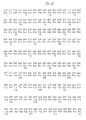
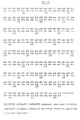
- Figure 2 ( Figure 2a and Figure 2b) shows the nucleotide sequence of the gene encoding xylanase and its amino acid translation (SEQ ID NO: 11).
- the invention also relates to a molecule of DNA that includes the promoter derived from the gene that codes for the Bacillus pumilus PRL B12 xylanase, a pre-sequence and the sequence of nucleotides (SEQ ID NO: 1) which codes for Bacillus sp. xylanase. 720/1.
- the invention also relates to a DNA molecule which comprises a promoter, the presequence that codes for the xylanase signal peptide of Bacillus pumilus PRL B12 and the nucleotide sequence (SEQ ID NO: 1) which code for Bacillus sp. xylanase. 720/1.
- the invention relates to a molecule DNA which includes the promoter (SEQ ID NO: 26) derived from the gene which code for Bacillus pumilus PRL B12 xylanase, the presequence (SEQ ID NO: 27) which codes for the Bacillus xylanase signal peptide pumilus PRL B12 and the nucleotide sequence (SEQ ID NO: 1) which codes for Bacillus sp. xylanase. 720/1.
- promoter SEQ ID NO: 26
- SEQ ID NO: 27 which codes for the Bacillus xylanase signal peptide pumilus PRL B12
- SEQ ID NO: 1 which codes for Bacillus sp. xylanase. 720/1.
- the invention also relates to the promoter (SEQ ID NO: 26) derived of the gene that codes for Bacillus pumilus PRL B12 xylanase.
- the promoter sequence is illustrated in Figure 11.
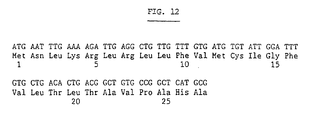
- the invention also relates to the pre-sequence (SEQ ID NO: 27) which code for the Bacillus pumilus PRL B12 xylanase signal peptide.
- SEQ ID NO: 29 The corresponding sequence of 27 amino acids has been identified (SEQ ID NO: 29). This nucleotide sequence, as well as its translation into acids amines, (SEQ ID NO: 28) is illustrated in Figure 12.
- Bacillus pumilus PRL B12 strain was deposited in the collection ATCC (American Type Culture Collection, 12301 Parklawn Drive, Rockville, Maryland, 20852, USA) in accordance with the Treaty of Budapest under number ATCC 55443 on June 24, 1993.
- the invention makes it possible to obtain a mutated DNA molecule, and the mutated xylanase derived therefrom (for which the mutated DNA molecule code), obtained by modifying the nucleotide sequence of the gene which code for the xylanase defined above.
- Techniques for obtaining such mutated xylanases are known to those skilled in the art and are especially described in MOLECULAR CLONING - a laboratory manual - SAMBROOK, FRITSCH, MANIATIS - second edition, 1989, chapter 15.
- the present invention also relates to an expression vector or chromosomal integration vector containing a DNA molecule, such as defined above.
- the expression vector or the vector of chromosomal integration contains the DNA molecule which includes the nucleotide sequence (SEQ ID NO: 1) which codes for the xylanase of Bacillus sp. 720/1.
- the expression vector or the integration vector chromosome contains a DNA molecule that includes the gene that code for xylanase.
- the expression vector or the chromosomal integration vector contains the DNA molecule which includes the sequence of nucleotides (SEQ ID NO: 10) which codes for Bacillus sp. xylanase. 720/1.
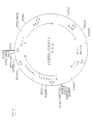
- this vector is the expression vector pUBRD-720X11. Good results were also obtained with the expression vector pUBR-720X11.
- a variant of the invention relates to an expression vector or a chromosomal integration vector which contains a DNA molecule comprising the gene which codes for the mature part of the xylanase.
- the vector expression or the chromosomal integration vector contains the molecule of DNA which includes the nucleotide sequence (SEQ ID NO: 1) which codes for Bacillus sp. xylanase. 720/1.
- the expression vector or the integration vector chromosomal contains a DNA molecule that includes the promoter derived from the gene (SEQ ID NO: 26) which codes for Bacillus xylanase pumilus PRL B12, a presequence and the nucleotide sequence (SEQ ID NO: 1) which codes for Bacillus sp. Xylanase. 720/1.
- the vector of expression contains a DNA molecule that includes a promoter, the presequence (SEQ ID NO: 27) which codes for the signal peptide of xylanase of Bacillus pumilus PRL B12 and the nucleotide sequence (SEQ ID NO: 1) which codes for Bacillus sp.
- the expression vector or the vector of chromosomal integration contains a DNA molecule that includes the promoter derived from the gene (SEQ ID NO: 26) which codes for the xylanase of Bacillus pumilus PRL B12, the presequence (SEQ ID NO: 27) which codes for the signal peptide of Bacillus pumilus PRL B12 xylanase and the sequence of nucleotides (SEQ ID NO: 1) which codes for Bacillus sp. xylanase. 720/1.
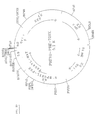
- this vector is the expression vector pBPXD-PRE-720X. Good results have also been obtained with the expression vector pC-BPX-PRE-720X.
- the invention also relates to an expression system which can be used for production of a polypeptide.
- the expression system comprises the sequence of a terminator.
- the expression system comprises the sequence of a terminator.
- the present invention also relates to recombinant strains in which the gene coding for a xylanase is introduced by genetic engineering techniques.
- the gene can be introduced through a replicative vector or integrated into the host chromosome in one or multiple copies through an integrative vector; the sequence of nucleotides encoding a xylanase can be introduced by transformation, either in the form integrated into the chromosomal DNA, or in the form self-replicating (plasmid).
- the invention also relates to the strains of microorganisms. different from the starting producer, in which the sequence of nucleotides coding for a xylanase is introduced by transformation, either in the form integrated into the chromosomal DNA, or in the form self-replicating (plasmid), the gene encoding a xylanase can be introduced via a replicative vector or integrated into the chromosome of the host in one or more copies by an integrative vector.
- the invention relates to a transformed strain comprising the molecule. of DNA that contains the structural gene that codes for mature xylanase of Bacillus sp. 720/1.
- the transformed strain is a strain bacteria.
- the transformed strain is chosen from among the strains of Escherichia, Pseudomonas or Bacillus.
- the transformed strain is a Bacillus strain.
- the transformed strain of Bacillus is a strain of Bacillus licheniformis, a strain of Bacillus pumilus, a strain of Bacillus alcalophilus or a strain of Bacillus sp. 720/1. Good results have been obtained with a strain of Bacillus licheniformis and with a strain of Bacillus pumilus.
- the invention relates to the transformed strain of Bacillus comprising the expression vector or the chromosomal integration vector which understands this DNA molecule.
- the transformed strain of Bacillus is a strain of Bacillus licheniformis.
- the transformed strain of Bacillus is a strain of Bacillus sp. 720/1.
- the present invention makes it possible to obtain a xylanase produced by a transformed strain as defined above.
- the present invention also relates to a method for production of a xylanase comprising the culture of an aerobic bacterium capable of producing xylanase in a suitable nutrient medium containing carbon and nitrogen sources and mineral salts under certain conditions aerobiosis and the harvest of the xylanase thus obtained.
- This culture medium can be solid or liquid.
- the culture medium is liquid.
- the aerobic bacteria is a strain of Bacillus or a derivative of this strain capable of producing xylanase.
- the present invention also relates to a method for production of a xylanase comprising the culture of the Bacillus strain sp. 720/1 or a derivative of this strain capable of producing xylanase in a suitable nutrient medium containing carbon and nitrogen sources and mineral salts under aerobic conditions and the harvest of xylanase thus obtained.
- the invention also relates to a process for the preparation of a xylanase from a recombinant organism, the method comprising the isolation of a DNA fragment coding for xylanase, the insertion of this DNA fragment in an appropriate vector, the introduction of this vector into an appropriate host or the introduction of this DNA fragment into the chromosome of an appropriate host, culture of that host, expression of xylanase and the harvest of xylanase.
- the appropriate host is usually chosen among the group consisting of the Escherichia coli microorganisms, Bacillus or Aspergillus. Usually the host is chosen from Bacillus.
- the host is chosen from the microorganisms of the genus Bacillus (aerobic). Particularly preferably, the host is chosen from the microorganisms Bacillus subtilis, Bacillus licheniformis, Bacillus alcalophilus, Bacillus pumilus, Bacillus lentus, Bacillus amylolique-faciens or Bacillus sp. 720/1. Good results have been obtained when the host for the expression of xylanase according to the present invention is a recombinant strain derived from Bacillus licheniformis, and preferably the Bacillus licheniformis SE2 delap1 strain and Bacillus strain licheniformis SE2 delap6. Bacillus licheniformis SE2 delap1 strain and the Bacillus licheniformis SE2 delap6 strain are described in European patent application 0 634 490.
- the invention makes it possible to obtain a xylanase produced, so heterologous, by a microorganism of the genus Bacillus.
- the microorganism of the genus Bacillus contains a gene coding for a alkaline protease when in the wild.
- this microorganism is a strain of Bacillus licheniformis comprising the DNA molecule that includes the nucleotide sequence that codes for the Bacillus sp. xylanase. 720/1.
- the gene encoding the alkaline protease has been deleted by deleting this Bacillus strain.
- This strain is preferably the Bacillus strain licheniformis SE2 delap1 or the Bacillus licheniformis SE2 delap6 strain.
- heterologously produced is meant a production which is not not carried out by the natural microorganism, i.e. the microorganism which contains in the wild the gene which codes for xylanase.
- Xylanase harvesting techniques are well known to humans of the profession and are chosen according to the envisaged uses of the xylanase. Usually, centrifugation, filtration, ultrafiltration, evaporation, microfiltration, crystallization or a combination of either of these techniques such as centrifugation followed by ultrafiltration. Examples of such techniques are notably described by R. SCRIBAN, Biotechnology, (Lavoisier Technical and Documentation), 1982, p. 267-276 and in ULLMANN'S ENCYCLOPEDIA OF INDUSTRIAL CHEMISTRY, 1987, 5th edition, Vol. A9, pages 363-390.
- the xylanase can then be purified, if necessary and according to the intended uses.
- Enzyme purification techniques are good known to a person skilled in the art, such as precipitation using a salt, such as ammonium sulfate, or solvent, such as acetone or a alcohol. Examples of such techniques are notably described by R. SCRIBAN, Biotechnology, (Lavoisier Technical and Documentation), 1982, p. 267-276.
- Xylanase can also be spray dried or lyophilisation. Examples of such techniques are notably described by R. Scriban, Biotechnologie, (Technique et Documentation Lavoisier), 1982, p. 267-276 and in ULLMANN'S ENCYCLOPEDIA OF INDUSTRIAL CHEMISTRY, 1987, 5th edition, Vol. A9, pages 363-390.
- the present invention also relates to compositions enzymes comprising xylanase according to the invention and at least one additive.
- additives are known to those skilled in the art and are chosen according to the intended use of the composition. They must be compatible with the xylanase and do not affect, or only slightly, the enzymatic activity of xylanase. Usually these additives are enzyme stabilizers, preservatives and formulants.
- compositions comprising the xylanase of the present invention can be used in solid or liquid form.
- Xylanase is formulated according to the intended uses. Stabilizers or preservatives can also be added to enzymatic compositions comprising the xylanase according to the invention.
- the xylanase can be stabilized by the addition of propylene glycol, ethylene glycol, glycerol, starch, xylan, sugar such as glucose and sorbitol, a salt such as sodium chloride, chloride calcium, potassium sorbate and sodium benzoate or a mixture of two or more of these products. Good results have been obtained with propylene glycol. Good results have been obtained with sorbitol.
- the xylanase according to the invention has multiple outlets in various industries, such as, for example, food industries, pharmaceutical or chemical industries.
- Xylanase can in particular be used in baking.
- An example of a use of a xylanase in baking is, in particular, described in international patent application WO 94/04664.
- Xylanase can in particular be used for the treatment of pulp paper.
- An example of the use of a xylanase for the treatment of pulp is, in particular, described in the European patent application 0 634 490.
- the xylanase of the present invention is in particular effective on pulp from eucalyptus wood, as illustrated in example 13 of the this patent application.
- 720/1 720XYL sequence coding for the precursor of Bacillus sp. xylanase. 720/1 PRE-5'BPUXYL promoter, and ribosome binding site, of Bacillus pumilus PRL B12 xylanase, followed by the presequence of Bacillus pumilus PRL B12 xylanase. 720XYL-MAT sequence coding for the mature part of the xylanase from Bacillus sp. 720/1
- the present invention is illustrated by the following examples.
- the strain of Bacillus sp. 720/1 was isolated from a soil sample, taken in Argentina, on an agar nutrient medium and selected for its ability to degrade a colored derivative of xylan known as AZCL-xylane and sold by the company MEGAZYME.
- This strain was cultured at 37 ° C. in LBS / C growth medium, the composition of which is as follows: wheat bran 10 g / l, TRYPTONE (DIFCO) 10 g / l, yeast extract 5 g / l , NaCl 10 g / l, Na 2 CO 3 5.3 g / l, NaHCO 3 4.2 g / l.
- LBS / C growth medium the composition of which is as follows: wheat bran 10 g / l, TRYPTONE (DIFCO) 10 g / l, yeast extract 5 g / l , NaCl 10 g / l, Na 2 CO 3 5.3 g / l, NaHCO 3 4.2 g / l.
- the sodium carbonate and bicarbonate are sterilized separately, then aseptically added to the other components of the sterile medium.
- the agar medium also contains 20 g / l of agar.
- the strain of this invention has been identified by its biochemical characteristics: bacteria Gram positive, aerobic which is in the form of rod, it forms an endo-spore. It therefore belongs to the genus Bacillus.
- the vegetative cells of this strain in culture on the agar LBS / C agar at 37 ° C. have a bacillus shape of size 0.8 ⁇ 3.0-5 ⁇ m .
- the mobility of vegetative cells is positive.
- the ASD environment agar contains 15 g / l of TRYPTONE (DIFCO), 5 g / l of soy peptone; 5 g / l NaCl and 15 g / l agar.
- DIFCO TRYPTONE
- soy peptone 5 g / l NaCl
- 15 g / l agar 15 g / l agar.
- the strain is oligosporogenic.
- Catalase test is positive in the presence of 10% (v / v) of peroxide hydrogen.
- the oxidase test is positive in the presence of 1% (w / v) of tetramethyl-1,4-phenylene diamine dihydrochloride.
- This strain is aerobic, that is, it develops aerobically. It does not develop anaerobically, i.e. under an atmosphere of 84% (v / v) N 2 , 8% (v / v) CO 2 , 8% (v / v) H 2 to 37 ° C.
- the abbreviation% (v / v) represents a percentage expressed in volume by volume.
- This strain is not thermophilic. It presents a development normal after incubation in LBS / C agar medium at 20 ° C, 30 ° C, 37 ° C and 45 ° C, on the other hand it does not develop at 50 ° C and 55 ° C, nor at 10 ° C.
- the strain of Bacillus sp. 720/1 does not acidify glucose.
- Bacillus sp. 720/1 has been identified by means of the gallery API 50 CHB and API 20 E gallery by following the instructions of use of the supplier (API SYSTEM, France). Bacillus strain sp. 720/1 uses glycerol, N-acetylglucosamine, arbutin, citrate, galactose, amygdalin, melibiose and hydrolyzes gelatin. These characteristics clearly differentiate the strain of Bacillus sp. 720/1 of a strain of Bacillus pumilus. Indeed, a strain of Bacillus pumilus does not have any of these characteristics.
- the strain of Bacillus sp. 720/1 has also been identified using the BIOLOG system (USA).
- the database analyzing the results of this system gives a score of 0.564 for Bacillus coagulans, of 0.097 for Bacillus subtilis, 0.057 for Bacillus licheniformis and 0.00 for Bacillus pumilus.
- These characteristics clearly differentiate the Bacillus sp. 720/1 of a strain of Bacillus coagulans, of a strain of Bacillus subtilis, a strain of Bacillus licheniformis and a Bacillus pumilus strain.
- the isolated bacteria therefore belongs to the genus Bacillus, no species known could not be determined.
- the strain of Bacillus sp. 720/1 has been deposited in the collection named BELGIAN COORDINATED COLLECTIONS OF MICROORGANISMS (LMG culture collection) under number LMG P-14798.
- the strain of Bacillus sp. 720/1 is cultured on a Petri dish containing an agar LBS / C medium at 37 ° C for 48 hours (culture A).
- a culture is carried out in a medium LB / C liquid whose composition is identical to that of LBS / C medium but without wheat bran, at 37 ° C for 24 hours with orbital shaking at at the rate of 250 revolutions per minute (culture B) with an amplitude about 2.54 cm.
- 500 ml of culture B are then transferred to a fermenter of 20 1 containing 14 LBS / C medium.
- the pH is left free, the speed agitation and the flow of air blown into the fermenter are such that the partial pressure of dissolved oxygen in the culture medium is not less than 30% of saturation.
- the xylanase and the cell biomass are separated by centrifugation (BECKMAN J21, rotor JA10) at 8,000 rpm for 30 minutes.
- the xylanase produced by the strain of Bacillus sp. 720/1 is extracellular.
- the residual insoluble matter is separated from the xylanase, from the centrifugation supernatant, by microfiltration (KROS FLOII cartridge 0.2 ⁇ of porosity, Company MICROGON).
- microfiltration retentate is washed with 1 deionized water. We wash three times.
- the enzymatic activity is measured on the retentate (product R) and on the permeate (product P) of ultrafiltration obtained.
- a unit of xylanase enzyme is defined as the quantity of enzyme which, at a pH of 8.0, at a temperature of 50 ° C and in the presence of xylan, catalyzes the release of glucose equivalents at a rate of 1 ⁇ mole of glucose per minute ( ⁇ mol / minute).
- the measurement of the xylanase enzymatic activity is carried out according to the protocol described by BAILEY, BIELY and POUTANEN, J. BIOTECHNOLOGY, 1992, 23, pages 257-270; except that the citrate-phosphate buffer cited by BAILEY et al. has been replaced by the Tris (hydroxymethyl) aminomethane-HCl buffer, 50 mM (pH 8.0).
- Enough is added to the ultrafiltration retentate (product R) polyethylene glycol (MERCK polyethylene glycol reference 807490) to obtain a concentration of 40% (w / w). After solubilization of polyethylene glycol, the solution obtained is incubated for 30 minutes at 25 ° C.
- the solution is centrifuged, containing the polyethylene glycol and the xylanase, 10 minutes at 8,000 rpm (BECKMAN centrifuge J21, rotor JA10).
- the centrifugation supernatant is removed.
- this acetone suspension is centrifuged. minutes at 8,000 rpm (BECKMAN J21, rotor JA10).
- this acetone suspension is centrifuged. minutes at 8,000 rpm (BECKMAN J21, rotor JA10).
- the centrifugation pellet is kept. This is suspended in sufficient volume of 0.9% (v / v) NaCl solution to be dissolved (product N).
- a fraction of the ultrafiltration retentate (product N) obtained in the example 2 is conditioned by passage through a chromatography column of gel permeation (BIO-RAD ECONOPAC 10DG column) balanced with a Bis-Tris (bis (2-hydroxyethyl) imino-tris (hydroxymethyl) methane) buffer) 20mM, pH 6.2 (buffer A). This gives a solution called product X.
- the amino acid sequence of the xylanase of the present invention is indirectly determined from the nucleotide sequence (SEQ ID NO: 10) of the gene which codes for this xylanase, the production of which is described in Example 14. This is done using the computer program IntelliGenetics Suite Software for Molecular Biology (Release # 5.4) from IntelliGenetics, Inc. USA.
- Figure 2 represents the nucleotide sequence (SEQ ID NO: 10) of the gene coding for the xylanase and its translation into amino acids (SEQ ID NO: 11).
- Xylanase is synthesized as a precursor.
- Precursor of xylanase contains 248 amino acids (SEQ ID NO: 6).
- SEQ ID NO: 4 The nucleotide sequence (SEQ ID NO: 4) coding for the precursor of the xylanase as well as its translation into amino acids (SEQ ID NO: 5).
- the pre-sequence of the xylanase synthesized is identified in the form of a precursor. It is a sequence of 27 amino acids (SEQ ID NO: 9). The corresponding nucleotide sequence is identified (SEQ ID NO: 7).
- the mature xylanase contains 221 amino acids (SEQ ID NO: 3).
- Figure 1 shows the sequence of nucleotides (SEQ ID NO: 1) coding for mature xylanase and its amino acid translation (SEQ ID NO: 2).
- the molecular weight of xylanase is estimated by calculation from the amino acid sequence of the mature form of xylanase, as described in example 4.
- the chromatogram obtained shows a single peak corresponding to xylanase activity. An apparent molecular weight is deduced therefrom. protein of about 13.5 kD.
- Coomassie blue staining reveals a polypeptide with a molecular weight of about 25.7 kD.
- the isoelectric point of xylanase is estimated from the amino acid sequence of the mature form of xylanase, such as described in Example 4.
- the estimated isoelectric point is representative of the net charge of the protein in denatured form.
- a fraction of solution A is deposited, as obtained in the example 3, on a MONO P 5/20 chromatofocus column (PHARMACIA) following the supplier's recommendations, and previously balanced with 25 mM diethanolamine buffer, pH 9.9.
- the column is eluted using the solution of ampholytes POLYBUFFER 96 (PHARMACIA) diluted 10 times in demineralized water.
- the pH of the fraction containing xylanase activity is 9.5.
- a halo which is in the form of a hydrolysis zone of AZCL-xylane, forms around the fraction that contains xylanase.
- xylanase has a slightly isoelectric point greater than 9.6, isoelectric point of the marker having the isoelectric point the highest implemented.
- the isoelectric point observed experimentally is representative of the surface charge of the protein in its native form.
- Capso 3- (cyclohexylamino) -2-hydroxy-1-propane sulfonic acid
- Caps 3- (cyclohexylamino) -1-propane sulfonic acid
- the symbol * means that the value obtained is the average of the measurements carried out at the same pH but obtained with the two buffers.
- This example shows that the xylanase according to the invention develops a high enzymatic activity in a very wide range of pH.
- aqueous suspensions of a pine paste are prepared (from from the company SCA) having 2.5% (by weight of dry matter) of consistency and having an initial Kappa index of 17.
- the pH of these suspensions is adjusted to pH 5 with H 2 SO 4 .
- the solution called product N is diluted, as obtained in Example 2, with demineralized water to obtain an enzyme solution having a enzymatic activity of 25 IU / ml (as described in example 2).
- This enzyme solution containing xylanase, is added to a pine pulp suspension so that the pulp suspension is treated using 5 IU / g dry dough
- each suspension of dough, thus obtained, is subjected to a bleaching treatment which consists of chlorination with water chlorinated. This treatment takes place on a paste having a consistency of 3% in dry matter weight.
- the 3 suspensions are incubated for 1 hour at room temperature. Then, the paste is washed with 40 volumes of demineralized water.
- an alkaline extraction which consists in adding 2% (weight / dry paste weight) of NaOH to the three suspensions obtained above and which have a consistency of 5% by weight of dry matter.
- the three suspensions are incubated for 1 hour 30 minutes at a temperature 60 ° C. Then, the paste is washed with 40 volumes of demineralized water and recovers it in sheet form at a whiteness of around 45 ° ISO (+/- 3 ° ISO).
- the Kappa index of the three leaves obtained is measured.
- the Kappa index relates to the measurement of the quantity of lignin present in the dough.
- the Kappa index is a number which represents the volume (in milliliters) of a 0.1 N potassium permanganate solution (KMnO 4 ) consumed per one gram of dry pulp under the specified conditions and following the procedures described in the TAPPI standard (Technical Committee of the Association of the Pulp and Paper industry) # T236cm-85 (1985).
- the ISO degree relates to the gloss measurement of the paper obtained at from the dough. This value is a factor of the reflectance of the paper obtained from the dough under the specified conditions and following the procedures described in ISO standard (The International Organization for Standardization) # 2469 published in standard #ISO 2470-1977 (F) in supplement to standard # 2470.
- the symbol / means that the dough suspension has not been tested.
- the xylanase according to the invention has a activity in a wide range of pH.
- the xylanase according to the invention is active in a pH range between about 5 and about 10. It is particularly active for higher pH values or equal to approximately 6. It is particularly active for pH values less than or equal to about 9.
- Example 11 is reproduced with 5 suspensions of softwood pulp at pH 8.
- the enzymatic treatment step is carried out at a pH of 8 and at different temperatures (55, 60 and 65 ° C).
- the symbol / means that the dough suspension has not been tested.
- This example shows that the xylanase according to the invention is active in a wide range of temperatures. It is active at a temperature about 65 ° C.
- This example also shows that the xylanase according to the invention is stable at a temperature of around 60 ° C.
- Xylanase activity produced by the Bacillus sp. 720/1 help to bleaching eucalyptus pulp in the ECF sequence
- a eucalyptus paste from the CEASA MILL company (Spain).
- the dough is treated by following a ECF sequence ("Elemental Chlorine Free"), that is to say that the succession of steps in the sequence does not use elemental chlorine.
- stage O oxygen stage
- the dough is treated by a process using oxygen as described in U.S. Patent 4,462,864, so that a dough with an initial Kappa number of 12.3 and an initial ISO degree of 33.4 is obtained.
- Two aqueous suspensions are prepared from this treated paste by oxygen having a consistency of 4% by weight of dry matter.
- the pH of these suspensions is adjusted to pH 9 with HCl.
- the solution called product N is diluted, as obtained in Example 2, with demineralized water to obtain an enzyme solution having a enzymatic activity of 25 IU / ml.
- This enzyme solution containing xylanase, is added to a eucalyptus pulp suspension so that the pulp suspension is treated with 10 IU / g of dry paste.
- each suspension of dough, thus obtained, is subjected to a bleaching treatment which consists of chlorination with dioxide of chlorine. This treatment takes place on a paste having a consistency of 3% in dry matter weight.
- the enzyme treated pulp suspension is added and to a suspension of pulp not treated enzymatically an amount of 0.6% chlorine dioxide (w / w dry paste).
- w / w dry paste we add to the other suspension of pulp not treated enzymatically a quantity of dioxide of 1% chlorine (w / w).
- the 3 suspensions are incubated for 30 minutes at 50 ° C. Then we wash the dough with 40 volumes of demineralized water.
- stage E stage with sodium hydroxide and hydrogen peroxide
- an alkaline extraction which consists in adding 1.8% (weight / weight of dry paste) of NaOH and 0.5% (weight / weight of dry paste) of hydrogen peroxide to the three suspensions obtained above and which have a consistency of 12% by weight of dry matter.
- the three suspensions are incubated for 1 hour 30 minutes at a temperature 70 ° C. Then, the paste is washed with 40 volumes of demineralized water.
- each suspension of dough, thus obtained, is subjected to new to a bleaching treatment which consists of chlorination with chlorine dioxide. This treatment takes place on a dough having a consistency of 12%.
- the 3 suspensions are incubated for 2 hours at 75 ° C. Then we wash the paste with 40 volumes of demineralized water.
- stage E / P soda and hydrogen peroxide stage
- an alkaline extraction which consists in adding 0.6% (weight / weight of dry paste) of NaOH and 0.3% (weight / weight of dry paste) of hydrogen peroxide to the three suspensions obtained above and which have a consistency of 12% by weight of dry matter.
- the three suspensions are incubated for 1 hour 30 minutes at a temperature 70 ° C. Then, the paste is washed with 40 volumes of demineralized water.
- each suspension of dough, thus obtained, is subjected to a bleaching treatment which consists of chlorination with dioxide of chlorine. This treatment takes place on a paste having a consistency of 12%.
- the 3 suspensions are incubated for 2 hours 30 minutes at 75 ° C. Then, the paste is washed with 40 volumes of demineralized water and it is recovered in sheet form.
- the ISO degree of the three sheets obtained is measured.
- the xylanase according to the invention is effective on the eucalyptus paste. In addition, it does not require any pH adjustment, since it has the advantage of being active at the pH of the dough, that is to say at a pH of approximately 9.
- the xylanase according to the invention is an alkaline xylanase.
- This example also shows that compared to what is obtained without xylanase, the use of xylanase according to the invention results in an increase in gloss of at least 3 ° ISO for a fixed amount of ClO 2 .
- This example also shows that the use of the xylanase according to the invention makes it possible to reduce the amount of ClO 2 by approximately 4 to 5 kg / tonne of pulp, which represents approximately 25 to 30% of the total amount of ClO 2 necessary.
- Example 2 From culture B, as obtained in Example 2, a culture of 200 ml of the Bacillus sp. 720/1 is performed in LB / C environment for 16 hours at 37 ° C.
- the LB / C medium is identical to the LBS / C medium, described in Example 1, without the addition of wheat bran.
- lysate thus obtained is then treated with 200 ⁇ l of a solution of RNAse at 10 mg / ml for 20 minutes at 50 ° C. 1 ml of a solution of SDS (sodium dodecyl sulfate) at 10% (w / v) is then added to this lysate. Then this lysate is incubated for 30 minutes at 70 ° C.
- SDS sodium dodecyl sulfate
- the lysate is cooled to around 45 ° C, then added to it 0.5 ml of proteinase K solution (sold by BOEHRINGER Mannheim) at 20 mg / ml (prepared immediately).
- the lysate is incubated at 45 ° C with shaking until a transparent solution.
- the DNA is precipitated with 20 ml of ethanol.
- the precipitate is recovered by centrifugation at 5,000 rpm (BECKMAN J21, rotor JA10) for 5 minutes, then suspended in 2 ml of TE buffer at pH 8.0 (10 mM TRIS-HCl, 1 mM EDTA at pH 8.0). This suspension contains chromosomal DNA.
- the vector pUBR2002 E. coli - Bacillus subtilis was obtained from of the plasmid pBR322 which is sold by the company BIOLABS (CLONTECH LABORATORIES catalog n ° 6210-1) and of the vector pUB131.
- Two synthetic oligonucleotides are constructed by the technique described in BEAUCAGE et al. (1981), Tetrahedron Letters, 22, pages 1859-1882 and using ⁇ -cyanoethyl phosphoramidites in a BIOSEARCH CYCLONE SYNTHESIZER.
- oligonucleotides are used to carry out an amplification by PCR from the plasmid pBR322 according to the technique described in Molecular Cloning, a laboratory Manual - SAMBROOK et al., Second edition, 1989, pages 14.18-14.19.
- the PCR amplified fragment contains the E. coli replicon limited in part and other by the restriction sites AvrII, BstEII, NotI, SfiI, SnabI.
- the construction of the vector pUB131 is described. in Example 10 and in Figure 7 of United States patent 5,352,603 (application for European patent 0 415 296).
- the ligation thus obtained is transformed into E cells.
- coli MC1061 [CLONTECH LABORATORIES, catalog n ° C-1070-1] by electroporation (SAMBROOK et al, pages 1.75-1.81).
- the transformed cells are cultured on Petri dishes containing LB agar medium, 100 ⁇ g / ml ampicillin and 10 ⁇ g / ml kanamycin at 37 ° C for about 18 hours.
- the plasmids are extracted from the colonies isolated by the method of alkaline lysis (SAMBROOK et al., pages 1.25-1.28) and are subjected to a restriction analysis, analysis described in Molecular Cloning, a laboratory Manual - MANIATIS et al., 1982, Cold Spring Harbor Laboratory, pages 374-379.
- the chromosomal DNA is cleaved partially by the restriction enzyme Sau3AI.
- the conditions of restrictions are those described by SAMBROOK et al. (pages 5.28-5.32), at except that these restriction conditions are increased by a factor of 10, so to obtain a sufficient quantity of DNA for the purification steps following.
- the ratio between the quantity of DNA used and the quantity of enzyme is adjusted in order to obtain a maximum of fragments of size between 4 and 7 kbp (kbp: 10 3 base pairs).
- the DNA fragments thus purified are then ligated (according to the method described by SAMBROOK et al. (pages 1.68-1.69) with the plasmid pUBR2002 (E. coli - Bacillus subtilis), previously cut at the BamHI site and dephosphorylated as described by SAMBROOK et al. (pages 1.60-1.61).
- the ligation thus obtained is used to transform cells of E. coli MC1061 by electroporation (SAMBROOK et al., Pages 1.75-1.81).
- the transformed E. coli cells are cultured on a dish of Petri dish containing LB agar medium, 0.8 g / l AZCL-xylan and 100 ⁇ g / ml ampicillin, for approximately 24 hours at 37 ° C.
- the plasmid present in this colony is extracted and isolated by the alkaline lysis technique described in SAMBROOK et al., pages 1.25-1.28.
- the plasmid pUBR-720X1 is thus obtained (FIG. 4).
- the plasmid pUBR-720X1 is digested by enzymes restricting SwaI and SpeI sites.
- the xylanase gene is thus obtained on a fragment of SwaI-SpeI DNA of about 1.5 kbp.
- This SwaI-SpeI DNA fragment is subjected to a treatment with Klenow fragment of DNA polymerase (SAMBROOK et al., pages F.2-F.3).
- the DNA preparation thus obtained is ligated with the vector pUBR2002, which was previously digested with EcoRV and dephosphorylated.
- the ligation is then transformed into E. cells. coli MC1061 by electroporation.
- the transformed strains are selected on a Petri dish containing LB medium (Luria-Bertani) agar, 0.8 g / l of AZCL-xylane (MEGAZYME) and 100 ⁇ g / ml of ampicillin, after growth at 37 ° C for about 24 hours.
- LB medium Lia-Bertani
- MEGAZYME AZCL-xylane
- Colonies with a hydrolysis zone are isolated.
- the plasmids are extracted from colonies isolated by the lysis technique alkaline (SAMBROOK et al., pages 1.25-1.28) and are subjected to an analysis by restriction (MANIATIS et al., 1982, pages 374-379).
- This analysis by restriction shows that the isolated plasmid, pUBR-720X11 ( Figure 5), contains the xylanase gene on an approximately 1.5 kbp fragment of DNA chromosome of Bacillus sp. 720/1.
- the plasmid pUBR-720X11 is then used to transform the cells of E. coli JM109 (CLONTECH LABORATORIES catalog n ° C1005-1) by the CaCl 2 technique (SAMBROOK et al., pages 1.82-1.84).
- Cells transformed E. coli are cultured on Petri dishes containing LB agar medium, 0.8 g / l of AZCL-xylan and 100 ⁇ g / ml ampicillin. After growth at 37 ° C for approximately 24 hours, a hydrolysis zone is observed around the colonies. This shows that transformed E. coli cells express xylanase well.
- a colony with a hydrolysis zone is isolated.
- the plasmid present in this colony is extracted and isolated by the lysis technique alkaline.
- the sequence of the xylanase is established using the method described in SAMBROOK et al. pages 13.15 and 13.17 (figure 13.3B) using the plasmid pUBR-720X11 as a template.
- synthetic oligonucleotides are prepared to hybridize with the plasmid pUBR2002.
- sequences of these synthetic oligonucleotides are as follows:
- the rest of the sequence is determined by the use of other synthetic oligonucleotides based on parts of the sequence newly determined.
- the nucleotide sequence of the complete gene that codes for xylanase (SEQ ID NO: 10) is thus obtained ( Figure 2).
- the xylanase gene is obtained as a fragment of about 1.5 kbp
- the expression vector pUBRD-720X11 ( Figure 6) is a plasmid derived from the plasmid pUBR-720X11, from which the replicon of E. coli has been eliminated.
- Plasmid pUBR-720X11 is digested with the enzyme restriction SnaBI sites, in order to eliminate the origin of replication of E. coli, by following the technique described in example 14. A fragment of approximately 5 kbp is thus obtained, it is ligated on itself, following the technique described in Example 14, to obtain the plasmid pUBRD-720X11.
- the ligation thus obtained is used to transform cells of Bacillus subtilis SE3 using the technique described in DNA Cloning, vol. II, ED. Glover, D.M., IRL Press Oxford, 1985, pages 9-11.
- Bacillus subtilis SE3 strain was deposited on June 21, 1993 at the collection named BELGIAN COORDINATED COLLECTIONS OF MICROORGANISMS (LMG culture collection, Ghent, Belgium) in accordance with the Budapest Treaty under number LMG P-14035.
- the transformed cells are cultured on a Petri dish containing agar LB (Luria-Bertani) agar, 0.8 g / l of AZCL-xylan and 25 ⁇ g / ml kanamycin, at 37 ° C for about 18 hours. After growth, the colonies presenting a hydrolysis zone are isolated.
- LB Lia-Bertani
- the isolated colonies are subjected to analysis of the plasmid by enzymatic restriction, in order to verify that the construction of the plasmid is correct, following the technique described in Example 14.
- the plasmid pUBRD-720X11, described in Example 15, is extracted from its host, isolated and purified (SAMBROOK et al., 1989, p. 1.25-1.28).
- a culture of the strain of Bacillus licheniformis SE2 is prepared delap6.
- the Bacillus licheniformis SE2 delap6 strain and the culture of these are described in Examples 27 and 28 of the patent application European 0 634 490.
- the Bacillus licheniformis SE2 delap6 strain was prepared from of the Bacillus licheniformis SE2 strain which was deposited on June 21, 1993 to the collection named BELGIAN COORDINATED COLLECTIONS OF MICROORGANISMS (LMG culture collection, Ghent, Belgium) in accordance with the Budapest Treaty under number LMG P-14034.
- the transformed strain [Bacillus licheniformis SE2 delap6 (pUBRD-720X11)] is selected on Petri dishes containing LB agar medium, 0.8 g / l of AZCL-xylan and 25 ⁇ g / ml kanamycin. Then, it is isolated and purified by screening, that is to say by being deposited and spread in the form of exhausting streaks on the surface of the agar LB medium (Luria Bertani) which is described in Molecular Cloning - Laboratory Manual (Sambrook and al.), 1989, p. A.4.
- the B. licheniformis SE2 delap6 strain transformed by the plasmid pUBRD-720X11, as obtained in Example 16, is cultured for 17 hours at 37 ° C. in an LB culture medium supplemented with 0.5% (w / v) glucose and 20 ⁇ g / ml kanamycin.
- This culture is transferred (5% v / v) in 50 ml of M2 medium supplemented with 20 ⁇ g / ml kanamycin.
- Medium M2 contains 30 g of soy flour, 75 g of soluble starch, 2 g of sodium sulphate, 5 mg of magnesium chloride, 3 g of NaH 2 PO 4 , 0.2 g of CaCl 2 .H 2 O and 1000 ml of water.
- the pH of this M2 medium is adjusted to 5.8 with 10 N NaOH before sterilization.
- the culture is incubated with orbital shaking, at a rate of 250 revolutions per minute with an amplitude of about 2.54 cm, for 80 hours at 37 ° C. After 80 hours, the biomass is eliminated by centrifugation (BECKMAN J21, rotor JA10) at 5000 rpm for 10 minutes. The centrifugation supernatant is kept. We measures the enzymatic activity on this supernatant, according to the technique described in Example 2, and the presence of xylanase activity is noted.
- the vector pUBC2001 (E. coli-Bacillus) ( Figure 7) is a plasmid derived from plasmid pUBC131, with the only difference being presence of two additional restriction sites: BstEII and PacI.
- the construction of the vector pUBC131 is described in Example 11 and in Figure 8 of the United States patent 5,352,603 (European patent application 0 415 296).
- the two oligonucleotides having the sequences SEQ ID NO: 18 and 19 are used to perform PCR amplification from the vector pUBC131, following the PCR technique described in Example 14.
- the fragment amplified by PCR containing part of the ampicillin resistance gene and the functions necessary for replication in B. coli, is subject to restriction by ScaI and BstEII, generating a fragment of approximately 1.5 - 1.6 kbp.
- a second PCR amplification is carried out using the vector pUBC131, using the oligonucleotides having the sequences SEQ ID NO: 20 and 21 and following the technique described in Example 14.
- the fragment amplified by PCR contains part of the vector pUBC131. This fragment is Restricted by BstEII and EcoRI, generating a fragment about 1.4 - 1.5 kbp.
- the two fragments thus obtained are ligated together, according to the technique described in Example 14, with the vector pUBC131 which has previously digested with EcoRI and ScaI, according to the technique described in Example 14.
- the ligation thus obtained is used to transform E. cells. coli MC1061 by electroporation, following the procedure described in Example 14.
- the transformed cells are cultured on Petri dishes containing LB agar medium, 100 ⁇ g / ml ampicillin and 10 ⁇ g / ml kanamycin, at 37 ° C for about 18 hours.
- the isolated colonies are subjected to an analysis of the plasmid by enzymatic restriction, following the technique described in Example 14.
- the expression vector pC-BPX-PRE-2003 (E. coli-Bacillus) ( Figure 8) is an expression vector derived from the plasmid pUBC2001. It contains the promoter derived from the gene that codes for Bacillus pumilus xylanase PRL B12 and the presequence which codes for the signal peptide of xylanase Bacillus pumilus PRL B12.
- the promoter sequence derived from the gene which codes for the xylanase of Bacillus pumilus PRL B12 is described in the present application under the SEQ ID NO: 26.
- the sequence of the pre-sequence which codes for the Bacillus pumilus PRL B12 xylanase signal peptide is described in this application under the number SEQ ID NO: 27.
- oligonucleotides are used to carry out an amplification by PCR from the plasmid pUB-BPX12, according to the technique described in Example 14.
- the construction of the plasmid pUB-BPX12 is described in Example 17 and in FIG. 4 of European patent application 0 634 490, which is incorporated by reference.
- oligonucleotide having the sequence SEQ ID NO: 22 allows, by the change of a nucleotide to eliminate, upstream of the promoter of B. pumilus PRL B12 xylanase, the restriction site SphI, located at around 5.5 kbp, normally present in pUBC2001.
- sequence SEQ ID NO: 23 is used to create a new SphI site at the end of the presequence which codes for the signal peptide of the xylanase of B. pumilus PRL B12 by changing only one nucleotide of codon Ala [25], that is, by changing GCG to GCT.
- the fragment amplified by PCR containing the promoter derived from the gene which codes for the B. pumilus PRL B12 xylanase and the pre-sequence which code for the B. pumilus PRL B12 xylanase signal peptide, is Restricted by PvuII and SphI, generating a fragment of approximately 0.7 kbp, following the technique described in Example 14.
- the PvuII-SphI fragment is ligated with the vector pUBC2001 which has previously been the subject of a double digestion with PvuII and SphI, following the techniques described in Example 14.
- the ligation thus obtained is used to transform E. cells. coli MC1061 by electroporation, following the procedure described in Example 14.
- the transformed cells are cultured on Petri dishes containing LB agar medium, 100 ⁇ g / ml ampicillin, at 37 ° C for about 18 hours .
- the isolated colonies are subjected to an analysis of the plasmid by enzymatic restriction, following the technique described in Example 14.
- the expression vector pC-BPX-PRE-720X (E. coli-Bacillus) ( Figure 9) is an expression vector comprising the promoter derived from the gene which code for B. pumilus PRL B12 xylanase and the presequence which codes for the B. pumilus PRL B12 xylanase signal peptide and the sequence of the gene which codes for the mature part of the xylanase of Bacillus sp. 720/1.
- the expression vector pC-BPX-PRE-720X comprises the sequence SEQ ID NO: 1, nucleotide sequence of the gene which codes for the part mature Bacillus sp. xylanase. 720/1.
- oligonucleotides are used to carry out an amplification by PCR from the plasmid pUBR-720X11, as obtained in Example 14, and according to the technique described in Example 14.
- the fragment amplified by PCR containing the sequence of the gene which codes for the mature part of Bacillus sp. xylanase. 720/1, is subject to a restriction by SphI and SacI, generating a fragment of approximately 0.8 kbp, according to the technique described in Example 14.
- the SphI-SacI fragment is ligated with the vector pC-BPX-PRE-2003 which has previously been the subject of a double digestion with SphI and SacI, according to the techniques described in Example 14. Ligation at the site SphI restriction allows to create a translational fusion of the sequence signal of the gene which codes for xylanase from B. pumilus PRL B12 with the gene sequence which codes for the mature part of Bacillus xylanase sp. 720/1.
- the ligation thus obtained is used to transform E. cells. coli MC1061 by electroporation, according to the technique described in Example 14.
- the transformed cells are cultured on a Petri dish containing the agar LB medium, 0.8 g / l of AZCL-xylan and 100 ⁇ g / ml of ampicillin, to 37 ° C for approximately 18 hours.
- the isolated colonies are subjected to an analysis of the plasmid by enzymatic restriction, according to the technique described in the example 14.
- the vector pBPXD-PRE-720X (Bacillus) ( Figure 10) is a vector of expression derived from plasmid pUB131. It includes the derivative promoter of the gene that codes for B. pumilus PRL B12 xylanase and the presequence which codes for the signal peptide of the xylanase of B. pumilus PRL B12 and the gene sequence that codes for the mature part of the Bacillus sp. xylanase. 720/1.
- the plasmid pC-BPX-PRE-720X, obtained in Example 20, is subjected to a restriction by PvuII and EcoRI, generating a fragment of approximately 1.5 kbp, according to the technique described in Example 14.
- the approximately 1.5 kbp fragment is ligated with the vector pUB131, which has previously been the subject of a double digestion with PvuII and EcoRI, according to the techniques described in Example 14.
- the ligation thus obtained is used to transform B cells. subtilis SE3, according to the electroporation technique described in Example 14.
- the transformed cells are cultured on a Petri dish containing the agar LB medium, 0.8 g / l of AZCL-xylan and 25 ⁇ g / ml of kanamycin, to 37 ° C for approximately 18 hours.
- the isolated colonies are subjected to an analysis of the plasmid by enzymatic restriction, according to the technique described in the example 14.
- the plasmid pBPXD-PRE-720X (FIG. 10), described in example 21, is extracted from its host, isolated and purified.
- a culture of the B. licheniformis SE2 delap6 strain is prepared, according to the technique described in Example 16. Then, this strain is transformed with this plasmid according to the protoplast technique described in Example 16.
- the transformed strain [B. licheniformis SE2 delap6 (pBPXD-PRE-720X)] is selected on a Petri dish containing LB agar medium, 0.8 g / l of AZCL-xylan and 25 ⁇ g / ml of kanamycin.
- the strain is isolated and purified by screening, according to the technique described in Example 16.
- Example 22 A test identical to that described in Example 17 is carried out, but with the strain of B. licheniformis SE2 delap6 transformed by the plasmid pBPXD-PRE-720X, as obtained in Example 22.
- the activity is measured, according to the technique described in Example 2, enzymatic on the supernatant obtained and the presence of activity is noted xylanase.
- the xylanase produced by the strain of B is isolated and purified.
- This strain is cultured by following the protocol described in example 23.
- the xylanase obtained is isolated and purified according to the protocol described in Example 3 of European patent application 0 634 490.
- sequence of the first 50 amino acids of xylanase produced by the strain of B. licheniformis SE2 delap6 (pBPXD-PRE-720X) is determined using a sequencing device (HP G1000A, HEWLETT-PACKARD) and following the instructions for use of this device.
- the isolated and purified xylanase is used as described in Example 24.
- the molecular weight of the xylanase produced by the strain of B. licheniformis SE2 delap6 (pBPXD-PRE-720X) is determined by following the protocol described in Example 7 and using the isolated xylanase and purified as described in Example 24.
- Coomassie blue staining reveals a polypeptide with a molecular weight between 25 and 26 kD, which is identical to that of the xylanase produced by the strain of Bacillus sp. 720/1.
Landscapes
- Life Sciences & Earth Sciences (AREA)
- Chemical & Material Sciences (AREA)
- Health & Medical Sciences (AREA)
- Genetics & Genomics (AREA)
- Engineering & Computer Science (AREA)
- Organic Chemistry (AREA)
- Bioinformatics & Cheminformatics (AREA)
- Zoology (AREA)
- Wood Science & Technology (AREA)
- Biochemistry (AREA)
- General Engineering & Computer Science (AREA)
- Biotechnology (AREA)
- Biomedical Technology (AREA)
- Microbiology (AREA)
- General Health & Medical Sciences (AREA)
- Molecular Biology (AREA)
- Food Science & Technology (AREA)
- Biophysics (AREA)
- Physics & Mathematics (AREA)
- Nutrition Science (AREA)
- Plant Pathology (AREA)
- Polymers & Plastics (AREA)
- Medicinal Chemistry (AREA)
- Micro-Organisms Or Cultivation Processes Thereof (AREA)
- Enzymes And Modification Thereof (AREA)
- Preparation Of Compounds By Using Micro-Organisms (AREA)
- Immobilizing And Processing Of Enzymes And Microorganisms (AREA)
- Saccharide Compounds (AREA)
- Peptides Or Proteins (AREA)
- Paper (AREA)
- Fodder In General (AREA)
Description
- la séquence du promoteur (SEQ ID NO:26) dérivé du gène qui code pour la xylanase de Bacillus pumilus PRL B12,
- une séquence codant pour un peptide signal, et
- la séquence de nucleotides (SEQ ID NO:1) qui code pour la xylanase de Bacillus sp. 720/1.
- la séquence d'un promoteur,
- la préséquence (SEQ ID NO:27) qui codé pour le peptide signal de la xylanase de Bacillus pumilus PRL B12, et
- la séquence de nucleotides (SEQ ID NO:1) qui code pour la xylanase de Bacillus sp. 720/1.
- la séquence du promoteur (SEQ ID NO:26) dérivé du gène qui code pour la xylanase de Bacillus pumilus PRL B12,
- la préséquence (SEQ ID NO:27) qui code pour le peptide signal de la xylanase de Bacillus pumilus PRL B12,
- la séquence de nucleotides (SEQ ID NO:1) qui code pour la xylanase de Bacillus sp. 720/1, et
- la séquence d'un terminateur.
| Symbole Abréviation | Signification |
| OriEC | origine de réplication dans E. coli |
| REP | protéine nécessaire pour la réplication dans Bacillus |
| Ori+ | origine de réplication du brin + dans Bacillus |
| Ori- | origine de réplication du brin - dans Bacillus |
| AmpR | gène apportant la résistance à l'ampicilline |
| KmR | gène apportant la résistance à la kanamycine |
| BlmR | gène apportant la résistance à la bléomycine |
| 5'720XYL | séquence 5' située en amont de la séquence codant pour la xylanase de Bacillus sp. 720/1 |
| 3'720XYL | séquence 3' située en aval de la séquence codant pour la xylanase de Bacillus sp. 720/1 |
| 720XYL | séquence codant pour le précurseur de la xylanase de Bacillus sp. 720/1 |
| 5'BPUXYL-PRE | promoteur, et site de fixation au ribosome, de la xylanase de Bacillus pumilus PRL B12, suivi de la préséquence de la xylanase de Bacillus pumilus PRL B12. |
| 720XYL-MAT | séquence codant pour la partie mature de la xylanase de Bacillus sp. 720/1 |
| Symbole | Acides aminés | Nombre | % (en poids moléculaire) |
| N | asparagine | 25 | 11,6 |
| Y | tyrosine | 13 | 8,6 |
| T | thréonine | 18 | 7,4 |
| S | serine | 19 | 6,7 |
| I | isoleucine | 14 | 6,4 |
| V | valine | 14 | 5,6 |
| G | glycine | 24 | 5,5 |
| W | tryptophane | 7 | 5,3 |
| K | lysine | 10 | 5,2 |
| R | arginine | 8 | 5,1 |
| Q | glutamine | 9 | 4,7 |
| D | acide aspartique | 10 | 4,7 |
| L | leucine | 10 | 4,6 |
| E | acide glutamique | 8 | 4,2 |
| F | phénylalanine | 7 | 4,2 |
| P | proline | 7 | 2,8 |
| M | méthionine | 5 | 2,7 |
| A | alanine | 8 | 2,3 |
| H | histidine | 4 | 2,2 |
| C | cystéine | 1 | 0,4 |
| B | acide aspartique/asparagine | 0 | 0,0 |
| X | inconnu | 0 | 0,0 |
| Z | glutamine acide glutamique | 0 | 0,0 |
| pH | Tampon utilisé (50 mM) | Activité relative % |
| 5,6 | Tris-maléate | 85 |
| 6,2 | Tris-maléate | 100 |
| 6,8 | Tris-maléate | 96 |
| 7,5 | Tris-maléate/Tris * | 88 |
| 8,7 | Tris/Capso * | 92 |
| 9,5 | Capso/Caps * | 76 |
| 10 | Caps | 50 |
| 10,35 | Caps | 19 |
| Tris = tris(hydroxyméthyl)aminométhane | ||
| Tris-maléate = tampon formé de tris(hydroxyméthyl)aminométhane (50 mM) et d'acide maléique (50 mM) dont la proportion entre les composants est choisie en fonction du pH souhaité, le pH étant ajusté au moyen de NaOH (1 M). | ||
| Capso = acide 3-(cyclohexylamino)-2-hydroxy-1-propane sulfonique | ||
| Caps = acide 3-(cyclohexylamino)-1-propane sulfonique |
| Quantité d'enzymes mises en oeuvre (UI/g) | 5 | 0 | 0 |
| Quantité de chlore mis en oeuvre (% en poids/poids de pâte sèche) | 2,89 | 2,89 | 3,40 |
| pH initial | Indice Kappa | ||
| 5 | 4,63 | 5,01 | 4,18 |
| 6 | 3,81 | / | 4,11 |
| 7 | 3,81 | 5,01 | 4,06 |
| 8 | 3,55 | / | 4,21 |
| 9 | 3,71 | 4,91 | 4,07 |
| Quantité d'enzymes mises en oeuvre (UI/g) | 5 | 0 | 0 |
| Quantité de chlore mis en oeuvre (% en poids/poids de pâte sèche) | 2,89 | 2,89 | 3,40 |
| Température °C | Indice Kappa | ||
| 55 | 3,89 | / | / |
| 60 | 3,64 | 4,77 | 4,09 |
| 65 | 3,49 | / | / |
| Quantité d'enzymes mises en oeuvre à l'étape 2 en UI/g | 10 | 0 | 0 |
| Quantité de dioxyde de chlore mis en oeuvre à l'étape 3 en % (poids/poids de pâte sèche) | 0,6 | 0,6 | 1,0 |
| °ISO | 88,5 | 85,5 | 87,9 |





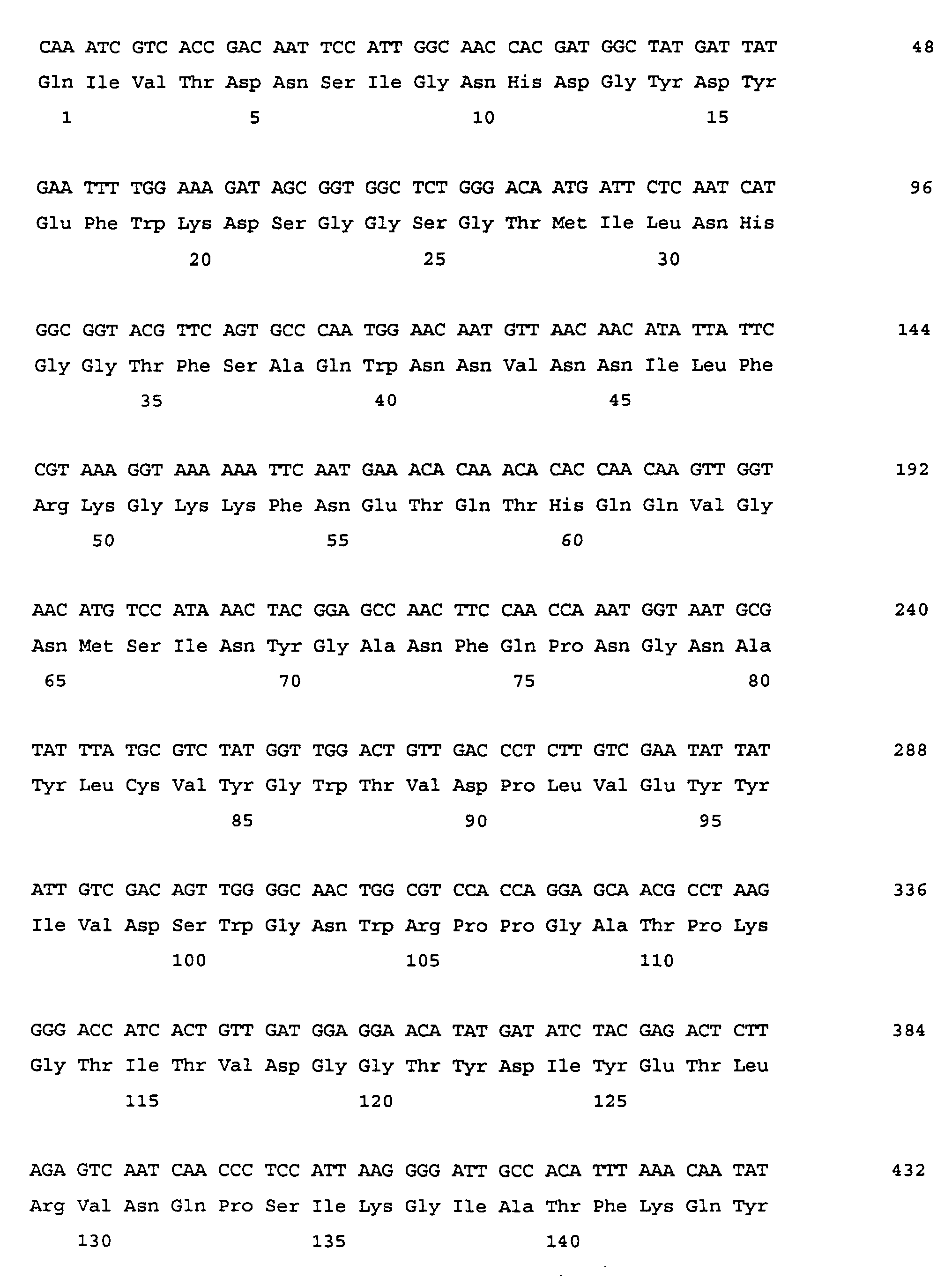


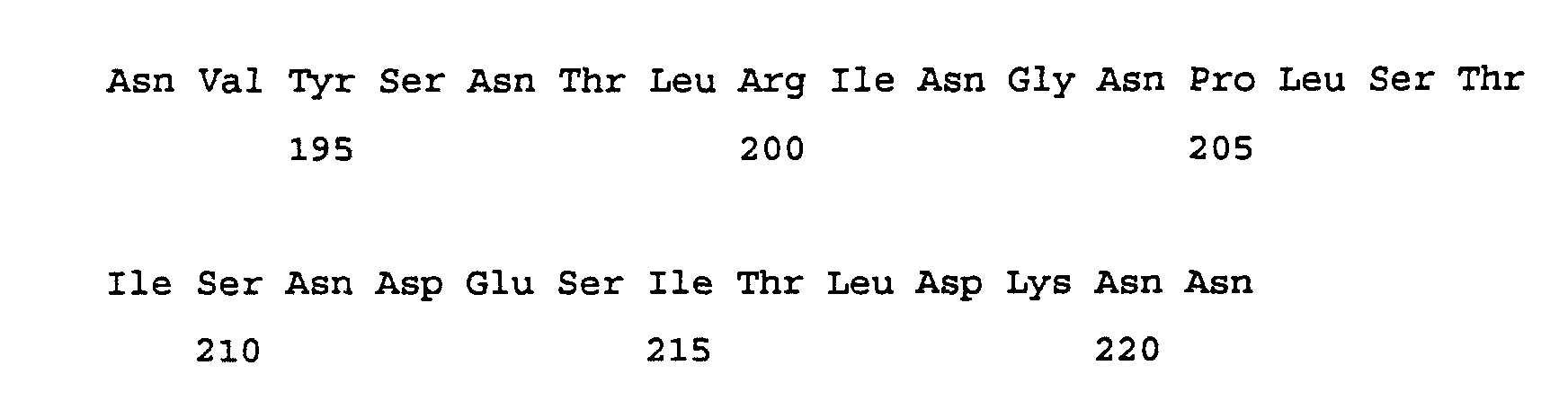

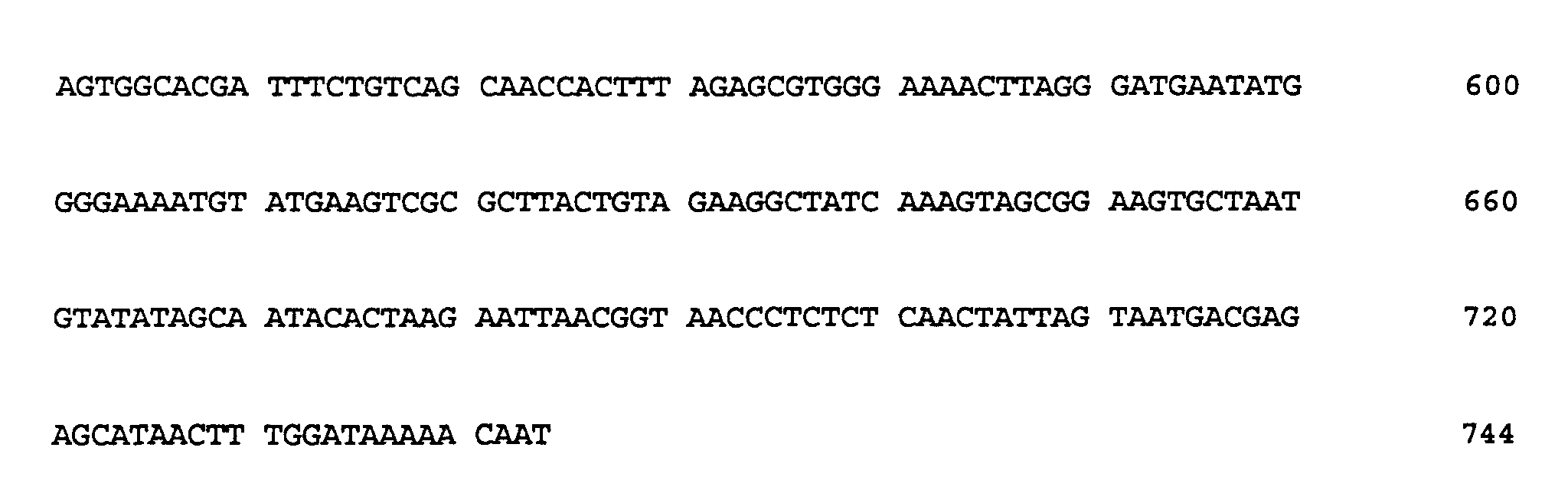
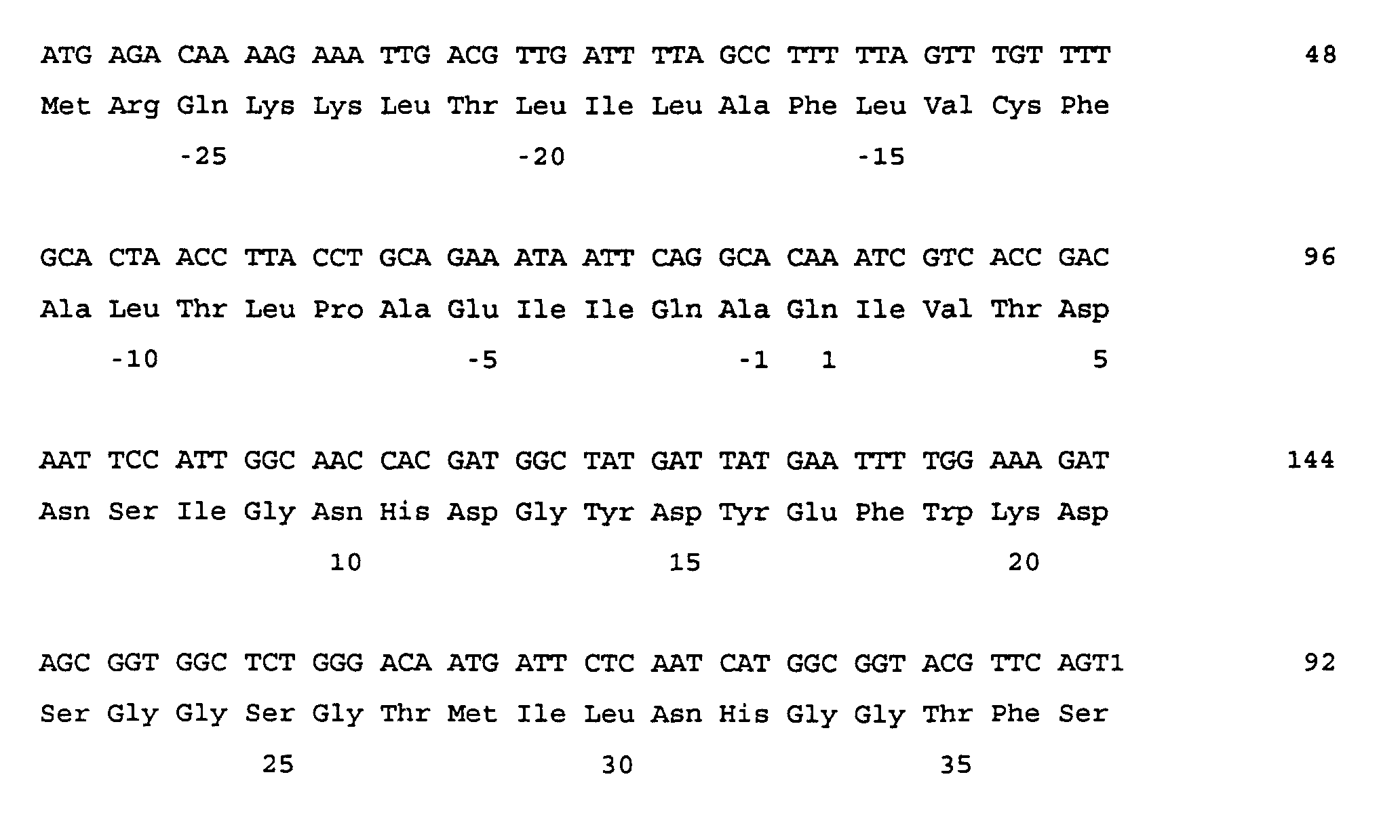


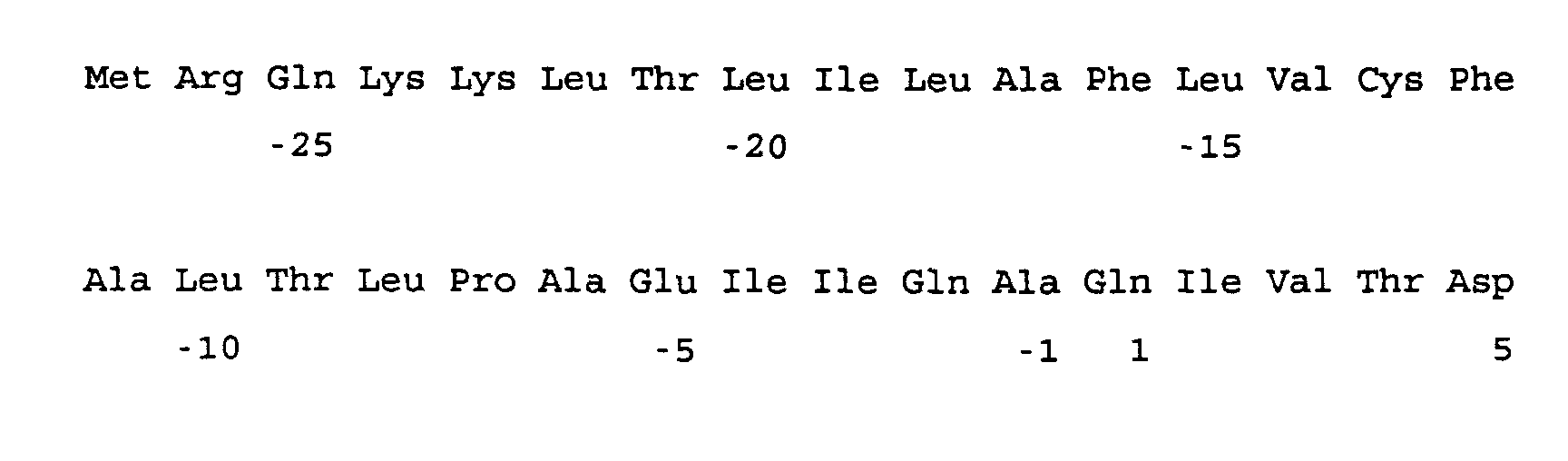





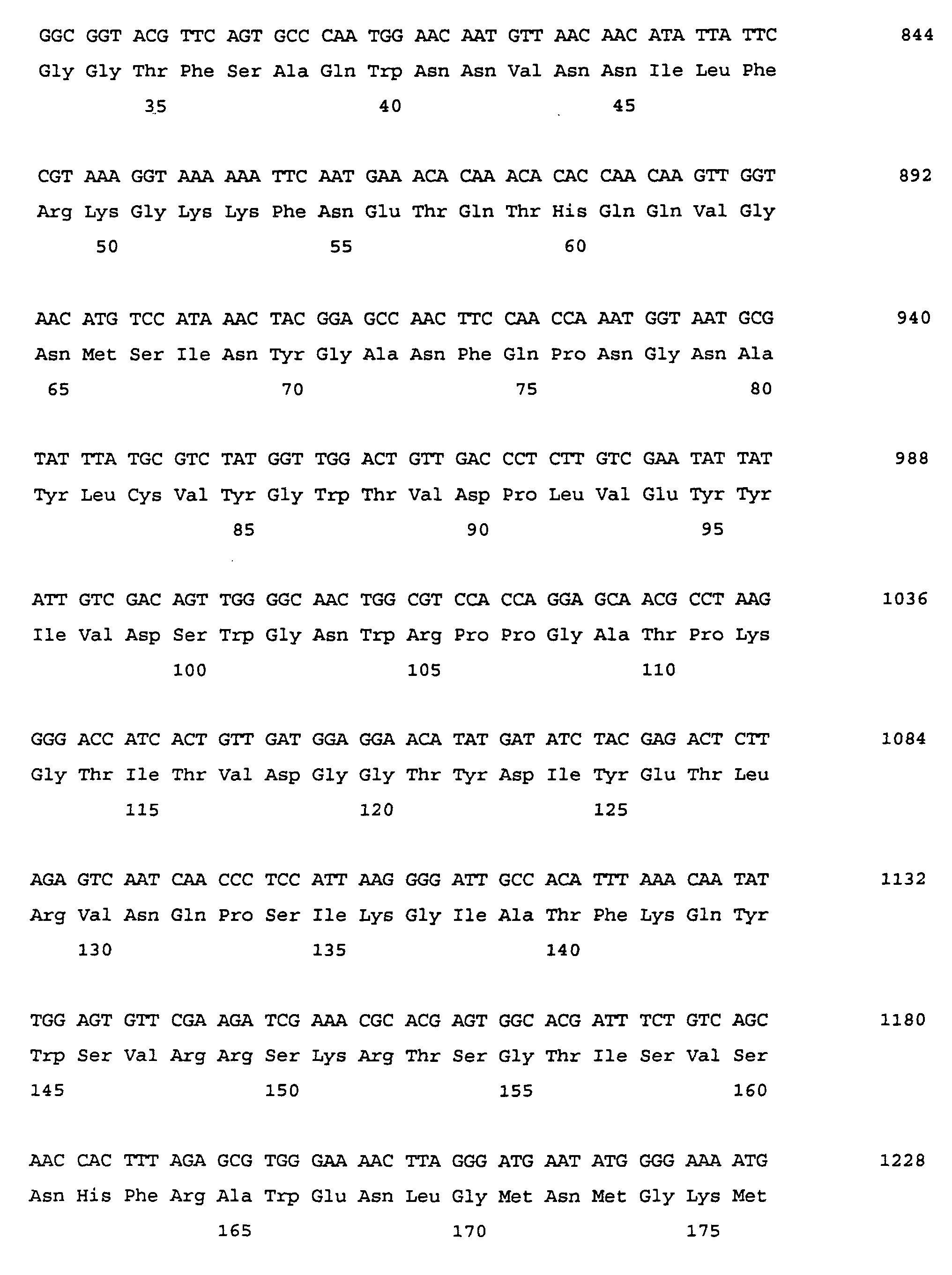
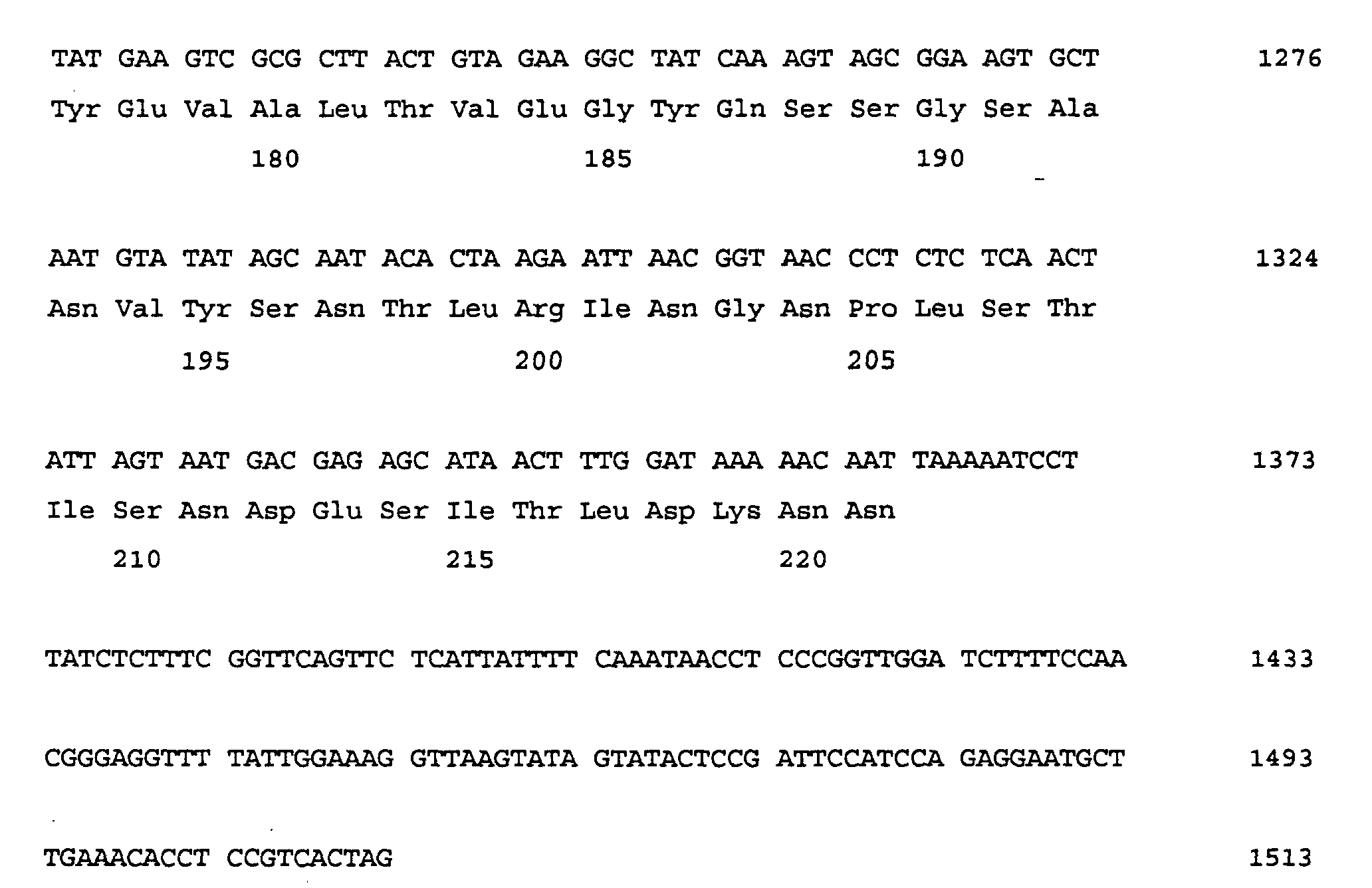


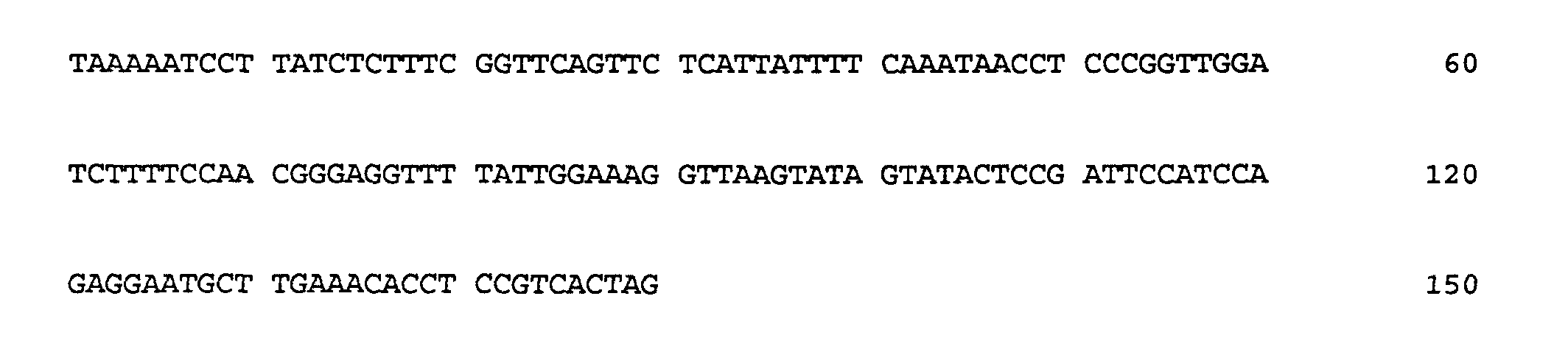














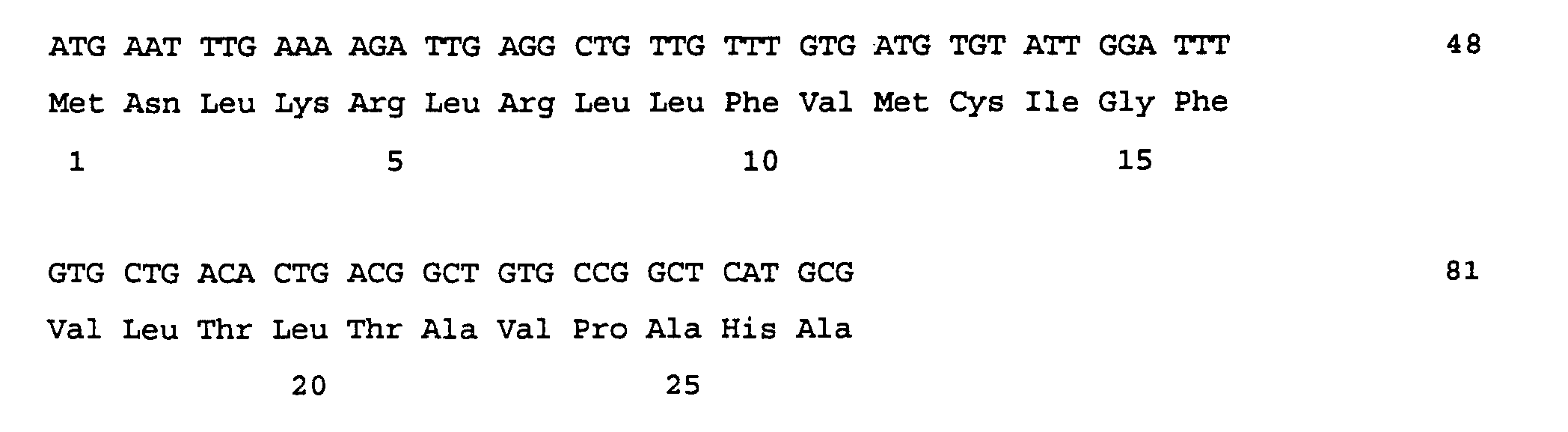
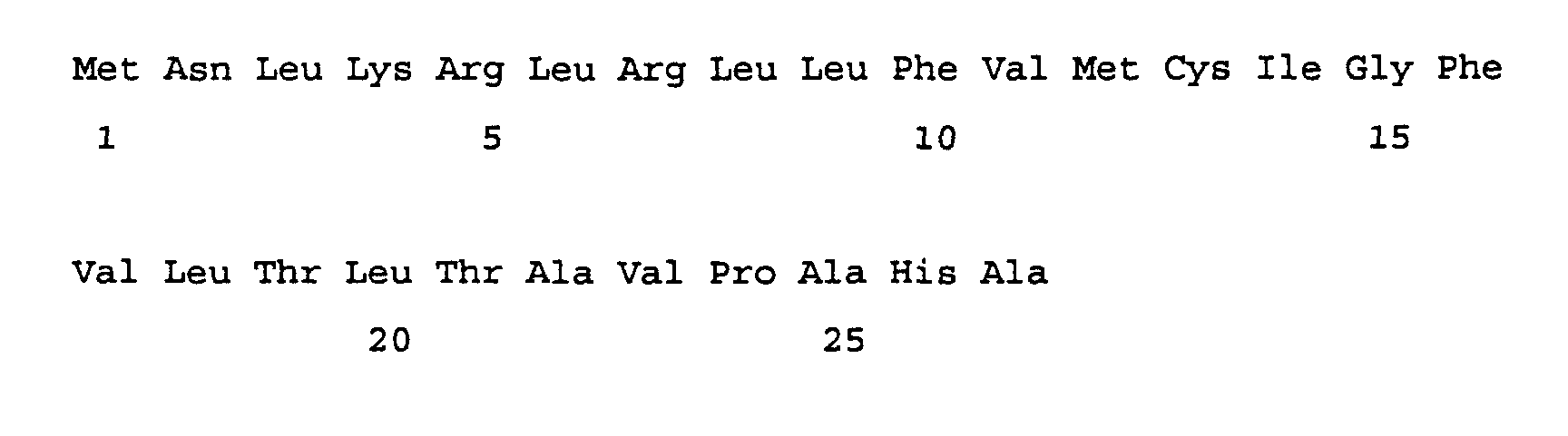
Claims (24)
- Xylanase isolée et purifiée, caractérisée en ce qu'elle comprend la séquence d'acides aminés de 1 à 221 acides aminés donnés à la SEQ ID NO: 3.
- Xylanase selon la revendication 1, caractérisée en ce qu'elle est un précurseur contenant 248 acides aminés donnés à la SEQ ID NO: 6.
- Une culture isolée et purifiée de Bacillus sp. 720/1 (LMG P-14798).
- Molécule d'ADN comprenant la séquence de nucléotides donnée à la SEQ ID NO 1 qui code pour la xylanase mature selon la revendication 1 de Bacillus sp. 720/1 (LMG P-14798).
- Molécule d'ADN selon la revendication 4, caractérisée en ce qu'elle comprend la séquence de nucléotides donnée à la SEQ ID NO: 4 qui code pour le précurseur de la xylanase de Bacillus sp. 720/1 (LMG P-14798).
- Molécule d'ADN selon la revendication 4 ou 5, caractérisée en ce qu'elle comprend tout le gène donné à la SEQ ID NO: 10 de la xylanase de Bacillus sp. 720/1 (LMG P-14798).
- Molécule d'ADN selon la revendication 4, caratérisée en ce qu'elle comprend le promoteur donné à la SEQ ID NO: 26 dérivé du gène qui code pour la xylanase de Bacillus pumilus PRL B12 ATCC 55443.
- Molécule d'ADN selon la revendication 4, caractérisée en ce qu'elle comprend la préséquence donnée à la SEQ ID NO: 27 qui code pour le peptide signal de la xylanase de Bacillus pumilus PRL B12 ATCC 55443.
- Molécule d'ADN selon la revendication 7 ou 8, caractérisée en ce qu'elle comprend le promoteur donné à la SEQ ID NO: 26 dérivé du gène qui code pour la xylanase de Bacillus pumilus PRL B12 ATCC 55443, la préséquence donnée à la SEQ ID NO: 27 qui code pour le peptide signal de la xylanase de Bacillus pumilus PRL B12 ATCC 55443 et la séquence de nucléotides donnée à la SEQ ID NO: 1 qui code pour la xylanase selon la revendication 1 ou 2 de Bacillus sp. 720/1 (LMG P-14798).
- Vecteur d'expression ou vecteur d'intégration chromosomique contenant la molécule d'ADN selon la revendication 4, 5, 6 ou 9.
- Vecteur d'expression selon la revendication 10 pUBRD-720X11 dont la carte est donnée à la figure 6.
- Vecteur d'expression selon la revendication 11 pBPXD-PRE-720X dont la carte est donnée à la figure 10.
- Souche transformée comprenant la molecule d'ADN selon la revendication 4, 5, 6 ou 9.
- Souche transformée comprenant le vecteur d'expression ou le vecteur d'intégration chromosomique selon la revendication 10, 11 ou 12.
- Souche transformée selon la revendication 13 ou 14, caractérisée en ce qu'il s'agit d'une souche de Bacillus.
- Souche transformée selon la revendication 15, caractérisée en ce qu'il s'agit d'une souche de Bacillus licheniformis ou de Bacillus pumilus.
- Procédé pour la production d'une xylanase selon la revendication 1 ou 2 caractérisée en ce qu'il comprend la culture d'une souche selon l'une quelconque des revendications 13 à 16, dans un milieu nutritif approprié contenant des sources de carbone et d'azote et des sels minéraux sous condition d'aérobiose et la récolte de la xylanase ainsi obtenue.
- Procédé selon la revendication 17 pour la préparation d'une xylanase selon la revendication 1 ou 2 caractérisée en ce qu'il comprend l'isolement d'un fragment d'ADN codant pour la xylanase, l'insertion de ce fragment d'ADN dans un vecteur approprié, l'introduction de ce vecteur dans un hôte approprié ou l'introduction de ce fragment d'ADN dans le chromosome d'un hôte approprié, la culture de cet hôte, l'expression de la xylanase et la récolte de la xylanase.
- Utilisation d'une xylanase selon la revendication 1 ou 2 pour le traitement de la pâte à papier.
- Utilisation d'une xylanase selon la revendication 1 ou 2 en alimentation animale.
- Une composition enzymatique contenant une xylanase selon revendication 1 ou 2 et au moins un additif.
- Système d'expression utilisable pour la production d'un polypeptide, caractérisé en ce qu'il comprend:la séquence du promoteur donné à la SEQ ID NO: 26 dérivé du gène qui code pour la xylanase de Bacillus pumilus PRL B12 ATCC 55443,une séquence codant pour un signal peptide, etla séquence de nucléotides donnée à la SEQ ID NO: 1 qui code pour la xylanase de Bacillus sp. 720/1 (LMG P-14798).
- Système d'expression utilisable pour la production d'un polypeptide, caractérisé en ce qu'il comprend:la séquence d'un promoteur,la préséquence donnée à la SEQ ID NO:27 qui code pour le peptide signal de la xylanase de Bacillus pumilus PRL B12 ATCC 55443, etla séquence de nucléotides donnée à la SEQ ID NO: 1 qui code pour la xylanase de Bacillus sp. 720/1 (LMG P-14798).
- Système d'expression utilisable pour la production d'un polypeptide, caractérisé en ce qu'il comprend:la séquence du promoteur donnée à la SEQ ID NO: 26 dérivé du gène qui code pour la xylanase de Bacillus pumilus PRL B12 ATCC 55443,la préséquence donnée à la SEQ ID NO: 27 qui code pour le peptide signal de la xylanase de Bacillus pumilus PRL B12 ATCC 55443,la séquence de nucléotides donnée à la SEQ ID NO: 1 qui code pour la xylanase de Bacillus sp. 720/1 (LMG P-14798), etla séquence d'un terminateur.
Applications Claiming Priority (4)
| Application Number | Priority Date | Filing Date | Title |
|---|---|---|---|
| BE9400706A BE1008570A3 (fr) | 1994-07-26 | 1994-07-26 | Xylanase, microorganismes la produisant, molecule d'adn, procedes de preparation de cette xylanase et utilisations de celle-ci. |
| BE9400706 | 1994-07-26 | ||
| BE9500448A BE1008751A3 (fr) | 1994-07-26 | 1995-05-17 | Xylanase, microorganismes la produisant, molecules d'adn, procedes de preparation de cette xylanase et utilisations de celle-ci. |
| BE9500448 | 1995-05-17 |
Publications (2)
| Publication Number | Publication Date |
|---|---|
| EP0698667A1 EP0698667A1 (fr) | 1996-02-28 |
| EP0698667B1 true EP0698667B1 (fr) | 2004-06-16 |
Family
ID=25662903
Family Applications (1)
| Application Number | Title | Priority Date | Filing Date |
|---|---|---|---|
| EP95201976A Expired - Lifetime EP0698667B1 (fr) | 1994-07-26 | 1995-07-18 | Xylanase, microorganismes la produisant, molécules d'ADN, procédés de préparation de cette xylanase et utilisations de celle-ci |
Country Status (12)
| Country | Link |
|---|---|
| US (4) | US6346407B1 (fr) |
| EP (1) | EP0698667B1 (fr) |
| JP (1) | JPH0892284A (fr) |
| AT (1) | ATE269408T1 (fr) |
| AU (1) | AU711105B2 (fr) |
| BE (1) | BE1008751A3 (fr) |
| BR (1) | BR9503454A (fr) |
| CA (1) | CA2154628C (fr) |
| DE (1) | DE69533152T2 (fr) |
| DK (1) | DK0698667T3 (fr) |
| FI (1) | FI121378B (fr) |
| NZ (1) | NZ272637A (fr) |
Families Citing this family (15)
| Publication number | Priority date | Publication date | Assignee | Title |
|---|---|---|---|---|
| US5770424A (en) * | 1994-11-30 | 1998-06-23 | Novonordisk A/S | DNA constructs and methods of producing xylanolytic enzymes |
| DK1141254T3 (da) * | 1998-12-23 | 2006-07-17 | Danisco | Anvendelse af xylanase til fremstilling af en födevare |
| US8372620B2 (en) * | 1998-12-23 | 2013-02-12 | Dupont Nutrition Biosciences Aps | Bacterial xylanases |
| GB2392159B (en) * | 1998-12-23 | 2004-04-28 | Danisco | Endo-ß-1, 4, xylanase and uses thereof |
| DK1516053T3 (da) | 2002-06-14 | 2013-03-25 | Verenium Corp | Xylanaser, nucleinsyrer, som koder herfor, og fremgangsmåder til at fremstille og benytte disse |
| ATE499006T1 (de) * | 2002-09-11 | 2011-03-15 | Puratos Nv | Verwendung von enzymen der familie 8 mit xylanolytischer wirksamkeit beim backen |
| BRPI0412279A (pt) | 2003-07-02 | 2006-09-19 | Diversa Corp | glucanases, ácidos nucléicos codificando as mesmas e métodos para preparar e aplicar os mesmos |
| CA2535526C (fr) | 2003-08-11 | 2015-09-29 | Diversa Corporation | Laccases, acides nucleiques codant pour ces enzymes et procedes permettant de les produire et de les utiliser |
| WO2005093072A1 (fr) * | 2004-03-25 | 2005-10-06 | Iogen Bio-Products Corporation | Xylanases modifiees a expression amelioree |
| TR201809912T4 (tr) * | 2006-02-14 | 2018-07-23 | Bp Corp North America Inc | Ksilanazlar, bunları kodlayan nükleik asitler ve bunları yapmak ve kullanmak için yöntemler. |
| KR100784168B1 (ko) | 2006-08-02 | 2007-12-10 | 건국대학교 산학협력단 | 열안정성이 증대된 신규 자일란 분해효소 |
| DK2069389T3 (en) | 2006-08-04 | 2015-01-12 | Bp Corp North America Inc | Glucanases, nucleic acids encoding them, and processes for their preparation and use |
| EP2218773A1 (fr) | 2009-02-17 | 2010-08-18 | Deinove | Compositions et procédés pour dégrader la biomasse lignocellulosique |
| KR101594995B1 (ko) * | 2012-12-26 | 2016-02-25 | 대한민국 | 흰코뿔소 유래 바실러스 푸밀러스 균주 및 이로부터 생산되는 자일라나제 |
| US8759041B1 (en) * | 2013-02-12 | 2014-06-24 | Novozymes Inc. | Polypeptides having xylanase activity and polynucleotides encoding same |
Family Cites Families (10)
| Publication number | Priority date | Publication date | Assignee | Title |
|---|---|---|---|---|
| AU539108B2 (en) | 1979-04-17 | 1984-09-13 | Interox Societe Anonyme | Delignification of unbleached chemical pulp |
| US4462884A (en) | 1983-07-25 | 1984-07-31 | Ppg Industries, Inc. | Low reflectance, low emissivity sputtered film |
| US5352603A (en) | 1989-08-31 | 1994-10-04 | Kali-Chemie Ag | Highly alkaline proteases |
| EP0579672B1 (fr) | 1991-04-02 | 1999-02-03 | Novo Nordisk A/S | Xylanase, sequence correspondante d'adn recombine, agent contenant de la xylanase, et utilisation dudit agent |
| FI946186A0 (fi) * | 1992-07-02 | 1994-12-30 | Novo Nordisk As | Alkalofiilinen Bacillus sp. AC13 ja siitä saatava proteaasi, ksylanaasi, sellulaasi |
| DE4226528A1 (de) * | 1992-08-11 | 1994-02-17 | Roehm Gmbh | Batterien-Xylanase, Verfahren zu ihrer Herstellung sowie dafür geeigneter Bakterienstamm, Plasmid mit zugehörigem Strukturgen, sowie Backmittel und Backverfahren zur Herstellung von Brot und Backwaren unter Verwendung der Xylanase |
| DK105592D0 (da) * | 1992-08-26 | 1992-08-26 | Novo Nordisk As | Nyt enzym |
| GB2279955B (en) * | 1993-07-15 | 1998-02-18 | Solvay | Xylanase derived from a Bacillus species, expression vectors for such xylanase and other proteins, host organisms therefor and use thereof |
| BR9405934A (pt) * | 1993-12-24 | 1995-12-26 | Gist Brocades Nv | Xilanases tolerantes a álcali |
| US5770424A (en) * | 1994-11-30 | 1998-06-23 | Novonordisk A/S | DNA constructs and methods of producing xylanolytic enzymes |
-
1995
- 1995-05-17 BE BE9500448A patent/BE1008751A3/fr not_active IP Right Cessation
- 1995-06-06 US US08/470,953 patent/US6346407B1/en not_active Expired - Lifetime
- 1995-07-18 DK DK95201976T patent/DK0698667T3/da active
- 1995-07-18 EP EP95201976A patent/EP0698667B1/fr not_active Expired - Lifetime
- 1995-07-18 DE DE69533152T patent/DE69533152T2/de not_active Expired - Lifetime
- 1995-07-18 AT AT95201976T patent/ATE269408T1/de not_active IP Right Cessation
- 1995-07-19 AU AU25086/95A patent/AU711105B2/en not_active Ceased
- 1995-07-25 NZ NZ272637A patent/NZ272637A/en unknown
- 1995-07-25 CA CA002154628A patent/CA2154628C/fr not_active Expired - Lifetime
- 1995-07-26 BR BR9503454A patent/BR9503454A/pt active Search and Examination
- 1995-07-26 FI FI953578A patent/FI121378B/fi not_active IP Right Cessation
- 1995-07-26 JP JP7190838A patent/JPH0892284A/ja active Pending
-
2001
- 2001-07-19 US US09/909,207 patent/US7022827B2/en not_active Expired - Fee Related
-
2005
- 2005-07-08 US US11/178,031 patent/US7638613B2/en not_active Expired - Fee Related
-
2007
- 2007-08-20 US US11/841,613 patent/US8148104B2/en not_active Expired - Fee Related
Also Published As
| Publication number | Publication date |
|---|---|
| BR9503454A (pt) | 1996-03-05 |
| DK0698667T3 (da) | 2004-10-25 |
| BE1008751A3 (fr) | 1996-07-02 |
| FI953578L (fi) | 1996-01-27 |
| US8148104B2 (en) | 2012-04-03 |
| US20060020122A1 (en) | 2006-01-26 |
| US7022827B2 (en) | 2006-04-04 |
| NZ272637A (en) | 1998-04-27 |
| EP0698667A1 (fr) | 1996-02-28 |
| ATE269408T1 (de) | 2004-07-15 |
| US6346407B1 (en) | 2002-02-12 |
| AU2508695A (en) | 1996-02-08 |
| CA2154628C (fr) | 2009-01-06 |
| FI953578A0 (fi) | 1995-07-26 |
| CA2154628A1 (fr) | 1996-01-27 |
| US20020115181A1 (en) | 2002-08-22 |
| FI121378B (fi) | 2010-10-29 |
| JPH0892284A (ja) | 1996-04-09 |
| AU711105B2 (en) | 1999-10-07 |
| DE69533152T2 (de) | 2005-08-25 |
| DE69533152D1 (de) | 2004-07-22 |
| US7638613B2 (en) | 2009-12-29 |
| US20090041896A1 (en) | 2009-02-12 |
Similar Documents
| Publication | Publication Date | Title |
|---|---|---|
| EP0605040B1 (fr) | Pullulanase, microorganismes la produisant, procédés de préparation de cette pullulanase et utilisations de celle-ci | |
| BE1008998A3 (fr) | Lipase, microorganisme la produisant, procede de preparation de cette lipase et utilisations de celle-ci. | |
| US8148104B2 (en) | Xylanase, microorganisms producing it, DNA molecules, methods for preparing this xylanase and uses of the latter | |
| JP4285767B2 (ja) | 熱安定性キシラナーゼ | |
| FI116848B (fi) | Bacillus-lajista saatu ksylanaasi, tällaisen ksylanaasin ja muiden proteiinien ekspressiovektori, niiden isäntäorganismit ja käyttö | |
| US5916796A (en) | Enzyme exhibiting cellulase activity | |
| US5434071A (en) | α-L-arabinofuranosidase and xylanase from Bacillus stearothermophilus NCIMB 40221, NCIMB 40222 or mutant thereof for delignification | |
| WO1994004664A1 (fr) | Nouvelles xylanases a stabilite et a activite elevees dans des conditions alcalines et a hautes temperatures | |
| BE1008570A3 (fr) | Xylanase, microorganismes la produisant, molecule d'adn, procedes de preparation de cette xylanase et utilisations de celle-ci. | |
| DK175634B1 (da) | Transformeret værtscelle og fremgangsmåde til fremstilling af et lipolytisk enzym | |
| EP0573536A1 (fr) | Xylanase, souches de bacillus productrices de xylanase et leurs utilisations. | |
| US5925554A (en) | Myceliophthora and scytalidium laccase variants | |
| US5770424A (en) | DNA constructs and methods of producing xylanolytic enzymes | |
| BE1007313A3 (fr) | Pullulanase, microorganismes la produisant, procedes de preparation de cette pullulanase et utilisations de celle-ci. | |
| JP2004121257A (ja) | 耐熱性キシラナーゼ | |
| BE1007723A6 (fr) | Pullulanase, microorganismes la produisant, procedes de preparation de cette pullulanase et utilisations de celle-ci. | |
| BE1008783A3 (fr) | Lipase, microorganisme la produisant, procede de preparation de cette lipase et utilisations de celle-ci. | |
| BE1009650A5 (fr) | Systeme d'expression, vecteur et cellule transformee par ce vecteur. | |
| JP2001231585A (ja) | 耐熱性キシラナーゼ | |
| JP2002095470A (ja) | 耐熱性キシラナーゼ | |
| JP2001288687A (ja) | 耐熱性キシラナーゼを有効成分として含む漂白剤 |
Legal Events
| Date | Code | Title | Description |
|---|---|---|---|
| PUAI | Public reference made under article 153(3) epc to a published international application that has entered the european phase |
Free format text: ORIGINAL CODE: 0009012 |
|
| AK | Designated contracting states |
Kind code of ref document: A1 Designated state(s): AT BE CH DE DK ES FR GB IT LI NL PT SE |
|
| RAP1 | Party data changed (applicant data changed or rights of an application transferred) |
Owner name: SOLVAY (SOCIETE ANONYME) |
|
| 17P | Request for examination filed |
Effective date: 19960828 |
|
| RAP1 | Party data changed (applicant data changed or rights of an application transferred) |
Owner name: GENENCOR INTERNATIONAL, INC. |
|
| 17Q | First examination report despatched |
Effective date: 20010718 |
|
| RAP1 | Party data changed (applicant data changed or rights of an application transferred) |
Owner name: GENENCOR INTERNATIONAL, INC. |
|
| GRAP | Despatch of communication of intention to grant a patent |
Free format text: ORIGINAL CODE: EPIDOSNIGR1 |
|
| GRAS | Grant fee paid |
Free format text: ORIGINAL CODE: EPIDOSNIGR3 |
|
| GRAA | (expected) grant |
Free format text: ORIGINAL CODE: 0009210 |
|
| AK | Designated contracting states |
Kind code of ref document: B1 Designated state(s): AT BE CH DE DK ES FR GB IT LI NL PT SE |
|
| PG25 | Lapsed in a contracting state [announced via postgrant information from national office to epo] |
Ref country code: IT Free format text: LAPSE BECAUSE OF FAILURE TO SUBMIT A TRANSLATION OF THE DESCRIPTION OR TO PAY THE FEE WITHIN THE PRESCRIBED TIME-LIMIT;WARNING: LAPSES OF ITALIAN PATENTS WITH EFFECTIVE DATE BEFORE 2007 MAY HAVE OCCURRED AT ANY TIME BEFORE 2007. THE CORRECT EFFECTIVE DATE MAY BE DIFFERENT FROM THE ONE RECORDED. Effective date: 20040616 Ref country code: AT Free format text: LAPSE BECAUSE OF FAILURE TO SUBMIT A TRANSLATION OF THE DESCRIPTION OR TO PAY THE FEE WITHIN THE PRESCRIBED TIME-LIMIT Effective date: 20040616 |
|
| REG | Reference to a national code |
Ref country code: GB Ref legal event code: FG4D Free format text: NOT ENGLISH |
|
| REG | Reference to a national code |
Ref country code: CH Ref legal event code: EP |
|
| REF | Corresponds to: |
Ref document number: 69533152 Country of ref document: DE Date of ref document: 20040722 Kind code of ref document: P |
|
| PG25 | Lapsed in a contracting state [announced via postgrant information from national office to epo] |
Ref country code: LI Free format text: LAPSE BECAUSE OF NON-PAYMENT OF DUE FEES Effective date: 20040731 Ref country code: CH Free format text: LAPSE BECAUSE OF NON-PAYMENT OF DUE FEES Effective date: 20040731 Ref country code: BE Free format text: LAPSE BECAUSE OF NON-PAYMENT OF DUE FEES Effective date: 20040731 |
|
| PG25 | Lapsed in a contracting state [announced via postgrant information from national office to epo] |
Ref country code: SE Free format text: LAPSE BECAUSE OF FAILURE TO SUBMIT A TRANSLATION OF THE DESCRIPTION OR TO PAY THE FEE WITHIN THE PRESCRIBED TIME-LIMIT Effective date: 20040916 |
|
| PG25 | Lapsed in a contracting state [announced via postgrant information from national office to epo] |
Ref country code: ES Free format text: LAPSE BECAUSE OF FAILURE TO SUBMIT A TRANSLATION OF THE DESCRIPTION OR TO PAY THE FEE WITHIN THE PRESCRIBED TIME-LIMIT Effective date: 20040927 |
|
| GBT | Gb: translation of ep patent filed (gb section 77(6)(a)/1977) |
Effective date: 20040908 |
|
| REG | Reference to a national code |
Ref country code: DK Ref legal event code: T3 |
|
| BERE | Be: lapsed |
Owner name: GENENCOR INTERNATIONAL, INC. Effective date: 20040731 |
|
| REG | Reference to a national code |
Ref country code: CH Ref legal event code: PL |
|
| PLAQ | Examination of admissibility of opposition: information related to despatch of communication + time limit deleted |
Free format text: ORIGINAL CODE: EPIDOSDOPE2 |
|
| PLAR | Examination of admissibility of opposition: information related to receipt of reply deleted |
Free format text: ORIGINAL CODE: EPIDOSDOPE4 |
|
| PLBI | Opposition filed |
Free format text: ORIGINAL CODE: 0009260 |
|
| PLBQ | Unpublished change to opponent data |
Free format text: ORIGINAL CODE: EPIDOS OPPO |
|
| PLAQ | Examination of admissibility of opposition: information related to despatch of communication + time limit deleted |
Free format text: ORIGINAL CODE: EPIDOSDOPE2 |
|
| PLAR | Examination of admissibility of opposition: information related to receipt of reply deleted |
Free format text: ORIGINAL CODE: EPIDOSDOPE4 |
|
| PLBQ | Unpublished change to opponent data |
Free format text: ORIGINAL CODE: EPIDOS OPPO |
|
| PLAB | Opposition data, opponent's data or that of the opponent's representative modified |
Free format text: ORIGINAL CODE: 0009299OPPO |
|
| 26 | Opposition filed |
Opponent name: NOVOZYMES A/S Effective date: 20050315 |
|
| PLAB | Opposition data, opponent's data or that of the opponent's representative modified |
Free format text: ORIGINAL CODE: 0009299OPPO |
|
| PLAQ | Examination of admissibility of opposition: information related to despatch of communication + time limit deleted |
Free format text: ORIGINAL CODE: EPIDOSDOPE2 |
|
| PLAR | Examination of admissibility of opposition: information related to receipt of reply deleted |
Free format text: ORIGINAL CODE: EPIDOSDOPE4 |
|
| PLAX | Notice of opposition and request to file observation + time limit sent |
Free format text: ORIGINAL CODE: EPIDOSNOBS2 |
|
| PLBQ | Unpublished change to opponent data |
Free format text: ORIGINAL CODE: EPIDOS OPPO |
|
| R26 | Opposition filed (corrected) |
Opponent name: NOVOZYMES A/S Effective date: 20050315 |
|
| R26 | Opposition filed (corrected) |
Opponent name: NOVOZYMES A/S Effective date: 20050315 |
|
| NLR1 | Nl: opposition has been filed with the epo |
Opponent name: NOVOZYMES A/S |
|
| NLR1 | Nl: opposition has been filed with the epo |
Opponent name: NOVOZYMES A/S |
|
| NLR1 | Nl: opposition has been filed with the epo |
Opponent name: NOVOZYMES A/S |
|
| PLAF | Information modified related to communication of a notice of opposition and request to file observations + time limit |
Free format text: ORIGINAL CODE: EPIDOSCOBS2 |
|
| PLAF | Information modified related to communication of a notice of opposition and request to file observations + time limit |
Free format text: ORIGINAL CODE: EPIDOSCOBS2 |
|
| PLBB | Reply of patent proprietor to notice(s) of opposition received |
Free format text: ORIGINAL CODE: EPIDOSNOBS3 |
|
| PLAB | Opposition data, opponent's data or that of the opponent's representative modified |
Free format text: ORIGINAL CODE: 0009299OPPO |
|
| R26 | Opposition filed (corrected) |
Opponent name: NOVOZYMES A/S Effective date: 20050315 |
|
| NLR1 | Nl: opposition has been filed with the epo |
Opponent name: NOVOZYMES A/S |
|
| PLAB | Opposition data, opponent's data or that of the opponent's representative modified |
Free format text: ORIGINAL CODE: 0009299OPPO |
|
| R26 | Opposition filed (corrected) |
Opponent name: NOVOZYMES A/S Effective date: 20050315 |
|
| NLR1 | Nl: opposition has been filed with the epo |
Opponent name: NOVOZYMES A/S |
|
| PLCK | Communication despatched that opposition was rejected |
Free format text: ORIGINAL CODE: EPIDOSNREJ1 |
|
| APBP | Date of receipt of notice of appeal recorded |
Free format text: ORIGINAL CODE: EPIDOSNNOA2O |
|
| APAH | Appeal reference modified |
Free format text: ORIGINAL CODE: EPIDOSCREFNO |
|
| BERE | Be: lapsed |
Owner name: *GENENCOR INTERNATIONAL INC. Effective date: 20040731 |
|
| PG25 | Lapsed in a contracting state [announced via postgrant information from national office to epo] |
Ref country code: PT Free format text: LAPSE BECAUSE OF NON-PAYMENT OF DUE FEES Effective date: 20041116 |
|
| APBQ | Date of receipt of statement of grounds of appeal recorded |
Free format text: ORIGINAL CODE: EPIDOSNNOA3O |
|
| APBU | Appeal procedure closed |
Free format text: ORIGINAL CODE: EPIDOSNNOA9O |
|
| PLBN | Opposition rejected |
Free format text: ORIGINAL CODE: 0009273 |
|
| STAA | Information on the status of an ep patent application or granted ep patent |
Free format text: STATUS: OPPOSITION REJECTED |
|
| 27O | Opposition rejected |
Effective date: 20100119 |
|
| PGFP | Annual fee paid to national office [announced via postgrant information from national office to epo] |
Ref country code: NL Payment date: 20140710 Year of fee payment: 20 Ref country code: DE Payment date: 20140716 Year of fee payment: 20 Ref country code: DK Payment date: 20140710 Year of fee payment: 20 |
|
| PGFP | Annual fee paid to national office [announced via postgrant information from national office to epo] |
Ref country code: GB Payment date: 20140716 Year of fee payment: 20 Ref country code: FR Payment date: 20140708 Year of fee payment: 20 |
|
| REG | Reference to a national code |
Ref country code: DE Ref legal event code: R071 Ref document number: 69533152 Country of ref document: DE |
|
| REG | Reference to a national code |
Ref country code: DK Ref legal event code: EUP Effective date: 20150718 |
|
| REG | Reference to a national code |
Ref country code: NL Ref legal event code: V4 Effective date: 20150718 |
|
| REG | Reference to a national code |
Ref country code: NL Ref legal event code: V4 Effective date: 20150718 |
|
| REG | Reference to a national code |
Ref country code: GB Ref legal event code: PE20 Expiry date: 20150717 |
|
| PG25 | Lapsed in a contracting state [announced via postgrant information from national office to epo] |
Ref country code: GB Free format text: LAPSE BECAUSE OF EXPIRATION OF PROTECTION Effective date: 20150717 |