EP0696801A2 - Synchrone Halbleiterspeicheranordnung mit niedrigem Verbrauch - Google Patents
Synchrone Halbleiterspeicheranordnung mit niedrigem Verbrauch Download PDFInfo
- Publication number
- EP0696801A2 EP0696801A2 EP95112606A EP95112606A EP0696801A2 EP 0696801 A2 EP0696801 A2 EP 0696801A2 EP 95112606 A EP95112606 A EP 95112606A EP 95112606 A EP95112606 A EP 95112606A EP 0696801 A2 EP0696801 A2 EP 0696801A2
- Authority
- EP
- European Patent Office
- Prior art keywords
- bits
- internal address
- bit
- bit internal
- groups
- Prior art date
- Legal status (The legal status is an assumption and is not a legal conclusion. Google has not performed a legal analysis and makes no representation as to the accuracy of the status listed.)
- Withdrawn
Links
- 239000004065 semiconductor Substances 0.000 title claims abstract description 28
- 230000001360 synchronised effect Effects 0.000 title claims abstract description 19
- 230000007704 transition Effects 0.000 claims abstract description 50
- 230000004044 response Effects 0.000 claims 2
- 230000003213 activating effect Effects 0.000 claims 1
- 239000000872 buffer Substances 0.000 description 60
- 238000010586 diagram Methods 0.000 description 12
- 238000004519 manufacturing process Methods 0.000 description 4
- 230000004048 modification Effects 0.000 description 4
- 238000012986 modification Methods 0.000 description 4
Images







Classifications
-
- G—PHYSICS
- G11—INFORMATION STORAGE
- G11C—STATIC STORES
- G11C7/00—Arrangements for writing information into, or reading information out from, a digital store
- G11C7/10—Input/output [I/O] data interface arrangements, e.g. I/O data control circuits, I/O data buffers
- G11C7/1006—Data managing, e.g. manipulating data before writing or reading out, data bus switches or control circuits therefor
-
- G—PHYSICS
- G11—INFORMATION STORAGE
- G11C—STATIC STORES
- G11C7/00—Arrangements for writing information into, or reading information out from, a digital store
Definitions
- the present invention relates to a semiconductor memory device, and more particularly, to a synchronous semiconductor memory device where a plurality of input/output (I/O) bit configurations are manufactured on one chip and one of the I/O bit configurations is selected and fixed by a mode setting circuit determined at a wiring step or a similar manufacturing step.
- I/O input/output
- DRAM dynamic random access memory
- a synchronous semiconductor memory device when an external address as well as a data read/write command is supplied thereto, the external address is latched in a burst counter, so that a read/write operation is performed upon a memory section using this external address in the burst counter. Then, the content of the burst counter is incremented or decremented by receiving a synchronization clock signal, so that sequential read/write operations are performed upon the memory section using incremented or decremented addresses in the burst counter.
- two kinds of semiconductor memory devices such as a 4-bit I/O configuration memory device and an 8-bit I/O configuration memory device are manufactured on one chip, and one of the memory devices is selected and fixed at a final stage such as a wiring step or a bonding step. That is, when such two kinds of memory devices are manufactured, most circuitry layouts thereof are commonly designed, to reduce the design cost. Also, the mode setting or fixing of the two memory devices is carried out at a later stage of the manufacturing steps, to rapidly comply with customers' orders.
- the other k bits of the m-bit internal addresses are used to select one of 2 k groups of data lines of the memory section and connect them to some of data input/output pins.
- the M ⁇ 2 k -bit I/O configuration memory device mode all the data lines of the memory section are connected to all the data input/output pins regardless of the other k bits of the m-bit internal addresses. This will be explained later in detail.
- n bits whose transition frequencies are larger are slected from the m-bit internal addresses and are used to access the memory section, while the 2 k groups of the data lines are connected to all the data input/output pins.
- the power consumption in decoders, amplifiers and the like of the memory section is reduced to reduce the power consumption in the device.
- a 4-bit I/O configuration memory device and an 8-bit I/O configuration memory device are manufactured on one chip, and one of the devices is selected and fixed at a wiring step or the like.
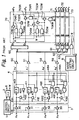
- a latch circuit 3 recieves the latch control signal LC to latch a 10-bit external address designated by A0, A1, ⁇ , A8 and A9.
- the latch circuit is constructed by tri-state buffers 30, 31, ⁇ 38 and 39.
- the external address latched by the latch circuit 3 is supplied to a burst counter 4.
- the burst counter 4 is constructed by a flip-flop 401, a tri-state buffer 402 and an inverter 403 for the external address bit A0; a flip-flop 411, a tri-state buffer 412 and an inverter 413 for the external address bit A1; ⁇ ; a flip-flop 481, a tri-state buffer 482, an exclusive OR circuit 483 and an AND circuit 484 for the external address bit A8; and a flip-flop 491, a tri-state buffer 492, an exclusive OR circuit 493 and an AND circuit 494 for the external address bit A9.
- the burst counter 4 receives the synchronization clock signal SC, the content of the burst counter 4 is counted up by +1, to generate a 9-bit internal address designated by A0', A1', ⁇ , A8' and A9' as shown in Fig. 2.
- the external address (A0, A1, ⁇ , A8, A9) (A0', A1', ⁇ , A8', A9') is 0000000000.
- the internal address bits A0', A1', ⁇ , A8', A9' are supplied to buffers 50, 51, ⁇ , 58 and 59, respectively.
- the lower nine bits A0', A1', ⁇ , A8' of the internal address are supplied to four memory blocks 60, 61, 62 and 63 which have the same configuration.
- Each of the memory blocks 60, 61, 62 and 63 decodes the 9 bits A0', A1', ⁇ , A8' of the internal address.
- the internal data lines D0 D4 D1, D5, D2, D6, D3and D7 correspond to data input/output pins P0, P4, P1, P5, P2, P6, P3 and P7, respectively.
- input/output (I/O) selection circuits 70, 71, 72, and 73 are provided between the internal data lines D0, D4, D1, D5, D2, D6, D 3 and D7 and the data I/O pins P0, P4, P1, P5, P2, P6, P3 and P7. That is, in a 4-bit I/O configuration memory device mode, only the data input/output pins P0 and P3 are made effective.
- the I/O selection circuits 70 to 73 are activated, so that either the internal data lines D0 to D3 or the internal data lines D4 to D7 are selected and are connected to the data input/output pins P0 to P3.
- the I/O selection circuits 70 to 73 are deactivated, i.e., the I/O selection circuits 70 to 73 are in a through state, so that the internal data lines D0 to D7 are connected to the data input/output pins P0 to P7, respectively.
- the I/O selection circuits 71, 72 and 73 have the same configuration as the I/O selection circuit 70.
- the I/O selection circuits 70, 71, 72 and 73 are controlled by a mode signal M of a mode setting circuit 8 and the most significant bit A9' of the internal address in addition to the read signal R and the write signal W. That is, the mode signal M is supplied to the gate circuits 706R and 706W. Also, the most significant bit A9' is supplied via an OR circuit 9 to the gate circuits 704R, 705R, 704W and 705W.
- the mode setting circuit 8 causes the mode signal M to be "0".
- the outputs of the gate circuits 706R and 706W of the I/O selection circuits 70 to 73 become "0", so that the tri-state buffers 703R and 703W are deactivated, while either the internal data lines D0 to D 3 or the internal data lines D4 to D7 are selected and are connected to a special group of the data input/output pins such as P0 to P3.
- the most significant bit A9' is supplied via the OR circuit 9 to the gate circuits 704R, 705R, 704W and 705W.
- the tri-state buffer 701R or 701W is activated, so that the internal data lines D0 to D3 are connected to the data input/output pins P0 to P3, respectively.
- the tri-state buffer 702R or 702W is activated, so that the internal data lines D4 to D 7 are connected to the data input/output pins P0 to P3, respectively.
- the I/O selection circuits 70 to 73 are placed in an activated state, i.e., in a selection state by the most significant bit A9'.
- the mode setting circuit 8 causes the mode signal M to be "1".
- the output of the OR circuit 9 becomes "1" regardless of the most significant bit A9', so that the gate circuits 704R or 704W of the I/O selection circuits 70 to 73 are activated, thus connecting the internal data lines D0 to D3 to the data input/output pins P0 to P3, respectively.
- the outputs of the gate circuits 706R and 706W of the I/O selection circuits 70 to 73 become "1", so that the tri-state buffers 703R and 703W are activated, thus connecting the internal data lines D4 to D7 to the data input/output pins P4 to P7.
- the I/O selection circuits 70 to 71 are a in deactivated state, i.e., in a nonselection state by the most significant bit A9', so that the internal data lines D0 to D7 are connected to the data input output pins P0 to P7, respectively.
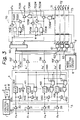
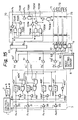
- Fig. 3 which illustrates a first embodiment of the present invention
- the buffer 50 instead of the buffer 59 of Fig. 1 is connected to the OR circuit 9, in order to supply the least significant bit A0' to the I/O selection circuits 70 to 73 in a 4-bit I/O configuration memory device mode.
- a tri-state buffer 59' is provided instead of the buffer 59 of Fig. 1 and is connected to the least significant bit sides of the memory blocks 60 to 63, in order to supply the most significant bit A9' to the memory bolcks 60 to 63 in a 4-bit I/O configuration memory device mode.
- the least significant bit A0' serves as the most significant bit
- the most significant bit A9' serves as the least significant bit.
- a tri-state buffer 50' is provided on the least significant bit A0'.
- the mode setting circuit 8 causes the mode signal M to be "0".
- the tri-state buffer 50' is deactivated and the tri-state buffer 59' is activated Therefore, the most significant bit A9' instead of the least significant bit A0' is supplied to the memory blocks 60 to 63, so that each of the memory blocks 60 to 63 is accessed by internal addresses designated by the mine bits A9', A1', ⁇ , and A8'.
- Such internal addresses have a transition frequency depending upon every two synchronization clock signals SC as shown in Fig. 2. Therefore, the power consumption in the memory blocks 60 to 63 is reduced as compared with that in Fig. 1.
- the outputs of the gate circuits 706R and 706W of the I/O selection circuits 70 to 73 become "0", so that the tri-state buffers 703R and 703W are deactivated, while either the internal data lines D0 to D3 or the internal data lines D4 to D7 are selected and are connected to a special group of the data input/output pins such as P0 to P3.
- the least significant bit A0' is supplied via the OR circuit 9 to the gate circuits 704R, 705R, 704W and 705W.
- the tri-state buffer 701R or 701W is activated, so that the internal data lines D0 to D3 are connected to the data input/output pins P0 to P3, respectively.
- the tri-state buffer 702R or 702W is activated, so that the internal data lines D4 to D7 are connected to the data input/output pins P0 to P3, respectively.
- the I/O selection circuits 70 to 73 are placed in an activated state, i.e., in a selection state by the least significant bit A0'.
- the mode setting circuit 8 causes the mode signal M to be "1".
- the tri-state buffer 50' is activated while the tri-state buffer 59' is deactivated. Therefore, each of the memory blocks 60 to 63 is accessed by the lower bits A0', A1', ⁇ , and A8' of the internal addresses in the same way as in the device of Fig. 1.
- the output of the OR circuit 9 becomes "1" regardless of the least significant bit A0', so that the gate circuits 704R or 704W of the I/O selection circuits 70 to 73 are activated, thus connecting the internal data lines D0 to D3 to the data input/output pins P0 to P3, respectively.
- the outpus of the gate circuits 706R and 706W of the I/O selection circuits 70 to 73 become "1", so that the tri-state buffers 703R and 703W are activated, thus connecting the internal data lines D4 to D7 to the data input/output pins P4 to P7.
- the I/O selection circuits 70 to 71 are in a deactivated state, i.e., in a nonselection state by the least significant bit A9', so that the internal data lines D0 to D7 are connected to the data input output pins P0 to P7, respectively.
- the least significant bit A0' is exchanged with the most significant bit A9'. That is, the least significant bit A0' which has the largest transition frequency is used for controlling the I/O selection circuits 70 to 73, while the most significant bit A9' while has the smallest transition frequency is used for accessing the memory blocks 60 to 63.
- the power consumption in the decorders, the amplifiers and the like of the memory blocks 60 to 63 can be reduced.
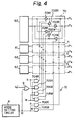
- Fig. 4 which illustrates a modification of the device of Fig. 3, the gate circuits 704R, 705R, 706R, 704W, 705W and 706W which form an I/O control circuit 10 are provided commonly for the I/O selection circuits 70 to 73, thus reducing the circuitry elements.
- a 4-bit I/O configuration memory device and a 16-bit I/O configuration memory device are manufactured on one chip, and one of the devices is selected and fixed at a wiring step or the like.
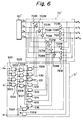
- a memory block 60' has internal data lines D0, D4, D8 and D12
- a memory block 61' has internal data lines D1, D5, D9 and D13
- a memory block 62' has internal data lines D2, D6, D10 and D14
- a memory block 60' has internal data lines D3, D7, D11 and D15. That is, four groups of the internal data lines D0 to D3, D4 to D7, D8 to D11, and D12 to D15 are provided.
- an I/O selection circuit 70' has data input/output pins P0, P4, P8 and P12
- an I/O selection circuit 71' has data input/output pins P1, P5, P9 and P13
- an I/O selection circuit 72' has data input/output pins P2, P6, P10 and P14
- an I/O selection circuit 73' has data input/output pins P3, P7, P11 and P15. That is, four groups of the data input/output pins P0 to P3, P4 to P7, P 8 to P11, and P12 to P15 are provided. That is, in a 4-bit I/O configuration memory device mode, only the data input/output pins P0 and P3 are made effective.
- the I/O selection circuits 70' to 73' are activated, so that one group of the internal data lines D0 and D3, the internal data lines D4 to D7 the internal data lines D8 to D11, and the internal data lines D12 to D15 are selected and are connected to the data input/output pins P0 to P3.
- the I/O selection circuits 70' to 73' are activated, so that one group of the internal data lines D0 and D3, the internal data lines D4 to D7 the internal data lines D8 to D11, and the internal data lines D12 to D15 are selected and are connected to the data input/output pins P0 to P3.
- all the data input/output pins P0 to P15 are mode effective.
- the I/O selection circuits 70' to 73' are deactivated, i.e., the I/O selection circuits 70' to 73' are in a through state, so that the internal data lines that the internal data lines D0 to D15 are connected to the data input/output pins P0 to P15, respectively.
- Such a connection is carried out by the I/O selection circuits 70' to 73' which are also controlled by an I/O control circuit 10'.
- the buffers 50 and 51 are connected to the I/O control circuit 10' in order to supply the lower bits A0' and A1' to the I/O control circuit 10' in a 4-bit I/O configuration memory device mode.
- tri-state buffers 58' and 59' are provided instead of the buffers 58 and 59 of Fig. 1 and are connected to the lower bit sides of the memory blocks 60' to 63', in order to supply the higher bits A8' and A9' to the memory blocks 60' to 63' in an 8-bit I/O configuration memory device mode.
- the I/O control circuit 10' is constructed by gate circuits 1001 to 1004 for decoding the lower bits A0' and A1', gate circuits 1005 to 1008 controlled by the mode signal M, gate circuits 1009 to 1012 controlled by the read signal R, and gate circuits 1013 to 1016 controlled by the write signal W.
- the mode setting circuit 8 causes the mode signal M to be "0".
- the tri-state buffers 50' and 51' are deactivated and the tri-state buffers 58' and 59' are activated. Therefore, the higher bits A8' and A9' instead of the lower bits A0'and A1' are supplied to the memory blocks 60' to 63', so that each of the memory blocks 60' to 63' is accessed by internal addresses designated by the eight bits A8', A9', A3', ⁇ .
- Such internal addresses have a transition frequency depending upon every four synchronization clock signals SC as shown in Fig. 2. Therefore, the power consumption in the memory blocks 60 to 63 is reduced.
- the outputs of the gate circuits 706R and 706W of the I/O selection circuits 70' to 73' become "0", so that the tri-state buffers 703R, 708R, 710R, 703W, 708W and 710W are deactivated, while one group of the internal data lines D0 to D3, the internal data lines D4 to D7, the internal data lines D8 to D11, and the internal data line D12 to D15 are selected and are connected to a special group of the data input/output pins such as P0 to P3.
- the lower bits A0' and A1' are supplied via to the gate circuits 1001 to 1004 of the decoder of the I/O control circuit 10'.
- the output of the gate circuit 1002 is "1". Therefore, the output of the gate circuit 1002 passes through the gate circuit 1006 and reaches the gate circuits 1010 and 1014. Therefore, since the tri-state buffer 702R or 702W is activated by the read signal R or the write signal W, the internal data lines D4 to D7 are connected to the data input/output pins P0 to P3, respectively.
- the output of the gate circuit 1003 is "1". Therefore, the output of the gate circuit 1003 passes through the gate circuit 1007 and reaches the gate circuits 1011 and 1015. Therefore, since the tri-state buffer 707R or 707W is activated by the read signal R or the write signal W, the internal data lines D8 to D11 are connected to the data input/output pins P0 to P3, respectively.
- the output of the gate circuit 1004 is "1". Therefore, the output of the gate circuit 1004 passes through the gate circuit 1008 and reaches the gate circuits 1012 and 1016. Therefore, since the tri-state buffer 709R or 709W is activated by the read signal R or the write signal W, the internal data lines D12 to D15 are connected to the data input/output pins P0 to P3, respectively.
- the mode setting circuit 8 causes the mode signal M to be "1".
- the tri-state buffer 50' and 51' are activated while the tri-state buffers 58' and 59' are deactivated. Therefore, each of the memory blocks 60' to 63' is accessed by the eight lower bits A0', A1', ⁇ , and A7' of the internal addresses.
- the output of the gate circuit 1005 becomes “1” and the outputs of the gate circuits 1006 to 1008 become “0” regardless of the lower bits A0'and A1'. Therefore, the tri-state buffer 701R or 701W is activated by the output of the gate circuit 1009 or 1013, and as a result, the internal data lines D0 to D3 are connected to the data input/output pins P0 to P3, respectively. Further, simultaneously, the output of the gate circuit 706R or 706W becomes "1", so that either the tri-state buffers 703R, 708R and 710R or the tri-state buffers 703W, 708W and 710W are activated.
- the internal data lines D4 to D7 are connected to the data input/output pins P4 to P7, respectively, the internal data lines D8 to D11 are connected to the data input/output pins P8 to P11, respectively,and the internal data lines D12 to D15 are connected to the data input/output pins P12 to P15, respectively.
- the I/0 selection circuits 70' to 71' are placed in a deactivated state, i.e., in a nonselection state by lower bits A0' and A1' so that the internal data lines D0 to D15 are connected to the data input/output pins P0 to P15, respectively.
- the lower bits A0' and A1' are exchanged with the higher bits A8' and A9'. That is, the lower bits A0' and A1' which have larger transition frequency are used for controlling the I/0 selection circuits 70' to 73', while the higher bits A8' and A9' which have smaller transition frequency are used for accessing the memory blocks 60' to 63'.
- the power consumption in the decoders, the amplifiers and the like of the memory blocks 60' to 63' can be reduced.
- Figs, 7A and 7B which illustrate an example of the mode setting circuit of Figs. 1, 3 and 5
- two inverters I1 and I2 in series are manufactured on a semiconductor chip in advance. Then, in a wiring forming step, if a wiring pattern is formed between an input of the inverter I1 and a ground power supply terminal (pad) GND as shown in Fig. 7A, the mode signal M is fixed at "0" (low level). Also, if a wiring pattern is formed between the input of the inverter I1 and a power supply terminal (pad) V cc as shown in Fig. 7B, the mode signal M is fixed at "1" (high level).
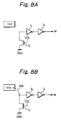
- Figs, 8A and 8B which illustrate another example of the mode setting circuit of Figs. 1, 3 and 5, two inverters I3 and I4 in series and a MOS transistor Q are manufactured on a semiconductor chip in advance. Then, in a bonding step, no bonding wiring is performed as shown in Fig. 8A, so the mode signal M is fixed at "0" (low level). Also, since a bonding wiring BW is performed as shown in Fig. 8B, the mode signal M is fixed at "1" (high level).
- Fig. 9 which illustrates an example of the tri-state buffer such as 402 of Figs. 1, 3 and 5
- P-channel MOS transistors 901 and 902 and N-channel MOS transistors 903 and 904 are connected in series between a V cc power supply line and a GND line.
- the gate of the P-channel transistor 901 is controlled via an inverter 905 by a control signal C
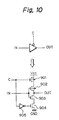
- Fig. 10 which illustrates an example of the tri-state buffer such as 59' of Figs. 3 and 5
- a burst counter 4-A includes inverters 404, 414, ⁇ , 485 in addition to the elements of the burst counter 4 of Figs. 3 and 4.
- the content of the burst counter 4-A is decremented by 1 as shown in Fig. 12. Therefore, the least significant bit A0' also has the largest transition frequency in the same way as in the burst counter 4 of Figs. 3 and 5, the burst counter 4 of Figs. 3 and 5 can be replaced by the burst counter 4-A of Fig. 11.
- a burst counter 4-B which has a burst length of 2 is provided instead of the burst counter 4 of Fig. 3 which has a burst length of 1.
- the second least significant bit A1' has the largest transition frequency. Therefore, the buffer 51 instead of the buffer 59 of Fig. 1 is connected to the OR circuit 9, in order to supply the second least significant bit A1' to the I/0 selection circuits 70 to 73 in a 4-bit I/0 configuration memory device mode.
- the tri-state buffer 59' is connected to the second least significant bit sides of the memory blocks 60 to 63, in order to supply the most significant bit A9' to the memory blocks 60 to 63 in a 4-bit I/0 configuration memory device mode. That is, in a 4-bit I/0 configuration memory device mode, the second least significant bit A1' serves as the most significant bit, and the most significant bit A9' serves as the second least significant bit. On the other hand, in an 8-bit I/0 configuration memory device mode, a tri-state buffer 51' is provided on the second least significant bit A1'.
- the N-th least significant bit A N-1 ' has the largest transition frequency. Therefore, in a 4-bit I/0 configuration memory device mode, the N-th least significart bit A N-1 ' is supplied to the I/0 selection circuits 70 to 73. Also, in a 4-bit I/0 configuration memory device mode, the most significant bit A9' is supplied to the memory blocks 60 to 63. That is, in a 4-bit I/0 configuration memory device mode, the N-th least significant bit A N-1 ' serves as the most significant bit, and the most significant bit A9' serves as the N-th least significant bit.
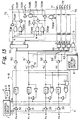
- a burst counter 4-C is constructed by a flip-flop 401', a tri-state buffer 402' an exclusive OR circuit 403' and an AND circuit 404' for the external address A0; a flip-folp 411', a tri-state buffer 412' an exclusive OR circuit 413' and an 4ND circuit 414' for the external address A1; ⁇ ; a flip-flop 481', a tri-state buffer 482' and an exclusive OR circuit 483' for the external address A8; and a flip-flop 491', a tri-state buffer 492' and an exclusive OR circuit 493' for the external address A9.
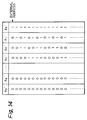
- the burst counter 4-C receives the synchronization clock signal SC, the content of the burst counter 4-C is counted down by 1, to generate a 9-bit internal address designated by A0', A1', ⁇ , A8' and A9' as shown in Fig. 16.
- the external address (A0, A1, ⁇ , A8, A9) (A0', A1', ⁇ , A8', A9') is 0000000000.
- a tri-state buffer 50" is provided instead of the buffer 50 and a tri-state buffer 59" is added, in order to supply the most significant bit A9' to the memory blocks 60 to 63 in an 8-bit I/0 configuration memory device mode. That is, in a 4-bit I/0 configuration memory device mode, the lower bits A0', A1', ⁇ , A8' are used for accessing the memory blocks 60 to 63 and the most significant bit A9'is used for controlling the I/0 selection circuits. On the other hand, in an 8-bit I/0 configuration memory device mode, the higher bits A1', A2', ⁇ , A9' are used for accessing the memory blocks 60 to 63.
- the two lower bits (A', A1') are changed from (0, 0) via (0, 1) and (1, 0) to (1, 1), from (0, 1) via (0, 0) and (1, 1) to (1, 0), from (1, 0) via (1, 1) and (0, 0) to (0, 1), or from (1, 1) via (1, 0) and (0, 1) to (0, 0).
- the power consumption in the memory section can be reduced to reduce the power consumption of the device.
Landscapes
- Dram (AREA)
- Static Random-Access Memory (AREA)
Applications Claiming Priority (2)
| Application Number | Priority Date | Filing Date | Title |
|---|---|---|---|
| JP212082/94 | 1994-08-12 | ||
| JP6212082A JPH0855471A (ja) | 1994-08-12 | 1994-08-12 | 同期型半導体記憶装置 |
Publications (2)
| Publication Number | Publication Date |
|---|---|
| EP0696801A2 true EP0696801A2 (de) | 1996-02-14 |
| EP0696801A3 EP0696801A3 (de) | 1998-09-23 |
Family
ID=16616577
Family Applications (1)
| Application Number | Title | Priority Date | Filing Date |
|---|---|---|---|
| EP95112606A Withdrawn EP0696801A3 (de) | 1994-08-12 | 1995-08-10 | Synchrone Halbleiterspeicheranordnung mit niedrigem Verbrauch |
Country Status (5)
| Country | Link |
|---|---|
| US (1) | US5608686A (de) |
| EP (1) | EP0696801A3 (de) |
| JP (1) | JPH0855471A (de) |
| KR (1) | KR0182303B1 (de) |
| CN (1) | CN1148249A (de) |
Cited By (1)
| Publication number | Priority date | Publication date | Assignee | Title |
|---|---|---|---|---|
| GB2296591A (en) * | 1994-12-31 | 1996-07-03 | Hyundai Electronics Ind | Data signal distribution circuit for synchronous memory |
Families Citing this family (7)
| Publication number | Priority date | Publication date | Assignee | Title |
|---|---|---|---|---|
| JP2991094B2 (ja) * | 1995-09-19 | 1999-12-20 | 日本電気株式会社 | 半導体記憶装置 |
| KR100431316B1 (ko) * | 1997-06-27 | 2004-10-08 | 주식회사 하이닉스반도체 | 디램패키지및그의어드레스라인및데이터라인폭변화방법 |
| US5973993A (en) * | 1998-02-27 | 1999-10-26 | Micron Technology, Inc. | Semiconductor memory burst length count determination detector |
| US6766385B2 (en) | 2002-01-07 | 2004-07-20 | Intel Corporation | Device and method for maximizing performance on a memory interface with a variable number of channels |
| KR100892673B1 (ko) * | 2007-09-05 | 2009-04-15 | 주식회사 하이닉스반도체 | 어드레스 치환 회로 및 이를 포함하는 반도체 메모리 장치 |
| KR101581414B1 (ko) * | 2009-02-05 | 2015-12-30 | 삼성전자주식회사 | 전력 소모 감소를 위한 재구성 가능 프로세서 및 그 동작 방법 |
| JP6068071B2 (ja) * | 2012-09-14 | 2017-01-25 | ローム株式会社 | 負荷駆動装置及びこれを用いたled照明機器 |
Family Cites Families (5)
| Publication number | Priority date | Publication date | Assignee | Title |
|---|---|---|---|---|
| DE3680371D1 (de) * | 1985-04-10 | 1991-08-29 | Nec Corp | Speicher mit auswaehlbarer wortlaenge. |
| JPS63188250A (ja) * | 1987-01-30 | 1988-08-03 | Nec Corp | 任意語長記憶回路 |
| JP3992757B2 (ja) * | 1991-04-23 | 2007-10-17 | テキサス インスツルメンツ インコーポレイテツド | マイクロプロセッサと同期するメモリ、及びデータプロセッサ、同期メモリ、周辺装置とシステムクロックを含むシステム |
| JP2875476B2 (ja) * | 1993-12-06 | 1999-03-31 | 松下電器産業株式会社 | 半導体メモリ装置 |
| JP2616567B2 (ja) * | 1994-09-28 | 1997-06-04 | 日本電気株式会社 | 半導体記憶装置 |
-
1994
- 1994-08-12 JP JP6212082A patent/JPH0855471A/ja active Pending
-
1995
- 1995-08-08 US US08/512,420 patent/US5608686A/en not_active Expired - Lifetime
- 1995-08-10 EP EP95112606A patent/EP0696801A3/de not_active Withdrawn
- 1995-08-12 CN CN95116351A patent/CN1148249A/zh active Pending
- 1995-08-12 KR KR1019950024877A patent/KR0182303B1/ko not_active Expired - Lifetime
Non-Patent Citations (1)
| Title |
|---|
| None |
Cited By (2)
| Publication number | Priority date | Publication date | Assignee | Title |
|---|---|---|---|---|
| GB2296591A (en) * | 1994-12-31 | 1996-07-03 | Hyundai Electronics Ind | Data signal distribution circuit for synchronous memory |
| GB2296591B (en) * | 1994-12-31 | 1998-09-09 | Hyundai Electronics Ind | Data signal distribution circuit for synchronous memory device |
Also Published As
| Publication number | Publication date |
|---|---|
| CN1148249A (zh) | 1997-04-23 |
| KR960008830A (ko) | 1996-03-22 |
| US5608686A (en) | 1997-03-04 |
| KR0182303B1 (ko) | 1999-04-15 |
| EP0696801A3 (de) | 1998-09-23 |
| JPH0855471A (ja) | 1996-02-27 |
Similar Documents
| Publication | Publication Date | Title |
|---|---|---|
| US4618947A (en) | Dynamic memory with improved address counter for serial modes | |
| US8284602B2 (en) | Pipe latch circuit of multi-bit prefetch-type semiconductor memory device with improved structure | |
| US4679173A (en) | Sequential access LSI memory circuit for pattern generator | |
| JPS59186058A (ja) | 記憶識別装置及び記憶識別方法 | |
| US6009494A (en) | Synchronous SRAMs having multiple chip select inputs and a standby chip enable input | |
| US6272053B1 (en) | Semiconductor device with common pin for address and data | |
| JPH04228172A (ja) | 半導体メモリ | |
| US5579264A (en) | Distributed signal drivers in arrayable devices | |
| US5610874A (en) | Fast burst-mode synchronous random access memory device | |
| EP0249413B1 (de) | Halbleiterspeicheranordnung | |
| EP0274378A2 (de) | Halbleiterspeichergerät | |
| US5608686A (en) | Synchronous semiconductor memory device with low power consumption | |
| JP3380828B2 (ja) | 半導体メモリ装置 | |
| US7480776B2 (en) | Circuits and methods for providing variable data I/O width for semiconductor memory devices | |
| US6058448A (en) | Circuit for preventing bus contention | |
| US5446859A (en) | Register addressing control circuit including a decoder and an index register | |
| JPH09106678A (ja) | 先取り方式のカラムデコーダ及びこれを備える半導体メモリ装置 | |
| US5363494A (en) | Bus interface circuit for connecting bus lines having different bit ranges | |
| JPH0734184B2 (ja) | チップ選択端子対を備える半導体装置 | |
| US4763304A (en) | Semiconductor random access memory device having switchable input and output bit forms | |
| US5524115A (en) | Input/output selection circuit of column repair | |
| US4514831A (en) | Static-type semiconductor memory device | |
| JP2663138B2 (ja) | 半導体集積回路装置 | |
| JPH0279294A (ja) | データ長変更可能メモリ | |
| US5778447A (en) | System and method for fast memory access using speculative access in a bus architecture system |
Legal Events
| Date | Code | Title | Description |
|---|---|---|---|
| PUAI | Public reference made under article 153(3) epc to a published international application that has entered the european phase |
Free format text: ORIGINAL CODE: 0009012 |
|
| AK | Designated contracting states |
Kind code of ref document: A2 Designated state(s): DE FR GB |
|
| PUAL | Search report despatched |
Free format text: ORIGINAL CODE: 0009013 |
|
| AK | Designated contracting states |
Kind code of ref document: A3 Designated state(s): DE FR GB |
|
| 17P | Request for examination filed |
Effective date: 19980810 |
|
| 17Q | First examination report despatched |
Effective date: 20000214 |
|
| STAA | Information on the status of an ep patent application or granted ep patent |
Free format text: STATUS: THE APPLICATION HAS BEEN WITHDRAWN |
|
| 18W | Application withdrawn |
Withdrawal date: 20001222 |