EP0694310B1 - Reversible, thermally gelling water-base medicinal composition - Google Patents
Reversible, thermally gelling water-base medicinal composition Download PDFInfo
- Publication number
- EP0694310B1 EP0694310B1 EP93924801A EP93924801A EP0694310B1 EP 0694310 B1 EP0694310 B1 EP 0694310B1 EP 93924801 A EP93924801 A EP 93924801A EP 93924801 A EP93924801 A EP 93924801A EP 0694310 B1 EP0694310 B1 EP 0694310B1
- Authority
- EP
- European Patent Office
- Prior art keywords
- composition
- hydrochloride
- sodium
- peg
- metolose
- Prior art date
- Legal status (The legal status is an assumption and is not a legal conclusion. Google has not performed a legal analysis and makes no representation as to the accuracy of the status listed.)
- Expired - Lifetime
Links
Images


Classifications
-
- A—HUMAN NECESSITIES
- A61—MEDICAL OR VETERINARY SCIENCE; HYGIENE
- A61K—PREPARATIONS FOR MEDICAL, DENTAL OR TOILETRY PURPOSES
- A61K47/00—Medicinal preparations characterised by the non-active ingredients used, e.g. carriers or inert additives; Targeting or modifying agents chemically bound to the active ingredient
- A61K47/30—Macromolecular organic or inorganic compounds, e.g. inorganic polyphosphates
- A61K47/36—Polysaccharides; Derivatives thereof, e.g. gums, starch, alginate, dextrin, hyaluronic acid, chitosan, inulin, agar or pectin
- A61K47/38—Cellulose; Derivatives thereof
-
- A—HUMAN NECESSITIES
- A61—MEDICAL OR VETERINARY SCIENCE; HYGIENE
- A61K—PREPARATIONS FOR MEDICAL, DENTAL OR TOILETRY PURPOSES
- A61K47/00—Medicinal preparations characterised by the non-active ingredients used, e.g. carriers or inert additives; Targeting or modifying agents chemically bound to the active ingredient
- A61K47/06—Organic compounds, e.g. natural or synthetic hydrocarbons, polyolefins, mineral oil, petrolatum or ozokerite
- A61K47/08—Organic compounds, e.g. natural or synthetic hydrocarbons, polyolefins, mineral oil, petrolatum or ozokerite containing oxygen, e.g. ethers, acetals, ketones, quinones, aldehydes, peroxides
- A61K47/10—Alcohols; Phenols; Salts thereof, e.g. glycerol; Polyethylene glycols [PEG]; Poloxamers; PEG/POE alkyl ethers
-
- A—HUMAN NECESSITIES
- A61—MEDICAL OR VETERINARY SCIENCE; HYGIENE
- A61K—PREPARATIONS FOR MEDICAL, DENTAL OR TOILETRY PURPOSES
- A61K9/00—Medicinal preparations characterised by special physical form
- A61K9/0012—Galenical forms characterised by the site of application
- A61K9/0014—Skin, i.e. galenical aspects of topical compositions
Definitions
- the present invention relates to an aqueous drug composition having property of reversible thermosetting gelation which comprises a pharmacologically effective component, methylcellulose, citric acid and polyethylene glycol (PEG). More specifically, it relates to an aqueous drug composition characterized in that said aqueous drug compositions is fluid or liquid at room temperature or lower and, when administered to eyes or body cavities or spread on skin, gelation happens at body temperature of mammal, so as to achieve a greater degree of bioavailability of the pharmacologically effective component and maintain the effect of the drugs for long period.
- PEG polyethylene glycol
- aqueous drug compositions which are liquid at room temperature or lower and form a semi-solid or gel at body temperature of mammal have been disclosed for aqueous drug compositions which effectively release a pharmacologically effective component to mammal to be treated.
- U.S. Patent. No. 4,188,373 discloses aqueous drug compositions having property of thermosetting gelation, which comprise PLURONIC (trademark) and form gel by heating, and a desired sol-gel transition temperature thereof is obtained by controlling the concentration of PLURONIC.
- PLURONIC trademark
- Patents. Nos. 4,474,751, 4,474,752, 4,474,753 and 4,478,822 disclose drug delivery systems utilizing aqueous drug compositions having property of thermosetting gelation.
- both the sol-gel transition temperature and/or the rigidity of the gel can be modified by adjustment of the pH and/or the ionic strength and the polymer concentration. More recently, aqueous drug compositions, which form gel at a local region by changing pH and increasing temperature simultaneously (PCT WO 91/19481), are proposed.
- Japanese Patent Application Laid-open 62-181228 discloses a aqueous drug composition having property of sol-gel phase transition by ionic strength.
- This composition is characterized in that the concentration of the materials giving rise to a sol-gel phase transition is 10-100 times less than that of the aforesaid aqueous drug compositions having property of thermosetting gelation, and that it has no danger of gelation even if the surrounding temperature rises during storage, but it can be applied to only the specific region (for example, eyes).
- E. Heymann has determined the sol-gel transition temperature of an aqueous solution of methylcellulose with the content of methoxyl group of 35.4 % (concentration of methylcellulose: 1.6 %) when it is combined with salts.
- concentration of methylcellulose: 1.6 % concentration of methylcellulose: 26-33 %
- the aqueous solution of methylcellulose with 0.2 mol of salt concentration concentration of methylcellulose: 1.6 %) has never formed gel at around body temperature of mammal.
- aqueous drug compositions which are liquid at room temperature or lower and form gel at body temperature of mammal by using gelling materials which can be administered to any regions to be treated and whose safeties have been certified, they have found that the excellent aqueous drug compositions which form gel at the temperature of a local region and give no discomfort after administration can be obtained by mixing the appropriate amounts of methylcellulose, citric acid and PEG having a particular range of molecular weight, and completed the present invention.
- the present invention relates to an aqueous drug composition having property of reversible thermosetting gelation comprising effective amount of drugs used for pharmaceutical therapy or diagnosis, characterized in that the said composition comprises 0.2 to 2.0 (W/V)% of methylcellulose (the content of methoxyl group is within the range of 26 to 33 %), 1.2 to 2.3 (W/V)% of citric acid, 0.5 to 13 (W/V)% of polyethylene glycol and a pharmaceutically acceptable pH adjusting agent in an amount sufficient to adjust pH of composition within the range of 3 to 10.
- the aqueous drug composition according to the present invention can be easily administered or spread on the region to be treated in a fixed amount since it has good fluidity at room temperature or lower, and moreover, since it forms gel immediately after administration, it can keep a good residence of drugs in any regions and maintain a prolonged effect of drugs.
- composition according to the present invention is liquid with low viscosity at temperature less than body temperature of mammal because of the low concentration of methylcellulose polymer and that it forms semi-solid or gel with very high viscosity immediately after contacted with mammal to be treated. Further, another advantageous feature is that the composition promptly arrives at the region to be treated and shows good contact with the region since it is liquid with low viscosity. Moreover, another advantageous feature is that even if administered to the skin or body cavities of mammal, the pain to be given to the patient can be minimized because it shows no stimulus on eyes.
- methylcelluloses can be used alone or as a mixture thereof as the methylcellulose (content of methoxyl group: 26-33%) used in the present invention, so long as it has a viscosity of 2 % aqueous solution within the range of 13-12,000 millipascal ⁇ sec at 20 °C.
- the content of methoxyl group is preferably within the range of from 26 to 33 % in view of the solubility to water.
- Such methylcelluloses are sold by Shinetsu Chemical Industry Inc.
- METOLOSE TM SM 15 SM 25, SM 100, SM 400, SM1500, SM4000, SM 8000 (the number represents the viscosity of 2 % aqueous solution at 20 °C, millipascal ⁇ sec), and by Matsumoto Oil and Fat Pharmaceutical Industry Inc. as MARPOLOSETM M, and from Dow chemical Co. as METOCELTMA, and all commodities can be easily obtained.
- the PEG's used in the present invention are sold by Wako Junyaku Industry Inc. as PEG-200, PEG-300, PEG-600, PEG-1000, PEG-1540, PEG-2,000, PEG-4,000, PEG-6,000, PEG-20,000, PEG-50,000, PEG-500,000, PEG-2,000,000 and PEG-4,000,000, and from Japan Oil and Fat Inc. as MACROGOL-200, MACROGOL-300, MACROGOL-400, MACROGOL-600, MACROGOL-1,500, MACROGOL-1,540, MACROGOL-4,000, MACROGOL-6,000 and MACROGOL-20,000.
- the weight-average molecular weight of the PEG used in the present invention is preferably 300 to 50,000, and particularly 1,000 to 20,000.
- the weight-average molecular weight is less than 300, the composition tends to be hard to form gel at a local region, and when it is more than 50,000, the viscosity in liquid state increases and it is not preferred.
- Two or more kinds of PEG can be mixed to adjust the weight-average molecular weight thereof within the above optimum range.
- the range of the concentration of methylcellulose, citric acid and PEG must be limited for the following reasons.
- the concentration of the methylcellulose used in the present invention is within the range of 0.2 to 2.0 (W/V)%.
- concentration of methylcellulose is less than 0.2 (W/V)%, the composition becomes hard to form gel at a local region and, when the concentration is more than 2.0 (W/V)%, the sol shows unduly high viscosity which results in incorrect dosage and it is not preferred.
- the concentration of the citric acid is within the range of 1.2 to 2.3 (W/V)%.
- concentration of citric acid is less than 1.2 (W/V)%, the composition becomes hard to form gel at a local region and, when the concentration is more than 2.3 (W/V)%, it is not preferred in view of the stimulus on eyes.
- the concentration of the PEG is within the range of 0.5-13 (W/V)%.
- concentration of PEG is less than 0.5 (W/V)%, the composition becomes hard to form gel at a local region and hence loses practical value and, when the concentration is more than 13 (W/V)%, the sol shows high viscosity and it is not preferred.
- the gelling temperature of the composition is preferably from about 20 °C to about 40°C since it is desired that the composition is liquid at room temperature or lower and forms gel at body temperature of mammal.
- the aqueous drug composition of the present invention may be used for the therapy and diagnosis of diseases of, for example, eyes, skin and body cavities.
- medicines and diagnostics which can be comprised in the composition of the present invention and administered to eyes of mammal, are as follows: chemotherapeutics such as amphotericin B, norfloxacin, miconazole nitrate, ofloxacin and idoxuridine; antibiotics preparation such as chloramphenicol, colistin sodium methanesulfonate, carbenicillin sodium and gentamicin sulfate; antiallergic agents such as 3'-(1H-tetrazol-5-yl)oxanilic acid(MTCC), ketotifen fumarate and sodium cromoglicate; anti-inflammatory agents such as betamethasone sodium phosphate, dexamethasone, fluorometholone, glycyrrhizinate dipotassium, lysozyme chloride, diclofenac sodium, prano
- anti-dermoinfectives such as bifonazole, siccanin, bisdequalinium acetate, clotrimazole and salicylic acid
- dermatics for purulence such as sulfamethoxazole sodium, erythromycin and gentamicin sulfate
- analgesics and anti-inflammatory agents such as indomethacin, ketoprofen, betamethasone valerate and fluocinolone acetonide
- anti-itchings such as diphenhydramine
- local anesthetics such as procaine hydrochloride and lidocaine hydrochloride
- antimicrobials for dermatologic use such as iodine, povidone iodine, benzalkonium chloride and chlorhexidine gluconate.
- drugs which can be comprised in the composition of the present invention and administered to body cavities of mammal, that is, rectum, urethra, nasal cavity, vagina, auditory meatus, oral cavity and buccal pouch, are as follows: antihistamines such as diphenhydramine hydrochloride and chlorpheniramine maleate; agents affecting genital organs such as clotrimazole, naphazoline nitrate, ketotifen fumarate and miconazole nitrate; agents for otic and nosal use such as tetryzoline hydrochloride; bronchodilators such as aminophylline; antimetabolic agents such as fluorouracil; hypnotics and sedatives such as diazepam; antipyretics,analgesics and anti-inflammatory agents such as aspirin, indomethacin, sulindac, phenylbutazone and ibuprofen; adrenal hormone preparations such as dexamethasone, triam
- the composition preferably contains from about 0.001 % to about 10 % by weight of the effective drug, though it may vary depending on the type of the drug.
- the examples of the pH adjusting agents used in the composition of the present invention include acids such as hydrochloric acid, sulfuric acid, boric acid, phosphoric acid and acetic acid and bases such as sodium hydroxide, monoethanolamine, diethanolamine and triethanolamine.
- the aqueous drug composition of the present invention may contain pharmaceutically acceptable buffering agents, salts, preservatives and solubilizing agents and the like.
- the examples of the preservatives may include invert soaps such as benzalkonium chloride, benzethonium chloride and chlorhexyzine gluconate, parabens such as methylparaben, ethylparaben, propylparaben and butylparaben, alcohols such as chlorobutanol, phenylethylalcohol and benzyl alcohol, organic acids and salts thereof such as dehydro sodium acetate, sorbic acid and sodium sorbate.
- invert soaps such as benzalkonium chloride, benzethonium chloride and chlorhexyzine gluconate
- parabens such as methylparaben, ethylparaben, propylparaben and butylparaben
- alcohols such as chlorobutano
- surfactants or chelating agents may be suitably added to the composition.
- these components may be used within the range of about 0.001 to 2 % by weight, and preferably within the range of about 0.002 to 1 % by weight.
- the examples of buffering agents include alkaline metal salts of acids such as phosphoric acid, boric acid, acetic acid, tartaric acid, lactic acid and carbonic acid, amino acids such as glutamic acid, ⁇ -aminocaproic acid, aspartic acid, glycine, arginine and lysine, and taurine, tris(hydroxymethyl) aminomethane. These buffering agents may be added to the composition in a sufficient amount to maintain pH within the range of 3 to 10.
- solubilizing agents include POLYSORBATE 80, polyoxyethylene, hydrogenated castor oil and cyclodextrin and they may be used within a range of 0 to 15 % by weight.
- the process of preparing the aqueous drug composition of the present invention is not particularly restricted and, for example, comprises dissolving citrate and PEG in sterilized water, adjusting the pH of this solution with a pH adjusting agent, adding drugs and necessary preservatives, adding a solution where methylcellulose is dissolved in sterilized water, adjusting pH again, filling up the volume of the mixture with sterilized water and stirring the composition with cooling.
- a variety of additive for example, buffering agents, salts and preservatives, may be added.
- drugs are slightly soluble or insoluble, they may be suspended or solubilized by solubilizing agents before use.
- citric acid 6.0g of POLYETHYLENE GLYCOL 4000 (weight-average molecular weight is 3000, available from Wako Junyaku Industry Inc.)
- chlorobutanol 0.5g
- chlorobutanol dissolved in 50ml of sterilized water.
- idoxuridine dissolved in 10ml of 3N sodium hydroxide
- METOLOSE SM 400 available from Shinetsu Chemical Industry Inc.
- citric acid 6.0g of POLYETHYLENE GLYCOL 4000 are dissolved in 50ml of sterilized water and pH is adjusted to 5.0 with 3N sodium hydroxide.
- pH is adjusted to 5.5 with 3N sodium hydroxide and the volume of the mixture is filled up to 100 ml with sterilized water, and the components are dissolved by stirring well with ice cooling to give eye drops.
- 0.026g of methylparaben and 0.014g of propylparaben are added to 50 ml of sterilized water prewarmed to about 60 °C and are well stirred to be dissolved. After this solution is cooled to room temperature, 2.3g of citric acid, 6.0g of POLYETHYLENE GLYCOL 4000 and 0.25g of chlorobutanol are added to this and dissolved, then pH is adjusted to 5.0 with monoethanolamine. To this mixture, 0.1g of MTCC is added and, furthermore, 0.5g of METOLOSE SM 400 dissolved in 25 ml of sterilized water is added. Then pH is adjusted to 5.5 with monoethanolamine and the volume of the mixture is filled up to 100ml by sterilized water and the components are dissolved by stirring well with ice cooling to give eye drops.
- 0.1g of pranoprofen, 2.3g of citric acid and 6.0g of POLYETHYLENE GLYCOL 4000 are added to 50ml of sterilized water and stirred well, then pH is adjusted to 6.5 with monoethanolamine. To this added is 0.005g of benzalkonium chloride and, furthermore, 0.5g of METOLOSE SM 400 dissolved in 25ml of sterilized water. Then pH is adjusted to 7.4 with monoethanolamine and the volume of the mixture is filled up to 100ml by sterilized water, and the components are dissolved by stirring well with ice cooling to give eye drops.
- 0.026g of methylparaben and 0.014g of propylparaben are added to 50 ml of sterilized water prewarmed to about 60°C and are stirred well to be dissolved. After this solution is cooled to room temperature, 0.05g of naphazoline nitrate, 3.5g of sodium citrate dihydrate and 6.0g of POLYETHYLENE GLYCOL 4000 are added to the solution and dissolved. To this mixture, 0.5g of METOLOSE SM 400 dissolved in 25 ml of sterilized water is added and stirred well. Then pH is adjusted to 5.8 with 1N hydrochloric acid and the volume of the mixture is filled up to 100ml by sterilized water, and the components are dissolved by stirring well with ice cooling to give eye drops.
- 0.34g of timolol maleate, 3.5g of sodium citrate dihydrate, 6.0g of POLYETHYLENE GLYCOL 4000 and 0.005g of benzalkonium chloride are added to 50 ml of sterilized water and dissolved.
- 0.5g of METOLOSE SM 400 dissolved in 25 ml of sterilized water is added and stirred well.
- pH is adjusted to 6.8 with 1N hydrochloric acid or 1N sodium hydroxide and the volume of the mixture is filled. up to 100ml with sterilized water and the components are dissolved by stirring well with ice cooling to give eye drops.
- Test Example 1 (Concentration of METOLOSE, pH and gelling temperature)
- Test Example 2 (Test of feeling when applied to human)
- citric acid and 4.2g of POLYETHYLENE GLYCOL 4000 were dissolved in 50ml of sterilized water, then pH was adjusted to 6.8 with 3N NaOH, the volume of the mixture was filled up to 100ml with sterilized water and the components were dissolved by stirring well with ice cooling to prepare the aqueous compositions 1 to 4. Further, 1.9 to 2.9g of citric acid and 4.2g of POLYETHYLENE GLYCOL 4000 are dissolved in 50ml of sterilized water, pH is adjusted to 6.0 with diethanolamine.
- METOLOSE SM 400 dissolved in 25ml of sterilized water and then, pH was adjusted to 6.8 with diethanolamine and the volume of the mixture was filled up to 100ml with sterilized water and the components were dissolved by stirring well with ice cooling to prepare the aqueous compositions 5 to 8.
- Test Example 3 (Test to examine the transition of timolol to albino rabbit aqueous humor)
- Example 14 methylcellulose, sodium citrate and PEG were replaced by 0.9g of sodium chloride to prepare Composition 9. Moreover, in the method of Example 14, PEG was omitted to prepare Composition 10.
- the aqueous composition of the present invention maintained high concentration for longer period than the eye drops which do not form gel in a local region.
- Test Example 4 (Test to examine the transition of timolol to albino rabbit blood)
- the aqueous composition of the present invention represses the transition of timolol to blood and may decrease the systemic side effects in compare with the eye drops which do not form gel in a local region.
Landscapes
- Health & Medical Sciences (AREA)
- Chemical & Material Sciences (AREA)
- Animal Behavior & Ethology (AREA)
- General Health & Medical Sciences (AREA)
- Veterinary Medicine (AREA)
- Public Health (AREA)
- Medicinal Chemistry (AREA)
- Pharmacology & Pharmacy (AREA)
- Epidemiology (AREA)
- Life Sciences & Earth Sciences (AREA)
- Inorganic Chemistry (AREA)
- Engineering & Computer Science (AREA)
- General Chemical & Material Sciences (AREA)
- Chemical Kinetics & Catalysis (AREA)
- Oil, Petroleum & Natural Gas (AREA)
- Dermatology (AREA)
- Medicinal Preparation (AREA)
- Pharmaceuticals Containing Other Organic And Inorganic Compounds (AREA)
- Acyclic And Carbocyclic Compounds In Medicinal Compositions (AREA)
- Materials For Medical Uses (AREA)
- Compositions Of Macromolecular Compounds (AREA)
Abstract
Description
- The present invention relates to an aqueous drug composition having property of reversible thermosetting gelation which comprises a pharmacologically effective component, methylcellulose, citric acid and polyethylene glycol (PEG). More specifically, it relates to an aqueous drug composition characterized in that said aqueous drug compositions is fluid or liquid at room temperature or lower and, when administered to eyes or body cavities or spread on skin, gelation happens at body temperature of mammal, so as to achieve a greater degree of bioavailability of the pharmacologically effective component and maintain the effect of the drugs for long period.
- Hitherto, many aqueous drug compositions which are liquid at room temperature or lower and form a semi-solid or gel at body temperature of mammal have been disclosed for aqueous drug compositions which effectively release a pharmacologically effective component to mammal to be treated. U.S. Patent. No. 4,188,373 discloses aqueous drug compositions having property of thermosetting gelation, which comprise PLURONIC (trademark) and form gel by heating, and a desired sol-gel transition temperature thereof is obtained by controlling the concentration of PLURONIC. Moreover, (3.5. Patents. Nos. 4,474,751, 4,474,752, 4,474,753 and 4,478,822 disclose drug delivery systems utilizing aqueous drug compositions having property of thermosetting gelation. The unique features of these systems are that both the sol-gel transition temperature and/or the rigidity of the gel can be modified by adjustment of the pH and/or the ionic strength and the polymer concentration. More recently, aqueous drug compositions, which form gel at a local region by changing pH and increasing temperature simultaneously (PCT WO 91/19481), are proposed.
- However, the safety of the gelling materials used in these aqueous compositions is not necessarily certified with respect to all of the regions to be treated, and the high viscosity of the compositions in liquid state due to the high concentration of polymer in aqueous compositions results in the disadvantage that it cannot be easily used in a certain regions to be treated (for example, eyes). Japanese Patent Application Laid-open 62-181228 discloses a aqueous drug composition having property of sol-gel phase transition by ionic strength. This composition is characterized in that the concentration of the materials giving rise to a sol-gel phase transition is 10-100 times less than that of the aforesaid aqueous drug compositions having property of thermosetting gelation, and that it has no danger of gelation even if the surrounding temperature rises during storage, but it can be applied to only the specific region (for example, eyes).
- On the other hand, it is well known that an aqueous solution of methylcellulose forms gel by heating and reverses to sol by cooling, in other words, its sol-gel phase transition is reversible, and researches on its mechanism have been considerably made.
- OOba reports the relation of the degree of polymerization of methylcellulose and the concentration of methylcellulose to the gelling temperature, and the modification of gelling temperature by addition of ion, based on the experiment where an aqueous solution of methylcellulose is heated at a fixed rate to form gel (Hakodate technical specialized high school bulletin, No.22, 113-120, 1987). However, there is no description about aqueous compositions comprising methylcellulose which form gel at around body temperature of mammal.
- Moreover, E. Heymann has determined the sol-gel transition temperature of an aqueous solution of methylcellulose with the content of methoxyl group of 35.4 % (concentration of methylcellulose: 1.6 %) when it is combined with salts. However, according to the experiment of the present inventors, when using methylcellulose (content of methoxyl group: 26-33 %) as used in the present invention, the aqueous solution of methylcellulose with 0.2 mol of salt concentration (concentration of methylcellulose: 1.6 %) has never formed gel at around body temperature of mammal.
- After the present inventors have diligently conducted many researches in order to develop aqueous drug compositions which are liquid at room temperature or lower and form gel at body temperature of mammal by using gelling materials which can be administered to any regions to be treated and whose safeties have been certified, they have found that the excellent aqueous drug compositions which form gel at the temperature of a local region and give no discomfort after administration can be obtained by mixing the appropriate amounts of methylcelullose, citric acid and PEG having a particular range of molecular weight, and completed the present invention.
- That is, the present invention relates to an aqueous drug composition having property of reversible thermosetting gelation comprising effective amount of drugs used for pharmaceutical therapy or diagnosis, characterized in that the said composition comprises 0.2 to 2.0 (W/V)% of methylcellulose (the content of methoxyl group is within the range of 26 to 33 %), 1.2 to 2.3 (W/V)% of citric acid, 0.5 to 13 (W/V)% of polyethylene glycol and a pharmaceutically acceptable pH adjusting agent in an amount sufficient to adjust pH of composition within the range of 3 to 10. The aqueous drug composition according to the present invention can be easily administered or spread on the region to be treated in a fixed amount since it has good fluidity at room temperature or lower, and moreover, since it forms gel immediately after administration, it can keep a good residence of drugs in any regions and maintain a prolonged effect of drugs.
- One of the excellent advantageous features of the composition according to the present invention is that it is liquid with low viscosity at temperature less than body temperature of mammal because of the low concentration of methylcellulose polymer and that it forms semi-solid or gel with very high viscosity immediately after contacted with mammal to be treated. Further, another advantageous feature is that the composition promptly arrives at the region to be treated and shows good contact with the region since it is liquid with low viscosity. Moreover, another advantageous feature is that even if administered to the skin or body cavities of mammal, the pain to be given to the patient can be minimized because it shows no stimulus on eyes.
- Any methylcelluloses can be used alone or as a mixture thereof as the methylcellulose (content of methoxyl group: 26-33%) used in the present invention, so long as it has a viscosity of 2 % aqueous solution within the range of 13-12,000 millipascal · sec at 20 °C. The content of methoxyl group is preferably within the range of from 26 to 33 % in view of the solubility to water. Such methylcelluloses are sold by Shinetsu Chemical Industry Inc. as METOLOSE ™ SM 15, SM 25, SM 100, SM 400, SM1500, SM4000, SM 8000 (the number represents the viscosity of 2 % aqueous solution at 20 °C, millipascal · sec), and by Matsumoto Oil and Fat Pharmaceutical Industry Inc. as MARPOLOSE™ M, and from Dow chemical Co. as METOCEL™A, and all commodities can be easily obtained.
- The PEG's used in the present invention are sold by Wako Junyaku Industry Inc. as PEG-200, PEG-300, PEG-600, PEG-1000, PEG-1540, PEG-2,000, PEG-4,000, PEG-6,000, PEG-20,000, PEG-50,000, PEG-500,000, PEG-2,000,000 and PEG-4,000,000, and from Japan Oil and Fat Inc. as MACROGOL-200, MACROGOL-300, MACROGOL-400, MACROGOL-600, MACROGOL-1,500, MACROGOL-1,540, MACROGOL-4,000, MACROGOL-6,000 and MACROGOL-20,000.
- The weight-average molecular weight of the PEG used in the present invention is preferably 300 to 50,000, and particularly 1,000 to 20,000. When the weight-average molecular weight is less than 300, the composition tends to be hard to form gel at a local region, and when it is more than 50,000, the viscosity in liquid state increases and it is not preferred. Two or more kinds of PEG can be mixed to adjust the weight-average molecular weight thereof within the above optimum range.
- In the embodiment of the aqueous drug composition having property of reversible thermosetting gelation according to the present invention, the range of the concentration of methylcellulose, citric acid and PEG must be limited for the following reasons.
- The concentration of the methylcellulose used in the present invention is within the range of 0.2 to 2.0 (W/V)%. When the concentration of methylcellulose is less than 0.2 (W/V)%, the composition becomes hard to form gel at a local region and, when the concentration is more than 2.0 (W/V)%, the sol shows unduly high viscosity which results in incorrect dosage and it is not preferred.
- The concentration of the citric acid is within the range of 1.2 to 2.3 (W/V)%. When the concentration of citric acid is less than 1.2 (W/V)%, the composition becomes hard to form gel at a local region and, when the concentration is more than 2.3 (W/V)%, it is not preferred in view of the stimulus on eyes.
- The concentration of the PEG is within the range of 0.5-13 (W/V)%. When the concentration of PEG is less than 0.5 (W/V)%, the composition becomes hard to form gel at a local region and hence loses practical value and, when the concentration is more than 13 (W/V)%, the sol shows high viscosity and it is not preferred.
- Furthermore, the gelling temperature of the composition is preferably from about 20 °C to about 40°C since it is desired that the composition is liquid at room temperature or lower and forms gel at body temperature of mammal.
- The aqueous drug composition of the present invention may be used for the therapy and diagnosis of diseases of, for example, eyes, skin and body cavities. The examples of medicines and diagnostics which can be comprised in the composition of the present invention and administered to eyes of mammal, are as follows: chemotherapeutics such as amphotericin B, norfloxacin, miconazole nitrate, ofloxacin and idoxuridine; antibiotics preparation such as chloramphenicol, colistin sodium methanesulfonate, carbenicillin sodium and gentamicin sulfate; antiallergic agents such as 3'-(1H-tetrazol-5-yl)oxanilic acid(MTCC), ketotifen fumarate and sodium cromoglicate; anti-inflammatory agents such as betamethasone sodium phosphate, dexamethasone, fluorometholone, glycyrrhizinate dipotassium, lysozyme chloride, diclofenac sodium, pranoprofen, indomethacin, cortisone acetate, azulene, allantoin and ε -aminocaproic acid; miotics preparations such as pilocarpine hydrochloride and carbachol; vitamin preparations such as flavin adenine dinucleotide, pyridoxal phosphate and cyanocobalamin; vasoconstrictors such as naphazoline nitrate and phenylephrine hydrochloride; antihistamines such as chlorpheniramine maleate and diphenhydramine hydrochloride; mydriatics preparations such as tropicamide; antiglaucoma drugs such as timolol maleate and carteolol hydrochloride; anticataract drugs such as glutathione and pirenoxine; local anesthetics such as lidocaine hydrochloride and oxybuprocaine hydrochloride; ophthalmic diagnostic agents such as fluorescein sodium; immunosuppressive agents such as ciclosporin and azathioprine; antimetabolic agents such as fluorouracil and tegafur; decongestants such as epinephrine hydrochloride; anti diabetic retinopathy agent such as [5-(3-thienyl)tetrazol-1-yl]acetic acid(TAT); amino acids such as chondroitin sulfate sodium and aminoethylsulfonic acid; autonomic nerve agents such as neostigmine methylsulfate, and mixtures thereof, and other drugs may be used for the theraphy of the symptom and focus of eyes.
- The examples of drugs which can be comprised in the composition of the present invention and administered to skin of mammal, are as follows: anti-dermoinfectives such as bifonazole, siccanin, bisdequalinium acetate, clotrimazole and salicylic acid; dermatics for purulence such as sulfamethoxazole sodium, erythromycin and gentamicin sulfate; analgesics and anti-inflammatory agents such as indomethacin, ketoprofen, betamethasone valerate and fluocinolone acetonide; anti-itchings such as diphenhydramine; local anesthetics such as procaine hydrochloride and lidocaine hydrochloride; antimicrobials for dermatologic use such as iodine, povidone iodine, benzalkonium chloride and chlorhexidine gluconate.
- The examples of drugs which can be comprised in the composition of the present invention and administered to body cavities of mammal, that is, rectum, urethra, nasal cavity, vagina, auditory meatus, oral cavity and buccal pouch, are as follows: antihistamines such as diphenhydramine hydrochloride and chlorpheniramine maleate; agents affecting genital organs such as clotrimazole, naphazoline nitrate, ketotifen fumarate and miconazole nitrate; agents for otic and nosal use such as tetryzoline hydrochloride; bronchodilators such as aminophylline; antimetabolic agents such as fluorouracil; hypnotics and sedatives such as diazepam; antipyretics,analgesics and anti-inflammatory agents such as aspirin, indomethacin, sulindac, phenylbutazone and ibuprofen; adrenal hormone preparations such as dexamethasone, triamcinolone and hydrocortisone; local anesthetics such as lidocaine hydrochloride; dermatics for purulence such as sulfisoxazole, kanamycin, tobramycin and erythromycin; synthetic antibacterials such as norfloxacin and nalidixic acid.
- Generally, the composition preferably contains from about 0.001 % to about 10 % by weight of the effective drug, though it may vary depending on the type of the drug.
- The examples of the pH adjusting agents used in the composition of the present invention include acids such as hydrochloric acid, sulfuric acid, boric acid, phosphoric acid and acetic acid and bases such as sodium hydroxide, monoethanolamine, diethanolamine and triethanolamine.
- If necessary, the aqueous drug composition of the present invention may contain pharmaceutically acceptable buffering agents, salts, preservatives and solubilizing agents and the like. The examples of the preservatives may include invert soaps such as benzalkonium chloride, benzethonium chloride and chlorhexyzine gluconate, parabens such as methylparaben, ethylparaben, propylparaben and butylparaben, alcohols such as chlorobutanol, phenylethylalcohol and benzyl alcohol, organic acids and salts thereof such as dehydro sodium acetate, sorbic acid and sodium sorbate. Moreover, surfactants or chelating agents may be suitably added to the composition. Generally, these components may be used within the range of about 0.001 to 2 % by weight, and preferably within the range of about 0.002 to 1 % by weight. The examples of buffering agents include alkaline metal salts of acids such as phosphoric acid, boric acid, acetic acid, tartaric acid, lactic acid and carbonic acid, amino acids such as glutamic acid, ε-aminocaproic acid, aspartic acid, glycine, arginine and lysine, and taurine, tris(hydroxymethyl) aminomethane. These buffering agents may be added to the composition in a sufficient amount to maintain pH within the range of 3 to 10.
- The examples of the solubilizing agents include POLYSORBATE 80, polyoxyethylene, hydrogenated castor oil and cyclodextrin and they may be used within a range of 0 to 15 % by weight.
- The process of preparing the aqueous drug composition of the present invention is not particularly restricted and, for example, comprises dissolving citrate and PEG in sterilized water, adjusting the pH of this solution with a pH adjusting agent, adding drugs and necessary preservatives, adding a solution where methylcellulose is dissolved in sterilized water, adjusting pH again, filling up the volume of the mixture with sterilized water and stirring the composition with cooling. If necessary, after this procedure, a variety of additive, for example, buffering agents, salts and preservatives, may be added. Moreover, if drugs are slightly soluble or insoluble, they may be suspended or solubilized by solubilizing agents before use.
-
- Figure 1 shows the relation of METOLOSE concentration and pH in the aqueous composition to gelling temperature. The axis of ordinate represents the concentration of METOLOSE SM 400 ((W/V)%) and the axis of abscissa represents pH.
- Figure 2 shows the time course of timolol concentration in the plasma of the albino rabbit following the topical instillation of the aqueous composition. The axis of ordinate represents the concentration of timolol (ng/ml) and the axis of abscissa represents time (hour).
-
- The following examples are provided to illustrate a variety of embodiment of the present invention.
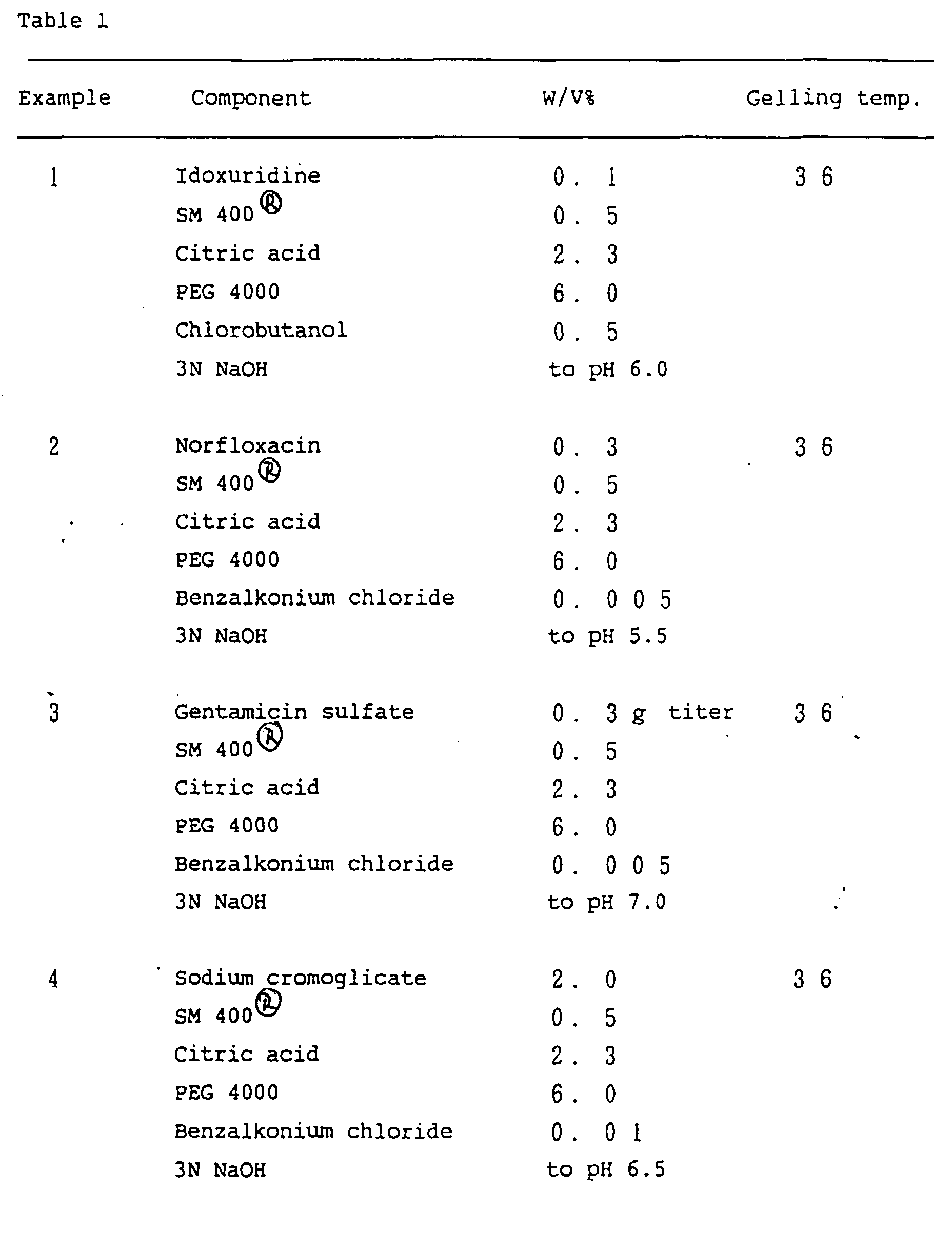
- 2.3g of citric acid, 6.0g of POLYETHYLENE GLYCOL 4000 (weight-average molecular weight is 3000, available from Wako Junyaku Industry Inc.), 0.5g of chlorobutanol are dissolved in 50ml of sterilized water. To this added are 0.1g of idoxuridine dissolved in 10ml of 3N sodium hydroxide and 0.5g of METOLOSE SM 400 (available from Shinetsu Chemical Industry Inc.) dissolved in 25ml of sterilized water. Then, pH is adjusted to 6.0 with 3N sodium hydroxide and the volume of the mixture is filled up to 100ml with sterilized water, and the components are dissolved by stirring well with ice cooling to give eye drops.
- 2.3g of citric acid, 6.0g of POLYETHYLENE GLYCOL 4000 are dissolved in 50ml of sterilized water and pH is adjusted to 5.0 with 3N sodium hydroxide. To this added are 0.3g of norfloxacin, 0.005 g of benzalkonium chloride and, furthermore, 0.5g of METOLOSE SM 400 dissolved in 25ml of sterilized water. Then, pH is adjusted to 5.5 with 3N sodium hydroxide and the volume of the mixture is filled up to 100 ml with sterilized water, and the components are dissolved by stirring well with ice cooling to give eye drops.
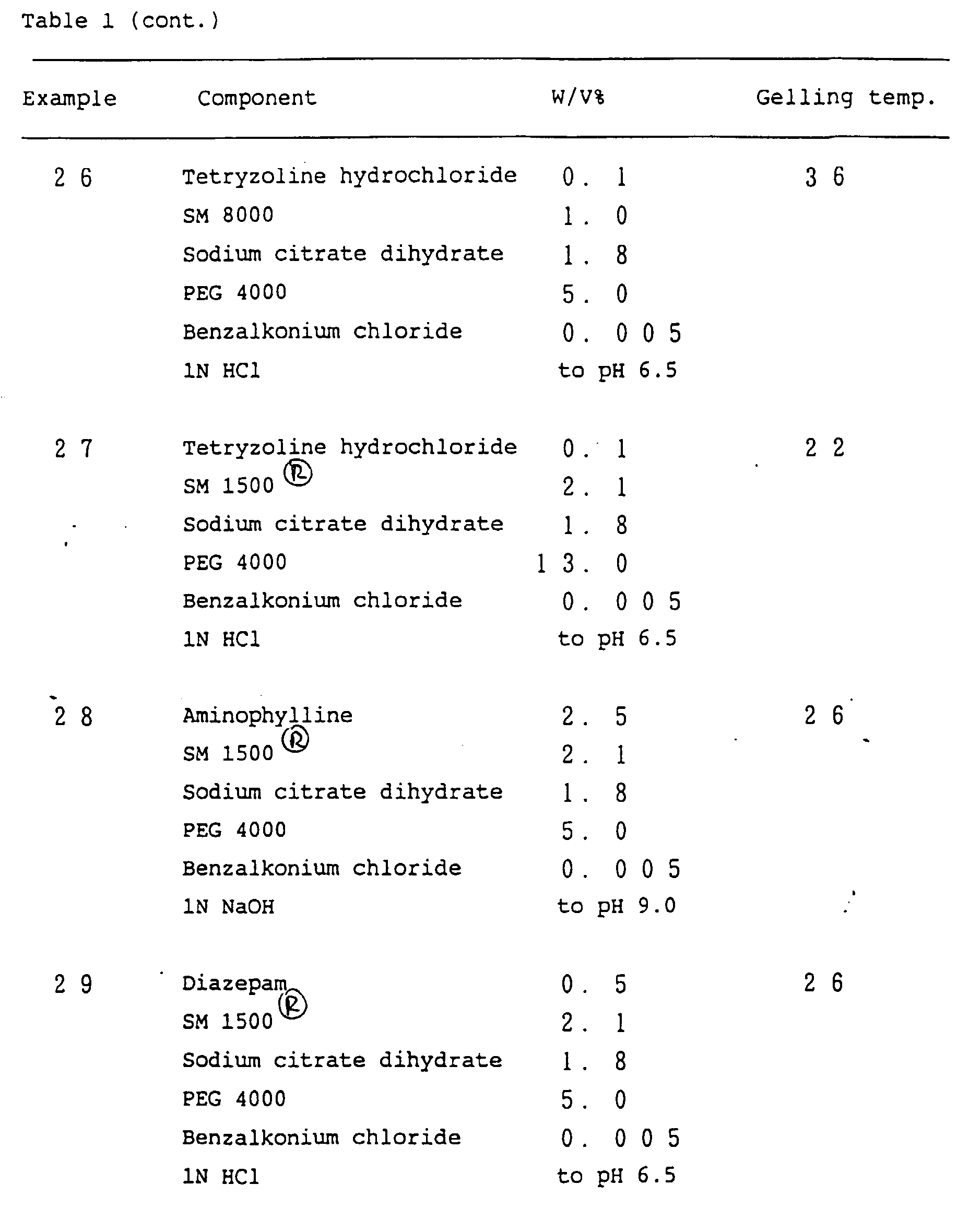
- By a method similar to that of Example 2, eye drops of which compositions are shown in Table 1, are prepared.
- 0.026g of methylparaben and 0.014g of propylparaben are added to 50 ml of sterilized water prewarmed to about 60 °C and are well stirred to be dissolved. After this solution is cooled to room temperature, 2.3g of citric acid, 6.0g of POLYETHYLENE GLYCOL 4000 and 0.25g of chlorobutanol are added to this and dissolved, then pH is adjusted to 5.0 with monoethanolamine. To this mixture, 0.1g of MTCC is added and, furthermore, 0.5g of METOLOSE SM 400 dissolved in 25 ml of sterilized water is added. Then pH is adjusted to 5.5 with monoethanolamine and the volume of the mixture is filled up to 100ml by sterilized water and the components are dissolved by stirring well with ice cooling to give eye drops.
- By a method similar to that of Example 7, eye drops of which compositions are shown in Table 1, are prepared.
- 0.1g of pranoprofen, 2.3g of citric acid and 6.0g of POLYETHYLENE GLYCOL 4000 are added to 50ml of sterilized water and stirred well, then pH is adjusted to 6.5 with monoethanolamine. To this added is 0.005g of benzalkonium chloride and, furthermore, 0.5g of METOLOSE SM 400 dissolved in 25ml of sterilized water. Then pH is adjusted to 7.4 with monoethanolamine and the volume of the mixture is filled up to 100ml by sterilized water, and the components are dissolved by stirring well with ice cooling to give eye drops.
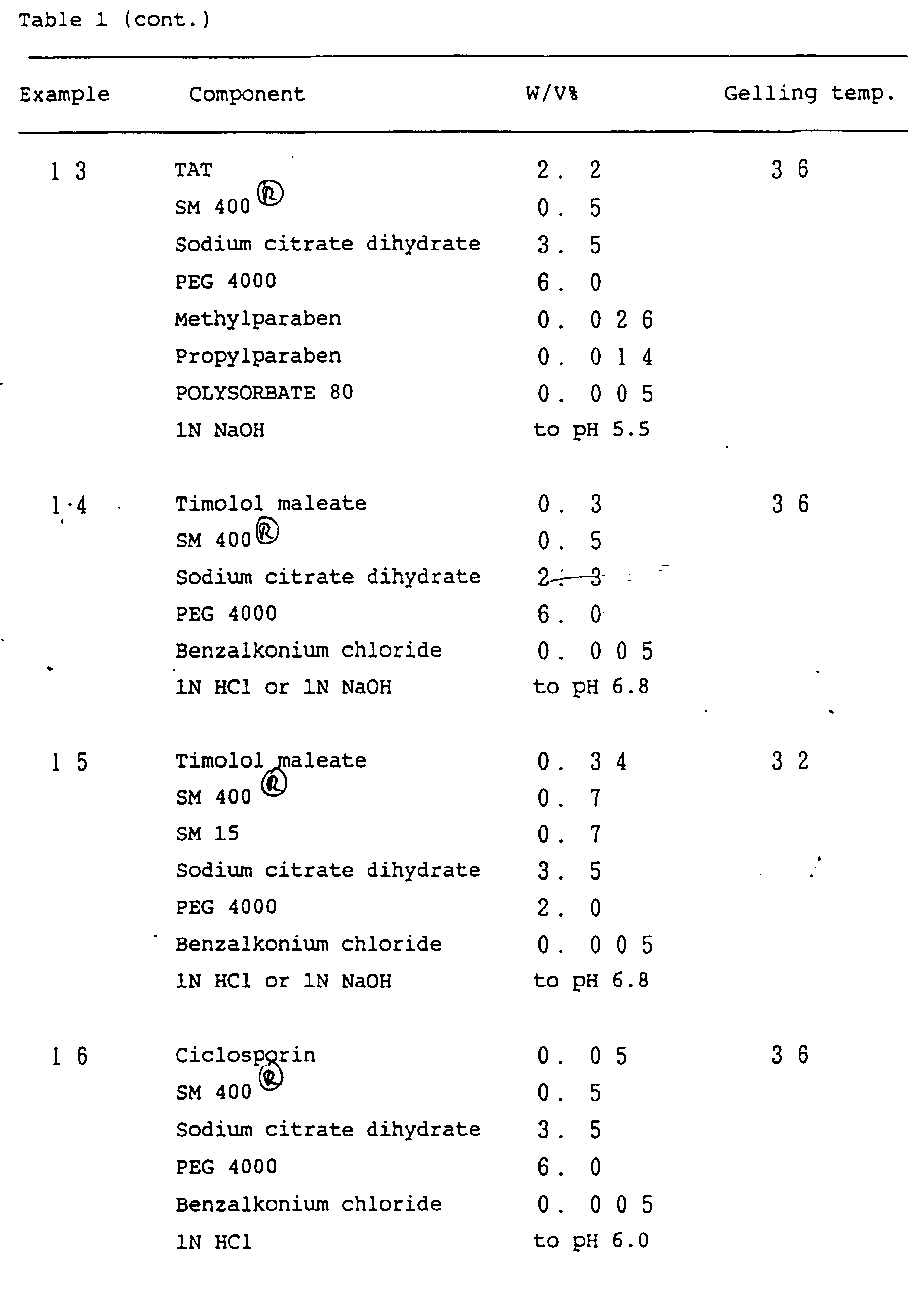
- 0.026g of methylparaben and 0.014g of propylparaben are added to 50 ml of sterilized water prewarmed to about 60°C and are stirred well to be dissolved. After this solution is cooled to room temperature, 0.05g of naphazoline nitrate, 3.5g of sodium citrate dihydrate and 6.0g of POLYETHYLENE GLYCOL 4000 are added to the solution and dissolved. To this mixture, 0.5g of METOLOSE SM 400 dissolved in 25 ml of sterilized water is added and stirred well. Then pH is adjusted to 5.8 with 1N hydrochloric acid and the volume of the mixture is filled up to 100ml by sterilized water, and the components are dissolved by stirring well with ice cooling to give eye drops.
- By a method similar to that of Example 10, eye drops of which compositions are shown in Table 1, are prepared.
- 0.34g of timolol maleate, 3.5g of sodium citrate dihydrate, 6.0g of POLYETHYLENE GLYCOL 4000 and 0.005g of benzalkonium chloride are added to 50 ml of sterilized water and dissolved. To this, 0.5g of METOLOSE SM 400 dissolved in 25 ml of sterilized water is added and stirred well. Then, pH is adjusted to 6.8 with 1N hydrochloric acid or 1N sodium hydroxide and the volume of the mixture is filled. up to 100ml with sterilized water and the components are dissolved by stirring well with ice cooling to give eye drops.
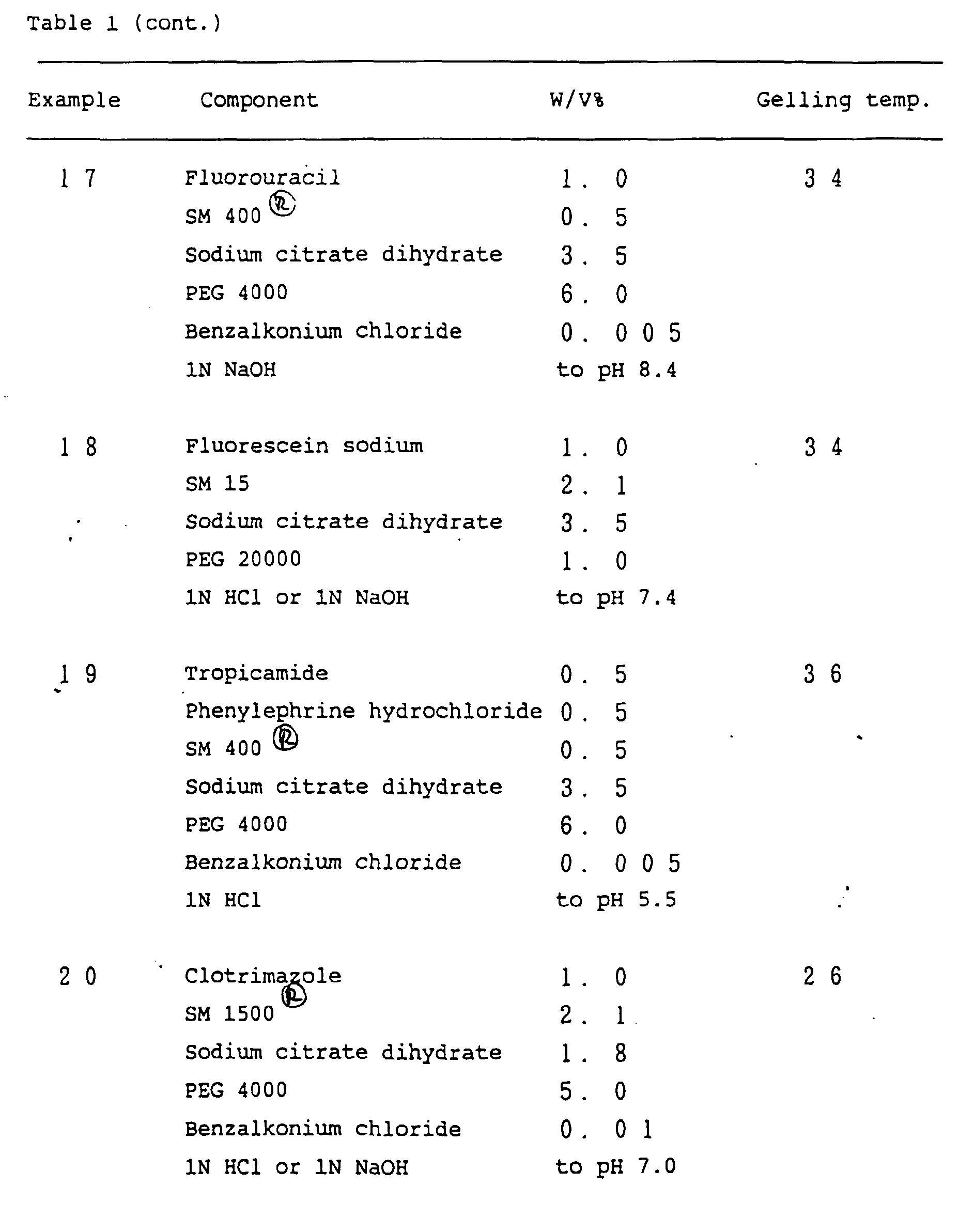
- By a method similar to that of Example 14, eye drops of which compositions are shown in Table 1, are prepared.
- By a method similar to that of Example 14, agents for dermal use of which compositions are shown in Table 1, are prepared.
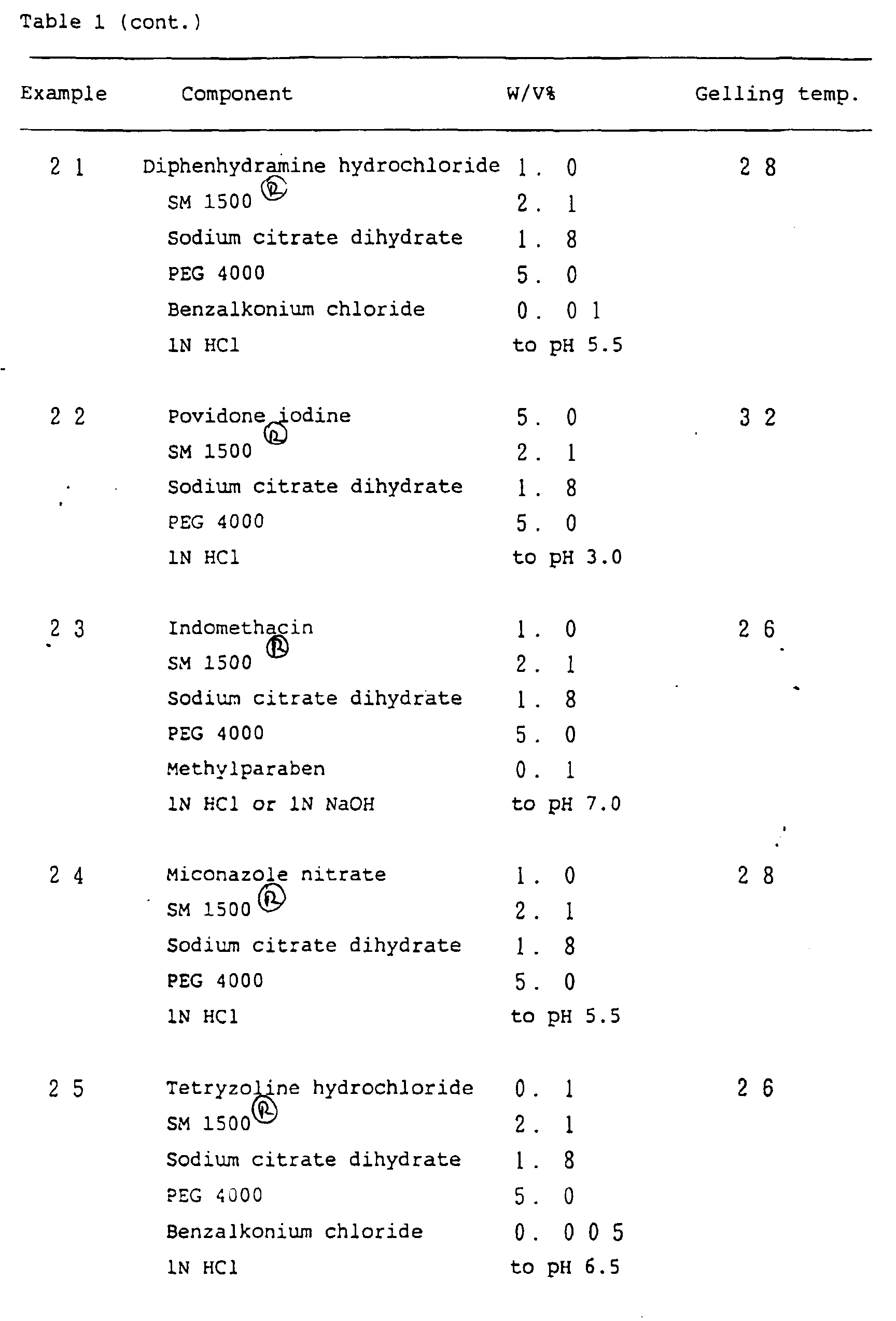
- By a method similar to that of Example 10, agents for dermal use of which compositions are shown in Table 1, are prepared.
- By a method similar to that of Example 14, agents for body cavitical use of which compositions are shown in Table 1, are prepared.



- 3.5g of sodium citrate dihydrate and 6.0g of POLYETHYLENE GLYCOL 4000 were dissolved in 50ml of sterilized water, then, 0.3 to 2.0g of METOLOSE SM 400 dissolved in 25ml of sterilized water was added to the solution and pH was adjusted to 3.0 to 10.0 with 3N HCl or 3N NaOH, the volume of the mixture was filled up to 100ml by sterilized water and the components were dissolved by stirring well with ice cooling to prepare an aqueous composition. The gelling temperature was determined for each aqueous composition. The results obtained are shown in Figure 1.
- 1.9 to 2.9g of citric acid and 4.2g of POLYETHYLENE GLYCOL 4000 were dissolved in 50ml of sterilized water, then pH was adjusted to 6.8 with 3N NaOH, the volume of the mixture was filled up to 100ml with sterilized water and the components were dissolved by stirring well with ice cooling to prepare the
aqueous compositions 1 to 4. Further, 1.9 to 2.9g of citric acid and 4.2g of POLYETHYLENE GLYCOL 4000 are dissolved in 50ml of sterilized water, pH is adjusted to 6.0 with diethanolamine. To this added was 0.7g of METOLOSE SM 400 dissolved in 25ml of sterilized water and then, pH was adjusted to 6.8 with diethanolamine and the volume of the mixture was filled up to 100ml with sterilized water and the components were dissolved by stirring well with ice cooling to prepare the aqueous compositions 5 to 8. - As to the stimulus on eyes, the sensory test was carried out in the panel of twenty persons. The standards of evaluation are as follows: " - " represents "non-stimulus", "+" represents "slight smart" and " + + " represents "smart". The results of this test are shown in Tables 2 and 3.
Aqueous composition Methylcellulose SM-400 conc. (W/V)% PEG4000 conc. (W/V)% Citric acid conc. (W/V)% Stimulus on eyes Composition 1 0.7 4.2 1.9 - Composition 20.7 4.2 2.3 - Composition 3 0.7 4.2 2.5 + Composition 40.7 4.2 2.9 ++ Aqueous composition Methylcellulose SM-400 conc. (W/V)% PEG4000 conc. (W/V)% Citric acid conc. (W/V)% Stimulus on eyes Composition 5 0.7 4.2 1.9 - Composition 60.7 4.2 2.3 - Composition 7 0.7 4.2 2.5 + Composition 80.7 4.2 2.9 ++ - As clearly shown by the results of Tables 2 and 3, the concentration of citric acid more than 2.5 (W/V)% gave stimulus on eyes regardless of the kind of citrate. As opposed to that, the aqueous compositions of the present invention gave no stimulus on eyes.
- In the method of Example 14, methylcellulose, sodium citrate and PEG were replaced by 0.9g of sodium chloride to prepare
Composition 9. Moreover, in the method of Example 14, PEG was omitted to prepareComposition 10. The transition of timolol comprised in the composition of Example 14 andCompositions Concentration of timolol in aqueous humor(µg/ml) 10 minutes 30 minutes 1 hour 2 hours 4 hours Ex. 14 1.2 ± 0.5 3.4 ± 0.9 3.0 ± 0.2 1.4 ± 0.3 0.2 ± 0.2 Com.9 0.5 ± 0.3 0.9 ± 0.4 0.9 ± 0.3 0.4 ± 0.1 0.1 ± 0.1 Com.10 0.7 ± 0.4 1.3 ± 0.3 0.9 ± 0.1 0.5 ± 0.0 0.1 ± 0.1 - As clearly shown by the results of Table 4, the aqueous composition of the present invention maintained high concentration for longer period than the eye drops which do not form gel in a local region.
- The transition of timolol comprised in the composition of Example 9 and
Composition 9, was determined in albino rabbits (body weight: 2.5-3.5 kg) of which 1 group consisted of 5 to 6 rabbits. 50µl of the eye drops was instilled to the albino rabbit eyes and the concentration of timolol in blood was determined at 10 minutes, 30 minutes, 1 hour, 2 hours, 4 hours and 6 hours after the administration. The results of this test are shown in Figure 2. - As clearly shown by the results of Figure 2, the aqueous composition of the present invention represses the transition of timolol to blood and may decrease the systemic side effects in compare with the eye drops which do not form gel in a local region.
Claims (15)
- An aqueous drug composition having property of reversible thermosetting gelation comprising the effective amount of drugs used in pharmaceutical therapy or diagnosis, characterized in that the composition comprises 0.2 to 2. (W/V)% of methylcellulose with a content of methoxyl group within the range of 26 to 33 %, 1.2 to 2.3 (W/V)% of citric acid, 0.5 to 13(W/V)% of polyethylene glycol and a pharmaceutically acceptable pH adjusting agent in an amount sufficient to adjust the pH of the composition within a range of 3 to 10.
- The aqueous drug composition according to claim 1 for ophthalmic use wherein the pharmaceutically effective drug is selected from the group consisting of chemotherapeutics, antibiotics preparation, antiallergic agents, anti-inflammatory agents, miotics preparations, vitamin preparations, vasoconstrictors, antihistamines, mydriatics preparations, antiglaucoma drugs, anticataract drugs, local anesthetics, ophthalmic diagnostic agents, immunosuppressive agents, antimetabolic agents, decongestants, autonomic nerve agents, anti diabetic retinopathy agent, amino acids and mixtures thereof.
- The composition according to claim 2 wherein the drug is selected from the group of compounds consisting of amphotericin B, norfloxacin, miconazole nitrate, ofloxacin, idoxuridine, chloramphenicol, colistin sodium methanesulfonate, carbenicillin sodium, gentamicin sulfate, ketotifen fumarate, sodium cromoglycate, 3'-(1H-tetrazole-5-yl) oxanilic acid, betamethasone sodium phosphate, dexamethasone, fluorometholone, glycyrrhizinate dipotassium, lysozyme chloride, diclofenac sodium, pranoprofen, indomethacin, cortisone acetate, azulene, allantoin, ε -aminocaproic acid, pilocarpine hydrochloride, carbachol, flavin adenine dinucleotide, pyridoxal phosphate, cyanocobalamin, naphazoline nitrate, phenylephrine hydrochloride, chlorpheniramine maleate, diphenhydramine hydrochloride, trocicamide, timolol maleate, carteolol hydrochloride, glutathione, pirenoxine, oxybuprocaine hydrochloride, lidocaine hydrochloride, fluorescein sodium, ciclosporin, azathioprine, fluorouracil, tegafur, epinephrine hydrochloride, neostigmine methylsulfate, [5-(3-thienyl)tetrazol-1-yl]acetic acid and chondroitin sulfate sodium.
- The composition according to claim 2 wherein the chemotherapeutics is idoxuridine or norfloxacin, the antibiotics preparation is gentamicin sulfate, the antiallergic agent is 3'-(1H-tetrazol-5-yl)oxanilic acid or sodium cromoglicate, the anti-inflammatory agent is betamethasone sodium phosphate or pranoprofen, the vitamin preparation is flavin adenine dinucleotide, the local anesthetics is lidocaine hydrochloride, the vasoconstrictors is naphazoline nitrate, the miotics preparation is pilocarpine hydrochloride, the antiglaucoma drug is timolol maleate, the anticataract drug is pirenoxine, the immunosuppressive agent is ciclosporin, the antimetabolic agent is fluorouracil, the ophthalmic diagnostic agent is fluorescein sodium, the mydriatics preparation is trocicamide and the anti diabetic retinopathy agent is [5-(3-thienyl)tetrazol-1-yl]acetic acid.
- The aqueous drug composition according to claim 1 for local or dermatological use wherein the pharmaceutically effective drug is selected from the group consisting of anti-dermoinfectives, dermatics for purulence, analgesics and anti-inflammatory agents, anti-itchings, local anesthetics and antimicrobials for dermatologic use.
- The composition according to claim 5 wherein the drug is selected from the compounds consisting of clotrimazole, salicylic acid, bifonazole, siccanin, bisdequalinium acetate, sulfamethoxazol sodium, erythromycin, gentamicin sulfate, indomethacin, ketoprofen, diphenhydramine, procaine hydrochloride, lidocaine hydrochloride, iodine, povidone iodine, benzalkonium chloride, chlorhexidine gluconate, betamethasone valerate and fluocinolone acetonide.
- The composition according to claim 5 wherein the anti-dermoinfectives is clotrimazole, the dermatics for purulence is gentamicin sulfate, the analgesics and anti-inflammatory agent is indomethacin, the anti-itchings is diphenhydramine, the local anesthetics is lidocaine hydrochloride and the antimicrobials for dermatologic use is povidone iodine.
- The aqueous drug composition according to claim 1 to be administered into body cavities wherein the pharmaceutically effective drug is selected from the group consisting of antihistamines, agents affecting genital organs, agents for otic and nasal use, bronchodilators, antimetabolic agents, hypnotics and sedatives, antipyretics,analgesics and anti-inflammatory agents, adrenal hormone preparations, local anesthetics, dermatics for purulence and synthetic antibacterials.
- The composition according to claim 8 wherein the drug is selected from the compounds consisting of diphenhydramine hydrochloride, chlorpheniramine maleate, clotrimazole, miconazole nitrate, tetryzoline hydrochloride, naphazoline nitrate, ketotifen fumarate, aminophylline, fluorouracil, diazepam, aspirin, indomethacin, sulindac, phenylbutazone, ibuprofen, dexamethasone, triamcinolone, hydrocortisone, lidocaine hydrochloride, sulfisoxazole, kanamycin, tobramycin, erythromycin, norfloxacin and nalidixic acid.
- The composition according to claim 8 wherein the antihistamines is diphenhydramine hydrochloride, the agent affecting genital organs is miconazole nitrate, the agent for otic and nasal use is tetryzoline hydrochloride, the bronchodilators is aminophylline, the antimetabolic agent is fluorouracil, the hypnotics and sedatives is diazepam, the antipyretics,analgesics and anti-inflammatory agent is indomethacin, the adrenal hormone preparation is dexamethasone, the local anesthetics is lidocaine hydrochloride, the dermatics for purulence is erythromycin and the synthetic antibacterials is norfloxacin.
- The composition according to claim 1 wherein 2.0% aqueous solution of the methylcellulose has a viscosity of 13 to 12,000 milipascal · sec at 20 °C.
- The composition according to claim 1 wherein the polyethylene glycol has a weight-average molecular weight of 300 to 50,000.
- The composition according to claim 1 wherein the composition shows the gelling temperature of from about 20 °C to about 40°C and the composition is liquid at the temperature below it.
- The composition according to claim 1 wherein the composition comprises at least one kind of pharmaceutically acceptable buffers, salts, preservatives and solubilizing agents.
- An aqueous drug composition having property of reversible thermosetting gelation, which is selected from a group consisting of the following compositions:(a) a composition comprising 1.0 W/V% of fluorescein sodium, 2.1 W/V% of METOLOSE ™ SM 15, 3.5 W/V% of sodium citrate dihydrate and 1.0 W/V% of PEG 20000 which is adjusted to pH 7.4;(b) a composition comprising 1.0 W/V% of clotrimazole, 2.1 W/V% of METOLOSE ™ SM 1500, 1.8 W/V% of sodium citrate dihydrate, 5.0 W/V% of PEG 4000 and 0.01 W/V% of benzalkoniumn chloride which is adjusted to pH 7.0;(c) a composition comprising 1.0 W/V% of diphenhydramine hydrochloride, 2.1 W/V% of METOLOSE ™ SM 1500, 1.8 W/V% of sodium citrate dihydrate, 5.0 W/V% of PEG 4000 and 0.01 W/V% of benzalkonium chloride which is adjusted to pH 5.5;(d) a composition comprising 5.0 W/V% of povidone iodine, 2.1 W/V% of METOLOSE ™ SM 1500, 1.8 W/V% of sodium citrate dihydrate and 5.0 W/V% of PEG 4000 which is adjusted to pH 3.0;(e) a composition comprising 1.0 W/V% of indomethacin, 2.1 W/V% of METOLOSE ™ SM 1500, 1.8 W/V% of sodium citrate dihydrate, 5.0 W/V% of PEG 4000 and 0.1 W/V% of Methylparaben which is adjusted to pH 7.0;(f) a composition comprising 1.0 W/V% of miconazole nitrate, 2.1 W/V% of METOLOSE ™ SM 1500, 1.8 W/V% of sodium citrate dihydrate and 5.0 W/V% of PEG 4000 which is adjusted to pH 5.5;(g) a composition comprising 0.1 W/V% of tetryzoline hydrochloride, 2.1 W/V% of METOLOSE ™ SM 1500, 1.8 W/V% of sodium citrate dihydrate, 5.0 W/V% of PEG 4000 and 0.005 W/V% of benzalkonium chloride which is adjusted to pH 6.5;(h) a composition comprising 0.1 W/V% of tetryzoline hydrochloride, 2.1 W/V% of METOLOSE ™ SM 1500, 1.8 W/V% of sodium citrate dihydrate, 13.0 W/V% of PEG 4000 and 0.005 W/V% of benzalkonium chloride which is adjusted to pH 6.5;(i) a composition comprising 2.5 W/V% of aminophylline, 2.1 W/V% of METOLOSE ™ SM 1500, 1.8 W/V% of sodium citrate dihydrate, 5.0 W/V% of PEG 4000 and 0.005 W/V% of benzalkonium chloride which is adjusted to pH 9.0;(j) a composition comprising 0.5 W/V% of diazepam, 2.1 W/V% of METOLOSE ™ SM 1500, 1.8 W/V% of sodium citrate dihydrate, 5.0 W/V% of PEG 4000 and 0.005 W/V% of benzalkonium chloride which is adjusted to pH 6.5;(k) a composition comprising 0.1 W/V% of dexamethasone, 2.1 W/V% of METOLOSE ™ SM 1500, 1.8 W/V% of sodium citrate dihydrate, 5.0 W/V% of PEG 4000 and 0.005 W/V% of benzalkonium chloride which is adjusted to pH 5.5; and(l) a composition comprising 0.1 W/V% of erythromycin, 2.1 W/V% of METOLOSE ™ SM 1500, 1.8 W/V% sodium citrate dihydrate, 5.0 W/V% of PEG 4000 and 0.005 W/V% of benzalkonium chloride which is adjusted to pH 7.0.
Applications Claiming Priority (4)
| Application Number | Priority Date | Filing Date | Title |
|---|---|---|---|
| JP112345/93 | 1993-04-16 | ||
| JP11234593 | 1993-04-16 | ||
| JP11234593 | 1993-04-16 | ||
| PCT/JP1993/001636 WO1994023750A1 (en) | 1993-04-16 | 1993-11-10 | Reversible, thermally gelling water-base medicinal composition |
Publications (3)
| Publication Number | Publication Date |
|---|---|
| EP0694310A1 EP0694310A1 (en) | 1996-01-31 |
| EP0694310A4 EP0694310A4 (en) | 1996-04-24 |
| EP0694310B1 true EP0694310B1 (en) | 2000-02-16 |
Family
ID=14584369
Family Applications (1)
| Application Number | Title | Priority Date | Filing Date |
|---|---|---|---|
| EP93924801A Expired - Lifetime EP0694310B1 (en) | 1993-04-16 | 1993-11-10 | Reversible, thermally gelling water-base medicinal composition |
Country Status (16)
| Country | Link |
|---|---|
| US (1) | US5624962A (en) |
| EP (1) | EP0694310B1 (en) |
| KR (1) | KR0162025B1 (en) |
| CN (1) | CN1048393C (en) |
| AT (1) | ATE189772T1 (en) |
| AU (1) | AU668447B2 (en) |
| CA (1) | CA2153234C (en) |
| DE (1) | DE69327878T2 (en) |
| DK (1) | DK0694310T3 (en) |
| ES (1) | ES2141775T3 (en) |
| FI (1) | FI112778B (en) |
| HU (1) | HU220864B1 (en) |
| IL (1) | IL107626A (en) |
| NO (1) | NO311635B1 (en) |
| RU (1) | RU2108112C1 (en) |
| WO (1) | WO1994023750A1 (en) |
Cited By (6)
| Publication number | Priority date | Publication date | Assignee | Title |
|---|---|---|---|---|
| EP1569618A2 (en) | 2002-11-27 | 2005-09-07 | Regents Of The University Of Minnesota | Methods and compositions for applying pharmacologic agents to the ear |
| US7745425B2 (en) | 2002-02-07 | 2010-06-29 | The Trustees Of Columbia University In The City Of New York | Non-irritating compositions containing zinc salts |
| US7759327B2 (en) | 2006-01-06 | 2010-07-20 | The Trustees Of Columbia University In The City Of New York | Compositions containing zinc salts for coating medical articles |
| US7871649B2 (en) | 2003-07-17 | 2011-01-18 | The Trustees Of Columbia University In The City Of New York | Antimicrobial compositions containing synergistic combinations of quaternary ammonium compounds and essential oils and/or constituents thereof |
| US7951840B2 (en) | 2002-02-07 | 2011-05-31 | Modak Shanta M | Zinc salt compositions for the prevention of dermal and mucosal irritation |
| US8293802B2 (en) | 2001-10-23 | 2012-10-23 | The Trustees Of Columbia University | Gentle-acting skin-disinfectants and hydroalcoholic gel formulations |
Families Citing this family (81)
| Publication number | Priority date | Publication date | Assignee | Title |
|---|---|---|---|---|
| US6436425B1 (en) | 1988-11-16 | 2002-08-20 | Mdv Technologies, Inc. | Method and non-gelling composition for inhibiting post-surgical adhesions |
| US5346703A (en) | 1990-08-07 | 1994-09-13 | Mediventures, Inc. | Body cavity drug delivery with thermo-irreversible polyoxyalkylene and ionic polysaccharide gels |
| US5318780A (en) * | 1991-10-30 | 1994-06-07 | Mediventures Inc. | Medical uses of in situ formed gels |
| MX9604411A (en) * | 1994-03-28 | 1997-12-31 | Univ Columbia | Composition for inactivating irritants in fluids. |
| WO1996011672A1 (en) * | 1994-10-13 | 1996-04-25 | Wakamoto Pharmaceutical Co., Ltd. | Lyophilized preparation providing reversibly thermogelling water-base medicinal composition |
| DE19511322C2 (en) | 1995-03-28 | 1999-09-02 | Mann Gerhard Chem Pharm Fab | Sterile eye gels containing medium chain triglycerides and process for their preparation |
| US5843470A (en) | 1995-10-06 | 1998-12-01 | Mdv Technologies, Inc. | Method and composition for inhibiting post-surgical adhesions |
| CA2232855C (en) * | 1997-04-10 | 2007-10-09 | Roche Consumer Health (Worldwide) Sa | Pharmaceutical formulation |
| US6274634B1 (en) * | 1997-05-14 | 2001-08-14 | Senju Pharmaceutical Co., Ltd. | Aqueous suspension preparations with excellent redispersibility |
| JP2001526246A (en) * | 1997-12-23 | 2001-12-18 | アライアンス・ファーマスーティカル・コーポレイション | Methods and compositions for drug delivery and / or adhesion prevention |
| US6197347B1 (en) | 1998-06-29 | 2001-03-06 | Andrx Pharmaceuticals, Inc. | Oral dosage for the controlled release of analgesic |
| ES2155027B1 (en) * | 1999-05-24 | 2001-12-01 | Univ Pais Vasco | GELS FOR MULTIPLE, REVERSIBLE AND DEGRADABLE PURPOSES. |
| US6589998B1 (en) * | 1999-06-11 | 2003-07-08 | Cytyc Health Corporation | Gel composition for filling a breast milk duct prior to surgical excision of the duct or other breast tissue |
| US6576224B1 (en) * | 1999-07-06 | 2003-06-10 | Sinuspharma, Inc. | Aerosolized anti-infectives, anti-inflammatories, and decongestants for the treatment of sinusitis |
| US20020061281A1 (en) * | 1999-07-06 | 2002-05-23 | Osbakken Robert S. | Aerosolized anti-infectives, anti-inflammatories, and decongestants for the treatment of sinusitis |
| US6777429B1 (en) * | 1999-07-23 | 2004-08-17 | Novartis Ag | Ophthalmic composition |
| JP2001158750A (en) * | 1999-12-02 | 2001-06-12 | Lion Corp | Method for improving sustainability of ophthalmic composition and anti-allergic medicine |
| RU2156128C1 (en) * | 2000-01-05 | 2000-09-20 | Гапонюк Петр Яковлевич | Ophthalmic drops for treatment of inflammatory eye disease with allergic symptoms |
| JP3450805B2 (en) * | 2000-08-08 | 2003-09-29 | わかもと製薬株式会社 | Aqueous pharmaceutical composition |
| US7420030B2 (en) | 2000-09-08 | 2008-09-02 | The Board Of Regents Of The University Of Texas System | Aminopeptidase A (APA) targeting peptides for the treatment of cancer |
| CA2423354C (en) * | 2000-09-20 | 2009-12-15 | Lee Shahinian Jr. | Self-preserved nasal, inhalable, and topical ophthalmic preparations and medications |
| JP4820024B2 (en) * | 2001-01-10 | 2011-11-24 | 昭和薬品化工株式会社 | Local anesthetic composition |
| CA2454357A1 (en) * | 2001-07-18 | 2003-01-30 | Wadih Arap | An anti-angiogenic state in mice and humans with retinal photoreceptor cell degeneration |
| US20040048243A1 (en) * | 2001-09-07 | 2004-03-11 | Wadih Arap | Methods and compositions for in vitro targeting |
| RU2191581C1 (en) * | 2001-11-16 | 2002-10-27 | Нестерук Владимир Викторович | Method of fluorouracil solution preparing |
| US7879365B2 (en) * | 2002-02-07 | 2011-02-01 | The Trustees Of Columbia University In The City Of New York | Zinc salt compositions for the prevention of dermal and mucosal irritation |
| SI1484054T1 (en) * | 2002-02-22 | 2012-12-31 | Santen Pharmaceutical Co. Ltd. | Drug delivery system for the subconjunctival administration of fine grains |
| TW200304812A (en) * | 2002-03-08 | 2003-10-16 | Sankyo Co | An eye drop containing a tetrazole derivative |
| US20030211173A1 (en) * | 2002-05-08 | 2003-11-13 | Veach Tom C. | Lubrication composition |
| RU2228742C2 (en) * | 2002-05-23 | 2004-05-20 | Сотникова Лариса Федоровна | Method for treating relapsing equine iridocyclochorioiditis |
| RU2228741C2 (en) * | 2002-05-23 | 2004-05-20 | Сотникова Лариса Федоровна | Method for treating relapsing equine iridocyclochorioiditis |
| AU2003264498A1 (en) * | 2002-09-18 | 2004-04-08 | Wakamoto Pharmaceutical Co., Ltd. | Transparent and reversibly heat-gelling aqueous compositions |
| RU2238092C2 (en) * | 2002-10-08 | 2004-10-20 | Нестерук Владимир Викторович | Aqueous medicinal composition for treatment of skin disease |
| JP2004196787A (en) * | 2002-12-04 | 2004-07-15 | Santen Pharmaceut Co Ltd | Drug delivery system with subconjunctival depot |
| US20060216245A1 (en) * | 2002-12-10 | 2006-09-28 | Showa Yakuhin Kako Co., Ltd. | Composition for local anesthesia |
| US20050085446A1 (en) * | 2003-04-14 | 2005-04-21 | Babu M.K. M. | Fluoroquinolone formulations and methods of making and using the same |
| JP4669960B2 (en) * | 2003-06-03 | 2011-04-13 | 株式会社 メドレックス | Oral or pharyngeal preparations containing local anesthetics |
| CA2536185C (en) * | 2003-08-20 | 2012-06-26 | Santen Pharmaceutical Co., Ltd. | Drug delivery system by administrating fine particles to sub-tenon |
| RU2245134C1 (en) * | 2003-09-02 | 2005-01-27 | Открытое акционерное общество "Красфарма" | Ofloxacine composition for injections |
| FR2860718B1 (en) * | 2003-10-09 | 2006-02-24 | Jean Pascal Conduzorgues | NOVEL FORMULATION AND ITS APPLICATIONS IN THE COSMETIC OR PHARMACEUTICAL FIELDS |
| WO2005067865A1 (en) * | 2004-01-15 | 2005-07-28 | Oral Bioscience Pty. Limited | Oral anaesthetic gel |
| US7658947B2 (en) * | 2004-06-25 | 2010-02-09 | Kimberly-Clark Worldwide, Inc. | Thermo-gelling composition |
| JP2007277095A (en) * | 2004-07-02 | 2007-10-25 | Wakamoto Pharmaceut Co Ltd | Reversible thermogelling aqueous composition containing azithromycin |
| US7459416B2 (en) * | 2004-07-12 | 2008-12-02 | Panasonic Corporation | Fluid bearing unit and spindle motor using the same |
| RU2281086C1 (en) * | 2005-01-18 | 2006-08-10 | Сергей Николаевич Анисимов | Ophthalmic anti-histaminic drops |
| EP2497460A1 (en) | 2005-03-10 | 2012-09-12 | 3M Innovative Properties Co. | Methods of reducing microbial contamination |
| JP4979258B2 (en) * | 2005-04-08 | 2012-07-18 | ロート製薬株式会社 | Acitazanolast-containing aqueous composition |
| CN100463668C (en) * | 2005-05-09 | 2009-02-25 | 凌沛学 | Reversible thermal gelation aqueous pharmaceutical composition |
| CN100430069C (en) * | 2005-07-28 | 2008-11-05 | 凌沛学 | Reversible heat gelling aquatic pharmaceutical composition of a Chinese medicine and compound prescription thereof |
| ES2340202T3 (en) * | 2005-10-17 | 2010-05-31 | Kowa Company, Ltd. | PREPARED LIQUID FOR EXTERNAL USE CONTAINING INDOMETACINE. |
| EA008737B1 (en) * | 2005-12-07 | 2007-08-31 | Леонид Андреевич Кожемякин | Preparation for the treatment and prophylaxis of conjunctivitis and keratitis of different etiology (variants), method for use thereof |
| US20070249546A1 (en) * | 2006-04-22 | 2007-10-25 | Sawaya Assad S | Ophthalmic and related aqueous solutions containing antifungal agents, uses therefor and methods for preparing them |
| US20070254854A1 (en) * | 2006-05-01 | 2007-11-01 | Medi-Flex, Inc. | Aqueous Antiseptic Solution and Compatible Anionic Dye for Staining Skin |
| US20070253909A1 (en) * | 2006-05-01 | 2007-11-01 | Medi-Flex, Inc. | Aqueous Antiseptic Solution and Compatible Cationic Dye for Staining Skin |
| US20080108674A1 (en) * | 2006-05-01 | 2008-05-08 | Enturia, Inc. | Cationic antiseptic and dye formulation |
| TW200808375A (en) * | 2006-05-12 | 2008-02-16 | Otsuka Pharma Co Ltd | Hydrogel suspension and manufacturing process thereof |
| EA014780B1 (en) * | 2007-01-05 | 2011-02-28 | Промед Экспортс Пвт. Лтд. | An ophthalmic composition |
| DE102007002073A1 (en) * | 2007-01-09 | 2008-07-10 | Matthias Habenicht | Medium for use during care and antimicrobial treatment of skin, for topical dermatological application, and for therapeutic skin and sore treatment, comprises benzalkonium chloride, which is basically exclusive pharmaceutically active |
| WO2009001899A1 (en) * | 2007-06-26 | 2008-12-31 | Wakamoto Pharmaceutical Co., Ltd. | Aqueous composition |
| KR101529093B1 (en) * | 2007-08-29 | 2015-06-16 | 와카모토 세이야꾸 가부시끼가이샤 | Latanoprost-containing aqueous pharmaceutical composition |
| WO2009074853A2 (en) * | 2007-12-10 | 2009-06-18 | Promed Research Centre | Ophthalmic composition comprising phenylephrine |
| WO2009139924A2 (en) * | 2008-05-14 | 2009-11-19 | Otonomy, Inc. | Controlled release corticosteroid compositions and methods for the treatment of otic disorders |
| US10517839B2 (en) * | 2008-06-09 | 2019-12-31 | Cornell University | Mast cell inhibition in diseases of the retina and vitreous |
| TW201023912A (en) * | 2008-12-05 | 2010-07-01 | Alcon Res Ltd | Pharmaceutical suspension |
| RU2402315C2 (en) * | 2009-01-21 | 2010-10-27 | Федеральное государственное учреждение "МОСКОВСКИЙ НАУЧНО-ИССЛЕДОВАТЕЛЬСКИЙ ИНСТИТУТ ГЛАЗНЫХ БОЛЕЗНЕЙ ИМЕНИ ГЕЛЬМГОЛЬЦА ФЕДЕРАЛЬНОГО АГЕНТСТВА ПО ВЫСОКОТЕХНОЛОГИЧНОЙ МЕДИЦИНСКОЙ ПОМОЩИ" | Reparative ophthalmic medicinal composition |
| AU2010221369B2 (en) * | 2009-03-03 | 2014-03-13 | Alcon Research, Ltd. | Pharmaceutical composition for delivery of receptor tyrosine kinase inhibiting (RTKi) compounds to the eye |
| WO2010101989A1 (en) * | 2009-03-03 | 2010-09-10 | Alcon Research, Ltd. | PHARMACEUTICAL COMPOSITION FOR DELIVERY OF RECEPTOR TYROSINE KINASE INHIBITING (RTKi) COMPOUNDS TO THE EYE |
| CN102340993A (en) * | 2009-03-03 | 2012-02-01 | 爱尔康研究有限公司 | Pharmaceutical compositions for the delivery of receptor tyrosine kinase inhibitory (RTKi) compounds to the eye |
| US8299079B2 (en) | 2009-05-22 | 2012-10-30 | Kaufman Herbert E | Preparations and methods for ameliorating or reducing presbyopia |
| US20100298335A1 (en) * | 2009-05-22 | 2010-11-25 | Kaufman Herbert E | Preparations and Methods for Ameliorating or Reducing Presbyopia |
| JP5870459B2 (en) | 2010-08-27 | 2016-03-01 | わかもと製薬株式会社 | Aqueous composition for eye drops |
| TWI544922B (en) | 2011-05-19 | 2016-08-11 | 愛爾康研究有限公司 | High concentration europart ingot ophthalmic composition |
| WO2013169458A1 (en) * | 2012-05-11 | 2013-11-14 | Bausch & Lomb Incorporated | Pharmaceutical compositions and methods for treating, controlling, ameliorating, or reversing conditions of dry eye |
| RU2485939C1 (en) * | 2012-06-19 | 2013-06-27 | Станислав Анатольевич Кедик | Disulfiram and taurine-containing ophthalmological medication in form of eye drops |
| US10507245B2 (en) * | 2012-07-19 | 2019-12-17 | Luis Felipe Vejarano Restrepo | Ophthalmic formulation and method for ameliorating presbyopia |
| RU2517033C1 (en) * | 2013-03-05 | 2014-05-27 | федеральное государственное бюджетное учреждение "Межотраслевой научно-технический комплекс "Микрохирургия глаза" имени академика С.Н. Федорова" Министерства здравоохранения Российской Федерации | Composition for integrated treatment of patients with primary open-angle glaucoma and ocular surface diseases |
| CN103239390B (en) * | 2013-05-15 | 2014-08-06 | 中国人民解放军第三军医大学第二附属医院 | Tropicamide ophthalmic temperature-sensitive in-situ gel and preparation method thereof |
| EP3082868A1 (en) * | 2013-12-20 | 2016-10-26 | The Procter & Gamble Company | Stable liquid medication containing diphenhydramine |
| JP6714247B2 (en) * | 2017-10-06 | 2020-06-24 | 有限会社ジーエヌコーポレーション | Urethral stricture therapeutic agent and method for treating urethral stricture |
| US11872304B2 (en) * | 2018-05-29 | 2024-01-16 | Jinno Institute | Topical composition |
| CN113242734A (en) * | 2018-11-26 | 2021-08-10 | 艾葳生物科技有限公司 | Pharmaceutical biosoluble gels for drug delivery |
Family Cites Families (14)
| Publication number | Priority date | Publication date | Assignee | Title |
|---|---|---|---|---|
| US3311577A (en) * | 1965-03-29 | 1967-03-28 | Burton Parsons Chemicals Inc | Underwater contact lens solution |
| US4188373A (en) * | 1976-02-26 | 1980-02-12 | Cooper Laboratories, Inc. | Clear, water-miscible, liquid pharmaceutical vehicles and compositions which gel at body temperature for drug delivery to mucous membranes |
| US4100271A (en) * | 1976-02-26 | 1978-07-11 | Cooper Laboratories, Inc. | Clear, water-miscible, liquid pharmaceutical vehicles and compositions which gel at body temperature for drug delivery to mucous membranes |
| DE2714065A1 (en) * | 1977-03-30 | 1978-10-12 | Boehringer Mannheim Gmbh | INSTILLATION PREPARATION |
| US4474751A (en) * | 1983-05-16 | 1984-10-02 | Merck & Co., Inc. | Ophthalmic drug delivery system utilizing thermosetting gels |
| US4474753A (en) * | 1983-05-16 | 1984-10-02 | Merck & Co., Inc. | Topical drug delivery system utilizing thermosetting gels |
| US4474752A (en) * | 1983-05-16 | 1984-10-02 | Merck & Co., Inc. | Drug delivery system utilizing thermosetting gels |
| US4478822A (en) * | 1983-05-16 | 1984-10-23 | Merck & Co., Inc. | Drug delivery system utilizing thermosetting gels |
| FR2588189B1 (en) * | 1985-10-03 | 1988-12-02 | Merck Sharp & Dohme | LIQUID-GEL PHASE TRANSITION PHARMACEUTICAL COMPOSITION |
| GB2203039B (en) * | 1987-03-02 | 1990-10-24 | American Cyanamid Co | Stable ophthalmic preparations containing acetazolamide |
| US5252318A (en) * | 1990-06-15 | 1993-10-12 | Allergan, Inc. | Reversible gelation compositions and methods of use |
| US5077033A (en) * | 1990-08-07 | 1991-12-31 | Mediventures Inc. | Ophthalmic drug delivery with thermo-irreversible gels of polxoxyalkylene polymer and ionic polysaccharide |
| MX9200339A (en) * | 1991-01-28 | 1992-08-01 | Hoechst Ag | PREPARED FOR THE CONTROLLED RELEASE OF ACTIVE SUBSTANCES, WHICH ARE APPROPRIATE AS THERAPEUTICS OR TO IMPROVE THE GROWTH AND USE OF FEED IN RUMINANTS |
| AU679937B2 (en) * | 1992-11-18 | 1997-07-17 | Johnson & Johnson Consumer Products, Inc. | Extrudable compositions for topical or transdermal drug delivery |
-
1993
- 1993-11-10 ES ES93924801T patent/ES2141775T3/en not_active Expired - Lifetime
- 1993-11-10 WO PCT/JP1993/001636 patent/WO1994023750A1/en not_active Ceased
- 1993-11-10 KR KR1019950703156A patent/KR0162025B1/en not_active Expired - Lifetime
- 1993-11-10 RU RU95122560A patent/RU2108112C1/en not_active IP Right Cessation
- 1993-11-10 EP EP93924801A patent/EP0694310B1/en not_active Expired - Lifetime
- 1993-11-10 DK DK93924801T patent/DK0694310T3/en active
- 1993-11-10 DE DE69327878T patent/DE69327878T2/en not_active Expired - Lifetime
- 1993-11-10 CA CA002153234A patent/CA2153234C/en not_active Expired - Fee Related
- 1993-11-10 US US08/397,064 patent/US5624962A/en not_active Expired - Lifetime
- 1993-11-10 AT AT93924801T patent/ATE189772T1/en not_active IP Right Cessation
- 1993-11-10 HU HU9502086A patent/HU220864B1/en not_active IP Right Cessation
- 1993-11-10 AU AU54333/94A patent/AU668447B2/en not_active Expired
- 1993-11-15 CN CN93121431A patent/CN1048393C/en not_active Expired - Lifetime
- 1993-11-16 IL IL107626A patent/IL107626A/en not_active IP Right Cessation
-
1995
- 1995-07-26 FI FI953575A patent/FI112778B/en not_active IP Right Cessation
- 1995-08-14 NO NO19953189A patent/NO311635B1/en not_active IP Right Cessation
Cited By (10)
| Publication number | Priority date | Publication date | Assignee | Title |
|---|---|---|---|---|
| US8293802B2 (en) | 2001-10-23 | 2012-10-23 | The Trustees Of Columbia University | Gentle-acting skin-disinfectants and hydroalcoholic gel formulations |
| US8436050B2 (en) | 2001-10-23 | 2013-05-07 | The Trustees Of Columbia University In The City Of New York | Gentle-acting skin-disinfectants and hydroalcoholic gel formulations |
| US7745425B2 (en) | 2002-02-07 | 2010-06-29 | The Trustees Of Columbia University In The City Of New York | Non-irritating compositions containing zinc salts |
| US7951840B2 (en) | 2002-02-07 | 2011-05-31 | Modak Shanta M | Zinc salt compositions for the prevention of dermal and mucosal irritation |
| USRE45435E1 (en) | 2002-02-07 | 2015-03-24 | The Trustees Of Columbia University In The City Of New York | Zinc salt compositions for the prevention of dermal and mucosal irritation |
| EP1569618A2 (en) | 2002-11-27 | 2005-09-07 | Regents Of The University Of Minnesota | Methods and compositions for applying pharmacologic agents to the ear |
| US7871649B2 (en) | 2003-07-17 | 2011-01-18 | The Trustees Of Columbia University In The City Of New York | Antimicrobial compositions containing synergistic combinations of quaternary ammonium compounds and essential oils and/or constituents thereof |
| US9421263B2 (en) | 2003-07-17 | 2016-08-23 | The Trustees Of Columbia University In The City Of New York | Antimicrobial compositions containing synergistic combinations of quaternary ammonium compounds and essential oils and/or constituents thereof |
| US7759327B2 (en) | 2006-01-06 | 2010-07-20 | The Trustees Of Columbia University In The City Of New York | Compositions containing zinc salts for coating medical articles |
| US8207148B2 (en) | 2006-01-06 | 2012-06-26 | The Trustees Of Columbia University In The City Of New York | Compositions containing zinc salts for coating medical articles |
Also Published As
| Publication number | Publication date |
|---|---|
| FI953575L (en) | 1995-07-26 |
| NO311635B1 (en) | 2001-12-27 |
| US5624962A (en) | 1997-04-29 |
| CA2153234C (en) | 1999-02-16 |
| NO953189L (en) | 1995-08-14 |
| HU9502086D0 (en) | 1995-09-28 |
| AU5433394A (en) | 1994-11-08 |
| EP0694310A4 (en) | 1996-04-24 |
| ATE189772T1 (en) | 2000-03-15 |
| AU668447B2 (en) | 1996-05-02 |
| KR960700075A (en) | 1996-01-19 |
| IL107626A (en) | 1997-09-30 |
| NO953189D0 (en) | 1995-08-14 |
| HUT71676A (en) | 1996-01-29 |
| HU220864B1 (en) | 2002-06-29 |
| FI112778B (en) | 2004-01-15 |
| CN1048393C (en) | 2000-01-19 |
| IL107626A0 (en) | 1994-02-27 |
| CN1097593A (en) | 1995-01-25 |
| EP0694310A1 (en) | 1996-01-31 |
| KR0162025B1 (en) | 1998-12-01 |
| ES2141775T3 (en) | 2000-04-01 |
| DE69327878D1 (en) | 2000-03-23 |
| DK0694310T3 (en) | 2000-06-05 |
| WO1994023750A1 (en) | 1994-10-27 |
| CA2153234A1 (en) | 1994-10-27 |
| FI953575A0 (en) | 1995-07-26 |
| HK1017805A1 (en) | 1999-11-26 |
| RU2108112C1 (en) | 1998-04-10 |
| DE69327878T2 (en) | 2000-06-15 |
Similar Documents
| Publication | Publication Date | Title |
|---|---|---|
| US5624962A (en) | Aqueous drug composition having property of reversible thermosetting gelation | |
| US20240197657A1 (en) | Ketorolac tromethamine compositions for treating or preventing ocular pain | |
| EP0533836B1 (en) | Reversible gelation compositions and methods of use | |
| RU95122560A (en) | WATER MEDICINAL COMPOSITION HAVING THE PROPERTIES OF REVERSABLE THERMAL-CONTROLLED HELO-FORMATION | |
| KR20030040384A (en) | Aqueous pharmaceutical compositions | |
| EP2965749B1 (en) | Carboxyvinyl polymer-containing nanoparticle suspensions | |
| MXPA98010124A (en) | Procedure to treat ocular infections with azitromic | |
| WO2011018800A2 (en) | A novel in-situ gel forming solution for ocular drug delivery | |
| CN104814924A (en) | Brinzolamide liposome eye preparation and preparation method thereof | |
| JP2729859B2 (en) | Reversible thermogelling aqueous pharmaceutical composition | |
| JPWO1994023750A1 (en) | Reversibly heat-gelling aqueous pharmaceutical composition | |
| CN104721130B (en) | A kind of brinzolamide inclusion compound eye-drops preparations and preparation method thereof | |
| HK1017805B (en) | Reversible, thermally gelling water-base medicinal composition | |
| EP0893990A1 (en) | Ophthalmological composition of the type which undergoes liquid-gel phase transition | |
| JP3504656B2 (en) | Aqueous pharmaceutical composition | |
| JPWO2002011734A1 (en) | Aqueous pharmaceutical composition | |
| HK1217091B (en) | Carboxyvinyl polymer-containing nanoparticle suspensions | |
| HK1149212B (en) | Ketorolac tromethamine compositions for treating or preventing ocular pain |
Legal Events
| Date | Code | Title | Description |
|---|---|---|---|
| PUAI | Public reference made under article 153(3) epc to a published international application that has entered the european phase |
Free format text: ORIGINAL CODE: 0009012 |
|
| 17P | Request for examination filed |
Effective date: 19950713 |
|
| AK | Designated contracting states |
Kind code of ref document: A1 Designated state(s): AT BE CH DE DK ES FR GB IT LI LU MC NL SE |
|
| A4 | Supplementary search report drawn up and despatched | ||
| AK | Designated contracting states |
Kind code of ref document: A4 Designated state(s): AT BE CH DE DK ES FR GB IT LI LU MC NL SE |
|
| 17Q | First examination report despatched |
Effective date: 19960628 |
|
| RIN1 | Information on inventor provided before grant (corrected) |
Inventor name: GOTO, MASAYOSHI WAKAMOTO PHARMACEUTICAL CO., LTD. Inventor name: OGUMA, TOURU WAKAMOTO PHARMACEUTICAL CO., LTD. Inventor name: NAITOU, KEIKO WAKAMOTO PHARMACEUTICAL CO., LTD. Inventor name: SASAKI, MIYAKO WAKAMOTO PHARMACEUTICAL CO., LTD Inventor name: MARUYAMA, HIROKI WAKAMOTO PHARMACEUTICAL CO., LTD Inventor name: TAKAHASHI, TOSHIE WAKAMOTO PHARMACEUTICAL CO., LT Inventor name: SUZUKI, HIROE WAKAMOTO PHARMAC. CO., LTD., Inventor name: TAKEUCHI, MASANOBU WAKAMOTO PHARMAC. CO., LTD. |
|
| GRAG | Despatch of communication of intention to grant |
Free format text: ORIGINAL CODE: EPIDOS AGRA |
|
| GRAG | Despatch of communication of intention to grant |
Free format text: ORIGINAL CODE: EPIDOS AGRA |
|
| GRAG | Despatch of communication of intention to grant |
Free format text: ORIGINAL CODE: EPIDOS AGRA |
|
| GRAH | Despatch of communication of intention to grant a patent |
Free format text: ORIGINAL CODE: EPIDOS IGRA |
|
| GRAH | Despatch of communication of intention to grant a patent |
Free format text: ORIGINAL CODE: EPIDOS IGRA |
|
| GRAA | (expected) grant |
Free format text: ORIGINAL CODE: 0009210 |
|
| AK | Designated contracting states |
Kind code of ref document: B1 Designated state(s): AT BE CH DE DK ES FR GB IT LI LU MC NL SE |
|
| REF | Corresponds to: |
Ref document number: 189772 Country of ref document: AT Date of ref document: 20000315 Kind code of ref document: T |
|
| REG | Reference to a national code |
Ref country code: CH Ref legal event code: NV Representative=s name: ARDIN & CIE S.A. Ref country code: CH Ref legal event code: EP |
|
| ET | Fr: translation filed | ||
| REF | Corresponds to: |
Ref document number: 69327878 Country of ref document: DE Date of ref document: 20000323 |
|
| REG | Reference to a national code |
Ref country code: ES Ref legal event code: FG2A Ref document number: 2141775 Country of ref document: ES Kind code of ref document: T3 |
|
| ITF | It: translation for a ep patent filed | ||
| REG | Reference to a national code |
Ref country code: DK Ref legal event code: T3 |
|
| PLBE | No opposition filed within time limit |
Free format text: ORIGINAL CODE: 0009261 |
|
| STAA | Information on the status of an ep patent application or granted ep patent |
Free format text: STATUS: NO OPPOSITION FILED WITHIN TIME LIMIT |
|
| 26N | No opposition filed | ||
| REG | Reference to a national code |
Ref country code: GB Ref legal event code: IF02 |
|
| PGFP | Annual fee paid to national office [announced via postgrant information from national office to epo] |
Ref country code: SE Payment date: 20091106 Year of fee payment: 17 Ref country code: MC Payment date: 20091021 Year of fee payment: 17 Ref country code: LU Payment date: 20091120 Year of fee payment: 17 Ref country code: ES Payment date: 20091105 Year of fee payment: 17 Ref country code: DK Payment date: 20091117 Year of fee payment: 17 Ref country code: CH Payment date: 20091022 Year of fee payment: 17 Ref country code: AT Payment date: 20090918 Year of fee payment: 17 |
|
| PGFP | Annual fee paid to national office [announced via postgrant information from national office to epo] |
Ref country code: BE Payment date: 20090929 Year of fee payment: 17 Ref country code: NL Payment date: 20091119 Year of fee payment: 17 |
|
| BERE | Be: lapsed |
Owner name: *WAKAMOTO PHARMACEUTICAL CO. LTD Effective date: 20101130 |
|
| REG | Reference to a national code |
Ref country code: NL Ref legal event code: V1 Effective date: 20110601 |
|
| REG | Reference to a national code |
Ref country code: SE Ref legal event code: EUG |
|
| PG25 | Lapsed in a contracting state [announced via postgrant information from national office to epo] |
Ref country code: MC Free format text: LAPSE BECAUSE OF NON-PAYMENT OF DUE FEES Effective date: 20101130 |
|
| REG | Reference to a national code |
Ref country code: CH Ref legal event code: PL |
|
| REG | Reference to a national code |
Ref country code: DK Ref legal event code: EBP |
|
| PG25 | Lapsed in a contracting state [announced via postgrant information from national office to epo] |
Ref country code: LI Free format text: LAPSE BECAUSE OF NON-PAYMENT OF DUE FEES Effective date: 20101130 Ref country code: CH Free format text: LAPSE BECAUSE OF NON-PAYMENT OF DUE FEES Effective date: 20101130 |
|
| PG25 | Lapsed in a contracting state [announced via postgrant information from national office to epo] |
Ref country code: BE Free format text: LAPSE BECAUSE OF NON-PAYMENT OF DUE FEES Effective date: 20101130 Ref country code: NL Free format text: LAPSE BECAUSE OF NON-PAYMENT OF DUE FEES Effective date: 20110601 Ref country code: AT Free format text: LAPSE BECAUSE OF NON-PAYMENT OF DUE FEES Effective date: 20101110 |
|
| PG25 | Lapsed in a contracting state [announced via postgrant information from national office to epo] |
Ref country code: SE Free format text: LAPSE BECAUSE OF NON-PAYMENT OF DUE FEES Effective date: 20101111 |
|
| PG25 | Lapsed in a contracting state [announced via postgrant information from national office to epo] |
Ref country code: DK Free format text: LAPSE BECAUSE OF NON-PAYMENT OF DUE FEES Effective date: 20101130 |
|
| REG | Reference to a national code |
Ref country code: ES Ref legal event code: FD2A Effective date: 20120110 |
|
| PG25 | Lapsed in a contracting state [announced via postgrant information from national office to epo] |
Ref country code: ES Free format text: LAPSE BECAUSE OF NON-PAYMENT OF DUE FEES Effective date: 20101111 |
|
| PG25 | Lapsed in a contracting state [announced via postgrant information from national office to epo] |
Ref country code: LU Free format text: LAPSE BECAUSE OF NON-PAYMENT OF DUE FEES Effective date: 20101110 |
|
| PGFP | Annual fee paid to national office [announced via postgrant information from national office to epo] |
Ref country code: FR Payment date: 20121008 Year of fee payment: 20 |
|
| PGFP | Annual fee paid to national office [announced via postgrant information from national office to epo] |
Ref country code: GB Payment date: 20121107 Year of fee payment: 20 Ref country code: IT Payment date: 20121107 Year of fee payment: 20 |
|
| PGFP | Annual fee paid to national office [announced via postgrant information from national office to epo] |
Ref country code: DE Payment date: 20121228 Year of fee payment: 20 |
|
| REG | Reference to a national code |
Ref country code: DE Ref legal event code: R071 Ref document number: 69327878 Country of ref document: DE |
|
| REG | Reference to a national code |
Ref country code: DE Ref legal event code: R071 Ref document number: 69327878 Country of ref document: DE |
|
| REG | Reference to a national code |
Ref country code: GB Ref legal event code: PE20 Expiry date: 20131109 |
|
| PG25 | Lapsed in a contracting state [announced via postgrant information from national office to epo] |
Ref country code: DE Free format text: LAPSE BECAUSE OF EXPIRATION OF PROTECTION Effective date: 20131112 Ref country code: GB Free format text: LAPSE BECAUSE OF EXPIRATION OF PROTECTION Effective date: 20131109 |