EP0688984B1 - Diaphragm valve - Google Patents
Diaphragm valve Download PDFInfo
- Publication number
- EP0688984B1 EP0688984B1 EP95108939A EP95108939A EP0688984B1 EP 0688984 B1 EP0688984 B1 EP 0688984B1 EP 95108939 A EP95108939 A EP 95108939A EP 95108939 A EP95108939 A EP 95108939A EP 0688984 B1 EP0688984 B1 EP 0688984B1
- Authority
- EP
- European Patent Office
- Prior art keywords
- valve
- coupling rod
- sleeve
- stop
- stop member
- Prior art date
- Legal status (The legal status is an assumption and is not a legal conclusion. Google has not performed a legal analysis and makes no representation as to the accuracy of the status listed.)
- Expired - Lifetime
Links
Images
Classifications
-
- F—MECHANICAL ENGINEERING; LIGHTING; HEATING; WEAPONS; BLASTING
- F16—ENGINEERING ELEMENTS AND UNITS; GENERAL MEASURES FOR PRODUCING AND MAINTAINING EFFECTIVE FUNCTIONING OF MACHINES OR INSTALLATIONS; THERMAL INSULATION IN GENERAL
- F16K—VALVES; TAPS; COCKS; ACTUATING-FLOATS; DEVICES FOR VENTING OR AERATING
- F16K37/00—Special means in or on valves or other cut-off apparatus for indicating or recording operation thereof, or for enabling an alarm to be given
-
- F—MECHANICAL ENGINEERING; LIGHTING; HEATING; WEAPONS; BLASTING
- F16—ENGINEERING ELEMENTS AND UNITS; GENERAL MEASURES FOR PRODUCING AND MAINTAINING EFFECTIVE FUNCTIONING OF MACHINES OR INSTALLATIONS; THERMAL INSULATION IN GENERAL
- F16K—VALVES; TAPS; COCKS; ACTUATING-FLOATS; DEVICES FOR VENTING OR AERATING
- F16K31/00—Actuating devices; Operating means; Releasing devices
- F16K31/12—Actuating devices; Operating means; Releasing devices actuated by fluid
- F16K31/126—Actuating devices; Operating means; Releasing devices actuated by fluid the fluid acting on a diaphragm, bellows, or the like
- F16K31/1262—Actuating devices; Operating means; Releasing devices actuated by fluid the fluid acting on a diaphragm, bellows, or the like one side of the diaphragm being spring loaded
-
- Y—GENERAL TAGGING OF NEW TECHNOLOGICAL DEVELOPMENTS; GENERAL TAGGING OF CROSS-SECTIONAL TECHNOLOGIES SPANNING OVER SEVERAL SECTIONS OF THE IPC; TECHNICAL SUBJECTS COVERED BY FORMER USPC CROSS-REFERENCE ART COLLECTIONS [XRACs] AND DIGESTS
- Y10—TECHNICAL SUBJECTS COVERED BY FORMER USPC
- Y10T—TECHNICAL SUBJECTS COVERED BY FORMER US CLASSIFICATION
- Y10T137/00—Fluid handling
- Y10T137/8158—With indicator, register, recorder, alarm or inspection means
- Y10T137/8225—Position or extent of motion indicator
- Y10T137/8275—Indicator element rigidly carried by the movable element whose position is indicated
-
- Y—GENERAL TAGGING OF NEW TECHNOLOGICAL DEVELOPMENTS; GENERAL TAGGING OF CROSS-SECTIONAL TECHNOLOGIES SPANNING OVER SEVERAL SECTIONS OF THE IPC; TECHNICAL SUBJECTS COVERED BY FORMER USPC CROSS-REFERENCE ART COLLECTIONS [XRACs] AND DIGESTS
- Y10—TECHNICAL SUBJECTS COVERED BY FORMER USPC
- Y10T—TECHNICAL SUBJECTS COVERED BY FORMER US CLASSIFICATION
- Y10T137/00—Fluid handling
- Y10T137/8158—With indicator, register, recorder, alarm or inspection means
- Y10T137/8359—Inspection means
Definitions
- the invention relates to a pneumatically or hydraulically driven Valve, in particular diaphragm valve, with an over a coupling rod actuable valve body, the coupling rod for setting a minimum flow cross section via a changeable stop in the corresponding position is held, and wherein the coupling rod the housing cover penetrates a valve housing and as an indicator for the Valve position serves.
- a diaphragm valve of the type mentioned at the outset is from DE-U-92 07 226 known.
- the coupling rod via an external thread directly connected to a socket, which at the same time as a variable stop for setting a minimum flow cross-section serves.
- a second stop of the socket can optionally be used instead of the minimum flow cross section maximum flow cross-section can be set.
- An essential one The disadvantage of this known diaphragm valve is that that to change the valve position of the housing cover must be dismantled.
- the two stops do not adjust independently of each other, so that a simultaneous presetting of both the minimum and the maximum flow cross-section is not possible.
- the inventor has the task asked to create a valve of the type mentioned at the beginning, in which a presetting of the minimum flow cross-section in a simple manner without opening the housing cover is possible.
- the operating status of the valve should always be be readily apparent.
- the coupling rod leads to the achievement of the object according to the invention is moved by a sleeve which forms the variable stop and via an external thread in a threaded bushing that is fixed to the housing cover engages and by a screwing movement in her Axis direction is displaceable, and that at the free end of the Coupling rod a stop part is fixed, which with the End of the sleeve facing away from the valve body in the stop is feasible.
- a stop part on free end of the coupling rod is the position of the actuator visible from the outside and the amount of stroke and thus the Opening position of the valve measurable.
- the stop part in its position on the coupling rod changeable fixed with an expedient Embodiment at least in the area of the stop part Coupling rod is designed as a threaded rod, so that the position the stop part on the coupling rod by a Screw movement can be changed.
- an expedient Embodiment at least in the area of the stop part Coupling rod is designed as a threaded rod, so that the position the stop part on the coupling rod by a Screw movement can be changed.
- the coupling rod is preferably connected in a stationary manner to a stop surface, the as a stop against the valve body Front side of the sleeve is used.
- the stop part can provide the stop part with a sliding pad be.
- a start-up or Intermediate disc made of sliding material or a roller bearing be used.
- the part of the coupling rod that penetrates the housing cover the stop part and part of the sleeve are preferred from a viewing bell placed on the housing cover covered.
- the closing movement takes place in all three functions by a force exerted on the diaphragm via the pressure spindle works.
- the force distribution of the pressure spindle on the membrane takes place via the pressure piece.
- the force is by springs or generated by a pneumatic or hydraulic pressure medium, depending on the type of construction, the membrane on the pressure piece or is coupled to the pressure spindle.
- the arrangement according to the invention can be used for all three functions a diaphragm valve actuator.
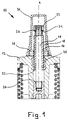
- Diaphragm valve housing 10 one not closer Diaphragm valve shown has a housing cover according to FIG. 1 12, which is penetrated by a coupling rod 14.
- the coupling rod 14 penetrates a sleeve 16.
- the with a External thread 18 provided sleeve 16 is in a in the housing cover 12 fixed threaded bushing 20 rotatably inserted such that the screwing movement causes a shift in the Sleeve 16 takes place in the direction of its longitudinal axis z.
- Stop part 22 placed, which is the one forming a stop Face 26 of the sleeve 16 is opposite.
- a sliding pad 24 instead of the slide pad 24 can also be a thrust washer made of slidable material or a roller bearing can be used.
- the parts of the sleeve 16 protruding from the housing cover 12 and the coupling rod 14 with the attached stop part 22 are with a viewing bell 30 made of transparent Material covered.
- the sight bell 30 rests on one encompassing the sleeve 16, placed on the housing cover 12 Positioning ring 28.
- the sleeve 16 For presetting a minimum flow cross-section of the valve the sleeve 16 by turning in the threaded sleeve 20 in their axis direction z shifted.
- the Stop part 22 moves on the end face 26 of the sleeve 16 the coupling rod 14 each by the same length Amount, which changes the minimum opening position of the valve changes accordingly.
- a stop surface 34 on the coupling rod 14 provided with the valve-side end face 32 of the sleeve 16 cooperates.
- the sleeve 16 is so far into the threaded sleeve 20th screwed in that the coupling rod 14 is lowered to a maximum and thereby the valve is closed.
- the stop part 22 is located here at a height g.
- the sleeve 16 is so far out of the threaded bushing 20 unscrewed that the coupling rod 14 is extended to the maximum and so that the valve is open to the maximum.
- the stop part 22 lies at a height o.
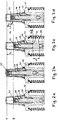
- Fig. 2c shows the setting option for the maximum stroke Coupling rod 14, with which the maximum open position of the valve and thus the maximum flow cross section can be limited can.
- the full stroke movement hv of the coupling rod 14 and thus the valve possible i.e. when the valve is actuated, it goes from its Closed position in its maximum possible open position.
- the Stop part 22 thus moves from the starting height g Closing position to the final height o the maximum open position.
- the maximum stroke of the coupling rod 14 and thus the valve can be limited in a simple manner by the sleeve 16 in the threaded sleeve 20 still further in the direction of the valve is turned.
- the sleeve 16 is like this screwed far out of the threaded bushing 20 that the valve is partially open in its basic position.
- the oneself resulting minimum flow cross-section of the valve shows themselves in the position of the stop part 22, which is at a height m between the height g of the closed position and the height o the maximum open position of the valve.
- the setting of the minimum flow cross section shown in FIG. 2d of the valve can also be achieved in that the stop part 22 placed on the coupling rod 14 as Nut on the coupling rod 14 designed as a threaded rod is screwed on.
- the stop part or the nut 22 on the coupling rod 14 By further screwing on the stop part or the nut 22 on the coupling rod 14 in the direction of the valve, the coupling rod 14 and thus the her coupled valve raised. Shortening the distance d between the valve-side end face 32 of the sleeve 16 and the Stop surface 34 on the coupling rod 14 can thus also by more or less unscrewing the stop part or the nut 22 can be reached on the coupling rod 14.
- any presetting of the valve from the outside to simple Way by changing the position of the sleeve 16 in the Threaded sleeve 20 or the stop member 22 on the coupling rod 14 realize.
- the respective operating position of the Valve at any time easily by the position of the sleeve 16 and the stop part 22 can be seen.
Landscapes
- Engineering & Computer Science (AREA)
- General Engineering & Computer Science (AREA)
- Mechanical Engineering (AREA)
- Indication Of The Valve Opening Or Closing Status (AREA)
- Fluid-Driven Valves (AREA)
- Magnetically Actuated Valves (AREA)
- Preventing Unauthorised Actuation Of Valves (AREA)
- Mechanically-Actuated Valves (AREA)
Abstract
Description
Die Erfindung betrifft ein pneumatisch oder hydraulisch angetriebenes Ventil, insbesondere Membranventil, mit einem über eine Koppelstange betätigbaren Ventilkörper, wobei die Koppelstange zur Einstellung eines Mindestdurchflussquerschnitts über einen veränderbaren Anschlag in der entsprechenden Position gehalten wird, und wobei die Koppelstange den Gehäusedeckel eines Ventilgehäuses durchdringt und als Anzeiger für die Ventilstellung dient.The invention relates to a pneumatically or hydraulically driven Valve, in particular diaphragm valve, with an over a coupling rod actuable valve body, the coupling rod for setting a minimum flow cross section via a changeable stop in the corresponding position is held, and wherein the coupling rod the housing cover penetrates a valve housing and as an indicator for the Valve position serves.
Ein Membranventil der eingangs erwähnten Art ist aus der DE-U-92 07 226 bekannt. Dort ist die Koppelstange über ein Aussengewinde direkt mit einer Buchse verbunden, welche gleichzeitig als veränderbarer Anschlag zur Einstellung eines Mindestdurchflussquerschnitts dient. Mit einem zweiten Anschlag der Buchse kann wahlweise anstelle des Mindestdurchflussquerschnitts der maximale Durchflussquerschnitt eingestellt werden. Ein wesentlicher Nachteil dieses vorbekannten Membranventils liegt darin, dass zur Veränderung der Ventilstellung jeweils der Gehäusedeckel demontiert werden muss. Zudem lassen sich die beiden Anschläge nicht unabhängig voneinander verstellen, so dass eine gleichzeitige Voreinstellung sowohl des minimalen als auch des maximalen Durchflussquerschnitts nicht möglich ist.A diaphragm valve of the type mentioned at the outset is from DE-U-92 07 226 known. There is the coupling rod via an external thread directly connected to a socket, which at the same time as a variable stop for setting a minimum flow cross-section serves. With a second stop of the socket can optionally be used instead of the minimum flow cross section maximum flow cross-section can be set. An essential one The disadvantage of this known diaphragm valve is that that to change the valve position of the housing cover must be dismantled. In addition, the two stops do not adjust independently of each other, so that a simultaneous presetting of both the minimum and the maximum flow cross-section is not possible.
Angesichts dieser Gegebenheiten hat sich der Erfinder die Aufgabe gestellt, ein Ventil der eingangs genannten Art zu schaffen, bei dem eine Voreinstellung des minimalen Durchflussquerschnitts auf einfache Weise ohne Oeffnung des Gehäusedeckels möglich ist. Zudem soll der Betriebszustand des Ventils jederzeit ohne weiteres ersichtlich sein.In view of these circumstances, the inventor has the task asked to create a valve of the type mentioned at the beginning, in which a presetting of the minimum flow cross-section in a simple manner without opening the housing cover is possible. In addition, the operating status of the valve should always be be readily apparent.
Zur erfindungsgemässen Lösung der Aufgabe führt, dass die Koppelstange durch eine Hülse bewegt ist, die den veränderbaren Anschlag bildet und über ein Aussengewinde in eine ortsfest mit dem Gehäusedeckel verbundene Gewindebüchse eingreift und durch eine Schraubbewegung in ihrer Achsenrichtung verschiebbar ist, und dass am freien Ende der Koppelstange ein Anschlagteil festgelegt ist, das mit der dem Ventilkörper abgewandten Stirnseite der Hülse in Anschlag bringbar ist.The coupling rod leads to the achievement of the object according to the invention is moved by a sleeve which forms the variable stop and via an external thread in a threaded bushing that is fixed to the housing cover engages and by a screwing movement in her Axis direction is displaceable, and that at the free end of the Coupling rod a stop part is fixed, which with the End of the sleeve facing away from the valve body in the stop is feasible.
Durch die erfindungsgemässe Anordnung eines Anschlagteils am freien Ende der Koppelstange ist die Position des Stellantriebs von aussen sichtbar und der Betrag des Hubes und damit der Oeffnungsstellung des Ventils messbar. Durch Drehen der Hülse in der Gewindebüchse kann je nach Drehrichtung die Hubbegrenzung der offenen oder geschlossenen Antriebsposition begrenzt werden. Durch Eindrehen der Hülse in die Gewindebüchse kann der maximale Durchflussquerschnitt, durch Herausdrehen der Hülse aus der Gewindebüchse der minimale Durchflussquerschnitt eingestellt werden.Due to the inventive arrangement of a stop part on free end of the coupling rod is the position of the actuator visible from the outside and the amount of stroke and thus the Opening position of the valve measurable. By turning the sleeve Depending on the direction of rotation, the stroke limitation can be in the threaded bush limited to the open or closed drive position will. By screwing the sleeve into the threaded sleeve, the maximum flow cross-section, by unscrewing the sleeve the minimum flow cross-section from the threaded sleeve can be set.
Bei einer bevorzugten Ausführungsform des erfindungsgemässen Ventils ist das Anschlagteil in seiner Position an der Koppelstange veränderbar festgelegt, wobei bei einer zweckmässigen Ausgestaltungsform zumindest im Bereich des Anschlagteils die Koppelstange als Gewindestab ausgeführt ist, so dass die Position des Anschlagteils auf der Koppelstange durch eine Schraubbewegung verändert werden kann. Durch diese zusätzliche Veränderungsmöglichkeit des Anschlagteils an der Koppelstange kann gleichzeitig sowohl die offene als auch die geschlossene Antriebsposition eingestellt werden, sodass sich das Ventil zwischen voreingestellten Werten eines minimalen und eines maximalen Durchflussquerschnitts betätigen lässt. In a preferred embodiment of the inventive Valve is the stop part in its position on the coupling rod changeable fixed, with an expedient Embodiment at least in the area of the stop part Coupling rod is designed as a threaded rod, so that the position the stop part on the coupling rod by a Screw movement can be changed. Through this additional Possibility to change the stop part on the coupling rod can open and closed at the same time Drive position can be set so that the valve between preset values of a minimum and one maximum flow cross section.
Zur Einstellung des minimalen Durchflussquerschnitts ist die Koppelstange bevorzugt ortsfest mit einer Anschlagfläche verbunden, die als Anschlag gegen die dem Ventilkörper zugewandte Stirnseite der Hülse dient.To set the minimum flow cross section is the The coupling rod is preferably connected in a stationary manner to a stop surface, the as a stop against the valve body Front side of the sleeve is used.
Zur Verminderung des Reibungswiderstandes zwischen dem Anschlagteil und der Hülse beim Drehen der Hülse in der Gewindebüchse kann das Anschlagteil mit einer Gleitauflage versehen sein. Anstelle einer Gleitauflage kann auch eine Anlauf- oder Zwischenscheibe aus gleitfähigem Material oder ein Wälzlager eingesetzt werden.To reduce the frictional resistance between the stop part and the sleeve when turning the sleeve in the threaded sleeve can provide the stop part with a sliding pad be. Instead of a sliding pad, a start-up or Intermediate disc made of sliding material or a roller bearing be used.
Der den Gehäusedeckel durchdringende Teil der Koppelstange mit dem Anschlagteil sowie ein Teil der Hülse sind bevorzugt von einer auf den Gehäusedeckel aufgesetzten Sichtglocke abgedeckt.The part of the coupling rod that penetrates the housing cover the stop part and part of the sleeve are preferred from a viewing bell placed on the housing cover covered.
Membranventil-Antriebe werden in drei Funktionen gebaut, nämlich
- FC (fail close) Federkraft schliessend
- FO (fail open) Federkraft öffnend
- DA (double acting) doppelt wirkend
- FC (fail close) spring force closing
- FO (fail open) spring force opening
- DA (double acting) double acting
In allen drei Funktionsweisen erfolgt die Schliessbewegung durch eine Kraft, die über die Druckspindel auf die Membrane wirkt. Die Kraftverteilung der Druckspindel auf die Membrane erfolgt über das Druckstück. Die Kraft wird durch Federn oder durch ein pneumatisches oder hydraulisches Druckmedium erzeugt, wobei je nach Konstruktionsart die Membrane an das Druckstück oder an die Druckspindel gekoppelt ist.The closing movement takes place in all three functions by a force exerted on the diaphragm via the pressure spindle works. The force distribution of the pressure spindle on the membrane takes place via the pressure piece. The force is by springs or generated by a pneumatic or hydraulic pressure medium, depending on the type of construction, the membrane on the pressure piece or is coupled to the pressure spindle.
Die erfindungsgemässe Anordnung lässt sich bei allen drei Funktionen eines Membranventil-Antriebs einsetzen.The arrangement according to the invention can be used for all three functions a diaphragm valve actuator.
Weitere Vorteile, Merkmale und Einzelheiten der Erfindung ergeben sich aus der nachfolgenden Beschreibung eines bevorzugten Ausführungsbeispiels sowie anhand der Zeichnung; diese zeigt schematisch in
- Fig. 1
- einen Querschnitt durch einen Teil eines Ventilgehäuses;
- Fig. 2a-d
- den Querschnitt von Fig. 1 bei verschiedenen Betriebszuständen des Ventils.
- Fig. 1
- a cross section through part of a valve housing;
- 2a-d
- the cross section of Fig. 1 in different operating states of the valve.
Ein aus Gründen der besseren Uebersicht in der Zeichnung nur
teilweise wiedergegebenes Ventilgehäuse 10 eines nicht näher
dargestellten Membranventils weist gemäss Fig. 1 einen Gehäusedeckel
12 auf, der von einer Koppelstange 14 durchsetzt ist.
Die Koppelstange 14 durchdringt eine Hülse 16. Die mit einem
Aussengewinde 18 versehene Hülse 16 ist in einer im Gehäusedeckel
12 festgelegten Gewindebüchse 20 drehbar derart eingesetzt,
dass durch die Schraubbewegung eine Verschiebung der
Hülse 16 in Richtung ihrer Längsachse z erfolgt.One for the sake of a better overview in the drawing only
partially reproduced
Der dem Ventil abgewandten Seite der Koppelstange 14 ist ein
Anschlagteil 22 aufgesetzt, welches der einen Anschlag bildenden
Stirnseite 26 der Hülse 16 gegenüberliegt. Zur Erleichterung
der Drehbewegung der Hülse 16 bei aufliegendem Anschlagteil
22 ist dieses auf seiner der Hülse 16 gegenüberliegenden
Seite mit einer Gleitauflage 24 versehen. Anstelle der Gleitauflage
24 kann auch eine Anlaufscheibe aus gleitfähigem Material
oder ein Wälzlager eingesetzt werden.The side of the
Die aus dem Gehäusedeckel 12 herausragenden Teile der Hülse 16
sowie der Koppelstange 14 mit dem dieser aufgesetztem Anschlagteil
22 sind mit einer Sichtglocke 30 aus durchsichtigem
Material überdeckt. Die Sichtglocke 30 ruht hierbei auf einem
die Hülse 16 umgreifenden, dem Gehäusedeckel 12 aufgesetzten
Positionierring 28.The parts of the
Zur Voreinstellung eines Mindestdurchflussquerschnitts des Ventils
wird die Hülse 16 durch Drehen in der Gewindebüchse 20 in
ihrer Achsenrichtung z verschoben. Durch die Auflage des
Anschlagteils 22 an der Stirnseite 26 der Hülse 16 verschiebt
sich die Koppelstange 14 jeweils um denselben längenmässigen
Betrag, wodurch sich die Mindestöffnungsstellung des Ventils
entsprechend ändert. Zur Einstellung des maximalen Durchflussquerschnitts
ist an der Koppelstange 14 eine Anschlagfläche 34
vorgesehen, die mit der ventilseitigen Stirnseite 32 der Hülse
16 zusammenwirkt.For presetting a minimum flow cross-section of the valve
the
In den Fig. 2a bis d sind die Einstellungen der Hülse 16 und
damit über das Anschlagteil 22 auch der Koppelstange 14 bei
verschiedenen Betriebszuständen des Ventils dargestellt.2a to d are the settings of the
In Fig. 2a ist die Hülse 16 soweit in die Gewindebüchse 20
eingeschraubt, dass die Koppelstange 14 maximal abgesenkt und
dadurch das Ventil geschlossen ist. Das Anschlagteil 22 befindet
sich hierbei auf einer Höhe g.2a, the
In Fig. 2b ist die Hülse 16 so weit aus der Gewindebüchse 20
herausgeschraubt, dass die Koppelstange 14 maximal ausgefahren
und damit das Ventil maximal geöffnet ist. Das Anschlagteil 22
liegt hierbei auf einer Höhe o.2b, the
Fig. 2c zeigt die Einstellmöglichkeit für den Maximalhub der
Koppelstange 14, womit die maximale Offenstellung des Ventils
und damit der maximale Durchflussquerschnitt begrenzt werden
kann. Bei der in Fig. 2c dargestellten Einstellung ist die
volle Hubbewegung hv der Koppelstange 14 und damit des Ventils
möglich, d.h. bei Betätigung des Ventils geht dieses von seiner
Schliessstellung in seine maximal mögliche Offenstellung. Das
Anschlagteil 22 bewegt sich somit von der Ausgangshöhe g der
Schliessstellung auf die Endhöhe o der maximalen Offenstellung.
Der maximale Hub der Koppelstange 14 und damit des Ventils kann
auf einfache Weise dadurch begrenzt werden, dass die Hülse 16
in der Gewindebüchse 20 noch weiter in Richtung des Ventils
eingedreht wird. Dadurch verringert sich die Distanz d zwischen
der gegen das Ventil gewandten Stirnseite 32 der Hülse 16 und
der Anschlagfläche 34 an der Koppelstange 14, sodass anstelle
der vollen Hubbewegung hv nur noch eine entsprechend reduzierte
Hubbewegung möglich ist. Durch Betätigung des Ventils öffnet
sich dieses somit nur um diese reduzierte Hubbewegung, d.h. das
Anschlagteil 22 bewegt sich von Anfangshöhe g der
Schliessstellung nur bis auf eine unterhalb der Höhe o der
maximalen Oeffnungsstellung des Ventils liegende Höhe. Bei der
in Fig. 2c gezeigten Einstellung ist die Distanz d auf ihren
Maximalwert eingestellt, was den Betrag einer vollen Hubbewegung
hv entspricht. Diese Einstellung gilt auch für alle andern
Ventileinstellungen, bei denen der höchstmögliche Durchflussquerschnitt
des Ventils bei dessen Offenstellung erwünscht ist.Fig. 2c shows the setting option for the maximum
Bei der in Fig. 2d gezeigten Einstellung ist die Hülse 16 so
weit aus der Gewindebüchse 20 herausgeschraubt, dass das Ventil
in seiner Grundstellung teilweise geöffnet ist. Der sich dadurch
ergebende Mindestdurchflussquerschnitt des Ventils zeigt
sich in der Lage des Anschlagteils 22, das auf einer Höhe m
zwischen der Höhe g der Schliessstellung und der Höhe o der
maximalen Offenstellung des Ventils liegt. Durch Verstellung
der Hülse 16 um den Betrag sm ergibt sich damit eine Teilhubbewegung
hm auf die Höhe m der Minimaldurchflussstellung. Bei
Betätigung des Ventils verbleibt somit nur noch eine Differenzhubbewegung
hd bis zur maximalen Offenstellung des Ventils.In the setting shown in Fig. 2d, the
Die in Fig. 2d dargestellte Einstellung des Minimaldurchflussquerschnitts
des Ventils lässt sich auch dadurch erzielen, dass
das auf die Koppelstange 14 aufgesetzte Anschlagteil 22 als
Mutter auf die als Gewindestange ausgebildete Koppelstange 14
aufgeschraubt ist. Durch das weitere Aufschrauben des Anschlagteils
bzw. der Mutter 22 auf die Koppelstange 14 in Richtung
des Ventils wird somit die Koppelstange 14 und somit das mit
ihr gekoppelte Ventil angehoben. Die Verkürzung der Distanz d
zwischen der ventilseitigen Stirnseite 32 der Hülse 16 und der
Anschlagfläche 34 an der Koppelstange 14 kann somit auch durch
mehr oder weniger weites Aufschrauben des Anschlagteils bzw.
der Mutter 22 auf die Koppelstange 14 erreicht werden. The setting of the minimum flow cross section shown in FIG. 2d
of the valve can also be achieved in that
the
Durch die zweifache Einstellmöglichkeit der Hubbewegung der
Koppelstange 14 und damit des Ventils ist es möglich, durch
eine entsprechende Voreinstellung sowohl der Lage der Hülse 16
als auch des Anschlagteils bzw. der Mutter 22 auf einfache
Weise sowohl die offene als auch die geschlossene Antriebsposition
des Ventils derart einzustellen, dass sich das Ventil zwischen
einer ersten Stellung mit einem voreingestellten minimalen
Durchflussquerschnitt und einer zweiten Stellung mit einem
voreingestellten maximalen Durchflussquerschnitt betätigen
lässt.Due to the double adjustment of the stroke movement of the
Wie insbesondere aus den Fig. 2a bis d hervorgeht, lässt sich
jede beliebige Voreinstellung des Ventils von aussen auf einfache
Weise durch Veränderung der Position der Hülse 16 in der
Gewindebüchse 20 bzw. des Anschlagteils 22 auf der Koppelstange
14 realisieren. Zudem ist die jeweilige Betriebsstellung des
Ventils jederzeit ohne weiteres durch die Lage der Hülse 16 und
des Anschlagteils 22 ersichtlich.As can be seen in particular from FIGS. 2a to d,
any presetting of the valve from the outside to simple
Way by changing the position of the
Claims (8)
- Pneumatically or hydraulically operated valve, in particular a diaphragm valve, having a valve body actuatable by means of a coupling rod (14), the coupling rod (14) being held in the appropriate position for setting a minimum throughflow cross-section by means of a variable stop (16), and the coupling rod (14) passing through the housing cover (12) of a valve housing (10) and serving as an indicator for the valve position, characterised in that the coupling rod (14) passes through a sleeve (16), which forms the variable stop and engages by means of an outer thread (18) into a threaded bushing (20) connected fixedly to the housing cover (12), and can be moved by a screw movement in its axial direction (z), and in that fixed at the free end of the coupling rod (14) is a stop member (22) which can be brought into abutment with the end (26) of the sleeve (16) remote from the valve body.
- Valve according to claim 1, characterised in that the stop member (22) is variably fixed in its position on the coupling rod (14).
- Valve according to claim 2, characterised in that the coupling rod (14) is constructed as a threaded rod at least in the region of the stop member (22), and the stop member (22) has an inner thread so that the position of the stop member (22) on the coupling rod (14) can be varied by a screw movement.
- Valve according to one of claims 1 to 3, characterised in that the coupling rod (14) is connected fixedly to a stop face (34) which serves as a stop against the end (32) of the sleeve (16) facing the valve body.
- Valve according to one of claims 1 to 4, characterised in that the stop member (22) is provided with a sliding bearing (24).
- Valve according to one of claims 1 to 4, characterised in that between the stop member (22) and the sleeve (16) there is arranged a buffer disc of slippery material or a roller bearing.
- Valve according to one of claims 1 to 6, characterised in that the part of the coupling rod (14) with the stop member (22) passing through the housing cover (12), and a part of the sleeve (16), are covered by a display cap (30) placed onto the housing cover (12) on which a scale can be fitted for monitoring the stroke.
- Valve according to one of claims 1 to 6, characterised in that if the control energy fails, the sleeve (16) allows actuation of the valve or manual emergency actuation.
Applications Claiming Priority (2)
| Application Number | Priority Date | Filing Date | Title |
|---|---|---|---|
| CH01944/94A CH689310A5 (en) | 1994-06-20 | 1994-06-20 | Diaphragm valve. |
| CH1944/94 | 1994-06-20 |
Publications (2)
| Publication Number | Publication Date |
|---|---|
| EP0688984A1 EP0688984A1 (en) | 1995-12-27 |
| EP0688984B1 true EP0688984B1 (en) | 1998-05-06 |
Family
ID=4222249
Family Applications (1)
| Application Number | Title | Priority Date | Filing Date |
|---|---|---|---|
| EP95108939A Expired - Lifetime EP0688984B1 (en) | 1994-06-20 | 1995-06-09 | Diaphragm valve |
Country Status (7)
| Country | Link |
|---|---|
| US (1) | US5647397A (en) |
| EP (1) | EP0688984B1 (en) |
| JP (1) | JP2719533B2 (en) |
| KR (1) | KR0177867B1 (en) |
| AT (1) | ATE165903T1 (en) |
| CH (1) | CH689310A5 (en) |
| DE (1) | DE59502086D1 (en) |
Cited By (1)
| Publication number | Priority date | Publication date | Assignee | Title |
|---|---|---|---|---|
| DE10322832A1 (en) * | 2003-05-19 | 2004-12-16 | Georg Fischer Rohrleitungssysteme Ag | Emergency hand-operation system for valve has handle with plug or screwdriver arrangement engaging in socket and has blade engaging in alternative screw head with slit |
Families Citing this family (20)
| Publication number | Priority date | Publication date | Assignee | Title |
|---|---|---|---|---|
| DE19802817A1 (en) * | 1998-01-26 | 1999-08-12 | Klein Schanzlin & Becker Ag | Cap with an integrated position indicator and stroke limitation for the stem of a shut-off valve as well as a method and device for its manufacture |
| DE10006326A1 (en) * | 2000-02-12 | 2001-08-16 | Gemue Gebr Mueller Appbau Gmbh | Manual drive for shut-off devices |
| JP3502597B2 (en) * | 2000-07-07 | 2004-03-02 | Smc株式会社 | Two-way valve |
| US6918407B2 (en) * | 2001-08-08 | 2005-07-19 | W. W. Offshore, Inc. | Pneumatic reset relief valve |
| US6895130B1 (en) | 2002-02-12 | 2005-05-17 | Tobi Mengle | True position sensor for diaphragm valves using reflected light property variation |
| WO2004081428A2 (en) * | 2003-03-07 | 2004-09-23 | Swagelok Company | Valve with adjustable stop |
| US20050150560A1 (en) * | 2004-01-08 | 2005-07-14 | Jerry Amato | Diaphragm valve |
| KR20070110521A (en) * | 2005-02-18 | 2007-11-19 | 스와겔로크 컴패니 | Flow control device with flow adjustment mechanism |
| CN101305230A (en) * | 2005-02-22 | 2008-11-12 | 斯瓦戈洛克公司 | Valve and actuator assembly |
| US9341281B2 (en) | 2007-02-12 | 2016-05-17 | Colt Irrigation Llc | Fluid activated flow control apparatus |
| US8397745B2 (en) | 2007-02-12 | 2013-03-19 | Colt Irrigation, LLC | Fluid activated flow control apparatus |
| US8191574B1 (en) | 2008-05-27 | 2012-06-05 | Davis Edward H | Visual indicator for air tank valve handle |
| JP5759883B2 (en) * | 2011-12-15 | 2015-08-05 | Ckd株式会社 | Switching valve |
| US9599286B2 (en) | 2014-01-23 | 2017-03-21 | Colt Irrigation, LLC | Fluid activated flow control apparatus |
| US10571937B1 (en) | 2014-01-23 | 2020-02-25 | Colt Irrigation, LLC | Valve control apparatus |
| US10088849B2 (en) | 2014-01-23 | 2018-10-02 | Colt Irrigation, LLC | Fluid activated flow control apparatus |
| DE202017104079U1 (en) * | 2017-07-07 | 2017-08-21 | Samson Ag | Actuator for process valves |
| DE102018213711A1 (en) * | 2018-08-15 | 2020-02-20 | Festo Ag & Co. Kg | Valve |
| DE102019129059A1 (en) * | 2019-10-28 | 2021-04-29 | Grohe Ag | Valve for a sanitary fitting with a diaphragm valve and an adjustable control rod |
| CN114396487A (en) * | 2021-12-31 | 2022-04-26 | 宁波宝蒂塑胶阀门有限公司 | Pneumatic diaphragm valve |
Family Cites Families (11)
| Publication number | Priority date | Publication date | Assignee | Title |
|---|---|---|---|---|
| US421308A (en) * | 1890-02-11 | reynolds | ||
| US685396A (en) * | 1901-07-17 | 1901-10-29 | American Steam Heating Specialty Company | Fitting for steam heating apparatus. |
| GB682057A (en) * | 1951-07-18 | 1952-11-05 | Allan Grannenfelt | Improvements in or relating to sluice valves |
| US3175473A (en) * | 1962-05-01 | 1965-03-30 | Grinnell Corp | Spring and fluid pressure actuator |
| NL133568C (en) * | 1966-07-01 | |||
| US3946756A (en) * | 1974-05-30 | 1976-03-30 | A-T-O Inc. | Pressure control valve |
| US4099703A (en) * | 1976-10-12 | 1978-07-11 | Ideal-Aerosmith, Inc. | Self-cleaning precision metering valve |
| GB2083594A (en) | 1980-07-26 | 1982-03-24 | Schubert & Salzer Maschinen | Slide valve |
| JPS60169467U (en) * | 1984-04-20 | 1985-11-09 | 旭有機材工業株式会社 | plastic gate valve |
| US5102094A (en) * | 1991-01-30 | 1992-04-07 | Marlen Research Corporation | Vacuumizer valve assembly |
| DE9207226U1 (en) | 1992-05-28 | 1992-07-30 | J. Lorch Gesellschaft & Co Kg, 7035 Waldenbuch | Diaphragm valve |
-
1994
- 1994-06-20 CH CH01944/94A patent/CH689310A5/en not_active IP Right Cessation
-
1995
- 1995-06-09 AT AT95108939T patent/ATE165903T1/en not_active IP Right Cessation
- 1995-06-09 EP EP95108939A patent/EP0688984B1/en not_active Expired - Lifetime
- 1995-06-09 DE DE59502086T patent/DE59502086D1/en not_active Expired - Fee Related
- 1995-06-19 US US08/492,395 patent/US5647397A/en not_active Expired - Fee Related
- 1995-06-19 JP JP7151506A patent/JP2719533B2/en not_active Expired - Fee Related
- 1995-06-20 KR KR1019950016535A patent/KR0177867B1/en not_active Expired - Fee Related
Cited By (2)
| Publication number | Priority date | Publication date | Assignee | Title |
|---|---|---|---|---|
| DE10322832A1 (en) * | 2003-05-19 | 2004-12-16 | Georg Fischer Rohrleitungssysteme Ag | Emergency hand-operation system for valve has handle with plug or screwdriver arrangement engaging in socket and has blade engaging in alternative screw head with slit |
| DE10322832B4 (en) * | 2003-05-19 | 2006-07-13 | Georg Fischer Rohrleitungssysteme Ag | Device for manual override of valves |
Also Published As
| Publication number | Publication date |
|---|---|
| JPH084940A (en) | 1996-01-12 |
| US5647397A (en) | 1997-07-15 |
| ATE165903T1 (en) | 1998-05-15 |
| CH689310A5 (en) | 1999-02-15 |
| KR0177867B1 (en) | 1999-04-15 |
| DE59502086D1 (en) | 1998-06-10 |
| KR960001571A (en) | 1996-01-25 |
| EP0688984A1 (en) | 1995-12-27 |
| JP2719533B2 (en) | 1998-02-25 |
Similar Documents
| Publication | Publication Date | Title |
|---|---|---|
| EP0688984A1 (en) | Diaphragm valve | |
| DE4323150B4 (en) | Swing door drive | |
| DE60207816T2 (en) | DOOR CLOSER | |
| DE2649520C2 (en) | ||
| DE102014203882B4 (en) | Piston-cylinder unit and door hinge with a piston-cylinder unit | |
| EP2697464A1 (en) | Closing hinge | |
| EP1431496A2 (en) | Servo-electrohydraulic door drive for driving a door, window or the like | |
| DE102009036872B4 (en) | door unit | |
| EP0972902B1 (en) | Door closer with reduced dimensions | |
| EP0816730B1 (en) | Device for limiting the prestress of a control spring | |
| DE2150392A1 (en) | Regulating valve with a simplified flow curve | |
| EP0622574A2 (en) | Actuating device for a rotatable valve shut-off element | |
| DE4323152C2 (en) | Swing door drive | |
| DE10031403C2 (en) | Overhead door closer with a slide rail arrangement | |
| CH641260A5 (en) | Pressure control (relief) valve for hydraulic control systems | |
| DE2362250C2 (en) | Hydraulic power steering device for vehicles | |
| DE19607878B4 (en) | Swing door drive | |
| CH689055A5 (en) | Hydraulic stop valve for rotary door drive | |
| DE4323151C5 (en) | Swing door drive | |
| EP0571850A1 (en) | Diaphragm valve | |
| DE102006059577B4 (en) | Valve | |
| EP0074496B1 (en) | Valve device, especially for a pressure casting machine | |
| DE19524778B4 (en) | Door closer with a displacer | |
| DE3829566A1 (en) | PISTON DRIVE | |
| DE2241551A1 (en) | THROUGH VALVE |
Legal Events
| Date | Code | Title | Description |
|---|---|---|---|
| PUAI | Public reference made under article 153(3) epc to a published international application that has entered the european phase |
Free format text: ORIGINAL CODE: 0009012 |
|
| 17P | Request for examination filed |
Effective date: 19950609 |
|
| AK | Designated contracting states |
Kind code of ref document: A1 Designated state(s): AT CH DE FR GB IT LI NL |
|
| GRAG | Despatch of communication of intention to grant |
Free format text: ORIGINAL CODE: EPIDOS AGRA |
|
| 17Q | First examination report despatched |
Effective date: 19970828 |
|
| GRAG | Despatch of communication of intention to grant |
Free format text: ORIGINAL CODE: EPIDOS AGRA |
|
| GRAH | Despatch of communication of intention to grant a patent |
Free format text: ORIGINAL CODE: EPIDOS IGRA |
|
| GRAH | Despatch of communication of intention to grant a patent |
Free format text: ORIGINAL CODE: EPIDOS IGRA |
|
| GRAA | (expected) grant |
Free format text: ORIGINAL CODE: 0009210 |
|
| AK | Designated contracting states |
Kind code of ref document: B1 Designated state(s): AT CH DE FR GB IT LI NL |
|
| REF | Corresponds to: |
Ref document number: 165903 Country of ref document: AT Date of ref document: 19980515 Kind code of ref document: T |
|
| REG | Reference to a national code |
Ref country code: CH Ref legal event code: EP |
|
| GBT | Gb: translation of ep patent filed (gb section 77(6)(a)/1977) |
Effective date: 19980506 |
|
| REG | Reference to a national code |
Ref country code: CH Ref legal event code: NV Representative=s name: ROTTMANN, ZIMMERMANN + PARTNER AG |
|
| REF | Corresponds to: |
Ref document number: 59502086 Country of ref document: DE Date of ref document: 19980610 |
|
| ITF | It: translation for a ep patent filed | ||
| ET | Fr: translation filed | ||
| PLBE | No opposition filed within time limit |
Free format text: ORIGINAL CODE: 0009261 |
|
| STAA | Information on the status of an ep patent application or granted ep patent |
Free format text: STATUS: NO OPPOSITION FILED WITHIN TIME LIMIT |
|
| 26N | No opposition filed | ||
| PG25 | Lapsed in a contracting state [announced via postgrant information from national office to epo] |
Ref country code: LI Free format text: LAPSE BECAUSE OF NON-PAYMENT OF DUE FEES Effective date: 19990630 Ref country code: CH Free format text: LAPSE BECAUSE OF NON-PAYMENT OF DUE FEES Effective date: 19990630 |
|
| PG25 | Lapsed in a contracting state [announced via postgrant information from national office to epo] |
Ref country code: NL Free format text: LAPSE BECAUSE OF NON-PAYMENT OF DUE FEES Effective date: 20000101 |
|
| REG | Reference to a national code |
Ref country code: CH Ref legal event code: PL |
|
| NLV4 | Nl: lapsed or anulled due to non-payment of the annual fee |
Effective date: 20000101 |
|
| REG | Reference to a national code |
Ref country code: GB Ref legal event code: IF02 |
|
| PGFP | Annual fee paid to national office [announced via postgrant information from national office to epo] |
Ref country code: GB Payment date: 20030530 Year of fee payment: 9 |
|
| PGFP | Annual fee paid to national office [announced via postgrant information from national office to epo] |
Ref country code: AT Payment date: 20030603 Year of fee payment: 9 |
|
| PGFP | Annual fee paid to national office [announced via postgrant information from national office to epo] |
Ref country code: FR Payment date: 20030611 Year of fee payment: 9 |
|
| PGFP | Annual fee paid to national office [announced via postgrant information from national office to epo] |
Ref country code: DE Payment date: 20040604 Year of fee payment: 10 |
|
| PG25 | Lapsed in a contracting state [announced via postgrant information from national office to epo] |
Ref country code: GB Free format text: LAPSE BECAUSE OF NON-PAYMENT OF DUE FEES Effective date: 20040609 Ref country code: AT Free format text: LAPSE BECAUSE OF NON-PAYMENT OF DUE FEES Effective date: 20040609 |
|
| GBPC | Gb: european patent ceased through non-payment of renewal fee |
Effective date: 20040609 |
|
| PG25 | Lapsed in a contracting state [announced via postgrant information from national office to epo] |
Ref country code: FR Free format text: LAPSE BECAUSE OF NON-PAYMENT OF DUE FEES Effective date: 20050228 |
|
| REG | Reference to a national code |
Ref country code: FR Ref legal event code: ST |
|
| PG25 | Lapsed in a contracting state [announced via postgrant information from national office to epo] |
Ref country code: IT Free format text: LAPSE BECAUSE OF NON-PAYMENT OF DUE FEES;WARNING: LAPSES OF ITALIAN PATENTS WITH EFFECTIVE DATE BEFORE 2007 MAY HAVE OCCURRED AT ANY TIME BEFORE 2007. THE CORRECT EFFECTIVE DATE MAY BE DIFFERENT FROM THE ONE RECORDED. Effective date: 20050609 |
|
| PG25 | Lapsed in a contracting state [announced via postgrant information from national office to epo] |
Ref country code: DE Free format text: LAPSE BECAUSE OF NON-PAYMENT OF DUE FEES Effective date: 20060103 |