EP0686153B1 - Chemische prozesse zur herstellung von 1,2-epoxy-1,2,3,4-tetrahydrnaphtalen - Google Patents
Chemische prozesse zur herstellung von 1,2-epoxy-1,2,3,4-tetrahydrnaphtalen Download PDFInfo
- Publication number
- EP0686153B1 EP0686153B1 EP94906331A EP94906331A EP0686153B1 EP 0686153 B1 EP0686153 B1 EP 0686153B1 EP 94906331 A EP94906331 A EP 94906331A EP 94906331 A EP94906331 A EP 94906331A EP 0686153 B1 EP0686153 B1 EP 0686153B1
- Authority
- EP
- European Patent Office
- Prior art keywords
- formula
- compound
- alkyl
- tetrahydronaphthalene
- phenyl
- Prior art date
- Legal status (The legal status is an assumption and is not a legal conclusion. Google has not performed a legal analysis and makes no representation as to the accuracy of the status listed.)
- Expired - Lifetime
Links
- 0 *[C@]1C=Cc2ccccc2[C@]1O Chemical compound *[C@]1C=Cc2ccccc2[C@]1O 0.000 description 2
- UMUJQRABWPODKX-KWQFWETISA-N C[C@@H](CCc1ccccc11)[C@@H]1O Chemical compound C[C@@H](CCc1ccccc11)[C@@H]1O UMUJQRABWPODKX-KWQFWETISA-N 0.000 description 1
- KMQJJAOZMONGLS-ZJUUUORDSA-N O[C@H](CCc1c2cccc1)[C@H]2O Chemical compound O[C@H](CCc1c2cccc1)[C@H]2O KMQJJAOZMONGLS-ZJUUUORDSA-N 0.000 description 1
Classifications
-
- C—CHEMISTRY; METALLURGY
- C12—BIOCHEMISTRY; BEER; SPIRITS; WINE; VINEGAR; MICROBIOLOGY; ENZYMOLOGY; MUTATION OR GENETIC ENGINEERING
- C12P—FERMENTATION OR ENZYME-USING PROCESSES TO SYNTHESISE A DESIRED CHEMICAL COMPOUND OR COMPOSITION OR TO SEPARATE OPTICAL ISOMERS FROM A RACEMIC MIXTURE
- C12P7/00—Preparation of oxygen-containing organic compounds
- C12P7/02—Preparation of oxygen-containing organic compounds containing a hydroxy group
- C12P7/22—Preparation of oxygen-containing organic compounds containing a hydroxy group aromatic
-
- C—CHEMISTRY; METALLURGY
- C07—ORGANIC CHEMISTRY
- C07C—ACYCLIC OR CARBOCYCLIC COMPOUNDS
- C07C203/00—Esters of nitric or nitrous acid
- C07C203/02—Esters of nitric acid
- C07C203/08—Esters of nitric acid having nitrate groups bound to carbon atoms of rings other than six-membered aromatic rings
-
- C—CHEMISTRY; METALLURGY
- C07—ORGANIC CHEMISTRY
- C07C—ACYCLIC OR CARBOCYCLIC COMPOUNDS
- C07C29/00—Preparation of compounds having hydroxy or O-metal groups bound to a carbon atom not belonging to a six-membered aromatic ring
- C07C29/17—Preparation of compounds having hydroxy or O-metal groups bound to a carbon atom not belonging to a six-membered aromatic ring by hydrogenation of carbon-to-carbon double or triple bonds
-
- C—CHEMISTRY; METALLURGY
- C07—ORGANIC CHEMISTRY
- C07C—ACYCLIC OR CARBOCYCLIC COMPOUNDS
- C07C309/00—Sulfonic acids; Halides, esters, or anhydrides thereof
- C07C309/63—Esters of sulfonic acids
- C07C309/64—Esters of sulfonic acids having sulfur atoms of esterified sulfo groups bound to acyclic carbon atoms
- C07C309/65—Esters of sulfonic acids having sulfur atoms of esterified sulfo groups bound to acyclic carbon atoms of a saturated carbon skeleton
- C07C309/66—Methanesulfonates
-
- C—CHEMISTRY; METALLURGY
- C07—ORGANIC CHEMISTRY
- C07C—ACYCLIC OR CARBOCYCLIC COMPOUNDS
- C07C67/00—Preparation of carboxylic acid esters
- C07C67/27—Preparation of carboxylic acid esters from ortho-esters
-
- C—CHEMISTRY; METALLURGY
- C07—ORGANIC CHEMISTRY
- C07C—ACYCLIC OR CARBOCYCLIC COMPOUNDS
- C07C69/00—Esters of carboxylic acids; Esters of carbonic or haloformic acids
- C07C69/013—Esters of alcohols having the esterified hydroxy group bound to a carbon atom of a ring other than a six-membered aromatic ring
-
- C—CHEMISTRY; METALLURGY
- C07—ORGANIC CHEMISTRY
- C07C—ACYCLIC OR CARBOCYCLIC COMPOUNDS
- C07C69/00—Esters of carboxylic acids; Esters of carbonic or haloformic acids
- C07C69/62—Halogen-containing esters
- C07C69/63—Halogen-containing esters of saturated acids
-
- C—CHEMISTRY; METALLURGY
- C07—ORGANIC CHEMISTRY
- C07D—HETEROCYCLIC COMPOUNDS
- C07D303/00—Compounds containing three-membered rings having one oxygen atom as the only ring hetero atom
- C07D303/02—Compounds containing oxirane rings
- C07D303/04—Compounds containing oxirane rings containing only hydrogen and carbon atoms in addition to the ring oxygen atoms
-
- C—CHEMISTRY; METALLURGY
- C07—ORGANIC CHEMISTRY
- C07D—HETEROCYCLIC COMPOUNDS
- C07D303/00—Compounds containing three-membered rings having one oxygen atom as the only ring hetero atom
- C07D303/02—Compounds containing oxirane rings
- C07D303/12—Compounds containing oxirane rings with hydrocarbon radicals, substituted by singly or doubly bound oxygen atoms
- C07D303/14—Compounds containing oxirane rings with hydrocarbon radicals, substituted by singly or doubly bound oxygen atoms by free hydroxyl radicals
-
- C—CHEMISTRY; METALLURGY
- C07—ORGANIC CHEMISTRY
- C07D—HETEROCYCLIC COMPOUNDS
- C07D317/00—Heterocyclic compounds containing five-membered rings having two oxygen atoms as the only ring hetero atoms
- C07D317/08—Heterocyclic compounds containing five-membered rings having two oxygen atoms as the only ring hetero atoms having the hetero atoms in positions 1 and 3
- C07D317/44—Heterocyclic compounds containing five-membered rings having two oxygen atoms as the only ring hetero atoms having the hetero atoms in positions 1 and 3 ortho- or peri-condensed with carbocyclic rings or ring systems
- C07D317/70—Heterocyclic compounds containing five-membered rings having two oxygen atoms as the only ring hetero atoms having the hetero atoms in positions 1 and 3 ortho- or peri-condensed with carbocyclic rings or ring systems condensed with ring systems containing two or more relevant rings
-
- C—CHEMISTRY; METALLURGY
- C07—ORGANIC CHEMISTRY
- C07C—ACYCLIC OR CARBOCYCLIC COMPOUNDS
- C07C2602/00—Systems containing two condensed rings
- C07C2602/02—Systems containing two condensed rings the rings having only two atoms in common
- C07C2602/04—One of the condensed rings being a six-membered aromatic ring
- C07C2602/10—One of the condensed rings being a six-membered aromatic ring the other ring being six-membered, e.g. tetraline
Definitions
- This invention relates to chemical processes, and in particular to processes for making (1S,2R)-1,2-epoxy-1,2,3,4-tetrahydronaphthalene having the Formula (I): and the enantiomer thereof having the Formula (IA):
- Compounds of Formulae (I) and (IA) are useful as intermediates for the synthesis of biologically active compounds, for example pharmaceutical compounds. As epoxides they are capable of undergoing a variety of reactions enabling preparation of a wide range of further products.
- the hydrogenation Step (a) of the present process may be carried out by standard procedures for example by reacting a solution of compound (II) with hydrogen in the presence of a metal catalyst.
- the metal catalyst may be any hydrogenation catalyst such as those comprising Raney nickel, platinum, palladium, ruthenium or rhodium which may be used as a finely divided free metal or metal oxide or as a metal or metal oxide carried on a support selected from charcoal, alumina or silica.
- the metal catalyst is preferably supported on charcoal, more preferably is from 0.5 to 10% platinum or palladium on charcoal and especially 10% palladium on charcoal.
- the compound (II) may be dissolved or dispersed in a liquid medium such as a lower alcohol, preferably methanol or ethanol for the hydrogenation reaction.
- a liquid medium such as a lower alcohol, preferably methanol or ethanol for the hydrogenation reaction.
- the reaction may be performed at a temperature from 0°C to 100°C and is preferably performed at temperatures from 20°C to 25°C.
- the product (V) may be recovered by filtering off the catalyst and evaporating the filtrate.
- the product may be purified by conventional methods such as recrystallisation.
- step (b) the sulphonyl halide is preferably reacted with the dihydroxy compound (V) in the presence of a tertiary amine as an acid acceptor.
- a tertiary amine include triethylamine, pyridine and dimethylaniline.
- the reaction is preferably conducted in an inert solvent at a temperature from -30°C to 10°C preferably at from -20°C to 5°C and especially at from 0 to 5°C.
- Suitable solvents include ethers such as diethylether or tetrahydrofuran, hydrocarbons such as benzene, toluene or xylene and halogenated hydrocarbons such as dichloromethane, chloroform and dichloroethane.
- ethers such as diethylether or tetrahydrofuran
- hydrocarbons such as benzene, toluene or xylene
- halogenated hydrocarbons such as dichloromethane, chloroform and dichloroethane.
- the tertiary amine hydrohalide formed may be removed by filtration and the bis-sulphonyl ester may be recovered by evaporation of the filtrate, and further purified by conventional means such as recrystallisation.
- Preferred sulphonyl halides are selected from methane-, trifluoromethane- and p-toluenesulphonyl chlorides.
- the alkali metal carbonate may be, for example sodium or potassium carbonate.
- the alkali metal hydroxide may be sodium or potassium hydroxide.
- the reaction may be performed in water or a mixture of water and a lower alcohol preferably methanol or ethanol and may be carried out at a temperature of from - 70°C to 100°C preferably from -20°C to 70°C and more preferably from 0°C to 40°C.
- stage (c) may be carried out in a mixture of water and immiscible organic solvent preferably a halogenated alkane such as dichloromethane, chloroform or carbon tetrachloride, a hydrocarbon such as benzene, toluene or xylene, an ether such as diethylether, tertiary butyl methylether or tetrahydrofuran.
- a phase transfer catalyst such as a tetraalkylammonium halide preferably tetrabutylammonium bromide may optionally be added to the reaction mixture.
- the reaction is preferably well stirred to achieve good mixing of solvents and efficient action of the phase transfer catalyst.
- the epoxide (I) may be isolated from the reaction mixture by standard procedures such as solvent extraction followed by evaporation of the solvent.
- step (a) of the above process the hydrogenation may be carried out as described for hydrogenation of compound (II) above.
- step (b) the reaction of the alkyl orthoalkanoate ester (VI) with the dihydroxy compound (V) may be carried out by heating the reactants in an inert medium, preferably in a hydrocarbon solvent such as benzene, toluene, or xylene in the presence of a catalytic amount of an acid, preferably an organic acid such as benzoic acid or p-toluenesulphonic acid.
- the reaction is preferably carried out at a temperature of from 60°C to 120°C.
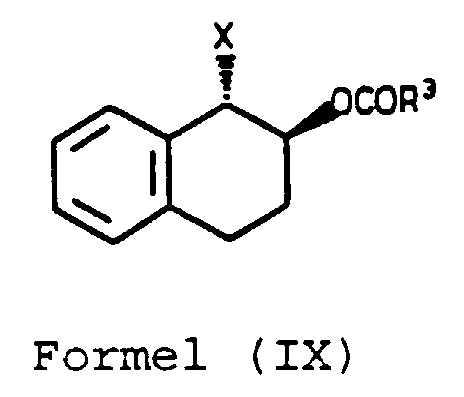
- the alkyl group R in compounds (VII), (VIIB) and (IX) is preferably methyl or ethyl.
- the group R 3 is preferably H, C 1-6 -alkyl or phenyl.
- R 2 is alkyl it is preferably C 1-6 alkyl, more preferably methyl and where R 2 is aryl it is preferably phenyl.
- X is preferably chloro.
- the alkali metal alkoxide is preferably an alkali metal C 1-4 -alkoxide more preferably sodium or potassium methoxide, ethoxide or butoxide and especially sodium methoxide.
- Reaction of the compound of Formula (IX) with the alkali metal alkoxide may be performed in a liquid medium preferably in an ether such as tetrahydrofuran.
- the compound (IA) may be isolated by evaporating the liquid medium and may be purified by crystallisation.
- halo substituent of compound (IX) may be reacted with nucleophilic reagents to give further 1,2-substituted-1,2,3,4-tetrahydronaphthalenes.
- the compounds of the present invention may be used to prepare other useful intermediates.
- Other useful intermediates For example:
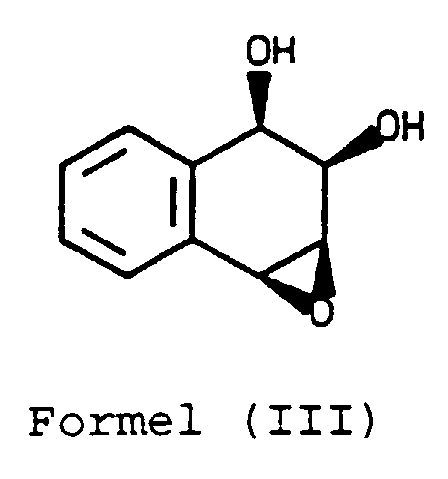
- the compound of Formula (III) is novel and forms a further part of the present invention.
- the epoxidising agent is not critical, and any of a number of epoxidising agents may be used.
- the epoxidising agent may be, for example, a per acid such as m -chloroperbenzoic acid.
- the epoxidation reaction may be carried out under conditions usual for such reactions.
- the dihydronaphthalene (II) is conveniently dissolved in a chlorinated hydrocarbon solvent, for example dichloromethane or chloroform, and is treated with for example m-chloroperbenzoic acid, preferably in an excess of the amount theoretically required.
- the reaction is preferably performed at below ambient temperature, for example at 0-5°C.
- the reaction is performed in the presence of an aqueous buffer solution having a pH of 8.
- the product may be recovered from the reaction mixture by standard methods, for example by separating the aqueous and organic solutions, and recovering the product by evaporating the organic solution. It is surprising that the syn -epoxide is formed; the anti -epoxide would have been expected.
- the dehydroxylating agent may be, for example, a combination of chlorotrimethylsilane (two molar proportions) and sodium iodide, used in a solvent (e.g. acetonitrile) at ambient temperature from 20°C to 25°C.
- a solvent e.g. acetonitrile
- suitable dehydroxylation procedures include treatment with triethylorthoformate at 110°C followed by acetic acid, or treatment with a mixture of dimethyl formamide and acetic acid at 100°C.
- the bis-sulphonyl ester (X) may be used to prepare other useful intermediates. By reaction with sodium nitrate, it may be converted to the bis-nitro ester (XI) :
- the bis-nitro ester (XI) may in turn be hydrogenated in presence of a catalyst to provide the diol (XII) :
- the bis-sulphonyl ester (X) may be reacted with an alkali metal acetate, for example caesium acetate, to give the bis-acetyl ester (XIII) :
- the bis-acetyl ester (XIII) may then be hydrolysed under acidic conditions to give the diol (XII).
- the compound of Formula (II) (cis-(1R,2S)-dihydroxy-1,2-dihydronaphthalene) is a known compound and may be prepared, for example, from naphthalene, using a biochemical process in which naphthalene is introduced into a culture of a mutant strain of the microorganism Pseudomonas putida , as described in Example 8 of European Patent 0076606 B1. As set forth in Example 8, the naphthalene may be added to the culture as a solid. It may also be introduced into the culture as a solution in an inert organic apolar solvent.
- solvents examples include alkanes, which may be straight-chain, branched or cyclic alkanes, preferably having from 8 to 20 carbon atoms.
- Preferred alkanes include decane, dodecane and hexadecane, or mixtures thereof.
- Other examples of such solvents include haloalkanes, for example carbon tetrachloride, dichloroethane, trichloroethane and tetrachloroethane; petroleum ethers which are free of aromatic hydrocarbons, preferably the higher-boiling fractions; and alkyl esters of alkanoic acids wherein the alkyl group has more than two carbon atoms and the alkanoic acid more than four.
- the alkyl group and the alkanoic acid each have more than 8 carbon atoms, and the sum of their carbon atoms is preferably more than 10.
- solvents include ethyl butanoate, hexyl hexanoate and octyl octanoate.
- the cells of the P. putida strain may be used as a cell suspension, or they may be immobilised. Immobilisation may be achieved by entrapping the cells in an inert support such as chitosan, a carrageenan alginate salt, a carrageenan polysaccharide, a synthetic polymer such as polyacrylamide, or cellulose acetate. Alternatively, the cells may be aggregated covalently or passively, or adsorbed. Preferably the cells are entrapped on an inert support. Immobilising the cells has the advantage that the amount of cellular debris is reduced; such debris causes difficulties in the isolation of the dihydroxy compound of Formula (II). Immobilisation also makes the separation of the cells from the culture medium easier at the end of the reaction, since it enables their separation by filtration rather than centrifugation. Furthermore, the life of the active cells may be extended.
- Immobilisation may be achieved by entrapping the cells in an inert support such as chitosan, a carrageen
- the enantiomer of compound (II) of structure (IIA) below: may be prepared from racemic-1,2-dihydro-1,2-dihydroxy naphthalene using a biochemical process as detailed in present Example 4.
- the racemic-1,2-dihydro-1,2-dihydroxynaphthalene may be prepared by reducing 2,3-epoxy-2,3-dihydro-1,4-naphthoquinone with NaBH 4 in ethanol to give 1,4-dihydroxy-2,3-epoxy-1,2,3,4-tetrahydronaphthalene which is reacted with a mixture of sodium iodide, sodium acetate, zinc dust and acetic acid to give 1,2-dihydroxy-1,2-dihydronaphthalene.
- Compound Formula (IIA) may be reacted with an epoxidising agent as described above to form the compound of Formula (IIIA).
- the compound of Formula (IIA) may be reacted with an alkylorthoalkanoate as described above to form the compound of Formula (IIIA).
- the compound of Formula (IIIA) may be reacted with a halotrialkylsilane or a halotriarylsilane as described above to form the compound of Formula (IXA).
- the compound of Formula (IIA) may be hydrogenated as described above to form a compound of Formula (VA) :
- the compound of Formula (VA) may be reacted with a sulphonyl halide as described above to form a compound of Formula (XA).
- the compound of Formula (XA) may be reacted with sodium carbonate as described above to form a compound of Formula (IA).
- the compound of Formula (XA) may be reacted with sodium nitrate as described above to form a compound of Formula (XIA).
- the inoculum was prepared by picking off several active colonies of Pseudomonas putida UV-4 growing on agar plates with 0.1% (w:v) pyruvate. The colonies were transferred using sterile techniques to 10ml of 0.85% saline solution in a 25ml sterile jar. The cells were uniformly dispersed in the solution by vigorously vortexing for several minutes. This solution was transferred, again using sterile techniques to a 1 litre baffled side arm inoculum flask, and plugged with a foam bung. The flask contained 200ml of Seed 2 medium (Seed 2 consists of potassium phosphate, sodium phosphate, ammonium sulphate, magnesium sulphate, ferric chloride at pH 7.2) and 0.6% pyruvate.
- Seed 2 medium Seed 2 consists of potassium phosphate, sodium phosphate, ammonium sulphate, magnesium sulphate, ferric chloride at pH 7.2
- Flasks so prepared were shaken at 300 rpm on an orbital shaker at 28°C overnight, during which the cells grew to an approximate dry cell weight of 3g/l.
- the activity of the cells was measured using the standard activity assay and if >14 units/hour the inoculum was used to inoculate the fermenter.
- Several flasks were prepared in parallel to enable an inoculum of high activity to be selected.
- a 30 litre fermenter containing 25 litres of Seed 2 medium and 5g/l glucose at pH 7.0 was inoculated with 200ml of inoculum prepared as above.
- the fermenter was sparged with air and vigorously stirred to maintain a high level of dissolved oxygen.
- the pH of the broth is maintained at 7.0, and antifoam (polyethylene glycol or a polysiloxane) was added as necessary to prevent foaming over.
- the temperature of the fermenter was held at 28°C.
- a glucose feed pump was switched on to deliver glucose at 1 gram per litre per hour for 4 hours.
- the feed rate was increased to 3g/l/hour after 4 to 6 hours, maintaining the culture in carbon limitation.
- the fermentation was continued until the desired dry cell weight and required activity of the cells was reached - generally 20g/l dry cell weight and an activity of >14 units/hour.
- the cells were harvested by centrifugation in 1 litre bottles.
- the cell pellets can be stored at 3°C for several days without significant loss of activity.
- a 5 litre bio-reactor containing 4.5 litres of potassium phosphate buffer pH 7.6 and 3g/l ethanol was inoculated with active cells to give 3g/l dry cell weight.
- the solution was sparged with air and vigorously stirred to maintain a high concentration of dissolved oxygen.
- the temperature was maintained at 28°C and the pH at 7.6 by addition of KOH as necessary.
- Naphthalene was introduced as a solid at a rate of 12g/hour.
- the reaction was monitored by following the change in absorbance at 261nm - corresponding to ⁇ max of the dihydroxydihydronaphthalene. After 8 hours the reaction was terminated by stopping the stirrer and air supply and removing the cells from the liquor by centrifugation.
- the cell free liquor was stored at 3°C and pH 8.5.
- Cis -(1R,2S)-1,2-dihydroxy-1,2-dihydronaphthalene was extracted from the aqueous liquor by stirring with an equal volume of dichloromethane.
- the dichloromethane layer was separated and the aqueous solution was extracted with a further volume of dichloromethane.
- the above process was repeated a total of 3 times.
- the dichloromethane fractions were combined, dried over Na 2 SO 4 , filtered and most of the solvent removed by vacuum distillation.
- the crude concentrated product formed was poured into n-hexane to precipitate a purer product. Most of the impurities were separated from the product in this way. Further purification was carried out by recrystallisation from 1,2-dichloroethane. 100g of naphthalene were introduced into the reactor and 36g of clean cis-(1R,2S)-1,2,-dihydroxy-1,2-dihydronaphthalene were obtained.
- Phosphate buffer solution pH 8, 50ml was added to a solution of cis -(1R,2S)-1,2-dihydroxy-1,2-dihydronaphthalene (II) (1.6g, 6.1mmol) in dichloromethane (50ml).
- m -Chloroperoxybenzoic acid (2.12g, 12mmol) was then added in two equal portions, the first while stirring at 0°C, the second after 2 hours. The mixture was then stirred vigorously overnight at room temperature. The organic layer was then separated and washed with 10% sodium sulphite solution (20ml), followed by 10% sodium bicarbonate solution (20ml), dried over magnesium sulphate and evaporated.
- the product was identified by its mass spectrum and proton magnetic resonance spectrum as cis-(1R,2S)-1,2-dihydroxy- syn -3,4-epoxy-1,2,3,4-tetrahydronaphthalene (III) having a melting point of 78-79°C and [ ⁇ ] D -52° (measured in chloroform).
- the phosphate buffer solution used above was prepared by adding a solution of sodium dihydrogen orthophosphate (0.1M, about 20ml) to a solution of disodium hydrogen orthophosphate (0.1M, 500ml) until a pH of 8 was reached.
- the innoculum was prepared by picking off several active colonies of Pseudomonas putida NC1B 11767 growing on agar plates with 0.11% pyruvate. The colonies were transferred using sterile techniques to 10ml of 0.85% saline solution in a 25ml sterile jar. The cells were uniformly dispersed in the solution by vortexing for several minutes. The solution was transferred, again using sterile techniques to a 1 litre baffled side arm inoculum flask and plugged with foam bung.
- the flask contained 200ml of solution made up of 0.96g KH 2 PO 4 , 1.23g K 2 HPO 4 , 3.00g NH 4 Cl, 0.40g MgSO 4 .7H 2 O and 1.9ml of trace elements per litre.
- the solution was made up to pH 7.0 using 2M KOH or 1MH 2 SO 4 prior to sterilisation.
- the trace elements solution comprised 50g Na 2 EDTA, 2.20g ZnSO 4 .7H 2 O, 5.54g CaCl 2 , 5.06g MnCl 2 .4H 2 O, 5.00g FeSO 4 .7H 2 O, 1.10g (NH 4 ) 6 Mo 7 O 24 .4H 2 O, 1.57g CUSO 4 .5H 2 O and 1.61g CoCl 2 .6H 2 O per litre of distilled water.
- Na 2 EDTA was dissolved alone by adjusting the solution to a pH value of 6.0 with potassium hydroxide (2M). The other components were then dissolved sequentially in the order shown above. Finally the pH value was again adjusted to 6.0 with the potassium hydroxide solution.
- Pseudomonas putida 11767 was grown in a 10 litre fermenter.
- the organisms were grown at 30°C, at a pH value of 7.0, an air supply flow rate of 51min -1 , a media volume of 9 litres and a stirrer speed of 500rpm. Under these conditions growth was oxygen limited.
- the same basic medium used for the growth of non-recombinant organisms in shake-flasks was used in 10 litre fermentations.
- the microorganism was grown with toluene as the sole source of carbon and energy.
- the air supply to the fermenter was passed through a reservoir of toluene (500ml), so that toluene-saturated air was continuously fed to the fermenter during growth.
- the biotransformation was a batch reaction with the racemic-1,2-dihydro-1,2-dihydroxynaphthalene added at the start of the reaction to a concentration of 1mg.ml -1 (for solids). Glucose was used as a co-substrate in this biotransformation, at a concentration of 4.8g 1 -1 .
- the pH was adjusted to pH 7.2 for biotransformation purposes, but other reactor conditions were the same as those used during growth of the biocatalyst.
Landscapes
- Organic Chemistry (AREA)
- Chemical & Material Sciences (AREA)
- Wood Science & Technology (AREA)
- Life Sciences & Earth Sciences (AREA)
- Engineering & Computer Science (AREA)
- Zoology (AREA)
- Biotechnology (AREA)
- Microbiology (AREA)
- General Chemical & Material Sciences (AREA)
- Chemical Kinetics & Catalysis (AREA)
- Health & Medical Sciences (AREA)
- Biochemistry (AREA)
- Bioinformatics & Cheminformatics (AREA)
- General Engineering & Computer Science (AREA)
- General Health & Medical Sciences (AREA)
- Genetics & Genomics (AREA)
- Organic Low-Molecular-Weight Compounds And Preparation Thereof (AREA)
- Epoxy Compounds (AREA)
- Epoxy Resins (AREA)
Claims (14)
- Verfahren zur Herstellung von (1S,2R)-1,2 -Epoxy-1,2,3,4-tetrahydronaphthalin der Formel (I):
 (a) Hydrierung der Verbindung der Formel (II) zur Bildung von cis-(1R,2S)-1,2-Dihydroxy-1,2,3,4-tetrahydronaphthalin der Formel (V):
 (b) Umsetzung der Dihydroxy-Verbindung der Formel (V) mit einem Sulfonylhalogenid der Formel R1SO2Z, in der R1 Methyl, Ethyl, Trifluormethyl, Phenyl oder p-Tolyl und Z Fluor, Chlor, Brom oder Jod ist, unter Erhalt eines Bis-sulfonylesters der Formel (X):
 (c) Behandlung des Bis-sulfonylesters (X) mit einem Alkalimetallcarbonat oder Alkalimetallhydroxid unter Erhalt der Verbindung der Formel (I).
 - Verfahren zur Herstellung von (1R,2S)-1,2-Epoxy-1,2,3,4-tetrahydronaphthalin der Formel (IA):
 a) Hydrierung der Verbindung der Formel (II) zur Bildung von cis-(1R,2S)-1,2-Dihydroxy-1,2,3,4-tetrahydronaphthalin der Formel (V):
 b) Umsetzung der Verbindung der Formel (V) mit einem Orthoalkansäurealkylester der Formel (VI) zur Bildung eines Gemisches aus Dioxolan-Diastereoisomeren der Formel (VII) und Formel (VIIB):
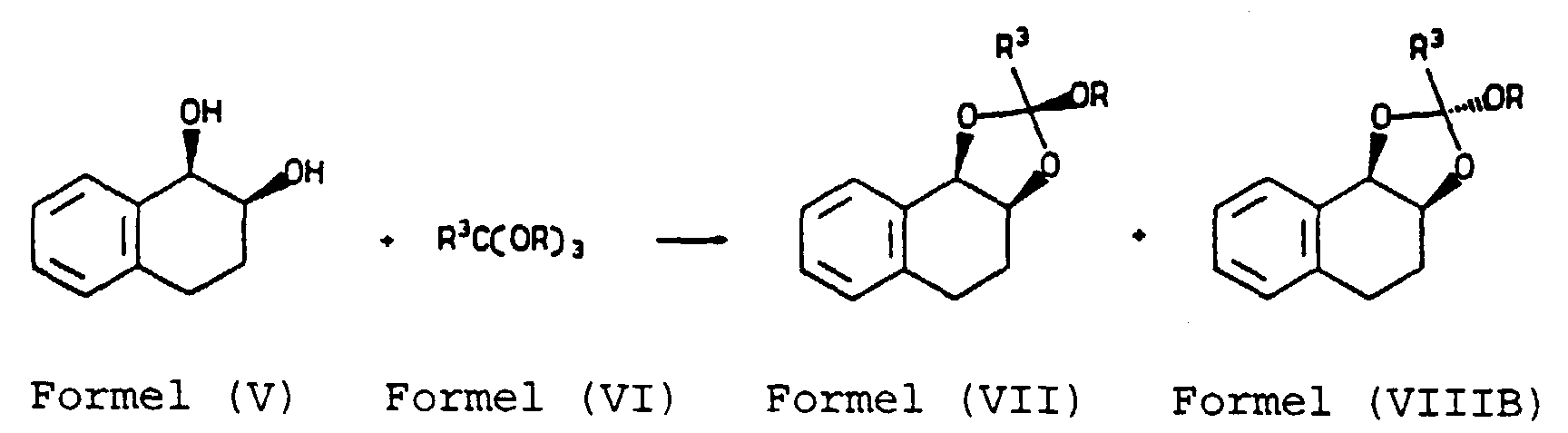 c) Umsetzung des Gemisches aus Dioxolan-Diasteroisomeren der Formel (VII) und (VIIB) mit einem Halogentrialkyl- oder Halogentriarylsilan der Formel (XIV) zur Bildung einer Verbindung der Formel (IX):
 R2 Alkyl oder Aryl,X -Cl, -Br oder -I, undR3 das bereits definierte,d) Umsetzung der Verbindung der Formel (IX) mit einem Alkalimetallalkoxid zur Bildung von (1R,2S)-1,2-Epoxy-1,2,3,4-tetrahydronaphthalin der Formel (IA).
 - Verbindung der Formel (III) :
- Verbindung der Formel (IIIA):

- Verbindung der Formel (VII):
 R Alkyl undR3 H, Alkyl oder Phenyl.
 - Verbindung der Formel (VIIB):
 R Alkyl undR3 H, Alkyl oder Phenyl.
 - Verbindung der Formel (VIIA):
 R Alkyl undR3 H, Alkyl oder Phenyl.
 - Verbindung der Formel (VIIC):
 R Alkyl undR3 H, Alkyl oder Phenyl.
 - Verbindung der Formel (IX):
 R3 H, Alkyl oder Phenyl undX -Cl, -Br oder -J.
 - Verbindung der Formel (IXA):
 R3 H, Alkyl oder Phenyl undX -Cl, -Br oder -J.
 - Verbindung der Formel (X):

R1 Methyl, Ethyl, Trifluormethyl, Phenyl oder p-Tolyl. - Verbindung der Formel (XA):

R1 Methyl, Ethyl, Trifluormethyl, Phenyl oder p-Tolyl. - Verbindung der Formel (XI):

- Verbindung der Formel (XIA) :

Applications Claiming Priority (3)
| Application Number | Priority Date | Filing Date | Title |
|---|---|---|---|
| GB9303911 | 1993-02-26 | ||
| GB939303911A GB9303911D0 (en) | 1993-02-26 | 1993-02-26 | Chemical process |
| PCT/GB1994/000307 WO1994019338A1 (en) | 1993-02-26 | 1994-02-16 | Chemical process |
Publications (2)
| Publication Number | Publication Date |
|---|---|
| EP0686153A1 EP0686153A1 (de) | 1995-12-13 |
| EP0686153B1 true EP0686153B1 (de) | 1997-06-04 |
Family
ID=10731085
Family Applications (1)
| Application Number | Title | Priority Date | Filing Date |
|---|---|---|---|
| EP94906331A Expired - Lifetime EP0686153B1 (de) | 1993-02-26 | 1994-02-16 | Chemische prozesse zur herstellung von 1,2-epoxy-1,2,3,4-tetrahydrnaphtalen |
Country Status (11)
| Country | Link |
|---|---|
| US (1) | US5637738A (de) |
| EP (1) | EP0686153B1 (de) |
| JP (1) | JPH08506827A (de) |
| AT (1) | ATE154019T1 (de) |
| CA (1) | CA2155306A1 (de) |
| DE (1) | DE69403637T2 (de) |
| DK (1) | DK0686153T3 (de) |
| ES (1) | ES2102829T3 (de) |
| GB (1) | GB9303911D0 (de) |
| NO (1) | NO953359L (de) |
| WO (1) | WO1994019338A1 (de) |
Families Citing this family (2)
| Publication number | Priority date | Publication date | Assignee | Title |
|---|---|---|---|---|
| WO2004043946A1 (en) * | 2002-11-12 | 2004-05-27 | Mallinckrodt Inc. | Cannabinoid crystalline derivatives and process of cannabinoid purification |
| WO2011146610A2 (en) * | 2010-05-19 | 2011-11-24 | Dr. Reddy's Laboratories Ltd. | An enantioselective synthesis of chiral amines for the production of rotigotine |
Family Cites Families (3)
| Publication number | Priority date | Publication date | Assignee | Title |
|---|---|---|---|---|
| US4082773A (en) * | 1972-07-03 | 1978-04-04 | E. R. Squibb & Sons, Inc. | Tricyclic tetrahydro naphthaleneols and related compounds |
| DE2603589C3 (de) * | 1976-01-30 | 1978-09-28 | Bayer Ag, 5090 Leverkusen | Verfahren zur Herstellung von Alkyldisulfonsäurediphenylesterdisulfonaten |
| FR2627491B1 (fr) * | 1988-02-18 | 1992-01-24 | Roussel Uclaf | Nouveaux derives du benzocyclohexane et du benzocycloheptane ainsi que leurs sels, leur procede de preparation et les nouveaux intermediaires ainsi obtenus, leur application comme medicaments et les compositions les renfermant |
-
1993
- 1993-02-26 GB GB939303911A patent/GB9303911D0/en active Pending
-
1994
- 1994-02-16 WO PCT/GB1994/000307 patent/WO1994019338A1/en not_active Ceased
- 1994-02-16 CA CA002155306A patent/CA2155306A1/en not_active Abandoned
- 1994-02-16 DK DK94906331.7T patent/DK0686153T3/da active
- 1994-02-16 JP JP6518736A patent/JPH08506827A/ja active Pending
- 1994-02-16 EP EP94906331A patent/EP0686153B1/de not_active Expired - Lifetime
- 1994-02-16 DE DE69403637T patent/DE69403637T2/de not_active Expired - Fee Related
- 1994-02-16 ES ES94906331T patent/ES2102829T3/es not_active Expired - Lifetime
- 1994-02-16 AT AT94906331T patent/ATE154019T1/de not_active IP Right Cessation
- 1994-02-26 US US08/507,470 patent/US5637738A/en not_active Expired - Fee Related
-
1995
- 1995-08-25 NO NO953359A patent/NO953359L/no not_active Application Discontinuation
Also Published As
| Publication number | Publication date |
|---|---|
| DK0686153T3 (da) | 1997-12-22 |
| US5637738A (en) | 1997-06-10 |
| JPH08506827A (ja) | 1996-07-23 |
| GB9303911D0 (en) | 1993-04-14 |
| NO953359D0 (no) | 1995-08-25 |
| WO1994019338A1 (en) | 1994-09-01 |
| ES2102829T3 (es) | 1997-08-01 |
| DE69403637T2 (de) | 1997-09-18 |
| CA2155306A1 (en) | 1994-09-01 |
| NO953359L (no) | 1995-08-25 |
| ATE154019T1 (de) | 1997-06-15 |
| EP0686153A1 (de) | 1995-12-13 |
| DE69403637D1 (de) | 1997-07-10 |
Similar Documents
| Publication | Publication Date | Title |
|---|---|---|
| EP0424064A1 (de) | Chirale Azabicycloheptanone und Verfahren zu ihrer Herstellung | |
| EP0044158A1 (de) | Optisch aktive 2-Imidazolidon-Derivate und ihre Herstellung | |
| EP0686153B1 (de) | Chemische prozesse zur herstellung von 1,2-epoxy-1,2,3,4-tetrahydrnaphtalen | |
| CA2039857A1 (en) | Process for producing epoxyalcohols of high optical purity | |
| EP0494203B1 (de) | Verfahren zur herstellung von aryl-alkandiolen mit hoher optischer reinheit | |
| EP0193227B1 (de) | Verfahren zur Herstellung von Aryl-Glycidyl-Äthern und von 3-substituierten 1-Alkylamino-2-Propanolen | |
| EP0765857B1 (de) | Verfahren zur herstellung von optisch aktiven alpha-substituierten carbonsäurederivaten | |
| EP0193228B1 (de) | Verfahren zur Herstellung von 4-(2-Methoxyethyl)-Phenyl-Glycidyl-Äther und/oder von Metoprolol | |
| US5811294A (en) | Production of optically active 1,2-dihydroxyindance derivatives by asymetric assimilation | |
| US5231027A (en) | Enzymatic process for separating the optical isomers of racemic 1,2-diols using lipase | |
| JP4294746B2 (ja) | エポキシド、ケトンの製造法、エポキシド、オキサザボロリジンの製造法およびケトンのエナンチオ選択的還元 | |
| US4865771A (en) | Process for preparing L(-)-carnitine chloride from 3,4-epoxybutyric esters and novel intermediate compounds | |
| KR0150592B1 (ko) | 효소를 이용한 (r,s)-1,2-페닐에탄디올의 광학적 분할방법 | |
| EP0515142B1 (de) | Optisch aktive Epoxide und Verfahren zu ihrer Herstellung | |
| US5840923A (en) | Chiral cyclopentene derivatives and their preparation | |
| CA1310014C (en) | Enantiomerically pure mono acetal-protected diols, their preparation and use | |
| EP0638077B1 (de) | Chirale cyclopentenderivate und ihre herstellung | |
| AU595052B2 (en) | Process for the preparation of 4-(2,3-epoxypropoxy)- phenylacetic acid and 4-(2-hydroxy-3-isopropylamino- propoxy)phenylacetic acid and/or atenolol in stereo-specific form | |
| JP2896583B2 (ja) | 光学活性なジシクロペンタジエン類 | |
| JPH0481437B2 (de) | ||
| JPH0481436B2 (de) | ||
| JPH11243989A (ja) | 光学活性環状ビアリール化合物の製法 | |
| JPH0827103A (ja) | 光学活性シクロヘプタノール誘導体及びその製法 | |
| FR2700537A1 (fr) | 1-Hydroxy-2-alcoxycarbonyl-tétralines optiquement pures, procédé pour leur préparation et leur utilisation comme intermédiaires clés de synthèse. | |
| JPH06335398A (ja) | シクロヘキセンジオール誘導体 |
Legal Events
| Date | Code | Title | Description |
|---|---|---|---|
| PUAI | Public reference made under article 153(3) epc to a published international application that has entered the european phase |
Free format text: ORIGINAL CODE: 0009012 |
|
| 17P | Request for examination filed |
Effective date: 19950926 |
|
| AK | Designated contracting states |
Kind code of ref document: A1 Designated state(s): AT BE CH DE DK ES FR GB GR IE IT LI LU MC NL PT SE |
|
| GRAG | Despatch of communication of intention to grant |
Free format text: ORIGINAL CODE: EPIDOS AGRA |
|
| 17Q | First examination report despatched |
Effective date: 19960705 |
|
| GRAH | Despatch of communication of intention to grant a patent |
Free format text: ORIGINAL CODE: EPIDOS IGRA |
|
| GRAH | Despatch of communication of intention to grant a patent |
Free format text: ORIGINAL CODE: EPIDOS IGRA |
|
| GRAA | (expected) grant |
Free format text: ORIGINAL CODE: 0009210 |
|
| ITF | It: translation for a ep patent filed | ||
| AK | Designated contracting states |
Kind code of ref document: B1 Designated state(s): AT BE CH DE DK ES FR GB GR IE IT LI LU MC NL PT SE |
|
| PG25 | Lapsed in a contracting state [announced via postgrant information from national office to epo] |
Ref country code: GR Free format text: LAPSE BECAUSE OF FAILURE TO SUBMIT A TRANSLATION OF THE DESCRIPTION OR TO PAY THE FEE WITHIN THE PRESCRIBED TIME-LIMIT Effective date: 19970604 |
|
| REF | Corresponds to: |
Ref document number: 154019 Country of ref document: AT Date of ref document: 19970615 Kind code of ref document: T |
|
| REG | Reference to a national code |
Ref country code: CH Ref legal event code: NV Representative=s name: A. BRAUN, BRAUN, HERITIER, ESCHMANN AG PATENTANWAE Ref country code: CH Ref legal event code: EP |
|
| REF | Corresponds to: |
Ref document number: 69403637 Country of ref document: DE Date of ref document: 19970710 |
|
| REG | Reference to a national code |
Ref country code: ES Ref legal event code: FG2A Ref document number: 2102829 Country of ref document: ES Kind code of ref document: T3 |
|
| ET | Fr: translation filed | ||
| PG25 | Lapsed in a contracting state [announced via postgrant information from national office to epo] |
Ref country code: PT Effective date: 19970904 |
|
| REG | Reference to a national code |
Ref country code: DK Ref legal event code: T3 |
|
| PG25 | Lapsed in a contracting state [announced via postgrant information from national office to epo] |
Ref country code: LU Free format text: LAPSE BECAUSE OF NON-PAYMENT OF DUE FEES Effective date: 19980216 |
|
| PLBE | No opposition filed within time limit |
Free format text: ORIGINAL CODE: 0009261 |
|
| 26N | No opposition filed | ||
| PG25 | Lapsed in a contracting state [announced via postgrant information from national office to epo] |
Ref country code: MC Free format text: LAPSE BECAUSE OF NON-PAYMENT OF DUE FEES Effective date: 19980831 |
|
| REG | Reference to a national code |
Ref country code: GB Ref legal event code: 732E |
|
| PGFP | Annual fee paid to national office [announced via postgrant information from national office to epo] |
Ref country code: GB Payment date: 20000216 Year of fee payment: 7 |
|
| PGFP | Annual fee paid to national office [announced via postgrant information from national office to epo] |
Ref country code: ES Payment date: 20010131 Year of fee payment: 8 |
|
| PGFP | Annual fee paid to national office [announced via postgrant information from national office to epo] |
Ref country code: SE Payment date: 20010206 Year of fee payment: 8 |
|
| PGFP | Annual fee paid to national office [announced via postgrant information from national office to epo] |
Ref country code: DE Payment date: 20010212 Year of fee payment: 8 |
|
| PGFP | Annual fee paid to national office [announced via postgrant information from national office to epo] |
Ref country code: FR Payment date: 20010213 Year of fee payment: 8 Ref country code: DK Payment date: 20010213 Year of fee payment: 8 Ref country code: CH Payment date: 20010213 Year of fee payment: 8 Ref country code: AT Payment date: 20010213 Year of fee payment: 8 |
|
| PG25 | Lapsed in a contracting state [announced via postgrant information from national office to epo] |
Ref country code: GB Free format text: LAPSE BECAUSE OF NON-PAYMENT OF DUE FEES Effective date: 20010216 |
|
| PGFP | Annual fee paid to national office [announced via postgrant information from national office to epo] |
Ref country code: IE Payment date: 20010221 Year of fee payment: 8 |
|
| PGFP | Annual fee paid to national office [announced via postgrant information from national office to epo] |
Ref country code: NL Payment date: 20010228 Year of fee payment: 8 |
|
| PGFP | Annual fee paid to national office [announced via postgrant information from national office to epo] |
Ref country code: BE Payment date: 20010427 Year of fee payment: 8 |
|
| GBPC | Gb: european patent ceased through non-payment of renewal fee |
Effective date: 20010216 |
|
| PG25 | Lapsed in a contracting state [announced via postgrant information from national office to epo] |
Ref country code: AT Free format text: LAPSE BECAUSE OF NON-PAYMENT OF DUE FEES Effective date: 20020216 |
|
| PG25 | Lapsed in a contracting state [announced via postgrant information from national office to epo] |
Ref country code: SE Free format text: LAPSE BECAUSE OF NON-PAYMENT OF DUE FEES Effective date: 20020217 |
|
| PG25 | Lapsed in a contracting state [announced via postgrant information from national office to epo] |
Ref country code: IE Free format text: LAPSE BECAUSE OF NON-PAYMENT OF DUE FEES Effective date: 20020218 Ref country code: ES Free format text: LAPSE BECAUSE OF NON-PAYMENT OF DUE FEES Effective date: 20020218 |
|
| PG25 | Lapsed in a contracting state [announced via postgrant information from national office to epo] |
Ref country code: LI Free format text: LAPSE BECAUSE OF NON-PAYMENT OF DUE FEES Effective date: 20020228 Ref country code: DK Free format text: LAPSE BECAUSE OF NON-PAYMENT OF DUE FEES Effective date: 20020228 Ref country code: CH Free format text: LAPSE BECAUSE OF NON-PAYMENT OF DUE FEES Effective date: 20020228 Ref country code: BE Free format text: LAPSE BECAUSE OF NON-PAYMENT OF DUE FEES Effective date: 20020228 |
|
| BERE | Be: lapsed |
Owner name: ZENECA LTD Effective date: 20020228 |
|
| PG25 | Lapsed in a contracting state [announced via postgrant information from national office to epo] |
Ref country code: NL Free format text: LAPSE BECAUSE OF NON-PAYMENT OF DUE FEES Effective date: 20020901 |
|
| PG25 | Lapsed in a contracting state [announced via postgrant information from national office to epo] |
Ref country code: DE Free format text: LAPSE BECAUSE OF NON-PAYMENT OF DUE FEES Effective date: 20020903 |
|
| EUG | Se: european patent has lapsed |
Ref document number: 94906331.7 |
|
| REG | Reference to a national code |
Ref country code: CH Ref legal event code: PL |
|
| REG | Reference to a national code |
Ref country code: DK Ref legal event code: EBP |
|
| PG25 | Lapsed in a contracting state [announced via postgrant information from national office to epo] |
Ref country code: FR Free format text: LAPSE BECAUSE OF NON-PAYMENT OF DUE FEES Effective date: 20021031 |
|
| NLV4 | Nl: lapsed or anulled due to non-payment of the annual fee |
Effective date: 20020901 |
|
| REG | Reference to a national code |
Ref country code: FR Ref legal event code: ST |
|
| REG | Reference to a national code |
Ref country code: IE Ref legal event code: MM4A |
|
| REG | Reference to a national code |
Ref country code: ES Ref legal event code: FD2A Effective date: 20031022 |
|
| PG25 | Lapsed in a contracting state [announced via postgrant information from national office to epo] |
Ref country code: IT Free format text: LAPSE BECAUSE OF NON-PAYMENT OF DUE FEES;WARNING: LAPSES OF ITALIAN PATENTS WITH EFFECTIVE DATE BEFORE 2007 MAY HAVE OCCURRED AT ANY TIME BEFORE 2007. THE CORRECT EFFECTIVE DATE MAY BE DIFFERENT FROM THE ONE RECORDED. Effective date: 20050216 |