EP0678484B1 - Mit einem Dünnschichtstapel beschichtete Glassubstrate mit reflektierenden Eigenschaften für Infrarot und/oder Sonnenstrahlung - Google Patents
Mit einem Dünnschichtstapel beschichtete Glassubstrate mit reflektierenden Eigenschaften für Infrarot und/oder Sonnenstrahlung Download PDFInfo
- Publication number
- EP0678484B1 EP0678484B1 EP19950400877 EP95400877A EP0678484B1 EP 0678484 B1 EP0678484 B1 EP 0678484B1 EP 19950400877 EP19950400877 EP 19950400877 EP 95400877 A EP95400877 A EP 95400877A EP 0678484 B1 EP0678484 B1 EP 0678484B1
- Authority
- EP
- European Patent Office
- Prior art keywords
- film
- oxide
- substrate according
- nanometres
- properties
- Prior art date
- Legal status (The legal status is an assumption and is not a legal conclusion. Google has not performed a legal analysis and makes no representation as to the accuracy of the status listed.)
- Expired - Lifetime
Links
- 239000000758 substrate Substances 0.000 title claims description 43
- 239000011521 glass Substances 0.000 title claims description 16
- 230000005855 radiation Effects 0.000 title claims description 6
- XLOMVQKBTHCTTD-UHFFFAOYSA-N Zinc monoxide Chemical compound [Zn]=O XLOMVQKBTHCTTD-UHFFFAOYSA-N 0.000 claims description 83
- 229910052709 silver Inorganic materials 0.000 claims description 39
- 239000004332 silver Substances 0.000 claims description 39
- 239000011787 zinc oxide Substances 0.000 claims description 39
- 238000000576 coating method Methods 0.000 claims description 21
- 239000010955 niobium Substances 0.000 claims description 19
- 230000005540 biological transmission Effects 0.000 claims description 15
- 239000011248 coating agent Substances 0.000 claims description 13
- 239000003989 dielectric material Substances 0.000 claims description 12
- 229910000484 niobium oxide Inorganic materials 0.000 claims description 12
- 239000002184 metal Substances 0.000 claims description 11
- GUCVJGMIXFAOAE-UHFFFAOYSA-N niobium atom Chemical compound [Nb] GUCVJGMIXFAOAE-UHFFFAOYSA-N 0.000 claims description 11
- HCHKCACWOHOZIP-UHFFFAOYSA-N Zinc Chemical compound [Zn] HCHKCACWOHOZIP-UHFFFAOYSA-N 0.000 claims description 10
- URLJKFSTXLNXLG-UHFFFAOYSA-N niobium(5+);oxygen(2-) Chemical compound [O-2].[O-2].[O-2].[O-2].[O-2].[Nb+5].[Nb+5] URLJKFSTXLNXLG-UHFFFAOYSA-N 0.000 claims description 10
- 239000011701 zinc Substances 0.000 claims description 10
- 229910052751 metal Inorganic materials 0.000 claims description 9
- 229910052758 niobium Inorganic materials 0.000 claims description 9
- XOLBLPGZBRYERU-UHFFFAOYSA-N tin dioxide Chemical compound O=[Sn]=O XOLBLPGZBRYERU-UHFFFAOYSA-N 0.000 claims description 9
- 229910001092 metal group alloy Inorganic materials 0.000 claims description 7
- BPUBBGLMJRNUCC-UHFFFAOYSA-N oxygen(2-);tantalum(5+) Chemical compound [O-2].[O-2].[O-2].[O-2].[O-2].[Ta+5].[Ta+5] BPUBBGLMJRNUCC-UHFFFAOYSA-N 0.000 claims description 7
- GUVRBAGPIYLISA-UHFFFAOYSA-N tantalum atom Chemical compound [Ta] GUVRBAGPIYLISA-UHFFFAOYSA-N 0.000 claims description 7
- 229910001936 tantalum oxide Inorganic materials 0.000 claims description 7
- ATJFFYVFTNAWJD-UHFFFAOYSA-N Tin Chemical compound [Sn] ATJFFYVFTNAWJD-UHFFFAOYSA-N 0.000 claims description 6
- 238000004519 manufacturing process Methods 0.000 claims description 6
- 229910052715 tantalum Inorganic materials 0.000 claims description 6
- 229910044991 metal oxide Inorganic materials 0.000 claims description 5
- 238000009736 wetting Methods 0.000 claims description 5
- 229910018487 Ni—Cr Inorganic materials 0.000 claims description 4
- RTAQQCXQSZGOHL-UHFFFAOYSA-N Titanium Chemical compound [Ti] RTAQQCXQSZGOHL-UHFFFAOYSA-N 0.000 claims description 4
- VNNRSPGTAMTISX-UHFFFAOYSA-N chromium nickel Chemical compound [Cr].[Ni] VNNRSPGTAMTISX-UHFFFAOYSA-N 0.000 claims description 4
- 239000010936 titanium Substances 0.000 claims description 4
- 229910052581 Si3N4 Inorganic materials 0.000 claims description 3
- QVZNQFNKKMMPFH-UHFFFAOYSA-N chromium niobium Chemical compound [Cr].[Nb] QVZNQFNKKMMPFH-UHFFFAOYSA-N 0.000 claims description 3
- HBCZDZWFGVSUDJ-UHFFFAOYSA-N chromium tantalum Chemical compound [Cr].[Ta] HBCZDZWFGVSUDJ-UHFFFAOYSA-N 0.000 claims description 3
- 238000010438 heat treatment Methods 0.000 claims description 3
- HQVNEWCFYHHQES-UHFFFAOYSA-N silicon nitride Chemical compound N12[Si]34N5[Si]62N3[Si]51N64 HQVNEWCFYHHQES-UHFFFAOYSA-N 0.000 claims description 3
- 229910001887 tin oxide Inorganic materials 0.000 claims description 3
- 229910052719 titanium Inorganic materials 0.000 claims description 3
- GWEVSGVZZGPLCZ-UHFFFAOYSA-N Titan oxide Chemical compound O=[Ti]=O GWEVSGVZZGPLCZ-UHFFFAOYSA-N 0.000 claims description 2
- 229910000410 antimony oxide Inorganic materials 0.000 claims description 2
- QGLKJKCYBOYXKC-UHFFFAOYSA-N nonaoxidotritungsten Chemical compound O=[W]1(=O)O[W](=O)(=O)O[W](=O)(=O)O1 QGLKJKCYBOYXKC-UHFFFAOYSA-N 0.000 claims description 2
- VTRUBDSFZJNXHI-UHFFFAOYSA-N oxoantimony Chemical compound [Sb]=O VTRUBDSFZJNXHI-UHFFFAOYSA-N 0.000 claims description 2
- OGIDPMRJRNCKJF-UHFFFAOYSA-N titanium oxide Inorganic materials [Ti]=O OGIDPMRJRNCKJF-UHFFFAOYSA-N 0.000 claims description 2
- 229910001930 tungsten oxide Inorganic materials 0.000 claims description 2
- 239000010408 film Substances 0.000 claims 24
- 239000005340 laminated glass Substances 0.000 claims 2
- 229910016287 MxOy Inorganic materials 0.000 claims 1
- 229910001128 Sn alloy Inorganic materials 0.000 claims 1
- 229910001362 Ta alloys Inorganic materials 0.000 claims 1
- 229910001069 Ti alloy Inorganic materials 0.000 claims 1
- 229910001297 Zn alloy Inorganic materials 0.000 claims 1
- LJCFOYOSGPHIOO-UHFFFAOYSA-N antimony pentoxide Inorganic materials O=[Sb](=O)O[Sb](=O)=O LJCFOYOSGPHIOO-UHFFFAOYSA-N 0.000 claims 1
- 229910000623 nickel–chromium alloy Inorganic materials 0.000 claims 1
- PBCFLUZVCVVTBY-UHFFFAOYSA-N tantalum pentoxide Inorganic materials O=[Ta](=O)O[Ta](=O)=O PBCFLUZVCVVTBY-UHFFFAOYSA-N 0.000 claims 1
- 239000010409 thin film Substances 0.000 claims 1
- 239000010410 layer Substances 0.000 description 118
- BQCADISMDOOEFD-UHFFFAOYSA-N Silver Chemical compound [Ag] BQCADISMDOOEFD-UHFFFAOYSA-N 0.000 description 45
- 239000002346 layers by function Substances 0.000 description 20
- XKRFYHLGVUSROY-UHFFFAOYSA-N Argon Chemical compound [Ar] XKRFYHLGVUSROY-UHFFFAOYSA-N 0.000 description 14
- 229910006404 SnO 2 Inorganic materials 0.000 description 13
- 238000000151 deposition Methods 0.000 description 13
- 230000008021 deposition Effects 0.000 description 13
- 230000003287 optical effect Effects 0.000 description 11
- 229910052725 zinc Inorganic materials 0.000 description 9
- ZKATWMILCYLAPD-UHFFFAOYSA-N niobium pentoxide Chemical compound O=[Nb](=O)O[Nb](=O)=O ZKATWMILCYLAPD-UHFFFAOYSA-N 0.000 description 8
- 229910052786 argon Inorganic materials 0.000 description 7
- QVGXLLKOCUKJST-UHFFFAOYSA-N atomic oxygen Chemical compound [O] QVGXLLKOCUKJST-UHFFFAOYSA-N 0.000 description 7
- 239000001301 oxygen Substances 0.000 description 7
- 229910052760 oxygen Inorganic materials 0.000 description 7
- 239000002356 single layer Substances 0.000 description 5
- 229910052718 tin Inorganic materials 0.000 description 5
- 238000004458 analytical method Methods 0.000 description 4
- 238000004040 coloring Methods 0.000 description 4
- 238000002425 crystallisation Methods 0.000 description 4
- 230000008025 crystallization Effects 0.000 description 4
- 239000000126 substance Substances 0.000 description 4
- 230000000052 comparative effect Effects 0.000 description 3
- 230000000694 effects Effects 0.000 description 3
- 239000000463 material Substances 0.000 description 3
- 238000000034 method Methods 0.000 description 3
- 238000005457 optimization Methods 0.000 description 3
- 238000005507 spraying Methods 0.000 description 3
- 238000000441 X-ray spectroscopy Methods 0.000 description 2
- 230000002745 absorbent Effects 0.000 description 2
- 239000002250 absorbent Substances 0.000 description 2
- 229910045601 alloy Inorganic materials 0.000 description 2
- 239000000956 alloy Substances 0.000 description 2
- 239000012300 argon atmosphere Substances 0.000 description 2
- 239000012298 atmosphere Substances 0.000 description 2
- 238000004630 atomic force microscopy Methods 0.000 description 2
- 238000004737 colorimetric analysis Methods 0.000 description 2
- 230000007797 corrosion Effects 0.000 description 2
- 238000005260 corrosion Methods 0.000 description 2
- 150000004706 metal oxides Chemical class 0.000 description 2
- 238000005546 reactive sputtering Methods 0.000 description 2
- 238000004544 sputter deposition Methods 0.000 description 2
- RYGMFSIKBFXOCR-UHFFFAOYSA-N Copper Chemical compound [Cu] RYGMFSIKBFXOCR-UHFFFAOYSA-N 0.000 description 1
- 239000002253 acid Substances 0.000 description 1
- 238000004378 air conditioning Methods 0.000 description 1
- 230000009286 beneficial effect Effects 0.000 description 1
- 239000000470 constituent Substances 0.000 description 1
- 229910052802 copper Inorganic materials 0.000 description 1
- 239000010949 copper Substances 0.000 description 1
- 230000032798 delamination Effects 0.000 description 1
- 230000006866 deterioration Effects 0.000 description 1
- 239000012467 final product Substances 0.000 description 1
- 239000007789 gas Substances 0.000 description 1
- 238000009499 grossing Methods 0.000 description 1
- 238000009434 installation Methods 0.000 description 1
- 238000009413 insulation Methods 0.000 description 1
- 239000012212 insulator Substances 0.000 description 1
- 230000007935 neutral effect Effects 0.000 description 1
- 230000006911 nucleation Effects 0.000 description 1
- 238000010899 nucleation Methods 0.000 description 1
- 238000013021 overheating Methods 0.000 description 1
- 230000003647 oxidation Effects 0.000 description 1
- 238000007254 oxidation reaction Methods 0.000 description 1
- 230000001590 oxidative effect Effects 0.000 description 1
- 239000000047 product Substances 0.000 description 1
- 230000001737 promoting effect Effects 0.000 description 1
- 239000005361 soda-lime glass Substances 0.000 description 1
- 230000037072 sun protection Effects 0.000 description 1
- 230000008685 targeting Effects 0.000 description 1
Images
Classifications
-
- C—CHEMISTRY; METALLURGY
- C03—GLASS; MINERAL OR SLAG WOOL
- C03C—CHEMICAL COMPOSITION OF GLASSES, GLAZES OR VITREOUS ENAMELS; SURFACE TREATMENT OF GLASS; SURFACE TREATMENT OF FIBRES OR FILAMENTS MADE FROM GLASS, MINERALS OR SLAGS; JOINING GLASS TO GLASS OR OTHER MATERIALS
- C03C17/00—Surface treatment of glass, not in the form of fibres or filaments, by coating
- C03C17/34—Surface treatment of glass, not in the form of fibres or filaments, by coating with at least two coatings having different compositions
- C03C17/36—Surface treatment of glass, not in the form of fibres or filaments, by coating with at least two coatings having different compositions at least one coating being a metal
- C03C17/3602—Surface treatment of glass, not in the form of fibres or filaments, by coating with at least two coatings having different compositions at least one coating being a metal the metal being present as a layer
- C03C17/3618—Coatings of type glass/inorganic compound/other inorganic layers, at least one layer being metallic
-
- C—CHEMISTRY; METALLURGY
- C03—GLASS; MINERAL OR SLAG WOOL
- C03C—CHEMICAL COMPOSITION OF GLASSES, GLAZES OR VITREOUS ENAMELS; SURFACE TREATMENT OF GLASS; SURFACE TREATMENT OF FIBRES OR FILAMENTS MADE FROM GLASS, MINERALS OR SLAGS; JOINING GLASS TO GLASS OR OTHER MATERIALS
- C03C17/00—Surface treatment of glass, not in the form of fibres or filaments, by coating
- C03C17/34—Surface treatment of glass, not in the form of fibres or filaments, by coating with at least two coatings having different compositions
- C03C17/36—Surface treatment of glass, not in the form of fibres or filaments, by coating with at least two coatings having different compositions at least one coating being a metal
-
- C—CHEMISTRY; METALLURGY
- C03—GLASS; MINERAL OR SLAG WOOL
- C03C—CHEMICAL COMPOSITION OF GLASSES, GLAZES OR VITREOUS ENAMELS; SURFACE TREATMENT OF GLASS; SURFACE TREATMENT OF FIBRES OR FILAMENTS MADE FROM GLASS, MINERALS OR SLAGS; JOINING GLASS TO GLASS OR OTHER MATERIALS
- C03C17/00—Surface treatment of glass, not in the form of fibres or filaments, by coating
- C03C17/34—Surface treatment of glass, not in the form of fibres or filaments, by coating with at least two coatings having different compositions
- C03C17/36—Surface treatment of glass, not in the form of fibres or filaments, by coating with at least two coatings having different compositions at least one coating being a metal
- C03C17/3602—Surface treatment of glass, not in the form of fibres or filaments, by coating with at least two coatings having different compositions at least one coating being a metal the metal being present as a layer
- C03C17/3639—Multilayers containing at least two functional metal layers
-
- C—CHEMISTRY; METALLURGY
- C03—GLASS; MINERAL OR SLAG WOOL
- C03C—CHEMICAL COMPOSITION OF GLASSES, GLAZES OR VITREOUS ENAMELS; SURFACE TREATMENT OF GLASS; SURFACE TREATMENT OF FIBRES OR FILAMENTS MADE FROM GLASS, MINERALS OR SLAGS; JOINING GLASS TO GLASS OR OTHER MATERIALS
- C03C17/00—Surface treatment of glass, not in the form of fibres or filaments, by coating
- C03C17/34—Surface treatment of glass, not in the form of fibres or filaments, by coating with at least two coatings having different compositions
- C03C17/36—Surface treatment of glass, not in the form of fibres or filaments, by coating with at least two coatings having different compositions at least one coating being a metal
- C03C17/3602—Surface treatment of glass, not in the form of fibres or filaments, by coating with at least two coatings having different compositions at least one coating being a metal the metal being present as a layer
- C03C17/3642—Surface treatment of glass, not in the form of fibres or filaments, by coating with at least two coatings having different compositions at least one coating being a metal the metal being present as a layer the multilayer coating containing a metal layer
-
- C—CHEMISTRY; METALLURGY
- C03—GLASS; MINERAL OR SLAG WOOL
- C03C—CHEMICAL COMPOSITION OF GLASSES, GLAZES OR VITREOUS ENAMELS; SURFACE TREATMENT OF GLASS; SURFACE TREATMENT OF FIBRES OR FILAMENTS MADE FROM GLASS, MINERALS OR SLAGS; JOINING GLASS TO GLASS OR OTHER MATERIALS
- C03C17/00—Surface treatment of glass, not in the form of fibres or filaments, by coating
- C03C17/34—Surface treatment of glass, not in the form of fibres or filaments, by coating with at least two coatings having different compositions
- C03C17/36—Surface treatment of glass, not in the form of fibres or filaments, by coating with at least two coatings having different compositions at least one coating being a metal
- C03C17/3602—Surface treatment of glass, not in the form of fibres or filaments, by coating with at least two coatings having different compositions at least one coating being a metal the metal being present as a layer
- C03C17/3644—Surface treatment of glass, not in the form of fibres or filaments, by coating with at least two coatings having different compositions at least one coating being a metal the metal being present as a layer the metal being silver
-
- C—CHEMISTRY; METALLURGY
- C03—GLASS; MINERAL OR SLAG WOOL
- C03C—CHEMICAL COMPOSITION OF GLASSES, GLAZES OR VITREOUS ENAMELS; SURFACE TREATMENT OF GLASS; SURFACE TREATMENT OF FIBRES OR FILAMENTS MADE FROM GLASS, MINERALS OR SLAGS; JOINING GLASS TO GLASS OR OTHER MATERIALS
- C03C17/00—Surface treatment of glass, not in the form of fibres or filaments, by coating
- C03C17/34—Surface treatment of glass, not in the form of fibres or filaments, by coating with at least two coatings having different compositions
- C03C17/36—Surface treatment of glass, not in the form of fibres or filaments, by coating with at least two coatings having different compositions at least one coating being a metal
- C03C17/3602—Surface treatment of glass, not in the form of fibres or filaments, by coating with at least two coatings having different compositions at least one coating being a metal the metal being present as a layer
- C03C17/3652—Surface treatment of glass, not in the form of fibres or filaments, by coating with at least two coatings having different compositions at least one coating being a metal the metal being present as a layer the coating stack containing at least one sacrificial layer to protect the metal from oxidation
-
- C—CHEMISTRY; METALLURGY
- C03—GLASS; MINERAL OR SLAG WOOL
- C03C—CHEMICAL COMPOSITION OF GLASSES, GLAZES OR VITREOUS ENAMELS; SURFACE TREATMENT OF GLASS; SURFACE TREATMENT OF FIBRES OR FILAMENTS MADE FROM GLASS, MINERALS OR SLAGS; JOINING GLASS TO GLASS OR OTHER MATERIALS
- C03C17/00—Surface treatment of glass, not in the form of fibres or filaments, by coating
- C03C17/34—Surface treatment of glass, not in the form of fibres or filaments, by coating with at least two coatings having different compositions
- C03C17/36—Surface treatment of glass, not in the form of fibres or filaments, by coating with at least two coatings having different compositions at least one coating being a metal
- C03C17/3602—Surface treatment of glass, not in the form of fibres or filaments, by coating with at least two coatings having different compositions at least one coating being a metal the metal being present as a layer
- C03C17/3657—Surface treatment of glass, not in the form of fibres or filaments, by coating with at least two coatings having different compositions at least one coating being a metal the metal being present as a layer the multilayer coating having optical properties
- C03C17/366—Low-emissivity or solar control coatings
-
- C—CHEMISTRY; METALLURGY
- C03—GLASS; MINERAL OR SLAG WOOL
- C03C—CHEMICAL COMPOSITION OF GLASSES, GLAZES OR VITREOUS ENAMELS; SURFACE TREATMENT OF GLASS; SURFACE TREATMENT OF FIBRES OR FILAMENTS MADE FROM GLASS, MINERALS OR SLAGS; JOINING GLASS TO GLASS OR OTHER MATERIALS
- C03C17/00—Surface treatment of glass, not in the form of fibres or filaments, by coating
- C03C17/34—Surface treatment of glass, not in the form of fibres or filaments, by coating with at least two coatings having different compositions
- C03C17/36—Surface treatment of glass, not in the form of fibres or filaments, by coating with at least two coatings having different compositions at least one coating being a metal
- C03C17/3602—Surface treatment of glass, not in the form of fibres or filaments, by coating with at least two coatings having different compositions at least one coating being a metal the metal being present as a layer
- C03C17/3681—Surface treatment of glass, not in the form of fibres or filaments, by coating with at least two coatings having different compositions at least one coating being a metal the metal being present as a layer the multilayer coating being used in glazing, e.g. windows or windscreens
Definitions
- the invention relates to transparent substrates, in particular glass, coated with a stack of thin layers comprising at least one layer metallic that can act on solar radiation and radiation long wavelength infrared.
- the invention also relates to the use of such substrates for manufacture glazing for thermal insulation and / or sun protection. These are intended to equip buildings as well as vehicles, in particular for reduce the air conditioning effort and / or reduce overheating excessive caused by the ever increasing importance of glass surfaces in the passenger compartment.
- a known type of stack of thin layers intended to give the substrate properties including low emissivity consists of at least minus a metallic layer such as a silver layer placed between two layers of dielectric material such as metal oxide layers.
- This stacking is generally obtained by a succession of deposits performed using a vacuum technique, such as spraying cathodic possibly assisted by magnetic field.
- the layers of dielectric material fulfill several roles since they act completely first on the optical appearance of the substrate in an interference manner. They also protect the silver layer from chemical attack and / or mechanical.
- EP-A-0 226 993 a stack comprising a layer of silver sandwiched between two layers of a dielectric material consisting of a mixed oxide of tin and zinc.
- This stack also has very thin so-called bonding layers in metal, in particular copper, arranged at the interface between the silver layer and each of the oxide layers to increase mutual adhesion.
- French patent FR-B-2,641,271 describes a stack where the silver layer is interposed between two coatings of dielectric material, each of these coatings being made up of a plurality of metallic oxide layers.
- the coating underlying the silver layer consists of three superimposed oxide layers including an oxide layer of tin, the one adjacent to the silver layer being made of zinc oxide and having according to this document a money protection effect, in particular by making it less vulnerable to attack by oxygen.
- the thickness of the layer of zinc must remain low, because according to this patent zinc oxide, not very resistant by elsewhere, would risk, if too thick, to weaken all of stacking.
- the object of the invention is then to develop a new type stack with functional layer (s) which has both properties improved thermal and optical performance, especially both low emissivity and very high light transmission.
- the solution according to the invention consists of a transparent substrate, in particular of glass, provided with a stack of thin layers comprising at least one layer with properties in the field of solar radiation and / or in the field of infrared, in particular metallic and low-emissive, which is placed between two coatings based on dielectric material.
- Said stack is designed, according to the invention, so that the coating underlying this metal layer comprises at least one "wetting" coating comprising a layer based on zinc oxide deposited on an oxide layer metallic corresponding to the formula M x O y with y / x ⁇ 2.5, and which may in particular be based on niobium oxide or tantalum oxide. It can also be antimony oxide Sb 2 O 5 or tungsten oxide WO 3 .
- Said layer based on zinc oxide is also optionally surmounted by a thin layer based on metal such as zinc, titanium, tantalum, tin or a metal alloy such as nickel-chromium.
- the metal layer which has properties in the field of solar and / or infrared radiation is part of the invention of preferably low-emissive and silver-based. It is hereinafter referred to as the term "functional layer”.
- the stack according to the invention gives its carrier substrate has both a very low emissivity and a very high light transmission.
- the invention thus allows obtaining lower emissivity values with identical functional layer thickness, or even an emissivity level unchanged for less thickness.
- the great advantage of the invention lies in the fact that this emissivity optimization does not come at the expense of performance optical, including light transmission, and neutrality of the coloring, especially in reflection. This is also a crucial point both in the building and automotive industries for example. Previously, as already mentioned, we only obtained emissivity values less than at the cost of a reduction in light transmission and a more intense coloring, in parallel.
- the invention now offers the possibility of developing favorably the two characteristics at the same time, by lowering the emissivity and by increasing the light transmission of the stack with functional layer thickness given.
- an additional layer is deposited on the functional layer.
- metal-based layer of niobium, titanium, tantalum, or alloy type metallic such as nickel-chromium, tantalum-chromium or niobium-chromium. It is called “sacrificial” because its role is to protect the functional layer oxidation during the subsequent deposition of the dielectric material above it, deposition usually carried out by reactive sputtering, that is to say in the presence of oxygen. In the final product, this layer sacrificial is therefore, depending on its thickness and the deposition conditions, partially or completely oxidized.
- the coating of dielectric material which is located above the functional layer advantageously comprises at least one base layer tin oxide, tantalum oxide, zinc oxide, niobium oxide or of titanium oxide, and / or a layer of silicon nitride.
- tin oxide is deposited very quickly by cathode sputtering
- specific hardness criteria oxide of niobium and tantalum oxide as well as silicon nitride are known for have higher resistance, especially mechanical, than others oxides).
- a functional layer thickness between 7 and 13 nanometers, preferably between 9 and 12 nm.
- a functional layer thickness between 7 and 13 nanometers, preferably between 9 and 12 nm.
- the overall thickness of the underlying coating is advantageously between 20 and 55 nanometers, preferably between 30 and 45 nm.
- the overall coating thickness above the functional layer is likewise advantageously between 20 and 55 nanometers.
- the layer based on zinc oxide has a thickness between 3 and 40 nanometers, preferably between 10 and 35 nanometers, and in particular greater than 15 nanometers.
- the layer based on niobium oxide or preferably tantalum a thickness between 3 and 40 nanometers, especially between 10 and 35 nanometers and more particularly between 5 and 25 nm, for example at least 10 nanometers.
- the thickness of the sacrificial layer is preferably chosen between 0.5 and 6 nanometers, in particular between 1 and 3 nanometers.
- the optional metallic layer which can overcome the zinc oxide layer preferably choose a range of thicknesses ranging from 0.2 to 2 nanometers.
- the invention also relates to multiple glazing of the type insulators, low-emissives incorporating at least one substrate coated with such stacking.
- the stack of layers is preferably placed on face 3 and / or face 2, while in the case of triple glazing, we can consider having a stack on side 3, on side 5 or on these two faces. (Remember that, conventionally, we number the faces from the outside, once the glass is fitted).
- the invention also relates to laminated glazing incorporating at least a substrate coated with such a stack of layers. They can then be advantageously used as anti-solar glazing, and are all particularly useful for equipping automobiles, given their high light transmission. They can also be used as glazing heating, by providing current leads for the layers to be properties in the silver type infrared. Indeed, such layers, at low emissivity, also have high electrical conductivity.
- double glazing whose emissivity is less than or equal to 0.05, in particular less than 0.045, and the light transmission nevertheless remains very high: this can indeed be greater than or equal to 80%. It should also be noted that, in double glazing, we obtain in reflection saturation values c * in the system colorimetric (L, a *, b *) of at most 5, which results in a color in very neutral, very aesthetic reflection.
- the invention can also advantageously be applied to substrates having not one but several functional layers, for example two functional layers interposed between three coatings based on dielectric material. At least one of the functional layers is then provided with the wetting coating according to the invention. It is thus possible to have a stack of the Nb 2 O 5 / ZnO / Ag / Nb / ZnO / Nb 2 O 5 / ZnO / Ag / Nb / SnO 2 type .
- the thicknesses of the silver layers and of the overall thicknesses of the dielectric coatings on either side of them can advantageously be chosen from the ranges recommended in European patent application EP-0 638 528.
- the successive deposits of layers thin are done by a sputtering technique assisted by magnetic field, but could also be done by any technique using vacuum and allowing good control of layer thicknesses obtained.
- the substrates on which the stacks are deposited are 4 mm thick silica-soda-lime glass substrates.
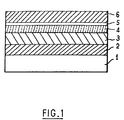
- the glass substrate 1 is surmounted by an oxide layer of zinc 3 which is placed on a layer of niobium oxide 2. Then there is the silver-based functional layer 4, topped with a sacrificial layer 5 niobium-based, above which is an oxide layer of tin 6.
- This figure is very schematic, and, for clarity, do not not respect the proportions as for the thicknesses of the various materials represented.
- the power densities and the running speeds of the substrate are adjusted in a known manner to obtain the desired layer thicknesses.
- Examples 1 to 4 are produced in accordance with the invention, with stacks as illustrated in FIG. 1.
- the following examples 5 to 8 are comparative examples, they lack the sequence Nb 2 O 5 / ZnO in the silver layer and will make it possible to emphasize the advantages linked to the invention.
- Table 1 below indicates, in nanometers, the thicknesses of the layers involved in the stacks according to Examples 1 to 6:
- the last comparative examples 7 and 8 differ from the previous ones by the type of the sequence of layers interposed between glass 1 and the layer money 4:
- the sequence of layers is as follows: glass (1) 4 mm SnO 2 38 nm Ag (4) 10.5 nm Nb (5) 1.2 nm SnO 2 (6) 38 nm.
- the sequence according to this example is as follows: glass (1) 4 mm SnO 2 28 nm ZnO (3) 10 nm Ag (4) 10.5 nm Nb (5) 1.2 nm SnO 2 (6) 38 nm.
- Each of the 8 substrates thus coated is then mounted in double glazing using another similar glass substrate (silico-soda-lime 4 mm thick) separated from the first by a blade of gas, here argon, 15 millimeters thick.
- argon a blade of gas
- Table 2 below indicates, for examples 1 to 4, the value of light transmission T L in percentage, (measured according to the illuminant D 65 ) the value of solar factor FS (without unit, and which corresponds to the ratio of the total energy passing through the glazing to the incident solar energy), the surface thermal transmission value called factor K and expressed in W / m 2 .K, the emissivity value ⁇ without unit, and the values a * and b * coloring in reflection according to the colorimetry system (L, a *, b *).
- Table 5 groups together for this substrate, mounted in double glazing like the substrates of the previous examples, the values of T L , FS, K, ⁇ , a * and b * explained above:
- Tables 1 and 2 it can be seen that all of the examples 1 to 4 and 9 according to the invention allow the production of functional double glazing crossing the threshold of 80% of T L all keeping the emissivity very low, at a value less than 0.050.
- the saturation c * (equal to the square root of the sum of the squares of a * and b *) remains confined to a value of at most 5.
- Such a combination of optical and thermal performance is very advantageous and surprising, knowing that the silver layer intrinsically has a certain absorbent character tending to decrease the light transmission.
- Table 2 also highlights the great flexibility of implementation.
- work of the invention since, according to the invention, the covering is subdivided between glass 1 and silver layer 4 in two oxide layers 2, 3, we can adjust / modify the geometric thickness of each of them, even if is desirable to keep overall for all of these two layers a similar optical thickness (the optical thickness is the product of the thickness geometry of a layer or a set of layers by the indices of refraction of the constituent materials thereof).
- the variations in thickness of each of the layers 2, 3 do not cause very large variations in stack performance, which is an advantage.
- niobium oxide acts favorably on the colorimetry, in particular, glazing, because of its high refractive index. So everything is question of choice of criteria and the invention allows very optimizations fine.
- Example 8 is close to the teaching of the cited patent previously FR-B-2 641 271, using a thin layer of oxide of zinc below the silver layer. We see that it does not reach no longer to match the performances of Examples 1 to 4 according to the invention. We may note in this regard that the stacks according to the invention use zinc oxide layers of significant thickness, without however laying particular sustainability issues, which again reinforces the idea of a synergy between the two layers of oxides 2, 3, which would perhaps increase their mutual adherence, which would have the consequence of slowing down the deterioration or delamination of zinc oxide.
- the choice of a specific sacrificial layer 4 is not indifferent from the optical point of view, and from the point of view of the durability of the stack.
- the Nb layer has proved to be interesting, insofar as it is a slightly less absorbent, for example, than an alloy of the nickel-chromium type. She penalizes the stack very little in terms of light transmission.
Landscapes
- Chemical & Material Sciences (AREA)
- Life Sciences & Earth Sciences (AREA)
- Engineering & Computer Science (AREA)
- Chemical Kinetics & Catalysis (AREA)
- General Chemical & Material Sciences (AREA)
- Geochemistry & Mineralogy (AREA)
- Materials Engineering (AREA)
- Organic Chemistry (AREA)
- Surface Treatment Of Glass (AREA)
- Laminated Bodies (AREA)
Claims (20)
- Transparentes Substrat (1), welches insbesondere aus Glas besteht und mit einem Aufbau aus dünnen Schichten versehen ist, der wenigstens eine speziell metallische und niedrig emittierende Schicht (4) mit Eigenschaften im Infrarot und/oder gegenüber Sonneneinstrahlung umfaßt, die zwischen zwei Beschichtungen auf der Basis von dielektrischem Material angeordnet ist, dadurch gekennzeichnet, daß die unter der Schicht (4) mit Eigenschaften im Infrarot liegende Beschichtung mindestens eine Haftbeschichtung enthält, welche an diese Schicht (4) angrenzt und eine Schicht (3) auf der Basis von Zinkoxid enthält, die auf einer Schicht (2) auf der Basis von Metalloxid mit der Formel MxOy mit y/x ≥ 2,5 wie Nioboxid, Tantaloxid, Ta2O5, Wolframoxid, WO3, und Antimonoxid, Sb2O5, aufgebracht ist.
- Substrat nach Anspruch 1, dadurch gekennzeichnet, daß die Schicht (4) mit Eigenschaften im Infrarot auf der Basis von Silber ist.
- Substrat nach Anspruch 1 oder 2, dadurch gekennzeichnet, daß die Schicht (3) auf der Basis von Zinkoxid mit einer feinen Schicht auf der Basis eines Metalls oder einer Metallegierung bedeckt ist.
- Substrat nach Anspruch 3, dadurch gekennzeichnet, daß die feine Schicht auf der Basis eines Metalls oder einer Metallegierung, welche die Schicht (3) auf der Basis von Zinkoxid bedeckt, aus Zink, Titan, Tantal, Zinn oder Nickelchromlegierung besteht und insbesondere eine Dicke von 0,2 bis 2 Nanometern besitzt.
- Substrat nach einem der vorhergehenden Ansprüche, dadurch gekennzeichnet, daß die Schicht (4) mit Eigenschaften im Infrarot mit einer Getterschicht (5) auf der Basis eines Metalls wie Niob, Titan und Tantal oder einer Metallegierung wie Nickelchrom, Tantalchrom oder Niobchrom mit insbesondere einer Dicke von 0,5 bis 6 Nanometern bedeckt ist.
- Substrat nach einem der vorhergehenden Ansprüche, dadurch gekennzeichnet, daß die über der Metallschicht (4) mit Eigenschaften im Infrarot befindliche Beschichtung auf der Basis eines dielektrischen Materials mindestens eine dünne Schicht (6) enthält, die aus einem Metalloxid, das aus der Gruppe von Zinnoxid, Zinkoxid, Nioboxid, Titanoxid und Tantaloxid ausgewählt ist, und/oder einer Siliciumnitridschicht besteht.
- Substrat nach einem der vorhergehenden Ansprüche, dadurch gekennzeichnet, daß die Dicke der Schicht (4) mit Eigenschaften im Infrarot 7 bis 13 Nanometer und vorzugsweise 9 bis 12 Nanometer beträgt.
- Substrat nach einem der vorhergehenden Ansprüche, dadurch gekennzeichnet, daß die Gesamtdicke der unter der Schicht (4) mit Eigenschaften im Infrarot liegenden Beschichtung (2, 3) 20 bis 55 Nanometer und vorzugsweise 30 bis 45 Nanometer beträgt.
- Substrat nach einem der vorhergehenden Ansprüche, dadurch gekennzeichnet, daß die Dicke der Schicht (3) auf der Basis von Zinkoxid 3 bis 40 Nanometer, vorzugsweise 10 bis 35 Nanometer und insbesondere mehr als 15 Nanometer beträgt.
- Substrat nach einem der vorhergehenden Ansprüche, dadurch gekennzeichnet, daß die Dicke der Schicht (2) auf der Basis von Niob- oder Tantaloxid 3 bis 40 Nanometer, vorzugsweise 5 bis 25 Nanometer und insbesondere mehr als 10 Nanometer beträgt.
- Substrat nach einem der vorhergehenden Ansprüche, dadurch gekennzeichnet, daß die Gesamtdicke der über der Metallschicht (4) mit Eigenschaften im Infrarot liegenden Beschichtung (5, 6) aus dielektrischem Material 20 bis 55 Nanometer beträgt.
- Substrat nach einem der vorhergehenden Ansprüche, dadurch gekennzeichnet, daß es mit einem Aufbau aus dünnen Schichten versehen ist, der zwei Metallschichten (4) mit Eigenschaften im Infrarot enthält.
- Transparentes Substrat (1) nach einem der vorhergehenden Ansprüche, dadurch gekennzeichnet, daß die Schicht (4) mit Eigenschaften im Infrarot mit einer Getterschicht (5) auf der Basis eines Metalls oder einer Metallegierung bedeckt ist, das/die aus Niob, Tantalchrom und Niobchrom ausgewählt ist.
- Transparentes Substrat (1) nach Anspruch 5 oder 13, dadurch gekennzeichnet, daß die Getterschicht (5) teilweise oxidiert ist.
- Transparentes Substrat (1) nach Anspruch 5 oder 13, dadurch gekennzeichnet, daß die Getterschicht (5) vollständig oxidiert ist.
- Niedrig emittierende Mehrfachverglasung, dadurch gekennzeichnet, daß sie mindestens ein Substrat nach einem der vorhergehenden Ansprüche, insbesondere in Form einer Zweifachverglasung mit Schichtaufbauten auf Position 3 und/oder 2 bzw. in Form einer Dreifachverglasung mit Schichtaufbauten auf Position 3 und/oder 5, umfaßt.
- Niedrig emittierende Zweifachverglasung, dadurch gekennzeichnet, daß sie ein Substrat nach einem der Ansprüche 1 bis 15 umfaßt und daß sie ein Emissionsvermögen von kleiner oder gleich 0,05 und insbesondere von kleiner als 0,045 aufweist.
- Niedrig emittierende Zweifachverglasung, dadurch gekennzeichnet, daß sie ein Substrat nach einem der Ansprüche 1 bis 15 umfaßt und daß sie einen Lichttransmissionsgrad TL von größer oder gleich 80 % aufweist.
- Verbundverglasung, dadurch gekennzeichnet, daß sie mindestens ein Substrat nach einem der Ansprüche 1 bis 15 umfaßt und daß sie entweder eine Sonnenschutzverglasung oder, wenn für die Schicht/en mit Eigenschaften im Infrarot Stromzuführungen vorgesehen werden, beheizbar ist.
- Verwendung des Substrats nach einem der Ansprüche 1 bis 15 zur Herstellung von Mehrfachverglasungen vom Typ von niedrig emittierenden und Isolierverglasungen oder von Verbundverglasungen vom Typ von Sonnenschutzverglasungen oder beheizbaren Verglasungen.
Applications Claiming Priority (2)
| Application Number | Priority Date | Filing Date | Title |
|---|---|---|---|
| FR9404810 | 1994-04-21 | ||
| FR9404810A FR2719036B1 (fr) | 1994-04-21 | 1994-04-21 | Substrats en verre revêtus d'un empilement de couches minces, à propriétés de réflexion dans l'infra-rouge et/ou dans le domaine du rayonnement solaire. |
Publications (3)
| Publication Number | Publication Date |
|---|---|
| EP0678484A2 EP0678484A2 (de) | 1995-10-25 |
| EP0678484A3 EP0678484A3 (de) | 1996-03-06 |
| EP0678484B1 true EP0678484B1 (de) | 1999-06-30 |
Family
ID=9462371
Family Applications (1)
| Application Number | Title | Priority Date | Filing Date |
|---|---|---|---|
| EP19950400877 Expired - Lifetime EP0678484B1 (de) | 1994-04-21 | 1995-04-20 | Mit einem Dünnschichtstapel beschichtete Glassubstrate mit reflektierenden Eigenschaften für Infrarot und/oder Sonnenstrahlung |
Country Status (4)
| Country | Link |
|---|---|
| EP (1) | EP0678484B1 (de) |
| DE (1) | DE69510488T2 (de) |
| ES (1) | ES2135671T3 (de) |
| FR (1) | FR2719036B1 (de) |
Cited By (6)
| Publication number | Priority date | Publication date | Assignee | Title |
|---|---|---|---|---|
| US7173750B2 (en) | 2005-07-01 | 2007-02-06 | Ppg Industries Ohio, Inc. | Electrochromic vision panel having a plurality of connectors |
| US7248392B2 (en) | 2005-07-01 | 2007-07-24 | Ppg Industries Ohio, Inc. | Vision panel having a multi-layer primer |
| EP1834934A1 (de) | 2006-03-17 | 2007-09-19 | Fraunhofer-Gesellschaft zur Förderung der angewandten Forschung e.V. | Warmedammendes transparentes schichtssystem |
| US7586664B2 (en) | 2005-07-01 | 2009-09-08 | Ppg Industries Ohio, Inc. | Transparent electrode for an electrochromic switchable cell |
| CN102653455A (zh) * | 2011-03-01 | 2012-09-05 | 苏州大学 | 低辐射薄膜、低辐射镀膜玻璃及其制备方法 |
| US9296650B1 (en) | 2014-10-13 | 2016-03-29 | Intermolecular, Inc. | Low-E panels and methods for forming the same |
Families Citing this family (21)
| Publication number | Priority date | Publication date | Assignee | Title |
|---|---|---|---|---|
| FR2728559B1 (fr) * | 1994-12-23 | 1997-01-31 | Saint Gobain Vitrage | Substrats en verre revetus d'un empilement de couches minces a proprietes de reflexion dans l'infrarouge et/ou dans le domaine du rayonnement solaire |
| DE19541937C1 (de) * | 1995-11-10 | 1996-11-28 | Ver Glaswerke Gmbh | Wärmedämmendes Schichtsystem mit niedriger Emissivität, hoher Transmission und neutraler Ansicht in Reflexion und Transmission |
| DE19607611C1 (de) * | 1996-02-29 | 1997-10-02 | Sekurit Saint Gobain Deutsch | Thermisch hoch belastbares Schichtsystem für Glasscheiben und Verwendung einer mit dem Schichtsystem beschichteten Glasscheibe |
| DE29606493U1 (de) * | 1996-04-10 | 1996-06-20 | Vegla Vereinigte Glaswerke Gmbh, 52066 Aachen | Wärmedämmende Glasscheibe mit niedriger Emissivität und hoher Transmission |
| US6231999B1 (en) * | 1996-06-21 | 2001-05-15 | Cardinal Ig Company | Heat temperable transparent coated glass article |
| IT1293394B1 (it) * | 1996-07-25 | 1999-03-01 | Glaverbel | Substrati rivestiti di metallo |
| FR2755962B1 (fr) * | 1996-11-21 | 1998-12-24 | Saint Gobain Vitrage | Vitrage comprenant un substrat muni d'un empilement de couches minces pour la protection solaire et/ou l'isolation thermique |
| FR2757151B1 (fr) | 1996-12-12 | 1999-01-08 | Saint Gobain Vitrage | Vitrage comprenant un substrat muni d'un empilement de couches minces pour la protection solaire et/ou l'isolation thermique |
| FR2781495B3 (fr) * | 1998-07-24 | 2000-09-01 | Saint Gobain Vitrage | Composition de traitement hydrophobe, procede de formation d'un revetement a partir de cette composition et produits munis de ce revetement |
| FR2781789B1 (fr) * | 1998-08-03 | 2001-08-03 | Saint Gobain Vitrage | Substrat transparent comportant un reseau de fils metalliques et utilisation de ce substrat |
| FR2784985B1 (fr) * | 1998-10-22 | 2001-09-21 | Saint Gobain Vitrage | Substrat transparent muni d'un empilement de couches minces |
| US20030186064A1 (en) * | 2000-09-29 | 2003-10-02 | Kenji Murata | Transparent laminate having low emissivity |
| FR2818272B1 (fr) | 2000-12-15 | 2003-08-29 | Saint Gobain | Vitrage muni d'un empilement de couches minces pour la protection solaire et/ou l'isolation thermique |
| FR2869898B1 (fr) | 2004-05-05 | 2007-03-30 | Saint Gobain | Substrat muni d'un empilement a proprietes thermiques |
| DE102005039707B4 (de) * | 2005-08-23 | 2009-12-03 | Saint-Gobain Glass Deutschland Gmbh | Thermisch hoch belastbares Low-E-Schichtsystem für transparente Substrate, insbesondere für Glasscheiben |
| PL2318206T3 (pl) * | 2008-07-24 | 2017-07-31 | Agc Glass Europe | Izolacyjna szyba zespolona |
| KR101192663B1 (ko) * | 2010-01-04 | 2012-10-19 | 삼성코닝정밀소재 주식회사 | 투명 도전막 및 그를 포함하는 디스플레이 필터 |
| FR3013348B1 (fr) | 2013-11-15 | 2021-01-01 | Saint Gobain | Vitrage comprenant un substrat revetu d'un empilement comprenant une couche fonctionnelle a base d'argent et une sous-couche de blocage epaisse de tiox |
| TWI577543B (zh) | 2013-12-30 | 2017-04-11 | 聖高拜塑膠製品公司 | 展現改良的光對太陽能增益熱比率的光學膜 |
| EP3136141A1 (de) | 2015-08-26 | 2017-03-01 | Saint-Gobain Performance Plastics Corporation | Reflektierender infrarotfilm |
| EP3347321B1 (de) * | 2015-09-08 | 2019-06-12 | Saint-Gobain Glass France | Verglasung mit funktionsbeschichtung |
Family Cites Families (5)
| Publication number | Priority date | Publication date | Assignee | Title |
|---|---|---|---|---|
| FR2279687B1 (fr) * | 1974-07-26 | 1977-01-07 | Saint Gobain | Vitrages chauffants a couches deposees sous vide |
| DE3543178A1 (de) * | 1985-12-06 | 1987-06-11 | Leybold Heraeus Gmbh & Co Kg | Verfahren zum herstellen von scheiben mit hohem transmissionsverhalten im sichtbaren spektralbereich und mit hohem reflexionsverhalten fuer waermestrahlung sowie durch das verfahren hergestellte scheiben |
| DE3869270D1 (de) * | 1987-08-08 | 1992-04-23 | Leybold Ag | Verfahren zum herstellen von scheiben mit hohem transmissionsverhalten im sichtbaren spektralbereich und mit hohem reflexionsverhalten fuer waermestrahlung sowie durch das verfahren hergestellte scheiben. |
| JPH01188446A (ja) * | 1988-01-20 | 1989-07-27 | Nippon Sheet Glass Co Ltd | 熱線反射透明体 |
| FR2701475B1 (fr) * | 1993-02-11 | 1995-03-31 | Saint Gobain Vitrage Int | Substrats en verre revêtus d'un empilement de couches minces, application à des vitrages à propriétés de réflexion dans l'infra-rouge et/ou à propriétés dans le domaine du rayonnement solaire. |
-
1994
- 1994-04-21 FR FR9404810A patent/FR2719036B1/fr not_active Expired - Lifetime
-
1995
- 1995-04-20 DE DE1995610488 patent/DE69510488T2/de not_active Expired - Fee Related
- 1995-04-20 ES ES95400877T patent/ES2135671T3/es not_active Expired - Lifetime
- 1995-04-20 EP EP19950400877 patent/EP0678484B1/de not_active Expired - Lifetime
Cited By (8)
| Publication number | Priority date | Publication date | Assignee | Title |
|---|---|---|---|---|
| US7173750B2 (en) | 2005-07-01 | 2007-02-06 | Ppg Industries Ohio, Inc. | Electrochromic vision panel having a plurality of connectors |
| US7248392B2 (en) | 2005-07-01 | 2007-07-24 | Ppg Industries Ohio, Inc. | Vision panel having a multi-layer primer |
| US7586664B2 (en) | 2005-07-01 | 2009-09-08 | Ppg Industries Ohio, Inc. | Transparent electrode for an electrochromic switchable cell |
| EP1834934A1 (de) | 2006-03-17 | 2007-09-19 | Fraunhofer-Gesellschaft zur Förderung der angewandten Forschung e.V. | Warmedammendes transparentes schichtssystem |
| CN102653455A (zh) * | 2011-03-01 | 2012-09-05 | 苏州大学 | 低辐射薄膜、低辐射镀膜玻璃及其制备方法 |
| WO2012116518A1 (zh) * | 2011-03-01 | 2012-09-07 | 苏州大学 | 低辐射薄膜、低辐射镀膜玻璃及其制备方法 |
| CN102653455B (zh) * | 2011-03-01 | 2015-05-13 | 苏州大学 | 低辐射薄膜、低辐射镀膜玻璃及其制备方法 |
| US9296650B1 (en) | 2014-10-13 | 2016-03-29 | Intermolecular, Inc. | Low-E panels and methods for forming the same |
Also Published As
| Publication number | Publication date |
|---|---|
| FR2719036A1 (fr) | 1995-10-27 |
| DE69510488T2 (de) | 2000-02-17 |
| ES2135671T3 (es) | 1999-11-01 |
| FR2719036B1 (fr) | 1996-05-24 |
| EP0678484A3 (de) | 1996-03-06 |
| EP0678484A2 (de) | 1995-10-25 |
| DE69510488D1 (de) | 1999-08-05 |
Similar Documents
| Publication | Publication Date | Title |
|---|---|---|
| EP0745569B1 (de) | Transparentes Substrat mit einer Häufung von Schichten mit Infrarot und/oder Sonnenstrahlung reflektierenden Eigenschaften | |
| EP0611213B1 (de) | Glassubstrate beschichtet mit einer Häufung von dünnen Schichten, Anwendung für Glasscheiben mit Infrarot reflectierenden Eigenschaften und/oder mit sonnenstrahlungseigenschaften | |
| EP0678484A2 (de) | Mit einem Dünnschichtstapel beschichtete Glassubstrate mit reflektierenden Eigenschaften für Infrarot und/oder Sonnenstrahlung | |
| EP0847965B2 (de) | Für den Sonnenschutz und/oder zur Wärmeisolierung dienende Verglasung bestehend aus einem mit dünnen Lagen mehrfach beschichtetem Substrat | |
| EP0995724B1 (de) | Transparentes Substrat beschichtet mit mehrlagigen, dünnen Schichten | |
| EP0995725B1 (de) | Transparentes Substrat mit einer Häufung von Schichten | |
| EP2577368B1 (de) | Sonnenschutzverglasung mit niedrigem g-wert | |
| EP2956422B2 (de) | Wärmeabsorbierende verglasung | |
| EP1089947B1 (de) | Durchsichtiges substrat mit silberbeschichtung | |
| EP1833768B1 (de) | Mehrfachbeschichtete glasscheibe | |
| EP1120383A2 (de) | Substrat mit Dünnschichtstapel, das Reflexionseigenschaften für Infrarot-und/oder Sonnenlicht aufweist | |
| EP0638528A1 (de) | Transparente Substrate mit einem Dünnschichtstapel, Verwendung in Verglasungen für thermische Isolation und/oder Sonnenschutz | |
| EP2247549A2 (de) | Sonnenschutzglasierung mit verbessertem lichtübertragungskoeffizienten | |
| EP1047644A1 (de) | Mit einem schichtstapel niedriger emissivität versehene verglasung | |
| EP0844219A1 (de) | Glassubstrate beschichtet mit einem Dünnschichtaufbau für Sonnenschutz und/oder thermisch Isolierung | |
| FR2893024A1 (fr) | Substrat muni d'un empilement a proprietes thermiques | |
| EP3645478B1 (de) | Verglasung mit sonnenschutzeigenschaften mit titanoxynitridschicht | |
| EP1744995B1 (de) | Substrat mit einem stapel mit thermischen eigenschaften | |
| EP0709349B1 (de) | Transparentes Substrat mit einer Häufung von Schichten aus Silber, Verwendung als heizbare Verbundglasscheibe | |
| EP0870601A2 (de) | Wärmedämmende Verglasung mit niedriger Emissivität | |
| WO2021105424A1 (fr) | Materiau comportant un empilement a sous-couche dielectrique fine d'oxide a base de zinc et procede de depot de ce materiau | |
| EP3319920B1 (de) | Material mit einer vielzahl von dünnen schichten | |
| EP4143143A1 (de) | Material mit einem stapel mit einer dünnen dielektrischen unterschicht aus zinkbasiertem oxid und verfahren zur ablagerung dieses materials | |
| FR2717171A1 (fr) | Substrats transparents munis d'un empilement de couches minces, application aux vitrages d'isolation thermique et/ou de protection solaire. | |
| EP4172124A1 (de) | Material mit einem stapel mit einer dünnen dielektrischen schicht aus zinkbasiertem oxid und verfahren zur abscheidung dieses materials |
Legal Events
| Date | Code | Title | Description |
|---|---|---|---|
| PUAI | Public reference made under article 153(3) epc to a published international application that has entered the european phase |
Free format text: ORIGINAL CODE: 0009012 |
|
| AK | Designated contracting states |
Kind code of ref document: A2 Designated state(s): BE CH DE ES GB IT LI LU NL |
|
| PUAL | Search report despatched |
Free format text: ORIGINAL CODE: 0009013 |
|
| AK | Designated contracting states |
Kind code of ref document: A3 Designated state(s): BE CH DE ES GB IT LI LU NL |
|
| 17P | Request for examination filed |
Effective date: 19960706 |
|
| 17Q | First examination report despatched |
Effective date: 19970602 |
|
| GRAG | Despatch of communication of intention to grant |
Free format text: ORIGINAL CODE: EPIDOS AGRA |
|
| GRAG | Despatch of communication of intention to grant |
Free format text: ORIGINAL CODE: EPIDOS AGRA |
|
| GRAH | Despatch of communication of intention to grant a patent |
Free format text: ORIGINAL CODE: EPIDOS IGRA |
|
| GRAH | Despatch of communication of intention to grant a patent |
Free format text: ORIGINAL CODE: EPIDOS IGRA |
|
| GRAA | (expected) grant |
Free format text: ORIGINAL CODE: 0009210 |
|
| AK | Designated contracting states |
Kind code of ref document: B1 Designated state(s): BE CH DE ES GB IT LI LU NL |
|
| REG | Reference to a national code |
Ref country code: CH Ref legal event code: EP |
|
| REF | Corresponds to: |
Ref document number: 69510488 Country of ref document: DE Date of ref document: 19990805 |
|
| ITF | It: translation for a ep patent filed | ||
| REG | Reference to a national code |
Ref country code: CH Ref legal event code: NV Representative=s name: KIRKER & CIE SA |
|
| GBT | Gb: translation of ep patent filed (gb section 77(6)(a)/1977) |
Effective date: 19990923 |
|
| REG | Reference to a national code |
Ref country code: ES Ref legal event code: FG2A Ref document number: 2135671 Country of ref document: ES Kind code of ref document: T3 |
|
| PLBE | No opposition filed within time limit |
Free format text: ORIGINAL CODE: 0009261 |
|
| STAA | Information on the status of an ep patent application or granted ep patent |
Free format text: STATUS: NO OPPOSITION FILED WITHIN TIME LIMIT |
|
| 26N | No opposition filed | ||
| REG | Reference to a national code |
Ref country code: GB Ref legal event code: IF02 |
|
| PGFP | Annual fee paid to national office [announced via postgrant information from national office to epo] |
Ref country code: DE Payment date: 20070412 Year of fee payment: 13 |
|
| PGFP | Annual fee paid to national office [announced via postgrant information from national office to epo] |
Ref country code: CH Payment date: 20070413 Year of fee payment: 13 |
|
| PGFP | Annual fee paid to national office [announced via postgrant information from national office to epo] |
Ref country code: ES Payment date: 20070521 Year of fee payment: 13 |
|
| PGFP | Annual fee paid to national office [announced via postgrant information from national office to epo] |
Ref country code: GB Payment date: 20070418 Year of fee payment: 13 |
|
| REG | Reference to a national code |
Ref country code: CH Ref legal event code: PL |
|
| GBPC | Gb: european patent ceased through non-payment of renewal fee |
Effective date: 20080420 |
|
| PG25 | Lapsed in a contracting state [announced via postgrant information from national office to epo] |
Ref country code: LI Free format text: LAPSE BECAUSE OF NON-PAYMENT OF DUE FEES Effective date: 20080430 Ref country code: DE Free format text: LAPSE BECAUSE OF NON-PAYMENT OF DUE FEES Effective date: 20081101 Ref country code: CH Free format text: LAPSE BECAUSE OF NON-PAYMENT OF DUE FEES Effective date: 20080430 |
|
| REG | Reference to a national code |
Ref country code: ES Ref legal event code: FD2A Effective date: 20080421 |
|
| PG25 | Lapsed in a contracting state [announced via postgrant information from national office to epo] |
Ref country code: GB Free format text: LAPSE BECAUSE OF NON-PAYMENT OF DUE FEES Effective date: 20080420 |
|
| PG25 | Lapsed in a contracting state [announced via postgrant information from national office to epo] |
Ref country code: ES Free format text: LAPSE BECAUSE OF NON-PAYMENT OF DUE FEES Effective date: 20080421 |
|
| PGFP | Annual fee paid to national office [announced via postgrant information from national office to epo] |
Ref country code: LU Payment date: 20140410 Year of fee payment: 20 |
|
| PGFP | Annual fee paid to national office [announced via postgrant information from national office to epo] |
Ref country code: NL Payment date: 20140410 Year of fee payment: 20 Ref country code: IT Payment date: 20140417 Year of fee payment: 20 |
|
| PGFP | Annual fee paid to national office [announced via postgrant information from national office to epo] |
Ref country code: BE Payment date: 20140429 Year of fee payment: 20 |
|
| REG | Reference to a national code |
Ref country code: NL Ref legal event code: V4 Effective date: 20150420 |