EP0678085B1 - Behandlung kompostierter organischer materialien - Google Patents
Behandlung kompostierter organischer materialien Download PDFInfo
- Publication number
- EP0678085B1 EP0678085B1 EP19940904777 EP94904777A EP0678085B1 EP 0678085 B1 EP0678085 B1 EP 0678085B1 EP 19940904777 EP19940904777 EP 19940904777 EP 94904777 A EP94904777 A EP 94904777A EP 0678085 B1 EP0678085 B1 EP 0678085B1
- Authority
- EP
- European Patent Office
- Prior art keywords
- compost
- sand
- fraction
- fractions
- separating
- Prior art date
- Legal status (The legal status is an assumption and is not a legal conclusion. Google has not performed a legal analysis and makes no representation as to the accuracy of the status listed.)
- Revoked
Links
- 239000011368 organic material Substances 0.000 title claims abstract description 12
- 238000000034 method Methods 0.000 claims abstract description 25
- 238000000926 separation method Methods 0.000 claims abstract description 17
- 239000000463 material Substances 0.000 claims abstract description 11
- 238000007873 sieving Methods 0.000 claims abstract description 5
- 239000002361 compost Substances 0.000 claims description 46
- 239000004576 sand Substances 0.000 claims description 27
- 229910001385 heavy metal Inorganic materials 0.000 claims description 13
- 239000000356 contaminant Substances 0.000 claims description 2
- 238000004062 sedimentation Methods 0.000 abstract description 8
- 239000000470 constituent Substances 0.000 description 14
- 239000002002 slurry Substances 0.000 description 7
- XLYOFNOQVPJJNP-UHFFFAOYSA-N water Substances O XLYOFNOQVPJJNP-UHFFFAOYSA-N 0.000 description 7
- 239000000047 product Substances 0.000 description 6
- 239000000126 substance Substances 0.000 description 6
- 239000000203 mixture Substances 0.000 description 4
- 239000005416 organic matter Substances 0.000 description 4
- 239000002699 waste material Substances 0.000 description 4
- 239000011521 glass Substances 0.000 description 3
- 238000010438 heat treatment Methods 0.000 description 3
- 238000011109 contamination Methods 0.000 description 2
- 239000010791 domestic waste Substances 0.000 description 2
- 235000013399 edible fruits Nutrition 0.000 description 2
- 239000010921 garden waste Substances 0.000 description 2
- 230000005484 gravity Effects 0.000 description 2
- 229910052500 inorganic mineral Inorganic materials 0.000 description 2
- 239000007788 liquid Substances 0.000 description 2
- 239000011707 mineral Substances 0.000 description 2
- 239000010815 organic waste Substances 0.000 description 2
- 239000000123 paper Substances 0.000 description 2
- 239000004033 plastic Substances 0.000 description 2
- 235000013311 vegetables Nutrition 0.000 description 2
- HCHKCACWOHOZIP-UHFFFAOYSA-N Zinc Chemical compound [Zn] HCHKCACWOHOZIP-UHFFFAOYSA-N 0.000 description 1
- -1 branches Substances 0.000 description 1
- 239000007795 chemical reaction product Substances 0.000 description 1
- 238000002485 combustion reaction Methods 0.000 description 1
- 230000007423 decrease Effects 0.000 description 1
- 238000001704 evaporation Methods 0.000 description 1
- 230000008020 evaporation Effects 0.000 description 1
- 239000012634 fragment Substances 0.000 description 1
- 239000008187 granular material Substances 0.000 description 1
- 238000005259 measurement Methods 0.000 description 1
- 239000002245 particle Substances 0.000 description 1
- 239000003415 peat Substances 0.000 description 1
- 229910052725 zinc Inorganic materials 0.000 description 1
- 239000011701 zinc Substances 0.000 description 1
Images
Classifications
-
- B—PERFORMING OPERATIONS; TRANSPORTING
- B04—CENTRIFUGAL APPARATUS OR MACHINES FOR CARRYING-OUT PHYSICAL OR CHEMICAL PROCESSES
- B04C—APPARATUS USING FREE VORTEX FLOW, e.g. CYCLONES
- B04C5/00—Apparatus in which the axial direction of the vortex is reversed
-
- B—PERFORMING OPERATIONS; TRANSPORTING
- B03—SEPARATION OF SOLID MATERIALS USING LIQUIDS OR USING PNEUMATIC TABLES OR JIGS; MAGNETIC OR ELECTROSTATIC SEPARATION OF SOLID MATERIALS FROM SOLID MATERIALS OR FLUIDS; SEPARATION BY HIGH-VOLTAGE ELECTRIC FIELDS
- B03B—SEPARATING SOLID MATERIALS USING LIQUIDS OR USING PNEUMATIC TABLES OR JIGS
- B03B5/00—Washing granular, powdered or lumpy materials; Wet separating
- B03B5/48—Washing granular, powdered or lumpy materials; Wet separating by mechanical classifiers
- B03B5/52—Spiral classifiers
-
- B—PERFORMING OPERATIONS; TRANSPORTING
- B03—SEPARATION OF SOLID MATERIALS USING LIQUIDS OR USING PNEUMATIC TABLES OR JIGS; MAGNETIC OR ELECTROSTATIC SEPARATION OF SOLID MATERIALS FROM SOLID MATERIALS OR FLUIDS; SEPARATION BY HIGH-VOLTAGE ELECTRIC FIELDS
- B03B—SEPARATING SOLID MATERIALS USING LIQUIDS OR USING PNEUMATIC TABLES OR JIGS
- B03B9/00—General arrangement of separating plant, e.g. flow sheets
- B03B9/06—General arrangement of separating plant, e.g. flow sheets specially adapted for refuse
-
- C—CHEMISTRY; METALLURGY
- C05—FERTILISERS; MANUFACTURE THEREOF
- C05F—ORGANIC FERTILISERS NOT COVERED BY SUBCLASSES C05B, C05C, e.g. FERTILISERS FROM WASTE OR REFUSE
- C05F9/00—Fertilisers from household or town refuse
- C05F9/04—Biological compost
-
- Y—GENERAL TAGGING OF NEW TECHNOLOGICAL DEVELOPMENTS; GENERAL TAGGING OF CROSS-SECTIONAL TECHNOLOGIES SPANNING OVER SEVERAL SECTIONS OF THE IPC; TECHNICAL SUBJECTS COVERED BY FORMER USPC CROSS-REFERENCE ART COLLECTIONS [XRACs] AND DIGESTS
- Y02—TECHNOLOGIES OR APPLICATIONS FOR MITIGATION OR ADAPTATION AGAINST CLIMATE CHANGE
- Y02A—TECHNOLOGIES FOR ADAPTATION TO CLIMATE CHANGE
- Y02A40/00—Adaptation technologies in agriculture, forestry, livestock or agroalimentary production
- Y02A40/10—Adaptation technologies in agriculture, forestry, livestock or agroalimentary production in agriculture
- Y02A40/20—Fertilizers of biological origin, e.g. guano or fertilizers made from animal corpses
-
- Y—GENERAL TAGGING OF NEW TECHNOLOGICAL DEVELOPMENTS; GENERAL TAGGING OF CROSS-SECTIONAL TECHNOLOGIES SPANNING OVER SEVERAL SECTIONS OF THE IPC; TECHNICAL SUBJECTS COVERED BY FORMER USPC CROSS-REFERENCE ART COLLECTIONS [XRACs] AND DIGESTS
- Y02—TECHNOLOGIES OR APPLICATIONS FOR MITIGATION OR ADAPTATION AGAINST CLIMATE CHANGE
- Y02P—CLIMATE CHANGE MITIGATION TECHNOLOGIES IN THE PRODUCTION OR PROCESSING OF GOODS
- Y02P20/00—Technologies relating to chemical industry
- Y02P20/141—Feedstock
- Y02P20/145—Feedstock the feedstock being materials of biological origin
-
- Y—GENERAL TAGGING OF NEW TECHNOLOGICAL DEVELOPMENTS; GENERAL TAGGING OF CROSS-SECTIONAL TECHNOLOGIES SPANNING OVER SEVERAL SECTIONS OF THE IPC; TECHNICAL SUBJECTS COVERED BY FORMER USPC CROSS-REFERENCE ART COLLECTIONS [XRACs] AND DIGESTS
- Y02—TECHNOLOGIES OR APPLICATIONS FOR MITIGATION OR ADAPTATION AGAINST CLIMATE CHANGE
- Y02W—CLIMATE CHANGE MITIGATION TECHNOLOGIES RELATED TO WASTEWATER TREATMENT OR WASTE MANAGEMENT
- Y02W30/00—Technologies for solid waste management
- Y02W30/50—Reuse, recycling or recovery technologies
- Y02W30/52—Mechanical processing of waste for the recovery of materials, e.g. crushing, shredding, separation or disassembly
Definitions
- the invention relates to a method for separating sand and optionally contaminants like heavy metals from composted organic material.
- the invention further relates to a method for removing heavy metals from compost or a fraction thereof.
- Compost made from organic waste contains in addition to organic constituents (about 30-40%) also a large portion of mineral constituents, such as for example sand. This is particularly the case with compost produced from VFG waste, which, because of its origin, often contains about 50 to 75% sand. This relatively large sand portion of course entails high costs for transporting the compost, for instance to processing locations.
- EP-228724 discloses a method for separating for example sand from material that is still to be composted.
- FR-2.160.528 relates to a method for separating glass fragments from compost in a dry separation process.
- the invention now has for its object to provide a method with which the composition of the compost can be adapted to the demands required thereof.
- compostted organic material is any material which contains organic constituents and is wholly or partially composted in aerobic or anaerobic manner.
- the method according to the invention is for example particularly suitable for treating compost produced from vegetable, fruit and garden waste (VFG waste) or from the organic fraction of domestic waste. It is likewise possible to reduce the material in size prior to the treatment.
- steps a) and/or b) are preferably repeated one or more times with the sub-fractions.
- the heavy metals are found to collect in specific fractions, such as the finer light or finer heavy fractions. By selecting a suitable treatment schedule the heavy metals can be concentrated as far as possible in a specific fraction.
- Separation on the basis of size can be carried out by means of sieving.
- Wet or dry compost can be used herefor.
- the sieve size can be chosen as desired.
- Separation of the compost into fractions on the basis of mass is performed by means of using a hydrocyclone.
- a hydrocyclone With such a hydrocyclone the compost in the form of a slurry is supplied tangentially to the cyclone. Due to the action of the centrifugal force the underflow of the cyclone contains mainly the heavier fraction, such as sand and other mineral constituents, while the overflow contains mainly the lighter, mainly organic constituents.
- the separation is then based on differences in specific gravity between for example sand and organic material.
- the density of sand is approximately 2600 kg/m 3
- the density of the organic material amounts to a maximum of 1400 kg/m 3 .
- gravitational separation techniques use is therefore made of this difference to enable separation of for instance a sand fraction from the compost, whereafter a fraction with organic constituents remains.
- a technique which can be used in the method of removing heavy metals for separating according to mass is sedimentation.
- a slurry is likewise used in this case.
- the heavy fraction settles to the bottom of a sedimentation tank, while the light, organic constituents are carried away with water for instance over the edge of the tank. It is possible for example to remove the heavy fraction from the sedimentation tank by means of a worm conveyor.
- the quantity of organic constituents per unit of volume is larger after removal of the sand whereby a better quality product is obtained.
- the separated sand fraction can be used again.
- the compost can be used for instance as peat replacement or other high-grade applications.
- fractions resulting from the method according to the invention can, after the treatment, also be mixed together in any desired proportion to obtain a compost with the required properties.
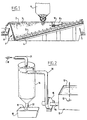
- FIG. 1 Shown in figure 1 is a sedimentation tank 1 in which a compost slurry 2 is contained.
- a liquid for example water
- the compost can optionally be supplied via a supply tank 9.
- the water in the tank will flow slowly and carry with it the lighter organic constituents which do not settle rapidly, while the heavier material 4, such as sand, settles in the tank.
- the sand can be continuously removed from the sedimentation tank by means of a worm conveyor 5.
- the sand is subsequently collected in a container 7.
- the organic constituents 3 float over the edge of the sedimentation tank 1 and fall into a receiving tank 6.
- FIG. 2 shows a second embodiment of the invention.
- the compost is fed from a supply container 11 in which it is held in the form of a slurry 12.
- a slurry Situated in supply container 11 is an agitator 13 for mixing the compost with a liquid, for example water.
- the compost is supplied from the container to a pump 15 and then via a conduit 20 to a hydrocyclone 16.
- hydrocyclone 16 the slurry is cycloned, wherein the sand fraction 17 falls via a pipe 22 as underflow of the hydrocyclone into a receiving bin 18.
- the organic constituents 19 leave the cyclone via a pipe 21.
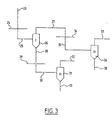
- Figure 3 shows a possible treatment schedule according to the invention.
- the compost is supplied at 23 to a sieve 24.
- Sieving takes place to about 10 mm, whereby the large constituents such as branches, stones, lumps of compost, paper, plastic, glass and the like are removed.
- the compost fraction 25 which goes through the sieve (the largest part) is then supplied to a first hydrocyclone 26.
- the hydrocycloning results in an overflow 27 and an underflow 28.
- Both sub-fractions are sieved again on the respective sieves 34 and 29 with a sieve size of about 0.5 mm and 1 mm respectively.
- the sieved fractions 35 and 30 herein released are subsequently treated in hydrocyclones 36 and 31 respectively, which results in overflows 37 and 32 and underflows 38 and 33.
- Fraction 37 contains the lightest and finest material.
- the test was performed with 100 litres of compost.
- the sand content of this compost is equated in this example with the calcined residue, that is, the portion of the dried material remaining after heating to 650°C.
- the portion of the compost which disappears at this temperature through evaporation and combustion is considered as the organic constituents.
- the tested compost and the products derived therefrom thus always consist of three components, namely sand, organic constituents and water.
- the sample used was found to have a dry substance content of 86%.
- the sand content of this dry substance was 77.8%.
- a compost slurry was prepared by mixing the compost with water in a predetermined ratio. In this test three different ratios were tested. The slurry formed in this manner was then guided through a hydrocyclone. The overflow and the underflow, after hydrocycloning, the compost residue (organic material) and the residual sand were analyzed.
- the "dry substance content” indicates how much of the sample remains when all the water has evaporated.
- the "calcined residue” is the portion of the dry substance remaining after heating to 650°C. In this test the calcined residue is equated with the sand content.
- the "organic matter content” is in this case the portion of the dry substance that has disappeared from the sample after heating to 650°C.
- ratio of organic matter/sand indicates the ratio of these two components to each other in the sample. A higher ratio indicates an enrichment in organic material and thus signifies a product of better quality.
- the "distribution of the sand mass" indicates how much of the initial quantity of sand has gone into a product during the test. This distribution preferably lies as far as possible in the direction of the sand residue.
- the "distribution of the organic matter” indicates how much of the initial amount of organic matter has passed into a product. Preferably as little organic material as possible finds its way into the sand residue. This distribution must therefore be as low as possible. Results of the performed tests CONTENTS IN % RATIO DISTRIBUTION IN % Dry substance Sand Org. matter Org. matter:sand Sand Org.
- a basic sample was made up that is representative of the compost composition of the compost commercially available at the moment in for example The Netherlands. For this purpose compost from four different suppliers was mixed. The composition of this basic sample was determined. According to currently applicable standards the basic sample was found to be not clean, that is, there was too much lead and zinc in the compost. A part of the basic sample was used for a wet sieving in order to determine the granule size distribution. It was found herefrom that almost half the material was larger than 1 millimetre. The rest of the basic sample was then dry sieved to 10 millimetres and cycloned. The fraction larger than 10 millimetres consisted of branches, stones, lumps of wet compost, lumps of grey compost, paper, plastic and glass. Measurements showed that the values for the heavy metals in the overflow were higher than was the case in the basic sample, while the underflow was comparatively cleaner. This indicates that the heavy metals are concentrated in the lighter fraction.
- the underflow and overflow obtained in this manner were subsequently further separated to try and obtain a relatively clean and a relatively concentrated contaminated sub-fraction. It was found from the concentration distribution of the sub-fractions of the overflow that the concentration of heavy metals decreases in larger particles. The overflow was therefore sieved again. It was found that the sub-fraction falling through the sieve is more heavily contaminated than the fraction which remains lying thereon. This corresponds with the expectation that the contamination collects in the fine fraction.
- the present invention provides a compost treatment method with which the compost can be separated into a number of fractions such as sand, clean organic material, contaminated residue, etc.
- the fractions can be sold separately or mixed in any desired ration.
Landscapes
- Health & Medical Sciences (AREA)
- Life Sciences & Earth Sciences (AREA)
- Molecular Biology (AREA)
- Chemical & Material Sciences (AREA)
- Organic Chemistry (AREA)
- Fertilizers (AREA)
- Processing Of Solid Wastes (AREA)
- Combined Means For Separation Of Solids (AREA)
- Separation Of Solids By Using Liquids Or Pneumatic Power (AREA)
- Treatment Of Sludge (AREA)
Claims (5)
- Verfahren zur Abscheidung von Sand und fakultativ von Verunreinigungen, wie Schwermetallen aus kompostiertem organischem Material mit den folgenden Schritten:dadurch gekennzeichnet, daß die Auftrennung gemäß der Masse durch einen Hydrozyklon durchgeführt wird.a) es wird das kompostierte Material größenmäßig getrennt, um wenigstens zwei Fraktionen zu erhalten; undb) es wird darauf wenigstens eine der Fraktionen gemäß der Masse aufgetrennt, um wenigstens zwei Unterfraktionen zu erhalten,
- Verfahren nach Anspruch 1,
dadurch gekennzeichnet, daß die Schritte a) und/oder b) danach einmal oder mehrmals mit den Unterfraktionen wiederholt werden. - Verfahren nach den Ansprüchen 1 oder 2,
dadurch gekennzeichnet, daß die größenmäßige Auftrennung durch Siebtechniken bewirkt wird. - Verfahren nach einem der Ansprüche 1 bis 3,
dadurch gekennzeichnet, daß der Kompost zerkleinert wird, bevor die Abtrennung der Sandfraktion erfolgt. - Verfahren zur Entfernung von Schwermetallen aus Kompost oder einer Fraktion von Kompost durch Massentrennung des Kompostes, um eine leichte und eine schwere Fraktion zu erhalten, wobei die stärker verunreinigte leichte Fraktion gemäß der Größe aufgeteilt wird in eine stärker verunreinigte feinere leichte Unterfraktion und eine weniger verunreinigte größere leichte Unterfraktion.
Applications Claiming Priority (3)
| Application Number | Priority Date | Filing Date | Title |
|---|---|---|---|
| NL9300041 | 1993-01-08 | ||
| NL9300041A NL9300041A (nl) | 1993-01-08 | 1993-01-08 | Behandeling van organisch materiaal. |
| PCT/NL1994/000005 WO1994015892A1 (en) | 1993-01-08 | 1994-01-07 | Treatment of composted organic material |
Publications (2)
| Publication Number | Publication Date |
|---|---|
| EP0678085A1 EP0678085A1 (de) | 1995-10-25 |
| EP0678085B1 true EP0678085B1 (de) | 1998-12-09 |
Family
ID=19861893
Family Applications (1)
| Application Number | Title | Priority Date | Filing Date |
|---|---|---|---|
| EP19940904777 Revoked EP0678085B1 (de) | 1993-01-08 | 1994-01-07 | Behandlung kompostierter organischer materialien |
Country Status (6)
| Country | Link |
|---|---|
| EP (1) | EP0678085B1 (de) |
| JP (1) | JPH08505353A (de) |
| AU (1) | AU5867194A (de) |
| DE (1) | DE69415144T2 (de) |
| NL (1) | NL9300041A (de) |
| WO (1) | WO1994015892A1 (de) |
Families Citing this family (6)
| Publication number | Priority date | Publication date | Assignee | Title |
|---|---|---|---|---|
| DE4434611C2 (de) * | 1994-09-28 | 1999-01-21 | Steinbrecher & Partner Ingenie | Verfahren und Anlage zur Aufbereitung und Beseitigung von Abfall |
| FR2736633B1 (fr) * | 1995-07-11 | 1997-08-29 | Valorga Process Sa | Procede de production d'un amendement organique stabilise de haute qualite, et installation pour la mise en oeuvre de ce procede |
| JP4865224B2 (ja) * | 2002-07-22 | 2012-02-01 | エムビーエー ポリマーズ, インコーポレイテッド | スラリー化濃密媒体分離における媒体粒子サイズの制御 |
| FR2956990B1 (fr) * | 2010-03-08 | 2012-04-20 | Vinci Environnement | Procede et dispositif de traitement des produits lourds issus d'un affinage de dechets provenant d'un traitement biologique. |
| US8329455B2 (en) | 2011-07-08 | 2012-12-11 | Aikan North America, Inc. | Systems and methods for digestion of solid waste |
| CN106890729B (zh) * | 2017-03-14 | 2019-02-05 | 昆明理工大学 | 一种分级摩擦荷电方法及装置 |
Family Cites Families (4)
| Publication number | Priority date | Publication date | Assignee | Title |
|---|---|---|---|---|
| DE2157409A1 (de) * | 1971-11-19 | 1973-05-24 | Kloeckner Humboldt Deutz Ag | Verfahren zur kontinuierlichen zerlegung eines gutgemisches in seine hauptkomponenten, vorzugsweise zur entglasung von kompost |
| US4079837A (en) * | 1974-03-14 | 1978-03-21 | Grube Kenneth E | System for the separation of fragmented solid waste |
| IT1187616B (it) * | 1985-12-19 | 1987-12-23 | Daneco Danieli Ecologia Spa | Separatore inerti e sistema di separazione inerti adottante tale dispositivo |
| SE8901022L (sv) * | 1989-03-22 | 1990-09-23 | Cementa Ab | Kvittblivning och nyttig anvaendning av miljoefarliga avfall |
-
1993
- 1993-01-08 NL NL9300041A patent/NL9300041A/nl not_active Application Discontinuation
-
1994
- 1994-01-07 JP JP51589594A patent/JPH08505353A/ja not_active Ceased
- 1994-01-07 DE DE69415144T patent/DE69415144T2/de not_active Expired - Fee Related
- 1994-01-07 AU AU58671/94A patent/AU5867194A/en not_active Abandoned
- 1994-01-07 EP EP19940904777 patent/EP0678085B1/de not_active Revoked
- 1994-01-07 WO PCT/NL1994/000005 patent/WO1994015892A1/en not_active Ceased
Also Published As
| Publication number | Publication date |
|---|---|
| NL9300041A (nl) | 1994-08-01 |
| EP0678085A1 (de) | 1995-10-25 |
| JPH08505353A (ja) | 1996-06-11 |
| DE69415144D1 (de) | 1999-01-21 |
| AU5867194A (en) | 1994-08-15 |
| WO1994015892A1 (en) | 1994-07-21 |
| DE69415144T2 (de) | 1999-05-06 |
Similar Documents
| Publication | Publication Date | Title |
|---|---|---|
| US6770680B2 (en) | Method for recycling pet components and device for carrying out said method | |
| US20090095673A1 (en) | Systems and methods for combining and converting solid and liquid organic waste materials into useful products | |
| EP0022659B1 (de) | Verfahren zur Reinigung von Kohle | |
| HUP9904209A2 (hu) | Eljárás hulladékok feltárására,amelyek legalább részben újrafelhasználható részeket tartalmaznak | |
| US4915706A (en) | Coal-water fuel production | |
| HUP0000911A2 (hu) | Eljárás szemét kezelésére | |
| EP0678085B1 (de) | Behandlung kompostierter organischer materialien | |
| US3869559A (en) | Process for separation and cleaning of edible vegetable products | |
| JP2000510397A (ja) | 回収可能な廃棄物を分別して処理するための方法および装置 | |
| CA1141353A (en) | Integrated coal cleaning and slurry preparation process | |
| AU2013201748A1 (en) | Separation method and apparatus | |
| NL8402951A (nl) | Werkwijze voor het reinigen van verontreinigde grond. | |
| US4938864A (en) | Method for processing fine coal | |
| US5658462A (en) | Process for recovering protein, fatty and water components from a float material produced by a waste water treatment system | |
| CZ77999A3 (cs) | Způsob dehydratačního zpracování vodu obsahujícího uhlí | |
| DE3833054A1 (de) | Verfahren zur aufbereitung von teichschlamm (flotationsabgaengen) und aufbereitungsanlage | |
| EP1005912B1 (de) | Verfahren zur Wiedergewinnung von Sekundärrohstoffen aus Restmüll und Reststoffen | |
| HU214349B (hu) | Eljárás és berendezés szemcsés talajok folyamatos átmosására | |
| NL9200751A (nl) | Werkwijze voor het verwerken van groente-fruit-tuin-afval. | |
| CA2401396A1 (en) | A method for treating fluid body waste material, and apparatus therefor | |
| US4157295A (en) | Method and apparatus for testing and separating minerals | |
| CZ233993A3 (en) | Process and apparatus for removing fatty substances, particularly oil from grained material | |
| AU2020101910B4 (en) | Method and apparatus for processing recycled glass | |
| EP0568710A1 (de) | Verfahren und Vorrichtung zur Rückverwendung von Kunststoff | |
| CZ20021267A3 (cs) | Způsob minimalizace nové vody pouľité v oběhu vody v úpravárenském zařízení |
Legal Events
| Date | Code | Title | Description |
|---|---|---|---|
| PUAI | Public reference made under article 153(3) epc to a published international application that has entered the european phase |
Free format text: ORIGINAL CODE: 0009012 |
|
| 17P | Request for examination filed |
Effective date: 19950724 |
|
| AK | Designated contracting states |
Kind code of ref document: A1 Designated state(s): BE DE FR GB NL |
|
| 17Q | First examination report despatched |
Effective date: 19951017 |
|
| GRAG | Despatch of communication of intention to grant |
Free format text: ORIGINAL CODE: EPIDOS AGRA |
|
| GRAG | Despatch of communication of intention to grant |
Free format text: ORIGINAL CODE: EPIDOS AGRA |
|
| GRAH | Despatch of communication of intention to grant a patent |
Free format text: ORIGINAL CODE: EPIDOS IGRA |
|
| RAP1 | Party data changed (applicant data changed or rights of an application transferred) |
Owner name: ARCADIS HEIDEMIJ REALISATIE B.V. |
|
| GRAH | Despatch of communication of intention to grant a patent |
Free format text: ORIGINAL CODE: EPIDOS IGRA |
|
| GRAA | (expected) grant |
Free format text: ORIGINAL CODE: 0009210 |
|
| AK | Designated contracting states |
Kind code of ref document: B1 Designated state(s): BE DE FR GB NL |
|
| REF | Corresponds to: |
Ref document number: 69415144 Country of ref document: DE Date of ref document: 19990121 |
|
| ET | Fr: translation filed | ||
| PLBQ | Unpublished change to opponent data |
Free format text: ORIGINAL CODE: EPIDOS OPPO |
|
| PLBQ | Unpublished change to opponent data |
Free format text: ORIGINAL CODE: EPIDOS OPPO |
|
| PLBI | Opposition filed |
Free format text: ORIGINAL CODE: 0009260 |
|
| 26 | Opposition filed |
Opponent name: BIOTECHNISCHE ABFALLVERWERTUNG GMBH & CO. KG Effective date: 19990909 Opponent name: ORGANIC WASTE SXSTEMS N.V.,IN HET KORT: O.W.S. N.V Effective date: 19990909 |
|
| PLBF | Reply of patent proprietor to notice(s) of opposition |
Free format text: ORIGINAL CODE: EPIDOS OBSO |
|
| NLR1 | Nl: opposition has been filed with the epo |
Opponent name: BIOTECHNISCHE ABFALLVERWERTUNG GMBH & CO. KG Opponent name: ORGANIC WASTE SXSTEMS N.V.,IN HET KORT: O.W.S. N.V |
|
| PLBF | Reply of patent proprietor to notice(s) of opposition |
Free format text: ORIGINAL CODE: EPIDOS OBSO |
|
| PLBF | Reply of patent proprietor to notice(s) of opposition |
Free format text: ORIGINAL CODE: EPIDOS OBSO |
|
| RDAH | Patent revoked |
Free format text: ORIGINAL CODE: EPIDOS REVO |
|
| APAC | Appeal dossier modified |
Free format text: ORIGINAL CODE: EPIDOS NOAPO |
|
| APAE | Appeal reference modified |
Free format text: ORIGINAL CODE: EPIDOS REFNO |
|
| PLAB | Opposition data, opponent's data or that of the opponent's representative modified |
Free format text: ORIGINAL CODE: 0009299OPPO |
|
| R26 | Opposition filed (corrected) |
Opponent name: ORGANIC WASTE SYSTEMS N.V.,IN HET KORT: O.W.S. N.V Effective date: 19990909 |
|
| REG | Reference to a national code |
Ref country code: GB Ref legal event code: IF02 |
|
| PGFP | Annual fee paid to national office [announced via postgrant information from national office to epo] |
Ref country code: FR Payment date: 20020130 Year of fee payment: 9 |
|
| PGFP | Annual fee paid to national office [announced via postgrant information from national office to epo] |
Ref country code: DE Payment date: 20020131 Year of fee payment: 9 Ref country code: BE Payment date: 20020131 Year of fee payment: 9 |
|
| NLR1 | Nl: opposition has been filed with the epo |
Opponent name: BIOTECHNISCHE ABFALLVERWERTUNG GMBH & CO. KG Opponent name: ORGANIC WASTE SYSTEMS N.V., IN HET KORT: O.W.S. N. |
|
| PLBQ | Unpublished change to opponent data |
Free format text: ORIGINAL CODE: EPIDOS OPPO |
|
| APAC | Appeal dossier modified |
Free format text: ORIGINAL CODE: EPIDOS NOAPO |
|
| PLAB | Opposition data, opponent's data or that of the opponent's representative modified |
Free format text: ORIGINAL CODE: 0009299OPPO |
|
| R26 | Opposition filed (corrected) |
Opponent name: ORGANIC WASTE SYSTEMS N.V.,IN HET KORT: O.W.S. N.V Effective date: 19990909 |
|
| NLR1 | Nl: opposition has been filed with the epo |
Opponent name: BIOTECHNISCHE ABFALLVERWERTUNG GMBH & CO. KG Opponent name: ORGANIC WASTE SYSTEMS N.V.,IN HET KORT: O.W.S. N.V |
|
| RAP2 | Party data changed (patent owner data changed or rights of a patent transferred) |
Owner name: ORGAWORLD B.V. |
|
| NLT2 | Nl: modifications (of names), taken from the european patent patent bulletin |
Owner name: ORGAWORLD B.V. |
|
| PGFP | Annual fee paid to national office [announced via postgrant information from national office to epo] |
Ref country code: GB Payment date: 20021230 Year of fee payment: 10 |
|
| PG25 | Lapsed in a contracting state [announced via postgrant information from national office to epo] |
Ref country code: BE Free format text: LAPSE BECAUSE OF NON-PAYMENT OF DUE FEES Effective date: 20030131 |
|
| PGFP | Annual fee paid to national office [announced via postgrant information from national office to epo] |
Ref country code: NL Payment date: 20030131 Year of fee payment: 10 |
|
| PG25 | Lapsed in a contracting state [announced via postgrant information from national office to epo] |
Ref country code: DE Free format text: LAPSE BECAUSE OF NON-PAYMENT OF DUE FEES Effective date: 20030801 |
|
| PG25 | Lapsed in a contracting state [announced via postgrant information from national office to epo] |
Ref country code: FR Free format text: LAPSE BECAUSE OF NON-PAYMENT OF DUE FEES Effective date: 20030930 |
|
| REG | Reference to a national code |
Ref country code: FR Ref legal event code: ST |
|
| APBU | Appeal procedure closed |
Free format text: ORIGINAL CODE: EPIDOSNNOA9O |
|
| RDAG | Patent revoked |
Free format text: ORIGINAL CODE: 0009271 |
|
| STAA | Information on the status of an ep patent application or granted ep patent |
Free format text: STATUS: PATENT REVOKED |
|
| 27W | Patent revoked |
Effective date: 20031223 |
|
| GBPR | Gb: patent revoked under art. 102 of the ep convention designating the uk as contracting state |
Free format text: 20031223 |
|
| NLR2 | Nl: decision of opposition |
Effective date: 20031223 |
|
| APAH | Appeal reference modified |
Free format text: ORIGINAL CODE: EPIDOSCREFNO |