EP0676879B1 - Packet management device for fast-packet network - Google Patents
Packet management device for fast-packet network Download PDFInfo
- Publication number
- EP0676879B1 EP0676879B1 EP95300390A EP95300390A EP0676879B1 EP 0676879 B1 EP0676879 B1 EP 0676879B1 EP 95300390 A EP95300390 A EP 95300390A EP 95300390 A EP95300390 A EP 95300390A EP 0676879 B1 EP0676879 B1 EP 0676879B1
- Authority
- EP
- European Patent Office
- Prior art keywords
- data
- packet
- frame
- control
- data packet
- Prior art date
- Legal status (The legal status is an assumption and is not a legal conclusion. Google has not performed a legal analysis and makes no representation as to the accuracy of the status listed.)
- Expired - Lifetime
Links
- 239000000872 buffer Substances 0.000 claims abstract description 102
- 210000004027 cell Anatomy 0.000 claims description 25
- 230000004044 response Effects 0.000 claims description 19
- 230000005540 biological transmission Effects 0.000 claims description 17
- 238000000034 method Methods 0.000 claims description 16
- 238000012545 processing Methods 0.000 claims description 14
- 230000003139 buffering effect Effects 0.000 claims description 2
- 210000000352 storage cell Anatomy 0.000 claims description 2
- 238000013519 translation Methods 0.000 abstract description 18
- 230000006870 function Effects 0.000 description 12
- 238000004891 communication Methods 0.000 description 11
- 238000012423 maintenance Methods 0.000 description 11
- 238000012546 transfer Methods 0.000 description 11
- 238000007726 management method Methods 0.000 description 9
- 238000005516 engineering process Methods 0.000 description 6
- 238000010586 diagram Methods 0.000 description 4
- 230000011664 signaling Effects 0.000 description 3
- 230000001360 synchronised effect Effects 0.000 description 3
- 102100023817 26S proteasome complex subunit SEM1 Human genes 0.000 description 2
- 101000684297 Homo sapiens 26S proteasome complex subunit SEM1 Proteins 0.000 description 2
- 101000873438 Homo sapiens Putative protein SEM1, isoform 2 Proteins 0.000 description 2
- 238000006243 chemical reaction Methods 0.000 description 2
- 125000004122 cyclic group Chemical group 0.000 description 2
- 239000000284 extract Substances 0.000 description 2
- 238000009432 framing Methods 0.000 description 2
- 238000013507 mapping Methods 0.000 description 2
- 238000006467 substitution reaction Methods 0.000 description 2
- 230000008859 change Effects 0.000 description 1
- 238000004883 computer application Methods 0.000 description 1
- 230000001934 delay Effects 0.000 description 1
- 230000001419 dependent effect Effects 0.000 description 1
- 238000003795 desorption Methods 0.000 description 1
- 238000001514 detection method Methods 0.000 description 1
- 230000000694 effects Effects 0.000 description 1
- 238000002060 fluorescence correlation spectroscopy Methods 0.000 description 1
- 230000007246 mechanism Effects 0.000 description 1
- 230000008520 organization Effects 0.000 description 1
- 238000002360 preparation method Methods 0.000 description 1
- 230000008569 process Effects 0.000 description 1
- 230000035755 proliferation Effects 0.000 description 1
- 238000012360 testing method Methods 0.000 description 1
Images



Classifications
-
- H—ELECTRICITY
- H04—ELECTRIC COMMUNICATION TECHNIQUE
- H04L—TRANSMISSION OF DIGITAL INFORMATION, e.g. TELEGRAPHIC COMMUNICATION
- H04L69/00—Network arrangements, protocols or services independent of the application payload and not provided for in the other groups of this subclass
- H04L69/30—Definitions, standards or architectural aspects of layered protocol stacks
- H04L69/32—Architecture of open systems interconnection [OSI] 7-layer type protocol stacks, e.g. the interfaces between the data link level and the physical level
- H04L69/322—Intralayer communication protocols among peer entities or protocol data unit [PDU] definitions
- H04L69/324—Intralayer communication protocols among peer entities or protocol data unit [PDU] definitions in the data link layer [OSI layer 2], e.g. HDLC
-
- H—ELECTRICITY
- H04—ELECTRIC COMMUNICATION TECHNIQUE
- H04L—TRANSMISSION OF DIGITAL INFORMATION, e.g. TELEGRAPHIC COMMUNICATION
- H04L43/00—Arrangements for monitoring or testing data switching networks
- H04L43/08—Monitoring or testing based on specific metrics, e.g. QoS, energy consumption or environmental parameters
- H04L43/0805—Monitoring or testing based on specific metrics, e.g. QoS, energy consumption or environmental parameters by checking availability
-
- H—ELECTRICITY
- H04—ELECTRIC COMMUNICATION TECHNIQUE
- H04L—TRANSMISSION OF DIGITAL INFORMATION, e.g. TELEGRAPHIC COMMUNICATION
- H04L47/00—Traffic control in data switching networks
- H04L47/10—Flow control; Congestion control
- H04L47/32—Flow control; Congestion control by discarding or delaying data units, e.g. packets or frames
-
- H—ELECTRICITY
- H04—ELECTRIC COMMUNICATION TECHNIQUE
- H04L—TRANSMISSION OF DIGITAL INFORMATION, e.g. TELEGRAPHIC COMMUNICATION
- H04L47/00—Traffic control in data switching networks
- H04L47/50—Queue scheduling
- H04L47/62—Queue scheduling characterised by scheduling criteria
-
- H—ELECTRICITY
- H04—ELECTRIC COMMUNICATION TECHNIQUE
- H04L—TRANSMISSION OF DIGITAL INFORMATION, e.g. TELEGRAPHIC COMMUNICATION
- H04L49/00—Packet switching elements
- H04L49/30—Peripheral units, e.g. input or output ports
- H04L49/3009—Header conversion, routing tables or routing tags
-
- H—ELECTRICITY
- H04—ELECTRIC COMMUNICATION TECHNIQUE
- H04L—TRANSMISSION OF DIGITAL INFORMATION, e.g. TELEGRAPHIC COMMUNICATION
- H04L49/00—Packet switching elements
- H04L49/30—Peripheral units, e.g. input or output ports
- H04L49/3081—ATM peripheral units, e.g. policing, insertion or extraction
-
- H—ELECTRICITY
- H04—ELECTRIC COMMUNICATION TECHNIQUE
- H04L—TRANSMISSION OF DIGITAL INFORMATION, e.g. TELEGRAPHIC COMMUNICATION
- H04L49/00—Packet switching elements
- H04L49/50—Overload detection or protection within a single switching element
-
- H—ELECTRICITY
- H04—ELECTRIC COMMUNICATION TECHNIQUE
- H04L—TRANSMISSION OF DIGITAL INFORMATION, e.g. TELEGRAPHIC COMMUNICATION
- H04L49/00—Packet switching elements
- H04L49/55—Prevention, detection or correction of errors
-
- H—ELECTRICITY
- H04—ELECTRIC COMMUNICATION TECHNIQUE
- H04L—TRANSMISSION OF DIGITAL INFORMATION, e.g. TELEGRAPHIC COMMUNICATION
- H04L49/00—Packet switching elements
- H04L49/90—Buffering arrangements
-
- H—ELECTRICITY
- H04—ELECTRIC COMMUNICATION TECHNIQUE
- H04L—TRANSMISSION OF DIGITAL INFORMATION, e.g. TELEGRAPHIC COMMUNICATION
- H04L49/00—Packet switching elements
- H04L49/90—Buffering arrangements
- H04L49/901—Buffering arrangements using storage descriptor, e.g. read or write pointers
-
- H—ELECTRICITY
- H04—ELECTRIC COMMUNICATION TECHNIQUE
- H04L—TRANSMISSION OF DIGITAL INFORMATION, e.g. TELEGRAPHIC COMMUNICATION
- H04L69/00—Network arrangements, protocols or services independent of the application payload and not provided for in the other groups of this subclass
- H04L69/08—Protocols for interworking; Protocol conversion
-
- H—ELECTRICITY
- H04—ELECTRIC COMMUNICATION TECHNIQUE
- H04L—TRANSMISSION OF DIGITAL INFORMATION, e.g. TELEGRAPHIC COMMUNICATION
- H04L9/00—Cryptographic mechanisms or cryptographic arrangements for secret or secure communications; Network security protocols
- H04L9/40—Network security protocols
-
- H—ELECTRICITY
- H04—ELECTRIC COMMUNICATION TECHNIQUE
- H04L—TRANSMISSION OF DIGITAL INFORMATION, e.g. TELEGRAPHIC COMMUNICATION
- H04L49/00—Packet switching elements
- H04L49/30—Peripheral units, e.g. input or output ports
Definitions
- This invention relates generally to data packet switching and more particularly, to a packet management device for frame relay and cell relay networks.
- fast-packet networks are found in intelligent end-user systems, reliable digital transmission facilities, and high-speed communication systems.
- the growth in computer applications which require high speed communications, the proliferation of intelligent PCS and work stations, and the growing availability of error-free high-speed transmission lines have combined to create a need for a new form of wide area network switching.
- This new switching technology requires high-speed, low delay, port sharing and band width sharing on a virtual circuit basis.
- TDM circuit switching provides the first two characteristics, and X.25 packet switching provides the last two.
- Fast-packet technology was developed as a new form of "packet mode" switching to provide all four characteristics, which together make fast-packet network an ideal solution for the bursty traffic sources found in LAN-WAN inter-networking.
- Fast-packet technology offers users the ability to improve performance (response time) and reduce transmission costs dramatically for a number of important types of network applications.
- fast-packet networks require that three conditions be met: (1) the end devices must be running an intelligent higher-layer protocol; (2) the transmission lines must be virtually error-free; and (3) the application must tolerate variable delay.
- a fast-packet network provides a "packet mode" service which uses statistical multiplexing and port sharing characteristics.
- the fast-packet network completely eliminates all processing at Layer 3.
- protocol functions such as sequence number, window rotation, acknowledgements and supervisory packets are not performed within the fast-packet network.
- through-put i.e., the number of frames that can be processed per second for a given cost of hardware
- the delay through a fast-packet network is lower than that of X.25 although it remains higher than a TDM network which does no processing at all.
- the end devices In order to be able to remove so many functions from the fast-packet network, the end devices must take the responsibility for assuring the error-free end-to-end transmission of data. The fact is that more and more of the end devices, particularly those attached to LANs, have the intelligence and processing power to perform that function.
- Frame relay and cell relay are the two divisions of fast-packet technologies.
- Frame relay uses a framing structure which has variable lengths ranging from just a few characters to well over a thousand. This feature, which it shares with X.25, is very important in making frame relay operate well with LANs and other sources of synchronous data traffic, which require variable frame sizes. It also means that the delays encountered by the traffic (although always lower than X.25) will vary depending upon the sizes of the frames being sent. Some types of traffic are intolerant of delay, particularly delay which is variable. Voice is one example and video is another. For that reason, frame relay is not well suited to carrying such delay-sensitive traffic. On the other hand, it is very well matched to the requirements of bursty data sources such as LAN-to-LAN traffic.
- the frame relay header contains the Data Link Connection Identifier (DLCI), which is the frame relay virtual circuit number corresponding with a particular destination.
- DLCI Data Link Connection Identifier
- the DLCI would denote the port to which the destination LAN is attached.
- the DLCI allows data coming into a frame relay network node to be sent across the network using a 3-step process:
- the two principal reasons frame relay data might be discarded are the detection of errors in the frame and the occurrence of congestion (the network is overloaded).
- the discard of frames does not interfere with the integrity of communications because of the intelligence in the end point devices such as PCs, work stations and hosts.
- These intelligent devices are operating with multi-level protocols which can detect and recover from loss of data in the network.
- the upper layer protocol in the end devices keeps track of the sequence numbers of the various frames sent and received. Acknowledgements are sent to inform the sending end which frame numbers have been successfully received. If a sequence number is missing, the receiving end will request a retransmittal. In this manner, the end devices assure that all of the frames eventually are received without errors.
- FIG. 1 is a field diagram of the frame relay high-level data-link control (HDLC) format, comprising a flag area used for delimiting frames, followed by the DLCI area representing the addressing mechanism of frame relay.
- the DLCI consists of the six most significant bits of the second octet plus the four most significant bits of the third octet of the frame-relay frame.
- the DLCI bits of the second octet are followed by the Command/Response (C/R) indication bit. Additional bits, dependent upon the value of the extended address (EA) bit may be used to extend the DLCI beyond 10 bits to form a complete DLCI.
- the two-octet version of the DLCI shown in FIG. 1 covers 1024 addresses.
- DLCI 0 is reserved for in channel call control signalling.
- DLCIs 1 through 15 and 1008 through 1022 are reserved for future use, and DLCI 1023 is reserved for Local Management Interface (LMI) communications.
- LMI Local Management Interface
- the DLCI area is followed by the Forward Explicit Congestion Notification (FECN) and Backward Explicit Congestion Notification (BECN) bits.
- the FECN bit indicates that congestion avoidance procedures should be started in the direction of the frame (Source -> Network ⁇ End point). This bit may be used by the receiving end point to adjust the rate of the destination-controlled transmitter. The end point should slow down transmission of messages resulting in responses/acknowledgements.
- the BECN bit indicates that congestion avoidance procedures should be started in the opposite direction of the frame (End point -> Network -> Source). This bit may be used by the receiving end point to adjust the rate of the source-controlled transmitters. The source should slow down all transmissions to the network.
- the Discard Eligibility (DE) bit is used to indicate a frame's suitability for discard in network congestion situations.
- the indicated frames should be discarded in preference to other frames during congestion.
- the information field of variable length carries user control data and information that are not interpreted by frame relay.
- FCS Frame Check Sequence
- CRC Cyclic Redundancy Checking
- Cell relay is another division of fast-packet technologies. Like frame relay, cell relay requires intelligent end systems, reliable digital transmission facilities, and high-bandwidth capacities. The major difference between frame relay and cell relay is the units of information transferred. While frame relay transfers information in variable length "frames", cell relay transfers information in fixed length "cells”.
- the frame relay protocol is defined in standards listed in Table 1.
- Cell relay is defined in the ATM and 802.6 DQDB standards.
- Table 1 Organization Standard Description ANSI T1.606-1990 Intregrated Services Digital Network (ISDN) - Frame Relaying Server Serves - Architectural Framework and Service Desorption for Frame Relaying Searer Service ANSI T151/90-175R4 Addendum to 11.606 ANSI T151/88-2242 Frame Relay Bearer Service - Architectural framework and Service Description ANSI T151/90-214 (T1.6ca) DSS1 - Core Aspects of Frame Protoco for Use with Frame Relay Bearer Service ANSI TI51/90-213 (T1.6fr) DSS1 - Signaling Specification for Frame Relay Bearer Service COTT 1.122 Framework for Providing Additional Packet Mode Bearer Services COTT 1.431 Primary 11544.2048 Kboss ISDN interface COTT 0.922 ISDN Date Link Layer Specification for Frame Moet Bearer Service COTT 0.931 ISDN Network Protocol C
- EP-A-0 560 706 discloses a terminal adapter interfaces between a Data Terminating Equipment (DTE) and either a Frame Relay (FR) or a Switched Multimegabit Data Service (SMDS) telecommuncations network so that the type of network over which the DTE is communicating is transparent to the DTE.
- the TA performs mapping from one protocol to another so that a native FR DTE can access an SMDS network and so that a native SMDS DTE can access a FR network.
- the address mapping method performed by the TA uses a parallel table look-up technique which reduces the chnce of collision (when two or more addresses hash into the same table entry), eliminates the traditional comparison function to detect a collision, and eliminates the traditional pointer technique when a collision occurs.
- a packet switching network having data receiving means for converting data received from a transmitting data terminal into a data packet with an address field, packet buffer means for temporary storing the data packet and data transmitting means for converting the data packet read from the buffer means into data transmitted to a receiving data terminal; apparatus for packet processing that comprises a packet receiver for receiving the data packet.
- the address field is separated from the data packet by an address extractor.
- the extracted address field designates an entry in a translation memory that stores translated address data and control data.
- an address substitution circuit replaces the address field in the data packet with the translated address data.
- a packet control circuit transfers the data packet with the translated address data into the packet buffer means.
- a packet transmitter In response to a control message from the packet control circuit, a packet transmitter reads the data packet from the packet buffer means and transfers the data packet to the data transmitting means. response to the control data, an address substitution circuit replaces the address field in the data packet with the translated address data. A packet control circuit transfers the data packet with the translated address data into the packet buffer means. In response to a control message from the packet control circuit, a packet transmitter reads the data packet from the packet buffer means and transfers the data packet to the data transmitting means.
- the data packet may comprise a data frame formatted to meet the frame relay standards or a data cell formatted to meet the cell relay standards.
- the translation memory sends the data packet to a control processor of the network in response to the control data stored in the cell designated by the address field of the data packet.
- the translation memory is updated by the control processor in response to the data packet.
- a frame processing system for a frame relay network comprises means for receiving data frames having incoming address fields formatted to provide data frame switching via the frame relay network. Means responsive to the receiving means separate the incoming address fields from the data frames. Storing means responsive to the incoming address fields supply the receiving means with destination address fields and control data. A frame control means responsive to the storing means replace the incoming address fields with the destination address fields. Buffer means responsive to the frame control means temporarily store the data frames having the destination address fields. Data frame transmitting means designated by the control data read the data frames from the buffer means and transmit the read data frames in accordance with their destination address fields.
- storing means stores the destination address fields and control data in cells designated by the incoming address fields.
- the receiving means may cause the data frames to be discarded when the control data indicate that their incoming address fields are not active.
- the data frame transmitting means read the data frames from the buffer means in response to a control message from the data frame control means.
- the control message may include addresses of buffer units in the buffer means wherefrom the data frames are to be read.
- the data frame transmitting means may comprise a FIFO register that stores the data frames supplied by the buffer means.
- the data frames are stored in the FIFO register until the FIFO register is full or until a complete data frame is accumulated in the FIFO register.
- the storing means may supply control information contained in the data frames to a control processor that updates contents of the storing means.
- a packet switching network having data receiving means for converting date received from a transmitting data terminal into a data packet with an address field, packet buffer means for temporarily storing the data packet and data transmitting means for converting the data packet read from the buffer means into data transmitted to a receiving data terminal, we describe a method of packet processing comprising:
- the validity of the translated address data may be checked to discard the data frame if the translated address data are not active.
- a packet check field of the data packet may be checked to discard the data packet if the packet check field indicates a transmission error.
- checking whether the packet buffer means have a space available to store the data packet may be provided in order to discard the data packet if the packet buffer means have no available space.
- the data frames may be buffered in a FIFO register. Checking whether the FIFO register is full or a complete data frame is stored in the FIFO register may be carried out before transferring the data frame to the transmitting means.
- the invention has general applicability in the field of data packets manipulation, the present example is based in part on the realization that the data packets transferred over the packet switching network have the frame relay HDLC format shown in FIG. 1. Accordingly, whereas this example of the invention is in the field of frame relay, it is to be understood that the invention had broader applications.
- LIDs line interface devices
- I/O input/out communication lines
- FIG. 2 shows receiving and transmitting sections of the LIDs as separate blocks 40-0 - 40-N and 50-0 - 50-N, respectively, coupled to input communication lines 42-0 - 42-N and output communication lines 52-0 - 52-0.
- LIDs 40 and 50 may be implemented as integral devices to provide bi-directional line interface with an I/O communication bus.
- the LIDs may interface the network to a specific data terminal, for example, synchronous, asynchronous terminals or Tl line, by performing on the receive side the physical translation of information on the input lines to clock signal CLK and HDLC framed data having the format shown in FIG. 1.
- the HDLC framed data and clock signal CLK are translated into the data appropriate for an end device.
- the type of the translation is specific to the line to be interfaced with. It may include some buffering capability to compensate for line jitter, transfer latency, etc.
- asynchronous to HDLC conversion must be performed.
- the synchronous data terminal may require time slot to HDLC conversion.
- the LIDs perform cell assembly and disassembly in addition to the line interface functions.
- the specific type of LID is required to support the specific end device.
- a general purpose modular switch may be provided by installing the appropriate LIDs for specific line interface requirements. This reduces the system cost by repeating the same network hardware for each LID, regardless of the LID data rate.
- the structure of various specific LIDs is described in my copending application S.N. , entitled “Line Interface Device for Fast-Packet Network,” filed concurrently herewith and incorporated by reference.
- the data frames transferred through the switching network are buffered in a frame buffer RAM 46 coupled to the LIDs through corresponding Frame Relay Packet Management devices (FRYPAM).
- FRYPAM Frame Relay Packet Management devices
- the receiving FRYPAM sections 44-0 - 44-N provide management of the frame queue transmitted from the receiving LID sections 40-0 - 40-N, respectively.
- the transmitting FRYPAM sections 54-0 - 54-N transfer the frames read from the frame buffer RAM 46 to the transmitting LID sections 50-0 - 50-N, respectively.
- an input to the receiving FRYPAM from the receiving LID comprises HDLC framed data and clock CLK.
- the FRYPAM checks the FCS field of the frame that may comprise a cyclic redundancy code (CRC). The frame is discarded, if its CRC has an error. Further, the FRYPAM extracts the 10-bit DLCI field of the received frame and uses this value as the address into a translation (XLAT) RAM 48 attached to each receiving FRYPAM.
- CRC cyclic redundancy code
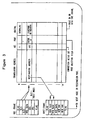
- Each of the translation RAMs 48-0 - 48-N respectively coupled to the FRYPAMs 44-0 - 44-N comprises a look-up table shown in FIG. 3 that contains a list of destination addresses, connection active bits, port selection fields and control field.
- the extracted DLCI address field provides an index to a new destination address in the table.
- the new destination address is read from the translation RAM to replace the address in the received frame. The same index is used to select the destination port and to determine additional functions to be performed with the received frame. If the connection active bit indicates that the DLCI is not active, the frame is discarded.
- the receiving FRYPAM If the frame is to be relayed, its DLCI is replaced with the new destination address, and the receiving FRYPAM generates a write control signal WR CNTL and addressing signal ADDR to write the new address together with the remaining frame data in the location of the frame buffer RAM.
- the receiving FRYPAM sends a packet availability message to the destination transmitting FRYPAM via inter FRYPAM communication link 56 that connects all of the transmitting and receiving FRYPAMs.
- the identification number of the destination FRYPAM is read from the look-up table in the translation RAM.
- the packet availability message comprises the address of the frame in the frame buffer RAM and byte counts indicating the length of the frame.
- the transmitting FRYPAM maintains a transmit queue for all frames it must transmit. It generates a read control signal RD CNTL and addressing signal ADDR to read the frames from the frame buffer RAM 46 and to send them to the corresponding transmitting LID 50 in the HDLC format (HDLC data) together with a clock signal CLK.
- the transmitting LIDs convert the HDLC data from the FRYPAMs to the format appropriate for the specific line interface. This information is then transmitted over the communication lines 52 to the receiving end device or data terminal.
- the FRYPAM receiving and transmitting sections may be implemented in an integral device. The frame processing procedure performed by the receiving and transmitting FRYPAMs and their structure are disclosed in more detail later.
- the transmission FRYPAM sends this frame to a control and maintenance processor 60 that handles control and maintenance operations in the switching network.
- the processor 60 uses the control and maintenance frames to update the contents of the translation RAMs in real time as virtual connections are altered. It may also perform call processing functions to support switched services and respond to or initiate maintenance operations (for example, loopbacks or error counts) throughout the network.
- the control and maintenance processor 60 communicates DLCI and line interface parameters to LIDs via an inter LID link 58 that connects all of the LIDs to each other and to the processor 60.
- the receiving FRYPAMs write the received frames into the frame buffer RAM 46.
- a frame buffer manager 62 that maintains a dynamic list of available frame buffers of the RAM provides allocation of the frame buffers for the receiving FRYPAM operations.
- the communication between the FRYPAMs and the frame buffer manager occurs over a frame buffer allocation link 64 that connects all of the FRYPAMs to each other and to the frame buffer manager 62. Over this link, the transmitting FRYPAMs send deallocating signals that cause the frame buffer manager to release the allocated buffers when the data has been transmitted on the line.
- the frame buffer continuously tries to maintain buffers for all receiving FRYPAMs.
- the received frame is discarded. All frames are allocated the same amount of space in the frame buffer RAM. This space may be large enough to buffer the largest frame available on the network (typically 4K bytes). As shown in more detail later, the allocation may be performed by hardware.
- the LIDs may perform cell assembly and disassembly in addition to the line interface functions. Further, LIDs may extract the addressing information from the cell header and transform this data into an HDLC formatted fixed length frame. As a result, the FRYPAM operations are performed in the same way as for the frame relay switching.
- the structure and operation of the system shown in FIG. 2 are disclosed in more detail in my copending application SN , entitled “Modular Architecture for Fast-Packet Network,” filed concurrently herewith and incorporated by reference.
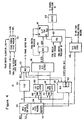
- FIG. 4 of the drawings showing the receiving section 44 of the FRYPAM that interacts with the XLAT RAM 48.
- the FRYPAM is supplied with data in the HDLC format shown in FIG. 1 and with a clock signal.
- a receiving circuit 402 receives the HDLC frame and clock and checks CRC information in the FCS field.
- the received information is supplied to a receiving state machine 404 that controls the DLCI translation procedure. As shown in FIG. 1, two 8 bit bytes following the flag field contain a 10 bit DLCI.
- state 0 the receiving state machine waits for the flag of the HDLC frame. If the flag is found, the state machine proceeds to state 1.
- state machine 404 checks the next byte of the frame. If the next byte is a flag, the machine remains in state 1. If the next byte indicates an abort status, the machine returns to state 0. If the next byte is data, they are transferred to a first byte latch 406 through a multiplexer 408, and the state machine proceeds to state 2.
- a byte counter 414 counts the data bytes processed by the state machine starting with the first data byte.
- the receiving state machine checks the next byte of the frame. If the next byte is a flag, the machine returns to state 1. If the next byte indicates an abort status, the machine returns to state 0. If the next byte is data, it is transferred to a second byte latch 410 through a multiplexer 412, and machine proceeds to state 3.
- the state machine 404 shifts the 16 bit data from first and second byte latches 406 and 410 through a DLCI extractor 416 to extract the received 10 bit DLCI field.
- this 10 bit value as an address is supplied to the address input of the XLAT RAM 48.
- the receiving state machine supplies a read enabling signal to the XLAT RAM 48 to read data from the location having the address indicated by the 10 bit DLCI value.
- the XLAT RAM contains a list of destination addresses, connection active bits, port selection fields and functions to be performed with the received frames.
- the extracted DLCI value provides an index to read the list corresponding to the received frame.
- the new destination address read from the list is supplied to a latch 422 of a mixer 424.
- the control information read from the XLAT RAM is loaded into a control information latch 426. If the XLAT RAM indicates that the received frame is a control frame that carries control and maintenance information, the control frame through a buffer 428 is supplied to the control and maintenance processor 60.
- the buffer 428 is used to verify that the data written to the XLAT RAM is correct.
- control and maintenance processor 60 is responsible for updating the information stored in the XLAT RAM 64. It sends to the XLAT RAM 48 an address signal via the multiplexer 418, read enabling signal via the multiplexer 420, write enabling signal and data to be written.
- the processor 60 updates DLCI, activity status and destination parameters stored in the XLAT RAM and initializes the XLAT RAM to a preset state after supplying with power or after a reset condition.
- the control and maintenance processor may access the XLAT RAM to perform a memory test and to query connection information in real time via the units 428 and 420.
- the control information latch 426 supplies the receiving state machine 404 with the control information to determine whether or not the new destination address is active. If so, the state machine provides the mixer 424 with a replacement enabling signal to rewrite the new 10 bit destination address from the latch 422 to the current DLCI field in the first and second byte latches 406 and 410.
- the byte counter 414 is set to 2 and the receiving state machine proceeds to state 4 sending a start allocation signal to a frame control state machine 430 to start transfer of the received data frame to the frame buffer RAM 46.
- the receiving state machine 404 determines whether a next byte of the data flow has been received or not. If so, the receiving state machine checks this byte. If it is a flag, the machine returns to state 1. If the byte indicates an abort status, the machine returns to state 0. If the byte is data from the HDLC information field, the data is written into a FIFO register 432, and the byte counter 414 is incremented. If the next byte is determined to be CRC data from the first FCS field, this CRC data is not stored, and the byte counter 414 is not incremented.
- the receiving state machine 404 sends the CRC check status and the byte count of the byte counter 414 to the frame control machine 430 and again proceeds to state 0. If the frame control machine 430 indicates an error condition, it proceeds to state 0 to discard the frame.
- the frame control machine 430 is responsible for translation of the DLCI and preparation of the data for transferring to the frame buffer RAM. Also, the frame control state machine attempts to move the data to the frame buffer RAM and informs the destination FRYPAM that a new frame is available for transmission.
- the frame control machine waits for the start allocation signal from the receiving state machine 404. If the signal is received, the frame control machine proceeds to state 1.
- the frame control machine over the frame buffer allocation link 64 requests the frame buffer manager 62 to allocate a buffer in the frame buffer RAM to the received frame. If in response the frame buffer manager sends a buffer address, the address is saved, and the frame control machine proceeds to state 2. If in response the frame buffer manager indicates that no room is available in the frame buffer RAM, the frame control machine sends an error message to the receiving state machine 404 to discard the frame and returns to state 0.
- the frame control machine sends a control signal to a multiplexer 434 to enable writing the values stored in the first and second byte latches 406 and 410 into the frame buffer RAM using the buffer address (address from the frame buffer manager times frame buffer size). Then, the frame control machine proceeds to state 3.
- state 3 if data is in the FIFO register 432, the frame control machine sends a control signal to the multiplexer 434 to enable writing the data stored in the FIFO register to the frame buffer RAM. If CRC, rather than the information field data has been received and is incorrect, the frame control machine proceeds to state 4. However, if the received CRC is correct, the frame control machine goes to state 5.
- a packet availability message is transferred to the designated destination FRYPAM to inform that the received frame is available for transmission.
- the identification number of the destination FRYPAM is read from the control information latch 426 that receives this number from the XLAT RAM 48.
- the packet availability message includes the buffer address and the byte count of the counter 414.
- the designated destination FRYPAM If the designated destination FRYPAM is not able to transmit the frame, it sends a negative acknowledgement message. In response, the frame control machine proceeds to state 4 to release the allocated buffer. If the designated destination FRYPAM is ready for transmission, the frame control machine returns to state 0.
- the transmitting section 54 of the destination FRYPAM comprises a FIFO register 502 coupled to an HDLC transmitter 504 that provides HDLC framing and CRC generation to form the HDLC data frame sent to the LID together with a clock signal.
- the FIFO register 502 receives the data flow read from the frame buffer RAM to provide compensation for frame buffer access latencies when multiple FRYPAMs are accessing a common frame buffer RAM.
- the frame buffer RAM may supply data in 16, 32 or larger bit width
- the FIFO register 502 adopts the data flow to the HDLC transmitter that operates on a byte basis. Hence, multiple bytes may be transmitted with each transfer to provide more efficient access to the frame buffer RAM.
- the FIFO register 502 should be large enough to ensure that the frame buffer RAM access latency will never allow the FIFO register to become empty during the transmission of a frame. Otherwise, the HDLC transmitter 504 would be forced to underrun and possibly send erroneous data to the LID. If such a condition occurs, the HDLC transmitter sends an incorrect CRC that causes the frame to be discarded. The current frame would be retransmitted.
- the packet availability message from the inter FRYPAM link is received by a transmit queue handler 506 that controls a transmit queue formed as a result of requests for frame transmission.
- the transmit queue handler is also responsible for clearing the transmit queue on power up or after a reset condition. All FRYPAMs have unique physical addresses that are programmable by external means, for example hardware address straps or software addressable latches.
- the transmit queue handler 506 adds this request to the transmit queue stored in a register 508, which may be a FIFO register or ROM capable of storing more than one request. If the transmit queue register is full, the handler sends a negative acknowledgement message to the source FRYPAM that causes the frame to be discarded. When the transmit queue register is empty, the HDLC transmitter 504 sends flags.
- the transmit queue is supplied to a transmitting state machine 510 that controls the flow of frames sent from the frame buffer RAM through the HDLC transmitter to the corresponding LID. It also removes transmit queue entries and releases the allocated buffers in the frame buffer RAM when the entire frame has been sent to the LID.
- the transmitting state machine 510 When the transmit queue register 508 is empty, the transmitting state machine 510 is in state 0, waiting for the requests (packet availability messages) from the inter FRYPAM link. When a request is put into the transmit queue, the state machine proceeds to state 1.
- the state machine 510 reads the buffer address and byte count contained in the packet availability message put into the transmit queue and computes the actual buffer address transferred to the frame buffer RAM together with a control signal to read the corresponding data frame from the frame buffer RAM.
- the read data are supplied to the FIFO register 502 that stores the data until the FIFO register is full or the entire data frame is in the FIFO register.
- the state machine 510 proceeds to state 2. If the FIFO register is not full and the entire frame is still not contained in the FIFO register, the state machine reads the next location from frame buffer RAM and stores the data in the FIFO register until the FIFO register is full or the entire data frame is in the FIFO register.
- state 2 if the HDLC transmitter is available, the state machine 510 sends a control signal to the FIFO register 502 to transfer a byte of the data from the FIFO register to the HDLC transmitter for sending to the LID. The byte count is decremented. This procedure is performed repeatedly until the resulting byte count is 0. Then, the state machine proceeds to state 3.
- the transmitting state machine 510 instructs the HDLC transmitter to form CRC bytes to be sent to the LID. Then, the frame buffer manager is sent a frame buffer release message via the frame buffer allocation link to release the buffer allocated to the transmitted frame. The corresponding entry is removed from the transmit queue and the state machine 510 returns to state 0.
- the receiving circuit receives incoming HDLC data frames and replaces DLCIs of the incoming HDLC data frames with the destination DLCIs stored in the location of a translation RAM designated by the incoming DLCI.
- the translated data frames are written into a frame buffer RAM.
- a packet availability message is sent to the destination FRYPAM selected in accordance with control data stored in the designated location of the translation RAM.
- the transmitting circuit of the destination FRYPAM reads the data frames from the frame buffer RAM and supplies them to the destination LID.
- the disclosed packet management device supports fast-packet switching protocols in hardware.
Landscapes
- Engineering & Computer Science (AREA)
- Computer Networks & Wireless Communication (AREA)
- Signal Processing (AREA)
- Computer Security & Cryptography (AREA)
- Environmental & Geological Engineering (AREA)
- Data Exchanges In Wide-Area Networks (AREA)
- Use Of Switch Circuits For Exchanges And Methods Of Control Of Multiplex Exchanges (AREA)
Applications Claiming Priority (2)
| Application Number | Priority Date | Filing Date | Title |
|---|---|---|---|
| US207520 | 1994-03-08 | ||
| US08/207,520 US5459723A (en) | 1994-03-08 | 1994-03-08 | Packet management device for fast-packet network |
Publications (3)
| Publication Number | Publication Date |
|---|---|
| EP0676879A2 EP0676879A2 (en) | 1995-10-11 |
| EP0676879A3 EP0676879A3 (en) | 2002-11-27 |
| EP0676879B1 true EP0676879B1 (en) | 2007-04-25 |
Family
ID=22770934
Family Applications (1)
| Application Number | Title | Priority Date | Filing Date |
|---|---|---|---|
| EP95300390A Expired - Lifetime EP0676879B1 (en) | 1994-03-08 | 1995-01-23 | Packet management device for fast-packet network |
Country Status (7)
| Country | Link |
|---|---|
| US (1) | US5459723A (enExample) |
| EP (1) | EP0676879B1 (enExample) |
| JP (1) | JP3682082B2 (enExample) |
| KR (1) | KR100316295B1 (enExample) |
| AT (1) | ATE360941T1 (enExample) |
| DE (1) | DE69535477T2 (enExample) |
| TW (1) | TW318986B (enExample) |
Families Citing this family (35)
| Publication number | Priority date | Publication date | Assignee | Title |
|---|---|---|---|---|
| US6847611B1 (en) | 1990-12-10 | 2005-01-25 | At&T Corp. | Traffic management for frame relay switched data service |
| CA2143495A1 (en) * | 1994-03-21 | 1995-09-22 | Rasoul M. Oskouy | Method and apparatus for reordering incoming interleaved asynchronous transfer mode cells |
| JP3641834B2 (ja) * | 1994-03-24 | 2005-04-27 | 株式会社日立製作所 | 並列プロセッサシステムおよびそれに適したパケット廃棄方法 |
| US5533017A (en) | 1994-05-02 | 1996-07-02 | Advanced Micro Devices, Inc. | Line interface device for fast-packet switching network |
| EP0700229B1 (en) * | 1994-08-22 | 2006-06-28 | Fujitsu Limited | Connectionless communications system, test method, and intra-station control system |
| US5944804A (en) * | 1995-09-11 | 1999-08-31 | Intel Corporation | Super pipelined architecture for transmit flow in a network controller |
| US5758089A (en) * | 1995-11-02 | 1998-05-26 | Sun Microsystems, Inc. | Method and apparatus for burst transferring ATM packet header and data to a host computer system |
| US5671223A (en) * | 1995-11-30 | 1997-09-23 | Motorola, Inc. | Multichannel HDLC framing/deframing machine |
| US6023472A (en) * | 1996-07-08 | 2000-02-08 | Lancast, Inc. | High speed FD/HD data translator and network |
| US5805595A (en) * | 1996-10-23 | 1998-09-08 | Cisco Systems, Inc. | System and method for communicating packetized data over a channel bank |
| US6320872B1 (en) | 1997-02-14 | 2001-11-20 | Metrobility Optical Systems, Inc. | Serially buffered medium translator |
| US6424627B1 (en) | 1997-02-24 | 2002-07-23 | Metrobility Optical Systems | Full-duplex medium tap apparatus and system |
| US6058479A (en) * | 1997-05-05 | 2000-05-02 | Lancast, Inc. | Redundant path data switch and media translator |
| US6301259B1 (en) | 1997-05-26 | 2001-10-09 | Mitsubishi Denki Kabushiki Kaisha | Switch and switching method |
| US6081524A (en) | 1997-07-03 | 2000-06-27 | At&T Corp. | Frame relay switched data service |
| US6141348A (en) * | 1997-08-25 | 2000-10-31 | Cisco Technology, Inc. | Constant-time programmable field extraction system and method |
| US6512773B1 (en) * | 1997-12-30 | 2003-01-28 | Paradyne Corporation | System and method for transporting information over a communication channel |
| US6252887B1 (en) * | 1998-01-28 | 2001-06-26 | Northern Telecom Limited | Cell to frame conversion management |
| US6493352B1 (en) * | 1998-05-15 | 2002-12-10 | Paradyne Corporation | Automatic configuration system which analyzes HDLC flag data in TDM time slots for determining which time slot(s) is dedicated for frame relay service |
| KR20000046137A (ko) * | 1998-12-31 | 2000-07-25 | 김영환 | Hdlc 라우터에서의 패킷 에러 제거 장치 및 방법 |
| US6453357B1 (en) * | 1999-01-07 | 2002-09-17 | Cisco Technology, Inc. | Method and system for processing fragments and their out-of-order delivery during address translation |
| KR20010027336A (ko) * | 1999-09-13 | 2001-04-06 | 박종섭 | 에이치디엘씨 통신용 라우터 |
| US6781956B1 (en) | 1999-09-17 | 2004-08-24 | Cisco Technology, Inc. | System and method for prioritizing packetized data from a distributed control environment for transmission through a high bandwidth link |
| US6970563B1 (en) * | 2000-06-01 | 2005-11-29 | Mindspeed Technologies, Inc. | System for fast scrambling and descrambling of data |
| KR20010000336A (ko) * | 2000-09-16 | 2001-01-05 | 최종선 | 방송문안 자동편집 송출방법 및 장치 |
| KR20020069448A (ko) * | 2001-02-26 | 2002-09-04 | 삼성전자 주식회사 | 고속 패킷 버스 장치 |
| JP2003124962A (ja) * | 2001-10-18 | 2003-04-25 | Fujitsu Ltd | パケット転送装置、パケット転送方法、および、半導体装置 |
| WO2003067383A2 (en) * | 2002-02-04 | 2003-08-14 | Intel Corporation | Services processor having a packet editing unit |
| US20070058671A1 (en) * | 2005-09-13 | 2007-03-15 | Hart Thomas B | Method and apparatus for packetization of data frames |
| US7953907B1 (en) * | 2006-08-22 | 2011-05-31 | Marvell International Ltd. | Concurrent input/output control and integrated error management in FIFO |
| US8687649B2 (en) | 2011-03-08 | 2014-04-01 | International Business Machines Corporation | Message forwarding toward a source end node in a converged network environment |
| GB2533532A (en) * | 2013-09-13 | 2016-06-22 | Smg Holdings-Anova Tech Llc | High payload data packet transmission system and relay to lower latency |
| US11044183B2 (en) * | 2015-12-29 | 2021-06-22 | Xilinx, Inc. | Network interface device |
| US11165683B2 (en) | 2015-12-29 | 2021-11-02 | Xilinx, Inc. | Network interface device |
| CN113949600B (zh) * | 2021-10-19 | 2023-04-18 | 中国电子科技集团公司第五十八研究所 | 一种1553b总线接入时间触发网络的方法和装置 |
Family Cites Families (12)
| Publication number | Priority date | Publication date | Assignee | Title |
|---|---|---|---|---|
| EP0097351A3 (en) * | 1982-06-21 | 1986-02-26 | Nec Corporation | Router unit and routing network for determining an output port by detecting a part of an input packet |
| FR2642247B1 (fr) * | 1988-12-30 | 1991-04-05 | Cit Alcatel | Systeme d'emission de trames hdlc sur canal de type mic, a circuit hdlc unique et memoire tampon de transposition |
| US4933938A (en) * | 1989-03-22 | 1990-06-12 | Hewlett-Packard Company | Group address translation through a network bridge |
| US5086428A (en) * | 1989-06-09 | 1992-02-04 | Digital Equipment Corporation | Reliable broadcast of information in a wide area network |
| US5189672A (en) * | 1989-10-12 | 1993-02-23 | Alcatel Cit | Device for regulating the throughput of virtual circuits on an asynchronous time-division multiplex transmission channel |
| US5136584A (en) * | 1990-07-11 | 1992-08-04 | At&T Bell Laboratories | Hardware interface to a high-speed multiplexed link |
| DE4103704A1 (de) * | 1990-07-18 | 1992-01-23 | Bosch Gmbh Robert | Druckgeber zur druckerfassung im brennraum von brennkraftmaschinen |
| EP0531599B1 (en) * | 1991-09-13 | 1998-07-22 | International Business Machines Corporation | Configurable gigabit/s switch adapter |
| US5251207A (en) * | 1992-03-10 | 1993-10-05 | International Business Machines Corporation | Combined terminal adapter for SMDS and frame relay high speed data services |
| WO1993026109A1 (en) * | 1992-06-17 | 1993-12-23 | The Trustees Of The University Of Pennsylvania | Apparatus for providing cryptographic support in a network |
| US5361259A (en) * | 1993-02-19 | 1994-11-01 | American Telephone And Telegraph Company | Wide area network (WAN)-arrangement |
| US5363369A (en) * | 1993-03-31 | 1994-11-08 | At&T Bell Laboratories | System for inter packet community communication |
-
1994
- 1994-03-08 US US08/207,520 patent/US5459723A/en not_active Expired - Lifetime
- 1994-09-05 TW TW083108145A patent/TW318986B/zh not_active IP Right Cessation
-
1995
- 1995-01-23 DE DE69535477T patent/DE69535477T2/de not_active Expired - Lifetime
- 1995-01-23 AT AT95300390T patent/ATE360941T1/de not_active IP Right Cessation
- 1995-01-23 EP EP95300390A patent/EP0676879B1/en not_active Expired - Lifetime
- 1995-02-16 KR KR1019950002905A patent/KR100316295B1/ko not_active Expired - Lifetime
- 1995-02-22 JP JP03336395A patent/JP3682082B2/ja not_active Expired - Lifetime
Also Published As
| Publication number | Publication date |
|---|---|
| JP3682082B2 (ja) | 2005-08-10 |
| KR950035216A (ko) | 1995-12-30 |
| KR100316295B1 (ko) | 2002-02-28 |
| DE69535477T2 (de) | 2008-01-03 |
| TW318986B (enExample) | 1997-11-01 |
| DE69535477D1 (de) | 2007-06-06 |
| JPH07273799A (ja) | 1995-10-20 |
| US5459723A (en) | 1995-10-17 |
| ATE360941T1 (de) | 2007-05-15 |
| EP0676879A2 (en) | 1995-10-11 |
| EP0676879A3 (en) | 2002-11-27 |
Similar Documents
| Publication | Publication Date | Title |
|---|---|---|
| EP0676879B1 (en) | Packet management device for fast-packet network | |
| US5448564A (en) | Modular architecture for fast-packet network | |
| US5619500A (en) | ATM network interface | |
| US5815501A (en) | ATM-ethernet portal/concentrator | |
| AU677125B2 (en) | Connectionless communication system | |
| KR100329130B1 (ko) | 데이타전달스위치,억세스제어형비동기식전달모드(atm)스위치및정보셀흐름제어방법 | |
| US5414707A (en) | Broadband ISDN processing method and system | |
| AU745753B2 (en) | System supporting variable bandwidth asynchronous transfer mode network access for wireline and wireless communications | |
| US5420858A (en) | Method and apparatus for communications from a non-ATM communication medium to an ATM communication medium | |
| US6064649A (en) | Network interface card for wireless asynchronous transfer mode networks | |
| CA2283999C (en) | Packet processing apparatus, packet processing method, and packet exchange | |
| EP0685951B1 (en) | Line interface devices for fast-packet networks | |
| US6208650B1 (en) | Circuit for performing high-speed, low latency frame relay switching with support for fragmentation and reassembly and channel multiplexing | |
| EP0691769A1 (en) | Voice circuit emulation system in a packet switching network | |
| JPH0918435A (ja) | 無線atmシステム | |
| US6810424B2 (en) | Link layer device and method of translating packets between transport protocols | |
| US6101192A (en) | Network router with partitioned memory for optimized data storage and retrieval | |
| WO1987002207A1 (en) | Packet switching system | |
| KR100236035B1 (ko) | Atm 망접속기에서 서브 테이블을 이용하여 가상채널의 대역을 할당하는 방법 | |
| US6594237B1 (en) | Fixed length data processing apparatus | |
| US5787075A (en) | Switched multi-megabit digital service switching apparatus | |
| US6804242B1 (en) | Method and apparatus for the channelization of cell or packet traffic over standard PC buses | |
| KR100236036B1 (ko) | Atm 망접속기에서 수신 셀 폐기방법 | |
| KR100236037B1 (ko) | Atm 망접속기에서 수신 셀 폐기방법 | |
| KR20030069671A (ko) | 통신 시스템에서 셀 전송 장치 및 방법 |
Legal Events
| Date | Code | Title | Description |
|---|---|---|---|
| PUAI | Public reference made under article 153(3) epc to a published international application that has entered the european phase |
Free format text: ORIGINAL CODE: 0009012 |
|
| AK | Designated contracting states |
Kind code of ref document: A2 Designated state(s): AT BE DE DK ES FR GB GR IE IT LU NL PT SE |
|
| PUAL | Search report despatched |
Free format text: ORIGINAL CODE: 0009013 |
|
| AK | Designated contracting states |
Kind code of ref document: A3 Designated state(s): AT BE DE DK ES FR GB GR IE IT LU NL PT SE |
|
| 17P | Request for examination filed |
Effective date: 20030501 |
|
| 17Q | First examination report despatched |
Effective date: 20040622 |
|
| GRAP | Despatch of communication of intention to grant a patent |
Free format text: ORIGINAL CODE: EPIDOSNIGR1 |
|
| GRAS | Grant fee paid |
Free format text: ORIGINAL CODE: EPIDOSNIGR3 |
|
| GRAA | (expected) grant |
Free format text: ORIGINAL CODE: 0009210 |
|
| AK | Designated contracting states |
Kind code of ref document: B1 Designated state(s): AT BE DE DK ES FR GB GR IE IT LU NL PT SE |
|
| REG | Reference to a national code |
Ref country code: GB Ref legal event code: FG4D |
|
| REG | Reference to a national code |
Ref country code: IE Ref legal event code: FG4D |
|
| REF | Corresponds to: |
Ref document number: 69535477 Country of ref document: DE Date of ref document: 20070606 Kind code of ref document: P |
|
| PG25 | Lapsed in a contracting state [announced via postgrant information from national office to epo] |
Ref country code: SE Free format text: LAPSE BECAUSE OF FAILURE TO SUBMIT A TRANSLATION OF THE DESCRIPTION OR TO PAY THE FEE WITHIN THE PRESCRIBED TIME-LIMIT Effective date: 20070725 |
|
| PG25 | Lapsed in a contracting state [announced via postgrant information from national office to epo] |
Ref country code: ES Free format text: LAPSE BECAUSE OF FAILURE TO SUBMIT A TRANSLATION OF THE DESCRIPTION OR TO PAY THE FEE WITHIN THE PRESCRIBED TIME-LIMIT Effective date: 20070805 |
|
| PG25 | Lapsed in a contracting state [announced via postgrant information from national office to epo] |
Ref country code: PT Free format text: LAPSE BECAUSE OF FAILURE TO SUBMIT A TRANSLATION OF THE DESCRIPTION OR TO PAY THE FEE WITHIN THE PRESCRIBED TIME-LIMIT Effective date: 20070925 |
|
| NLV1 | Nl: lapsed or annulled due to failure to fulfill the requirements of art. 29p and 29m of the patents act | ||
| PG25 | Lapsed in a contracting state [announced via postgrant information from national office to epo] |
Ref country code: AT Free format text: LAPSE BECAUSE OF FAILURE TO SUBMIT A TRANSLATION OF THE DESCRIPTION OR TO PAY THE FEE WITHIN THE PRESCRIBED TIME-LIMIT Effective date: 20070425 |
|
| EN | Fr: translation not filed | ||
| PG25 | Lapsed in a contracting state [announced via postgrant information from national office to epo] |
Ref country code: BE Free format text: LAPSE BECAUSE OF FAILURE TO SUBMIT A TRANSLATION OF THE DESCRIPTION OR TO PAY THE FEE WITHIN THE PRESCRIBED TIME-LIMIT Effective date: 20070425 |
|
| PG25 | Lapsed in a contracting state [announced via postgrant information from national office to epo] |
Ref country code: NL Free format text: LAPSE BECAUSE OF FAILURE TO SUBMIT A TRANSLATION OF THE DESCRIPTION OR TO PAY THE FEE WITHIN THE PRESCRIBED TIME-LIMIT Effective date: 20070425 Ref country code: DK Free format text: LAPSE BECAUSE OF FAILURE TO SUBMIT A TRANSLATION OF THE DESCRIPTION OR TO PAY THE FEE WITHIN THE PRESCRIBED TIME-LIMIT Effective date: 20070425 |
|
| PLBE | No opposition filed within time limit |
Free format text: ORIGINAL CODE: 0009261 |
|
| STAA | Information on the status of an ep patent application or granted ep patent |
Free format text: STATUS: NO OPPOSITION FILED WITHIN TIME LIMIT |
|
| 26N | No opposition filed |
Effective date: 20080128 |
|
| PG25 | Lapsed in a contracting state [announced via postgrant information from national office to epo] |
Ref country code: IT Free format text: LAPSE BECAUSE OF FAILURE TO SUBMIT A TRANSLATION OF THE DESCRIPTION OR TO PAY THE FEE WITHIN THE PRESCRIBED TIME-LIMIT Effective date: 20070425 Ref country code: GR Free format text: LAPSE BECAUSE OF FAILURE TO SUBMIT A TRANSLATION OF THE DESCRIPTION OR TO PAY THE FEE WITHIN THE PRESCRIBED TIME-LIMIT Effective date: 20070726 Ref country code: FR Free format text: LAPSE BECAUSE OF FAILURE TO SUBMIT A TRANSLATION OF THE DESCRIPTION OR TO PAY THE FEE WITHIN THE PRESCRIBED TIME-LIMIT Effective date: 20071221 |
|
| PG25 | Lapsed in a contracting state [announced via postgrant information from national office to epo] |
Ref country code: FR Free format text: LAPSE BECAUSE OF FAILURE TO SUBMIT A TRANSLATION OF THE DESCRIPTION OR TO PAY THE FEE WITHIN THE PRESCRIBED TIME-LIMIT Effective date: 20070425 |
|
| PG25 | Lapsed in a contracting state [announced via postgrant information from national office to epo] |
Ref country code: IE Free format text: LAPSE BECAUSE OF NON-PAYMENT OF DUE FEES Effective date: 20080123 |
|
| PG25 | Lapsed in a contracting state [announced via postgrant information from national office to epo] |
Ref country code: LU Free format text: LAPSE BECAUSE OF NON-PAYMENT OF DUE FEES Effective date: 20080123 |
|
| PGFP | Annual fee paid to national office [announced via postgrant information from national office to epo] |
Ref country code: DE Payment date: 20140115 Year of fee payment: 20 |
|
| PGFP | Annual fee paid to national office [announced via postgrant information from national office to epo] |
Ref country code: GB Payment date: 20140122 Year of fee payment: 20 |
|
| REG | Reference to a national code |
Ref country code: DE Ref legal event code: R071 Ref document number: 69535477 Country of ref document: DE |
|
| REG | Reference to a national code |
Ref country code: GB Ref legal event code: PE20 Expiry date: 20150122 |
|
| PG25 | Lapsed in a contracting state [announced via postgrant information from national office to epo] |
Ref country code: GB Free format text: LAPSE BECAUSE OF EXPIRATION OF PROTECTION Effective date: 20150122 |