EP0674460B1 - A method of routing a request for a virtual circuit based on information from concurent requests - Google Patents
A method of routing a request for a virtual circuit based on information from concurent requests Download PDFInfo
- Publication number
- EP0674460B1 EP0674460B1 EP95301759A EP95301759A EP0674460B1 EP 0674460 B1 EP0674460 B1 EP 0674460B1 EP 95301759 A EP95301759 A EP 95301759A EP 95301759 A EP95301759 A EP 95301759A EP 0674460 B1 EP0674460 B1 EP 0674460B1
- Authority
- EP
- European Patent Office
- Prior art keywords
- routing
- requests
- path
- network
- function
- Prior art date
- Legal status (The legal status is an assumption and is not a legal conclusion. Google has not performed a legal analysis and makes no representation as to the accuracy of the status listed.)
- Expired - Lifetime
Links
Images


Classifications
-
- H—ELECTRICITY
- H04—ELECTRIC COMMUNICATION TECHNIQUE
- H04L—TRANSMISSION OF DIGITAL INFORMATION, e.g. TELEGRAPHIC COMMUNICATION
- H04L45/00—Routing or path finding of packets in data switching networks
- H04L45/22—Alternate routing
-
- H—ELECTRICITY
- H04—ELECTRIC COMMUNICATION TECHNIQUE
- H04Q—SELECTING
- H04Q3/00—Selecting arrangements
- H04Q3/64—Distributing or queueing
- H04Q3/66—Traffic distributors
-
- Y—GENERAL TAGGING OF NEW TECHNOLOGICAL DEVELOPMENTS; GENERAL TAGGING OF CROSS-SECTIONAL TECHNOLOGIES SPANNING OVER SEVERAL SECTIONS OF THE IPC; TECHNICAL SUBJECTS COVERED BY FORMER USPC CROSS-REFERENCE ART COLLECTIONS [XRACs] AND DIGESTS
- Y10—TECHNICAL SUBJECTS COVERED BY FORMER USPC
- Y10S—TECHNICAL SUBJECTS COVERED BY FORMER USPC CROSS-REFERENCE ART COLLECTIONS [XRACs] AND DIGESTS
- Y10S379/00—Telephonic communications
- Y10S379/901—Virtual networks or virtual private networks
Definitions
- the invention relates to the routing of multiple virtual circuits in networks.
- Computer networks are a principal means of exchanging or transferring information (e.g. data, voice, text, video, etc.) among host machines connected to the network.
- the network comprises nodes connected, to each other and to the hosts, by links.
- each link is bidirectional, i.e. information may be conveyed in forward and reverse directions, and each link is characterized by a bandwidth capacity in each direction.
- VC virtual circuit
- the task of routing is to select the nodes and links between the nodes that comprise the path taken by the VC so as to efficiently utilize network resources, e.g. route as many VCs as possible without exceeding the bandwidth capacity of any particular link.
- cost functions typically take into account the current network state (i.e., the network topology and current allocation of network resources), delay through the network, etc.
- the routing problem is often further complicated in that the routing must be effectuated "on-line,” i.e. without knowledge of what effect future routing demands will have on network resources.
- C l (x, ⁇ x) is the cost for link l in the path
- a is a constant
- x 1 is the fraction of the bandwidth capacity of the link that is in use
- ⁇ x l is the fraction of the bandwidth capacity of the link that is requested by the VC.
- a method according to the invention is as set out in claim 1. Preferred forms are set out in the dependent claims.
- routing techniques do not take into account information available in a "multiple VC request" situation.
- the network may have received two or more concurrent requests to establish VCs.
- Prior methods simply respond to one of the multiple requests for a VC and route the requested VC, e.g. according to a first-come, first-served discipline, without checking to determine the demands of the other requests.
- the routing is truly of the "on-line" type described above even though the network does have some information about what further network routing demands will be as a result of the fact that other requests were concurrently received.
- a method for routing a set of concurrent requests for virtual circuits, wherein each virtual circuit request is specified by one or more parameters, by routing each request in the set as a function of one or more parameters of a plurality of the requests.
- a set of concurrent requests is ordered according to one or more of the parameters, and the requests are then routed in that order.
- the routing may be refined by using a local search to exploit to a greater extent the information available from multiple requests for virtual circuits.
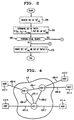
- FIG. 1 illustrates the structure of a network in which the invention may be practiced.
- a pair of nodes may be connected by one or more links.
- Network 106 in FIG. 1 is a centralized routing system in that network 106 utilizes complete information for routing through use of centralized routing request processor 111.
- the cost for any path (i.e. the additional network resources required for any path) through the network can be determined, and, using the inventive method described below, all VCs in network 106 of FIG. 1 can be routed efficiently with respect to a given criterion, e.g. maximizing the total amount of bandwidth routed.
- FIG. 2 is a flowchart of an illustrative routing method with which the present invention may be used.
- each VC req i may be specified by the source host S i , destination host D i , bandwidth requested in the forward direction B f i and bandwidth requested in the reverse direction B r i
- VC req i ( S i , D i , B f i , B r i )
- step 205 of FIG. 2 the information available in the multiple VC request situation is used in routing. Specifically, for each individual request in the set of requests, a path is selected according to function of one or more parameters of a plurality of requests in the set.
- a path is selected according to function of one or more parameters of a plurality of requests in the set.
- This embodiment routes permanent VCs (i.e. VCs designed to operate and remain established for time periods on the order of years, as opposed to switched VCs which are designed to operate for hours or days) by first ordering the requests according to a parameter of the requests, e.g. bandwidth, and then using an exponential cost function to route the requests.
- the ordering process first routes of those requests requiring the most network resources according to a cost function and thus requiring the most flexibility in routing. If an objective in the routing is to conserve bandwidth, it is advantageous to order VC req i in decreasing order of total requested bandwidth (forward and reverse) so that those requests requiring large bandwidths can be accommodated without increasing the risk of exceeding the bandwidth capacity of any link.
- the information available in the multiple (switched or permanent) VC request situation may be used in a variety of ways and with a variety of, i.e. not necessarily exponential, cost functions.
- the requests can be routed on a first-come, first-served basis but with knowledge of what the average bandwidth requirement is of the requests in the set of requests.
- the cost function for the routing may reflect whether the request requires a large or small amount of bandwidth relative to other requests in the set thereby routing relatively small bandwidth requests on links already near capacity so as to conserve bandwidth on other links for large bandwidth requests.
- step 205 once a set of paths P is determined, an optional local search may be performed, as described below, to refine the set of path selections.
- step 275 of the method of FIG. 2 the set of requests are routed on the set of path P.
- the optional local search of step 265 can be used to refine the selection of paths so that the total cost of routing all VCs can be reduced.
- the steps in one embodiment of the local search of step 265 are illustrated in the flowchart of FIG. 3.
- variables are initialized.
- P is defined as the set of paths ⁇ p 1 , p 2 ,..., pi max ⁇ associated with the i max VC requests as determined by a routing method, e.g. the method of FIG. 2.
- the current set of best paths for routing is stored in P * and the cost of routing that current set of best paths is C* .
- a particular VC req i and its associated path p i are selected.
- the VC req i are selected in increasing order of i .
- a search is made for a lowest cost path p * for routing VC req i (using, for example, Cosr 1 ) assuming all other VC req i are routed as in the set P .
- a new set of paths, P ⁇ is formed in step 320 by setting P ⁇ to P except for the selected p i , which is setter*.
- step 330 if C ( P ⁇ ) ⁇ C * , then P * and C * are set to P ⁇ and C ( P ⁇ ) , respectively, and impflag is set to one.
- Steps 315-340 are repeated for each successive VC req i .
- impflag is checked to see if any improvement in routing is possible. If impflag is zero, no alternative routing of any one VC req i will reduce the cost of routing all VC req i , and the search is ended.
- step 345 if impflag has been set to one, there exists an alternative routing (i.e. a new shortest path) for one VC req i that results in the greatest reduction in routing cost.
- step 355 that new lowest cost path, reflected in P * , becomes P.
- the VC req i are now to be routed according to P * at cost C(P*). Steps 310-355 are repeated until no new paths are found that reduce the cost.
- the second cost function gives the total cost of routing multiple VC req i on their associated paths.
- the steps in FIG. 3 reflect a so-called "greedy" heuristic in which each possible alternative path for each VC req i is examined to see which alternative path, if any, reduces the cost of routing by the greatest amount. That alternative path is then selected as the new path associated with the VC. The process is repeated until no alternative path for any VC req i will reduce the cost of routing all the requests.
- Those skilled in the art will recognize that other local searches utilizing other search criteria can be used. For example, instead of searching through all the alternative paths to find the one that reduces the cost of routing all VC req i the most, it may be sufficient simply to find a first alternative path that reduces costs by any amount.
- FIG. 4 illustrates the structure of a distributed network 416, comprising nodes 418-m and links 420-n, in which the inventive method may be practiced.
- Network 416 is a distributed routing system in that each node 418-m periodically exchanges state information.
- the state information reflects the amount of network resources available or in use on a link from a node to every neighboring node. Thus, the cost for any path through the network can be determined. However, unless the state information propagates quickly relative to the speed with which VCs are established and torn down, the information will be incomplete (e.g. dated). Thus, each node may have a different description of the network state, and this description is called the local network state.
- the methods described above can be used in a distributed routing system except that incomplete state information (i.e. the local network state) is used. Note however, the paths determined based on the incomplete information may no longer be available (e.g. the capacity of a link may have become exhausted since the most recent state information was received) when the VC is actually to be routed (as for example in the routing of step 275 of FIG. 2). Requests for VCs that are not successfully routed, e.g. those requests for which the selected path is not available, may be included in the next set of requests or may form a new set of requests. Note further that it is advantageous when routing in a distributed routing system not to update the local network state until an entire set of requests has been routed. This ensures that procedures, such as the search routine of FIG. 3, will terminate.
- incomplete state information i.e. the local network state
- the paths determined based on the incomplete information may no longer be available (e.g. the capacity of a link may have become exhausted since the most recent state information was received) when the
- This disclosure describes a method of routing multiple virtual circuit requests using information available in the multiple VC request situation.
- the method disclosed herein have been described without reference to specific hardware or software. Instead, the method has been described in such a manner that those skilled in the art can readily adapt such hardware and software as may be available or preferable for particular application.
Landscapes
- Engineering & Computer Science (AREA)
- Computer Networks & Wireless Communication (AREA)
- Signal Processing (AREA)
- Data Exchanges In Wide-Area Networks (AREA)
- Computer And Data Communications (AREA)
Applications Claiming Priority (2)
| Application Number | Priority Date | Filing Date | Title |
|---|---|---|---|
| US08/218,390 US5502816A (en) | 1994-03-25 | 1994-03-25 | Method of routing a request for a virtual circuit based on information from concurrent requests |
| US218390 | 1994-03-25 |
Publications (3)
| Publication Number | Publication Date |
|---|---|
| EP0674460A2 EP0674460A2 (en) | 1995-09-27 |
| EP0674460A3 EP0674460A3 (en) | 1998-01-28 |
| EP0674460B1 true EP0674460B1 (en) | 2006-01-04 |
Family
ID=22814915
Family Applications (1)
| Application Number | Title | Priority Date | Filing Date |
|---|---|---|---|
| EP95301759A Expired - Lifetime EP0674460B1 (en) | 1994-03-25 | 1995-03-16 | A method of routing a request for a virtual circuit based on information from concurent requests |
Country Status (6)
| Country | Link |
|---|---|
| US (1) | US5502816A (enExample) |
| EP (1) | EP0674460B1 (enExample) |
| JP (1) | JP3512896B2 (enExample) |
| CA (1) | CA2141354C (enExample) |
| DE (1) | DE69534729T2 (enExample) |
| ES (1) | ES2253742T3 (enExample) |
Families Citing this family (28)
| Publication number | Priority date | Publication date | Assignee | Title |
|---|---|---|---|---|
| JP3326292B2 (ja) * | 1994-05-24 | 2002-09-17 | 株式会社東芝 | 通信機器及びその通信方法 |
| JP3224963B2 (ja) | 1994-08-31 | 2001-11-05 | 株式会社東芝 | ネットワーク接続装置及びパケット転送方法 |
| JP3347914B2 (ja) * | 1995-05-26 | 2002-11-20 | シャープ株式会社 | データ管理装置 |
| US5727051A (en) * | 1995-07-14 | 1998-03-10 | Telefonaktiebolaget Lm Ericsson (Publ.) | System and method for adaptive routing on a virtual path broadband network |
| US6175870B1 (en) * | 1995-11-30 | 2001-01-16 | Lucent Technologies Inc. | Method of admission control and routing of virtual circuits |
| GB9606711D0 (en) * | 1996-03-29 | 1996-06-05 | Plessey Telecomm | Routing and bandwidth allocation |
| US5854899A (en) * | 1996-05-09 | 1998-12-29 | Bay Networks, Inc. | Method and apparatus for managing virtual circuits and routing packets in a network/subnetwork environment |
| US6961341B1 (en) * | 1996-07-02 | 2005-11-01 | Microsoft Corporation | Adaptive bandwidth throttling for network services |
| JP3332733B2 (ja) | 1996-07-11 | 2002-10-07 | 株式会社東芝 | ノード装置及びパケット転送方法 |
| SE507118C2 (sv) * | 1996-08-26 | 1998-03-30 | Ericsson Telefon Ab L M | Förfarande för att optimera ett huvudsakligen optiskt ATM- nätvärk |
| EP1021757A1 (en) * | 1997-07-25 | 2000-07-26 | Starvox, Inc. | Apparatus and method for integrated voice gateway |
| JPH1168750A (ja) * | 1997-08-22 | 1999-03-09 | Nec Corp | ネットワーク管理システム |
| FI110398B (fi) * | 1997-10-17 | 2003-01-15 | Nokia Corp | Reititys tietoliikennejärjestelmässä |
| US6757247B1 (en) * | 1998-02-20 | 2004-06-29 | Adc Telecommunications, Inc. | Circuit and method for controlling virtual connections in a ring network |
| US6850965B2 (en) * | 1998-11-17 | 2005-02-01 | Arthur Douglas Allen | Method for connection acceptance and rapid determination of optimal multi-media content delivery over network |
| US7334044B1 (en) * | 1998-11-17 | 2008-02-19 | Burst.Com | Method for connection acceptance control and optimal multi-media content delivery over networks |
| WO2002045305A1 (en) * | 2000-12-01 | 2002-06-06 | Motorola, Inc. | Methods for managing bandwidth in a packet-based communication system |
| US6996789B2 (en) * | 2002-11-18 | 2006-02-07 | Cadence Design Systems, Inc. | Method and apparatus for performing an exponential path search |
| US8300798B1 (en) | 2006-04-03 | 2012-10-30 | Wai Wu | Intelligent communication routing system and method |
| US8953486B2 (en) * | 2007-11-09 | 2015-02-10 | Cisco Technology, Inc. | Global auto-configuration of network devices connected to multipoint virtual connections |
| US8667095B2 (en) * | 2007-11-09 | 2014-03-04 | Cisco Technology, Inc. | Local auto-configuration of network devices connected to multipoint virtual connections |
| US8468537B2 (en) * | 2010-07-14 | 2013-06-18 | Fujitsu Limited | Systems and methods for distributing validation computations |
| US9178903B1 (en) | 2014-12-02 | 2015-11-03 | Synack, Inc. | Simulating a bot-net spanning a plurality of geographic regions |
| EP3750284A1 (en) * | 2018-02-23 | 2020-12-16 | Huawei Technologies Co., Ltd. | Advertising and programming preferred path routes using interior gateway protocols |
| WO2019190699A1 (en) | 2018-03-28 | 2019-10-03 | Futurewei Technologies, Inc. | Method and apparatus for preferred path route information distribution and maintenance |
| EP3785405B1 (en) | 2018-04-26 | 2025-02-26 | Huawei Technologies Co., Ltd. | Resource reservation and maintenance for preferred path routes in a network |
| WO2019212678A1 (en) | 2018-05-04 | 2019-11-07 | Futurewei Technologies, Inc. | Explicit backups and fast re-route mechanisms for preferred path routes in a network |
| WO2019236221A1 (en) | 2018-06-04 | 2019-12-12 | Futurewei Technologies, Inc. | Preferred path route graphs in a network |
Family Cites Families (10)
| Publication number | Priority date | Publication date | Assignee | Title |
|---|---|---|---|---|
| DE3687400T2 (de) * | 1985-11-04 | 1993-07-15 | Ibm | Digitale nachrichtenuebertragungsnetzwerke und aufbau von uebertragungswegen in diesen netzwerken. |
| US4870641A (en) * | 1988-03-30 | 1989-09-26 | Bell Communications Research, Inc. | Multichannel bandwidth allocation |
| US5155854A (en) * | 1989-02-03 | 1992-10-13 | Digital Equipment Corporation | System for arbitrating communication requests using multi-pass control unit based on availability of system resources |
| US4993016A (en) * | 1989-05-08 | 1991-02-12 | At&T Bell Laboratories | Network control arrangement for processing a plurality of connection requests |
| US5218676A (en) * | 1990-01-08 | 1993-06-08 | The University Of Rochester | Dynamic routing system for a multinode communications network |
| US5179556A (en) * | 1991-08-02 | 1993-01-12 | Washington University | Bandwidth management and congestion control scheme for multicast ATM networks |
| US5377262A (en) * | 1991-12-30 | 1994-12-27 | At&T Corp. | Telecommunication switching system having adaptive routing switching nodes |
| US5335268A (en) * | 1992-10-22 | 1994-08-02 | Mci Communications Corporation | Intelligent routing of special service telephone traffic |
| US5274643A (en) * | 1992-12-11 | 1993-12-28 | Stratacom, Inc. | Method for optimizing a network having virtual circuit routing over virtual paths |
| US5317565A (en) * | 1993-01-26 | 1994-05-31 | International Business Machines Corporation | Method of sequencing bus operations in a simplex switch |
-
1994
- 1994-03-25 US US08/218,390 patent/US5502816A/en not_active Expired - Lifetime
-
1995
- 1995-01-30 CA CA002141354A patent/CA2141354C/en not_active Expired - Lifetime
- 1995-03-16 DE DE69534729T patent/DE69534729T2/de not_active Expired - Lifetime
- 1995-03-16 EP EP95301759A patent/EP0674460B1/en not_active Expired - Lifetime
- 1995-03-16 ES ES95301759T patent/ES2253742T3/es not_active Expired - Lifetime
- 1995-03-24 JP JP06541295A patent/JP3512896B2/ja not_active Expired - Lifetime
Also Published As
| Publication number | Publication date |
|---|---|
| JPH07271688A (ja) | 1995-10-20 |
| CA2141354C (en) | 2000-03-07 |
| US5502816A (en) | 1996-03-26 |
| EP0674460A3 (en) | 1998-01-28 |
| DE69534729D1 (de) | 2006-03-30 |
| CA2141354A1 (en) | 1995-09-26 |
| ES2253742T3 (es) | 2006-06-01 |
| JP3512896B2 (ja) | 2004-03-31 |
| EP0674460A2 (en) | 1995-09-27 |
| DE69534729T2 (de) | 2006-08-10 |
Similar Documents
| Publication | Publication Date | Title |
|---|---|---|
| US5502816A (en) | Method of routing a request for a virtual circuit based on information from concurrent requests | |
| EP0674459A2 (en) | A method of on-line permanent virtual circuit routing | |
| JP3159927B2 (ja) | 網動作方法、要求経路方法並びにルーティング及び承認制御する方法 | |
| US6842463B1 (en) | Automated and adaptive management of bandwidth capacity in telecommunications networks | |
| US5600638A (en) | Method and system for improving the processing time of the path selection in a high speed packet switching network | |
| US5274643A (en) | Method for optimizing a network having virtual circuit routing over virtual paths | |
| US6301244B1 (en) | QoS-oriented one-to-all route selection method for communication networks | |
| US6584071B1 (en) | Routing with service level guarantees between ingress-egress points in a packet network | |
| US6538991B1 (en) | Constraint-based routing between ingress-egress points in a packet network | |
| US5048011A (en) | Routing method for fast packet switching systems | |
| JP4368981B2 (ja) | Atmネットワーク中のロード平衡したubrルーティング | |
| EP0773652A2 (en) | Message routing in multinode networks | |
| US6477582B1 (en) | Method and apparatus for conservative link selection | |
| US20020191545A1 (en) | Methods and apparatus for selecting multiple paths taking into account shared risk | |
| EP1087576A2 (en) | Constraint-based route selection using biased cost | |
| EP0568477A2 (en) | Method and apparatus for optinum path selection in packet transmission networks | |
| EP0753979A1 (en) | Routing method and system for a high speed packet switching network | |
| JPH0241053A (ja) | データ通信ネツトワークにおけるルート選択方法 | |
| JPH1070571A (ja) | 最適パス決定方法 | |
| US6992979B2 (en) | Maintaining information to optimize restorable dynamic routing with shared backup | |
| US6366559B1 (en) | Method and system for state-dependent admission control and routing of multi-rate circuit-switched traffic | |
| EP1956750B1 (en) | A method for realizing the separate routes spanning domains | |
| US20040233850A1 (en) | Device and a method for determining routing paths in a communication network in the presence of selection attributes | |
| US6377544B1 (en) | System and method for increasing the speed of distributed single and multi-commodity flow using second order methods | |
| JP2002359634A (ja) | 通信経路設計方法、通信経路設計装置及びプログラム |
Legal Events
| Date | Code | Title | Description |
|---|---|---|---|
| PUAI | Public reference made under article 153(3) epc to a published international application that has entered the european phase |
Free format text: ORIGINAL CODE: 0009012 |
|
| AK | Designated contracting states |
Kind code of ref document: A2 Designated state(s): DE ES FR GB IT |
|
| PUAL | Search report despatched |
Free format text: ORIGINAL CODE: 0009013 |
|
| AK | Designated contracting states |
Kind code of ref document: A3 Designated state(s): DE ES FR GB IT |
|
| 17P | Request for examination filed |
Effective date: 19980715 |
|
| 17Q | First examination report despatched |
Effective date: 20040312 |
|
| RTI1 | Title (correction) |
Free format text: A METHOD OF ROUTING A REQUEST FOR A VIRTUAL CIRCUIT BASED ON INFORMATION FROM CONCURENT REQUESTS |
|
| GRAP | Despatch of communication of intention to grant a patent |
Free format text: ORIGINAL CODE: EPIDOSNIGR1 |
|
| GRAS | Grant fee paid |
Free format text: ORIGINAL CODE: EPIDOSNIGR3 |
|
| GRAA | (expected) grant |
Free format text: ORIGINAL CODE: 0009210 |
|
| AK | Designated contracting states |
Kind code of ref document: B1 Designated state(s): DE ES FR GB IT |
|
| REG | Reference to a national code |
Ref country code: GB Ref legal event code: FG4D |
|
| REF | Corresponds to: |
Ref document number: 69534729 Country of ref document: DE Date of ref document: 20060330 Kind code of ref document: P |
|
| REG | Reference to a national code |
Ref country code: ES Ref legal event code: FG2A Ref document number: 2253742 Country of ref document: ES Kind code of ref document: T3 |
|
| ET | Fr: translation filed | ||
| PLBE | No opposition filed within time limit |
Free format text: ORIGINAL CODE: 0009261 |
|
| STAA | Information on the status of an ep patent application or granted ep patent |
Free format text: STATUS: NO OPPOSITION FILED WITHIN TIME LIMIT |
|
| 26N | No opposition filed |
Effective date: 20061005 |
|
| REG | Reference to a national code |
Ref country code: FR Ref legal event code: TP Owner name: ALCATEL-LUCENT USA INC., US Effective date: 20130823 Ref country code: FR Ref legal event code: CD Owner name: ALCATEL-LUCENT USA INC., US Effective date: 20130823 |
|
| REG | Reference to a national code |
Ref country code: GB Ref legal event code: 732E Free format text: REGISTERED BETWEEN 20140102 AND 20140108 |
|
| PGFP | Annual fee paid to national office [announced via postgrant information from national office to epo] |
Ref country code: DE Payment date: 20140328 Year of fee payment: 20 |
|
| REG | Reference to a national code |
Ref country code: FR Ref legal event code: GC Effective date: 20140410 |
|
| PGFP | Annual fee paid to national office [announced via postgrant information from national office to epo] |
Ref country code: IT Payment date: 20140326 Year of fee payment: 20 Ref country code: FR Payment date: 20140319 Year of fee payment: 20 |
|
| PGFP | Annual fee paid to national office [announced via postgrant information from national office to epo] |
Ref country code: GB Payment date: 20140319 Year of fee payment: 20 |
|
| REG | Reference to a national code |
Ref country code: FR Ref legal event code: RG Effective date: 20141015 |
|
| REG | Reference to a national code |
Ref country code: DE Ref legal event code: R071 Ref document number: 69534729 Country of ref document: DE |
|
| REG | Reference to a national code |
Ref country code: GB Ref legal event code: PE20 Expiry date: 20150315 |
|
| PG25 | Lapsed in a contracting state [announced via postgrant information from national office to epo] |
Ref country code: GB Free format text: LAPSE BECAUSE OF EXPIRATION OF PROTECTION Effective date: 20150315 |
|
| REG | Reference to a national code |
Ref country code: ES Ref legal event code: FD2A Effective date: 20150826 |
|
| PG25 | Lapsed in a contracting state [announced via postgrant information from national office to epo] |
Ref country code: ES Free format text: LAPSE BECAUSE OF EXPIRATION OF PROTECTION Effective date: 20150317 |
|
| PGFP | Annual fee paid to national office [announced via postgrant information from national office to epo] |
Ref country code: ES Payment date: 20140331 Year of fee payment: 20 |