EP0664778B1 - Verfahren zur kontrolle von destillativen katalytischen veretherungen - Google Patents
Verfahren zur kontrolle von destillativen katalytischen veretherungen Download PDFInfo
- Publication number
- EP0664778B1 EP0664778B1 EP93924318A EP93924318A EP0664778B1 EP 0664778 B1 EP0664778 B1 EP 0664778B1 EP 93924318 A EP93924318 A EP 93924318A EP 93924318 A EP93924318 A EP 93924318A EP 0664778 B1 EP0664778 B1 EP 0664778B1
- Authority
- EP
- European Patent Office
- Prior art keywords
- methanol
- distillation
- concentration
- unreacted
- fixed bed
- Prior art date
- Legal status (The legal status is an assumption and is not a legal conclusion. Google has not performed a legal analysis and makes no representation as to the accuracy of the status listed.)
- Expired - Lifetime
Links
- 238000000034 method Methods 0.000 title claims abstract description 29
- 238000004821 distillation Methods 0.000 title claims description 74
- 230000003197 catalytic effect Effects 0.000 title claims description 15
- 238000006266 etherification reaction Methods 0.000 title abstract description 8
- 238000006243 chemical reaction Methods 0.000 claims abstract description 43
- LFQSCWFLJHTTHZ-UHFFFAOYSA-N Ethanol Chemical compound CCO LFQSCWFLJHTTHZ-UHFFFAOYSA-N 0.000 claims abstract description 18
- 239000003054 catalyst Substances 0.000 claims abstract description 11
- 238000004519 manufacturing process Methods 0.000 claims abstract description 7
- OKKJLVBELUTLKV-UHFFFAOYSA-N Methanol Chemical compound OC OKKJLVBELUTLKV-UHFFFAOYSA-N 0.000 claims description 280
- HVZJRWJGKQPSFL-UHFFFAOYSA-N tert-Amyl methyl ether Chemical compound CCC(C)(C)OC HVZJRWJGKQPSFL-UHFFFAOYSA-N 0.000 claims description 23
- NWUYHJFMYQTDRP-UHFFFAOYSA-N 1,2-bis(ethenyl)benzene;1-ethenyl-2-ethylbenzene;styrene Chemical compound C=CC1=CC=CC=C1.CCC1=CC=CC=C1C=C.C=CC1=CC=CC=C1C=C NWUYHJFMYQTDRP-UHFFFAOYSA-N 0.000 claims description 8
- 239000003729 cation exchange resin Substances 0.000 claims description 7
- 239000007788 liquid Substances 0.000 claims description 7
- BKOOMYPCSUNDGP-UHFFFAOYSA-N 2-methylbut-2-ene Chemical group CC=C(C)C BKOOMYPCSUNDGP-UHFFFAOYSA-N 0.000 claims description 5
- 239000002253 acid Substances 0.000 claims description 5
- 238000004508 fractional distillation Methods 0.000 claims description 3
- 125000005233 alkylalcohol group Chemical group 0.000 claims description 2
- 150000002170 ethers Chemical class 0.000 claims description 2
- 229930195733 hydrocarbon Natural products 0.000 claims description 2
- 150000002430 hydrocarbons Chemical class 0.000 claims description 2
- RTZKZFJDLAIYFH-UHFFFAOYSA-N Diethyl ether Chemical compound CCOCC RTZKZFJDLAIYFH-UHFFFAOYSA-N 0.000 abstract description 18
- 238000000926 separation method Methods 0.000 abstract description 3
- 150000001298 alcohols Chemical class 0.000 abstract description 2
- 239000000376 reactant Substances 0.000 abstract description 2
- 238000010992 reflux Methods 0.000 description 9
- 150000001336 alkenes Chemical class 0.000 description 8
- 238000009835 boiling Methods 0.000 description 6
- JRZJOMJEPLMPRA-UHFFFAOYSA-N olefin Natural products CCCCCCCC=C JRZJOMJEPLMPRA-UHFFFAOYSA-N 0.000 description 5
- 239000000047 product Substances 0.000 description 5
- BZLVMXJERCGZMT-UHFFFAOYSA-N Methyl tert-butyl ether Chemical compound COC(C)(C)C BZLVMXJERCGZMT-UHFFFAOYSA-N 0.000 description 4
- 238000010586 diagram Methods 0.000 description 4
- 239000004744 fabric Substances 0.000 description 4
- 125000003118 aryl group Chemical group 0.000 description 3
- 239000000203 mixture Substances 0.000 description 3
- 125000000542 sulfonic acid group Chemical group 0.000 description 3
- OFBQJSOFQDEBGM-UHFFFAOYSA-N Pentane Chemical compound CCCCC OFBQJSOFQDEBGM-UHFFFAOYSA-N 0.000 description 2
- 239000004809 Teflon Substances 0.000 description 2
- 229920006362 Teflon® Polymers 0.000 description 2
- 238000013459 approach Methods 0.000 description 2
- 150000001875 compounds Chemical class 0.000 description 2
- 229920001577 copolymer Polymers 0.000 description 2
- 239000007791 liquid phase Substances 0.000 description 2
- -1 methanol Chemical compound 0.000 description 2
- 239000002245 particle Substances 0.000 description 2
- 239000011541 reaction mixture Substances 0.000 description 2
- KAKZBPTYRLMSJV-UHFFFAOYSA-N Butadiene Chemical group C=CC=C KAKZBPTYRLMSJV-UHFFFAOYSA-N 0.000 description 1
- 239000004215 Carbon black (E152) Substances 0.000 description 1
- 229920000742 Cotton Polymers 0.000 description 1
- LCGLNKUTAGEVQW-UHFFFAOYSA-N Dimethyl ether Chemical group COC LCGLNKUTAGEVQW-UHFFFAOYSA-N 0.000 description 1
- 150000001768 cations Chemical class 0.000 description 1
- 239000007795 chemical reaction product Substances 0.000 description 1
- 238000007334 copolymerization reaction Methods 0.000 description 1
- 230000001419 dependent effect Effects 0.000 description 1
- 230000000694 effects Effects 0.000 description 1
- 125000001033 ether group Chemical group 0.000 description 1
- 239000011152 fibreglass Substances 0.000 description 1
- 239000008187 granular material Substances 0.000 description 1
- 239000003456 ion exchange resin Substances 0.000 description 1
- 229920003303 ion-exchange polymer Polymers 0.000 description 1
- 239000000463 material Substances 0.000 description 1
- 238000012856 packing Methods 0.000 description 1
- YWAKXRMUMFPDSH-UHFFFAOYSA-N pentene Chemical class CCCC=C YWAKXRMUMFPDSH-UHFFFAOYSA-N 0.000 description 1
- 229920000642 polymer Polymers 0.000 description 1
- 238000006116 polymerization reaction Methods 0.000 description 1
- 229920001447 polyvinyl benzene Polymers 0.000 description 1
- 239000011347 resin Substances 0.000 description 1
- 229920005989 resin Polymers 0.000 description 1
- 229910001220 stainless steel Inorganic materials 0.000 description 1
- 238000006277 sulfonation reaction Methods 0.000 description 1
- BFKJFAAPBSQJPD-UHFFFAOYSA-N tetrafluoroethene Chemical compound FC(F)=C(F)F BFKJFAAPBSQJPD-UHFFFAOYSA-N 0.000 description 1
- 238000009834 vaporization Methods 0.000 description 1
- 230000008016 vaporization Effects 0.000 description 1
- 229920002554 vinyl polymer Polymers 0.000 description 1
Images


Classifications
-
- C—CHEMISTRY; METALLURGY
- C07—ORGANIC CHEMISTRY
- C07C—ACYCLIC OR CARBOCYCLIC COMPOUNDS
- C07C41/00—Preparation of ethers; Preparation of compounds having groups, groups or groups
- C07C41/01—Preparation of ethers
- C07C41/34—Separation; Purification; Stabilisation; Use of additives
- C07C41/40—Separation; Purification; Stabilisation; Use of additives by change of physical state, e.g. by crystallisation
- C07C41/42—Separation; Purification; Stabilisation; Use of additives by change of physical state, e.g. by crystallisation by distillation
-
- C—CHEMISTRY; METALLURGY
- C07—ORGANIC CHEMISTRY
- C07C—ACYCLIC OR CARBOCYCLIC COMPOUNDS
- C07C41/00—Preparation of ethers; Preparation of compounds having groups, groups or groups
- C07C41/01—Preparation of ethers
- C07C41/05—Preparation of ethers by addition of compounds to unsaturated compounds
- C07C41/06—Preparation of ethers by addition of compounds to unsaturated compounds by addition of organic compounds only
-
- B—PERFORMING OPERATIONS; TRANSPORTING
- B01—PHYSICAL OR CHEMICAL PROCESSES OR APPARATUS IN GENERAL
- B01D—SEPARATION
- B01D3/00—Distillation or related exchange processes in which liquids are contacted with gaseous media, e.g. stripping
- B01D3/009—Distillation or related exchange processes in which liquids are contacted with gaseous media, e.g. stripping in combination with chemical reactions
-
- Y—GENERAL TAGGING OF NEW TECHNOLOGICAL DEVELOPMENTS; GENERAL TAGGING OF CROSS-SECTIONAL TECHNOLOGIES SPANNING OVER SEVERAL SECTIONS OF THE IPC; TECHNICAL SUBJECTS COVERED BY FORMER USPC CROSS-REFERENCE ART COLLECTIONS [XRACs] AND DIGESTS
- Y02—TECHNOLOGIES OR APPLICATIONS FOR MITIGATION OR ADAPTATION AGAINST CLIMATE CHANGE
- Y02P—CLIMATE CHANGE MITIGATION TECHNOLOGIES IN THE PRODUCTION OR PROCESSING OF GOODS
- Y02P20/00—Technologies relating to chemical industry
- Y02P20/10—Process efficiency
Definitions
- the present invention relates to the etherification of isoolefins, particularly C 4 and C 5 isoolefins, with an alcohol such as methanol, to produce the corresponding tertiary ether. More particularly the invention relates to a process wherein a catalytic distillation process is used in the process and wherein the concentration of the alcohol below the catalyst bed is controlled to prevent the concentration of the alcohol from becoming too low (and thus reducing the conversion) or too high (and thus contaminating the ether product).
- the alcohol and isoolefin are fed to a distillation column reactor having a distillation reaction zone containing a suitable catalyst, such as an acid cation exchange resin, in the form of catalytic distillation structure, and also having a distillation zone containing inert distillation structure.
- a suitable catalyst such as an acid cation exchange resin
- the olefin and an excess of methanol are first fed to a fixed bed reactor wherein most of the olefin is reacted to form the corresponding ether, methyl tertiary butyl ether (MTBE) or tertiary amyl methyl ether (TAME).
- MTBE methyl tertiary butyl ether
- TAME tertiary amyl methyl ether
- the fixed bed reactor is operated at a given pressure such that the reaction mixture is at the boiling point, thereby removing the exothermic heat of reaction by vaporization of the mixture.
- the fixed bed reactor and process are described more completely in U.S. patent 4,950,803 to which reference may be made for detailed information
- the C 4 or C 5 olefin stream generally contains only about 10 to 60 per cent olefin, the remainder being inerts which are removed in the overheads from the distillation column reactor.
- the concentration of the methanol in the C 4 azeotrope is only about 4 wt% (depending upon the composition of the C 4 mixture), it is necessary to operate with a methanol concentration somewhat below 4 wt% to avoid exceeding the azeotrope, in which case the excess will first accumulate in the column and then leave with the MTBE bottoms.
- the azeotrope contains about 12 wt% methanol, and the boiling point of the azeotrope is 5.6 to 8.3°C (10 to 15 degrees F) below that of the corresponding C 5 's.
- the methanol concentration in the reaction distillation zone will be relatively quite low, about 1%.
- the net methanol flow into the column is higher than the azeotrope, the methanol concentration will increase (60% has been measured) until methanol leaves with the TAME bottoms product. Neither case is desirable, because at low concentration the conversion of isoamylene to TAME is low, whereas at high concentrations the TAME purity is affected by the presence of the excess methanol.
- the present invention is a method for controlling etherification reactions in catalytic distillation column reactor comprising maintaining the concentration of the alcohol just above the level wherein no azeotrope is formed in the overhead and just below the level wherein a full azeotrope is formed in the overhead when measured at the lower end of the catalytic distillation zone or below the catalytic distillation zone in the column.
- the control is maintained at the "mid-reflux" point in the column, which is understood to mean herein the liquid at the bottom of the catalytic distillation zone.
- a process for the production of ethers from the reaction of isoolefins with an alkyl alcohol in a distillation column reactor having a distillation reaction zone above a distillation zone the improvement comprising determining the concentration of alcohol at the lower end of or a point below the distillation reaction zone and maintaining the concentration of the alcohol just above the level wherein no azeotrope is formed in the overhead and just below the level wherein a full azeotrope is formed in the overhead.
- the total methanol feed to the fixed bed reactors is adjusted in response to the measured methanol concentration in the column.
- the methanol feed is split into two streams, one going to the fixed bed reactor and the other to the column, either directly or mixed into the feed stream from the primary reactor.
- the analyzer is of the infrared or near infrared variety because of its rapid response to changes in concentration.
- the alcohol is preferably methanol, the isoolefin is preferably isoamylene, and the point is preferably directly below said distillation reaction zone.
- the concentration of methanol in step (f) is preferably controlled at 4-8 wt%.
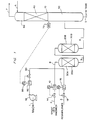
- FIG.1 is a simplified flow diagram of one embodiment of a process utilizing the invention.
- FIG.2 is a simplified flow diagram of a second embodiment of a process utilizing the invention.
- FIG.3 is a graphical presentation of the methanol concentration profile within a distillation column reactor utilizing the invention.
- U.S. Pat. Nos. 5,003,124 and 4,950,803 disclose a liquid phase process for the etherification of C 4 and C 5 isoolefins with C 1 to C 6 alcohols in a boiling point fixed bed reactor that is controlled at a pressure to maintain the reaction mixture at its boiling point which may be directly attached to a catalytic distillation reactor.
- the catalytic distillation process employs a catalyst system (See U.S. Patent Nos. 4,215,011 and 4,302,356) which provides for both reaction and distillation concurrently in the same reactor, at least in part within the catalyst system.
- the method involved is briefly described as one where concurrent reaction and distillation occur in combination reactor-distillation structures which are described in several U.S. Patents, namely U.S. Pat. Nos. 4,242,530; 4,250,052; 4,232,177; 4,302,356; 4,307,254; and 4,336,407. Additionally U.S. Pat. Nos. 4,302,356 and 4,443,559 disclose catalyst structures which are useful as distillation structures.
- methanol and isoamylene or the stream from the boiling point reactor which contains, ether, some unreacted isoolefin and methanol or make up methanol
- C 5 stream are continuously fed to the reactor/distillation column where they are contacted in the catalytic distillation structure.
- the methanol preferentially reacts with isoamylene, forming TAME which is heavier than the C 5 components of the feed and the methanol, hence it drops in the column to form the bottoms.
- the unreacted C 5 's e.g. n-pentane, n-pentenes
- Catalysts preferred for the etherification process are cation exchangers, which contain sulfonic acid groups, and which have been obtained by polymerization or copolymerization of aromatic vinyl compounds followed by sulfonation.
- the resulting products preferably contain an average of 1.3 to 1.8 sulfonic acid groups per aromatic nucleus.
- suitable polymers which contain sulfonic acid groups are copolymers of aromatic monovinyl compounds with aromatic polyvinyl compounds, particularly, divinyl compounds, in which the polyvinyl benzene content is preferably 1 to 20% by weight of the copolymer (see, for example, German Patent specification 908,247).
- the ion exchange resin is preferably used in a granular size of about 0.25 to 1 mm, although particles form 0.15 mm up to about 1 mm may be employed.
- the resin catalyst is loaded into the fixed bed reactor as a fixed bed of the granules.
- the feed to the reaction is fed to the bed in liquid phase.
- the bed may be horizontal, vertical or angled.
- Preferably the bed is vertical with the feed passing downward through the bed and exiting, after reaction, through the lower end of the reactor.
- a preferred catalytic distillation structure for use herein comprises placing the cation exchange resin particles into a plurality of pockets in a cloth belt, which is supported in the distillation column reactor by open mesh knitted stainless steel wire by twisting the two together in a helical form. This allows the requisite flows and prevents loss of catalyst.
- the cloth may be any material which is inert in the reaction. Cotton or linen are useful, but fiber glass cloth or "Teflon" cloth are preferred.
- the catalytic distillation structure when loaded into the column constitutes a distillation reaction zone.
- a distillation zone containing inert distillation structure Directly below the distillation reaction zone is a distillation zone containing inert distillation structure to effect the separation of unreacted methanol from the TAME product.
- a Model PA Infra Red Analyzer (IRA) obtained from ABB Process Analytics, Inc. is installed to sample and analyze the methanol concentration of the liquid leaving the distillation reaction zone (in catalytic distillation terminology the mid-reflux).
- the IRA can be connected to either the primary methanol flow control loop, injecting ahead of the fixed bed reactor, or to a secondary methanol control loop which injects to the fixed bed reactor effluent to the distillation column reactor directly. Both systems have been successfully tested, but the secondary methanol control provides faster and more responsive control.
- the sample point should be connected close to the "mid-reflux stream" or the "froth valve” if operating in the mode described in U.S. patents 4,978,807 and 5,120,404.
- a small stream of methanol 5-10% of the total methanol requirement will bypass the fixed bed reactor (primary reactor).
- the flow of this methanol will be set by a flow controller and reset by the IRA controller. If the secondary methanol flow approaches its maximum or minimum the flow of the primary methanol will be adjusted to compensate.
- the methanol concentration in the mid-reflux stream should be between 4-8 percent where the feed was C 5 stream and slightly lower when the feed is a C 4 or mixed C 4 /C 5 feed.
- FIG. 1 there is shown a simplified flow diagram of a TAME process utilizing primary methanol control.
- Methanol is fed by pump 18 through flow line 1.
- the C 5 's are fed via flow lines 2 and 3 respectively and combined with the methanol in flow line 8 as feed to two fixed bed reactors 20A and 20B containing the cation exchange resin packing 30A and 30B as described above.
- the effluent from the last fixed bed reactor 30B is fed to a distillation column reactor 10 having a distillation reaction zone 40 in the upper portion.
- the unreacted isoamylenes remaining in the effluent react in the distillation reaction zone 40 with methanol to form tertiary amyl methyl ether (TAME) which is removed as bottoms via flow line 5.
- TAME tertiary amyl methyl ether
- Distillation zone 50 is provided below the distillation reaction zone to separate the unreacted methanol from the TAME. If desired the liquid flowing down the column may be restricted to provide a froth within the distillation reaction zone as described in U.S. patent 4,978,807. Unreacted methanol and lighter inerts are removed as overheads via flow line 7. Preferably a portion of the overheads is condensed and returned as reflux via flow line 6.
- a Model PA Infra Red Analyzer 70 provided by ABB Process Analytics, Inc. is installed to sample and analyze the methanol concentration of the liquid (mid-reflux) as it leaves the reaction distillation zone 40.
- the IRA is operably connected to flow control loop 80 which controls flow control valve 90.
- the methanol feed rate is controlled such that the concentration in the mid-reflux is between 4-8 wt%.
- FIG. 2 a simplified flow diagram of the secondary methanol control scheme is shown.
- the equipment and flow are essentially the same as in FIG. 1 except a slip stream 1A of methanol is removed from flow line 1 before control loop 92.
- a second control loop 92A is located in flow line 1A which responds to the IRA 70 controlling the flow of methanol through flow line 1A directly to the distillation column reactor. If the flow through flow line 1A approaches either the minimum or maximum, flow control loop 92 is reset to compensate by adding or reducing the primary methanol feed rate.
- FIG. 3 there is shown a comparison of the methanol concentration profiles when there is insufficient methanol feed, excess methanol feed, and when the methanol feed is controlled by the mid-reflux concentration at about 8 wt per cent.
- the mid-reflux concentration at about 8 wt per cent.
- Another process which is benefitted by the use of the analyzer control scheme is a process which feeds a combined C 4 /C 5 stream and produces TAME and MTBE.
- TEFLON is a trade-mark which may be registered in some or all of the territories in which the eventual patent will be validated.
Landscapes
- Chemical & Material Sciences (AREA)
- Organic Chemistry (AREA)
- Chemical Kinetics & Catalysis (AREA)
- Crystallography & Structural Chemistry (AREA)
- Organic Low-Molecular-Weight Compounds And Preparation Thereof (AREA)
- Low-Molecular Organic Synthesis Reactions Using Catalysts (AREA)
Claims (6)
- Verfahren zur Herstellung von Ethern durch Reaktion von Isoolefinen mit einem Alkylalkohol in einem Destillationskolonnenreaktor mit einer Destillationsreaktionszone oberhalb einer Destillationszone, bei dem man die Alkoholkonzentration am unteren Ende der Destillationsreaktionszone oder einem darunterliegenden Punkt bestimmt und die Alkoholkonzentration auf einem Wert unmittelbar über dem Niveau, wo kein Azeotrop im Destillat gebildet wird, und unmittelbar unter dem Niveau, wo ein volles Azeotrop im Destillat gebildet wird, hält.
- Verfahren nach Anspruch 1, bei dem der Alkohol Methanol enthält und die Konzentration durch Messen der Konzentration mit einem Infrarotanalysegerät gesteuert wird.
- Verfahren nach Anspruch 1, bei dem der Alkohol Methanol ist, das Isoolefin Isoamylen ist und der Punkt sich direkt unterhalb der Destillationsreaktionszone befindet.
- Verfahren nach Anspruch 3, bei dem die Methanolkonzentration in der Flüssigkeit direkt unterhalb der Destillationsreaktionszone zwischen 4 und 8 Gew.-% eingestellt wird.
- Verfahren zur Herstellung von tertiärem Amylmethylether mit folgenden Schritten:(a) Einspeisen eines ersten Stroms, der C5-Kohlenwasserstoffe einschließlich Isoamylenen enthält, in einen Festbett-Durchlauf-Reaktor mit einem Katalysator aus einem sauren Kationenaustauschharz;(b) Einleiten eines zweiten, Methanol enthaltenden Stroms in das Verfahren;(c) Einspeisen des zweiten Stroms in den Festbettreaktor, wo ein Teil der Isoamylene mit einem Teil des Methanols zur Umsetzung gebracht wird, um einen dritten Strom herzustellen, der tertiären Amylmethylether, nicht umgesetztes Methanol und nicht umgesetzte Isoamylene enthält;(d) Einspeisen des dritten Stroms zusammen mit einem vierten, Methanol enthaltenden Strom in einen Destillationskolonnenreaktor mit einem zweiten Festbett aus einem sauren Kationenaustauschharz in Form einer katalytischen Destillationsstruktur, in der der größte Teil der nicht umgesetzten Isoamylene mit Methanol zur Umsetzung gebracht wird, um weiteren tertiären Amylmethylether zu bilden, während gleichzeitig durch fraktionelle Destillation nicht umgesetztes Methanol von tertiärem Amylmethylether getrennt wird, wobei der tertiäre Amylmethylether als Bodenprodukt aus dem Destillationskolonnenreaktor entfernt wird und das nicht umgesetzte Methanol zusammen mit den nicht umgesetzten C5-Kohlenstoffen als Destillat entfernt wird;(e) Messen der Methanolkonzentration im Destillationskolonnenreaktor unmittelbar unter dem zweiten Festbett und(f) Einstellen der Methanolkonzentration in der Destillationskolonne direkt unterhalb des zweiten Festbetts auf einen Wert unmittelbar über dem Niveau, wo kein Azeotrop im Destillat gebildet wird, und unmittelbar unter dem Niveau, wo ein volles Azeotrop im Destillat gebildet wird.
- Verfahren nach Anspruch 5, bei dem die Methanolkonzentration in Schritt (f) auf 4 bis 8 Gew.-% eingestellt wird.
Applications Claiming Priority (3)
| Application Number | Priority Date | Filing Date | Title |
|---|---|---|---|
| US964496 | 1992-10-21 | ||
| US07/964,496 US5248837A (en) | 1992-10-21 | 1992-10-21 | Method for controlling catalytic distillation etherifications |
| PCT/US1993/009823 WO1994008928A1 (en) | 1992-10-21 | 1993-10-14 | Method for controlling catalytic distillation etherifications |
Publications (3)
| Publication Number | Publication Date |
|---|---|
| EP0664778A4 EP0664778A4 (de) | 1995-06-12 |
| EP0664778A1 EP0664778A1 (de) | 1995-08-02 |
| EP0664778B1 true EP0664778B1 (de) | 1998-02-25 |
Family
ID=25508610
Family Applications (1)
| Application Number | Title | Priority Date | Filing Date |
|---|---|---|---|
| EP93924318A Expired - Lifetime EP0664778B1 (de) | 1992-10-21 | 1993-10-14 | Verfahren zur kontrolle von destillativen katalytischen veretherungen |
Country Status (8)
| Country | Link |
|---|---|
| US (1) | US5248837A (de) |
| EP (1) | EP0664778B1 (de) |
| KR (1) | KR100272198B1 (de) |
| AU (1) | AU5404594A (de) |
| CA (1) | CA2146552A1 (de) |
| DE (1) | DE69317120T2 (de) |
| RO (1) | RO115627B1 (de) |
| WO (1) | WO1994008928A1 (de) |
Families Citing this family (13)
| Publication number | Priority date | Publication date | Assignee | Title |
|---|---|---|---|---|
| US5714640A (en) * | 1994-01-21 | 1998-02-03 | Mobil Oil Corporation | Vapor pocket reactor |
| AU2515795A (en) * | 1994-06-06 | 1996-01-04 | Chemical Research & Licensing Company | Etherification process |
| US5792428A (en) * | 1994-07-18 | 1998-08-11 | Chemical Research & Licensing Company | Apparatus for conducting exothermic reactions |
| US5671153A (en) * | 1995-02-24 | 1997-09-23 | Phillips Petroleum Company | Chemical reactor feed control |
| US5586051A (en) * | 1995-02-24 | 1996-12-17 | Phillips Petroleum Company | Chemical reactor feed control |
| RU2103255C1 (ru) * | 1995-12-28 | 1998-01-27 | Товарищество с ограниченной ответственностью "Научно-исследовательский центр по нефтехимическим технологиям" | Способ получения алкил-трет-алкиловых эфиров |
| US5628880A (en) * | 1996-02-12 | 1997-05-13 | Chemical Research & Licensing Company | Etherification--hydrogenation process |
| US6262314B1 (en) * | 1999-04-06 | 2001-07-17 | Intevep, S.A. | Process for preparation of ethers in a catalytic distillation column |
| US6846959B2 (en) | 2002-10-07 | 2005-01-25 | Air Products And Chemicals, Inc. | Process for producing alkanolamines |
| US7141705B2 (en) * | 2004-08-05 | 2006-11-28 | Catalytic Distillation Technologies | Etherification process |
| US7320745B2 (en) * | 2005-01-19 | 2008-01-22 | Catalytic Distillation Technologies | Energy efficient method for exothermic reactions |
| EP3333146A1 (de) * | 2016-12-08 | 2018-06-13 | Evonik Degussa GmbH | Kostengünstige herstellung von hochreinem methyl-tert.-butylether |
| WO2022094458A1 (en) | 2020-11-02 | 2022-05-05 | Lummus Technology Llc | High purity isoamylene production from tertiary amyl methyl ether decomposition |
Family Cites Families (6)
| Publication number | Priority date | Publication date | Assignee | Title |
|---|---|---|---|---|
| US4232177A (en) * | 1979-02-21 | 1980-11-04 | Chemical Research & Licensing Company | Catalytic distillation process |
| US4307254A (en) * | 1979-02-21 | 1981-12-22 | Chemical Research & Licensing Company | Catalytic distillation process |
| US4336407A (en) * | 1980-02-25 | 1982-06-22 | Chemical Research & Licensing Company | Catalytic distillation process |
| US4504687A (en) * | 1982-02-16 | 1985-03-12 | Chemical Research & Licensing Company | Method for etherifications |
| US4978807A (en) * | 1989-03-23 | 1990-12-18 | Chemical Research & Licensing Company | Method for the preparation of methyl tertiary butyl ether |
| US5118873A (en) * | 1990-11-19 | 1992-06-02 | Chemical Research & Licensing Company | Process for the preparation of mtbe |
-
1992
- 1992-10-21 US US07/964,496 patent/US5248837A/en not_active Expired - Lifetime
-
1993
- 1993-10-14 CA CA002146552A patent/CA2146552A1/en not_active Abandoned
- 1993-10-14 KR KR1019950701517A patent/KR100272198B1/ko not_active Expired - Fee Related
- 1993-10-14 AU AU54045/94A patent/AU5404594A/en not_active Abandoned
- 1993-10-14 EP EP93924318A patent/EP0664778B1/de not_active Expired - Lifetime
- 1993-10-14 WO PCT/US1993/009823 patent/WO1994008928A1/en not_active Ceased
- 1993-10-14 DE DE69317120T patent/DE69317120T2/de not_active Expired - Fee Related
- 1993-10-14 RO RO95-00784A patent/RO115627B1/ro unknown
Also Published As
| Publication number | Publication date |
|---|---|
| KR100272198B1 (ko) | 2000-11-15 |
| AU5404594A (en) | 1994-05-09 |
| US5248837A (en) | 1993-09-28 |
| KR950704221A (ko) | 1995-11-17 |
| DE69317120T2 (de) | 1998-06-18 |
| WO1994008928A1 (en) | 1994-04-28 |
| EP0664778A4 (de) | 1995-06-12 |
| EP0664778A1 (de) | 1995-08-02 |
| RO115627B1 (ro) | 2000-04-28 |
| CA2146552A1 (en) | 1994-04-28 |
| DE69317120D1 (de) | 1998-04-02 |
Similar Documents
| Publication | Publication Date | Title |
|---|---|---|
| US4475005A (en) | Process for preparing tertiary alkyl ethers | |
| US5248836A (en) | Process for the preparation of ETBE | |
| US7030277B2 (en) | Process and apparatus for catalytic distillations | |
| US5536886A (en) | Process for preparing alkyl ethers | |
| US4232177A (en) | Catalytic distillation process | |
| US4307254A (en) | Catalytic distillation process | |
| US5248837A (en) | Method for controlling catalytic distillation etherifications | |
| US4336407A (en) | Catalytic distillation process | |
| US7141705B2 (en) | Etherification process | |
| JP2807314B2 (ja) | メチル t―ブチルエーテルの製造法 | |
| EP0487264B1 (de) | Prozess zur Herstellung von MTBE | |
| JPH03106840A (ja) | 第三級アルコールの製造法 | |
| US5345006A (en) | Method and apparatus for operating a catalytic distillation process | |
| US5523061A (en) | Equipment for catalytic distillation | |
| US5313005A (en) | Method for controlling catalytic distillation etherifications | |
| US5231234A (en) | Two stage production of ether from tertiary alcohol | |
| US6232509B1 (en) | Etherification process | |
| KR19990076673A (ko) | 알킬 에테르 및 이들의 혼합물을 제조하는 방법 | |
| EP1513791B1 (de) | Verfahren und vorrichtung für katalytische destillierungen | |
| JPS6363254B2 (de) |
Legal Events
| Date | Code | Title | Description |
|---|---|---|---|
| A4 | Supplementary search report drawn up and despatched | ||
| AK | Designated contracting states |
Kind code of ref document: A4 Designated state(s): DE FR GB NL |
|
| PUAI | Public reference made under article 153(3) epc to a published international application that has entered the european phase |
Free format text: ORIGINAL CODE: 0009012 |
|
| 17P | Request for examination filed |
Effective date: 19950413 |
|
| AK | Designated contracting states |
Kind code of ref document: A1 Designated state(s): DE FR GB NL |
|
| 17Q | First examination report despatched |
Effective date: 19960321 |
|
| GRAG | Despatch of communication of intention to grant |
Free format text: ORIGINAL CODE: EPIDOS AGRA |
|
| GRAG | Despatch of communication of intention to grant |
Free format text: ORIGINAL CODE: EPIDOS AGRA |
|
| GRAH | Despatch of communication of intention to grant a patent |
Free format text: ORIGINAL CODE: EPIDOS IGRA |
|
| GRAH | Despatch of communication of intention to grant a patent |
Free format text: ORIGINAL CODE: EPIDOS IGRA |
|
| GRAA | (expected) grant |
Free format text: ORIGINAL CODE: 0009210 |
|
| AK | Designated contracting states |
Kind code of ref document: B1 Designated state(s): DE FR GB NL |
|
| REF | Corresponds to: |
Ref document number: 69317120 Country of ref document: DE Date of ref document: 19980402 |
|
| ET | Fr: translation filed | ||
| PLBE | No opposition filed within time limit |
Free format text: ORIGINAL CODE: 0009261 |
|
| STAA | Information on the status of an ep patent application or granted ep patent |
Free format text: STATUS: NO OPPOSITION FILED WITHIN TIME LIMIT |
|
| 26N | No opposition filed | ||
| PGFP | Annual fee paid to national office [announced via postgrant information from national office to epo] |
Ref country code: FR Payment date: 20010920 Year of fee payment: 9 Ref country code: DE Payment date: 20010920 Year of fee payment: 9 |
|
| PGFP | Annual fee paid to national office [announced via postgrant information from national office to epo] |
Ref country code: GB Payment date: 20010921 Year of fee payment: 9 |
|
| PGFP | Annual fee paid to national office [announced via postgrant information from national office to epo] |
Ref country code: NL Payment date: 20010925 Year of fee payment: 9 |
|
| REG | Reference to a national code |
Ref country code: GB Ref legal event code: IF02 |
|
| PG25 | Lapsed in a contracting state [announced via postgrant information from national office to epo] |
Ref country code: GB Free format text: LAPSE BECAUSE OF NON-PAYMENT OF DUE FEES Effective date: 20021014 |
|
| PG25 | Lapsed in a contracting state [announced via postgrant information from national office to epo] |
Ref country code: NL Free format text: LAPSE BECAUSE OF NON-PAYMENT OF DUE FEES Effective date: 20030501 Ref country code: DE Free format text: LAPSE BECAUSE OF NON-PAYMENT OF DUE FEES Effective date: 20030501 |
|
| GBPC | Gb: european patent ceased through non-payment of renewal fee |
Effective date: 20021014 |
|
| PG25 | Lapsed in a contracting state [announced via postgrant information from national office to epo] |
Ref country code: FR Free format text: LAPSE BECAUSE OF NON-PAYMENT OF DUE FEES Effective date: 20030630 |
|
| NLV4 | Nl: lapsed or anulled due to non-payment of the annual fee |
Effective date: 20030501 |
|
| REG | Reference to a national code |
Ref country code: FR Ref legal event code: ST |