EP0656397A1 - Temperaturbeständige, hochelastische, abriebfeste Polyurethan-Polyester-Triblockpolyadditionsprodukte, ein Verfahren zu ihrer Herstellung und ihre Verwendung - Google Patents
Temperaturbeständige, hochelastische, abriebfeste Polyurethan-Polyester-Triblockpolyadditionsprodukte, ein Verfahren zu ihrer Herstellung und ihre Verwendung Download PDFInfo
- Publication number
- EP0656397A1 EP0656397A1 EP94118398A EP94118398A EP0656397A1 EP 0656397 A1 EP0656397 A1 EP 0656397A1 EP 94118398 A EP94118398 A EP 94118398A EP 94118398 A EP94118398 A EP 94118398A EP 0656397 A1 EP0656397 A1 EP 0656397A1
- Authority
- EP
- European Patent Office
- Prior art keywords
- weight
- tpu
- polyurethane
- und
- polyester
- Prior art date
- Legal status (The legal status is an assumption and is not a legal conclusion. Google has not performed a legal analysis and makes no representation as to the accuracy of the status listed.)
- Granted
Links
- 238000000034 method Methods 0.000 title claims abstract description 20
- 238000002360 preparation method Methods 0.000 title claims abstract description 5
- 238000005299 abrasion Methods 0.000 title abstract description 7
- 229920002803 thermoplastic polyurethane Polymers 0.000 claims abstract description 101
- 239000004433 Thermoplastic polyurethane Substances 0.000 claims abstract description 99
- 229920000728 polyester Polymers 0.000 claims abstract description 27
- 125000005442 diisocyanate group Chemical group 0.000 claims abstract description 24
- 150000001875 compounds Chemical class 0.000 claims abstract description 21
- 238000006243 chemical reaction Methods 0.000 claims abstract description 15
- 239000004970 Chain extender Substances 0.000 claims abstract description 13
- 229920001971 elastomer Polymers 0.000 claims abstract description 12
- 229920001169 thermoplastic Polymers 0.000 claims abstract description 12
- 239000000806 elastomer Substances 0.000 claims abstract description 10
- 239000004416 thermosoftening plastic Substances 0.000 claims abstract description 10
- 238000004519 manufacturing process Methods 0.000 claims abstract description 9
- 238000000465 moulding Methods 0.000 claims abstract description 7
- -1 polyoxytetramethylene Polymers 0.000 claims description 54
- 239000000203 mixture Substances 0.000 claims description 47
- WERYXYBDKMZEQL-UHFFFAOYSA-N butane-1,4-diol Chemical compound OCCCCO WERYXYBDKMZEQL-UHFFFAOYSA-N 0.000 claims description 39
- 125000002887 hydroxy group Chemical group [H]O* 0.000 claims description 32
- 125000004432 carbon atom Chemical group C* 0.000 claims description 19
- LYCAIKOWRPUZTN-UHFFFAOYSA-N Ethylene glycol Chemical compound OCCO LYCAIKOWRPUZTN-UHFFFAOYSA-N 0.000 claims description 17
- 229920001707 polybutylene terephthalate Polymers 0.000 claims description 15
- UPMLOUAZCHDJJD-UHFFFAOYSA-N 4,4'-Diphenylmethane Diisocyanate Chemical compound C1=CC(N=C=O)=CC=C1CC1=CC=C(N=C=O)C=C1 UPMLOUAZCHDJJD-UHFFFAOYSA-N 0.000 claims description 12
- 229920000139 polyethylene terephthalate Polymers 0.000 claims description 11
- 239000005020 polyethylene terephthalate Substances 0.000 claims description 10
- RFFLAFLAYFXFSW-UHFFFAOYSA-N 1,2-dichlorobenzene Chemical compound ClC1=CC=CC=C1Cl RFFLAFLAYFXFSW-UHFFFAOYSA-N 0.000 claims description 9
- ISWSIDIOOBJBQZ-UHFFFAOYSA-N Phenol Chemical compound OC1=CC=CC=C1 ISWSIDIOOBJBQZ-UHFFFAOYSA-N 0.000 claims description 4
- 150000002009 diols Chemical class 0.000 claims description 4
- 238000001125 extrusion Methods 0.000 claims description 4
- WGCNASOHLSPBMP-UHFFFAOYSA-N hydroxyacetaldehyde Natural products OCC=O WGCNASOHLSPBMP-UHFFFAOYSA-N 0.000 claims description 4
- 238000006068 polycondensation reaction Methods 0.000 claims description 4
- 229920001515 polyalkylene glycol Polymers 0.000 claims description 3
- 150000001990 dicarboxylic acid derivatives Chemical class 0.000 claims description 2
- 239000000047 product Substances 0.000 description 30
- MTHSVFCYNBDYFN-UHFFFAOYSA-N diethylene glycol Chemical compound OCCOCCO MTHSVFCYNBDYFN-UHFFFAOYSA-N 0.000 description 13
- IAYPIBMASNFSPL-UHFFFAOYSA-N Ethylene oxide Chemical compound C1CO1 IAYPIBMASNFSPL-UHFFFAOYSA-N 0.000 description 11
- GOOHAUXETOMSMM-UHFFFAOYSA-N Propylene oxide Chemical compound CC1CO1 GOOHAUXETOMSMM-UHFFFAOYSA-N 0.000 description 10
- 239000003054 catalyst Substances 0.000 description 9
- 239000000654 additive Substances 0.000 description 8
- WNLRTRBMVRJNCN-UHFFFAOYSA-N adipic acid Chemical compound OC(=O)CCCCC(O)=O WNLRTRBMVRJNCN-UHFFFAOYSA-N 0.000 description 8
- 150000001991 dicarboxylic acids Chemical class 0.000 description 8
- KKEYFWRCBNTPAC-UHFFFAOYSA-N benzene-dicarboxylic acid Natural products OC(=O)C1=CC=C(C(O)=O)C=C1 KKEYFWRCBNTPAC-UHFFFAOYSA-N 0.000 description 7
- XXMIOPMDWAUFGU-UHFFFAOYSA-N hexane-1,6-diol Chemical compound OCCCCCCO XXMIOPMDWAUFGU-UHFFFAOYSA-N 0.000 description 7
- WYURNTSHIVDZCO-UHFFFAOYSA-N Tetrahydrofuran Chemical compound C1CCOC1 WYURNTSHIVDZCO-UHFFFAOYSA-N 0.000 description 6
- 125000003118 aryl group Chemical group 0.000 description 6
- 239000012948 isocyanate Substances 0.000 description 6
- 150000002513 isocyanates Chemical class 0.000 description 6
- QQVIHTHCMHWDBS-UHFFFAOYSA-N isophthalic acid Chemical compound OC(=O)C1=CC=CC(C(O)=O)=C1 QQVIHTHCMHWDBS-UHFFFAOYSA-N 0.000 description 6
- 239000000155 melt Substances 0.000 description 6
- 229920002635 polyurethane Polymers 0.000 description 6
- 239000004814 polyurethane Substances 0.000 description 6
- 239000007858 starting material Substances 0.000 description 6
- JOYRKODLDBILNP-UHFFFAOYSA-N urethane group Chemical group NC(=O)OCC JOYRKODLDBILNP-UHFFFAOYSA-N 0.000 description 6
- RTZKZFJDLAIYFH-UHFFFAOYSA-N Diethyl ether Chemical compound CCOCC RTZKZFJDLAIYFH-UHFFFAOYSA-N 0.000 description 5
- OFOBLEOULBTSOW-UHFFFAOYSA-N Malonic acid Chemical compound OC(=O)CC(O)=O OFOBLEOULBTSOW-UHFFFAOYSA-N 0.000 description 5
- ZMXDDKWLCZADIW-UHFFFAOYSA-N N,N-Dimethylformamide Chemical compound CN(C)C=O ZMXDDKWLCZADIW-UHFFFAOYSA-N 0.000 description 5
- 125000001931 aliphatic group Chemical group 0.000 description 5
- 150000002334 glycols Chemical class 0.000 description 5
- 229920001228 polyisocyanate Polymers 0.000 description 5
- 229920002959 polymer blend Polymers 0.000 description 5
- 239000011541 reaction mixture Substances 0.000 description 5
- 239000000126 substance Substances 0.000 description 5
- KBPLFHHGFOOTCA-UHFFFAOYSA-N 1-Octanol Chemical compound CCCCCCCCO KBPLFHHGFOOTCA-UHFFFAOYSA-N 0.000 description 4
- QIGBRXMKCJKVMJ-UHFFFAOYSA-N Hydroquinone Chemical compound OC1=CC=C(O)C=C1 QIGBRXMKCJKVMJ-UHFFFAOYSA-N 0.000 description 4
- LRHPLDYGYMQRHN-UHFFFAOYSA-N N-Butanol Chemical compound CCCCO LRHPLDYGYMQRHN-UHFFFAOYSA-N 0.000 description 4
- SJRJJKPEHAURKC-UHFFFAOYSA-N N-Methylmorpholine Chemical compound CN1CCOCC1 SJRJJKPEHAURKC-UHFFFAOYSA-N 0.000 description 4
- KWYUFKZDYYNOTN-UHFFFAOYSA-M Potassium hydroxide Chemical compound [OH-].[K+] KWYUFKZDYYNOTN-UHFFFAOYSA-M 0.000 description 4
- ZMANZCXQSJIPKH-UHFFFAOYSA-N Triethylamine Chemical compound CCN(CC)CC ZMANZCXQSJIPKH-UHFFFAOYSA-N 0.000 description 4
- 150000005690 diesters Chemical class 0.000 description 4
- LQZZUXJYWNFBMV-UHFFFAOYSA-N dodecan-1-ol Chemical compound CCCCCCCCCCCCO LQZZUXJYWNFBMV-UHFFFAOYSA-N 0.000 description 4
- NMRPBPVERJPACX-UHFFFAOYSA-N octan-3-ol Chemical compound CCCCCC(O)CC NMRPBPVERJPACX-UHFFFAOYSA-N 0.000 description 4
- 239000005056 polyisocyanate Substances 0.000 description 4
- 239000002904 solvent Substances 0.000 description 4
- RXYPXQSKLGGKOL-UHFFFAOYSA-N 1,4-dimethylpiperazine Chemical compound CN1CCN(C)CC1 RXYPXQSKLGGKOL-UHFFFAOYSA-N 0.000 description 3
- RTBFRGCFXZNCOE-UHFFFAOYSA-N 1-methylsulfonylpiperidin-4-one Chemical compound CS(=O)(=O)N1CCC(=O)CC1 RTBFRGCFXZNCOE-UHFFFAOYSA-N 0.000 description 3
- BPRJQFIHEGORJE-UHFFFAOYSA-N 2-(1-hydroxypropan-2-yloxy)propan-1-ol 1-(2-hydroxypropoxy)propan-2-ol Chemical compound CC(O)COCC(C)O.CC(CO)OC(C)CO BPRJQFIHEGORJE-UHFFFAOYSA-N 0.000 description 3
- NQRYJNQNLNOLGT-UHFFFAOYSA-N Piperidine Chemical compound C1CCNCC1 NQRYJNQNLNOLGT-UHFFFAOYSA-N 0.000 description 3
- 239000004721 Polyphenylene oxide Substances 0.000 description 3
- KDYFGRWQOYBRFD-UHFFFAOYSA-N Succinic acid Natural products OC(=O)CCC(O)=O KDYFGRWQOYBRFD-UHFFFAOYSA-N 0.000 description 3
- 102100025342 Voltage-dependent N-type calcium channel subunit alpha-1B Human genes 0.000 description 3
- 101710088658 Voltage-dependent N-type calcium channel subunit alpha-1B Proteins 0.000 description 3
- 239000001361 adipic acid Substances 0.000 description 3
- 235000011037 adipic acid Nutrition 0.000 description 3
- 125000002947 alkylene group Chemical group 0.000 description 3
- JFCQEDHGNNZCLN-UHFFFAOYSA-N anhydrous glutaric acid Natural products OC(=O)CCCC(O)=O JFCQEDHGNNZCLN-UHFFFAOYSA-N 0.000 description 3
- 239000007795 chemical reaction product Substances 0.000 description 3
- PAFZNILMFXTMIY-UHFFFAOYSA-N cyclohexylamine Chemical compound NC1CCCCC1 PAFZNILMFXTMIY-UHFFFAOYSA-N 0.000 description 3
- SZXQTJUDPRGNJN-UHFFFAOYSA-N dipropylene glycol Chemical compound OCCCOCCCO SZXQTJUDPRGNJN-UHFFFAOYSA-N 0.000 description 3
- 125000004435 hydrogen atom Chemical group [H]* 0.000 description 3
- IQPQWNKOIGAROB-UHFFFAOYSA-N isocyanate group Chemical group [N-]=C=O IQPQWNKOIGAROB-UHFFFAOYSA-N 0.000 description 3
- BDJRBEYXGGNYIS-UHFFFAOYSA-N nonanedioic acid Chemical compound OC(=O)CCCCCCCC(O)=O BDJRBEYXGGNYIS-UHFFFAOYSA-N 0.000 description 3
- 229920001610 polycaprolactone Polymers 0.000 description 3
- 229920000515 polycarbonate Polymers 0.000 description 3
- 239000004417 polycarbonate Substances 0.000 description 3
- 229920000570 polyether Polymers 0.000 description 3
- 238000006116 polymerization reaction Methods 0.000 description 3
- 229920006324 polyoxymethylene Polymers 0.000 description 3
- 239000000243 solution Substances 0.000 description 3
- 150000005846 sugar alcohols Polymers 0.000 description 3
- YLQBMQCUIZJEEH-UHFFFAOYSA-N tetrahydrofuran Natural products C=1C=COC=1 YLQBMQCUIZJEEH-UHFFFAOYSA-N 0.000 description 3
- 239000012815 thermoplastic material Substances 0.000 description 3
- XLYOFNOQVPJJNP-UHFFFAOYSA-N water Chemical compound O XLYOFNOQVPJJNP-UHFFFAOYSA-N 0.000 description 3
- QVCUKHQDEZNNOC-UHFFFAOYSA-N 1,2-diazabicyclo[2.2.2]octane Chemical compound C1CC2CCN1NC2 QVCUKHQDEZNNOC-UHFFFAOYSA-N 0.000 description 2
- PQXKWPLDPFFDJP-UHFFFAOYSA-N 2,3-dimethyloxirane Chemical compound CC1OC1C PQXKWPLDPFFDJP-UHFFFAOYSA-N 0.000 description 2
- WKBOTKDWSSQWDR-UHFFFAOYSA-N Bromine atom Chemical compound [Br] WKBOTKDWSSQWDR-UHFFFAOYSA-N 0.000 description 2
- ZAMOUSCENKQFHK-UHFFFAOYSA-N Chlorine atom Chemical compound [Cl] ZAMOUSCENKQFHK-UHFFFAOYSA-N 0.000 description 2
- DGAQECJNVWCQMB-PUAWFVPOSA-M Ilexoside XXIX Chemical compound C[C@@H]1CC[C@@]2(CC[C@@]3(C(=CC[C@H]4[C@]3(CC[C@@H]5[C@@]4(CC[C@@H](C5(C)C)OS(=O)(=O)[O-])C)C)[C@@H]2[C@]1(C)O)C)C(=O)O[C@H]6[C@@H]([C@H]([C@@H]([C@H](O6)CO)O)O)O.[Na+] DGAQECJNVWCQMB-PUAWFVPOSA-M 0.000 description 2
- SVYKKECYCPFKGB-UHFFFAOYSA-N N,N-dimethylcyclohexylamine Chemical compound CN(C)C1CCCCC1 SVYKKECYCPFKGB-UHFFFAOYSA-N 0.000 description 2
- AMQJEAYHLZJPGS-UHFFFAOYSA-N N-Pentanol Chemical compound CCCCCO AMQJEAYHLZJPGS-UHFFFAOYSA-N 0.000 description 2
- AKNUHUCEWALCOI-UHFFFAOYSA-N N-ethyldiethanolamine Chemical compound OCCN(CC)CCO AKNUHUCEWALCOI-UHFFFAOYSA-N 0.000 description 2
- ALQSHHUCVQOPAS-UHFFFAOYSA-N Pentane-1,5-diol Chemical compound OCCCCCO ALQSHHUCVQOPAS-UHFFFAOYSA-N 0.000 description 2
- 229920001283 Polyalkylene terephthalate Polymers 0.000 description 2
- 229920002614 Polyether block amide Polymers 0.000 description 2
- WQDUMFSSJAZKTM-UHFFFAOYSA-N Sodium methoxide Chemical compound [Na+].[O-]C WQDUMFSSJAZKTM-UHFFFAOYSA-N 0.000 description 2
- 239000002253 acid Substances 0.000 description 2
- 150000001298 alcohols Chemical class 0.000 description 2
- VMPVEPPRYRXYNP-UHFFFAOYSA-I antimony(5+);pentachloride Chemical compound Cl[Sb](Cl)(Cl)(Cl)Cl VMPVEPPRYRXYNP-UHFFFAOYSA-I 0.000 description 2
- OHJMTUPIZMNBFR-UHFFFAOYSA-N biuret Chemical group NC(=O)NC(N)=O OHJMTUPIZMNBFR-UHFFFAOYSA-N 0.000 description 2
- KDYFGRWQOYBRFD-NUQCWPJISA-N butanedioic acid Chemical compound O[14C](=O)CC[14C](O)=O KDYFGRWQOYBRFD-NUQCWPJISA-N 0.000 description 2
- 229910052799 carbon Inorganic materials 0.000 description 2
- 125000003178 carboxy group Chemical group [H]OC(*)=O 0.000 description 2
- 230000000052 comparative effect Effects 0.000 description 2
- HPXRVTGHNJAIIH-UHFFFAOYSA-N cyclohexanol Chemical compound OC1CCCCC1 HPXRVTGHNJAIIH-UHFFFAOYSA-N 0.000 description 2
- 230000007423 decrease Effects 0.000 description 2
- ROORDVPLFPIABK-UHFFFAOYSA-N diphenyl carbonate Chemical compound C=1C=CC=CC=1OC(=O)OC1=CC=CC=C1 ROORDVPLFPIABK-UHFFFAOYSA-N 0.000 description 2
- TVIDDXQYHWJXFK-UHFFFAOYSA-N dodecanedioic acid Chemical compound OC(=O)CCCCCCCCCCC(O)=O TVIDDXQYHWJXFK-UHFFFAOYSA-N 0.000 description 2
- 239000008187 granular material Substances 0.000 description 2
- 238000004898 kneading Methods 0.000 description 2
- 239000007788 liquid Substances 0.000 description 2
- 230000007774 longterm Effects 0.000 description 2
- 150000002736 metal compounds Chemical class 0.000 description 2
- 238000002156 mixing Methods 0.000 description 2
- XLDBGFGREOMWSL-UHFFFAOYSA-N n,n'-bis[2,6-di(propan-2-yl)phenyl]methanediimine Chemical compound CC(C)C1=CC=CC(C(C)C)=C1N=C=NC1=C(C(C)C)C=CC=C1C(C)C XLDBGFGREOMWSL-UHFFFAOYSA-N 0.000 description 2
- 229940117969 neopentyl glycol Drugs 0.000 description 2
- AHHWIHXENZJRFG-UHFFFAOYSA-N oxetane Chemical compound C1COC1 AHHWIHXENZJRFG-UHFFFAOYSA-N 0.000 description 2
- XNGIFLGASWRNHJ-UHFFFAOYSA-N phthalic acid Chemical compound OC(=O)C1=CC=CC=C1C(O)=O XNGIFLGASWRNHJ-UHFFFAOYSA-N 0.000 description 2
- 229920003023 plastic Polymers 0.000 description 2
- 239000004033 plastic Substances 0.000 description 2
- 239000004632 polycaprolactone Substances 0.000 description 2
- 229920000642 polymer Polymers 0.000 description 2
- 230000000379 polymerizing effect Effects 0.000 description 2
- HNJBEVLQSNELDL-UHFFFAOYSA-N pyrrolidin-2-one Chemical compound O=C1CCCN1 HNJBEVLQSNELDL-UHFFFAOYSA-N 0.000 description 2
- 239000005060 rubber Substances 0.000 description 2
- CXMXRPHRNRROMY-UHFFFAOYSA-N sebacic acid Chemical compound OC(=O)CCCCCCCCC(O)=O CXMXRPHRNRROMY-UHFFFAOYSA-N 0.000 description 2
- HEMHJVSKTPXQMS-UHFFFAOYSA-M sodium hydroxide Inorganic materials [OH-].[Na+] HEMHJVSKTPXQMS-UHFFFAOYSA-M 0.000 description 2
- TYFQFVWCELRYAO-UHFFFAOYSA-N suberic acid Chemical compound OC(=O)CCCCCCC(O)=O TYFQFVWCELRYAO-UHFFFAOYSA-N 0.000 description 2
- 150000003606 tin compounds Chemical class 0.000 description 2
- AVWRKZWQTYIKIY-UHFFFAOYSA-N urea-1-carboxylic acid Chemical group NC(=O)NC(O)=O AVWRKZWQTYIKIY-UHFFFAOYSA-N 0.000 description 2
- DNIAPMSPPWPWGF-VKHMYHEASA-N (+)-propylene glycol Chemical compound C[C@H](O)CO DNIAPMSPPWPWGF-VKHMYHEASA-N 0.000 description 1
- HFVMEOPYDLEHBR-UHFFFAOYSA-N (2-fluorophenyl)-phenylmethanol Chemical class C=1C=CC=C(F)C=1C(O)C1=CC=CC=C1 HFVMEOPYDLEHBR-UHFFFAOYSA-N 0.000 description 1
- DNIAPMSPPWPWGF-GSVOUGTGSA-N (R)-(-)-Propylene glycol Chemical compound C[C@@H](O)CO DNIAPMSPPWPWGF-GSVOUGTGSA-N 0.000 description 1
- PCHXZXKMYCGVFA-UHFFFAOYSA-N 1,3-diazetidine-2,4-dione Chemical group O=C1NC(=O)N1 PCHXZXKMYCGVFA-UHFFFAOYSA-N 0.000 description 1
- YPFDHNVEDLHUCE-UHFFFAOYSA-N 1,3-propanediol Substances OCCCO YPFDHNVEDLHUCE-UHFFFAOYSA-N 0.000 description 1
- CDMDQYCEEKCBGR-UHFFFAOYSA-N 1,4-diisocyanatocyclohexane Chemical compound O=C=NC1CCC(N=C=O)CC1 CDMDQYCEEKCBGR-UHFFFAOYSA-N 0.000 description 1
- 229940008841 1,6-hexamethylene diisocyanate Drugs 0.000 description 1
- SMNOVRZDAZZQTI-UHFFFAOYSA-N 1-[dibutyl(dodecanoyl)stannyl]dodecan-1-one Chemical compound CCCCCCCCCCCC(=O)[Sn](CCCC)(CCCC)C(=O)CCCCCCCCCCC SMNOVRZDAZZQTI-UHFFFAOYSA-N 0.000 description 1
- YQPCHPBGAALCRT-UHFFFAOYSA-N 2-[1-(carboxymethyl)cyclohexyl]acetic acid Chemical compound OC(=O)CC1(CC(O)=O)CCCCC1 YQPCHPBGAALCRT-UHFFFAOYSA-N 0.000 description 1
- ZNQVEEAIQZEUHB-UHFFFAOYSA-N 2-ethoxyethanol Chemical compound CCOCCO ZNQVEEAIQZEUHB-UHFFFAOYSA-N 0.000 description 1
- KZMGYPLQYOPHEL-UHFFFAOYSA-N Boron trifluoride etherate Chemical compound FB(F)F.CCOCC KZMGYPLQYOPHEL-UHFFFAOYSA-N 0.000 description 1
- 239000005058 Isophorone diisocyanate Substances 0.000 description 1
- 239000002841 Lewis acid Substances 0.000 description 1
- 229930040373 Paraformaldehyde Natural products 0.000 description 1
- 239000004952 Polyamide Substances 0.000 description 1
- 239000005062 Polybutadiene Substances 0.000 description 1
- ATJFFYVFTNAWJD-UHFFFAOYSA-N Tin Chemical compound [Sn] ATJFFYVFTNAWJD-UHFFFAOYSA-N 0.000 description 1
- RTAQQCXQSZGOHL-UHFFFAOYSA-N Titanium Chemical compound [Ti] RTAQQCXQSZGOHL-UHFFFAOYSA-N 0.000 description 1
- XSQUKJJJFZCRTK-UHFFFAOYSA-N Urea Chemical group NC(N)=O XSQUKJJJFZCRTK-UHFFFAOYSA-N 0.000 description 1
- ISKQADXMHQSTHK-UHFFFAOYSA-N [4-(aminomethyl)phenyl]methanamine Chemical compound NCC1=CC=C(CN)C=C1 ISKQADXMHQSTHK-UHFFFAOYSA-N 0.000 description 1
- GHVZOJONCUEWAV-UHFFFAOYSA-N [K].CCO Chemical compound [K].CCO GHVZOJONCUEWAV-UHFFFAOYSA-N 0.000 description 1
- UKLDJPRMSDWDSL-UHFFFAOYSA-L [dibutyl(dodecanoyloxy)stannyl] dodecanoate Chemical compound CCCCCCCCCCCC(=O)O[Sn](CCCC)(CCCC)OC(=O)CCCCCCCCCCC UKLDJPRMSDWDSL-UHFFFAOYSA-L 0.000 description 1
- 150000007513 acids Chemical class 0.000 description 1
- 230000000996 additive effect Effects 0.000 description 1
- 150000007933 aliphatic carboxylic acids Chemical class 0.000 description 1
- 239000003513 alkali Substances 0.000 description 1
- 229910001854 alkali hydroxide Inorganic materials 0.000 description 1
- 150000008044 alkali metal hydroxides Chemical class 0.000 description 1
- 125000000217 alkyl group Chemical group 0.000 description 1
- 150000001412 amines Chemical class 0.000 description 1
- 125000003277 amino group Chemical group 0.000 description 1
- 238000010539 anionic addition polymerization reaction Methods 0.000 description 1
- HIFVAOIJYDXIJG-UHFFFAOYSA-N benzylbenzene;isocyanic acid Chemical class N=C=O.N=C=O.C=1C=CC=CC=1CC1=CC=CC=C1 HIFVAOIJYDXIJG-UHFFFAOYSA-N 0.000 description 1
- 238000004061 bleaching Methods 0.000 description 1
- 229920001400 block copolymer Polymers 0.000 description 1
- GDTBXPJZTBHREO-UHFFFAOYSA-N bromine Substances BrBr GDTBXPJZTBHREO-UHFFFAOYSA-N 0.000 description 1
- 229910052794 bromium Inorganic materials 0.000 description 1
- YRKMYKUIIHZXCL-UHFFFAOYSA-N butane-1,4-diol;ethane-1,1-diol Chemical compound CC(O)O.OCCCCO YRKMYKUIIHZXCL-UHFFFAOYSA-N 0.000 description 1
- KMHIOVLPRIUBGK-UHFFFAOYSA-N butane-1,4-diol;hexane-1,6-diol Chemical compound OCCCCO.OCCCCCCO KMHIOVLPRIUBGK-UHFFFAOYSA-N 0.000 description 1
- 239000004202 carbamide Chemical group 0.000 description 1
- VPKDCDLSJZCGKE-UHFFFAOYSA-N carbodiimide group Chemical group N=C=N VPKDCDLSJZCGKE-UHFFFAOYSA-N 0.000 description 1
- BVKZGUZCCUSVTD-UHFFFAOYSA-N carbonic acid Chemical compound OC(O)=O BVKZGUZCCUSVTD-UHFFFAOYSA-N 0.000 description 1
- 125000002091 cationic group Chemical group 0.000 description 1
- 238000010382 chemical cross-linking Methods 0.000 description 1
- 239000000460 chlorine Substances 0.000 description 1
- 229910052801 chlorine Inorganic materials 0.000 description 1
- PMMYEEVYMWASQN-IMJSIDKUSA-N cis-4-Hydroxy-L-proline Chemical compound O[C@@H]1CN[C@H](C(O)=O)C1 PMMYEEVYMWASQN-IMJSIDKUSA-N 0.000 description 1
- 239000007859 condensation product Substances 0.000 description 1
- 238000001816 cooling Methods 0.000 description 1
- 229920001577 copolymer Polymers 0.000 description 1
- QYQADNCHXSEGJT-UHFFFAOYSA-N cyclohexane-1,1-dicarboxylate;hydron Chemical compound OC(=O)C1(C(O)=O)CCCCC1 QYQADNCHXSEGJT-UHFFFAOYSA-N 0.000 description 1
- VKONPUDBRVKQLM-UHFFFAOYSA-N cyclohexane-1,4-diol Chemical compound OC1CCC(O)CC1 VKONPUDBRVKQLM-UHFFFAOYSA-N 0.000 description 1
- INSRQEMEVAMETL-UHFFFAOYSA-N decane-1,1-diol Chemical compound CCCCCCCCCC(O)O INSRQEMEVAMETL-UHFFFAOYSA-N 0.000 description 1
- 230000001419 dependent effect Effects 0.000 description 1
- PNOXNTGLSKTMQO-UHFFFAOYSA-L diacetyloxytin Chemical compound CC(=O)O[Sn]OC(C)=O PNOXNTGLSKTMQO-UHFFFAOYSA-L 0.000 description 1
- 239000012975 dibutyltin dilaurate Substances 0.000 description 1
- 238000002845 discoloration Methods 0.000 description 1
- PYBNTRWJKQJDRE-UHFFFAOYSA-L dodecanoate;tin(2+) Chemical compound [Sn+2].CCCCCCCCCCCC([O-])=O.CCCCCCCCCCCC([O-])=O PYBNTRWJKQJDRE-UHFFFAOYSA-L 0.000 description 1
- 238000001035 drying Methods 0.000 description 1
- 239000000975 dye Substances 0.000 description 1
- 125000004185 ester group Chemical group 0.000 description 1
- 230000032050 esterification Effects 0.000 description 1
- 238000005886 esterification reaction Methods 0.000 description 1
- 150000002148 esters Chemical class 0.000 description 1
- 125000001495 ethyl group Chemical group [H]C([H])([H])C([H])([H])* 0.000 description 1
- 239000000945 filler Substances 0.000 description 1
- 239000003063 flame retardant Substances 0.000 description 1
- 230000009969 flowable effect Effects 0.000 description 1
- 238000005469 granulation Methods 0.000 description 1
- 230000003179 granulation Effects 0.000 description 1
- 125000005843 halogen group Chemical group 0.000 description 1
- 238000005338 heat storage Methods 0.000 description 1
- 238000010438 heat treatment Methods 0.000 description 1
- RRAMGCGOFNQTLD-UHFFFAOYSA-N hexamethylene diisocyanate Chemical compound O=C=NCCCCCCN=C=O RRAMGCGOFNQTLD-UHFFFAOYSA-N 0.000 description 1
- 230000007062 hydrolysis Effects 0.000 description 1
- 238000006460 hydrolysis reaction Methods 0.000 description 1
- 239000003112 inhibitor Substances 0.000 description 1
- 238000001746 injection moulding Methods 0.000 description 1
- 239000011256 inorganic filler Substances 0.000 description 1
- 239000011872 intimate mixture Substances 0.000 description 1
- 150000002506 iron compounds Chemical class 0.000 description 1
- 125000000959 isobutyl group Chemical group [H]C([H])([H])C([H])(C([H])([H])[H])C([H])([H])* 0.000 description 1
- HLJDOURGTRAFHE-UHFFFAOYSA-N isocyanic acid;3,5,5-trimethylcyclohex-2-en-1-one Chemical compound N=C=O.N=C=O.CC1=CC(=O)CC(C)(C)C1 HLJDOURGTRAFHE-UHFFFAOYSA-N 0.000 description 1
- ZFSLODLOARCGLH-UHFFFAOYSA-N isocyanuric acid Chemical group OC1=NC(O)=NC(O)=N1 ZFSLODLOARCGLH-UHFFFAOYSA-N 0.000 description 1
- NIMLQBUJDJZYEJ-UHFFFAOYSA-N isophorone diisocyanate Chemical compound CC1(C)CC(N=C=O)CC(C)(CN=C=O)C1 NIMLQBUJDJZYEJ-UHFFFAOYSA-N 0.000 description 1
- 125000001449 isopropyl group Chemical group [H]C([H])([H])C([H])(*)C([H])([H])[H] 0.000 description 1
- 150000002596 lactones Chemical class 0.000 description 1
- 150000007517 lewis acids Chemical class 0.000 description 1
- 239000000314 lubricant Substances 0.000 description 1
- 239000000463 material Substances 0.000 description 1
- 238000002844 melting Methods 0.000 description 1
- 230000008018 melting Effects 0.000 description 1
- 229910052751 metal Inorganic materials 0.000 description 1
- 239000002184 metal Substances 0.000 description 1
- CRVGTESFCCXCTH-UHFFFAOYSA-N methyl diethanolamine Chemical group OCCN(C)CCO CRVGTESFCCXCTH-UHFFFAOYSA-N 0.000 description 1
- 125000002496 methyl group Chemical group [H]C([H])([H])* 0.000 description 1
- DNIAPMSPPWPWGF-UHFFFAOYSA-N monopropylene glycol Natural products CC(O)CO DNIAPMSPPWPWGF-UHFFFAOYSA-N 0.000 description 1
- 125000004108 n-butyl group Chemical group [H]C([H])([H])C([H])([H])C([H])([H])C([H])([H])* 0.000 description 1
- SZEGKVHRCLBFKJ-UHFFFAOYSA-N n-methyloctadecan-1-amine Chemical compound CCCCCCCCCCCCCCCCCCNC SZEGKVHRCLBFKJ-UHFFFAOYSA-N 0.000 description 1
- 125000004123 n-propyl group Chemical group [H]C([H])([H])C([H])([H])C([H])([H])* 0.000 description 1
- KYTZHLUVELPASH-UHFFFAOYSA-N naphthalene-1,2-dicarboxylic acid Chemical class C1=CC=CC2=C(C(O)=O)C(C(=O)O)=CC=C21 KYTZHLUVELPASH-UHFFFAOYSA-N 0.000 description 1
- SLCVBVWXLSEKPL-UHFFFAOYSA-N neopentyl glycol Chemical compound OCC(C)(C)CO SLCVBVWXLSEKPL-UHFFFAOYSA-N 0.000 description 1
- INAMEDPXUAWNKL-UHFFFAOYSA-N nonadecan-1-amine Chemical compound CCCCCCCCCCCCCCCCCCCN INAMEDPXUAWNKL-UHFFFAOYSA-N 0.000 description 1
- 239000012766 organic filler Substances 0.000 description 1
- 239000000049 pigment Substances 0.000 description 1
- 229920000058 polyacrylate Polymers 0.000 description 1
- 229920002647 polyamide Polymers 0.000 description 1
- 229920002857 polybutadiene Polymers 0.000 description 1
- 229920000166 polytrimethylene carbonate Polymers 0.000 description 1
- WQKGAJDYBZOFSR-UHFFFAOYSA-N potassium;propan-2-olate Chemical compound [K+].CC(C)[O-] WQKGAJDYBZOFSR-UHFFFAOYSA-N 0.000 description 1
- 239000000843 powder Substances 0.000 description 1
- 235000013772 propylene glycol Nutrition 0.000 description 1
- 230000036632 reaction speed Effects 0.000 description 1
- 230000035484 reaction time Effects 0.000 description 1
- 230000009257 reactivity Effects 0.000 description 1
- 239000012744 reinforcing agent Substances 0.000 description 1
- 238000005096 rolling process Methods 0.000 description 1
- 150000003839 salts Chemical class 0.000 description 1
- 238000000926 separation method Methods 0.000 description 1
- 229910052708 sodium Inorganic materials 0.000 description 1
- 239000011734 sodium Substances 0.000 description 1
- 239000003381 stabilizer Substances 0.000 description 1
- 238000003756 stirring Methods 0.000 description 1
- 238000003860 storage Methods 0.000 description 1
- 125000000999 tert-butyl group Chemical group [H]C([H])([H])C(*)(C([H])([H])[H])C([H])([H])[H] 0.000 description 1
- 150000003512 tertiary amines Chemical class 0.000 description 1
- KSBAEPSJVUENNK-UHFFFAOYSA-L tin(ii) 2-ethylhexanoate Chemical compound [Sn+2].CCCCC(CC)C([O-])=O.CCCCC(CC)C([O-])=O KSBAEPSJVUENNK-UHFFFAOYSA-L 0.000 description 1
- 239000010936 titanium Substances 0.000 description 1
- 229910052719 titanium Inorganic materials 0.000 description 1
- DVKJHBMWWAPEIU-UHFFFAOYSA-N toluene 2,4-diisocyanate Chemical compound CC1=CC=C(N=C=O)C=C1N=C=O DVKJHBMWWAPEIU-UHFFFAOYSA-N 0.000 description 1
- RUELTTOHQODFPA-UHFFFAOYSA-N toluene 2,6-diisocyanate Chemical compound CC1=C(N=C=O)C=CC=C1N=C=O RUELTTOHQODFPA-UHFFFAOYSA-N 0.000 description 1
- 238000005809 transesterification reaction Methods 0.000 description 1
Classifications
-
- C—CHEMISTRY; METALLURGY
- C08—ORGANIC MACROMOLECULAR COMPOUNDS; THEIR PREPARATION OR CHEMICAL WORKING-UP; COMPOSITIONS BASED THEREON
- C08G—MACROMOLECULAR COMPOUNDS OBTAINED OTHERWISE THAN BY REACTIONS ONLY INVOLVING UNSATURATED CARBON-TO-CARBON BONDS
- C08G18/00—Polymeric products of isocyanates or isothiocyanates
- C08G18/06—Polymeric products of isocyanates or isothiocyanates with compounds having active hydrogen
- C08G18/28—Polymeric products of isocyanates or isothiocyanates with compounds having active hydrogen characterised by the compounds used containing active hydrogen
- C08G18/40—High-molecular-weight compounds
- C08G18/42—Polycondensates having carboxylic or carbonic ester groups in the main chain
- C08G18/4205—Polycondensates having carboxylic or carbonic ester groups in the main chain containing cyclic groups
- C08G18/4208—Polycondensates having carboxylic or carbonic ester groups in the main chain containing cyclic groups containing aromatic groups
- C08G18/4211—Polycondensates having carboxylic or carbonic ester groups in the main chain containing cyclic groups containing aromatic groups derived from aromatic dicarboxylic acids and dialcohols
-
- C—CHEMISTRY; METALLURGY
- C08—ORGANIC MACROMOLECULAR COMPOUNDS; THEIR PREPARATION OR CHEMICAL WORKING-UP; COMPOSITIONS BASED THEREON
- C08G—MACROMOLECULAR COMPOUNDS OBTAINED OTHERWISE THAN BY REACTIONS ONLY INVOLVING UNSATURATED CARBON-TO-CARBON BONDS
- C08G18/00—Polymeric products of isocyanates or isothiocyanates
- C08G18/06—Polymeric products of isocyanates or isothiocyanates with compounds having active hydrogen
- C08G18/28—Polymeric products of isocyanates or isothiocyanates with compounds having active hydrogen characterised by the compounds used containing active hydrogen
- C08G18/40—High-molecular-weight compounds
- C08G18/42—Polycondensates having carboxylic or carbonic ester groups in the main chain
- C08G18/4205—Polycondensates having carboxylic or carbonic ester groups in the main chain containing cyclic groups
- C08G18/4208—Polycondensates having carboxylic or carbonic ester groups in the main chain containing cyclic groups containing aromatic groups
- C08G18/4211—Polycondensates having carboxylic or carbonic ester groups in the main chain containing cyclic groups containing aromatic groups derived from aromatic dicarboxylic acids and dialcohols
- C08G18/4213—Polycondensates having carboxylic or carbonic ester groups in the main chain containing cyclic groups containing aromatic groups derived from aromatic dicarboxylic acids and dialcohols from terephthalic acid and dialcohols
-
- C—CHEMISTRY; METALLURGY
- C08—ORGANIC MACROMOLECULAR COMPOUNDS; THEIR PREPARATION OR CHEMICAL WORKING-UP; COMPOSITIONS BASED THEREON
- C08G—MACROMOLECULAR COMPOUNDS OBTAINED OTHERWISE THAN BY REACTIONS ONLY INVOLVING UNSATURATED CARBON-TO-CARBON BONDS
- C08G18/00—Polymeric products of isocyanates or isothiocyanates
- C08G18/06—Polymeric products of isocyanates or isothiocyanates with compounds having active hydrogen
- C08G18/08—Processes
- C08G18/10—Prepolymer processes involving reaction of isocyanates or isothiocyanates with compounds having active hydrogen in a first reaction step
-
- C—CHEMISTRY; METALLURGY
- C08—ORGANIC MACROMOLECULAR COMPOUNDS; THEIR PREPARATION OR CHEMICAL WORKING-UP; COMPOSITIONS BASED THEREON
- C08L—COMPOSITIONS OF MACROMOLECULAR COMPOUNDS
- C08L75/00—Compositions of polyureas or polyurethanes; Compositions of derivatives of such polymers
- C08L75/04—Polyurethanes
Definitions
- Thermoplastic polymer blends made from at least one PES, e.g. an aromatic polycarbonate or polyalkylene terephthalate, and a TPU are known.
- Such polymer mixtures of at least 2 fully reacted thermoplastic materials such as e.g. (Co) polymeric, polycondensation or polyaddition products, which are usually mixed as dry granules at room temperature and then by kneading or extruding at elevated temperatures, e.g. at 180 to 250 ° C, is also known as a blend.
- the individual thermoplastic materials used are present separately in their own phases without a chemical bond. If the polarity differences between the individual plastic phases are sufficiently large, they can be removed from the blend again using suitable solvents.
- polyaddition products such as TPU
- polycondensation products such as polyether amides
- TPU consists of, for example a soft phase made of higher molecular weight polyhydroxyl compounds, for example polyester or polyether segments, and a hard phase made of urethane groups, formed from low molecular weight chain extenders and polyisocyanates.
- polyether amides contain a polyether soft phase and a polyamide hard phase.
- TPU are usually produced by reacting a prefabricated, high molecular weight, essentially linear polyhydroxyl compound with an organic diisocyanate and a low molecular weight chain extender according to the so-called one-shot or prepolymer process in a suitable device.
- a reaction temperature used and the reaction speed dependent on it TPUs can be obtained with a more or less pronounced block-wise binding of the soft and hard segments.
- a well-developed block structure at TPU means, among other things, high elasticity. If, for example, the block structure is negatively influenced by reaction temperatures that are too high or reaction times that are too long, this leads to a drastic drop in the mechanical properties of the TPU.
- PES-TPU blends are known. According to DE-A-26 46 947 (GB-A 1 513 197), an intimate mixture of 50 to 25 parts by weight of polybutylene terephthalate and 50 to 75 parts by weight of TPU polymer blends with excellent flexibility at low temperatures and high impact strength receive. To improve the hardness of TPU or the deformability of polybutylene terephthalate, PES-TPU blends are produced according to CA-A 1 111 984, which, based on the total weight, contain 5 to 95% by weight of polybutylene terephthalate and 95 to 5% by weight TPU.
- thermoplastic polymer mixtures with a high modulus of elasticity, a high Shore D hardness, a high elongation at break value and excellent cold impact behavior consist of 70 to 95 parts by weight of a TPU, made from a diisocyanate ( Ba), a hydroxyl or amino group-containing compound (Bb) and a short-chain chain extender (Bc), where, based on the sum (Ba) to (Bc), the weight fraction of (Bb) is 5 to 20% by weight and that
- the ratio of NCO groups of component (Ba) to the Zerewitinoff active groups of components (Bb) and (Bc) is in a range from 0.9 to 1.15, and 30 to 5 parts by weight of a thermoplastic terephthalic acid ester which optionally mixed with at least one further thermoplastic component.
- Impact-modified polyurethane-polyester molding compositions are described in EP-A 0 420 016 (CA-A 20 24 715), based on 100 parts by weight, contain 30 to 90 parts by weight of TPU, 5 to 65 parts by weight of PES and 5 to 30 parts by weight of at least one graft rubber based on a polybutadiene or polyacrylate.
- a disadvantage of these molding compositions is that, while the graft rubber additive considerably improves their flexibility in cold, their heat resistance is reduced at the same time.
- the PES-TPU blends mentioned also have the disadvantage that, due to the use of TPU with a characteristic number of usually 90 to 110, there is no chemical bond between the PES and TPU phases.
- thermoplastic materials with increased strength, increased modulus of elasticity and improved heat resistance consist of 99.5 to 60% by weight of TPU and 0.5 to 40% by weight of a PES, which is 180 to 250 ° C with the addition of 0.05 to 5 wt .-% of an organic polyisocyanate.
- a disadvantage of this process is the high concentration of monomeric, often gaseous di- or triisocyanates in the production of polymer blends. The added monomeric di- or triisocyanate reacts during the residence time in e.g. Reaction extruder only incomplete and escapes in vapor form at the extruder head.
- the object of the present invention was to produce materials with a very good temperature resistance, a high elasticity and great resistance to abrasion by a technically easy to handle process.
- This task was surprisingly achieved by triblock polyaddition products based on a PES and a modified TPU, in which the polyester blocks of the PES and the hard and soft segments of the TPU are linked together by a chemical bond.
- Such TPU (B) which can be used according to the invention advantageously have a free NCO group content of 0.5 to 4% by weight and a total NCO group content of 0.75 to 5% by weight, based on the total weight of the TPU .
- the invention further relates to a process for the preparation of the TPU-PES triblock polyaddition products according to the invention by reacting the PES (A) and the special TPU (B) which can be used according to the invention at a temperature in the range from 180 to 300 ° C according to claim 7 and the use thereof the TPU-PES triblock polyaddition products according to the invention for the production of extrusion products, preferably molded articles according to claims 8 and 9.
- the TPU-PES triblock polyaddition products according to the invention consist of two hard phase blocks, the PES hard phase from preferably polybutylene terephthalate, also abbreviated as PBT, or polyethylene terephthalate, also abbreviated as PET, or from mixtures of PBT and PET and the TPU hard phase, consisting of the urethane hard segment, the oligomeric or polymeric reaction product of an organic diisocyanate and a low molecular chain extender, preferably an alkane diol and / or dialkylene glycol and the elastic soft urethane segment, consisting of the higher molecular weight polyhydroxy compound, preferably a higher molecular weight polyester and / or polyether diol, which are chemically blocked in blocks by urethane and / or amide bonds are linked together.
- the PES hard phase from preferably polybutylene terephthalate, also abbreviated as PBT, or polyethylene terephthalate, also abbreviated as PET,
- the urethane or amide bonds are formed on the one hand from terminal hydroxyl or carboxyl groups of the PES and on the other hand from terminal isocyanate groups of the TPU.
- the TPU-PES triblock polyaddition products according to the invention show an almost ideal mechanical property combination of high temperature resistance, elasticity and abrasion resistance, the outstanding long-term temperature resistance at high storage temperatures, e.g. at 150 ° C to 170 ° C is particularly noteworthy.
- triblock polyadducts which have a high temperature resistance and high elongation at break and high toughness, in which the individual structural blocks are chemically bound.
- additives can also be incorporated into the structural components.
- examples include lubricants, inhibitors, stabilizers against hydrolysis, light, heat or discoloration, flame retardants, dyes, pigments, inorganic and / or organic fillers and reinforcing agents.
- the additives (Be) can be introduced into the structural components or into the reaction mixture for producing the TPU (B).
- the additives (Be) can, however, be mixed with the PES (A) and the TPU (B) and then melted or they can be incorporated directly into the melt from PES (A) and TPU (B).
- the last-mentioned method is also used in particular to introduce the fibrous and / or particulate fillers.
- the structural components (Ba), (Bb) and (Bc) are preferably reacted in the presence of catalysts (Bd) and, if appropriate, additives (Be) in amounts such that the equivalence ratio of NCO groups in the Diisocyanates to the sum of the hydroxyl groups of components (Bb) and (Bc) is greater than 1.15: 1, preferably 1.16 to 1.35: 1 and in particular 1.20 to 1.35: 1.
- the TPU (B) which can be used according to the invention advantageously have a free NCO group content of 0.5 to 4% by weight, preferably 1.0 to 2.5% by weight and a total NCO group content of 0, 75 to 5% by weight, preferably from 1.25 to 3.5% by weight and in particular 1.25 to 3.0% by weight, in each case based on the total weight of the TPU (B).
- the total content of NCO groups is by definition the sum of the free NCO groups plus the NCO groups bound in allophanate, biuret and uretdione groups.
- the TPU can e.g.
- TPU-PES triblock polyaddition products are produced by the extruder or preferably belt process by batchwise or continuous mixing of the structural components (Ba) to (Bc) and optionally (Bd) and / or (Be), allowing the reaction mixture to react in the extruder or on a carrier belt at temperatures of 60 to 250 ° C, preferably 70 to 150 ° C and then granulating the resulting TPU (B). If appropriate, it may be expedient to anneal the TPU (B) obtained at 80 to 120 ° C., preferably 100 to 110 ° C., for a period of 1 to 24 hours before further processing to the TPU-PES triblock polyaddition products according to the invention.
- the TPU (B) are preferably produced by the belt process.
- the structural components (Ba) to (Bc) and optionally (Bd) and / or (Be) are continuously mixed at temperatures above the melting point of the structural components (Ba) to (Bc) with the aid of a mixing head.
- the reaction mixture is applied to a carrier, preferably a conveyor belt, for example made of metal, and at a speed of 1 to 20 m / minute, preferably 4 to 10 m / minute, through a tempered zone of 1 to 20 m, preferably 3 to 10 m length led.
- the reaction temperature in the tempered zone is 60 to 200 ° C, preferably 80 to 180 ° C.
- the reaction is controlled by cooling or heating in such a way that at least 70%, preferably at least 80%, of the isocyanate groups of the diisocyanates and the reaction mixture are reacted solidifies at the selected reaction temperature. Due to the free isocyanate groups in the solidified reaction product, TPU (B) with a very low melt viscosity or a high melt index are obtained.
- the TPU-PES triblock polyaddition products according to the invention are expediently produced at a temperature in the range from 180 to 300 ° C., preferably from 190 to 260 ° C. and in particular from 220 to 245 ° C. and a residence time of 1 to 30 minutes, preferably 2 to 10 Minutes in, for example, flowable, softened or preferably molten state of the PES (A) and TPU (B), for example by stirring, rolling, kneading or preferably extrusion, for example using conventional plasticizing devices such as e.g. Brabender or Banburg mills, kneaders and extruders, preferably a single-screw, twin-screw or extrusion molding extruder.
- a temperature in the range from 180 to 300 ° C. preferably from 190 to 260 ° C. and in particular from 220 to 245 ° C.
- a residence time of 1 to 30 minutes, preferably 2 to 10 Minutes in,
- the PES (A) and TPU (B) are melted together at temperatures of 220 to 245 ° C, preferably in an extruder, additives (Be) are optionally added to the melt and these are then allowed to cool and the crushed obtained TPU-PES triblock polyadducts.
- the TPU-PES triblock polyaddition products according to the invention are in solvents customary for polyurethanes, such as e.g. Dimethylformamide or dimethylformamide amine mixtures, essentially insoluble.
- the TPU cannot be detached from the TPU-PES triblock polyaddition product according to the invention with the solvents mentioned.
- the decrease in the content of free NCO groups in the end product also proves the reaction between PES (A) and TPU (B).
- the TPU-PES triblock polyaddition products according to the invention have a high temperature resistance, in particular long-term temperature resistance, high elasticity and abrasion resistance and can be easily processed into moldings, with no separation into the components PES and in the melt or in the moldings TPU enters.
- Thermoplastic polyurethanes that can be used according to the invention
- the PES and TPU granules were mixed intensively at a temperature of 23 ° C., the mixture was introduced into a twin-screw extruder, at 220 to 240 ° C. melted, reacted within a residence time of 2 to 5 minutes and then extruded into a water bath.
- the TPU-PES triblock polyaddition products or blends were shaped with an injection molding machine, depending on the hardness, at 210 to 235 ° C to test specimens on which the density according to DIN 53 479 and Shore D hardness according to DIN 53 without further treatment 505 the tensile strength according to DIN 53 504 the elongation at break according to DIN 53 504, the tear propagation resistance according to DIN 53 515 and the abrasion according to DIN 53 516 were measured.
- the tensile strength and elongation at break were also measured after 500 hours of heat storage in a convection oven at 130 ° C, 150 ° C and 170 ° C.
- the TPU was made in a reaction extruder in the presence of the PES.
- the build-up components (Ba), (Bb) and (Bc) were intimately mixed in a high equivalence ratio of NCO: OH groups in a twin-screw extruder and reacted.
- the TPU formed with a high NCO index was converted into the triblock polyaddition product in the further course of the reaction in a twin-screw extruder with metered polybutylene terephthalate.
Landscapes
- Chemical & Material Sciences (AREA)
- Health & Medical Sciences (AREA)
- Chemical Kinetics & Catalysis (AREA)
- Medicinal Chemistry (AREA)
- Polymers & Plastics (AREA)
- Organic Chemistry (AREA)
- Polyurethanes Or Polyureas (AREA)
Abstract
Description
- Temperaturbeständige, hochelastische, abriebfeste Polyurethan-Polyester-Triblockpolyadditionsprodukte sind erhältlich durch Umsetzung
- A) mindestens eines thermoplastischen Polyesters, im folgenden abgekürzt "PES" genannt, und
- B) mindestens eines thermoplastischen Polyurethan-Elastomeren, im folgenden "TPU" genannt, das vorzugsweise einen Gehalt an freien NCO-Gruppen von 0,5 bis 4 Gew.-% und einen Gesamtgehalt an NCO-Gruppen von 0,75 bis 5 Gew.-%, jeweils bezogen auf das Gesamtgewicht des TPU, besitzt und seinerseits erhältlich ist durch Umsetzung von organischen Diisocyanaten (Ba) mit höhermolekularen Polyhydroxylverbindungen (Bb) und niedermolekularen Kettenverlängerungsmitteln (Bc) unter Anwendung einer Kennzahl (Isocyanatindex) größer als 115,
- Thermoplastische Polymermischungen aus mindestens einem PES, wie z.B. einem aromatischen Polycarbonat oder Polyalkylenterephthalat, und einem TPU sind bekannt. Derartige Polymermischungen aus mindestens 2 völlig ausreagierten thermoplastischen Kunststoffen, wie z.B. (Co)polymeren, Polykondensations- oder Polyadditionsprodukten, die üblicherweise als trockenes Granulat bei Raumtemperatur gemischt und danach durch Kneten oder Extrudieren bei erhöhten Temperaturen, z.B. bei 180 bis 250°C, konfektioniert werden, bezeichnet man auch als Blend. In Blends liegen die einzelnen verwendeten thermoplastischen Kunststoffe in eigenen Phasen getrennt vor, ohne daß eine chemische Bindung besteht. Bei ausreichend großen Polaritätsunterschieden zwischen den einzelnen Kunststoffphasen können diese mit geeigneten Lösungsmitteln wieder aus dem Blend herausgelöst werden.
- Im Gegensatz hierzu bestehen Blockcopolymere, Polyadditionsprodukte, wie z.B. TPU, oder Polykondensationsprodukte, wie z.B. Polyetheramide aus unterschiedlichen, durch eine chemische Bindung verknüpften Segmenten oder Phasen. TPU besteht z.B. aus einer Weichphase aus höhermolekularen Polyhydroxylverbindungen, z.B. aus Polyester- oder Polyethersegmenten, und einer Hartphase aus Urethangruppen, gebildet aus niedermolekularen Kettenverlängerungsmitteln und Polyisocyanaten. In analoger Weise enthalten Polyetheramide eine Polyether-Weichphase und eine Polyamid-Hartphase.
- TPU werden üblicherweise durch Reaktion einer vorgefertigten, höhermolekularen, im wesentlichen linearen Polyhydroxylverbindung mit einem organischen Diisocyanat und einem niedermolekularen Kettenverlängerungsmittel nach dem sogenannten one-shot- oder Prepolymer-Verfahren in einer geeigneten Vorrichtung hergestellt. Je nach chemischer Struktur und Reaktivität der verwendeten Ausgangsstoffe, der angewandten Reaktionstemperatur und der davon abhängigen Reaktionsgeschwindigkeit können TPU mit einer mehr oder weniger stark ausgeprägten blockweisen Bindung der Weich- und Hartsegmente erhalten werden. Eine gut ausgebildete Blockstruktur bewirkt bei TPU u.a. eine hohe Elastizität. Wird die Blockstruktur beispielsweise durch zu hohe Reaktionstemperaturen oder zu lange Reaktionszeiten negativ beeinflußt, so führt dies zu einem drastischen Abfall der mechanischen Eigenschaften des TPU.
- PES-TPU-Blends sind, wie bereits dargelegt wurde, bekannt. Nach Angaben der DE-A-26 46 947 (GB-A 1 513 197) werden durch innige Mischung von 50 bis 25 Gew.-Teilen Polybutylenterephthalat und 50 bis 75 Gew.-Teilen TPU Polymerabmischungen mit ausgezeichneter Flexibilität bei niedrigen Temperaturen und hoher Schlagzähigkeit erhalten. Zur Verbesserung der Härte von TPU oder der Verformbarkeit von Polybutylenterephthalat werden gemäß CA-A 1 111 984 PES-TPU-Blends hergestellt, die, bezogen auf das Gesamtgewicht, enthalten 5 bis 95 Gew.-% Polybutylenterephthalat und 95 bis 5 Gew.-% TPU. Thermoplastische Polymermischungen mit einem hohen E-Modul, einer hohen Shore-D-Härte, einem hohen Bruchdehnungswert und einem hervorragenden Kälteschlagverhalten bestehen nach Angaben der EP-A 0 334 186 aus 70 bis 95 Gew.-Teilen eines TPU, hergestellt aus einem Diisocyanat (Ba), einer Hydroxyl- oder Aminogruppen haltigen Verbindung (Bb) und einem kurzkettigen Kettenverlängerungsmittel (Bc), wobei, bezogen auf die Summe (Ba) bis (Bc) der Gewichtsanteil von (Bb) 5 bis 20 Gew.-% beträgt und das Verhältnis von NCO-Gruppen der Komponente (Ba) zu den Zerewitinoff aktiven Gruppen der Komponenten (Bb) und (Bc) in einem Bereich von 0,9 bis 1,15 liegt, und 30 bis 5 Gew.-Teilen eines thermoplastischen Terephthalsäureesters, der gegebenenfalls mit wenigstens einer weiteren thermoplastischen Komponente abgemischt ist. In der EP-A 0 420 016 (CA-A 20 24 715) werden schlagzäh modifizierte Polyurethan-Polyester-Formmassen beschrieben, die bezogen auf 100 Gew.-Teile, enthalten 30 bis 90 Gew.-Teile TPU, 5 bis 65 Gew.-Teile PES und 5 bis 30 Gew.-Teile mindestens eines Pfropfkautschuks auf der Grundlage eines Polybutadiens oder Polyacrylats. Nachteilig an diesen Formmassen ist, daß durch den Pfropfkautschukzusatz zwar ihre Kälteflexibilität beträchtlich verbessert, gleichzeitig jedoch ihre Wärmebeständigkeit vermindert wird.
- Die genannten PES-TPU-Blends weisen ferner den Nachteil auf, daß, aufgrund der Verwendung von TPU mit einer Kennzahl von üblicherweise 90 bis 110, keine chemische Bindung zwischen der PES- und TPU-Phase eintritt.
- Thermoplastische Werkstoffe mit erhöhter Festigkeit, erhöhtem E-Modul und verbesserter Wärmeformbeständigkeit bestehen gemäß DE-A 41 28 274 aus 99,5 bis 60 Gew.-% TPU und 0,5 bis 40 Gew.-% eines PES, die bei 180 bis 250°C unter Zusatz von 0,05 bis 5 Gew.-% eines organischen Polyisocyanats hergestellt werden. Nachteilig an diesem Verfahren ist die hohe Konzentration von monomeren, vielfach gasförmigen Di- oder Triisocyanaten bei der Polymerblendherstellung. Das zugesetzte monomere Di- oder Triisocyanat reagiert während der Verweilzeit im z.B. Reaktionsextruder nur unvollständig ab und entweicht dampfförmig am Extruderkopf.
- Die Aufgabe der vorliegenden Erfindung bestand darin, Werkstoffe mit einer sehr guten Temperaturbeständigkeit, einer hohen Elastizität und großen Beständigkeit gegen Abrieb nach einem technisch leicht handhabbaren Verfahren herzustellen.
- Diese Aufgabe konnte überraschenderweise gelöst werden durch Triblockpolyadditionsprodukte auf der Grundlage eines PES und eines modifizierten TPU, bei denen die Polyesterblöcke der PES und die Hart- und Weichsegmente des TPU durch eine chemische Bindung miteinander verknüpft sind.
- Gegenstand der Erfindung sind somit Polyurethan-Polyester-Triblockpolyadditionsprodukte, die erhältlich sind durch Umsetzung von
- A) mindestens einem thermoplastischen Polyester, vorzugsweise Polybutylen- und/oder Polyethylenterephthalat und
- B) mindestens einem thermoplastischen Polyurethan-Elastomeren, das seinerseits erhältlich ist durch Umsetzung von
- Ba) organischen Diisocyanaten mit
- Bb) höhermolekularen Polyhydroxylverbindungen und
- Bc) niedermolekularen Kettenverlängerungsmitteln,
- Derartige erfindungsgemäß verwendbare TPU (B) besitzen vorteilhafterweise einen Gehalt an freien NCO-Gruppen von 0,5 bis 4 Gew.-% und einem Gesamtgehalt an NCO-Gruppen von 0,75 bis 5 Gew.-%, bezogen auf das Gesamtgewicht des TPU.
- Gegenstand der Erfindung sind ferner ein Verfahren zur Herstellung der erfindungsgemäßen TPU-PES-Triblockpolyadditionsprodukte durch Umsetzung der PES (A) und der erfindungsgemäß verwendbaren, speziellen TPU (B) bei einer Temperatur im Bereich von 180 bis 300°C nach Anspruch 7 und die Verwendung der erfindungsgemäßen TPU-PES-Triblockpolyadditionsprodukte zur Herstellung von Extrusionsprodukten, vorzugsweise von Formkörpern nach den Ansprüchen 8 und 9.
- Die erfindungsgemäßen TPU-PES-Triblockpolyadditionsprodukte bestehen aus zwei Hartphasenblöcken, der PES-Hartphase aus vorzugsweise Polybutylenterephthalat, abgekürzt auch PBT genannt, oder Polyethylenterephthalat, abgekürzt auch PET genannt oder aus Mischungen von PBT und PET und der TPU-Hartphase, bestehend aus dem Urethanhartsegment, dem oligomeren oder polymeren Reaktionsprodukt aus einem organischen Diisocyanat und einem niedermolekularen Kettenverlängerungsmittel, vorzugsweise einem Alkandiol und/oder Dialkylenglykol und dem elastischen Urethan-Weichsegment, bestehend aus der höhermolekularen Polyhydroxylverbindung, vorzugsweise einem höhermolekularen Polyester- und/oder Polyetherdiol, die blockweise chemisch durch Urethan- und/oder Amidbindungen miteinander verknüpft sind. Die Urethan- oder Amidbindungen werden gebildet, einerseits aus endständigen Hydroxyl- oder Carboxylgruppen der PES und andererseits aus endständigen Isocyanatgruppen des TPU. Die erfindungsgemäßen TPU-PES-Triblockpolyadditionsprodukte zeigen eine nahezu ideale mechanische Eigenschaftskombination aus hoher Temperaturbeständigkeit, Elastizität und Abriebfestigkeit, wobei die hervorragende Langzeittemperaturbeständigkeit bei hohen Lagertemperaturen, z.B. bei 150°C bis 170°C insbesondere hervorzuheben ist.
- Werden die PES mit entsprechenden Mengen an erfindungsgemäß verwendbaren TPU umgesetzt, so erhält man Triblockpolyadditionsprodukte mit einer hohen Temperaturbeständigkeit, hohen Reißdehnung und hohen Zähigkeit, bei denen die einzelnen Strukturblöcke chemisch gebunden sind.
- Die zur Herstellung der erfindungsgemäßen TPU-PES-Triblockpolyadditionsprodukte verwendbaren PES (A) und TPU (B) entsprechend dem Stand der Technik.
- A) Hierfür geeignete PES (A) werden in der Literatur beschrieben und enthalten mindestens einen aromatischen Ring gebunden in der Polykondensathauptkette, der sich von einer aromatischen Dicarbonsäure ableitet. Der aromatische Ring kann gegebenenfalls auch substituiert sein, beispielsweise durch Halogenatome, wie z.B. Chlor oder Brom oder/und durch lineare oder verzweigte Alkylgruppen mit vorzugsweise 1 bis 4 Kohlenstoffatomen, insbesondere 1 bis 2 Kohlenstoffatomen, wie z.B. einer Methyl-, Ethyl-, iso- bzw. n-Propyl- und/oder einer n-, iso- bzw. tert.-Butylgruppe.
Die PES (A) können hergestellt werden durch Polykondensation von aromatischen Dicarbonsäuren oder Mischungen aus aromatischen und aliphatischen und/oder cycloaliphatischen Dicarbonsäuren sowie den entsprechenden esterbildenden Derivaten, wie z.B. Dicarbonsäureanhydriden, Mono- und/oder Diestern mit zweckmäßigerweise maximal 4 Kohlenstoffatomen im Alkoholrest, mit aliphatischen Dihydroxyverbindungen bei erhöhten Temperaturen, beispielsweise von 160 bis 260°C, in Gegenwart oder Abwesenheit von Veresterungskatalysatoren.
Als vorzugsweise zur Anwendung kommende aromatische Dicarbonsäuren sind die Naphthalindicarbonsäuren, Isophthalsäure und insbesondere Terephthalsäure oder Mischungen dieser Dicarbonsäuren zu nennen. Sofern Mischungen aus aromatischen und (cyclo)aliphatischen Dicarbonsäuren Anwendung finden, können bis zu 10 Mol-% der aromatischen Dicarbonsäuren durch aliphatische und/oder cycloaliphatische Dicarbonsäuren mit zweckmäßigerweise 4 bis 14 Kohlenstoffatomen, wie z.B. Bernstein-, Adipin-, Azelain-, Sebacin-, Dodecandisäure und/oder Cyclohexandicarbonsäure, ersetzt werden.
Als aliphatische Dihydroxyverbindungen kommen vorzugsweise Alkandiole mit 2 bis 6 Kohlenstoffatomen und Cycloalkandiole mit 5 bis 7 Kohlenstoffatomen in Betracht. Beispielhaft genannt seien und bevorzugt angewandt werden 1,2-Ethandiol, 1,4-Butandiol, 1,6-Hexandiol, Neopentylglykol und 1,4-Cyclohexandiol oder Mischungen aus mindestens zwei der genannten Diole.
Als PES (A) haben sich speziell die Polyalkylenterephthalate von Alkandiolen mit 2 bis 6 Kohlenstoffatomen hervorragend bewährt, so daß bevorzugt PET und insbesondere bevorzugt PBT oder Mischungen aus PET und PBT Anwendung finden.
Die relative Viskosität der PES (A) liegt üblicherweise im Bereich von 0,8 bis 1,8, vorzugsweise von 1,0 bis 1,8 und insbesondere 1,2 bis 1,6 gemessen in einer 0,5 gew.-%igen Lösung in einem Phenol/1,2-Dichlorbenzolgemisch im Gewichtsverhältnis 1:1 bei 25°C. - B) Die zur Herstellung der erfindungsgemäßen TPU-PES-Triblockpolyadditionsprodukte verwendbaren TPU (B) können beispielsweise hergestellt werden durch Umsetzung von
- Ba) organischen, vorzugsweise aromatischen Diisocyanaten, insbesondere 4,4'-Diphenylmethan-diisocyanat, mit
- Bb) mindestens einer höhermolekularen Polyhydroxylverbindung, vorzugsweise einer im wesentlichen difunktionellen Polyhydroxylverbindung mit einem Molekulargewicht von 500 bis 8000, insbesondere Polyalkylenglykolpolyadipaten mit 2 bis 6 C-Atomen im Alkylenrest und Molekulargewichten von 500 bis 6000 oder Polyoxytetramethylen-glykol mit einem Molekulargewicht von 500 bis 3200 und
- Bc) mindestens einem niedermolekularen Kettenverlängerungsmittel, zweckmäßigerweise mit einem Molekulargewicht unter 400, vorzugsweise mit einem Molekulargewicht von 60 bis 300, insbesondere Butandiol-1,4
- Bd) Katalysatoren und gegebenenfalls
- Be) Zusatzstoffen
- Zu den TPU-Aufbaukomponenten (Ba) bis (Bc) und gegebenenfalls (Bd) und/oder (Be) ist folgendes auszuführen:
- Ba) als organische Diisocyanate (Ba) kommen beispielsweise aliphatische, cycloaliphatische und vorzugsweise aromatische Diisocyanate in Betracht. Im einzelnen seien beispielhaft genannt: aliphatische Diisocyanate, wie Hexamethylen-diisocyanat-1,6, 2-Methyl-pentamethylen-diisocyanat-1,5, 2-Ethyl-2-butyl-pentamethylen-diisocyanat-1,5, 2-Ethylbutylen-diisocyanat-1,4 oder Mischungen aus mindestens zwei der genannten aliphatischen Diisocyanate, cycloaliphatische Diisocyanate, wie Isophoron-diisocyanat, 1,4-Cyclohexan-diisocyanat, 1-Methyl-2,4- und -2,6-cyclohexan-diisocyanat sowie die entsprechenden Isomerengemische, 4,4'-, 2,4'- und 2,2'-Dicyclohexylmethan-diisocyanat sowie die entsprechenden Isomerengemische und vorzugsweise aromatische Diisocyanate, wie 2,4-Toluylen-diisocyanat, Gemische aus 2,4- und 2,6-Toluylen-diisocyanat, 4,4'-, 2,4'- und 2,2'-Diphenylmethan-diisocyanat, Gemische aus 2,4'- und 4,4'-Diphenylmethan-diisocyanat, urethanmodifizierte flüssige 4,4'- und/oder 2,4'-Diphenylmethan-diisocyanate, 4,4'-Diisocyanatodiphenylethan-1,2 und Gemische aus 4,4'-, 2,4'- und/oder 2,2'-Diisocyanato-diphenylethan-1,2, vorteilhafterweise solche mit einem 4,4'-Diisocyanato-diphenylethan-1,2-Gehalt von mindestens 95 Gew.-%. Vorzugsweise verwendet werden Diphenylmethan-diisocyanat-Isomerengemische mit einem 4,4'-Diphenylmethan-diisocyanatgehalt von größer als 96 Gew.-% und insbesondere im wesentlichen reines 4,4'-Diphenylmethan-diisocyanat.
Die organischen Diisocyanate können gegebenenfalls in untergeordneten Mengen, z.B. in Mengen bis zu 3 Mol-%, vorzugsweise bis zu 1 Mol-%, bezogen auf das organische Diisocyanat, durch ein tri- oder höherfunktionelles Polyisocyanat ersetzt werden, wobei dessen Mengen jedoch so begrenzt werden muß, daß noch thermoplastisch verarbeitbare Polyurethane erhalten werden. Eine größere Menge an derartigen mehr als difunktionellen Isocyanaten wird zweckmäßigerweise durch die Mitverwendung von weniger als difunktionellen Verbindungen mit reaktiven Wasserstoffatomen ausgeglichen, so daß eine zu weitgehende chemische Vernetzung des Polyurethans vermieden wird. Beispiele für mehr als difunktionelle Isocyanate sind Mischungen aus Diphenylmethan-diisocyanaten und Polyphenylpolymethylen-polyisocyanaten, sog. Roh-MDI sowie flüssige, mit Isocyanurat-, Harnstoff-, Biuret-, Allophanat-, Urethan- und/oder Carbodiimidgruppen modifizierte 4,4'- und/oder 2,4'-Diphenylmethan-diisocyanate.
Als geeignete monofunktionelle Verbindungen mit reaktivem Wasserstoffatom, die auch als Molekulargewichtsregler verwendbar sind, seien z.B. genannt: Monoamine wie z.B. Butyl-, Dibutyl-, Octyl-, Stearyl-, N-Methylstearylamin, Pyrrolidon, Piperidin und Cyclohexylamin, und Monoalkohole wie z.B. Butanol, Amylalkohol, 1-Ethylhexanol, Octanol, Dodecanol, Cyclohexanol und Ethylenglykolmonoethylether. - Bb) Als höhermolekulare Polyhydroxylverbindungen (B) mit Molekulargewichten von 500 bis 8000 eignen sich vorzugsweise Polyetherole und insbesondere Polyesterole. In Betracht kommen jedoch auch andere hydroxylgruppenhaltige Polymere mit Ether- oder Estergruppen als Brückenglieder, beispielsweise Polyacetale, wie Polyoxymethylene und vor allem wasserunlösliche Formale, z.B. Polybutandiolformal und Polyhexandiolformal, und Polycarbonate, insbesondere solche aus Diphenylcarbonat und Hexandiol-1,6, hergestellt durch Umesterung. Die Polyhydroxylverbindungen müssen zumindest überwiegend linear, d.h. im Sinne der Isocyanatreaktion difunktionell aufgebaut sein. Die genannten Polyhydroxylverbindungen können als Einzelkomponenten oder in Form von Mischungen zur Anwendung kommen.
Geeignete Polyetherole können nach bekannten Verfahren, beispielsweise durch anionische Polymerisation mit Alkalihydroxiden, wie Natrium- oder Kaliumhydroxid oder Alkalialkoholaten, wie Natriummethylat, Natrium- oder Kaliumethylat oder Kaliumisopropylat als Katalysatoren und unter Zusatz mindestens eines Startermoleküls das vorzugsweise 2 reaktive Wasserstoffatome gebunden enthält, oder durch kationische Polymerisation mit Lewis-Säuren, wie Antimonpentachlorid, Borfluorid-Etherat u.a. oder Bleicherde als Katalysatoren aus einem oder mehreren Alkylenoxiden mit 2 bis 4 Kohlenstoffatomen im Alkylenrest hergestellt werden.
Geeignete Alkylenoxide sind beispielsweise 1,3-Propylenoxid, 1,2- bzw. 2,3-Butylenoxid und vorzugsweise Tetrahydrofuran, Ethylenoxid und 1,2-Propylenoxid. Die Alkylenoxide können einzeln, alternierend nacheinander oder als Mischungen verwendet werden. Als Startermoleküle kommen beispielsweise in Betracht: Wasser, organische Dicarbonsäuren, wie Bernsteinsäure, Adipinsäure und/oder Glutarsäure, N-Alkyldialkanolamine, wie z.B. N-Methyl- und N-Ethyl-diethanolamin und vorzugsweise zweiwertige, gegebenenfalls Etherbrücken gebunden enthaltende Alkohole, wie z.B. Ethandiol, Propandiol-1,2 und -1,3, Butandiol-1,4, Diethylenglykol, Pentandiol-1,5, Hexandiol-1,6, Dipropylenglykol, 2-Methylpentandiol-1,5 und 2-Ethyl-butandiol-1,4. Die Startermoleküle können einzeln oder als Gemische eingesetzt werden.
Vorzugsweise verwendet werden Polyetherole aus 1,2-Propylenoxid und Ethylenoxid, in denen mehr als 50 %, vorzugsweise 60 bis 80 % der OH-Gruppen primäre Hydroxylgruppen sind und bei denen zumindest ein Teil des Ethylenoxids als endständiger Block angeordnet ist. Derartige Polyetherole können erhalten werden, indem man z.B. an das Startermolekül zunächst das 1,2-Propylenoxid und daran anschließend das Ethylenoxid polymerisiert oder zunächst das gesamte 1,2-Propylenoxid im Gemisch mit einem Teil des Ethylenoxids copolymerisiert und den Rest des Ethylenoxids anschließend anpolymerisiert oder schrittweise zunächst einen Teil des Ethylenoxids, dann das gesamte 1,2-Propylenoxid und dann den Rest des Ethylenoxids an das Startermolekül anpolymerisiert.
Sehr gut geeignet sind insbesondere die hydroxylgruppenhaltigen Polymerisationsprodukte des Tetrahydrofurans, die Polyoxytetramethylen-glykole.
Die im wesentlichen linearen Polyetherole besitzen Molekulargewichte von 500 bis 8000, vorzugsweise 600 bis 6000 und insbesondere 800 bis 3500, wobei die Polyoxytetramethylen-glykole bevorzugt Molekulargewichte von 500 bis 3200 insbesondere von 600 bis 2200 aufweisen. Die Polyetherole können sowohl einzeln als auch in Form von Mischungen untereinander zur Anwendung kommen.
Geeignete Polyesterole können beispielsweise aus Dicarbonsäuren mit 2 bis 12, vorzugsweise 4 bis 6 Kohlenstoffatomen und mehrwertigen Alkoholen hergestellt werden. Als Dicarbonsäuren kommen beispielsweise in Betracht: aliphatische Dicarbonsäuren, wie Bernsteinsäure, Glutarsäure, Adipinsäure, Korksäure, Azelainsäure und Sebacinsäure und aromatische Dicarbonsäuren, wie Phthalsäure, Isophthalsäure und Terephthalsäure. Die Dicarbonsäuren können einzeln oder als Gemische, z.B. in Form einer Bernstein-, Glutar- und Adipinsäuremischung, verwendet werden. Zur Herstellung der Polyesterole kann es gegebenenfalls vorteilhaft sein, anstelle der Dicarbonsäuren die entsprechenden Dicarbonsäurederivate, wie Dicarbonsäuremono- oder -diester mit 1 bis 4 Kohlenstoffatomen im Alkoholrest, Dicarbonsäureanhydride oder Dicarbonsäuredichloride zu verwenden. Beispiele für mehrwertige Alkohole sind Alkandiole mit 2 bis 10, vorzugsweise 2 bis 6 Kohlenstoffatomen, wie Ethandiol, Propandiol-1,3, Butandiol-1,4, Pentandiol-1,5, Hexandiol-1,6, Decandiol-1,10, 2,2-Dimethylpropandiol-1,3, Propandiol-1,2 und Dialkylenglykole, wie z.B. Diethylenglykol und Dipropylenglykol. Je nach den gewünschten Eigenschaften können die mehrwertigen Alkohole allein oder gegebenenfalls in Mischungen untereinander verwendet werden.
Geeignet sind ferner Polyester der Kohlensäure mit den genannten mehrwertigen Alkoholen, insbesondere Alkandiolen mit 4 bis 6 Kohlenstoffatomen, wie Butandiol-1,4 und/oder Hexandiol-1,6, Kondensationsprodukte von ω-Hydroxycarbonsäuren, beispielsweise ω-Hydroxycapronsäure und vorzugsweise Polymerisationsprodukte von Lactonen, beispielsweise gegebenenfalls substituierten ω-Caprolactonen.
Als Polyesterole vorzugsweise verwendet werden Polyalkylenglykolpolyadipate mit 2 bis 6 C-Atomen im Alkylenrest, wie z.B. Ethandiol-polyadipate, 1,4-Butandiol-polyadipate, Ethandiol-1,4-butandiol-polyadipate, 1,6-Hexandiol-neopentylglykol-polyadipate, 1,6-Hexandiol-1,4-butandiol-polyadipate und Polycaprolactone.
Die Polyesterole besitzen Molekulargewichte von 500 bis 6000, vorzugsweise von 800 bis 3500. - Bc) Als Kettenverlängerungsmittel (Bc) mit Molekulargewichten kleiner als 400, vorzugsweise 60 bis 300, kommen vorzugsweise Alkandiole mit 2 bis 12 Kohlenstoffatomen, vorzugsweise mit 2, 4 oder 6 Kohlenstoffatomen und/oder Alkylenglykole, wie z.B. Ethandiol, Hexandiol-1,6, Diethylenglykol, Dipropylenglykol und insbesondere Butandiol-1,4 in Betracht. Geeignet sind jedoch auch Diester der Terephthalsäure mit Glykolen mit 2 bis 4 Kohlenstoffatomen, wie z.B. Terephthalsäure-bis-ethylenglykol oder -butandiol-1,4 und Hydroxyalkylenether des Hydrochinons, wie z.B. 1,4-Di-(b-hydroxyethyl)-hydrochinon sowie Polytetramethylenglykole mit Molekulargewichten von 162 bis 378.
Zur Einstellung von Härte und Schmelzindex können die Aufbaukomponenten in relativ breiten molaren Verhältnissen variiert werden, wobei die Härte und die Schmelzviskosität mit zunehmendem Gehalt an Kettenverlängerungsmittel (c) ansteigt, während der Schmelzindex abnimmt.
Zur Herstellung von weicheren TPU (B), z.B. solchen mit einer Härte Shore A von kleiner als 95, vorzugsweise von 95 bis 75 Shore A, können beispielsweise die im wesentlichen difunktionellen Polyhydroxylverbindungen (Bb) und Alkandiole (Bc) vorteilhafterweise in Molverhältnissen von 1:1 bis 1:5, vorzugsweise 1:1,5 bis 1:4,5 verwendet werden, so daß die resultierenden Mischungen aus (Bb) und (Bc) ein Hydroxyläquivalentgewicht von größer als 200, und insbesondere von 230 bis 450 besitzen, während zur Herstellung von härteren TPU (B), z.B. solchen mit einer Härte Shore A von größer als 98, vorzugsweise von 55 bis 75 Shore D, die Molverhältnisse von (Bb):(Bc) im Bereich von 1:5,5 bis 1:15, vorzugsweise von 1:6 bis 1:12 liegen, so daß die erhaltenen Mischungen aus (Bb) und (Bc) ein Hydroxyläquivalentgewicht von 110 bis 200, vorzugsweise von 120 bis 180 aufweisen. - Bd) Die TPU (B) können in Abwesenheit und vorzugsweise in Gegenwart von Katalysatoren (Bd) hergestellt werden. Geeignete Katalysatoren, welche insbesondere die Reaktion zwischen den NCO-Gruppen der Diisocyanate (Ba) und den Hydroxylgruppen der Aufbaukomponenten (Bb) und (Bc) beschleunigen, sind die nach dem Stand der Technik bekannten und üblichen tertiären Amine, wie z.B. Triethylamin, Dimethylcyclohexylamin, N-Methylmorpholin, N,N'-Dimethyl-piperazin, Diazabicyclo-(2,2,2)-octan und ähnliche sowie insbesondere organische Metallverbindungen wie Titansäureester, Eisenverbindungen, Zinnverbindungen, z.B. Zinndiacetat, Zinndioctoat, Zinndilaurat oder die Zinndialkylsalze aliphatischer Carbonsäuren, wie z.B. Dibutylzinndiacetat, Dibutylzinndilaurat oder ähnliche. Die Katalysatoren werden üblicherweise in Mengen von 0,001 bis 0,1 Gew.-Teilen pro 100 Gew.-Teilen der Mischung aus Polyhydroxylverbindungen (Bb) und Kettenverlängerungsmittel (Bc) eingesetzt.
- Neben Katalysatoren (Bd) können den Aufbaukomponenten auch Zusatzstoffe (Be) einverleibt werden. Genannt seien beispielsweise Gleitmittel, Inhibitoren, Stabilisatoren gegen Hydrolyse, Licht, Hitze oder Verfärbung, Flammschutzmittel, Farbstoffe, Pigmente, anorganische und/oder organische Füllstoffe und Verstärkungsmittel.
- Die Zusatzstoffe (Be) können hierzu in die Aufbaukomponenten oder in die Reaktionsmischung zur Herstellung der TPU (B) eingebracht werden. Nach einer anderen Verfahrensvariante können die Zusatzstoffe (Be), jedoch mit dem PES (A) und dem TPU (B) gemischt und anschließend verschmolzen werden oder sie werden direkt der Schmelze aus PES (A) und TPU (B) einverleibt. Die zuletzt genannte Methode findet insbesondere auch Anwendung zum Einbringen der faser- und/oder teilchenförmigen Füllstoffe.
- Sofern zu den verwendbaren Zusatzstoffen nachfolgend keine näheren Angaben gemacht werden, können diese der Fachliteratur, beispielsweise der Monographie von J.H. Saunders und K.C. Frisch "High Polymers", Band XVI, Polyurethane, Teil 1 und 2 (Verlag Interscience Publishers 1962 bzw. 1964), dem Kunststoff-Handbuch, Band 7, Polyurethane, 1. und 2. Auflage (Carl Hanser Verlag, 1966 bzw. 1983) oder der DE-A 29 01 774 entnommen werden.
- Zur Herstellung der TPU (B) werden die Aufbaukomponenten (Ba), (Bb) und (Bc) vorzugsweise in Gegenwart von Katalysatoren (Bd) und gegebenenfalls Zusatzstoffen (Be) in solchen Mengen zur Reaktion gebracht, daß das Äquivalenzverhältnis von NCO-Gruppen der Diisocyanate zur Summe der Hydroxylgruppen der Komponenten (Bb) und (Bc) größer 1,15:1, vorzugsweise 1,16 bis 1,35:1 und insbesondere 1,20 bis 1,35:1 beträgt.
- Die erfindungsgemäß verwendbaren TPU (B) besitzen vorteilhafterweise einen Gehalt an freien NCO-Gruppen von 0,5 bis 4 Gew.-%, vorzugsweise von 1,0 bis 2,5 Gew.-% und einem Gesamtgehalt an NCO-Gruppen von 0,75 bis 5 Gew.-% vorzugsweise von 1,25 bis 3,5 Gew.-% und insbesondere 1,25 bis 3,0 Gew.-%, jeweils bezogen auf das Gesamtgewicht des TPU (B). Der Gesamtgehalt an NCO-Gruppen ist hierbei definitionsgemäß die Summe der freien NCO-Gruppen, zuzüglich den in Allophanat-, Biuret- und Uretdiongruppen gebundenen NCO-Gruppen. Die TPU können z.B. hergestellt werden nach dem Extruder- oder vorzugsweise Bandverfahren durch batchweises oder kontinuierliches Mischen der Aufbaukomponenten (Ba) bis (Bc) sowie gegebenenfalls (Bd) und/oder (Be), Ausreagierenlassen der Reaktionsmischung im Extruder oder auf einem Trägerband bei Temperaturen von 60 bis 250°C, vorzugsweise 70 bis 150°C und anschließendes Granulieren der erhaltenen TPU (B). Gegebenenfalls kann es zweckmäßig sein das erhaltene TPU (B) vor der Weiterverarbeitung zu den erfindungsgemäßen TPU-PES-Triblockpolyadditionsprodukte bei 80 bis 120°C, vorzugsweise 100 bis 110°C über einen Zeitraum von 1 bis 24 Stunden zu tempern.
- Die TPU (B) werden, wie bereits ausgeführt wurde, bevorzugt nach dem Bandverfahren hergestellt. Hierzu werden die Aufbaukomponenten (Ba) bis (Bc) und gegebenenfalls (Bd) und/oder (Be) bei Temperaturen oberhalb des Schmelzpunktes der Aufbaukomponenten (Ba) bis (Bc) mit Hilfe eines Mischkopfes kontinuierlich gemischt. Die Reaktionsmischung wird auf einen Träger, vorzugsweise ein Förderband z.B. aus Metall, aufgebracht und mit einer Geschwindigkeit von 1 bis 20 m/Minute, vorzugsweise von 4 bis 10 m/Minute durch eine temperierte Zone von 1 bis 20 m, vorzugsweise von 3 bis 10 m Länge geführt. Die Reaktionstemperatur in der temperierten Zone beträgt 60 bis 200°C, vorzugsweise 80 bis 180°C. In Abhängigkeit vom Diisocyanatanteil in der Reaktionsmischung wird die Reaktion durch Kühlen oder Heizen so gesteuert, daß mindestens 70 %, vorzugsweise mindestens 80 % der Isocyanatgruppen der Diisocyanate umgesetzt werden und die Reaktionsmischung bei der gewählten Reaktionstemperatur erstarrt. Aufgrund der freien Isocyanatgruppen im erstarrten Reaktionsprodukt werden TPU (B) mit einer sehr niedrigen Schmelzviskosität bzw. einem hohen Schmelzindex erhalten.
- Zur Herstellung der erfindungsgemäßen TPU-PES-Triblockpolyadditionsprodukte können die Aufbaukomponenten PES (A) und TPU (B) in breiten Mengenverhältnissen, z.B. in PES-TPU-Mengenverhältnissen, von 95:5 bis 5:95 Gew.-Teilen variiert werden. Nach einer bevorzugten Ausführungsform enthalten oder vorzugsweise bestehen die TPU-PES-Triblockpolyadditionsprodukte, bezogen auf das Gesamtgewicht, aus
- A) 70 bis 5 Gew.-%, vorzugsweise 50 bis 10 Gew.-% mindestens eines PES (A) und
- B) 30 bis 95 Gew.-%, vorzugsweise 50 bis 90 Gew.-% mindestens eines TPU (B)
- Die Herstellung der erfindungsgemäßen TPU-PES-Triblockpolyadditionsprodukte erfolgt zweckmäßigerweise bei einer Temperatur im Bereich von 180 bis 300°C vorzugsweise von 190 bis 260°C und insbesondere von 220 bis 245°C und einer Verweilzeit von 1 bis 30 Minuten, vorzugsweise 2 bis 10 Minuten in beispielsweise fließfähigem, erweichten oder vorzugsweise geschmolzenem Zustand der PES (A) und TPU (B) z.B. durch Rühren, Walzen, Kneten oder vorzugsweise Extrudieren, beispielsweise unter Verwendung von üblichen Plastifizierungsvorrichtungen, wie z.B. Brabender- oder Banburg-Mühlen, Knetern und Extrudern, vorzugsweise eines Einschnekken-, Doppelschnecken- oder Preßspritzmischextruders.
- Nach dem zweckmäßigsten und daher vorzugsweise angewandten Herstellungsverfahren werden die PES (A) und TPU (B) bei Temperaturen von 220 bis 245°C, vorzugsweise in einem Extruder, zusammengeschmolzen, der Schmelze gegebenenfalls Zusatzstoffe (Be) einverleibt und diese danach abkühlen gelassen und die erhaltenen TPU-PES-Triblockpolyadditionsprodukte zerkleinert.
- Die erfindungsgemäßen TPU-PES-Triblockpolyadditionsprodukte sind, im Gegensatz zu TPU und TPU enthaltenden Polymerblends, in für Polyurethane üblichen Lösungsmitteln, wie z.B. Dimethylformamid oder Dimethylformamid-Amingemischen, im wesentlichen unlöslich. Im Gegensatz zu TPU enthaltenden Polymerblends kann das TPU nicht aus dem erfindungsgemäßen TPU-PES-Triblockpolyadditionsprodukt mit den genannten Lösungsmitteln herausgelöst werden. Neben der praktischen Unlöslichkeit der TPU-PES-Triblockpolyadditionsprodukte in den für TPU geeigneten Lösungsmitteln belegt auch der Abfall des Gehalts an freien NCO-Gruppen im Endprodukt die Reaktion zwischen PES (A) und TPU (B).
- Die erfindungsgemäßen TPU-PES-Triblockpolyadditionsprodukte weisen, wie bereits dargelegt wurde, eine hohe Temperaturbeständigkeit, insbesondere Langzeittemperaturbeständigkeit, eine hohe Elastizität und Abriebfestigkeit auf und lassen sich leicht zu Formkörpern verarbeiten, wobei weder in der Schmelze noch im Formkörper eine Entmischung in die Komponenten PES und TPU eintritt.
- Zur Herstellung der erfindungsgemäßen TPU-PES-Triblockpolyadditionsprodukte und der TPU-PES-Blends als Vergleichsprodukte wurden die folgenden Aufbaukomponenten verwendet:
-
- A1: Polybutylenterephthalat mit endständigen Hydroxylgruppen und einer Viskositätszahl von 130 (gemessen an einer 0,5 gew.-%igen Lösung in Phenol/1,2-Dichlorbenzol im Gewichtsverhältnis 1:1 bei 25°C (Molgewicht ca. 35000).
- A2: Polybutylenterephthalat mit endständigen Hydroxylgruppen und einer Viskositätszahl von 140, gemessen wie bei A1 beschrieben (Molgewicht ca. 40000).
- A3: Polyethylenterephthalat mit endständigen Hydroxylgruppen und einer Viskositätszahl von 90, gemessen wie bei A1 beschrieben.
-
- BI: TPU, hergestellt durch Umsetzung einer Mischung, bestehend aus
1000 Gew.-Teilen eines Polycaprolactondiols mit einem mittleren Molekulargewicht von 2000 (berechnet aus der bestimmten Hydroxylzahl),
133 Gew.-Teilen Butandiol-1,4 und
10 Gew.-Teilen 2,2'6,6'-Tetraisopropyl-diphenylcarbodiimid mit
520 Gew.-Teilen 4,4'-Diphenylmethan-diisocyanat (MDI)
bei Temperaturen im Bereich von 80 bis 170°C nach dem Bandverfahren.
Das Verhältnis von NCO-:OH-Gruppen war 1,05:1, entsprechend einer NCO-Kennzahl von 105. - BII: TPU, hergestellt durch Umsetzung einer Mischung, bestehend aus
1000 Gew.-Teilen eines Polyoxytetramethylen-glykols mit einem mittleren Molekulargewicht von 1000 (berechnet aus der bestimmten Hydroxylzahl), und
126 Gew.-Teilen Butandiol-1,4 mit
600 Gew.-Teilen 4,4'-MDI
analog BI.
Das Verhältnis von NCO-:OH-Gruppen war 1,001:1, entsprechend einer NCO-Kennzahl von 100,1. - BIII: TPU, hergestellt durch Umsetzung einer Mischung, bestehend aus
1000 Gew.-Teilen eines Poly(ethandiol-butandiol-1,4-adipats) mit einem mittleren Molekulargewicht von 2000 (berechnet aus der bestimmten Hydroxylzahl),
112 Gew.-Teilen Butandiol-1,4 und
10 Gew.-Teilen 2,2',6,6'-Tetraisopropyl-diphenylcarbodiimid mit
440 Gew.-Teilen 4,4'-MDI
analog BI.
Das Verhältnis von NCO-:OH-Gruppen war 1,008:1, entsprechend einer NCO-Kennzahl von 100,8. -
- B1: TPU, hergestellt analog den Angaben von BI, jedoch unter Verwendung von 111 Gew.-Teilen Butandiol-1,4.
Das Verhältnis von NCO-:OH-Gruppen war 1,2:1, entsprechend einer NCO-Kennzahl von 120. Das TPU besaß einen analytisch bestimmten Gehalt an freien NCO-Gruppen von 2,0 Gew.-% und einen Gesamtgehalt an NCO-Gruppen von 2,1 Gew.-%. - B2: TPU, hergestellt analog den Angaben von BII, jedoch unter Verwendung von 90 Gew.-Teilen Butandiol-1,4.
Das Verhältnis von NCO-:OH-Gruppen war 1,2:1, entsprechend einer NCO-Kennzahl von 120. Das TPU besaß einen analytisch bestimmten Gehalt an freien NCO-Gruppen von 1,7 Gew.-% und einen Gesamtgehalt an NCO-Gruppen von 1,9 Gew.-%. - B3: TPU, hergestellt analog den Angaben von BIII, jedoch unter Verwendung von 87 Gew.-Teilen Butandiol-1,4.
Das Verhältnis von NCO-:OH-Gruppen war 1,2:1, entsprechend einer NCO-Kennzahl von 120. Das TPU besaß einen Gehalt an freien NCO-Gruppen von 2,4 Gew.-% und einen Gesamtgehalt an NCO-Gruppen von 2,5 Gew.-%. - B4: TPU, hergestellt durch Umsetzung einer Mischung, bestehend aus
1000 Gew.-Teilen eines Poly(butandiol-1,4-adipats) mit einem mittleren Molekulargewicht von 2500 (berechnet aus der bestimmten Hydroxylzahl),
68 Gew.-Teilen Butandiol-1,4 und
10 Gew.-Teilen 2,2',6,6'-Tetraisopropyl-diphenylcarbodiimid mit
360 Gew.-Teilen 4,4'-MDI
analog BI.
Das Verhältnis von NCO-:OH-Gruppen war 1,25:1, entsprechend einer NCO-Kennzahl von 125. - B5: TPU, hergestellt analog den Angaben von BI, jedoch unter Verwendung von 105 Gew.-Teilen Butandiol-1,4.
Das Verhältnis von NCO-:OH-Gruppen betrug 1,25:1, entsprechend einer NCO-Kennzahl von 125. - B6: TPU, hergestellt analog den Angaben von BII, jedoch unter Verwendung von 94 Gew.-Teilen Butandiol-1,4.
Das Verhältnis von NCO-:OH-Gruppen war 1,35:1, entsprechend einer NCO-Kennzahl von 135. - B7: TPU, hergestellt analog den Angaben von BIII, jedoch unter Verwendung von 96 Gew.-Teilen Butandiol-1,4.
Das Verhältnis von NCO-:OH-Gruppen war 1,16:1, entsprechend einer NCO-Kennzahl von 116. - Vergleichsbeispiele I bis III
und Beispiele 1 bis 9 - Zur Herstellung der erfindungsgemäßen TPU-PES-Triblockpolyadditionsprodukte bzw. TPU-PES-Blends als Vergleichsprodukte wurden die PES- und TPU-Granulate bei einer Temperatur von 23°C intensiv gemischt, die Mischung wurde in einen Doppelschneckenextruder eingebracht, bei 220 bis 240°C aufgeschmolzen, innerhalb einer Verweilzeit von 2 bis 5 Minuten zur Reaktion gebracht und danach in ein Wasserbad extrudiert.
- Nach der Granulierung und Trocknung wurden die TPU-PES-Triblockpolyadditionsprodukte oder -Blends mit Hilfe einer Spritzgußmaschine je nach Härte bei 210 bis 235°C zu Prüfkörpern verformt, an denen ohne weitere Nachbehandlung die Dichte nach DIN 53 479 die Härte Shore D nach DIN 53 505 die Zugfestigkeit nach DIN 53 504 die Bruchdehnung nach DIN 53 504, die Weiterreißfestigkeit nach DIN 53 515 und der Abrieb nach DIN 53 516 gemessen wurde.
- Gemessen wurde ferner die Zugfestigkeit und Bruchdehnung nach einer 500 stündigen Wärmelagerung im Umluftofen bei 130°C, 150°C und 170°C.
- Man verfuhr analog der Verfahrensvariante 1, verwendete jedoch anstelle des Doppelschneckenextruders einen Einschneckenextruder.
- Das TPU wurde in einem Reaktionsextruder in Gegenwart des PES hergestellt.
- Die Aufbaukomponente (Ba), (Bb) und (Bc) wurden in einem hohen Äquivalenzverhältnis von NCO-:OH-Gruppen in einem Doppelschneckenextruder innig gemischt und zur Reaktion gebracht. Das gebildete TPU mit hoher NCO-Kennzahl wurde im weiteren Verlauf der Reaktion im Doppelschneckenextruder mit zudosiertem Polybutylen-terephthalat zum Triblockpolyadditionsprodukt umgesetzt.
- Die Art und Menge der verwendeten PES (A) und TPU (B) und die an den Prüfkörpern gemessenen mechanischen Eigenschaften sind in den folgenden Tabellen I bis II zusammengefaßt.

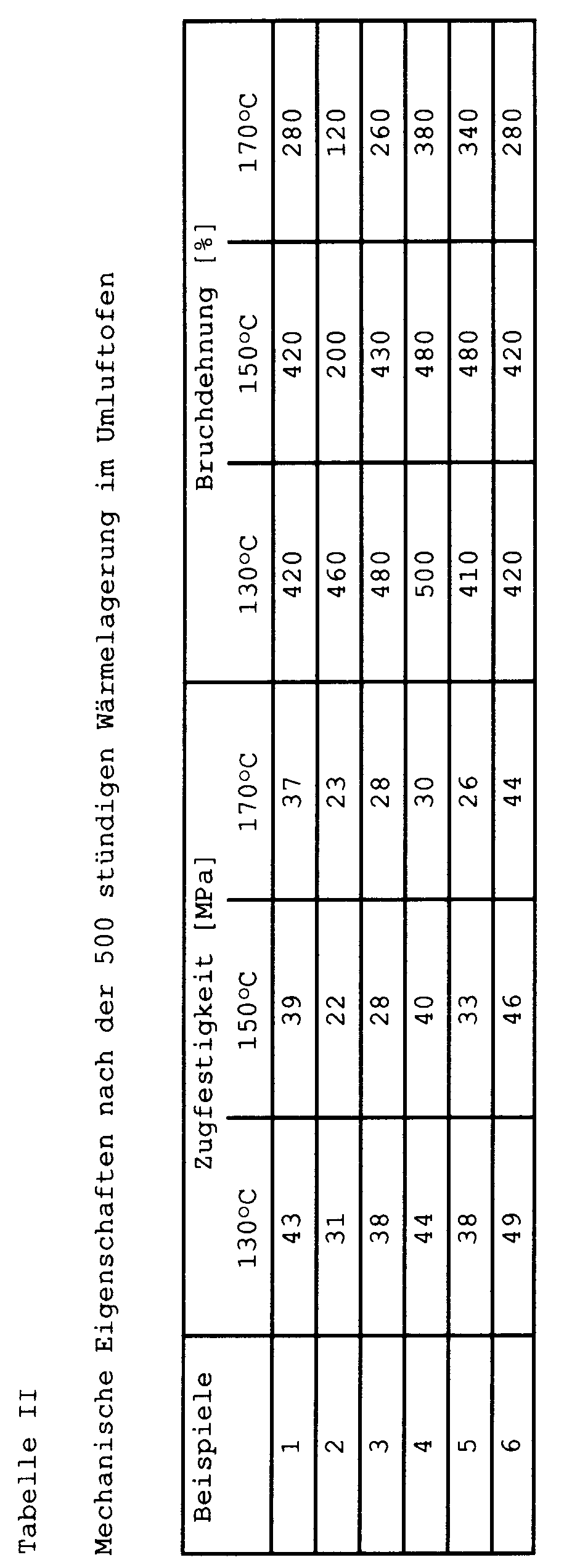
Claims (9)
- Polyurethan-Polyester-Triblockpolyadditionsprodukte, erhältlich durch UmsetzungA) mindestens eines thermoplastischen Polyesters undB) mindestens eines thermoplastischen Polyurethan-Elastomeren, das seinerseits erhältlich ist durch Umsetzung vonBa) organischen Diisocyanaten mitBb) höhermolekularen Polyhydroxylverbindungen undBc) niedermolekularen Kettenverlängerungsmittelnunter Anwendung einer NCO-Kennzahl größer als 115.
- Polyurethan-Polyester-Triblockpolyadditionsprodukte nach Anspruch 1, dadurch gekennzeichnet, daß die thermoplastischen Polyurethan-Elastomeren (B) einen Gehalt an freien NCO-Gruppen von 0,5 bis 4 Gew.-% und einen Gesamtgehalt an NCO-Gruppen von 0,75 bis 5 Gew.-%, bezogen auf das Gesamtgewicht des thermoplastischen Polyurethans, besitzen.
- Polyurethan-Polyester-Triblockpolyadditionsprodukte nach Anspruch 1, dadurch gekennzeichnet, daß die thermoplastischen Polyurethan-Elastomeren (B) hergestellt werden durch Umsetzung vonBa) mindestens einem aromatischen Diisocyanat mitBb) mindestens einer im wesentlichen difunktionellen Polyhydroxylverbindung mit einem Molekulargewicht von 500 bis 8000 undBc) mindestens einem Diol mit einem Molekulargewicht von 60 bis 300in einem Äquivalenzverhältnis von NCO-Gruppen der aromatischen Diisocyanate (Ba) zur Summe der Hydroxylgruppen der Komponenten (Bb) und (Bc) von 1,16 bis 1,35:1,0.
- Polyurethan-Polyester-Triblockpolyadditionsprodukte nach Anspruch 1, dadurch gekennzeichnet, daß die thermoplastischen Polyurethan-Elastomeren (B) hergestellt werden durch Umsetzung vonBa) 4,4'-Diphenylmethan-diisocyanat mitBb) Polyalkylenglykolpolyadipaten mit 2 bis 6 C-Atomen im Alkylenrest und Molekulargewichten von 500 bis 6000 oder Polyoxytetramethylen-glykol mit einem Molekulargewicht von 500 bis 3200 undBc) Butandiol-1,4in einem Äquivalenzverhältnis von NCO-:OH-Gruppen größer als 1,15:1.
- Polyurethan-Polyester-Triblockpolyadditionsprodukte nach Anspruch 1, dadurch gekennzeichnet, daß die thermoplastischen Polyester (A) eine relative Viskosität im Bereich von 0,8 bis 1,8 aufweisen, gemessen in einer 0,5 gew.-%igen Lösung in einem Phenol/1,2-Dichlorbenzolgemisch im Gewichtsverhältnis 1:1 bei 25°C, und hergestellt werden durch Polykondensation von aromatischen Dicarbonsäuren und/oder Dicarbonsäurederivaten mit Alkandiolen mit 2 bis 6 Kohlenstoffatomen im Alkylenrest.
- Polyurethan-Polyester-Triblockpolyadditionsprodukte nach Anspruch 1, dadurch gekennzeichnet, daß die thermoplastischen Polyester (A) bestehen aus Polyethylenterephthalat, Polybutylenterephthalat oder Mischungen davon.
- Verfahren zur Herstellung von Polyurethan-Polyester-Triblockpolyadditionsprodukten durch Umsetzung vonA) mindestens einem thermoplastischen Polyester undB) mindestens einem thermoplastischen Polyurethan-Elastomeren beieiner Temperatur im Bereich von 180 bis 300°C, dadurch gekennzeichnet, daß die thermoplastischen Polyurethan-Elastomeren einen Gehalt an freien NCO-Gruppen von 0,5 bis 4 Gew.-% und einen Gesamtgehalt an NCO-Gruppen von 0,75 bis 5 Gew.-%, bezogen auf das Gesamtgewicht des thermoplastischen Polyurethans, besitzen und ihrerseits hergestellt werden durch UmsetzungBa) mindestens eines organischen Diisocyanats mitBb) mindestens einer höhermolekularen Polyhydroxylverbindung undBc) mindestens einem niedermolekularen Kettenverlängerungsmittelim Verhältnis von NCO-Gruppen von (Ba) zur Summe der Hydroxylgruppen von (Bb) und (Bc) von größer als 1,15:1.
- Verwendung der Polyurethan-Polyester-Triblockpolyadditionsprodukte nach einem der Anspruche 1 bis 6 zur Herstellung von Extrusionsprodukten.
- Verwendung der Polyurethan-Polyester-Triblockpolyadditionsprodukte nach einem der Anspruche 1 bis 6 zur Herstellung von Formkörpern.
Applications Claiming Priority (2)
| Application Number | Priority Date | Filing Date | Title |
|---|---|---|---|
| DE4341077 | 1993-12-02 | ||
| DE4341077A DE4341077A1 (de) | 1993-12-02 | 1993-12-02 | Temperaturbeständige, hochelastische, abriebfeste Polyurethan-Polyester-Triblockpolyadditionsprodukte, ein Verfahren zu ihrer Herstellung und ihre Verwendung |
Publications (2)
| Publication Number | Publication Date |
|---|---|
| EP0656397A1 true EP0656397A1 (de) | 1995-06-07 |
| EP0656397B1 EP0656397B1 (de) | 1998-07-29 |
Family
ID=6504003
Family Applications (1)
| Application Number | Title | Priority Date | Filing Date |
|---|---|---|---|
| EP94118398A Expired - Lifetime EP0656397B1 (de) | 1993-12-02 | 1994-11-23 | Temperaturbeständige, hochelastische, abriebfeste Polyurethan-Polyester-Triblockpolyadditionsprodukte, ein Verfahren zu ihrer Herstellung und ihre Verwendung |
Country Status (7)
| Country | Link |
|---|---|
| EP (1) | EP0656397B1 (de) |
| JP (1) | JPH0848742A (de) |
| KR (1) | KR950018119A (de) |
| CN (1) | CN1109074A (de) |
| AT (1) | ATE169051T1 (de) |
| CA (1) | CA2136125A1 (de) |
| DE (2) | DE4341077A1 (de) |
Cited By (5)
| Publication number | Priority date | Publication date | Assignee | Title |
|---|---|---|---|---|
| WO1999011710A1 (en) * | 1997-09-04 | 1999-03-11 | Eastman Chemical Company | Thermoplastic polyurethane additives for chain extension and reactive extrusion |
| EP1693394A1 (de) | 2001-08-10 | 2006-08-23 | Basf Aktiengesellschaft | Thermoplastische Polyurethane |
| WO2019175313A1 (de) | 2018-03-14 | 2019-09-19 | Basf Se | Herstellungsverfahren von polyetherester elastomeren |
| WO2020136238A1 (de) | 2018-12-28 | 2020-07-02 | Basf Se | Partikelschäume aus aromatischem-polyester-polyurethan-multiblockcopolymer |
| US11267928B2 (en) | 2016-02-22 | 2022-03-08 | Basf Se | Method for producing a diblock copolymer |
Families Citing this family (5)
| Publication number | Priority date | Publication date | Assignee | Title |
|---|---|---|---|---|
| CN1078228C (zh) * | 1997-12-22 | 2002-01-23 | 黎燕 | 耐磨型聚酯树脂组合物 |
| KR100694200B1 (ko) * | 2004-03-05 | 2007-03-14 | (주)선한엠엔티 | 방수제용 공중합체 및 이의 제조방법 |
| CN105237964A (zh) * | 2015-09-30 | 2016-01-13 | 滁州优胜高分子材料有限公司 | 一种高抗冲pbt/bovc/tpu复合材料及其制备方法 |
| WO2017108920A1 (de) * | 2015-12-22 | 2017-06-29 | Basf Se | Tpu schrumpfmaterial |
| CN119752119B (zh) * | 2024-07-11 | 2025-10-10 | 广州爱德医疗科技有限公司 | 一种覆膜热敏材料及其制备方法 |
Citations (8)
| Publication number | Priority date | Publication date | Assignee | Title |
|---|---|---|---|---|
| JPS5460395A (en) * | 1977-10-20 | 1979-05-15 | Toray Ind Inc | Preparation of modified polyester |
| US4165307A (en) * | 1977-04-11 | 1979-08-21 | Dai Nippon Ink & Chemicals Incorporated | Process for preparation of molding resins |
| EP0013461A1 (de) * | 1979-01-03 | 1980-07-23 | Akzo N.V. | Verfahren zur Herstellung segmentierter thermoplastischer Elastomere |
| EP0167889A1 (de) * | 1984-06-29 | 1986-01-15 | Mobay Corporation | Thermoplastische Polyesterformmassen mit Schlagfestigkeit |
| EP0334186A2 (de) * | 1988-03-25 | 1989-09-27 | Bayer Ag | Thermoplastische Polymermischung und Verfahren zu ihrer Herstellung |
| WO1991015530A1 (en) * | 1990-03-30 | 1991-10-17 | H.B. Fuller Licensing & Financing Inc. | Hot melt moisture-cure polyurethane adhesive |
| DE4128274A1 (de) * | 1991-08-27 | 1993-03-04 | Basf Schwarzheide Gmbh | Thermoplastischer werkstoff mit erhoehter festigkeit, erhoehtem e-modul und verbesserter waermeformbestaendigkeit auf basis von polyurethan und verfahren zu seiner herstellung |
| WO1993022383A1 (en) * | 1992-04-30 | 1993-11-11 | The Dow Chemical Company | Thermally processable blends of aromatic polyesters and high modulus polyurethanes |
-
1993
- 1993-12-02 DE DE4341077A patent/DE4341077A1/de not_active Withdrawn
-
1994
- 1994-11-18 CA CA002136125A patent/CA2136125A1/en not_active Abandoned
- 1994-11-23 AT AT94118398T patent/ATE169051T1/de not_active IP Right Cessation
- 1994-11-23 DE DE59406557T patent/DE59406557D1/de not_active Expired - Fee Related
- 1994-11-23 EP EP94118398A patent/EP0656397B1/de not_active Expired - Lifetime
- 1994-11-30 JP JP6296769A patent/JPH0848742A/ja active Pending
- 1994-12-02 KR KR1019940032503A patent/KR950018119A/ko not_active Withdrawn
- 1994-12-02 CN CN94119363A patent/CN1109074A/zh active Pending
Patent Citations (8)
| Publication number | Priority date | Publication date | Assignee | Title |
|---|---|---|---|---|
| US4165307A (en) * | 1977-04-11 | 1979-08-21 | Dai Nippon Ink & Chemicals Incorporated | Process for preparation of molding resins |
| JPS5460395A (en) * | 1977-10-20 | 1979-05-15 | Toray Ind Inc | Preparation of modified polyester |
| EP0013461A1 (de) * | 1979-01-03 | 1980-07-23 | Akzo N.V. | Verfahren zur Herstellung segmentierter thermoplastischer Elastomere |
| EP0167889A1 (de) * | 1984-06-29 | 1986-01-15 | Mobay Corporation | Thermoplastische Polyesterformmassen mit Schlagfestigkeit |
| EP0334186A2 (de) * | 1988-03-25 | 1989-09-27 | Bayer Ag | Thermoplastische Polymermischung und Verfahren zu ihrer Herstellung |
| WO1991015530A1 (en) * | 1990-03-30 | 1991-10-17 | H.B. Fuller Licensing & Financing Inc. | Hot melt moisture-cure polyurethane adhesive |
| DE4128274A1 (de) * | 1991-08-27 | 1993-03-04 | Basf Schwarzheide Gmbh | Thermoplastischer werkstoff mit erhoehter festigkeit, erhoehtem e-modul und verbesserter waermeformbestaendigkeit auf basis von polyurethan und verfahren zu seiner herstellung |
| WO1993022383A1 (en) * | 1992-04-30 | 1993-11-11 | The Dow Chemical Company | Thermally processable blends of aromatic polyesters and high modulus polyurethanes |
Non-Patent Citations (1)
| Title |
|---|
| CHEMICAL ABSTRACTS, vol. 91, no. 16, October 1979, Columbus, Ohio, US; abstract no. 124490h, YONETANI ET AL: "MODIFIED POLYESTERS" page 39; column 2; * |
Cited By (7)
| Publication number | Priority date | Publication date | Assignee | Title |
|---|---|---|---|---|
| WO1999011710A1 (en) * | 1997-09-04 | 1999-03-11 | Eastman Chemical Company | Thermoplastic polyurethane additives for chain extension and reactive extrusion |
| EP1693394A1 (de) | 2001-08-10 | 2006-08-23 | Basf Aktiengesellschaft | Thermoplastische Polyurethane |
| US7241854B2 (en) | 2001-08-10 | 2007-07-10 | Basf Aktiengesellschaft | Thermoplastic polyurethanes |
| US8680213B2 (en) | 2001-08-10 | 2014-03-25 | Basf Aktiengesellschaft | Thermoplastic polyurethanes |
| US11267928B2 (en) | 2016-02-22 | 2022-03-08 | Basf Se | Method for producing a diblock copolymer |
| WO2019175313A1 (de) | 2018-03-14 | 2019-09-19 | Basf Se | Herstellungsverfahren von polyetherester elastomeren |
| WO2020136238A1 (de) | 2018-12-28 | 2020-07-02 | Basf Se | Partikelschäume aus aromatischem-polyester-polyurethan-multiblockcopolymer |
Also Published As
| Publication number | Publication date |
|---|---|
| DE4341077A1 (de) | 1995-06-08 |
| CA2136125A1 (en) | 1995-06-03 |
| DE59406557D1 (de) | 1998-09-03 |
| ATE169051T1 (de) | 1998-08-15 |
| EP0656397B1 (de) | 1998-07-29 |
| KR950018119A (ko) | 1995-07-22 |
| JPH0848742A (ja) | 1996-02-20 |
| CN1109074A (zh) | 1995-09-27 |
Similar Documents
| Publication | Publication Date | Title |
|---|---|---|
| EP0129193B1 (de) | Verfahren zur Herstellung von antistatischen und/oder elektrisch leitfähigen thermoplastischen Polyurethanen sowie deren Verwendung | |
| EP0571831B1 (de) | Mehrstufenprozess zur Herstellung von thermoplastisch verarbeitbaren Polyurethan-Elastomeren | |
| DE102005039933B4 (de) | Verfahren zur Herstellung von thermoplastisch verarbeitbaren Polyurethanen | |
| EP1826225B1 (de) | Thermoplastisch verarbeitbare Polyurethane, Verfahren zu ihrer Herstellung und ihre Verwendung | |
| EP1338614A1 (de) | Verfahren zur Herstellung von weichen, gut entformbaren thermoplastischen Polyurethanelastomeren mit geringer Schwindung | |
| EP0382051A2 (de) | Kälteschlagzähe, gut fliessfähige, thermoplastische Polyurethan-Elastomerzusammensetzungen, Verfahren zu ihrer Herstellung und ihre Verwendung | |
| DE19755545A1 (de) | Verfahren zur Herstellung von thermoplastischen Polyurethanelastomeren | |
| EP0420016A2 (de) | Schlagzäh modifizierte thermoplastische Polyurethan-Polyester-Formmassen, Verfahren zu ihrer Herstellung und ihre Verwendung | |
| DE19924090C1 (de) | Verfahren zur kontinuierlichen Herstellung von thermoplastisch verarbeitbaren Polyurethanen mit verbessertem Erweichungsverhalten | |
| DE19907987C2 (de) | Weiche, thermoplastische Formmassen | |
| EP0134455A1 (de) | Verwendung von weichmacherhaltigen thermoplastischen Polyurethanen zur Herstellung von Folien oder Formkörpern | |
| DE3501762A1 (de) | Flammwidrige, thermoplastische polyurethan-elastomere, verfahren zu deren herstellung und deren verwendung | |
| EP1055691A2 (de) | Verfahren zur kontinuierlichen Herstellung von thermoplastisch verarbeitbaren Polyurethanen | |
| EP0656397B1 (de) | Temperaturbeständige, hochelastische, abriebfeste Polyurethan-Polyester-Triblockpolyadditionsprodukte, ein Verfahren zu ihrer Herstellung und ihre Verwendung | |
| EP1391472B1 (de) | Kontinuierliche Herstellung von thermoplastisch verarbeitbaren Polyurethanen | |
| EP0571828B1 (de) | Mehrstufenprozess zur Herstellung von thermoplastisch verarbeitbaren Polyurethan-Elastomeren | |
| EP0737718B1 (de) | Herstellung von TPU-Copolymerisat-Mischungen mit Hilfe von Fliessverbesserern | |
| EP3589676B1 (de) | Schlagzähe thermoplastische polyurethane, deren herstellung und verwendung | |
| EP0111682B1 (de) | Gut entformbare und nicht blockende, thermoplastische Polyurethan-Elastomere, Verfahren zu deren Herstellung und deren Verwendung | |
| DE3871814T2 (de) | Verfahren zur herstellung einer legierung vom typ polyoxymethylen-polyurethan. | |
| EP0420017A2 (de) | Schlagzäh modifizierte thermoplastische Polyurethan-Polyester-Formmassen, Verfaren zu ihrer Herstellung und ihre Verwendung | |
| DE19754601A1 (de) | Verfahren zur Herstellung von Polyisocyanat-Polyadditionsprodukten | |
| DE4018716A1 (de) | Mischungen aus themroplastischem polyurethan-elastomer und ethylen/vinylacetat-copolymerisat | |
| DE19706452C2 (de) | Verwendung von Fettsäuren zur Herstellung von thermoplastischen Polyisocyanat-Polyadditionsprodukten | |
| EP0387590B1 (de) | Schlagzäh modifizierte thermoplastische Polyurethan-Formmassen, Verfahren zu ihre Herstellung und ihre Verwendung |
Legal Events
| Date | Code | Title | Description |
|---|---|---|---|
| PUAI | Public reference made under article 153(3) epc to a published international application that has entered the european phase |
Free format text: ORIGINAL CODE: 0009012 |
|
| AK | Designated contracting states |
Kind code of ref document: A1 Designated state(s): AT BE CH DE DK ES FR GB IT LI NL PT SE |
|
| 17P | Request for examination filed |
Effective date: 19951115 |
|
| 17Q | First examination report despatched |
Effective date: 19970612 |
|
| GRAG | Despatch of communication of intention to grant |
Free format text: ORIGINAL CODE: EPIDOS AGRA |
|
| GRAG | Despatch of communication of intention to grant |
Free format text: ORIGINAL CODE: EPIDOS AGRA |
|
| GRAG | Despatch of communication of intention to grant |
Free format text: ORIGINAL CODE: EPIDOS AGRA |
|
| GRAH | Despatch of communication of intention to grant a patent |
Free format text: ORIGINAL CODE: EPIDOS IGRA |
|
| GRAH | Despatch of communication of intention to grant a patent |
Free format text: ORIGINAL CODE: EPIDOS IGRA |
|
| GRAA | (expected) grant |
Free format text: ORIGINAL CODE: 0009210 |
|
| AK | Designated contracting states |
Kind code of ref document: B1 Designated state(s): AT BE CH DE DK ES FR GB IT LI NL PT SE |
|
| PG25 | Lapsed in a contracting state [announced via postgrant information from national office to epo] |
Ref country code: NL Free format text: LAPSE BECAUSE OF FAILURE TO SUBMIT A TRANSLATION OF THE DESCRIPTION OR TO PAY THE FEE WITHIN THE PRESCRIBED TIME-LIMIT Effective date: 19980729 Ref country code: ES Free format text: THE PATENT HAS BEEN ANNULLED BY A DECISION OF A NATIONAL AUTHORITY Effective date: 19980729 |
|
| REF | Corresponds to: |
Ref document number: 169051 Country of ref document: AT Date of ref document: 19980815 Kind code of ref document: T |
|
| REG | Reference to a national code |
Ref country code: CH Ref legal event code: EP |
|
| REF | Corresponds to: |
Ref document number: 59406557 Country of ref document: DE Date of ref document: 19980903 |
|
| GBT | Gb: translation of ep patent filed (gb section 77(6)(a)/1977) |
Effective date: 19980814 |
|
| PGFP | Annual fee paid to national office [announced via postgrant information from national office to epo] |
Ref country code: FR Payment date: 19981023 Year of fee payment: 5 |
|
| PG25 | Lapsed in a contracting state [announced via postgrant information from national office to epo] |
Ref country code: SE Free format text: LAPSE BECAUSE OF FAILURE TO SUBMIT A TRANSLATION OF THE DESCRIPTION OR TO PAY THE FEE WITHIN THE PRESCRIBED TIME-LIMIT Effective date: 19981029 Ref country code: PT Free format text: LAPSE BECAUSE OF FAILURE TO SUBMIT A TRANSLATION OF THE DESCRIPTION OR TO PAY THE FEE WITHIN THE PRESCRIBED TIME-LIMIT Effective date: 19981029 Ref country code: DK Free format text: LAPSE BECAUSE OF FAILURE TO SUBMIT A TRANSLATION OF THE DESCRIPTION OR TO PAY THE FEE WITHIN THE PRESCRIBED TIME-LIMIT Effective date: 19981029 |
|
| PGFP | Annual fee paid to national office [announced via postgrant information from national office to epo] |
Ref country code: AT Payment date: 19981103 Year of fee payment: 5 |
|
| PGFP | Annual fee paid to national office [announced via postgrant information from national office to epo] |
Ref country code: CH Payment date: 19981104 Year of fee payment: 5 |
|
| PGFP | Annual fee paid to national office [announced via postgrant information from national office to epo] |
Ref country code: GB Payment date: 19981116 Year of fee payment: 5 |
|
| PGFP | Annual fee paid to national office [announced via postgrant information from national office to epo] |
Ref country code: BE Payment date: 19981118 Year of fee payment: 5 |
|
| PGFP | Annual fee paid to national office [announced via postgrant information from national office to epo] |
Ref country code: DE Payment date: 19981204 Year of fee payment: 5 |
|
| ET | Fr: translation filed | ||
| NLV1 | Nl: lapsed or annulled due to failure to fulfill the requirements of art. 29p and 29m of the patents act | ||
| PLBE | No opposition filed within time limit |
Free format text: ORIGINAL CODE: 0009261 |
|
| STAA | Information on the status of an ep patent application or granted ep patent |
Free format text: STATUS: NO OPPOSITION FILED WITHIN TIME LIMIT |
|
| 26N | No opposition filed | ||
| PG25 | Lapsed in a contracting state [announced via postgrant information from national office to epo] |
Ref country code: GB Free format text: LAPSE BECAUSE OF NON-PAYMENT OF DUE FEES Effective date: 19991123 Ref country code: AT Free format text: LAPSE BECAUSE OF NON-PAYMENT OF DUE FEES Effective date: 19991123 |
|
| PG25 | Lapsed in a contracting state [announced via postgrant information from national office to epo] |
Ref country code: LI Free format text: LAPSE BECAUSE OF NON-PAYMENT OF DUE FEES Effective date: 19991130 Ref country code: CH Free format text: LAPSE BECAUSE OF NON-PAYMENT OF DUE FEES Effective date: 19991130 Ref country code: BE Free format text: LAPSE BECAUSE OF NON-PAYMENT OF DUE FEES Effective date: 19991130 |
|
| BERE | Be: lapsed |
Owner name: ELASTOGRAN G.M.B.H. Effective date: 19991130 |
|
| GBPC | Gb: european patent ceased through non-payment of renewal fee |
Effective date: 19991123 |
|
| REG | Reference to a national code |
Ref country code: CH Ref legal event code: PL |
|
| PG25 | Lapsed in a contracting state [announced via postgrant information from national office to epo] |
Ref country code: FR Free format text: LAPSE BECAUSE OF NON-PAYMENT OF DUE FEES Effective date: 20000731 |
|
| PG25 | Lapsed in a contracting state [announced via postgrant information from national office to epo] |
Ref country code: DE Free format text: LAPSE BECAUSE OF NON-PAYMENT OF DUE FEES Effective date: 20000901 |
|
| REG | Reference to a national code |
Ref country code: FR Ref legal event code: ST |
|
| PG25 | Lapsed in a contracting state [announced via postgrant information from national office to epo] |
Ref country code: IT Free format text: LAPSE BECAUSE OF NON-PAYMENT OF DUE FEES Effective date: 20051123 |