EP0652197B1 - Procédé de production d'au moins un alkyl tertiobutyl éther à partir du gaz naturel - Google Patents
Procédé de production d'au moins un alkyl tertiobutyl éther à partir du gaz naturel Download PDFInfo
- Publication number
- EP0652197B1 EP0652197B1 EP94402268A EP94402268A EP0652197B1 EP 0652197 B1 EP0652197 B1 EP 0652197B1 EP 94402268 A EP94402268 A EP 94402268A EP 94402268 A EP94402268 A EP 94402268A EP 0652197 B1 EP0652197 B1 EP 0652197B1
- Authority
- EP
- European Patent Office
- Prior art keywords
- zone
- effluent
- containing mainly
- fraction
- synthesis
- Prior art date
- Legal status (The legal status is an assumption and is not a legal conclusion. Google has not performed a legal analysis and makes no representation as to the accuracy of the status listed.)
- Expired - Lifetime
Links
Images
Classifications
-
- C—CHEMISTRY; METALLURGY
- C07—ORGANIC CHEMISTRY
- C07C—ACYCLIC OR CARBOCYCLIC COMPOUNDS
- C07C41/00—Preparation of ethers; Preparation of compounds having groups, groups or groups
- C07C41/01—Preparation of ethers
-
- C—CHEMISTRY; METALLURGY
- C07—ORGANIC CHEMISTRY
- C07C—ACYCLIC OR CARBOCYCLIC COMPOUNDS
- C07C41/00—Preparation of ethers; Preparation of compounds having groups, groups or groups
- C07C41/01—Preparation of ethers
- C07C41/05—Preparation of ethers by addition of compounds to unsaturated compounds
- C07C41/06—Preparation of ethers by addition of compounds to unsaturated compounds by addition of organic compounds only
Definitions
- the present invention relates to a method for producing at least an alkyl tert-butyl ether at least partially from natural gas.
- Natural gas is an abundant fossil raw material, consisting essentially of methane, whose currently proven reserves, of the order of 10 14 m 3 , represent around 50 years of world consumption. Gas fields often contain significant amounts of ethane, propane, other higher alkanes (C 3 + hydrocarbons, i.e. hydrocarbons with at least the same number of carbon atoms per molecule to 3), as well as other constituents such as H 2 O, CO 2 , N 2 , H 2 S and He.
- LPG liquefied petroleum gas.
- LPG liquefied petroleum gas
- Hydrogen sulfide is also separated, because of its corrosive nature, and water, because of the formation of hydrates which interfere with the transport of natural gas.
- the purified natural gas obtained after dehydration and desulfurization preferably up to a sulfur compound content of less than 10 ppm, is then qualified as non-condensed gas, and mainly contains methane (for example 55-99% by volume) as well as ethane, usually propane and possibly small amounts of nitrogen and / or carbon dioxide.
- methane for example 55-99% by volume
- ethane usually propane and possibly small amounts of nitrogen and / or carbon dioxide.
- natural gas indifferently the purified gas, obtained after dehydration and desulfurization, or the unpurified gas, resulting from a deposit and not having undergone any preliminary purification.
- alkyl tert-butyl ether such as for example methyl tert-butyl ether (MTBE) or ethyl tert-butyl ether (ETBE)
- MTBE methyl tert-butyl ether
- ETBE ethyl tert-butyl ether
- alkyl tert-butyl ethers are currently produced by reaction of isobutene with an alcohol, such as for example methanol or ethanol, and if said alcohols are easily synthesized from natural gas via synthesis gas (defined as a mixture containing carbon monoxide, hydrogen and possibly carbon dioxide), it is not the same for isobutene which is usually extracted from a C 4 cut (hydrocarbons comprising 4 atoms of carbon per molecule), available for example from a catalytic cracking unit for petroleum fractions.
- synthesis gas defined as a mixture containing carbon monoxide, hydrogen and possibly carbon dioxide
- This source of olefins currently appears far too limited to meet the growing demand for alkyl tert-butyl ether (s) such as MTBE or ETBE.
- alkyl tert-butyl ether such as MTBE or ETBE.
- One of the objectives of the method according to the present invention is to synthesizing at least one alkyl tert-butyl ether, preferably respectively MTBE or ETBE, from at least one alcohol and from isobutene, synthesized at least partially from natural gas.
- US-A-5,159,125 claims a condensation process aldolic of methanol or other alcohols with an olefin comprising at least minus two carbon atoms, in order to synthesize a mixture of alcohols higher molecular weights rich in isobutanol.
- Isobutanol can then be separated and dehydrated into isobutene and said isobutene condensed with the methanol to form MTBE, these processes being known to those skilled in the art job.
- Another objective of the process according to the invention is to enhance the by-products from the non-selective oxidation of natural gas in the C.O.M. reactor, i.e. carbon monoxide and carbon dioxide carbon, as well as the co-produced hydrogen, as synthesis gas serving to at least partially supply the synthesis unit with at least one alcohol.
- the reaction of the oxidative coupling in sequential mode consists of the oxidation of methane by a reducible agent followed by the reoxidation of this agent, separately, by the oxygen in the air.
- a reducible agent especially Mn, Ce, Pr, Sn, In, Ge, Pb, Sb, Bi, Tb, such as reducible agents for this reaction, has been mentioned in several American patents such as, for example, US-A-4,499,323, US-A-4,523,049, US-A-4,547,611 and US-A-4,567,307.
- US Pat. No. 5,113,032 Another possibility (US Pat. No. 5,113,032) consists, in an oxypyrolysis process, of separating natural gas into three fractions, that is to say a first fraction rich in methane, a second fraction rich in C 2 and a third fraction rich in C 3 + hydrocarbons, and to pyrolyze said second and third fractions separately in order to increase the yield of ethylene, or to pyrolyze said second fraction and to independently value the C 3 + cut in any other process known to those skilled in the art.
- the present invention therefore also relates to a method of production of at least one alkyl tert-butyl ether at least partially from natural gas in which the ethylene necessary for the production of isobutene is produced by the oxypyrolysis process claimed in the patents US-A-5,025,108 and US-A-5,113,032.
- any contact mass can be used known for this use as for example contact masses based on nickel dispersed on an oxide preferably having a large surface specific such as for example an alumina or a stabilized alumina.
- the contact masses which correspond to the above conditions and whose use is therefore preferred for the process according to the invention are generally those which contain oxides and / or carbonates of alkali metals (such as lithium, sodium, potassium, rubidium and cesium), alkaline earth metals (such as beryllium, magnesium, calcium, strontium and barium) and rare earth metals (such as yttrium, lanthanum, praseodymium, neodymium, samarium, gadolinium, terbium, dysprosium, holmium, erbium, thulium, ytterbium, europium and lutetium), either alone (as in the case of rare earths and alkaline earth), or as a mixture (as in the case of metals alkaline earth doped with alkali metals and earth metals rare doped with alkali and / or alkaline earth metals).
- alkali metals such as lithium, sodium, potassium, rubidium and ces
- Others contact masses which correspond to the above conditions are those which contain oxides and / or carbonates of titanium, zirconium, hafnium, manganese, cerium, tin, indium, germanium, lead, antimony, zinc and bismuth, preferably with one or more oxides and / or carbonates of alkali, alkaline earth metals, rare earths and silica.
- Contact masses above designated are effective alone or doped with halides, phosphorus or sulfur oxides. The contact masses are only however not limited to the formulas indicated above: it is also possible more generally to use any contact mass provided for this use.
- the fraction of gas preferably enriched in methane and subjected to the oxidation (step (d) of the process according to the invention) can be used without diluent or can be diluted with at least one inert gas such as nitrogen, carbon dioxide or water vapor.
- the oxygen content in methane cannot generally not exceed 40 mol%; it is therefore generally between 0.1 and 40% molar, preferably between 5 and 25% molar.
- the temperature of the oxidative coupling reaction (C.O.M.) (step (d) of the method according to the invention), is generally between 650 and 1200 ° C, preferably between 650 and 950 ° C.
- the contact time (that is to say the time necessary to effect the consumption of at least 80% of the molecular oxygen in the charge) is usually between 10 -6 and 1 second, preferably between 10 - 6 and 10 -1 second.
- C.O.M.'s reaction can be implemented in any type of reactor, in particular in a fixed bed, bubbling bed, bed reactor circulating or in a fluidized bed, preferably in a fixed bed reactor.
- contact mass used for the reaction of dimerization of ethylene (step (e) of the process according to the invention)
- any known contact mass or soluble catalyst for this use such as for example a nickel salt deposited on a support oxide such as alumina or, for example, a mixture of soluble complexes comprising nickel and a Lewis acid such as the mixture of a nickel carboxylate and a trialkylaluminum.
- any contact mass known for this use can be used, and more particularly any contact mass having an acidity substantially weak such as possibly doped aluminas, silica-aluminas, silica-zirconia or zeolites. It is in particular possible and advantageous to use the contact masses described in the request for French patent 92 / 10.949.
- step (g) of the process according to the invention is done according to any process known to those skilled in the art.
- the synthesis of methanol from synthesis gas is an industrial process, generally operated in the presence of copper-based catalysts and previously described for example in patents US-A-3,388,972 and US-A-3,546,140 from C.C.I. and US-A-3,923,694 from I.C.I ..
- Any contact mass known for this purpose can be used in this process. use, such as catalysts based on copper aluminum and zinc described in patent US-A-5 112 591.
- any contact mass known for this use can be used, such as for example acid resins such as for example resins sulfonic or any acidic oxide or zeolite with adequate acidity.
- acid resins such as for example resins sulfonic or any acidic oxide or zeolite with adequate acidity.
- Such a synthesis is for example described in the patents US-A-4,847,431, US-A-5,013,407 and US-A-4,847,430.
- step (d) of the process according to the invention it is possible to use the method according to the invention for simultaneously prepare at least one alkyl tert-butyl ether as well as liquid fuel (e.g. petrol and / or diesel) by dimerization and / or oligomerization of part of the olefins produced during the step of oxidative methane coupling (step (d) of the process according to the invention), as described for example in patents US-A-5,025,108 and US-A-5 113 032.
- step (a) from preforming of the process according to the invention and only the synthesis gas from step (d) (i.e. the second effluent from the C.O.M. zone) is then used for the production of alcohol (s).
- This (or these) alcohol (s) is (are) next advantageously transformed (s) into alkyl tert-butyl ether (s) by making it (s) react, in step (h) of the process according to the invention, with the isobutene produced by dimerization and isomerization (steps (e) and (f) of the process according to the invention) of the residual ethylene fraction which has not been transformed into liquid fuel. It is thus possible to obtain, by means of the method according to the invention, a very efficient liquid fuel base, such as high octane gasoline, mixing the fuel produced with the at least part of the alkyl tert-butyl ether (s) obtained simultaneously.
- a very efficient liquid fuel base such as high octane gasoline
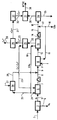
- This fraction will be used as feed gas for the methanol synthesis unit (34).
- the composition of this fraction does not correspond to the stoichiometry of the methanol synthesis.
- the other part of said second fraction (764.5 kmol / h) is sent via line (25) to the preforming unit (26), in order to produce the hydrogen necessary for the stoichiometry of the methanol synthesis.
- the third fraction corresponding to 484.5 kmol / h of C 2 + , is sent via line (20) to the fractionation unit (21).
- the 764.5 kmol / h of gas is transformed by steam injected through line (27) into 1038.5 kmol / h of gas (dry counted) of the following composition: CO: 0.51 CO 2 : 6.12 H 2 : 25.86 K 1 : 67.51 100.00
- This gas arriving through line (28) is mixed with the effluent gas from the unit (6) by the pipe (7) then after drying and compression by the line (8), and the mixture arriving through line (9) is decarbonated in the unit (10).
- the unit (21) first separates the C 3 + which is returned to the unit (6) via the line (22) at the level of the pyrolysis section installed downstream of the COM reactor.
- the remaining fraction of the initial line (20) is distilled and gives ethylene or 296.5 kmol / h as well as ethane or 172 kmol / h.
- Ethane is also sent to the unit (6) via line (22) to be pyrolyzed into ethylene, as described in patent US-A-5,025,108.
- This unit (6) is supplied with oxygen by the pipe (5), said oxygen coming from an air distillation unit (3) supplied with air by the pipe (2) and producing nitrogen by the pipe (4).
- the linear butene is sent via the line (31) to the unit (32) which is an isomerization unit of n-butene to isobutene.
- This isobutene is sent via line (33) to the methyl tert-butyl synthesis unit (37) ether (MTBE) which also receives methanol from the synthesis of methanol (34) via line (36).
- MTBE methyl tert-butyl synthesis unit
Landscapes
- Chemical & Material Sciences (AREA)
- Organic Chemistry (AREA)
- Organic Low-Molecular-Weight Compounds And Preparation Thereof (AREA)
Description
Le procédé de préréformage a par exemple été décrit par British Gas (Hydrocarbon Processing, p.34, décembre 1990). Tous les hydrocarbures C2 + présents dans la charge se trouvent décomposés en méthane. Ce dernier, par contre, se met en équilibre de réformage avec l'hydrogène, les oxydes de carbone et la vapeur d'eau.
- une première fraction comprenant principalement du dioxyde de carbone,
- une deuxième fraction comprenant principalement du méthane,
- une troisième fraction comprenant principalement de l'éthylène,
- une quatrième fraction contenant principalement de l'hydrogène et du monoxyde de carbone,
- une cinquième fraction comprenant principalement l'éthane et les hydrocarbures C3 +.
Dans le cas de la présence d'une zone d'oxypyrolyse, il est préférable d'alimenter la partie de la zone d'oxypyrolyse dans laquelle on réalise la pyrolyse par la majeure partie de la cinquième fraction décrite à l'étape (c) comme cela est décrit dans le brevet US-A-5 025 108 cité précédemment. De manière encore plus préférée, ladite cinquième fraction est séparée en un premier flux contenant principalement de l'éthane et en un second flux contenant principalement les hydrocarbures C3 +, de facon soit à alimenter la partie de la zone d'oxypyrolyse dans laquelle on réalise la pyrolyse avec au moins une partie desdits deux flux qui seront pyrolysés séparemment, comme cela est décrit dans le brevet US-A-5 113 032 cité précedemment, soit à alimenter la partie de la zone d'oxypyrolyse dans laquelle on réalise la pyrolyse avec la majeure partie dudit premier flux et à purger la majeure partie dudit second flux.
Dans le cas particulier de la synthèse du méthanol, qui peut être une synthèse industrielle, une caractéristique du procédé selon la présente invention vient de ce que l'on combine tous les flux alimentant la zone de synthèse d'alcool(s) pour que le gaz alimentant ladite zone ait un rapport H2/(2CO + 3CO2) généralement égal approximativement à 1, c'est-à-dire généralement compris entre 0,8 et 1,2, de préférence compris entre 0,9 et 1,1.
Dans le cas particulier de la synthèse de l'éthanol, il est possible de procéder en deux étapes : en première étape on réalise la synthèse de méthanol; puis, dans une seconde étape, on réalise la transformation de la majeure partie du méthanol synthétisé en première étape en éthanol, par exemple par homologation. Il est aussi possible de procéder à la synthèse d'une autre partie de l'éthanol par hydratation de l'éthylène.
D'autre part, il est possible que la zone de synthèse d'alcool(s) soit une zone présente sur le site que l'on utilise partiellement pour l'étape (g) du procédé selon l'invention.
Finalement on obtient un effluent de la zone de synthèse d'alcool(s) comprenant principalement au moins un alcool, de préférence respectivement du méthanol ou de l'éthanol.
- une première fraction comprenant principalement du dioxyde de carbone
- une deuxième fraction comprenant principalement du méthane
- une troisième fraction comprenant principalement de l'éthylène
- une quatrième fraction comprenant principalement de l'hydrogène et du monoxyde de carbone,
- une cinquième fraction comprenant principalement l'éthane et les hydrocarbures C3+
| CH4 : | 88,7 |
| C2 : | 5,6 |
| C3+ : | 2,6 |
| CO2 : | 2,3 |
| H2S : | 0,8 |
| |
| CO : | 0,51 |
| CO2 : | 6,12 |
| H2 : | 25,86 |
| C1: | 67,51 |
| |
Claims (10)
- Procédé de production d'au moins un alkyl tertiobutyl éther au moins partiellement à partir du gaz naturel, ledit procédé comprenant les étapes suivantes :(a) Le préréformage à la vapeur, dans une zone de préréformage (26) d'une charge comprenant principalement du gaz naturel, en présence d'une masse de contact, de façon à obtenir un effluent comprenant principalement de l'hydrogène, du monoxyde de carbone et du dioxyde de carbone.(b) La majeure partie de l'effluent issu de l'étape de préréformage (a) est mélangée (7) avec la majeure partie du second effluent provenant de la zone de C.O.M. (Couplage Oxydant du Méthane) décrit ci-après à l'étape (d) préalablement séché et comprimé.(c) Le mélange réalisé à l'étape (b) est ensuite envoyé dans une zone de séparation [(10), (21)] qui permet l'obtention des effluents suivants :une première fraction comprenant principalement du dioxyde de carbone,une deuxième fraction comprenant principalement du méthane,une troisième fraction comprenant principalement de l'éthylène,une quatrième fraction contenant principalement de l'hydrogène et du monoxyde de carbone,une cinquième fraction comprenant l'éthane et les hydrocarbures C3 +.(d) La réaction de couplage oxydant du méthane est réalisée dans une zone (6) de C.O.M., permettant l'obtention d'un premier effluent (23) comprenant principalement de l'éthylène, et d'un second effluent comprenant principalement de l'hydrogène, du monoxyde de carbone et du dioxyde de carbone.(e) La majeure partie du premier effluent obtenu à l'étape (d) est dimérisée dans une zone de dimérisation (29), permettant l'obtention d'un effluent comprenant principalement du n-butène.(f) La majeure partie de l'effluent obtenu à l'étape (e) est isomérisée dans une zone d'isomérisation (32), permettant l'obtention d'un efflluent comprenant principalement de l'isobutène.(g) La synthèse d'au moins un alcool est réalisée dans une zone de synthèse d'alcool(s) (34), à partir d'une partie de la quatrième fraction obtenue à l'étape (c) et d'une partie de la première fraction obtenue à l'étape (c), lesdites parties étant comprimées avant l'introduction dans la zone de synthèse d'alcool(s), permettant l'obtention d'un effluent comprenant principalement au moins un alcool.(h) La majeure partie de l'effluent obtenu à l'étape (f) est combinée à au moins une partie de l'effluent obtenu à l'étape (g), de façon à synthétiser au moins un alkyl tertiobutyl éther, dans une zone de synthèse d'alkyl tertiobutyl éther(s) (37).
- Procédé selon la revendication 1 dans lequel on procède, préalablement au préréformage, à la séparation de ladite charge en une première fraction comprenant principalement du méthane qui constitue finalement la charge réelle pour l'étape (a) et en une seconde fraction comprenant principalement des hydrocarbures comportant au moins deux atomes de carbone par molécule.
- Procédé selon la revendication 2 dans lequel ladite séparation est effectuée dans la zone de séparation décrite à l'étape (c).
- Procédé selon l'une des revendications 1 à 3 dans lequel on alimente la zone de C.O.M. par au moins une partie de la deuxième fraction décrite à l'étape (c).
- Procédé selon l'une des revendications 1 à 4 dans lequel la zone de C.O.M. est la partie de la zone d'oxypyrolyse dans laquelle on réalise le C.O.M..
- Procédé selon la revendication 5 dans lequel on alimente la partie de la zone d'oxypyrolyse dans laquelle on réalise la pyrolyse par la cinquième fraction décrite à l'étape (c).
- Procédé selon l'une des revendications 1 à 6 dans lequel on introduit en outre dans la zone de synthèse d'alcool(s) une partie comprimée du second effluent obtenu à l'étape (d).
- Utilisation du procédé selon l'une des revendications 1 à 7 pour la synthèse de méthyl tertiobutyl éther.
- Utilisation du procédé selon l'une des revendications 1 à 7 pour la synthèse d'éthyl tertiobutyl éther.
- Procédé de production simultanée d'au moins un alkyl tertiobutyl éther et de carburant liquide à partir de gaz naturel, ledit procédé comprenant les étapes suivantes :(1) la majeure partie du second effluent provenant de la zone de COM décrit ci-après à l'étape (2) préalablement séchée et comprimée est envoyée dans une zone de séparation qui permet l'obtention des effluents suivants :une première fraction comprenant principalement du dioxyde de carboneune deuxième fraction comprenant principalement du méthaneune troisième fraction comprenant principalement de l'éthylèneune quatrième fraction comprenant principalement de l'hydrogène et du monoxyde de carbone,une cinquième fraction comprenant principalement l'éthane et les hydrocarbures C3 +.(2) la réaction de couplage oxydant du méthane est réalisée dans une zone de COM, permettant l'obtention d'un premier effluent comprenant principalement de l'éthylène et d'un second effluent comprenant principalement de l'hydrogène, du monoxyde de carbone et du dioxyde de carbone.(3) une partie du premier effluent obtenu à l'étape (2) est dimérisée dans une zone de dimérisation permettant l'obtention d'un effluent comprenant principalement du n-butène.(4) la majeure partie de l'effluent obtenu à l'étape (3) est isomérisée dans une zone d'isomérisation permettant l'obtention d'un effluent comprenant principalement de l'isobutène.(5) La synthèse d'au moins un alcool est réalisée dans une zone de synthèse d'alcool(s), à partir d'une partie de la quatrième fraction obtenue à l'étape (1) et d'une partie de la première fraction obtenue à l'étape (1), lesdites parties étant comprimées avant l'introduction dans la zone de synthèse d'alcool(s), permettant l'obtention d'un effluent comprenant principalement au moins un alcool.(6) une autre partie du premier effluent obtenu à l'étape (2) ci après subit au moins une des réactions suivantes : dimérisation, oligomérisation dans une zone réactionnelle, permettant l'obtention d'un effluent comprenant principalement du carburant liquide.(7) La majeure partie de l'effluent obtenu à l'étape (4) est combinée à au moins une partie de l'effluent obtenu à l'étape (5), de façon à synthétiser au moins un alkyl tertiobutyl éther, dans une zone de synthèse d'alkyl tertiobutyl éther(s).(8) la majeure partie de l'effluent obtenu à l'étape (6) est mélangée avec une partie de l' (des) alkyl tertiobutyl éther(s), permettant l'obtention d'une base carburant liquide.
Applications Claiming Priority (2)
| Application Number | Priority Date | Filing Date | Title |
|---|---|---|---|
| FR9312404A FR2711136B1 (fr) | 1993-10-15 | 1993-10-15 | Procédé de production d'au moins un alkyl tertiobutyl éther à partir du gaz naturel. |
| FR9312404 | 1993-10-15 |
Publications (2)
| Publication Number | Publication Date |
|---|---|
| EP0652197A1 EP0652197A1 (fr) | 1995-05-10 |
| EP0652197B1 true EP0652197B1 (fr) | 1998-04-22 |
Family
ID=9451953
Family Applications (1)
| Application Number | Title | Priority Date | Filing Date |
|---|---|---|---|
| EP94402268A Expired - Lifetime EP0652197B1 (fr) | 1993-10-15 | 1994-10-10 | Procédé de production d'au moins un alkyl tertiobutyl éther à partir du gaz naturel |
Country Status (7)
| Country | Link |
|---|---|
| US (1) | US5523493A (fr) |
| EP (1) | EP0652197B1 (fr) |
| CA (1) | CA2118176A1 (fr) |
| DE (1) | DE69409755T2 (fr) |
| ES (1) | ES2119112T3 (fr) |
| FR (1) | FR2711136B1 (fr) |
| NO (1) | NO301159B1 (fr) |
Families Citing this family (32)
| Publication number | Priority date | Publication date | Assignee | Title |
|---|---|---|---|---|
| US5744652A (en) * | 1997-03-10 | 1998-04-28 | Huntsman Specialty Chemicals Corp. | Method for the manufacture of methyl tertiary butyl ether from tertiary butyl alcohol and methanol |
| EP2576046B1 (fr) | 2010-05-24 | 2014-11-19 | Siluria Technologies, Inc. | Procédé de préparation d'éthylene à partir de méthane par utilisation d'un catalyseur nanofil |
| US8921256B2 (en) | 2011-05-24 | 2014-12-30 | Siluria Technologies, Inc. | Catalysts for petrochemical catalysis |
| BR112014012795B1 (pt) | 2011-11-29 | 2022-04-12 | Siluria Technologies, Inc | Material catalítico na forma de uma microesfera prensada, extrusado ou monólito e método para o acoplamento oxidativo de metano |
| AU2013207783B2 (en) | 2012-01-13 | 2017-07-13 | Lummus Technology Llc | Process for providing C2 hydrocarbons via oxidative coupling of methane and for separating hydrocarbon compounds |
| US9446397B2 (en) | 2012-02-03 | 2016-09-20 | Siluria Technologies, Inc. | Method for isolation of nanomaterials |
| CA2874526C (fr) | 2012-05-24 | 2022-01-18 | Siluria Technologies, Inc. | Systemes et procedes de couplage oxydant du methane |
| JP6308998B2 (ja) | 2012-05-24 | 2018-04-11 | シルリア テクノロジーズ, インコーポレイテッド | 触媒ナノワイヤを含む触媒およびそれらの使用 |
| US9670113B2 (en) * | 2012-07-09 | 2017-06-06 | Siluria Technologies, Inc. | Natural gas processing and systems |
| AU2013355038B2 (en) | 2012-12-07 | 2017-11-02 | Lummus Technology Llc | Integrated processes and systems for conversion of methane to multiple higher hydrocarbon products |
| US20160107143A1 (en) | 2013-03-15 | 2016-04-21 | Siluria Technologies, Inc. | Catalysts for petrochemical catalysis |
| US10047020B2 (en) | 2013-11-27 | 2018-08-14 | Siluria Technologies, Inc. | Reactors and systems for oxidative coupling of methane |
| US10301234B2 (en) | 2014-01-08 | 2019-05-28 | Siluria Technologies, Inc. | Ethylene-to-liquids systems and methods |
| US10377682B2 (en) | 2014-01-09 | 2019-08-13 | Siluria Technologies, Inc. | Reactors and systems for oxidative coupling of methane |
| US9701597B2 (en) | 2014-01-09 | 2017-07-11 | Siluria Technologies, Inc. | Oxidative coupling of methane implementations for olefin production |
| CA2947483C (fr) | 2014-05-02 | 2023-08-01 | Siluria Technologies, Inc. | Catalyseurs heterogenes |
| EP3825001A1 (fr) | 2014-09-17 | 2021-05-26 | Lummus Technology LLC | Catalyseurs pour processus de gaz naturel |
| US9334204B1 (en) | 2015-03-17 | 2016-05-10 | Siluria Technologies, Inc. | Efficient oxidative coupling of methane processes and systems |
| EP3271061B1 (fr) * | 2015-03-17 | 2020-10-07 | Lummus Technology LLC | Procédés et systèmes de couplage oxydatif du méthane |
| US10793490B2 (en) | 2015-03-17 | 2020-10-06 | Lummus Technology Llc | Oxidative coupling of methane methods and systems |
| US20160289143A1 (en) | 2015-04-01 | 2016-10-06 | Siluria Technologies, Inc. | Advanced oxidative coupling of methane |
| US9328297B1 (en) | 2015-06-16 | 2016-05-03 | Siluria Technologies, Inc. | Ethylene-to-liquids systems and methods |
| US10364204B2 (en) * | 2015-06-22 | 2019-07-30 | Lyondell Chemical Technology, L.P. | Process for manufacturing methyl tertiary-butyl ether (MTBE) and other hydrocarbons |
| US20170107162A1 (en) | 2015-10-16 | 2017-04-20 | Siluria Technologies, Inc. | Separation methods and systems for oxidative coupling of methane |
| CN106631673A (zh) * | 2015-11-02 | 2017-05-10 | 中国石油化工股份有限公司 | 以甲醇和乙醇为原料同时生产二甲醚和乙烯的方法 |
| US20170267605A1 (en) | 2016-03-16 | 2017-09-21 | Siluria Technologies, Inc. | Catalysts and methods for natural gas processes |
| CA3250074A1 (fr) | 2016-04-13 | 2025-02-24 | Lummus Technology Llc | Couplage oxydant de méthane pour la production d’oléfines |
| WO2018118105A1 (fr) | 2016-12-19 | 2018-06-28 | Siluria Technologies, Inc. | Procédés et systèmes pour effectuer des séparations chimiques |
| JP2020521811A (ja) | 2017-05-23 | 2020-07-27 | ラマス テクノロジー リミテッド ライアビリティ カンパニー | メタン酸化カップリングプロセスの統合 |
| AU2018298234B2 (en) | 2017-07-07 | 2022-11-17 | Lummus Technology Llc | Systems and methods for the oxidative coupling of methane |
| EP4403259A1 (fr) | 2019-01-30 | 2024-07-24 | Lummus Technology LLC | Catalyseurs pour le couplage oxydatif du méthane |
| CN118302400A (zh) | 2021-08-31 | 2024-07-05 | 鲁玛斯科技有限责任公司 | 用于进行甲烷氧化偶联的方法和系统 |
Family Cites Families (5)
| Publication number | Priority date | Publication date | Assignee | Title |
|---|---|---|---|---|
| DE3027965C2 (de) * | 1980-07-24 | 1982-12-30 | Davy McKee AG, 6000 Frankfurt | Verfahren zur Verbesserung der Wärmebilanz bei der Herstellung von Methyl- tert.-butyläther |
| GB2123411B (en) * | 1982-07-08 | 1986-01-22 | Ici Plc | Preparation of a mixture of ethers useful as a gasoline additive |
| US4731490A (en) * | 1986-07-23 | 1988-03-15 | Arco Chemical Company | Process for methyl, tertiary butyl ether production |
| FR2629451B1 (fr) * | 1988-04-05 | 1991-07-12 | Inst Francais Du Petrole | Procede de production d'olefines a partir du gaz naturel |
| FR2641531B1 (fr) * | 1989-01-06 | 1991-05-03 | Inst Francais Du Petrole | Procede de production d'olefines a partir du gaz naturel |
-
1993
- 1993-10-15 FR FR9312404A patent/FR2711136B1/fr not_active Expired - Fee Related
-
1994
- 1994-10-10 DE DE69409755T patent/DE69409755T2/de not_active Expired - Fee Related
- 1994-10-10 ES ES94402268T patent/ES2119112T3/es not_active Expired - Lifetime
- 1994-10-10 EP EP94402268A patent/EP0652197B1/fr not_active Expired - Lifetime
- 1994-10-13 NO NO943867A patent/NO301159B1/no not_active IP Right Cessation
- 1994-10-14 CA CA002118176A patent/CA2118176A1/fr not_active Abandoned
- 1994-10-17 US US08/324,145 patent/US5523493A/en not_active Expired - Fee Related
Also Published As
| Publication number | Publication date |
|---|---|
| NO943867L (no) | 1995-04-18 |
| DE69409755T2 (de) | 1998-08-13 |
| FR2711136A1 (fr) | 1995-04-21 |
| ES2119112T3 (es) | 1998-10-01 |
| NO943867D0 (no) | 1994-10-13 |
| DE69409755D1 (de) | 1998-05-28 |
| NO301159B1 (no) | 1997-09-22 |
| FR2711136B1 (fr) | 1996-02-02 |
| EP0652197A1 (fr) | 1995-05-10 |
| CA2118176A1 (fr) | 1995-04-16 |
| US5523493A (en) | 1996-06-04 |
Similar Documents
| Publication | Publication Date | Title |
|---|---|---|
| EP0652197A1 (fr) | Procédé de production d'au moins un alkyl tertiobutyl éther à partir du gaz naturel | |
| EP0336823B1 (fr) | Procédé de production d'olefines à partir du gaz naturel | |
| US5659090A (en) | Steps in a process for the production of at least one alkyl tertiobutyl ether from natural gas | |
| EP0516507B1 (fr) | Procédé de production d'hydrocarbures liquides à partir du gaz naturel, en présence d'un catalyseur à base de zéolithe et de gallium | |
| EP0742234B1 (fr) | Procédé et installation pour la conversion de coupes C4 oléfiniques en polyisobutène et en propylène | |
| FR2641531A1 (fr) | Procede de production d'olefines a partir du gaz naturel | |
| EP0882116B1 (fr) | Melange d'alkyl-aryl-sulfonates de metaux alcalino-terreux, son application comme additif pour huile lubrifiante et procedes de preparation | |
| WO2014118484A1 (fr) | Procede de preparation d'une olefine par conversion catalytique d'au moins un alcool | |
| EP0132172A1 (fr) | Procédé de production de supercarburant par polymérisation des coupes C4 | |
| EP2488612A1 (fr) | Procede de production de distillat a partir d'une charge hydrocarbonee comprenant une condensation d'alcool | |
| FR2566390A1 (fr) | Procede de synthese du methanol en presence d'un catalyseur soluble du cuivre et du zinc a partir d'oxyde de carbone et d'hydrogene | |
| EP0679709B1 (fr) | Procédé de conversion du gaz naturel en hydrocarbures | |
| EP0869107B1 (fr) | Procédé de production d'alpha oléfine, d'oléfine tertiaire et/ou d'éther à partir de coupe hydrocarbonée insaturée | |
| FR2689501A1 (fr) | Procédé de fabrication d'éthylbenzène. | |
| EP0643992B1 (fr) | Catalyseur d'alkylation d'isoparaffine C4-C5 par au moins une oléfine C3-C6 | |
| EP0066485B1 (fr) | Procédé d'isomérisation d'oléfines | |
| EP0516506B1 (fr) | Procédé catalytique de production d'hydrocarbures liquides à partir du gaz naturel | |
| EP0869108A1 (fr) | Procédé de production d'éther et d'oléfine à partir de coupe hydrocarbonée contenant au moins une oléfine tertiaire par synthèse puis décomposition d'éther comportant une première étape de purification d'oléfine par fractionnement | |
| FR2481269A1 (fr) | Procede de production d'ethers par reaction d'olefines avec des alcools | |
| EP0559509B1 (fr) | Procédé de déshydrogénation d'hydrocarbures aliphatiques saturés en hydrocarbures oléfiniques | |
| FR2795719A1 (fr) | Procede de production de composes oxygenes contenant au moins un atome d'oxygene lie a deux atomes de carbone distincts, non lies entre eux et ne comportant pas de liaison multiple | |
| EP0357488B1 (fr) | Procédé de production couplée d'oléfines et d'ammoniac à partir du gaz naturel et utilisation de ce procédé pour la production d'urée | |
| EP0283379B1 (fr) | Procédé de conversion du méthane en hydrocarbures supérieurs | |
| FR3091869A1 (fr) | Procede de preparation d’un compose de formule rsh par hydrosulfuration | |
| FR2684099A1 (fr) | Procede de preparation d'adipates d'alkyle. |
Legal Events
| Date | Code | Title | Description |
|---|---|---|---|
| PUAI | Public reference made under article 153(3) epc to a published international application that has entered the european phase |
Free format text: ORIGINAL CODE: 0009012 |
|
| AK | Designated contracting states |
Kind code of ref document: A1 Designated state(s): BE DE ES FR GB IT NL SE |
|
| 17P | Request for examination filed |
Effective date: 19951110 |
|
| 17Q | First examination report despatched |
Effective date: 19961122 |
|
| GRAG | Despatch of communication of intention to grant |
Free format text: ORIGINAL CODE: EPIDOS AGRA |
|
| GRAG | Despatch of communication of intention to grant |
Free format text: ORIGINAL CODE: EPIDOS AGRA |
|
| GRAH | Despatch of communication of intention to grant a patent |
Free format text: ORIGINAL CODE: EPIDOS IGRA |
|
| GRAH | Despatch of communication of intention to grant a patent |
Free format text: ORIGINAL CODE: EPIDOS IGRA |
|
| GRAA | (expected) grant |
Free format text: ORIGINAL CODE: 0009210 |
|
| ITF | It: translation for a ep patent filed | ||
| AK | Designated contracting states |
Kind code of ref document: B1 Designated state(s): BE DE ES FR GB IT NL SE |
|
| GBT | Gb: translation of ep patent filed (gb section 77(6)(a)/1977) |
Effective date: 19980423 |
|
| REF | Corresponds to: |
Ref document number: 69409755 Country of ref document: DE Date of ref document: 19980528 |
|
| REG | Reference to a national code |
Ref country code: ES Ref legal event code: FG2A Ref document number: 2119112 Country of ref document: ES Kind code of ref document: T3 |
|
| PLBE | No opposition filed within time limit |
Free format text: ORIGINAL CODE: 0009261 |
|
| STAA | Information on the status of an ep patent application or granted ep patent |
Free format text: STATUS: NO OPPOSITION FILED WITHIN TIME LIMIT |
|
| 26N | No opposition filed | ||
| REG | Reference to a national code |
Ref country code: GB Ref legal event code: IF02 |
|
| PGFP | Annual fee paid to national office [announced via postgrant information from national office to epo] |
Ref country code: GB Payment date: 20020924 Year of fee payment: 9 |
|
| PGFP | Annual fee paid to national office [announced via postgrant information from national office to epo] |
Ref country code: SE Payment date: 20020925 Year of fee payment: 9 |
|
| PGFP | Annual fee paid to national office [announced via postgrant information from national office to epo] |
Ref country code: ES Payment date: 20021016 Year of fee payment: 9 |
|
| PGFP | Annual fee paid to national office [announced via postgrant information from national office to epo] |
Ref country code: FR Payment date: 20021018 Year of fee payment: 9 |
|
| PGFP | Annual fee paid to national office [announced via postgrant information from national office to epo] |
Ref country code: BE Payment date: 20021021 Year of fee payment: 9 |
|
| PGFP | Annual fee paid to national office [announced via postgrant information from national office to epo] |
Ref country code: DE Payment date: 20021029 Year of fee payment: 9 |
|
| PGFP | Annual fee paid to national office [announced via postgrant information from national office to epo] |
Ref country code: NL Payment date: 20021031 Year of fee payment: 9 |
|
| PG25 | Lapsed in a contracting state [announced via postgrant information from national office to epo] |
Ref country code: GB Free format text: LAPSE BECAUSE OF NON-PAYMENT OF DUE FEES Effective date: 20031010 |
|
| PG25 | Lapsed in a contracting state [announced via postgrant information from national office to epo] |
Ref country code: SE Free format text: LAPSE BECAUSE OF NON-PAYMENT OF DUE FEES Effective date: 20031011 Ref country code: ES Free format text: LAPSE BECAUSE OF NON-PAYMENT OF DUE FEES Effective date: 20031011 |
|
| PG25 | Lapsed in a contracting state [announced via postgrant information from national office to epo] |
Ref country code: BE Free format text: LAPSE BECAUSE OF NON-PAYMENT OF DUE FEES Effective date: 20031031 |
|
| BERE | Be: lapsed |
Owner name: *ELF AQUITAINE PRODUCTION Effective date: 20031031 Owner name: INSTITUT FRANCAIS DU *PETROLE Effective date: 20031031 |
|
| PG25 | Lapsed in a contracting state [announced via postgrant information from national office to epo] |
Ref country code: NL Free format text: LAPSE BECAUSE OF NON-PAYMENT OF DUE FEES Effective date: 20040501 Ref country code: DE Free format text: LAPSE BECAUSE OF NON-PAYMENT OF DUE FEES Effective date: 20040501 |
|
| EUG | Se: european patent has lapsed | ||
| GBPC | Gb: european patent ceased through non-payment of renewal fee |
Effective date: 20031010 |
|
| PG25 | Lapsed in a contracting state [announced via postgrant information from national office to epo] |
Ref country code: FR Free format text: LAPSE BECAUSE OF NON-PAYMENT OF DUE FEES Effective date: 20040630 |
|
| NLV4 | Nl: lapsed or anulled due to non-payment of the annual fee |
Effective date: 20040501 |
|
| REG | Reference to a national code |
Ref country code: FR Ref legal event code: ST |
|
| REG | Reference to a national code |
Ref country code: ES Ref legal event code: FD2A Effective date: 20031011 |
|
| PG25 | Lapsed in a contracting state [announced via postgrant information from national office to epo] |
Ref country code: IT Free format text: LAPSE BECAUSE OF NON-PAYMENT OF DUE FEES;WARNING: LAPSES OF ITALIAN PATENTS WITH EFFECTIVE DATE BEFORE 2007 MAY HAVE OCCURRED AT ANY TIME BEFORE 2007. THE CORRECT EFFECTIVE DATE MAY BE DIFFERENT FROM THE ONE RECORDED. Effective date: 20051010 |