EP0651625B1 - Solid woven tubular prosthesis - Google Patents
Solid woven tubular prosthesis Download PDFInfo
- Publication number
- EP0651625B1 EP0651625B1 EP94914921A EP94914921A EP0651625B1 EP 0651625 B1 EP0651625 B1 EP 0651625B1 EP 94914921 A EP94914921 A EP 94914921A EP 94914921 A EP94914921 A EP 94914921A EP 0651625 B1 EP0651625 B1 EP 0651625B1
- Authority
- EP
- European Patent Office
- Prior art keywords
- prosthesis
- ply
- plies
- woven
- prosthesis according
- Prior art date
- Legal status (The legal status is an assumption and is not a legal conclusion. Google has not performed a legal analysis and makes no representation as to the accuracy of the status listed.)
- Expired - Lifetime
Links
Images


Classifications
-
- D—TEXTILES; PAPER
- D03—WEAVING
- D03D—WOVEN FABRICS; METHODS OF WEAVING; LOOMS
- D03D11/00—Double or multi-ply fabrics not otherwise provided for
-
- A—HUMAN NECESSITIES
- A61—MEDICAL OR VETERINARY SCIENCE; HYGIENE
- A61F—FILTERS IMPLANTABLE INTO BLOOD VESSELS; PROSTHESES; DEVICES PROVIDING PATENCY TO, OR PREVENTING COLLAPSING OF, TUBULAR STRUCTURES OF THE BODY, e.g. STENTS; ORTHOPAEDIC, NURSING OR CONTRACEPTIVE DEVICES; FOMENTATION; TREATMENT OR PROTECTION OF EYES OR EARS; BANDAGES, DRESSINGS OR ABSORBENT PADS; FIRST-AID KITS
- A61F2/00—Filters implantable into blood vessels; Prostheses, i.e. artificial substitutes or replacements for parts of the body; Appliances for connecting them with the body; Devices providing patency to, or preventing collapsing of, tubular structures of the body, e.g. stents
- A61F2/02—Prostheses implantable into the body
- A61F2/04—Hollow or tubular parts of organs, e.g. bladders, tracheae, bronchi or bile ducts
- A61F2/06—Blood vessels
-
- D—TEXTILES; PAPER
- D03—WEAVING
- D03D—WOVEN FABRICS; METHODS OF WEAVING; LOOMS
- D03D3/00—Woven fabrics characterised by their shape
- D03D3/02—Tubular fabrics
Definitions
- the present invention relates to tubular prostheses, and, more particularly, to woven tubular prostheses having increased wall stiffness.
- tubular prostheses have commonly been manufactured by, for example, weaving a plurality of warp yarns and a plurality of fill yarns into a tubular fabric.
- Such products typically lack sufficient radial stiffness to maintain an open lumen, i.e., if unsupported, they will radially collapse.
- the tendency to radially collapse or kink is particularly problematic to a surgeon during implantation of the prosthesis.
- weaves used for vascular grafts and other medical devices are known as simple weaves, i.e., one-ply weaves. These types of constructions are inherently strong with respect to burst pressure, but suffer from the above-mentioned kinking and collapsing tendencies, as well as the tendency to ravel at the ends, making it difficult to properly hold sutures. Additionally, the one-ply structure has inherent limitations as to the properties which can be engineered into the final woven product. For example, simple weaves do not stretch well radially or longitudinally and, further, possess only a simple pore structure due to the single layer.
- prior art prostheses are typically crimped at equidistant lengths along their longitudinal axis.
- the crimping is believed to provide the prosthesis with sufficient radial stiffness to maintain an open lumen.
- the crimping additionally provides a degree of longitudinal compliance to the prosthesis.
- Crimping is not without its disadvantages.
- the crimps create a plurality of irregularities along the inner wall of the prosthesis that may create blood flow disturbances. These blood flow disturbances become more pronounced and consequently less acceptable as the diameter of the prosthesis is reduced.
- thrombi can accumulate in the valleys of the crimps, tending to form hyperplastic pockets.
- An alternative prior art technique for providing radial stiffness to a woven prosthesis involves the use of a stiffening component.
- the fabric is woven around a suitable stiffener or, alternatively, such a stiffener is secured to either the interior or exterior of the prosthesis following weaving.
- a stiffener creates its own drawbacks. For example, tissue ingrowth may be hindered by the stiffener, the porosity of the prosthesis may be affected by the stiffener and, finally, the ability to suture the prosthesis to the host vessel may be hindered by the stiffener.
- a woven tubular prosthesis that contains sufficient inherent wall stiffness so as to be radially self-supporting.
- Such a graft would not require crimping or the use of stiffening components, thereby providing a smooth, continuous inner wall that better simulates the natural hemodynamics of the connecting vessels, even with respect to those prostheses having a relatively small diameter, e.g., down to about 4 mm.
- the same prosthesis would be less prone to pinching, kinking or other collapsing tendencies when subjected to bending forces, as well as being resistant to ravelling when cut to size during surgery.
- the prosthesis would also have the ability to hold sutures well.
- the pore structure would be more tortuous, thereby providing better hemostasis at the time of implantation and the ability to support long term healing and tissue incorporation.
- a tubular prosthesis for implantation in a patients's body comprising:
- the warp or fill yarns must continuously pass through at least two adjacent plies, and so at least two adjacent layers have common yarns which serve to interlock and integrate the plies into a unitary structure.
- a porosity gradient from the innermost to the outermost ply can be incorporated into the prosthesis, thereby reducing blood loss yet, at the same time, encouraging tissue ingrowth and assimilation of the prosthesis into the body.
- different types of yarns may be used in the interlocking plies to achieve a gradient of properties such as stiffness,m compliance, texture, ravel resistance and fray resistance. This can be achieved by using, for example, different yarns or by subjecting the same or different yarns to different treatments prior to incorporation into the fabric.
- elastomeric yarns are incorporated, in an elongated state, into the prosthesis in the warp direction such that subsequent to the weaving process and fabric will retract longitudinally, thereby providing longitudinal compliance, such as heat-setting techniques, are also contemplated.
- the implantable prosthetic devices of the present invention may be used in a variety of locations in the body, such as intraluminal applications in the vascular system, pulmonary system or gastrointestinal track.
- locations in the body such as intraluminal applications in the vascular system, pulmonary system or gastrointestinal track.
- vascular grafts that are implanted surgically or by endoscopic means.
- Woven prostheses are ideal in that they provide strong, pressure-resistant vessels. These same grafts, however, typically require radial support through mechanical treatment, such as crimping, or through the incorporation of radial stiffening yarns.
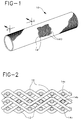
- a woven tubular prosthesis 10 fabricated in accordance with the present invention is shown.
- the prosthesis may include longitudinally-extending warp yarns 12 and circumferentially-extending fill yarns 14.
- the prosthesis of the present invention differs from prior art woven prostheses (which typically were formed with simple, one ply weaves) in that the present prosthesis includes a plurality of solid woven plies (i.e., the plies are not separable into discrete layers).
- the use of several plies allows certain ideal characteristics to be designed into the prosthesis.
- different yarns can be used in the different plies.
- a porosity gradient can be created in the wall of the prosthesis.
- Such a gradient resists leaking of fluid from the inner wall, yet still allows ingrowth of natural tissue into the outer wall.
- the discretely-designed plies are interconnected in such a fashion that the plies become inseparable and also, at the same time, provide sufficient inherent wall stiffness to the prostheses to allow it to be radially self-supporting.
- the solid woven prosthesis of the present invention can best be understood by reference to Fig. 2, which depicts a prosthesis having three plies.
- fill yarn 14a is located in the outermost ply
- fill yarn 14b is located in the intermediate ply
- fill yarn 14c is located in the innermost ply.
- a plurality of warp yarns 12 are solidly woven throughout these fill yarns.
- each warp yarn (or fill yarn) in a solid woven prosthesis must pass continuously through, and therefore be part of, at least two adjacent plies.
- the design of the prosthesis may require that each warp yarn pass continuously through each and every ply. In such a case, all of the plies will have warp yarns in common to form a unitary solid structure.
- the prosthesis is fabricated with three plies.
- the outermost ply preferably contains textured or filamentous materials for enhanced tissue attachment.
- the intermediate ply preferably contains a fusible material to aid in ravel resistance.
- the innermost ply preferably contains a bioresorbable material to aid in healing, long term patency and zero preclotting.
- the solid woven prosthesis of the present invention has a wall thickness greater than that of the typical prior art device, thereby providing a degree of radial support.
- wall thicknesses may range from 0.50 mm to 1.25 mm, whereas a conventional wall thickness ranges from 0.25 mm to 0.50 mm.
- the solid woven design provides greater wall stiffness and resistance to kinking or pinching, as compared to single-ply grafts due to the increased wall thickness. Notwithstanding the increased wall thickness of the multi-ply unitary construction, excellent longitudinal or axial flexibility for handling is retained.
- tubular products made from this weave structure are sufficiently flexible and compliant to meet the requirements of a prosthetic implant or graft.
- the inner wall of the prosthesis can be fabricated as a smooth, continuous surface.
- the inner wall of a conventional crimped one-ply prosthesis includes a plurality of irregularities or corrugations that disturb the flow of fluid therethrough, e.g., the flow of blood through an artery. This is additionally problematic because debris may collect in these irregularities causing further complications in patients with arterial disease. In larger-sized prostheses, these disturbances have little effect on the flow of fluid. However, as the diameter of the prostheses decreases, the acceptability of the disturbances decreases.
- the present invention by providing a prostheses having a smooth, continuous inner wall, overcomes this disadvantage associated with the prior art and, as a result, is capable of being employed to fabricate relatively small-sized prostheses.
- a solid woven texturized graft having raised velour loops can be fabricated in accordance with the present invention.
- prosthesis 10' is woven such that the warp yarns located at the outermost surface pass externally over at least two fill yarns.
- warp yarn 12' passes over fill yarns 14a 1 , 14a 2 and 14a 3 .
- the "loose" surface weave allows these warp yarns to rise from the surface following heat-setting, thereby forming a filamentous velour surface as shown in Fig. 3a.
- At least one elastomeric warp yarn 16 is incorporated into the fabric.
- Prosthesis 10'' is woven with the elastomeric warp yarns in a stretched state such that subsequent to weaving the fabric will longitudinally retract, thereby providing a degree of longitudinal compliance. Longitudinal compliance assists the surgeon in sizing the length of the prosthesis for implantation and also provides a degree of flexibility to the prosthesis following implantation.
- the prosthesis is sealed in a package.
- the package, along with the prosthesis contained therein, is then subjected to a sterilization procedure, e.g., a radiation procedure, a heat procedure, etc.
- a sterilization procedure e.g., a radiation procedure, a heat procedure, etc.
- the prosthesis may be sterilized prior to being sealed in its packaging or may be sterilized by the physician performing the implant operation at the time of such surgery.
- polymeric materials useful in the present invention include, without limitation, yarns made from polyester, polypropylene, polytetrafluoroethylene, polyethylene, polyurethane and resorbable polymers.
- the material is scoured in a basic solution of warm water (e.g., 150°F) and cleaning detergent. It is then rinsed to remove the cleaning agents.
- the prosthesis is heat-set on mandrels of the final desired inside diameter. Typically, the outside diameter of the mandrel is approximately equal to the diameter of the final prosthesis.
- the woven tubing is woven to be 5-15% oversize so that it can be mounted onto a mandrel and shrink fitted to an exact diameter. Heat-setting can take place in a steam heated autoclave at about 250°F for about 5-10 minutes or in a convection oven at 250-400°F for about 10-30 minutes.
- the material is scoured in a basic solution of warm water (e.g., 150°F) and cleaning detergent. It is then rinsed to remove the cleaning agents.
- the prosthesis is heat-set on mandrels of the final desired inside diameter. Typically, the outside diameter of the mandrel is equal to the diameter of the final prosthesis.
- the woven tubing is woven to be 5-15% oversize so that it can be mounted onto a mandrel and shrink fitted to an exact diameter.
- Heat-setting can take place in a steam heated autoclave at about 250°F for about 5-10 minutes or in a convection oven at 250-400°F for about 10-30 minutes.
- the heat-setting can be done in a two-step process.
- the first step involves heat-setting the prosthesis in its fully extended state to shrink fit the prosthesis snugly to the mandrel.
- the second heat-setting step entails compressing the prosthesis longitudinally. The compression is on the order of 25-50%.
- the prosthesis is then heat-set a second time using at least the same conditions as in the first heat-setting cycle.
- the warp yarns buckle and crimp.
- the heat locks the yarns in this geometry to build in "spring like” or elastomeric properties.
- the material is scoured in a basic solution of warm water (e.g., 150°F) and cleaning detergent. It is then rinsed to remove the cleaning agents.
- the prosthesis is heat-set on mandrels of the final desired inside diameter. Typically, the outside diameter of the mandrel is equal to the diameter of the final prosthesis.
- the woven tubing is woven to be 5-15% oversize so that it can be mounted onto a mandrel and shrink fitted to an exact diameter.
- Heat-setting can take place in a steam heated autoclave at about 250°F for about 5-10 minutes or in a convection oven at 250-400° for about 10-30 minutes.
- the heat-setting can be done in a two-step process.
- the first step involves heat-setting the prosthesis in its fully extended state to shrink fit the prosthesis snugly to the mandrel.
- the second heat-setting step entails compressing the prosthesis longitudinally. The compression is on the order of 25-50%.
- the prosthesis is then heat-set a second time using at least the same conditions as in the first heat-setting cycle.
- the warp yarns buckle and crimp.
- the heat locks the yarns in this geometry to build in "spring like” properties.
- the warp yarns in the outer ply which are floating over 3 picks, would raise from the fabric, forming a filamentous velour surface.
- the tubing is woven to include an elastomeric yarn in the warp direction, such as Lycra Spandex from DuPont.
- the elastomeric yarn is woven into the fabric by inserting it between the first and second plies.
- the elastomeric yarn is woven in a stretched state, so that after weaving the fabric will retract longitudinally.
- the elastomeric yarn provides the longitudinal compliance to the graft.
- the material is scoured in a basic solution of warm water (e.g., 150°F) and cleaning detergent. It is then rinsed to remove the cleaning agents.
- warm water e.g. 150°F
- the scouring process allows the woven tubing to fully retract by relieving the stress induced by weaving the elastomeric warp yarns in a stressed state.
- the prosthesis is heat-set on mandrels of the final desired inside diameter.
- the outside diameter of the mandrel is equal to the diameter of the final prostheses.
- the tubing is woven to be 5-15% over-size so that it can be mounted onto a mandrel and shrink fitted to an exact diameter.
- Heat-setting can take place in a steam heated autoclave at about 250°F for about 5-10 minutes or in a convection oven at 250-400°F for about 10-30 minutes.
- the warp yarns in the outer ply which are floating over 3 picks, are raised from the fabric, forming a filamentous velour surface. Longtudinal compliance on the order of 25-50% can be achieved by this method.
Landscapes
- Health & Medical Sciences (AREA)
- Engineering & Computer Science (AREA)
- Textile Engineering (AREA)
- Biomedical Technology (AREA)
- Vascular Medicine (AREA)
- Cardiology (AREA)
- Oral & Maxillofacial Surgery (AREA)
- Transplantation (AREA)
- Gastroenterology & Hepatology (AREA)
- Heart & Thoracic Surgery (AREA)
- Pulmonology (AREA)
- Life Sciences & Earth Sciences (AREA)
- Animal Behavior & Ethology (AREA)
- General Health & Medical Sciences (AREA)
- Public Health (AREA)
- Veterinary Medicine (AREA)
- Prostheses (AREA)
- Materials For Medical Uses (AREA)
Applications Claiming Priority (5)
| Application Number | Priority Date | Filing Date | Title |
|---|---|---|---|
| US52657 | 1993-04-26 | ||
| US08/052,657 US5370682A (en) | 1993-04-26 | 1993-04-26 | Solid woven tubular prosthesis |
| PCT/US1994/004606 WO1994024960A1 (en) | 1993-04-26 | 1994-04-25 | Solid woven tubular prosthesis |
| CA002234504A CA2234504C (en) | 1993-04-26 | 1994-11-30 | Implantable tubular prosthesis |
| CA002137021A CA2137021C (en) | 1993-04-26 | 1994-11-30 | Implantable tubular prosthesis |
Publications (3)
| Publication Number | Publication Date |
|---|---|
| EP0651625A1 EP0651625A1 (en) | 1995-05-10 |
| EP0651625A4 EP0651625A4 (en) | 1995-08-23 |
| EP0651625B1 true EP0651625B1 (en) | 1998-12-16 |
Family
ID=27169904
Family Applications (1)
| Application Number | Title | Priority Date | Filing Date |
|---|---|---|---|
| EP94914921A Expired - Lifetime EP0651625B1 (en) | 1993-04-26 | 1994-04-25 | Solid woven tubular prosthesis |
Country Status (7)
| Country | Link |
|---|---|
| US (1) | US5370682A (enExample) |
| EP (1) | EP0651625B1 (enExample) |
| JP (1) | JP3017290B2 (enExample) |
| AU (1) | AU670198B2 (enExample) |
| DE (1) | DE69415275T2 (enExample) |
| ES (1) | ES2125453T3 (enExample) |
| FI (1) | FI946033L (enExample) |
Families Citing this family (47)
| Publication number | Priority date | Publication date | Assignee | Title |
|---|---|---|---|---|
| JP2961287B2 (ja) * | 1991-10-18 | 1999-10-12 | グンゼ株式会社 | 生体管路拡張具、その製造方法およびステント |
| GB9616272D0 (en) * | 1996-08-02 | 1996-09-11 | Vascutek Ltd | Expansible woven fabric |
| US6240616B1 (en) * | 1997-04-15 | 2001-06-05 | Advanced Cardiovascular Systems, Inc. | Method of manufacturing a medicated porous metal prosthesis |
| US10028851B2 (en) | 1997-04-15 | 2018-07-24 | Advanced Cardiovascular Systems, Inc. | Coatings for controlling erosion of a substrate of an implantable medical device |
| US8172897B2 (en) | 1997-04-15 | 2012-05-08 | Advanced Cardiovascular Systems, Inc. | Polymer and metal composite implantable medical devices |
| US6395019B2 (en) | 1998-02-09 | 2002-05-28 | Trivascular, Inc. | Endovascular graft |
| US6494907B1 (en) * | 1998-04-28 | 2002-12-17 | Intratherapeutics, Inc. | Braided stent |
| US6159239A (en) * | 1998-08-14 | 2000-12-12 | Prodesco, Inc. | Woven stent/graft structure |
| US7807211B2 (en) | 1999-09-03 | 2010-10-05 | Advanced Cardiovascular Systems, Inc. | Thermal treatment of an implantable medical device |
| US6805898B1 (en) | 2000-09-28 | 2004-10-19 | Advanced Cardiovascular Systems, Inc. | Surface features of an implantable medical device |
| US6547820B1 (en) | 2000-10-03 | 2003-04-15 | Scimed Life Systems, Inc. | High profile fabric graft for arteriovenous access |
| CN1226970C (zh) | 2000-11-15 | 2005-11-16 | 麦克默里纺织品公司 | 带接缝过渡的软组织管状假体 |
| US6641607B1 (en) | 2000-12-29 | 2003-11-04 | Advanced Cardiovascular Systems, Inc. | Double tube stent |
| US7147660B2 (en) | 2001-12-20 | 2006-12-12 | Boston Scientific Santa Rosa Corp. | Advanced endovascular graft |
| US7147661B2 (en) | 2001-12-20 | 2006-12-12 | Boston Scientific Santa Rosa Corp. | Radially expandable stent |
| US20030236457A1 (en) * | 2002-04-24 | 2003-12-25 | Mericle Robert A. | Method of endovascular brain mapping |
| US7452374B2 (en) * | 2003-04-24 | 2008-11-18 | Maquet Cardiovascular, Llc | AV grafts with rapid post-operative self-sealing capabilities |
| WO2004100772A2 (en) * | 2003-05-12 | 2004-11-25 | University Of Florida | Devices and methods for disruption and removal of luninal occlusions |
| US20040230289A1 (en) * | 2003-05-15 | 2004-11-18 | Scimed Life Systems, Inc. | Sealable attachment of endovascular stent to graft |
| US20050118344A1 (en) * | 2003-12-01 | 2005-06-02 | Pacetti Stephen D. | Temperature controlled crimping |
| CA2539110A1 (en) * | 2003-09-02 | 2005-03-24 | University Of Florida | Polymeric reconstrainable, repositionable, detachable, percutaneous endovascular stentgraft |
| US7803178B2 (en) | 2004-01-30 | 2010-09-28 | Trivascular, Inc. | Inflatable porous implants and methods for drug delivery |
| US7758633B2 (en) * | 2004-04-12 | 2010-07-20 | Boston Scientific Scimed, Inc. | Varied diameter vascular graft |
| US7465316B2 (en) * | 2004-04-12 | 2008-12-16 | Boston Scientific Scimed, Inc. | Tri-petaled aortic root vascular graft |
| KR100511618B1 (ko) * | 2005-01-17 | 2005-08-31 | 이경범 | 약물방출 조절형 다층 코팅 스텐트 및 이의 제조방법 |
| US7588587B2 (en) * | 2005-03-10 | 2009-09-15 | Tyco Healthcare Group Lp | Suture anchors |
| US8388679B2 (en) | 2007-01-19 | 2013-03-05 | Maquet Cardiovascular Llc | Single continuous piece prosthetic tubular aortic conduit and method for manufacturing the same |
| WO2008109019A1 (en) * | 2007-03-02 | 2008-09-12 | Atex Technologies, Inc. | Fabric medical device having a tapered transition and method of making |
| US8177834B2 (en) * | 2007-03-12 | 2012-05-15 | Cook Medical Technologies Llc | Woven fabric with shape memory element strands |
| US8226701B2 (en) | 2007-09-26 | 2012-07-24 | Trivascular, Inc. | Stent and delivery system for deployment thereof |
| US8066755B2 (en) | 2007-09-26 | 2011-11-29 | Trivascular, Inc. | System and method of pivoted stent deployment |
| US8663309B2 (en) | 2007-09-26 | 2014-03-04 | Trivascular, Inc. | Asymmetric stent apparatus and method |
| JP2010540190A (ja) | 2007-10-04 | 2010-12-24 | トリバスキュラー・インコーポレイテッド | 低プロファイル経皮的送達のためのモジュラー式血管グラフト |
| US8083789B2 (en) | 2007-11-16 | 2011-12-27 | Trivascular, Inc. | Securement assembly and method for expandable endovascular device |
| US8328861B2 (en) | 2007-11-16 | 2012-12-11 | Trivascular, Inc. | Delivery system and method for bifurcated graft |
| US8834552B2 (en) | 2007-12-27 | 2014-09-16 | Cook Medical Technologies Llc | Stent graft having floating yarns |
| US20090281379A1 (en) * | 2008-05-12 | 2009-11-12 | Xlumena, Inc. | System and method for transluminal access |
| US20100151114A1 (en) * | 2008-12-17 | 2010-06-17 | Zimmer, Inc. | In-line treatment of yarn prior to creating a fabric |
| US20120109301A1 (en) | 2010-11-03 | 2012-05-03 | Zimmer, Inc. | Modified Polymeric Materials And Methods Of Modifying Polymeric Materials |
| US8696741B2 (en) | 2010-12-23 | 2014-04-15 | Maquet Cardiovascular Llc | Woven prosthesis and method for manufacturing the same |
| US8992595B2 (en) | 2012-04-04 | 2015-03-31 | Trivascular, Inc. | Durable stent graft with tapered struts and stable delivery methods and devices |
| US9498363B2 (en) | 2012-04-06 | 2016-11-22 | Trivascular, Inc. | Delivery catheter for endovascular device |
| US9352071B2 (en) * | 2013-03-14 | 2016-05-31 | Ethicon, Inc. | Method of forming an implantable device |
| WO2019112184A1 (ko) * | 2017-12-05 | 2019-06-13 | 한국생산기술연구원 | 3차원 섬유형 스캐폴드 |
| DE102019125367A1 (de) | 2019-09-20 | 2021-03-25 | E.S. Bio-Tech Limited | Gefäßprothese |
| US11969335B2 (en) | 2020-04-28 | 2024-04-30 | Cook Medical Technologies Llc | Woven graft having a taper with a re-engaged warp end |
| US11744702B1 (en) * | 2020-07-01 | 2023-09-05 | Aortic Innovations, Llc | Transcatheter aortic valve repair and replacement |
Family Cites Families (17)
| Publication number | Priority date | Publication date | Assignee | Title |
|---|---|---|---|---|
| US3304557A (en) * | 1965-09-28 | 1967-02-21 | Ethicon Inc | Surgical prosthesis |
| US3878565A (en) * | 1971-07-14 | 1975-04-22 | Providence Hospital | Vascular prosthesis with external pile surface |
| US4340091A (en) * | 1975-05-07 | 1982-07-20 | Albany International Corp. | Elastomeric sheet materials for heart valve and other prosthetic implants |
| US4191218A (en) * | 1975-05-07 | 1980-03-04 | Albany International Corp. | Fabrics for heart valve and vascular prostheses and methods of fabricating same |
| US4193137A (en) * | 1977-05-06 | 1980-03-18 | Meadox Medicals, Inc. | Warp-knitted double-velour prosthesis |
| US4164045A (en) * | 1977-08-03 | 1979-08-14 | Carbomedics, Inc. | Artificial vascular and patch grafts |
| FR2548225A1 (fr) * | 1983-06-16 | 1985-01-04 | Applic Realisa Tissus Indl | Nouvelles applications de structures tridimensionnelles |
| SU1355278A1 (ru) * | 1984-03-30 | 1987-11-30 | 1-Й Московский Медицинский Институт Им.И.М.Сеченова | Манжета протеза трахеи |
| US4923470A (en) * | 1985-04-25 | 1990-05-08 | American Cyanamid Company | Prosthetic tubular article made with four chemically distinct fibers |
| FR2583072B3 (fr) * | 1985-06-05 | 1987-11-27 | Applic Realisa Tissus Indl | Tissu tubulaire sans couture tridimensionnel, a plusieurs fils de trame superposes dans un meme plan |
| US4792336A (en) * | 1986-03-03 | 1988-12-20 | American Cyanamid Company | Flat braided ligament or tendon implant device having texturized yarns |
| US4892539A (en) * | 1988-02-08 | 1990-01-09 | D-R Medical Systems, Inc. | Vascular graft |
| ATE136068T1 (de) * | 1990-01-15 | 1996-04-15 | Albany Int Corp | Flechtstruktur |
| SE9102448D0 (sv) * | 1990-08-28 | 1991-08-26 | Meadox Medicals Inc | Ravel-resistant, self-supporting woven graft |
| US5178630A (en) * | 1990-08-28 | 1993-01-12 | Meadox Medicals, Inc. | Ravel-resistant, self-supporting woven graft |
| CS277367B6 (en) * | 1990-12-29 | 1993-01-13 | Krajicek Milan | Three-layered vascular prosthesis |
| CA2106971C (en) * | 1991-03-25 | 1998-06-23 | David Stuart Brookstein | Vascular prosthesis |
-
1993
- 1993-04-26 US US08/052,657 patent/US5370682A/en not_active Expired - Lifetime
-
1994
- 1994-04-25 FI FI946033A patent/FI946033L/fi not_active Application Discontinuation
- 1994-04-25 ES ES94914921T patent/ES2125453T3/es not_active Expired - Lifetime
- 1994-04-25 EP EP94914921A patent/EP0651625B1/en not_active Expired - Lifetime
- 1994-04-25 DE DE69415275T patent/DE69415275T2/de not_active Expired - Lifetime
- 1994-04-25 JP JP6524499A patent/JP3017290B2/ja not_active Expired - Fee Related
- 1994-04-25 AU AU67139/94A patent/AU670198B2/en not_active Ceased
Also Published As
| Publication number | Publication date |
|---|---|
| AU6713994A (en) | 1994-11-21 |
| AU670198B2 (en) | 1996-07-04 |
| FI946033A0 (fi) | 1994-12-22 |
| DE69415275D1 (de) | 1999-01-28 |
| EP0651625A4 (en) | 1995-08-23 |
| FI946033A7 (fi) | 1994-12-22 |
| JP3017290B2 (ja) | 2000-03-06 |
| ES2125453T3 (es) | 1999-03-01 |
| JPH08500759A (ja) | 1996-01-30 |
| US5370682A (en) | 1994-12-06 |
| EP0651625A1 (en) | 1995-05-10 |
| DE69415275T2 (de) | 1999-04-29 |
| FI946033L (fi) | 1994-12-22 |
Similar Documents
| Publication | Publication Date | Title |
|---|---|---|
| US5370682A (en) | Solid woven tubular prosthesis | |
| US6090137A (en) | Solid woven tubular prosthesis methods | |
| EP1322253B1 (en) | High profile fabric graft for arteriovenous access | |
| CA2050030C (en) | Ravel-resistant, self-supporting woven graft | |
| US5178630A (en) | Ravel-resistant, self-supporting woven graft | |
| CA2090435C (en) | Self-supporting woven vascular graft | |
| US5800514A (en) | Shaped woven tubular soft-tissue prostheses and methods of manufacturing | |
| US7198638B2 (en) | Low profile, high stretch, low dilation knit prosthetic device | |
| US20030149464A1 (en) | Low profile, high stretch knit prosthetic device | |
| JPH02501118A (ja) | 動脈用移植片 | |
| EP1734900B1 (en) | Varied diameter vascular graft | |
| WO2003049644A1 (en) | Anatomically curved graft for implantation at the aortic arch | |
| AU2002230522A1 (en) | Soft-tissue tubular prostheses with seamed transitions | |
| CA2138640C (en) | Solid woven tubular prosthesis | |
| JP7629700B2 (ja) | 血管プロテーゼ | |
| AU729443B2 (en) | Shaped woven tubular soft-tissue prostheses and methods of manufacturing | |
| AU2003203446B2 (en) | Shaped woven tubular soft-tissue prostheses and methods of manufacture | |
| AU757985C (en) | Shaped woven tubular soft-tissue prostheses and methods of manufacture | |
| AU2003203446A1 (en) | Shaped woven tubular soft-tissue prostheses and methods of manufacture |
Legal Events
| Date | Code | Title | Description |
|---|---|---|---|
| PUAI | Public reference made under article 153(3) epc to a published international application that has entered the european phase |
Free format text: ORIGINAL CODE: 0009012 |
|
| 17P | Request for examination filed |
Effective date: 19950214 |
|
| AK | Designated contracting states |
Kind code of ref document: A1 Designated state(s): BE CH DE DK ES FR GB IT LI LU NL SE |
|
| A4 | Supplementary search report drawn up and despatched | ||
| AK | Designated contracting states |
Kind code of ref document: A4 Designated state(s): BE CH DE DK ES FR GB IT LI LU NL SE |
|
| 17Q | First examination report despatched |
Effective date: 19970923 |
|
| GRAG | Despatch of communication of intention to grant |
Free format text: ORIGINAL CODE: EPIDOS AGRA |
|
| GRAG | Despatch of communication of intention to grant |
Free format text: ORIGINAL CODE: EPIDOS AGRA |
|
| GRAH | Despatch of communication of intention to grant a patent |
Free format text: ORIGINAL CODE: EPIDOS IGRA |
|
| GRAH | Despatch of communication of intention to grant a patent |
Free format text: ORIGINAL CODE: EPIDOS IGRA |
|
| GRAA | (expected) grant |
Free format text: ORIGINAL CODE: 0009210 |
|
| AK | Designated contracting states |
Kind code of ref document: B1 Designated state(s): BE CH DE DK ES FR GB IT LI LU NL SE |
|
| PG25 | Lapsed in a contracting state [announced via postgrant information from national office to epo] |
Ref country code: NL Free format text: LAPSE BECAUSE OF FAILURE TO SUBMIT A TRANSLATION OF THE DESCRIPTION OR TO PAY THE FEE WITHIN THE PRESCRIBED TIME-LIMIT Effective date: 19981216 Ref country code: LI Free format text: LAPSE BECAUSE OF FAILURE TO SUBMIT A TRANSLATION OF THE DESCRIPTION OR TO PAY THE FEE WITHIN THE PRESCRIBED TIME-LIMIT Effective date: 19981216 Ref country code: CH Free format text: LAPSE BECAUSE OF FAILURE TO SUBMIT A TRANSLATION OF THE DESCRIPTION OR TO PAY THE FEE WITHIN THE PRESCRIBED TIME-LIMIT Effective date: 19981216 Ref country code: BE Free format text: LAPSE BECAUSE OF FAILURE TO SUBMIT A TRANSLATION OF THE DESCRIPTION OR TO PAY THE FEE WITHIN THE PRESCRIBED TIME-LIMIT Effective date: 19981216 |
|
| REG | Reference to a national code |
Ref country code: CH Ref legal event code: EP |
|
| REF | Corresponds to: |
Ref document number: 69415275 Country of ref document: DE Date of ref document: 19990128 |
|
| ET | Fr: translation filed | ||
| REG | Reference to a national code |
Ref country code: ES Ref legal event code: FG2A Ref document number: 2125453 Country of ref document: ES Kind code of ref document: T3 |
|
| ITF | It: translation for a ep patent filed | ||
| PG25 | Lapsed in a contracting state [announced via postgrant information from national office to epo] |
Ref country code: SE Free format text: LAPSE BECAUSE OF FAILURE TO SUBMIT A TRANSLATION OF THE DESCRIPTION OR TO PAY THE FEE WITHIN THE PRESCRIBED TIME-LIMIT Effective date: 19990316 Ref country code: DK Free format text: LAPSE BECAUSE OF FAILURE TO SUBMIT A TRANSLATION OF THE DESCRIPTION OR TO PAY THE FEE WITHIN THE PRESCRIBED TIME-LIMIT Effective date: 19990316 |
|
| PG25 | Lapsed in a contracting state [announced via postgrant information from national office to epo] |
Ref country code: LU Free format text: LAPSE BECAUSE OF NON-PAYMENT OF DUE FEES Effective date: 19990425 |
|
| NLV1 | Nl: lapsed or annulled due to failure to fulfill the requirements of art. 29p and 29m of the patents act | ||
| REG | Reference to a national code |
Ref country code: CH Ref legal event code: PL |
|
| PLBE | No opposition filed within time limit |
Free format text: ORIGINAL CODE: 0009261 |
|
| STAA | Information on the status of an ep patent application or granted ep patent |
Free format text: STATUS: NO OPPOSITION FILED WITHIN TIME LIMIT |
|
| 26N | No opposition filed | ||
| REG | Reference to a national code |
Ref country code: GB Ref legal event code: IF02 |
|
| PGFP | Annual fee paid to national office [announced via postgrant information from national office to epo] |
Ref country code: ES Payment date: 20020411 Year of fee payment: 9 |
|
| PG25 | Lapsed in a contracting state [announced via postgrant information from national office to epo] |
Ref country code: ES Free format text: LAPSE BECAUSE OF NON-PAYMENT OF DUE FEES Effective date: 20030426 |
|
| REG | Reference to a national code |
Ref country code: ES Ref legal event code: FD2A Effective date: 20030426 |
|
| PG25 | Lapsed in a contracting state [announced via postgrant information from national office to epo] |
Ref country code: IT Free format text: LAPSE BECAUSE OF NON-PAYMENT OF DUE FEES;WARNING: LAPSES OF ITALIAN PATENTS WITH EFFECTIVE DATE BEFORE 2007 MAY HAVE OCCURRED AT ANY TIME BEFORE 2007. THE CORRECT EFFECTIVE DATE MAY BE DIFFERENT FROM THE ONE RECORDED. Effective date: 20050425 |
|
| REG | Reference to a national code |
Ref country code: GB Ref legal event code: 732E |
|
| REG | Reference to a national code |
Ref country code: GB Ref legal event code: 732E |
|
| REG | Reference to a national code |
Ref country code: FR Ref legal event code: TP Ref country code: FR Ref legal event code: CD |
|
| PGFP | Annual fee paid to national office [announced via postgrant information from national office to epo] |
Ref country code: GB Payment date: 20100312 Year of fee payment: 17 |
|
| PGFP | Annual fee paid to national office [announced via postgrant information from national office to epo] |
Ref country code: FR Payment date: 20100420 Year of fee payment: 17 |
|
| PGFP | Annual fee paid to national office [announced via postgrant information from national office to epo] |
Ref country code: DE Payment date: 20100430 Year of fee payment: 17 |
|
| REG | Reference to a national code |
Ref country code: DE Ref legal event code: R119 Ref document number: 69415275 Country of ref document: DE |
|
| REG | Reference to a national code |
Ref country code: DE Ref legal event code: R119 Ref document number: 69415275 Country of ref document: DE |
|
| GBPC | Gb: european patent ceased through non-payment of renewal fee |
Effective date: 20110425 |
|
| REG | Reference to a national code |
Ref country code: FR Ref legal event code: ST Effective date: 20111230 |
|
| PG25 | Lapsed in a contracting state [announced via postgrant information from national office to epo] |
Ref country code: FR Free format text: LAPSE BECAUSE OF NON-PAYMENT OF DUE FEES Effective date: 20110502 |
|
| PG25 | Lapsed in a contracting state [announced via postgrant information from national office to epo] |
Ref country code: GB Free format text: LAPSE BECAUSE OF NON-PAYMENT OF DUE FEES Effective date: 20110425 |
|
| PG25 | Lapsed in a contracting state [announced via postgrant information from national office to epo] |
Ref country code: DE Free format text: LAPSE BECAUSE OF NON-PAYMENT OF DUE FEES Effective date: 20111031 |