EP0648783B1 - TNF inhibitors - Google Patents
TNF inhibitors Download PDFInfo
- Publication number
- EP0648783B1 EP0648783B1 EP94116015A EP94116015A EP0648783B1 EP 0648783 B1 EP0648783 B1 EP 0648783B1 EP 94116015 A EP94116015 A EP 94116015A EP 94116015 A EP94116015 A EP 94116015A EP 0648783 B1 EP0648783 B1 EP 0648783B1
- Authority
- EP
- European Patent Office
- Prior art keywords
- tnf
- ligand
- ligand according
- region
- amino acid
- Prior art date
- Legal status (The legal status is an assumption and is not a legal conclusion. Google has not performed a legal analysis and makes no representation as to the accuracy of the status listed.)
- Expired - Lifetime
Links
Images

Classifications
-
- C—CHEMISTRY; METALLURGY
- C07—ORGANIC CHEMISTRY
- C07K—PEPTIDES
- C07K14/00—Peptides having more than 20 amino acids; Gastrins; Somatostatins; Melanotropins; Derivatives thereof
- C07K14/435—Peptides having more than 20 amino acids; Gastrins; Somatostatins; Melanotropins; Derivatives thereof from animals; from humans
- C07K14/705—Receptors; Cell surface antigens; Cell surface determinants
- C07K14/715—Receptors; Cell surface antigens; Cell surface determinants for cytokines; for lymphokines; for interferons
- C07K14/7151—Receptors; Cell surface antigens; Cell surface determinants for cytokines; for lymphokines; for interferons for tumor necrosis factor [TNF], for lymphotoxin [LT]
-
- C—CHEMISTRY; METALLURGY
- C07—ORGANIC CHEMISTRY
- C07K—PEPTIDES
- C07K16/00—Immunoglobulins [IG], e.g. monoclonal or polyclonal antibodies
- C07K16/18—Immunoglobulins [IG], e.g. monoclonal or polyclonal antibodies against material from animals or humans
- C07K16/28—Immunoglobulins [IG], e.g. monoclonal or polyclonal antibodies against material from animals or humans against receptors, cell surface antigens or cell surface determinants
- C07K16/2866—Immunoglobulins [IG], e.g. monoclonal or polyclonal antibodies against material from animals or humans against receptors, cell surface antigens or cell surface determinants against receptors for cytokines, lymphokines, interferons
-
- C—CHEMISTRY; METALLURGY
- C07—ORGANIC CHEMISTRY
- C07K—PEPTIDES
- C07K16/00—Immunoglobulins [IG], e.g. monoclonal or polyclonal antibodies
- C07K16/42—Immunoglobulins [IG], e.g. monoclonal or polyclonal antibodies against immunoglobulins
- C07K16/4208—Immunoglobulins [IG], e.g. monoclonal or polyclonal antibodies against immunoglobulins against an idiotypic determinant on Ig
- C07K16/4241—Immunoglobulins [IG], e.g. monoclonal or polyclonal antibodies against immunoglobulins against an idiotypic determinant on Ig against anti-human or anti-animal Ig
- C07K16/4258—Immunoglobulins [IG], e.g. monoclonal or polyclonal antibodies against immunoglobulins against an idiotypic determinant on Ig against anti-human or anti-animal Ig against anti-receptor Ig
-
- A—HUMAN NECESSITIES
- A61—MEDICAL OR VETERINARY SCIENCE; HYGIENE
- A61K—PREPARATIONS FOR MEDICAL, DENTAL OR TOILETRY PURPOSES
- A61K38/00—Medicinal preparations containing peptides
-
- C—CHEMISTRY; METALLURGY
- C07—ORGANIC CHEMISTRY
- C07K—PEPTIDES
- C07K2319/00—Fusion polypeptide
Definitions
- the present invention relates to ligands to Tumor Necrosis Factor receptors (TNF-Rs) which inhibit the effect of TNF but not its binding to the TNF-Rs, as well as to ligands interacting with other receptors of the TNF/NGF family.
- TNF-Rs Tumor Necrosis Factor receptors
- Tumor necrosis factor is a pleiotropic cytokine, produced by a number of cell types, mainly by activated macrophages. It is one of the principal mediators of the immune and inflammatory response. Interest in its function has greatly increased, recently, in view of evidence of the involvement of TNF in the pathogenesis of a wide range of disease states, including endotoxin shock, cerebral malaria and graft-versus-host reaction. Since many of the effects of TNF are deleterious to the organism, it is of great interest to find ways of blocking its action on host cells. An evident target for such intervention are the molecules to which TNF has to bind in order to exert its effects, namely the TNF-Rs.
- TNF inhibition Another method of TNF inhibition based on the principle of competing with cell-bound molecules, is the use of antibodies recognizing TNF receptors and blocking the ligand binding.
- TNF-Rs The cell surface TNF-Rs are expressed in almost all cells of the body.
- the various effects of TNF, the cytotoxic, growth-promoting and others, are all signalled by the TNF receptors upon the binding of TNF to them.
- the TNF-Rs belong to a family of receptors which are involved in other critical biological processes. Examples of these receptors are the low affinity NGF receptor, which plays an important role in the regulation of growth and differentiation of nerve cells. Several other receptors are involved in the regulation of lymphocyte growth, such as CDw40 and some others. Another member of the family is the FAS receptor also called APO, a receptor which is involved in signalling for apoptosis and which, based on a study with mice deficient in its function, seems to play an important role in the etiology of a lupus-like disease. Herein, this family of receptors is called "TNF/NGF receptor family”.
- TNF TNF-killing activity
- European patent application No. EP-A1-0 412 486 discloses antibodies to the soluble TNF-Rs. These antibodies were found to recognize the soluble TNF-Rs and to inhibit the binding of TNF to the TNF-Rs on the cell surface. Monovalent F(ab) fragments blocked the effect of TNF, while intact antibodies were observed to mimic the cytotoxic effect of TNF.
- European patent application No. EP-A2-0 585 939 describes ligands interacting with a certain region in TNF-Rs. Masters, J. Biol. Chem. 467 (1992), 5747-5750 describes that p55 and p75 TNF-R similar to other cell surface proteins including nerve growth factor receptors contain a repetitive amino acid sequence pattern of four cysteine rich domains.
- the present invention provides a ligand to a member of the TNF/NGF receptor family, which binds either to the region of the fourth cysteine rich domain of such a receptor, or to the region between it and the cell membrane.
- the region of the fourth cysteine rich domain will be called herein, for simplicity's sake, the "67 epitope” and the antibodies recognizing it the "group 67" antibodies.
- This region may extend between amino acids pro-141 and thr-179 in the p75 TNF-R or a corresponding region in another member of the TNF/NGF family. More particularly, the region may extend between amino acids cys-163 and pro-141 of the p75 TNF-R or a corresponding region in another member of the TNF/NGF family.
- the ligand downstream of the fourth cysteine rich domain includes the amino acid sequence between thr-179 and the end of the extracellular domain of the receptor or a corresponding region in another member of the TNF/NGF family.
- the receptor is the TNF-R, in particular the p75 TNF-R.
- One such ligand includes the amino acid sequence for the CDR region of the heavy chain of monoclonal antibody no. 67 and/or of the light chain thereof.
- Another such ligand includes the amino acid sequence for the CDR region of the heavy chain of monoclonal antibody no. 81, and/or the light chain thereof.
- Yet another such ligand includes the amino acid sequence for antibody against the "stalk" region, i.e. from about amino acid thr-181 to about amino acid 235-asp.
- the ligands may comprise e.g. proteins, peptides, immunoadhesins, antibodies or other organic compounds.
- the proteins may comprise, for example, a fusion protein of the ligand with another protein, optionally linked by a peptide linker.
- a fusion protein can increase the retention time of the ligand in the body, and thus may even allow the ligand-protein complex to be employed as a latent agent or as a vaccine.
- proteins includes muteins and fused proteins, their salts, functional derivatives and active fractions.
- muteins refers to analogs of the proteins, peptides and the like in which one or more of the amino acid residues of the protein found to bind are replaced by different amino acid residues or are deleted, or one or more amino acid residues are added to the original sequence, without changing considerably the activity of the resulting product.
- muteins are prepared by known synthesis and/or by site-directed mutagenesis techniques, or any other known technique suitable therefor.
- fused protein refers to a polypeptide comprising the ligands or a mutein thereof fused with another protein which has an extended residence time in body fluids.
- the ligands may thus be fused to another protein, polypeptide or the like, e.g. an immunoglobulin or a fragment thereof.
- salts herein refers to both salts of carboxyl groups and to acid addition salts of amino groups of the ligands, muteins and fused proteins thereof.
- Salts of a carboxyl group may be formed by means known in the art and include inorganic salts, for example, sodium, calcium, ammonium, ferric or zinc salts, and the like, and salts with organic bases as those formed, for example, with amines, such as triethanolamine, arginine or lysine, piperidine, procaine and the like.
- Acid addition salts include, for example, salts with mineral acids such as, for example, hydrochloric acid or sulfuric acid, and salts with organic acids such as, for example, acetic acid or oxalic acid.
- “Functional derivatives” as used herein cover derivatives of the ligands and their fused proteins and muteins, which may be prepared from the functional groups which occur as side chains on the residues or the N- or C- terminal groups, by means known in the art, and are included in the invention as long as they remain pharmaceutically acceptable, i.e. they do not destroy the activity of the ligand and do not confer toxic properties on compositions containing it.
- These derivatives may, for example, include polyethylene glycol side chains which may mask antigenic sites and extend the residence of the ligands in body fluids.
- Other derivatives include aliphatic esters of the carboxyl groups, amides of the carboxyl groups by reaction with ammonia or with primary or secondary amines, N-acyl derivatives of free amino groups of the amino acid residues formed with acyl moieties (e.g. alkanoyl or carbocyclic aroyl groups) or O-acyl derivatives of free hydroxyl groups (for example that of seryl or threonyl residues) formed with acyl moieties.
- acyl moieties e.g. alkanoyl or carbocyclic aroyl groups
- O-acyl derivatives of free hydroxyl groups for example that of seryl or threonyl residues
- active fractions of the ligands, its fused proteins and its muteins covers any fragment or precursors of the polypeptide chain of the ligand alone or together with associated molecules or residues linked thereto, e.g. sugar or phosphate residues, or aggregates of the protein molecule or the sugar residues by themselves, provided said fraction has the same biological and/or pharmaceutical activity.
- the peptides include peptide bond replacements and/or peptide mimetics, i.e. pseudopeptides, as known in the art (see e.g. proceedings of the 20th European Peptide Symposium, ed. G. Jung, E. Bayer, pp. 289-336), as well as salts and pharmaceutical preparations and/or formulations which render the bioactive peptide(s) particularly suitable for oral, topical, nasal spray, ocular, pulmonary, I.V. or subcutaneous delivery, depending on the particular treatment indicated.
- salts, formulations, amino acid replacements and pseudopeptide structures may be necessary and desirable to enhance the stability, formulation, deliverability (e.g. slow release, prodrugs), or to improve the economy of production, as long as they do not adversely affect the biological activity of the peptide.
- cyclic structure for stability such as N to C interchain imides and lactames (Ede et al. in Smith and Rivier (Eds.) "Peptides: Chemistry and Biology", Escom, Leiden (1991), pp. 268-270), and sometimes also receptor binding may be enhanced by forming cyclic analogues.
- An example of this is given in "Confirmationally restricted thymopentin-like compounds", US Pat. 4,457,489 (1985), Goldstein, G. et al.
- the introduction of ketomethylene, methylsuflide or retroinverse bonds to replace peptide bonds, i.e. the interchange of the CO and NH moieties are likely to enhance both stability and potency.
- the peptides of the invention can be synthesized by various methods which are known in principle, namely by chemical coupling methods (cf. Wunsch, E: “Methoden der organischen Chemie", Volume 15, Band 1 + 2, Synthese von Peptiden, Thime Verlag, Stuttgart (1974), and Barrany, G.; Marrifield, R.B.: “The Peptides”, eds. E. Gross, J. Meienhofer, Volume 2, Chapter 1, pp. 1-284, Academic Press (1980)), or by enzymatic coupling methods (cf. Widmer, F. Johansen, J.T., Carlsberg Res. Commun., Vol.44, pp.
- a cysteine residue may be added at both the amino and carboxy terminals of the peptide, which will allow the cyclisation of the peptide by the formation of a di-sulphide bond.
- anti-idiotypic antibodies anti-idiotypic antibodies
- anti-Id Abs anti-idiotypic antibodies
- anti-Id Abs to an antigen to function like that antigen in its interaction with animal cells and components of cells.
- anti-Id Abs to a peptide hormone antigen can have hormone-like activity and interact specifically with a mediator in the same way as the receptor does.
- anti-Id Abs bearing the internal image of an antigen can induce immunity to such an antigen.
- the present invention also provides anti-idiotypic antibodies to the peptides of the present invention, the anti-idiotypic antibody being capable of inhibiting TNF toxicity, but not its binding to the receptor.
- the individual specificity of antibodies resides in the structures of the peptide loops making up the Complementary Determining Regions (CDRs) of the variable domains of the antibodies. Since in general the amino acid sequence of the CDR peptides of an anti-Id Ab are not identical to or even similar to the amino acid sequence of the peptide antigen from which it was originally derived, it follows that peptides whose amino acid sequence in quite dissimilar, in certain contexts, can take up a very similar three-dimensional structure. The concept of this type of peptide, termed a "functionally equivalent sequence" or mimotope by Geyson is known. (Geyson, H.M. et al, 1987, Strategies for epitope analysis using peptide synthesis., J. Immun. Methods, Vol. 102, pp. 259-274).
- peptide and non-peptide compounds having the same three-dimensional structure as the peptides of the present invention.
- These "functionally equivalent structures” or peptide mimics” will react with antibodies raised against the peptide of the present invention and may also be capable of inhibiting TNF toxicity.
- a further embodiment of the present invention provides a compound the three-dimensional structure of which is similar as a pharmacophore to the three-dimensional structure of the peptides of the present invention, the compound being characterized in that it reacts with antibodies raised against the peptides of the present invention and that the compound is capable of inhibiting TNF toxicity.
- All of the molecules may be produced either by conventional chemical methods, as described herein, or by recombinant DNA methods.
- the invention also provides DNA molecules encoding the ligands according to the invention, vectors containing them and host cells comprising the vectors and capable of expressing the ligands according to the invention.
- the host cell may be either prokaryotic or eukaryotic.
- the invention further provides DNA molecules hybridizing to the above DNA molecules and encoding ligands having the same activity.
- the invention also provides pharmaceutical compositions comprising the above ligands which are useful for treating diseases induced or caused by the effects of TNF, either endogenously produced or exogenously administered.
- the invention also provides for using the ligands according to the invention for increasing the inhibitory effect of a soluble receptor of the TNF/NGF receptor family.
- the soluble receptors especially those of TNF, have the ability to block the function of TNF by binding it in competition with the surface receptors.
- Application of a ligand according to the invention together with a soluble receptor is therefore expected to increase the inhibitory effect of the soluble receptor.
- TNF is a cytokine which initiates its effect on cell function by binding to two specific cell surface receptors: the p55 and p75 receptors. Binding of antibodies to the extracellular domain of these receptors can interfere with its effect. However, as shown in a number of studies, antibodies binding to the extracellular domain of the receptors can also trigger the effects of TNF by inducing aggregation of the p55 receptors, as well as by inducing aggregation of the p75 receptors. (Engelmann, et al. J. Biol. Chem., Vo. 265, No. 24, pp. 14497-14504, 1990; and unpublished data).
- the present invention also reveals that the so-called "stalk-antibody” recognizes a region downstream of the fourth cysteine rich domain, more particularly the region extending from about amino acid 181 to about amino acid 235.
- the divalent antibodies have an effect which mimics TNF action, while the monovalent fragments, such as F(ab), inhibit the cytotoxic effect of TNF.
- small molecular weight compounds such as peptides or mimetic compounds, which will either inhibit the function of the p75 receptor, or enhance it, can be defined.
- this invention relates also to ligands which bind to the same regions in the extracellular domain of the various other members of the TNF/NGF receptor family and modulate the function of the other receptors, similarly to the modulation of the function of TNF.
- this receptor family the localization of cysteines in the extra-cellular domain and the spacing is highly conserved.
- Recombinant production of the ligands is carried out by known methods commonly employed in the art.
- EXAMPLE 1 Mapping of the epitope 67 of the p75 TNF-R
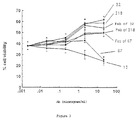
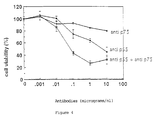
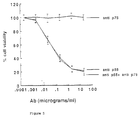
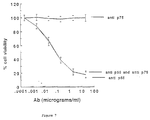
- the protective effect of the different antibodies studied on the cytocidal effect of TNF on HeLa p75.3 cells was found to vary depending on the paricular antibody used: antibodies 32 and antiserum 318 and their Fab monovalent fragments, which protect, antibody 67, which protects as Fab monovalent fragment and enhances TNF cytotoxicity in its divalent form, and antibody 13 (which binds to the upper part of the extracellular domain of the -75-R) which enhances the cytocidal effect of TNF (p75.3 cells are HeLa cells transfected with the full length p75 TNF-R).
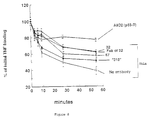
- Figure 8 shows a comparison of the rate of the dissociation of TNF from the p55 TNF-R, as assessed by measuring the dissociation of radiolabeled TNF from mouse A9 cells expressing transfected human p55 TNF-R (A9D2 cells, in which over 90% of the cell-bound TNF is associated with the human p55 TNF-R) and from the HeLa p75.3 cells, in which most of the bound TNF is associated with the over-expressed p75 TNF-R.
- A9D2 cells transfected human p55 TNF-R
- HeLa p75.3 cells in which most of the bound TNF is associated with the over-expressed p75 TNF-R.
- TNF dissociates rather rapidly from the p75 TNF-R.
- Figure 8 also illustrates the effect of antibodies that bind to various regions at the bottom of the extracellular domain of the p75 TNF-R on the dissociation of TNF from the receptor:
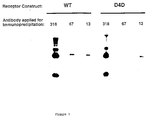
- Antibody 32 that binds to the "32 epitope" as well as its Fab monovalent fragments, antibody 67 - that binds to the 67 epitope, as well as antiserum 318, raised against the "stalk" region at the bottom of the extracellular domain, are all shown to impede the dissociation of TNF from the receptor.
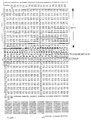
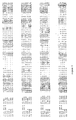
- Figure 9 shows the internal cystein rich repeats in the extracellular domains of the two TNF-Rs and their alignment with the homologous repeats in the extracellular domain of the human FAS, nerve growth factor receptor (NGF) and CDw40, as well as rat Ox40.
- the amino acid sequences (one letter symbols) are aligned for maximal homology.
- the positions of the amino acids within the receptors are denoted in the left hand margin.
- Hybridomas TBP-II 67 and 81 were deposited with the Collection National de Cultures de Microorganismes, Institut Pasteur (CNCM) on October 11, 1993 and assigned No.s I-1368 and I-1369, respectively.
Landscapes
- Health & Medical Sciences (AREA)
- Chemical & Material Sciences (AREA)
- Organic Chemistry (AREA)
- Immunology (AREA)
- Life Sciences & Earth Sciences (AREA)
- Proteomics, Peptides & Aminoacids (AREA)
- General Health & Medical Sciences (AREA)
- Genetics & Genomics (AREA)
- Medicinal Chemistry (AREA)
- Molecular Biology (AREA)
- Biophysics (AREA)
- Biochemistry (AREA)
- Zoology (AREA)
- Toxicology (AREA)
- Cell Biology (AREA)
- Gastroenterology & Hepatology (AREA)
- Pharmaceuticals Containing Other Organic And Inorganic Compounds (AREA)
- Peptides Or Proteins (AREA)
- Preparation Of Compounds By Using Micro-Organisms (AREA)
- Medicines Containing Antibodies Or Antigens For Use As Internal Diagnostic Agents (AREA)
- Micro-Organisms Or Cultivation Processes Thereof (AREA)
- Solid-Sorbent Or Filter-Aiding Compositions (AREA)
- Treatment Of Liquids With Adsorbents In General (AREA)
Applications Claiming Priority (3)
| Application Number | Priority Date | Filing Date | Title |
|---|---|---|---|
| IL107267A IL107267A (en) | 1993-10-12 | 1993-10-12 | Ligand to a member of the tnf/ngf receptor family |
| IL10726793 | 1993-10-12 | ||
| IS107267 | 1993-10-12 |
Publications (2)
| Publication Number | Publication Date |
|---|---|
| EP0648783A1 EP0648783A1 (en) | 1995-04-19 |
| EP0648783B1 true EP0648783B1 (en) | 2000-03-29 |
Family
ID=101084313
Family Applications (1)
| Application Number | Title | Priority Date | Filing Date |
|---|---|---|---|
| EP94116015A Expired - Lifetime EP0648783B1 (en) | 1993-10-12 | 1994-10-11 | TNF inhibitors |
Country Status (12)
| Country | Link |
|---|---|
| EP (1) | EP0648783B1 (enExample) |
| JP (1) | JPH07188298A (enExample) |
| AT (1) | ATE191224T1 (enExample) |
| AU (1) | AU683298B2 (enExample) |
| CA (1) | CA2133873C (enExample) |
| DE (1) | DE69423697T2 (enExample) |
| DK (1) | DK0648783T3 (enExample) |
| ES (1) | ES2146243T3 (enExample) |
| GR (1) | GR3033468T3 (enExample) |
| IL (1) | IL107267A (enExample) |
| PT (1) | PT648783E (enExample) |
| ZA (1) | ZA947961B (enExample) |
Cited By (3)
| Publication number | Priority date | Publication date | Assignee | Title |
|---|---|---|---|---|
| US7364736B2 (en) | 2001-06-26 | 2008-04-29 | Amgen Inc. | Antibodies to OPGL |
| US7928074B2 (en) | 2002-12-30 | 2011-04-19 | Amgen Inc. | Combination therapy with co-stimulatory factors |
| US9028822B2 (en) | 2002-06-28 | 2015-05-12 | Domantis Limited | Antagonists against TNFR1 and methods of use therefor |
Families Citing this family (8)
| Publication number | Priority date | Publication date | Assignee | Title |
|---|---|---|---|---|
| US6262239B1 (en) * | 1989-05-18 | 2001-07-17 | Yeda Research And Development Co., Ltd. | TNF receptor-specific antibodies |
| US6232446B1 (en) * | 1989-05-18 | 2001-05-15 | Yeda Research And Development Co. Ltd. | TNF ligands |
| IL139574A0 (en) * | 1998-05-18 | 2002-02-10 | Applied Research Systems | TNF-RII (p75) AGONISTS FOR TREATING ASTHMA AND OTHER ALLERGIC CONDITIONS |
| US6627199B1 (en) | 1999-07-09 | 2003-09-30 | Amgen Inc | Isolation, identification and characterization of tmst2, a novel member of the TNF-receptor supergene family |
| MXPA02001264A (es) | 1999-08-04 | 2002-07-22 | Amgen Inc | Fhm, nuevo miembro de la familia de supergenes de ligando de factor de necrosis tumoral. |
| AU6517800A (en) | 1999-08-04 | 2001-03-05 | Amgen, Inc. | Ntr3, a member of the tnf-receptor supergene family |
| US6808902B1 (en) | 1999-11-12 | 2004-10-26 | Amgen Inc. | Process for correction of a disulfide misfold in IL-1Ra Fc fusion molecules |
| WO2003009864A1 (en) * | 2001-07-23 | 2003-02-06 | Genset S.A. | Agonists and antagonists of disomet for the treatment of metabolic disorders |
Family Cites Families (3)
| Publication number | Priority date | Publication date | Assignee | Title |
|---|---|---|---|---|
| IL94039A (en) * | 1989-08-06 | 2006-09-05 | Yeda Res & Dev | Antibodies to tbp - 1 and their use |
| DK0398327T4 (da) * | 1989-05-18 | 2013-04-15 | Yeda Res & Dev | Tumornekrosefaktor-bindende protein, dets oprensning og antistoffer dertil |
| IL106271A (en) * | 1992-09-03 | 2008-03-20 | Yeda Res & Dev | Ligand to TNF 75P receptor and its preparation |
-
1993
- 1993-10-12 IL IL107267A patent/IL107267A/en unknown
-
1994
- 1994-10-07 CA CA2133873A patent/CA2133873C/en not_active Expired - Fee Related
- 1994-10-11 AU AU75743/94A patent/AU683298B2/en not_active Ceased
- 1994-10-11 DE DE69423697T patent/DE69423697T2/de not_active Expired - Lifetime
- 1994-10-11 AT AT94116015T patent/ATE191224T1/de active
- 1994-10-11 ES ES94116015T patent/ES2146243T3/es not_active Expired - Lifetime
- 1994-10-11 PT PT94116015T patent/PT648783E/pt unknown
- 1994-10-11 DK DK94116015T patent/DK0648783T3/da active
- 1994-10-11 EP EP94116015A patent/EP0648783B1/en not_active Expired - Lifetime
- 1994-10-12 ZA ZA947961A patent/ZA947961B/xx unknown
- 1994-10-12 JP JP6274531A patent/JPH07188298A/ja active Pending
-
2000
- 2000-05-22 GR GR20000401164T patent/GR3033468T3/el unknown
Cited By (3)
| Publication number | Priority date | Publication date | Assignee | Title |
|---|---|---|---|---|
| US7364736B2 (en) | 2001-06-26 | 2008-04-29 | Amgen Inc. | Antibodies to OPGL |
| US9028822B2 (en) | 2002-06-28 | 2015-05-12 | Domantis Limited | Antagonists against TNFR1 and methods of use therefor |
| US7928074B2 (en) | 2002-12-30 | 2011-04-19 | Amgen Inc. | Combination therapy with co-stimulatory factors |
Also Published As
| Publication number | Publication date |
|---|---|
| AU7574394A (en) | 1995-05-04 |
| JPH07188298A (ja) | 1995-07-25 |
| IL107267A0 (en) | 1994-01-25 |
| DE69423697T2 (de) | 2000-11-09 |
| DE69423697D1 (de) | 2000-05-04 |
| DK0648783T3 (da) | 2000-08-14 |
| ATE191224T1 (de) | 2000-04-15 |
| EP0648783A1 (en) | 1995-04-19 |
| ES2146243T3 (es) | 2000-08-01 |
| CA2133873C (en) | 2010-08-03 |
| PT648783E (pt) | 2000-08-31 |
| AU683298B2 (en) | 1997-11-06 |
| IL107267A (en) | 2009-07-20 |
| GR3033468T3 (en) | 2000-09-29 |
| ZA947961B (en) | 1995-05-24 |
| CA2133873A1 (en) | 1995-04-13 |
Similar Documents
| Publication | Publication Date | Title |
|---|---|---|
| US6262239B1 (en) | TNF receptor-specific antibodies | |
| IL106271A (en) | Ligand to TNF 75P receptor and its preparation | |
| US6232446B1 (en) | TNF ligands | |
| CA2743394C (en) | Il-4-derived peptides for modulation of the chronic inflammatory response and treatment of autoimmune diseases | |
| AU2008243270A1 (en) | Tumor necrosis factor receptor-derived peptide analogues | |
| AU683298B2 (en) | TNF inhibitors | |
| KR20050107435A (ko) | 개선된 특성의 인터페론 알파 뮤테인의 융합 단백질 | |
| WO1997011091A1 (fr) | Nouveaux composes peptidiques et leurs compositions medicinales | |
| JP3662264B2 (ja) | インターフェロン−α/β結合タンパク質、その製造法およびそれを含有する医薬組成物 | |
| EP0676413B1 (en) | Interferon-alpha/beta binding protein, its preparation and use | |
| CA2938366C (en) | New pharmaceutical compositions and their use for the treatment of autoimmune disorders | |
| CN101878224A (zh) | 促红细胞生成素融合蛋白 | |
| WO1998057979A1 (en) | Peptides and compounds that bind to the il-5 receptor | |
| CA2178927A1 (en) | Peptide inhibitors of cxc intercrine molecules |
Legal Events
| Date | Code | Title | Description |
|---|---|---|---|
| PUAI | Public reference made under article 153(3) epc to a published international application that has entered the european phase |
Free format text: ORIGINAL CODE: 0009012 |
|
| AK | Designated contracting states |
Kind code of ref document: A1 Designated state(s): AT BE CH DE DK ES FR GB GR IE IT LI LU MC NL PT SE |
|
| 17P | Request for examination filed |
Effective date: 19950531 |
|
| 17Q | First examination report despatched |
Effective date: 19960805 |
|
| RIN1 | Information on inventor provided before grant (corrected) |
Inventor name: METT, IGOR Inventor name: BELETSKY , IGOR Inventor name: BIGDA , JACEK Inventor name: WALLACH , DAVID |
|
| GRAG | Despatch of communication of intention to grant |
Free format text: ORIGINAL CODE: EPIDOS AGRA |
|
| GRAG | Despatch of communication of intention to grant |
Free format text: ORIGINAL CODE: EPIDOS AGRA |
|
| GRAH | Despatch of communication of intention to grant a patent |
Free format text: ORIGINAL CODE: EPIDOS IGRA |
|
| GRAH | Despatch of communication of intention to grant a patent |
Free format text: ORIGINAL CODE: EPIDOS IGRA |
|
| GRAA | (expected) grant |
Free format text: ORIGINAL CODE: 0009210 |
|
| AK | Designated contracting states |
Kind code of ref document: B1 Designated state(s): AT BE CH DE DK ES FR GB GR IE IT LI LU MC NL PT SE |
|
| REF | Corresponds to: |
Ref document number: 191224 Country of ref document: AT Date of ref document: 20000415 Kind code of ref document: T |
|
| REG | Reference to a national code |
Ref country code: CH Ref legal event code: EP |
|
| REG | Reference to a national code |
Ref country code: IE Ref legal event code: FG4D |
|
| REF | Corresponds to: |
Ref document number: 69423697 Country of ref document: DE Date of ref document: 20000504 |
|
| ET | Fr: translation filed | ||
| ITF | It: translation for a ep patent filed | ||
| REG | Reference to a national code |
Ref country code: CH Ref legal event code: NV Representative=s name: ISLER & PEDRAZZINI AG |
|
| REG | Reference to a national code |
Ref country code: ES Ref legal event code: FG2A Ref document number: 2146243 Country of ref document: ES Kind code of ref document: T3 |
|
| REG | Reference to a national code |
Ref country code: DK Ref legal event code: T3 |
|
| REG | Reference to a national code |
Ref country code: PT Ref legal event code: SC4A Free format text: AVAILABILITY OF NATIONAL TRANSLATION Effective date: 20000605 |
|
| PLBE | No opposition filed within time limit |
Free format text: ORIGINAL CODE: 0009261 |
|
| STAA | Information on the status of an ep patent application or granted ep patent |
Free format text: STATUS: NO OPPOSITION FILED WITHIN TIME LIMIT |
|
| 26N | No opposition filed | ||
| REG | Reference to a national code |
Ref country code: GB Ref legal event code: IF02 |
|
| REG | Reference to a national code |
Ref country code: CH Ref legal event code: PCAR Free format text: ISLER & PEDRAZZINI AG;POSTFACH 1772;8027 ZUERICH (CH) |
|
| PGFP | Annual fee paid to national office [announced via postgrant information from national office to epo] |
Ref country code: MC Payment date: 20120926 Year of fee payment: 19 |
|
| PGFP | Annual fee paid to national office [announced via postgrant information from national office to epo] |
Ref country code: LU Payment date: 20121011 Year of fee payment: 19 Ref country code: GR Payment date: 20120919 Year of fee payment: 19 |
|
| PGFP | Annual fee paid to national office [announced via postgrant information from national office to epo] |
Ref country code: DK Payment date: 20121010 Year of fee payment: 19 Ref country code: IT Payment date: 20120912 Year of fee payment: 19 |
|
| PGFP | Annual fee paid to national office [announced via postgrant information from national office to epo] |
Ref country code: PT Payment date: 20120412 Year of fee payment: 19 Ref country code: BE Payment date: 20121018 Year of fee payment: 19 Ref country code: IE Payment date: 20121017 Year of fee payment: 19 Ref country code: FR Payment date: 20121018 Year of fee payment: 19 Ref country code: DE Payment date: 20121003 Year of fee payment: 19 Ref country code: CH Payment date: 20121012 Year of fee payment: 19 |
|
| PGFP | Annual fee paid to national office [announced via postgrant information from national office to epo] |
Ref country code: GB Payment date: 20121010 Year of fee payment: 19 Ref country code: ES Payment date: 20121019 Year of fee payment: 19 Ref country code: SE Payment date: 20121011 Year of fee payment: 19 |
|
| PGFP | Annual fee paid to national office [announced via postgrant information from national office to epo] |
Ref country code: AT Payment date: 20120927 Year of fee payment: 19 Ref country code: NL Payment date: 20121016 Year of fee payment: 19 |
|
| REG | Reference to a national code |
Ref country code: PT Ref legal event code: MM4A Free format text: LAPSE DUE TO NON-PAYMENT OF FEES Effective date: 20140411 |
|
| BERE | Be: lapsed |
Owner name: *YEDA RESEARCH AND DEVELOPMENT CO. LTD Effective date: 20131031 |
|
| REG | Reference to a national code |
Ref country code: NL Ref legal event code: V1 Effective date: 20140501 |
|
| REG | Reference to a national code |
Ref country code: DK Ref legal event code: EBP Effective date: 20131031 |
|
| PG25 | Lapsed in a contracting state [announced via postgrant information from national office to epo] |
Ref country code: MC Free format text: LAPSE BECAUSE OF NON-PAYMENT OF DUE FEES Effective date: 20131031 |
|
| REG | Reference to a national code |
Ref country code: CH Ref legal event code: PL |
|
| REG | Reference to a national code |
Ref country code: SE Ref legal event code: EUG |
|
| REG | Reference to a national code |
Ref country code: AT Ref legal event code: MM01 Ref document number: 191224 Country of ref document: AT Kind code of ref document: T Effective date: 20131011 |
|
| GBPC | Gb: european patent ceased through non-payment of renewal fee |
Effective date: 20131011 |
|
| REG | Reference to a national code |
Ref country code: GR Ref legal event code: ML Ref document number: 20000401164 Country of ref document: GR Effective date: 20140505 |
|
| REG | Reference to a national code |
Ref country code: IE Ref legal event code: MM4A |
|
| PG25 | Lapsed in a contracting state [announced via postgrant information from national office to epo] |
Ref country code: GB Free format text: LAPSE BECAUSE OF NON-PAYMENT OF DUE FEES Effective date: 20131011 Ref country code: LI Free format text: LAPSE BECAUSE OF NON-PAYMENT OF DUE FEES Effective date: 20131031 Ref country code: CH Free format text: LAPSE BECAUSE OF NON-PAYMENT OF DUE FEES Effective date: 20131031 |
|
| REG | Reference to a national code |
Ref country code: DE Ref legal event code: R119 Ref document number: 69423697 Country of ref document: DE Effective date: 20140501 |
|
| REG | Reference to a national code |
Ref country code: FR Ref legal event code: ST Effective date: 20140630 |
|
| PG25 | Lapsed in a contracting state [announced via postgrant information from national office to epo] |
Ref country code: GR Free format text: LAPSE BECAUSE OF NON-PAYMENT OF DUE FEES Effective date: 20140505 Ref country code: IT Free format text: LAPSE BECAUSE OF NON-PAYMENT OF DUE FEES Effective date: 20131011 Ref country code: SE Free format text: LAPSE BECAUSE OF NON-PAYMENT OF DUE FEES Effective date: 20131012 Ref country code: FR Free format text: LAPSE BECAUSE OF NON-PAYMENT OF DUE FEES Effective date: 20131031 Ref country code: DE Free format text: LAPSE BECAUSE OF NON-PAYMENT OF DUE FEES Effective date: 20140501 Ref country code: NL Free format text: LAPSE BECAUSE OF NON-PAYMENT OF DUE FEES Effective date: 20140501 Ref country code: PT Free format text: LAPSE BECAUSE OF NON-PAYMENT OF DUE FEES Effective date: 20140411 Ref country code: AT Free format text: LAPSE BECAUSE OF NON-PAYMENT OF DUE FEES Effective date: 20131011 |
|
| PG25 | Lapsed in a contracting state [announced via postgrant information from national office to epo] |
Ref country code: BE Free format text: LAPSE BECAUSE OF NON-PAYMENT OF DUE FEES Effective date: 20131031 |
|
| REG | Reference to a national code |
Ref country code: PT Ref legal event code: MM4A Free format text: MAXIMUM VALIDITY LIMIT REACHED Effective date: 20141011 |
|
| PG25 | Lapsed in a contracting state [announced via postgrant information from national office to epo] |
Ref country code: DK Free format text: LAPSE BECAUSE OF NON-PAYMENT OF DUE FEES Effective date: 20131031 Ref country code: IE Free format text: LAPSE BECAUSE OF NON-PAYMENT OF DUE FEES Effective date: 20131011 |
|
| REG | Reference to a national code |
Ref country code: ES Ref legal event code: FD2A Effective date: 20141107 |
|
| PG25 | Lapsed in a contracting state [announced via postgrant information from national office to epo] |
Ref country code: ES Free format text: LAPSE BECAUSE OF NON-PAYMENT OF DUE FEES Effective date: 20131012 Ref country code: PT Free format text: LAPSE BECAUSE OF EXPIRATION OF PROTECTION Effective date: 20141021 |
|
| PG25 | Lapsed in a contracting state [announced via postgrant information from national office to epo] |
Ref country code: PT Free format text: LAPSE BECAUSE OF EXPIRATION OF PROTECTION Effective date: 20140421 Ref country code: LU Free format text: LAPSE BECAUSE OF NON-PAYMENT OF DUE FEES Effective date: 20131011 |