EP0640601A1 - Benzamide derivative - Google Patents
Benzamide derivative Download PDFInfo
- Publication number
- EP0640601A1 EP0640601A1 EP92904979A EP92904979A EP0640601A1 EP 0640601 A1 EP0640601 A1 EP 0640601A1 EP 92904979 A EP92904979 A EP 92904979A EP 92904979 A EP92904979 A EP 92904979A EP 0640601 A1 EP0640601 A1 EP 0640601A1
- Authority
- EP
- European Patent Office
- Prior art keywords
- chloro
- methoxybenzamido
- amino
- azabicyclo
- endo
- Prior art date
- Legal status (The legal status is an assumption and is not a legal conclusion. Google has not performed a legal analysis and makes no representation as to the accuracy of the status listed.)
- Granted
Links
- 0 CCC*c1c(*)cc(*)c(N**)c1 Chemical compound CCC*c1c(*)cc(*)c(N**)c1 0.000 description 2
Classifications
-
- C—CHEMISTRY; METALLURGY
- C07—ORGANIC CHEMISTRY
- C07D—HETEROCYCLIC COMPOUNDS
- C07D451/00—Heterocyclic compounds containing 8-azabicyclo [3.2.1] octane, 9-azabicyclo [3.3.1] nonane, or 3-oxa-9-azatricyclo [3.3.1.0<2,4>] nonane ring systems, e.g. tropane or granatane alkaloids, scopolamine; Cyclic acetals thereof
- C07D451/02—Heterocyclic compounds containing 8-azabicyclo [3.2.1] octane, 9-azabicyclo [3.3.1] nonane, or 3-oxa-9-azatricyclo [3.3.1.0<2,4>] nonane ring systems, e.g. tropane or granatane alkaloids, scopolamine; Cyclic acetals thereof containing not further condensed 8-azabicyclo [3.2.1] octane or 3-oxa-9-azatricyclo [3.3.1.0<2,4>] nonane ring systems, e.g. tropane; Cyclic acetals thereof
- C07D451/04—Heterocyclic compounds containing 8-azabicyclo [3.2.1] octane, 9-azabicyclo [3.3.1] nonane, or 3-oxa-9-azatricyclo [3.3.1.0<2,4>] nonane ring systems, e.g. tropane or granatane alkaloids, scopolamine; Cyclic acetals thereof containing not further condensed 8-azabicyclo [3.2.1] octane or 3-oxa-9-azatricyclo [3.3.1.0<2,4>] nonane ring systems, e.g. tropane; Cyclic acetals thereof with hetero atoms directly attached in position 3 of the 8-azabicyclo [3.2.1] octane or in position 7 of the 3-oxa-9-azatricyclo [3.3.1.0<2,4>] nonane ring system
-
- C—CHEMISTRY; METALLURGY
- C07—ORGANIC CHEMISTRY
- C07D—HETEROCYCLIC COMPOUNDS
- C07D211/00—Heterocyclic compounds containing hydrogenated pyridine rings, not condensed with other rings
- C07D211/04—Heterocyclic compounds containing hydrogenated pyridine rings, not condensed with other rings with only hydrogen or carbon atoms directly attached to the ring nitrogen atom
- C07D211/06—Heterocyclic compounds containing hydrogenated pyridine rings, not condensed with other rings with only hydrogen or carbon atoms directly attached to the ring nitrogen atom having no double bonds between ring members or between ring members and non-ring members
- C07D211/36—Heterocyclic compounds containing hydrogenated pyridine rings, not condensed with other rings with only hydrogen or carbon atoms directly attached to the ring nitrogen atom having no double bonds between ring members or between ring members and non-ring members with hetero atoms or with carbon atoms having three bonds to hetero atoms with at the most one bond to halogen, e.g. ester or nitrile radicals, directly attached to ring carbon atoms
- C07D211/56—Nitrogen atoms
- C07D211/58—Nitrogen atoms attached in position 4
-
- C—CHEMISTRY; METALLURGY
- C07—ORGANIC CHEMISTRY
- C07D—HETEROCYCLIC COMPOUNDS
- C07D451/00—Heterocyclic compounds containing 8-azabicyclo [3.2.1] octane, 9-azabicyclo [3.3.1] nonane, or 3-oxa-9-azatricyclo [3.3.1.0<2,4>] nonane ring systems, e.g. tropane or granatane alkaloids, scopolamine; Cyclic acetals thereof
- C07D451/14—Heterocyclic compounds containing 8-azabicyclo [3.2.1] octane, 9-azabicyclo [3.3.1] nonane, or 3-oxa-9-azatricyclo [3.3.1.0<2,4>] nonane ring systems, e.g. tropane or granatane alkaloids, scopolamine; Cyclic acetals thereof containing 9-azabicyclo [3.3.1] nonane ring systems, e.g. granatane, 2-aza-adamantane; Cyclic acetals thereof
Definitions
- the present invention relates to novel benzamide derivatives which have excellent gastrointestinal stimulating activity and antiemetic activity and are useful as medicament for the treatment of gastrointestinal diseases.
- the present invention further relates to a method for preparing said benzamide derivatives and a pharmaceutical composition useful for the treatment of gastrointestinal diseases comprising said benzamide derivative as an active ingredient.
- Metoclopramide (The Merck Index, 11th Edition, 6063) as an antiemetic agent and a gastrointestinal prokinetic agent
- various substituted benzamide derivatives having antiemetic activity and gastrointestinal stimulating activity have been provided.
- the Merck Index (11th edition, 2344) discloses Clebopride which is a benzamide derivative having a piperidine ring and is useful as antiulcer agent.
- the Merck Index (11th edition, 2318) discloses Cisapride useful as a gastrointestinal prokinetic agent. These drugs are widely used clinically.
- Japanese Patent Unexamined Publication No. (Sho)55-92384 discloses that benzamide derivatives substituted with an azabicyclo ring have antiemetic activity and gastrointestinal stimulating activity and that they are useful as an antiemetic agent and a gastrointestinal prokinetic agent.
- substituted benzamide derivatives are not sufficiently useful since they do not have stimulating activity on lower digestive tracts such as the large intestine, although they have stimulating activity on upper digestive tracts such as the stomach. Furthermore, these substituted benzamide derivatives are not satisfactory from a safe standpoint since they sometimes cause adverse reactions such as extrapyramidal syndrome or hyperprolactinemia.
- an object of the present invention is to provide medicament for the treatment of gastrointestinal diseases having stimulating activity not only on upper digestive tract but on lower digestive tract and reduced side effects.
- novel benzamide derivatives of the present invention have stimulating activity both on upper digestive tract and lower digestive tract.
- novel benzamide derivatives have reduced side effects and are useful as medicament for the treatment of gastrointestinal diseases having excellent selectivity.
- the present invention was achieved on the basis of these findings.
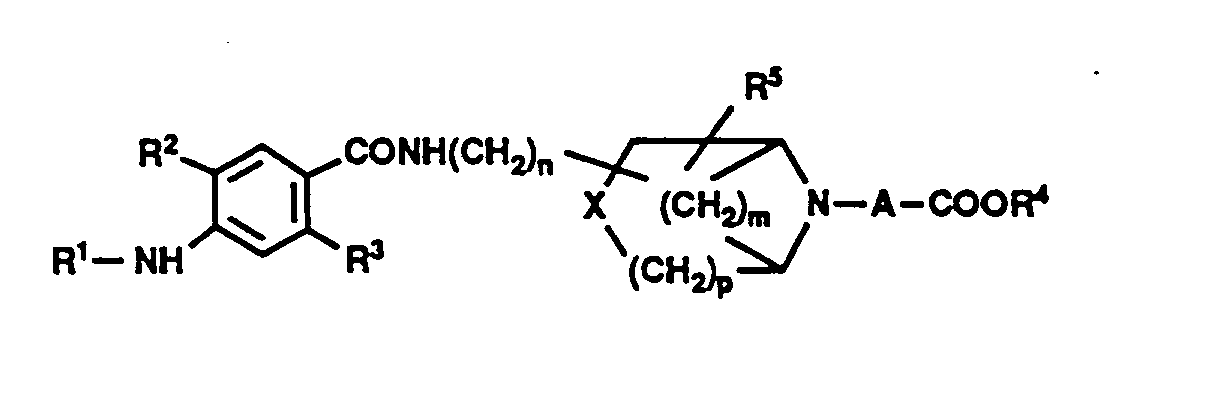
- the present invention provides benzamide derivatives represented by the following formula (I): wherein, R1 represents a hydrogen atom or a lower alkanoyl group; R2 represents a hydrogen atom or a halogen atom; R3 represents a lower alkoxy group; R4 represents a hydrogen atom or a lower alkyl group; R5 represents a hydrogen atom, a lower alkyl group, or a lower alkoxy group; A represents C1-C7 alkylene group which may optionally be substituted with a lower alkyl group; X represents a methylene group, an oxygen atom, or a sulfur atom; m represents an integer of from 0 to 3; n represents an integer of from 0 to 3; and p represents an integer of from 0 to 2, or pharmacologically acceptable salts thereof.
- the benzamide derivatives are useful since they have gastrointestinal stimulating activity.
- a method for preparing said benzamide derivatives is provided.
- a pharmaceutical composition useful for the treatment of gastrointestinal diseases which comprises said benzamide derivative as an active ingredient.
- the pharmaceutical composition is useful as, for example, a gastrointestinal prokinetic agent, an antiemetic agent, an agent for the treatment of irritable bowel syndrome, and agent for the treatment of constipation.
- a lower alkanoyl group represented by R1 may be, for example, formyl group, acetyl group, propanoyl group, butyroyl group, or trimethylacetyl group.
- a halogen atom represented by R2 may be, for example, a fluorine atom, a chlorine atom, or a bromine atom.
- a lower alkoxy group represented by R3 and R5 may be, for example, methoxy group, ethoxy group, propoxy group, isopropoxy group, butoxy group, isobutoxy group, or tert-butoxy group.
- a lower alkyl group represented by R4 and R5 or a lower alkyl group which may optionally substitute on the alkylene group represented by A may be, for example, methyl group, ethyl group, n-propyl group, isopropyl group, n-butyl group, or tert-butyl group.
- R5 and Ph-CONH(CH2) n - may substitute at any position of a ring comprising X and N.
- Examples of pharmacologically acceptable salts of the benzamide drivatives of the present invention include alkali-addition salts or acid-addition salts.
- alkali-addition salts include, for example, inorganic alkali-addition salts such as, for example, sodium salt, potassium salt, calcium salt, and ammonium salt, and organic base-addition salts such as, for example, ethylenediamine salt, ethanolamine salt, N,N-dialkylethanolamine salt, and triethanolamine salt.
- acid addition salts include, for example, inorganic acid-addition salts such as, for example, hydrochloride, hydrobromide, hydroiodide, sulfate, nitrate, and phosphate, and organic acid-addition salts such as, for example, acetate, maleate, fumarate, citrate, oxalate, tartrate, malate, mandelate, methanesulfonate, p-toluenesulfonate, and 10-camphorsulfonate.
- inorganic acid-addition salts such as, for example, hydrochloride, hydrobromide, hydroiodide, sulfate, nitrate, and phosphate
- organic acid-addition salts such as, for example, acetate, maleate, fumarate, citrate, oxalate, tartrate, malate, mandelate, methanesulfonate, p-toluenesulfonate, and
- the benzamide derivatives of the present invention represented by the above-described formula (I) may optionally have an asymmetric carbon atom.
- Each of enantio-isomers distinguished by the asymmetric carbon atom, an arbitrary mixture thereof, and racemate, i.e., equimolor mixture thereof, fall within the scope of the present invention.
- the benzamide derivatives of the present invention have more than one asymmetric carbon atoms, each diastereomer and an arbitrary mixture of the diastereomers also fall within the scope of the present invention.
- the benzamide derivatives of the present invention may be in any one of possible conformations.
- the compounds of the aforementioned formula (I) wherein p is 1, piperidine, morphorine, or thiamorphorine ring substituted with Ph-CONH(CH2) n - group may be in any one of configurations selected from chair form, boat form, or twist-boat form.
- compounds having Ph-CONH(CH2) n - group and -(CH2) m - cross linking group above the same side of a ring plane comprising X and N are referred to as endo-compounds, and compounds having each of the groups above the opposite sides of the plane are referred to as exo-compounds.
- the benzamide derivative represented by formula (I) can be prepared according to a method described below which is an embodiment of the present invention. However, methods for preparing said compound are not limited to these processes.
- a process for preparing the benzamide derivatives of the present invention represented by formula (I) comprises the following steps:
- organic solvent used for the N-alkylation in the method of the present invention examples include, for example, alcohols such as, for example, methanol, ethanol, n-propanol, isopropanol, and n-butanol; aromatic hydrocarbons such as, for example, benzene, toluene, and xylene; and aprotic polar solvents such as, for example, tetrahydrofuran, 1,4-dioxane, acetonitrile, N,N-dimethylformamide, N-methyl-2-pyrrolidone, and dimethyl sulfoxide.
- alcohols such as, for example, methanol, ethanol, n-propanol, isopropanol, and n-butanol
- aromatic hydrocarbons such as, for example, benzene, toluene, and xylene
- aprotic polar solvents such as, for example, tetrahydrofuran, 1,
- Examples of the base used include, for example, metallic sodium, sodium hydride, sodium methoxide, sodium ethoxide, sodium amide, sodium hydroxide, potassium hydroxide, sodium carbonate, potassium carbonate, sodium hydrogen carbonate, and potassium hydrogen carbonate.
- the reaction may be carried out at from ice-cooling temperature to refluxing temperature of a solvent.
- Halogenation may be carried out by the treatment with a halogenating agent in an organic solvent.
- a halogenating agent used include, for example, chlorine, bromine, and sulfuryl chloride.
- the organic solvent used include, for example, alcohols such as, for example, methanol, ethanol, and n-propanol; halogenated hydrocarbons such as, for example, dichloromethane, chloroform, carbon tetrachloride, and 1,2-dichloroethane; and aliphatic acids such as, for example, acetic acid.
- the reaction may be carried out at from -30°C to refluxing temperature of a solvent.
- Hydrolysis may be carried out by using an acid or a base.
- acids such as hydrochloric acid or sulfric acid may be used
- bases such as sodium hydroxide, potassium hydroxide, sodium carbonate, or potassium carbonate may be used.
- These acids and bases may be used in the reaction in a form of aqueous solution, or alternatively, solutions in methanol, ethanol, n-propanol, isopropanol, n-butanol, sec-butanol, or tert-butanol, or solutions in aqueous organic solvents.
- the reaction may be carried out at from ice-cooling temperature to refluxing temperature of a solvent.
- the compounds represented by formula (II) used as starting materials in the aforementioned preparation process of the present invention are novel compounds with a few exceptions.
- the compounds can be prepared according to the scheme set out below, in which R1, R2, R3, R5, X, m, n, and p are the same as those defined above, R7 represents a lower alkyl group, and Z represents a halogen atom. Specific examples of the preparation process are given as reference examples in Examples which follows.
- the benzamide derivatives represented by formula (I) prepared according to the process described above and their pharmacologically acceptable salts have hyderfunctional activity on digestive tract and are useful for the treatment of gastrointestinal diseases.
- the compounds may preferably be formulated in a pharmaceutical composition as an active ingredient.
- compositions comprising said compound as an active ingredient may generally be formulated and administered to a patient as orally available compositions such as, for example, capsules, tablets, subtilized granules, granules, powder or syrup, or administered as injection, suppository, eye drop, eye ointment, ear drop, or topical composition.
- compositions can be prepared by ordinary methods. If necessary, pharmacologically and pharmaceutically acceptable additives may be added.
- excipients such as, for example, lactose, D-mannitol, cornstarch, or crystalline cellulose; disintegrants such as, for example, carboxymethylcellulose or calcium carboxymethylcellulose; binders such as, for example, hydroxypropylcellulose, hydroxypropylmethylcellulose, or polyvinylpyrrolidone; lubricants such as, for example, magnesium stearate or talc; coating agents such as, for example, hydroxypropylmethylcellulose, sucrose, or titanium oxide; or bases such as, for example polyethylene glycol or hard fat may be used as pharmaceutical additives.
- solubilizing agents or solubilizers such as, for example, distilled water for injection, saline, or propylene glycol which is useful for an aqueous composition or a composition for preparing aqueous solution before use; pH adjusting agents such as, for example, an inorganic or organic acid or base; isotonicity agents such as, for example, sodium chloride, glucose, or glycerin; or stabilizers may be used as pharmaceutical additives.
- suitable pharmaceutical additives ordinarily formulated in ointment, cream, or cataplasms such as white vaseline, macrogol, glycerin, or cloth may be used.
- compositions of the present invention may be administered orally to an adult patient at a daily dose of about 0.1 to 500 mg.
- the dose may be increased or decreased depending on the age or conditions of a patient.
- Example 23 1 133.5 133.3
- Example 24 0.1 116.0 134.8
- Example 25 1 180.9 132.7
- Example 27 0.1 113.4 134.5
- Example 28 1 141.5 163.7
- Example 32 1 176.7 158.5
- Example 33 1 147.1 117.4
- Example 34 1 187.0 191.5
- Example 35 1 186.8 135.8
- Example 36 1 195.9 119.6
- Example 38 1 145.6 140.3
- Example 39 0.1 134.7 159.1
- Example 41 1 118.3 172.0
- Example 43 1 166.5 504.8
- Example 46 1 182.5 165.6
- Example 58 0.1 180.7 217.5
- Example 63 1 129.6 156.6
- Example 64 0.1 200.3 234.5
- Example 17 Ethyl endo-3-[3-(4-acetylamino-5-chloro-2-methoxybenzamido)-9-azabicyclo[3.3.1]non-9-yl]propionate sesquifumarate
- Example 52 Ethyl cis-[4-(4-amino-5-chloro-2-methoxybenzamido)-3-methoxypiperidino]acetate hydrochloride
- Example 54 Ethyl cis-6-[4-(4-amino-5-chloro-2-methoxybenzamido)-3-methoxypiperidino]hexanoate hydrochloride
- Example 58 In the same manner as Example 58, the compounds of Examples 59-68 were obtained.
- Example 65 cis-4-[4-(4-Amino-5-chloro-2-methoxybenzamido)-3-methoxypiperidino]butyric acid hydrochloride
- Example 66 cis-6-[4-(4-Amino-5-chloro-2-methoxybenzamido)-3-methoxypiperidino]hexanoic acid hydrochloride
- novel benzamide derivatives of the present invention represented by formula (I) have excellent gastrointestinal stimulating activity and antiemetic activity and thus are useful for the treatment of gastrointestinal diseases.
Landscapes
- Chemical & Material Sciences (AREA)
- Organic Chemistry (AREA)
- Pharmaceuticals Containing Other Organic And Inorganic Compounds (AREA)
- Acyclic And Carbocyclic Compounds In Medicinal Compositions (AREA)
- Heterocyclic Carbon Compounds Containing A Hetero Ring Having Nitrogen And Oxygen As The Only Ring Hetero Atoms (AREA)
- Organic Low-Molecular-Weight Compounds And Preparation Thereof (AREA)
- Nitrogen Condensed Heterocyclic Rings (AREA)
- Hydrogenated Pyridines (AREA)
Abstract
Description
- The present invention relates to novel benzamide derivatives which have excellent gastrointestinal stimulating activity and antiemetic activity and are useful as medicament for the treatment of gastrointestinal diseases. The present invention further relates to a method for preparing said benzamide derivatives and a pharmaceutical composition useful for the treatment of gastrointestinal diseases comprising said benzamide derivative as an active ingredient.
- Since the development of Metoclopramide (The Merck Index, 11th Edition, 6063) as an antiemetic agent and a gastrointestinal prokinetic agent, various substituted benzamide derivatives having antiemetic activity and gastrointestinal stimulating activity have been provided.
- For example, The Merck Index (11th edition, 2344) discloses Clebopride which is a benzamide derivative having a piperidine ring and is useful as antiulcer agent. The Merck Index (11th edition, 2318) discloses Cisapride useful as a gastrointestinal prokinetic agent. These drugs are widely used clinically. In addition, Japanese Patent Unexamined Publication No. (Sho)55-92384 discloses that benzamide derivatives substituted with an azabicyclo ring have antiemetic activity and gastrointestinal stimulating activity and that they are useful as an antiemetic agent and a gastrointestinal prokinetic agent.
- However, these substituted benzamide derivatives are not sufficiently useful since they do not have stimulating activity on lower digestive tracts such as the large intestine, although they have stimulating activity on upper digestive tracts such as the stomach. Furthermore, these substituted benzamide derivatives are not satisfactory from a safe standpoint since they sometimes cause adverse reactions such as extrapyramidal syndrome or hyperprolactinemia.
- Accordingly, an object of the present invention is to provide medicament for the treatment of gastrointestinal diseases having stimulating activity not only on upper digestive tract but on lower digestive tract and reduced side effects.
- The inventors of the present invention conducted various studies to achieve the aforementioned object, and found that novel benzamide derivatives of the present invention have stimulating activity both on upper digestive tract and lower digestive tract. The inventors also found that these novel benzamide derivatives have reduced side effects and are useful as medicament for the treatment of gastrointestinal diseases having excellent selectivity. The present invention was achieved on the basis of these findings.
-
- The present invention provides benzamide derivatives represented by the following formula (I):

wherein, R¹ represents a hydrogen atom or a lower alkanoyl group; R² represents a hydrogen atom or a halogen atom; R³ represents a lower alkoxy group; R⁴ represents a hydrogen atom or a lower alkyl group; R⁵ represents a hydrogen atom, a lower alkyl group, or a lower alkoxy group; A represents C₁-C₇ alkylene group which may optionally be substituted with a lower alkyl group; X represents a methylene group, an oxygen atom, or a sulfur atom; m represents an integer of from 0 to 3; n represents an integer of from 0 to 3; and p represents an integer of from 0 to 2, or pharmacologically acceptable salts thereof. The benzamide derivatives are useful since they have gastrointestinal stimulating activity. - According to another embodiment of the present invention, a method for preparing said benzamide derivatives is provided.
- According to yet another embodiment of the present invention, a pharmaceutical composition useful for the treatment of gastrointestinal diseases which comprises said benzamide derivative as an active ingredient. The pharmaceutical composition is useful as, for example, a gastrointestinal prokinetic agent, an antiemetic agent, an agent for the treatment of irritable bowel syndrome, and agent for the treatment of constipation.
- In the aforementioned formula (I), a lower alkanoyl group represented by R¹ may be, for example, formyl group, acetyl group, propanoyl group, butyroyl group, or trimethylacetyl group. A halogen atom represented by R² may be, for example, a fluorine atom, a chlorine atom, or a bromine atom. A lower alkoxy group represented by R³ and R⁵ may be, for example, methoxy group, ethoxy group, propoxy group, isopropoxy group, butoxy group, isobutoxy group, or tert-butoxy group. A lower alkyl group represented by R⁴ and R⁵ or a lower alkyl group which may optionally substitute on the alkylene group represented by A may be, for example, methyl group, ethyl group, n-propyl group, isopropyl group, n-butyl group, or tert-butyl group. R⁵ and Ph-CONH(CH₂) n - (wherein Ph represents a substituted phenyl) may substitute at any position of a ring comprising X and N.
- Examples of pharmacologically acceptable salts of the benzamide drivatives of the present invention include alkali-addition salts or acid-addition salts. Examples of the alkali-addition salts include, for example, inorganic alkali-addition salts such as, for example, sodium salt, potassium salt, calcium salt, and ammonium salt, and organic base-addition salts such as, for example, ethylenediamine salt, ethanolamine salt, N,N-dialkylethanolamine salt, and triethanolamine salt. Examples of the acid addition salts include, for example, inorganic acid-addition salts such as, for example, hydrochloride, hydrobromide, hydroiodide, sulfate, nitrate, and phosphate, and organic acid-addition salts such as, for example, acetate, maleate, fumarate, citrate, oxalate, tartrate, malate, mandelate, methanesulfonate, p-toluenesulfonate, and 10-camphorsulfonate.
- The benzamide derivatives of the present invention represented by the above-described formula (I) may optionally have an asymmetric carbon atom. Each of enantio-isomers distinguished by the asymmetric carbon atom, an arbitrary mixture thereof, and racemate, i.e., equimolor mixture thereof, fall within the scope of the present invention. Where the benzamide derivatives of the present invention have more than one asymmetric carbon atoms, each diastereomer and an arbitrary mixture of the diastereomers also fall within the scope of the present invention.
- The benzamide derivatives of the present invention may be in any one of possible conformations. For instance, where the compounds of the aforementioned formula (I) wherein p is 1, piperidine, morphorine, or thiamorphorine ring substituted with Ph-CONH(CH₂) n - group may be in any one of configurations selected from chair form, boat form, or twist-boat form. In the specification, compounds having Ph-CONH(CH₂) n - group and -(CH₂) m - cross linking group above the same side of a ring plane comprising X and N are referred to as endo-compounds, and compounds having each of the groups above the opposite sides of the plane are referred to as exo-compounds.
- Preferred embodiments of the benzamide derivatives of the present invention include the following compounds:
- (1) ethyl exo-[3-(4-acetylamino-2-methoxybenzamido)-8-azabicyclo[3.2.1]oct-8-yl]acetate;
- (2) ethyl exo-4-[3-(4-acetylamino-2-methoxybenzamido)-8-azabicyclo[3.2.1]oct-8-yl]butyrate;
- (3) ethyl endo-[3-(4-acetylamino-2-methoxybenzamido)-8-azabicyclo[3.2.1]oct-8-yl]acetate;
- (4) ethyl endo-4-[3-(4-acetylamino-2-methoxybenzamido)-8-azabicyclo[3.2.1]oct-8-yl]butyrate;
- (5) ethyl exo-[3-(4-acetylamino-2-methoxybenzamido)-9-azabicyclo[3.3.1]non-9-yl]acetate;
- (6) ethyl exo-4-[3-(4-acetylamino-2-methoxybenzamido)-9-azabicyclo[3.3.1]non-9-yl]butyrate;
- (7) ethyl endo-[3-(4-acetylamino-2-methoxybenzamido)-9-azabicyclo[3.3.1]non-9-yl]acetate;
- (8) ethyl endo-3-[3-(4-acetylamino-2-methoxybenzamido)-9-azabicyclo[3.3.1]non-9-yl]propionate;
- (9) ethyl endo-4-[3-(4-acetylamino-2-methoxybenzamido)-9-azabicyclo[3.3.1]non-9-yl]butyrate;
- (10) ethyl endo-5-[3-(4-acetylamino-2-methoxybenzamido)-9-azabicyclo[3.3.1]non-9-yl]valerate;
- (11) methyl endo-6-[3-(4-acetylamino-2-methoxybenzamido)-9-azabicyclo[3.3.1]non-9-yl]hexanoate;
- (12) methyl endo-7-[3-(4-acetylamino-2-methoxybenzamido)-9-azabicyclo[3.3.1]non-9-yl]heptanoate;
- (13) methyl endo-8-[3-(4-acetylamino-2-methoxybenzamido)-9-azabicyclo[3.3.1]non-9-yl]octanoate;
- (14) ethyl endo-[3-(4-acetylamino-2-ethoxybenzamido)-9-azabicyclo[3.3.1]non-9-yl]acetate;
- (15) ethyl endo-4-[3-(4-acetylamino-2-ethoxybenzamido)-9-azabicyclo[3.3.1]non-9-yl]butyrate;
- (16) ethyl exo-[3-(4-acetylamino-5-chloro-2-methoxybenzamido)-8-azabicyclo[3.2.1]oct-8-yl]acetate;
- (17) ethyl exo-4-[3-(4-acetylamino-5-chloro-2-methoxybenzamido)-8-azabicyclo[3.2.1]oct-8-yl]butyrate;
- (18) ethyl endo-[3-(4-acetylamino-5-chloro-2-methoxybenzamido)-8-azabicyclo[3.2.1]oct-8-yl]acetate;
- (19) ethyl endo-4-[3-(4-acetylamino-5-chloro-2-methoxybenzamido)-8-azabicyclo[3.2.1]oct-8-yl]butyrate;
- (20) ethyl exo-[3-(4-acetylamino-5-chloro-2-methoxybenzamido)-9-azabicyclo[3.3.1]non-9-yl]acetate;
- (21) ethyl exo-4-[3-(4-acetylamino-5-chloro-2-methoxybenzamido)-9-azabicyclo[3.3.1]non-9-yl]butyrate;
- (22) ethyl endo-[3-(4-acetylamino-5-chloro-2-methoxybenzamido)-9-azabicyclo[3.3.1]non-9-yl]acetate;
- (23) ethyl endo-3-[3-(4-acetylamino-5-chloro-2-methoxybenzamido)-9-azabicyclo[3.3.1]non-9-yl]propionate;
- (24) ethyl endo-4-[3-(4-acetylamino-5-chloro-2-methoxybenzamido)-9-azabicyclo[3.3.1]non-9-yl]butyrate;
- (25) ethyl endo-5-[3-(4-acetylamino-5-chloro-2-methoxybenzamido)-9-azabicyclo[3.3.1]non-9-yl]valerate;
- (26) methyl endo-6-[3-(4-acetylamino-5-chloro-2-methoxybenzamido)-9-azabicyclo[3.3.1]non-9-yl]hexanoate;
- (27) methyl endo-7-[3-(4-acetylamino-5-chloro-2-methoxybenzamido)-9-azabicyclo[3.3.1]non-9-yl]heptanoate;
- (28) methyl endo-8-(3-(4-acetylamino-5-chloro-2-methoxybenzamido)-9-azabicyclo[3.3.1]non-9-yl]octanoate;
- (29) ethyl endo-[3-(4-acetylamino-5-chloro-2-ethoxybenzamido)-9-azabicyclo[3.3.1]non-9-yl]acetate;
- (30) ethyl endo-4-[3-(4-acetylamino-5-chloro-2-ethoxybenzamido)-9-azabicyclo[3.3.1]non-9-yl]butyrate;
- (31) ethyl exo-[3-(4-amino-5-chloro-2-methoxybenzamido)-8-azabicyclo[3.2.1]oct-8-yl]acetate;
- (32) ethyl exo-4-[3-(4-amino-5-chloro-2-methoxybenzamido)-8-azabicyclo[3.2.1]oct-8-yl]butyrate;
- (33) ethyl endo-[3-(4-amino-5-chloro-2-methoxybenzamido)-8-azabicyclo[3.2.1]oct-8-yl]acetate;
- (34) ethyl endo-4-[3-(4-amino-5-chloro-2-methoxybenzamido)-8-azabicyclo[3.2.1]oct-8-yl]butyrate;
- (35) ethyl exo-[3-(4-amino-5-chloro-2-methoxybenzamido)-9-azabicyclo[3.3.1]non-9-yl]acetate;
- (36) ethyl exo-4-[3-(4-amino-5-chloro-2-methoxybenzamido)-9-azabicyclo[3.3.1]non-9-yl]butyrate;
- (37) ethyl endo-[3-(4-amino-5-chloro-2-methoxybenzamido)-9-azabicyclo[3.3.1]non-9-yl]acetate;
- (38) ethyl endo-3-[3-(4-amino-5-chloro-2-methoxybenzamido)-9-azabicyclo[3.3.1]non-9-yl]propionate;
- (39) ethyl endo-2-[3-(4-amino-5-chloro-2-methoxybenzamido)-9-azabicyclo[3.3.1]non-9-yl]propionate;
- (40) ethyl endo-4-[3-(4-amino-5-chloro-2-methoxybenzamido)-9-azabicyclo[3.3.1]non-9-yl]butyrate;
- (41) ethyl endo-5-[3-(4-amino-5-chloro-2-methoxybenzamido)-9-azabicyclo[3.3.1]non-9-yl]valerate;
- (42) ethyl endo-6-[3-(4-amino-5-chloro-2-methoxybenzamido)-9-azabicyclo[3.3.1]non-9-yl]hexanoate;
- (43) methyl endo-7-[3-(4-amino-5-chloro-2-methoxybenzamido)-9-azabicyclo[3.3.1]non-9-yl]heptanoate;
- (44) ethyl endo-8-[3-(4-amino-5-chloro-2-methoxybenzamido)-9-azabicyclo[3.3.1]non-9-yl]octanoate;
- (45) ethyl endo-[3-(4-amino-5-chloro-2-ethoxybenzamido)-9-azabicyclo[3.3.1]non-9-yl]acetate;
- (46) ethyl endo-4-[3-(4-amino-5-chloro-2-ethoxybenzamido)-9-azabicyclo[3.3.1]non-9-yl]butyrate;
- (47) ethyl endo-[3-[(4-amino-5-chloro-2-methoxybenzamido)methyl]-9-azabicyclo[3.3.1]non-9-yl]acetate;
- (48) ethyl endo-4-[3-[(4-amino-5-chloro-2-methoxybenzamido)methyl]-9-azabicyclo[3.3.1]non-9-yl]butyrate;
- (49) ethyl endo-[3-[2-(4-amino-5-chloro-2-methoxybenzamido)ethyl]-9-azabicyclo[3.3.1]non-9-yl]acetate;
- (50) ethyl endo-4-[3-(2-(4-amino-5-chloro-2-methoxybenzamido)ethyl]-9-azabicyclo[3.3.1]non-9-yl]butyrate;
- (51) ethyl endo-[3-[3-(4-amino-5-chloro-2-methoxybenzamido)propyl]-9-azabicyclo[3.3.1]non-9-yl]acetate;
- (52) ethyl endo-4-[3-[3-(4-amino-5-chloro-2-methoxybenzamido)propyl]-9-azabicyclo[3.3.1]non-9-yl]butyrate;
- (53) exo-[3-(4-amino-5-chloro-2-methoxybenzamido)-8-azabicyclo[3.2.1]oct-8-yl]acetic acid;
- (54) exo-4-[3-(4-amino-5-chloro-2-methoxybenzamido)-8-azabicyclo[3.2.1]oct-8-yl]butyric acid;
- (55) endo-[3-(4-amino-5-chloro-2-methoxybenzamido)-8-azabicyclo[3.2.1]oct-8-yl]acetic acid;
- (56) endo-4-[3-(4-amino-5-chloro-2-methoxybenzamido)-8-azabicyclo[3.2.1]oct-8-yl]butyric acid;
- (57) exo-[3-(4-amino-5-chloro-2-methoxybenzamido)-9-azabicyclo[3.3.1]non-9-yl]acetic acid;
- (58) exo-4-[3-(4-amino-5-chloro-2-methoxybenzamido)-9-azabicyclo[3.3.1]non-9-yl]butyric acid;
- (59) endo-[3-(4-amino-5-chloro-2-methoxybenzamido)-9-azabicyclo[3.3.1]non-9-yl]acetic acid;
- (60) endo-3-[3-(4-amino-5-chloro-2-methoxybenzamido)-9-azabicyclo[3.3.1]non-9-yl]propionic acid;
- (61) endo-2-[3-(4-amino-5-chloro-2-methoxybenzamido)-9-azabicyclo[3.3.1]non-9-yl]propionic acid;
- (62) endo-4-[3-(4-amino-5-chloro-2-methoxybenzamido)-9-azabicyclo[3.3.1]non-9-yl]butyric acid;
- (63) endo-5-[3-(4-amino-5-chloro-2-methoxybenzamido)-9-azabicyclo[3.3.1]non-9-yl]valeric acid;
- (64) endo-6-[3-(4-amino-5-chloro-2-methoxybenzamido)-9-azabicyclo[3.3.1]non-9-yl]hexanoic acid;
- (65) endo-7-[3-(4-amino-5-chloro-2-methoxybenzamido)-9-azabicyclo[3.3.1]non-9-yl]heptanoic acid;
- (66) endo-8-[3-(4-amino-5-chloro-2-methoxybenzamido)-9-azabicyclo[3.3.1]non-9-yl]octanoic acid;
- (67) endo-[3-(4-amino-5-chloro-2-ethoxybenzamido)-9-azabicyclo[3.3.1]non-9-yl]acetic acid;
- (68) endo-4-[3-(4-amino-5-chloro-2-ethoxybenzamido)-9-azabicyclo[3.3.1]non-9-yl]butyric acid;
- (69) endo-[3-[(4-amino-5-chloro-2-methoxybenzamido)methyl]-9-azabicyclo[3.3.1]non-9-yl]acetic acid;
- (70) endo-4-[3-[(4-amino-5-chloro-2-methoxybenzamido)methyl]-9-azabicyclo[3.3.1]non-9-yl]butyric acid;
- (71) endo-[3-[2-(4-amino-5-chloro-2-methoxybenzamido)ethyl]-9-azabicyclo[3.3.1]non-9-yl]acetoc acid;
- (72) endo-4-[3-[2-(4-amino-5-chloro-2-methoxybenzamido)ethyl]-9-azabicyclo[3.3.1]non-9-yl]butyric acid;
- (73) endo-[3-[3-(4-amino-5-chloro-2-methoxybenzamido)propyl]-9-azabicyclo[3.3.1]non-9-yl]acetic acid;
- (74) endo-4-[3-[3-(4-amino-5-chloro-2-methoxybenzamido)propyl]-9-azabicyclo[3.3.1]non-9-yl]butyric acid;
- (75) ethyl [4-(4-amino-5-chloro-2-methoxybenzamido)piperidino]acetate;
- (76) ethyl 2-[4-(4-amino-5-chloro-2-methoxybenzamido)piperidino]propionate;
- (77) ethyl 3-[4-(4-amino-5-chloro-2-methoxybenzamido)piperidino]propionate;
- (78) ethyl 4-[4-(4-amino-5-chloro-2-methoxybenzamido)piperidino]butyrate;
- (79) ethyl 5-[4-(4-amino-5-chloro-2-methoxybenzamido)piperidino]valerate;
- (80) methyl 6-[4-(4-amino-5-chloro-2-methoxybenzamido)piperidino]hexanoate;
- (81) ethyl [4-[(4-amino-5-chloro-2-methoxybenzamido)methyl]piperidino]acetate;
- (82) ethyl 4-[4-[(4-amino-5-chloro-2-methoxybenzamido)methyl]piperidino]butyrate;
- (83) ethyl [4-[2-(4-amino-5-chloro-2-methoxybenzamido)ethyl]piperidino]acetate;
- (84) ethyl 4-[4-[2-(4-amino-5-chloro-2-methoxybenzamido)ethyl]piperidino]butyrate;
- (85) ethyl [4-[3-(4-amino-5-chloro-2-methoxybenzamido)propyl]piperidino]acetate;
- (86) ethyl 4-[4-[3-(4-amino-5-chloro-2-methoxybenzamido)propyl]piperidino]butyrate;
- (87) [4-(4-amino-5-chloro-2-methoxybenzamido)piperidino]acetic acid;
- (88) 2-[4-(4-amino-5-chloro-2-methoxybenzamido)piperidino]propionic acid;
- (89) 3-[4-(4-amino-5-chloro-2-methoxybenzamido)piperidino]propionic acid;
- (90) 4-[4-(4-amino-5-chloro-2-methoxybenzamido)piperidino]butyric acid;
- (91) 5-[4-(4-amino-5-chloro-2-methoxybenzamido)piperidino]valeric acid;
- (92) 6-[4-(4-amino-5-chloro-2-methoxybenzamido)piperidino]hexanoic acid;
- (93) [4-[(4-amino-5-chloro-2-methoxybenzamido)methyl]piperidino]acetic acid;
- (94) 4-[4-[(4-amino-5-chloro-2-methoxybenzamido)methyl]piperidino]butyric acid;
- (95) [4-[2-(4-amino-5-chloro-2-methoxybenzamido)ethyl]piperidino]acetic acid;
- (96) 4-[4-[2-(4-amino-5-chloro-2-methoxybenzamido)ethyl]piperidino]butyric acid;
- (97) [4-[3-(4-amino-5-chloro-2-methoxybenzamido)propyl]piperidino]acetic acid;
- (98) 4-[4-[3-(4-amino-5-chloro-2-methoxybenzamido)propyl]piperidino]butyric acid;
- (99) ethyl cis-[4-(4-amino-5-chloro-2-methoxybenzamido)-3-methoxypiperidino]acetate;
- (100) ethyl trans-[4-(4-amino-5-chloro-2-methoxybenzamido)-3-methoxypiperidino]acetate;
- (101) ethyl cis-4-[4-(4-amino-5-chloro-2-methoxybenzamido)-3-methoxypiperidino]butyrate;
- (102) ethyl trans-4-[4-(4-amino-5-chloro-2-methoxybenzamido)-3-methoxypiperidino]butyrate;
- (103) methyl cis-6-[4-(4-amino-5-chloro-2-methoxybenzamido)-3-methoxypiperidino]hexanoate;
- (104) ethyl cis-[4-(4-amino-5-chloro-2-methoxybenzamido)-3-methylpiperidino]acetate;
- (105) ethyl trans-[4-(4-amino-5-chloro-2-methoxybenzamido)-3-methylpiperidino]acetate;
- (106) ethyl cis-4-[4-(4-amino-5-chloro-2-methoxybenzamido)-3-methylpiperidino]butyrate;
- (107) ethyl trans-4-[4-(4-amino-5-chloro-2-methoxybenzamido)-3-methylpiperidino]butyrate;
- (108) methyl cis-6-[4-(4-amino-5-chloro-2-methoxybenzamido)-3-methylpiperidino]hexanoate;
- (109) cis-[4-(4-amino-5-chloro-2-methoxybenzamido)-3-methoxypiperidino]acetic acid;
- (110) trans-[4-(4-amino-5-chloro-2-methoxybenzamido)-3-methoxypiperidino]acetic acid;
- (111) cis-4-[4-(4-amino-5-chloro-2-methoxybenzamido)-3-methoxypiperidino]butyric acid;
- (112) trans-4-[4-(4-amino-5-chloro-2-methoxybenzamido)-3-methoxypiperidino]butyric acid;
- (113) cis-6-[4-(4-amino-5-chloro-2-methoxybenzamido)-3-methoxypiperidino]hexanoic acid;
- (114) cis-[4-(4-amino-5-chloro-2-methoxybenzamido)-3-methylpiperidino]butyric acid;
- (115) trans-[4-(4-amino-5-chloro-2-methoxybenzamido)-3-methylpiperidino]acetic acid;
- (116) cis-4-[4-(4-amino-5-chloro-2-methoxybenzamido)-3-methylpiperidino]butyric acid;
- (117) trans-4-[4-(4-amino-5-chloro-2-methoxybenzamido)-3-methylpiperidino]butyric acid;
- (118) cis-6-[4-(4-amino-5-chloro-2-methoxybenzamido)-3-methylpiperidino]hexanoic acid;
- (119) ethyl [2-[(4-amino-5-chloro-2-methoxybenzamido)methyl]morpholino]acetate;
- (120) ethyl 4-[2-[(4-amino-5-chloro-2-methoxybenzamido)methyl]morpholino]butyrate;
- (121) [2-[(4-amino-5-chloro-2-methoxybenzamido)methyl]morpholino]acetic acid;
- (122) 4-[2-[(4-amino-5-chloro-2-methoxybenzamido)methyl]morpholino]butyric acid;
- (123) ethyl [2-[(4-amino-5-chloro-2-methoxybenzamido)methyl]thiamorpholino]acetate;
- (124) ethyl 4-[2-[(4-amino-5-chloro-2-methoxybenzamido)methyl]thiamorpholino]butyrate;
- (125) [2-[(4-amino-5-chloro-2-methoxybenzamido)methyl]thiamorpholino]acetic acid;
- (126) 4-[2-[(4-amino-5-chloro-2-methoxybenzamido)methyl]thiamorpholino]butyric acid;
- (127) ethyl [3-[(4-amino-5-chloro-2-methoxybenzamido)methyl]pyrrolidin-1-yl]acetate;
- (128) ethyl 4-[3-[(4-amino-5-chloro-2-methoxybenzamido)methyl]pyrrolidin-1-yl]butyrate;
- (129) [3-[(4-amino-5-chloro-2-methoxybenzamido)methyl]pyrrolidin-1-yl]acetic acid;
- (130) 4-[3-[(4-amino-5-chloro-2-methoxybenzamido)methyl]pyrrolidin-1-yl]butyric acid;
- (131) ethyl [3-(4-amino-5-chloro-2-methoxybenzamido)pyrrolidin-1-yl]acetate;
- (132) ethyl 4-[3-(4-amino-5-chloro-2-methoxybenzamido)pyrrolidin-1-yl]butyrate;
- (133) [3-(4-amino-5-chloro-2-methoxybenzamido)pyrrolidin-1-yl]acetic acid; and
- (134) 4-[3-(4-amino-5-chloro-2-methoxybenzamido)pyrrolidin-1-yl]butyric acid. However, the present invention is not limited to these examples.
- The benzamide derivative represented by formula (I) can be prepared according to a method described below which is an embodiment of the present invention. However, methods for preparing said compound are not limited to these processes.
- A process for preparing the benzamide derivatives of the present invention represented by formula (I) comprises the following steps:
- (a) reacting a compound represented by the following formula (II) wherein R¹, R², R³, R⁵, X, m, n, and p are the same as those defined above:

Y-A-CO₂R⁶ or CH=CH₂CO₂R⁶ (III)
to carry out N-alkylation reaction in an organic solvent or without a solvent and in the presence or absence of a base as a dehydrohalogenating agent; and - (b) halogenating or hydrolyzing the product obtained in the above step (a), if desired.
- Examples of the organic solvent used for the N-alkylation in the method of the present invention include, for example, alcohols such as, for example, methanol, ethanol, n-propanol, isopropanol, and n-butanol; aromatic hydrocarbons such as, for example, benzene, toluene, and xylene; and aprotic polar solvents such as, for example, tetrahydrofuran, 1,4-dioxane, acetonitrile, N,N-dimethylformamide, N-methyl-2-pyrrolidone, and dimethyl sulfoxide. Examples of the base used include, for example, metallic sodium, sodium hydride, sodium methoxide, sodium ethoxide, sodium amide, sodium hydroxide, potassium hydroxide, sodium carbonate, potassium carbonate, sodium hydrogen carbonate, and potassium hydrogen carbonate. The reaction may be carried out at from ice-cooling temperature to refluxing temperature of a solvent.
- Halogenation may be carried out by the treatment with a halogenating agent in an organic solvent. Examples of the halogenating agent used include, for example, chlorine, bromine, and sulfuryl chloride. Examples of the organic solvent used include, for example, alcohols such as, for example, methanol, ethanol, and n-propanol; halogenated hydrocarbons such as, for example, dichloromethane, chloroform, carbon tetrachloride, and 1,2-dichloroethane; and aliphatic acids such as, for example, acetic acid. The reaction may be carried out at from -30°C to refluxing temperature of a solvent.
- Hydrolysis may be carried out by using an acid or a base. For acidic hydrolysis, acids such as hydrochloric acid or sulfric acid may be used, and for alkaline hydrolysis, bases such as sodium hydroxide, potassium hydroxide, sodium carbonate, or potassium carbonate may be used. These acids and bases may be used in the reaction in a form of aqueous solution, or alternatively, solutions in methanol, ethanol, n-propanol, isopropanol, n-butanol, sec-butanol, or tert-butanol, or solutions in aqueous organic solvents. The reaction may be carried out at from ice-cooling temperature to refluxing temperature of a solvent.
- The compounds represented by formula (II) used as starting materials in the aforementioned preparation process of the present invention are novel compounds with a few exceptions. The compounds can be prepared according to the scheme set out below, in which R¹, R², R³, R⁵, X, m, n, and p are the same as those defined above, R⁷ represents a lower alkyl group, and Z represents a halogen atom. Specific examples of the preparation process are given as reference examples in Examples which follows.

The benzamide derivatives represented by formula (I) prepared according to the process described above and their pharmacologically acceptable salts have hyderfunctional activity on digestive tract and are useful for the treatment of gastrointestinal diseases. The compounds may preferably be formulated in a pharmaceutical composition as an active ingredient. The pharmaceutical composition comprising said compound as an active ingredient may generally be formulated and administered to a patient as orally available compositions such as, for example, capsules, tablets, subtilized granules, granules, powder or syrup, or administered as injection, suppository, eye drop, eye ointment, ear drop, or topical composition. - These pharmaceutical compositions can be prepared by ordinary methods. If necessary, pharmacologically and pharmaceutically acceptable additives may be added. For the preparation of orally available compositions and suppository, excipients such as, for example, lactose, D-mannitol, cornstarch, or crystalline cellulose; disintegrants such as, for example, carboxymethylcellulose or calcium carboxymethylcellulose; binders such as, for example, hydroxypropylcellulose, hydroxypropylmethylcellulose, or polyvinylpyrrolidone; lubricants such as, for example, magnesium stearate or talc; coating agents such as, for example, hydroxypropylmethylcellulose, sucrose, or titanium oxide; or bases such as, for example polyethylene glycol or hard fat may be used as pharmaceutical additives. For the preparation of an injection, eye drop, or ear drop, solubilizing agents or solubilizers such as, for example, distilled water for injection, saline, or propylene glycol which is useful for an aqueous composition or a composition for preparing aqueous solution before use; pH adjusting agents such as, for example, an inorganic or organic acid or base; isotonicity agents such as, for example, sodium chloride, glucose, or glycerin; or stabilizers may be used as pharmaceutical additives. For the preparation of eye ointment and topical composition, suitable pharmaceutical additives ordinarily formulated in ointment, cream, or cataplasms such as white vaseline, macrogol, glycerin, or cloth may be used.
- The pharmaceutical compositions of the present invention may be administered orally to an adult patient at a daily dose of about 0.1 to 500 mg. The dose may be increased or decreased depending on the age or conditions of a patient.
- As an example demonstrating remarkable advantageous effects of the compounds of the present invention, experimental results are set out below relating to effects on motility of digestive tract of a conscious dog.
- Under systemical anesthesia, force transducers were chronically implanted to the stomach and the colon of the adult male or female dogs in a direction to measure circular muscle contraction according to the method of Ito et al. (Japanese Journal of Smooth Muscle Research, 13, 33, 1976). A silicone tube chronically attached into jugular vein for intravenous administration of test compounds. After the animal was recovered from the operation, test compounds were administered at about two hours after feeding while gastrointestinal motility was measured. The gastrointestinal motility was indicated as motor index, and the effects of test compounds were estimated by the change of motor index for twenty minutes before and after the administration. The results are summarized in Table 1. It can be concluded that the compounds of the present invention exhibit excellent stimulating effects on lower digestive tracts as well as upper digestive tracts.
Table 1 Stimulating Effect on Gastrointestinal Motility (Conscious Dog) Test Compound Dose (mg/kg, i.v.) Change of Motor Index (%) Stomach Colon Example 23 1 133.5 133.3 Example 24 0.1 116.0 134.8 Example 25 1 180.9 132.7 Example 27 0.1 113.4 134.5 Example 28 1 141.5 163.7 Example 32 1 176.7 158.5 Example 33 1 147.1 117.4 Example 34 1 187.0 191.5 Example 35 1 186.8 135.8 Example 36 1 195.9 119.6 Example 38 1 145.6 140.3 Example 39 0.1 134.7 159.1 Example 41 1 118.3 172.0 Example 43 1 166.5 504.8 Example 46 1 182.5 165.6 Example 58 0.1 180.7 217.5 Example 63 1 129.6 156.6 Example 64 0.1 200.3 234.5 - The present invention will be explained by way of reference examples and examples. However, the present invention is not limited to these examples.
- To a mixture of 11.0 g of 4-acetylamino-2-methoxybenzoic acid, 8.5 ml of triethylamine, and 210 ml of tetrahydrofuran, 5.3 ml of ethyl chloroformate was added dropwise with stirring under ice-cooling. After the mixture was stirred for 1.5 hours under ice-cooling, 12.72 g of endo-9-benzyl-9-azabicyclo[3.3.1]nonan-3-amine was added by portions. Stirring was continued for 2.5 days at room temperature, and then the mixture was concentrated under reduced pressure. Water was added to the residue, and pH was adjusted to 9 using 10% aqueous potassium carbonate solution. Crystals precipitated were collected by filtration and washed with water and then with ethanol to give 15.7 g of colorless crystals. Recrystallization from methanol gave colorless needles, m.p. 233.5-235 °C.
Anal. C₂₅H₃₁N₃O₃ Calcd. C: 71.23; H: 7.41; N: 9.97 Found C: 71.19; H: 7.50; N: 9.93 - To a mixture of 15.5 g of endo-4-acetylamino-N-(9-benzyl-9-azabicyclo[3.3.1]non-3-yl)-2-methoxybenzamide, 20 ml of acetic acid, and 180 ml of methanol, 2.0 g of Pearlman's catalyst (20% palladium hydroxide on carbon) was added, and then hydrogenolysis was carried out for 1 hour at room temperature under ordinary pressure. The catalyst was removed and the filtrate was concentrated under reduced pressure. The residue was taken up in water and pH was adjusted to 9 by adding potassium carbonate. Crystals precipitated were collected by filtration and washed with water to give 12.6 g of pale yellow crystals. Recrystallization from 1,2-dichloroethane gave colorless prisms, m.p. 196-200 °C.
Anal. C₁₈H₂₅N₃O₃ · 1/4H₂O Calcd. C: 64.36; H: 7.65; N: 12.51 Found C: 64.32; H: 7.53; N: 12.47 - In the same manner as Reference Example 1, the compounds of Reference Examples 2-4 were obtained.
- Appearance: pale brown needles (MeOH)
IR Spectrum ν (KBr) cm⁻¹ : 1694, 1668
NMR Spectrum δ (DMSO-d₆) ppm : 1.50-1.83(6H,m), 1.88-2.14(2H,m), 2.06(3H,s), 3.05-3.32(2H,m), 3.55(2H,s), 3.85(3H,s), 4.05-4.29(1H,m), 7.10-7.45(5H,m), 7.17(1H,dd,J=8.6,1.7Hz), 7.48(1H,d,J=1.7Hz), 7.62-7.77(1H,m), 7.70(1H,d,J=8.6Hz), 10.04(1H,s)
Mass Spectrum m/z : 407 (M⁺ ) - Appearance: colorless crystals (MeOH)
m.p. 223-225°C(decomp.)Anal. C₁₇H₂₃N₃O₃ · C₄H₄O₄ Calcd. C: 58.19; H: 6.28; N: 9.69 Found C: 58.05; H: 6.45; N: 9.71 - Appearance: slightly brown needles (MeOH)
m.p. 215-216°CAnal. C₂₅H₃₁N₃O₃ Calcd. C: 71.23; H: 7.41; N: 9.97 Found C: 71.12; H: 7.48; N: 9.89 -
Appearance: colorless crystals (MeOH)
m.p. 194-196°C (decomp.)Anal. C₁₈H₂₅N₃O₃ · C₄H₄O₄ · 3/4H₂O Calcd. C: 57.32; H: 6.67; N: 9.12 Found C: 57.13; H: 6.58; N: 9.12 - Appearance: colorless needles (MeOH)
m.p. 215-216°CAnal. C₂₆H₃₃N₃O₃ Calcd. C: 71.70; H: 7.64; N: 9.65 Found C: 71.45; H: 7.61; N: 9.47 - Appearance: colorless needles (H₂O)
m.p. 116-119°C
224-226°CAnal. C₁₉H₂₇N₃O₃ · 5/2H₂O Calcd. C: 58.44; H: 8.26; N: 10.76 Found C: 58.45; H: 7.86; N: 10.40 -
- To a mixture of 38.0 g of 4-acetylamino-5-chloro-2-methoxybenzoic acid, 26.1 ml of triethylamine, and 500 ml of tetrahydrofuran, 15.7 ml of ethyl chloroformate was added dropwise with stirring under ice-cooling. Stirring was continued for 1 hour under ice-cooling, and then a solution of 23.0 g of endo-8-methyl-8-azabicyclo[3.2.1]octan-3-amine in 40 ml of tetrahydrofuran was added dropwise. Stirring was continued for 1.5 hours at room temperature, and then insoluble materials were removed and the filtrate obtained was concentrated under reduced pressure. Water was added to the residue and pH was adjusted to 9 by using aqueous potassium carbonate solution. Crystals precipitated were collected by filtration and washed with water and then with ethyl acetate to give 48.6 g of slightly yellow crystals.
- To a mixture of 40.0 g of endo-4-acetylamino-5-chloro-2-methoxy-N-(8-methyl-8-azabicyclo[3.2.1]oct-3-yl)benzamide, 16.0 g of potassium carbonate, and 400 ml of chloroform, 80.0 ml of methyl chloroformate was added dropwise with stirring at room temperature. The mixture was refluxed for 19 hours, and then insoluble materials were removed and the filtrate obtained was concentrated under reduced pressure. The residue was washed with ethyl acetate and then with hot methanol to give 17.5 g of colorless crystals. Recrystallization from dichloromethane-methanol gave colorless needles, m.p. 250-252°C.
Anal. C₁₉H₂₄ClN₃O₅ · 1/2H₂O Calcd. C: 54.48; H: 6.02; N: 10.03 Found C: 54.17; H: 5.77; N: 9.79 - To a suspension of 16.3 g of methyl endo-[3-(4-acetylamino-5-chloro-2-methoxybenzamido)-8-azabicyclo[3.2.1]oct-8-yl]formate in 400 ml of dichloromethane, 22.0 ml of iodo trimethylsilane was added dropwise with stirring at room temperature. Stirring was continued for 6 hours at room temperature, and then aqueous sodium hydrosulfite solution was added. Aqueous layer was separated after pH was adjusted to 2 using 10% hydrochloric acid. The aqueous layer was basified using potassium carbonate and then extracted with dichloromethane. The extract was dried over anhydrous sodium sulfate and concentrated under reduced pressure. The residue was purified using column chromatography on aluminum oxide [eluent: dichloromethane→ dichloromethane-methanol (50:1)] to afford 8.41 g of pale yellow syrup.
IR Spectrum ν (liq) cm⁻¹ : 1694, 1644
NMR Spectrum δ (CDCl₃) ppm : 1.65-2.30(9H,m), 2.28(3H,s), 3.60-3.74(2H,m), 4.02(3H,s), 4.30-4.46(1H,m), 7.82(1H,br-s), 8.21(1H,s), 8.34(1H,s), 8.40-8.50(1H,m)
High Resolution Mass Spectrum : C₁₇H₂₂ClN₃O₃ Calcd. m/z 351.1350, 353.1320 Found m/z 351.1363, 353.1325 - In the same manner as Reference Example 5, the compound of Reference Example 6 was obtained.
- Appearance: slightly brown amorphous solid
IR Spectrum ν (KBr) cm⁻¹ : 1706, 1646
NMR Spectrum δ (CDCl₃) ppm: 1.00-1.15(2H,m), 1.20-1.40(2H,m), 1.45-1.60(1H,m), 1.85-2.10(3H,m), 2.28(3H,s), 2.40-2.75(2H,m), 2.50(3H,s), 3.00-3.15(2H,m), 3.98(3H,s), 4.35-4.60(1H,m), 7.60-7.70(1H,m), 7.82(1H,br-s), 8.21(1H,s), 8.30(1H,s)High Resolution Mass Spectrum: C₁₉H₂₆ClN₃O₃ Calcd. m/z 379.1663, 381.1633 Found m/z 379.1654, 381.1630 - Appearance: colorless crystals (AcOEt)
m.p. 202-205°CAnal. C₂₀H₂₆ClN₃O₅ Calcd. C: 56.67; H: 6.18; N: 9.91 Found C: 56.49; H: 6.25; N: 9.69 -
Appearance: pale yellow syrup
IR Spectrum ν (liq) cm⁻¹ : 1694, 1646
NMR Spectrum δ (CDCl₃) ppm: 1.14-2.00(8H,m), 2.18(1H,br-s), 2.28(3H,s), 2.20-2.40(2H,m), 3.30-3.47(2H,m), 3.99(3H,s), 4.06-4.28(1H,m), 7.57-7.70(1H,m), 7.81(1H,br-s), 8.22(1H,s), 8.32(1H,s)High Resolution Mass Spectrum: C₁₈H₂₄ClN₃O₃ Calcd. m/z 365.1506, 367.1477 Found m/z 365.1510, 367.1457 - To a solution of 7.86 g of endo-4-acetylamino-N-(8-azabicyclo[3.2.1]oct-3-yl)-5-chloro-2-methoxybenzamide in 23 ml of ethanol, 40 ml of 32% hydrogen chloride/ethanol solution was added and then the mixture was refluxed for 5.5 hours. The reaction mixture was concentrated under reduced pressure, and the residue was washed with ethanol to give 5.05 g of pale brown crystals. Recrystallization from methanol gave colorless needles, m.p. 280-282 °C (decomp.).
Anal. C₁₅H₂₀ClN₃O₂ · HCl · 3/4H₂O Calcd. C: 50.08; H: 6.30; N: 11.68 Found C: 50.07; H: 6.20; N: 11.57 - In the same manner as Reference Example 7, the compound of Reference Example 8 was obtained.
- Appearance: slightly brown needles (EtOH)
m.p. 257-261°C (decomp.)Anal. C₁₆H₂₂ClN₃O₂ · HCl · H₂O Calcd. C: 50.80; H: 6.66; N: 11.11 Found C: 50.74; H: 6.57; N: 10.91 - To a mixture of 16.40 g of 4-amino-5-chloro-2-methoxybenzoic acid, 13.60 ml of triethylamine, and 330 ml of dry tetrahydrofuran, 8.55 ml of ethyl chloroformate was added with stirring under ice-cooling. Stirring was continued for 2 hours under ice-cooling, 30.64 g of 4-amino-1-triphenylmethylpiperidine was added by portions. After stirring was continued for 20 hours at room temperature, insoluble materials were removed and the filtrate obtained was concentrated under reduced pressure. The residue was dissolved in dichloromethane and washed with water. The solution was dried over anhydrous sodium sulfate and then concentrated under reduced pressure. The residue was washed with n-hexane to give 39.42 g of colorless crystals.
IR Spectrum ν (KBr) cm⁻¹ : 1646, 1624
NMR Spectrum δ (CDCl₃) ppm: 1.57-1.81(2H,m), 1.92-2.19(2H,m), 2.73-3.38(2H,m), 3.58-4.08(3H,m), 4.33(2H,br-s), 6.25(1H,s), 7.05-7.55(15H,m), 7.67(1H,br-s), 8.06(1H,s) - A mixture of 39.42 g of 4-amino-5-chloro-2-methoxy-N-(1-triphenylmethyl-4-piperidinyl)benzamide, 10 ml of concentrated hydrochloric acid, and 600 ml of acetone was refluxed for 40 minutes. After the mixture was cooled to 5 °C , crystals precipitated were collected by filtration and washed with acetone to give 25.79 g of colorless crystals, m.p. 165-168°C.
IR Spectrum ν (KBr) cm⁻¹ : 2948, 2812, 1640
NMR Spectrum δ (DMSO-d₆) ppm: 1.63-1.85(2H,m), 1.92-2.13(2H,m), 2.88-3.09(2H,m), 3.13-3.33(2H,m), 3.83(3H,s), 3.88-4.07(1H,m), 6.53(1H,s), 7.62(1H,s), 7.66-7.79(1H,m)
Mass Spectrum m/z : 283, 285 (3:1) [M⁺ (free base)] - In the same manner as Reference Example 9, the compounds of Reference Examples 10 and 11 were obtained.
- Appearance: slightly brown crystals
NMR Spectrum δ (CDCl₃) ppm: 1.35-1.80(2H,m), 2.80-3.10(2H,m), 3.10-3.35(1H,m), 3.50-3.75(1H,m), 3.71(3H,s), 3.75-4.10(3H,m), 4.35(2H,br-s), 6.23(1H,s), 7.05-7.60(15H,m), 7.80-7.90(1H,m), 8.07(1H,s) - Appearance: slightly brown crystals (H₂O)
m.p. 219-222°CAnal. C₁₃H₁₈ClN₃O₃ · HCl · H₂O Calcd. C: 44.08; H: 5.98; N: 11.86 Found C: 44.20; H: 5.88; N: 11.82 - Appearance: slightly brown crystals
NMR Spectrum δ (CDCl₃) ppm: 1.33-1.50(1H,m), 1.50-1.65(1H,m), 1.76-1.96(1H,m), 2.10-2.40(3H,m), 2.46-2.50(1H,m), 3.30-3.60(2H,m), 3.77(3H,s), 4.35(2H,br-s), 6.26(1H,s), 7.05-7.60(15H,m), 7.60-7.75(1H,m), 8.10(1H,s) - Appearance: pale yellow crystals (H₂O)
m.p. 204-206°CAnal. C₁₃H₁₈ClN₃O₂ · HCl · 5/4H₂O Calcd. C: 45.56; H: 6.32; N: 12.26 Found C: 45.60; H: 6.14; N: 12.30 - To a mixture of 33.3 g of 4-amino-5-chloro-3-methoxybenzoic acid, 27.0 ml of triethylamine, and 450 ml of tetrahydrofuran, 16.2 ml of ethyl chloroformate was added dropwise with stirring under ice-cooling. Stirring was continued for 1.5 hours under ice-cooling, a solution of 35.0 g of ethyl cis-(4-amino-3-methoxypiperidino)formate in 50 ml of tetrahydrofuran was added dropwise. After being stirred for 20 hours at room temperature, the reaction mixture was concentrated under reduced pressure. Water was added to the residue, and the mixture was extracted with dichloromethane. The extract was washed with aqueous potassium carbonate solution, dried over anhydrous sodium sulfate, and then concentrated under reduced pressure. The residue was washed with diethyl ether to give 44.5 g of colorless crystals.
- A mixuture of 44.0 g of ethyl cis-[4-(4-amino-5-chloro-2-methoxybenzamide)-3-methoxypiperidino]formate, 67.7 g of potassium hydroxide, and 400 ml of iso-propanol was refluxed for 9 hours. The reaction mixture was concentrated under reduced pressure, and then water was added to the residue and the mixture was extracted with dichloromethane. The extract was dried over anhydrous sodium sulfate and then concentrated under reduced pressure. The residue was washed with iso-propylether to give 27.0 g of colorless crystals. Recrystallization from ethanol gave colorless prisms,
m.p. 193-194°C.Anal. C₁₄H₂₀ClN₃O₃ Calcd. C: 53.59; H: 6.42; N: 13.39 Found C: 53.44; H: 6.38; N: 13.28 - A mixture of 12.4 g of endo-4-acetylamino-N-(9-azabicyclo[3.3.1]non-3-yl)-2-methoxybenzamide, 4.6 ml of ethyl bromoacetate, 5.72 g of potassium carbonate, and 75 ml of N,N-dimethylformamide was heated for 2 hours at 60°C with stirring. The reaction mixture was poured into ice-water, and crystals precipitated were collected by filtration and washed with water to give 13.4 g of pale yellow crystals. Recrystallization from benzene gave colorless prisms, m.p. 85-88 °C.
Anal. C₂₂ H₃₁N₃O₅ · 1/2H₂O Calcd. C: 61.95; H: 7.56; N: 9.85 Found C: 61.85; H: 7.55; N: 9.86 - In the same manner as Example 1, the compounds of Examples 2 to 12 were obtained.
- Appearance: colorless oil
IR Spectrum ν (liq ) cm⁻¹ : 1732, 1698, 1638
NMR Spectrum δ (CDCl₃) ppm : 1.00-2.15(10H,m), 1.26(3H,t,J=7.0Hz), 2.21(3H,s), 2.37(2H,t,J=7.0Hz), 2.45-2.60(2H,m), 2.60-2.85(2H,m), 3.10-3.30 (2H,m), 3.96(3H,s), 4.13(2H,q,J=7.0Hz), 4.30-4.55(1H,m), 6.77 (1H,dd,J=8.5,1.5Hz), 7.65-7.75(1H,m), 7.82(1H, s), 7.86(1H,d,J=1.5Hz), 8.09(1H,d,J=8.5Hz)High Resolution Mass Spectrum : C₂₄H₃₅N₃O₅ Calcd. m/z 445.2577 Found m/z 445.2586 - Appearance: colorless oil
IR Spectrum ν (liq ) cm⁻¹ : 1738, 1698, 1638
NMR Spectrum δ (CDCl₃) ppm: 1.00-2.00(14H,m), 2.21(3H,s), 2.33(2H,t,J=7.5Hz), 2.40-2.65(2H,m), 2.65-2.85(2H,m), 3.15-3.35(2H,m), 3.67(3H,s), 3.97(3H,s), 4.40-4.60(1H,m), 6.78(1H,d,J=8.0Hz), 7.65-7.70(1H,m), 7.70-7.80(1H,m), 7.85(1H,s), 8.10(1H,d,J=8.0Hz)High Resolution Mass Spectrum : C₂₅ H₃₇ N₃O₅ Calcd. m/z 459.2733 Found m/z 459.2744 - Appearance: colorless needles (EtOH)
m.p. 159-160°C
IR Spectrum ν (KBr) cm⁻¹ : 1740, 1696, 1636
NMR Spectrum δ (CDCl₃) ppm: 1.00-2.15(18H,m), 2.21(3H,s), 2.30(2H,t,J=7.5Hz), 2.40-2.60(2H,m), 2.60-2.70(2H,m), 3.10-3.30(2H,m), 3.67(3H,s), 3.95(3H,s), 4.30-4.60(1H,m), 6.80(1H,dd,J=8.5,2.0Hz), 7.65-7.75(1H,m), 7.87(1H,m), 8.07(1H,d,J=8.5Hz), 8.26(1H,d,J=2.0Hz)High Resolution Mass Spectrum : C₂₇H₄₁N₃O₅ Calcd. m/z 487.3046 Found m/z 487.3041 - Appearance: colorless oil
IR Spectrum ν (KBr) cm⁻¹ : 1732, 1698, 1638
NMR Spectrum δ (CDCl₃) ppm : 1.00-2.06(8H,m), 1.27(3H,t,J=7.0Hz), 2.21(3H,s), 2.32-2.54(2H,m), 2.40(2H,t,J=7.0Hz), 2.95(2H,t,J=7.0Hz), 3.06-3.20(2H,m), 3.95(3H,s), 4.15(2H,q,J=7.0Hz), 4.28-4.46(1H,m), 6.77 (1H,dd,J=8.5,2.0Hz), 7.58-7.72(1H,m), 7.87(1H,br-s), 8.06(1H,d,J=8.5Hz), 8.19(1H,s)High Resolution Mass Spectrum : C₂₃H₃₃N₃O₅ Calcd. m/z 431.2420 Found m/z 431.2420 - Appearance: colorless oil
IR Spectrum ν (KBr) cm⁻¹ : 1734, 1696, 1636
NMR Spectrum δ (CDCl₃) ppm: 0.95-2.10(12H,m), 1.26(3H,t,J=7.0Hz), 2.21(3H,s), 2.31(2H,t,J=7.0Hz), 2.37-2.55(2H,m), 2.64(2H,t,J=7.0Hz), 3.03-3.20(2H,m), 3.95(3H,s), 4.13(2H,q,J=7.0Hz), 4.33-4.53(1H,m), 6.77(1H,dd,J=8.5,2.0Hz), 7.58-7.72(1H,m), 7.87(1H,d,J=2.0Hz), 8.07(1H,d,J=8.5Hz), 8.09(1H,s)High Resolution Mnass Spectrum : C₂₅H₃₇N₃O₅ Calcd. m/z 459.2733 Found m/z 459.2724 - Appearance: colorless oil
IR Spectrum ν (KBr) cm⁻¹ : 1732, 1696, 1644
NMR Spectrum δ (CDCl₃) ppm: 1.00-2.10(16H,m), 2.21(3H,s), 2.30(2H,t,J=7.5Hz), 2.37-2.55(2H,m), 2.61(2H,t,J=7.0Hz), 3.05-3.20(2H,m), 3.66(3H,s), 3.93(3H,s), 4.35-4.55(1H,m), 6 .84(1H,dd,J=8.5,1.5Hz), 7.64-7.78(1H,m), 7.87(1H,d,J=1.5Hz), 8.03(1H,d,J=8.5Hz), 8.85(1H,s)High Resolution Mass Spectrum C₂₆H₃₉N₃O₅ Calcd. m/z 473.2890 Found m/z 473.2893 - Appearance: colorless needles (benzene)
m.p. 77-81°CAnal. C₂₃H₃₃N₃O₅ · 1/2H₂O Calcd. C: 62.71; H: 7.78; N: 9.54 Found C: 62.72; H: 7.57; N: 9.55 - Appearance: colorless oil
IR Spectrum ν (KBr) cm⁻¹ : 1746, 1686, 1636
NMR Spectrum δ (CDCl₃) ppm : 1.28(3H,t,J=7.0Hz), 1.40-2.13(10H,m), 2.20(3H,s), 3.00-3.15(2H,m), 3.54(2H,s), 3.94(3H,s), 4.19(2H,q,J=7.0Hz), 4.80-5.00(1H,m), 6.78(1H,dd,J=8.5,2.0Hz), 7.57-7.75(1H,m), 7.83(1H,d,J=2.0Hz), 7.87(1H,s), 8.09(1H,d,J=8.5Hz)High Resolution Mass Spectrum : C₂₂H₃₁N₃O₅ Calcd. m/z 417.2264 Found m/z 417.2253 - Appearance: pale yellow oil
IR Spectrum ν (KBr) cm⁻¹ : 1746, 1692, 1638
NMR Spectrum δ (CDCl₃) ppm: 1.28(3H,t,J=7.0Hz), 1.60-2.10(8H,m), 2.20(3H,s), 3.23(2H,s), 3.30-3.45(2H,m), 3.92(3H,s), 4.20(2H,q,J=7.0Hz), 4.28-4.48(1H,m), 6.77(1H,dd,J=8.5,2.0Hz), 7.60(1H,s), 7.60-7.80(1H,m), 7.80(1H,d,J=2.0Hz), 7.80(1H,s), 8.10(1H,d,J=8.5Hz)High Resolution Mass Spectrum : C₂₁H₂₉N₃O₅ Calcd. m/z 403.2107 Found m/z 403.2111 - Appearance: colorless prisms (EtOH)
m.p. 144-145°CAnal. C₂₁H₂₈ClN₃O₅ Calcd. C: 57.60; H: 6.44; N: 9.60 Found C: 57.45; H: 6.32; N: 9.49 - Appearance: pale brown needles (AcOEt)
m.p. 154-156°CAnal. C₂₁H₃₀ClN₃O₄ · 1/4H₂O Calcd. C: 58.87; H: 7.18; N: 9.81 Found C: 58.80; H: 6.97; N: 9.71 - To a suspension of 13.0 g of ethyl endo-[3-(4-acetylamino-2-methoxybenzamido)-9-azabicyclo[3.3.1]non-9-yl]acetate in 140 ml of dichloromethane, 3.4 ml of sulfuryl chloride was added dropwise at - 10°C. Siirring was continued at room temperature for 1.5 hours, and then the mixture was made basic by adding saturated aqueous sodium bicarbonate solution. The organic layer was separated and dried over anhydrous sodium sulfate. After being concentrated under reduced pressure, the residue was purified by column chromatography on silica gel (eluent: dichloromethane-methanol/50:1) to give 11.4 g of pale yellow amorphous solid.
IR Spectrum ν (KBr) cm⁻¹ : 1750, 1646
NMR Spectrum δ (CDCl₃) ppm: 1.05-2.17(8H,m), 1.28(3H,t,J=7.3Hz), 2.28(3H,s), 2.42-2.64(2H,m), 3.12-3.34(2H,m), 3.49(2H,s), 3.98(3H,s), 4.17(2H,q,J=7.3Hz), 4.34-4.55(1H,m), 7.58-7.71(1H,m), 7.80(1H,s), 8.22(1H,s), 8.32(1H,s)High Resolution Mass Spectrum : C₂₂H₃₀ClN₃O₅ Calcd. m/z 451.1874, 453.1844 Found m/z 451.1859, 453.1853 - In the same manner as Example 13, the compounds of Examples 14 to 22 were obtained.
- Appearance: colorless oil
IR Spectrum ν (liq) cm⁻¹ : 1732, 1704, 1646
NMR Spectrum δ (CDCl₃) ppm: 1.00-2.10(10H,m), 1.27(3H,t,J=7.0Hz), 2.28(3H,s), 2.37(2H,t,J=7.5Hz), 2.45-2.60(2H,m), 2.65-2.80(2H,m), 3.05-3.20(2H,m), 3.98(3H,s), 4.14(2H,q,J=7.0Hz), 4.30-4.50(1H,m), 7.55-7.65(1H,m), 7.82(1H,s), 8.20(1H,s), 8.31(1H,s)High Resolution Mass Spectrum C₂₄H₃₄ClN₃O₅ Calcd. m/z 479.2187, 481.2157 Found m/z 479.2190, 481.2173 - Appearance: colorless needles (EtOH)
m.p. 157-161°CAnal. C₂₅H₃₆ClN₃O₅ · C₄H₄O₄ · 5/4H₂O Calcd. C: 55.06; H: 6.77; N, 6.64 Found C: 54.95; H: 6.94; N, 6.72 - Appearance: colorless needles (EtOH)
IR Spectrum ν (KBr) cm⁻¹ : 1738, 1704, 1646
NMR Spectrum δ (CDCl₃) ppm: 1.00-2.10(18H,m), 2.28(3H,s), 2.31(2H,t,J=7.5Hz), 2.35-2.55(2H,m), 2.55-2.75(2H,m), 3.10-3.25(2H,m), 3.67(3H,s), 3.98(3H,s), 4.30-4.55(1H,m), 7.55-7.75(1H,m), 7.81(1H,s), 8.21(1H,s), 8.31(1H,s)High Resolution Mass Spectrum : C₂₇H₄₀ClN₃O₅ Calcd. m/z 521.2657, 523.2627 Found m/z 521.2642, 523.2617 - Appearance: colorless needles (EtOH)
m.p. 170-172°CAnal. C₂₃H₃₂ClN₃O₅ · 3/2C₄H₄O₄ Calcd. C: 54.42; H: 5.98; N: 6.56 Found C: 54.18; H: 6.06; N: 6.69 - Appearance: colorless crystals (acetone)
m.p. 127-129°CAnal. C₂₅H₃₆ClN₃O₅ · C₄H₄O₄ · 1/2H₂O Calcd. C: 56.26; H: 6.67; N: 6.79 Found C: 56.34; H: 6.72; N: 6.65 - Appearance: colorless needles (MeOH-Et₂O)
m.p. 124.5-126°CAnal. C₂₆H₃₈ClN₃O₅ · C₄H₄O₄ · 3/4H₂O Calcd. C: 56.51; H: 6.88; N: 6.59 Found C: 56.51; H: 6.82; N: 6.59 - Appearance: slightly yellow syrup
IR Spectrum ν (liq) cm⁻¹ : 1748, 1704, 1646
NMR Spectrum δ (CDCl₃) ppm: 1.05-1.64(5H,m), 1.75-2.10(3H,m), 2.45-2.65(2H,m), 1.28(3H,t,J=7.0Hz), 1.52(3H,t,J=7.0Hz), 2.27(3H,s), 3.16-3.31(2H,m), 3.49(2H,s), 4.18(2H,q,J=7.0Hz), 4.22(2H,q,J=7.0Hz), 4.37-4.55(1H,m), 7.78(1H,br-s), 7.80-7.94(1H,m), 8.21(1H,s), 8.27(1H,s)High Resolution Mass Spectrum : C₂₃H₃₂ClN₃O₅ Calcd. m/z 465.2031, 467.2001 Found m/z 465.2033, 467.2003 - Appearance: colorless needles (MeOH)
IR Spectrum ν (KBr) cm⁻¹ : 1738, 1698, 1638
NMR Spectrum δ (DMSO-d₆) ppm: 1.19(3H,t,J=7.0Hz), 1.43-2.05(10H,m), 2.14(3H,s), 2.90-3.00(2H,m), 3.48(2H,s), 3.85(3H,s), 4.08(2H,q,J=7.0Hz), 4.55-4.73(1H,m), 6.61(1H,s), 7.69(1H,s), 7.73(1H,s), 7.70-7.90(1H,m), 9.42 (1H,s)High Resolution Mass Spectrum : C₂₂H₃₀ClN₃O₅ Calcd. m/z 451.1874, 453.1844 Found m/z 451.1876, 453.1840 - Appearance: colorless crystals (EtOH)
m.p. 174-175°CAnal. C₂₁H₂₈ClN₃O₅ · C₄H₄O₄ Calcd. C: 54.20; H: 5.82; N: 7.58 Found C: 54.03; H: 5.85; N: 7.56 - To a solution of 11.0 g of ethyl endo-[3-(4-acetylamino-5-chloro-2-methoxybenzamido)-9-azabicyclo[3.3.1]non-9-yl]acetate in 22 ml of ethanol, 66 ml of 20% hydrogen chloride/ethanol solution was added and the mixture was refluxed for 1 hour. The reaction mixture was concentrated under reduced pressure, and then the residuce was dissolved in water and pH was adjusted to 10 with potassium carbonate. Crystals precipitated were collected by filtration and washed with water and then with isopropyl ether to give 8.88 g of pale brown crystals. Recrystallization from ethanol gave colorless crystals,
m.p. 163.5-164.5 °C.Anal. C₂₀H₂₈ClN₃O₄ Calcd. C: 58.60; H: 6.88; N: 10.25 Found C: 58.39; H: 6.84; N: 10.26 - In the same manner as Example 23, the compounds of Examples 24 to 33 were obtained.
- Appearance: pale orange prisms (EtOH)
m.p. 136.5-138°CAnal. C₂₂H₃₂ClN₃O₄ Calcd. C: 60.33; H: 7.36; N: 9.59 Found C: 60.27; H: 7.41; N: 9.52 - Appearance: colorless prisms (EtOH)
m.p. 122-123.5°CAnal. C₂₄H₃₆ClN₃O₄ Calcd. C: 61.86; H: 7.79; N: 9.02 Found C: 61.68; H: 7.80; N: 9.01 - Appearance: colorless needles (EtOH)
m.p. 108-109°CAnal. C₂₆ H₄₀ClN₃O₄ Calcd. C: 63.21; H: 8.16; N: 8.50 Found C: 62.93; H: 8.14; N: 8.46 - Appearance: pale pink needles (AcOEt)
m.p. 110-112°CAnal. C₂₁H₃₀ClN₃O₄ Calcd. C: 59.50; H: 7.13; N: 9.91 Found C: 59.31; H: 7.12; N: 9.89 - Appearance: colorless crystals (EtOH)
m.p. 126-128°CAnal. C₂₃H₃₄ClN₃O₄ Calcd. C: 61.12; H: 7.58; N: 9.30 Found C: 60.85; H: 7.49; N: 9.26 - Appearance: colorless prisms (MeOH-Et₂O)
m.p. 144.5-145.5°CAnal. C₂₄H₃₆ClN₃O₄ Calcd. C: 61.86; H: 7.79; N: 9.02 Found C: 61.64; H: 7.75; N: 9.06 - Appearance: colorless needles (EtOH)
m.p. 215-217°CAnal. C₂₁H₃₀ClN₃O₄ Calcd. C: 59.50; H: 7.13; N: 9.91 Found C: 59.26; H, 7.04; N: 9.87 - Appearance: pale pink crystals (iso-PrOH-Et₂O)
m.p. 161-164°CAnal. C₂₀H₂₈ClN₃O₄ · 3/4H₂O Calcd. C: 56.73; H: 7.02; N: 9.92 Found C: 56.73; H: 6.63; N: 9.96 - Appearance: colorless plates (EtOH)
m.p. 187-188°CAnal. C₁₉H₂₆ClN₃O₄ Calcd. C: 57.65; H: 6.62; N: 10.61 Found C: 57.57; H: 6.52; N: 10.42 - Appearance: pale orange prisms (EtOH-Et₂O)
m.p. 188.5-190°CAnal. C₁₉H₂₆ClN₃O₄ Calcd. C: 57.65; H: 6.62; N: 10.61 Found C: 57.60; H: 6.57; N: 10.49 - To a suspension of 8.00 g of ethyl endo-[3-(4-amino-5-chloro-2-methoxybenzamido)-9-azabicyclo[3.3.1]non-9-yl]acetate in 80 ml of methanol, 19.5 ml of 2N sodium hydroxide solution was added and the mixture was refluxed for 1 hour. After the reaction mixture was concentrated under reduced pressure, the residuce was dissolved in a small volume of water and pH was adjusted to 1 with 10% hydrochloric acid. Crystals precipitated were collected by filtration, washed with water, and then recrystallized from methanol-isopropyl ether to give 5.75 g of colorless powder, m.p. 189-194°C (decomp.).
Anal. C₁₈H₂₄ClN₃O₄ · HCl · H₂O Calcd. C: 49.55; H: 6.23; N: 9.63 Found C: 49.38; H: 5.99; N: 9.49 - In the same manner as Example 34, the compounds of Examples 35 to 45 were obtained.
- Appearance: colorless crystals (H₂O)
m.p. 166-167°CAnal. C₂₀H₂₈ClN₃O₄ · HCl · 3/2H₂O Calcd. C: 50.74; H: 6.81; N: 8.88 Found C: 50.68; H: 6.66; N: 8.91 - Appearance: colorless crystals (H₂O)
m.p. 237-239°CAnal. C₂₂H₃₂ClN₃O₄ · HCl · 5/4H₂O Calcd. C: 53.17; H: 7.20; N: 8.46 Found C: 53.32; H: 7.01; N: 8.48 - Appearance: slightly orange crystals (H₂O)
m.p. 125-128°CAnal. C₂₄H₃₆ClN₃O₄ · HCl · 5/4H₂O Calcd. C: 54.91; H: 7.58; N: 8.00 Found C: 54.87; H: 7.44; N: 7.98 - Appearance: pale brown prisms (H₂O)
m.p. 157-160°CAnal. C₁₉H₂₆ClN₃O₄ · HCl · 7/4H₂O Calcd. C: 49.20; H: 6.63; N: 9.06 Found C: 49.27; H: 6.41; N: 9.07 - Appearance: pale pink crystals (H₂O)
m.p. 152-153.5°CAnal. C₂₁H₃₀ClN₃O₄ · HCl · 7/4H₂O Calcd. C: 51.27; H: 7.06; N: 8.54 Found C: 51.30; H: 6.89; N: 8.53 - Appearance: colorless needles (H₂O)
m.p. 130-133°CAnal. C₂₃H₃₄ClN₃O₄ · HCl · 2H₂O Calcd. C: 52.67; H: 7.49; N: 8.01 Found C: 52.61; H: 7.21; N: 8.14 - Appearance: slightly yellow needles (H₂O)
m.p. 216-220°C (decomp.)Anal. C₁₉H₂₆ClN₃O₄ · HCl · 5/2H₂O Calcd. C: 47.80; H: 6.76; N: 8.80 Found C: 48.05; H: 6.41; N: 8.93 - Appearance: pale orange crystals (MeOH)
m.p. 250-252°C (decomp.)Anal. C₁₈H₂₄Cl N₃O₄ · 3/4H₂O Calcd. C: 54.68; H: 6.50; N: 10.63 Found C: 54.68; H: 6.25; N: 10.94 - Appearance: slightly yellow needles (H₂O)
m.p. 254-256°C (decomp.)Anal. C₁₇H₂₂ClN₃O₄ · HCl · 3/2H₂O Calcd. C: 47.34; H: 6.08; N: 9.74 Found C: 47.36; H: 5.96; N: 9.79 - Appearance: colorless crystals (H₂O)
m.p. 242-243°CAnal. C₁₉H₂₆ClN₃O₄ · HCl · 5/4H₂O Calcd. C: 50.17; H: 6.54; N: 9.24 Found C: 50.29; H: 6.38; N: 9.23 - Appearance: pale orange crystals (MeOH-Et₂O)
m.p. 273-276°C (decomp.)Anal. C₁₇H₂₂ClN₃O₄ Calcd. C: 55.51; H: 6.03; N: 11.42 Found C: 55.20; H: 6.05; N: 11.20 - A mixture of 3.20 g of 4-amino-5-chloro-2-methoxy-N-(4-piperidinyl)benzamide hydrochloride, 1.22 ml of ethyl bromoacetate, 3.04 g of porassium carbonate, and 32 ml of N,N-dimethylformamide was stirred for 2.5 hours with heating at 60 °C. The reaction mixture was concentrated under reduced pressure, and then the residue was added with water and extracted with dichloromethane. The extract was washed with saturated aqueous sodium chloride solution, dried over anhydrous sodium sulfate, and then concentrated under reduced pressure to give brown oil. The result was converted to the hydrochloride by an ordinary method to afford 3.31 g of pale yellow crystals. Recrystallization from ethanol gave colorless plates, m.p. 196.5-198.5 °C.
Anal. C₁₇H₂₄ClN₃O₄ · HCl Calcd. C: 50.25; H: 6.20; N: 10.34 Found C: 49.98; H: 6.23; N: 10.36 - In the same manner as Exmple 46, the compounds of Examples 47-57 were obtained.
- Appearance: slightly brown columns (EtOH)
m.p. 188.5-191.5°CAnal. C₁₉H₂₈ClN₃O₄ · HCl Calcd. C: 52.54; H: 6.73; N: 9.67 Found C: 52.18; H: 6.66; N: 9.75 - Appearance: slightly brown needles (MeOH)
m.p. 208.5-210.5°CAnal. C₂₀H₃₀ClN₃O₄ · HCl · 5/4H₂O Calcd. C: 51.01; H: 7.17; N: 8.92 Found C: 51.06; H: 7.03; N: 8.99 - Appearance: colorless needles (acetone-Et₂O)
m.p. 116-117.5°CAnal. C₁₈H₂₆ClN₃O₄ Calcd. C: 56.32; H: 6.83; N: 10.95 Found C: 56.28; H: 6.74; N: 10.87 - Appearance: colorless crystals (EtOH)
m.p. 202-203.5°CAnal. C₂₀H₃₀ClN₃O₄ · HCl · 1/4H₂O Calcd. C: 53.04; H: 7.01; N: 9.28 Found C: 52.99; H: 6.95; N: 9.21 - Appearance: slightly yellow crystals (EtOH)
m.p. 158-159°CAnal. C₁₈H₂₆ClN₃O₄ · C₄H₄O₄ Calcd. C: 52.85; H: 6.05; N: 8.40 Found C: 52.67; H: 5.94; N: 8.39 - Appearance: colorless needles (MeOH)
m.p. 225-226°CAnal. C₁₈H₂₆ClN₃O₅ · HCl · 1/4H₂O Calcd. C: 49.04; H: 6.29; N: 9.53 Found C: 48.89; H: 6.14; N: 9.44 - Appearance: colorless crystals (EtOH)
m.p. 218-219.5°CAnal. C₂₀H₃₀ClN₃O₅ · HCl Calcd. C: 51.73; H: 6.73; N: 9.05 Found C: 51.45; H: 6.64; N: 8.98 - Appearance: colorless crystals (EtOH)
m.p. 207-208.5°CAnal. C₂₂H₃₄ClN₃O₅ · HCl · 1/4H₂O Calcd. C: 53.17; H: 7.20; N: 8.46 Found C: 52.95; H: 7.09; N: 8.35 - Appearance: pale yellow crystals (H₂0)
m.p. 203-204°CAnal. C₁₇H₂₄ClN₃O₅ · HCl Calcd. C: 48.35; H: 5.97; N: 9.95 Found C: 48.12; H: 6.03; N: 9.75 - Appearance: pale yellow crystals (EtOH)
m.p. 196-197°CAnal. C₁₉H₂₈ClN₃O₅ · HCl · 1/2H₂O Calcd. C: 49.68; H: 6.58; N: 9.15 Found C: 49.59; H: 6.65; N: 9.10 - Appearance: pale yellow oil
IR Spectrum ν (liq.) cm⁻¹ : 1744, 1632
NMR Spectrum δ (CDCl₃) ppm: 1.27(3H,t,J=7.0Hz), 1.46-1.69(1H,m), 1.93-2.14(1H,m), 2.38-2.99(5H,m), 3.24-3.54(4H,m), 3.89(3H,s), 4.18(2H,q,J= 7.0Hz), 4.39(2H,br-s), 6.29(1H,s), 7.81(1H,br-s), 8.09(1H,s)High Resolution Mass Spectrum : C₁₇H₂₄ClN₃O₄ Calc. m/z 369.1455, 371.1426 Found m/z 369.1466, 371.1439 - To a suspension of 2.23 g of ethyl [4-[(4-amino-5-chloro-2-methoxybenzamido)piperidino]acetate in 22 ml of methanol, 9,86 ml of 2N sodium hydroxide solution was added and the mixture was refluxed for 1 hour. After methanol was removed by distillation under reduced pressure, 10% hydrochloric acid was added to the residue and pH was adjusted to 2. After the mixture was cooled to 5 °C, crystals precipitated were collected by filtration and washed with water to give 1.47 g of pale brown crystals. Recrystallization from water gave pale yellow prisms, m.p. 248-251 °C (decomp.).
Anal. C₁₅H₂₀ClN₃O₄ · HCl · 1/4H₂O Calcd. C: 47.07; H: 5.66; N: 10.98 Found C: 47.34; H: 5.58; N: 11.08 - In the same manner as Example 58, the compounds of Examples 59-68 were obtained.
- Appearance: pale yellow prisms (H₂O)
m.p. 228.5-231.5°CAnal. C₁₇H₂₄ClN₃O₄ · HCl · H₂O Calcd. C: 48.12; H: 6.41; N: 9.90 Found C: 47.97; H: 6.34; N: 10.12 - Appearance: slightly brown prisms (H₂O)
m.p. 223-225°CAnal. C₁₉H₂₈ClN₃O₄ · HCl · H₂O Calcd. C: 50.45; H: 6.91; N: 9.29 Found C: 50.33; H: 6.84; N: 9.25 - Appearance: colorless needles (H₂O)
m.p. 218-219.5°CAnal. C₁₆H₂₂ClN₃O₄ · HCl Calcd. C: 48.99; H: 5.91; N: 10.71 Found C: 48.80; H: 5.84; N: 10.68 - Appearance: colorless crystals (H₂O)
m.p. 226-227.5°CAnal. C₁₈H₂₆ClN₃O₄ · HCl · H₂O Calcd. C: 49.32; H: 6.67; N: 9.59 Found C: 49.18; H: 6.45; N: 9.54 - Appearance: pale yellow crystals (H₂O)
m.p. 246-247°CAnal. C₁₆H₂₂ClN₃O₄ · 5/4H₂O Calcd. C: 50.79; H: 6.53; N: 11.11 Found C: 50.59; H: 6.25; N: 11.06 - Appearance: colorless needles (H₂O)
m.p. 230-233°C (decomp.)Anal. C₁₆H₂₂ClN₃O₅ · 5/2H₂O Calcd. C: 46.10; H: 6.53; N: 10.08 Found C: 46.18; H: 6.57; N: 10.00 - Appearance: colorless needles (H₂O)
m.p. 232-234.5°C (decomp.)Anal. C₁₈H₂₆ClN₃O₅ · HCl · 1/4H₂O Calcd. C: 49.04; H: 6.29; N: 9.53 Found C: 49.03; H: 6.19; N: 9.77 - Appearance: colorless prisms (H₂O)
m.p. 232.5-235.5°C (decomp.)Anal. C₂₀H₃₀ClN₃O₅ · HCl Calcd. C: 51.73; H: 6.73; N: 9.05 Found C: 51.52; H: 6.62; N: 8.90 - Appearance: slightly yellow crystals (MeOH)
m.p. 208-210°CAnal. C₁₅H₂₀ClN₃O₅ Calcd. C: 50.35; H: 5.63; N: 11.74 Found C: 50.04; H: 5.53; N: 11.63 - Appearance: colorless needles (EtOH)
m.p. 194-195°CAnal. C₁₇H₂₄ClN₃O₅ Calcd. C: 52.92; H: 6.27; N: 10.89 Found C: 52.60; H: 6.09; N: 10.83 Formulation 1 Compound of Example 23 5 mg Lactose suitable amount Cornstarch 15 mg Magnesium Stearate 1 mg 80 mg Formulation 2 Compound of Example 23 5 mg Lactose siutable amount Cornstarch 15 mg Magnesium Stearate 1 mg Hydroxypropylmethylcellulose 4 mg Polyethylene glycol 6000 0.5 mg Titanium Oxide 0.5 mg 100 mg Formulation 3 Compound of Example 23 10 mg Lactose siutable amount D-mannitol 500 mg Hydroxypropylcellulose 20 mg Talc 2 mg 1,000 mg Formulation 4 Compound of Example 23 5 mg Citric Acid 0.5 mg Glucose 50 mg Sodium Hydroxide siutable amount Distilled Water for Injection siutable amount 1 ml Formulation 5 Compound of Example 23 5 mg Hard Fat 1,295 mg 1,300 mg - As explained above, the novel benzamide derivatives of the present invention represented by formula (I) have excellent gastrointestinal stimulating activity and antiemetic activity and thus are useful for the treatment of gastrointestinal diseases.
Claims (15)
- A benzamide derivative represented by the following formula:
- Ethyl endo-[3-(4-amino-5-chloro-2-methoxybenzamido)-9-azabicyclo[3.3.1]non-9-yl]acetate and a pharmacologically acceptable salt thereof.
- Endo-[3-(4-amino-5-chloro-2-methoxybenzamido)-9-azabicyclo[3.3.1]non-9-yl]acetic acid and a pharmacologically acceptable salt thereof.
- Ethyl endo-4-[3-(4-amino-5-chloro-2-methoxybenzamido)-9-azabicyclo[3.3.1]non-9-yl]butyrate and a pharmacologically acceptable salt thereof.
- Endo-4-[3-(4-amino-5-chloro-2-methoxybenzamido)-9-azabicyclo[3.3.1]non-9-yl]butyric acid and a pharmacologically acceptable salt thereof.
- Ethyl endo-[3-(4-amino-5-chloro-2-methoxybenzamido)-8-azabicyclo[3.2.1]oct-8-yl]acetate and a pharmacologically acceptable salt thereof.
- Endo-[3-(4-amino-5-chloro-2-methoxybenzamido)-8-azabicyclo[3.2.1]oct-8-yl]acetic acid and a pharmacologically acceptable salt thereof.
- Ethyl endo-4-[3-(4-amino-5-chloro-2-methoxybenzamido)-8-azabicyclo[3.2.1]oct-8-yl]butyrate and a pharmacologically acceptable salt thereof.
- Endo-4-[3-(4-amino-5-chloro-2-methoxybenzamido)-8-azabicyclo[3.2.1]oct-8-yl]butyric acid and a pharmacologically acceptable salt thereof.
- Ethyl [4-(4-amino-5-chloro-2-methoxybenzamido)piperidino]acetate and a pharmacologically acceptable salt thereof.
- [4-(4-amino-5-chloro-2-methoxybenzamido)piperidino]acetic acid and a pharmacologically acceptable salt thereof.
- A process for preparing a benzamide derivative represented by the following formula:
 (a) reacting a compound represented by the following formula:
with a compound represented by the following formula:
Y-A-CO₂R⁶ or CH=CH₂CO₂R⁶ (III)
wherein R⁶ represents a lower alkyl, A represents C₁-C₇ alkylene group which may optionally be substituted with a lower alkyl group, and Y represents a halogen atom, and(b) halogenating or hydrolyzing the product obtained by the above step (a), if desired. - A pharmaceutical composition comprising a benzamide derivative represented by the following formula:

- The composition according to claim 13, which is useful for the treatment of gastrointestinal diseases.
- A method for treatment of gastrointestinal diseases comprising the step of administering to a patient an effective amount of a benzamide derivative represented by the following formula:

Applications Claiming Priority (5)
| Application Number | Priority Date | Filing Date | Title |
|---|---|---|---|
| JP42425/91 | 1991-02-15 | ||
| JP4242591 | 1991-02-15 | ||
| JP233756/91 | 1991-08-22 | ||
| JP23375691 | 1991-08-22 | ||
| PCT/JP1992/000134 WO1992014705A1 (en) | 1991-02-15 | 1992-02-12 | Benzamide derivative |
Publications (3)
| Publication Number | Publication Date |
|---|---|
| EP0640601A4 EP0640601A4 (en) | 1994-03-07 |
| EP0640601A1 true EP0640601A1 (en) | 1995-03-01 |
| EP0640601B1 EP0640601B1 (en) | 1996-12-04 |
Family
ID=26382109
Family Applications (1)
| Application Number | Title | Priority Date | Filing Date |
|---|---|---|---|
| EP92904979A Expired - Lifetime EP0640601B1 (en) | 1991-02-15 | 1992-02-12 | Benzamide derivative |
Country Status (9)
| Country | Link |
|---|---|
| EP (1) | EP0640601B1 (en) |
| KR (1) | KR0159961B1 (en) |
| AT (1) | ATE145906T1 (en) |
| CA (1) | CA2103590C (en) |
| DE (1) | DE69215694T2 (en) |
| DK (1) | DK0640601T3 (en) |
| ES (1) | ES2096073T3 (en) |
| TW (2) | TW243449B (en) |
| WO (1) | WO1992014705A1 (en) |
Cited By (14)
| Publication number | Priority date | Publication date | Assignee | Title |
|---|---|---|---|---|
| EP0774460A4 (en) * | 1994-03-30 | 1997-03-18 | Yoshitomi Pharmaceutical | Benzoic acid compound and use thereof as medicine |
| US5686441A (en) * | 1995-08-04 | 1997-11-11 | Syphar Laboratories, Inc. | Penam sulfones as β-lactamase inhibitors |
| WO1999002496A1 (en) * | 1997-07-11 | 1999-01-21 | Janssen Pharmaceutica N.V. | (+)-norcisapride useful for 5-ht3 and 5-ht4 mediated disorders |
| WO2000046201A1 (en) * | 1999-02-04 | 2000-08-10 | Hokuriku Seiyaku Co., Ltd. | Benzamide derivatives and drugs containing the same |
| WO2001093849A3 (en) * | 2000-06-07 | 2003-01-30 | Aryx Therapeutics | Treatment of gastroesophageal reflux disease using piperidine derivatives |
| WO2003106440A3 (en) * | 2002-06-13 | 2004-06-17 | Richter Gedeon Vegyeszet | PROCESS FOR THE SYNTHESIS OF A BENZAMIDE DERIVATIVE |
| WO2004105750A1 (en) * | 2003-05-30 | 2004-12-09 | Neuromed Technologies, Inc. | 3-aminomethyl-pyrrolidines as n-type calcium channel blockers |
| WO2005068461A1 (en) * | 2004-01-07 | 2005-07-28 | Aryx Therapeutics | Stereoisomeric compounds and methods for the treatment of gastrointestinal and central nervous system disorders |
| WO2007028073A3 (en) * | 2005-08-31 | 2007-05-24 | Aryx Therapeutics | Synthetic methods and intermediates for stereoisomeric compounds useful for the treatment of gastrointestinal and central nervous system disorders |
| AU2006201053B2 (en) * | 2000-06-07 | 2008-01-31 | Aryx Therapeutics | Materials and methods for the treatment of gastroesophageal reflux disease |
| EP2189451A4 (en) * | 2007-09-11 | 2011-05-04 | Jiangsu Hengrui Medicine Co | Benzamide derivatives, their preparation and uses in medicine thereof |
| US8138204B2 (en) | 2004-01-07 | 2012-03-20 | Aryx Therapeutics, Inc. | Stereoisomeric compounds and methods for the treatment of gastrointestinal and central nervous system disorders |
| US8524736B2 (en) | 2004-01-07 | 2013-09-03 | Armetheon, Inc. | Stereoisomeric compounds and methods for the treatment of gastrointestinal and central nervous system disorders |
| US10570127B1 (en) | 2018-11-05 | 2020-02-25 | Renexxion, Llc | Material and methods for the treatment of gastro-intestinal disorders |
Families Citing this family (6)
| Publication number | Priority date | Publication date | Assignee | Title |
|---|---|---|---|---|
| AU7001796A (en) * | 1995-09-22 | 1997-04-09 | Yoshitomi Pharmaceutical Industries, Ltd. | Benzoic acid compounds and medicinal use thereof |
| TW402591B (en) * | 1997-07-11 | 2000-08-21 | Janssen Pharmaceutica Nv | Monocyclic benzamides of 3- or 4-substituted 4-(aminomethyl)-piperidine derivatives |
| US7049326B2 (en) | 2000-05-12 | 2006-05-23 | The University Of Toledo | Method and compositions for temporarily incapacitating subjects |
| US6750238B1 (en) | 2000-05-12 | 2004-06-15 | The University Of Toledo | Aralkyl ester soft drugs |
| KR100976063B1 (en) * | 2007-03-16 | 2010-08-17 | 동아제약주식회사 | Novel benzamide derivative compounds and preparation methods thereof |
| TWI423967B (en) | 2008-02-21 | 2014-01-21 | Dainippon Sumitomo Pharma Co | Amide derivative and pharmaceutical composition comprising the same |
Family Cites Families (7)
| Publication number | Priority date | Publication date | Assignee | Title |
|---|---|---|---|---|
| GB1513631A (en) * | 1976-02-17 | 1978-06-07 | Gallardo Antonio Sa | Piperidine derivatives |
| JPS5832878A (en) * | 1981-06-17 | 1983-02-25 | ビ−チヤム・グレ−プ・ピ−エルシ− | Alkylthio derivative, manufacture and medicinal composition containing same |
| EP0099194A3 (en) * | 1982-07-03 | 1984-04-11 | Beecham Group Plc | Novel benzamides |
| ZA854790B (en) * | 1984-06-28 | 1986-02-26 | Bristol Myers Co | Pharmacologically active substituted benzamides |
| GB8527052D0 (en) * | 1985-11-02 | 1985-12-04 | Beecham Group Plc | Compounds |
| CZ284687B6 (en) * | 1986-04-30 | 1999-02-17 | Dainippon Pharmaceutical Co., Ltd. | Substituted benzamide derivative, process of its preparation and pharmaceutical composition based thereon |
| GB8718345D0 (en) * | 1987-08-03 | 1987-09-09 | Fordonal Sa | N-substituted benzamides |
-
1992
- 1992-01-13 TW TW081100172A patent/TW243449B/zh not_active IP Right Cessation
- 1992-01-13 TW TW082101388A patent/TW213460B/zh not_active IP Right Cessation
- 1992-02-12 DK DK92904979.9T patent/DK0640601T3/en active
- 1992-02-12 EP EP92904979A patent/EP0640601B1/en not_active Expired - Lifetime
- 1992-02-12 WO PCT/JP1992/000134 patent/WO1992014705A1/en not_active Ceased
- 1992-02-12 KR KR1019930702366A patent/KR0159961B1/en not_active Expired - Lifetime
- 1992-02-12 ES ES92904979T patent/ES2096073T3/en not_active Expired - Lifetime
- 1992-02-12 DE DE69215694T patent/DE69215694T2/en not_active Expired - Lifetime
- 1992-02-12 CA CA002103590A patent/CA2103590C/en not_active Expired - Lifetime
- 1992-02-12 AT AT92904979T patent/ATE145906T1/en active
Cited By (33)
| Publication number | Priority date | Publication date | Assignee | Title |
|---|---|---|---|---|
| EP0774460A4 (en) * | 1994-03-30 | 1997-03-18 | Yoshitomi Pharmaceutical | Benzoic acid compound and use thereof as medicine |
| US5686441A (en) * | 1995-08-04 | 1997-11-11 | Syphar Laboratories, Inc. | Penam sulfones as β-lactamase inhibitors |
| WO1999002496A1 (en) * | 1997-07-11 | 1999-01-21 | Janssen Pharmaceutica N.V. | (+)-norcisapride useful for 5-ht3 and 5-ht4 mediated disorders |
| EA002362B1 (en) * | 1997-07-11 | 2002-04-25 | Янссен Фармацевтика Н.В. | Use of (+)-4-amino-5 chloro-n-(3-methoxy-4-piperidinyl) 2-metoxybenzamide for manufacture of medicament for the treatment of gastro-intestinal disorders |
| WO2000046201A1 (en) * | 1999-02-04 | 2000-08-10 | Hokuriku Seiyaku Co., Ltd. | Benzamide derivatives and drugs containing the same |
| US6638951B1 (en) | 1999-02-04 | 2003-10-28 | Hokuriku Seiyaku Co., Ltd. | Benzamide derivatives and drugs containing the same |
| CZ298219B6 (en) * | 1999-02-04 | 2007-07-25 | Abbott Japan Co., Ltd. | Benzamide derivative, its use and medicament containing thereof |
| AU2001275326C1 (en) * | 2000-06-07 | 2006-09-21 | Aryx Therapeutics | Treatment of gastroesophageal reflux disease using piperidine derivatives |
| WO2001093849A3 (en) * | 2000-06-07 | 2003-01-30 | Aryx Therapeutics | Treatment of gastroesophageal reflux disease using piperidine derivatives |
| US6552046B2 (en) | 2000-06-07 | 2003-04-22 | Aryx Therapeutics | Materials and methods for the treatment of gastroesophageal reflux disease |
| AU2006201053B2 (en) * | 2000-06-07 | 2008-01-31 | Aryx Therapeutics | Materials and methods for the treatment of gastroesophageal reflux disease |
| AU2001275326B2 (en) * | 2000-06-07 | 2006-02-02 | Aryx Therapeutics | Treatment of gastroesophageal reflux disease using piperidine derivatives |
| WO2003106440A3 (en) * | 2002-06-13 | 2004-06-17 | Richter Gedeon Vegyeszet | PROCESS FOR THE SYNTHESIS OF A BENZAMIDE DERIVATIVE |
| US7244758B2 (en) | 2003-05-30 | 2007-07-17 | Neuromed Pharmaceuticals Ltd. | N-type calcium channel blockers |
| WO2004105750A1 (en) * | 2003-05-30 | 2004-12-09 | Neuromed Technologies, Inc. | 3-aminomethyl-pyrrolidines as n-type calcium channel blockers |
| EP2194053A1 (en) * | 2004-01-07 | 2010-06-09 | Aryx Therapeutics, Inc. | Stereoisomeric compounds and methods for the treatment of gastrointestinal and central nervous system disorders |
| US8524736B2 (en) | 2004-01-07 | 2013-09-03 | Armetheon, Inc. | Stereoisomeric compounds and methods for the treatment of gastrointestinal and central nervous system disorders |
| WO2005068461A1 (en) * | 2004-01-07 | 2005-07-28 | Aryx Therapeutics | Stereoisomeric compounds and methods for the treatment of gastrointestinal and central nervous system disorders |
| US7282509B2 (en) | 2004-01-07 | 2007-10-16 | Aryx Therapeutics | Stereoisomeric compounds and methods for the treatment of gastrointestinal and central nervous system disorders |
| US8138204B2 (en) | 2004-01-07 | 2012-03-20 | Aryx Therapeutics, Inc. | Stereoisomeric compounds and methods for the treatment of gastrointestinal and central nervous system disorders |
| US7176218B2 (en) | 2004-01-07 | 2007-02-13 | Aryx Therapeutics | Stereoisomeric compounds and methods for the treatment of gastrointestinal and central nervous system disorders |
| RU2418798C2 (en) * | 2005-08-31 | 2011-05-20 | Арикс Терапьютикс, Инк. | Synthesis methods and intermediate compounds during synthesis of stereoisomeric compounds, suitable for treating gastrointestinal disorders and central nervous system disorders |
| US7629466B2 (en) | 2005-08-31 | 2009-12-08 | Aryx Therapeutics, Inc. | Synthetic methods and intermediates for steroisomeric compounds useful for the treatment of gastrointestinal and central nervous system disorders |
| US7326787B2 (en) | 2005-08-31 | 2008-02-05 | Aryx Therapeutics, Inc. | Synthetic methods and intermediates for stereoisomeric compounds useful for the treatment of gastrointestinal and central nervous system disorders |
| AU2006284601B2 (en) * | 2005-08-31 | 2012-12-20 | Renexxion, Llc | Synthetic methods and intermediates for stereoisomeric compounds useful for the treatment of gastrointestinal and central nervous system disorders |
| WO2007028073A3 (en) * | 2005-08-31 | 2007-05-24 | Aryx Therapeutics | Synthetic methods and intermediates for stereoisomeric compounds useful for the treatment of gastrointestinal and central nervous system disorders |
| EP2189451A4 (en) * | 2007-09-11 | 2011-05-04 | Jiangsu Hengrui Medicine Co | Benzamide derivatives, their preparation and uses in medicine thereof |
| US10570127B1 (en) | 2018-11-05 | 2020-02-25 | Renexxion, Llc | Material and methods for the treatment of gastro-intestinal disorders |
| US11498918B2 (en) | 2018-11-05 | 2022-11-15 | Renexxion, Llc | Methods for the treatment of gastro-intestinal disorders |
| US11643409B2 (en) | 2018-11-05 | 2023-05-09 | Renexxion, Llc | Material for the treatment of gastro-intestinal disorders |
| US11827631B2 (en) | 2018-11-05 | 2023-11-28 | Renexxion, Llc | Methods for the treatment of gastro-intestinal disorders |
| US12098149B2 (en) | 2018-11-05 | 2024-09-24 | Renexxion, Llc | Pharmaceutical formulations for the treatment of gastrointestinal disorders |
| US12391684B2 (en) | 2018-11-05 | 2025-08-19 | Renexxion, Llc | Pharmaceutical formulations and methods for the treatment of gastrointestinal disorders |
Also Published As
| Publication number | Publication date |
|---|---|
| WO1992014705A1 (en) | 1992-09-03 |
| CA2103590A1 (en) | 1992-08-16 |
| DK0640601T3 (en) | 1997-06-02 |
| ES2096073T3 (en) | 1997-03-01 |
| TW213460B (en) | 1993-09-21 |
| KR0159961B1 (en) | 1998-12-01 |
| ATE145906T1 (en) | 1996-12-15 |
| EP0640601B1 (en) | 1996-12-04 |
| CA2103590C (en) | 1999-06-01 |
| EP0640601A4 (en) | 1994-03-07 |
| DE69215694D1 (en) | 1997-01-16 |
| DE69215694T2 (en) | 1997-05-28 |
| TW243449B (en) | 1995-03-21 |
Similar Documents
| Publication | Publication Date | Title |
|---|---|---|
| EP0640601B1 (en) | Benzamide derivative | |
| US6489338B2 (en) | Imidazopyridine and imidazopyrimidine antiviral agents | |
| US4983600A (en) | Heterocyclic compounds useful as 5-HT3 antagonists | |
| US7714009B2 (en) | Nitrogen-containing fused heterocyclic compounds | |
| CA2066640C (en) | Heterocyclic compounds | |
| GB2231265A (en) | Therapeutic use of serotonin antagonists | |
| US5395832A (en) | Benzamide derivatives | |
| WO1999017772A1 (en) | 5ht4 agonists and antagonists | |
| WO2000009506A1 (en) | 1h-imidazopyridine derivatives | |
| JP2000512645A (en) | Sulfonamide derivatives and their use in treating CNS disorders | |
| JPH08502741A (en) | 5-HT 4) Piperidine derivative for receptor antagonist | |
| EP0560604B1 (en) | Cinnoline-3-carboxylic acid derivatives as 5-HT3 antagonists | |
| EP1940823A2 (en) | Substituted 1-amino-phthalzine derivatives, preparation and therapeutic use thereof | |
| JPH08502283A (en) | 5-HT 4) Fused ring system N-alkylpiperidinyl-4-methylcarboxylic acid ester / amide for receptor antagonist | |
| AP424A (en) | Piperidine derivatives, their preparation and their application in therapy. | |
| US8236841B2 (en) | Fused heterocycle derivative | |
| AU688186B2 (en) | (Thiophen-2-YL)-piperidin or tetrahydropyridin carboxamides | |
| JPH06503331A (en) | pharmaceuticals | |
| CZ298219B6 (en) | Benzamide derivative, its use and medicament containing thereof | |
| JP3104142B2 (en) | Benzamide derivatives | |
| CH628885A5 (en) | Piperidine derivative | |
| CZ280228B6 (en) | (endo)-n//(8-methyl-8-azabicyclo/3.2.1/octan-3-yl)-amino /-carbonyl/-2-(cyclopropylmethoxy)benzamide, process of its preparation and pharmaceutical compositions containing thereof | |
| JPH05213957A (en) | New spiropyrrolidineimdazoline derivative and new aminopyrrolidine carboxylic acid derivative and anticonvulsant containing the compound as active ingredient | |
| JPH07500590A (en) | Pyridine-3-carboxylic acid esters or amides useful as 5-HT3 antagonists | |
| JPH04103583A (en) | Amide compound |
Legal Events
| Date | Code | Title | Description |
|---|---|---|---|
| PUAI | Public reference made under article 153(3) epc to a published international application that has entered the european phase |
Free format text: ORIGINAL CODE: 0009012 |
|
| 17P | Request for examination filed |
Effective date: 19930811 |
|
| AK | Designated contracting states |
Kind code of ref document: A1 Designated state(s): AT BE CH DE DK ES FR GB IT LI NL SE |
|
| 17Q | First examination report despatched |
Effective date: 19950518 |
|
| GRAG | Despatch of communication of intention to grant |
Free format text: ORIGINAL CODE: EPIDOS AGRA |
|
| GRAH | Despatch of communication of intention to grant a patent |
Free format text: ORIGINAL CODE: EPIDOS IGRA |
|
| GRAH | Despatch of communication of intention to grant a patent |
Free format text: ORIGINAL CODE: EPIDOS IGRA |
|
| GRAA | (expected) grant |
Free format text: ORIGINAL CODE: 0009210 |
|
| AK | Designated contracting states |
Kind code of ref document: B1 Designated state(s): AT BE CH DE DK ES FR GB IT LI NL SE |
|
| REF | Corresponds to: |
Ref document number: 145906 Country of ref document: AT Date of ref document: 19961215 Kind code of ref document: T |
|
| REF | Corresponds to: |
Ref document number: 69215694 Country of ref document: DE Date of ref document: 19970116 |
|
| REG | Reference to a national code |
Ref country code: CH Ref legal event code: NV Representative=s name: KIRKER & CIE SA |
|
| ET | Fr: translation filed | ||
| ITF | It: translation for a ep patent filed | ||
| REG | Reference to a national code |
Ref country code: ES Ref legal event code: FG2A Ref document number: 2096073 Country of ref document: ES Kind code of ref document: T3 |
|
| REG | Reference to a national code |
Ref country code: DK Ref legal event code: T3 |
|
| PLBE | No opposition filed within time limit |
Free format text: ORIGINAL CODE: 0009261 |
|
| STAA | Information on the status of an ep patent application or granted ep patent |
Free format text: STATUS: NO OPPOSITION FILED WITHIN TIME LIMIT |
|
| 26N | No opposition filed | ||
| REG | Reference to a national code |
Ref country code: GB Ref legal event code: IF02 |
|
| REG | Reference to a national code |
Ref country code: CH Ref legal event code: PFA Owner name: ABBOTT JAPAN CO., LTD. Free format text: HOKURIKU SEIYAKU CO., LTD.#3-14, TATEKAWA-CHO 1-CHOME#KATSUYAMA-SHI, FUKUI-KEN 911 (JP) -TRANSFER TO- ABBOTT JAPAN CO., LTD.#9-9, ROPPONGI 1-CHOME#MINATO-KU, TOKYO (JP) |
|
| NLS | Nl: assignments of ep-patents |
Owner name: ABBOTT JAPAN CO., LTD. |
|
| REG | Reference to a national code |
Ref country code: FR Ref legal event code: TP |
|
| PGFP | Annual fee paid to national office [announced via postgrant information from national office to epo] |
Ref country code: DK Payment date: 20110125 Year of fee payment: 20 |
|
| PGFP | Annual fee paid to national office [announced via postgrant information from national office to epo] |
Ref country code: FR Payment date: 20110201 Year of fee payment: 20 Ref country code: IT Payment date: 20110223 Year of fee payment: 20 Ref country code: NL Payment date: 20110216 Year of fee payment: 20 Ref country code: SE Payment date: 20110209 Year of fee payment: 20 Ref country code: DE Payment date: 20110228 Year of fee payment: 20 Ref country code: AT Payment date: 20110124 Year of fee payment: 20 Ref country code: CH Payment date: 20110103 Year of fee payment: 20 |
|
| PGFP | Annual fee paid to national office [announced via postgrant information from national office to epo] |
Ref country code: ES Payment date: 20110216 Year of fee payment: 20 Ref country code: BE Payment date: 20110309 Year of fee payment: 20 Ref country code: GB Payment date: 20110124 Year of fee payment: 20 |
|
| REG | Reference to a national code |
Ref country code: DE Ref legal event code: R071 Ref document number: 69215694 Country of ref document: DE |
|
| REG | Reference to a national code |
Ref country code: DE Ref legal event code: R071 Ref document number: 69215694 Country of ref document: DE |
|
| REG | Reference to a national code |
Ref country code: CH Ref legal event code: PL |
|
| REG | Reference to a national code |
Ref country code: NL Ref legal event code: V4 Effective date: 20120212 |
|
| REG | Reference to a national code |
Ref country code: DK Ref legal event code: EUP |
|
| BE20 | Be: patent expired |
Owner name: *HOKURIKU SEIYAKU CO. LTD Effective date: 20120212 |
|
| REG | Reference to a national code |
Ref country code: GB Ref legal event code: PE20 Expiry date: 20120211 |
|
| REG | Reference to a national code |
Ref country code: SE Ref legal event code: EUG |
|
| PG25 | Lapsed in a contracting state [announced via postgrant information from national office to epo] |
Ref country code: DE Free format text: LAPSE BECAUSE OF EXPIRATION OF PROTECTION Effective date: 20120213 |
|
| REG | Reference to a national code |
Ref country code: ES Ref legal event code: FD2A Effective date: 20120509 |
|
| PG25 | Lapsed in a contracting state [announced via postgrant information from national office to epo] |
Ref country code: GB Free format text: LAPSE BECAUSE OF EXPIRATION OF PROTECTION Effective date: 20120211 |
|
| PG25 | Lapsed in a contracting state [announced via postgrant information from national office to epo] |
Ref country code: ES Free format text: LAPSE BECAUSE OF EXPIRATION OF PROTECTION Effective date: 20120213 |
|
| REG | Reference to a national code |
Ref country code: AT Ref legal event code: MK07 Ref document number: 145906 Country of ref document: AT Kind code of ref document: T Effective date: 20120212 |