EP0637460B1 - Selbstfahrendes Fahrzeug, vorzugsweise Golf-Caddy - Google Patents
Selbstfahrendes Fahrzeug, vorzugsweise Golf-Caddy Download PDFInfo
- Publication number
- EP0637460B1 EP0637460B1 EP94102390A EP94102390A EP0637460B1 EP 0637460 B1 EP0637460 B1 EP 0637460B1 EP 94102390 A EP94102390 A EP 94102390A EP 94102390 A EP94102390 A EP 94102390A EP 0637460 B1 EP0637460 B1 EP 0637460B1
- Authority
- EP
- European Patent Office
- Prior art keywords
- vehicle
- transmitter
- distance
- ultrasonic
- caddy
- Prior art date
- Legal status (The legal status is an assumption and is not a legal conclusion. Google has not performed a legal analysis and makes no representation as to the accuracy of the status listed.)
- Expired - Lifetime
Links
- 238000013459 approach Methods 0.000 claims abstract description 9
- 238000002604 ultrasonography Methods 0.000 description 12
- 230000005540 biological transmission Effects 0.000 description 2
- 238000010586 diagram Methods 0.000 description 2
- 238000012935 Averaging Methods 0.000 description 1
- 241001465754 Metazoa Species 0.000 description 1
- 230000004913 activation Effects 0.000 description 1
- 230000009286 beneficial effect Effects 0.000 description 1
- 238000001514 detection method Methods 0.000 description 1
- 238000011161 development Methods 0.000 description 1
- 230000018109 developmental process Effects 0.000 description 1
- 238000006073 displacement reaction Methods 0.000 description 1
- 230000000694 effects Effects 0.000 description 1
- 238000000034 method Methods 0.000 description 1
- 239000004576 sand Substances 0.000 description 1
Images
Classifications
-
- B—PERFORMING OPERATIONS; TRANSPORTING
- B62—LAND VEHICLES FOR TRAVELLING OTHERWISE THAN ON RAILS
- B62B—HAND-PROPELLED VEHICLES, e.g. HAND CARTS OR PERAMBULATORS; SLEDGES
- B62B5/00—Accessories or details specially adapted for hand carts
- B62B5/0026—Propulsion aids
-
- A—HUMAN NECESSITIES
- A63—SPORTS; GAMES; AMUSEMENTS
- A63B—APPARATUS FOR PHYSICAL TRAINING, GYMNASTICS, SWIMMING, CLIMBING, OR FENCING; BALL GAMES; TRAINING EQUIPMENT
- A63B55/00—Bags for golf clubs; Stands for golf clubs for use on the course; Wheeled carriers specially adapted for golf bags
- A63B55/60—Wheeled carriers specially adapted for golf bags
- A63B55/61—Wheeled carriers specially adapted for golf bags motorised
-
- G—PHYSICS
- G05—CONTROLLING; REGULATING
- G05D—SYSTEMS FOR CONTROLLING OR REGULATING NON-ELECTRIC VARIABLES
- G05D1/00—Control of position, course, altitude or attitude of land, water, air or space vehicles, e.g. using automatic pilots
- G05D1/02—Control of position or course in two dimensions
- G05D1/021—Control of position or course in two dimensions specially adapted to land vehicles
- G05D1/0231—Control of position or course in two dimensions specially adapted to land vehicles using optical position detecting means
- G05D1/0242—Control of position or course in two dimensions specially adapted to land vehicles using optical position detecting means using non-visible light signals, e.g. IR or UV signals
-
- G—PHYSICS
- G05—CONTROLLING; REGULATING
- G05D—SYSTEMS FOR CONTROLLING OR REGULATING NON-ELECTRIC VARIABLES
- G05D1/00—Control of position, course, altitude or attitude of land, water, air or space vehicles, e.g. using automatic pilots
- G05D1/02—Control of position or course in two dimensions
- G05D1/021—Control of position or course in two dimensions specially adapted to land vehicles
- G05D1/0255—Control of position or course in two dimensions specially adapted to land vehicles using acoustic signals, e.g. ultra-sonic singals
-
- A—HUMAN NECESSITIES
- A63—SPORTS; GAMES; AMUSEMENTS
- A63B—APPARATUS FOR PHYSICAL TRAINING, GYMNASTICS, SWIMMING, CLIMBING, OR FENCING; BALL GAMES; TRAINING EQUIPMENT
- A63B55/00—Bags for golf clubs; Stands for golf clubs for use on the course; Wheeled carriers specially adapted for golf bags
- A63B55/60—Wheeled carriers specially adapted for golf bags
- A63B2055/603—Wheeled carriers specially adapted for golf bags with means for trailing the caddy other than by hand
-
- A—HUMAN NECESSITIES
- A63—SPORTS; GAMES; AMUSEMENTS
- A63B—APPARATUS FOR PHYSICAL TRAINING, GYMNASTICS, SWIMMING, CLIMBING, OR FENCING; BALL GAMES; TRAINING EQUIPMENT
- A63B55/00—Bags for golf clubs; Stands for golf clubs for use on the course; Wheeled carriers specially adapted for golf bags
- A63B55/60—Wheeled carriers specially adapted for golf bags
- A63B2055/603—Wheeled carriers specially adapted for golf bags with means for trailing the caddy other than by hand
- A63B2055/605—Wheeled carriers specially adapted for golf bags with means for trailing the caddy other than by hand by remote control
-
- B—PERFORMING OPERATIONS; TRANSPORTING
- B62—LAND VEHICLES FOR TRAVELLING OTHERWISE THAN ON RAILS
- B62B—HAND-PROPELLED VEHICLES, e.g. HAND CARTS OR PERAMBULATORS; SLEDGES
- B62B2202/00—Indexing codes relating to type or characteristics of transported articles
- B62B2202/40—Sport articles
- B62B2202/404—Golf articles, e.g. golfbags
-
- B—PERFORMING OPERATIONS; TRANSPORTING
- B62—LAND VEHICLES FOR TRAVELLING OTHERWISE THAN ON RAILS
- B62B—HAND-PROPELLED VEHICLES, e.g. HAND CARTS OR PERAMBULATORS; SLEDGES
- B62B5/00—Accessories or details specially adapted for hand carts
- B62B5/0026—Propulsion aids
- B62B5/0069—Control
- B62B5/0076—Remotely controlled
-
- G—PHYSICS
- G05—CONTROLLING; REGULATING
- G05D—SYSTEMS FOR CONTROLLING OR REGULATING NON-ELECTRIC VARIABLES
- G05D1/00—Control of position, course, altitude or attitude of land, water, air or space vehicles, e.g. using automatic pilots
- G05D1/02—Control of position or course in two dimensions
- G05D1/021—Control of position or course in two dimensions specially adapted to land vehicles
- G05D1/0259—Control of position or course in two dimensions specially adapted to land vehicles using magnetic or electromagnetic means
-
- Y—GENERAL TAGGING OF NEW TECHNOLOGICAL DEVELOPMENTS; GENERAL TAGGING OF CROSS-SECTIONAL TECHNOLOGIES SPANNING OVER SEVERAL SECTIONS OF THE IPC; TECHNICAL SUBJECTS COVERED BY FORMER USPC CROSS-REFERENCE ART COLLECTIONS [XRACs] AND DIGESTS
- Y02—TECHNOLOGIES OR APPLICATIONS FOR MITIGATION OR ADAPTATION AGAINST CLIMATE CHANGE
- Y02T—CLIMATE CHANGE MITIGATION TECHNOLOGIES RELATED TO TRANSPORTATION
- Y02T10/00—Road transport of goods or passengers
- Y02T10/60—Other road transportation technologies with climate change mitigation effect
- Y02T10/72—Electric energy management in electromobility
Definitions
- the invention relates to a system consisting of a self-propelled Vehicle, preferably a golf caddy, and one Transmitter according to the preamble of claim 1.
- the invention is not only applicable to golf carts that have so far usually as a handheld golf cart by a player on handles be carried and carry the golf bag with the clubs, but also on other vehicles for whose purpose it is can be advantageous if these vehicles automatically one can follow moving transmitters.
- U.S. Patents 3,742,507 and 4,844,493 are already automatic Golf car known that have a bearing device with whose help they automatically approach an associated transmitter that the player is wearing.
- the direction finder of the known In one case, golf cart consists of a high-frequency direction finder and in the other known embodiment from an infrared direction finder, each of which is not an option offer the exact distance to the associated transmitter to determine.
- the known golf carts are therefore not in the Able to address each other exactly up to a predetermined distance Approach transmitter and when this minimum distance is reached to stop automatically until the player is comfortable with the The transmitter starts moving again. So that are the known Golf carts not suitable for practice.
- US-PS 4,109,186 is a wirelessly controlled guide and Speed control system for a golf caddy known the spaced receiver has to be from a portable energy source to receive magnetic energy signals.
- the received Signals vary according to the positions of the receivers regarding the energy source and are processed electrically, to control separate motors, the two wheels of the Golf Caddy drive to start, steer and stop.
- US-PS 3,748,564 is a remote-controlled vehicle with a right and a left drive wheel known to be independent of two electric DC motors can be driven, the Vehicle responds to a control signal from a portable Sender is emitted by a moving person will be carried.
- the vehicle has an electronic control system with a receiver that receives the transmitted control signal and derives from it a distance signal that corresponds to the distance between the person and the vehicle, as well as a Bearing signal for the course of the vehicle relative to the person.
- a Amplifier circuit converts the distance and direction signals into Control signals for the right and left wheel motors around.
- the present invention is based on the object System from a self-driving vehicle, preferably, however not exclusively - a golf caddy and a transmitter like that continue to develop that the golf caddy automatically the transmitter follow and at an exact distance from the transmitter can stop automatically.
- the vehicle should also in the Be able to automatically approach the transmitter even if it is at a greater distance.
- the system includes vehicle and transmitters both a radio frequency direction finder, which then is effective when the distance between the vehicle and the Transmitter exceeds a predetermined distance and its task is is to determine the direction in which the vehicle is heading seen the transmitter, as well as an ultrasonic direction finder, which is both the direction of the transmitter and the respective distance between the vehicle and the transmitter - preferably with the help of a processor - determined if that Vehicle within the predetermined distance from the transmitter located.
- a radio frequency direction finder which then is effective when the distance between the vehicle and the Transmitter exceeds a predetermined distance and its task is is to determine the direction in which the vehicle is heading seen the transmitter, as well as an ultrasonic direction finder, which is both the direction of the transmitter and the respective distance between the vehicle and the transmitter - preferably with the help of a processor - determined if that Vehicle within the predetermined distance from the transmitter located.
- the high-frequency direction finder thus enables the vehicle preferably the area on a straight line to approach the transmitter by moving the transmitter from the transmitter in short Time intervals of, for example, 0.5 to 1 s emitted ultrasonic signals can be received. If the vehicle located within this range, it receives the ultrasound signals and switches from high-frequency bearing to ultrasonic bearing around. To receive the ultrasonic signals are on the vehicle preferably two spaced apart in the transverse direction Ultrasound receiving devices attached to the received Send signals to the processor attached to the vehicle, which from the difference of the received signals exactly the respective one Direction and the respective distance of the transmitter from the vehicle determined. The processor gives according to the received Control signals to the drive device of the vehicle from, so that this constantly follows the transmitter, the vehicle in Contrary to the approximation in the high-frequency DF range also from that Transmitter passes through predetermined curved paths.
- the control device switches the Drive device of the vehicle and the vehicle remains stand automatically.
- the control device or the processor does that Vehicle only moves again when the transmitter is over a predetermined distance from the vehicle Has.
- the golf cart should be at a distance of about 2 up to 3 m from the player wearing the transmitter Come to a standstill.
- the golf cart expediently follows the Player when they are about 5 to 6 m from the golf cart removed. In this way, the golf cart is not a nuisance Obstacle to the game operation and limits the freedom of movement the player does not.
- those of the golf cart transported golf clubs for the player always at hand.
- the limit is that of the radio frequency bearing automatically switched to ultrasonic bearing is determined by the reception range of the ultrasonic signals.
- This reception area preferably extends over a Distance from about 10 to 20 m.
- the transmitter of the automatic golf caddy system contains one Start and stop button.
- the start button When the start button is pressed, puts the vehicle into the standby state from which it is automatically follows the transmitter.
- the detects the control device processor of the vehicle containing whether the Ultrasound receiving system of the vehicle receives ultrasound signals, with which the vehicle can be controlled. If not In this case, the control device activates the high-frequency direction finder to carry out a bearing.
- a high-frequency receiving antenna can be mounted on the vehicle be immovable, which is preferred points in the direction of travel of the vehicle.
- the high-frequency DF process is expediently so executed that the drive device of the vehicle is controlled is that it first rotates the vehicle through 360 °, the Direction of the transmitter either by detecting the location of the Maximum of the high-frequency signal or by averaging the two Minimum values is determined. The vehicle is following the Rotated 360 ° further towards the transmitter.
- the High-frequency direction finding can be carried out using the Doppler effect, by placing at least three antennas that are electrical can be switched to the receiver one after the other.
- the vehicle When the direction of the transmitter is determined and the vehicle is on this direction is set, controls the control device the drive device of the vehicle so that it is straight towards the transmitter.
- the vehicle normally gets thereby in the ultrasound bearing zone, so that it then affects the can further approach the transmitter described above.
- the control device switches the Drive device of the vehicle after passing a predetermined one Route off, which brings the vehicle back to standby is offset in which a new high-frequency bearing is carried out.
- the control device can do this for example, be connected to a displacement measuring device.
- the automatic golf cart according to the invention follow the player in such a way that he is always within the ultrasonic DF zone.
- a Golfers must enter a terrain in which the golf cart enters cannot follow, for example a sand bunker or dense Undergrowth.
- the golf cart according to the invention switched off by pressing the stop button on the hand transmitter.
- the stop button On the hand transmitter.
- the hand-held transmitter back into standby mode, from which out of the golf cart even over a longer distance Approaches the player up to the set minimum distance.
- the high frequency direction finder means that this is a requirement avoided that the player in turn up to the golf cart approaching the ultrasound bearing zone so that the golf cart can follow automatically.
- the golf cart according to the invention expediently has a free-running one Front wheel that swivels freely around a vertical axis is mounted, and two laterally spaced rear wheels can be driven by independently controllable electric motors are.
- the golf cart is steered by the rear wheels are driven at different speeds.
- the golf cart with the straight line approximation in the high-frequency DF range moved at a higher speed than in the ultrasonic bearing area, in which the driving speed of the vehicle be matched to the running speed of the player can.
- the control device switches automatically when reached the ultrasound bearing area down the speed.
- an infrared detector be equipped of such heat-radiating Detects obstacles so that the control device controls the vehicle can bring it to a standstill in good time.
- the vehicle according to the invention is also able to large distance to the associated transmitter by moving it first straight after a high-frequency bearing Transmitter moved and then the transmitter by means of ultrasonic bearing also follows on curved tracks to exactly when a predetermined one is reached Minimum distance to stop automatically. If the Transmitter a predetermined activation distance from the vehicle removed, it follows it again exactly up to the minimum distance, that the ultrasound bearing can determine precisely.
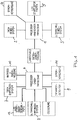
- Fig. 1 shows that the hand-held transmitter has a processor 1 High-frequency transmission system 2 with a wavelength of 70 cm, an ultrasound transmission system 3, a power source 4 and start / stop buttons 5 has.
- the golf cart contains a processor 6, a radio frequency receiving system 7, an ultrasound receiving system 8, an infrared detector 9, two electric motors connected to the rear wheels of the Golf cart connected to the drive, and also a power source 11.
- the power is supplied by one battery for each Vehicle and the handheld transmitter, with both batteries over automatic chargers can be charged.
- the golf cart can by operating a switch 12 and over a speed controller at any time regardless of Transmitter is operated in manual mode, whereby he then by hand must be directed.
- the golf cart can be operated at any time using the stop button on the handheld transmitter be put into a waiting state in which it can only be Manual operation is movable.
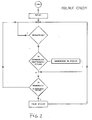
- the rough flow diagram clearly shows that the invention Golf carts can either be driven manually or automatically follows a player, doing this in the far range the high frequency bearing and after approaching the player uses ultrasound detection at close range.
- the speed of the golf cart, the size of the minimum distance and the Distance at which the golf cart can follow the transmitter etc. can be set.
- the individual components such as processor 6, radio frequency reception system 7, ultrasound reception system 8, infrared detector, accumulator etc. can be attached to the golf cart in any convenient way be arranged, this also on the components of the handheld transmitter applies.
Landscapes
- Engineering & Computer Science (AREA)
- Physics & Mathematics (AREA)
- Remote Sensing (AREA)
- Radar, Positioning & Navigation (AREA)
- Automation & Control Theory (AREA)
- Aviation & Aerospace Engineering (AREA)
- General Physics & Mathematics (AREA)
- Electromagnetism (AREA)
- Health & Medical Sciences (AREA)
- Physical Education & Sports Medicine (AREA)
- Mechanical Engineering (AREA)
- Combustion & Propulsion (AREA)
- General Health & Medical Sciences (AREA)
- Transportation (AREA)
- Chemical & Material Sciences (AREA)
- Acoustics & Sound (AREA)
- Control Of Position, Course, Altitude, Or Attitude Of Moving Bodies (AREA)
- Compositions Of Macromolecular Compounds (AREA)
Description
- Fig. 1
- einen Systemüberblick eines Golfwagens und
- Fig. 2
- ein Grobflußschema des Caddy-Systems.
Claims (12)
- System, bestehend aus einem selbstfahrenden Fahrzeug, vorzugsweise Golfwagen, und einem Sender, wobei das Fahrzeug eine Antriebseinrichtung, eine Steuereinrichtung und einer Hochfrequenzpeilvorrichtung aufweist, mit deren Hilfe sich das Fahrzeug selbsttätig dem Sender nähern kann,
dadurch gekennzeichnet,
daß der Sender Hochfrequenzsignale und Ultraschallsignale aussendet und daß die Peilvorrichtung eine Hochfrequenzpeileinrichtung (2,7), die bei einem eine vorbestimmte Distanz übersteigenden Abstand zwischen dem Fahrzeug und dem Sender wirksam ist, um die Richtung des Senders zu ermitteln, und eine Ultraschallpeileinrichtung (3, 8) aufweist, die dann wirksam ist, wenn sich das Fahrzeug innerhalb der vorbestimmten Distanz zu dem Sender befindet, um die Richtung des Senders und den jeweiligen Abstand von diesem zu ermitteln. - System nach Anspruch 1,
dadurch gekennzeichnet, daß die vorbestimmte Distanz die Strecke ist, über die Ultraschallsignale zur Steuerung des Fahrzeugs empfangbar sind. - System nach 1 oder 2,
dadurch gekennzeichnet, daß im Bereitschaftszustand des Fahrzeugs dessen Steuereinrichtung (6) erfaßt, ob Ultraschallsignale empfangen werden. - System nach Anspruch 3,
dadurch gekennzeichnet, daß in dem Fall, in dem keine Ultraschallsignale empfangen werden, die Steuereinrichtung (6) des Fahrzeugs die Hochfrequenzpeileinrichtung zur Ausführung eines Peilvorgangs aktiviert. - System nach einem der Ansprüche 1 bis 4,
dadurch gekennzeichnet, daß die Hochfrequenzpeileinrichtung eine am Fahrzeug unbeweglich angebrachte Hochfrequenzempfangsantenne (7) aufweist und daß der Hochfrequenzpeilvorgang in der Weise ausgeführt wird, daß die Antriebseinrichtung (10) das Fahrzeug um mindestens 360° dreht. - System nach einem der Ansprüche 1 bis 4,
dadurch gekennzeichnet, daß die Hochfrequenzpeileinrichtung mindestens drei Antennen aufweist, mit denen eine Doppler-Peilung ausgeführt wird. - System nach einem der Ansprüche 1 bis 6,
dadurch gekennzeichnet, daß die Steuereinrichtung (6) die Antriebseinrichtung (10) des Fahrzeugs so steuert, daß dieses nach dem Hochfrequenzpeilvorgang geradlinig in die ermittelte Richtung fährt, bis es entweder in den Ultraschallempfangsbereich gerät oder von der Steuereinrichtung (6) wieder in den Bereitschaftszustand versetzt wird. - System nach einem der Ansprüche 1 bis 7,
dadurch gekennzeichnet, daß an dem Fahrzeug zwei in Querrichtung des Fahrzeugs beabstandete Ultraschallempfangseinrichtungen (8) befestigt sind, deren Empfangssignale fortlaufend von einem an dem Fahrzeug befestigten Prozessor (6) derart ausgewertet werden, daß jeweils die Richtung und der Abstand zum Sender ermittelt werden. - System nach Anspruch 8,
dadurch gekennzeichnet, daß der Prozessor (6) die Antriebseinrichtung so steuert, daß das Fahrzeug dem Sender folgt, bis ein vorbestimmter Minimalabstand von dem Sender erreicht ist. - System nach einem der Ansprüche 1 bis 9,
dadurch gekennzeichnet, daß das Fahrzeug ein freilaufendes Vorderrad, welches um eine vertikale Achse frei schwenkbar gelagert ist, und zwei Hinterräder aufweist, die von zwei Elektromotoren antreibbar sind, die unabhängig voneinander steuerbar sind. - System nach einem der Ansprüche 1 bis 10,
dadurch gekennzeichnet, daß die Antriebseinrichtung (10) so gesteuert wird, daß sie das Fahrzeug bei der geradlinigen Annäherung in Hochfrequenzpeilbereich mit einer größeren Geschwindigkeit antreibt als im Ultraschallpeilbereich. - System nach einem der Ansprüche 1 bis 11,
dadurch gekennzeichnet, daß ferner ein in Fahrtrichtung weisender Infrarot-Detektor (9) angeordnet ist.
Applications Claiming Priority (2)
| Application Number | Priority Date | Filing Date | Title |
|---|---|---|---|
| DE4326016A DE4326016C1 (de) | 1993-08-03 | 1993-08-03 | Selbstfahrendes Fahrzeug, vorzugsweise Golfwagen |
| DE4326016 | 1993-08-03 |
Publications (2)
| Publication Number | Publication Date |
|---|---|
| EP0637460A1 EP0637460A1 (de) | 1995-02-08 |
| EP0637460B1 true EP0637460B1 (de) | 1998-04-29 |
Family
ID=6494350
Family Applications (1)
| Application Number | Title | Priority Date | Filing Date |
|---|---|---|---|
| EP94102390A Expired - Lifetime EP0637460B1 (de) | 1993-08-03 | 1994-02-17 | Selbstfahrendes Fahrzeug, vorzugsweise Golf-Caddy |
Country Status (15)
| Country | Link |
|---|---|
| US (1) | US6142251A (de) |
| EP (1) | EP0637460B1 (de) |
| JP (1) | JPH09500800A (de) |
| AT (1) | ATE165522T1 (de) |
| AU (1) | AU7262694A (de) |
| CA (1) | CA2167909A1 (de) |
| CZ (1) | CZ26196A3 (de) |
| DE (3) | DE4326016C1 (de) |
| DK (1) | DK0637460T3 (de) |
| ES (1) | ES2118271T3 (de) |
| HU (1) | HU221489B (de) |
| PL (1) | PL175241B1 (de) |
| SI (1) | SI9420045A (de) |
| SK (1) | SK15496A3 (de) |
| WO (1) | WO1995003858A1 (de) |
Families Citing this family (16)
| Publication number | Priority date | Publication date | Assignee | Title |
|---|---|---|---|---|
| DE4433750C1 (de) * | 1994-09-22 | 1995-12-14 | Bail Guenther | Führungssystem für ein selbstfahrendes Fahrzeug mit getrennter, mobiler Sendereinrichtung und Verfahren zum Steuern des Fahrzeugs |
| DE19509320A1 (de) * | 1995-03-15 | 1996-09-19 | Technologietransfer Anstalt Te | Folgesteuerung für ein selbstfahrendes Fahrzeug |
| US6327219B1 (en) | 1999-09-29 | 2001-12-04 | Vi&T Group | Method and system for directing a following device toward a movable object |
| DE10066147C1 (de) * | 2000-02-19 | 2003-10-30 | Romy Salvagno | Roboter-Golfcaddie |
| US6915871B2 (en) * | 2002-03-12 | 2005-07-12 | Dan Gavish | Method and apparatus for improving child safety and adult convenience while using a mobile ride-on toy |
| JP3875988B2 (ja) * | 2002-05-10 | 2007-01-31 | 本田技研工業株式会社 | 未知の障害物の中の予測不可能な目標物の実時間追跡 |
| US7744441B2 (en) * | 2004-11-05 | 2010-06-29 | Mattel, Inc. | Interactive play sets |
| AU2007250460B2 (en) * | 2006-05-17 | 2011-02-03 | Your Shadow Technologies Pty Ltd | Robotic golf caddy |
| WO2007132033A1 (es) * | 2006-05-17 | 2007-11-22 | Smart Technology, S.A. | Sistema de detección, guiado o seguimiento de dispositivos o personas |
| IL200921A (en) * | 2009-09-14 | 2016-05-31 | Israel Aerospace Ind Ltd | A robotic carry system for infantry and useful methods for the above purpose |
| CA2997160C (en) * | 2015-10-16 | 2023-10-03 | Lemmings LLC | Robotic golf caddy |
| US10197999B2 (en) | 2015-10-16 | 2019-02-05 | Lemmings, Llc | Robotic golf caddy |
| DE102016200813A1 (de) * | 2016-01-21 | 2017-07-27 | Robert Bosch Gmbh | Verfahren zur Bestimmung einer Fahrzeugposition |
| US20190151725A1 (en) * | 2017-11-20 | 2019-05-23 | Andrew Bennett | Golf course carrier controller and assistant |
| CN110825120A (zh) * | 2018-08-13 | 2020-02-21 | 纮信科技股份有限公司 | 目标跟随载具 |
| US11613289B2 (en) * | 2019-01-28 | 2023-03-28 | Lg Electronics Inc. | Cart following transmission module based on position information of transmission module and method for moving thereof |
Family Cites Families (12)
| Publication number | Priority date | Publication date | Assignee | Title |
|---|---|---|---|---|
| US3742507A (en) * | 1970-09-10 | 1973-06-26 | J Pirre | Automatic golf bag cart |
| US3720281A (en) * | 1971-02-16 | 1973-03-13 | J Frownfelter | Remotely controlled vehicle |
| US3748564A (en) * | 1972-07-07 | 1973-07-24 | S Ohba | Motor control circuit |
| US3856104A (en) * | 1972-07-07 | 1974-12-24 | S Ohba | Sequential control circuit for a remote-controlled vehicle |
| US4109186A (en) * | 1974-04-17 | 1978-08-22 | Gettig Engineering & Manufacturing Co., Inc. | Self-propelled golf cart |
| US4023178A (en) * | 1974-07-24 | 1977-05-10 | Sanyo Electric Co., Ltd. | Radio-controlled vehicle with RF noise elimination feature and with ultrasonic anti-collision means insensitive to mechanical shocks |
| US4317854A (en) * | 1979-06-11 | 1982-03-02 | Rathmell Richard K | Vacuum-insulated panel |
| GB8621105D0 (en) * | 1986-09-01 | 1986-10-08 | Kramer D C | Remotely-controlled vehicle |
| US5076384A (en) * | 1989-10-17 | 1991-12-31 | Mitsubishi Denki Kabushiki Kaisha | Ultrasonic obstacle sensor |
| US5327345A (en) * | 1991-02-15 | 1994-07-05 | Laser Alignment, Inc. | Position control system for a construction implement such as a road grader |
| JPH0887324A (ja) * | 1994-09-16 | 1996-04-02 | Nikko Denki Kogyo Kk | 自動誘導・追尾装置 |
| US5711388A (en) * | 1995-07-20 | 1998-01-27 | Golfpro International, Inc. | Robotic golf caddy apparatus and method |
-
1993
- 1993-08-03 DE DE4326016A patent/DE4326016C1/de not_active Expired - Fee Related
-
1994
- 1994-02-17 DE DE59405826T patent/DE59405826D1/de not_active Expired - Lifetime
- 1994-02-17 AT AT94102390T patent/ATE165522T1/de not_active IP Right Cessation
- 1994-02-17 EP EP94102390A patent/EP0637460B1/de not_active Expired - Lifetime
- 1994-02-17 ES ES94102390T patent/ES2118271T3/es not_active Expired - Lifetime
- 1994-02-17 DK DK94102390T patent/DK0637460T3/da active
- 1994-07-27 PL PL94312783A patent/PL175241B1/pl unknown
- 1994-07-27 US US08/586,919 patent/US6142251A/en not_active Expired - Fee Related
- 1994-07-27 SK SK154-96A patent/SK15496A3/sk unknown
- 1994-07-27 CZ CZ96261A patent/CZ26196A3/cs unknown
- 1994-07-27 SI SI9420045A patent/SI9420045A/sl unknown
- 1994-07-27 DE DE9490212U patent/DE9490212U1/de not_active Expired - Lifetime
- 1994-07-27 AU AU72626/94A patent/AU7262694A/en not_active Abandoned
- 1994-07-27 HU HU9600243A patent/HU221489B/hu not_active IP Right Cessation
- 1994-07-27 WO PCT/DE1994/000872 patent/WO1995003858A1/de not_active Ceased
- 1994-07-27 CA CA002167909A patent/CA2167909A1/en not_active Abandoned
- 1994-07-27 JP JP7505485A patent/JPH09500800A/ja not_active Ceased
Also Published As
| Publication number | Publication date |
|---|---|
| CA2167909A1 (en) | 1995-02-09 |
| PL312783A1 (en) | 1996-05-13 |
| EP0637460A1 (de) | 1995-02-08 |
| SI9420045A (en) | 1996-08-31 |
| HUT73889A (en) | 1996-10-28 |
| PL175241B1 (pl) | 1998-11-30 |
| AU7262694A (en) | 1995-02-28 |
| WO1995003858A1 (de) | 1995-02-09 |
| DE9490212U1 (de) | 1996-05-15 |
| CZ26196A3 (en) | 1996-06-12 |
| DK0637460T3 (da) | 1999-02-15 |
| ES2118271T3 (es) | 1998-09-16 |
| DE4326016C1 (de) | 1994-09-15 |
| HU221489B (en) | 2002-10-28 |
| JPH09500800A (ja) | 1997-01-28 |
| ATE165522T1 (de) | 1998-05-15 |
| HU9600243D0 (en) | 1996-03-28 |
| SK15496A3 (en) | 1996-10-02 |
| US6142251A (en) | 2000-11-07 |
| DE59405826D1 (de) | 1998-06-04 |
Similar Documents
| Publication | Publication Date | Title |
|---|---|---|
| EP0637460B1 (de) | Selbstfahrendes Fahrzeug, vorzugsweise Golf-Caddy | |
| EP0732641B1 (de) | Folgesteuerung für ein selbstfahrendes Fahrzeug | |
| EP3412133B1 (de) | Bodenbearbeitungssystem mit mindestens einer ladestation | |
| DE3536907C2 (de) | ||
| DE69914183T2 (de) | Automatischer wagen zum transport von golfschlägern oder anderen gegenständen und zubehör | |
| DE69312726T2 (de) | Bewegungssteuerungsverfahren für eine autonome in beliebige richtungen fahrende elektrische maschine und dafür geeignete elektrische maschine | |
| DE69804253T2 (de) | Verbesserungen bei beweglichen robotern und bei ihren steuerungssystemen | |
| DE2143623B2 (de) | Ferngesteuertes fahrzeug, insbesondere koecherwagen fuer golfschlaeger | |
| EP3392731B1 (de) | Verfahren zum betrieb eines systems aus selbstfahrenden bodenbearbeitungsgeräten | |
| DE10196988T5 (de) | Robotersystem | |
| DE2425341A1 (de) | Transportwagen fuer ein schienengebundenes transportsystem | |
| EP3559770B1 (de) | Verfahren zum betrieb eines sich selbsttätig fortbewegenden reinigungsgerätes sowie ein solches reinigungsgerät | |
| DE102011018191A1 (de) | Wagen für Sicherheitstests, gesteuert durch ein externes Führungssystem | |
| EP3447598B1 (de) | Verfahren zum betreiben eines kraftfahrzeugs sowie kraftfahrzeug | |
| WO2014033275A1 (de) | System zum aufbereiten von futter | |
| DE102020102667A1 (de) | System und verfahren zur fahrzeugausrichtungssteuerung | |
| EP0782723A1 (de) | Führungssystem für ein selbstfahrendes fahrzeug mit getrennter, mobiler sendeeinrichtung und verfahren zum steuern des fahrzeugs | |
| DE102008057446B4 (de) | Mobiler Roboter und Verfahren zu seiner Ansteuerung | |
| DE102020102928A1 (de) | Autonom fahrendes Schienenfahrzeug | |
| DE112021002716T5 (de) | Verfahren zur Positionsbestimmung eines Roboterwerkzeugs, ein Roboterwerkzeug und ein Roboterwerkzeugsystem | |
| CN211752311U (zh) | 一种使用安全的手推电动高尔夫球包车 | |
| DE2420339A1 (de) | Verfahren und einrichtung zum automatischen maehen einer rasenflaeche | |
| DE3938106A1 (de) | Golfwagen fuer die befoerderung eines golfsacks mit schlaegern | |
| DE9317044U1 (de) | Skateboard mit Eigenantrieb | |
| DE2307780A1 (de) | Ferngesteuertes raederfahrzeug |
Legal Events
| Date | Code | Title | Description |
|---|---|---|---|
| PUAI | Public reference made under article 153(3) epc to a published international application that has entered the european phase |
Free format text: ORIGINAL CODE: 0009012 |
|
| AK | Designated contracting states |
Kind code of ref document: A1 Designated state(s): AT BE CH DE DK ES FR GB GR IE IT LI LU MC NL PT SE |
|
| 17P | Request for examination filed |
Effective date: 19951004 |
|
| 17Q | First examination report despatched |
Effective date: 19970114 |
|
| GRAG | Despatch of communication of intention to grant |
Free format text: ORIGINAL CODE: EPIDOS AGRA |
|
| GRAG | Despatch of communication of intention to grant |
Free format text: ORIGINAL CODE: EPIDOS AGRA |
|
| GRAH | Despatch of communication of intention to grant a patent |
Free format text: ORIGINAL CODE: EPIDOS IGRA |
|
| GRAH | Despatch of communication of intention to grant a patent |
Free format text: ORIGINAL CODE: EPIDOS IGRA |
|
| RAP1 | Party data changed (applicant data changed or rights of an application transferred) |
Owner name: BAIL, GUENTHER, DR. |
|
| GRAA | (expected) grant |
Free format text: ORIGINAL CODE: 0009210 |
|
| AK | Designated contracting states |
Kind code of ref document: B1 Designated state(s): AT BE CH DE DK ES FR GB GR IE IT LI LU MC NL PT SE |
|
| REF | Corresponds to: |
Ref document number: 165522 Country of ref document: AT Date of ref document: 19980515 Kind code of ref document: T |
|
| REG | Reference to a national code |
Ref country code: CH Ref legal event code: EP |
|
| REF | Corresponds to: |
Ref document number: 59405826 Country of ref document: DE Date of ref document: 19980604 |
|
| ET | Fr: translation filed | ||
| ITF | It: translation for a ep patent filed | ||
| GBT | Gb: translation of ep patent filed (gb section 77(6)(a)/1977) |
Effective date: 19980707 |
|
| REG | Reference to a national code |
Ref country code: CH Ref legal event code: NV Representative=s name: KIRKER & CIE SA |
|
| REG | Reference to a national code |
Ref country code: IE Ref legal event code: FG4D Free format text: 80068 |
|
| REG | Reference to a national code |
Ref country code: ES Ref legal event code: FG2A Ref document number: 2118271 Country of ref document: ES Kind code of ref document: T3 |
|
| REG | Reference to a national code |
Ref country code: PT Ref legal event code: SC4A Free format text: AVAILABILITY OF NATIONAL TRANSLATION Effective date: 19980727 |
|
| REG | Reference to a national code |
Ref country code: DK Ref legal event code: T3 |
|
| PLBE | No opposition filed within time limit |
Free format text: ORIGINAL CODE: 0009261 |
|
| STAA | Information on the status of an ep patent application or granted ep patent |
Free format text: STATUS: NO OPPOSITION FILED WITHIN TIME LIMIT |
|
| 26N | No opposition filed | ||
| REG | Reference to a national code |
Ref country code: GB Ref legal event code: IF02 |
|
| PGFP | Annual fee paid to national office [announced via postgrant information from national office to epo] |
Ref country code: IE Payment date: 20030218 Year of fee payment: 10 |
|
| PGFP | Annual fee paid to national office [announced via postgrant information from national office to epo] |
Ref country code: PT Payment date: 20030220 Year of fee payment: 10 |
|
| PGFP | Annual fee paid to national office [announced via postgrant information from national office to epo] |
Ref country code: MC Payment date: 20030221 Year of fee payment: 10 Ref country code: FR Payment date: 20030221 Year of fee payment: 10 |
|
| PGFP | Annual fee paid to national office [announced via postgrant information from national office to epo] |
Ref country code: ES Payment date: 20030226 Year of fee payment: 10 Ref country code: LU Payment date: 20030226 Year of fee payment: 10 Ref country code: GR Payment date: 20030226 Year of fee payment: 10 |
|
| PGFP | Annual fee paid to national office [announced via postgrant information from national office to epo] |
Ref country code: AT Payment date: 20030227 Year of fee payment: 10 |
|
| PGFP | Annual fee paid to national office [announced via postgrant information from national office to epo] |
Ref country code: DK Payment date: 20030228 Year of fee payment: 10 Ref country code: SE Payment date: 20030228 Year of fee payment: 10 Ref country code: NL Payment date: 20030228 Year of fee payment: 10 |
|
| PGFP | Annual fee paid to national office [announced via postgrant information from national office to epo] |
Ref country code: BE Payment date: 20030326 Year of fee payment: 10 |
|
| PGFP | Annual fee paid to national office [announced via postgrant information from national office to epo] |
Ref country code: CH Payment date: 20030508 Year of fee payment: 10 |
|
| PG25 | Lapsed in a contracting state [announced via postgrant information from national office to epo] |
Ref country code: LU Free format text: LAPSE BECAUSE OF NON-PAYMENT OF DUE FEES Effective date: 20040217 Ref country code: IE Free format text: LAPSE BECAUSE OF NON-PAYMENT OF DUE FEES Effective date: 20040217 Ref country code: AT Free format text: LAPSE BECAUSE OF NON-PAYMENT OF DUE FEES Effective date: 20040217 |
|
| PG25 | Lapsed in a contracting state [announced via postgrant information from national office to epo] |
Ref country code: SE Free format text: LAPSE BECAUSE OF NON-PAYMENT OF DUE FEES Effective date: 20040218 Ref country code: ES Free format text: LAPSE BECAUSE OF NON-PAYMENT OF DUE FEES Effective date: 20040218 |
|
| PG25 | Lapsed in a contracting state [announced via postgrant information from national office to epo] |
Ref country code: MC Free format text: LAPSE BECAUSE OF NON-PAYMENT OF DUE FEES Effective date: 20040228 Ref country code: BE Free format text: LAPSE BECAUSE OF NON-PAYMENT OF DUE FEES Effective date: 20040228 |
|
| PG25 | Lapsed in a contracting state [announced via postgrant information from national office to epo] |
Ref country code: LI Free format text: LAPSE BECAUSE OF NON-PAYMENT OF DUE FEES Effective date: 20040229 Ref country code: CH Free format text: LAPSE BECAUSE OF NON-PAYMENT OF DUE FEES Effective date: 20040229 |
|
| PG25 | Lapsed in a contracting state [announced via postgrant information from national office to epo] |
Ref country code: DK Free format text: LAPSE BECAUSE OF NON-PAYMENT OF DUE FEES Effective date: 20040301 |
|
| BERE | Be: lapsed |
Owner name: *BAIL GUNTHER Effective date: 20040228 |
|
| PG25 | Lapsed in a contracting state [announced via postgrant information from national office to epo] |
Ref country code: PT Free format text: LAPSE BECAUSE OF NON-PAYMENT OF DUE FEES Effective date: 20040831 |
|
| PG25 | Lapsed in a contracting state [announced via postgrant information from national office to epo] |
Ref country code: NL Free format text: LAPSE BECAUSE OF NON-PAYMENT OF DUE FEES Effective date: 20040901 |
|
| PG25 | Lapsed in a contracting state [announced via postgrant information from national office to epo] |
Ref country code: GR Free format text: LAPSE BECAUSE OF NON-PAYMENT OF DUE FEES Effective date: 20040903 |
|
| REG | Reference to a national code |
Ref country code: DK Ref legal event code: EBP |
|
| EUG | Se: european patent has lapsed | ||
| REG | Reference to a national code |
Ref country code: CH Ref legal event code: PL |
|
| PG25 | Lapsed in a contracting state [announced via postgrant information from national office to epo] |
Ref country code: FR Free format text: LAPSE BECAUSE OF NON-PAYMENT OF DUE FEES Effective date: 20041029 |
|
| NLV4 | Nl: lapsed or anulled due to non-payment of the annual fee |
Effective date: 20040901 |
|
| REG | Reference to a national code |
Ref country code: IE Ref legal event code: MM4A |
|
| REG | Reference to a national code |
Ref country code: FR Ref legal event code: ST |
|
| PG25 | Lapsed in a contracting state [announced via postgrant information from national office to epo] |
Ref country code: IT Free format text: LAPSE BECAUSE OF NON-PAYMENT OF DUE FEES Effective date: 20050217 |
|
| REG | Reference to a national code |
Ref country code: ES Ref legal event code: FD2A Effective date: 20040218 |
|
| PGFP | Annual fee paid to national office [announced via postgrant information from national office to epo] |
Ref country code: GB Payment date: 20100217 Year of fee payment: 17 |
|
| PGFP | Annual fee paid to national office [announced via postgrant information from national office to epo] |
Ref country code: DE Payment date: 20100427 Year of fee payment: 17 |
|
| GBPC | Gb: european patent ceased through non-payment of renewal fee |
Effective date: 20110217 |
|
| REG | Reference to a national code |
Ref country code: DE Ref legal event code: R119 Ref document number: 59405826 Country of ref document: DE Effective date: 20110901 |
|
| PG25 | Lapsed in a contracting state [announced via postgrant information from national office to epo] |
Ref country code: GB Free format text: LAPSE BECAUSE OF NON-PAYMENT OF DUE FEES Effective date: 20110217 |
|
| PG25 | Lapsed in a contracting state [announced via postgrant information from national office to epo] |
Ref country code: DE Free format text: LAPSE BECAUSE OF NON-PAYMENT OF DUE FEES Effective date: 20110901 |