EP0632110B1 - Bismutvanadathaltige Glanzpigmente - Google Patents
Bismutvanadathaltige Glanzpigmente Download PDFInfo
- Publication number
- EP0632110B1 EP0632110B1 EP94109703A EP94109703A EP0632110B1 EP 0632110 B1 EP0632110 B1 EP 0632110B1 EP 94109703 A EP94109703 A EP 94109703A EP 94109703 A EP94109703 A EP 94109703A EP 0632110 B1 EP0632110 B1 EP 0632110B1
- Authority
- EP
- European Patent Office
- Prior art keywords
- metal
- bismuth
- vanadate
- coated
- luster pigments
- Prior art date
- Legal status (The legal status is an assumption and is not a legal conclusion. Google has not performed a legal analysis and makes no representation as to the accuracy of the status listed.)
- Expired - Lifetime
Links
Classifications
-
- C—CHEMISTRY; METALLURGY
- C09—DYES; PAINTS; POLISHES; NATURAL RESINS; ADHESIVES; COMPOSITIONS NOT OTHERWISE PROVIDED FOR; APPLICATIONS OF MATERIALS NOT OTHERWISE PROVIDED FOR
- C09C—TREATMENT OF INORGANIC MATERIALS, OTHER THAN FIBROUS FILLERS, TO ENHANCE THEIR PIGMENTING OR FILLING PROPERTIES ; PREPARATION OF CARBON BLACK ; PREPARATION OF INORGANIC MATERIALS WHICH ARE NO SINGLE CHEMICAL COMPOUNDS AND WHICH ARE MAINLY USED AS PIGMENTS OR FILLERS
- C09C1/00—Treatment of specific inorganic materials other than fibrous fillers; Preparation of carbon black
- C09C1/0015—Pigments exhibiting interference colours, e.g. transparent platelets of appropriate thinness or flaky substrates, e.g. mica, bearing appropriate thin transparent coatings
-
- C—CHEMISTRY; METALLURGY
- C01—INORGANIC CHEMISTRY
- C01P—INDEXING SCHEME RELATING TO STRUCTURAL AND PHYSICAL ASPECTS OF SOLID INORGANIC COMPOUNDS
- C01P2004/00—Particle morphology
- C01P2004/80—Particles consisting of a mixture of two or more inorganic phases
- C01P2004/82—Particles consisting of a mixture of two or more inorganic phases two phases having the same anion, e.g. both oxidic phases
- C01P2004/84—Particles consisting of a mixture of two or more inorganic phases two phases having the same anion, e.g. both oxidic phases one phase coated with the other
Definitions
- the present invention relates to new luster pigments based on coated, platelet-shaped substrates which contain a layer containing bismuth vanadate.
- the invention also relates to the production of these luster pigments and to their use for coloring paints, printing inks, plastics, glasses, ceramic products and decorative cosmetic preparations.
- Gloss or effect pigments are being used to an increasing extent in many areas of technology, for example in automotive coatings, in decorative coating, in plastic coloring, in paints, prints, in particular security colors, and in cosmetics.
- metallic effect pigments e.g. aluminum, zinc or copper flakes
- pearlescent pigments e.g. highly refractive, transparent, platelet-shaped metal oxides such as bismuth oxychloride or silicate substrates coated with highly refractive metal oxides such as titanium or zirconium dioxide, such as muscovite, phlogopite, Biotite, talc or glass.
- combination pigments in which the abovementioned pigments are coated with other, in particular colored, high-index metal oxides such as chromium oxide and, above all, iron oxide. Interference, reflection and absorption phenomena result in a variety of angle-dependent color and brightness impressions depending on the thickness of the metal oxide layer. These pigments can therefore also be called interference absorption pigments and in the case of metallic substrates also interference reflection pigments.
- the commercially available yellow gloss pigments are all more or less reddish, which is usually due to the incorporation of Fe (III) compounds.
- Fe (III) compounds For example, with Titanium dioxide-coated mica in the yellow color range have very pure interference colors, but these are pastel-like colors with low color intensity.
- the invention was therefore based on the object of providing bright-colored gloss pigments in the yellow color range which do not have the disadvantages mentioned and which can advantageously be used for the desired purposes.
- gloss pigments based on coated, platelet-shaped substrates were found which contain a layer containing bismuth vanadate.
- all platelet-shaped substrates which are stable under the conditions of the production process according to the invention are suitable as starting materials for the luster pigments according to the invention.
- Silicate substrates such as light or white mica are particularly suitable, scales of preferably wet-ground muscovite being particularly preferred.
- other natural mica such as phlogopite and biotite, artificial mica, talc and glass flakes can also be used.
- the silicate substrate particles are preferably coated in a first layer with high-index metal oxides such as titanium, zirconium, tin, aluminum, silicon, zinc oxide, bismuth oxychloride or mixtures thereof.
- high-index metal oxides such as titanium, zirconium, tin, aluminum, silicon, zinc oxide, bismuth oxychloride or mixtures thereof.
- a coating with zirconium dioxide and particularly preferably with titanium dioxide is preferred.
- Suitable substrates are platelet-shaped crystals of metal oxides, such as those e.g. of bismuth oxychloride and ferric oxide are known.
- Aluminum flakes that are already coated with a protective oxide layer in particular made of aluminum, titanium or iron oxide.
- Aluminum flakes coated with titanium dioxide and iron oxide are preferred, which can be produced, for example, according to the information in US Pat. No. 4,978,394 and EP-A 33 457 by gas phase decomposition of titanium tetrachloride or iron pentacarbonyl in the presence of the aluminum flakes.
- the aluminum flakes themselves can be punched out of aluminum foil or manufactured using known atomization and grinding techniques and are also commercially available (e.g. from Eckart, Harrisonth and Alcan-Toyo, Maisons-Laffitte).
- the size of the substrate particles is not critical per se and can be tailored to the particular application. As a rule, the particles have largest diameters of approximately 1 to 200 ⁇ m, in particular approximately 5 to 100 ⁇ m, and thicknesses of approximately 0.1 to 5 ⁇ m, in particular approximately 0.5 ⁇ m.
- the substrate particles which are either coated with high-index metal oxide or are uncoated, are coated with a layer containing bismutvanadate.
- the luster pigments according to the invention combine the high color strength of the bismuth vanadate absorption pigment known as pure yellow pigment with the high luster of the substrate serving as the interference pigment.
- the gloss pigments according to the invention are also notable for improved application properties, such as the lighter one Dispersibility in paints compared to the pure bismuth vanadate pigments.
- the bismuth vanadate-containing layers according to the invention can be doped both with anions and with cations.
- preferred anionic dopants are borates, perborates, sulfates, silicates and phosphates.
- preferred cationic dopants are alkaline earth metal cations such as magnesium, calcium and strontium, zinc and aluminum.
- Particularly preferred bismuth vanadate-containing layers according to the invention contain phosphate and borate as dopants. Suitable amounts of doping are generally 0.005 to 10% by weight, preferably 0.01 to 4% by weight, of doping agent, based on the coated pigment.
- layers of bismutvanadate containing adherent layers are obtained, which generally consist of bismuth vanadate-containing crystallites of the order of magnitude of 0.01 to 5 ⁇ m, preferably 0.5 up to 3 ⁇ m. Depending on the amount of bismuth vanadate precipitated, these crystallites are more or less densely packed.
- the precipitated bismuth vanadate-containing crystallites will be too large to result in a layer capable of interference.
- strong, pure yellow pigments e.g. substrate with golden or silver interference color
- two-tone pigments which show the yellow body color and the interference color of the substrate (e.g. substrate with red or blue interference color)
- the yellow body color and the interference color of the substrate e.g. substrate with red or blue interference color
- uncoated mica for example ground muscovite
- a thin layer of bismutvanadate containing shiny yellow pigments is obtained which, when applied, show a weak brightness flop.
- the bismuth vanadate crystallites applied have a size of approximately 0.5 to 3 ⁇ m, no interference effects can be observed. With unchanged good color properties, these are gloss pigments dispersible in lacquers much more easily than the classic bismuth vanadate pigments.
- the bismuth vanadate-containing layer according to the invention can also consist of a metal oxide matrix, in particular of silicon and / or titanium oxide, in which bismuth vanadate particles are incorporated.
- Luster pigments coated with such a bismuth vanadate-containing layer can be produced by having bismuth vanadate pigments which have been formed fully present in the precipitation of the metal hydroxide in an aqueous suspension of the substrate particles and also being coincident on the substrate surface.
- an aqueous suspension of the substrate particles is expediently introduced, the bismuth vanadate pigment dispersed in water is added and an aqueous metal salt solution (for example titanium tetrachloride or sodium silicate solution) is metered in.
- an aqueous metal salt solution for example titanium tetrachloride or sodium silicate solution
- a base or acid is added in such a way that the pH of the mixture is kept in a range in which the precipitation of the metal hydroxide takes place.
- the precipitated hydroxides are converted into the corresponding oxides or oxide hydrates.
- the first-mentioned bismuth vanadate-containing layers in which the bismuth vanadate is formed and struck in situ will be preferable.
- Luster pigments coated with these bismuth vanadate-containing layers can advantageously be obtained by the process according to the invention by precipitating bismuth vanadate in the presence of the substrate particles to be coated, a base and optionally dissolved salts of the above-mentioned dopants with an alkaline vanadate solution from an acidic bismuth salt solution Subsequently, substrate particles are filtered off, washed and dried.
- Bismuth nitrate is particularly suitable for this purpose as bismuth salt;
- suitable vanadates are, for example, ammonium and alkali metal, especially sodium and potassium ortho and metavanadate.
- Examples of soluble salts of the dopants are, in addition to the corresponding alkaline earth metal salts, above all the alkali metal phosphates, hydrogen phosphates, borates, perborates, sulfates and silicates, in particular the sodium and potassium phosphates, hydrogen phosphates, borates, perborates, sulfates and silicates.
- the alkaline vanadate solution which at the same time also contains dissolved phosphate and, if desired, borate, perborate, silicate and / or sulfate, is added to the acid bismuth salt solution in which the substrate particles are suspended, with a base (eg sodium hydroxide solution) the pH of the mixture to 2 to 6, preferably 2.5 to 5, the mixture is stirred for about 1 h at this pH, then the pH to 5 to 8, preferably 5.5 to 7, then the mixture was heated to the reflux temperature by maintaining the pH constant by further addition of base, then heated further for 0.5 to 5 hours without further addition of base and the pigment was filtered off hot.
- a base eg sodium hydroxide solution
- the phosphate is usually used in an amount of 0.5 to 50, preferably 1 to 25 mol%, based on the bismuth concentration.
- Suitable amounts of the further dopants are generally 1 to 25, preferably 2 to 15 mol%, based on the bismuth concentration.
- the bismuth salt solution can also be added to the vanadate solution, the pH of the mixture can be adjusted to 3 to 6.5 by adding a base, and constant by adding an additional base while heating up to 100 ° C holds until it no longer sinks and the pigment is isolated after 0.5 to 5 h and tempered at 300 to 600 ° C for 0.5 to 5 h.
- the luster pigments according to the invention can also contain an outer, essentially colorless layer of metal oxides, oxide hydrates, metal silicates or metal phosphates which further improve the application properties, e.g. light fastness, thermal stability or stability to acids and reducing agents.
- a layer preferably consists of aluminum hydroxide and / or calcium or zinc phosphate.
- these layers can be applied to the pigment particles present in aqueous suspension by precipitating a metal phosphate (for example Ca 3 (PO 4 ) 2 ).
- a metal phosphate for example Ca 3 (PO 4 ) 2
- the luster pigments according to the invention are notable for good application properties, in particular their pure, yellow color, their color strength and their luster. They are light in the application media, especially varnishes, dispersible and are therefore advantageous for many purposes, for example the coloring of paints, printing inks, plastics, glasses, ceramic products and preparations for decorative cosmetics.
- the pH of the suspension was then adjusted to 3.5 using 30% strength by weight sodium hydroxide solution.
- the suspension was then stirred at room temperature for 1 h, the pH being kept between 3.4 and 3.7 by metering in 4% by weight sodium hydroxide solution.
- the pH was then also increased to 6.0 by adding the 4% strength by weight sodium hydroxide solution and kept constant during the heating to the reflux temperature by further addition of base.
Landscapes
- Chemical & Material Sciences (AREA)
- Organic Chemistry (AREA)
- Pigments, Carbon Blacks, Or Wood Stains (AREA)
Description
- Die vorliegende Erfindung betrifft neue Glanzpigmente auf Basis beschichteter, plättchenförmiger Substrate, die eine bismutvanadathaltige Schicht enthalten.
- Außerdem betrifft die Erfindung die Herstellung dieser Glanzpigmente sowie ihre Verwendung zum Einfärben von Lacken, Druckfarben, Kunststoffen, Gläsern, keramischen Produkten und Zubereitungen der dekorativen Kosmetik.
- Glanz- oder Effektpigmente werden in zunehmendem Maße in vielen Bereichen der Technik eingesetzt, beispielsweise in Automobillakken, in der dekorativen Beschichtung, der Kunststoffeinfärbung, in Anstrich-, Druck-, insbesondere Sicherheitsfarben sowie in der Kosmetik.
- Ihre optische Wirkung beruht auf der gerichteten Reflexion an überwiegend flächig ausgebildeten, ausgerichteten metallischen oder stark lichtbrechenden Pigmentteilchen. Je nach Art der Pigmentteilchen spricht man auch von Metalleffektpigmenten (z.B. Aluminium-, Zink- oder Kupferflakes) oder Perlglanzpigmenten (z.B. hochbrechende, transparente, plättchenförmige Metalloxide wie Bismutoxychlorid oder mit hochbrechenden Metalloxiden wie Titan- oder Zirkondioxid beschichtete, silikatische Substrate wie Muskovit, Phlogopit, Biotit, Talkum oder Glas).
- Daneben gibt es eine Reihe von Kombinationspigmenten, bei denen die oben genannten Pigmente mit weiteren, insbesondere farbigen, hochbrechenden Metalloxiden wie Chromoxid und vor allem Eisenoxid beschichtet sind. Durch Interferenz-, Reflexions- und Absorptionsphänomene ergibt sich hier in Abhängigkeit von der Dicke der Metalloxidschicht eine Vielzahl von winkelabhängigen Farb- und Helligkeitseindrücken. Man kann diese Pigmente daher auch Interferenzabsorptionspigmente und bei metallischem Substrat auch Interferenzreflexionspigmente nennen.
- Mit den bekannten Glanzpigmenten ist insbesondere der rote bis goldene Farbtonbereich gut abgedeckt, jedoch gibt es keine rein gelben Glanzpigmente mit hoher Farbstärke.
- Die handelsüblichen gelben Glanzpigmente sind alle mehr oder weniger rotstichig, was in der Regel auf den Einbau von Fe(III)-Verbindungen zurückzuführen ist. Zwar können z.B. mit Titandioxid beschichtete Glimmer im gelben Farbtonbereich sehr reine Interferenzfarben aufweisen, dabei handelt es sich jedoch um pastellartige Farbtöne mit geringer Farbstärke. Eine Verstärkung der Körperfarbe durch den Einbau nichtselektiv absorbierender Schichten, wie beispielsweise in der DE-A 41 41 069 beschrieben, ist zwar möglich, jedoch zeigen die im Lack applizierten Pigmente beim Abkippen eine Abschwächung der Farbstärke, so daß ein unbunter Farbeindruck resultiert.
- Der Erfindung lag daher die Aufgabe zugrunde, farbstarke Glanzpigmente im gelben Farbtonbereich bereitzustellen, die die genannten Nachteile nicht aufweisen und die vorteilhaft für die gewünschten Verwendungszwecke eingesetzt werden können.
- Demgemäß wurde Glanzpigmente auf Basis beschichteter, plättchenförmiger Substrate gefunden, die eine bismutvanadathaltige Schicht enthalten.
- Weiterhin wurde ein Verfahren zur Herstellung dieser Glanzpigmente gefunden, welches dadurch gekennzeichnet ist, daß man Bismutvanadat in Gegenwart der zu belegenden Substratteilchen, einer Base und gegebenenfalls gelöster Phosphate, Borate und/oder hydrolysierbarer Metallsalze mit einer alkalischen Vanadatlösung aus einer sauren Bismutsalzlösung ausfällt und die so erhaltenen, belegten Substratteilchen abfiltriert, wäscht und trocknet.
- Außerdem wurde die Verwendung dieser Glanzpigmente zur Einfärbung von Lacken, Druckfarben, Kunststoffen, Gläsern, keramischen Produkten und Zubereitungen der dekorativen Kosmetik gefunden.
- Als Ausgangsmaterialien für die erfindungsgemäßen Glanzpigmente eignen sich prinzipiell alle plättchenförmigen Substrate, die unter den Bedingungen des erfindungsgemäßen Herstellverfahrens stabil sind.
- Besonders geeignet sind silikatische Substrate wie helle oder weiße Glimmer, wobei Schuppen von vorzugsweise naß vermahlenem Muskovit besonders bevorzugt sind. Selbstverständlich können auch andere natürliche Glimmer wie Phlogopit und Biotit, künstliche Glimmer, Talk- und Glasschuppen verwendet werden.
- Die silikatischen Substratteilchen sind vorzugsweise in einer ersten Schicht mit hochbrechenden Metalloxiden wie Titan-, Zirkon-, Zinn-, Aluminium-, Silicium-, Zinkoxid, Bismutoxychlorid oder deren Mischungen belegt. Bevorzugt ist dabei eine Beschichtung mit Zirkondioxid und besonders bevorzugt mit Titandioxid.
- Diese einfach beschichteten Pigmente sind allgemein bekannt und beispielsweise in den DE-C 14 67 468, EP-A 45 851, DE-A 32 37 264 und DE-A 36 17 430 beschrieben. Metalloxidbeschichtete Glimmerplättchen sind auch unter dem Namen Iriodin® (E. Merck, Darmstadt), Flonac® (Kemira Oy, Pori, Finnland) oder Mearlin® (Mearl Corporation, New York) im Handel.
- Weitere geeignete Substrate sind plättchenförmige Kristalle von Metalloxiden wie sie z.B. von Bismutoxychlorid und Eisen(III)oxid bekannt sind.
- Denkbar ist auch die Verwendung von plättchenförmigen Metallpigmenten, die unter den Beschichtungsbedingungen stabil sind.
- In Frage kommen z.B. Aluminiumflakes, die bereits mit einer schützenden Oxidschicht insbesondere aus Aluminium-, Titan- oder Eisenoxid belegt sind. Bevorzugt sind dabei titandioxid- und eisenoxidbeschichtete Aluminiumflakes, die beispielsweise nach den Angaben in der US-A 4 978 394 und der EP-A 33 457 durch Gasphasenzersetzung von Titantetrachlorid bzw. Eisenpentacarbonyl in Gegenwart der Aluminiumflakes herzustellen sind. Die Aluminiumflakes selbst können aus Aluminiumfolie herausgestanzt oder nach bekannten Verdüsungs- und Mahltechniken hergestellt werden und sind auch im Handel erhältlich (z.B. Firma Eckart, Fürth und Alcan-Toyo, Maisons-Laffitte).
- Weiterhin kommen auch Stahlflakes in Betracht, die nach ähnlichen Techniken hergestellt werden können und unter den Beschichtungsbedingungen stabil sind.
- Die Größe der Substratteilchen ist an sich nicht kritisch und kann auf den jeweiligen Anwendungszweck abgestimmt werden. In der Regel haben die Teilchen größte Durchmesser von etwa 1 bis 200 µm, insbesondere etwa 5 bis 100 µm, und Dicken von etwa 0,1 bis 5 µm, insbesondere etwa 0,5 µm.
- Bei den erfindungsgemäßen Glanzpigmenten sind die Substratteilchen, die entweder mit hochbrechendem Metalloxid beschichtet oder unbeschichtet sind, mit einer bismutvanadathaltigen Schicht belegt.
- Die erfindungsgemäßen Glanzpigmente verbinden auf diese Weise die hohe Farbstärke des als reines Gelbpigment bekannten Absorptionspigments Bismutvanadat mit dem hohen Glanz des als Interferenzpigment dienenden Substrats. Neben dem deutlich erhöhten Glanz zeichnen sich die erfindungsgemäßen Glanzpigmente auch durch verbesserte anwendungstechnische Eigenschaften wie die leichtere Dispergierbarkeit in Lacken gegenüber den reinen Bismutvanadatpigmenten aus.
- Die erfindungsgemäßen bismutvanadathaltigen Schichten können wie die reinen Bismutvanadatpigmente sowohl mit Anionen als auch mit Kationen dotiert sein. Beispiele für bevorzugte anionische Dotierungsmittel sind Borate, Perborate, Sulfate, Silikate und Phosphate. Als bevorzugte kationische Dotierungsmittel seien beispielsweise Erdalkalikationen wie Magnesium, Calcium und Strontium, Zink und Aluminium genannt. Besonders bevorzugte erfindungsgemäße bismutvanadathaltige Schichten enthalten Phosphat und Borat als Dotierungsmittel. Geeignete Dotierungsmengen sind dabei in der Regel 0,005 bis 10 Gew.-%, vorzugsweise 0,01 bis 4 Gew.-% Dotierungsmittel, bezogen auf das beschichtete Pigment.
- Bei der erfindungsgemäßen Herstellung der neuen Glanzpigmente durch Ausfällen von Bismutvanadat aus einer Bismutsalzlösung mit Vanadat in Gegenwart der Substratteilchen werden auf der Substratoberfläche festhaftende bismutvanadathaltige Schichten erhalten, die in der Regel aus bismutvanadathaltigen Kristalliten der Größenordnung von 0,01 bis 5 µm, bevorzugt 0,5 bis 3 µm, aufgebaut sind. Je nach der Menge des ausgefällten Bismutvanadats sind diese Kristallite mehr oder weniger dicht gepackt.
- Werden filmartige Schichten aus dicht gepackten, kleinen (10 bis 100 nm) Kristalliten abgeschieden, so können diese zur Interferenz des beschichteten Glanzpigmentes beitragen.
- In der Regel werden die aufgefällten, bismutvanadathaltigen Kristallite jedoch zu groß sein, um eine interferenzfähige Schicht zu ergeben.
- In Abhängigkeit von der Interferenzfarbe des Substrats werden farbstarke, rein gelbe Pigmente (z.B. Substrat mit goldener oder silberner Interferenzfarbe) oder two-tone-Pigmente, die gelbe Körperfarbe und die Interferenzfarbe des Substrats (z.B. Substrat mit roter oder blauer Interferenzfarbe) zeigen, erhalten.
- Wird als Substrat unbeschichteter Glimmer, z.B. gemahlener Muskovit, verwendet, so erhält man durch Aufbringung einer dünnen bismutvanadathaltigen Schicht glänzende, gelbe Pigmente, die in applizierter Form einen schwachen Helligkeitsflop zeigen. Haben die aufgebrachten Bismutvanadatkristallite eine Größe von etwa 0,5 bis 3 µm, so sind keine Interferenzeffekte zu beobachten. Bei unverändert guten koloristischen Eigenschaften sind diese Glanzpigmente in Lacken wesentlich leichter dispergierbar als die klassischen Bismutvanadatpigmente.
- Alternativ kann die erfindungsgemäße bismutvanadathaltige Schicht auch aus einer Metalloxidmatrix, insbesondere aus Silicium- und/oder Titanoxid, bestehen, in die Bismutvanadatteilchen eingebaut sind.
- Mit einer solchen bismutvanadathaltigen Schicht belegte Glanzpigmente können hergestellt werden, indem fertig ausgebildete Bismutvanadatpigmente bei der Fällung des Metallhydroxids in einer wäßrigen Suspension der Substratteilchen zugegen sind und auf die Substratoberfläche mitaufgefällt werden.
- Zweckmäßigerweise legt man hierzu eine wäßrige Suspension der Substratteilchen vor, gibt das in Wasser dispergierte Bismutvanadatpigment zu und dosiert eine wäßrige Metallsalzlösung (z.B. Titantetrachlorid- oder Natronwasserglaslösung) zu. Gleichzeitig gibt man eine Base bzw. Säure so zu, daß der pH-Wert der Mischung in einem Bereich gehalten wird, in dem die Fällung des Metallhydroxids stattfindet. Bei der anschließenden Trocknung des abgetrennten und gewaschenen Pigments werden die aufgefällten Hydroxide in die entsprechenden Oxide bzw. Oxidhydrate überführt.
- In der Regel werden die erstgenannten bismutvanadathaltigen Schichten, bei denen das Bismutvanadat in situ gebildet und aufgefällt wird, vorzuziehen sein.
- Glanzpigmente, die mit diesen bismutvanadathaltigen Schichten belegt sind, können vorteilhaft nach dem erfindungsgemäßen Verfahren erhalten werden, indem man Bismutvanadat in Gegenwart der zu belegenden Substratteilchen, einer Base und gegebenenfalls gelöster Salze der obengenannten Dotierungsmittel mit einer alkalischen Vanadatlösung aus einer sauren Bismutsalzlösung ausfällt und die belegten Substratteilchen anschließend abfiltriert, wäscht und trocknet.
- Als Bismutsalz eignet sich hierfür insbesondere Bismutnitrat, geeignete Vanadate sind zum Beispiel Ammonium- und Alkali-, vor allem Natrium- und Kalium-ortho- und -metavanadat.
- Beispiele für lösliche Salze der Dotierungsmittel sind neben den entsprechenden Erdalkalisalzen vor allem die Alkaliphosphate, -hydrogenphosphate, -borate, -perborate, -sulfate und -silikate insbesondere die Natrium- und Kaliumphosphate, -hydrogenphosphate, -borate, -perborate, -sulfate und -silikate.
- Vorzugsweise geht man beim erfindungsgemäßen Herstellungsverfahren so vor, daß man die alkalische Vanadatlösung, die gleichzeitig auch gelöstes Phosphat und gewünschtenfalls Borat, Perborat, Silikat und/oder Sulfat enthält, zu der sauren Bismutsalzlösung, in der die Substratteilchen suspendiert sind, gibt, mit einer Base (z.B. Natronlauge) den pH-Wert der Mischung auf 2 bis 6, bevorzugt 2,5 bis 5, einstellt, die Mischung ungefähr 1 h bei diesem pH-Wert rührt, den pH-Wert dann auf 5 bis 8, vorzugsweise 5,5 bis 7, erhöht, dann die Mischung unter Konstanthaltung des pH-Wertes durch weitere Basenzugabe auf Rückflußtemperatur erhitzt, anschließend ohne weitere Basenzugabe 0,5 bis 5 h weiter erhitzt und das Pigment heiß abfiltriert.
- Das Phosphat wird üblicherweise in einer Menge von 0,5 bis 50, bevorzugt 1 bis 25 mol.-%, bezogen auf die Bismutkonzentration, eingesetzt.
- Geeignete Mengen der weiteren Dotierungsmittel sind in der Regel 1 bis 25, vorzugsweise 2 bis 15 mol.-%, bezogen auf die Bismutkonzentration.
- Nach einer Variante des erfindungsgemäßen Verfahrens kann man auch so vorgehen, daß man die Bismutsalzlösung zu der Vanadatlösung gibt, den pH-Wert der Mischung durch Basenzugabe auf 3 bis 6,5 einstellt und durch weitere Basenzugabe während des Erhitzens auf bis zu 100°C konstant hält, bis er nicht mehr absinkt, und das Pigment nach 0,5 bis 5 h isoliert und 0,5 bis 5 h bei 300 bis 600°C tempert.
- Gewünschtenfalls können die erfindungsgemäßen Glanzpigmente noch eine äußere, im wesentlichen farblose Schicht aus Metalloxiden, -oxidhydraten, Metallsilikaten oder Metallphosphaten enthalten, die eine zusätzliche Verbesserung der anwendungstechnischen Eigenschaften, z.B. der Lichtechtheit, der thermischen Stabilität oder der Stabilität gegenüber Säuren und reduzierenden Agenzien, bewirken kann. Bevorzugt besteht eine solche Schicht aus Aluminiumhydroxid und/oder Calcium- oder Zinkphosphat.
- Diese Schichten können, wie beispielsweise in der US-A 4 063 956 beschrieben, durch Auffällen eines Metallphosphates (z.B. Ca3(PO4)2) auf die in wäßriger Suspension vorliegenden Pigmentteilchen aufgebracht werden.
- Die erfindungsgemäßen Glanzpigmente zeichnen sich durch gute anwendungstechnische Eigenschaften, insbesondere ihren reinen, gelben Farbton, ihre Farbstärke und ihren Glanz aus. Sie sind leicht in den Anwendungsmedien, insbesondere auch Lacken, dispergierbar und eignen sich daher vorteilhaft für viele Zwecke, beispielsweise die Einfärbung von Lacken, Druckfarben, Kunststoffen, Gläsern, keramischen Produkten und Zubereitungen der dekorativen Kosmetik.
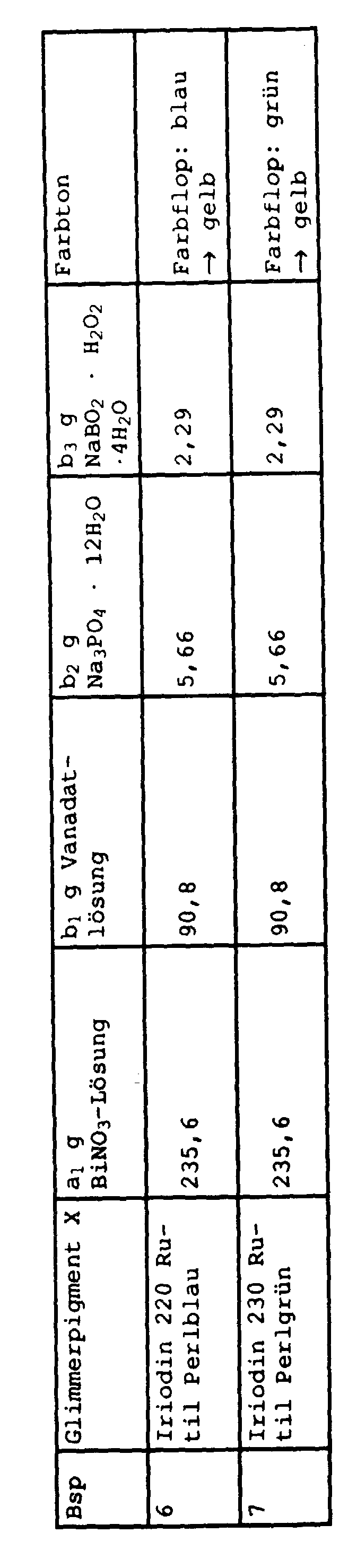
- Zu einer Suspension von 40 g des Glimmerpigments X in a1 g einer 11 gew.-%igen, salpetersauren, wäßrigen Bismutnitratlösung (berechnet als Bismut) wurde rasch unter Rühren eine alkalische wäßrige Lösung, die b1 g Natriummetavanadatlösung (6,86 Gew.-% Vanadin), b2 g Trinatriumphosphatdodecahydrat und b3 g Natriumperborattetrahydrat gegeben. Der pH-Wert der Mischung betrug 0,1 bis 1.
- Danach wurde mit 30 gew.-%iger Natronlauge der pH-Wert der Suspension auf 3,5 eingestellt. Die Suspension wurde dann 1 h bei Raumtemperatur gerührt, wobei der pH-Wert durch Zudosierung von 4 gew.-%iger Natronlauge zwischen 3,4 und 3,7 gehalten wurde.
- Anschließend wurde der pH-Wert ebenfalls durch Zugabe der 4 gew.-%igen Natronlauge, auf 6,0 erhöht und während des Erhitzens auf Rückflußtemperatur durch weitere Basenzugabe konstant gehalten.
- Nach Erreichen der Rückflußtemperatur begann der pH-Wert zu steigen, und die Suspension verfärbte sich nach gelb.
- Nach zweistündigem Erhitzen unter Rückfluß wurde das Pigment heiß abfiltriert, salzfrei gewaschen und bei 80°C im Vakuum getrocknet.
- Weitere Angaben zu diesen Versuchen sowie deren Ergebnisse sind in der folgenden Tabelle zusammengestellt.

Claims (10)
- Glanzpigmente auf Basis beschichteter, plättchenförmiger Substrate, die eine bismutvanadathaltige Schicht enthalten.
- Glanzpigmente nach Anspruch 1, bei denen die bismutvanadathaltige Schicht Phosphat, Borat, Sulfat, Silikat und/oder Metalloxid oder Metalloxidhydrat enthält.
- Glanzpigmente nach Anspruch 1 oder 2, bei denen die bismutvanadathaltige Schicht Erdalkali-, Silicium- und/oder Titanoxid oder -oxidhydrat enthält.
- Glanzpigmente nach den Ansprüchen 1 bis 3, die als äußere Schicht eine im wesentlichen farblose metalloxid-, metallsilikat- und/oder metallphosphathaltige Schicht enthalten.
- Glanzpigmente nach den Ansprüchen 1 bis 4, die ein silikatisches Substrat, das mit Metalloxid beschichtet sein kann, enthalten.
- Verfahren zur Herstellung der Glanzpigmente gemäß den Ansprüchen 1 bis 5, dadurch gekennzeichnet, daß man Bismutvanadat in Gegenwart der zu belegenden Substratteilchen, einer Base und gegebenenfalls gelöster Phosphate, Borate und/oder hydrolysierbarer Metallsalze mit einer alkalischen Vanadatlösung aus einer sauren Bismutsalzlösung ausfällt und die so erhaltenen belegten Substratteilchen abfiltriert, wäscht und trocknet.
- Verfahren nach Anspruch 6, dadurch gekennzeichnet, daß man die alkalische Vanadatlösung zu der sauren Bismutsalzlösung, in der die Substratteilchen suspendiert sind, gibt, mit einer Base den pH-Wert der Mischung auf 2 bis 6 einstellt, ungefähr eine Stunde bei diesem pH-Wert rührt, den pH-Wert dann auf 5 bis 8 erhöht, unter Konstanthaltung des pH-Wertes auf Rückflußtemperatur erhitzt, anschließend 0,5 bis 5 Stunden weiter erhitzt und das Pigment isoliert.
- Verfahren nach Anspruch 6, dadurch gekennzeichnet, daß man die saure Bismutsalzlösung, in der die Substratteilchen suspendiert sind, zu der alkalischen Vanadatlösung gibt, mit einer Base den pH-Wert der Mischung auf 3 bis 6,5 einstellt, den pH-Wert durch weitere Zugabe von Base während des Erhitzens auf bis zu 100°C konstant hält, bis er nicht mehr absinkt, und nach 0,5 bis 5 h das Pigment isoliert und 0,5 bis 5 Stunden bei 300 bis 600°C tempert.
- Verfahren nach den Ansprüchen 6 bis 8, dadurch gekennzeichnet, daß man die mit einer bismutvanadathaltigen Schicht belegten Substratteilchen in wäßriger Suspension durch Hydrolyse eines Metallsalzes mit einer äußeren metalloxid- oder metalloxidhydrathaltigen Schicht oder durch Auffällen eines Metallsilikates oder Metallphosphates mit einer äußeren metallsilikat- oder metallphosphathaltigen Schicht belegt und das Pigment in üblicher Weise isoliert.
- Verwendung der Glanzpigmente gemäß den Ansprüchen 1 bis 5 zur Einfärbung von Lacken, Druckfarben, Kunststoffen, Gläsern, keramischen Produkten und Zubereitungen der dekorativen Kosmetik.
Applications Claiming Priority (2)
| Application Number | Priority Date | Filing Date | Title |
|---|---|---|---|
| DE4322020 | 1993-07-02 | ||
| DE4322020 | 1993-07-02 |
Publications (2)
| Publication Number | Publication Date |
|---|---|
| EP0632110A1 EP0632110A1 (de) | 1995-01-04 |
| EP0632110B1 true EP0632110B1 (de) | 1996-09-11 |
Family
ID=6491773
Family Applications (1)
| Application Number | Title | Priority Date | Filing Date |
|---|---|---|---|
| EP94109703A Expired - Lifetime EP0632110B1 (de) | 1993-07-02 | 1994-06-23 | Bismutvanadathaltige Glanzpigmente |
Country Status (5)
| Country | Link |
|---|---|
| US (1) | US5411586A (de) |
| EP (1) | EP0632110B1 (de) |
| JP (1) | JPH0734003A (de) |
| DE (1) | DE59400627D1 (de) |
| FI (1) | FI943166L (de) |
Cited By (4)
| Publication number | Priority date | Publication date | Assignee | Title |
|---|---|---|---|---|
| US9168209B2 (en) | 2013-03-13 | 2015-10-27 | Johnson & Johnson Consumer Inc. | Pigmented skin-care compositions |
| US9168394B2 (en) | 2013-03-13 | 2015-10-27 | Johnson & Johnson Consumer Inc. | Pigmented skin-care compositions |
| US9168393B2 (en) | 2013-03-13 | 2015-10-27 | Johnson & Johnson Consumer Inc. | Pigmented skin-care compositions |
| US9320687B2 (en) | 2013-03-13 | 2016-04-26 | Johnson & Johnson Consumer Inc. | Pigmented skin-care compositions |
Families Citing this family (22)
| Publication number | Priority date | Publication date | Assignee | Title |
|---|---|---|---|---|
| DE19502196A1 (de) * | 1995-01-25 | 1996-08-01 | Bayer Ag | Farbstabile Bismutvanadat-Gelbpigmente |
| US6040255A (en) * | 1996-06-25 | 2000-03-21 | Kimberly-Clark Worldwide, Inc. | Photostabilization package usable in nonwoven fabrics and nonwoven fabrics containing same |
| FR2785528B1 (fr) | 1998-11-10 | 2002-08-30 | Oreal | Composition cosmetique a phase continue lipophile contenant un nouveau pigment |
| FR2785527B1 (fr) * | 1998-11-10 | 2000-12-15 | Oreal | Composition cosmetique a phase continue hydrophile contenant du vanadate de bismuth |
| DE10046152A1 (de) | 2000-09-15 | 2002-03-28 | Merck Patent Gmbh | Pigmentpräparation in Granulatform |
| DE69913343D1 (de) * | 1999-09-22 | 2004-01-15 | Gebroeders Cappelle N V | Hitzebeständiges Bismuthvanadat-Pigment und Verfahren zu seiner Herstellung |
| DE19947175A1 (de) | 1999-10-01 | 2001-04-05 | Merck Patent Gmbh | Pigmentpräparation |
| DE10120856A1 (de) | 2001-04-27 | 2002-10-31 | Merck Patent Gmbh | Pigmentpräparation |
| FR2829022B1 (fr) * | 2001-09-03 | 2004-09-24 | Oreal | Composition de fond de teint comprenant des pigments interferentiels |
| US20050169950A1 (en) * | 2002-01-08 | 2005-08-04 | Marie-Laure Delacour | Solid cosmetic composition comprising fibers |
| JP4558283B2 (ja) * | 2002-11-01 | 2010-10-06 | エスケー化研株式会社 | 金色顔料及びその製造方法 |
| US20050175562A1 (en) * | 2004-01-05 | 2005-08-11 | Anke Hadasch | Skin makeup composition |
| US20050287099A1 (en) * | 2004-05-13 | 2005-12-29 | Anne Liechty | Cosmetic powder comprising at least one acrylic polymer powder |
| US20050276776A1 (en) * | 2004-05-13 | 2005-12-15 | Anne Liechty | Cosmetic powder comprising at least one elastomeric organopolysiloxane |
| US20050287092A1 (en) * | 2004-05-13 | 2005-12-29 | Anne Liechty | Cosmetic powder comprising barium sulfate |
| DE102005006767B4 (de) * | 2005-02-15 | 2008-07-24 | Heubach Gmbh | Kompositpigment, Verfahren zu dessen Herstellung sowie dessen Verwendung |
| EP1889598B1 (de) * | 2006-07-18 | 2016-02-03 | L'Oréal | Kosmetische Zusammensetzung in Pulverform |
| JP5911798B2 (ja) | 2009-07-20 | 2016-04-27 | ロレアル | オキシ塩化ビスマスの分散液を含有するエマルジョン |
| WO2011067807A1 (en) | 2009-12-02 | 2011-06-09 | L'oreal | Cosmetic composition containing fusiform particles for cosmetic use |
| US8974720B2 (en) | 2010-07-01 | 2015-03-10 | Toyota Jidosha Kabushiki Kaisha | Method for producing ceramic laminate |
| WO2012042570A1 (en) | 2010-09-29 | 2012-04-05 | L'oreal | A cosmetic method for hiding skin imperfections |
| WO2014203913A1 (en) | 2013-06-18 | 2014-12-24 | L'oreal | Cosmetic composition |
Family Cites Families (13)
| Publication number | Priority date | Publication date | Assignee | Title |
|---|---|---|---|---|
| NL280256A (de) * | 1961-06-28 | |||
| US3087828A (en) * | 1961-06-28 | 1963-04-30 | Du Pont | Nacreous pigment compositions |
| US3087829A (en) * | 1961-06-28 | 1963-04-30 | Du Pont | Micaceous pigment composition |
| US4063956A (en) * | 1976-09-16 | 1977-12-20 | E. I. Du Pont De Nemours And Company | Heat stable monoclinic bismuth vanadate pigment |
| DE3003352A1 (de) * | 1980-01-31 | 1981-08-06 | Basf Ag, 6700 Ludwigshafen | Verfahren zur herstellung von eisenoxidbelegten metallpigmenten |
| DE3030056A1 (de) * | 1980-08-08 | 1982-03-25 | Basf Ag, 6700 Ludwigshafen | Verfahren zur herstellung von mit metalloxiden beschichteten schuppenfoermigen glimmerpigmenten |
| DE3237264A1 (de) * | 1982-10-08 | 1984-04-12 | Basf Ag, 6700 Ludwigshafen | Verfahren zur herstellung von mit metalloxid beschichteten effektpigmenten |
| DE3617430A1 (de) * | 1986-05-23 | 1987-11-26 | Merck Patent Gmbh | Perlglanzpigmente |
| DE3813335A1 (de) * | 1988-04-21 | 1989-11-02 | Basf Ag | Metalloxidbeschichtete aluminiumpigmente |
| DE4104310A1 (de) * | 1991-02-13 | 1992-08-20 | Merck Patent Gmbh | Plaettchenfoermiges pigment |
| US5336312A (en) * | 1991-04-24 | 1994-08-09 | Ferro Corporation | Bismuth-containing colorants |
| DE4141069A1 (de) * | 1991-12-13 | 1993-06-17 | Basf Ag | Glanzpigmente auf der basis von mehrfach beschichteten plaettchenfoermigen silikatischen substraten |
| DE4209242A1 (de) * | 1992-03-21 | 1993-09-23 | Basf Ag | Als glanzpigmente geeignete mischungen |
-
1994
- 1994-06-23 DE DE59400627T patent/DE59400627D1/de not_active Expired - Lifetime
- 1994-06-23 EP EP94109703A patent/EP0632110B1/de not_active Expired - Lifetime
- 1994-06-27 US US08/266,481 patent/US5411586A/en not_active Expired - Fee Related
- 1994-06-30 JP JP6149522A patent/JPH0734003A/ja not_active Withdrawn
- 1994-07-01 FI FI943166A patent/FI943166L/fi not_active Application Discontinuation
Cited By (4)
| Publication number | Priority date | Publication date | Assignee | Title |
|---|---|---|---|---|
| US9168209B2 (en) | 2013-03-13 | 2015-10-27 | Johnson & Johnson Consumer Inc. | Pigmented skin-care compositions |
| US9168394B2 (en) | 2013-03-13 | 2015-10-27 | Johnson & Johnson Consumer Inc. | Pigmented skin-care compositions |
| US9168393B2 (en) | 2013-03-13 | 2015-10-27 | Johnson & Johnson Consumer Inc. | Pigmented skin-care compositions |
| US9320687B2 (en) | 2013-03-13 | 2016-04-26 | Johnson & Johnson Consumer Inc. | Pigmented skin-care compositions |
Also Published As
| Publication number | Publication date |
|---|---|
| DE59400627D1 (de) | 1996-10-17 |
| JPH0734003A (ja) | 1995-02-03 |
| US5411586A (en) | 1995-05-02 |
| FI943166A7 (fi) | 1995-01-03 |
| EP0632110A1 (de) | 1995-01-04 |
| FI943166L (fi) | 1995-01-03 |
| FI943166A0 (fi) | 1994-07-01 |
Similar Documents
| Publication | Publication Date | Title |
|---|---|---|
| EP0632110A1 (de) | Bismutvanadathaltige Glanzpigmente | |
| EP0307747B1 (de) | Goldfarbene Farbglanzpigmente | |
| EP1213330B1 (de) | Silberfarbenes Glanzpigment | |
| EP1572812B1 (de) | Silberweisse interferenzpigmente mit hohem glanz auf der basis von transparenten substratplättchen | |
| DE2557796C2 (de) | Rußhaltige Pigmente | |
| EP0668329B1 (de) | Mehrfach beschichtete metallische Glanzpigmente | |
| EP1025168B2 (de) | Interferenzpigmente | |
| EP0708154B1 (de) | Mehrfach beschichtete metallische Glanzpigmente | |
| EP0075186B1 (de) | Perlglanzpigmente, ihre Herstellung und ihre Verwendung | |
| DE68905953T2 (de) | Witterungsbestaendige perlglanzpigmente und verfahren zu deren herstellung. | |
| EP0075755A2 (de) | Perlglanzpigmente mit verbesserter Lichtechtheit, Verfahren zur Herstellung und Verwendung | |
| EP0944097B1 (de) | Leitfähige Pigmente | |
| EP0211351A2 (de) | Eisenoxidbeschichtete Perlglanzpigmente | |
| DE1959998B2 (de) | Perlglanzpigmente und verfahren zu ihrer herstellung | |
| EP0948572A1 (de) | Mehrschichtige interferenzpigmente | |
| EP0090260A1 (de) | Verfahren zur Herstellung von Perlglanzpigmenten mit verbesserten Glanzeigenschaften | |
| DE3235017A1 (de) | Perlglanzpigmente | |
| EP1506262B1 (de) | Goniochromatische glanzpigmente | |
| DE10128489A1 (de) | Mehrschichtige Glanzpigmente | |
| DE19915153A1 (de) | Farbstarke Interferenzpigmente | |
| EP0659843B1 (de) | Nicht glänzendes Pigment | |
| EP0560144B1 (de) | Oberflächenmodifizierte Pigmente | |
| DE19842134A1 (de) | Pigment mit hoher Lichtdiffusion | |
| EP0750021A2 (de) | Goldfarbiges Pigment auf Basis von mit Metalloxiden überzogenen Substraten | |
| DE60301967T2 (de) | VERBESSERTES BiOCl-PIGMENT |
Legal Events
| Date | Code | Title | Description |
|---|---|---|---|
| PUAI | Public reference made under article 153(3) epc to a published international application that has entered the european phase |
Free format text: ORIGINAL CODE: 0009012 |
|
| 17P | Request for examination filed |
Effective date: 19940924 |
|
| AK | Designated contracting states |
Kind code of ref document: A1 Designated state(s): BE CH DE FR GB IT LI NL |
|
| 17Q | First examination report despatched |
Effective date: 19951030 |
|
| GRAH | Despatch of communication of intention to grant a patent |
Free format text: ORIGINAL CODE: EPIDOS IGRA |
|
| GRAH | Despatch of communication of intention to grant a patent |
Free format text: ORIGINAL CODE: EPIDOS IGRA |
|
| GRAA | (expected) grant |
Free format text: ORIGINAL CODE: 0009210 |
|
| AK | Designated contracting states |
Kind code of ref document: B1 Designated state(s): BE CH DE FR GB IT LI NL |
|
| GBT | Gb: translation of ep patent filed (gb section 77(6)(a)/1977) |
Effective date: 19960924 |
|
| REF | Corresponds to: |
Ref document number: 59400627 Country of ref document: DE Date of ref document: 19961017 |
|
| ITF | It: translation for a ep patent filed | ||
| ET | Fr: translation filed | ||
| PGFP | Annual fee paid to national office [announced via postgrant information from national office to epo] |
Ref country code: FR Payment date: 19970520 Year of fee payment: 4 |
|
| PGFP | Annual fee paid to national office [announced via postgrant information from national office to epo] |
Ref country code: NL Payment date: 19970527 Year of fee payment: 5 |
|
| PGFP | Annual fee paid to national office [announced via postgrant information from national office to epo] |
Ref country code: CH Payment date: 19970529 Year of fee payment: 4 |
|
| PGFP | Annual fee paid to national office [announced via postgrant information from national office to epo] |
Ref country code: BE Payment date: 19970612 Year of fee payment: 4 |
|
| PGFP | Annual fee paid to national office [announced via postgrant information from national office to epo] |
Ref country code: DE Payment date: 19970624 Year of fee payment: 4 |
|
| PLBE | No opposition filed within time limit |
Free format text: ORIGINAL CODE: 0009261 |
|
| STAA | Information on the status of an ep patent application or granted ep patent |
Free format text: STATUS: NO OPPOSITION FILED WITHIN TIME LIMIT |
|
| 26N | No opposition filed | ||
| PG25 | Lapsed in a contracting state [announced via postgrant information from national office to epo] |
Ref country code: GB Free format text: LAPSE BECAUSE OF NON-PAYMENT OF DUE FEES Effective date: 19980623 |
|
| PG25 | Lapsed in a contracting state [announced via postgrant information from national office to epo] |
Ref country code: DE Free format text: LAPSE BECAUSE OF THE APPLICANT RENOUNCES Effective date: 19980624 |
|
| PG25 | Lapsed in a contracting state [announced via postgrant information from national office to epo] |
Ref country code: LI Free format text: LAPSE BECAUSE OF NON-PAYMENT OF DUE FEES Effective date: 19980630 Ref country code: CH Free format text: LAPSE BECAUSE OF NON-PAYMENT OF DUE FEES Effective date: 19980630 Ref country code: BE Free format text: LAPSE BECAUSE OF NON-PAYMENT OF DUE FEES Effective date: 19980630 |
|
| BERE | Be: lapsed |
Owner name: BASF A.G. Effective date: 19980630 |
|
| GBPC | Gb: european patent ceased through non-payment of renewal fee |
Effective date: 19980623 |
|
| REG | Reference to a national code |
Ref country code: CH Ref legal event code: PL |
|
| PG25 | Lapsed in a contracting state [announced via postgrant information from national office to epo] |
Ref country code: FR Free format text: LAPSE BECAUSE OF NON-PAYMENT OF DUE FEES Effective date: 19990226 |
|
| REG | Reference to a national code |
Ref country code: FR Ref legal event code: ST |
|
| PG25 | Lapsed in a contracting state [announced via postgrant information from national office to epo] |
Ref country code: NL Free format text: LAPSE BECAUSE OF NON-PAYMENT OF DUE FEES Effective date: 20000101 |
|
| NLV4 | Nl: lapsed or anulled due to non-payment of the annual fee |
Effective date: 20000101 |
|
| PG25 | Lapsed in a contracting state [announced via postgrant information from national office to epo] |
Ref country code: IT Free format text: LAPSE BECAUSE OF NON-PAYMENT OF DUE FEES;WARNING: LAPSES OF ITALIAN PATENTS WITH EFFECTIVE DATE BEFORE 2007 MAY HAVE OCCURRED AT ANY TIME BEFORE 2007. THE CORRECT EFFECTIVE DATE MAY BE DIFFERENT FROM THE ONE RECORDED. Effective date: 20050623 |