EP0622601B1 - Heat exchanger - Google Patents
Heat exchanger Download PDFInfo
- Publication number
- EP0622601B1 EP0622601B1 EP94302824A EP94302824A EP0622601B1 EP 0622601 B1 EP0622601 B1 EP 0622601B1 EP 94302824 A EP94302824 A EP 94302824A EP 94302824 A EP94302824 A EP 94302824A EP 0622601 B1 EP0622601 B1 EP 0622601B1
- Authority
- EP
- European Patent Office
- Prior art keywords
- diameter
- heat exchanger
- heat transfer
- base
- tip
- Prior art date
- Legal status (The legal status is an assumption and is not a legal conclusion. Google has not performed a legal analysis and makes no representation as to the accuracy of the status listed.)
- Expired - Lifetime
Links
- 238000005219 brazing Methods 0.000 claims description 30
- 238000000034 method Methods 0.000 claims description 13
- 230000007423 decrease Effects 0.000 claims description 7
- 239000000463 material Substances 0.000 claims description 6
- 238000003780 insertion Methods 0.000 description 6
- 230000037431 insertion Effects 0.000 description 6
- 238000004519 manufacturing process Methods 0.000 description 5
- 239000003507 refrigerant Substances 0.000 description 4
- 238000004026 adhesive bonding Methods 0.000 description 2
- 238000004378 air conditioning Methods 0.000 description 2
- 238000005192 partition Methods 0.000 description 2
- 238000003466 welding Methods 0.000 description 2
- 230000003247 decreasing effect Effects 0.000 description 1
Images




Classifications
-
- F—MECHANICAL ENGINEERING; LIGHTING; HEATING; WEAPONS; BLASTING
- F28—HEAT EXCHANGE IN GENERAL
- F28F—DETAILS OF HEAT-EXCHANGE AND HEAT-TRANSFER APPARATUS, OF GENERAL APPLICATION
- F28F9/00—Casings; Header boxes; Auxiliary supports for elements; Auxiliary members within casings
- F28F9/02—Header boxes; End plates
- F28F9/04—Arrangements for sealing elements into header boxes or end plates
- F28F9/16—Arrangements for sealing elements into header boxes or end plates by permanent joints, e.g. by rolling
- F28F9/18—Arrangements for sealing elements into header boxes or end plates by permanent joints, e.g. by rolling by welding
- F28F9/182—Arrangements for sealing elements into header boxes or end plates by permanent joints, e.g. by rolling by welding the heat-exchange conduits having ends with a particular shape, e.g. deformed; the heat-exchange conduits or end plates having supplementary joining means, e.g. abutments
-
- Y—GENERAL TAGGING OF NEW TECHNOLOGICAL DEVELOPMENTS; GENERAL TAGGING OF CROSS-SECTIONAL TECHNOLOGIES SPANNING OVER SEVERAL SECTIONS OF THE IPC; TECHNICAL SUBJECTS COVERED BY FORMER USPC CROSS-REFERENCE ART COLLECTIONS [XRACs] AND DIGESTS
- Y10—TECHNICAL SUBJECTS COVERED BY FORMER USPC
- Y10S—TECHNICAL SUBJECTS COVERED BY FORMER USPC CROSS-REFERENCE ART COLLECTIONS [XRACs] AND DIGESTS
- Y10S165/00—Heat exchange
- Y10S165/454—Heat exchange having side-by-side conduits structure or conduit section
- Y10S165/471—Plural parallel conduits joined by manifold
- Y10S165/476—Fusion joint, e.g. solder, braze between tube plate and header tank
-
- Y—GENERAL TAGGING OF NEW TECHNOLOGICAL DEVELOPMENTS; GENERAL TAGGING OF CROSS-SECTIONAL TECHNOLOGIES SPANNING OVER SEVERAL SECTIONS OF THE IPC; TECHNICAL SUBJECTS COVERED BY FORMER USPC CROSS-REFERENCE ART COLLECTIONS [XRACs] AND DIGESTS
- Y10—TECHNICAL SUBJECTS COVERED BY FORMER USPC
- Y10T—TECHNICAL SUBJECTS COVERED BY FORMER US CLASSIFICATION
- Y10T29/00—Metal working
- Y10T29/49—Method of mechanical manufacture
- Y10T29/4935—Heat exchanger or boiler making
- Y10T29/49373—Tube joint and tube plate structure
Definitions
- the present invention relates to a heat exchanger suitable for use in an air conditioning system for vehicles, and more particularly to improved end portions for heat transfer tubes in heat exchangers.
- a heat exchanger 21 comprises a pair of tanks 22 and 23.
- Inlet pipe 24 and outlet pipe 25 are connected to tank 22.
- a plurality of heat transfer tubes 26 (for example, refrigerant tubes) are fluidly connected between tanks 22 and 23.
- Each tube 26 has a central portion 26a and end portions 26b having diameters which are smaller than the diameter of central portion 26a. End portions 26b are inserted into holes 22a and 23a disposed in tanks 22 and 23, respectively, and fixed to tanks 22 and 23 by brazing.
- a partition 27 is provided in tank 22 at a center portion thereof.
- a heat medium for example, refrigerant, flows from inlet pipe 24 to outlet pipe 25 through the interior of tank 22, down heat transfer tubes 26, through the interior of tank 23, up heat transfer tubes 26 and through the interior of tank 22, as shown by arrows in Fig. 6.
- Fig. 7 depicts the structure of the connection between end portion 26b of each heat transfer tube 26 and tank 22 or 23.
- End portion 26b extends straight through tank 22 (23) and has a substantially uniform diameter which is smaller than the diameter of central portion 26a.
- End portion 26b is inserted through hole 22a (23a) and fixed to tank 22 (23) by brazing, welding, gluing or the like between the periphery of end portion 26b and the inner edge of hole 22a (23a).
- Gap A between the periphery of end portion 26b and the inner edge of hole 22a (23a) generally has a relatively small width, for example, not more than about 0.2 mm (0.008 in), so that a sufficiently thick layer of brazing material may be extended to uniformly cover end portion 26b.
- the width of gap A is also relatively small, for example, not more than about 0.2 mm (0.008 in). Specifically, if the width of gap A is greater than about 0.2 mm (0.008 in), it is difficult to provide a sufficient amount of brazing material in the gap to enable proper brazing to occur.
- end portions 26b as straight portions, however, presents difficulties in the manufacturing of the heat exchanger. Because the end portions 26b are straight and have a diameter which is only slightly less than the diameter of the holes, it is not easy to insert end portions 26b into holes 22a and 23a. Therefore, this type of heat transfer tube does not permit easy assembly of the heat exchanger.
- a heat transfer tube 31 comprises a central portion 31a and end portions 31b.
- Each end portion 31b is tapered from central portion 31a, so that the diameter of end portion 31b gradually decreases from a maximum diameter at a base 32 to a minimum diameter at a tip 33.
- the width of gap A between base 32 and the inner edge of hole 22a (23a) of tank 22 (23) is equal not more than about 0.2 mm (0.008 in).
- end portions 31b are tapered, they may be more easily inserted into holes 22a (23a). Therefore, this type of heat transfer tube permits easier assembly of the heat exchangers.
- straight end portions 26b are used, however, a wider variation in the length of tubes 26 may be allowed. Because the diameter of straight end portion 26b may be substantially uniform, the width of gap A is substantially constant as long as end portion 26b is disposed in hole 22a (23a).
- US-A-5046555 discloses a heat exchanger including a pair of spaced apart tanks each having a plurality of holes of uniform diameter, and a plurality of heat transfer tubes fluidly connecting the pair of tanks, each heat transfer tube comprising a central portion having a central diameter and a first end portion which fits in one hole of the holes comprising a first tapered portion, having a first base and a first tip and having a first tapering diameter which decreases from the first base diameter at the first base to a first tip diameter at the first tip; and according to a first aspect of the present invention, such a heat exchanger is characterised in that the first end portion further comprises a first straight portion between the central body portion and the tapered portion having a first base diameter less than the central diameter.
- US-A-5046555 discloses a method of assembling a heat exchanger comprising a pair of tanks spaced from each other and having a plurality of holes of uniform diameter disposed therein, the method comprising the steps of: providing a plurality of heat transfer tubes, each of the heat transfer tubes comprising a central portion having a central diameter, a first end portion comprising a first tapered portion, having a first base and a first tip and having a first tapering diameter which decreases from the first base diameter at the first base to a first tip diameter at the first tip and a second end portion; and according to a second aspect of the present invention, such a method is characterised in that the first end portion further comprises a first straight portion between the central portion and the first tapered portion and which has a first base diameter less than the central diameter; in that the second end portion has a second straight portion; and in that the method further comprises inserting the second end portions of the heat transfer tubes into respective holes in a first tank of the pair of tanks, positioning the straight portions of the second end portions
- the tip of the end portion of each heat transfer tube is inserted into one of the holes of one of the tanks. Because the tip of the tapered portion has a diameter less than the diameter of the hole of the tank, the insertion may be performed with ease. After the tube is inserted, the straight portion of the end portion is positioned in the hole.
- the straight portion has a diameter which is the maximum diameter of the end portion, and because the maximum diameter is predetermined so that the width of the gap between the periphery of the straight portion and the inner edge of the hole is preferably a suitable distance for brazing therebetween, e.g., less than or equal to about 0.2 mm (0.008 in), even if the position of the end portion varies slightly in length, i.e., along the y-axis, the gap may still be maintained at a width suitable for brazing or otherwise connecting. Therefore, insertion of end portions of the heat transfer tubes is easily performed and a wider variation in the length of tubes is permitted while still providing suitable brazing width between the tubes and the holes of the tanks.
- Fig. 1 is a vertical cross-sectional view of a heat exchanger according to a first embodiment of the present invention.
- Fig. 2 is an enlarged, partial, vertical cross-sectional view of the heat exchanger depicted in Fig. 1.
- Fig. 3 is a perspective view of the heat exchanger depicted in Fig. 1.
- Fig. 4 is a vertical cross-sectional view of a heat exchanger according to a second embodiment of the present invention.
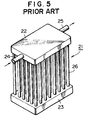
- Fig. 5 is a perspective view of a known heat exchanger.
- Fig. 6 is a vertical cross-sectional view of the heat exchanger depicted in Fig. 5.
- Fig. 7 is an enlarged, partial, vertical cross-sectional view of the heat exchanger depicted in Fig. 5.
- Fig. 8 is a partial vertical cross-sectional view of another conventional heat exchanger.
- Fig. 9 is a vertical cross-sectional view of the portion depicted in Fig. 8, showing a positioning of a tube.
- Heat exchanger 1 includes a pair of tanks 2 and 3. Inlet pipe 4 and outlet pipe 5 are connected to tank 2. A plurality of substantially parallel heat transfer tubes 6 (for example, refrigerant tubes) are fluidly connected between tanks 2 and 3. Heat transfer tubes 6 are arranged in columns and rows between tanks 2 and 3 of heat exchanger 1, as shown in Fig. 3. Each tube 6 has a central portion 6a and two end portions 6b having a maximum diameter less than the diameter of central portion 6a. The diameter of central portion 6a may be substantially uniform. A stepped portion 6e is formed between central portion 6a and each end portion 6b.
- Stepped portion 6e is substantially perpendicular to an axis through the diameter of both central portion 6a and a straight portion 6c.
- Central portion 6a and end portions 6b of each tube 6 each have circular cross-sections along the entire length of tube 6. End portions 6b are inserted into holes 2a and 3a defined on tanks 2 and 3, and fixed to the tanks by brazing.
- a partition 7 is provided in tank 2 at a central portion thereof. Holes 2a and 3a may have substantially equal diamaters.
- a heat medium for example, refrigerant, flows from inlet pipe 4 to outlet pipe 5 through the interior of tank 2, down heat transfer tubes 6, through the interior of tank 3, up heat transfer tubes 6, and through the interior of tank 2, as shown by arrows in Fig. 1. As the heat medium flows through tubes 6, heat is exchanged between the heat medium and the atmosphere or an air flow passing between tubes 6 via the walls of tubes 6.
- Fig. 2 depicts the structure of connection between end portion 6b of heat transfer tubes 6 and tank 2 or 3.
- End portions 6b have a base diameter which is a maximum diameter D less than a central diameter D1 of central portion 6a of each heat transfer tube 6.
- both end portions 6b of each heat transfer tube 6 comprises a straight portion 6c and a tapered portion 6d.
- Straight portion 6c extends straight out from the end of central portion 6a, that is, from stepped portion 6e, and has a diameter which is equal to the maximum diameter D.
- Tapered portion 6d extends from the end of straight portion 6c, i.e. , base 41 to tip 40 of tube 6 with a diameter gradually decreasing from the maximum diameter D at base 41 to a tip diameter D3 at tip 40.
- end portion 6b is inserted into hole 2a (3a) defined on tank 2 (3), and straight portion 6c is positioned in hole 2a (3a).
- Each tube 6 is fixed to tanks 2 and 3 by brazing mainly at the positions of both straight portions 6c.
- end portion 6b of each heat transfer tube 6 is inserted into hole 2a (3a) of tank 2 (3) via tip 40 of tapered portion 6d. Because minimum diameter D3 at tip 40 of tapered portion 6d is less than the hole diameter D2 of hole 2a (3a), the insertion of the tube may be made with ease.
- straight portion 6c is positioned in hole 2a (3a). Because straight portion 6c has a diameter equal to the maximum diameter D, even if stepped portion 6e does not abut tank 2 (3) due to a slight variation in the length of tube 6, gap A may still be maintained at a suitable width for brazing or otherwise connecting.
- the width of gap A is predetermined to a suitable value for brazing, for example, less than about 0.2 mm (0.008 in).
- a brazing material may be provided to adequately extend over the periphery of straight portion 6c and the inner edge of hole 2a (3a) in gap A.
- effective brazing may be maintained.
- insertion of end portions 6b is easy, and effective brazing between the tubes 6 and the holes 2a and 3a of tanks 2 and 3 may be achieved in the manufacturing process of the heat exchanger.
- effective brazing may be obtained even if slight variations in the y-axis position of end portions 6b occur. This provides further improvement and uniformity in the quality of the heat exchanger.
- Fig. 4 depicts a heat exchanger according to a second embodiment of the present invention.
- straight portion 16c and tapered portion 16d are formed only on one end portion 16b of each heat transfer tube 16.
- the other end portion 16f of each tube 16 is formed merely as a straight pipe.
- end portions 16f are inserted into holes 3a of tank 3.
- end portions 16b are inserted into holes 2a of tank 2.
- end portions 16f are inserted into holes 3a, the end portions are easily inserted even if the end portions are straight. Nevertheless, if end portions 16b are also straight, the insertion thereof into holes 2a is difficult as aforementioned in the explanation of the related art.
- each end portion 16b has straight portion 16c and tapered portion 16d
- an easy insertion of each tube 16 may be achieved by tapered portion 16d, and excellent brazing between tube 16 and tank 2 may be ensured by straight portion 16c.
- straight portion 16c and tapered portion 16d are formed only on one end portion 16b of each heat transfer tube 16, effective brazing and easy manufacture are still obtained.
Landscapes
- Engineering & Computer Science (AREA)
- Physics & Mathematics (AREA)
- Thermal Sciences (AREA)
- Mechanical Engineering (AREA)
- General Engineering & Computer Science (AREA)
- Details Of Heat-Exchange And Heat-Transfer (AREA)
- Heat-Exchange Devices With Radiators And Conduit Assemblies (AREA)
Description
- The present invention relates to a heat exchanger suitable for use in an air conditioning system for vehicles, and more particularly to improved end portions for heat transfer tubes in heat exchangers.
- Figs. 5-7 depict a conventional heat exchanger for use in an air conditioning system for vehicles. In Figs. 5 and 6, a
heat exchanger 21 comprises a pair oftanks Inlet pipe 24 andoutlet pipe 25 are connected totank 22. A plurality of heat transfer tubes 26 (for example, refrigerant tubes) are fluidly connected betweentanks tube 26 has a central portion 26a andend portions 26b having diameters which are smaller than the diameter of central portion 26a.End portions 26b are inserted intoholes 22a and 23a disposed intanks tanks partition 27 is provided intank 22 at a center portion thereof. A heat medium, for example, refrigerant, flows frominlet pipe 24 tooutlet pipe 25 through the interior oftank 22, downheat transfer tubes 26, through the interior oftank 23, upheat transfer tubes 26 and through the interior oftank 22, as shown by arrows in Fig. 6. - Fig. 7 depicts the structure of the connection between
end portion 26b of eachheat transfer tube 26 andtank End portion 26b extends straight through tank 22 (23) and has a substantially uniform diameter which is smaller than the diameter of central portion 26a.End portion 26b is inserted through hole 22a (23a) and fixed to tank 22 (23) by brazing, welding, gluing or the like between the periphery ofend portion 26b and the inner edge of hole 22a (23a). Gap A between the periphery ofend portion 26b and the inner edge of hole 22a (23a) generally has a relatively small width, for example, not more than about 0.2 mm (0.008 in), so that a sufficiently thick layer of brazing material may be extended to uniformly coverend portion 26b. Other connecting methods such as gluing or welding may also be used. In such a case, the width of gap A is also relatively small, for example, not more than about 0.2 mm (0.008 in). Specifically, if the width of gap A is greater than about 0.2 mm (0.008 in), it is difficult to provide a sufficient amount of brazing material in the gap to enable proper brazing to occur. - Providing
end portions 26b as straight portions, however, presents difficulties in the manufacturing of the heat exchanger. Because theend portions 26b are straight and have a diameter which is only slightly less than the diameter of the holes, it is not easy to insertend portions 26b intoholes 22a and 23a. Therefore, this type of heat transfer tube does not permit easy assembly of the heat exchanger. - To solve such problems, another structure for end portions of heat transfer tubes shown in Fig. 8 has been designed. In this structure, a
heat transfer tube 31 comprises a central portion 31a and end portions 31b. Each end portion 31b is tapered from central portion 31a, so that the diameter of end portion 31b gradually decreases from a maximum diameter at abase 32 to a minimum diameter at atip 33. The width of gap A betweenbase 32 and the inner edge of hole 22a (23a) of tank 22 (23) is equal not more than about 0.2 mm (0.008 in). In such a structure, because end portions 31b are tapered, they may be more easily inserted into holes 22a (23a). Therefore, this type of heat transfer tube permits easier assembly of the heat exchangers. - In manufacturing this type of heat exchanger, however, sometimes central portion 31a is not long enough to properly position end portion 31b for brazing, as shown in Fig. 9. This problem often occurs because of warping of
tube 31 or nonuniformity of the length oftubes 31 in the direction of the y-axis depicted in Figs. 6 and 9. When usingtubes 31, as shown in Fig. 9, the width of gap A is enlarged by the discrepancy in the incorrect position along the y-axis of the tube end portion 31b. This enlargement of the width of gap A makes effective brazing more difficult. If gap A increases to a width greater than about 0.2 mm, it is difficult to provide enough brazing material to extend around the periphery of end portion 31a. If the width of gap A is much wider than about 0.2 mm (0.008 in), effective brazing becomes impossible. In other words, a tapered end portion allows for only small variations in the positioning of end portion within the hole of the tank due to the length of the tubes. - If
straight end portions 26b are used, however, a wider variation in the length oftubes 26 may be allowed. Because the diameter ofstraight end portion 26b may be substantially uniform, the width of gap A is substantially constant as long asend portion 26b is disposed in hole 22a (23a). - It would be desirable to provide a heat exchanger including heat transfer tubes with a structure which is easy to assemble and permits a wide variation in the length of the tubes and thus position of the end portions along the y-axis for effective brazing of the tubes to the tanks.
- US-A-5046555 discloses a heat exchanger including a pair of spaced apart tanks each having a plurality of holes of uniform diameter, and a plurality of heat transfer tubes fluidly connecting the pair of tanks, each heat transfer tube comprising a central portion having a central diameter and a first end portion which fits in one hole of the holes comprising a first tapered portion, having a first base and a first tip and having a first tapering diameter which decreases from the first base diameter at the first base to a first tip diameter at the first tip; and according to a first aspect of the present invention, such a heat exchanger is characterised in that the first end portion further comprises a first straight portion between the central body portion and the tapered portion having a first base diameter less than the central diameter.
- US-A-5046555 discloses a method of assembling a heat exchanger comprising a pair of tanks spaced from each other and having a plurality of holes of uniform diameter disposed therein, the method comprising the steps of: providing a plurality of heat transfer tubes, each of the heat transfer tubes comprising a central portion having a central diameter, a first end portion comprising a first tapered portion, having a first base and a first tip and having a first tapering diameter which decreases from the first base diameter at the first base to a first tip diameter at the first tip and a second end portion; and according to a second aspect of the present invention, such a method is characterised in that the first end portion further comprises a first straight portion between the central portion and the first tapered portion and which has a first base diameter less than the central diameter; in that the second end portion has a second straight portion; and in that the method further comprises inserting the second end portions of the heat transfer tubes into respective holes in a first tank of the pair of tanks, positioning the straight portions of the second end portions in the respective holes of the first tank, inserting the first end portions of the heat transfer tubes into holes in a second tank of the pair of tanks, and positioning the straight portions of the first end portions in the holes of the second tank.
- In the heat exchanger according to the present invention, the tip of the end portion of each heat transfer tube is inserted into one of the holes of one of the tanks. Because the tip of the tapered portion has a diameter less than the diameter of the hole of the tank, the insertion may be performed with ease. After the tube is inserted, the straight portion of the end portion is positioned in the hole. Because the straight portion has a diameter which is the maximum diameter of the end portion, and because the maximum diameter is predetermined so that the width of the gap between the periphery of the straight portion and the inner edge of the hole is preferably a suitable distance for brazing therebetween, e.g., less than or equal to about 0.2 mm (0.008 in), even if the position of the end portion varies slightly in length, i.e., along the y-axis, the gap may still be maintained at a width suitable for brazing or otherwise connecting. Therefore, insertion of end portions of the heat transfer tubes is easily performed and a wider variation in the length of tubes is permitted while still providing suitable brazing width between the tubes and the holes of the tanks.
- In the accompanying drawings:
- Fig. 1 is a vertical cross-sectional view of a heat exchanger according to a first embodiment of the present invention.
- Fig. 2 is an enlarged, partial, vertical cross-sectional view of the heat exchanger depicted in Fig. 1.
- Fig. 3 is a perspective view of the heat exchanger depicted in Fig. 1.
- Fig. 4 is a vertical cross-sectional view of a heat exchanger according to a second embodiment of the present invention.
- Fig. 5 is a perspective view of a known heat exchanger.
- Fig. 6 is a vertical cross-sectional view of the heat exchanger depicted in Fig. 5.
- Fig. 7 is an enlarged, partial, vertical cross-sectional view of the heat exchanger depicted in Fig. 5.
- Fig. 8 is a partial vertical cross-sectional view of another conventional heat exchanger.
- Fig. 9 is a vertical cross-sectional view of the portion depicted in Fig. 8, showing a positioning of a tube.
- Referring to Figs. 1-3, a
heat exchanger 1 is provided according to a first embodiment of the present invention.Heat exchanger 1 includes a pair oftanks Inlet pipe 4 andoutlet pipe 5 are connected totank 2. A plurality of substantially parallel heat transfer tubes 6 (for example, refrigerant tubes) are fluidly connected betweentanks Heat transfer tubes 6 are arranged in columns and rows betweentanks heat exchanger 1, as shown in Fig. 3. Eachtube 6 has a central portion 6a and twoend portions 6b having a maximum diameter less than the diameter of central portion 6a. The diameter of central portion 6a may be substantially uniform. Astepped portion 6e is formed between central portion 6a and eachend portion 6b. Steppedportion 6e is substantially perpendicular to an axis through the diameter of both central portion 6a and a straight portion 6c. Central portion 6a andend portions 6b of eachtube 6 each have circular cross-sections along the entire length oftube 6.End portions 6b are inserted intoholes 2a and 3a defined ontanks partition 7 is provided intank 2 at a central portion thereof.Holes 2a and 3a may have substantially equal diamaters. A heat medium, for example, refrigerant, flows frominlet pipe 4 tooutlet pipe 5 through the interior oftank 2, downheat transfer tubes 6, through the interior oftank 3, upheat transfer tubes 6, and through the interior oftank 2, as shown by arrows in Fig. 1. As the heat medium flows throughtubes 6, heat is exchanged between the heat medium and the atmosphere or an air flow passing betweentubes 6 via the walls oftubes 6. - Fig. 2 depicts the structure of connection between
end portion 6b ofheat transfer tubes 6 andtank End portions 6b have a base diameter which is a maximum diameter D less than a central diameter D1 of central portion 6a of eachheat transfer tube 6. In the embodiment of Fig. 2, bothend portions 6b of eachheat transfer tube 6 comprises a straight portion 6c and a taperedportion 6d. Straight portion 6c extends straight out from the end of central portion 6a, that is, from steppedportion 6e, and has a diameter which is equal to the maximum diameter D.Tapered portion 6d extends from the end of straight portion 6c, i.e.,base 41 to tip 40 oftube 6 with a diameter gradually decreasing from the maximum diameter D atbase 41 to a tip diameter D3 at tip 40. - In Fig. 2,
end portion 6b is inserted into hole 2a (3a) defined on tank 2 (3), and straight portion 6c is positioned in hole 2a (3a). The maximum diameter D is predetermined, so that the width of gap A, Wg, between the periphery of straight portion 6c and the inner edge of hole 2a (3a), i.e., Wg = (D2-D) x 1/2, where D2 is the hole diameter of hole 2a (3a), is a value suitable for brazing or otherwise connecting therebetween, for example, less than or equal to about 0.2 mm (0.008 in). Eachtube 6 is fixed totanks - In the first embodiment,
end portion 6b of eachheat transfer tube 6 is inserted into hole 2a (3a) of tank 2 (3) via tip 40 of taperedportion 6d. Because minimum diameter D3 at tip 40 of taperedportion 6d is less than the hole diameter D2 of hole 2a (3a), the insertion of the tube may be made with ease. After the tube is inserted, straight portion 6c is positioned in hole 2a (3a). Because straight portion 6c has a diameter equal to the maximum diameter D, even if steppedportion 6e does not abut tank 2 (3) due to a slight variation in the length oftube 6, gap A may still be maintained at a suitable width for brazing or otherwise connecting. Because the width of gap A is predetermined to a suitable value for brazing, for example, less than about 0.2 mm (0.008 in), effective brazing occurs. Specifically a brazing material may be provided to adequately extend over the periphery of straight portion 6c and the inner edge of hole 2a (3a) in gap A. As a result, effective brazing may be maintained. Thus, in this heat exchanger, insertion ofend portions 6b is easy, and effective brazing between thetubes 6 and theholes 2a and 3a oftanks end portions 6b occur. This provides further improvement and uniformity in the quality of the heat exchanger. - Fig. 4 depicts a heat exchanger according to a second embodiment of the present invention. In this embodiment,
straight portion 16c and tapered portion 16d are formed only on oneend portion 16b of each heat transfer tube 16. Theother end portion 16f of each tube 16 is formed merely as a straight pipe. In the manufacturing of a heat exchanger 11,end portions 16f are inserted intoholes 3a oftank 3. Next,end portions 16b are inserted into holes 2a oftank 2. Whenend portions 16f are inserted intoholes 3a, the end portions are easily inserted even if the end portions are straight. Nevertheless, ifend portions 16b are also straight, the insertion thereof into holes 2a is difficult as aforementioned in the explanation of the related art. In this embodiment, because eachend portion 16b hasstraight portion 16c and tapered portion 16d, an easy insertion of each tube 16 may be achieved by tapered portion 16d, and excellent brazing between tube 16 andtank 2 may be ensured bystraight portion 16c. Thus, even ifstraight portion 16c and tapered portion 16d are formed only on oneend portion 16b of each heat transfer tube 16, effective brazing and easy manufacture are still obtained.
Claims (17)
- A heat exchanger including a pair of spaced apart tanks (2,3) each having a plurality of holes (2a,3a) of uniform diameter, and a plurality of heat transfer tubes (6,16) fluidly connecting the pair of tanks (2,3), each heat transfer tube (6,16) comprising a central portion (6a,16a) having a central diameter and a first end portion (6b,16b) which fits in one of the holes (2a,3a) and comprising a first tapered portion (6d,16d), having a first base (41) and a first tip (40) and having a first tapering diameter which decreases from the first base diameter at the first base (41) to a first tip diameter at the first tip (40); characterised in that the first end portion (6b,16b) further comprises a first straight portion (6c,16c) between the central body portion (6a,16a) and the tapered portion (6d,16d) having a first base diameter less than the central diameter.
- A heat exchanger according to claim 1, wherein the plurality of heat transfer tubes (6, 16) are arranged in columns and rows between the tanks of the heat exchanger.
- A heat exchanger according to claim 1 or claim 2, wherein each of the tubes (6) further comprises a stepped portion (6e) formed between the straight portion (6c) and the central portion (6a), the stepped portion (6e) being substantially perpendicular to the straight portion (6c) and the central portion (6a).
- A heat exchanger according to any one of preceding claims, wherein the heat exchanger further comprises a second end portion (6b) comprising a second straight portion (6c) having a second base diameter less than the central diameter and a second tapered portion (6d), the second tapered portion (6d) comprising a second base (41) and a second tip (40) and having a second tapering diameter which decreases from the second base diameter at the second base (41) to a second tip diameter at the second tip (40).
- A heat exchanger according to any one of claims 1 to 3, wherein the heat exchanger further comprises a second end portion having a second straight portion (16f) having a second base diameter less than the central diameter, and each of the straight portions (6c,16f) being positioned in one of the holes (3a) and brazed to the tank (3).
- A heat exchanger according to any of the preceding claims, wherein each of the end portions (6b,16b) of the heat transfer tubes (6,16) have circular cross-sections.
- A heat exchanger according to any one of the preceding claims, wherein each of the first end portions (6b) is connected to a first tank (2) of the pair of tanks (2, 3) and the second end portions (6b) are connected to a second tank (3) of the pair of tanks (2,3).
- A heat exchanger according to any of the preceding claims, wherein the end portions (6b,16b) of each heat transfer tube (6,16) are fixed to the tanks (2,3) by brazing.
- A heat exchanger according to any one of the preceding claims, wherein each of the heat transfer tubes (6,16) has a circular cross section.
- A heat exchanger according to any one of the preceding claims, wherein the straight portion (6c,16c) and an inner edge of a corresponding hole (2a,3a) define a gap (A) having a width less than or equal to about 0.2 mm (0.008 in).
- A heat exchanger according to any one of the preceding claims, wherein the heat transfer tubes (6,16) are substantially parallel.
- A method of assembling a heat exchanger comprising a pair of tanks (2,3) spaced from each other and having a plurality of holes (2a,3a) of uniform diameter disposed therein, the method comprising the steps of: providing a plurality of heat transfer tubes (6,16), each of the heat transfer tubes (6,16) comprising a central portion (6a,16a) having a central diameter, a first end portion (6b,16b) comprising a first tapered portion (6d,16d), having a first base (41) and a first tip (40) and having a first tapering diameter which decreases from the first base diameter at the first base (41) to a first tip diameter at the first tip (40) and a second end portion (6b); characterised in that the first end portion (6b,16b) further comprises a first straight portion (6c,16c) between the central portion (6a,16a) and the first tapered portion (6d,16d) and which has a first base diameter less than the central diameter; in that the second end portion (6b) has a second straight portion (6c,16f); and in that the method further comprises inserting the second end portions of the heat transfer tubes (6,16) into respective holes (3a) in a first tank (3) of the pair of tanks (2,3), positioning the straight portions (6c,16f) of the second end portions in the respective holes (3a) of the first tank (3), inserting the first end portions (6b, 16b) of the heat transfer tubes (6, 16) into holes (2a) in a second tank (2) of the pair of tanks (2, 3), and positioning the straight portions (6c, 16c) of the first end portions (6b, 16b) in the holes (2a) of the second tank (2).
- A method according to claim 12, wherein the second end portions (6b) of the plurality of heat transfer tubes (6) further comprise a second tapered portion (6d), the second tapered portion (6d) comprising a second base (41) and a second tip (40) and having a second tapering diameter which decreases from the second base diameter at the second base (41) to a second tip diameter at the second tip (40).
- A method according to claim 12 or claim 13, wherein a difference between the first and second base diameters and a hole diameter of an inner edge of each hole (2a,3a) is sufficiently small to permit effective brazing.
- A method according to claim 14, wherein the difference is less than about 0.2 mm (0.008 in).
- A method according to any of claims 12 to 15, further comprising the steps of: inserting a brazing material in a gap (A) formed between the straight portion (6c) of the heat transfer tubes (6) and an inner edge of the respective holes (2a,3a) of the tank (2,3); and brazing the heat transfer tubes (6) to the tank (2,3) using the brazing material in the gap (A).
- A method according to any one of claims 12 to 16, wherein each of the heat transfer tubes (6) has a circular cross-section.
Applications Claiming Priority (2)
| Application Number | Priority Date | Filing Date | Title |
|---|---|---|---|
| JP21876/93U | 1993-04-26 | ||
| JP021876U JPH0684188U (en) | 1993-04-26 | 1993-04-26 | Heat exchanger |
Publications (2)
| Publication Number | Publication Date |
|---|---|
| EP0622601A1 EP0622601A1 (en) | 1994-11-02 |
| EP0622601B1 true EP0622601B1 (en) | 1997-01-29 |
Family
ID=12067333
Family Applications (1)
| Application Number | Title | Priority Date | Filing Date |
|---|---|---|---|
| EP94302824A Expired - Lifetime EP0622601B1 (en) | 1993-04-26 | 1994-04-20 | Heat exchanger |
Country Status (5)
| Country | Link |
|---|---|
| US (1) | US5579834A (en) |
| EP (1) | EP0622601B1 (en) |
| JP (1) | JPH0684188U (en) |
| CN (1) | CN1100197A (en) |
| DE (1) | DE69401610T2 (en) |
Families Citing this family (22)
| Publication number | Priority date | Publication date | Assignee | Title |
|---|---|---|---|---|
| JP3530660B2 (en) * | 1995-12-14 | 2004-05-24 | サンデン株式会社 | Heat exchanger tank structure |
| FR2812718A1 (en) * | 2000-08-04 | 2002-02-08 | Ciat Sa | Refrigerator heat exchanger tube has thinned end sections for fitting into exchanger partition wall |
| IT1318751B1 (en) * | 2000-08-09 | 2003-09-10 | Kea S R L | HEATING DEVICE |
| DE60100617T2 (en) | 2000-10-06 | 2004-06-09 | Visteon Global Technologies, Inc., Dearborn | Manufacture of a tube for a heat exchanger |
| FR2817334B1 (en) * | 2000-11-27 | 2003-05-30 | Valeo Thermique Moteur Sa | BRAZED HEAT EXCHANGER, PARTICULARLY FOR A MOTOR VEHICLE, AND MANUFACTURING METHOD THEREOF |
| JP4109444B2 (en) * | 2001-11-09 | 2008-07-02 | Gac株式会社 | Heat exchanger and manufacturing method thereof |
| DE102004018317A1 (en) * | 2004-04-13 | 2005-11-03 | Behr Gmbh & Co. Kg | Heat exchanger for motor vehicles |
| US10352484B2 (en) * | 2004-08-05 | 2019-07-16 | Faurecia Emissions Control Technologies Germany Gmbh | Exhaust system |
| EP1707912A1 (en) * | 2005-04-01 | 2006-10-04 | Fiwihex B.V. | Heat exchanger and greenhouse |
| JP2006320910A (en) * | 2005-05-17 | 2006-11-30 | Sanden Corp | Tube for heat exchanger, and method for manufacturing the same |
| NL1029280C1 (en) * | 2005-06-17 | 2006-12-19 | Fiwihex B V | Housing with a cooling. |
| EP1780491B1 (en) * | 2005-10-25 | 2008-07-16 | Zehnder Verkaufs- und Verwaltungs AG | Radiator, in particular multi-column radiator |
| CA2635085A1 (en) | 2007-06-22 | 2008-12-22 | Johnson Controls Technology Company | Heat exchanger |
| DE102008026074B3 (en) * | 2008-05-30 | 2009-05-20 | Viessmann Werke Gmbh & Co Kg | Heat exchanger i.e. assembly unit, for boiler building, has flow openings exhibiting cross-section, which is dimensioned smaller than slotted hole-like cross-section of one connection channel, and flow gap provided between openings |
| WO2009148199A1 (en) * | 2008-06-03 | 2009-12-10 | Lg Electronics Inc. | Refrigerant system |
| DE102011076871A1 (en) | 2011-06-01 | 2012-12-06 | Trumpf Laser- Und Systemtechnik Gmbh | Heat exchanger for a gas laser and gas laser with it |
| JP6372332B2 (en) * | 2014-12-08 | 2018-08-15 | 株式会社デンソー | HEAT EXCHANGER AND HEAT EXCHANGER MANUFACTURING METHOD |
| US20170045309A1 (en) * | 2015-08-11 | 2017-02-16 | Hamilton Sundstrand Corporation | High temperature flow manifold |
| EP3760962B1 (en) * | 2019-07-05 | 2023-08-30 | UTC Aerospace Systems Wroclaw Sp. z o.o. | Heat exchanger |
| US20220325956A1 (en) * | 2019-10-08 | 2022-10-13 | Hangzhou Sanhua Research Institute Co., Ltd. | Heat exchanger |
| IT201900019181A1 (en) * | 2019-10-17 | 2021-04-17 | Danieli Off Mecc | DISTRIBUTOR TUBE FOR COOLING METALLIC TAPES |
| US20250067514A1 (en) * | 2023-08-22 | 2025-02-27 | Hamilton Sundstrand Corporation | Heat exchanger core geometries used as support material and fluid connectivity passages for heat exchanger headering |
Family Cites Families (22)
| Publication number | Priority date | Publication date | Assignee | Title |
|---|---|---|---|---|
| US1561212A (en) * | 1924-07-16 | 1925-11-10 | Dempsey C Britton | Radiator |
| FR646612A (en) * | 1927-12-31 | 1928-11-14 | economiser consisting of lower and upper trays connected and anchored by tubes | |
| US1911375A (en) * | 1930-03-14 | 1933-05-30 | Babcock & Wilcox Co | Fluid heater and method of operating the same |
| US2158792A (en) * | 1934-12-07 | 1939-05-16 | Gen Refrigeration Corp | Header feed evaporator |
| US2225760A (en) * | 1938-05-09 | 1940-12-24 | Superheater Co Ltd | Return bend clamp block |
| DE803998C (en) * | 1948-10-12 | 1951-04-16 | Leo Hoppe | Connection of the superheater pipes to the steam collecting box |
| FR1097396A (en) * | 1953-11-06 | 1955-07-05 | Warme Austausch Technik G M B | heat exchangers |
| DE1143525B (en) * | 1958-01-15 | 1963-02-14 | Superheater Co Ltd | Socket welded on between the collector or distributor of a heat exchanger and a pipe |
| US3265126A (en) * | 1963-11-14 | 1966-08-09 | Borg Warner | Heat exchanger |
| GB1256228A (en) * | 1968-04-03 | 1971-12-08 | Ass Eng Ltd | Improvements in or relating to heat exchangers |
| DE1807464A1 (en) * | 1968-11-07 | 1970-06-11 | Gerhard Esser | Manufacture of radiators |
| GB1414473A (en) * | 1972-02-10 | 1975-11-19 | Covrad Ltd | Heat exchangers |
| US3805745A (en) * | 1972-05-31 | 1974-04-23 | Raypak Inc | Boiler for use with gaseous fuel or oil |
| US4153305A (en) * | 1978-03-02 | 1979-05-08 | Abex Corporation | Railroad air brake systems |
| FR2459534A1 (en) * | 1979-06-14 | 1981-01-09 | Commissariat Energie Atomique | METHOD AND DEVICE FOR FIXING A GUIDE PIPE OF A NUCLEAR COMBUSTIBLE ASSEMBLY TO THE END PLATES OF SAID ASSEMBLY |
| JPS5956095A (en) * | 1982-09-24 | 1984-03-31 | Nippon Radiator Co Ltd | Jointing method of seat plate of synthetic resin to metallic tube in heat exchanger |
| EP0480914A3 (en) * | 1986-07-29 | 1992-05-13 | Showa Aluminum Kabushiki Kaisha | Condenser |
| US4860823A (en) * | 1988-03-02 | 1989-08-29 | Diesel Kiki Co., Ltd. | Laminated heat exchanger |
| JPH0717965Y2 (en) * | 1990-02-22 | 1995-04-26 | サンデン株式会社 | Heat exchanger |
| DE4012820A1 (en) * | 1990-04-21 | 1991-10-24 | Behr Gmbh & Co | HEAT EXCHANGER |
| US5046555A (en) * | 1990-09-06 | 1991-09-10 | General Motors Corporation | Extended surface tube-to-header connection for condenser |
| JPH04177094A (en) * | 1990-11-13 | 1992-06-24 | Sanden Corp | Laminated type heat exchanger |
-
1993
- 1993-04-26 JP JP021876U patent/JPH0684188U/en active Pending
-
1994
- 1994-04-20 DE DE69401610T patent/DE69401610T2/en not_active Expired - Fee Related
- 1994-04-20 EP EP94302824A patent/EP0622601B1/en not_active Expired - Lifetime
- 1994-04-26 CN CN94106947.8A patent/CN1100197A/en active Pending
-
1995
- 1995-08-28 US US08/520,275 patent/US5579834A/en not_active Expired - Fee Related
Also Published As
| Publication number | Publication date |
|---|---|
| EP0622601A1 (en) | 1994-11-02 |
| DE69401610T2 (en) | 1997-06-12 |
| JPH0684188U (en) | 1994-12-02 |
| CN1100197A (en) | 1995-03-15 |
| US5579834A (en) | 1996-12-03 |
| DE69401610D1 (en) | 1997-03-13 |
Similar Documents
| Publication | Publication Date | Title |
|---|---|---|
| EP0622601B1 (en) | Heat exchanger | |
| US5622220A (en) | Heat exchanger for automobile air conditioning system | |
| EP0703425B1 (en) | Laminated heat exchanger | |
| JP3146442B2 (en) | Tube for heat exchanger and method for producing the same | |
| US5842515A (en) | Heat exchanger and method of manufacturing header pipe for the same | |
| US5918667A (en) | Heat exchanger | |
| JPH07260391A (en) | Manifold for heat exchanger, manufacture of heat exchanger and heat exchanger | |
| JPH05172488A (en) | Partition plate assembling structure of header pipe for heat exchanger and assembling method therefor | |
| GB2285858A (en) | A two-piece header | |
| US5562153A (en) | Heat exchanger and method of making heat exchangers | |
| US20070266730A1 (en) | Refrigerant Distributor and Method for Manufacturing the Same | |
| EP0802386B1 (en) | Multi-tube heat exchanger | |
| JPH0666490A (en) | Heat exchanger and manufacture thereof | |
| EP1850076A2 (en) | Refrigerant condenser equipped with receiver | |
| EP0798530B1 (en) | Heat exchanger | |
| JPH1047888A (en) | Heat exchanger | |
| EP1167897B1 (en) | Capacitor | |
| WO2003085344A1 (en) | Heat exchanger assembly | |
| JPH08240395A (en) | Heat exchanger | |
| JPH04335996A (en) | Heat exchanger | |
| JPH0613957B2 (en) | Heat exchanger | |
| EP0683372A1 (en) | Heat exchanger and method of making heat exchangers | |
| JP2831578B2 (en) | Method of manufacturing heat exchanger with bracket | |
| KR20050011186A (en) | Coolant Distributor for Heat Exchanger and Method for manufacturing the same | |
| JP3632871B2 (en) | Manufacturing method of header tank |
Legal Events
| Date | Code | Title | Description |
|---|---|---|---|
| PUAI | Public reference made under article 153(3) epc to a published international application that has entered the european phase |
Free format text: ORIGINAL CODE: 0009012 |
|
| AK | Designated contracting states |
Kind code of ref document: A1 Designated state(s): DE FR GB IT SE |
|
| 17P | Request for examination filed |
Effective date: 19950412 |
|
| 17Q | First examination report despatched |
Effective date: 19951208 |
|
| GRAG | Despatch of communication of intention to grant |
Free format text: ORIGINAL CODE: EPIDOS AGRA |
|
| GRAH | Despatch of communication of intention to grant a patent |
Free format text: ORIGINAL CODE: EPIDOS IGRA |
|
| GRAH | Despatch of communication of intention to grant a patent |
Free format text: ORIGINAL CODE: EPIDOS IGRA |
|
| GRAA | (expected) grant |
Free format text: ORIGINAL CODE: 0009210 |
|
| AK | Designated contracting states |
Kind code of ref document: B1 Designated state(s): DE FR GB IT SE |
|
| ET | Fr: translation filed | ||
| REF | Corresponds to: |
Ref document number: 69401610 Country of ref document: DE Date of ref document: 19970313 |
|
| ITF | It: translation for a ep patent filed | ||
| PLBE | No opposition filed within time limit |
Free format text: ORIGINAL CODE: 0009261 |
|
| STAA | Information on the status of an ep patent application or granted ep patent |
Free format text: STATUS: NO OPPOSITION FILED WITHIN TIME LIMIT |
|
| 26N | No opposition filed | ||
| PGFP | Annual fee paid to national office [announced via postgrant information from national office to epo] |
Ref country code: SE Payment date: 20000406 Year of fee payment: 7 |
|
| PGFP | Annual fee paid to national office [announced via postgrant information from national office to epo] |
Ref country code: FR Payment date: 20000411 Year of fee payment: 7 |
|
| PGFP | Annual fee paid to national office [announced via postgrant information from national office to epo] |
Ref country code: DE Payment date: 20000417 Year of fee payment: 7 |
|
| PGFP | Annual fee paid to national office [announced via postgrant information from national office to epo] |
Ref country code: GB Payment date: 20000419 Year of fee payment: 7 |
|
| PG25 | Lapsed in a contracting state [announced via postgrant information from national office to epo] |
Ref country code: GB Free format text: LAPSE BECAUSE OF NON-PAYMENT OF DUE FEES Effective date: 20010420 |
|
| PG25 | Lapsed in a contracting state [announced via postgrant information from national office to epo] |
Ref country code: SE Free format text: LAPSE BECAUSE OF NON-PAYMENT OF DUE FEES Effective date: 20010421 |
|
| PG25 | Lapsed in a contracting state [announced via postgrant information from national office to epo] |
Ref country code: FR Free format text: THE PATENT HAS BEEN ANNULLED BY A DECISION OF A NATIONAL AUTHORITY Effective date: 20010430 |
|
| EUG | Se: european patent has lapsed |
Ref document number: 94302824.1 |
|
| GBPC | Gb: european patent ceased through non-payment of renewal fee |
Effective date: 20010420 |
|
| PG25 | Lapsed in a contracting state [announced via postgrant information from national office to epo] |
Ref country code: DE Free format text: LAPSE BECAUSE OF NON-PAYMENT OF DUE FEES Effective date: 20020201 |
|
| REG | Reference to a national code |
Ref country code: FR Ref legal event code: ST |
|
| PG25 | Lapsed in a contracting state [announced via postgrant information from national office to epo] |
Ref country code: IT Free format text: LAPSE BECAUSE OF NON-PAYMENT OF DUE FEES;WARNING: LAPSES OF ITALIAN PATENTS WITH EFFECTIVE DATE BEFORE 2007 MAY HAVE OCCURRED AT ANY TIME BEFORE 2007. THE CORRECT EFFECTIVE DATE MAY BE DIFFERENT FROM THE ONE RECORDED. Effective date: 20050420 |