EP0621239B1 - Klein-Wasseraufbereitungsanlage auf Ionenaustauscherbasis mit Möglichkeit zur Regeneration und thermischer Desinfektion - Google Patents
Klein-Wasseraufbereitungsanlage auf Ionenaustauscherbasis mit Möglichkeit zur Regeneration und thermischer Desinfektion Download PDFInfo
- Publication number
- EP0621239B1 EP0621239B1 EP94103087A EP94103087A EP0621239B1 EP 0621239 B1 EP0621239 B1 EP 0621239B1 EP 94103087 A EP94103087 A EP 94103087A EP 94103087 A EP94103087 A EP 94103087A EP 0621239 B1 EP0621239 B1 EP 0621239B1
- Authority
- EP
- European Patent Office
- Prior art keywords
- ion exchanger
- container
- water
- regeneration
- resin
- Prior art date
- Legal status (The legal status is an assumption and is not a legal conclusion. Google has not performed a legal analysis and makes no representation as to the accuracy of the status listed.)
- Revoked
Links
- XLYOFNOQVPJJNP-UHFFFAOYSA-N water Substances O XLYOFNOQVPJJNP-UHFFFAOYSA-N 0.000 title claims abstract description 123
- 230000008929 regeneration Effects 0.000 title claims abstract description 76
- 238000011069 regeneration method Methods 0.000 title claims abstract description 76
- 239000011347 resin Substances 0.000 claims abstract description 30
- 229920005989 resin Polymers 0.000 claims abstract description 30
- 238000004659 sterilization and disinfection Methods 0.000 claims abstract description 8
- 238000010411 cooking Methods 0.000 claims abstract description 7
- 229910052799 carbon Inorganic materials 0.000 claims abstract 2
- 239000000463 material Substances 0.000 claims description 39
- 239000003795 chemical substances by application Substances 0.000 claims description 23
- 238000000034 method Methods 0.000 claims description 22
- OKTJSMMVPCPJKN-UHFFFAOYSA-N Carbon Chemical compound [C] OKTJSMMVPCPJKN-UHFFFAOYSA-N 0.000 claims description 16
- 239000008399 tap water Substances 0.000 claims description 8
- 235000020679 tap water Nutrition 0.000 claims description 8
- 238000005406 washing Methods 0.000 claims description 8
- 238000004519 manufacturing process Methods 0.000 claims description 7
- 230000035622 drinking Effects 0.000 claims description 6
- 238000010438 heat treatment Methods 0.000 claims description 6
- 230000001172 regenerating effect Effects 0.000 claims description 6
- 241001122767 Theaceae Species 0.000 claims description 2
- 238000001914 filtration Methods 0.000 claims description 2
- 239000012530 fluid Substances 0.000 claims 9
- 239000008237 rinsing water Substances 0.000 claims 2
- 230000015572 biosynthetic process Effects 0.000 claims 1
- 239000008213 purified water Substances 0.000 claims 1
- 239000012492 regenerant Substances 0.000 abstract description 27
- 239000007788 liquid Substances 0.000 abstract description 15
- 230000005484 gravity Effects 0.000 abstract description 6
- 235000020188 drinking water Nutrition 0.000 abstract description 4
- 239000003651 drinking water Substances 0.000 abstract description 4
- 230000000813 microbial effect Effects 0.000 abstract 1
- 238000005342 ion exchange Methods 0.000 description 59
- 150000002500 ions Chemical class 0.000 description 45
- NWUYHJFMYQTDRP-UHFFFAOYSA-N 1,2-bis(ethenyl)benzene;1-ethenyl-2-ethylbenzene;styrene Chemical compound C=CC1=CC=CC=C1.CCC1=CC=CC=C1C=C.C=CC1=CC=CC=C1C=C NWUYHJFMYQTDRP-UHFFFAOYSA-N 0.000 description 33
- 239000003456 ion exchange resin Substances 0.000 description 26
- 229920003303 ion-exchange polymer Polymers 0.000 description 26
- FAPWRFPIFSIZLT-UHFFFAOYSA-M Sodium chloride Chemical compound [Na+].[Cl-] FAPWRFPIFSIZLT-UHFFFAOYSA-M 0.000 description 20
- 235000002639 sodium chloride Nutrition 0.000 description 16
- 239000011780 sodium chloride Substances 0.000 description 14
- 239000003729 cation exchange resin Substances 0.000 description 7
- KRKNYBCHXYNGOX-UHFFFAOYSA-N citric acid Chemical compound OC(=O)CC(O)(C(O)=O)CC(O)=O KRKNYBCHXYNGOX-UHFFFAOYSA-N 0.000 description 6
- 239000000047 product Substances 0.000 description 6
- 238000000746 purification Methods 0.000 description 6
- 239000003957 anion exchange resin Substances 0.000 description 5
- 150000001768 cations Chemical class 0.000 description 5
- 229910002651 NO3 Inorganic materials 0.000 description 4
- 238000009826 distribution Methods 0.000 description 4
- 150000003839 salts Chemical group 0.000 description 4
- 101100298225 Caenorhabditis elegans pot-2 gene Proteins 0.000 description 3
- NHNBFGGVMKEFGY-UHFFFAOYSA-N Nitrate Chemical group [O-][N+]([O-])=O NHNBFGGVMKEFGY-UHFFFAOYSA-N 0.000 description 3
- 238000005349 anion exchange Methods 0.000 description 3
- 150000001450 anions Chemical class 0.000 description 3
- 238000005341 cation exchange Methods 0.000 description 3
- 239000000356 contaminant Substances 0.000 description 3
- 238000003860 storage Methods 0.000 description 3
- OYPRJOBELJOOCE-UHFFFAOYSA-N Calcium Chemical compound [Ca] OYPRJOBELJOOCE-UHFFFAOYSA-N 0.000 description 2
- VEXZGXHMUGYJMC-UHFFFAOYSA-N Hydrochloric acid Chemical compound Cl VEXZGXHMUGYJMC-UHFFFAOYSA-N 0.000 description 2
- 241000589517 Pseudomonas aeruginosa Species 0.000 description 2
- QAOWNCQODCNURD-UHFFFAOYSA-N Sulfuric acid Chemical compound OS(O)(=O)=O QAOWNCQODCNURD-UHFFFAOYSA-N 0.000 description 2
- 230000002378 acidificating effect Effects 0.000 description 2
- 239000011575 calcium Substances 0.000 description 2
- 239000011734 sodium Substances 0.000 description 2
- ZAMOUSCENKQFHK-UHFFFAOYSA-N Chlorine atom Chemical compound [Cl] ZAMOUSCENKQFHK-UHFFFAOYSA-N 0.000 description 1
- DGAQECJNVWCQMB-PUAWFVPOSA-M Ilexoside XXIX Chemical compound C[C@@H]1CC[C@@]2(CC[C@@]3(C(=CC[C@H]4[C@]3(CC[C@@H]5[C@@]4(CC[C@@H](C5(C)C)OS(=O)(=O)[O-])C)C)[C@@H]2[C@]1(C)O)C)C(=O)O[C@H]6[C@@H]([C@H]([C@@H]([C@H](O6)CO)O)O)O.[Na+] DGAQECJNVWCQMB-PUAWFVPOSA-M 0.000 description 1
- FYYHWMGAXLPEAU-UHFFFAOYSA-N Magnesium Chemical group [Mg] FYYHWMGAXLPEAU-UHFFFAOYSA-N 0.000 description 1
- JLVVSXFLKOJNIY-UHFFFAOYSA-N Magnesium ion Chemical compound [Mg+2] JLVVSXFLKOJNIY-UHFFFAOYSA-N 0.000 description 1
- 229910052791 calcium Inorganic materials 0.000 description 1
- 229910001424 calcium ion Inorganic materials 0.000 description 1
- 239000000460 chlorine Substances 0.000 description 1
- 229910052801 chlorine Inorganic materials 0.000 description 1
- 239000000428 dust Substances 0.000 description 1
- 238000011049 filling Methods 0.000 description 1
- 230000002070 germicidal effect Effects 0.000 description 1
- 239000012535 impurity Substances 0.000 description 1
- 239000011777 magnesium Chemical group 0.000 description 1
- 229910052749 magnesium Chemical group 0.000 description 1
- 229910001425 magnesium ion Inorganic materials 0.000 description 1
- -1 nitrate ions Chemical class 0.000 description 1
- 231100000252 nontoxic Toxicity 0.000 description 1
- 230000003000 nontoxic effect Effects 0.000 description 1
- 238000002360 preparation method Methods 0.000 description 1
- 238000003825 pressing Methods 0.000 description 1
- 238000004064 recycling Methods 0.000 description 1
- 229910052708 sodium Inorganic materials 0.000 description 1
- 239000007787 solid Substances 0.000 description 1
- 239000013589 supplement Substances 0.000 description 1
Images



Classifications
-
- C—CHEMISTRY; METALLURGY
- C02—TREATMENT OF WATER, WASTE WATER, SEWAGE, OR SLUDGE
- C02F—TREATMENT OF WATER, WASTE WATER, SEWAGE, OR SLUDGE
- C02F1/00—Treatment of water, waste water, or sewage
- C02F1/42—Treatment of water, waste water, or sewage by ion-exchange
-
- B—PERFORMING OPERATIONS; TRANSPORTING
- B01—PHYSICAL OR CHEMICAL PROCESSES OR APPARATUS IN GENERAL
- B01J—CHEMICAL OR PHYSICAL PROCESSES, e.g. CATALYSIS OR COLLOID CHEMISTRY; THEIR RELEVANT APPARATUS
- B01J47/00—Ion-exchange processes in general; Apparatus therefor
- B01J47/012—Ion-exchange processes in general; Apparatus therefor using portable ion-exchange apparatus
-
- B—PERFORMING OPERATIONS; TRANSPORTING
- B01—PHYSICAL OR CHEMICAL PROCESSES OR APPARATUS IN GENERAL
- B01J—CHEMICAL OR PHYSICAL PROCESSES, e.g. CATALYSIS OR COLLOID CHEMISTRY; THEIR RELEVANT APPARATUS
- B01J49/00—Regeneration or reactivation of ion-exchangers; Apparatus therefor
- B01J49/75—Regeneration or reactivation of ion-exchangers; Apparatus therefor of water softeners
-
- C—CHEMISTRY; METALLURGY
- C02—TREATMENT OF WATER, WASTE WATER, SEWAGE, OR SLUDGE
- C02F—TREATMENT OF WATER, WASTE WATER, SEWAGE, OR SLUDGE
- C02F1/00—Treatment of water, waste water, or sewage
- C02F1/001—Processes for the treatment of water whereby the filtration technique is of importance
- C02F1/003—Processes for the treatment of water whereby the filtration technique is of importance using household-type filters for producing potable water, e.g. pitchers, bottles, faucet mounted devices
Definitions
- the invention relates to a small water treatment plant for the production of drinking and cooking water with at least one resin-filled ion exchange container that has a capacity has between 100 ml and 1000 ml and with each about 10 l to 100 l of product water with one filling regenerated resin can be produced, whereby the ion exchanger container is water-permeable at the top and bottom Sieve trays or in the upper and / or lower area of its Perforations provided on the side walls and a free one Has water inlet and outlet, and wherein the water inlet to the ion exchanger tank i.w. pressure free and designed like this is that there is a flow of water through the ion exchange container only comes about due to gravity.
- Such small water treatment plants are for example from DE 88 10 413.3 U1, DE 91 13 512.5 U1, DE 39 36 611 A1, EP 0 155 645 B1, DE 34 09 828 C2 or DE 91 05 220.3 U1 known.
- water-permeable sieve plates used in the ion exchanger while in the last three publications mentioned above and / or lower region of the side walls of the ion exchanger container intended perforations are disclosed.
- EP 0 324 634 A2 and DE 40 24 289 A1 describe water treatment devices of the type described in the introduction, especially for use in connection with a Tea or coffee brewing machines are suitable.
- a water treatment device and a in DE 40 35 563 A1 Method for treating water known in which the Water flow through the ion exchanger tank is not pressure-free, but is generated with water pipe pressure, whereby treating the ion exchanger with a regeneration liquid he follows.
- So-called water purifiers are used in the household to improve drinking water, in particular to remove calcium and magnesium ions or nitrate ions. Containing them as an effective component usually micro filter with ion exchange material to exchange the above-mentioned, unwanted ions for example, H + -, OH - -, Na + - or C1 - - ions.
- the ion exchange material is usually located in devices which have an inlet for the water to be treated and an outlet for the treated water at the opposite end of the device. Since the water flows through such water purification devices as a rule driven by gravity, the inlet is usually at the upper end of the device and the outlet at the lower end of the device.
- Inlet and outlet are usually as sieve trays or similar. executed, the zone exchange material in the device hold, but are permeable to water.
- the amount of ion exchange material contained in the device depending on the raw water quality or product water requirement for the production of approx. 10 - 100 l product water. Then the device with the exhausted Ion exchange material thrown away or to the manufacturer sent back for recycling of the ion exchange material will.
- the device For operation, i.e. for the production of such treated
- the device is placed in a storage vessel for the water treating water stuck or represents the bottom, so that this water to be treated by gravity the device flows and the treated water into one for it provided collecting vessel drips (see e.g. DE 34 09 828 C2, EP 0 155 645 B1, DE 88 10 413 U1, DE 39 36 611 A1, DE 91 05 220 U1).
- This overall arrangement represents the above called water purifier.
- Such water purification devices have three main ones Disadvantage.
- the water to be treated is allowed the small amount used for hygienic reasons Ion exchange material only very slowly through the device flow so that the water in the device is sufficient has a long dwell time and is treated well enough becomes. This results in a manufacturing speed for the treated water of only a few liters per hour.
- the exhausted device is incinerated or has to be laboriously collected through retail and be sent back to the manufacturer for regeneration.
- the third disadvantage is the hygiene mentioned above.
- the filter device should be a have a certain lifespan so that they can last e.g. can treat drinking and cooking water in the household and does not have to be constantly renewed.
- DIN 19636 must ion exchange systems for the domestic water area however, for hygienic reasons, regenerated every 4 days and thereby e.g. with electrolytic from the regeneration agent Chlorine produced in NaCl can be disinfected.
- the object of the present invention is therefore a small water treatment plant of the type shown above as well to introduce a procedure for their operation that complies with the above overcomes the disadvantages of the prior art, in particular a faster passage of the to be treated Water is allowed and can be regenerated with little effort is disinfectable.
- this object is achieved in that a Regeneration station with an inlet line for regenerant liquid to the upper part of the ion exchanger container and a drain line for spent regenerant the bottom part of the ion exchanger container and with a Hot water supply to the ion exchanger tank for hot Water between 50 ° C and 110 ° C, especially between 80 ° C and 110 ° C is provided, and that the regeneration station Device for heating the regeneration station to 50 ° to 110 ° C included.
- the regeneration option allows a larger amount of Ion exchange material can be used, so that a faster flow of the water to be treated possible is. Due to the hot water supply, there is always Possibility of thermal disinfection of the ion exchange material by heating it to prevent Germ growth.
- Small water treatment plant is the hot water supply identical to the supply line for regenerant liquid. As a result, the system can be made more compact overall will.
- the regeneration station preferably has a control device for the automatic supply of regenerant liquid and hot water in the ion exchanger tank so that the regeneration process is full or at least can be carried out semi-automatically.
- there are several stackable ion exchange containers are provided, so that the water treatment system even when different Types of ions (anions and cations) relative can be kept compact.
- the top ion exchanger container has a perforated lid have through which the water to be treated or Regenerating liquid in the ion exchanger tank can be initiated.
- the ion exchanger container of the system according to the invention can with anion exchange resin or with cation exchange resin be filled. If both anion exchange resin as well as cation exchange resin, these should Resins housed in two separate container units be.
- activated carbon in the ion exchanger container be filled with the organic impurities be removed from the water to be treated. Because activated carbon is not or only very difficult to regenerate it is easiest if after every regeneration of the ion exchange resin, the activated carbon is discarded and is replaced by fresh in the required amount.
- At least one ion exchanger container can advantageously be used symmetrical with regard to its top and bottom be built up and therefore both in direct current and in Counter current can be regenerated. Especially with countercurrent regeneration then becomes the ion exchange container simply by 180 ° from its operating position by a horizontal Axis rotated inserted in the regeneration station.
- a drain line in one embodiment in the regeneration station one below the lowest to be regenerated Ion exchange container arranged collection vessel be provided for used regenerant.
- This embodiment is mainly for the semi-automatic Operation provided in the fresh regenerant filled by hand and used regeneration agent from Hand is removed.
- the top ion exchange container can in the water treatment plant Inlet vessel may be arranged, which preferably for Protection against dirt can be covered with a lid.
- fresh regenerant liquid on the other hand, but also something to be treated Water to be poured.
- the Regeneration station a commercial household coffee machine, whose coffee filter holder by one to be regenerated Ion exchange container is replaced. This will make the purchase a separate regeneration station with possibility for hot water preparation or for heating the regenerant liquid saved. Also omitted by the alternative use of an existing coffee machine as a regeneration station the space required for another Device. In addition, the user with the operation of the household coffee machine already is familiar and not the proper handling of a other device must learn.
- the system according to the invention can be designed such that at least one ion exchange container at least approximately cylindrical container wall and two vertically spaced Has sieve trays, between which ion exchange resin is arranged that the ion exchanger container has at its top a distributor floor, and that water to be treated through the upper sieve tray into the ion exchange resin flow and this through the bottom Sieve bottom can leave again, being on a container bottom hits, radially inward and there in an outer Inner tube up to one of an inner inner tube formed overflow edge, which flows above the lower Sieve plate and below the upper sieve plate, preferably above the lowest third of the axial extension of the Ion exchange resin is arranged from where the water flow down through the inner inner tube and the ion exchange container through a bottom opening in treated Can leave state.
- the outer shape of the resin container used as a miniature filter is usually at least approximately cylindrical and specially adapted to the water purification device.
- this resin container is the purchase of a special device - the water purification device - required.
- the system according to the invention on surprising easily avoided in that the outer shape of the Resin container of the inner shape of a standard coffee filter bag holder corresponds, and that with ion exchange resin filled containers instead of a coffee filter bag in the standard coffee filter bag holder of a coffee machine or in a standard coffee filter bag holder for coffee filtering can be used by hand.
- This can the normal coffee pot as a collecting vessel for the treated Drinking water or coffee water as well as for the used regenerant be used.
- a particular advantage in connection with the embodiment mentioned above, in which the regeneration station contains a commercially available household coffee machine, is the fact that, due to the external shape of the ion exchanger container, it can be used in any commercially available coffee machine, since the ion exchanger shape corresponds to the standardized coffee filter bag holders.
- different sizes of ion exchanger container types are generally required for the different sizes of the standard coffee filter bag holders.
- smaller types of ion exchangers can also be used in larger coffee filter bag holder sizes.
- the resin container is closed at the top and that too treating water or the regenerant solution only can get into the resin container via a dip tube and there above the also closed container bottom is redirected back up.
- Between the upper sieve plate and the ion exchanger container top wall collects the treated Water or the used regenerant and leaves the ion exchange container over the in this area perforated outer wall.
- a method of operation also falls within the scope of the invention a small water treatment plant of the above Type in which when the ion exchange resin is regenerated in at least one regeneration step Liquid with a temperature between 50 ° C and 110 ° C, preferably between 80 ° C and 100 ° C by the ion exchange resin is directed to a thermal disinfection of the To achieve ion exchange material.
- hot regenerant solution through the ion exchange resin headed is in a rinsing step hot water for washing out residues of regenerant passed through the ion exchange resin.
- hot water for washing out residues of regenerant passed through the ion exchange resin is particularly preferred.
- the hot regenerant solution or the hot rinse water outside the regeneration station for example on a stove, in one Prepares tea kettle and then in from above poured the ion exchange container or containers.
- a preferred method variant using a household coffee machine that regenerating agents measured and placed in a coffee pot, the coffee pot then up to a predetermined Mark is filled with tap water, which is Regenerating agent to form a regenerating agent solution at least largely dissolves and this regenerant solution filled into a reservoir of the coffee machine and after pressing a switch on the coffee machine heated and in the upper inlet of the ion exchange container to be regenerated is transported, the used Regenerating the ion exchange container at its lower Leaves again and caught in the coffee pot which is after completion of the regeneration solution emptied by the ion exchange material, rinsed and is filled with tap water, which in turn is filled into the reservoir of the coffee machine and in a second pass as hot wash water frees the ion exchanger container from regenerant residues and continues to heat up or that through regeneration reached high temperature in the ion exchange material maintains for a longer period of time.
- the Regenerant measured and as a solid in the feed area of the ion exchanger container deposited where it starts the regeneration of the inflowing water and passed as a dilute regenerant solution through the resin bed becomes.
- the advantage of this variant is that the regeneration station with the exception of the collecting vessel comes into contact with the regenerant.
- the regeneration of the ion exchange resin take place automatically in the regeneration station.
- the different types of ion exchange resin contain, for example, either cation exchange resin or anion exchange resin, separately and independently regenerates.
- the regeneration of the ion exchange resin can be special simply done in direct current. Alternatively, the regeneration of the ion exchange resin but also in countercurrent take place if the symmetrical structure described above Ion exchanger tank type is used.
- NaCl is particularly recommended, preferably Table salt, for the regeneration of cation exchange resin and / or anion exchange resin, as common salt in present in every household and chemically completely harmless is.
- a particularly preferred exemplary embodiment is based on a standard coffee machine as regeneration station 1, whose Coffee filter holder by e.g. cylindrical, with ion exchange material filled ion exchanger container 4 was replaced.
- the regenerant e.g. NaCl, especially preferably table salt
- the regenerant is measured (e.g. a certain one Number of teaspoons, particularly preferably with the help of a Measuring cup) and placed in a coffee pot 2. Then the Coffee pot up to a specified mark with tap water filled, with the table salt largely dissolves. The resulting solution (incl. Possibly undissolved salt residues) is placed in a storage container 3 the coffee machine filled.
- the coffee machine is switched on with a switch 5 and the one heated and transported by the coffee machine Regeneration solution flows through the ion exchange device.
- the ion exchange material is regenerated and the used regenerant solution collects in the coffee pot 2, which is in its intended position. After all of the regenerant has passed through the ion exchange container 4 has flowed through, it will Regenerate collected in the coffee pot is discarded, the pot rinsed with tap water and up to the maximum mark filled. This water is again in the reservoir 3 of the machine and for washing, i.e. for washing out of salt residues from the ion exchange material and used to further heat it up.
- the outlet temperature the after-wash water from the ion exchanger tank 4 is about 70 ° C. This ensures that even the test germ Pseudomonas aeruginosa according to the DIN 19636 is killed.
- the ion exchanger container 4 can with both anion exchange material and with cation exchange material be filled.
- Fig. 2 shows a particularly preferred embodiment for the drinking water treatment with a water purification device 6, whose ion exchanger container 4a and 4b with that as a regeneration station used coffee machine 1 according to example 1 were regenerated.
- a lid 7 protects the one located in a storage vessel 8 Raw water from dust or other contaminants.
- This Water flows through the cation exchange material one after the other filled ion exchanger container 4b and with Anion exchange material filled ion exchange container 4a, the order is arbitrary, and accumulates then in the coffee pot 2.
- the water treated in this way can now can be used for drinking and cooking purposes.
- the cation exchanger tank 4b calcium and magnesium exchange
- use of the anion exchanger container 4a (nitrate exchange) required. If necessary, however, both devices can be combined with each other.
- Example 1 with approx. 22 g NaCl (3 weakly heaped Teaspoon) an ion exchange device with about 0.5 liters Ion exchange material (cation exchanger) regenerated.
- Ion exchanger container regenerated in this way (4b) can be removed from approx. 35 l water in each case approx. 20 ° dH will.
- the amount of product water is dimensioned so that the Device must be regenerated 1 to 2 times a week, in Based on the forced regeneration required by DIN 19636 every 4 days.
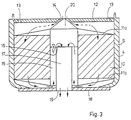
- FIG. 3 shows a particularly preferred embodiment of the Ion exchanger container 4 with a cylindrical container wall 9 and ion exchange material 10, which of two Sieve trays 11a and 11b is held.
- the inflow of the to be treated Water flows from above through a distributor floor 12 with openings 13 and 14 and a distributor cone 20th
- the water flows through the upper sieve tray 11a into the ion exchange material 10 and leaves this via the lower one Sieve tray 11b.
- the treated water flows vertically down and leaves the closed with a container bottom 18 Ion exchange container 4 through an opening 19.
- the particular advantage of this embodiment is in that the cavities of the ion exchange material always are filled with water at least in one area that the replenisher distribution over the tank cross-section evenly and that the entire volume of resin through the even flow distribution during regeneration and After washing is heated to the target temperature.
- Fig. 4 shows a preferred embodiment of an ion exchange container 101 with a standard coffee filter bag holder 102 matched container outer wall 103 and ion exchange material 104, which of two sieve trays 105 and 106 is held.
- the water to be treated is fed in from above via a distributor floor 107 with openings 108.
- the water flows through the upper sieve plate 106 into the Ion exchange material 104 and leaves via the lower Siebêt 105.
- it is in an outer inner tube 109 directed up to an upper edge 110 of an inner one Inner tube 111, which forms an overflow edge.
- the treated inner water 111 flows vertically down and leaves the closed with a container bottom 112 Ion exchange container 101 through an opening 113. It thus enters the coffee filter bag holder 102 and leaves it via an outlet 114.
- the particular advantage of this embodiment is that that the cavities of the ion exchange material always at least are filled with water in a section that the Regeneration agent distribution over the tank cross-section takes place evenly, and that the entire volume of resin through the even flow distribution during regeneration and After washing is heated to the target temperature.
- FIG. 5 shows a particularly preferred embodiment of the Ion exchanger container 101 with the coffee filter bag holder 102 matched container outer wall 103 and ion exchange material 104, which of two sieve trays 105 and 106 is held.
- the resin container 101 is closed from above and the water to be treated or the replenisher solution flows into the resin tank via a dip tube 115 inside and is above a likewise closed container bottom 116 redirected back up.
- First The liquid then flows through the ion exchange resin bed carrying sieve tray 105, the ion exchange resin bed 104 and the upper sieve tray 106.
- a particularly advantageous embodiment results if the openings 118 in the outer wall 103 of the in FIG shown ion exchanger container 101 executed so be that the sieve bottom 106 can be omitted because the openings 118 through fine gaps, slits, sieves or other Perforations are formed, which are the function of the sieve plate Perceive 106, d. H. so let liquids through well, however, the ion exchange resin is reliable in Retain container 101.
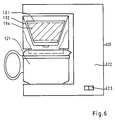
- a preferred embodiment is based on a standard coffee machine (Fig. 6) as a regeneration station 120, in whose coffee filter bag holder 102 is on the inner shape adapted ion exchange containers filled with ion exchange material 101 was used.
- the regenerant e.g. NaCl, particularly preferably table salt
- the regenerant is measured (e.g. a certain number of teaspoons, particularly preferred with the help of a measuring cup) and into a coffee pot 121 given.
- the coffee pot is up to a predetermined one Mark filled with tap water, taking the table salt largely dissolves.
- the resulting solution (including any undissolved salt residues) is put into one Reservoir 122 of the coffee machine filled.
- the coffee machine is switched on with a switch 123 and the one heated and transported by the coffee machine Regeneration solution flows through the ion exchange device.
- the ion exchange material is regenerated and the used regenerant solution collects in the coffee pot 121, which is in its intended position.
- Regenerate collected in the coffee pot is discarded rinsed with tap water and up to the maximum mark filled. This water is again in the reservoir 122 of the machine filled and for washing, d. H. for washing out of salt residues from the ion exchange material and used to further heat it up.
- the outlet temperature of the post-wash water from the ion exchanger tank 101 is approx. 70 ° C. This ensures that even the test germ Pseudomonas aeruginosa is killed in accordance with DIN 19636.
- the ion exchange container 101 can be used with both anion exchange material and also be filled with cation exchange material.
- Example 8 with approx. 22 g NaCl (3 weakly heaped Teaspoon) an ion exchange device with about 0.5 liters Ion exchange material (cation exchanger) regenerated (Device suitable for coffee filter bag holder size 4). With the ion exchanger container 101 regenerated in this way can be removed from approx. 35 liters of water each approx. 20 ° dH will. The amount of product water is dimensioned so that the Device to be regenerated once or twice a week must, based on the forced regeneration required by DIN 19636 every 4 days.
- a strongly acidic ion exchange resin is advantageous
- Cation exchange resin used that regenerates with common salt is used and used for softening.
- An ion exchange resin is particularly advantageous weakly acidic cation exchange resin used, which is preferred is regenerated with citric acid and for softening is used, with no sodium in the product water is delivered.
- an ion exchange resin strongly basic anion exchange resin used which is regenerated with common salt and to reduce the nitrate concentration is used.
- a nitrate-specific ion exchange resin is used for this.
- the ion exchange resin is particularly advantageous a proportion of activated carbon to remove organic contaminants supplements, which are also thermally disinfected and at the same time is regenerated thermally.
Landscapes
- Chemical & Material Sciences (AREA)
- Organic Chemistry (AREA)
- Life Sciences & Earth Sciences (AREA)
- Hydrology & Water Resources (AREA)
- Engineering & Computer Science (AREA)
- Environmental & Geological Engineering (AREA)
- Water Supply & Treatment (AREA)
- Chemical Kinetics & Catalysis (AREA)
- Treatment Of Water By Ion Exchange (AREA)
Description
- Fig. 1
- eine schematische Seitenansicht der erfindungsgemäßen Anlage mit Regenerierstation;
- Fig. 2
- eine schematische Seitenansicht einer erfindungsgemäßen Anlage mit mehreren aufeinander gestapelten Ionenaustauschergefäßen; und
- Fig. 3
- einen Vertikalschnitt durch eine besondere Ausführungsform eines erfindungsgemäßen Ionenaustauscherbehälters.
- Fig. 4
- das Ausführungsbeispiel 5 eines erfindungsgemäßen Ionenaustauscherbehälters eingesetzt in einen Standard-Kaffeefiltertütenhalter;
- Fig. 5
- das Ausführungsbeispiel 6 eines erfindungsgemäßen Ionenaustauscherbehälters eingesetzt in einen Standard-Kaffeefiltertütenhalter;
- Fig. 6
- eine schematische Seitenansicht einer Haushaltskaffeemaschine als Regenerierstation mit dem erfindungsgemäßen Ionenaustauscherbehälter eingesetzt in den Kaffeefiltertütenhalter der Kaffeemaschine.
Claims (22)
- Klein-Wasseraufbereitungsanlage zur Herstellung von Trink- und Kochwasser mit mindestens einem harzgefüllten Ionenaustauscherbehälter, der ein Fassungsvermögen zwischen 100 ml und 1000 ml aufweist und mit dem jeweils ca. 10 l bis 100 l Produktwasser mit einer Füllung regenerierten Harzes hergestellt werden können, wobei der Ionenaustauscherbehälter oben und unten wasserdurchlässige Siebböden oder im oberen und/oder unteren Bereich seiner Seitenwände vorgesehene Perforationen sowie einen freien Wasser-Zu- und Ablauf aufweist, und wobei der Wasserzulauf zum Ionenaustauscherbehälter i.w. druckfrei und so gestaltet ist, daß eine Wasserströmung durch den Ionenaustauscherbehälter nur aufgrund der Schwerkraft zustande kommt,
dadurch gekennzeichnet,
daß eine Regenerierstation (1; 120) mit einer Zulaufleitung für Regeneriermittelflüssigkeit zum Oberteil des Ionenaustauscherbehälters (4, 4a, 4b; 101) und eine Ablaufleitung für verbrauchtes Regeneriermittel aus dem Bodenteil des Ionenaustauscherbehälters (4, 4a, 4b; 101) sowie mit einer Heißwasserzuführung zum Ionenaustauscherbehälter (4, 4a, 4b; 101) für heißes Wasser zwischen 50°C und 110°C, insbesondere zwischen 80°C und 110°C vorgesehen ist, und daß die Regenerierstation (1; 120) eine Einrichtung zum Erhitzen der Regeneriermittelflüssigkeit auf 50°C bis 110°C enthält. - Anlage nach Anspruch 1, dadurch gekennzeichnet, daß die Heißwasserzuführung mit der Zulaufleitung für Regeneriermittelflüssigkeit identisch ist.
- Anlage nach einem der vorhergehenden Ansprüche, dadurch gekennzeichnet, daß mehrere übereinander stapelbare Ionenaustauscherbehälter (4a, 4b) vorgesehen sind.
- Anlage nach einem der vorhergehenden Ansprüche, dadurch gekennzeichnet, daß in der Regenerierstation (1; 120) anstelle einer Ablaufleitung ein unterhalb des zu regenerierenden Ionenaustauscherbehälters (4a; 101) angeordnetes Sammelgefäß (2; 121) für verbrauchtes Regeneriermittel vorgesehen ist.
- Anlage nach einem der vorhergehenden Ansprüche, dadurch gekennzeichnet, daß über den obersten Ionenaustauscherbehälter (4b; 101) in der Wasseraufbereitungsanlage ein Einlaufgefäß (8) angeordnet ist, welches vorzugsweise mit einem Deckel (7) abdeckbar ist.
- Anlage nach einem der vorhergehenden Ansprüche, dadurch gekennzeichnet, daß die Regenerierstation (1; 120) eine handelsübliche Haushaltskaffeemaschine enthält, deren Kaffeefilterhalter durch einen zu regenerierenden Ionenaustauscherbehälter (4) ersetzt ist.
- Anlage nach einem der vorhergehenden Ansprüche, dadurch gekennzeichnet, daß die äußere Form des Behälters (101) der inneren Form eines Standard-Kaffeefiltertütenhalters (102) entspricht, und daß der mit Ionenaustauscherharz (104) befüllte Behälter (101) anstelle einer Kaffeefiltertüte in den Standard-Kaffeefiltertütenhalter (102) einer Kaffeemaschine oder in einen Standard-Kaffeefiltertütenhalter (102) für eine Kaffeefilterung von Hand eingesetzt werden kann.
- Anlage nach Anspruch 7, dadurch gekennzeichnet, daß im Ionenaustauschbehälter (101) eine Behälterwand (103) und zwei Siebböden (105, 106) vorgesehen sind, von denen das Ionenaustauscherharz (104) gehalten werden kann, daß ein Verteilerboden (107) mit Öffnungen (108) vorgesehen ist, über den der Zulauf des zu behandelnden Wassers von oben erfolgen kann, daß ein äußeres Innenrohr (109) vorgesehen ist, in dem die behandelte Flüssigkeit nach oben geleitet werden kann bis zu einer Oberkante (110) eines inneren Innenrohres (111), welche eine Überlaufkante bildet, wobei die Flüssigkeit in diesem Innenrohr nach unten strömen kann, und daß ein Behälterauslaß (113) in einem Behälterboden (112), der den Ionenaustauscherbehälter verschließt, vorgesehen ist, über den die Flüssigkeit den Behälter wieder verlassen kann.
- Anlage nach Anspruch 7, dadurch gekennzeichnet, daß der Ionenaustauscherbehälter (101) von oben verschlossen ist, daß ein Tauchrohr (115) vorgesehen ist, über das das zu behandelnde Wasser bzw. die Regeneriermittellösung in den Ionenaustauscherbehälter (101) hineinströmen kann, daß ein ebenfalls verschlossener Behälterboden (116) vorgesehen ist, oberhalb dessen die Flüssigkeit wieder nach oben umgeleitet werden kann, daß zwei Siebböden (105, 106) vorgesehen sind, zwischen denen Ionenaustauscherharz (104) gehalten ist, durch welches das Fluid hindurchströmen und sich oberhalb des oberen Siebbodens (106) bzw. unterhalb einer Ionenaustauscherbehälteroberwand (118) sammeln und den Ionenaustauscherbehälter (101) über eine in diesem Bereich mit Öffnungen (118) versehene Außenwand (103) wieder verlassen kann, woraufhin es zwischen dieser Außenwand des Ionenaustauscherbehälters und dem Standard-Kaffeefiltertütenhalter (102) schwerkraftbedingt nach unten zu dessen Auslauf (114) strömen kann.
- Anlage nach Anspruch 9, dadurch gekennzeichnet, daß die Öffnungen (118) in der Außenwand unterhalb der Ionenaustauscherbehälteroberwand (117) so gestaltet sind, daß sie den Siebboden (106) ersetzen.
- Anlage nach einem der vorhergehenden Ansprüche, dadurch gekennzeichnet, daß zusätzlich zum Ionenaustauscherharz (10; 104) noch Aktivkohle in den Ionenaustauscherbehälter (4; 4a, 4b; 101) eingefüllt ist.
- Verfahren zum Betrieb einer Klein-Wasseraufbereitungsanlage nach einem der vorhergehenden Ansprüche, dadurch gekennzeichnet, daß beim Regenerieren des Ionenaustauscherharzes (10; 104) bei mindestens einem Regenerationsschritt heiße Flüssigkeit mit einer Temperatur zwischen 50°C und 110°C, vorzugsweise zwischen 80°C und 110°C, durch das Ionenaustauscherharz (10; 104) geleitet wird.
- Verfahren nach Anspruch 12, dadurch gekennzeichnet, daß heiße Regeneriermittellösung durch das Ionenaustauscherharz (10; 104) geleitet wird.
- Verfahren nach Anspruch 12 oder 13, dadurch gekennzeichnet, daß heißes Wasser in einem Spülschritt zum Auswaschen von Regeneriermittelresten durch das Ionenaustauscherharz (10; 104) geleitet wird.
- Verfahren nach einem der Ansprüche 12 bis 14, dadurch gekennzeichnet, daß die heiße Regeneriermittellösung bzw. das heiße Nachspülwasser außerhalb der Regenerierstation, beispielsweise auf einem Herd in einem Teewasserkessel bereitet und anschließend von oben in den oder die Ionenaustauscherbehälter (4, 4a, 4b; 101) gegossen wird.
- Verfahren nach einem der Ansprüche 12 bis 14 unter Verwendung einer Haushaltskaffeemaschine nach Anspruch 7, dadurch gekennzeichnet, daß Regeneriermittel abgemessen und in eine Kaffeekanne (2; 121) gegeben wird, die Kaffeekanne (2; 121) daran anschließend in einer vorgegebenen Volumenmenge oder bis zu einer vorgegebenen Markierung mit Leitungswasser gefüllt wird, wobei sich das Regeneriermittel unter Bildung einer Regeneriermittellösung zumindest weitgehend auflöst und diese Regeneriermittellösung in einen Vorratsbehälter (3; 122) der Kaffeemaschine eingefüllt wird und nach Betätigen eines Schalters (5; 123) der Kaffeemaschine erhitzt und in den oberen Zulauf des zu regenerierenden Ionenaustauscherbehälters (4; 101) transportiert wird, das verbrauchte Regeneriermittel den Ionenaustauscherbehälter an seinem unteren Ende wieder verläßt und in der Kaffeekanne aufgefangen wird, welche nach beendetem Durchlauf der Regeneriermittellösung durch das Ionenaustauschermaterial entleert, ausgespült und mit Leitungswasser befüllt wird, welches wiederum in den Vorratsbehälter (3; 122) der Kaffeemaschine eingefüllt wird und in einem zweiten Durchlauf als heißes Nachwaschwasser den Ionenaustauscherbehälter (4; 101) von Regeneriermittelresten befreit und weiter aufheizt bzw. die durch die Regeneration erreichte hohe Temperatur im Ionenaustauschermaterial über einen längeren Zeitraum aufrecht erhält.
- Verfahren nach Anspruch 12, dadurch gekennzeichnet, daß der Ionenaustauscherbehälter (101) zur Herstellung von gereinigtem Wasser in einen Kaffeefiltertütenhalter (102) eingesetzt wird.
- Verfahren nach Anspruch 12, dadurch gekennzeichnet, daß der Ionenaustauscherbehälter (101) zur Regeneration in einen Kaffeefiltertütenhalter (102) eingesetzt wird.
- Verfahren nach Anspruch 12, dadurch gekennzeichnet, daß der Ionenaustauscherbehälter (101) zur Regeneration und thermischen Desinfektion in einen Kaffeefiltertütenhalter (102) eingesetzt wird.
- Verfahren nach Anspruch 19, dadurch gekennzeichnet, daß die Regeneration und Desinfektion in einer Haushaltskaffeemaschine durchgeführt wird.
- Verfahren nach Anspruch 19 oder 12 zum Betrieb einer Anlage nach Anspruch 11, dadurch gekennzeichnet, daß die Aktivkohle ebenfalls thermisch desinfiziert wird.
- Verfahren nach Anspruch 21, dadurch gekennzeichnet, daß die Aktivkohle vor jeder Regeneration verworfen und nach der Regeneration durch frische Aktivkohle ersetzt wird.
Priority Applications (1)
| Application Number | Priority Date | Filing Date | Title |
|---|---|---|---|
| DE9422125U DE9422125U1 (de) | 1993-04-17 | 1994-03-02 | Klein-Wasseraufbereitungsanlage auf Ionenaustauscherbasis mit Möglichkeit zur Regeneration und thermischer Desinfektion |
Applications Claiming Priority (4)
| Application Number | Priority Date | Filing Date | Title |
|---|---|---|---|
| DE4312580A DE4312580C1 (de) | 1993-04-17 | 1993-04-17 | Klein-Wasseraufbereitungsanlage auf Ionenaustauscherbasis mit Möglichkeit zur Regeneration und thermischer Desinfektion |
| DE4312580 | 1993-04-17 | ||
| DE4343615 | 1993-12-21 | ||
| DE4343615A DE4343615C2 (de) | 1993-12-21 | 1993-12-21 | Klein-Wasseraufbereitungsanlage auf Ionenaustauscherbasis zum Einsetzen in einem Standard-Kaffeefiltertütenhalter |
Publications (3)
| Publication Number | Publication Date |
|---|---|
| EP0621239A2 EP0621239A2 (de) | 1994-10-26 |
| EP0621239A3 EP0621239A3 (de) | 1995-02-01 |
| EP0621239B1 true EP0621239B1 (de) | 1998-05-27 |
Family
ID=25925019
Family Applications (1)
| Application Number | Title | Priority Date | Filing Date |
|---|---|---|---|
| EP94103087A Revoked EP0621239B1 (de) | 1993-04-17 | 1994-03-02 | Klein-Wasseraufbereitungsanlage auf Ionenaustauscherbasis mit Möglichkeit zur Regeneration und thermischer Desinfektion |
Country Status (3)
| Country | Link |
|---|---|
| EP (1) | EP0621239B1 (de) |
| AT (1) | ATE166634T1 (de) |
| DE (1) | DE59406070D1 (de) |
Families Citing this family (6)
| Publication number | Priority date | Publication date | Assignee | Title |
|---|---|---|---|---|
| AT406826B (de) * | 1998-07-08 | 2000-09-25 | Leiter Klaus Dr | Vorrichtung zum desinfizieren einer wasserbehandlungseinheit |
| JP2003511220A (ja) * | 1999-10-05 | 2003-03-25 | コーニンクレッカ フィリップス エレクトロニクス エヌ ヴィ | イオン交換カートリッジの再生装置 |
| DE10010739A1 (de) * | 2000-03-04 | 2001-09-06 | Karl Spiegl Gmbh | Ionentauscheranlage |
| WO2002042220A1 (de) * | 2000-11-23 | 2002-05-30 | Watercryst Chemiefreie Wasserbehandlung Gmbh | Einrichtung zur behandlung von trinkwasser |
| CN112557145A (zh) * | 2020-12-28 | 2021-03-26 | 江苏苏青水处理工程集团有限公司 | 一种水处理离子交换树脂分离度测试系统及测试方法 |
| CN115025824B (zh) * | 2022-05-24 | 2024-04-30 | 中国纺织科学研究院有限公司 | 离子交换器 |
Family Cites Families (4)
| Publication number | Priority date | Publication date | Assignee | Title |
|---|---|---|---|---|
| NL68653C (de) * | 1900-01-01 | |||
| US3204770A (en) * | 1961-06-21 | 1965-09-07 | Robert V Brink | Portable water softener |
| DE3522966C1 (de) * | 1985-06-27 | 1990-04-19 | Erich 5412 Ransbach-Baumbach Alhäuser | Filterpatrone zur Verbesserung der Qualität von Trinkwasser |
| JPS6392351A (ja) * | 1986-10-07 | 1988-04-22 | 株式会社荏原総合研究所 | 活性炭の殺菌方法 |
-
1994
- 1994-03-02 AT AT94103087T patent/ATE166634T1/de not_active IP Right Cessation
- 1994-03-02 DE DE59406070T patent/DE59406070D1/de not_active Revoked
- 1994-03-02 EP EP94103087A patent/EP0621239B1/de not_active Revoked
Also Published As
| Publication number | Publication date |
|---|---|
| EP0621239A3 (de) | 1995-02-01 |
| ATE166634T1 (de) | 1998-06-15 |
| EP0621239A2 (de) | 1994-10-26 |
| DE59406070D1 (de) | 1998-07-02 |
Similar Documents
| Publication | Publication Date | Title |
|---|---|---|
| EP0888247B1 (de) | Wasseraufbereitungsgerät mit trinkwasserfilter, regeneriervorrichtung und verfahren zum aufbereiten von trinkwasser | |
| EP0401535B1 (de) | Vorrichtung zur Wasserbehandlung | |
| EP0050813B1 (de) | Gegenstrom-Adsorptionsfilter zur Behandlung von Flüssigkeiten und Verfahren zum Betreiben des Filters | |
| DE102006058223A1 (de) | Verfahren und Vorrichtung zur Anreicherung von Wasser mit Magnesium-Ionen | |
| DE69737090T2 (de) | Methode und vorrichtung zur minimierung des anfallenden abwassers | |
| DE3840276A1 (de) | Einrichtung zur behandlung von trinkwasser | |
| DE546115C (de) | Verfahren zur Durchfuehrung von Basenaustauschreaktionen mittels zeolithartiger Stoffe, insbesondere zur Enthaertung von Wasser | |
| DE2110687A1 (de) | Verfahren und Geraet zur Zubereitung von Getraenken | |
| CH672602A5 (de) | ||
| DE4312580C1 (de) | Klein-Wasseraufbereitungsanlage auf Ionenaustauscherbasis mit Möglichkeit zur Regeneration und thermischer Desinfektion | |
| EP0621239A2 (de) | Klein-Wasseraufbereitungsanlage auf Ionenaustauscherbasis mit Möglichkeit zur Regeneration und thermischer Desinfektion | |
| DE68902237T2 (de) | Geraet zum aufbruehen von tee, kaffee mit wasserreinigungsgeraet. | |
| DE102021103911B4 (de) | Verfahren und Steuereinrichtung zur Steuerung einer Wasserbehandlungsanlage sowie Wasserbehandlungsanlage mit einer Steuereinrichtung | |
| DE3033964C2 (de) | Elektrisch beheiztes Dampfbügeleisen | |
| DE4438265C1 (de) | Vorrichtung zur Filterung von kleinen Mengen Wasser sowie Enthärtungseinrichtung | |
| DE1642449A1 (de) | Verfahren und Vorrichtung zur Regenerierung von Ionenaustauschmaterial aus erschoepften Entmineralisierungsgeraeten | |
| EP4137462A1 (de) | Verfahren zum enthärten von trinkwasser, schwimm- und badebeckenwasser und/oder prozesswasser | |
| DE4343615C2 (de) | Klein-Wasseraufbereitungsanlage auf Ionenaustauscherbasis zum Einsetzen in einem Standard-Kaffeefiltertütenhalter | |
| DE9422125U1 (de) | Klein-Wasseraufbereitungsanlage auf Ionenaustauscherbasis mit Möglichkeit zur Regeneration und thermischer Desinfektion | |
| DE19615102A1 (de) | Wasserreinigungsvorrichtung | |
| DE102012105443B4 (de) | Strömungsleitungssystem für Fluide und Getränkeautomat mit einem derartigen Strömungsleitungssystem | |
| DE19650191C1 (de) | Verfahren zur Wasserreinigung sowie Vorrichtung zur Durchführung des Verfahrens | |
| DE102016115229B4 (de) | Getränkeautomat und Verfahren zur Pflege eines Getränkeautomaten | |
| DE1517874A1 (de) | Vorrichtung zum Stabilisieren und Behandeln von Fluessigkeiten,wie Getraenken,z.B. Bier,Wein,Fruchtsaefte u.dgl.,mit Hilfe von regenerierbaren,wasserunloeslichen,pulverfoermigen oder koernigen Behandlungsmitteln,wie Adsorptionsstoffen,Ionenaustauschern,z.B. Nylon,Perlon,Polyvinylpyrrolidon | |
| CH569504A5 (en) | Drinking water filter with tap attachment - comprises housing with internal vessel contg. mixed granulate |
Legal Events
| Date | Code | Title | Description |
|---|---|---|---|
| PUAI | Public reference made under article 153(3) epc to a published international application that has entered the european phase |
Free format text: ORIGINAL CODE: 0009012 |
|
| AK | Designated contracting states |
Kind code of ref document: A2 Designated state(s): AT BE CH DE ES FR GB IT LI LU NL |
|
| PUAL | Search report despatched |
Free format text: ORIGINAL CODE: 0009013 |
|
| AK | Designated contracting states |
Kind code of ref document: A3 Designated state(s): AT BE CH DE ES FR GB IT LI LU NL |
|
| 17P | Request for examination filed |
Effective date: 19950328 |
|
| 17Q | First examination report despatched |
Effective date: 19970227 |
|
| GRAG | Despatch of communication of intention to grant |
Free format text: ORIGINAL CODE: EPIDOS AGRA |
|
| GRAG | Despatch of communication of intention to grant |
Free format text: ORIGINAL CODE: EPIDOS AGRA |
|
| GRAH | Despatch of communication of intention to grant a patent |
Free format text: ORIGINAL CODE: EPIDOS IGRA |
|
| GRAH | Despatch of communication of intention to grant a patent |
Free format text: ORIGINAL CODE: EPIDOS IGRA |
|
| GRAA | (expected) grant |
Free format text: ORIGINAL CODE: 0009210 |
|
| AK | Designated contracting states |
Kind code of ref document: B1 Designated state(s): AT BE CH DE ES FR GB IT LI LU NL |
|
| PG25 | Lapsed in a contracting state [announced via postgrant information from national office to epo] |
Ref country code: NL Free format text: LAPSE BECAUSE OF FAILURE TO SUBMIT A TRANSLATION OF THE DESCRIPTION OR TO PAY THE FEE WITHIN THE PRESCRIBED TIME-LIMIT Effective date: 19980527 |
|
| REF | Corresponds to: |
Ref document number: 166634 Country of ref document: AT Date of ref document: 19980615 Kind code of ref document: T |
|
| REG | Reference to a national code |
Ref country code: CH Ref legal event code: NV Representative=s name: ISLER & PEDRAZZINI AG Ref country code: CH Ref legal event code: EP |
|
| GBT | Gb: translation of ep patent filed (gb section 77(6)(a)/1977) |
Effective date: 19980528 |
|
| ITF | It: translation for a ep patent filed | ||
| REF | Corresponds to: |
Ref document number: 59406070 Country of ref document: DE Date of ref document: 19980702 |
|
| PG25 | Lapsed in a contracting state [announced via postgrant information from national office to epo] |
Ref country code: ES Free format text: LAPSE BECAUSE OF FAILURE TO SUBMIT A TRANSLATION OF THE DESCRIPTION OR TO PAY THE FEE WITHIN THE PRESCRIBED TIME-LIMIT Effective date: 19980828 |
|
| ET | Fr: translation filed | ||
| NLV1 | Nl: lapsed or annulled due to failure to fulfill the requirements of art. 29p and 29m of the patents act | ||
| PGFP | Annual fee paid to national office [announced via postgrant information from national office to epo] |
Ref country code: GB Payment date: 19990224 Year of fee payment: 6 |
|
| PLBQ | Unpublished change to opponent data |
Free format text: ORIGINAL CODE: EPIDOS OPPO |
|
| PLBI | Opposition filed |
Free format text: ORIGINAL CODE: 0009260 |
|
| PG25 | Lapsed in a contracting state [announced via postgrant information from national office to epo] |
Ref country code: LU Free format text: LAPSE BECAUSE OF NON-PAYMENT OF DUE FEES Effective date: 19990302 |
|
| PGFP | Annual fee paid to national office [announced via postgrant information from national office to epo] |
Ref country code: CH Payment date: 19990302 Year of fee payment: 6 |
|
| PGFP | Annual fee paid to national office [announced via postgrant information from national office to epo] |
Ref country code: FR Payment date: 19990319 Year of fee payment: 6 |
|
| PLBF | Reply of patent proprietor to notice(s) of opposition |
Free format text: ORIGINAL CODE: EPIDOS OBSO |
|
| PGFP | Annual fee paid to national office [announced via postgrant information from national office to epo] |
Ref country code: BE Payment date: 19990323 Year of fee payment: 6 |
|
| PGFP | Annual fee paid to national office [announced via postgrant information from national office to epo] |
Ref country code: DE Payment date: 19990327 Year of fee payment: 6 |
|
| PGFP | Annual fee paid to national office [announced via postgrant information from national office to epo] |
Ref country code: AT Payment date: 19990331 Year of fee payment: 6 |
|
| 26 | Opposition filed |
Opponent name: BWT WASSERTECHNIK GMBH Effective date: 19990223 |
|
| PLBF | Reply of patent proprietor to notice(s) of opposition |
Free format text: ORIGINAL CODE: EPIDOS OBSO |
|
| RDAH | Patent revoked |
Free format text: ORIGINAL CODE: EPIDOS REVO |
|
| RDAG | Patent revoked |
Free format text: ORIGINAL CODE: 0009271 |
|
| STAA | Information on the status of an ep patent application or granted ep patent |
Free format text: STATUS: PATENT REVOKED |
|
| REG | Reference to a national code |
Ref country code: CH Ref legal event code: PL |
|
| 27W | Patent revoked |
Effective date: 19991108 |
|
| GBPR | Gb: patent revoked under art. 102 of the ep convention designating the uk as contracting state |
Free format text: 991108 |