EP0620436A1 - Dispositif destiné à détecter des traces de produits polluant dans un milieu aqueux - Google Patents
Dispositif destiné à détecter des traces de produits polluant dans un milieu aqueux Download PDFInfo
- Publication number
- EP0620436A1 EP0620436A1 EP94400640A EP94400640A EP0620436A1 EP 0620436 A1 EP0620436 A1 EP 0620436A1 EP 94400640 A EP94400640 A EP 94400640A EP 94400640 A EP94400640 A EP 94400640A EP 0620436 A1 EP0620436 A1 EP 0620436A1
- Authority
- EP
- European Patent Office
- Prior art keywords
- sensitive element
- contactors
- aqueous medium
- traces
- polluting
- Prior art date
- Legal status (The legal status is an assumption and is not a legal conclusion. Google has not performed a legal analysis and makes no representation as to the accuracy of the status listed.)
- Granted
Links
- 239000012736 aqueous medium Substances 0.000 title claims abstract description 11
- 239000003344 environmental pollutant Substances 0.000 title abstract description 4
- 231100000719 pollutant Toxicity 0.000 title abstract description 4
- 229930195733 hydrocarbon Natural products 0.000 claims abstract description 18
- 150000002430 hydrocarbons Chemical class 0.000 claims abstract description 18
- 230000006835 compression Effects 0.000 claims abstract description 9
- 238000007906 compression Methods 0.000 claims abstract description 9
- 230000015556 catabolic process Effects 0.000 claims abstract description 7
- 238000006731 degradation reaction Methods 0.000 claims abstract description 6
- 239000004215 Carbon black (E152) Substances 0.000 claims abstract description 5
- 238000007373 indentation Methods 0.000 claims description 5
- 229920003048 styrene butadiene rubber Polymers 0.000 claims description 4
- 229920002725 thermoplastic elastomer Polymers 0.000 claims description 3
- 238000012544 monitoring process Methods 0.000 abstract description 4
- YXFVVABEGXRONW-UHFFFAOYSA-N Toluene Chemical compound CC1=CC=CC=C1 YXFVVABEGXRONW-UHFFFAOYSA-N 0.000 description 9
- 239000000463 material Substances 0.000 description 9
- XLYOFNOQVPJJNP-UHFFFAOYSA-N water Substances O XLYOFNOQVPJJNP-UHFFFAOYSA-N 0.000 description 9
- 238000001514 detection method Methods 0.000 description 8
- 230000001960 triggered effect Effects 0.000 description 5
- 239000012528 membrane Substances 0.000 description 4
- 230000035945 sensitivity Effects 0.000 description 4
- 239000003795 chemical substances by application Substances 0.000 description 3
- KAKZBPTYRLMSJV-UHFFFAOYSA-N Butadiene Chemical compound C=CC=C KAKZBPTYRLMSJV-UHFFFAOYSA-N 0.000 description 2
- 238000004519 manufacturing process Methods 0.000 description 2
- 229920006395 saturated elastomer Polymers 0.000 description 2
- 239000010409 thin film Substances 0.000 description 2
- 239000002174 Styrene-butadiene Substances 0.000 description 1
- 230000002745 absorbent Effects 0.000 description 1
- 239000002250 absorbent Substances 0.000 description 1
- 239000002253 acid Substances 0.000 description 1
- 150000007513 acids Chemical class 0.000 description 1
- 230000003213 activating effect Effects 0.000 description 1
- 238000007792 addition Methods 0.000 description 1
- 239000000853 adhesive Substances 0.000 description 1
- 230000001070 adhesive effect Effects 0.000 description 1
- 239000003963 antioxidant agent Substances 0.000 description 1
- 239000008346 aqueous phase Substances 0.000 description 1
- 229920001400 block copolymer Polymers 0.000 description 1
- MTAZNLWOLGHBHU-UHFFFAOYSA-N butadiene-styrene rubber Chemical compound C=CC=C.C=CC1=CC=CC=C1 MTAZNLWOLGHBHU-UHFFFAOYSA-N 0.000 description 1
- 238000006243 chemical reaction Methods 0.000 description 1
- 239000011248 coating agent Substances 0.000 description 1
- 238000000576 coating method Methods 0.000 description 1
- 239000000470 constituent Substances 0.000 description 1
- 238000007796 conventional method Methods 0.000 description 1
- 230000006866 deterioration Effects 0.000 description 1
- 230000002542 deteriorative effect Effects 0.000 description 1
- 238000010586 diagram Methods 0.000 description 1
- 239000006185 dispersion Substances 0.000 description 1
- 238000005868 electrolysis reaction Methods 0.000 description 1
- 150000002148 esters Chemical class 0.000 description 1
- 150000002170 ethers Chemical class 0.000 description 1
- 230000008020 evaporation Effects 0.000 description 1
- 238000001704 evaporation Methods 0.000 description 1
- 239000003673 groundwater Substances 0.000 description 1
- 239000011810 insulating material Substances 0.000 description 1
- 238000012986 modification Methods 0.000 description 1
- 230000004048 modification Effects 0.000 description 1
- 230000003472 neutralizing effect Effects 0.000 description 1
- 239000003305 oil spill Substances 0.000 description 1
- 150000002989 phenols Chemical class 0.000 description 1
- 229920000642 polymer Polymers 0.000 description 1
- 229920006254 polymer film Polymers 0.000 description 1
- 230000001105 regulatory effect Effects 0.000 description 1
- 239000002904 solvent Substances 0.000 description 1
- 239000003381 stabilizer Substances 0.000 description 1
- 229920006132 styrene block copolymer Polymers 0.000 description 1
- 239000011115 styrene butadiene Substances 0.000 description 1
- 230000000007 visual effect Effects 0.000 description 1
- 239000003643 water by type Substances 0.000 description 1
Images
Classifications
-
- G—PHYSICS
- G01—MEASURING; TESTING
- G01M—TESTING STATIC OR DYNAMIC BALANCE OF MACHINES OR STRUCTURES; TESTING OF STRUCTURES OR APPARATUS, NOT OTHERWISE PROVIDED FOR
- G01M3/00—Investigating fluid-tightness of structures
- G01M3/02—Investigating fluid-tightness of structures by using fluid or vacuum
- G01M3/04—Investigating fluid-tightness of structures by using fluid or vacuum by detecting the presence of fluid at the leakage point
- G01M3/042—Investigating fluid-tightness of structures by using fluid or vacuum by detecting the presence of fluid at the leakage point by using materials which expand, contract, disintegrate, or decompose in contact with a fluid
- G01M3/045—Investigating fluid-tightness of structures by using fluid or vacuum by detecting the presence of fluid at the leakage point by using materials which expand, contract, disintegrate, or decompose in contact with a fluid with electrical detection means
-
- G—PHYSICS
- G01—MEASURING; TESTING
- G01N—INVESTIGATING OR ANALYSING MATERIALS BY DETERMINING THEIR CHEMICAL OR PHYSICAL PROPERTIES
- G01N33/00—Investigating or analysing materials by specific methods not covered by groups G01N1/00 - G01N31/00
- G01N33/18—Water
- G01N33/1826—Organic contamination in water
- G01N33/1833—Oil in water
-
- Y—GENERAL TAGGING OF NEW TECHNOLOGICAL DEVELOPMENTS; GENERAL TAGGING OF CROSS-SECTIONAL TECHNOLOGIES SPANNING OVER SEVERAL SECTIONS OF THE IPC; TECHNICAL SUBJECTS COVERED BY FORMER USPC CROSS-REFERENCE ART COLLECTIONS [XRACs] AND DIGESTS
- Y02—TECHNOLOGIES OR APPLICATIONS FOR MITIGATION OR ADAPTATION AGAINST CLIMATE CHANGE
- Y02A—TECHNOLOGIES FOR ADAPTATION TO CLIMATE CHANGE
- Y02A20/00—Water conservation; Efficient water supply; Efficient water use
- Y02A20/20—Controlling water pollution; Waste water treatment
Definitions
- the present invention relates to the field of preventing pollution of an aqueous medium.
- the present invention relates to the detection of certain polluting organic products, in particular hydrocarbons, present in an aqueous medium.
- detection systems comprising at least one element sensitive to the polluting product and which deteriorates or, more generally, whose mechanical properties vary, in contact with the polluting product.
- the well-known operating principle of such detection systems consists in making the sensitive element cooperate with means capable of activating an alarm when the sensitive element is damaged by the polluting product.
- an audible, visual alarm or any other reaction means can be activated following the degradation of the sensitive element.
- the degradation of the sensitive element can for example trigger the dispersion of an absorbent or neutralizing product vis-à-vis the pollutant.
- the sensitive element can be a thin strip maintained in traction and the rupture of which, as a result of its deterioration by hydrocarbons, triggers an alert system.
- the present invention provides a hydrocarbon detector present in an aqueous medium, the sensitivity of which is clearly improved with respect to the prior art, and which therefore makes it possible to detect traces of dissolved hydrocarbons. in an aqueous medium.
- Another advantage of the invention lies in the simplicity of the device.
- An additional advantage of the invention lies in the small amount of material used in the constitution of the sensitive element.
- the present invention can be used to detect pollution of groundwater.
- Another possible use of the invention relates to the permanent monitoring of river, port, coastal, urban, industrial or rainwater marine waters against pollution by traces of hydrocarbons.
- the invention can be used for the detection of oxygenated hydrocarbons such as phenols, acids, ethers, esters ...
- the subject of the present invention is a device intended for detecting traces of polluting products present in an aqueous medium, comprising an electrical circuit containing at least one sensitive element reacting by degradation to the presence of hydrocarbons, electrical means cooperating with said sensitive element and means for monitoring the state of the circuit.
- said electrical means consist of at least two contactors maintaining said sensitive element in compression.
- the sensitive element has a thickness of between 0.05 mm and 0.60 mm at the level of the compression zone.
- the sensitive element consists of a thermoplastic elastomer which is not chemically crosslinked.
- the sensitive element consists of a multi-block styrene-butadiene copolymer.
- the device according to the invention may include a safety element interrupting the passage of electric current (in the electrical circuit) in the event that the device is no longer submerged.
- At least one of the contactors cooperating with the sensitive element has an indentation at the level of the sensitive element.
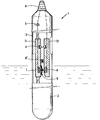
- This figure shows schematically, by way of example a device 1 for detecting traces of hydrocarbons floating on the surface of the water.
- This device can be maintained in vertical position by a ballast 2.
- An enclosure 3 contains an electrical circuit essentially comprising in series two contactors 4, an autonomous power supply 5 and a means of monitoring the state of the circuit in the form of an audible alarm. and / or bright.
- An additional safety element (not shown) can be provided in order to avoid possible electric arcs in the event that the contactors no longer immerse in water.
- this means 7 resembles a clamp comprising two arms 71, 72 whose ends are compressed by means of a spiral spring 8. These arms are made of an insulating material and they each comprise at least one housing for a contactor 4 and passages for electrical wires connecting each contactor to the other components of the electrical circuit.
- Each contactor 4 preferably has an indentation or protruding area of rounded or cylindrical shape in order to increase the pressure on the material, the load then being punctual and not distributed.
- Any means capable of regulating the compressive force exerted on the sensitive element can advantageously be provided.
- the establishment of the sensitive element 9 is carried out by any conventional technique either of laying a thin film, or of coating obtained after evaporation of the solvent initially present in a polymer in solution.
- the sensitive element 9 preferably consists of a non-crosslinked thermoplastic elastomer such as, for example, a styrene-butadiene multi-block copolymer.
- the sensitive element degrades, in a manner known per se, in the presence of hydrocarbons.
- this degradation is favored by the fact that the sensitive element 9 is kept in compression between the two contactors 4.
- the sensitive element 9 When the device according to the invention is placed in unpolluted water, the sensitive element 9 does not degrade and contact is therefore not established, the alarm 6 is not activated.
- the sensitive material 9 When the device according to the invention is placed in water containing a hydrocarbon, the sensitive material 9 gradually flows. Creep is accelerated by the fact that the sensitive element 9 is compressed; the material thus tends to lose its hardness as it absorbs hydrocarbons.
- alarm 6 can be triggered.
- the response time that is to say the time after which the alarm is triggered, varies according to the concentration of hydrocarbons in the aqueous medium, the temperature of the aqueous medium, the nature of the sensitive material and its thickness: the examples below show the influence of these parameters.
- the materials and shapes of the various constituents of the device according to the invention will be chosen so as to eliminate any phenomenon of electrolysis which may result from the passage of current between the contactors 4 within the aqueous phase.
- the power source is a 4.5V battery.
- the detection signal is a light signal.
- the apparatus is immersed in pure water.
- Example 1 is repeated by replacing the 0.60 mm thick membrane with a 0.12 mm thick membrane.
- Example 1 is repeated by immersing this time the system according to the invention in water saturated with toluene, that is to say containing about 0.05 g of toluene per 100 g of water.
- the time after which alarm 6 is triggered is 24 to 48 hours.
- Example 2 is repeated by immersing the system according to the invention in water saturated with toluene as defined in example 3.
- the response time is 10 to 17 hours.
- Example 4 is repeated by replacing the 0.12 mm thick membrane with a 0.08 mm thick membrane.
- the response time is 4 to 5 hours.
- Example 5 is repeated, the aqueous medium being maintained at 50 ° C.
Landscapes
- Physics & Mathematics (AREA)
- General Physics & Mathematics (AREA)
- Health & Medical Sciences (AREA)
- Life Sciences & Earth Sciences (AREA)
- Chemical & Material Sciences (AREA)
- Engineering & Computer Science (AREA)
- Food Science & Technology (AREA)
- Medicinal Chemistry (AREA)
- Analytical Chemistry (AREA)
- Biochemistry (AREA)
- General Health & Medical Sciences (AREA)
- Immunology (AREA)
- Pathology (AREA)
- Investigating Or Analyzing Materials By The Use Of Electric Means (AREA)
- Investigating Or Analyzing Materials By The Use Of Fluid Adsorption Or Reactions (AREA)
Abstract
Description
- La présente invention concerne le domaine de la prévention de la pollution d'un milieu aqueux.
- Plus particulièrement, la présente invention concerne la détection de certains produits organiques polluants, notamment les hydrocarbures, présents dans un milieu aqueux.
- Dans ce domaine, on connaît des systèmes de détection comportant au moins un élément sensible au produit polluant et qui se détériore ou, plus généralement, dont les propriétés mécaniques varient, au contact du produit polluant.
- Le principe de fonctionnement, bien connu, de tels systèmes de détection consiste à faire coopérer l'élément sensible avec des moyens capables d'actionner une alarme lorsque l'élément sensible est détérioré par le produit polluant.
- Selon les applications envisagées une alarme sonore, visuelle ou tout autre moyen de réaction peut être actionné suite à la dégradation de l'élément sensible.
- La dégradation de l'élément sensible peut par exemple déclencher la dispersion d'un produit absorbant ou neutralisant vis-à-vis du polluant.
- On a déjà proposé des dispositifs de détection automatiques sensibles à certains produits polluants, notamment les hydrocarbures, comportant deux morceaux d'une bande ou d'un fil assemblés par une colle spéciale qui est détériorée ou dissoute par l'agent polluant. L'assemblage étant maintenu sous tension, l'action de l'agent polluant provoque la rupture de l'assemblage, entraînant le déclenchement d'un signal d'alarme. De tels dispositifs ont, par exemple, été fabriqués par la société canadienne Bennett Pollution Controls Ltd, sous la dénomination "Oil Spill Detection System".
- Un tel système présente des difficultés de fabrication et les résultats sont peu fiables, la sensibilité du collage aux agents polluants dépendant énormément de la qualité de fabrication.
- On connaît également les dispositifs qui sont basés sur l'utilisation d'un élément sensible massif qui, au contact des produits polluants, est gonflé ou détruit en provoquant le déclenchement d'une alarme (cf. le brevet français N° 2 178 950).
- Les divers produits proposés jusqu'ici pour constituer l'élément sensible ne donnent pas entièrement satisfaction, car ils s'avèrent trop peu sensibles aux produits polluants (produits selon le brevet français N° 2 178 950) ou, lorsqu'ils sont d'une sensibilité suffisante, ne résistent pas assez longtemps à l'action de la lumière (produits selon le brevet français N° 2 254 749).
- Afin de pallier certains des inconvénients énoncés ci-dessus, il a été proposé, dans le brevet français FR 2 455 294 déposé au nom de la demanderesse, d'utiliser comme matériau se détériorant au contact des produits, un matériau comportant un copolymère séquencé styrène butadiéne dont une partie au moins est hydrogénée. Préférentiellement, ce matériau comporte des agents stabilisants vis-à-vis des rayons ultra-violets, des agents anti-oxydants et de l'huile 400k dans des proportions déterminées en fonction de l'utilisation envisagée.
- Selon cette réalisation l'élément sensible peut être une bande mince maintenue en traction et dont la rupture, par suite de sa détérioration par des hydrocarbures, déclenche un système d'alerte.
- Il s'est avéré, à l'usage, qu'un tel détecteur d'hydrocarbures n'est réellement actif qu'en présence de quantités non négligeables d'hydrocarbures dans l'eau. Ce détecteur présente avant tout une fonction de fusible ne se déclenchant qu'en présence de forte quantité d'hydrocarbures.
- Pour remédier notamment à ce problème, la présente invention propose un détecteur d'hydrocarbures présents dans un milieu aqueux dont la sensibilité est nettement améliorée vis-à-vis de l'art antérieur, et qui permet donc de détecter des traces d'hydrocarbures dissoutes dans un milieu aqueux.
- Un autre avantage de l'invention réside dans.la simplicité du dispositif. Un avantage supplémentaire de l'invention réside dans la faible quantité de matériau entrant dans la constitution de l'élément sensible.
- Ainsi, la présente invention peut être utilisée pour détecter la pollution de nappes phréatiques.
- Une autre utilisation possible de l'invention concerne.la surveillance permanente d'eaux marines fluviales, portuaires, cotières, urbaines, industrielles ou pluviales contre la pollution par des traces d'hydrocarbures.
- L'invention peut être utilisée pour la détection d'hydrocarbures oxygénés tels que les phénols, les acides, les éthers, les esters...
- La présente invention a pour objet un dispositif destiné à détecter des traces de produits polluants présentes dans un milieu aqueux, comprenant un circuit électrique renfermant au moins un élément sensible réagissant par dégradation à la présence d'hydrocarbures, des moyens électriques coopérant avec ledit élément sensible et un moyen de contrôle de l'état du circuit.
- Selon l'invention lesdits moyens électriques sont constitués d'au moins deux contacteurs maintenant en compression ledit élément sensible.
- Préférentiellement, l'élément sensible présente une épaisseur comprise entre 0,05 mm et 0,60 mm au niveau de la zone de compression.
- Avantageusement, l'élément sensible est constitué d'un élastomère thermoplastique non réticulé par voie chimique.
- Plus précisément, l'élément sensible est constitué d'un copolymère multiséquencé styrène-butadiène.
- En outre, le dispositif selon l'invention peut comporter un élément de sécurité interrompant le passage du courant électrique (dans le circuit électrique) au cas où le dispositif n'est plus immergé.
- Selon un mode de réalisation de l'invention, l'un au moins des contacteurs coopérant avec l'élément sensible présente une indentation au niveau de l'élément sensible.
- L'invention sera mieux comprise, d'autres éléments et avantages apparaîtront mieux à la lecture de la description qui va suivre, faite à titre illustratif et nullement limitatif, en référence à l'unique figure annexée.
- Cette figure représente schématiquement, à titre d'exemple un dispositif 1 détecteur de traces d'hydrocarbures flottant à la surface de l'eau.
- Ce dispositif peut-être maintenu en position verticale par un lest 2. Une enveloppe 3 renferme un circuit électrique comprenant essentiellement en série deux contacteurs 4, une alimentation autonome 5 et un moyen de contrôle de l'état de circuit sous forme d'alarme sonore et/ou lumineuse. Un élément supplémentaire de sécurité (non représenté) peut être prévu afin d'éviter d'éventuelles arcs électriques au cas où les contacteurs ne plongeraient plus dans l'eau.
- Les contacteurs sont comprimés l'un vers l'autre par tout moyen 7 connu en soi. Selon la figure annexée, ce moyen 7 ressemble à une pince comprenant deux bras 71, 72 dont les extrêmités sont comprimées grâce à un ressort spiralé 8. Ces bras sont réalisés en un matériau isolant et ils comprennent chacun au moins un logement pour un contacteur 4 et des passages pour des fils électriques reliant chaque contacteur aux autres constituants du circuit électrique.
- Chaque contacteur 4 présente de préférence une indentation ou zone saillante de forme arrondie ou cylindrique afin d'augmenter la pression sur le matériau, la charge étant alors ponctuelle et non répartie.
- Tout moyen capable de régler la force de compression exercée sur l'élément sensible peut avantageusement être prévu.
- Un élément sensible 9, sous forme de film mince, d'épaisseur comprise préférentiellement entre 0,05 mm et 0,60 mm est interposé entre les deux contacteurs 4 au niveau de l'indentation lorsque celle-ci est prévue.
- La mise en place de l'élément sensible 9 est réalisée par toute technique conventionnelle soit de pose de film mince, soit de revêtement obtenu après évaporation du solvant initialement présent dans un polymère en solution.
- L'élément sensible 9 est préférentiellement constitué d'élastomère thermoplastique non réticulé comme par exemple un copolymère multiséquencé styrène-butadiène.
- L'élément sensible se dégrade, de façon connue en soi, en présence d'hydrocarbures.
- Selon l'invention cette dégradation est favorisée par le fait que l'élément sensible 9 est maintenu en compression entre les deux contacteurs 4.
- Lorsque le dispositif selon l'invention est placé dans une eau non polluée, l'élément sensible 9 ne se dégrade pas et le contact ne s'établit donc pas, l'alarme 6 n'est pas actionnée.
- Lorsque le dispositif selon l'invention est placé dans de l'eau contenant un hydrocarbure, le matériau sensible 9 flue peu à peu. Le fluage est accéléré par le fait que l'élément sensible 9 est comprimé ; le matériau a ainsi tendance à perdre de sa dureté au fur et à mesure qu'il absorbe des hydrocarbures.
- Ainsi après un bref laps de temps (précisé dans les exemples qui vont suivre), et même en présence de faibles traces d'hydrocarbures, l'alarme 6 peut être déclenchée.
- Bien entendu, le temps de réponse c'est-à-dire le temps au bout duquel l'alarme se déclenche, varie selon la concentration du milieu aqueux en hydrocarbures, la température du milieu aqueux, la nature du matériau sensible et son épaisseur : les exemples ci-dessous montrent l'influence de ces paramètres.
- Il est en outre possible de régler ce temps de réponse par la contrainte de compression exercée au niveau des contacteurs 4, et/ou par la forme et les dimensions de l'indentation des contacteurs.
- Les matériaux et les formes des différents constituants du dispositif selon l'invention seront choisis de façon à éliminer tout phénomène d'électrolyse pouvant résulter du passage de courant entre les contacteurs 4 au sein de la phase aqueuse.
- Les exemples qui vont suivre mettent notamment en évidence la fiabilité du système selon l'invention, sa sensibilité, l'influence des différents paramètres évoqués ci-avant :
- Un appareillage est réalisé selon le schéma de la figure annexée.
- La source d'alimentation électrique est une pile de 4,5V.
- Le signal de détection est un signal lumineux.
- Les contacteurs électriques de détection (φ = 3 mm) sont maintenus en compression sous une contrainte de 2MPa, un film de polymère (épaisseur 0,60 mm) étant intercalé entre les contacteurs.
- L'appareillage est immergé dans de l'eau pure.
- Après trois mois aucun passage de courant n'est décelé entre les deux contacteurs.
- On renouvelle l'exemple 1 en remplaçant la membrane d'épaisseur 0,60 mm par une membrane d'épaisseur 0,12 mm.
- Après trois mois aucun passage de courant n'est décelé.
- On renouvelle l'exemple 1 en immergeant cette fois le système selon l'invention dans de l'eau saturée de toluène, c'est-à-dire contenant environ 0,05 g de toluène pour 100 g d'eau.
- Le temps au bout duquel l'alarme 6 se déclenche est 24 à 48 heures.
- On renouvelle l'exemple 2 en immergeant le système selon l'invention dans de l'eau saturée de toluène telle que définie dans l'exemple 3.
- Le temps de réponse est de 10 à 17 heures.
- On renouvelle l'exemple 4 en remplaçant la membrane d'épaisseur 0,12 mm par une membrane d'épaisseur 0,08 mm.
- Le temps de réponse est de 4 à 5 heures.
- On renouvelle l'exemple 5, le milieu aqueux étant maintenu à 50° C.
- Le temps de réponse est divisé par 2.
- Bien entendu diverses modifications et adjonctions pourront être apportées par l'homme de métier au dispositif qui vient d'être décrit sans sortir du cadre de la présente invention.
Claims (8)
Applications Claiming Priority (2)
| Application Number | Priority Date | Filing Date | Title |
|---|---|---|---|
| FR9304418 | 1993-04-13 | ||
| FR9304418A FR2704062B1 (fr) | 1993-04-13 | 1993-04-13 | Dispositif destiné à détecter des traces de produits polluants dans un milieu aqueux. |
Publications (2)
| Publication Number | Publication Date |
|---|---|
| EP0620436A1 true EP0620436A1 (fr) | 1994-10-19 |
| EP0620436B1 EP0620436B1 (fr) | 1999-08-25 |
Family
ID=9446084
Family Applications (1)
| Application Number | Title | Priority Date | Filing Date |
|---|---|---|---|
| EP94400640A Expired - Lifetime EP0620436B1 (fr) | 1993-04-13 | 1994-03-25 | Dispositif destiné à détecter des traces de produits polluant dans un milieu aqueux |
Country Status (6)
| Country | Link |
|---|---|
| US (1) | US5443712A (fr) |
| EP (1) | EP0620436B1 (fr) |
| CA (1) | CA2121188C (fr) |
| DE (1) | DE69420171T2 (fr) |
| FR (1) | FR2704062B1 (fr) |
| NO (1) | NO316046B1 (fr) |
Cited By (1)
| Publication number | Priority date | Publication date | Assignee | Title |
|---|---|---|---|---|
| EP2410327A1 (fr) | 2010-07-20 | 2012-01-25 | IFP Energies nouvelles | Dispositif de détection de polluants dans un milieu fluide, notamment d'hydrocarbures ou de composés organiques dans un milieu aqueux |
Families Citing this family (2)
| Publication number | Priority date | Publication date | Assignee | Title |
|---|---|---|---|---|
| US8124931B2 (en) * | 2007-08-10 | 2012-02-28 | Schlumberger Technology Corporation | Method and apparatus for oil spill detection |
| CN108489875B (zh) * | 2018-02-06 | 2020-10-16 | 济宁中科云天环保科技有限公司 | 一种基于时段统计分析的污染物溯源系统及方法 |
Citations (8)
| Publication number | Priority date | Publication date | Assignee | Title |
|---|---|---|---|---|
| US3427869A (en) * | 1964-07-16 | 1969-02-18 | Ingeniorsfirma G Karlbom Ab | Fluid-detecting system |
| US3720797A (en) * | 1971-09-10 | 1973-03-13 | K Gunn | Gas fusing sensing device |
| FR2254749A1 (fr) * | 1973-12-18 | 1975-07-11 | Sumitomo Chemical Co | |
| FR2266157A1 (en) * | 1974-03-26 | 1975-10-24 | Scarella Georges | Hydrocarbon leakage detector - has two filiform electrodes brough into contact in presence of a leak |
| DE2559233A1 (de) * | 1975-12-30 | 1977-07-14 | Robert Heidenreich Inh Frank H | Geraet zur anzeige von fluessigen, unloeslichen fremdschichten auf fluessigkeiten |
| FR2455294A1 (fr) * | 1979-04-27 | 1980-11-21 | Inst Francais Du Petrole | Elements sensibles a certains produits organiques polluants, notamment les hydrocarbures |
| DE3140804A1 (de) * | 1981-10-14 | 1983-04-21 | kabelmetal electro GmbH, 3000 Hannover | "flexibles leitungsrohr" |
| JPS5983029A (ja) * | 1982-11-02 | 1984-05-14 | Nec Corp | 液体漏れ検出器 |
Family Cites Families (2)
| Publication number | Priority date | Publication date | Assignee | Title |
|---|---|---|---|---|
| US4125822A (en) * | 1972-10-23 | 1978-11-14 | Benno Perren | Probe for determining organic liquids |
| US4058802A (en) * | 1976-02-09 | 1977-11-15 | Frank Meyers | Contaminating spill detection arrangement |
-
1993
- 1993-04-13 FR FR9304418A patent/FR2704062B1/fr not_active Expired - Lifetime
-
1994
- 1994-03-25 EP EP94400640A patent/EP0620436B1/fr not_active Expired - Lifetime
- 1994-03-25 DE DE69420171T patent/DE69420171T2/de not_active Expired - Fee Related
- 1994-04-11 NO NO19941297A patent/NO316046B1/no not_active IP Right Cessation
- 1994-04-13 US US08/226,831 patent/US5443712A/en not_active Expired - Lifetime
- 1994-04-13 CA CA002121188A patent/CA2121188C/fr not_active Expired - Fee Related
Patent Citations (8)
| Publication number | Priority date | Publication date | Assignee | Title |
|---|---|---|---|---|
| US3427869A (en) * | 1964-07-16 | 1969-02-18 | Ingeniorsfirma G Karlbom Ab | Fluid-detecting system |
| US3720797A (en) * | 1971-09-10 | 1973-03-13 | K Gunn | Gas fusing sensing device |
| FR2254749A1 (fr) * | 1973-12-18 | 1975-07-11 | Sumitomo Chemical Co | |
| FR2266157A1 (en) * | 1974-03-26 | 1975-10-24 | Scarella Georges | Hydrocarbon leakage detector - has two filiform electrodes brough into contact in presence of a leak |
| DE2559233A1 (de) * | 1975-12-30 | 1977-07-14 | Robert Heidenreich Inh Frank H | Geraet zur anzeige von fluessigen, unloeslichen fremdschichten auf fluessigkeiten |
| FR2455294A1 (fr) * | 1979-04-27 | 1980-11-21 | Inst Francais Du Petrole | Elements sensibles a certains produits organiques polluants, notamment les hydrocarbures |
| DE3140804A1 (de) * | 1981-10-14 | 1983-04-21 | kabelmetal electro GmbH, 3000 Hannover | "flexibles leitungsrohr" |
| JPS5983029A (ja) * | 1982-11-02 | 1984-05-14 | Nec Corp | 液体漏れ検出器 |
Non-Patent Citations (1)
| Title |
|---|
| PATENT ABSTRACTS OF JAPAN vol. 8, no. 196 (P - 299)<1633> 8 September 1984 (1984-09-08) * |
Cited By (2)
| Publication number | Priority date | Publication date | Assignee | Title |
|---|---|---|---|---|
| EP2410327A1 (fr) | 2010-07-20 | 2012-01-25 | IFP Energies nouvelles | Dispositif de détection de polluants dans un milieu fluide, notamment d'hydrocarbures ou de composés organiques dans un milieu aqueux |
| FR2963105A1 (fr) * | 2010-07-20 | 2012-01-27 | IFP Energies Nouvelles | Dispositif de detection de polluants dans un milieu fluide, notamment d'hydrocarbures ou de composes organiques dans un milieu aqueux |
Also Published As
| Publication number | Publication date |
|---|---|
| NO941297D0 (no) | 1994-04-11 |
| DE69420171D1 (de) | 1999-09-30 |
| DE69420171T2 (de) | 1999-12-09 |
| US5443712A (en) | 1995-08-22 |
| FR2704062B1 (fr) | 1995-05-24 |
| CA2121188C (fr) | 2005-07-26 |
| NO941297L (no) | 1994-10-14 |
| EP0620436B1 (fr) | 1999-08-25 |
| FR2704062A1 (fr) | 1994-10-21 |
| CA2121188A1 (fr) | 1994-10-14 |
| NO316046B1 (no) | 2003-12-01 |
Similar Documents
| Publication | Publication Date | Title |
|---|---|---|
| CA1165048A (fr) | Elements sensibles a certains produits organiques polluants, notamment les hydrocarbures | |
| CH563893A5 (fr) | ||
| US6558546B2 (en) | pH dependent membrane diffusion | |
| FR2650892A1 (fr) | Capteur d'humidite capacitif et procede de fabrication d'un tel capteur | |
| US8049638B2 (en) | Sensor for detecting hydrocarbons | |
| FR2690527A1 (fr) | Capteur destiné à détecter l'humidité du sol. | |
| EP2166317A1 (fr) | Dispositif de pilotage d'une pompe de relevage de condensats | |
| EP0620436B1 (fr) | Dispositif destiné à détecter des traces de produits polluant dans un milieu aqueux | |
| EP2654105A1 (fr) | Système et procédé de détection de désoperculation pour un accumulateur étanche | |
| FR2618399A1 (fr) | Dispositif signalisateur pour le liquide de freinage d'installations hydrauliques de freinage de vehicules | |
| WO1995012119A1 (fr) | Dispositif de surveillance du viellissement de fluides | |
| EP1815569B1 (fr) | Dispositif de protection contre les surtensions a capacite de deconnexion amelioree | |
| FR2548611A1 (fr) | Appareil d'alimentation de fluide | |
| FR2589326A1 (fr) | Revetement pour parties de vehicule automobile en vue d'eviter un dommage par des morsures ou des griffures d'animaux | |
| FR2494649A1 (fr) | Dispositif destine a la protection contre le vol des vehicules, de leurs roues et leur carburant | |
| EP0174891B1 (fr) | Contacteur électrique déclenchable par immersion et dispositif pyrotechnique utilisant un tel contacteur | |
| EP0144260B1 (fr) | Dispositif d'alimentation électrique amorçable par un liquide | |
| US5477018A (en) | Moisture-detecting, switching device and a method of forming the same | |
| EP0448487A1 (fr) | Dispositif de contrôle du niveau des liquides | |
| EP4453986B1 (fr) | Dispositif de coupure électrique à contact auxiliaire | |
| FR2963105A1 (fr) | Dispositif de detection de polluants dans un milieu fluide, notamment d'hydrocarbures ou de composes organiques dans un milieu aqueux | |
| FR2591508A1 (fr) | Laveur pour l'epuration des gaz. | |
| FR2580371A1 (fr) | Moyen et procede de protection de la surface d'un liquide contre l'echange de masse calorifique dans le systeme liquide-gaz | |
| FR2634597A1 (fr) | Generateur electrochimique a electrolyte alcalin et a electrode negative de zinc | |
| FR2521769A1 (fr) | Contacteur thermostatique sensible a la pression |
Legal Events
| Date | Code | Title | Description |
|---|---|---|---|
| PUAI | Public reference made under article 153(3) epc to a published international application that has entered the european phase |
Free format text: ORIGINAL CODE: 0009012 |
|
| 17P | Request for examination filed |
Effective date: 19940402 |
|
| AK | Designated contracting states |
Kind code of ref document: A1 Designated state(s): BE DE GB IT NL |
|
| 17Q | First examination report despatched |
Effective date: 19970707 |
|
| GRAG | Despatch of communication of intention to grant |
Free format text: ORIGINAL CODE: EPIDOS AGRA |
|
| GRAG | Despatch of communication of intention to grant |
Free format text: ORIGINAL CODE: EPIDOS AGRA |
|
| GRAH | Despatch of communication of intention to grant a patent |
Free format text: ORIGINAL CODE: EPIDOS IGRA |
|
| GRAH | Despatch of communication of intention to grant a patent |
Free format text: ORIGINAL CODE: EPIDOS IGRA |
|
| GRAA | (expected) grant |
Free format text: ORIGINAL CODE: 0009210 |
|
| ITF | It: translation for a ep patent filed | ||
| AK | Designated contracting states |
Kind code of ref document: B1 Designated state(s): BE DE GB IT NL |
|
| GBT | Gb: translation of ep patent filed (gb section 77(6)(a)/1977) |
Effective date: 19990827 |
|
| REF | Corresponds to: |
Ref document number: 69420171 Country of ref document: DE Date of ref document: 19990930 |
|
| PLBE | No opposition filed within time limit |
Free format text: ORIGINAL CODE: 0009261 |
|
| STAA | Information on the status of an ep patent application or granted ep patent |
Free format text: STATUS: NO OPPOSITION FILED WITHIN TIME LIMIT |
|
| 26N | No opposition filed | ||
| REG | Reference to a national code |
Ref country code: GB Ref legal event code: IF02 |
|
| PGFP | Annual fee paid to national office [announced via postgrant information from national office to epo] |
Ref country code: NL Payment date: 20090327 Year of fee payment: 16 |
|
| PGFP | Annual fee paid to national office [announced via postgrant information from national office to epo] |
Ref country code: GB Payment date: 20090324 Year of fee payment: 16 |
|
| PGFP | Annual fee paid to national office [announced via postgrant information from national office to epo] |
Ref country code: BE Payment date: 20090326 Year of fee payment: 16 |
|
| PGFP | Annual fee paid to national office [announced via postgrant information from national office to epo] |
Ref country code: IT Payment date: 20090320 Year of fee payment: 16 Ref country code: DE Payment date: 20090330 Year of fee payment: 16 |
|
| BERE | Be: lapsed |
Owner name: INSTITUT FRANCAIS DU *PETROLE Effective date: 20100331 |
|
| REG | Reference to a national code |
Ref country code: NL Ref legal event code: V1 Effective date: 20101001 |
|
| GBPC | Gb: european patent ceased through non-payment of renewal fee |
Effective date: 20100325 |
|
| PG25 | Lapsed in a contracting state [announced via postgrant information from national office to epo] |
Ref country code: NL Free format text: LAPSE BECAUSE OF NON-PAYMENT OF DUE FEES Effective date: 20101001 |
|
| PG25 | Lapsed in a contracting state [announced via postgrant information from national office to epo] |
Ref country code: DE Free format text: LAPSE BECAUSE OF NON-PAYMENT OF DUE FEES Effective date: 20101001 Ref country code: BE Free format text: LAPSE BECAUSE OF NON-PAYMENT OF DUE FEES Effective date: 20100331 |
|
| PG25 | Lapsed in a contracting state [announced via postgrant information from national office to epo] |
Ref country code: IT Free format text: LAPSE BECAUSE OF NON-PAYMENT OF DUE FEES Effective date: 20100325 Ref country code: GB Free format text: LAPSE BECAUSE OF NON-PAYMENT OF DUE FEES Effective date: 20100325 |