EP0609162A2 - Gerät zur Kollisionsverhinderung für Flugzeuge - Google Patents
Gerät zur Kollisionsverhinderung für Flugzeuge Download PDFInfo
- Publication number
- EP0609162A2 EP0609162A2 EP94420025A EP94420025A EP0609162A2 EP 0609162 A2 EP0609162 A2 EP 0609162A2 EP 94420025 A EP94420025 A EP 94420025A EP 94420025 A EP94420025 A EP 94420025A EP 0609162 A2 EP0609162 A2 EP 0609162A2
- Authority
- EP
- European Patent Office
- Prior art keywords
- aircraft
- objects
- collision
- respect
- signal processing
- Prior art date
- Legal status (The legal status is an assumption and is not a legal conclusion. Google has not performed a legal analysis and makes no representation as to the accuracy of the status listed.)
- Withdrawn
Links
Images




Classifications
-
- G—PHYSICS
- G01—MEASURING; TESTING
- G01S—RADIO DIRECTION-FINDING; RADIO NAVIGATION; DETERMINING DISTANCE OR VELOCITY BY USE OF RADIO WAVES; LOCATING OR PRESENCE-DETECTING BY USE OF THE REFLECTION OR RERADIATION OF RADIO WAVES; ANALOGOUS ARRANGEMENTS USING OTHER WAVES
- G01S17/00—Systems using the reflection or reradiation of electromagnetic waves other than radio waves, e.g. lidar systems
- G01S17/88—Lidar systems specially adapted for specific applications
- G01S17/93—Lidar systems specially adapted for specific applications for anti-collision purposes
- G01S17/933—Lidar systems specially adapted for specific applications for anti-collision purposes of aircraft or spacecraft
-
- G—PHYSICS
- G01—MEASURING; TESTING
- G01S—RADIO DIRECTION-FINDING; RADIO NAVIGATION; DETERMINING DISTANCE OR VELOCITY BY USE OF RADIO WAVES; LOCATING OR PRESENCE-DETECTING BY USE OF THE REFLECTION OR RERADIATION OF RADIO WAVES; ANALOGOUS ARRANGEMENTS USING OTHER WAVES
- G01S7/00—Details of systems according to groups G01S13/00, G01S15/00, G01S17/00
- G01S7/48—Details of systems according to groups G01S13/00, G01S15/00, G01S17/00 of systems according to group G01S17/00
- G01S7/4802—Details of systems according to groups G01S13/00, G01S15/00, G01S17/00 of systems according to group G01S17/00 using analysis of echo signal for target characterisation; Target signature; Target cross-section
Definitions
- the present invention relates to airborne obstacle collision avoidance apparatus.
- the invention is particularly applicable in apparatus for avoiding low- flying hazards such as cables, which are particularly hazardous for helicopters, but the invention may be used for avoiding other types of obstacles, such as hills, sand dunes or other terrain formations, other aircraft, etc.
- Direct vision is frequently not sufficient to avoid collisions with objects, and many obstacle collision avoidance systems have been designed for this purpose.
- the problem has become particularly serious for helicopters since, even under good conditions with trained users and with the aid of night vision devices, direct vision cannot always reveal power lines, sand dunes, telephone poles, and other such hazards to low flying aircraft.
- an airborne obstacle collision avoidance apparatus comprising: object sensor means for sensing objects within a field of view of the aircraft; an aircraft navigation system for navigating the aircraft through space; signal processing means for receiving data from both the object sensor means and the aircraft navigation system, for generating map data of the objects within the field of view of the aircraft, for dynamically changing said map data as the aircraft moves through space, and for determining the probability that the aircraft is on a collision course with respect to each sensed object; and alarm means for producing an alarm when the signal processing means determines there is a high probability that the current aircraft flight direction is on a collision course with respect to a sensed object.
- the aircraft navigation system is an inertial navigation system.
- the alarm means includes a visual display, and display control means for visually displaying thereon the sensed objects and an indication of their probabilities of being located on a collision course with respect to the current flight direction of the aircraft.
- the display control means visually displays: in a first color, objects at a relatively large distance from the aircraft; in a second color, objects that will become a danger of collision if no corrective action is taken; and in a third color, objects which represent a danger to the aircraft and require corrective action.
- the display control means also visually displays the range of each detected object having a high probability of being located on a collision course with respect to the current flight direction; it also displays azimuth and elevation, with respect to the current flight direction, of each detected object having a high probability of being located on a collision course with respect to the current flight direction.
- the display control means displays, in full lines, the sensed objects having a high probability of being located on a collision course with respect to the current flight direction, and in broken lines, spaced at a distance from the full lines of the sensed objects, an uncertainty region caused by measurement noise and disturbances.
- the apparatus further includes guidance command generator means for generating an emergency escape flight guidance path, and for displaying the escape path to the pilot, in the event the signal processing means determines there is a danger of an imminent collision with an object.
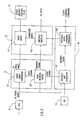
- the apparatus illustrated in the drawings is designed to sense a cable or other obstacle in a protected region within the field of view of the aircraft while travelling through space and to estimate the future position with respect to the sensed obstacle and the collision probability. If the apparatus determines there is a high probability that the aircraft is on a collision course with respect to a sensed obstacle, the apparatus also functions to generate alarm signals to the aircraft pilot and collision avoiding flight commands to the aircraft autopilot.
- the obstacles can be cables as well as other objects, such as terrain formations and other aircraft, which may constitute obstacles to the aircraft equipped with the system.
- the illustrated apparatus may include two types of obstacle sensors: an electro-optical laser sensor 3, and an optional electromagnetic cable sensor 4.
- the electro-optical laser sensor 3 transmits a laser beam and receives the beam reflected by an object in the line of sight of the laser beam. Sensor 3 measures the time-of-flight and the intensity of the returned laser signal corresponding to a given angular position of the laser beam, and calculates the range by multiplying one-half the time of flight by the light speed.
- the laser beam is deflected by a 2-D scanning system 6, e.g., a rotating mirror, prism or any other scanning device.
- the scanning system 6 generates a pattern such that the light beam covers an angular region defined by a horizontal field of view and a vertical field of view as described more particularly below with respect to Figs. 3 and 4.
- the output of the scanner system 6 are 3-D images of both range and intensity in the field of view of the aircraft. These images from sensor 3, together with data from the electromagnetic cable sensor 4, are fed into a signal processing system 8, which also generates a map of the objects within the field of view of the aircraft.
- the generated map continuously changes with respect to both range and intensity because of the movements of the aircraft.
- the range and intensity are dynamically updated by the signal processing system 8 by using data of the dynamic movements of the aircraft measured by the inertial navigation system 10 of the aircraft.
- the output of the signal processing system 8 is a list of objects in the protected region, as well as the 3-D composite range-intensity image to be displayed to the pilot.
- the list of objects contain data concerning the relative position (space and time) of each object with respect to the aircraft. This list is fed to an alarm decision system 12, which generates, for each object in the list, a condition status or warning concerning the danger of collision of the respective object by the protected aircraft.
- the 3-D range-intensity images from the signal processing system 8 are also fed to an audio-visual alarm system 14 which displays the images to the pilot.
- Those objects representing a real collision danger obstacle are emphasized on the display in different colors, each color corresponding to a different alarm level, for example: yellow, for obstacles still at a distance; green, for obstacles becoming a danger if no correcting action is taken; red, for obstacles which endanger the aircraft and should be overcome; and blinking red, for obstacles which must be overcome by an immediate escape sequence.
- the illustrated system further includes a guidance command generator system 16.
- This system receives both the data from the signal processing system 8, and also the alarm status from the alarm decision system 12, and body angles from the inertial navigation system 10. If an imminent danger is present, meaning that at the current velocity and heading of the aircraft a collision is certain in a short time with respect to the pilot response time, the guidance command generator system 16 generates an emergency escape flight guidance command to the autopilot, and a strong audio-visual warning display to the pilot. The pilot may accept the command and validate it, or may override the command with manual flight commands to avoid the obstacle and to stop the warning signals.
- Fig. 2 more particularly illustrates the structure of the alarm decision system 12, the audio-visual alarm system 14, and the guidance command generator system 16.
- the signal processing system 8 produces dynamically-updated 3-D composite range-intensity images of the protected region as sensed by the laser sensor 3 (Fig. 1), and the cable sensor 4. These are hybrid images combining range and intensity data. These images are not dependent on the day/night conditions, so they have to be adapted for display in any condition.
- This 3-D composite range-intensity images from the signal processing system 8 are fed to a video image generator 121, and to a logic decision block 122 in the alarm decision system 12.
- the video image generator 121 generates 2-D pixel images. These are fed to a video mixer 141 in the audio-visual alarm system 14, to be displayed to the pi lot via the aircraft display 142 in the latter system only if there is any information to be displayed, i.e., if the list of obstacles is not empty.
- the decision as to the existence of information to be displayed is made by the logic decision block 122 in the alarm decision system 12.
- the latter block outputs an enable signal to the video image generator 121 whenever the list of objects supplied by the signal processing system 8 includes at least one obstacle which represents a danger to the protected aircraft.
- the logic decision block 122 also generates a warning signal fed to the aircraft displays 142 in the audio visual alarm system 14 for displaying the obstacle to the pilot.
- the display is color-coded as described earlier to indicate the respective alarm level represented by the detected obstacle
- the logic decision block 122 in the alarm decision system 12 also controls an obstacle map generator 161 in the guidance command generator system 16.
- Generator 161 also receives the 3-D composite range-intensity image from the signal processing system 8, and also the actual position data of the aircraft from the inertial navigation system 10. Based on this data, the obstacle map generator 161 generates the map of the obstacles from the list generated by the signal processing system 8. This map is projected on the horizontal plane for displaying it on a moving map display, if such a display is available (for helicopters). Also displayed are possible escape paths for each obstacle of the list, as generated by an obstacle avoid command generator 162.
- the logic decision block 122 in the alarm decision system 12 determines that one of the obstacles is a real danger, it causes the obstacle map generator 161 and the obstacle avoid command generator 162 to calculate flight guidance commands for the aircraft to follow in an escape path. These are automatically applied to the autopilot, and also to the aircraft displays 142 to serve as a warning to the pilot: However, the pilot must first validate the flight guidance commands displayed by the aircraft display 142 before they will be automatically implemented to avoid the obstacle.
- the other displays in the aircraft are indicated by box 18 in Fig. 2. These otherdisplays are combined with the 3-D range-intensity image from the signal processing system 8, via the video image generator 121, and a composite image is generated by the video mixer 141 and fed to the pilot via the aircraft displays 142, together with the warning signals generated by the logic decision block 122, and the guidance commands generated by the obstacle avoid command generator 162.
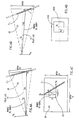
- Fig. 3 is a 3-D isometric representation of the protected region, schematically indicated at 20; whereas Figs. 4a, 4b and 4c represent the projections of the protected region onto the vertical, horizontal and frontal planes, respectively.
- the pilot's line-of-sight position is represented by broken line 21 passing through a marking (cross) 22 on the display. Both the line-of-sight 21 and the marking 22 move together with the aircraft coordinate system 26 such that the protected region 20 is fixed with respect to the aircraft but contains obstacles which are fixed with respect to the horizon coordinate system 27.
- Fig. 3 illustrated in Fig. 3 are two obstacles in the form of a first cable C 1 and a second cable C 2 having different spatial positions in the protected region 20 and moving in different directions relative to the coordinate system 23 of the protected aircraft.
- the positions of the obstacles are represented in the aircraft coordinate system (the center of which is at 23), as defined by the aircraft inertial navigation system 10, as (Xa.ya.zJ, with the center at point 23 on the aircraft.
- the obstacles are standing or moving objects, having an absolute position with respect to the horizon coordinate system 27 (x h ,y h ,z h ) with the center at point 23 in Fig. 3; i.e., the standing objects move relatively to the aircraft with the same dynamics as the aircraft with respect to the world coordinate system, such as LLLN (Local Level Local North).
- the position of a cable with respect to the aircraft is defined by the range to the closest point on the cable, indicated as "A" in Figs. 4a-4c, and the three angles AZ, ELand DP.
- the frontal projection illustrated in Fig. 4c shows the image seen by the pilot.
- the pilot sees cable C 1 at angular position AZ, EL, with respect to his line of sight 21, which is identical with the heading of the aircraft as measured by the inertial navigation system 10 (Fig. 1) located at the center 23 of the aircraft coordinate system.
- the marking 22 on the display In order to avoid an obstacle, the marking 22 on the display must be away from the point A, the point on the obstacle nearest to the aircraft. If the marking 22 is on point A and no change in the course is made, the aircraft will collide with the cable at point A. In order to avoid the collision, the pilot must fly the aircraft such that the marking 22 will be as far away as possible from point A; that is, the distances AZ and EL (Fig. 4c) should be larger than a minimum value corresponding to the size of the aircraft and its movement disturbances.
- the obstacle is irrelevant to the pilot.
- the system includes two types of sensors, namely an electro-optical laser sensor 3, and an electromagnetic cable sensor 4.
- the laser sensor 3 is an active one, operating in the RF or in the millimeter spectrum, and transmits laser beams in the direction of the movement of the aircraft to detect dangerous obstacles in its course of travel.
- the electromagnetic cable sensor 4 may be an active sensor or a passive sensor. An active sensor operates in the RF or millimeter spectrum and illuminates the protected area. A passive sensor receives the electromagnetic energy produced by current flowing through an electric cable.
- the objective of the system is to sense any obstacles in the travelling direction by at least one of the above sensors in order to alert the pilot to take evasive action to avoid a collision.
- the laser sensor 3 is attached as a rigid body to the aircraft (helicopter or other airborne unit) which serves as a platform. It has a global field of view (GFOV) constituted of the HFOV (horizontal field of view) and the VFOV (vertical field ofview), which may have the following values:
- the complete region is illuminated by the sensor devices in order to detect the obstacles.
- the instantaneous field of view is smaller than the GFOV, as shown in Fig. 4d, in such a way that the IFOV continuously adjusts the values of the parameters HIFOV (instantaneous HFOV) and VIFOV (instantaneous VFOV) based on the flight conditions, velocity, acceleration and height. In this manner, an adaptive FOV value is achieved, so that the IFOV is scanned rather than the GFOV. This technique enables the scanning rate to be increased.
- HIFOV instantaneous HFOV
- VIFOV instantaneous VFOV
- the global line-of-sight is the line of sight of GFOV which has the center at O G .
- the instantaneous line-of-sight (I-LOS) is the LOS of IFOV. In this manner, the angle 11 is changed according to well known adaption rules in order to increase the scanning rate, and therefore the probability of detection.
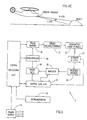
- Fig. 5 is a block diagram illustrating the components of the electro-optical laser sensor system 3.
- the laser sensor system 3 includes a central processing unit CPU which generates pulses supplied via a pulse shaping circuit 30 and a drive 31 to a laser diode (a single diode or an array of diodes) transmitter 32.
- the laser pulses are transmitted via a scanner and optic unit, schematically indicated at 33, which includes not only the scanner system 6 (Fig. 1), but also the necessary optics to collimate and direct the photonic energy to the monitored area, to receive the photonic energy reflected therefrom and to direct it to the receiver diodes 34.
- the received energy is amplified in an amplifier 35 and fed via a range gate 36 and a buffer and A-D converter 37, back to the CPU.
- the foregoing operations are synchronized by synchronizer 38.
- Fig. 5 also illustrates the power supply 39 forcon- trolling the various units of the laser sensor 3.
- the instrumentation block 40 illustrated in Fig. 5 refers to all the instruments that the aircraft platform (helicopter or other airborne unit) includes, such as the inertial navigation system 10 (Fig. 1), vertical and other gyros, magnetometer, altitude reference unit, velocity meter, GPS (Global Positioning System) unit, etc.
- the scanner included in unit 33 in Fig. 5 or the scanner illustrated at 6 in Fig. 1, may be a conventional electromechanical scanner including a motor that can deflect a mirror or prism to any desired direction in order to transmit the photonic energy to the monitored region in front of the aircraft, and to receive the photonic energy reflected from objects in that region.
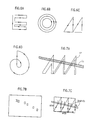
- Figs. 6a-6d illustrate four types of scanning patterns that may be used: a raster scan in Fig. 6a, a conical scan in Fig. 6b, a saw-tooth scan in Fig. 6c, and a spiral scan in Fig. 6d.
- the output of the receiver 34 (Fig. 1) is arranged to create a bit map of the objects within the scanned field of view.
- Fig. 7a illustrates an object, namely cable C 1 being scanned by a saw-tooth scan pattern SP.
- the information received by the receiver 34 as a result of scanning the cable C 1 , is fed to the signal processing system 8, as described earlier, where it is modified by the information from the inertial navigation system 10 according to the dynamically changing characteristics of the aircraft as it moves through space.
- Fig. 7b illustrates the bit map produced as a result of scanning the cable C 1 (Fig. 7a) after filtering, and modification by the inertial navigation system 10.
- the cable will be scanned at least five times in each frame.
- Fig. 7c illustrates an example when using a saw-tooth pattern.
- the signal processing system 8 receives the outputs of the two sensors 3, 4 and produces a composite map of all the potential obstacles that relate to the field of view of the aircraft as detected by these sensors; it also receives data from the aircraft inertial navigation system 10 and dynamically changes the generated map of the obstacles as the aircraft moves through space.
- the signal processing system 8 operates according to the following phases, as illustrated by the block diagram of Fig. 8.
- the data from the two sensors 3, 4, from the aircraft inertial navigation system 10, and from other instrumentation in the aircraft is used for creating a bit map of all the objects in the field of view detected by the two sensors 3, 4.
- This data is dynamically updated by the aircraft inertial navigation system 10 as the aircraft moves through space, as indicated by block 41 in Fig. 8 and as described below with respect to the flow charts of Figs. 9 and 9a.
- This data is then filtered, as indicated by block 42, to output potential features which have to be further analyzed.
- a con- tour/terrain extraction operation to define where is the boundary between the ground and the flight space with respect to the inertial or body reference frame.
- This operation is performed in block 43 which may also receive data from a digital terrain map (DTM), as shown by block 44.
- DTM digital terrain map
- the potential features from block 42 are subjected to a straight line extraction operation indicated by block. 45, in order to define the location of the obstacle, e.g., the electric cables and/or the poles that hold them perpendicular to the terrain contour.
- Fig. 9 is a flow chart illustrating the generation of the bit map as described above with respect to Fig. 8, and Fig. 9a more particularly illustrates the geometric transformation operation of Fig. 9, in which the data from the two sensors 3 and 4 is dynamically updated according to the movements of the aircraft as determined by the inertial navigation system 10.
- each sampled frame includes all the information available by that time.
- the dynamic updating operation "propagates" this frame in time in order that it will be correct and coherent with the next sampled frame.
- Figs. 9 and 9a illustrate how this is done.
- Fig. 9a illustrates the outputs of the inertial navigation system 10 as X k being a function of P, V, a and m, wherein:
- the change in the vehicle position (8X k+1 ) was 20 meters; therefore, in the predicted (updated) map the distance at time t k+1 will be changed to 180 meters.
- Fig. 10 illustrates the straight line extraction operation (block45) in the block diagram of Fig. 8. Since one of the obstacles of particular interest desired to be detected by the system is a cable, the system will include a "straight line extraction" filter to extract any straight lines from the bit map generated by the signal processor system 8.
- the filter search for straight line matching in the image-bit map may be based on well known rules for minimizing errors between a sampled image and a desired feature.
- MMS minimum mean square
- LMS least mean square
- the square dots in Fig. 10 illustrate potential features within the field of view, and the straight line indicates a filtered line.
- the objective is to minimize the error between the filtered (straight) line and the potential (square dot) features.
- the filtered line shown in Fig. 10 may also be based on predetermined rules that characterize electrical cables in the field and introduced, e.g., by block 44.
- rules for example, may relate to:
- Fig. 11a illustrates the operation performed by blocks 46 and 47 (Fig. 8) in the signal processing system 8 of predicting and ranking the obstacles detected. These operations are schematically indicated by block 60 in Fig. 11a, and are based on the following inputted data:
- the signal processing system 8 then establishes an object/obstacles potential table, as illustrated at 62 in Fig. 11 b, based on all the object parameters and the direction of flight.
- This table classifies each of the detected objects 1---n, according to the following classifications:
- the data from the aircraft inertial navigation system 10 enables the signal processing system 8 to generate, from table 62, three additional tables as illustrated in Fig. 12 that partition the data of table 62 into three categories, as follows: (a) table 62a, partitioned according to the ranges of all the objects included in the semi-sphere with radius R, which is a predetermined value based on flight conditions; (b) table 62b, partitioned according to the "time-to-go" (tg o ), or time to collision if the aircraft continues in the same flight direction and at the same velocity; and (c) table 62c illustrating the most dangerous object reflected by the two tables 62a and 62b.
- table 62a partitioned according to the ranges of all the objects included in the semi-sphere with radius R, which is a predetermined value based on flight conditions
- table 62b partitioned according to the "time-to-go" (tg o ), or time to collision if the aircraft continues in the same flight direction and at the same
- the alarm decision system 12 includes a video image generator 121 (Fig. 2) which receives the 3-D composite range-intensity images of the protected region from the signal processing system 8, and also a logic decision block 122 which determines the presence of at least one object which represents a danger to the protected aircraft.
- the logic decision block 122 in turn controls the video image generator 121, the aircraft displays 142 in the audio visual alarm system 14, and the obstacle map generator 161 in the guidance command generator system 16.
- Fig. 13 is a flow chart illustrating the operation of the alarm decision system 12.
- the input to system 12 is a list of objects in the protected region which represent present or future dangers to the protected aircraft as detected by the signal processing system 8. This list contains information concerning the range to the obstacle, as well as tg o (time- to-go) at the current velocity and heading to a collision with the respective obstacle.
- the alarm decision system 12 first decides whether the list "L" is empty (block 70). If so, this means that there is no object present in the protected region. Accordingly, no alarm is generated (block 71), and there is nothing to display to the pilot.
- the list L is sorted according to the range to the obstacles (block 72); and the objects are displayed to the pilot (block 73) as detected by the signal processing system 8 with no emphasis as to the level of danger represented by the obstacle.
- the list sorted by range is then tested for the existence of objects belonging to a semi-sphere of radius R, where R is calculated according to the maximum measurement range of the sensor, taking into account measurement uncertainty factors. If there is no object in the semi- sphere defined by R, no alarm status is generated (block 74a), and the decision process is restarted from the beginning while the tracking process continues. If there are objects at range less than R, they are tested for closer ranges to the aircraft.
- R min is calculated from dynamic parameters, e.g., maximum acceleration (a max ) and maximum velocity (V max ) of the aircraft, such that if the aircraft moves at a max and V max , no collision could occur until the next position update of the aircraft inertial navigation system 10. If there are no objects closer than R min , the objects inside the ball R are highlighted onto the display as yellow features by box 76.
- a max maximum acceleration
- V max maximum velocity
- tg o time-to-go
- t min Aminimum time
- t min is calculated (box 79) using the data from the aircraft inertial navigation system 10, including the current and maximum velocity and acceleration. If there are no objects with tg o less than a minimum time (block 80), an alarm condition (No.2) is generated (block 81), and those objects with tg o less than a minimum time t min are highlighted on the display as green features.
- an alarm condition No.3 is generated (block 83), and the obstacles are displayed as red features; the obstacle with minimum tg o is highlighted by blinking red (blocks 84, 85).
- an escape guidance command is generated by the system 16 (block 86), and is displayed to the pilot in blinking red (block 87).
- the pilot is then asked for validation of the escape command (block 88). If the pilot validates the command, the guidance command is sent to the autopilot (block 89); but if not, the command is cleared from the display. However, the obstacle with alarm condition No.3 continues to be displayed as blinking red until the pilot changes the course manually.
- Fig. 14 is a block diagram of the audio-visual alarm system 22.
- the inputs to this system are the alarm condition status generated by the alarm decision system 12, the data generated by the signal processing system 8, and the flight commands outputted by the guidance command generator system 16.
- the audio-visual alarm system 14 controls the alarm display to the pilot.
- the alarm condition status generated by the alarm decision system 12 is applied to a pilot warning signal generator 143, which transforms the logical alarm signals into audio signals and visual signals.
- the audio signals such as beeps at variable frequency, are applied to a speaker 144.
- the visual signals are of two types: (1) warning messages to be displayed as warning signals and commands in aircraft display 142a, and (2) colored graphic features to be displayed in the aircraft moving map display 142b. Both of the latter displays are fed from an obstacle display generator 145 receiving the output of the pilot warning signal generator 143.
- the obstacle display generator 145 further controls the video image mixer 141 in the audio-visual alarm system 14.
- the data from the signal processing system 8 is applied to a video image generator 146 and is transformed into a 2-D image which is also fed to the video image mixer 141.
- Mixer 141 combines the 2-D images from the video image generator 146 with other displays 18 of the aircraft and with the artificial displays generated by the obstacle display generator 145.
- the latter generator 145 generates yellow, green and red contours of the obstacles corresponding to the different alarm condition levels, and emphasizes the features generated by the video image generator 121.
- the resulting 2-D composite image and color features generated by the video image mixer 141 are displayed to the pilot in the display 142a. This display also includes the suitable warning messages generated by the obstacle display generator 145, and the flight commands generated by the guidance command generator system 16.
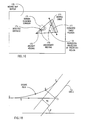
- Fig. 15 illustrates, at 150, the format of the images displayed in the display 142a.
- the obstacle image represents a sub-frame of the size of the dimensions of the HFOV (horizontal field of view) x VFOV (vertical field of view) on the screen of the display 142a.
- the obstacles can be the cables C 1 , C 2 as shown at 151 and 152, respectively, and/or terrain features as shown at 153. They are represented by their actual positions in the form of solid lines, and include an uncertainty region, as indicated by broken lines 151 a, 152a and 153a, respectively, around them because of measurement noise.
- Each obstacle is associated with a point O a , O b and O c , respectively, representing the closest point of the obstacle to the aircraft.
- Each obstacle further includes a message box, as shown at 151 b, 152b and 153b, respectively, containing the range to the respective point O A , O B , O c , and the angles AZ (azimuth) and EL (elevation) between the pilot line-of-sight (21, Fig. 3) and the marking 22 (Fig. 1) on the panel display and the position of the respective point O A , O B , O c .
- the message box 151 b, 152b, 153b, associated with an obstacle is colored according to its alarm status.
- the obstacle display generator 145 produces an artificial dynamic moving image to the moving map display, indicating the horizontal projection of the obstacles onto the moving map.
- Fig. 16 illustrates such a display image.
- the moving map displayed, generally indicated at 170, in the moving map display 142a contains terrain elevation contours 171, aircraft heading 172, mapped high power line cables 173, geographical information data, and other features, as introduced by the digital terrain map 44 (Fig. 8).
- the obstacle display generator 145 (Fig. 14) generates images of detected obstacles, as shown at 174, uncertainty regions 175, the horizontal projection 176 of the protected region (20, Fig. 4), and estimated cable positions at 177.
- the cables are represented by solid lines whose colors correspond to their alarm status.
- Fig. 17 is a block diagram illustrating the guidance command generator system 16.
- this system includes an obstacle map generator 161 which receives the following inputs: (1) the range and orientation of the obstacles, from the signal processing system 8; (2) the aircraft velocity and body angles from the aircraft inertial navigation system 10; and (3) the warning level signals, from the alarm decision system 12.
- the obstacle map generator 161 calculates, from the foregoing inputs, the escape path, namely the 3-D escape trajectory for the aircraft to follow in order to avoid the obstacle. This escape path is applied to the aircraft displays 142 for viewing by the pilot.
- the obstacle map generator system 16 also generates, at the same time, the flight guidance acceleration commands applied to the obstacle avoiding command generator 162 for controlling the aircraft autopilot.
- this control of the autopilot requires first the validation of the commands by the pilot before such commands can be executed.
- Fig. 18 illustrates an example of how an escape path is generated by generator 161 and displayed in the aircraft display 142.
- the current velocity and heading of the aircraft is represented by the vector V.
- the collision point Cp lies on the line defined by the vector V at a range which takes into account the response time of the pilot and measurement errors; that is, the response time multiplied by V is less than the range to the cable, i.e., OCp.
- the orientation of the cable with respect to the heading direction of the aircraft is indicated as (3.
- R F is the safety distance between the aircraft and the cable at the actual velocity V.
- the escape path (EP) computed by the obstacle map generator 161 (Fig. 17) is indicated as EP and is tangent to the velocity vector Vat the current position. It is also tangent to a line parallel to the cable at distance R F from it at a point P on its trajectory further than the point Q of intersection between the line perpendicular to the cable at Cp and the trajectory.
- the obstacle is placed at such a distance to enable the aircraft to move on a given trajectory EP at maximum acceleration and velocity.
- the alarm decision system 12 is designed such that tmm and R min stand for the previous condition.
Landscapes
- Engineering & Computer Science (AREA)
- Physics & Mathematics (AREA)
- Computer Networks & Wireless Communication (AREA)
- General Physics & Mathematics (AREA)
- Radar, Positioning & Navigation (AREA)
- Remote Sensing (AREA)
- Aviation & Aerospace Engineering (AREA)
- Electromagnetism (AREA)
- Traffic Control Systems (AREA)
- Navigation (AREA)
Applications Claiming Priority (2)
| Application Number | Priority Date | Filing Date | Title |
|---|---|---|---|
| IL10454293A IL104542A (en) | 1993-01-28 | 1993-01-28 | Airborne obstacle collision avoidance apparatus |
| IL10454293 | 1993-01-28 |
Publications (2)
| Publication Number | Publication Date |
|---|---|
| EP0609162A2 true EP0609162A2 (de) | 1994-08-03 |
| EP0609162A3 EP0609162A3 (de) | 1994-10-19 |
Family
ID=11064463
Family Applications (1)
| Application Number | Title | Priority Date | Filing Date |
|---|---|---|---|
| EP9494420025A Withdrawn EP0609162A3 (de) | 1993-01-28 | 1994-01-26 | Gerät zur Kollisionsverhinderung für Flugzeuge. |
Country Status (5)
| Country | Link |
|---|---|
| US (1) | US5448233A (de) |
| EP (1) | EP0609162A3 (de) |
| CA (1) | CA2114385A1 (de) |
| IL (1) | IL104542A (de) |
| ZA (1) | ZA94604B (de) |
Cited By (15)
| Publication number | Priority date | Publication date | Assignee | Title |
|---|---|---|---|---|
| EP0750238A1 (de) * | 1995-06-20 | 1996-12-27 | Honeywell Inc. | Integriertes System zur Grundkollisionsvermeidung |
| WO2002025208A3 (en) * | 2000-09-20 | 2002-06-13 | Honeywell Int Inc | Apparatus for displaying detected wires to an aircraft flight crew |
| WO2003021291A1 (en) * | 2001-09-04 | 2003-03-13 | Rosemount Aerospace, Inc. | Wide field scanning laser obstacle awareness system |
| US6665063B2 (en) * | 2001-09-04 | 2003-12-16 | Rosemount Aerospace Inc. | Distributed laser obstacle awareness system |
| EP1441236A1 (de) * | 2003-01-21 | 2004-07-28 | Rosemount Aerospace Inc. | System zur Profilaufnahme von Objekten, die sich vor und unter einem Flugzeug auf dem Boden befinden, mittels eines Laseraltimeters, das in Querrichtung zur Flugrichtung geschwenkt wird |
| GB2408492A (en) * | 2003-11-26 | 2005-06-01 | Safe Flight Instrument | Obstacle avoidance system for a rotary wing aircraft |
| EP1520207A4 (de) * | 2002-06-27 | 2007-08-01 | Agency For Defence Dev | Verfahren und vorrichtung zum scannen des camera-los in einem kontinuierlichen zoom-camerasystem |
| WO2007115359A1 (en) * | 2006-04-10 | 2007-10-18 | Windbidco Pty Ltd | Display system for controlling aircraft traffic and method |
| EP1892670A3 (de) * | 2006-08-25 | 2009-02-25 | Honeywell International Inc. | Verfahren und System zur Bildüberwachung |
| EP2161197A1 (de) * | 2008-09-09 | 2010-03-10 | Thales | Anzeigevorrichtung für Flugzeug mit Einrichtung zur Ausgabe eines akustischer Alarms, der auf ein Kollisionsrisiko darstellende Flugzeuge hinweist |
| EP2182419A1 (de) * | 2008-11-04 | 2010-05-05 | Saab Ab | Vermeidungsmanöver-Generator für ein Flugzeug |
| EP2498101A1 (de) * | 2011-03-11 | 2012-09-12 | Eurocopter | Verfahren zur Höhenmessung und Hinderniserkennung, Funkhöhenmesser und Luftfahrzeug |
| CN104503463A (zh) * | 2014-12-25 | 2015-04-08 | 中国人民解放军总参谋部第六十研究所 | 一种无人直升机主动避障飞行控制方法 |
| EP3062123A1 (de) * | 2015-02-27 | 2016-08-31 | GE Aviation Systems LLC | System und verfahren zur detektion eines eindringenden objekts in ein relatives navigationssystem |
| CN113371185A (zh) * | 2021-07-19 | 2021-09-10 | 江苏中天吉奥信息技术股份有限公司 | 一种地形航拍勘测方法及航拍飞行器 |
Families Citing this family (72)
| Publication number | Priority date | Publication date | Assignee | Title |
|---|---|---|---|---|
| FR2728374A1 (fr) * | 1994-12-15 | 1996-06-21 | Aerospatiale | Procede et dispositif pour fournir une information, alerte ou alarme pour un aeronef a proximite du sol |
| DE19605218C1 (de) * | 1996-02-13 | 1997-04-17 | Dornier Gmbh | Hinderniswarnsystem für tieffliegende Fluggeräte |
| US5864307A (en) * | 1996-02-19 | 1999-01-26 | Gec Marconi Limited | Aircraft terrain advisory system |
| US5781146A (en) * | 1996-03-11 | 1998-07-14 | Imaging Accessories, Inc. | Automatic horizontal and vertical scanning radar with terrain display |
| US5828332A (en) * | 1996-03-11 | 1998-10-27 | Imaging Accessories, Inc. | Automatic horizontal and vertical scanning radar with terrain display |
| US5884223A (en) * | 1996-04-29 | 1999-03-16 | Sun Microsystems, Inc. | Altitude sparse aircraft display |
| ATE237811T1 (de) * | 1996-05-14 | 2003-05-15 | Honeywell Int Inc | Autonomes landeführungssystem |
| US5838262A (en) * | 1996-12-19 | 1998-11-17 | Sikorsky Aircraft Corporation | Aircraft virtual image display system and method for providing a real-time perspective threat coverage display |
| US5859597A (en) * | 1997-11-05 | 1999-01-12 | Cornelio; C. Joseph | Helicopter electronic system for detecting electric power lines during landing |
| US6208270B1 (en) | 1997-11-17 | 2001-03-27 | Thermotrex Corporation | Device and method for detection of aircraft wire hazard |
| US20070132638A1 (en) * | 1998-12-30 | 2007-06-14 | Frazier James A | Close/intra-formation positioning collision avoidance system and method |
| US6459411B2 (en) * | 1998-12-30 | 2002-10-01 | L-3 Communications Corporation | Close/intra-formation positioning collision avoidance system and method |
| US7667647B2 (en) | 1999-03-05 | 2010-02-23 | Era Systems Corporation | Extension of aircraft tracking and positive identification from movement areas into non-movement areas |
| US7570214B2 (en) | 1999-03-05 | 2009-08-04 | Era Systems, Inc. | Method and apparatus for ADS-B validation, active and passive multilateration, and elliptical surviellance |
| US7612716B2 (en) | 1999-03-05 | 2009-11-03 | Era Systems Corporation | Correlation of flight track data with other data sources |
| US8203486B1 (en) | 1999-03-05 | 2012-06-19 | Omnipol A.S. | Transmitter independent techniques to extend the performance of passive coherent location |
| US7777675B2 (en) | 1999-03-05 | 2010-08-17 | Era Systems Corporation | Deployable passive broadband aircraft tracking |
| US8446321B2 (en) | 1999-03-05 | 2013-05-21 | Omnipol A.S. | Deployable intelligence and tracking system for homeland security and search and rescue |
| US7908077B2 (en) | 2003-06-10 | 2011-03-15 | Itt Manufacturing Enterprises, Inc. | Land use compatibility planning software |
| US7889133B2 (en) | 1999-03-05 | 2011-02-15 | Itt Manufacturing Enterprises, Inc. | Multilateration enhancements for noise and operations management |
| US7132982B2 (en) * | 1999-03-05 | 2006-11-07 | Rannock Corporation | Method and apparatus for accurate aircraft and vehicle tracking |
| US7782256B2 (en) | 1999-03-05 | 2010-08-24 | Era Systems Corporation | Enhanced passive coherent location techniques to track and identify UAVs, UCAVs, MAVs, and other objects |
| US7739167B2 (en) | 1999-03-05 | 2010-06-15 | Era Systems Corporation | Automated management of airport revenues |
| KR100887244B1 (ko) * | 2000-10-10 | 2009-03-06 | 샌델 애비아닉스 엘엘씨 | 예측 고도 디스플레이 방법 및 장치 |
| US6683556B2 (en) * | 2000-10-10 | 2004-01-27 | Sandel Avionics, Inc. | Method and apparatus for predictive altitude display |
| US6489916B2 (en) * | 2000-10-10 | 2002-12-03 | Sandel Avionics, Inc. | Method and apparatus for predictive altitude display |
| US6281806B1 (en) | 2000-10-12 | 2001-08-28 | Ford Global Technologies, Inc. | Driver road hazard warning and illumination system |
| US6622066B2 (en) * | 2001-01-23 | 2003-09-16 | Yasuo Ishihara | EGPWS cutoff altitude for helicopters |
| US6693558B2 (en) * | 2001-06-18 | 2004-02-17 | Innovative Solutions & Support, Inc. | Aircraft flat panel display system |
| EP1285842B1 (de) * | 2001-08-23 | 2008-05-28 | Nissan Motor Co., Ltd. | Fahrassistenzsystem |
| US6995688B2 (en) * | 2001-09-24 | 2006-02-07 | Reynolds James S | Method and apparatus for thwarting attempts to hijack aircraft and for responding to other aircraft emergencies |
| US6748325B1 (en) | 2001-12-07 | 2004-06-08 | Iwao Fujisaki | Navigation system |
| US7113098B1 (en) | 2002-08-29 | 2006-09-26 | Melvin Hayes | Animal accident reduction systems, methods, and apparatuses |
| US6745115B1 (en) | 2003-01-07 | 2004-06-01 | Garmin Ltd. | System, method and apparatus for searching geographic area using prioritized spacial order |
| US7386373B1 (en) | 2003-01-07 | 2008-06-10 | Garmin International, Inc. | System, method and apparatus for searching geographic area using prioritized spatial order |
| US7148861B2 (en) * | 2003-03-01 | 2006-12-12 | The Boeing Company | Systems and methods for providing enhanced vision imaging with decreased latency |
| US6885313B2 (en) * | 2003-03-26 | 2005-04-26 | Honeywell International Inc. | Graphical display for aircraft navigation |
| US7091881B2 (en) * | 2003-03-31 | 2006-08-15 | Sikorsky Aircraft Corporation | Integrated hover display with augmented approach to hover symbology cueing for degraded visual environmental conditions |
| US7106217B2 (en) * | 2003-03-31 | 2006-09-12 | Sikorsky Aircraft Corporation | Technical design concepts to improve helicopter obstacle avoidance and operations in “brownout” conditions |
| US7415936B2 (en) * | 2004-06-03 | 2008-08-26 | Westerngeco L.L.C. | Active steering for marine sources |
| GB2400662B (en) * | 2003-04-15 | 2006-08-09 | Westerngeco Seismic Holdings | Active steering for marine seismic sources |
| US6975246B1 (en) | 2003-05-13 | 2005-12-13 | Itt Manufacturing Enterprises, Inc. | Collision avoidance using limited range gated video |
| US7382287B1 (en) | 2003-06-03 | 2008-06-03 | Garmin International, Inc | Avionics system, method and apparatus for selecting a runway |
| US7343232B2 (en) * | 2003-06-20 | 2008-03-11 | Geneva Aerospace | Vehicle control system including related methods and components |
| US20050222769A1 (en) * | 2003-06-26 | 2005-10-06 | Jefferey Simon | Modular sensor system |
| US20050015201A1 (en) * | 2003-07-16 | 2005-01-20 | Sarnoff Corporation | Method and apparatus for detecting obstacles |
| GB2416616A (en) * | 2004-02-27 | 2006-02-01 | Christopher Yardley | Aircraft door handle alarm |
| FR2867270B1 (fr) * | 2004-03-05 | 2006-06-23 | Thales Sa | Procede d'estimation de distance curviligne pour mobile a manoeuvrabilite limitee |
| US8824239B2 (en) * | 2004-03-17 | 2014-09-02 | Westerngeco L.L.C. | Marine seismic survey method and system |
| US7466632B1 (en) * | 2004-05-04 | 2008-12-16 | Westerngeco L.L.C. | Method and apparatus for positioning a center of a seismic source |
| JP2008501955A (ja) * | 2004-06-02 | 2008-01-24 | アテナ テクノロジーズ,インコーポレーテッド | イメージ拡張型の慣性航行システム(iains)および方法 |
| US7818127B1 (en) * | 2004-06-18 | 2010-10-19 | Geneva Aerospace, Inc. | Collision avoidance for vehicle control systems |
| US7403132B2 (en) * | 2005-04-21 | 2008-07-22 | Honeywell International Inc. | System and method for management of a ground obstacle display |
| US7571148B2 (en) * | 2005-06-02 | 2009-08-04 | Northrop Grumman Corporation | System and method for graphically representing uncertainty in an assisted decision-making system |
| FR2893147B1 (fr) * | 2005-11-10 | 2010-12-10 | Thales Sa | Procede de predictions de collision avec des obstacles au sol et d'alertes, notamment embarques sur un aeronef |
| US8050863B2 (en) * | 2006-03-16 | 2011-11-01 | Gray & Company, Inc. | Navigation and control system for autonomous vehicles |
| US7965227B2 (en) | 2006-05-08 | 2011-06-21 | Era Systems, Inc. | Aircraft tracking using low cost tagging as a discriminator |
| US7756637B2 (en) * | 2006-12-21 | 2010-07-13 | The Boeing Company | Methods and systems for displaying electronic enroute maps |
| ATE460723T1 (de) * | 2006-12-22 | 2010-03-15 | Saab Ab | Vorrichtung an einem flugkörper und verfahren zur kollisionsvermeidung |
| US8159416B1 (en) * | 2007-08-06 | 2012-04-17 | Rockwell Collins, Inc. | Synthetic vision dynamic field of view |
| US20100023264A1 (en) * | 2008-07-23 | 2010-01-28 | Honeywell International Inc. | Aircraft display systems and methods with obstacle warning envelopes |
| ES2400708T3 (es) * | 2008-08-27 | 2013-04-11 | Saab Ab | Utilización de un sensor de imágenes y de un filtro de seguimiento de tiempo restante para evitar colisiones en vuelo |
| US7986249B2 (en) * | 2008-11-24 | 2011-07-26 | Honeywell International Inc. | System and method for displaying graphical departure procedures |
| US8570211B1 (en) * | 2009-01-22 | 2013-10-29 | Gregory Hubert Piesinger | Aircraft bird strike avoidance method and apparatus |
| FR2946780B1 (fr) * | 2009-06-12 | 2011-07-15 | Thales Sa | Procede et dispositif d'affichage des limites de marges de vol pour un aeronef |
| FR2949569B1 (fr) * | 2009-09-01 | 2011-08-19 | Thales Sa | Systeme d'aide a la navigation a affichage 3d et son procede d'affichage |
| US9691281B2 (en) * | 2010-03-24 | 2017-06-27 | Telenav, Inc. | Navigation system with image assisted navigation mechanism and method of operation thereof |
| US9355565B2 (en) | 2010-06-23 | 2016-05-31 | Honeywell International Inc. | Crossing traffic depiction in an ITP display |
| KR101305896B1 (ko) * | 2011-07-19 | 2013-09-06 | 서강대학교산학협력단 | 차량의 능동 안전장치 |
| US10403158B2 (en) * | 2017-04-06 | 2019-09-03 | The Boeing Company | Vertical landing vehicle, situational awareness system, and method thereof |
| US11348468B1 (en) * | 2019-03-15 | 2022-05-31 | Rockwell Collins, Inc. | Systems and methods for inhibition of terrain awareness and warning system alerts |
| CN115148053A (zh) * | 2022-06-29 | 2022-10-04 | 沃飞长空科技(成都)有限公司 | 飞行器预警方法、装置、终端设备以及存储介质 |
Family Cites Families (13)
| Publication number | Priority date | Publication date | Assignee | Title |
|---|---|---|---|---|
| US3052882A (en) * | 1958-04-17 | 1962-09-04 | Thompson Ramo Wooldridge Inc | Craft protective system |
| US2994867A (en) * | 1959-02-02 | 1961-08-01 | Collins Radio Co | Collision avoidance presentation system |
| US4646244A (en) * | 1984-02-02 | 1987-02-24 | Sundstrand Data Control, Inc. | Terrain advisory system |
| US4914733A (en) * | 1987-10-30 | 1990-04-03 | Allied-Signal, Inc. | Traffic advisory-instantaneous vertical speed display |
| JPH01229910A (ja) * | 1988-03-10 | 1989-09-13 | Toshiba Corp | 航法装置 |
| US4929936A (en) * | 1988-03-21 | 1990-05-29 | Home Security Systems, Inc. | LED illuminated sign |
| FR2632755B1 (fr) * | 1988-06-08 | 1994-05-27 | Thomson Csf | Systeme d'aide au deplacement de mobiles en formation groupee |
| US5086396A (en) * | 1989-02-02 | 1992-02-04 | Honeywell Inc. | Apparatus and method for an aircraft navigation system having improved mission management and survivability capabilities |
| US5227786A (en) * | 1989-06-30 | 1993-07-13 | Honeywell Inc. | Inside/out perspective format for situation awareness displays |
| US5128874A (en) * | 1990-01-02 | 1992-07-07 | Honeywell Inc. | Inertial navigation sensor integrated obstacle detection system |
| US5012251A (en) * | 1990-05-31 | 1991-04-30 | The United States Of America As Represented By The Secretary Of The Air Force | Radar capability display apparatus |
| EP0464263A3 (en) * | 1990-06-27 | 1992-06-10 | Siemens Aktiengesellschaft | Device for obstacle detection for pilots of low flying aircrafts |
| IT1246234B (it) * | 1990-09-07 | 1994-11-17 | Selenia Ind Elettroniche | Rivelatore di fili sospesi, particolarmente idoneo per applicazioni avioniche |
-
1993
- 1993-01-28 IL IL10454293A patent/IL104542A/en not_active IP Right Cessation
-
1994
- 1994-01-26 EP EP9494420025A patent/EP0609162A3/de not_active Withdrawn
- 1994-01-27 CA CA002114385A patent/CA2114385A1/en not_active Abandoned
- 1994-01-27 US US08/186,959 patent/US5448233A/en not_active Expired - Lifetime
- 1994-01-28 ZA ZA94604A patent/ZA94604B/xx unknown
Cited By (30)
| Publication number | Priority date | Publication date | Assignee | Title |
|---|---|---|---|---|
| US5892462A (en) * | 1995-06-20 | 1999-04-06 | Honeywell Inc. | Adaptive ground collision avoidance system |
| EP0750238A1 (de) * | 1995-06-20 | 1996-12-27 | Honeywell Inc. | Integriertes System zur Grundkollisionsvermeidung |
| WO2002025208A3 (en) * | 2000-09-20 | 2002-06-13 | Honeywell Int Inc | Apparatus for displaying detected wires to an aircraft flight crew |
| US6771257B2 (en) | 2000-09-20 | 2004-08-03 | Honeywell International Inc. | Apparatus for displaying detected wires to an aircraft flight crew |
| WO2003021291A1 (en) * | 2001-09-04 | 2003-03-13 | Rosemount Aerospace, Inc. | Wide field scanning laser obstacle awareness system |
| US6650407B2 (en) | 2001-09-04 | 2003-11-18 | Rosemount Aerospace Inc. | Wide field scanning laser obstacle awareness system |
| US6665063B2 (en) * | 2001-09-04 | 2003-12-16 | Rosemount Aerospace Inc. | Distributed laser obstacle awareness system |
| EP1626292A3 (de) * | 2001-09-04 | 2006-04-05 | Rosemount Aerospace Inc. | Lasersystem mit breiter Abtastung für Hindernisdetektion |
| EP1520207A4 (de) * | 2002-06-27 | 2007-08-01 | Agency For Defence Dev | Verfahren und vorrichtung zum scannen des camera-los in einem kontinuierlichen zoom-camerasystem |
| US7468740B2 (en) | 2002-06-27 | 2008-12-23 | Agency For Defense Development | Method and apparatus for scanning the camera LOS in a continuous zoom camera system |
| EP1441236A1 (de) * | 2003-01-21 | 2004-07-28 | Rosemount Aerospace Inc. | System zur Profilaufnahme von Objekten, die sich vor und unter einem Flugzeug auf dem Boden befinden, mittels eines Laseraltimeters, das in Querrichtung zur Flugrichtung geschwenkt wird |
| US7095488B2 (en) | 2003-01-21 | 2006-08-22 | Rosemount Aerospace Inc. | System for profiling objects on terrain forward and below an aircraft utilizing a cross-track laser altimeter |
| RU2312797C2 (ru) * | 2003-11-26 | 2007-12-20 | Сэйф Флайт Инструмент Корпорейшн | Система обхода от препятствий для летательного аппарата с несущим винтом |
| FR2866970A1 (fr) * | 2003-11-26 | 2005-09-02 | Safe Flight Instrument | Systeme destine a permettre d'eviter les obstacles pour les aeronefs a voilure tournante |
| GB2408492A (en) * | 2003-11-26 | 2005-06-01 | Safe Flight Instrument | Obstacle avoidance system for a rotary wing aircraft |
| WO2007115359A1 (en) * | 2006-04-10 | 2007-10-18 | Windbidco Pty Ltd | Display system for controlling aircraft traffic and method |
| EP1892670A3 (de) * | 2006-08-25 | 2009-02-25 | Honeywell International Inc. | Verfahren und System zur Bildüberwachung |
| US7724260B2 (en) | 2006-08-25 | 2010-05-25 | Honeywell International Inc. | Method and system for image monitoring |
| EP2161197A1 (de) * | 2008-09-09 | 2010-03-10 | Thales | Anzeigevorrichtung für Flugzeug mit Einrichtung zur Ausgabe eines akustischer Alarms, der auf ein Kollisionsrisiko darstellende Flugzeuge hinweist |
| FR2935826A1 (fr) * | 2008-09-09 | 2010-03-12 | Thales Sa | Dispositif de visualisation pour aeronef comprenant des moyens d'alarmes sonores representatifs d'aeronefs presentant un risque de collision |
| US8355861B2 (en) | 2008-11-04 | 2013-01-15 | Saab Ab | Avoidance manoeuvre generator for an aircraft |
| EP2182419A1 (de) * | 2008-11-04 | 2010-05-05 | Saab Ab | Vermeidungsmanöver-Generator für ein Flugzeug |
| EP2498101A1 (de) * | 2011-03-11 | 2012-09-12 | Eurocopter | Verfahren zur Höhenmessung und Hinderniserkennung, Funkhöhenmesser und Luftfahrzeug |
| US9239381B2 (en) | 2011-03-11 | 2016-01-19 | Airbus Helicopters | Method of measuring height and detecting obstacles, a radioaltimeter, and an aircraft |
| CN104503463A (zh) * | 2014-12-25 | 2015-04-08 | 中国人民解放军总参谋部第六十研究所 | 一种无人直升机主动避障飞行控制方法 |
| EP3062123A1 (de) * | 2015-02-27 | 2016-08-31 | GE Aviation Systems LLC | System und verfahren zur detektion eines eindringenden objekts in ein relatives navigationssystem |
| JP2016161572A (ja) * | 2015-02-27 | 2016-09-05 | ジーイー・アビエイション・システムズ・エルエルシー | 侵入オブジェクトを検出するシステムおよび方法 |
| US9435635B1 (en) | 2015-02-27 | 2016-09-06 | Ge Aviation Systems Llc | System and methods of detecting an intruding object in a relative navigation system |
| CN113371185A (zh) * | 2021-07-19 | 2021-09-10 | 江苏中天吉奥信息技术股份有限公司 | 一种地形航拍勘测方法及航拍飞行器 |
| CN113371185B (zh) * | 2021-07-19 | 2023-08-08 | 江苏中天吉奥信息技术股份有限公司 | 一种地形航拍勘测方法及航拍飞行器 |
Also Published As
| Publication number | Publication date |
|---|---|
| ZA94604B (en) | 1994-09-09 |
| US5448233A (en) | 1995-09-05 |
| EP0609162A3 (de) | 1994-10-19 |
| IL104542A (en) | 1996-05-14 |
| CA2114385A1 (en) | 1994-07-29 |
Similar Documents
| Publication | Publication Date | Title |
|---|---|---|
| US5448233A (en) | Airborne obstacle collision avoidance apparatus | |
| KR102604969B1 (ko) | 이미지 세그멘테이션을 이용한 자율 운항 방법 | |
| EP0965118B1 (de) | Gerät zur anzeige von luft- und bodenkollisionsgefahr für flugzeug | |
| US10176723B2 (en) | Obstacle avoidance system | |
| US7379796B2 (en) | Low-altitude flight guidance system, warning system for low-altitude flight guidance, warning generator for low-altitude flight guidance and method for low-altitude flight guidance | |
| US5892462A (en) | Adaptive ground collision avoidance system | |
| US7307578B2 (en) | Declutter of graphical TCAS targets to improve situational awareness | |
| US7030780B2 (en) | Method for displaying position of an aircraft in a display for air traffic control | |
| EP0790487B1 (de) | Geländeauskunftsystem für Flugzeuge | |
| UA61915C2 (en) | Method and device, with an extended zone of vision, for preventing collision of an aircraft against ground | |
| RU2134911C1 (ru) | Система предупреждения столкновения летательных аппаратов при летных испытаниях | |
| KR20210044197A (ko) | 이미지 세그멘테이션을 이용한 자율 운항 방법 | |
| US6940994B2 (en) | Passive power line detection system for aircraft | |
| EP3978879A1 (de) | Systeme und verfahren zur visualisierung einer angenommenen lateralen und vertikalen flugbahn auf einer avionikanzeige | |
| Shish et al. | Survey of capabilities and gaps in external perception sensors for autonomous urban air mobility applications | |
| EP3905223B1 (de) | Flugzeuganzeigesysteme und verfahren zur identifizierung von zielverkehr | |
| Münsterer et al. | Sensor based 3D conformal cueing for safe and reliable HC operation specifically for landing in DVE | |
| Seidel et al. | Novel approaches to helicopter obstacle warning | |
| EP1228383B1 (de) | Wetterstörungsvorhersage | |
| Bers et al. | Laser radar system for obstacle avoidance | |
| Tirri et al. | Advanced sensing issues for UAS collision avoidance. | |
| Gunasinghe et al. | A mid-air collision warning system: Performance comparison using simulated ADS-B, Radar and Vision sensor inputs | |
| CN110614951A (zh) | 一种车辆周围环境重建的镜头转换方法及系统 | |
| EP4000982B1 (de) | Systeme und verfahren zur visualisierung von erweiterter realität basierend auf sensordaten | |
| ITTO20010546A1 (it) | Perfezionamenti relativi a sistemi consultivi della presenza di ostacoli. |
Legal Events
| Date | Code | Title | Description |
|---|---|---|---|
| PUAI | Public reference made under article 153(3) epc to a published international application that has entered the european phase |
Free format text: ORIGINAL CODE: 0009012 |
|
| AK | Designated contracting states |
Kind code of ref document: A2 Designated state(s): AT BE CH DE DK ES FR GB GR IE IT LI NL PT SE |
|
| PUAL | Search report despatched |
Free format text: ORIGINAL CODE: 0009013 |
|
| AK | Designated contracting states |
Kind code of ref document: A3 Designated state(s): AT BE CH DE DK ES FR GB GR IE IT LI NL PT SE |
|
| 17P | Request for examination filed |
Effective date: 19941223 |
|
| 17Q | First examination report despatched |
Effective date: 19961206 |
|
| STAA | Information on the status of an ep patent application or granted ep patent |
Free format text: STATUS: THE APPLICATION IS DEEMED TO BE WITHDRAWN |
|
| 18D | Application deemed to be withdrawn |
Effective date: 19970417 |