EP0586832B1 - Rackets having damping elements - Google Patents
Rackets having damping elements Download PDFInfo
- Publication number
- EP0586832B1 EP0586832B1 EP93111253A EP93111253A EP0586832B1 EP 0586832 B1 EP0586832 B1 EP 0586832B1 EP 93111253 A EP93111253 A EP 93111253A EP 93111253 A EP93111253 A EP 93111253A EP 0586832 B1 EP0586832 B1 EP 0586832B1
- Authority
- EP
- European Patent Office
- Prior art keywords
- racket
- damping
- vibration
- impacted
- damping elements
- Prior art date
- Legal status (The legal status is an assumption and is not a legal conclusion. Google has not performed a legal analysis and makes no representation as to the accuracy of the status listed.)
- Expired - Lifetime
Links
- 238000013016 damping Methods 0.000 title claims description 110
- 239000003190 viscoelastic substance Substances 0.000 claims description 23
- NIXOWILDQLNWCW-UHFFFAOYSA-N acrylic acid group Chemical group C(C=C)(=O)O NIXOWILDQLNWCW-UHFFFAOYSA-N 0.000 claims description 2
- 229920000642 polymer Polymers 0.000 claims description 2
- 230000000052 comparative effect Effects 0.000 description 23
- OKTJSMMVPCPJKN-UHFFFAOYSA-N Carbon Chemical compound [C] OKTJSMMVPCPJKN-UHFFFAOYSA-N 0.000 description 15
- 229910002804 graphite Inorganic materials 0.000 description 15
- 239000010439 graphite Substances 0.000 description 15
- XAGFODPZIPBFFR-UHFFFAOYSA-N aluminium Chemical compound [Al] XAGFODPZIPBFFR-UHFFFAOYSA-N 0.000 description 14
- 229910052782 aluminium Inorganic materials 0.000 description 14
- 238000000034 method Methods 0.000 description 14
- 230000004044 response Effects 0.000 description 9
- 230000001133 acceleration Effects 0.000 description 4
- 238000005065 mining Methods 0.000 description 4
- 230000000694 effects Effects 0.000 description 3
- 238000010438 heat treatment Methods 0.000 description 3
- 238000004519 manufacturing process Methods 0.000 description 3
- 239000000463 material Substances 0.000 description 3
- 238000005452 bending Methods 0.000 description 2
- 229910000831 Steel Inorganic materials 0.000 description 1
- 238000010276 construction Methods 0.000 description 1
- 230000007423 decrease Effects 0.000 description 1
- 230000003111 delayed effect Effects 0.000 description 1
- 239000011888 foil Substances 0.000 description 1
- 239000011521 glass Substances 0.000 description 1
- 229920006267 polyester film Polymers 0.000 description 1
- 230000003938 response to stress Effects 0.000 description 1
- 238000010008 shearing Methods 0.000 description 1
- 239000007787 solid Substances 0.000 description 1
- 238000001228 spectrum Methods 0.000 description 1
- 239000010959 steel Substances 0.000 description 1
Images










Classifications
-
- A—HUMAN NECESSITIES
- A63—SPORTS; GAMES; AMUSEMENTS
- A63B—APPARATUS FOR PHYSICAL TRAINING, GYMNASTICS, SWIMMING, CLIMBING, OR FENCING; BALL GAMES; TRAINING EQUIPMENT
- A63B49/00—Stringed rackets, e.g. for tennis
-
- A—HUMAN NECESSITIES
- A63—SPORTS; GAMES; AMUSEMENTS
- A63B—APPARATUS FOR PHYSICAL TRAINING, GYMNASTICS, SWIMMING, CLIMBING, OR FENCING; BALL GAMES; TRAINING EQUIPMENT
- A63B60/00—Details or accessories of golf clubs, bats, rackets or the like
- A63B60/54—Details or accessories of golf clubs, bats, rackets or the like with means for damping vibrations
Definitions
- This invention relates to rackets.
- the present invention relates to rackets having damping elements as basically known from EP-A-0 275 805 defining the preamble of claim 1.
- a racket such as a tennis racket or racquetball racket
- the racket bends and begins to vibrate. Since the vibration is produced when the player is gripping the racket, the vibration is translated to the player's arm. The degree of vibration imparted to the player's arm varies depending upon the racket material and construction.
- Racket vibrations can be classified into several modes amongst which are three vibratory modes which normally affect the quality of play.
- a first mode illustrated in Fig. 1, comprises a first bending mode of the racket frame and string.
- a second mode depicted in Fig. 2, comprises a second bending mode of both the frame and strings.
- a third mode shown in Fig. 3 comprises the vibration of the strings in a plane perpendicular to the plane of the racket.
- US-A-4,875,679 (corresponding to EP-A-0275805) describes one method of damping frame vibration. According to this method, damping elements comprising viscoelastic material are secured to very specific and relatively small portions of the racket. In particular, the damping elements are secured to the bridge of the racket or on both sides of the bridge. They can also be secured to the head or on both sides of the head. In addition, US-A-4 875 679 teaches that damping elements can be centrally secured on both sides of the head. Although providing some damping affect, the known racket provides less than optimal damping results.
- US-A-4,983,242 discloses yet another method of damping frame vibration.
- This US patent teaches the use of a tennis racket frame comprising an inner tubular member and an outer tubular member. Sandwiched between the two tubular members is a dampening sleeve made of viscoelastic material. The sleeve is coextensive with both the tubular members.
- This known racket is unsatisfactory because it is 20% weaker than a tubular racket because the first modal frequency decreases from 55 to 50 Hz.
- viscoelastic material is unnecessarily uses thereby increasing the weight and cost of the racket.
- a tennis racket having a frame with a bridge and a handle, wherein several individual vibration damping elements are arranged at specific locations spaced apart from each at the outer surface of the frame.
- RESEARCH DISCLOSURE, vol. 262, February 1986, EMSWORTH, HAMPSHIRE, GREAT BRITAIN, pages 74-75 "Vibration Damping in Rackets" a racket is known having a tubular frame the inner surface of which is provided with two parallel damping strips spaced apart from each other. The damping strips can be located at specific places of the frame. If the frame of racket extends into the handle, the damping strips can be extend likewise in this portion.
- the racket of the present invention comprises at least one damping element which substantially dampens the frame vibration of the racket and which extends substantially only from a point about equidistant from the top of said head and the center of said head to the top of said handle.
- a "racket” is defined herein as any device consisting of a head with an interlaced network of strings and a handle depending from the head used to strike a ball, a shuttle cock or other objects.
- the vibration dampening element extends substantially only from about a point equidistant from the top of the head of the racket and the center of the head to the top of the handle of the racket.
- the racket can comprise either a solid racket or a tubular frame which includes a head and a handle depending therefrom and at least one vibration damping element secured and positioned on said head to substantially dampen the frame and/or string vibration of a racket.
- the damping element comprises viscoelastic material secured to the frame by a constraining layer.
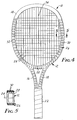
- a racket 10 of the present invention comprises a frame 12 having a head portion 14, two branches 16, 18 which form a bridge 20 and a handle 22.
- Strings 24 are mounted in string holes (not illustrated) and are interlaced in any conventional manner to form a network of strings.
- damping elements 26 are secured to the frame 12.
- the damping elements 26 comprise viscoelastic material 28 which effectively dampens frame and string vibrations and in particular, first mode vibrations.
- viscoelastic refers to a material which exhibits a viscous and/or delayed elastic and/or inelastic response to stress in addition to instantaneous elasticity. The amount of energy dissipated depends upon the damping properties of the viscoelastic materials and therefore, the amount of damping can be tailored to the user's preference.
- Preferred viscoelastic materials include acrylic viscoelastic polymers sold under the tradenames ISD 110, ISD 112 and ISD 113 by the Minnesota, Mining and Manufacturing Company.
- a constraining layer 30 can be used to secure the viscoelastic material 28 to the frame 12.
- the constraining layer 30 can be made of aluminum, graphite, steel, glass reinforced laminates, polyester films or any material which can constrain the viscoelastic material.
- the constraining layer 30 which is stiffer than the viscoelastic material constrains the viscoelastic material; therefore, the surface of the viscoelastic material attached to the racket is extended or compressed while the other surface attached to the constraining layer is held by the constraining layer thereby increasing the amount of shearing of the viscoelastic material 28. This results in a shear strain in viscoelastic material which significantly improves the dampening efficiency of the viscoelastic material.
- Examples of damping elements which have constraining layers are sold under the tradename SJ-2052X Type 0502, SJ-2052X Type 0805, SJ-2052X Type 1002 and SJ-2052X Type 1005 by Minnesota, Mining and Manufacturing Co.
- the damping element 26 can be secured to the exterior surface 32 of the frame in a number of ways which one skilled in the art would recognize.
- a preferred way includes the step of securing the viscoelastic material 28 to the constraining layer 30 by attaching the viscoelastic material 28 to the constraining layer 30 and then heating the damping element 26 in a vacuum oven for 30 minutes at 150°C. After this procedure, the damping element 26 is secured to the racket 10.
- the damping element 26 must be positioned on the frame 12 so that it substantially dampens the frame vibration of the racket 10. By substantial, it is meant that the damping ratio is at least 1.2 %.
- the damping ration is of the critical damping.
- the damping elements 26 can be secured to both sides of a first face 32 of the head 14 and extend from the top of head 14 to the bridge 16 or the damping elements 26 can extend from a portion of the head 14 just beneath the center of the head 14 to the bridge 16. As indicated in Fig. 4 the damping elements 26 extend from a portion of racket 10 equidistant from the top of the head 14 and the center of the racket 10.
- the damping element 26 can also be secured to the second outer face of the head as illustrated in Fig 5.
- the damping element 26 should be wide enough to sufficiently dissipate the energy caused by an impact. For example, widths of 0,48 cm, (3/16 inch) 0,64 cm, (1/4 inch) and 0,95 cm. (3/8 inch) have been found to be suitable.
- a layer 30 of damping elements 26 can be applied to the racket 10.
- the damping elements 26 are stacked one on top the other as illustrated in Fig. 5.
- the number of damping elements 26 in the layer depends upon the user's preference.
- the type of viscoelastic material 28 used can vary from one damping element 26 to another in layer 30 in order to tailor the damping to the user's preference.
- layer 30 can be replaced by a damping element 26 of thickness equal to that of layer 30.
- a test racket of the present invention utilizing damping elements was made by utilizing a Wilson Profile 2.7si, 4 1/4-L4 racket strung with Babolat string at 26 kg. (58 pounds).
- the damping elements were made by attaching a 0,25 mm (10 mil.) element of viscoelastic material sold by the Minnesota Mining and Manufacturing Company under the tradename ISD, SJ2015 type 112 to a clean constraining layer comprising a dead soft aluminum foil which was 0,25 mm (10 mil.) thick.
- the damping element was then placed in a vacuum oven and heated at 150° C for 30 minutes. After heating, the damping element was removed and cut into a 4,8 mm wide strip and secured to the first face of the racket as shown in Fig. 4. This procedure was repeated three times to install a total of three damping elements to both faces of the racket frame.
- the racket was then stimulated by a PCB086B03 impact hammer sold by PCB Piezotronics, Inc. located at 3425 Walden Ave., Repen, N.Y. 14043 at 34 indicated in Fig. 4.
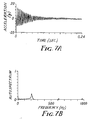
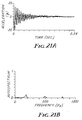
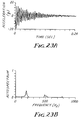
- the racket's response to the impact was measured by a PCB303A03 accelerometer as sold by PCB Piezotronics, Inc. processed with the signal conditioner sold under the tradename PCB483B17 commercially available from PCB Piezotronics, Inc. positioned at the handle 22 as shown in Fig. 4 and was reported as the vibrational time decay trace and the associated auto-spectrum shown in Figs. 7A and 7B.
- the modal damping ratio is reported in Table 1.
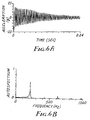
- the test racket of Comparative Example 1 comprised a Wilson Profile 2.7si, 4 1/4-L4 racket strung with Babolat string at 26 kg. (58 pounds). No damping elements were utilized.
- the racket was tested in accordance with the procedures outlined in Example 1. The test results are reported in Figs. 6A and 6B. The damping ratio is reported in Table 1.
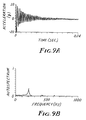
- Example 2 Test rackets were constructed and tested in accordance with the method of Example 1.
- Examples 2-4 demonstrated damping element placement on one and two faces of the racket and the effect of differing the damping element lengths.
- the location and the lengths of the damping elements of Examples 2-4 are summarized in Table 1.
- Table 1 Ex. Description of Treatment Faces Damping Ratio (%) 1 Long Damping Elements Both 1,60 C1 No Damping Elements None 0,40 2 Long Damping Elements One 1,40 3 Short Damping Elements Both 1,40 4 Short Damping Elements One 0,77
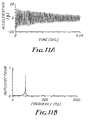
- the rackets of Examples 1-4 showed noticeable improvements in the damping ratio when compared to the racket of Comparative Example 1.
- the first modal frequency response of an impacted racket was visibly lower than the response of the racket of Comparative Example 1 indicating that more energy was dissipated in rackets of the present invention than the racket of Comparative Example 1.
- the test rackets of Examples 5-7 comprised a mid-size racket sold under the trade name Wilson Hammer. Damping elements were attached to the racket.
- the damping elements were made by applying a 0,25 mm (10 mil) thick graphite constraining layer to a 0,25 mm (10 mil.) thick layer of viscoelastic material comprising sold by the Minnesota Mining and Manufacturing Company under the tradename ISD, SJ2015 type 112 which was 4,8 mm wide.
- the damping element comprising the graphite covered viscoelastic material was then secured to first face of the racket as shown in Fig. 4. This procedure was repeated three times to install a total of three damping elements to each side of the racket frame.
- test racket was placed in an oven for 15 minutes set at 150°C (300° F). After heating at 150°C (300°F), the test racket was cured at a temperature of 66°C (150°F) for two hours. Then the racket was strung with Wilson Thin Core string at 25 kg. (55 pounds).
- test rackets of Examples 5-7 varied in that they had damping elements of differing widths.
- the widths associated with the test rackets for each example are reported in Table 2.
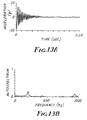
- the rackets of Examples 5-7 were tested in accordance with the procedures outlined in Example 1 and the test results are reported in Figs. 12-14, respectively.
- the modal damping ratio is reported in Table 2.
- the test racket of Comparative Example 2 comprised a mid-size racket sold under the tradename Wilson Hammer strung with Wilson Thin Core string at 25 kg. (55 pounds). This racket was tested in accordance with the procedures of Example 1. The test results are reported in Figs. 11A and 11B. The damping ratio is reported in Table 2. Ex. Width of Constraining Layer Damping Ratio (%) 5 4.8 mm 2,2 6 6.44 mm 2,4 7 9.5 mm 3,5 C2 No Damping Elements 0,5
- the test rackets of Examples 8-11 comprised an aluminum racket sold under the trade name Pro Kennex Power Prophecy 110.
- the test rackets were constructed and tested in accordance with the method of Example 1.
- Examples 8 and 9 demonstrated long damping element placement and the effect of differing the damping element lengths.
- Example 10 illustrated the placement of short damping elements.
- the test results for Examples 8-11 are reported in Figs. 16-19, respectively.
- the location and the lengths of the damping elements of Examples 8-11 are summarized in Table 3.
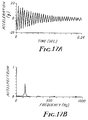
- the test racket of Comparative Example 3 comprised a mid-size aluminum racket sold under the trade name Pro Kennex Power Prophecy 110. This racket was tested in accordance with the procedures of Example 1. The test results are reported in Figs. 15A and 15B. The damping ratio is reported in Table 3. Ex. Description of Treatment Faces Damping Ratio (%) 8 Long Damping Elements Both 2,40 C3 No Damping Elements None 0,77 9 Long Damping Elements One 1,40 10 Short Damping Elements Both 2,10 11 Short Damping Elements One 1,40
- the rackets of Examples 8-11 showed noticeable improvements in the damping ratio when compared to the racket of Comparative Example 3.
- the first modal frequency response of an impacted racket was visibly lower than response of the racket of Comparative Example 3 indicating that more energy was dissipated in the rackets of the present invention than the racket of Comparative Example 3.
- the test rackets of Examples 12-15 comprised a graphite racket sold under the tradename Wilson Profile 3.6 Si strung with Babolat string at 26 kg.
- the test rackets were constructed and tested in accordance with the method of Example 1.
- Examples 12 and 13 demonstrated the effect of long damping element placement.
- Examples 14 and 15 illustrated the placement of short damping elements.
- the test results for Examples 12-15 are reported in Figs. 21-24, respectively.
- the location and the lengths of the damping elements of Examples 12-15 are summarized in Table 4.
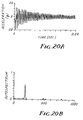
- the test racket of Comparative Example 4 comprised a graphite racket sold under the tradename Wilson Profile 3.6 Si strung with Babolat string at 26 kg. This racket was tested in accordance with the procedures of Example 1. The test results are reported in Figs. 20A and 20B. The damping ratio is reported in Table 4. Ex. Description of Treatment Faces Damping Ratio (%) 12 Long Damping Elements Both 2,60 C4 No Damping Elements None 0,37 13 Long Damping Elements One 1,70 14 Short Damping Elements Both 1,60 15 Short Damping Elements One 1,10
- the rackets of Examples 12-15 showed noticeable improvements in the damping ratio when compared to the racket of Comparative Example 4.
- the first modal frequency response of an impacted racket was lower than the response of the racket of Comparative Example 4 indicating that more energy was dissipated in rackets of the present invention than the racket of Comparative Example 4.
Landscapes
- Health & Medical Sciences (AREA)
- General Health & Medical Sciences (AREA)
- Physical Education & Sports Medicine (AREA)
- Vibration Prevention Devices (AREA)
- Laminated Bodies (AREA)
Applications Claiming Priority (2)
| Application Number | Priority Date | Filing Date | Title |
|---|---|---|---|
| US914982 | 1986-10-03 | ||
| US91498292A | 1992-07-16 | 1992-07-16 |
Publications (2)
| Publication Number | Publication Date |
|---|---|
| EP0586832A1 EP0586832A1 (en) | 1994-03-16 |
| EP0586832B1 true EP0586832B1 (en) | 1998-09-02 |
Family
ID=25435042
Family Applications (1)
| Application Number | Title | Priority Date | Filing Date |
|---|---|---|---|
| EP93111253A Expired - Lifetime EP0586832B1 (en) | 1992-07-16 | 1993-07-14 | Rackets having damping elements |
Country Status (7)
| Country | Link |
|---|---|
| US (1) | US5374057A (Direct) |
| EP (1) | EP0586832B1 (Direct) |
| JP (1) | JPH06154364A (Direct) |
| KR (1) | KR940001909A (Direct) |
| CN (1) | CN1082445A (Direct) |
| DE (1) | DE69320739T2 (Direct) |
| TW (1) | TW286290B (Direct) |
Families Citing this family (19)
| Publication number | Priority date | Publication date | Assignee | Title |
|---|---|---|---|---|
| US5651545A (en) * | 1995-06-07 | 1997-07-29 | Roush Anatrol, Inc. | Vibration damping device for stringed racquets |
| US5935027A (en) * | 1995-12-28 | 1999-08-10 | Roush Anatrol, Inc. | Multi-mode vibration absorbing device for implements |
| US5902656A (en) * | 1996-06-21 | 1999-05-11 | Minnesota Mining And Manufacturing Company | Dampers for internal applications and articles damped therewith |
| US5759113A (en) * | 1996-06-21 | 1998-06-02 | Minnesota Mining And Manufacturing Company | Vibration damped golf clubs and ball bats |
| JP3442672B2 (ja) * | 1998-11-30 | 2003-09-02 | 卓三 岩壷 | テニスラケット |
| JP3734008B2 (ja) * | 1999-06-14 | 2006-01-11 | Sriスポーツ株式会社 | ラケットフレーム |
| US6524692B1 (en) | 2000-05-02 | 2003-02-25 | Structured Composites, Lp | Energy absorbing structural laminate |
| US20080026658A1 (en) * | 2002-03-07 | 2008-01-31 | Matthew Kriesel | Multi-axially stretchable polymer shock absorbing pad |
| US7097576B2 (en) * | 2002-05-17 | 2006-08-29 | Ef Composite Technologies, L.P. | String bearing assemblies for sports racquets |
| US6852048B1 (en) | 2002-05-17 | 2005-02-08 | Ef Composite Technologies, L.P. | Guiding and vibration dampening string tubes for sports racquets |
| US8302213B2 (en) * | 2004-10-08 | 2012-11-06 | Ig Holdings Llc | Helmets and vests |
| US20080250729A1 (en) * | 2007-04-12 | 2008-10-16 | Matthew Kriesel | Acoustical and energy absorbent flooring underlayment |
| US20090042676A1 (en) * | 2007-08-06 | 2009-02-12 | Matthew Kriesel | Vibration Attenuating Ball Racquet |
| WO2009063332A2 (en) * | 2007-10-24 | 2009-05-22 | Herfried Lammer | System and method of using shear thickening materials in sports products |
| JP5948082B2 (ja) * | 2012-02-27 | 2016-07-06 | ヨネックス株式会社 | テニスラケット |
| JP6136920B2 (ja) * | 2013-12-25 | 2017-05-31 | ソニー株式会社 | 解析装置、記録媒体および解析方法 |
| EP4003549B1 (en) * | 2019-07-22 | 2025-10-08 | VT Advantec, LLC | Dampeners for sporting equipment and sporting equipment including the same |
| JP7585625B2 (ja) * | 2020-06-11 | 2024-11-19 | 住友ゴム工業株式会社 | ラケット |
| TWM630130U (zh) * | 2022-01-21 | 2022-08-01 | 陳正盛 | 具有管狀桿(框)體之球拍的減震結構 |
Family Cites Families (17)
| Publication number | Priority date | Publication date | Assignee | Title |
|---|---|---|---|---|
| FR55184E (fr) * | 1947-01-17 | 1951-10-02 | Ct D Etudes Tech Et D Inv S | Dispositif de rattrapage de jeu, notamment pour la commande de la roue de division et celle du chariot dans les machines à tailler les engrenages par fraisemère |
| AT367305B (de) * | 1980-07-18 | 1982-06-25 | Graf Roland | Zwischenstueck fuer tennisschlaegerbespannungen |
| US4627635A (en) * | 1983-09-20 | 1986-12-09 | Koleda Michael T | Vibration damping units and vibration damped products |
| US4609194A (en) * | 1984-05-30 | 1986-09-02 | Krent Edward D | Vibration dampening device for sporting rackets |
| US4684131A (en) * | 1984-06-14 | 1987-08-04 | Ektelon | Graphite composite racquet with aramid core |
| GB8422666D0 (en) * | 1984-09-07 | 1984-10-10 | Dunlop Ltd | Games rackets |
| FR2608444B1 (fr) * | 1986-12-22 | 1989-03-31 | Rossignol Sa | Raquette de tennis |
| KR920011015B1 (ko) * | 1987-03-02 | 1992-12-26 | 가부시끼가이샤 큐우빅 엔지니아링구 | 타구용 운동구 |
| DE3724205A1 (de) * | 1987-07-22 | 1989-01-26 | Tegro Gmbh | Tennis-, squash-, badmintonschlaeger |
| JPH062172B2 (ja) * | 1987-08-19 | 1994-01-12 | 鈴木総業株式会社 | 打球用運動具 |
| US4876169A (en) * | 1988-10-24 | 1989-10-24 | Xerox Corporation | Toner compositions with release additives therein |
| US4983242A (en) * | 1988-11-02 | 1991-01-08 | Roland Reed | Tennis racquet having a sandwich construction, vibration-dampening frame |
| WO1991003284A1 (en) * | 1989-08-28 | 1991-03-21 | Toray Industries, Inc. | Sporting goods and shock absorbing material used by being fitted to the sporting goods |
| US5088734A (en) * | 1990-07-09 | 1992-02-18 | Glava Gary L | Attenuating handle for recreational and work implements |
| US5029858A (en) * | 1990-07-17 | 1991-07-09 | Dennis Chen | Structure of a composite fiber racket |
| US5122405A (en) * | 1990-12-11 | 1992-06-16 | Supracor Systems, Inc. | Shock absorbing means for sporting equipment handles |
| US5262232A (en) * | 1992-01-22 | 1993-11-16 | Minnesota Mining And Manufacturing Company | Vibration damping constructions using acrylate-containing damping materials |
-
1992
- 1992-07-29 TW TW081106001A patent/TW286290B/zh active
-
1993
- 1993-07-14 DE DE69320739T patent/DE69320739T2/de not_active Expired - Fee Related
- 1993-07-14 EP EP93111253A patent/EP0586832B1/en not_active Expired - Lifetime
- 1993-07-14 CN CN93108463A patent/CN1082445A/zh active Pending
- 1993-07-15 KR KR1019930013373A patent/KR940001909A/ko not_active Ceased
- 1993-07-15 JP JP5175405A patent/JPH06154364A/ja active Pending
- 1993-11-19 US US08/155,085 patent/US5374057A/en not_active Expired - Lifetime
Also Published As
| Publication number | Publication date |
|---|---|
| JPH06154364A (ja) | 1994-06-03 |
| EP0586832A1 (en) | 1994-03-16 |
| TW286290B (Direct) | 1996-09-21 |
| US5374057A (en) | 1994-12-20 |
| CN1082445A (zh) | 1994-02-23 |
| DE69320739D1 (de) | 1998-10-08 |
| KR940001909A (ko) | 1994-02-16 |
| DE69320739T2 (de) | 1999-04-08 |
Similar Documents
| Publication | Publication Date | Title |
|---|---|---|
| EP0586832B1 (en) | Rackets having damping elements | |
| US5759113A (en) | Vibration damped golf clubs and ball bats | |
| US4875679A (en) | Tennis racket | |
| US5137769A (en) | Vibration dampening means for strung or spoked equipment | |
| JP2642903B2 (ja) | シャフトおよび打撃ヘッドを有する器具用振動減衰装置 | |
| DE69515982D1 (de) | Tennisschläger mit grosser gesamtlänge | |
| EP0186686B1 (en) | Vibration dampening device for sporting rackets | |
| EP0615772A2 (en) | Tennis racket frame | |
| CA2194687A1 (en) | Cushion bumper assembly for sports racquet | |
| TWI337883B (en) | Racket for ball games and production process | |
| US7556575B2 (en) | Dampening device for a ball games racket | |
| JPH0332384Y2 (Direct) | ||
| US4291876A (en) | FRP Racket frame | |
| JP3734008B2 (ja) | ラケットフレーム | |
| CA2044229C (en) | String vibration dampener for a tennis racquet | |
| CA2502538C (en) | Irregular hockey stick shaft and a method of fabrication thereof | |
| JP2006094951A (ja) | ラケット | |
| JP2002045444A (ja) | ラケットフレーム | |
| JP4318989B2 (ja) | テニスラケット | |
| JP4444429B2 (ja) | 軟式テニス用ラケットフレーム | |
| JP2005065842A (ja) | ラケットフレーム | |
| US20030054908A1 (en) | Tennis racket with shaft having light weight metal piece | |
| JPH0228992B2 (Direct) | ||
| JP4218871B2 (ja) | ストリング保護材および該ストリング保護材を備えたテニスラケット | |
| JPH0731702A (ja) | 卓球用ラケット |
Legal Events
| Date | Code | Title | Description |
|---|---|---|---|
| PUAI | Public reference made under article 153(3) epc to a published international application that has entered the european phase |
Free format text: ORIGINAL CODE: 0009012 |
|
| AK | Designated contracting states |
Kind code of ref document: A1 Designated state(s): DE FR GB IT |
|
| 17P | Request for examination filed |
Effective date: 19940621 |
|
| 17Q | First examination report despatched |
Effective date: 19950131 |
|
| GRAG | Despatch of communication of intention to grant |
Free format text: ORIGINAL CODE: EPIDOS AGRA |
|
| GRAG | Despatch of communication of intention to grant |
Free format text: ORIGINAL CODE: EPIDOS AGRA |
|
| GRAH | Despatch of communication of intention to grant a patent |
Free format text: ORIGINAL CODE: EPIDOS IGRA |
|
| GRAH | Despatch of communication of intention to grant a patent |
Free format text: ORIGINAL CODE: EPIDOS IGRA |
|
| GRAH | Despatch of communication of intention to grant a patent |
Free format text: ORIGINAL CODE: EPIDOS IGRA |
|
| GRAA | (expected) grant |
Free format text: ORIGINAL CODE: 0009210 |
|
| AK | Designated contracting states |
Kind code of ref document: B1 Designated state(s): DE FR GB IT |
|
| ITF | It: translation for a ep patent filed | ||
| REF | Corresponds to: |
Ref document number: 69320739 Country of ref document: DE Date of ref document: 19981008 |
|
| ET | Fr: translation filed | ||
| PLBE | No opposition filed within time limit |
Free format text: ORIGINAL CODE: 0009261 |
|
| STAA | Information on the status of an ep patent application or granted ep patent |
Free format text: STATUS: NO OPPOSITION FILED WITHIN TIME LIMIT |
|
| 26N | No opposition filed | ||
| REG | Reference to a national code |
Ref country code: GB Ref legal event code: IF02 |
|
| PG25 | Lapsed in a contracting state [announced via postgrant information from national office to epo] |
Ref country code: IT Free format text: LAPSE BECAUSE OF NON-PAYMENT OF DUE FEES;WARNING: LAPSES OF ITALIAN PATENTS WITH EFFECTIVE DATE BEFORE 2007 MAY HAVE OCCURRED AT ANY TIME BEFORE 2007. THE CORRECT EFFECTIVE DATE MAY BE DIFFERENT FROM THE ONE RECORDED. Effective date: 20050714 |
|
| PGFP | Annual fee paid to national office [announced via postgrant information from national office to epo] |
Ref country code: DE Payment date: 20070831 Year of fee payment: 15 |
|
| PGFP | Annual fee paid to national office [announced via postgrant information from national office to epo] |
Ref country code: GB Payment date: 20070727 Year of fee payment: 15 |
|
| PGFP | Annual fee paid to national office [announced via postgrant information from national office to epo] |
Ref country code: FR Payment date: 20070717 Year of fee payment: 15 |
|
| GBPC | Gb: european patent ceased through non-payment of renewal fee |
Effective date: 20080714 |
|
| PG25 | Lapsed in a contracting state [announced via postgrant information from national office to epo] |
Ref country code: DE Free format text: LAPSE BECAUSE OF NON-PAYMENT OF DUE FEES Effective date: 20090203 |
|
| REG | Reference to a national code |
Ref country code: FR Ref legal event code: ST Effective date: 20090331 |
|
| PG25 | Lapsed in a contracting state [announced via postgrant information from national office to epo] |
Ref country code: GB Free format text: LAPSE BECAUSE OF NON-PAYMENT OF DUE FEES Effective date: 20080714 |
|
| PG25 | Lapsed in a contracting state [announced via postgrant information from national office to epo] |
Ref country code: FR Free format text: LAPSE BECAUSE OF NON-PAYMENT OF DUE FEES Effective date: 20080731 |