EP0579818B1 - Mehrlagiges papiermaschinengewebe - Google Patents
Mehrlagiges papiermaschinengewebe Download PDFInfo
- Publication number
- EP0579818B1 EP0579818B1 EP93904963A EP93904963A EP0579818B1 EP 0579818 B1 EP0579818 B1 EP 0579818B1 EP 93904963 A EP93904963 A EP 93904963A EP 93904963 A EP93904963 A EP 93904963A EP 0579818 B1 EP0579818 B1 EP 0579818B1
- Authority
- EP
- European Patent Office
- Prior art keywords
- yarns
- warp
- binder
- fabric
- shute
- Prior art date
- Legal status (The legal status is an assumption and is not a legal conclusion. Google has not performed a legal analysis and makes no representation as to the accuracy of the status listed.)
- Expired - Lifetime
Links
- 239000004744 fabric Substances 0.000 title claims abstract description 140
- 239000011230 binding agent Substances 0.000 claims abstract description 88
- XLYOFNOQVPJJNP-UHFFFAOYSA-N water Substances O XLYOFNOQVPJJNP-UHFFFAOYSA-N 0.000 claims description 17
- 238000004140 cleaning Methods 0.000 claims description 8
- 238000010276 construction Methods 0.000 claims description 7
- 239000007788 liquid Substances 0.000 claims description 6
- 230000035515 penetration Effects 0.000 claims description 3
- 239000002356 single layer Substances 0.000 claims description 3
- 239000000356 contaminant Substances 0.000 abstract description 8
- 239000000835 fiber Substances 0.000 abstract description 8
- 230000001419 dependent effect Effects 0.000 abstract description 3
- 239000010410 layer Substances 0.000 description 32
- 238000009740 moulding (composite fabrication) Methods 0.000 description 31
- 229920001131 Pulp (paper) Polymers 0.000 description 5
- 239000013055 pulp slurry Substances 0.000 description 5
- 230000002411 adverse Effects 0.000 description 4
- 238000006073 displacement reaction Methods 0.000 description 3
- 238000000034 method Methods 0.000 description 3
- 210000000481 breast Anatomy 0.000 description 2
- 230000032798 delamination Effects 0.000 description 2
- 239000006185 dispersion Substances 0.000 description 2
- 230000002708 enhancing effect Effects 0.000 description 2
- 230000001965 increasing effect Effects 0.000 description 2
- 229920002522 Wood fibre Polymers 0.000 description 1
- 230000015572 biosynthetic process Effects 0.000 description 1
- 230000002939 deleterious effect Effects 0.000 description 1
- 238000009826 distribution Methods 0.000 description 1
- 238000001035 drying Methods 0.000 description 1
- 230000000694 effects Effects 0.000 description 1
- 238000000605 extraction Methods 0.000 description 1
- 239000011888 foil Substances 0.000 description 1
- 238000004519 manufacturing process Methods 0.000 description 1
- 239000000203 mixture Substances 0.000 description 1
- 238000012986 modification Methods 0.000 description 1
- 230000004048 modification Effects 0.000 description 1
- 229920000642 polymer Polymers 0.000 description 1
- 238000003825 pressing Methods 0.000 description 1
- 238000004537 pulping Methods 0.000 description 1
- 230000000717 retained effect Effects 0.000 description 1
- 238000000926 separation method Methods 0.000 description 1
- 238000012876 topography Methods 0.000 description 1
- 239000011800 void material Substances 0.000 description 1
- 238000003809 water extraction Methods 0.000 description 1
- 238000009941 weaving Methods 0.000 description 1
- 239000002025 wood fiber Substances 0.000 description 1
Images


Classifications
-
- D—TEXTILES; PAPER
- D21—PAPER-MAKING; PRODUCTION OF CELLULOSE
- D21F—PAPER-MAKING MACHINES; METHODS OF PRODUCING PAPER THEREON
- D21F1/00—Wet end of machines for making continuous webs of paper
- D21F1/0027—Screen-cloths
- D21F1/0036—Multi-layer screen-cloths
- D21F1/0045—Triple layer fabrics
-
- Y—GENERAL TAGGING OF NEW TECHNOLOGICAL DEVELOPMENTS; GENERAL TAGGING OF CROSS-SECTIONAL TECHNOLOGIES SPANNING OVER SEVERAL SECTIONS OF THE IPC; TECHNICAL SUBJECTS COVERED BY FORMER USPC CROSS-REFERENCE ART COLLECTIONS [XRACs] AND DIGESTS
- Y10—TECHNICAL SUBJECTS COVERED BY FORMER USPC
- Y10S—TECHNICAL SUBJECTS COVERED BY FORMER USPC CROSS-REFERENCE ART COLLECTIONS [XRACs] AND DIGESTS
- Y10S162/00—Paper making and fiber liberation
- Y10S162/903—Paper forming member, e.g. fourdrinier, sheet forming member
Definitions
- the present invention relates to an improved multi-layer, paper-forming fabric or wire for use in a paper-making machine.
- the fabric of the present invention is particularly useful for supporting the paper web at the wet end of the paper-making machine in a process which uses a substantial portion of recycled paper pulp.
- Polymer forming fabrics are becoming increasingly more complex to suit the changing demands of the paper-making industry.
- the forming fabric While having a fine mesh on the top surface, the forming fabric must maintain a high degree of porosity to afford extraction of large quantities of water from the pulp.
- Forming fabrics with complex weaves have very small filament interstices which easily become blocked with contaminants during the useful life of the fabric. The contaminants which become embedded in the fabric also promote localized wear on the internal fabric binder.
- conventional "triple-layer" fabrics typically have a separate system of mono-filament binding yarns interweaving with and connecting the independent top and bottom plies.
- the top and bottom plies of the fabric have different moduli of elasticity.
- flexing of the two plies generates stresses and strains which permit a degree of relative longitudinal displacement between the top and bottom plies.
- the relative displacement causes internal localized wear on the binder and prematurely wears or "saws" the binder before the useful wear life of the fabric's bottom ply is fully utilized. Internal binder wear is greatest at the contact point between the larger bottom warp and the binder. As a result, fabric irregularities and delamination of the two independent top and bottom layers develop which adversely affect the paper web formed on the fabric.
- a paper forming double fabric comprising a top layer composed of a first set of warp yarns interwoven with a first set of shute yarns and a bottom layer composed of a second set of warp yarns interwoven with a second set of shute yarns, the second set of warp yarns also being partly interwoven with the yarns of the top layer in order to combine the top and bottom layers together.
- a forming fabric for use at the wet end of a paper making machine for receiving wet pulp, said fabric comprising a multi-ply fabric having a width corresponding to the width of the paper-making machine and a length in the form of a continuous loop corresponding to the length of the path of travel of the fabric through the paper machine, and having a top pulp face and a bottom machine face, said top pulp face forming the pulp into a consolidated web by affording discharge of the free water content of the wet pulp from the bottom machine face, said fabric including:
- the forming fabric of the present invention provides a multi-ply forming fabric which cannot be characterized as either a "double-layer” or “triple-layer” fabric. More specifically, like a "triple-layer” forming fabric, the present invention provides a multi-ply forming fabric having a self-sustaining, independent top ply comprising a system of top warp yarns interwoven with a system of top shute yarns.
- the top ply has a top pulp face which provides a preselected surface characteristic in the paper web formed on the pulp face.
- the bottom side of the present invention has no self-sustaining, independent bottom ply. Instead, it has a bottom machine face comprising a system of bottom shute yarns larger than the top shute yarns.
- the top ply has twice as many shute yarns as the bottom side.
- the bottom side has no independent warp system but rather is interwoven with and connected to the top ply by a warp binder system comprising single or grouped binder arrangements.
- the diameter of the warp binder can be of the same, bigger or smaller diameter as the top warp yarns.
- the binder in a "triple-layer" is always the smallest diameter of all the yarn components of the fabric.
- the fabric of the present invention has no shute binder yarns.
- all the warp directional yarns can be of the same diameter.
- the "double-layer” warps are arranged side by side resulting in no projected open area as viewed from the top, the present invention has warps arranged in groups with definite projected open area between warp groups for ease of cleaning.
- the fabric has particular application in a paper-making machine which uses a substantial portion of recycled paper pulp.
- the absence of an independent bottom warp system and shute binder system results in larger internal interstices which reduce the number of contaminants which are trapped in the body of the fabric and enhances cleaning by continuous showers.
- the absence of a large bottom warp system also significantly reduces the caliper of the fabric which reduces the volume of water capable of being entrained in the body of the fabric and reduces rewetting.
- the fabric's reduced caliper also enhances the flexibility of the fabric which facilitates more uniform dispersion of the paper fibers on the fabric.
- the fabric of the present invention does not have two self-sustaining weaves in a top and bottom ply with two different moduli of elasticity, internal stress and strain which cause localized wear on the binder is reduced.
- the warp binder is interwoven in a manner such that exposure of the binder on either the top pulp face or bottom machine face is minimized.
- the fabric can be woven more quickly than conventional "triple-layer" fabrics since the forming fabric has no independent bottom warp system or shute binder system.
- a forming section also referred to as the Fourdrinier wire section, indicated generally by reference number 10 includes a forming fabric 12.
- the forming section 10 is so called because the paper-forming fibers in the pulp slurry are deposited on top of an endless forming fabric belt 12 running horizontally over processing elements positioned under the horizontal upper run of the fabric belt.
- the processing elements are supported by side beams 8 and include: plain or grooved table rolls 14; single or double deflectors 16; foils 18; wet suction boxes 20; dry suction boxes 22; and lump breaker rolls 24.
- the belt has a width corresponding to the width of a paper-making machine and a length in the form of a continuous loop corresponding to the length of the path of travel of the fabric through the machine.
- the belt is contained, supported and driven by a number of rolls including: breast roll 26 underneath a headbox 25 from which the pulp slurry is deposited on the belt; couch roll 28; and return rolls 29.
- the fabric of one embodiment of the present invention comprises an independent, top ply indicated generally by reference number 30 for receiving wet pulp on a top pulp face and forming the pulp into a consolidated web.
- the top ply has a self-sustaining weave construction comprising top warp yarns 32, preferably tensioned so as to provide a uniform top pulp face denoted generally by reference number 36 when woven with shute yarns 34.
- the top ply is normally an independent single-layer weave in plain lxl, basket 2x2, straight 1x2, 1x3, 1x4, or 2x3 in straight twill, or satin weave pattern. More complicated single weave patterns may also be used.
- the top warps 32 are preferably round but may be either round or flat or rectangular or ovate in shape as taught, for example, by Chiu U.S. Patent No. 4,705,601, incorporated herein by reference.
- the fabric has a dependent lower side denoted generally by reference number 40 for affording discharge of the free water content of the wet pulp.
- the bottom side comprises shute yarns 44 for resisting wear on the bottom machine face denoted generally by the reference number 46.
- the bottom side 40 has no independent bottom warp yarns interwoven with the bottom shute yarns 44 to form a self-sustaining weave construction. Rather, the shute yarns 44 in the bottom side are dependent upon binder warp yarns 52, discussed hereinafter, for binding to the top ply.
- the bottom shutes 44 have a larger diameter than the top shutes 34 for greater wear resistance since the bottom shutes 44 contact the abrasive dewatering elements and belt rollers of the paper-making machine.
- the fabric comprises single binder yarns 52 which serve the function of interweaving and interconnecting the bottom shute yarns 44 with the top ply 30.
- the single warp binder yarns 52 follow the path shown in Figs. 2-4.
- the warp binders 52 attach to the top ply adjacent to the knuckles where the top warps 32 overlay the top shutes 34. By sharing the same binding position disturbance to the topography of the top pulp face and exposure of the warp binder on the top pulp face 36 is minimized as seen in Figs. 3 and 4.
- the binder 52 passes under at least one bottom shute 44 in the bottom side 40, preferably in a manner such that the binder 52 is buried in the body of the fabric and does not have any substantial exposure on the bottom machine face 46 of the fabric as seen in Figs. 3 and 4.
- the binder warps 52 are preferably round but any or all of the yarns may be ovate, flat or rectangular.
- the binder warps 52 may have different but preferably the same diameter as the top warps 32.
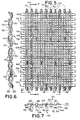
- the distribution and frequency of the binding points can be arranged to give both uniform appearance and mechanical stability to the fabric structure, as shown, for example, in Fig. 2 which illustrates the weave pattern of this embodiment of the fabric.
- the top ply preferably has a warp density typical of a conventional single layer in the range of approximately 50% to 60% warp coverage.
- the top surface can be woven with the long shute knuckles on the face side as shown or it can be woven with the long warp knuckles on the face side to achieve a different surface texture.
- the top warp yarns 32 have a substantially uniform spacing across the width of the fabric and have a warp density to provide channels between the yarns affording the discharge of the free water through the top layer.
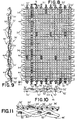
- the individual binder warps 52, 52' (Fig. 8) or the paired binder warps 152 and 154 (Fig. 5) are spaced apart across the width of the fabric to produce channels between the yarns, either individual or paired, as viewed from the top plan. At least half of the channels formed by the top warp yarn in the top ply are in vertical registry with the channels formed by the binder warps to provide a direct and free liquid passage through the interstices in the upper ply and the lower layer.
- the binder warp density is preferably not greater than that of the top ply to insure that the binder warps provide enough open channels which may be in registry with the channels of the upper ply.
- the open channels produce substantial projected open areas when viewed in plan.
- the fabric of the present invention is particularly useful in paper-making processes using a substantial portion of recycled paper pulp since the present fabric has half as many bottom shutes 44 and has no bottom warps and, thus, larger internal interstices in the fabric structure than in conventional double-layer or triple-layer fabrics.
- the present fabric has half as many bottom shutes 44 and has no bottom warps and, thus, larger internal interstices in the fabric structure than in conventional double-layer or triple-layer fabrics.
- a greater number of contaminants mix with the paper fibers and become embedded in the fabric which can accelerate both internal binder wear and bottom shute wear. Larger internal interstices trap fewer contaminants and allow the fabric to be more easily cleaned by continuous cleaning showers.
- the channels and the substantial projected open areas afford direct penetration of water for the cleaning showers into and through the internal structure of the fabric.
- Conventional double-layer and triple-layer fabrics have many more yarn crossings in the internal structure which trap contaminants and block drainage.
- the fabric of the present invention is not prone to delamination of the top and bottom layers due to binder failure since the fabric is more flexible and not formed of two independent, self-sustaining plies with different moduli of elasticity. Since the bottom shutes are not bound in an independent layer, the bottom shutes have freedom to move relative to each other to account for the differential in circumference of the top ply and bottom shutes as the belt is trained around the various rollers of the paper-making machine. In this manner, the bottom shutes move together with the top layer weave structure, thereby eliminating any relative longitudinal displacement or internal stresses between the upper ply and the bottom shutes.
- the absence of an independent system of bottom warps in the fabric of the present invention greatly enhances the porosity of the bottom side of the fabric without creating substantial voids in the top pulp face 36. Greater porosity in the bottom side enhances water extraction from the pulp without adversely affecting the surface density of the paper web formed on the fabric. It should also be appreciated that the absence of a system of bottom warps reduces the caliper of the bottom side and thus the total caliper of the fabric.
- Conventional triple-layer fabrics have a tendency to carry along a substantial amount of water which was extracted from the pulp but is retained in the body of the fabric itself. Using such a conventional fabric, the dried paper web has a tendency to absorb the water entrained in the body of the fabric.
- the present fabric has a reduced caliper and less internal fabric volume to entrain water after the fabric has travelled past the dewatering elements to the exit end of the forming section.
- the fabric of the present invention is also easier and faster to weave since it utilizes no binder shutes.
- the binder shute's only function is to bind the top ply and bottom side and the binder shutes generally serve no function in forming the paper pulp on the fabric.
- the weave of the present fabric makes efficient use of every shute.
- the top shute yarns form the paper web while the bottom shute yarns enhance wear resistance.
- the top warp and the warp binder can be made of the same or different diameters, either single or double warp beam weaving looms can be used to produce the fabric.
- the fabric is preferably woven flat and then seamed with the warp directional strands bearing the running tension of the paper machine, this fabric can also be woven as a continuous loop with more manufacturing difficulties. It is well known that in general, increasing the crimp in the warp knuckles increases the strength of the seam.
- the use of warp binders instead of shute binders provides a stronger seam for the fabric as compared to conventional triple-layer structures because the warp binder passes over both the top and bottom faces resulting in a maximum crimped knuckle configuration which strengthens the seam's tensile strength.
- a larger diameter shute can be used in the bottom side for greater wear resistance. Since this fabric has a reduced caliper and has fewer filaments in the bottom side, the drainage and cleaning characteristics are not adversely affected by the larger diameter bottom shute yarns 44 which protrude from the bottom wear face as seen in Figs. 3 and 4.
- Figs. 5-7 Another embodiment of a fabric according to the present invention is shown in Figs. 5-7.
- This fabric is similar the first embodiment except for the warp binder yarns.
- the corresponding components have been identified with the same reference numerals, but with a prefix of "1".
- the warp binder comprises a pair of warp yarns 152 and 154 interwoven with the top ply 130 and bottom side 140.
- the warp binders 152 and 154 in the warp binder pair have alternate binding patterns such that only one binder yarn of the pair passes above a top shute 134 at a time.
- FIG. 8-11 A third embodiment of a fabric according to the present invention is shown in Figs. 8-11.
- This fabric is similar to the first two embodiments except for the warp binder yarns.
- the corresponding components have been identified with the same reference numerals as in Figs. 2-4, but followed by a prime (').
- the warp binder 52' comprises an ovate yarn having a horizontal thickness approximately twice the vertical thickness of the yarn.
- the binder warp yarn interweaves with the bottom shutes to anchor the bottom shutes against the undersurface of the top ply, the binder warp intermittently extending into the top ply and over a single top shute in the channels between the top warp yarns to provide knuckles which are widely-spaced warp-wise in the top ply, the knuckles in adjacent binder warps on opposite sides of each binder warp being staggered warp-wise of the fabric.
- forming machines may include suction breast roll formers, cylinder machines, twin wire formers, top wire formers and variations thereof. Changes and modifications may be made therein and thereto for use in any paper-making wet process such as pulping, forming, pressing or drying in which an endless belt or flat fabric comprising a major proportion by weight of synthetic filament is used for receiving a pulp slurry, all within the scope of the following claims.
Landscapes
- Paper (AREA)
- Woven Fabrics (AREA)
- Laminated Bodies (AREA)
Claims (13)
- Herstellungsgewebe für die Verwendung am nassen Ende einer Papierherstellungsmaschine für die Aufnahme von nasser Pulpe, wobei das Gewebe ein mehrlagiges Gewebe ist, welches eine Breite entsprechend der Breite der Papierherstellungsmaschine und eine Länge in Form einer kontinuierlichen Schleife hat, welche der Länge des Laufweges des Gewebes durch die Papiermaschine entspricht, und mit einer oberen Pulpenfläche (36), sowie einer unteren Maschinenfläche (46), wobei die obere Pulpenfläche die Pulpe zu einer sich absetzenden, zusammenhängenden Bahn macht, indem sie den Ausstoß des freien Wassergehaltes aus der nassen Pulpe aus der unteren Maschinenfläche bewirkt, wobei das Gewebe aufweist:eine obere Lage (30), die einen selbsttragenden Gewebeaufbau mit oberen Kettfäden (32) hat, die mit oberen Schußfäden (34) in einem Webmuster auf der Oberseite verwoben sind, welches so ausgewählt ist, daß es eine gewünschte Oberflächentextur in dem Papier hervorruft, welches aus der Bahn erzeugt wird, die auf der oberen Pulpenfläche ausgebildet wird, wobei die oberen Kettfäden über die Breite des Gewebes hinweg einen im wesentlichen gleichförmigen Abstand haben und eine Kettfadendichte derart haben, daß Kanäle zwischen den Fäden gebildet werden, die die Abgabe von Wasser bewirken, wobei das Gewebe weiterhin aufweist:eine Unterseite (40), welche im wesentlichen aus einer Reihe von unteren Schußfäden (44) besteht, undBindekettfäden (52), welche die obere Lage (30) und die unteren Schußgarne (44) miteinander verweben, um dadurch einen selbsttragenden Gewebeaufbau (12) einschließlich der oberen Lage (30) und der Unterseite (40) zu bilden, welcher gekennzeichnet ist durch ein hohes Maß an Porosität, wobei die Bindekettfäden (52) eine Kettfadendichte haben, die nicht größer ist als die Kettfadendichte der oberen Lage, wobei die oberen Kettfäden (32) und die Bindekettfäden (52) die beiden einzigen Kettfadensysteme in dem Gewebe bilden, und wobei die Bindekettfäden die einzigen Komponenten bereitstellen, welche die unteren Schußgame miteinander und mit den Garnen der oberen Lage verbinden,dadurch gekennzeichnet, daß die Bindekettfäden (52) über die Breite des Gewebes hinweg so voneinander beabstandet sind, daß sie Kanäle erzeugen, die mit einigen der Kanäle in der oberen Lage registerhaltig ausgerichtet sind, um dadurch einen direkten und freien Flüssigkeitsdurchgang durch die Zwischenräume in der oberen Lage und der Bodenseite zu definieren.
- Herstellungsgewebe nach Anspruch 1, wobei die obere Lage (30) einen unabhängigen einschichtigen Gewebeaufbau hat.
- Herstellungsgewebe nach Anspruch 1 oder 2, wobei die Bindekettfäden (52) in der erwähnten Reihe hauptsächlich unterhalb der oberen Lage (30) liegen und über obere Schußgarne (34) hinweg geführt werden, um Bindungen in Intervallen zu bilden, die in Kettfadenrichtung weit voneinander beabstandet sind, wobei die Bindungen benachbarter Bindekettfäden abgestuft angeordnet sind.
- Herstellungsgewebe nach Anspruch 1, 2 oder 3, welches näherungsweise zweimal so viele obere Schußfäden (34) wie untere Schußfäden (44) hat.
- Herstellungsgewebe nach irgendeinem der vorstehenden Ansprüche, wobei die oberen Kettfäden (32) und die Bindekettfäden (52) von in etwa gleicher vertikaler Dicke sind.
- Herstellungsgewebe nach einem der vorstehenden Ansprüche, wobei das untere Schußgarn (44) eine größere horizontale Dicke hat als das obere Schußgam (34), um auf der Unterseite (40) im Vergleich zur oberen Lage (30) eine größere Verschleißfestigkeit bereitzustellen.
- Herstellungsgewebe nach einem der vorstehenden Ansprüche, wobei der Bindekettfaden (32) eine obere Bindung hat, die über ein oberes Schußgarn (34) hinweg verläuft, und eine untere Bindung hat, die unter einem Bodenschußgarn (44) in einer Art und Weise verläuft, daß die Bindekettfäden nicht in nennenswertem Maße entweder auf der oberen Pulpenfläche oder auf der unteren Maschinenfläche offenliegen.
- Herstellungsgewebe nach Anspruch 7, wobei der Bindekettfaden (52) mit der oberen Lage (30) neben einem oberen Kettfaden (32) an einem Punkt verwoben ist, in welchem der obere Kettfaden über einen oberen Schußfaden (34) hinweg verläuft.
- Herstellungsgewebe nach einem der vorstehenden Ansprüche, wobei die Bindekettfäden Fäden aufweisen, die in einander berührenden Paaren (152, 154) angeordnet sind, wobei die Paare in Richtung der Breite des Gewebes beabstandet sind, um Kanäle zwischen den Paaren zu erzeugen, wobei zumindest die Hälfte der von den oberen Kettfäden gebildeten Kanäle in vertikaler Ausrichtung mit den Kanälen liegt, die von den Bindekettfäden gebildet werden, um den Ausstoß von freiem Wasser durch die miteinander ausgerichteten Kanäle und ein direktes Eindringen von Flüssigkeit aus Reinigungsberieselungen gewährleisten.
- Herstellungsgewebe nach Anspruch 9, wobei das Paar aus Bindekettfäden (152, 154) unter zumindest einem Bodenschußgarn (144) hindurch verläuft und daß jeder der Bindekettfäden in dem Paar über ein getrenntes oberes Schußgam (134) in einer Art und Weise hinweg verläuft, daß das Paar von Bindekettfäden weder an der oberen Pulpenfläche (36) noch an der unteren Maschinenfläche (46) nennenswert freiliegt.
- Herstellungsgewebe nach Anspruch 10, wobei jeder der Bindekettfäden in dem Paar (152, 154) mit der oberen Lage neben einem oberen Kettfaden (132) an einem Punkt verwoben ist, an welchem der obere Kettfaden (132) über einen oberen Schußfaden (134) verläuft.
- Herstellungsgewebe nach einem der vorstehenden Ansprüche, wobei der Bindekettfaden (52) Fäden aufweist, die in Richtung der Breite des Gewebes voneinander beabstandet sind, um niedrigere Kanäle zwischen den Bindekettfäden herzustellen, wobei zumindest die Hälfte der von den oberen Kettfäden (32) gebildeten Kanäle in vertikaler Richtung mit den von den Bindekettfäden gebildeten Kanälen ausgerichtet ist, um den Ablauf von freiem Wasser durch die miteinander ausgerichteten Kanäle und das direkte Eindringen von Flüssigkeit aus Reinigungsberieselungen zu gewährleisten.
- Herstellungsgewebe nach einem der Ansprüche 1 bis 11, wobei die oberen Kettfäden eine gegebene vertikale Dicke haben und dadurch Kanäle definieren, die eine Breite haben, welche etwa gleich dem Zweifachen der gegebenen vertikalen Dicke ist und die Abgabe von Wasser erlauben,
wobei die Bindekettfäden (52) eine vertikale Dicke haben, die gleich der gegebenen Dicke ist, und so angeordnet sind, daß die Bindekettfäden (52) in ausgewählten Kanälen, welche in der oberen Lage vorgesehen sind, ein horizontales Maß haben, welches im wesentlichen der Breite des Kanales entspricht, jedoch nicht mit den nicht-ausgewählten Kanälen der oberen Lage zusammenfällt oder diese blockiert.
Applications Claiming Priority (3)
| Application Number | Priority Date | Filing Date | Title |
|---|---|---|---|
| US07/832,027 US5219004A (en) | 1992-02-06 | 1992-02-06 | Multi-ply papermaking fabric with binder warps |
| US832027 | 1992-02-06 | ||
| PCT/US1993/001096 WO1993016221A1 (en) | 1992-02-06 | 1993-02-08 | Multi-ply papermaking fabric |
Publications (3)
| Publication Number | Publication Date |
|---|---|
| EP0579818A1 EP0579818A1 (de) | 1994-01-26 |
| EP0579818A4 EP0579818A4 (en) | 1994-07-27 |
| EP0579818B1 true EP0579818B1 (de) | 1998-01-14 |
Family
ID=25260462
Family Applications (1)
| Application Number | Title | Priority Date | Filing Date |
|---|---|---|---|
| EP93904963A Expired - Lifetime EP0579818B1 (de) | 1992-02-06 | 1993-02-08 | Mehrlagiges papiermaschinengewebe |
Country Status (7)
| Country | Link |
|---|---|
| US (2) | US5219004A (de) |
| EP (1) | EP0579818B1 (de) |
| AT (1) | ATE162236T1 (de) |
| AU (1) | AU663929B2 (de) |
| CA (1) | CA2106491C (de) |
| DE (1) | DE69316280T2 (de) |
| WO (1) | WO1993016221A1 (de) |
Families Citing this family (85)
| Publication number | Priority date | Publication date | Assignee | Title |
|---|---|---|---|---|
| US5219004A (en) * | 1992-02-06 | 1993-06-15 | Lindsay Wire, Inc. | Multi-ply papermaking fabric with binder warps |
| US5437315A (en) * | 1994-03-09 | 1995-08-01 | Huyck Licensco, Inc. | Multilayer forming fabric |
| US5983953A (en) * | 1994-09-16 | 1999-11-16 | Weavexx Corporation | Paper forming progess |
| US5709250A (en) * | 1994-09-16 | 1998-01-20 | Weavexx Corporation | Papermakers' forming fabric having additional fiber support yarns |
| US5518042A (en) * | 1994-09-16 | 1996-05-21 | Huyck Licensco, Inc. | Papermaker's forming fabric with additional cross machine direction locator and fiber supporting yarns |
| AT404142B (de) * | 1996-09-18 | 1998-08-25 | Tiroler Loden Gmbh | Gewebe zur herstellung von bekleidung sowie verfahren zur herstellung eines solchen gewebes |
| US5937914A (en) * | 1997-02-20 | 1999-08-17 | Weavexx Corporation | Papermaker's fabric with auxiliary yarns |
| DE19732879C2 (de) * | 1997-07-30 | 1999-07-22 | Sca Hygiene Prod Gmbh | Mehrlagiges Sieb für den Naßbereich einer Papiermaschine und damit hergestelltes Produkt |
| US5967195A (en) * | 1997-08-01 | 1999-10-19 | Weavexx Corporation | Multi-layer forming fabric with stitching yarn pairs integrated into papermaking surface |
| DE19811685C1 (de) * | 1998-03-18 | 1999-06-02 | Achter Viktor Gmbh & Co Kg | Textiles Flächengebilde mit Sollbruchlinie |
| GB9811089D0 (en) | 1998-05-23 | 1998-07-22 | Jwi Ltd | Warp-tied composite forming fabric |
| US6112774A (en) * | 1998-06-02 | 2000-09-05 | Weavexx Corporation | Double layer papermaker's forming fabric with reduced twinning. |
| ZA200007449B (en) | 1998-08-06 | 2001-06-14 | Kimberly Clark Co | Rolls of tissue sheets having improved properties. |
| US7935409B2 (en) * | 1998-08-06 | 2011-05-03 | Kimberly-Clark Worldwide, Inc. | Tissue sheets having improved properties |
| US6248210B1 (en) * | 1998-11-13 | 2001-06-19 | Fort James Corporation | Method for maximizing water removal in a press nip |
| ATE211191T1 (de) * | 1998-11-18 | 2002-01-15 | Heimbach Gmbh Thomas Josef | Textiles flächengebilde |
| DE19859581A1 (de) * | 1998-12-22 | 2000-06-29 | Voith Fabrics Heidenheim Gmbh | Mehrlagiges Papiermaschinensieb zur Entwässerung und Blattbildung |
| US6183601B1 (en) | 1999-02-03 | 2001-02-06 | Kimberly-Clark Worldwide, Inc. | Method of calendering a sheet material web carried by a fabric |
| GB2351505A (en) | 1999-06-29 | 2001-01-03 | Jwi Ltd | Two-layer woven fabric for papermaking machines |
| US6179013B1 (en) | 1999-10-21 | 2001-01-30 | Weavexx Corporation | Low caliper multi-layer forming fabrics with machine side cross machine direction yarns having a flattened cross section |
| US6123116A (en) * | 1999-10-21 | 2000-09-26 | Weavexx Corporation | Low caliper mechanically stable multi-layer papermaker's fabrics with paired machine side cross machine direction yarns |
| US6733626B2 (en) * | 2001-12-21 | 2004-05-11 | Georgia Pacific Corporation | Apparatus and method for degrading a web in the machine direction while preserving cross-machine direction strength |
| US6585006B1 (en) | 2000-02-10 | 2003-07-01 | Weavexx Corporation | Papermaker's forming fabric with companion yarns |
| GB0005344D0 (en) * | 2000-03-06 | 2000-04-26 | Stone Richard | Forming fabric with machine side layer weft binder yarns |
| US6244306B1 (en) | 2000-05-26 | 2001-06-12 | Weavexx Corporation | Papermaker's forming fabric |
| US6253796B1 (en) | 2000-07-28 | 2001-07-03 | Weavexx Corporation | Papermaker's forming fabric |
| US6610173B1 (en) * | 2000-11-03 | 2003-08-26 | Kimberly-Clark Worldwide, Inc. | Three-dimensional tissue and methods for making the same |
| US6745797B2 (en) | 2001-06-21 | 2004-06-08 | Weavexx Corporation | Papermaker's forming fabric |
| US6787000B2 (en) | 2001-11-02 | 2004-09-07 | Kimberly-Clark Worldwide, Inc. | Fabric comprising nonwoven elements for use in the manufacture of tissue products having visually discernable background texture regions bordered by curvilinear decorative elements and method thereof |
| US6790314B2 (en) | 2001-11-02 | 2004-09-14 | Kimberly-Clark Worldwide, Inc. | Fabric for use in the manufacture of tissue products having visually discernable background texture regions bordered by curvilinear decorative elements and method thereof |
| US6746570B2 (en) * | 2001-11-02 | 2004-06-08 | Kimberly-Clark Worldwide, Inc. | Absorbent tissue products having visually discernable background texture |
| US6749719B2 (en) * | 2001-11-02 | 2004-06-15 | Kimberly-Clark Worldwide, Inc. | Method of manufacture tissue products having visually discernable background texture regions bordered by curvilinear decorative elements |
| US6821385B2 (en) | 2001-11-02 | 2004-11-23 | Kimberly-Clark Worldwide, Inc. | Method of manufacture of tissue products having visually discernable background texture regions bordered by curvilinear decorative elements using fabrics comprising nonwoven elements |
| US7959761B2 (en) * | 2002-04-12 | 2011-06-14 | Georgia-Pacific Consumer Products Lp | Creping adhesive modifier and process for producing paper products |
| ATE352669T1 (de) * | 2002-10-02 | 2007-02-15 | Fort James Corp | Oberflächenbehandelte wärmeverbindbare faser enthaltende papierprodukte, und verfahren zu ihrer herstellung |
| US7662257B2 (en) | 2005-04-21 | 2010-02-16 | Georgia-Pacific Consumer Products Llc | Multi-ply paper towel with absorbent core |
| US7789995B2 (en) | 2002-10-07 | 2010-09-07 | Georgia-Pacific Consumer Products, LP | Fabric crepe/draw process for producing absorbent sheet |
| US8398820B2 (en) | 2002-10-07 | 2013-03-19 | Georgia-Pacific Consumer Products Lp | Method of making a belt-creped absorbent cellulosic sheet |
| ES2316835T3 (es) | 2002-10-07 | 2009-04-16 | Georgia-Pacific Consumer Products Lp | Proceso para fabricar una hoja celulosica crepada. |
| US7494563B2 (en) | 2002-10-07 | 2009-02-24 | Georgia-Pacific Consumer Products Lp | Fabric creped absorbent sheet with variable local basis weight |
| US7442278B2 (en) | 2002-10-07 | 2008-10-28 | Georgia-Pacific Consumer Products Lp | Fabric crepe and in fabric drying process for producing absorbent sheet |
| US6834684B2 (en) * | 2002-10-24 | 2004-12-28 | Albany International Corp. | Paired warp triple layer forming fabrics with optimum sheet building characteristics |
| US7048012B2 (en) * | 2002-10-24 | 2006-05-23 | Albany International Corp. | Paired warp triple layer forming fabrics with optimum sheet building characteristics |
| US7300547B2 (en) | 2002-11-07 | 2007-11-27 | Georgia-Pacific Consumer Products Llc | Absorbent sheet exhibiting resistance to moisture penetration |
| US6827821B2 (en) * | 2002-12-02 | 2004-12-07 | Voith Fabrics Heidenheim Gmbh & Co. Kg | High permeability, multi-layer woven members employing machine direction binder yarns for use in papermaking machine |
| US6860969B2 (en) | 2003-01-30 | 2005-03-01 | Weavexx Corporation | Papermaker's forming fabric |
| US6837277B2 (en) | 2003-01-30 | 2005-01-04 | Weavexx Corporation | Papermaker's forming fabric |
| US7059357B2 (en) | 2003-03-19 | 2006-06-13 | Weavexx Corporation | Warp-stitched multilayer papermaker's fabrics |
| US6896009B2 (en) * | 2003-03-19 | 2005-05-24 | Weavexx Corporation | Machine direction yarn stitched triple layer papermaker's forming fabrics |
| US6905574B2 (en) * | 2003-04-18 | 2005-06-14 | Albany International Corp. | Multi-layer forming fabric with two warp systems bound together with a triplet of binder yarns |
| GB0317248D0 (en) * | 2003-07-24 | 2003-08-27 | Voith Fabrics Gmbh & Co Kg | Fabric |
| US7297226B2 (en) | 2004-02-11 | 2007-11-20 | Georgia-Pacific Consumer Products Lp | Apparatus and method for degrading a web in the machine direction while preserving cross-machine direction strength |
| US8293072B2 (en) | 2009-01-28 | 2012-10-23 | Georgia-Pacific Consumer Products Lp | Belt-creped, variable local basis weight absorbent sheet prepared with perforated polymeric belt |
| CA2559526C (en) | 2004-04-14 | 2013-07-23 | Fort James Corporation | Wet-pressed tissue and towel products with elevated cd stretch and low tensile ratios made with a high solids fabric crepe process |
| US7243687B2 (en) * | 2004-06-07 | 2007-07-17 | Weavexx Corporation | Papermaker's forming fabric with twice as many bottom MD yarns as top MD yarns |
| US7503998B2 (en) * | 2004-06-18 | 2009-03-17 | Georgia-Pacific Consumer Products Lp | High solids fabric crepe process for producing absorbent sheet with in-fabric drying |
| JP4481765B2 (ja) * | 2004-08-23 | 2010-06-16 | 日本フイルコン株式会社 | 工業用二層織物 |
| JP4400925B2 (ja) * | 2004-08-23 | 2010-01-20 | 日本フイルコン株式会社 | 工業用二層織物 |
| US20060048840A1 (en) * | 2004-08-27 | 2006-03-09 | Scott Quigley | Compound forming fabric with additional bottom yarns |
| JP4762529B2 (ja) * | 2004-11-17 | 2011-08-31 | 日本フイルコン株式会社 | 工業用二層織物 |
| US8178025B2 (en) | 2004-12-03 | 2012-05-15 | Georgia-Pacific Consumer Products Lp | Embossing system and product made thereby with both perforate bosses in the cross machine direction and a macro pattern |
| US7124781B2 (en) * | 2005-02-01 | 2006-10-24 | Albany International Corp. | Multiple contour binders in triple layer fabrics |
| US7195040B2 (en) * | 2005-02-18 | 2007-03-27 | Weavexx Corporation | Papermaker's forming fabric with machine direction stitching yarns that form machine side knuckles |
| US7484538B2 (en) * | 2005-09-22 | 2009-02-03 | Weavexx Corporation | Papermaker's triple layer forming fabric with non-uniform top CMD floats |
| US7219701B2 (en) * | 2005-09-27 | 2007-05-22 | Weavexx Corporation | Papermaker's forming fabric with machine direction stitching yarns that form machine side knuckles |
| US7357155B2 (en) * | 2005-12-29 | 2008-04-15 | Albany International Corp. | Different contour paired binders in multi-layer fabrics |
| US7275566B2 (en) * | 2006-02-27 | 2007-10-02 | Weavexx Corporation | Warped stitched papermaker's forming fabric with fewer effective top MD yarns than bottom MD yarns |
| US8540846B2 (en) | 2009-01-28 | 2013-09-24 | Georgia-Pacific Consumer Products Lp | Belt-creped, variable local basis weight multi-ply sheet with cellulose microfiber prepared with perforated polymeric belt |
| US7580229B2 (en) | 2006-04-27 | 2009-08-25 | Hitachi Global Storage Technologies Netherlands B.V. | Current-perpendicular-to-the-plane (CPP) magnetoresistive sensor with antiparallel-free layer structure and low current-induced noise |
| PL3103920T3 (pl) | 2006-05-26 | 2019-11-29 | Gpcp Ip Holdings Llc | Krepowany tkaniną arkusz chłonny o lokalnie zmiennej gramaturze |
| LT2057016T (lt) * | 2006-08-30 | 2017-07-25 | Georgia-Pacific Consumer Products Lp | Daugiasluoksnis popierinis rankšluostis |
| WO2008073301A2 (en) * | 2006-12-08 | 2008-06-19 | Astenjohnson, Inc. | Machine side layer weave design for composite forming fabrics |
| US7487805B2 (en) * | 2007-01-31 | 2009-02-10 | Weavexx Corporation | Papermaker's forming fabric with cross-direction yarn stitching and ratio of top machined direction yarns to bottom machine direction yarns of less than 1 |
| US20080196784A1 (en) * | 2007-02-15 | 2008-08-21 | Scott Quigley | Wear side weave pattern of a composite forming fabric |
| US7624766B2 (en) * | 2007-03-16 | 2009-12-01 | Weavexx Corporation | Warped stitched papermaker's forming fabric |
| DE102007020071A1 (de) * | 2007-04-28 | 2008-10-30 | Voith Patent Gmbh | Formiersieb |
| US7959764B2 (en) * | 2007-06-13 | 2011-06-14 | Voith Patent Gmbh | Forming fabrics for fiber webs |
| WO2009018274A1 (en) * | 2007-07-30 | 2009-02-05 | Astenjohnson, Inc. | Warp-tied forming fabric with selective warp pair ordering |
| US20090183795A1 (en) * | 2008-01-23 | 2009-07-23 | Kevin John Ward | Multi-Layer Papermaker's Forming Fabric With Long Machine Side MD Floats |
| CA2735867C (en) | 2008-09-16 | 2017-12-05 | Dixie Consumer Products Llc | Food wrap basesheet with regenerated cellulose microfiber |
| US7766053B2 (en) * | 2008-10-31 | 2010-08-03 | Weavexx Corporation | Multi-layer papermaker's forming fabric with alternating paired and single top CMD yarns |
| JP5143709B2 (ja) | 2008-11-28 | 2013-02-13 | 日本フイルコン株式会社 | 工業用二層織物 |
| US8251103B2 (en) * | 2009-11-04 | 2012-08-28 | Weavexx Corporation | Papermaker's forming fabric with engineered drainage channels |
| US9309627B2 (en) | 2011-07-28 | 2016-04-12 | Georgia-Pacific Consumer Products Lp | High softness, high durability bath tissues with temporary wet strength |
| US9267240B2 (en) | 2011-07-28 | 2016-02-23 | Georgia-Pacific Products LP | High softness, high durability bath tissue incorporating high lignin eucalyptus fiber |
Family Cites Families (13)
| Publication number | Priority date | Publication date | Assignee | Title |
|---|---|---|---|---|
| US4314589A (en) * | 1978-10-23 | 1982-02-09 | Jwi Ltd. | Duplex forming fabric |
| SE430425C (sv) * | 1981-06-23 | 1986-09-19 | Nordiskafilt Ab | Formeringsvira for pappers-, cellulosa- eller liknande maskiner |
| SE435739B (sv) * | 1983-02-23 | 1984-10-15 | Nordiskafilt Ab | Formeringsvira av dubbelvevnadstyp |
| ATE43376T1 (de) * | 1984-06-14 | 1989-06-15 | Oberdorfer Fa F | Papiermaschinen-sieb. |
| US5114777B2 (en) * | 1985-08-05 | 1997-11-18 | Wangner Systems Corp | Woven multilayer papermaking fabric having increased stability and permeability and method |
| US4705601A (en) * | 1987-02-05 | 1987-11-10 | B.I. Industries, Inc. | Multi-ply paper forming fabric with ovate warp yarns in lowermost ply |
| DE3705345A1 (de) * | 1987-02-19 | 1988-09-01 | Oberdorfer Fa F | Verbundgewebe als bespannung fuer den blattbildungsteil einer papiermaschine |
| US4967805A (en) * | 1989-05-23 | 1990-11-06 | B.I. Industries, Inc. | Multi-ply forming fabric providing varying widths of machine direction drainage channels |
| US5054525A (en) * | 1989-06-23 | 1991-10-08 | F. Oberdorfer Gmbh & Co. | Double layer forming wire fabric |
| DE3938159A1 (de) * | 1989-11-16 | 1991-05-23 | Oberdorfer Fa F | Verbundgewebe fuer papiermaschinensiebe |
| US5151316A (en) * | 1989-12-04 | 1992-09-29 | Asten Group, Inc. | Multi-layered papermaker's fabric for thru-dryer application |
| US5219004A (en) * | 1992-02-06 | 1993-06-15 | Lindsay Wire, Inc. | Multi-ply papermaking fabric with binder warps |
| FI89819C (fi) * | 1992-02-24 | 1993-11-25 | Tamfelt Oy Ab | Torkvira foer pappersmaskin |
-
1992
- 1992-02-06 US US07/832,027 patent/US5219004A/en not_active Expired - Lifetime
-
1993
- 1993-02-08 AT AT93904963T patent/ATE162236T1/de not_active IP Right Cessation
- 1993-02-08 EP EP93904963A patent/EP0579818B1/de not_active Expired - Lifetime
- 1993-02-08 AU AU36140/93A patent/AU663929B2/en not_active Ceased
- 1993-02-08 WO PCT/US1993/001096 patent/WO1993016221A1/en not_active Ceased
- 1993-02-08 DE DE69316280T patent/DE69316280T2/de not_active Expired - Fee Related
- 1993-02-08 CA CA002106491A patent/CA2106491C/en not_active Expired - Fee Related
- 1993-02-08 US US08/117,005 patent/US5379808A/en not_active Expired - Lifetime
Also Published As
| Publication number | Publication date |
|---|---|
| US5219004A (en) | 1993-06-15 |
| AU3614093A (en) | 1993-09-03 |
| CA2106491A1 (en) | 1993-08-07 |
| CA2106491C (en) | 1996-01-09 |
| DE69316280T2 (de) | 1998-04-30 |
| EP0579818A4 (en) | 1994-07-27 |
| DE69316280D1 (de) | 1998-02-19 |
| US5379808A (en) | 1995-01-10 |
| ATE162236T1 (de) | 1998-01-15 |
| AU663929B2 (en) | 1995-10-26 |
| WO1993016221A1 (en) | 1993-08-19 |
| EP0579818A1 (de) | 1994-01-26 |
Similar Documents
| Publication | Publication Date | Title |
|---|---|---|
| AU663929B2 (en) | Multi-ply papermaking fabric | |
| CA1278240C (en) | Paper forming fabric | |
| CA2174919C (en) | Press felt having fine base fabric | |
| US4989647A (en) | Dual warp forming fabric with a diagonal knuckle pattern | |
| US4759975A (en) | Papermaker's wet press felt having multi-layered base fabric | |
| CA2229613C (en) | Papermaker's fabric with additional cross machine direction yarns positioned in saddles | |
| EP0098612B1 (de) | Pressfilz | |
| KR100508540B1 (ko) | 제지(製紙)용 표면에 통합된 결합 사(絲) 쌍을 가진 다층성형 직물 | |
| US6379506B1 (en) | Auto-joinable triple layer papermaker's forming fabric | |
| US4824525A (en) | Papermaking apparatus having a seamed wet press felt | |
| EP0474856A1 (de) | Doppelschichtiges gewebe zur herstellung von papier. | |
| US6585006B1 (en) | Papermaker's forming fabric with companion yarns | |
| CA1290181C (en) | Sixteen harness dual layer weave | |
| FI87667B (fi) | Beklaednad foer en arkformningsdel vid en pappersmaskin | |
| JP3883276B2 (ja) | 上層織物に補助緯糸を配置した工業用2層織物 | |
| CN102852023B (zh) | 具有成对内在经纱结线的经向走线三层织物 | |
| NZ248711A (en) | Paper machine wet end forming fabric without an independent bottom warp and shute binder system | |
| JP2000170083A (ja) | 製紙面側織物に補助緯糸を配置した製紙用2層織物 | |
| JP2000160492A (ja) | 製紙面側織物に補助緯糸を配置した製紙用2層織物 |
Legal Events
| Date | Code | Title | Description |
|---|---|---|---|
| PUAI | Public reference made under article 153(3) epc to a published international application that has entered the european phase |
Free format text: ORIGINAL CODE: 0009012 |
|
| AK | Designated contracting states |
Kind code of ref document: A1 Designated state(s): AT BE CH DE DK ES FR GB GR IE IT LI LU MC NL PT SE |
|
| 17P | Request for examination filed |
Effective date: 19930917 |
|
| A4 | Supplementary search report drawn up and despatched | ||
| AK | Designated contracting states |
Kind code of ref document: A4 Designated state(s): AT BE CH DE DK ES FR GB GR IE IT LI LU MC NL PT SE |
|
| 17Q | First examination report despatched |
Effective date: 19950630 |
|
| GRAG | Despatch of communication of intention to grant |
Free format text: ORIGINAL CODE: EPIDOS AGRA |
|
| GRAG | Despatch of communication of intention to grant |
Free format text: ORIGINAL CODE: EPIDOS AGRA |
|
| GRAH | Despatch of communication of intention to grant a patent |
Free format text: ORIGINAL CODE: EPIDOS IGRA |
|
| GRAH | Despatch of communication of intention to grant a patent |
Free format text: ORIGINAL CODE: EPIDOS IGRA |
|
| GRAA | (expected) grant |
Free format text: ORIGINAL CODE: 0009210 |
|
| AK | Designated contracting states |
Kind code of ref document: B1 Designated state(s): AT BE CH DE DK ES FR GB GR IE IT LI LU MC NL PT SE |
|
| PG25 | Lapsed in a contracting state [announced via postgrant information from national office to epo] |
Ref country code: LI Free format text: LAPSE BECAUSE OF FAILURE TO SUBMIT A TRANSLATION OF THE DESCRIPTION OR TO PAY THE FEE WITHIN THE PRESCRIBED TIME-LIMIT Effective date: 19980114 Ref country code: IT Free format text: LAPSE BECAUSE OF FAILURE TO SUBMIT A TRANSLATION OF THE DESCRIPTION OR TO PAY THE FEE WITHIN THE PRESCRIBED TIME-LIMIT;WARNING: LAPSES OF ITALIAN PATENTS WITH EFFECTIVE DATE BEFORE 2007 MAY HAVE OCCURRED AT ANY TIME BEFORE 2007. THE CORRECT EFFECTIVE DATE MAY BE DIFFERENT FROM THE ONE RECORDED. Effective date: 19980114 Ref country code: GR Free format text: LAPSE BECAUSE OF FAILURE TO SUBMIT A TRANSLATION OF THE DESCRIPTION OR TO PAY THE FEE WITHIN THE PRESCRIBED TIME-LIMIT Effective date: 19980114 Ref country code: ES Free format text: THE PATENT HAS BEEN ANNULLED BY A DECISION OF A NATIONAL AUTHORITY Effective date: 19980114 Ref country code: CH Free format text: LAPSE BECAUSE OF FAILURE TO SUBMIT A TRANSLATION OF THE DESCRIPTION OR TO PAY THE FEE WITHIN THE PRESCRIBED TIME-LIMIT Effective date: 19980114 Ref country code: BE Free format text: LAPSE BECAUSE OF FAILURE TO SUBMIT A TRANSLATION OF THE DESCRIPTION OR TO PAY THE FEE WITHIN THE PRESCRIBED TIME-LIMIT Effective date: 19980114 Ref country code: AT Free format text: LAPSE BECAUSE OF FAILURE TO SUBMIT A TRANSLATION OF THE DESCRIPTION OR TO PAY THE FEE WITHIN THE PRESCRIBED TIME-LIMIT Effective date: 19980114 |
|
| REF | Corresponds to: |
Ref document number: 162236 Country of ref document: AT Date of ref document: 19980115 Kind code of ref document: T |
|
| REG | Reference to a national code |
Ref country code: CH Ref legal event code: EP |
|
| PG25 | Lapsed in a contracting state [announced via postgrant information from national office to epo] |
Ref country code: LU Free format text: LAPSE BECAUSE OF NON-PAYMENT OF DUE FEES Effective date: 19980208 |
|
| ET | Fr: translation filed | ||
| REF | Corresponds to: |
Ref document number: 69316280 Country of ref document: DE Date of ref document: 19980219 |
|
| PG25 | Lapsed in a contracting state [announced via postgrant information from national office to epo] |
Ref country code: IE Free format text: LAPSE BECAUSE OF NON-PAYMENT OF DUE FEES Effective date: 19980314 |
|
| PG25 | Lapsed in a contracting state [announced via postgrant information from national office to epo] |
Ref country code: PT Free format text: LAPSE BECAUSE OF FAILURE TO SUBMIT A TRANSLATION OF THE DESCRIPTION OR TO PAY THE FEE WITHIN THE PRESCRIBED TIME-LIMIT Effective date: 19980414 Ref country code: DK Free format text: LAPSE BECAUSE OF FAILURE TO SUBMIT A TRANSLATION OF THE DESCRIPTION OR TO PAY THE FEE WITHIN THE PRESCRIBED TIME-LIMIT Effective date: 19980414 |
|
| REG | Reference to a national code |
Ref country code: IE Ref legal event code: FG4D Free format text: 78320 |
|
| REG | Reference to a national code |
Ref country code: CH Ref legal event code: PL |
|
| PG25 | Lapsed in a contracting state [announced via postgrant information from national office to epo] |
Ref country code: MC Free format text: LAPSE BECAUSE OF NON-PAYMENT OF DUE FEES Effective date: 19980831 |
|
| PLBE | No opposition filed within time limit |
Free format text: ORIGINAL CODE: 0009261 |
|
| STAA | Information on the status of an ep patent application or granted ep patent |
Free format text: STATUS: NO OPPOSITION FILED WITHIN TIME LIMIT |
|
| 26N | No opposition filed | ||
| NLS | Nl: assignments of ep-patents |
Owner name: VOITH FABRICS SHREVEPORT, INC. |
|
| REG | Reference to a national code |
Ref country code: GB Ref legal event code: IF02 |
|
| REG | Reference to a national code |
Ref country code: FR Ref legal event code: TP |
|
| PGFP | Annual fee paid to national office [announced via postgrant information from national office to epo] |
Ref country code: NL Payment date: 20030226 Year of fee payment: 11 |
|
| PGFP | Annual fee paid to national office [announced via postgrant information from national office to epo] |
Ref country code: FR Payment date: 20040219 Year of fee payment: 12 |
|
| PGFP | Annual fee paid to national office [announced via postgrant information from national office to epo] |
Ref country code: SE Payment date: 20040220 Year of fee payment: 12 |
|
| PGFP | Annual fee paid to national office [announced via postgrant information from national office to epo] |
Ref country code: GB Payment date: 20040226 Year of fee payment: 12 |
|
| PGFP | Annual fee paid to national office [announced via postgrant information from national office to epo] |
Ref country code: DE Payment date: 20040310 Year of fee payment: 12 |
|
| PG25 | Lapsed in a contracting state [announced via postgrant information from national office to epo] |
Ref country code: NL Free format text: LAPSE BECAUSE OF NON-PAYMENT OF DUE FEES Effective date: 20040901 |
|
| NLV4 | Nl: lapsed or anulled due to non-payment of the annual fee |
Effective date: 20040901 |
|
| PG25 | Lapsed in a contracting state [announced via postgrant information from national office to epo] |
Ref country code: GB Free format text: LAPSE BECAUSE OF NON-PAYMENT OF DUE FEES Effective date: 20050208 |
|
| PG25 | Lapsed in a contracting state [announced via postgrant information from national office to epo] |
Ref country code: SE Free format text: LAPSE BECAUSE OF NON-PAYMENT OF DUE FEES Effective date: 20050209 |
|
| PG25 | Lapsed in a contracting state [announced via postgrant information from national office to epo] |
Ref country code: DE Free format text: LAPSE BECAUSE OF NON-PAYMENT OF DUE FEES Effective date: 20050901 |
|
| GBPC | Gb: european patent ceased through non-payment of renewal fee |
Effective date: 20050208 |
|
| EUG | Se: european patent has lapsed | ||
| PG25 | Lapsed in a contracting state [announced via postgrant information from national office to epo] |
Ref country code: FR Free format text: LAPSE BECAUSE OF NON-PAYMENT OF DUE FEES Effective date: 20051031 |
|
| REG | Reference to a national code |
Ref country code: FR Ref legal event code: ST Effective date: 20051031 |