EP0576861A1 - Tire fabric with polyester/high wet modulus rayon filling - Google Patents
Tire fabric with polyester/high wet modulus rayon filling Download PDFInfo
- Publication number
- EP0576861A1 EP0576861A1 EP19930109002 EP93109002A EP0576861A1 EP 0576861 A1 EP0576861 A1 EP 0576861A1 EP 19930109002 EP19930109002 EP 19930109002 EP 93109002 A EP93109002 A EP 93109002A EP 0576861 A1 EP0576861 A1 EP 0576861A1
- Authority
- EP
- European Patent Office
- Prior art keywords
- weight
- polyester
- high wet
- wet modulus
- fabric
- Prior art date
- Legal status (The legal status is an assumption and is not a legal conclusion. Google has not performed a legal analysis and makes no representation as to the accuracy of the status listed.)
- Withdrawn
Links
- 239000004744 fabric Substances 0.000 title claims abstract description 37
- 229920000297 Rayon Polymers 0.000 title claims abstract description 27
- 239000002964 rayon Substances 0.000 title claims abstract description 27
- 229920000728 polyester Polymers 0.000 title claims abstract description 24
- 229920000742 Cotton Polymers 0.000 claims abstract description 6
- 239000004677 Nylon Substances 0.000 claims abstract description 3
- 239000000463 material Substances 0.000 claims abstract description 3
- 229920001778 nylon Polymers 0.000 claims abstract description 3
- 239000004816 latex Substances 0.000 claims description 18
- 229920000126 latex Polymers 0.000 claims description 18
- KVBYPTUGEKVEIJ-UHFFFAOYSA-N benzene-1,3-diol;formaldehyde Chemical compound O=C.OC1=CC=CC(O)=C1 KVBYPTUGEKVEIJ-UHFFFAOYSA-N 0.000 claims 1
- DGXAGETVRDOQFP-UHFFFAOYSA-N 2,6-dihydroxybenzaldehyde Chemical compound OC1=CC=CC(O)=C1C=O DGXAGETVRDOQFP-UHFFFAOYSA-N 0.000 description 14
- 239000000835 fiber Substances 0.000 description 10
- 238000003490 calendering Methods 0.000 description 7
- KGIGUEBEKRSTEW-UHFFFAOYSA-N 2-vinylpyridine Chemical compound C=CC1=CC=CC=N1 KGIGUEBEKRSTEW-UHFFFAOYSA-N 0.000 description 5
- 238000004519 manufacturing process Methods 0.000 description 5
- 230000000717 retained effect Effects 0.000 description 5
- 229920001971 elastomer Polymers 0.000 description 4
- 244000144992 flock Species 0.000 description 4
- 239000011347 resin Substances 0.000 description 4
- 229920005989 resin Polymers 0.000 description 4
- 238000009987 spinning Methods 0.000 description 4
- 238000009941 weaving Methods 0.000 description 4
- 241000254043 Melolonthinae Species 0.000 description 3
- 238000010438 heat treatment Methods 0.000 description 3
- 238000002156 mixing Methods 0.000 description 3
- -1 polyethylene terephthalate Polymers 0.000 description 3
- 238000012360 testing method Methods 0.000 description 3
- XLYOFNOQVPJJNP-UHFFFAOYSA-N water Substances O XLYOFNOQVPJJNP-UHFFFAOYSA-N 0.000 description 3
- KAKZBPTYRLMSJV-UHFFFAOYSA-N Butadiene Chemical compound C=CC=C KAKZBPTYRLMSJV-UHFFFAOYSA-N 0.000 description 2
- PPBRXRYQALVLMV-UHFFFAOYSA-N Styrene Chemical compound C=CC1=CC=CC=C1 PPBRXRYQALVLMV-UHFFFAOYSA-N 0.000 description 2
- 230000015572 biosynthetic process Effects 0.000 description 2
- 238000007598 dipping method Methods 0.000 description 2
- 239000000203 mixture Substances 0.000 description 2
- 229920000139 polyethylene terephthalate Polymers 0.000 description 2
- 239000005020 polyethylene terephthalate Substances 0.000 description 2
- 238000009960 carding Methods 0.000 description 1
- 150000001875 compounds Chemical class 0.000 description 1
- 239000007859 condensation product Substances 0.000 description 1
- 238000007796 conventional method Methods 0.000 description 1
- 238000005520 cutting process Methods 0.000 description 1
- 238000002844 melting Methods 0.000 description 1
- 230000008018 melting Effects 0.000 description 1
- 238000000034 method Methods 0.000 description 1
- 238000007383 open-end spinning Methods 0.000 description 1
- 229920001707 polybutylene terephthalate Polymers 0.000 description 1
- 238000007378 ring spinning Methods 0.000 description 1
- 239000007787 solid Substances 0.000 description 1
- 229920001897 terpolymer Polymers 0.000 description 1
- 238000004804 winding Methods 0.000 description 1
- 239000002759 woven fabric Substances 0.000 description 1
Images
Classifications
-
- D—TEXTILES; PAPER
- D03—WEAVING
- D03D—WOVEN FABRICS; METHODS OF WEAVING; LOOMS
- D03D15/00—Woven fabrics characterised by the material, structure or properties of the fibres, filaments, yarns, threads or other warp or weft elements used
-
- D—TEXTILES; PAPER
- D03—WEAVING
- D03D—WOVEN FABRICS; METHODS OF WEAVING; LOOMS
- D03D15/00—Woven fabrics characterised by the material, structure or properties of the fibres, filaments, yarns, threads or other warp or weft elements used
- D03D15/20—Woven fabrics characterised by the material, structure or properties of the fibres, filaments, yarns, threads or other warp or weft elements used characterised by the material of the fibres or filaments constituting the yarns or threads
- D03D15/208—Woven fabrics characterised by the material, structure or properties of the fibres, filaments, yarns, threads or other warp or weft elements used characterised by the material of the fibres or filaments constituting the yarns or threads cellulose-based
- D03D15/225—Woven fabrics characterised by the material, structure or properties of the fibres, filaments, yarns, threads or other warp or weft elements used characterised by the material of the fibres or filaments constituting the yarns or threads cellulose-based artificial, e.g. viscose
-
- D—TEXTILES; PAPER
- D03—WEAVING
- D03D—WOVEN FABRICS; METHODS OF WEAVING; LOOMS
- D03D15/00—Woven fabrics characterised by the material, structure or properties of the fibres, filaments, yarns, threads or other warp or weft elements used
- D03D15/20—Woven fabrics characterised by the material, structure or properties of the fibres, filaments, yarns, threads or other warp or weft elements used characterised by the material of the fibres or filaments constituting the yarns or threads
- D03D15/283—Woven fabrics characterised by the material, structure or properties of the fibres, filaments, yarns, threads or other warp or weft elements used characterised by the material of the fibres or filaments constituting the yarns or threads synthetic polymer-based, e.g. polyamide or polyester fibres
-
- D—TEXTILES; PAPER
- D03—WEAVING
- D03D—WOVEN FABRICS; METHODS OF WEAVING; LOOMS
- D03D15/00—Woven fabrics characterised by the material, structure or properties of the fibres, filaments, yarns, threads or other warp or weft elements used
- D03D15/40—Woven fabrics characterised by the material, structure or properties of the fibres, filaments, yarns, threads or other warp or weft elements used characterised by the structure of the yarns or threads
- D03D15/41—Woven fabrics characterised by the material, structure or properties of the fibres, filaments, yarns, threads or other warp or weft elements used characterised by the structure of the yarns or threads with specific twist
-
- D—TEXTILES; PAPER
- D03—WEAVING
- D03D—WOVEN FABRICS; METHODS OF WEAVING; LOOMS
- D03D15/00—Woven fabrics characterised by the material, structure or properties of the fibres, filaments, yarns, threads or other warp or weft elements used
- D03D15/50—Woven fabrics characterised by the material, structure or properties of the fibres, filaments, yarns, threads or other warp or weft elements used characterised by the properties of the yarns or threads
- D03D15/573—Tensile strength
-
- D—TEXTILES; PAPER
- D10—INDEXING SCHEME ASSOCIATED WITH SUBLASSES OF SECTION D, RELATING TO TEXTILES
- D10B—INDEXING SCHEME ASSOCIATED WITH SUBLASSES OF SECTION D, RELATING TO TEXTILES
- D10B2201/00—Cellulose-based fibres, e.g. vegetable fibres
- D10B2201/01—Natural vegetable fibres
- D10B2201/02—Cotton
-
- D—TEXTILES; PAPER
- D10—INDEXING SCHEME ASSOCIATED WITH SUBLASSES OF SECTION D, RELATING TO TEXTILES
- D10B—INDEXING SCHEME ASSOCIATED WITH SUBLASSES OF SECTION D, RELATING TO TEXTILES
- D10B2201/00—Cellulose-based fibres, e.g. vegetable fibres
- D10B2201/20—Cellulose-derived artificial fibres
- D10B2201/22—Cellulose-derived artificial fibres made from cellulose solutions
- D10B2201/24—Viscose
-
- D—TEXTILES; PAPER
- D10—INDEXING SCHEME ASSOCIATED WITH SUBLASSES OF SECTION D, RELATING TO TEXTILES
- D10B—INDEXING SCHEME ASSOCIATED WITH SUBLASSES OF SECTION D, RELATING TO TEXTILES
- D10B2331/00—Fibres made from polymers obtained otherwise than by reactions only involving carbon-to-carbon unsaturated bonds, e.g. polycondensation products
- D10B2331/02—Fibres made from polymers obtained otherwise than by reactions only involving carbon-to-carbon unsaturated bonds, e.g. polycondensation products polyamides
-
- D—TEXTILES; PAPER
- D10—INDEXING SCHEME ASSOCIATED WITH SUBLASSES OF SECTION D, RELATING TO TEXTILES
- D10B—INDEXING SCHEME ASSOCIATED WITH SUBLASSES OF SECTION D, RELATING TO TEXTILES
- D10B2331/00—Fibres made from polymers obtained otherwise than by reactions only involving carbon-to-carbon unsaturated bonds, e.g. polycondensation products
- D10B2331/04—Fibres made from polymers obtained otherwise than by reactions only involving carbon-to-carbon unsaturated bonds, e.g. polycondensation products polyesters, e.g. polyethylene terephthalate [PET]
-
- Y—GENERAL TAGGING OF NEW TECHNOLOGICAL DEVELOPMENTS; GENERAL TAGGING OF CROSS-SECTIONAL TECHNOLOGIES SPANNING OVER SEVERAL SECTIONS OF THE IPC; TECHNICAL SUBJECTS COVERED BY FORMER USPC CROSS-REFERENCE ART COLLECTIONS [XRACs] AND DIGESTS
- Y10—TECHNICAL SUBJECTS COVERED BY FORMER USPC
- Y10S—TECHNICAL SUBJECTS COVERED BY FORMER USPC CROSS-REFERENCE ART COLLECTIONS [XRACs] AND DIGESTS
- Y10S152/00—Resilient tires and wheels
- Y10S152/14—Fabrics
-
- Y—GENERAL TAGGING OF NEW TECHNOLOGICAL DEVELOPMENTS; GENERAL TAGGING OF CROSS-SECTIONAL TECHNOLOGIES SPANNING OVER SEVERAL SECTIONS OF THE IPC; TECHNICAL SUBJECTS COVERED BY FORMER USPC CROSS-REFERENCE ART COLLECTIONS [XRACs] AND DIGESTS
- Y10—TECHNICAL SUBJECTS COVERED BY FORMER USPC
- Y10T—TECHNICAL SUBJECTS COVERED BY FORMER US CLASSIFICATION
- Y10T152/00—Resilient tires and wheels
- Y10T152/10—Tires, resilient
- Y10T152/10495—Pneumatic tire or inner tube
- Y10T152/10855—Characterized by the carcass, carcass material, or physical arrangement of the carcass materials
- Y10T152/10873—Characterized by the carcass, carcass material, or physical arrangement of the carcass materials with two or more differing cord materials
-
- Y—GENERAL TAGGING OF NEW TECHNOLOGICAL DEVELOPMENTS; GENERAL TAGGING OF CROSS-SECTIONAL TECHNOLOGIES SPANNING OVER SEVERAL SECTIONS OF THE IPC; TECHNICAL SUBJECTS COVERED BY FORMER USPC CROSS-REFERENCE ART COLLECTIONS [XRACs] AND DIGESTS
- Y10—TECHNICAL SUBJECTS COVERED BY FORMER USPC
- Y10T—TECHNICAL SUBJECTS COVERED BY FORMER US CLASSIFICATION
- Y10T442/00—Fabric [woven, knitted, or nonwoven textile or cloth, etc.]
- Y10T442/20—Coated or impregnated woven, knit, or nonwoven fabric which is not [a] associated with another preformed layer or fiber layer or, [b] with respect to woven and knit, characterized, respectively, by a particular or differential weave or knit, wherein the coating or impregnation is neither a foamed material nor a free metal or alloy layer
- Y10T442/2008—Fabric composed of a fiber or strand which is of specific structural definition
-
- Y—GENERAL TAGGING OF NEW TECHNOLOGICAL DEVELOPMENTS; GENERAL TAGGING OF CROSS-SECTIONAL TECHNOLOGIES SPANNING OVER SEVERAL SECTIONS OF THE IPC; TECHNICAL SUBJECTS COVERED BY FORMER USPC CROSS-REFERENCE ART COLLECTIONS [XRACs] AND DIGESTS
- Y10—TECHNICAL SUBJECTS COVERED BY FORMER USPC
- Y10T—TECHNICAL SUBJECTS COVERED BY FORMER US CLASSIFICATION
- Y10T442/00—Fabric [woven, knitted, or nonwoven textile or cloth, etc.]
- Y10T442/20—Coated or impregnated woven, knit, or nonwoven fabric which is not [a] associated with another preformed layer or fiber layer or, [b] with respect to woven and knit, characterized, respectively, by a particular or differential weave or knit, wherein the coating or impregnation is neither a foamed material nor a free metal or alloy layer
- Y10T442/2861—Coated or impregnated synthetic organic fiber fabric
- Y10T442/2869—Coated or impregnated regenerated cellulose fiber fabric
-
- Y—GENERAL TAGGING OF NEW TECHNOLOGICAL DEVELOPMENTS; GENERAL TAGGING OF CROSS-SECTIONAL TECHNOLOGIES SPANNING OVER SEVERAL SECTIONS OF THE IPC; TECHNICAL SUBJECTS COVERED BY FORMER USPC CROSS-REFERENCE ART COLLECTIONS [XRACs] AND DIGESTS
- Y10—TECHNICAL SUBJECTS COVERED BY FORMER USPC
- Y10T—TECHNICAL SUBJECTS COVERED BY FORMER US CLASSIFICATION
- Y10T442/00—Fabric [woven, knitted, or nonwoven textile or cloth, etc.]
- Y10T442/30—Woven fabric [i.e., woven strand or strip material]
- Y10T442/3146—Strand material is composed of two or more polymeric materials in physically distinct relationship [e.g., sheath-core, side-by-side, islands-in-sea, fibrils-in-matrix, etc.] or composed of physical blend of chemically different polymeric materials or a physical blend of a polymeric material and a filler material
-
- Y—GENERAL TAGGING OF NEW TECHNOLOGICAL DEVELOPMENTS; GENERAL TAGGING OF CROSS-SECTIONAL TECHNOLOGIES SPANNING OVER SEVERAL SECTIONS OF THE IPC; TECHNICAL SUBJECTS COVERED BY FORMER USPC CROSS-REFERENCE ART COLLECTIONS [XRACs] AND DIGESTS
- Y10—TECHNICAL SUBJECTS COVERED BY FORMER USPC
- Y10T—TECHNICAL SUBJECTS COVERED BY FORMER US CLASSIFICATION
- Y10T442/00—Fabric [woven, knitted, or nonwoven textile or cloth, etc.]
- Y10T442/30—Woven fabric [i.e., woven strand or strip material]
- Y10T442/3179—Woven fabric is characterized by a particular or differential weave other than fabric in which the strand denier or warp/weft pick count is specified
- Y10T442/322—Warp differs from weft
Definitions
- This invention is directed at an improved tire fabric for use in manufacture of passenger tires, truck tires, and off-the-road tires.
- tire fabric is prepared by weaving warp cords with filling yarns spun from 100% by weight high wet modulus rayon staple fibers.
- the woven fabric is resorcinol formaldehyde latex dip treated to coat it for adhesion and is concomitantly heated and stretched to set desired properties.
- the latex dip treated fabric is calendared with an even coat of uncured rubber and the calendered fabric is cut on a bias angle to produce plies for tire building.
- plies are interpositioned with tread and interliner and the resulting assembly is expanded and, after application of chafer fabric, is cured.
- a tire fabric woven from filling yarn consisting essentially of from 40% to 80% by weight of polyester and from 60% to 20% by weight of high wet modulus rayon and having a cotton count ranging from 10/1 to 40/1 and warp cords consisting essentially of a material selected from the group consisting of nylon, polyester and rayon and having a weight-per-unit-length ranging from 2100 to 5000 denier, and having a filling of 1.0 to 3.0 picks per inch and a warp of 15 to 35 ends per inch.
- the filling yarn consists of 65% by weight polyester and 35% by weight high wet modulus rayon.
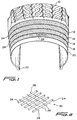
- Fig. 1 is an exploded view of a portion of a bias tire with filling yarns schematically depicted.
- Fig. 2 is an enlarged view of a portion of the tire fabric prior to resorcinol formaldehyde latex dip treatment.
- a tread 10 overlies a bias ply 12 which overlies a second bias ply 14 which overlies a third bias ply 16 which overlies a fourth bias ply 18 which in turn overlies an interliner 20 which terminates in a chafer fabric 22.
- the bias plies 12, 14, 16 and 18 are alternately laid at bias angles of 25 to 40° to the tread direction. Warp cords 24 are depicted in each bias ply and filling yarns 26 are schematically depicted.
- the fabric of the invention herein is used in making of the plies 12, 14, 16 and 18. It is noted that while a bias tire is depicted, the invention herein also applies to tire fabric for bias/belted tires and to tire fabric for radial tires.
- the tire fabric 30 consists of warp cords 24 woven into the fabric by filling yarns 26.
- the warp cords provide the strength and the filling yarns maintain the warp cords in place.
- the fabric is converted into plies for use in tire manufacture. In the processing to produce a tire, the filling yarns are normally broken.
- the filling yarns preferably consist essentially of from 45% to 70% by weight of polyester and from 55% to 30% by weight of high wet modulus rayon and practically consist essentially of from 50% to 65% by weight of polyester and from 50% to 35% by weight of high wet modulus rayon (since polyester/rayon blends are normally 50%/50% or 65%/35%).
- the filling yarns very preferably consist essentially of from 60% to 70% by weight of polyester and from 40% to 30% by weight of high wet modulus rayon and most preferably consist essentially of 65% by weight polyester and 35% by weight high wet modulus rayon.
- Use of greater amounts of polyester than 80% can result in melting during high temperature processing .
- Use of greater amounts of high wet modulus rayon than 60% harms (lessens) elongation at break and increases retained tensile and detracts from minimizing flock formation and from improved tire uniformity.
- the polyester preferably is polyethylene terephthalate.
- the polyester can be polybutylene terephthalate.
- the high wet modulus rayon normally has a wet modulus of 5 to 15 grams/denier.
- the wet modulus is a measure of resistance of the wet fiber to stretching when subjected to tension and is the amount of stress in grams/denier of the fiber required to stretch the fully wet fiber 5% of its length divided by 0.05 which is the strain.
- the filling yarn is readily prepared by intimately blending staple fibers and then spinning, using a conventional spinning process.
- the staple fibers of polyester can be, for example, 1 to 3 inches long and of 1.0 to 3.0 denier.
- the staple fibers of high wet modulus rayon can be, for example, 1 to 3 inches long and 1.0 to 3.0 denier.
- the intimate blending of the staple fibers is readily carried out by intermingling the staple fibers in the appropriate percentages in a mill.
- the spinning process can consist for example of opening, blending, carding, drawing, roving, spinning and winding and can be carried out on either an open end spinning system or a ring spinning system.
- the twist can be either in the "S" or the "Z" direction with either warp or filling twist multipliers to provide for example 10 to 25 turns per inch, preferably from 15 to 20 turns per inch.
- the resulting filling yarn has a cotton count ranging from 15/1 to 30/1.
- warp cords For passenger tires these are filaments having a weight-per-unit-length ranging from 2100 to 3000 denier.
- the weaving is carried out to uniformly space the warp cords across the fabric and is readily carried out by a conventional weaving process, e.g., on a fly shuttle or on a shuttleless loom.
- weaving is carried out to provide 1.0 to 1.5 picks per inch and 15.5 to 32.5 ends per inch.
- the tire fabric is normally resorcinol formaldehyde latex dip treated to coat it for adhesion. It is concomitantly heated and stretched to set tensile, shrinkage and adhesion properties.
- the resorcinol formaldehyde latex dip can be of conventional constitution and comprises, for example, resorcinol formaldehyde resin, vinyl pyridine latex and water.
- the resorcinol formaldehyde resin (consisting essentially of resorcinol-formaldehyde condensation product) is readily available commercially, for example, under the names Inspect Penacolite or Schenectady Resin.
- the vinyl pyridine latex e.g., a 100% vinyl pyridine latex containing 40% solids consisting of 70% butadiene, 15% vinyl pyridine, 15% styrene terpolymer
- Gentac Latex e.g., a 100% vinyl pyridine latex containing 40% solids consisting of 70% butadiene, 15% vinyl pyridine, 15% styrene terpolymer
- the resorcinol formaldehyde resin, the vinyl pyridine latex and water are admixed to form the dip.
- a suitable resorcinol formaldehyde latex dip is described in Hartz U.S. Patent No. 4,137,358. Another suitable dip is described in the Example herein.
- the tire fabric is immersed in a bath of the resorcinol formaldehyde latex dip to coat the fabric with the dip and provide a tire fabric impregnated with resorcinol formaldehyde latex dip.
- the heating and stretching is applied by a hot stretch machine and consists, for example, of heating to 475° to 500°F, typically to 480°F, and stretching to cause the molecules to become highly oriented to heat stabilize the cord, e.g., 2 to 10%.
- the treated fabric is calendered with an even coat of uncured rubber. This is carried out, for example, by a calendering machine which coats both sides of the fabric with uncured rubber compound.
- the calendered fabric is cut on a bias angle, e.g., using a bias cutting machine to produce plies for tire building.
- typically plies are interpositioned with tread and interliner and expansion is carried out to cause 65 to 75% expansion and is concurrently or subsequently cured (molded).
- the chafer fabric is typically applied during tire building.
- Filling yarns were spun from a homogeneous blend consisting of 65% by weight 1.5 denier x 1.5 inch polyethylene terephthalate staple (obtained commercially) and 35% 1.5 denier x 1 9/16 inch high wet modulus rayon staple (obtained commercially) to provide yarn with 16.6 turns per inch and a cotton count of 20/1.
- the variance (square of the standard deviation from the mean) from uniformity is 70% less than in the case with 100% high wet modulus rayon.
- Fabric was woven from the spun filling yarns (the 65/35 polyester/high wet modulus rayon yarns) and polyester warp cords of 2975 denier to provide a fabric 61.50 inches wide with characteristics as follows: filling of 1.00 picks per inch, warp of 29.66 ends per inch, 1,824 total ends, 1.17 linear yards per lb. and 10.96 square yards per ounce.
- the fabric is treated by dipping in a resorcinol formaldehyde latex bath made up from 2.0% Inspect Penacolite, 21% Gentax Latex and 77% water, with application of heating to 480°F and stretching 5%. Essentially no flock is formed to disturb the calendering step.
Landscapes
- Engineering & Computer Science (AREA)
- Textile Engineering (AREA)
- Tires In General (AREA)
- Treatments For Attaching Organic Compounds To Fibrous Goods (AREA)
- Yarns And Mechanical Finishing Of Yarns Or Ropes (AREA)
- Woven Fabrics (AREA)
Applications Claiming Priority (2)
| Application Number | Priority Date | Filing Date | Title |
|---|---|---|---|
| US07/905,611 US5244717A (en) | 1992-06-29 | 1992-06-29 | Tire fabric with polyester/high wet modulus rayon filling |
| US905611 | 1992-06-29 |
Publications (1)
| Publication Number | Publication Date |
|---|---|
| EP0576861A1 true EP0576861A1 (en) | 1994-01-05 |
Family
ID=25421139
Family Applications (1)
| Application Number | Title | Priority Date | Filing Date |
|---|---|---|---|
| EP19930109002 Withdrawn EP0576861A1 (en) | 1992-06-29 | 1993-06-04 | Tire fabric with polyester/high wet modulus rayon filling |
Country Status (5)
| Country | Link |
|---|---|
| US (1) | US5244717A (enExample) |
| EP (1) | EP0576861A1 (enExample) |
| JP (1) | JP3596818B2 (enExample) |
| BR (1) | BR9302688A (enExample) |
| CA (1) | CA2099337A1 (enExample) |
Cited By (2)
| Publication number | Priority date | Publication date | Assignee | Title |
|---|---|---|---|---|
| EP1288357A1 (en) * | 2001-08-10 | 2003-03-05 | Milliken Europe N.V. | Woven cord fabric |
| US20140230205A1 (en) * | 2011-09-28 | 2014-08-21 | Michelin Recherche Et Technique S.A. | Partitioned rubber-coated fabric |
Families Citing this family (4)
| Publication number | Priority date | Publication date | Assignee | Title |
|---|---|---|---|---|
| US6518207B1 (en) * | 1998-07-21 | 2003-02-11 | The Goodyear Tire & Rubber Company | Agricultural belting |
| GB2359097A (en) * | 2000-02-08 | 2001-08-15 | Milliken Europ Nv | Hose and pipe reinforcement |
| US20080245482A1 (en) * | 2007-04-03 | 2008-10-09 | Steinke Richard A | Belt for use in forming a core of plies, beads and belts of a urethane tire |
| EP3390075A4 (en) * | 2015-12-17 | 2019-06-19 | Bridgestone Americas Tire Operations, LLC | TIRE PLATED METAL FABRIC HAVING SPECIFIC FRAME WIRES, RUBBER-COATED TIRE FOLD THEREOF, AND ASSOCIATED METHODS |
Citations (4)
| Publication number | Priority date | Publication date | Assignee | Title |
|---|---|---|---|---|
| FR2238783A1 (enExample) * | 1973-07-28 | 1975-02-21 | Dunlop Ltd | |
| FR2354412A1 (fr) * | 1976-06-10 | 1978-01-06 | Uniroyal Inc | Additifs a des formules de bains de protection d'etoffes et cordes enduites d'adhesifs |
| US4814225A (en) * | 1986-02-18 | 1989-03-21 | Crown Textile Company | Fusible interlining fabric using high wet modulus rayon |
| EP0365465A2 (en) * | 1988-10-17 | 1990-04-25 | The Goodyear Tire & Rubber Company | Tubeless tire containing a barrier ply |
Family Cites Families (17)
| Publication number | Priority date | Publication date | Assignee | Title |
|---|---|---|---|---|
| CA583150A (en) * | 1959-09-15 | Dominion Rubber Company | Conveyor belts | |
| US3529052A (en) * | 1963-02-26 | 1970-09-15 | Fmc Corp | Method of manufacturing rayon fiber |
| US3395744A (en) * | 1966-02-04 | 1968-08-06 | Firestone Tire & Rubber Co | Reinforcing fabric for tires |
| US3720743A (en) * | 1970-10-20 | 1973-03-13 | Itt | Process for producing high performance crimped rayon staple fiber |
| US3979536A (en) * | 1971-07-08 | 1976-09-07 | Uniroyal Inc. | Zero degree belted tires, and high "soft stretch" belt-forming tapes therefor |
| US3941162A (en) * | 1974-03-28 | 1976-03-02 | Uniroyal Inc. | Reinforcing fabric for belts |
| GB1590809A (en) * | 1976-11-05 | 1981-06-10 | Teijin Ltd | Tyre cord fabric and tyre construction |
| US4242405A (en) * | 1979-01-15 | 1980-12-30 | Avtex Fibers Inc. | Viscose rayon and method of making same |
| US4388260A (en) * | 1979-03-16 | 1983-06-14 | Avtex Fibers Inc. | Method of making viscose rayon |
| USRE31457E (en) * | 1979-03-16 | 1983-12-06 | Avtex Fibers Inc. | Viscose rayon |
| US4245000A (en) * | 1979-03-16 | 1981-01-13 | Avtex Fibers Inc. | Viscose rayon |
| JPS56330A (en) * | 1979-06-15 | 1981-01-06 | Teijin Ltd | Original fiber for tire cord textile woof and tire cord textile |
| US4364889A (en) * | 1980-05-15 | 1982-12-21 | Fiber Associates, Inc. | Process for preparing a cotton-like rayon fiber |
| US4487608A (en) * | 1981-07-01 | 1984-12-11 | Lintrend Limited | Dyeing of fibrous materials |
| US4416935A (en) * | 1981-12-11 | 1983-11-22 | E. I. Du Pont De Nemours & Co. | Bulked extensible weft yarn suitable for use as tire cords |
| DE3369353D1 (en) * | 1982-11-02 | 1987-02-26 | Akzo Nv | Adhesive-coated multifilament yarn of an aromatic polyamide and a method for the manufacture thereof |
| US4719144A (en) * | 1986-02-18 | 1988-01-12 | Crown Textile Company | Fusible interlining fabric using high wet modulus rayon |
-
1992
- 1992-06-29 US US07/905,611 patent/US5244717A/en not_active Expired - Lifetime
-
1993
- 1993-06-04 EP EP19930109002 patent/EP0576861A1/en not_active Withdrawn
- 1993-06-24 JP JP17590693A patent/JP3596818B2/ja not_active Expired - Lifetime
- 1993-06-28 CA CA 2099337 patent/CA2099337A1/en not_active Abandoned
- 1993-06-28 BR BR9302688A patent/BR9302688A/pt not_active Application Discontinuation
Patent Citations (4)
| Publication number | Priority date | Publication date | Assignee | Title |
|---|---|---|---|---|
| FR2238783A1 (enExample) * | 1973-07-28 | 1975-02-21 | Dunlop Ltd | |
| FR2354412A1 (fr) * | 1976-06-10 | 1978-01-06 | Uniroyal Inc | Additifs a des formules de bains de protection d'etoffes et cordes enduites d'adhesifs |
| US4814225A (en) * | 1986-02-18 | 1989-03-21 | Crown Textile Company | Fusible interlining fabric using high wet modulus rayon |
| EP0365465A2 (en) * | 1988-10-17 | 1990-04-25 | The Goodyear Tire & Rubber Company | Tubeless tire containing a barrier ply |
Cited By (3)
| Publication number | Priority date | Publication date | Assignee | Title |
|---|---|---|---|---|
| EP1288357A1 (en) * | 2001-08-10 | 2003-03-05 | Milliken Europe N.V. | Woven cord fabric |
| US20140230205A1 (en) * | 2011-09-28 | 2014-08-21 | Michelin Recherche Et Technique S.A. | Partitioned rubber-coated fabric |
| US9931801B2 (en) * | 2011-09-28 | 2018-04-03 | Compagnie Generale Des Etablissements Michelin | Partitioned rubber-coated fabric |
Also Published As
| Publication number | Publication date |
|---|---|
| CA2099337A1 (en) | 1993-12-30 |
| BR9302688A (pt) | 1994-02-08 |
| JPH0641842A (ja) | 1994-02-15 |
| US5244717A (en) | 1993-09-14 |
| JP3596818B2 (ja) | 2004-12-02 |
Similar Documents
| Publication | Publication Date | Title |
|---|---|---|
| US4024895A (en) | Product reinforcing fabric and two-component weft yarn useful therein | |
| US2755214A (en) | Tire cord and method of making same | |
| CA2054848C (en) | Pneumatic tire including gas absorbing cords | |
| US2419922A (en) | Method of producing reinforcing elements | |
| US5651168A (en) | Abrasion resistant chenille yarn and fabric and method for its manufacture | |
| US6855423B2 (en) | Wrapped cord | |
| DE68923038T2 (de) | Monofilament zum Einbetten in Kautschuk. | |
| AU2995277A (en) | Tire Cord Fabric | |
| JP2744974B2 (ja) | タイヤコードのモノフイラメント | |
| US5244717A (en) | Tire fabric with polyester/high wet modulus rayon filling | |
| US2313104A (en) | Plied yarn and cords and process of producing the same | |
| US4845934A (en) | False twisted bulky multifilament yarn, method of making and end use of this yarn | |
| US3921691A (en) | Macrofilamentary yarns and rubber structures reinforced therewith | |
| US4107369A (en) | Fabric having an elastomer coat on face and method of producing same | |
| US20060189237A1 (en) | Synthetic fiber tire fabric for reinforcing rubber and pneumatic tire using the same | |
| US2318120A (en) | Treatment of textile yarns and filaments | |
| US3314847A (en) | Textile | |
| US3507673A (en) | Method of making woven chafer fabric | |
| RU205528U1 (ru) | Ткань кордная полиэфирная | |
| JPH06294072A (ja) | ゴム補強用繊維材料、それを補強材として使用してなる空気入りタイヤ及びその製造方法 | |
| JPS61113852A (ja) | タイヤ補強用織物 | |
| JP4145195B2 (ja) | ゴム補強用合成繊維すだれ織物及びそれを用いた空気入りタイヤ | |
| JP2005154963A (ja) | ゴム補強用合成繊維すだれ織物及びそれを用いた空気入りタイヤ | |
| JPS6035449B2 (ja) | 補強用織物 | |
| EP0413327A2 (de) | Polyester-Monofil für die Karkasse von Gürtelreifen |
Legal Events
| Date | Code | Title | Description |
|---|---|---|---|
| PUAI | Public reference made under article 153(3) epc to a published international application that has entered the european phase |
Free format text: ORIGINAL CODE: 0009012 |
|
| AK | Designated contracting states |
Kind code of ref document: A1 Designated state(s): DE ES FR GB IT |
|
| 17P | Request for examination filed |
Effective date: 19940628 |
|
| STAA | Information on the status of an ep patent application or granted ep patent |
Free format text: STATUS: THE APPLICATION HAS BEEN WITHDRAWN |
|
| 18W | Application withdrawn |
Withdrawal date: 19950221 |