EP0572354A2 - Immobilisierte und gepufferte Gele und Membrane aus Hydroxy-funktionellen Polymeren - Google Patents
Immobilisierte und gepufferte Gele und Membrane aus Hydroxy-funktionellen Polymeren Download PDFInfo
- Publication number
- EP0572354A2 EP0572354A2 EP93810374A EP93810374A EP0572354A2 EP 0572354 A2 EP0572354 A2 EP 0572354A2 EP 93810374 A EP93810374 A EP 93810374A EP 93810374 A EP93810374 A EP 93810374A EP 0572354 A2 EP0572354 A2 EP 0572354A2
- Authority
- EP
- European Patent Office
- Prior art keywords
- basic
- acid
- gel
- diazine
- reaction product
- Prior art date
- Legal status (The legal status is an assumption and is not a legal conclusion. Google has not performed a legal analysis and makes no representation as to the accuracy of the status listed.)
- Granted
Links
- 239000000499 gel Substances 0.000 title claims abstract description 178
- 239000012528 membrane Substances 0.000 title claims abstract description 54
- 125000002887 hydroxy group Chemical group [H]O* 0.000 title claims abstract description 34
- 229920000642 polymer Polymers 0.000 title claims description 75
- 239000002253 acid Substances 0.000 claims abstract description 65
- 239000000203 mixture Substances 0.000 claims abstract description 45
- 150000003918 triazines Chemical class 0.000 claims abstract description 41
- -1 proteins or peptides Chemical class 0.000 claims abstract description 34
- 150000001875 compounds Chemical class 0.000 claims abstract description 19
- 238000001155 isoelectric focusing Methods 0.000 claims abstract description 13
- 229920005615 natural polymer Polymers 0.000 claims abstract 3
- 239000000243 solution Substances 0.000 claims description 67
- 229920000936 Agarose Polymers 0.000 claims description 52
- 239000007795 chemical reaction product Substances 0.000 claims description 48
- 238000000034 method Methods 0.000 claims description 48
- 230000008569 process Effects 0.000 claims description 33
- SEEPANYCNGTZFQ-UHFFFAOYSA-N sulfadiazine Chemical compound C1=CC(N)=CC=C1S(=O)(=O)NC1=NC=CC=N1 SEEPANYCNGTZFQ-UHFFFAOYSA-N 0.000 claims description 29
- 230000007935 neutral effect Effects 0.000 claims description 25
- 238000002360 preparation method Methods 0.000 claims description 24
- 229920001577 copolymer Polymers 0.000 claims description 20
- 238000005266 casting Methods 0.000 claims description 19
- 239000000178 monomer Substances 0.000 claims description 18
- JYEUMXHLPRZUAT-UHFFFAOYSA-N 1,2,3-triazine Chemical compound C1=CN=NN=C1 JYEUMXHLPRZUAT-UHFFFAOYSA-N 0.000 claims description 17
- 238000004132 cross linking Methods 0.000 claims description 17
- 230000002378 acidificating effect Effects 0.000 claims description 16
- 125000004432 carbon atom Chemical group C* 0.000 claims description 16
- 238000006243 chemical reaction Methods 0.000 claims description 16
- 230000003139 buffering effect Effects 0.000 claims description 15
- 239000003153 chemical reaction reagent Substances 0.000 claims description 15
- MGNCLNQXLYJVJD-UHFFFAOYSA-N cyanuric chloride Chemical compound ClC1=NC(Cl)=NC(Cl)=N1 MGNCLNQXLYJVJD-UHFFFAOYSA-N 0.000 claims description 15
- 230000000269 nucleophilic effect Effects 0.000 claims description 15
- 125000000217 alkyl group Chemical group 0.000 claims description 13
- 229920000768 polyamine Polymers 0.000 claims description 11
- 229920002451 polyvinyl alcohol Polymers 0.000 claims description 11
- 235000019422 polyvinyl alcohol Nutrition 0.000 claims description 11
- 239000004971 Cross linker Substances 0.000 claims description 10
- 239000004372 Polyvinyl alcohol Substances 0.000 claims description 10
- 125000001309 chloro group Chemical group Cl* 0.000 claims description 10
- 125000005843 halogen group Chemical group 0.000 claims description 10
- 239000011521 glass Substances 0.000 claims description 8
- IMROMDMJAWUWLK-UHFFFAOYSA-N Ethenol Chemical compound OC=C IMROMDMJAWUWLK-UHFFFAOYSA-N 0.000 claims description 7
- CERQOIWHTDAKMF-UHFFFAOYSA-M Methacrylate Chemical compound CC(=C)C([O-])=O CERQOIWHTDAKMF-UHFFFAOYSA-M 0.000 claims description 7
- 239000011544 gradient gel Substances 0.000 claims description 7
- 229920001519 homopolymer Polymers 0.000 claims description 7
- 239000011159 matrix material Substances 0.000 claims description 7
- IIACRCGMVDHOTQ-UHFFFAOYSA-N sulfamic acid Chemical compound NS(O)(=O)=O IIACRCGMVDHOTQ-UHFFFAOYSA-N 0.000 claims description 7
- GVBHCMNXRKOJRH-UHFFFAOYSA-N 2,4,5,6-tetrachloropyrimidine Chemical compound ClC1=NC(Cl)=C(Cl)C(Cl)=N1 GVBHCMNXRKOJRH-UHFFFAOYSA-N 0.000 claims description 5
- KXDHJXZQYSOELW-UHFFFAOYSA-N Carbamic acid Chemical compound NC(O)=O KXDHJXZQYSOELW-UHFFFAOYSA-N 0.000 claims description 5
- WHNWPMSKXPGLAX-UHFFFAOYSA-N N-Vinyl-2-pyrrolidone Chemical compound C=CN1CCCC1=O WHNWPMSKXPGLAX-UHFFFAOYSA-N 0.000 claims description 5
- 125000003282 alkyl amino group Chemical group 0.000 claims description 5
- 125000002947 alkylene group Chemical group 0.000 claims description 5
- 150000004891 diazines Chemical class 0.000 claims description 5
- LYCAIKOWRPUZTN-UHFFFAOYSA-N ethylene glycol Natural products OCCO LYCAIKOWRPUZTN-UHFFFAOYSA-N 0.000 claims description 5
- 125000001153 fluoro group Chemical group F* 0.000 claims description 5
- 150000004676 glycans Chemical class 0.000 claims description 5
- 229920001282 polysaccharide Polymers 0.000 claims description 5
- 239000005017 polysaccharide Substances 0.000 claims description 5
- NIXOWILDQLNWCW-UHFFFAOYSA-M Acrylate Chemical compound [O-]C(=O)C=C NIXOWILDQLNWCW-UHFFFAOYSA-M 0.000 claims description 4
- QYKIQEUNHZKYBP-UHFFFAOYSA-N Vinyl ether Chemical compound C=COC=C QYKIQEUNHZKYBP-UHFFFAOYSA-N 0.000 claims description 4
- 238000001816 cooling Methods 0.000 claims description 4
- WGCNASOHLSPBMP-UHFFFAOYSA-N hydroxyacetaldehyde Natural products OCC=O WGCNASOHLSPBMP-UHFFFAOYSA-N 0.000 claims description 4
- 230000000379 polymerizing effect Effects 0.000 claims description 4
- 230000009257 reactivity Effects 0.000 claims description 4
- 125000000020 sulfo group Chemical group O=S(=O)([*])O[H] 0.000 claims description 4
- RWSOTUBLDIXVET-UHFFFAOYSA-O sulfonium Chemical compound [SH3+] RWSOTUBLDIXVET-UHFFFAOYSA-O 0.000 claims description 4
- 238000004448 titration Methods 0.000 claims description 4
- 229920001567 vinyl ester resin Polymers 0.000 claims description 4
- 239000011240 wet gel Substances 0.000 claims description 4
- BAVYZALUXZFZLV-UHFFFAOYSA-N Methylamine Chemical compound NC BAVYZALUXZFZLV-UHFFFAOYSA-N 0.000 claims description 3
- 125000003545 alkoxy group Chemical group 0.000 claims description 3
- 125000000129 anionic group Chemical group 0.000 claims description 3
- 229920001400 block copolymer Polymers 0.000 claims description 3
- MVBJSQCJPSRKSW-UHFFFAOYSA-N n-[1,3-dihydroxy-2-(hydroxymethyl)propan-2-yl]prop-2-enamide Chemical compound OCC(CO)(CO)NC(=O)C=C MVBJSQCJPSRKSW-UHFFFAOYSA-N 0.000 claims description 3
- 229920001897 terpolymer Polymers 0.000 claims description 3
- 150000001252 acrylic acid derivatives Chemical class 0.000 claims description 2
- 125000002091 cationic group Chemical group 0.000 claims description 2
- 238000006073 displacement reaction Methods 0.000 claims description 2
- 239000011259 mixed solution Substances 0.000 claims description 2
- 239000012736 aqueous medium Substances 0.000 claims 2
- FNXLCIKXHOPCKH-UHFFFAOYSA-N bromamine Chemical compound BrN FNXLCIKXHOPCKH-UHFFFAOYSA-N 0.000 claims 2
- BXDAOUXDMHXPDI-UHFFFAOYSA-N trifluoperazine hydrochloride Chemical compound [H+].[H+].[Cl-].[Cl-].C1CN(C)CCN1CCCN1C2=CC(C(F)(F)F)=CC=C2SC2=CC=CC=C21 BXDAOUXDMHXPDI-UHFFFAOYSA-N 0.000 claims 1
- 102000004169 proteins and genes Human genes 0.000 abstract description 25
- 108090000623 proteins and genes Proteins 0.000 abstract description 25
- 238000001962 electrophoresis Methods 0.000 abstract description 4
- 102000004196 processed proteins & peptides Human genes 0.000 abstract description 3
- 108090000765 processed proteins & peptides Proteins 0.000 abstract description 3
- 229920001059 synthetic polymer Polymers 0.000 abstract 1
- CSCPPACGZOOCGX-UHFFFAOYSA-N Acetone Chemical compound CC(C)=O CSCPPACGZOOCGX-UHFFFAOYSA-N 0.000 description 57
- XLYOFNOQVPJJNP-UHFFFAOYSA-N water Substances O XLYOFNOQVPJJNP-UHFFFAOYSA-N 0.000 description 33
- 239000000872 buffer Substances 0.000 description 26
- PEDCQBHIVMGVHV-UHFFFAOYSA-N Glycerine Chemical compound OCC(O)CO PEDCQBHIVMGVHV-UHFFFAOYSA-N 0.000 description 21
- HEMHJVSKTPXQMS-UHFFFAOYSA-M Sodium hydroxide Chemical compound [OH-].[Na+] HEMHJVSKTPXQMS-UHFFFAOYSA-M 0.000 description 21
- 239000008367 deionised water Substances 0.000 description 13
- 229910021641 deionized water Inorganic materials 0.000 description 13
- DHMQDGOQFOQNFH-UHFFFAOYSA-N Glycine Chemical compound NCC(O)=O DHMQDGOQFOQNFH-UHFFFAOYSA-N 0.000 description 11
- 238000006116 polymerization reaction Methods 0.000 description 11
- 238000013459 approach Methods 0.000 description 10
- 238000009739 binding Methods 0.000 description 10
- 230000002441 reversible effect Effects 0.000 description 10
- BTCSSZJGUNDROE-UHFFFAOYSA-N gamma-aminobutyric acid Chemical compound NCCCC(O)=O BTCSSZJGUNDROE-UHFFFAOYSA-N 0.000 description 9
- 239000000017 hydrogel Substances 0.000 description 9
- 239000012535 impurity Substances 0.000 description 9
- 239000011543 agarose gel Substances 0.000 description 8
- 239000012620 biological material Substances 0.000 description 8
- 239000003431 cross linking reagent Substances 0.000 description 8
- RWIVICVCHVMHMU-UHFFFAOYSA-N n-aminoethylmorpholine Chemical compound NCCN1CCOCC1 RWIVICVCHVMHMU-UHFFFAOYSA-N 0.000 description 8
- 239000000126 substance Substances 0.000 description 7
- IHDBZCJYSHDCKF-UHFFFAOYSA-N 4,6-dichlorotriazine Chemical class ClC1=CC(Cl)=NN=N1 IHDBZCJYSHDCKF-UHFFFAOYSA-N 0.000 description 6
- 230000015572 biosynthetic process Effects 0.000 description 6
- 229920002401 polyacrylamide Polymers 0.000 description 6
- 239000000047 product Substances 0.000 description 6
- GETQZCLCWQTVFV-UHFFFAOYSA-N trimethylamine Chemical compound CN(C)C GETQZCLCWQTVFV-UHFFFAOYSA-N 0.000 description 6
- 239000004471 Glycine Substances 0.000 description 5
- 230000008901 benefit Effects 0.000 description 5
- 230000005684 electric field Effects 0.000 description 5
- 239000000463 material Substances 0.000 description 5
- 239000011148 porous material Substances 0.000 description 5
- 238000000926 separation method Methods 0.000 description 5
- 238000007873 sieving Methods 0.000 description 5
- 239000002904 solvent Substances 0.000 description 5
- 238000003756 stirring Methods 0.000 description 5
- OZAIFHULBGXAKX-UHFFFAOYSA-N 2-(2-cyanopropan-2-yldiazenyl)-2-methylpropanenitrile Chemical compound N#CC(C)(C)N=NC(C)(C)C#N OZAIFHULBGXAKX-UHFFFAOYSA-N 0.000 description 4
- WOBHKFSMXKNTIM-UHFFFAOYSA-N Hydroxyethyl methacrylate Chemical compound CC(=C)C(=O)OCCO WOBHKFSMXKNTIM-UHFFFAOYSA-N 0.000 description 4
- JGFZNNIVVJXRND-UHFFFAOYSA-N N,N-Diisopropylethylamine (DIPEA) Chemical compound CCN(C(C)C)C(C)C JGFZNNIVVJXRND-UHFFFAOYSA-N 0.000 description 4
- JLTDJTHDQAWBAV-UHFFFAOYSA-N N,N-dimethylaniline Chemical compound CN(C)C1=CC=CC=C1 JLTDJTHDQAWBAV-UHFFFAOYSA-N 0.000 description 4
- 239000003929 acidic solution Substances 0.000 description 4
- 239000007864 aqueous solution Substances 0.000 description 4
- 239000003637 basic solution Substances 0.000 description 4
- 238000007334 copolymerization reaction Methods 0.000 description 4
- 230000000694 effects Effects 0.000 description 4
- 239000003999 initiator Substances 0.000 description 4
- 229920002338 polyhydroxyethylmethacrylate Polymers 0.000 description 4
- 241000894007 species Species 0.000 description 4
- OISVCGZHLKNMSJ-UHFFFAOYSA-N 2,6-dimethylpyridine Chemical compound CC1=CC=CC(C)=N1 OISVCGZHLKNMSJ-UHFFFAOYSA-N 0.000 description 3
- MUBZPKHOEPUJKR-UHFFFAOYSA-N Oxalic acid Chemical compound OC(=O)C(O)=O MUBZPKHOEPUJKR-UHFFFAOYSA-N 0.000 description 3
- 239000000370 acceptor Substances 0.000 description 3
- 150000001412 amines Chemical class 0.000 description 3
- 229940124277 aminobutyric acid Drugs 0.000 description 3
- 230000004888 barrier function Effects 0.000 description 3
- 239000003795 chemical substances by application Substances 0.000 description 3
- 238000004140 cleaning Methods 0.000 description 3
- 230000003247 decreasing effect Effects 0.000 description 3
- 238000007872 degassing Methods 0.000 description 3
- UAOMVDZJSHZZME-UHFFFAOYSA-N diisopropylamine Chemical compound CC(C)NC(C)C UAOMVDZJSHZZME-UHFFFAOYSA-N 0.000 description 3
- 229960003692 gamma aminobutyric acid Drugs 0.000 description 3
- 230000007062 hydrolysis Effects 0.000 description 3
- 238000006460 hydrolysis reaction Methods 0.000 description 3
- 125000003010 ionic group Chemical group 0.000 description 3
- 239000012633 leachable Substances 0.000 description 3
- 229920002521 macromolecule Polymers 0.000 description 3
- 238000002156 mixing Methods 0.000 description 3
- 230000035699 permeability Effects 0.000 description 3
- 150000003230 pyrimidines Chemical class 0.000 description 3
- 150000003512 tertiary amines Chemical class 0.000 description 3
- 229920003169 water-soluble polymer Polymers 0.000 description 3
- QAGFPFWZCJWYRP-UHFFFAOYSA-N 1,1-bis(hydroxymethyl)urea Chemical compound NC(=O)N(CO)CO QAGFPFWZCJWYRP-UHFFFAOYSA-N 0.000 description 2
- JIHQDMXYYFUGFV-UHFFFAOYSA-N 1,3,5-triazine Chemical class C1=NC=NC=N1 JIHQDMXYYFUGFV-UHFFFAOYSA-N 0.000 description 2
- BWZVCCNYKMEVEX-UHFFFAOYSA-N 2,4,6-Trimethylpyridine Chemical compound CC1=CC(C)=NC(C)=C1 BWZVCCNYKMEVEX-UHFFFAOYSA-N 0.000 description 2
- IKHGUXGNUITLKF-UHFFFAOYSA-N Acetaldehyde Chemical compound CC=O IKHGUXGNUITLKF-UHFFFAOYSA-N 0.000 description 2
- HRPVXLWXLXDGHG-UHFFFAOYSA-N Acrylamide Chemical compound NC(=O)C=C HRPVXLWXLXDGHG-UHFFFAOYSA-N 0.000 description 2
- QGZKDVFQNNGYKY-UHFFFAOYSA-N Ammonia Chemical compound N QGZKDVFQNNGYKY-UHFFFAOYSA-N 0.000 description 2
- QGZKDVFQNNGYKY-UHFFFAOYSA-O Ammonium Chemical compound [NH4+] QGZKDVFQNNGYKY-UHFFFAOYSA-O 0.000 description 2
- VEXZGXHMUGYJMC-UHFFFAOYSA-M Chloride anion Chemical compound [Cl-] VEXZGXHMUGYJMC-UHFFFAOYSA-M 0.000 description 2
- RTZKZFJDLAIYFH-UHFFFAOYSA-N Diethyl ether Chemical compound CCOCC RTZKZFJDLAIYFH-UHFFFAOYSA-N 0.000 description 2
- YNAVUWVOSKDBBP-UHFFFAOYSA-N Morpholine Chemical compound C1COCCN1 YNAVUWVOSKDBBP-UHFFFAOYSA-N 0.000 description 2
- RIXQYKVMWLKVBI-UHFFFAOYSA-N NC(C(=O)O)CC.ClC1=CC(=NN=N1)Cl Chemical compound NC(C(=O)O)CC.ClC1=CC(=NN=N1)Cl RIXQYKVMWLKVBI-UHFFFAOYSA-N 0.000 description 2
- 241000700605 Viruses Species 0.000 description 2
- 239000000654 additive Substances 0.000 description 2
- 125000003118 aryl group Chemical group 0.000 description 2
- UCMIRNVEIXFBKS-UHFFFAOYSA-N beta-alanine Chemical compound NCCC(O)=O UCMIRNVEIXFBKS-UHFFFAOYSA-N 0.000 description 2
- 125000001246 bromo group Chemical group Br* 0.000 description 2
- 230000000711 cancerogenic effect Effects 0.000 description 2
- 238000005251 capillar electrophoresis Methods 0.000 description 2
- 231100000315 carcinogenic Toxicity 0.000 description 2
- 239000003054 catalyst Substances 0.000 description 2
- 230000002860 competitive effect Effects 0.000 description 2
- 239000006184 cosolvent Substances 0.000 description 2
- 238000004090 dissolution Methods 0.000 description 2
- FJKIXWOMBXYWOQ-UHFFFAOYSA-N ethenoxyethane Chemical compound CCOC=C FJKIXWOMBXYWOQ-UHFFFAOYSA-N 0.000 description 2
- 125000000524 functional group Chemical group 0.000 description 2
- 150000004820 halides Chemical class 0.000 description 2
- 229910052736 halogen Inorganic materials 0.000 description 2
- 150000002367 halogens Chemical class 0.000 description 2
- 238000010438 heat treatment Methods 0.000 description 2
- 229920001477 hydrophilic polymer Polymers 0.000 description 2
- 230000002209 hydrophobic effect Effects 0.000 description 2
- 239000012948 isocyanate Substances 0.000 description 2
- 239000007788 liquid Substances 0.000 description 2
- 125000002496 methyl group Chemical group [H]C([H])([H])* 0.000 description 2
- 239000012457 nonaqueous media Substances 0.000 description 2
- 231100000252 nontoxic Toxicity 0.000 description 2
- 230000003000 nontoxic effect Effects 0.000 description 2
- 150000002989 phenols Chemical class 0.000 description 2
- 238000000746 purification Methods 0.000 description 2
- 125000001453 quaternary ammonium group Chemical group 0.000 description 2
- 239000007787 solid Substances 0.000 description 2
- 238000007711 solidification Methods 0.000 description 2
- 230000008023 solidification Effects 0.000 description 2
- 238000001179 sorption measurement Methods 0.000 description 2
- HMYDRWZDTWVLGO-UHFFFAOYSA-N (2,2-diethoxy-2-hydroxyethyl) 2-methylprop-2-enoate Chemical compound CCOC(O)(OCC)COC(=O)C(C)=C HMYDRWZDTWVLGO-UHFFFAOYSA-N 0.000 description 1
- URYWXMHZLSZSNE-UHFFFAOYSA-N (2,2-diethoxy-2-methoxyethyl) 2-methylprop-2-enoate Chemical compound CCOC(OCC)(OC)COC(=O)C(C)=C URYWXMHZLSZSNE-UHFFFAOYSA-N 0.000 description 1
- 125000004178 (C1-C4) alkyl group Chemical group 0.000 description 1
- 229920002818 (Hydroxyethyl)methacrylate Polymers 0.000 description 1
- ZTNJGMFHJYGMDR-UHFFFAOYSA-N 1,2-diisocyanatoethane Chemical compound O=C=NCCN=C=O ZTNJGMFHJYGMDR-UHFFFAOYSA-N 0.000 description 1
- AUHZEENZYGFFBQ-UHFFFAOYSA-N 1,3,5-Me3C6H3 Natural products CC1=CC(C)=CC(C)=C1 AUHZEENZYGFFBQ-UHFFFAOYSA-N 0.000 description 1
- XOAHPHMWZIPIHH-UHFFFAOYSA-N 2,2-dichloro-2-(triazin-4-ylamino)acetic acid Chemical compound OC(=O)C(Cl)(Cl)NC1=CC=NN=N1 XOAHPHMWZIPIHH-UHFFFAOYSA-N 0.000 description 1
- NGCRLFIYVFOUMZ-UHFFFAOYSA-N 2,3-dichloroquinoxaline-6-carbonyl chloride Chemical compound N1=C(Cl)C(Cl)=NC2=CC(C(=O)Cl)=CC=C21 NGCRLFIYVFOUMZ-UHFFFAOYSA-N 0.000 description 1
- VHYBUUMUUNCHCK-UHFFFAOYSA-N 2,4,6-tribromo-1,3,5-triazine Chemical compound BrC1=NC(Br)=NC(Br)=N1 VHYBUUMUUNCHCK-UHFFFAOYSA-N 0.000 description 1
- OLQFXOWPTQTLDP-UHFFFAOYSA-N 2-(2-hydroxyethoxy)ethyl 2-methylprop-2-enoate Chemical compound CC(=C)C(=O)OCCOCCO OLQFXOWPTQTLDP-UHFFFAOYSA-N 0.000 description 1
- DAVVKEZTUOGEAK-UHFFFAOYSA-N 2-(2-methoxyethoxy)ethyl 2-methylprop-2-enoate Chemical compound COCCOCCOC(=O)C(C)=C DAVVKEZTUOGEAK-UHFFFAOYSA-N 0.000 description 1
- XMNIXWIUMCBBBL-UHFFFAOYSA-N 2-(2-phenylpropan-2-ylperoxy)propan-2-ylbenzene Chemical compound C=1C=CC=CC=1C(C)(C)OOC(C)(C)C1=CC=CC=C1 XMNIXWIUMCBBBL-UHFFFAOYSA-N 0.000 description 1
- AMZDVZVJQSDJRG-UHFFFAOYSA-N 2-[(3,5-dichloro-2,4-dihydrotriazin-1-yl)amino]acetic acid Chemical compound OC(=O)CNN1NN(Cl)CC(Cl)=C1 AMZDVZVJQSDJRG-UHFFFAOYSA-N 0.000 description 1
- IVLXQGJVBGMLRR-UHFFFAOYSA-N 2-aminoacetic acid;hydron;chloride Chemical compound Cl.NCC(O)=O IVLXQGJVBGMLRR-UHFFFAOYSA-N 0.000 description 1
- XDZZQMNDCFNREN-UHFFFAOYSA-N 2-azaniumylpropane-1-sulfonate Chemical compound CC(N)CS(O)(=O)=O XDZZQMNDCFNREN-UHFFFAOYSA-N 0.000 description 1
- YXYJVFYWCLAXHO-UHFFFAOYSA-N 2-methoxyethyl 2-methylprop-2-enoate Chemical compound COCCOC(=O)C(C)=C YXYJVFYWCLAXHO-UHFFFAOYSA-N 0.000 description 1
- XWKFPIODWVPXLX-UHFFFAOYSA-N 2-methyl-5-methylpyridine Natural products CC1=CC=C(C)N=C1 XWKFPIODWVPXLX-UHFFFAOYSA-N 0.000 description 1
- TYEXNUYOCCZOEF-UHFFFAOYSA-N 3,5-dichloro-n-(2-morpholin-4-ylethyl)-2,4-dihydrotriazin-1-amine Chemical compound N1N(Cl)CC(Cl)=CN1NCCN1CCOCC1 TYEXNUYOCCZOEF-UHFFFAOYSA-N 0.000 description 1
- ZKWIJCLSZRCDKK-UHFFFAOYSA-N 3,5-dichloro-n-(3-morpholin-4-ylpropyl)-2,4-dihydrotriazin-1-amine Chemical compound N1N(Cl)CC(Cl)=CN1NCCCN1CCOCC1 ZKWIJCLSZRCDKK-UHFFFAOYSA-N 0.000 description 1
- UIKUBYKUYUSRSM-UHFFFAOYSA-N 3-morpholinopropylamine Chemical compound NCCCN1CCOCC1 UIKUBYKUYUSRSM-UHFFFAOYSA-N 0.000 description 1
- WENRBDYSXGOIGG-UHFFFAOYSA-N 4,6-dichlorotriazine 2-morpholin-4-ylethanamine Chemical compound NCCN1CCOCC1.ClC1=CC(=NN=N1)Cl WENRBDYSXGOIGG-UHFFFAOYSA-N 0.000 description 1
- VHYFNPMBLIVWCW-UHFFFAOYSA-N 4-Dimethylaminopyridine Chemical compound CN(C)C1=CC=NC=C1 VHYFNPMBLIVWCW-UHFFFAOYSA-N 0.000 description 1
- RGUKYNXWOWSRET-UHFFFAOYSA-N 4-pyrrolidin-1-ylpyridine Chemical compound C1CCCN1C1=CC=NC=C1 RGUKYNXWOWSRET-UHFFFAOYSA-N 0.000 description 1
- CPELXLSAUQHCOX-UHFFFAOYSA-M Bromide Chemical compound [Br-] CPELXLSAUQHCOX-UHFFFAOYSA-M 0.000 description 1
- RWDZPIIZXNTQAX-UHFFFAOYSA-N ClC1C(N(CCO1)CCN)(C1=NN=NC=C1)Cl Chemical compound ClC1C(N(CCO1)CCN)(C1=NN=NC=C1)Cl RWDZPIIZXNTQAX-UHFFFAOYSA-N 0.000 description 1
- VGGSQFUCUMXWEO-UHFFFAOYSA-N Ethene Chemical compound C=C VGGSQFUCUMXWEO-UHFFFAOYSA-N 0.000 description 1
- 239000005977 Ethylene Substances 0.000 description 1
- WQZGKKKJIJFFOK-GASJEMHNSA-N Glucose Natural products OC[C@H]1OC(O)[C@H](O)[C@@H](O)[C@@H]1O WQZGKKKJIJFFOK-GASJEMHNSA-N 0.000 description 1
- SXRSQZLOMIGNAQ-UHFFFAOYSA-N Glutaraldehyde Chemical compound O=CCCCC=O SXRSQZLOMIGNAQ-UHFFFAOYSA-N 0.000 description 1
- 239000006173 Good's buffer Substances 0.000 description 1
- CERQOIWHTDAKMF-UHFFFAOYSA-N Methacrylic acid Chemical compound CC(=C)C(O)=O CERQOIWHTDAKMF-UHFFFAOYSA-N 0.000 description 1
- 229920002845 Poly(methacrylic acid) Polymers 0.000 description 1
- OFOBLEOULBTSOW-UHFFFAOYSA-N Propanedioic acid Natural products OC(=O)CC(O)=O OFOBLEOULBTSOW-UHFFFAOYSA-N 0.000 description 1
- 229910006069 SO3H Inorganic materials 0.000 description 1
- 229920002125 Sokalan® Polymers 0.000 description 1
- 229930006000 Sucrose Natural products 0.000 description 1
- WYURNTSHIVDZCO-UHFFFAOYSA-N Tetrahydrofuran Chemical compound C1CCOC1 WYURNTSHIVDZCO-UHFFFAOYSA-N 0.000 description 1
- XTXRWKRVRITETP-UHFFFAOYSA-N Vinyl acetate Chemical compound CC(=O)OC=C XTXRWKRVRITETP-UHFFFAOYSA-N 0.000 description 1
- MBHRHUJRKGNOKX-UHFFFAOYSA-N [(4,6-diamino-1,3,5-triazin-2-yl)amino]methanol Chemical class NC1=NC(N)=NC(NCO)=N1 MBHRHUJRKGNOKX-UHFFFAOYSA-N 0.000 description 1
- USDJGQLNFPZEON-UHFFFAOYSA-N [[4,6-bis(hydroxymethylamino)-1,3,5-triazin-2-yl]amino]methanol Chemical compound OCNC1=NC(NCO)=NC(NCO)=N1 USDJGQLNFPZEON-UHFFFAOYSA-N 0.000 description 1
- 150000007513 acids Chemical class 0.000 description 1
- 239000011149 active material Substances 0.000 description 1
- 150000001299 aldehydes Chemical class 0.000 description 1
- 125000001931 aliphatic group Chemical group 0.000 description 1
- 125000003342 alkenyl group Chemical group 0.000 description 1
- 150000003973 alkyl amines Chemical class 0.000 description 1
- 125000005210 alkyl ammonium group Chemical group 0.000 description 1
- 125000004390 alkyl sulfonyl group Chemical group 0.000 description 1
- ZHWLPDIRXJCEJY-UHFFFAOYSA-N alpha-hydroxyglycine Chemical compound NC(O)C(O)=O ZHWLPDIRXJCEJY-UHFFFAOYSA-N 0.000 description 1
- 150000001408 amides Chemical class 0.000 description 1
- 150000001413 amino acids Chemical class 0.000 description 1
- 125000003277 amino group Chemical group 0.000 description 1
- 229910021529 ammonia Inorganic materials 0.000 description 1
- 150000001448 anilines Chemical class 0.000 description 1
- 239000000010 aprotic solvent Substances 0.000 description 1
- 239000003125 aqueous solvent Substances 0.000 description 1
- 150000007514 bases Chemical class 0.000 description 1
- 125000003236 benzoyl group Chemical group [H]C1=C([H])C([H])=C(C([H])=C1[H])C(*)=O 0.000 description 1
- WQZGKKKJIJFFOK-VFUOTHLCSA-N beta-D-glucose Chemical compound OC[C@H]1O[C@@H](O)[C@H](O)[C@@H](O)[C@@H]1O WQZGKKKJIJFFOK-VFUOTHLCSA-N 0.000 description 1
- 238000002306 biochemical method Methods 0.000 description 1
- 238000005460 biophysical method Methods 0.000 description 1
- 238000011138 biotechnological process Methods 0.000 description 1
- 239000007853 buffer solution Substances 0.000 description 1
- 229910052799 carbon Inorganic materials 0.000 description 1
- 125000005518 carboxamido group Chemical group 0.000 description 1
- 125000003178 carboxy group Chemical group [H]OC(*)=O 0.000 description 1
- 150000001735 carboxylic acids Chemical class 0.000 description 1
- 125000002057 carboxymethyl group Chemical group [H]OC(=O)C([H])([H])[*] 0.000 description 1
- 238000010382 chemical cross-linking Methods 0.000 description 1
- 238000001311 chemical methods and process Methods 0.000 description 1
- 239000007859 condensation product Substances 0.000 description 1
- VMKJWLXVLHBJNK-UHFFFAOYSA-N cyanuric fluoride Chemical compound FC1=NC(F)=NC(F)=N1 VMKJWLXVLHBJNK-UHFFFAOYSA-N 0.000 description 1
- 230000002939 deleterious effect Effects 0.000 description 1
- 230000001419 dependent effect Effects 0.000 description 1
- 238000001212 derivatisation Methods 0.000 description 1
- 238000000502 dialysis Methods 0.000 description 1
- 150000005690 diesters Chemical class 0.000 description 1
- 238000009792 diffusion process Methods 0.000 description 1
- 229940043279 diisopropylamine Drugs 0.000 description 1
- IUNMPGNGSSIWFP-UHFFFAOYSA-N dimethylaminopropylamine Chemical compound CN(C)CCCN IUNMPGNGSSIWFP-UHFFFAOYSA-N 0.000 description 1
- AFOSIXZFDONLBT-UHFFFAOYSA-N divinyl sulfone Chemical class C=CS(=O)(=O)C=C AFOSIXZFDONLBT-UHFFFAOYSA-N 0.000 description 1
- 238000005370 electroosmosis Methods 0.000 description 1
- 150000002118 epoxides Chemical class 0.000 description 1
- 238000011067 equilibration Methods 0.000 description 1
- 150000002148 esters Chemical class 0.000 description 1
- 125000001495 ethyl group Chemical group [H]C([H])([H])C([H])([H])* 0.000 description 1
- 239000012527 feed solution Substances 0.000 description 1
- 238000000855 fermentation Methods 0.000 description 1
- 230000004151 fermentation Effects 0.000 description 1
- 238000011049 filling Methods 0.000 description 1
- 238000001502 gel electrophoresis Methods 0.000 description 1
- 239000008103 glucose Substances 0.000 description 1
- 150000002332 glycine derivatives Chemical class 0.000 description 1
- 239000012456 homogeneous solution Substances 0.000 description 1
- 150000002433 hydrophilic molecules Chemical class 0.000 description 1
- 150000001261 hydroxy acids Chemical class 0.000 description 1
- 125000002768 hydroxyalkyl group Chemical group 0.000 description 1
- 239000005457 ice water Substances 0.000 description 1
- 150000002500 ions Chemical class 0.000 description 1
- 150000002605 large molecules Chemical class 0.000 description 1
- 230000000670 limiting effect Effects 0.000 description 1
- 231100000053 low toxicity Toxicity 0.000 description 1
- VZCYOOQTPOCHFL-UPHRSURJSA-N maleic acid Chemical compound OC(=O)\C=C/C(O)=O VZCYOOQTPOCHFL-UPHRSURJSA-N 0.000 description 1
- 239000011976 maleic acid Substances 0.000 description 1
- 238000004519 manufacturing process Methods 0.000 description 1
- 239000000155 melt Substances 0.000 description 1
- 150000002734 metacrylic acid derivatives Chemical class 0.000 description 1
- LCGLNKUTAGEVQW-UHFFFAOYSA-N methyl monoether Natural products COC LCGLNKUTAGEVQW-UHFFFAOYSA-N 0.000 description 1
- QOHMWDJIBGVPIF-UHFFFAOYSA-N n',n'-diethylpropane-1,3-diamine Chemical compound CCN(CC)CCCN QOHMWDJIBGVPIF-UHFFFAOYSA-N 0.000 description 1
- DILRJUIACXKSQE-UHFFFAOYSA-N n',n'-dimethylethane-1,2-diamine Chemical compound CN(C)CCN DILRJUIACXKSQE-UHFFFAOYSA-N 0.000 description 1
- LNUUNRQWWNQTRN-UHFFFAOYSA-N n-(3,5-dichloro-2,4-dihydrotriazin-1-yl)-n',n'-diethylpropane-1,3-diamine Chemical compound CCN(CC)CCCNN1NN(Cl)CC(Cl)=C1 LNUUNRQWWNQTRN-UHFFFAOYSA-N 0.000 description 1
- IUXHJNVIOWJIHV-UHFFFAOYSA-N n-(3,5-dichloro-2,4-dihydrotriazin-1-yl)-n',n'-dimethylethane-1,2-diamine Chemical compound CN(C)CCNN1NN(Cl)CC(Cl)=C1 IUXHJNVIOWJIHV-UHFFFAOYSA-N 0.000 description 1
- GCQBZQMAGBZRHH-UHFFFAOYSA-N n-(3,5-dichloro-2,4-dihydrotriazin-1-yl)-n',n'-dimethylpropane-1,3-diamine Chemical compound CN(C)CCCNN1NN(Cl)CC(Cl)=C1 GCQBZQMAGBZRHH-UHFFFAOYSA-N 0.000 description 1
- 150000007523 nucleic acids Chemical class 0.000 description 1
- 102000039446 nucleic acids Human genes 0.000 description 1
- 108020004707 nucleic acids Proteins 0.000 description 1
- 238000010534 nucleophilic substitution reaction Methods 0.000 description 1
- 150000002894 organic compounds Chemical class 0.000 description 1
- 235000006408 oxalic acid Nutrition 0.000 description 1
- 230000037361 pathway Effects 0.000 description 1
- 150000002978 peroxides Chemical class 0.000 description 1
- 150000004965 peroxy acids Chemical class 0.000 description 1
- 125000001997 phenyl group Chemical group [H]C1=C([H])C([H])=C(*)C([H])=C1[H] 0.000 description 1
- XYFCBTPGUUZFHI-UHFFFAOYSA-O phosphonium Chemical compound [PH4+] XYFCBTPGUUZFHI-UHFFFAOYSA-O 0.000 description 1
- 125000005496 phosphonium group Chemical group 0.000 description 1
- 239000003505 polymerization initiator Substances 0.000 description 1
- 229920002717 polyvinylpyridine Polymers 0.000 description 1
- 239000002244 precipitate Substances 0.000 description 1
- OVARTBFNCCXQKS-UHFFFAOYSA-N propan-2-one;hydrate Chemical compound O.CC(C)=O OVARTBFNCCXQKS-UHFFFAOYSA-N 0.000 description 1
- 125000002572 propoxy group Chemical group [*]OC([H])([H])C(C([H])([H])[H])([H])[H] 0.000 description 1
- 125000001436 propyl group Chemical group [H]C([*])([H])C([H])([H])C([H])([H])[H] 0.000 description 1
- 238000001742 protein purification Methods 0.000 description 1
- 150000003222 pyridines Chemical class 0.000 description 1
- JUJWROOIHBZHMG-UHFFFAOYSA-O pyridinium Chemical compound C1=CC=[NH+]C=C1 JUJWROOIHBZHMG-UHFFFAOYSA-O 0.000 description 1
- 150000003254 radicals Chemical class 0.000 description 1
- 239000011541 reaction mixture Substances 0.000 description 1
- 239000012070 reactive reagent Substances 0.000 description 1
- 238000011084 recovery Methods 0.000 description 1
- 230000002829 reductive effect Effects 0.000 description 1
- 239000000758 substrate Substances 0.000 description 1
- 239000005720 sucrose Substances 0.000 description 1
- 230000008961 swelling Effects 0.000 description 1
- GFYHSKONPJXCDE-UHFFFAOYSA-N sym-collidine Natural products CC1=CN=C(C)C(C)=C1 GFYHSKONPJXCDE-UHFFFAOYSA-N 0.000 description 1
- 238000003786 synthesis reaction Methods 0.000 description 1
- 231100000331 toxic Toxicity 0.000 description 1
- 230000002588 toxic effect Effects 0.000 description 1
- 231100000419 toxicity Toxicity 0.000 description 1
- 230000001988 toxicity Effects 0.000 description 1
- VZCYOOQTPOCHFL-UHFFFAOYSA-N trans-butenedioic acid Natural products OC(=O)C=CC(O)=O VZCYOOQTPOCHFL-UHFFFAOYSA-N 0.000 description 1
- 125000004306 triazinyl group Chemical group 0.000 description 1
- 125000000391 vinyl group Chemical group [H]C([*])=C([H])[H] 0.000 description 1
- 238000005406 washing Methods 0.000 description 1
Images

Classifications
-
- G—PHYSICS
- G01—MEASURING; TESTING
- G01N—INVESTIGATING OR ANALYSING MATERIALS BY DETERMINING THEIR CHEMICAL OR PHYSICAL PROPERTIES
- G01N27/00—Investigating or analysing materials by the use of electric, electrochemical, or magnetic means
- G01N27/26—Investigating or analysing materials by the use of electric, electrochemical, or magnetic means by investigating electrochemical variables; by using electrolysis or electrophoresis
- G01N27/416—Systems
- G01N27/447—Systems using electrophoresis
- G01N27/44756—Apparatus specially adapted therefor
- G01N27/44795—Isoelectric focusing
-
- B—PERFORMING OPERATIONS; TRANSPORTING
- B01—PHYSICAL OR CHEMICAL PROCESSES OR APPARATUS IN GENERAL
- B01D—SEPARATION
- B01D57/00—Separation, other than separation of solids, not fully covered by a single other group or subclass, e.g. B03C
- B01D57/02—Separation, other than separation of solids, not fully covered by a single other group or subclass, e.g. B03C by electrophoresis
-
- C—CHEMISTRY; METALLURGY
- C08—ORGANIC MACROMOLECULAR COMPOUNDS; THEIR PREPARATION OR CHEMICAL WORKING-UP; COMPOSITIONS BASED THEREON
- C08B—POLYSACCHARIDES; DERIVATIVES THEREOF
- C08B37/00—Preparation of polysaccharides not provided for in groups C08B1/00 - C08B35/00; Derivatives thereof
- C08B37/0006—Homoglycans, i.e. polysaccharides having a main chain consisting of one single sugar, e.g. colominic acid
- C08B37/0036—Galactans; Derivatives thereof
- C08B37/0039—Agar; Agarose, i.e. D-galactose, 3,6-anhydro-D-galactose, methylated, sulfated, e.g. from the red algae Gelidium and Gracilaria; Agaropectin; Derivatives thereof, e.g. Sepharose, i.e. crosslinked agarose
-
- G—PHYSICS
- G01—MEASURING; TESTING
- G01N—INVESTIGATING OR ANALYSING MATERIALS BY DETERMINING THEIR CHEMICAL OR PHYSICAL PROPERTIES
- G01N27/00—Investigating or analysing materials by the use of electric, electrochemical, or magnetic means
- G01N27/26—Investigating or analysing materials by the use of electric, electrochemical, or magnetic means by investigating electrochemical variables; by using electrolysis or electrophoresis
- G01N27/416—Systems
- G01N27/447—Systems using electrophoresis
- G01N27/44704—Details; Accessories
- G01N27/44747—Composition of gel or of carrier mixture
Definitions
- the present invention relates to immobilized buffered gels and their use in electrophoretic processes, particularly in preparative isoelectric focusing (PIEF) for separating (high molecular) organic compounds, such as proteins or peptides from biological mixtures, and in immobilized pH-gradients for isoelectric focusing slabs and columns.
- PIEF preparative isoelectric focusing
- the present invention is directed to new polymeric reaction products and methods for their preparation, and their use for preparing said immobilized buffered gels of for example a fixed pH-value or of a pH-gradient.
- These gels are suitable media for preparing membranes, plates or columns, such as plates or columns of immobilized pH-gradient gels (IPG-gels) which can be used e.g. in capillary electrophoresis (CE).
- IPG-gels immobilized pH-gradient gels
- a continuously working PIEF-device is for example disclosed in EP-A-287 513, using polyacrylamide gel membranes. These membranes are, however, toxic because of their carcinogenic monomer (acrylamide), and attempts for making nontoxic gel(membranes) from, for example, agarose were not highly successful (P. Wenger et al., J.of Biochemical and Biophysical Methods 14, 29-43 (1987)). The polyacrylamide gels are also relative weak mechanically.
- Polyacrylamide gels are further limited in PIEF-processes by a considerable sieving effect which does not allow free flow of protein molecules with molecular weights greater than 500 kDa (kilo-Dalton). This prevents the efficient separation of high molecular weight proteins or viruses in the preparative or analytical devices (gel membranes, IPG-plates or columns).
- inventive gels which are non-sieving gels for free passage of all molecules and contain acid and basic groups together in the right proportions to give buffering capacity, at a fixed pH-value.
- inventive gels which are non-sieving gels for free passage of all molecules and contain acid and basic groups together in the right proportions to give buffering capacity, at a fixed pH-value.
- advantages of the inventive gels are their low toxicity and better pH-stability.
- Another objects of the present invention are the process of the preparation of said reaction products, an immobilized buffered gel which comprises an optionally cross-linked matrix of a mixture of said acid and basic reaction products, a process for the preparation of the immobilized buffered gels, the formation of the gels into membranes or immobilized pH-gradient gel plates or columns, the gradient mixer to prepare these membranes, plates and columns,as well as their use in preparative isoelectric focusing electrophoresis, e.g. for separating biologically active components from biological mixtures.
- the inventive reaction products are preferably those wherein the hydroxy group containing neutral polymer is a natural or a synthetic homo- or copolymer and the diazine or triazine derivative is
- Suitable, natural hydroxy group containing polymers are e.g. the polysaccharides, preferably agarose.
- the synthetic homo- or copolymers can be selected from the vast number of hydroxy group containing polymeric species; preferred are the polyvinyl alcohols or the copolymers on the basis of vinylalcohol; further a poly-(hydroxyalkyl)- or a poly-(hydroxyalkoxyalkyl)-acrylate or -methacrylate, a homopolymer based on an N-acryloyl(methacryloyl)-tris-(hydroxyalkyl)aminomethane, or a copolymer of a hydroxyalkylacrylate or -methacrylate or a hydroxyalkoxyalkyl acrylate or -methacrylate and at least one comonomer, or a block co- or terpolymer of said (meth)acrylates and at least one of said comonomer.
- alkyl and alkoxy each independently represent lower alkyl or alkoxy radicals with e.g. 1 to 5, preferably 1 to 3 carbon atoms, such as methyl, ethyl, propyl, methoxy, ethoxy or propoxy.
- Suitable copolymers on the basis of vinylalcohol are those containing as comonomers e.g. ethylene, methyl(meth)acrylate, N-vinylpyrrolidone, or preferably a hydroxyalkyl acrylate or methacrylate with alkyl of 1 to 3 carbon atoms.
- Suitable comonomers that can be copolymerized with the hydroxyalkyl/hydroxyalkoxyalkyl - acrylates or methacrylates are e.g. vinyl ethers, such as vinylethylether; vinyl esters, such as vinyl acetate; N-vinyl pyrrolidone; a mono- or poly-(alkoxy)-alkyl acrylate or methacrylate, such as methoxyethyl methacrylate, methoxyethoxyethyl methacrylate, or methoxydiethoxyethyl methacrylate, or an alkylene (C2-C4)glycol di-acrylate or -methacrylate.
- vinyl ethers such as vinylethylether
- vinyl esters such as vinyl acetate
- N-vinyl pyrrolidone a mono- or poly-(alkoxy)-alkyl acrylate or methacrylate, such as methoxyethyl methacrylate
- Suitable and preferred homopolymers are those based on hydroxyethyl methacrylate, hydroxyethoxyethyl methacrylate or hydroxydiethoxyethyl methacrylate, or a homopolymer based on N-acryloyl-tris-(hydroxymethyl)-aminomethane(NAT).
- the reactive acid reaction product (which will be reacted with the polymer) of(a) an amino-carboxylic or amino-sulfonic acid and (b) a di- or triazine containing a nucleophilic leaving group comprises as (a) an alkylamino carboxylic or alkylamino sulfonic acid, each independently containing alkyl of preferably 1 to 6 carbon atoms. Examples are: amino glycolic acid, glycine, 3-amino propanoic acid, 4-amino butyric acid, or 2-amino propane sulfonic acid.
- nucleophilic leaving groups groups that are split off when the component undergoes a nucleophilic substitution reaction
- halogen atoms such as bromo, but preferably fluoro and chloro
- further ammonium such as tri(lower)alkyl ammonium or (optionally substituted) pyridinium
- di- and triazines are:
- the preferred compounds are s-triazines and pyrimidines substituted by active leaving groups, such as halogen atoms, prefearably fluoro and chloro, quternary ammonium groups or sulfo (-SO3H).
- the reactive basic reaction product (which will be reacted with the polymer) of (c) a mono- or polyamine and (b) a di- or triazine containing a nucleophilic leaving group comprises as (c) an alkylmono- or an alkylene polyamine of 4 to 10 carbon atoms.
- Representative examples of (c) are 2-aminoethyl-morpholine, 3-aminopropyl-morpholine, 2-(dimethylamino)-ethylamine, 3-(dimethylamino)-propylamine, 3-(diethylamino)-propylamine, and 2-(triethylammonium)-ethylamine chloride.
- Component (b) is as defined above.
- Examples of the reactive acid reaction products are: 1-( amino-2-propane sulfonic acid)-3,5-dichlorotriazine, 1-(amino glycolic acid)-3,5-dichlorotriazine, 1-(glycino)-3,5-dichlorotriazine, 1-(amino propanoic acid)-3,5-dichlorotriazine, 1-(amino-butyric acid)-3,5-dichlorotriazine.
- Examples of the reactive basic reaction products which also are used to impart buffer capacity to the the polymers are: 1-(2-morpholino-ethylamino)-3,5-dichlorotriazine, 1-(3-morpholino-propylamino)-3,5-dichlorotriazine, 1-(2-dimethylamino-ethylamino)-3,5-dichlorotriazine, 1-(3-dimethylamino-propylamino)-3,5-dichlorotriazine, 1-(3-diethylamino-propylamino)-3,5-dichlorotriazine and 1-(2-triethylammonium-ethylamino)-3,5-dichlorotriazine chloride.
- the reactive acid and basic reaction products can be prepared by reacting (a) or (c) with (b) according to known chemical processes.
- the acid or basic moiety does not react with (b) under the conditions employed.
- the acid groups are preferably chosen from carboxylic acids, and the amino groups are chosen from tertiary alkyl or heterocyclic amines.
- amines should not react under the conditions of use with the other reactive groups of (b) (or of different reagents which may be used to cross-link the polymer (gel)), and this generally means that the alkyl side chain should contain more than one carbon atom in at least two of the alkyl radicals (which prevents reactivity of tertiary amines with halo triazines or diazines because of steric hindrance, and the heterocyclic amines should contain sterically arranged groups which prevent reactions).
- heterocyclic amines can react with component (b) to form quaternary ammoniums, they should react much slower than the designed binding groups, and if they react at other conditions after the acid/basic reaction products (buffering reagents) are bound, they should form reactive groups which can be displaced by the functional group of the polymer (gel) to bind the buffering reagents to the polymers (gels).
- the acid and basic diazine and triazine derivatives as hereinbefore described are reacted with a hydroxy group containing neutral polymer; the resulting acid and basic polymeric reaction products are mixed together (titrated against each other) to form a solution of the desired pH-value, set in a mold and then gelled, e.g. by lowering the temperature (when agarose derivatives are used) or by chemically cross-linking.
- These immobilized buffered gels constitute a further object of the present invention.
- inventive gels can be prepared by various processes, one of which comprises reacting simultaneously the acid and the basic diazine or triazine derivatives with the hydroxy group containing neutral polymer in a mold and gelling them.
- the preparation of the derivatized polymers may thus take different pathways:
- the triazine or diazine derivatives of the acid or basic buffer (compound with a pH-determining moiety) are prepared and then reacted with the polymer.
- the reactive reagent may be prepared in preferably non-aqueous solutions or in aqueous ones when one of the components is not soluble.
- the derivative is then reacted with the gel at a pH and temperature which is allowed by the second halogen atom on the triazine and which leaves the third halogen atom unreacted.
- the cyanuric chloride is derivatized with the acid or basic buffering groups at 0 to 10°C, and reacted with the gel at 15 to 25°C.
- the second chloro atom hydrolyzes to hydroxy, this derivative has only the third chloro atom, which is not reactive and will not react with the gel and will be washed out in the purification step.
- the obtained polymeric products are purified. Being not cross-linked they are redissolved and titrated against each other to the proper pH-value and then formed into the desired configuration, and gelled and/or crosslinked as required.
- the polymer may be first derivatized through its hydroxy groups with the underivatized halogeno di- or triazine (tetrachloro pyrimidine or preferably cyanuric chloride), the excess reagent washed away, and then reacted with the acid or basic compound.
- These compounds may be the said amino acids (e.g.4-aminobutyric acid) for the acid derivatives, and primary alkyl tertiary amines (e.g. 2-aminoethyl-morpholine) for the basic derivatives. They may also be, but less preferred, hydroxy acids or hydroxy tertiary amino derivatives. All the steps may be carried out in solution, but it is also advantageous to carry out the reactions on the polymer (gel).
- the gel is made from water solutions by lowering the temperature of the sol to get a gel, replacing the water with acetone, and reacting with cyanuric chloride in acetone with a non-nucleophilic acid acceptor, such as N,N-dimethyl aniline, diisopropyl amine or diisopropylethyl amine, at 0 to 5°C.
- a non-nucleophilic acid acceptor such as N,N-dimethyl aniline, diisopropyl amine or diisopropylethyl amine
- the gel is washed off unreacted cyanuric chloride with acetone, then reacted with an excess of the acid or basic reagent to introduce the buffering groups, and the excess reagent washed out.
- This approach works well with the basic buffering reagents, as they dissolve well in non-aqueous solutions like acetone or tetrahydrofurane.
- the acid derivatives do not dissolve so well in non-aqueous solvents and must be used in general in aqueous mixtures or with bulky aliphatic or aromatic counter ions to the acid groups to increase solubility in solvents.
- An aqueous mixture that can be used is e.g. acetone/water (90/10).
- the water of the gel can be replaced by a solvent like acetone, and the acetone swollen gel can be reacted with the triazine or diazine derivative in aprotic solvents, such as acetone, in order to bind the buffer groups to the gel.
- aprotic solvents such as acetone
- Pore-forming agents e.g. leachable polymers, cosolvents
- Pore-forming agents may be used to get large pores.
- the permeability of poly-(2-hydroxyethyl methacrylate) membranes J. Biomed. Mat. Res. 15, 307, 1981
- the cross-linking agent At low concentrations of the cross-linking agent, the transport of water and solutes is possible through the pores present.
- the membranes are dense and block solute passage.
- PVA polyvinyl alcohol
- permeability is affected by the extent of crystallinity versus amorphous content, which can be controlled by choice of comonomers.
- polymers such as those based on NAT, form porous structures greater than polyacrylamides, even though they are formed in the same way of polymerization of the monomer and cross-linking during polymerization.
- Agarose a thermally reversible gel, on the other hand, forms gels with large pores on its own when cooled from a sol which are suitable for protein permeation.
- the best way to form gel membranes is to first derivatize separately the agarose with the acid and basic di- or triazine derivative and then to isolate (for purification).
- the (polymeric) derivatives are then titrated against each other to the desired pH-range (single pH-point) for single pH membranes or continuously to form IPG at elevated temperature while in the sol state.
- the sol titrated to the required pH is cast in a mold and then left to cool and gel.
- the reason for derivatizing the polymer prior to casting is that control over the pH or pH-gradient is is more accurately carried out by titration of preformed species in solution, than on gels already formed into the shaps they will be used.
- one agarose derivative in sol form is titrated continuously with one or more other agarose derivatives, and added to a mold while continuously titrating to get a continuous pH gradient.
- the sol is then left in the mold to gel and gives an IPG.
- density gradients may be set up with gycerol or other suitable materials.
- Devices for continuous gradient making are well known in the state of the art. In working with sols and polymer solutions, it may not be necsessary to work with the said density gradient materials.
- the inventive agarose derivatives are thermally reversible gels which are solid at room temperature and need no cross-linking.
- Other non-thermally reversible gel polymer derivatives e.g. derivatized polyvinyl alcohol or poly-(hydroxyalkylmethacrylates) must be cross-linked after they are formed in the desired configuration.
- the gel membrane is made from a thermally reversible gel, as would be the case with agarose, or from a water-swellable but not water-soluble polymer, then the gel does not have to be chemically cross-linked, although ist may be desirable to enhance extreme pH and chemical stability.
- Room temperature soluble hydrophilic polymers such as polyvinyl alcohol
- the cross-linking may be done with a cross-linker which is the acid/basic di- and triazine derivative mentioned (buffering reagent - BR), when it contains two or more reactive (leaving) groups towards the functional groups (OH -groups) of the polymer (gel), with a cross-linker other than the BR, or with a combination of both.
- a cross-linker which is the acid/basic di- and triazine derivative mentioned (buffering reagent - BR), when it contains two or more reactive (leaving) groups towards the functional groups (OH -groups) of the polymer (gel), with a cross-linker other than the BR, or with a combination of both.
- the BR does both the cross-linking and introduces the buffering moieties.
- the cross-linking should occur after the sol or polymer solutions have been titrated into the right pH range and formed as gels into the desired configuration (plates, columns or capillaries).
- Preferred examples of BR are dichloro triazine derivatives of tertiary amines and alkyl carboxylic acids as mentioned hereinbefore.
- Cross-linkers which only cross-link but do not buffer may be chosen from the list below (e.g. non-ionic triazine derivatives).
- non-thermally reversible polymers are used, then they are preferably derivatized first, purified and then mixed in the correct proportion by titration as required to achieve the correct pH or pH gradient, as described above for agarose. They are then placed in a mold, where they are subsequently cross-linked to maintain their shape and preserve the pH or pH gradient.
- cross-linking agents in this context are multi-functional reagents with groups that react with hydroxy groups and do not introduce ionic, acid or basic, groups. These include aldehydes, such as acetaldehyde or glutardialdehyde; diacids, such as maleic or oxalic acid; di-esters; di-isocyanates, such as C2-C4-alkylene di-isocyanates, e.g.
- ethylene di-isocyanate epoxides (water-soluble); di-vinyl sulfones; free or etherified N-methylol ureas or N-methylol melamines, such as N,N-dimethylolurea, N,N-dimethylolurea dimethyl ether or trimethylolmelamine dimetyl ether; ceric redox systems; and most preferably diazines and triazines; of these latter ones tetrachloropyrimidine and in particular cyanuric chloride have proven especially advantageous.
- BR will be bound to the hydrophilic polymers prior to cross-linking to form the gel or be carried out during the cross-linking step.
- BR with halogen di- or triazinyl groups may be prepared and then reacted with the pendants of the hydrogel polymers.
- Good candidate polymers for this approach are hydrogels, such as agarose, polymers based on NAT and PVA.
- the BR may also be used with hydrogel monomers during polymerization to form cross-linked hydrogels.
- One benefit of this approach is improved pH stability over the ester or amide type BR. All BR achieve the maximum buffer capacity for the chosen isoelectric point. The criteria for maximizing buffer capacity is well known, and one preferred approach is to use appropriate mixtures of weak acid and basic buffers wherein the difference between their respective pK-value is less than 2.
- the modes of reacting of the BR with the hydroxy groups of the polymers follow the basic chemistry of di- and triazines. Their reactivity can be enhanced under basic conditions.
- the components can be mixed and formed into a polymer solution by the followiong different modes:
- the binding reaction it is advantageous to carry out the binding reaction at lower temperatures to minimize the hydrolysis rate of the BR, in comparison to maximizing the binding of BR to the polymer.
- higher temperature may be optimum for casting and degassing because of the reduced viscosity.
- the BR may be bound to the gel, washed of excess reagent, and then melted, titrated one with the other, and cast into the buffered gel.
- the above heating protocols may be followed, or both the binding of the BR and the casting of the derivatized polymer may be carried out at the same temperature.
- the binding and cross-linking reactions may occur at temperatures of from -10 to 100°C, but preferably between 4 to 90°C.
- Thermally reversible gels like agarose may be reacted with the BR at 40 to 90°C and preferably 40 to 60°C (in order to prevent competitive reactions (hydrolysis) the temperature should be kept -whenever possible- to the minimum in which the polymer solution is still a solution and not a gel), and then raised to 70 to 95°C, preferably 90°C for casting.
- the pH ranges for binding the reagents are, to a certain extent, a function of the polymer stability, and where the BR is required to only bind to the polymer or also to cross-link it.
- the primary task is to bind the buffer moiety.
- gels made from naturally occuring polysaccharides, such as agarose must be reacted under relatively mild pH conditions.
- the dichlorotriazine buffers are reacted at pH values of from about 6.0 to 8.0.
- Water-soluble and pH stable polymers, such as polyvinyl alcohol, are reacted, in the pH range of 6.0 to 11.0. The more basic the pH range (e.g.
- the less reactive moieties on the BR are necessary to achieve cross-linking; as for example the third chloro atom of the chloro triazine molecule after two chloro atoms have reacted with the buffer group and one hydroxy group of the polymer (gel), repectively.
- Copolymerization/cross-linking reactions to produce polymer gels, especially poly-(hydroxyalkyl methacrylates), are known from the state of the art.
- Initiators that can be used in these reactions include both radical and anionic initiators.
- Azo-bis-isobutyronitrile (AIBN) is widely used, although there are advantages of the use of azo-bis-methylisobutyrate and other simjlar chemicals.
- Peroxides, such as benzoyl or cumyl peroxide, or peracids can be used as well.
- Solvents may be added during the polymerization to decrease the viscosity of the solution.
- Chain transfer is a typical problem in these reactions. For example, during the polymerization of 2-hydroxyethyl methacrylate in the absence of a cross-linking agent, chain transfer to the polymer may be observed, which leads to the formation of cross-linked poly-(2-hydroxyethyl methacrylate)( PHEMA).
- the copolymerization of hydrophilic and hydrophobic monomers also allows the control of hydrophilicity.
- the relatively high hydrophobicity of the usual chemical polymerizable cross-linking agents also affects the overall hydrophilicity of the hydrogel formed, which may, of course, be raised by exchanging the cross-linking agent for a more hydrophilic compound. It must be remembered that, with hydrogels formed by chemical cross-linking, the copolymers obtained depend on the constraints of the copolymerization system, especially with respect to the possible inhomogeneity of composition of the copolymer formed, particularly if the copolymerization parameters differ from each other.
- hydrophilic groups differs not only in affinity to water but also, equally important, in polarity. This makes the character of some gels either completely neutral, e.g. PHEMA, or polymers of glucose and sucrose methacrylates - or capable of ionization - e.g. polyacrylic and polymethacrylic acids and coplymers on the basis of (meth)acrylic acid - or basic, such as polyvinyl pyridine and its copolymers and derivatives. negatively and positively charged polymers mixed together can form water-insoluble, but swelling, complexes which behave as hydrogels. For the present invention, however, only neutral polymers which prevent adsorption and electro-osmosis are of interest. One especially neutral gel made by polymerization is that of NAT.
- the mixtures After pouring into the mold the mixtures are polymerized in the presence of polymerization initiators, crosslinking agents (monomers), and optionally comonomers, e.g. by applying heat; thus preserving the shape and the pH-gradient.
- a gel structure is formed, swollen by the solvent.
- the pore size may, of course, be controlled by the concentration of the cross-linker (and e.g. its hydrophobicity) and the initiator (consistent with mechanical strength), but just as important may be pore-forming agents.
- Such agents may be leachable polymers (neutral and non-charged), or cosolvents which precipitate the polymers as they are formed.
- the acid/basic di- or triazine derivatives may react with the polymerizable monomer or the (formed) polymer in the process of polymerization.
- the BR may be added at any time before or during the polymerization.
- other materials may be added to facilitate the reaction between them and the hydroxyl groups of the monomers or polymers (matrix).
- catalysts such as tertiary amines, e.g.trimethyl amine, or aromatic or heterocyclic amines, such as optionallly substituted pyridines, e.g.
- 4-(dimethyl)-amino pyridine or non-nucleophilic proton acceptors, such as diisoprpyl amine, 2,6-lutidine and 2,4,6-collidine.
- Particularly powerful catalysts are 4-N,N-dimethylamino pyridine and 4-pyrrolidino pyridine.
- the hydroxy group containing polymerizable monomers reacted with BR are a further object of the present invention. As indicated above, they can be (co)polymerized in the presence of suitable initiators, cross-linkers, comonomers and optionally other additives to form, after casting into a configuration and gelling, the immobilized buffered gels and membranes, respectively.
- Suitable monomers are those mentioned hereinabove for the preparation of the hydroxy group containing polymers; useful BR are also mentioned.
- the bound acid or basic group molarity may vary from about 10 to 5000 mmol, preferably from 50 to 2000 mmol, and most preferably from 150 or 200 to 1500 mmol per kg of dry gel.
- the amount of said groups comprises only the corresponding part, e.g. the 50 th part.
- wet agarose gels e.g.2% gels
- the preferred range is from 1 to 100(50) mmol, preferably from 1 to 20 mmol, and most preferably from 3 to 15 mmol per kg of wet gel.
- the inventive immobilized buffered gels when formed e.g. in membranes, pH-gradient gel plates or columns, may be used in electrophoretic processes, most preferably in preparative isoelectric focusing electrophoresis (PIEF) for separating amphoteric substances, such as biological materials.
- PIEF isoelectric focusing electrophoresis
- the principle of isoelectric focusing is based on the fact that certain biological materials (such as proteins, peptides, nucleic acids, and viruses) are amphoteric in nature, i.e. they are positively charged in an acid medium and negatively charged in a basic medium. At a particular pH value, called the isoelectric point (pI), these biological materials will have a zero net charge.
- certain biological materials such as proteins, peptides, nucleic acids, and viruses
- the biomaterials Being charged in a pH gradient, the biomaterials migrate under the influence of an electric field until they reach the ph of their isoelectric point. At the isoelectric point (zero net charge), the biomaterials are not influenced by the electric field. Diffusion of "focused" biomaterials away from their pI will cause them to once again become charged, whereby they will electrophoretically migrate back to their pI. Thus, the biomaterials focus into narrow zones from which they can be selectively separated.
- the inventive immobilized buffered gels in membrane form can form gel barriers that can be used e.g. in PIEF devices.
- the barriers are characterized by a constant pH, close to the pI of the target biomaterial (protein), which keeps this protein entrapped within a cell.
- the charged impurities are driven through the gel membranes by an applied electric field perpendicular to the membrane.
- the pH of the gel membrane is chosen to be slightly higher or lower than the pI of the target protein (or both membranes may be at the same pH equal to that of the isoelectric point), so that when it occasionally approaches the membrane surface, it acquires electric charge, which causes the protein to be pulled back from the membrane into the central solution.
- the solution containing the desired material protein etc.
- proteins can be separated differing by as little as 0.01 pH units in their pKi values (pK of the isoelectric points).
- inventive gel membranes are designed for an electrophoretic apparatus (continuous isoelectric focusing device) generically represented in Figure 1, and known from EP-A-278 513.
- inventive gels or membranes can be used are described in EP-A- 323 948 and EP-A-369 945.
- the device of Figure 1 basically comprises a flow chamber (8), containing the protein feed solution connected with two containers (3) and (4), separated by the gel membrane with immobilized pH barrier (2).
- the membrane close to the anode (+) may have an isoelectric point just below to the electric point of the protein being purified, and the membrane close to the cathode (-) may have an isoelectric point just above that value.
- This device uses an isoelectric focusing technique wherein the protein of interest is not electrophoretically driven into a gel matrix, but is kept in an isoelectric state in the liquid stream, and only the impurities are forced to focus in the gel membrane phases.
- the gel membranes may be regarded as very short pH gradients, covering only a very narrow pH interval. Ideally, the pH interval comprises zero pH units. Furthermore, the pH values of the membranes may have a pH value, which is identical to isoelectric point of the compound of interest. Consequently, identical membranes can be prepared instead of membranes differing from each other.
- the currently used membranes are prepared from poyacrylamide gels, which are operating satisfactorily except for their potentially carcinogenic leachables of acrylamide, poor mechanical strength and their sieving effect for very large molecules (above 500 kDa). This toxicity limits their use for human or animal consumptions, as in pharmaceutical applications.
- inventive gels and membranes are non-toxic.
- advantages of the inventive gels and membranes are their fixed and constant pH and their good buffer capacity, as well as their conductivity; they show non-sieving behaviour and allow transport of impurity macro-molecules, such as proteins and ionic polysaccharides; electro-osmotic effects can be prevented due to the minimum content of residual ionic groups; further, the gels and membranes eliminate hydrophobic or electrostatic adsorption of macro-molecules because they are hydrophilic and non-charged; and finally, the gels and membranes show particular mechanical and chemical stability.
- IPG immobilized pH-gradient gels
- the density of the solutions is controlled by appropriate addition of glycerol in such a way as to generate inside the cassette a density gradient.
- the density gradient helps to maintain the shape of the pH-gradient during the stages of the gel formation. While, as exemplified, glycerol is used to form the density gradient, the density gradient may well be formed with other substances.
- the pH of the solutions is adjusted such that the acidic solution has a pH equal to the basic extreme of the IPG gel.
- the available pH gradient mixers are only suitable for the preparation of polyacrylamide gels in which both the acidic and basic solutions have a low viscosity and the mixing is done at ambient temperature.
- the mixed pH gradient has to be kept at elevated temperatures (about 60°C) for some time.
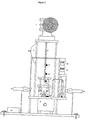
- the gradient mixer (Fig. 2) for the preparation of agarose based IPG gels - and this is a further object of the present invention - comprises:
- Figure 2 schematically describes the general layout of the gradient mixer.
- the mixer is comprised of two 15 ml glass syringes, a basic gel glass syringe (4) and an acidic gel glass syringe (5), which are placed in a closed circulating air oven compartment (7) preheated to the gel melt temperature, usually 70 to 80°C, by an air jet gun (10) (30 l/min, 20 to 80°C) controlled by a temperature controller and indicator(12).
- the melted gel is sucked into the syringes through a three way valve (14) so that the more basic agarose gel is placed in syringe (4) and the more acidic gel is placed in syringe (5), in the procedure where the acidic syringe (5) will contain the glycerol and will have the higher density. If the gel is made with the basic (gel)solution being the heavier solution it will be put in syringe (5) and the acidic (gel)solution in syringe (4).
- the design is such as to make sure that no air bubbles are entrapped in the syringes or the connecting tubing.
- variable speed motor (1) (0 to 20 rpm) is started and the excess of gel is pushed out so that a predetermined volume of gel is left in each syringe. That volume is determined accurately and repeatable by the location of the start point switch (16).
- the cassette (9) (glass plate cassette, e.g. 20x10 cm) is placed in the second circulating air oven (8) which is heated to about 60°C by the second air gun (11) (30 l/min, 20 to 80°C) and kept at that temperature for equilibration.
- the temperature of the oven (8) is kept constant by the aid of a temperature controller and indicator(13).
- the magnetic stirrer (6) When the whole system reaches equilibrium, the magnetic stirrer (6) is started, the three way valve (14) is rotated to a position which connects the two syringes (4)(5), the output flexible tube is placed in the cassette (9) and the motor (1) is started at a speed of about 10 rpm as determined by the motor speed control (2).
- a load screw (3) pushes down the syringe plungers and melted gel is dispensed from the basic syringe (4) to the cassette.
- acidic gel is dispensed from the acidic syringe (5) to the basic syringe (4) gradually increasing the acidity in this syringe. If syringe (5) is the basic one (contains the basic gel solution) and syringe (4) is the acidic one, then the situation is reversed.
- the gel which is dispensed to the cassette (9) will have a progressively decreasing pH.
- the gel dispensed into the cassette also has a gradually decreasing density. This is the particular case for making an IPG with the pH range of 5 to 6 using aem- and gly-derivatives of agarose.
- the density gradient imposed on the pH gradient helps to maintain the linear shape of the pH gradient during the dispensing and solidification stages.
- the oven is shut off, cooled to ambient temperature, and the gel is released from the cassette.
- the gradient mixer is monitored by an electrical switcing board (18).
- the method for preparing immobilized buffered agarose (gel) membranes first requires the synthesis of the buffered reagents (BR), their binding to the agarose polymer in separate samples for the acid and basic BR, respectively, and mixing and casting of the sol or solution of the polymeric reaction products.
- BR buffered reagents
- the obtained gel membranes are designed to clean the protein Eglin with a pI of 5.50. Therefore, the membrane on the anodic side was made with a BR concentration to give a buffered pH of 5.45, while the cathodic membrane was buffered to 5.80. These membranes are then placed in the PIEF device according to Figure 1.
- the details of each duplicate run (batches 1 and 2) are given in Tables 1 and 2.
- Impurities of the Elgin samples are separated within 0.05 pH units. 91% of protein recovery is achieved. Cleaning of impurities improves as a function of time. Cleaning for a longer period of time would get rid of the remaining impurities.
- Example 1 The procedure of Example 1 is repeated, but the acid and the basic buffered agarose products are prepared individually by heating them in solution, cooling the sol to form a gel, and then the gel is cleaned of unreacted monomers and reagents (e.g. by dialysis and/or electrophoresis), and the basic agarose products is then titrated in the melt form with the acid agarose product to give the desired pH of 5.5. The results in cleaning Eglin are even better than in Example 1.
- the 2% agarose gel is washed with acetone to replace water; the agarose gel is then reacted with cyanuric chloride in acetone at 0°C for 30 minutes, and washed with acetone to take out the unreacted cyanuric chloride.
- the agarose dichloro triazine derivative is then immersed in an acetone solution of the amino butyric acid or aminoethyl morpholine for 10 hours, the gel is then removed from the solution and washed.
- PIEF membranes are made by dissolving the derivatives at 50°C in water, titrating the basic derivative with the acid one to get gels of pH 5.8 and 5.65, and casting them into membranes. These membranes cleaned Eglin on both sides of the anodic and cathodic bonds.
- agarose derivatives In another variation of making agarose derivatives, the dichloro triazine amino butyric acid and aminoethyl morpholine each are dissolved in acetone or an acetone-water solution at 0 to 4°C, proton acceptors are added, such as diisopropylethyl amine or N,N-dimethylaniline, and reacted with agarose gel swollen with acetone for 10 to 72 hours, drained, washed and then used as in Example 3.
- proton acceptors such as diisopropylethyl amine or N,N-dimethylaniline
- the agarose derivatives of Example 4 are titrated one against the other with a pH gradient mixer according to Figure 2. In this case, however, dichloro triazinyl glycine was used instead of the aminobutyric acid derivative.
- the resultant gel in a cassette, has a linear immobilized gradient from pH 5 to pH 6 over a 10 cm length.
- the single steps can be defined as follows:
- the temperature is then raised to 85 to 90°C and the reaction mixture is stirred at this temperature for one hour.
- the solution is then poured into a glass mold which is 20 cm long, 10 cm wide and 5 mm deep. The mold is left at room temperature for 3 hours and then stored at 4°C for 12 hours.
- the mold is then cut into pieces (1x1) and then washed as follows: 2 times with 1 l of an acetone/water mixture (80/20), 2 times with 1 l of deionized water, 2 times with 1 l of water acidified to pH 4, 2 times with 1 l of deionized water, 3 times with 1 l of water of pH 11 (1 hour each), and then with deionized water until the pH of water is achieved.
- a pH gradient gel of between pH 5 to 6 is made from the above derivatives using the gradient gel mixer in the following way:
- the necessary dichlorotriazines for each pH range are synthesized and used to prepare the agarose derivatives for the buffers and titrants.
- the reaction of the agarose with the the dichlorotriazines is conducted in aqueous solutions at the required concentrations (for details cf. Example 6 and the other foregoing examples) to give an acidic or basic capacity between 4 to 20 meq/kg of a 2% wet gel.
- the agarose derivatives are then used as either buffers or titrants, depending on the IPG gel being made.
- the agarose derivatives are mixed at a temperature at which they are melted (usually about 60°C), while the IPG solid gel is used in analytical IEF (isoelectric focusing) at 10°C. Since the pH of the gel is temperature-dependent, this dependency has to be considered in order to predict the gel's pH at 10°C, based on the known titrated pH at 60°C. Thus, the operational steps are:
- a constant buffer capacity over the gradient is required.
- the concentration of the buffering species is adjusted so that the concentration of buffer increases, going to the pH extreme farthest from the pK of the buffer. In this case it is achieved by the addition of glycerol to the appropriate buffer/titrant solution.
Landscapes
- Chemical & Material Sciences (AREA)
- Life Sciences & Earth Sciences (AREA)
- Health & Medical Sciences (AREA)
- Molecular Biology (AREA)
- Chemical Kinetics & Catalysis (AREA)
- Biochemistry (AREA)
- Electrochemistry (AREA)
- General Health & Medical Sciences (AREA)
- Pathology (AREA)
- Analytical Chemistry (AREA)
- General Physics & Mathematics (AREA)
- Immunology (AREA)
- Physics & Mathematics (AREA)
- Engineering & Computer Science (AREA)
- Organic Chemistry (AREA)
- Medicinal Chemistry (AREA)
- Polymers & Plastics (AREA)
- Materials Engineering (AREA)
- Environmental & Geological Engineering (AREA)
- Dispersion Chemistry (AREA)
- Immobilizing And Processing Of Enzymes And Microorganisms (AREA)
- Addition Polymer Or Copolymer, Post-Treatments, Or Chemical Modifications (AREA)
- Peptides Or Proteins (AREA)
- Solid-Sorbent Or Filter-Aiding Compositions (AREA)
- Polysaccharides And Polysaccharide Derivatives (AREA)
Applications Claiming Priority (2)
| Application Number | Priority Date | Filing Date | Title |
|---|---|---|---|
| GB9211324 | 1992-05-28 | ||
| GB9211324A GB2267502B (en) | 1992-05-28 | 1992-05-28 | Polymeric reaction products for use in immobilized buffered gels and membranes |
Publications (3)
| Publication Number | Publication Date |
|---|---|
| EP0572354A2 true EP0572354A2 (de) | 1993-12-01 |
| EP0572354A3 EP0572354A3 (de) | 1994-03-02 |
| EP0572354B1 EP0572354B1 (de) | 1998-01-07 |
Family
ID=10716169
Family Applications (1)
| Application Number | Title | Priority Date | Filing Date |
|---|---|---|---|
| EP93810374A Expired - Lifetime EP0572354B1 (de) | 1992-05-28 | 1993-05-21 | Immobilisierte und gepufferte Gele und Membrane aus Hydroxy-funktionellen Polymeren |
Country Status (8)
| Country | Link |
|---|---|
| US (3) | US5430099A (de) |
| EP (1) | EP0572354B1 (de) |
| JP (1) | JPH06116322A (de) |
| AT (1) | ATE161854T1 (de) |
| CA (1) | CA2097124A1 (de) |
| DE (1) | DE69316085D1 (de) |
| GB (1) | GB2267502B (de) |
| IL (1) | IL105769A (de) |
Cited By (3)
| Publication number | Priority date | Publication date | Assignee | Title |
|---|---|---|---|---|
| EP1044716A1 (de) * | 1999-03-13 | 2000-10-18 | Michael Dr. Cahill | Mikropräparative isoelektrischen Fokussierung |
| WO2005017009A1 (en) * | 2003-08-15 | 2005-02-24 | The Texas A & M University System | Hydrolytically stable isoelectric hydrogel compositions |
| US7622028B2 (en) | 2003-05-09 | 2009-11-24 | Life Technologies Corporation | Solution phase electrophoresis device, components, and methods |
Families Citing this family (18)
| Publication number | Priority date | Publication date | Assignee | Title |
|---|---|---|---|---|
| DE3638110C2 (de) * | 1986-11-07 | 1995-06-14 | Fritz Stahlecker | Vorrichtung zum pneumatischen Falschdrallspinnen |
| US20040120891A1 (en) * | 1998-12-21 | 2004-06-24 | Craig Hill | Compounds for intracellular delivery of therapeutic moieties to nerve cells |
| WO2003052381A2 (en) * | 2001-12-18 | 2003-06-26 | Lynx Therapeutics, Inc. | METHOD FOR APPLYING A pH GRADIENT TO A MICROCHANNEL DEVICE |
| AU2002951153A0 (en) * | 2002-09-02 | 2002-09-19 | Proteome Systems Intellectual Property Pty Ltd | An electrophoresis gel having improved swelling properties |
| US20050032246A1 (en) * | 2002-11-14 | 2005-02-10 | Mcmaster University | Method of immobilizing membrane-associated molecules |
| US20040247977A1 (en) * | 2003-06-06 | 2004-12-09 | Steven Holdcroft | Electrochemical cell and fuel cell with curable liquid electrolyte |
| US20040258990A1 (en) * | 2003-06-19 | 2004-12-23 | Mclean Gerard Francis | Electrochemical cell with curable liquid electrolyte and method of making |
| US7381331B2 (en) * | 2005-09-30 | 2008-06-03 | General Electric Company | Hydrophilic membrane and associated method |
| US7291696B2 (en) * | 2005-11-04 | 2007-11-06 | General Electric Company | Composition and associated method |
| US7631768B2 (en) * | 2005-11-04 | 2009-12-15 | General Electric Company | Membrane and associated method |
| US8900435B2 (en) * | 2007-12-19 | 2014-12-02 | Palo Alto Research Center Incorporated | Separating gas using ion exchange |
| US7938891B2 (en) * | 2008-03-17 | 2011-05-10 | Palo Alto Research Center Incorporated | Using ionic liquids |
| US7938892B2 (en) * | 2008-06-10 | 2011-05-10 | Palo Alto Research Center Incorporated | Producing articles that include ionic liquids |
| US7938890B2 (en) * | 2008-07-08 | 2011-05-10 | Palo Alto Research Center Incorporated | Separating gas using immobilized buffers |
| SG172975A1 (en) | 2009-01-13 | 2011-08-29 | B P T Bio Pure Technology Ltd | Solvent and acid stable membranes, methods of manufacture thereof and methods of use thereof inter alia for separating metal ions from liquid process streams |
| US20200155048A1 (en) * | 2017-06-21 | 2020-05-21 | Eccrine Systems, Inc. | Biofluid sensing devices with ph-buffered eab sensors |
| MX2021000644A (es) | 2018-07-18 | 2021-08-19 | Manzanita Pharmaceuticals Inc | Conjugados para suministrar un agente contra el cancer a las celulas nerviosas, metodos de uso y metodos para la elaboracion de los mismos. |
| CN111939593B (zh) * | 2020-08-26 | 2024-08-09 | 福建天源兴达生物科技有限公司 | 江蓠菜浸泡蒸煮系统 |
Family Cites Families (22)
| Publication number | Priority date | Publication date | Assignee | Title |
|---|---|---|---|---|
| BE577523A (de) * | 1958-04-10 | |||
| FR1244293A (fr) * | 1959-01-31 | 1960-10-21 | Goldschmidt Ag Th | Procédé de réticulation de l'alcool polyvinylique avec diminution simultanée de sa solubilité dans l'eau ou de son hydrophilie |
| NL131215C (de) * | 1964-08-18 | |||
| GB1116858A (en) * | 1966-07-26 | 1968-06-12 | Coates Brothers & Co | Improvements in and relating to synthetic resins |
| SE361829B (de) * | 1972-05-16 | 1973-11-19 | Lkb Produkter Ab | |
| GB1381380A (en) * | 1972-09-06 | 1975-01-22 | Warner Lambert Co | Water-soluble dyed substrate for amylase assay |
| US3795600A (en) * | 1973-03-23 | 1974-03-05 | Instrumentation Specialties Co | Electrophoresis and method apparatus |
| US4016149A (en) * | 1973-09-10 | 1977-04-05 | Research Corporation | Selective removal of albumin from blood fluid and compositions therefore |
| CH600782A5 (de) * | 1973-09-10 | 1978-06-30 | Research Corp | |
| FR2287912A1 (fr) * | 1974-10-14 | 1976-05-14 | Anvar | Derives de polysaccharide portant des groupements amines, leurs procedes de preparation et leurs applications en tant qu'agents adjuvants de l'immunite non specifique |
| US4043997A (en) * | 1976-05-28 | 1977-08-23 | Cutter Laboratories, Inc. | Method for isolating albumin using insoluble supports coupled to a dye |
| US4229537A (en) * | 1978-02-09 | 1980-10-21 | New York University | Preparation of trichloro-s-triazine activated supports for coupling ligands |
| CS204190B1 (en) * | 1978-02-22 | 1981-03-31 | Jaroslav Drobnik | Activation method for hydrxyl groups containing insoluble carriers |
| US4319975A (en) * | 1980-10-20 | 1982-03-16 | Fmc Corporation | Derivatized agarose and method of making and using same |
| US4562251A (en) * | 1981-03-26 | 1985-12-31 | Amicon Corporation | Agarose derivatives of amino phenyl boronic acid |
| US4506987A (en) * | 1982-09-08 | 1985-03-26 | The United States Of America As Represented By The United States Department Of Energy | High pressure liquid chromatographic gradient mixer |
| CA1239357A (en) * | 1984-12-07 | 1988-07-19 | That T. Ngo | Method of activating polymeric carrier |
| US4971671A (en) * | 1987-03-02 | 1990-11-20 | Xerox Corporation | Processes for separation of DNA fragments |
| ES2037273T3 (es) * | 1987-04-11 | 1993-06-16 | Ciba-Geigy Ag | Proceso de focalizacion isoelectrica y medios para llevar a cabo dicho proceso. |
| US5114555A (en) * | 1988-01-05 | 1992-05-19 | Monsanto Company | Continuous isoelectric separation |
| GB2225339A (en) * | 1988-11-15 | 1990-05-30 | Aligena Ag | Separating electrically charged macromolecular compounds by forced-flow membrane electrophoresis |
| JP2787142B2 (ja) * | 1991-03-01 | 1998-08-13 | 上村工業 株式会社 | 無電解錫、鉛又はそれらの合金めっき方法 |
-
1992
- 1992-05-28 GB GB9211324A patent/GB2267502B/en not_active Revoked
-
1993
- 1993-05-21 IL IL10576993A patent/IL105769A/en not_active IP Right Cessation
- 1993-05-21 DE DE69316085T patent/DE69316085D1/de not_active Expired - Lifetime
- 1993-05-21 EP EP93810374A patent/EP0572354B1/de not_active Expired - Lifetime
- 1993-05-21 AT AT93810374T patent/ATE161854T1/de not_active IP Right Cessation
- 1993-05-27 CA CA002097124A patent/CA2097124A1/en not_active Abandoned
- 1993-05-27 US US08/067,617 patent/US5430099A/en not_active Expired - Lifetime
- 1993-05-28 JP JP5126782A patent/JPH06116322A/ja active Pending
-
1995
- 1995-04-05 US US08/417,113 patent/US5599506A/en not_active Expired - Fee Related
- 1995-04-05 US US08/417,117 patent/US5597863A/en not_active Expired - Fee Related
Cited By (3)
| Publication number | Priority date | Publication date | Assignee | Title |
|---|---|---|---|---|
| EP1044716A1 (de) * | 1999-03-13 | 2000-10-18 | Michael Dr. Cahill | Mikropräparative isoelektrischen Fokussierung |
| US7622028B2 (en) | 2003-05-09 | 2009-11-24 | Life Technologies Corporation | Solution phase electrophoresis device, components, and methods |
| WO2005017009A1 (en) * | 2003-08-15 | 2005-02-24 | The Texas A & M University System | Hydrolytically stable isoelectric hydrogel compositions |
Also Published As
| Publication number | Publication date |
|---|---|
| GB9211324D0 (en) | 1992-07-15 |
| GB2267502B (en) | 1997-01-22 |
| DE69316085D1 (de) | 1998-02-12 |
| GB2267502A (en) | 1993-12-08 |
| ATE161854T1 (de) | 1998-01-15 |
| IL105769A0 (en) | 1993-09-22 |
| US5430099A (en) | 1995-07-04 |
| EP0572354B1 (de) | 1998-01-07 |
| JPH06116322A (ja) | 1994-04-26 |
| CA2097124A1 (en) | 1993-11-29 |
| US5597863A (en) | 1997-01-28 |
| US5599506A (en) | 1997-02-04 |
| EP0572354A3 (de) | 1994-03-02 |
| IL105769A (en) | 1996-05-14 |
Similar Documents
| Publication | Publication Date | Title |
|---|---|---|
| US5597863A (en) | Immobilized buffered gels and membranes of hydroxy groups containing polymers | |
| US5135627A (en) | Mosaic microcolumns, slabs, and separation media for electrophoresis and chromatography | |
| AU712081B2 (en) | Thermoreversible hydrogels comprising linear copolymers and their use in electrophoresis | |
| US5569364A (en) | Separation media for electrophoresis | |
| US20060127878A1 (en) | Hydrogel preparation and process of manufacture thereof | |
| EP2585541B1 (de) | Semiinterpenetrierendes polymernetzwerk | |
| WO1997040078A1 (en) | Thermoreversible hydrogels comprising non-crosslinked copolymers and their use in electrophoresis | |
| EP2414321B1 (de) | Hydrophobe monomere, hydrophob derivatisierte substrate sowie verfahren zu ihrer herstellung und verwendung | |
| JP2654681B2 (ja) | ポリマー、および電気泳動のためのゲルとしてのその使用方法 | |
| KR20190002572A (ko) | 정전기적 분리를 위한 대전된 이소포러스 재료 | |
| US7169847B2 (en) | Polymeric membranes and uses thereof | |
| EP2026063A1 (de) | Elektrophoresematrix basierend auf einem vernetzten Hydrogel mit doppeltem Netzwerk | |
| JPH11515017A (ja) | 電気泳動及びクロマトグラフィー技術でのポリアクリルアミドマトリックスのための、新規アクリルアミド誘導体及び新規な配合物 | |
| US5219923A (en) | Electrophoretic media | |
| US20080264793A1 (en) | Hydrolytically Stable Isoelectric Hydrogel Compositions | |
| JP3065099B2 (ja) | 電気泳動用媒質 | |
| JPS60250015A (ja) | 透過選別能を有する樹脂 | |
| US5212253A (en) | Electrophoresis element comprising a polymer containing a haloacetamido group | |
| CN117751186A (zh) | 用于降低核酸纯化的内毒素水平的方法 | |
| WO2000067009A1 (en) | Mixed buffers in gel electrophoresis systems | |
| AU2002234425B2 (en) | Polymeric membranes and uses thereof | |
| Garfin | Isoelectric focusing | |
| WO2025027059A1 (en) | Method for purification of plasmid dna | |
| AU2002234425A1 (en) | Polymeric membranes and uses thereof | |
| US20060102480A1 (en) | Apparatus and methods for performing electrophoretic separations of macromolecules |
Legal Events
| Date | Code | Title | Description |
|---|---|---|---|
| PUAI | Public reference made under article 153(3) epc to a published international application that has entered the european phase |
Free format text: ORIGINAL CODE: 0009012 |
|
| AK | Designated contracting states |
Kind code of ref document: A2 Designated state(s): AT BE CH DE DK ES FR GB GR IE IT LI LU NL PT SE |
|
| PUAL | Search report despatched |
Free format text: ORIGINAL CODE: 0009013 |
|
| AK | Designated contracting states |
Kind code of ref document: A3 Designated state(s): AT BE CH DE DK ES FR GB GR IE IT LI LU NL PT SE |
|
| 17P | Request for examination filed |
Effective date: 19940622 |
|
| 17Q | First examination report despatched |
Effective date: 19961025 |
|
| GRAG | Despatch of communication of intention to grant |
Free format text: ORIGINAL CODE: EPIDOS AGRA |
|
| GRAG | Despatch of communication of intention to grant |
Free format text: ORIGINAL CODE: EPIDOS AGRA |
|
| GRAH | Despatch of communication of intention to grant a patent |
Free format text: ORIGINAL CODE: EPIDOS IGRA |
|
| GRAH | Despatch of communication of intention to grant a patent |
Free format text: ORIGINAL CODE: EPIDOS IGRA |
|
| GRAA | (expected) grant |
Free format text: ORIGINAL CODE: 0009210 |
|
| AK | Designated contracting states |
Kind code of ref document: B1 Designated state(s): AT BE CH DE DK ES FR GB GR IE IT LI LU NL PT SE |
|
| PG25 | Lapsed in a contracting state [announced via postgrant information from national office to epo] |
Ref country code: NL Free format text: LAPSE BECAUSE OF FAILURE TO SUBMIT A TRANSLATION OF THE DESCRIPTION OR TO PAY THE FEE WITHIN THE PRESCRIBED TIME-LIMIT Effective date: 19980107 Ref country code: LI Free format text: LAPSE BECAUSE OF FAILURE TO SUBMIT A TRANSLATION OF THE DESCRIPTION OR TO PAY THE FEE WITHIN THE PRESCRIBED TIME-LIMIT Effective date: 19980107 Ref country code: IT Free format text: LAPSE BECAUSE OF FAILURE TO SUBMIT A TRANSLATION OF THE DESCRIPTION OR TO PAY THE FEE WITHIN THE PRE;WARNING: LAPSES OF ITALIAN PATENTS WITH EFFECTIVE DATE BEFORE 2007 MAY HAVE OCCURRED AT ANY TIME BEFORE 2007. THE CORRECT EFFECTIVE DATE MAY BE DIFFERENT FROM THE ONE RECORDED.SCRIBED TIME-LIMIT Effective date: 19980107 Ref country code: GR Free format text: LAPSE BECAUSE OF FAILURE TO SUBMIT A TRANSLATION OF THE DESCRIPTION OR TO PAY THE FEE WITHIN THE PRESCRIBED TIME-LIMIT Effective date: 19980107 Ref country code: FR Free format text: LAPSE BECAUSE OF FAILURE TO SUBMIT A TRANSLATION OF THE DESCRIPTION OR TO PAY THE FEE WITHIN THE PRESCRIBED TIME-LIMIT Effective date: 19980107 Ref country code: ES Free format text: THE PATENT HAS BEEN ANNULLED BY A DECISION OF A NATIONAL AUTHORITY Effective date: 19980107 Ref country code: CH Free format text: LAPSE BECAUSE OF FAILURE TO SUBMIT A TRANSLATION OF THE DESCRIPTION OR TO PAY THE FEE WITHIN THE PRESCRIBED TIME-LIMIT Effective date: 19980107 Ref country code: BE Free format text: LAPSE BECAUSE OF FAILURE TO SUBMIT A TRANSLATION OF THE DESCRIPTION OR TO PAY THE FEE WITHIN THE PRESCRIBED TIME-LIMIT Effective date: 19980107 Ref country code: AT Free format text: LAPSE BECAUSE OF FAILURE TO SUBMIT A TRANSLATION OF THE DESCRIPTION OR TO PAY THE FEE WITHIN THE PRESCRIBED TIME-LIMIT Effective date: 19980107 |
|
| REF | Corresponds to: |
Ref document number: 161854 Country of ref document: AT Date of ref document: 19980115 Kind code of ref document: T |
|
| REG | Reference to a national code |
Ref country code: CH Ref legal event code: EP |
|
| REF | Corresponds to: |
Ref document number: 69316085 Country of ref document: DE Date of ref document: 19980212 |
|
| PG25 | Lapsed in a contracting state [announced via postgrant information from national office to epo] |
Ref country code: SE Free format text: LAPSE BECAUSE OF FAILURE TO SUBMIT A TRANSLATION OF THE DESCRIPTION OR TO PAY THE FEE WITHIN THE PRESCRIBED TIME-LIMIT Effective date: 19980407 Ref country code: PT Free format text: LAPSE BECAUSE OF FAILURE TO SUBMIT A TRANSLATION OF THE DESCRIPTION OR TO PAY THE FEE WITHIN THE PRESCRIBED TIME-LIMIT Effective date: 19980407 Ref country code: DK Free format text: LAPSE BECAUSE OF FAILURE TO SUBMIT A TRANSLATION OF THE DESCRIPTION OR TO PAY THE FEE WITHIN THE PRESCRIBED TIME-LIMIT Effective date: 19980407 |
|
| PG25 | Lapsed in a contracting state [announced via postgrant information from national office to epo] |
Ref country code: DE Free format text: LAPSE BECAUSE OF FAILURE TO SUBMIT A TRANSLATION OF THE DESCRIPTION OR TO PAY THE FEE WITHIN THE PRESCRIBED TIME-LIMIT Effective date: 19980408 |
|
| PG25 | Lapsed in a contracting state [announced via postgrant information from national office to epo] |
Ref country code: LU Free format text: LAPSE BECAUSE OF NON-PAYMENT OF DUE FEES Effective date: 19980521 Ref country code: IE Free format text: LAPSE BECAUSE OF NON-PAYMENT OF DUE FEES Effective date: 19980521 Ref country code: GB Free format text: LAPSE BECAUSE OF NON-PAYMENT OF DUE FEES Effective date: 19980521 |
|
| NLV1 | Nl: lapsed or annulled due to failure to fulfill the requirements of art. 29p and 29m of the patents act | ||
| REG | Reference to a national code |
Ref country code: IE Ref legal event code: FG4D Free format text: 78164 |
|
| EN | Fr: translation not filed | ||
| REG | Reference to a national code |
Ref country code: CH Ref legal event code: PL |
|
| PLBE | No opposition filed within time limit |
Free format text: ORIGINAL CODE: 0009261 |
|
| STAA | Information on the status of an ep patent application or granted ep patent |
Free format text: STATUS: NO OPPOSITION FILED WITHIN TIME LIMIT |
|
| 26N | No opposition filed | ||
| GBPC | Gb: european patent ceased through non-payment of renewal fee |
Effective date: 19980521 |