EP0569457B1 - Verwendung von thiazolo-[2,3-a]isoindol-derivaten als antivirale arzneimittel und neue thiazolo- [2,3-a]isoindol-derivate - Google Patents
Verwendung von thiazolo-[2,3-a]isoindol-derivaten als antivirale arzneimittel und neue thiazolo- [2,3-a]isoindol-derivate Download PDFInfo
- Publication number
- EP0569457B1 EP0569457B1 EP92904272A EP92904272A EP0569457B1 EP 0569457 B1 EP0569457 B1 EP 0569457B1 EP 92904272 A EP92904272 A EP 92904272A EP 92904272 A EP92904272 A EP 92904272A EP 0569457 B1 EP0569457 B1 EP 0569457B1
- Authority
- EP
- European Patent Office
- Prior art keywords
- dihydrothiazolo
- isoindole
- alkoxy
- alkoxycarbonyl
- halogen
- Prior art date
- Legal status (The legal status is an assumption and is not a legal conclusion. Google has not performed a legal analysis and makes no representation as to the accuracy of the status listed.)
- Expired - Lifetime
Links
Classifications
-
- C—CHEMISTRY; METALLURGY
- C07—ORGANIC CHEMISTRY
- C07D—HETEROCYCLIC COMPOUNDS
- C07D513/00—Heterocyclic compounds containing in the condensed system at least one hetero ring having nitrogen and sulfur atoms as the only ring hetero atoms, not provided for in groups C07D463/00, C07D477/00 or C07D499/00 - C07D507/00
- C07D513/02—Heterocyclic compounds containing in the condensed system at least one hetero ring having nitrogen and sulfur atoms as the only ring hetero atoms, not provided for in groups C07D463/00, C07D477/00 or C07D499/00 - C07D507/00 in which the condensed system contains two hetero rings
- C07D513/04—Ortho-condensed systems
-
- A—HUMAN NECESSITIES
- A61—MEDICAL OR VETERINARY SCIENCE; HYGIENE
- A61P—SPECIFIC THERAPEUTIC ACTIVITY OF CHEMICAL COMPOUNDS OR MEDICINAL PREPARATIONS
- A61P31/00—Antiinfectives, i.e. antibiotics, antiseptics, chemotherapeutics
- A61P31/12—Antivirals
Definitions
- the present invention relates to the use of thiazolo [2,3-a] isoindole derivatives for the production of antiviral drugs and to new thiazolo [2,3-a] isoindole derivatives.
- the present invention also relates to new thiazolo [2,3-a] isoindoles of the formula I in which R is a heterocyclic mono-, bi- or tricyclic ring each having 5 or 6 ring atoms and 1-4 or 1- per ring system 5 heteroatoms can be contained, the heteroatoms can be oxygen, sulfur or nitrogen, and these rings can be substituted by C1-C6-alkyl, C1-C6-alkoxy, nitro, amino or halogen.
- Thiazolo- [2,3-a] isoindoles of the formula I in which X is an oxygen atom, n is the number 0 and 1, R1-R6 are each hydrogen and R is a hydrogen atom or an aliphatic radical having 1-7 C atoms, which by Phenyl can be substituted, or R a phenyl ring which can be mono- or polysubstituted by alkyl, alkoxy, hydroxyl, trifluoromethyl, methylsulfonyl or halogen, are known from the earlier German patent application P 40 35 809.7 (WO 92/08457) as antiviral drugs.
- the object of the present invention was to find a further medical indication for known compounds of the formula I and to provide new thiazolo- [2,3-a] isoindoles with antiviral activity. This object is achieved by the features characterized in the claims.
- the compounds of formula I have valuable pharmacological properties. They are particularly suitable for the therapy and prophylaxis of infections caused by DNA viruses such as e.g. the herpes simplex virus, the cytomegalovirus, papilloma viruses, the varicella zoster virus or Epstein-Barr virus or RNA viruses such as toga viruses or in particular retroviruses such as the oncoviruses HTLV-I and II, as well as the lentiviruses Visna and the human immunodeficiency virus HIV-1 and -2.
- DNA viruses such as e.g. the herpes simplex virus, the cytomegalovirus, papilloma viruses, the varicella zoster virus or Epstein-Barr virus or RNA viruses such as toga viruses or in particular retroviruses such as the oncoviruses HTLV-I and II, as well as the lentiviruses Visna and the human immunodeficiency virus HIV-1 and -2.
- the compounds of the formula I appear to be particularly suitable for the treatment of the clinical manifestations of retroviral HIV infection in humans, such as persistent, generalized lymphadenopathy (PGL), the advanced stage of the AIDS-related complex (ARC) and the clinical picture of AIDS.
- PDL generalized lymphadenopathy
- ARC advanced stage of the AIDS-related complex
- the compounds of general formula I according to the invention have a pronounced antiviral effect and are particularly suitable for the treatment of viral or retro-viral infections.
- Viral infections in mammals, especially humans, are common.
- chemotherapeutic agents which interfere causally or symptomatically with the viral or retroviral-related disease process with recognizable substantial success.
- AIDS Acquired Immune Deficiency Syndrome
- ARC AIDS-related complex
- CMV cytomegalovirus
- AZT 3'-azido-3'-deoxy-thymidine
- Zidovudine or Retrovir R 3'-azido-3'-deoxy-thymidine
- Retrovir R 3'-azido-3'-deoxy-thymidine
- AZT is characterized by a very narrow therapeutic range or by very severe toxicities already occurring in the therapeutic field (Hirsch, MS (1988) J.Infec.Dis. 157 , 427-431).
- the compounds of the general formula I do not have these disadvantages. They have an antiviral effect without being cytotoxic in pharmacologically relevant doses.
- the compounds mentioned could advantageously be used prophylactically or therapeutically in the treatment of diseases in which a retroviral infection is of pathophysiological, symptomatic or clinical relevance.
- the compounds of formula I have a chiral center and can be used both in the form of their racemates and in the form of their enantiomers or diastereoisomers.
- the separation of the racemates into the enantiomers can be carried out analytically, semi-preparatively and preparatively chromatographically on suitable optically active phases using common eluents.
- suitable optically active phases are, for example, optically active polyacrylamides or polymethacrylamides, sometimes also on silica gel (e.g. ChiraSpher (R) from Merck, Chiralpak (R) OT / OP from Baker), cellulose esters / carbamates (e.g. Chiracel (R) OB / OY from Baker / Daicel), phases based on cyclodextrin or crown ether (eg Crownpak (R) from Daicel) or microcrystalline cellulose triacetate (Merck).
- silica gel e.g. ChiraSpher (R
- An aliphatic radical means a straight-chain or branched alkyl, alkenyl or alkynyl radical with 1-9, preferably 2-7 carbon atoms, e.g. the propyl, isopropyl, butyl, isobutyl, pentyl, hexyl or heptyl radical.
- unsaturated radicals are C2-C7 alkenyl and alkynyl, preferably C2-C5, such as the allyl, dimethylallyl, butenyl, isobutenyl, pentenyl or propinyl radical.
- An aliphatic radical which may be substituted by phenyl is in particular a phenyl-C1-C--alkyl group, such as, for example, the benzyl, phenethyl, phenylpropyl or phenylbutyl radical.
- R is a phenyl ring, this can be mono-, di- or trisubstituted.
- the substituents can be in the o, m or p position independently of one another.
- a carbocyclic ring with 7-15 C atoms can be mono-, bi- or tricyclic and have 5 or 6 C atoms per ring.
- This ring can be saturated, unsaturated, partially saturated or aromatic.
- the following ring systems may be mentioned by way of example: the naphthyl, anthracenyl, phenanthrenyl, flouryl, indenyl, indanyl, acenaphthylenyl, norbornyl, adamantyl ring or a C3-C7-cycloalkyl or C5-C8-cycloalkenyl group, wherein in In the latter two cases, the corresponding five or six rings are preferred.
- the heterocyclic mono-, bi- or tricyclic ring systems contain 5 or 6 carbon atoms per ring system, where 1-4 or 1-5 carbon atoms can be replaced by the heteroatoms oxygen, sulfur and / or nitrogen.
- the ring systems can be aromatic, partially or completely hydrogenated.
- ring systems may be mentioned by way of example: the pyridine, pyrimidine, pyridazine, pyrazine, triazine, pyrrole, pyrazole, imidazole, triazole, thiazole, oxazole, isoxazole, oxadiazole, furazane, Furan, thiophene, indole, quinoline, isoquinoline, coumarone, thionaphthene, benzoxazole, benzothiazole, indazole, benzimidazole, benzotriazole, chromene, phthalazine, quinazoline, quinoxaline, methylenedioxybenzene , Carbazole, acridine, phenoxazine, phenothiazine, phenazine or purine system, where the unsaturated or aromatic carbo- and heterocycles can be partially or completely hydrogenated.
- aryl or hetaryl radicals in the definition of R3-R6 are preferably phenyl, naphthyl or pyridyl radical, these radicals can in particular be mono- or disubstituted by C1-C3-alkyl, C1-C3-alkoxy or Halogen.
- R is preferably unsubstituted phenyl or phenyl mono- or disubstituted by C1-C3-alkyl, C1-C3-alkoxy, C1-C3-alkylmercapto, C1-C3-alkylsulfinyl, C1-C3-alkylsulfonyl, C2-C4-alkenyl, C2 -C3-alkynyl, C3-C4-alkenyloxy, C1-C3-alkylamino, C1-C3-dialkylamino-, C1-C3-alkylcarbonylamino, C1-C3-alkylaminocarbonyl, C1-C3-alkoxycarbonyl, amino, hydroxy, nitro, azido , Trifluoromethyl, cyano or halogen.
- Carbocyclic rings are preferably biphenyl, naphthyl, anthracenyl, indanyl, fluorenyl, acenaphthylenyl, phenanthrenyl, norbornyl, adamantyl, C3-C6-cycloalkyl, C5-C8-cycloalkenyl.
- Heterocyclic ring systems are preferably pyrrole, imidazole, furan, thiophene, pyridine, pyrimidine, thiazole, triazine, indole, quinoline, isoquinoline, coumarone, thionaphthene, benzimidazole, quinazoline, methylenedioxybenzene, ethylenedioxybenzene, carbazole, acridine and phenothiazine.
- radicals R1 and R2 are hydrogen, C1-C3-alkyl, C2-C4-alkenyl, C2-C4-alkynyl, C1-C3-alkoxy, C1-C3-alkylmercapto, C1-C3-alkylamino, C1-C3-alkoxycarbonyl , Sulfonamido, amino, halogen, hydroxy, cyano and azido are preferred, these radicals being in particular in the 7-, 8- or 9-position of the thiazolo [2,3-a] isoindole ring.
- R3, R4, R5 and R6 are hydrogen, C1-C3-alkyl, C1-C3-alkoxy, C1-C3-alkylmercapto, carboxy, C1-C3-alkoxycarbonyl, morpholinocarbonyl, aminocarbonyl, C1-C3-alkylaminocarbonyl, di -C1-C3-alkylaminocarbonyl, C1-C3-alkoxy-C1-C3-alkoxycarbonyl, pyridyl-C1-C3-alkoxycarbonyl, halogen, cyano and hydroxy, where R3 and R4 are in particular hydrogen.
- the R3-R-radicals can be the same or different, but preference is given to those derivatives in which at least two, preferably three, of these radicals are hydrogen.
- X is preferably oxygen or sulfur, n is preferably equal to 0.
- Halogen is generally to be understood as meaning fluorine, chlorine, bromine and iodine, preferably fluorine, chlorine and bromine.
- radicals for R are C3-C5-alkyl, C2-C5-alkenyl, C2-C4-alkynyl, benzyl, phenethyl; Phenyl; by C1-C3-alkyl, C1-C3-alkoxy, C1-C3-alkylmercapto, allyl, allyloxy, C1-C3-alkylamino, di-C1-C3-alkylamino, amino, hydroxy, azido, nitro, trifluoromethyl, cyano or halogen mono- or disubstituted phenyl or phenyl trisubstituted by methyl or halogen; Naphthyl, Anthracenyl, Indanyl, Acenaphthylenyl, Phenanthrenyl, Adamantyl, Cyclohexyl, Cyclohexenyl, Furyl, Thienyl, Pyridyl, Pyrim
- R1 and R2 independently of one another, hydrogen, methyl, ethyl, isopropyl, allyl, methoxy, ethoxy, methylmercapto, ethylmercapto, methylamino, methoxycarbonyl, ethoxycarbonyl, amino, azido, cyano, hydroxy and halogen are particularly preferred, where halogen in particular denotes chlorine and bromine .
- R3, R4, R5 and R6 methyl, ethyl, isopropyl, methoxy, ethoxy, methylmercapto, ethylmercapto, methylamino, amino, chlorine, bromine and cyano are particularly preferred.
- R, R1, X and n have the meaning given above and R2, R3, R4, R5 and R6 are hydrogen, methyl, ethyl, chlorine, bromine, methoxy or ethoxy, where the radicals R2 to R6 preferably represent hydrogen.
- the new compounds of formula I in which R represents a heterocyclic radical are, in particular, those derivatives in which R represents thienyl, furyl, pyridyl, thionaphthenyl or indolyl, which radicals can in particular be substituted by C1-C6-alkyl and halogen.
- the medicaments containing at least one compound of the formula I for the treatment of viral infections can be administered enterally or parenterally in liquid or solid form.
- the usual forms of application are possible here, such as tablets, capsules, dragées, syrups, solutions or suspensions.
- Water is preferably used as the injection medium, which contains the additives customary for injection solutions, such as stabilizers, solubilizers and buffers.
- additives are e.g. Tartrate and citrate buffers, ethanol, complexing agents such as ethylene diamine tetraacetic acid and its non-toxic salts, high molecular weight polymers such as liquid polyethylene oxide for viscosity regulation.
- Liquid carriers for injection solutions must be sterile and are preferably filled into ampoules.
- Solid carriers are, for example, starch, lactose, mannitol, methyl cellulose, talc, highly disperse silicas, higher molecular fatty acids, such as stearic acid, gelatin, agar-agar, calcium phosphate, magnesium stearate, animal and vegetable fats, solid high-molecular polymers, such as polyethylene glycols, etc.
- suitable for oral applications can, if desired, contain flavorings or sweeteners.
- the medicaments containing at least one compound of the formula I are prepared by mixing a compound of the formula I with customary pharmaceutical auxiliaries and forming pharmaceutical forms, such as. B. tablets, coated tablets, capsules or solutions processed. These dosage forms are packaged into ready-to-sell packaging units and with a corresponding note, e.g. B. in the form of an instruction leaflet, from which the use for the treatment of viral or retroviral infections or of viral or retroviral-related diseases emerges.
- the dosage can depend on various factors, such as the mode of administration, species, age or individual condition.
- the compounds according to the invention are usually applied in amounts of 0.1-100 mg, preferably 0.2-80 mg per day and per kg of body weight. It is preferred to distribute the daily dose over 2-5 applications, 1-2 tablets with an active ingredient content of 0.5-500 mg being administered with each application.
- the tablets can also be delayed, which reduces the number of applications per day to 1-3.
- the active substance content of the retarded tablets can be 2 - 1000 mg.
- the active ingredient can also be given by continuous infusion, with the amounts of 5-1000 mg per day usually being sufficient.
- the compounds of formula I can also be in the form of their physiologically acceptable salts, e.g. of the alkali or alkaline earth metal salts are used, provided that these compounds are acidic groups, e.g. have a free carboxy group. If basic groups are present, the compounds of the formula I can be converted into the corresponding physiologically tolerated acid addition salts using organic or inorganic acids.
- the benzoic acid derivatives of the general formula II are also known from the literature and are obtained, for example, by Friedel-Crafts acylation of substituted or unsubstituted phthalic anhydride with optionally substituted arenes in the presence of a Lewis acid (for example aluminum chloride) or by reaction of Grignard reagents of the general formula IV R-MgBr (IV), in which R, with the exception of hydrogen, has the meaning given above, with phthalic anhydride, which is optionally substituted, in suitable inert solvents at low temperatures.
- a Lewis acid for example aluminum chloride
- the 2- (1-naphthoyl) benzoic acid used was added slowly by dropwise addition of 1-naphthyl magnesium bromide in ether / toluene 4/1 at -10 ° C. to a solution of phthalic anhydride in toluene, after 2 hours of stirring, adding sat. NH4Cl solution, extraction with ethyl acetate, shaking out the ethyl acetate phase with 2 N sodium carbonate solution and extraction of the acidified soda phase with ethyl acetate again. Yield after recrystallization from ethanol 64% of theory, mp. 170 ° C.
- the screening test system contains the purified RT from HIV-1, which was expressed by genetic engineering methods in E. coli, and the components of the initiation complex, such as the in vitro transcripts of the HIV-LTR with the neighboring primer binding site as a template and one for Primer binding site complementary 18mer oligonucleotide as a primer.
- the [3 H] thymidine 5'-triphosphate incorporation was measured by counting in the ⁇ counter.
- the following table shows the IC50 value for the compounds tested. This value corresponds to the concentration of the test substance which causes an inhibition of the reverse transcriptase activity by 50%.
- the value for AZT was determined accordingly as a reference substance.
Landscapes
- Chemical & Material Sciences (AREA)
- Organic Chemistry (AREA)
- Health & Medical Sciences (AREA)
- Life Sciences & Earth Sciences (AREA)
- Medicinal Chemistry (AREA)
- Pharmacology & Pharmacy (AREA)
- Chemical Kinetics & Catalysis (AREA)
- General Chemical & Material Sciences (AREA)
- Communicable Diseases (AREA)
- Nuclear Medicine, Radiotherapy & Molecular Imaging (AREA)
- Virology (AREA)
- Oncology (AREA)
- Animal Behavior & Ethology (AREA)
- General Health & Medical Sciences (AREA)
- Public Health (AREA)
- Veterinary Medicine (AREA)
- Pharmaceuticals Containing Other Organic And Inorganic Compounds (AREA)
- Nitrogen And Oxygen Or Sulfur-Condensed Heterocyclic Ring Systems (AREA)
Description
- Die vorliegende Erfindung bezieht sich auf die Verwendung von Thiazolo-[2,3-a]isoindol-Derivaten zur Herstellung von antiviralen Arzneimitteln und auf neue Thiazolo-[2,3-a]-isoindol-Derivate.
- Die Erfindung betrifft insbesondere die Verwendung von Thiazolo-[2,3-a]isoindol-Derivaten der allgemeinen Formel I
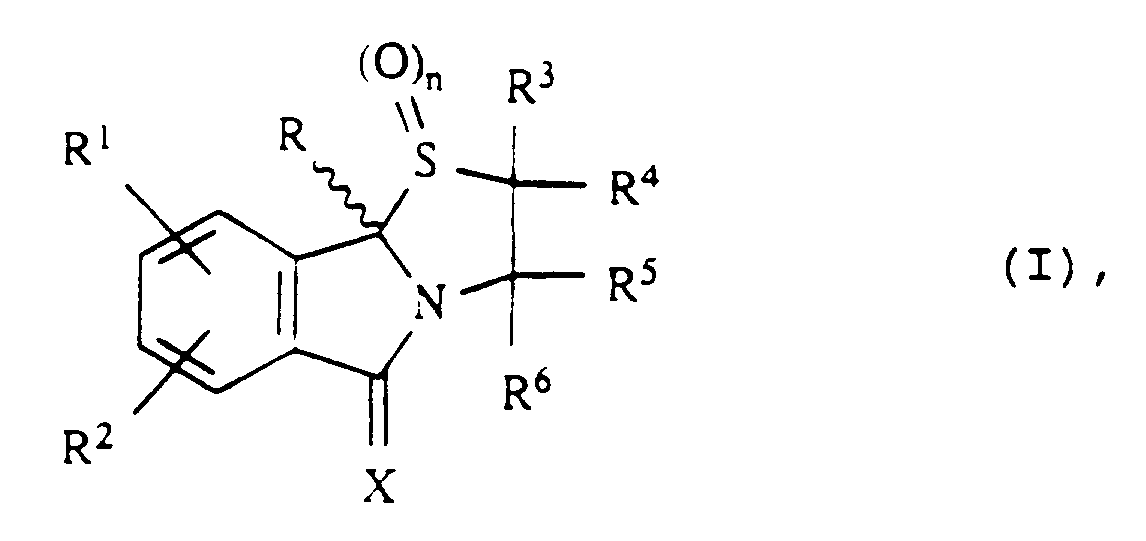
zur Herstellung von Arzneimitteln zur Behandlung von viralen oder retroviralen Infektionen, wobei - X
- ein Sauerstoff- oder Schwefelatom, die Iminogruppe =NH oder eine N-C₁-C₅-Alkyliminogruppe sein kann,
- n
- gleich 0, 1 oder 2 ist,
- R
- ein Wasserstoffatom, einen geradkettigen oder verzweigten, gesättigten oder ungesättigten aliphatischen Rest mit 1-9 C-Atomen, der durch Phenyl substituiert sein kann, oder einen C₁-C₆-Alkoxy-C₁-C₆-alkyl- oder C₁-C₆-Alkylmercapto-C₁-C₆-alkylrest bedeutet, oder
einen Phenylring bedeutet, der gegebenenfalls ein- oder mehrfach substituiert ist durch C₁-C₆-Alkyl, C₁-C₆-Alkoxy, C₁-C₆-Alkylmercapto, C₁-C₆-Alkylsulfinyl, C₁-C₆-Alkylsulfonyl, C₂-C₆-Alkenyl, C₂-C₆-Alkinyl, C₂-C₆-Alkenyloxy, C₂-C₆-Alkenylmercapto, C₂-C₆-Alkinyloxy, C₂-C₆-Alkinylmercapto, Amino, C₁-C₆-Alkylamino, Di-C₁-C₆-alkylamino, C₁-C₆-Alkylcarbonylamino, C₁-C₆-Alkylaminocarbonyl, C₁-C₆-Alkoxycarbonyl, Aminocarbonyl, Hydroxy, Benzyloxy, Phenylmercapto, Phenyloxy, Nitro, Cyano, Halogen, Trifluormethyl, Azido, Formylamino, Carboxy oder Phenyl, oder
einen mono-, bi- oder tricyclischen carbocyclischen Ring mit 7-15 C-Atomen oder ein heterocyclisches mono-, bi- oder tricyclisches Ringsystem mit jeweils 5 oder 6 Ringatomen bedeutet und pro Ringsystem 1-4 bzw. 1-5 Heteroatome enthalten sein können, wobei die Heteroatome Stickstoff, Schwefel oder Sauerstoff sind, und diese Ringe durch C₁-C₆-Alkyl, C₁-C₆-Alkoxy, Nitro, Amino oder Halogen substituiert sein können, - R¹
- ein Wasserstoffatom, einen geradkettigen oder verzweigten, gesättigten oder ungesättigten aliphatischen Rest mit 1-6 C-Atomen oder C₁-C₆-Alkoxy, C₁-C₆-Alkylmercapto, C₁-C₆-Alkylsulfinyl, C₁-C₆-Alkylsulfonyl, Amino, C₁-C₆-Alkylamino, Di-C₁-C₆-Alkylamino, Sulfonamido, C₁-C₆-Alkoxycarbonyl, Carboxy, Halogen, Hydroxy, Nitro, Cyano, Azido, Phenyl oder Benzyloxy bedeutet,
- R²
- die gleiche Bedeutung hat wie R¹, wobei die Reste R¹ und R² unabhangig voneinander gleich oder verschieden sein konnen,
- R³
- Wasserstoff, C₁-C₆-Alkyl, C₁-C₆-Alkoxy, C₁-C₆-Alkylmercapto, Amino, C₁-C₆-Alkylamino, Di-C₁-C₆-Alkylamino, Aminocarbonyl, C₁-C₆-Alkylaminocarbonyl, Di-C₁-C₆-alkylaminocarbonyl, Morpholinocarbonyl, Halogen, Cyano, Hydroxy, Carboxy, C₁-C₆-Alkoxycarbonyl, Aryloxycarbonyl, Hetaryloxycarbonyl, Aryl-C₁-C₆-alkoxycarbonyl, Hetaryl-C₁-C₆-alkoxycarbonyl, C₁-C₆-Alkoxy-C₁-C₆-alkoxycarbonyl oder Hydroxy-C₁-C₆-alkoxycarbonyl bedeutet, wobei die Aryl- oder Hetarylreste jeweils substituiert sein können durch C₁-C₆-Alkyl, C₁-C₆-Alkoxy oder Halogen,
- R⁴, R⁵, R⁶
- die gleiche Bedeutung wie R³ haben, wobei die Reste R³, R⁴, R⁵ und R⁶ unabhängig voneinander gleich oder verschieden sein können,
- Gegenstand der vorliegenden Erfindung sind auch neue Thiazolo[2,3-a]isoindole der Formel I, in der R einen heterocyclischen mono-, bi- oder tricyclischen Ring mit jeweils 5 oder 6 Ringatomen bedeutet und pro Ringsystem 1-4 bzw. 1-5 Heteroatome enthalten sein können, wobei die Heteroatome Sauerstoff, Schwefel oder Stickstoff sein können, und diese Ringe durch C₁-C₆-Alkyl, C₁-C₆-Alkoxy, Nitro, Amino oder Halogen substituiert sein können.
- Thiazolo-[2,3-a]isoindole der Formel I, in der X ein Sauerstoffatom, n die Zahlen 0 und 1, R₁-R₆ jeweils Wasserstoff und R ein Wasserstoffatom oder einen aliphatischen Rest mit 1-7 C-Atomen, der durch Phenyl substituiert sein kann, oder R einen Phenylring, der ein- oder mehrfach substituiert sein kann durch Alkyl, Alkoxy, Hydroxy, Trifluormethyl, Methylsulfonyl oder Halogen, bedeuten kann, sind aus der früheren deutschen Patentanmeldung P 40 35 809.7 (WO 92/08457) als antivirale Arzneimittel bekannt.
- Ferner sind einzelne Verbindungen der Formel I, in der R ein Wasserstoffatom darstellt, aus J. Org. Chem. 30, 1965, 1506-1508; J. Am. Chem. Soc. 80, 1958, 702-707 und Liebigs Ann. Chem. 4, 1985, 657-672 bekannt. Verbindungen mit X=0 und R=Phenyl oder Naphthyl sind aus GB 1,039,117 als Arzneimittel mit anti-inflammatorischer, anticonvulsiver und analgetischer Wirkung beschrieben.
- Der vorliegenden Erfindung lag die Aufgabe zugrunde, eine weitere medizinische Indikation für bekannte Verbindungen der Formel I zu finden und neue Thiazolo-[2,3-a]isoindole mit antiviraler Wirksamkeit zur Verfügung zu stellen. Diese Aufgabe wird durch die in den Ansprüchen gekennzeichneten Merkmale gelöst.
- Die Verbindungen der Formel I weisen wertvolle pharmakologische Eigenschaften auf. Insbesondere eignen sie sich zur Therapie und Prophylaxe von Infektionen, die durch DNA-Viren wie z.B. das Herpes-Simplex-Virus, das Zytomegalie-Virus, Papilloma-Viren, das Varicella-Zoster-Virus oder Epstein-Barr-Virus oder RNA-Viren wie Toga-Viren oder insbesondere Retroviren wie die Onko-Viren HTLV-I und II, sowie die Lentiviren Visna und Humanes-Immunschwäche-Virus HIV-1 und - 2, verursacht werden.
- Besonders geeignet erscheinen die Verbindungen der Formel I zur Behandlung der klinischen Manifestationen der retroviralen HIV-Infektion beim Menschen, wie der anhaltenden, generalisierten Lymphadenopathie (PGL), dem fortgeschrittenen Stadium des AIDS-verwandten Komplex (ARC) und dem klinischen Vollbild von AIDS.
- Die erfindungsgemäßen Verbindungen der allgemeinen Formel I besitzen eine ausgeprägte antivirale Wirkung und eignen sich insbesondere zur Behandlung von viralen bzw. retro-viralen Infektionen. Virale Infektionen von Säugern, insbesondere des Menschen, sind weit verbreitet. Trotz intensiver Bemühungen ist es bisher nicht gelungen, Chemotherapeutika bereitzustellen, die ursächlich oder symptomatisch mit dem viral oder retroviral bedingten Krankheitsgeschehen mit erkennbar substantiellem Erfolg interferieren. Es ist heutzutage nicht möglich, bestimmte Viruserkrankungen, wie zum Beispiel das Acquired Immune Deficiency Syndrom (AIDS), den AIDS-related-complex (ARC) und deren Vorstadien, Herpes-, Cytomegalie-Virus (CMV)-, Influenza-und andere Virusinfektionen zu heilen oder chemotherapeutisch deren Symptome günstig zu beeinflussen. Derzeit steht beispielsweise für die Behandlung von AIDS fast ausschließlich das 3'-Azido-3'-deoxy-thymidin (AZT), bekannt als Zidovudine oder RetrovirR, zur Verfügung. AZT ist jedoch durch eine sehr enge therapeutische Breite bzw. durch bereits im therapeutischen Bereich auftretende, sehr schwere Toxizitäten charakterisiert (Hirsch, M.S. (1988) J.Infec.Dis. 157, 427-431). Die Verbindungen der allgemeinen Formel I besitzen diese Nachteile nicht. Sie wirken antiviral, ohne in pharmakologisch relevanten Dosen cytotoxisch zu sein.
- Es konnte nun nachgewiesen werden, daß Verbindungen der allgemeinen Formel I die Vermehrung von DNA- bzw. RNA-Viren auf der Stufe der virusspezifischen DNA- bzw. RNA-Transkription hemmen. Die Substanzen können über die Inhibierung des Enzyms Reverse Transkriptase die Vermehrung von Retroviren beeinflussen (vgl. Proc. Natl. Acad. Sci. USA 83, 1911, 1986 bzw. Nature 325, 773 1987).
- Da ein sehr großer Bedarf an Chemotherapeutica besteht, die möglichst spezifisch mit retroviral bedingten Erkrankungen oder deren Symptomen interferieren, ohne die normal ablaufenden natürlichen Körperfunktionen zu beeinflussen, konnten die genannten Verbindungen vorteilhaft prophylaktisch oder therapeutisch bei der Behandlung von Krankheiten eingesetzt werden, bei denen eine retrovirale Infektion von pathophysiologischer, symptomatischer oder klinischer Relevanz ist.
- Die Verbindungen der Formel I besitzen ein Chiralitätszentrum und können sowohl in Form ihrer Racemate als auch in Form ihrer Enantiomere oder Diastereoisomere eingesetzt werden. Die Trennung der Racemate in die Enantiomeren kann analytisch, semipräparativ und präparativ chromatographisch auf geeigneten optisch aktiven Phasen mit gängigen Elutionsmitteln durchgeführt werden. Als optisch aktive Phasen eignen sich beispielsweise optisch aktive Polyacrylamide oder Polymethacrylamide, z.T. auch an Kieselgel (z.B. ChiraSpher (R) von Merck, Chiralpak (R) OT/OP von Baker), Celluloseester/carbamate (z.B. Chiracel (R) OB/OY von Baker/Daicel), Phasen auf Cyclodextrin- oder Kronenetherbasis (z.B. Crownpak (R) von Daicel) oder mikrokristallines Cellulosetriacetat (Merck).
- Ein aliphatischer Rest bedeutet einen geradkettigen oder verzweigten Alkyl-, Alkenyl- oder Alkinylrest mit 1-9, vorzugsweise 2-7 Kohlenstoffatomen, wie z.B. der Propyl-, Isopropyl-, Butyl-, Isobutyl-, Pentyl-, Hexyl- oder Heptylrest. Als ungesättigte Reste kommen C₂-C₇-Alkenyl- und Alkinylreste in Frage, bevorzugt C₂-C₅, wie z.B. der Allyl-, Dimethylallyl-, Butenyl-, Isobutenyl-, Pentenyl- oder Propinylrest.
- Ein aliphatischer Rest, der durch Phenyl substituiert sein kann, ist insbesondere eine Phenyl-C₁-C₆-alkylgruppe, wie z.B. der Benzyl-, Phenethyl-, Phenylpropyl- oder Phenylbutylrest.
- Bedeutet R einen Phenylring, so kann dieser ein-, zwei- oder dreifach substituiert sein. Die Substituenten können unabhängig voneinander in o-, m- oder p-Stellung stehen.
- Ein carbocyclischer Ring mit 7-15 C-Atomen kann mono-, bi- oder tricyclisch sein und pro Ring jeweils 5 oder 6 C-Atome aufweisen. Dieser Ring kann gesättigt, ungesättigt, teilweise gesättigt oder aromatisch sein. Beispielhaft genannt seien die folgenden Ringsysteme: der Naphthyl-, Anthracenyl-, Phenanthrenyl-, Flourenyl-, Indenyl-, Indanyl-, Acenaphthylenyl-, Norbornyl-, Adamantylring oder eine C₃-C₇-Cycloalkyl- oder C₅-C₈-Cycloalkenylgruppe, wobei in den beiden letzten Fällen die entsprechende Fünf- oder Sechsringe bevorzugt sind.
- Die heterocylischen mono-, bi- oder tricyclischen Ringsysteme enthalten pro Ringsystem 5 oder 6 Kohlenstoffatome, wobei 1-4 bzw. 1-5 C-Atome durch die Heteroatome Sauerstoff, Schwefel und/oder Stickstoff ersetzt sein können. Die Ringsysteme können aromatisch, partiell oder vollständig hydriert sein. Beispielhaft genannt seien die folgenden Ringsysteme: das Pyridin-, Pyrimidin-, Pyridazin-, Pyrazin- , Triazin-, Pyrrol-, Pyrazol-, Imidazol-, Triazol-, Thiazol-, Oxazol-, Isoxazol-, Oxadiazol-, Furazan-, Furan- , Thiophen-, Indol-, Chinolin-, Isochinolin-, Cumaron-, Thionaphthen-, Benzoxazol-, Benzthiazol-, Indazol-, Benzimidazol-, Benztriazol-, Chromen-, Phthalazin-, Chinazolin-, Chinoxalin-, Methylendioxybenzol-, Carbazol-, Acridin-, Phenoxazin-, Phenothiazin-, Phenazin- oder Purinsystem, wobei die ungesättigten bzw. aromatischen Carbo- und Heterocyclen partiell oder vollständig hydriert sein können.
- Als Aryl- bzw. Hetarylreste kommen in der Definition von R³-R⁶ bevorzugt dar Phenyl-, Naphthyl- oder Pyridylrest in Frage, wobei diese Reste insbesondere ein- oder zweifach substituiert sein können durch C₁-C₃-Alkyl, C₁-C₃-Alkoxy oder Halogen.
- R bedeutet bevorzugt unsubstituiertes Phenyl oder Phenyl ein- oder zweifach substituiert durch C₁-C₃-Alkyl, C₁-C₃-Alkoxy, C₁-C₃-Alkylmercapto, C₁-C₃-Alkylsulfinyl, C₁-C₃-Alkylsulfonyl, C₂-C₄-Alkenyl, C₂-C₃-Alkinyl, C₃-C₄-Alkenyloxy, C₁-C₃-Alkylamino, C₁-C₃-Dialkylamino-, C₁-C₃-Alkylcarbonylamino, C₁-C₃-Alkylaminocarbonyl, C₁-C₃-Alkoxycarbonyl-, Amino, Hydroxy, Nitro, Azido, Trifluormethyl, Cyano oder Halogen. Carbocylische Ringe sind bevorzugt Biphenyl, Naphthyl, Anthracenyl, Indanyl, Fluorenyl, Acenaphthylenyl, Phenanthrenyl, Norbornyl, Adamantyl, C₃-C₆-Cycloalkyl, C₅-C₈-Cycloalkenyl. Heterocyclische Ringsysteme sind bevorzugt Pyrrol, Imidazol, Furan, Thiophen, Pyridin, Pyrimidin, Thiazol, Triazin, Indol, Chinolin, Isochinolin, Cumaron, Thionaphthen, Benzimidazol, Chinazolin, Methylendioxybenzol, Ethylendioxybenzol, Carbazol, Acridin und Phenothiazin.
- Für die Reste R¹ und R² sind Wasserstoff, C₁-C₃-Alkyl, C₂-C₄-Alkenyl, C₂-C₄-Alkinyl, C₁-C₃-Alkoxy, C₁-C₃-Alkylmercapto, C₁-C₃-Alkylamino, C₁-C₃-Alkoxycarbonyl, Sulfonamido, Amino, Halogen, Hydroxy, Cyano und Azido bevorzugt, wobei diese Reste insbesondere in 7-, 8- oder 9-Stellung des Thiazolo[2,3-a]-isoindolringes stehen.
- Bevorzugte Substituenten für R³, R⁴, R⁵ und R⁶ sind Wasserstoff, C₁-C₃-Alkyl, C₁-C₃-Alkoxy, C₁-C₃-Alkylmercapto, Carboxy, C₁-C₃-Alkoxycarbonyl, Morpholinocarbonyl, Aminocarbonyl, C₁-C₃-Alkylaminocarbonyl, Di-C₁-C₃-alkylaminocarbonyl, C₁-C₃-Alkoxy-C₁-C₃-alkoxycarbonyl, Pyridyl-C₁-C₃-alkoxycarbonyl, Halogen, Cyano und Hydroxy, wobei R³ und R⁴ insbesondere Wasserstoff bedeutet. Die Reste R³-R⁶ können gleich oder verschieden sein, bevorzugt sind jedoch solche Derivate, in denen mindestens zwei, bevorzugt drei dieser Reste Wasserstoff bedeuten.
- X ist bevorzugt Sauerstoff oder Schwefel, n bevorzugt gleich 0. Unter Halogen ist allgemein Fluor, Chlor, Brom und Iod zu verstehen, bevorzugt Fluor, Chlor und Brom.
- Besonders bevorzugte Reste für R sind C₃-C₅-Alkyl, C₂-C₅-Alkenyl, C₂-C₄-Alkinyl, Benzyl, Phenethyl; Phenyl; durch C₁-C₃-Alkyl, C₁-C₃-Alkoxy, C₁-C₃-Alkylmercapto, Allyl, Allyloxy, C₁-C₃-Alkylamino, Di-C₁-C₃-alkylamino, Amino, Hydroxy, Azido, Nitro, Trifluormethyl, Cyano oder Halogen mono- oder disubstituiertes Phenyl bzw. durch Methyl oder Halogen trisubstituiertes Phenyl; Naphthyl, Anthracenyl, Indanyl, Acenaphthylenyl, Phenanthrenyl, Adamantyl, Cyclohexyl, Cyclohexenyl, Furyl, Thienyl, Pyridyl, Pyrimidinyl, Thiazolyl, Indolyl, Chinolinyl, Benzimidazolyl, Methyiendioxyphenyl, Carbazolyl und Phenothiazinyl.
- Für R¹ und R² sind unabhängig voneinander besonders bevorzugt Wasserstoff, Methyl, Ethyl, Isopropyl, Allyl, Methoxy, Ethoxy, Methylmercapto, Ethylmercapto, Methylamino, Methoxycarbonyl, Ethoxycarbonyl, Amino, Azido, Cyano, Hydroxy und Halogen, wobei Halogen insbesondere Chlor und Brom bedeutet.
- Für R³, R⁴, R⁵ und R⁶ sind Methyl, Ethyl, Isopropyl, Methoxy, Ethoxy, Methylmercapto, Ethylmercapto, Methylamino, Amino, Chlor, Brom und Cyano besonders bevorzugt.
- Insbesondere bevorzugt sind Verbindungen der allgemeinen Formel I, in denen R, R¹, X und n die oben angegebene Bedeutung haben und R², R³, R⁴, R⁵ und R⁶ gleich Wasserstoff, Methyl, Ethyl, Chlor, Brom, Methoxy oder Ethoxy sind, wobei die Reste R² bis R⁶ bevorzugt Wasserstoff darstellen.
- Die neuen Verbindungen der Formel I, in der R einen heterocylischen Rest bedeutet, sind insbesondere solche Derivate, in denen R Thienyl, Furyl, Pyridyl, Thionaphthenyl oder Indolyl bedeutet, wobei diese Reste insbesondere durch C₁-C₆-Alkyl und Halogen substituiert sein können.
- Die Arzneimittel enthaltend mindestens eine Verbindung der Formel I zur Behandlung von viralen Infektionen können in flüssiger oder fester Form enteral oder parenteral appliziert werden. Hierbei kommen die üblichen Applikationsformen in Frage, wie beispielsweise Tabletten, Kapseln, Dragées, Sirupe, Lösungen oder Suspensionen. Als Injektionsmedium kommt vorzugsweise Wasser zur Anwendung, das die bei Injektionslösungen üblichen Zusätze wie Stabilisierungsmittel, Lösungsvermittler und Puffer enthält. Derartige Zusätze sind z.B. Tartrat- und Zitratpuffer, Ethanol, Komplexbildner, wie Ethylen-diamintetraessigsäure und deren nichttoxischen Salze, hochmolekulare Polymere, wie flüssiges Polyethylenoxid zur Viskositätsregulierung. Flüssige Trägerstoffe für Injektionslösungen müssen steril sein und werden vorzugsweise in Ampullen abgefüllt. Feste Trägerstoffe sind beispielsweise Stärke, Lactose, Mannit, Methylcellulose, Talkum, hochdisperse Kieselsäuren, höher molekulare Fettsäuren, wie Stearinsäure, Gelatine, Agar-Agar, Calziumphosphat, Magnesiumstearat, tierische und pflanzliche Fette, feste hochmolekulare Polymere, wie Polyethylenglykole, etc.. Für orale Applikationen geeignete Zubereitungen können gewünschtenfalls Geschmacks- oder Süßstoffe enthalten.
- Die Arzneimittel enthaltend mindestens eine Verbindung der Formel I werden dadurch hergestellt, indem man eine Verbindung der Formel I mit üblichen pharmazeutischen Hilfsstoffen mischt und zu Arzneiformen, wie z. B. Tabletten, Dragees, Kapseln oder Lösungen verarbeitet. Diese Arzneiformen werden zu verkaufsfertigen Verpackungseinheiten konfektioniert, und mit einem entsprechenden Hinweis, z. B. in Form eines Beipackzettels, versehen, aus dem die Verwendung zur Behandlung von viralen oder retroviralen Infektionen bzw. von viralen oder retroviral bedingten Erkrankungen hervorgeht.
- Die Dosierung kann von verschiedenen Faktoren, wie Applikationsweise, Spezies, Alter oder individuellem Zustand abhängen. Die erfindungsgemäßen Verbindungen werden üblicherweise in Mengen von 0,1 - 100 mg, vorzugsweise 0,2 - 80 mg pro Tag und pro kg Körpergewicht appliziert. Bevorzugt ist es, die Tagesdosis auf 2-5 Applikationen zu verteilen, wobei bei jeder Applikation 1-2 Tabletten mit einem Wirkstoffgehalt von 0,5 - 500 mg verabreicht werden. Die Tabletten können auch retardiert sein, wodurch sich die Anzahl der Applikationen pro Tag auf 1-3 vermindert. Der Wirkstoffgehalt der retardierten Tabletten kann 2 - 1000 mg betragen. Der Wirkstoff kann auch durch Dauerinfusion gegeben werden, wobei die Mengen von 5 - 1000 mg pro Tag normalerweise ausreichen.
- Die Verbindungen der Formel I können auch in Form ihrer physiologisch verträglichen Salze, wie z.B. der Alkali- oder Erdalkalisalze eingesetzt werden, sofern diese Verbindungen saure Gruppen, wie z.B. eine freie Carboxygruppe besitzen. Sind basische Gruppen vorhanden, so können die Verbindungen der Formel I mit Hilfe von organischen oder anorganischen Säuren in die entsprechenden physiologisch verträgliche Säureadditionssalze überführt werden.
- Die erfindungsgemäßen Verbindungen der allgemeinen Formel I werden nach literaturbekannten Verfahren hergestellt, indem man gegebenenfalls substituierte Benzoesäurederivaten der allgemeinen Formel II

in der R, R¹, und R² die oben angegebene Bedeutung haben und A gleich -COOH oder C=N ist, mit substituiertem oder unsubstituiertem Cysteamin der allgemeinen Formel III
in der R³, R⁴, R⁵ und R⁶ die oben angegebene Bedeutung haben, in einem geeigneten inerten Lösungsmittel bei Raumtemperatur bis Rückflußtemperatur evtl. in Gegenwart katalytischer Mengen Säure, z.B. p-Toluolsulfonsäure, umsetzt und gegebenenfalls anschließend Verbindungen der Formel I in andere Verbindungen der Formel I nachträglich umwandelt und anschließend chromatographisch bzw. durch Umkristallisation reinigt. Racemate können durch Chromatographie an geeigneten optisch aktiven Phasen, z.B. Cellulosetriacetat, in die Antipoden getrennt werden. - Die nachträglichen Umwandlungen von Verbindungen der Formel I in andere Verbindungen der Formel I betreffen die Herstellung von Thialzolo-[2,3-a]isoindolin-Derivaten mit X=S oder N-Alkylimin. Verbindungen mit X=S werden hergestellt durch Umsetzung von Verbindungen der Formel I, in der X ein Sauerstoffatom bedeutet, mit schwefelgruppenübertragenden Verbindungen, wie z.B. Lawesson's Reagenz. Verbindungen mit X = N-Alkylimino werden hergestellt durch Umsetzung der entsprechenden Iminoverbindungen der allgemeinen Formel I mit Alkylaminen nach an sich bekannten Methoden.
- Die Benzoesäurederivate der allgemeinen Formel II sind ebenfalls literaturbekannt und werden z.B. durch Friedel-Crafts-Acylierung von substituiertem oder unsubstituiertem Phthalsäureanhydrid mit gegebenenfalls substituierten Arenen in Gegenwart einer Lewis-Säure (z.B. Aluminiumchlorid) oder durch Reaktion von Grignardreagenzien der allgemeinen Formel IV
R-MgBr (IV),
in der R mit Ausnahme von Wasserstoff die oben angegebene Bedeutung hat, mit Phthalsäureanhydrid, das gegebenenfalls substituiert ist, in geeigneten inerten Lösungsmitteln bei tiefen Temperaturen hergestellt. - Die Verfahren zur Herstellung der erfindungsgemäßen Verbindungen der allgemeinen Formel I können auch der im Stand der Technik genannten Patentanmeldungen bzw. Literaturstellen entnommen werden (vgl. US-Patent 3,334,113, CH-469,733, belgische Patentanmeldung 659,528 bzw. US-Patent 3,646,022, U.S. 2,860,985, belgische Patentanmeldung 564,592, J. Org. Chem. 30, 1506 (1965) sowie J. Org. Chem. 34, 165 (1969) ).
- Im Sinne der vorliegenden Erfindung kommen außer den in den Beispielen genannten Verbindungen und der durch Kombination aller in den Ansprüchen genannten Bedeutungen der Substituenten die folgenden Verbindungen der Formel I in Frage, die als racemischen Gemische oder in optisch aktiver Form bzw. als reine R- und S-Enantiomeren vorliegen können:
- 1. 8,9b-Dimethyl-2,3-dihydrothiazolo-[2,3-a]isoindol-5(9bH)-on
- 2. 8-Chlor-9b-phenyl-2,3-dihydrothiazolo-[2,3-a]isoindol-5(9bH)-on
- 3. 8-Fluor-9b-(4-methylphenyl)-2,3-dihydrothiazolo-[2,3-a]isoindol-5(9bH)-on
- 4. 8-Chlor-9b-(3-methylphenyl)-2,3-dihydrothiazolo-[2,3-a]isoindol-5(9bH)-on
- 5. 3-Methyl-9b-(4-ethylphenyl)-2,3-dihydrothiazolo-[2,3-a]isoindol-5(9bH)-on
- 6. 9b-(2,3-Dimethylphenyl)-2,3-dihydrothiazolo-[2,3-a]isoindol-5(9bH)-thion
- 7. 8-Chlor-9b-(3,4-dimethylphenyl)-2,3-dihydrothiazolo-[2,3-a]isoindol-5(9bH)-thion
- 8. 2-Ethyl-9b-(2,5-Dimethylphenyl)-2,3-dihydrothiazolo-[2,3-a]isoindol-5(9bH)-on
- 9. 8-Chlor-9b-(3-trifluormethylphenyl)-2,3-dihydrothiazolo-[2,3-a]isoindol-5(9bH)-on
- 10. 6-Methoxy-9b-(4-trifluormethylphenyl)-2,3-dihydrothiazolo-[2,3-a]isoindol-5(9bH)-on
- 11. 9b-(4-Hydroxyphenyl)-2,3-dihydrothiazolo-[2,3-a]isoindol-5(9bH)-thion
- 12. 8-Chlor-9b-(3-hydroxyphenyl)-2,3-dihydrothiazolo-[2,3-a]isoindol-5(9bH)-on
- 13. 7-Methylmercapto-9b-(4-ethoxyphenyl)-2,3-dihydrothiazolo-[2,3-a]isoindol-5(9bH)-on
- 14. 9-Methyl-9b-(3-methoxyphenyl)-2,3-dihydrothiazolo-[2,3-a]isoindol-5(9bH)-on
- 15. 8-Fluor-9b-(3-fluorphenyl)-2,3-dihydrothiazolo-[2,3-a]isoindol-5(9bH)-on
- 16. 9b-(4-Chlorphenyl)-2,3-dihydrothiazolo-[2,3-a]isoindol-5(9bH)-thion
- 17. 8-Methyl-9b-(3-methylsulfonylphenyl)-2,3-dihydrothiazolo-[2,3-a]isoindol-5(9bH)-on
- 18. 9-Chlor-9b-phenyl-2,3-dihydrothiazolo-[2,3-a]isoindol-5(9bH)-on-1-oxid
- 19. 8-Chlor-9b-benzyl-2,3-dihydrothiazolo-[2,3-a]isoindol-5(9bH)-on
- 20. 2,2,-Dimethyl-9b-phenethyl-2,3-dihydrothiazolo-[2,3-a]isoindol-5(9bH)-on
- 21. 9b-(3-Methylmercaptophenyl)-2,3-dihydrothiazolo-[2,3-a]isoindol-5(9bH)-on
- 22. 9b-(3-Methylaminophenyl)-2,3-dihydrothiazolo-[2,3-a]isoindol-5(9bH)-on
- 23. 9b-(3-Azidophenyl)-2,3-dihydrothiazolo-[2,3-a]isoindol-5(9bH)-on
- 24. 8-Methyl-9b-allyl-2,3-dihydrothiazolo-[2,3-a]isoindol-5(9bH)-on
- 25. 8-Chlor-9b-(3,5-dimethylphenyl)-2,3-dihydrothiazolo-[2,3-a]isoindol-5(9bH)-on
- 26. 8-Methyl-9b-(1-napthyl)-2,3-dihydrothiazolo-[2,3-a]isoindol-5(9bH)-on
- 27. 9b-(Anthracen-1-yl)-2,3-dihydrothiazolo-[2,3-a]isoindol-5(9bH)-thion
- 28. 9b-(Anthracen-9-yl)-2,3-dihydrothiazolo-[2,3-a]isoindol-5(9bH)-on
- 29. 9b-(Inden-1-yl)-2,3-dihydrothiazolo-[2,3-a]isoindol-5(9bH)-on
- 30. 9b-(Inden-3-yl)-2,3-dihydrothiazolo-[2,3-a]isoindol-5(9bH)-on
- 31. 9b-(Inden-4-yl)-2,3-dihydrothiazolo-[2,3-a]isoindol-5(9bH)-thion
- 32. 9b-(Phenanthren-1-yl)-2,3-dihydrothiazolo-[2,3-a]isoindol-5(9bH)-on
- 33. 9b-(Phenanthren-9-yl)-2,3-dihydrothiazolo-[2,3-a]isoindol-5(9bH)-on
- 34. 9b-(Cyclohexen-3-yl)-2,3-dihydrothiazolo-[2,3-a]isoindol-5(9bH)-thion
- 35. 9b-(2-Furyl)-2,3-dihydrothiazolo-[2,3-a]isoindol-5(9bH)-thion
- 36. 9b-(3-Furyl)-2,3-dihydrothiazolo-[2,3-a]isoindol-5(9bH)-on
- 37. 9b-(2-Thienyl)-2,3-dihydrothiazolo-[2,3-a]isoindol-5(9bH)-thion
- 38. 9b-(3-Thienyl)-2,3-dihydrothiazolo-[2,3-a]isoindol-5(9bH)-on
- 39. 9b-(Pyrimidin-4-yl)-2,3-dihydrothiazolo-[2,3-a]isoindol-5(9bH)-on
- 40. 9b-(Thiazol-2-yl)-2,3-dihydrothiazolo-[2,3-a]isoindol-5(9bH)-on
- 41. 9b-(Thiazol-4-yl)-2,3-dihydrothiazolo-[2,3-a]isoindol-5(9bH)-thion
- 42. 9b-(Indol-3-yl)-2,3-dihydrothiazolo-[2,3-a]isoindol-5(9bH)-on
- 43. 9b-(Indol-7-yl)-2,3-dihydrothiazolo-[2,3-a]isoindol-5(9bH)-on
- 44. 9b-(Chinolin-4-yl)-2,3-dihydrothiazolo-[2,3-a]isoindol-5(9bH)-on
- 45. 9b-(Chinolin-5-yl)-2,3-dihydrothiazolo-[2,3-a]isoindol-5(9bH)-thion
- 46. 9b-(Benzimidazol-4-yl)-2,3-dihydrothiazolo-[2,3-a]isoindol-5(9bH)-on
- 47. 9b-(Carbazol-1-yl)-2,3-dihydrothiazolo-[2,3-a]isoindol-5(9bH)-on
- 48. 9b-(Carbazol-4-yl)-2,3-dihydrothiazolo-[2,3-a]isoindol-5(9bH)-thion
- 49. 9b-(Phenothiazin-1-yl)-2,3-dihydrothiazolo-[2,3-a]isoindol-5(9bH)-thion
- 50. 9b-(Phenothiazin-4-yl)-2,3-dihydrothiazolo-[2,3-a]isoindol-5(9bH)-on
- 51. 9b-(4-Chinazolin-4-yl)-2,3-dihydrothiazolo-[2,3-a]isoindol-5(9bH)-on
- 52. 8-Chlor-9b-(inden-3-yl)-2,3-dihydrothiazolo-[2,3-a]isoindol-5(9bH)-on
- 53. 8-Methyl-9b-(isochinolin-1-yl)-2,3-dihydrothiazolo-[2,3-a]isoindol-5(9bH)-thion
- 54. 9-Methoxy-9b-(1-naphthyl)-2,3-dihydrothiazolo-[2,3-a]isoindol-5(9bH)-on
- 55. 9b-(Cumaron-3-yl)-2,3-dihydrothiazolo-[2,3-a]isoindol-5(9bH)-on
- 56. 9b-(1-Naphthyl)-2,3-dihydrothiazolo-[2,3-a]isoindol-5(9bH)-on-1,1-dioxid
- 57. 9b-(1-Naphthyl)-2,3-dihydrothiazolo-[2,3-a]isoindol-5(9bH)-on-1-oxid
- 2.76 g (10 mmol) 2-(1-Naphthoyl)benzoesäure wurden in 100 ml Xylol gelöst und nach Zugabe von 1.54 g (20 mmol) Cysteamin sowie einer katalytischen Menge p-Toluolsulfonsäure 1 h am Wasserabscheider unter Rückfluß erhitzt. Dann wurde das Lösungsmittel im Vakuum entfernt und der Rückstand aus Ethanol umkristallisiert. Ausbeute 1.54 g (67 % d.Th.), Schmp. 151-152°C.
- Die verwendete 2-(1-Naphthoyl)benzoesäure wurde durch langsames Zutropfen von 1-Napthylmagnesiumbromid in Ether/Toluol 4/1 bei -10°C zu einer Lösung von Phthalsäureanhydrid in Toluol, nach 2-stündigem Nachrühren Zugabe von ges. NH₄Cl-Lösung, Extraktion mit Essigester, Ausschütteln der Essigesterphase mit 2 N Sodalösung und erneuter Extraktion der angesäuerten Sodaphase mit Essigester hergestellt. Ausbeute nach Umkristallisation aus Ethanol 64 % d.Th., Schmp. 170°C.
- Analog zu Bsp. 1 wurden folgende Verbindungen hergestellt:
- 1.1 9b-(2-Naphthyl)-2,3-dihydrothiazolo-[2,3-a]isoindol-5(9bH)-on; amorph; Rf = 0.5 (Essigester/Isohexan 1/3) aus 2-(2-Naphthoyl)benzoesäure und Cysteamin (66 % Ausb.)
- 1.2 9b-(Anthracen-9-yl)-2,3-dihydrothiazolo-[2,3-a]isoindol-5(9bH)-on; Schmp. 198°C aus 2-(9-Anthracenoyl)-benzoesäure und Cysteamin ( 49 % Ausb.)
- 1.3 7-Chlor-9b-phenyl-2,3-dihydrothiazolo-[2,3-a]isoindol-5(9bH)-on; Schmp. 123°C aus 5-Chlor-2-benzoylbenzoesäure und Cysteamin (61 % Ausb.)
- 1.4 7-Methyl-9b-phenyl-2,3-dihydrothiazolo-[2,3-a]isoindol-5(9bH)-on; Schmp. 98°C aus 5-Methyl-2-benzoylbenzoesäure und Cysteamin (59 % Ausb.)
- 1.5 6-Methyl-9b-phenyl-2,3-dihydrothiazolo-[2,3-a]isoindol-5(9bH)-on; Schmp. 185°C aus 6-Methyl-2-benzoylbenzoesäure und Cysteamin (79 % Ausb.)
- 1.6 7-Methoxy-9b-phenyl-2,3-dihydrothiazolo-[2,3-a]isoindol-5(9bH)-on; Rf = 0.33; (Essigester/Isohexan 1/3) aus 5-Methoxy-2-benzoylbenzoesäure und Cysteamin (55 % Ausb.)
- 1.7 7,8-Dichlor-9b-phenyl-2,3-dihydrothiazolo-[2,3-a]isoindol-5(9bH)-on; Schmp. 112-114°C aus 4,5-Dichlor-2-benzoylbenzoesäure und Cysteamin (67 % Ausb.)
- 1.8 9b-(2-Thienyl)-2,3-dihydrothiazolo[2,3-a]isoindol-5(9bH)-on; Schmp. 151°C (Ethanol/H₂O) aus 2-(2-Thienoyl)benzoesäure und Cysteamin (63 % Ausb.)
- 1.9 9b-(2-Furyl)-2,3-dihydrothiazolo[2,3-a]isoindol-5(9bH)-on; Schmp. 114°C (Ethanol/Ether) aus 2-(2-Furoyl)-benzoesäure und Cysteamin (70 % Ausb.)
- 1.10 9b-Cyclopentyl-2,3-dihydrothiazolo-[2,3-a]isoindol-5(9bH)-on; Öl; Rf = 0.85 (CH₂Cl₂/CH₃OH 9/1) aus 2-Cyclopentoylbenzoesäure und Cysteamin (81 % Ausb.). Die Reinigung dieser Verbindung erfolgt durch Säulenchromatographie mit Essigester/Isohexan 1/1.
- 1.11 8-Chlor-7-sulfonamido-9b-phenyl-2,3-dihydrothiazolo-[2,3-a]isoindol-5-(9bH)-on; Schmp. 245-246°C aus 4-Chlor-5-sulfonamido-2-benzoylbenzoesäure und Cysteamin (54 % Ausb.)
- 1.12 8-Chlor-9b-phenyl-2,3-dihydrothiazolo[2,3-a]isoindol-5(9bH)-on; Schmp. 113-136°C aus 4-Chlor-2-benzoylbenzoesäure und Cysteamin (68 % Ausb.)
- 1.13 8-Methyl-9b-phenyl-2,3-dihydrothiazolo-[2,3-a]isoindol-5(9bH)-on; Schmp. 115-118°C aus 4-Methyl-2-benzoylbenzoesäure und Cysteamin (75 % Ausb.)
- 1.14 9b-(4-Pyridyl)-2,3-dihydrothiazolo[2,3-a]isoindol-5(9bH)-on; Schmp. 114°C aus 2-(4-Pyridoyl)benzoesäure und Cysteamin (68 % Ausb.)
- 1.15 9b-(2-Pyridyl)-2,3-dihydrothiazolo[2,3-a]isoindol-5(9bH)-on; Schmp. 115-116°C aus 2-(2-Pyridoyl)benzoesäure und Cysteamin (61 % Ausb.)
- 1.16 9b-(3-Pyridyl)-2,3-dihydrothiazolo[2,3-a]isoindol-5(9bH)-on; Schmp. 149-152°C aus 2-(3-Pyridoyl)benzoesäure und Cysteamin (57 % Ausb.)
- 1.17 9b-Cyclohexyl-2,3-dihydrothiazolo[2,3-a]isoindol-5(9bH)-on; Öl; Rf = 0.55 (Essigester/Isohexan 1/3) aus 2-Cyclohexoylbenzoesäure und Cysteamin (79 % Ausb.)
- 1.18 9b-(2-Aminophenyl)-2,3-dihydrothiazolo-[2,3-a]isoindol-5(9bH)-on; Schmp. 147-151°C (Isopropanol) aus 2-(2-Aminobenzoyl)benzoesaure und Cysteamin (43 % Ausb.)
- 1.19 9b-(4-Aminophenyl)-2,3-dihydrothiazolo-[2,3-a]isoindol-5(9bH)-on; Schmp. 179-185°C (Isopropanol) aus 2-(4-Aminobenzoyl)benzoesäure und Cysteamin (49 % Ausb.).
- 1.20 9b-(Indan-4-yl)-2,3-dihydrothiazolo-[2,3-a]isoindol-5(9bH)-on; Schmp. 151-153°C aus 2-(Indan-4-ylcarbonyl)-benzoesäure und Cysteamin (63 % Ausb.)
- 1.21 9b-(2-Nitro-5-methylphenyl)-2,3-dihydrothiazolo-[2,3-a]isoindol-5(9bH)-on; Schmp. 161-164°C (Essigester/Isohexan) aus 2-(2-Nitro-5-methyl-benzoyl)benzoesäure und Cysteamin (70 % Ausb.)
- 1.22 8-Methoxy-9b-phenyl-2,3-dihydrothiazolo-[2,3-a]isoindol-5(9bH)-on; Öl aus 4-Methoxybenzoylbenzoesäure und Cysteamin (56 % Ausb.)
- 1.23 9b-(3-Nitrophenyl)-2,3-dihydrothiazolo-[2,3-a]isoindol-5(9bH)-on; Schmp. 91-97°C aus 2-(3-Nitrobenzoyl)benzoesäure und Cysteamin (33 % Ausb.)
- 1.24 8-Chlor-9b-(1-naphthyl)-2,3-dihydrothiazolo-[2,3-]isoindol-5(9bH)-on; Schmp. 156-159°C (Methanol) aus 4-Chlor-2-(1-naphthoyl)benzoesäure und Cysteamin (28 % Ausb.)
- 1.25 9b-(3-Dimethylaminophenyl)-2,3-dihydrothiazolo-[2,3-a]-isoindol-5(9bH)-on; Schmp. 149-151°C (Methanol) aus 2-(3-Dimethylaminobenzoyl)benzoesäure und Cysteamin (27 % Ausb.)
- 1.26 9b-(9-Phenanthrenyl)-2,3-dihydrothiazolo-[2,3-a]isoindol-5(9bH)-on; Schmp. 170-172°C (Essigester/Isohexan) aus 2-(9-Phenanthrenoyl)benzoesäure und Cysteamin (64 % Ausb.)
- 1.27 9b-(3-Amino-4-chlorphenyl)-2,3-dihydrothiazolo-[2,3-a]isoindol-5(9bH)-on; Schmp. 180°C (Isopropanol) aus 2-(3-Amino-4-chlorbenzoyl)benzoesäure und Cysteamin (41 % Ausb.)
- 1.28 9b-(5-Fluor-1-naphthyl)-2,3-dihydrothiazolo-[2,3-a]isoindol-5(9bH)-on; Schmp. 157°C aus 2-(5-Fluor-1-naphthoyl)benzoesäure und Cysteamin (85 % Ausb.)
- 1.29 8-Chlor-9b-(3-Chlorphenyl)-2,3-dihydrothiazolo-[2,3-a]isoindol-5(9bH)-on; Schmp. 162°C aus 4-Chlor-2-(3-chlorbenzoyl)benzoesäure und Cysteamin (73 % Ausb.)
- 1.30 6-Methoxy-9b-phenyl-2,3-dihydrothiazolo-[2,3-a]isoindol-5(9bH)-on; Schmp. 187°C (Isopropanol) aus 6-Methoxy-2-benzoylbenzoesäure und Cysteamin (42 % Ausb.)
- 1.31 8-Chlor-9b-(3-methylphenyl)-2,3-dihydrothiazolo-[2,3-a]isoindol-5(9bH)-on; Schmp. 129-132°C (Ether) aus 4-Chlor-2-(3-methylbenzoyl)benzoesäure und Cysteamin (24 % Ausb.)
- 1.32 7-Chlor-9b-(3-methylphenyl)-2,3-dihydrothiazolo-[2,3-a]isoindol-5(9bH)-on; Schmp. 76-80°C (Ether) aus 5- Chlor-2-(3-methylbenzoyl)benzoesäure und Cysteamin (27 % Ausb.)
- 1.33 9b-(4-Methylpyridin-2-yl)-2,3-dihydrothiazolo-[2,3-a]isoindol-5(9bH)-on; Öl aus 2-[2-(4-Methylpyridoyl)]benzoesäure und Cysteamin (53 % Ausb.)
- 1.34 9b-(2-Thionapthenyl)-2,3-dihydrothiazolo-[2,3-a]isoindol-5(9bH)-on; Schmp. 130-133°C aus 2-(2-Thionaphthenoyl)benzoesäure und Cysteamin (62 % Ausb.)
- 1.35 9b-(3-Thionaphthenyl)-2,3-dihydrothiazolo-[2,3-a]isoindol-5(9bH)-on; Schmp. 206-217°C aus 2-(3-Thionaphthenoyl)benzoesäure und Cysteamin (50 % Ausb.)
- 1.36 9b-(Indol-3-yl)-2,3-dihydrothiazolo-[2,3-a]isoindol-5(9bH)-on; Schmp. 272-275°C (Methanol) aus 2-(Indol-3-ylcarbonyl)benzoesäure und Cysteamin (42 % Ausb.)
- 2 g (7.5 mmol) 9b-Phenyl-2,3-dihydrothiazolo-[2,3-a]isoindolin-5(9bH)-on [J.Org.Chem. 34, 165 (1969)] in 100 ml abs. Dioxan wurden mit 3.8 g (9.4 mmol) Lawesson's-Reagenz [2,4-Bis-(4-methoxyphenyl)-1,3-dithia-2,4-diphosphetan-2,4-disulfid] versetzt und 5 h bei 60°C gerührt (DC-Kontrolle).
- Nach dem Abkühlen wurde von Niederschlag abfiltriert, das Filtrat im Vakuum eingedampft und der Rückstand durch Flash-Säulenchromatographie mit Heptan/Methylethylketon 6/1 als Eluens gereinigt.
Ausbeute 1.24 g (58 % d.Th.), Schmp. 152-155°C. - Analog wurde hergestellt:
- 2.1 9b-(1-Naphthyl)-2,3-dihydrothiazolo-[2,3-a]isoindol-5(9bH)-thion
wurde aus der entsprechenden Oxo-Verbindung (Bsp. 1) hergestellt. Ausbeute: 71 % d.Th., Schm. °C. - Für die Trennung der Antipoden wurden 200 mg des Racemats in 15 ml Methanol gelöst, auf eine Säule mit 50 mm Innendurchmesser und 300 mm Länge (entsprechend 250 g Cellulosetriacetat, 15-25 » Korngröße, Merck 16326) aufgegeben und mit Methanol eluiert (Fluß 7.5 ml/min, ca. 1.5 bar).

- Analog zu Bsp. 3 wurden getrennt:
- 3.1 (-)-8-Chlor-9b-phenyl-2,3-dihydrothiazolo-[2,3-a]isoindol-5(9bH)-on
(Schmp. 87-93°C). - 3.2 (+)-8-Chlor-9b-phenyl-2,3-dihydrothiazolo-[2,3-a]isoindol-5(9bH)-on
(Schmp. 87-93°C); mit Ethanol als Eluens. - 3.3 (-)-8-Chlor-9b-(3-chlorphenyl)-2,3-dihydrothiazolo-[2,3-a]isoindol-5(9bH)-on;
(Schmp. 138°C/Ethanol; [α]D = -236°C/c = 1/CHCl₃) - 3.4 (+)-8-Chlor-9b-(3-chlorphenyl)-2,3-dihydrothiazolo-[2,3-a]isoindol-5(9bH)-on;
(Schmp. 138°C/Etnanol; [α]D = + 236°C/c = 1/CHCl₃) mit Methanol als Eluens. - 2.1 g (7.4 mmol) 9b-(4-Aminophenyl)-2,3-dihydrothiazolo-[2,3-a]-isoindol-5(9bH)-on wurden in 12 ml 2 N HCl suspendiert, bei 0-5°C innerhalb von 15 min. mit einer Lösung aus 0.55 g (8 mmol) NaNO₂ in 3 ml H₂O versetzt und 30 min. bei 0°C gerührt.
- Dann wurde innerhalb von 10 min eine Lösung aus 0.6 g (9.2 mmol) NaN₃ in 8 ml H₂O zugetropft, 30 min nachgerührt und der entstandene Niederschlag abgesaugt. Das Rohprodukt wurde durch Säulenchromatographie an Kieselgel 60 mit Ether/Isohexan 1/2 als Eluens gereinigt. Ausbeute 1.62 g (71 % d.Th.), Schmp. >140°C Zers..
- 4.1 9b-(3-Azidophenyl)-2,3-dihydrothiazolo-[2,3-a]isoindol-5(9bH)-on
wurde analog zu Bsp. 4 aus 9b-(3-Aminophenyl)-2,3-dihydrothiazolo-[2,3-a]isoindol-5(9bH)-on in 86 % Ausbeute hergestellt. Schmp. 100-101°C (Umkristallisation aus Ether). - 11.2 g (35.7 mmol) 9b-(3-Nitrophenyl)-2,3-dihydrothiazolo-[2,3-a]isoindol-5(9bH)-on in 90 ml Ethanol wurden in der Siedehitze innerhalb von 5 min mit 23 g Na₂S₂O₄ in 90 ml H₂O versetzt und 1 h unter Rückfluß erhitzt.
- Dann wurde das Ethanol im Vakuum abgedampft, die wäßrige Phase mehrmals mit Dichlormethan extrahiert und die organische Phase über Na₂SO₄ getrocknet. Nach Entfernen des Lösungsmittels im Rotationsverdampfer wurde der Rückstand aus Dichlormethan umkristallisiert. Aus.b. 6.02 g (60 % d.Th.), Schmp. 184-186°C.
- 5.1 9b-(2-Amino-5-methylphenyl)-2,3-dihydrothiazolo-[2,3-a]isoindol-5(9bH)-on
wurde analog zu Bsp. 5 aus 9b-(2-Nitro-5-methylphenyl)-2,3-dihydrothiazolo-[2,3-a]isoindol-5(9bH)-on in 53 % Ausbeute hergestellt. Schmp. 153-156°C (Umkristallisation aus Dichlormethan). - In eine Lösung aus 1 g (4.4 mmol) 2-Benzoylbenzoesäure in 10 ml Xylol wurden bei 100°C über einen Zeitraum von 10 h portionsweise 1.7 g (9.9 mmol) L-Cysteinmethylester-hydrochlorid und 1.35 g Natriumacetat eingetragen. Nach weiteren 3 h bei 100°C wurde das Xylol abdestilliert, der Rückstand in Dichlormethan aufgenommen und mit NaHCO₃-Lsg. sowie Wasser gewaschen. Der Ester wurde durch Entfernen des Lösungsmittels isoliert und ohne weitere Reinigung in die nächste Reaktion eingesetzt.
[α]D = -57°C/c = 1/MeOH) - Das Rohprodukt der letzten Reaktion wurde in 5 ml Ethanol gelöst, mit 2 ml 2 N NaOH versetzt und 2 h bei 40°C gerührt.
- Dann wurde der Alkohol abdestilliert, die wäßrige Phase mit 6 N HCl angesäuert und die freie Säure abgesaugt. Ausb. 0.6 g (44 % d.Th., bezogen auf eingesetzte 2-Benzoylbenzoesäure), Schmp. 96-98°C (Umkristallisation aus Ethanol). [α]D = - 211°/c = 0.89 /MeOH.
- 311 mg (1 mmol) 9b-Phenyl-2,3-dihydrothiazolo-[2,3-a]isoindol-5(9bH)-on-3-carbonsäure (Bsp. 7) in 10 ml abs. Dichlormethan wurden bei -15°C mit 101 mg (1 mmol) 4-Methylmorpholin und anschließend 155 mg (1.1 mmol) Isobutylchlorformiat versetzt und 15 min gerührt. Dann wurden 96 mg (1.1 mmol) Morpholin zugegeben, auf RT erwärmt und 4 h bei RT gerührt. Nach Zugabe weiterer 20 ml Dichlormethan wurde die Lösung mit NaHCO₃-Lsg. und Wasser ausgeschüttelt, über Na₂SO₄ getrocknet und vom Lösungsmittel befreit. Der Rückstand wurde durch Chromatographie an Kieselgel mit Essigester als Eluens gereinigt. Ausb. 158 mg (51 % d. Th.), Schmp. 138-141°C.
- 8.1 9b-Phenyl-2,3-dihydrothiazolo-[2,3-a]isoindol-5(9bH)-on-3-carbonsäureamid
wurde analog zu Bsp. 8 in 57 % Ausbeute hergestellt, Schmp. 164°C (Essigester). - 8.2 9b-Phenyl-2,3-dihydrothiazolo-[2,3-a]isoindol-5(9bH)-on-3-carbonsäuremethylamid
wurde analog zu Bsp. 8 in 41 % Ausbeute hergestellt, Schmp. 160-162°C (Essigester). - 8.3 9b-Phenyl-2,3-dihydrothiazolo-[2,3-a]isoindol-5(9bH)-on-3-carbonsäuredimethylamid
wurde analog zu Bsp. 8 in 59 % Ausbeute hergestellt, Schmp. 178°C (Essigester). - 8.4. 9b-Phenyl-2,3-dihydrothiazolo-[2,3-a]isoindol-5(9bH)-on3-carbonsäurepropylester
wurde analog zu Bsp. 8 durch Umsetzung des Aktivesters mit n-Propanol in 27 % Ausbeute hergestellt, Schmp. 103-106°C. - 8.5 9b-Phenyl-2,3-dihydrothiazolo-[2,3-a]isoindol-5(9bH)-on-3-carbonsäureisonropylester
wurde analog zu Bsp. 8 durch Umsetzung des Aktivesters mit 2-Propanol in 31 % Ausbeute hergestellt, Schmp. 88-90°C. - 8.6 9b-Phenyl-2,3-dihydrothiazolo-[2,3-a]isoindol-5(9bH)-on-3-carbonsäuremethoxyethylester
wurde analog zu Bsp. 8 durch Umsetzung des Aktivesters mit 2-Methoxyethanol in 30 % Ausbeute hergestellt, Öl. - 8.7 9b-Phenyl-2,3-dihydrothiazolo-[2,3-a]isoindol-5(9bH)-on-3-carbonsäureisobutylester
wurde analog zu Bsp. 8 durch Umsetzung des Aktivesters mit 2-Methyl-1-propanol in 42 % Ausbeute hergestellt, Öl. - 8.8 9b-Phenyl-2,3-dihydrothiazolo-[2,3-a]isoindol-5(9bH)-on-3-carbonsäure-(2-pyridylmethyl)ester
wurde analog zu Bsp. 8 durch Umsetzung des Aktivesters mit 2-(Hydroxymethyl)pyridin in 42 % Ausbeute hergestellt. - 8.9 9b-Phenyl-2,3-dihydrothiazolo-[2,3-a]isoindol-5(9bH)-on-3-carbonsäure-(3-pyridylmethyl)ester
wurde analog zu Bsp. 8 durch Umsetzung des Aktivesters mit 3-(Hydroxymethyl)pyridin in 60 % Ausbeute hergestellt, Schmp. 119-121°C. - 8.10 9b-Phenyl-2,3-dihydrothiazolo-[2,3-a]isoindol-5(9bH)-on-3-carbonsäure-(4-pyridylmethyl)ester
wurde analog zu Bsp. 8 durch Umsetzung des Aktivesters mit 4-(Hydroxymethyl)pyridin in 37 % Ausbeute hergestellt, Schmp. 125-128°C. - Das Screeningtestsystem beinhaltet die gereinigte RT aus HIV-1, die durch gentechnologische Methoden in E. coli exprimiert wurde, sowie die Komponenten des Initiationskomplexes, wie die in-vitro-Transkripte des HIV-LTR's mit der benachbarten Primer Binding Site als Template und einem zur Primer Binding Site komplementären 18mer Oligonukleotid als Primer. Gemessen wurde der [³H]-Thymidin-5'-triphosphat-Einbau durch Auszählen im β-Counter. In der folgenden Tabelle wird für die untersuchten Verbindungen der IC50-Wert angegeben. Dieser Wert entspricht derjenigen Konzentration der Testsubstanz, die eine Hemmung der Reversen Transkriptase Aktivität um 50% bewirkt. Als Vergleichssubstanz wurde der Wert für AZT entsprechend bestimmt.
-
Substanz Hemmung der HIV-RT IC₅₀[M] 3'-Azido-3'-desoxythymidin-5'-triphosphat [AZT-TP] 6.0 x 10⁻⁶ 9b-Phenyl-2,3-dihydrothiazolo-[2,3-a]isoindol-5(9bH)-thion 3.5 x 10⁻⁶ 7,8-Dichlor-9b-phenyl-2,3-dihydrothiazolo-[2,3,-a]isoindol-5(9bH)-on 4.5 x 10⁻⁶ 9b-(2-Thienyl)-2,3-dihydrothiazolo-[2,3,-a]isoindol-5(9bH)-on 2.7 x 10⁻⁶ 9b-(2-Furyl)-2,3-dihydrothiazolo-[2,3,-a]isoindol-5(9bH)-on 1.4 x 10⁻⁶
mit der Maßgabe, daß für den Fall, daß R¹, R², R³, R⁴, R⁵ und R⁶ gleichzeitig Wasserstoff, n die Zahlen 0 bzw. 1 und X ein Sauerstoffatom bedeuten, der Rest R nicht Wasserstoff, eine aliphatische Gruppe mit 1-7 C-Atomen, die durch Phenyl substituiert sein kann, oder Phenyl, das ein- oder mehrfach substituiert ist durch C₁-C₄-Alkyl, C₁-C₄-Alkoxy, Hydroxy, Trifluormethyl, Methylsulfonyl oder Halogen, bedeuten kann.
Die Verbindungen wurden jeweils aus Ethanol umkristallisiert, sofern nichts anderes angegeben ist.
Claims (10)
- Verwendung von Thiazolo-[2,3-a]isoindol-Derivate der Formel I

X ein Sauerstoff- oder Schwefelatom, die Iminogruppe =NH oder eine N-C₁-C₅-Alkyliminogruppe sein kann,
n gleich 0, 1 oder 2 ist,
R ein Wasserstoffatom, einen geradkettigen oder verzweigten, gesättigten oder ungesättigten aliphatischen Rest mit 1-9 C-Atomen, der durch Phenyl substituiert sein kann, oder einen C₁-C₆-Alkoxy-C₁-C₆-alkyl- oder C₁-C₆-Alkylmercapto-C₁-C₆-alkylrest bedeutet, oder
einen Phenylring bedeutet, der gegebenenfalls ein- oder mehrfach substituiert ist durch C₁-C₆-Alkyl, C₁-C₆-Alkoxy, C₁-C₆-Alkylmercapto, C₁-C₆-Alkylsulfinyl, C₁-C₆-Alkylsulfonyl, C₂-C₆-Alkenyl, C₂-C₆-Alkinyl, C₂-C₆-Alkenyloxy, C₂-C₆-Alkenylmercapto, C₂-C₆-Alkinyloxy, C₂-C₆-Alkinylmercapto, Amino, C₁-C₆-Alkylamino, Di-C₁-C₆-alkylamino, C₁-C₆-Alkylcarbonylamino, C₁-C₆-Alkylaminocarbonyl, C₁-C₆-Alkoxycarbonyl, Aminocarbonyl, Hydroxy, Benzyloxy, Phenylmercapto, Phenyloxy, Nitro, Cyano, Halogen, Trifluormethyl, Azido, Formylamino, Carboxy oder Phenyl, oder
einen mono-, bi- oder tricyclischen carbocyclischen Ring mit 7-15 C-Atomen oder ein heterocyclisches mono-, bi- oder tricyclisches Ringsystem mit jeweils 5 oder 6 Ringatomen bedeutet und pro Ringsystem 1-4 bzw. 1-5 Heteroatome enthalten sein können, wobei die Heteroatome Stickstoff, Schwefel oder Sauerstoff sind, und diese Ringe durch C₁-C₆-Alkyl, C₁-C₆-Alkoxy, Nitro, Amino oder Halogen substituiert sein können,
R¹ ein Wasserstoffatom, einen geradkettigen oder verzweigten, gesättigten oder ungesättigten aliphatischen Rest mit 1-6 C-Atomen oder C₁-C₆-Alkoxy, C₁-C₆-Alkylmercapto, C₁-C₆-Alkylsulfinyl, C₁-C₆-Alkylsulfonyl, Amino, C₁-C₆-Alkylamino, Di-C₁-C₆-Alkylamino, Sulfonamido, C₁-C₆-Alkoxycarbonyl, Carboxy, Halogen, Hydroxy, Nitro, Cyano, Azido, Phenyl oder Benzyloxy bedeutet,
R² die gleiche Bedeutung hat wie R¹, wobei die Reste R¹ und R² unabhängig voneinander gleich oder verschieden sein können,
R³ Wasserstoff, C₁-C₆-Alkyl, C₁-C₆-Alkoxy, C₁-C₆-Alkylmercapto, Amino, C₁-C₆-Alkylamino, Di-C₁-C₆-Alkylamino, Aminocarbonyl, C₁-C₆-Alkylaminocarbonyl, Di-C₁-C₆-alkylaminocarbonyl, Morpholinocarbonyl, Halogen, Cyano, Hydroxy, Carboxy, C₁-C₆-Alkoxycarbonyl, Aryloxycarbonyl, Hetaryloxycarbonyl, Aryl-C₁-C₆-alkoxycarbonyl, Hetaryl-C₁-C₆-alkoxycarbonyl, C₁-C₆-Alkoxy-C₁-C₆-alkoxycarbonyl oder Hydroxy-C₁-C₆-alkoxycarbonyl bedeutet, wobei die Aryl- oder Hetarylreste jeweils substituiert sein können durch C₁-C₆-Alkyl, C₁-C₆-Alkoxy oder Halogen,
R⁴, R⁵, R⁶ die gleiche Bedeutung wie R³ haben, wobei die Reste R³, R⁴, R⁵ und R⁶ unabhängig voneinander gleich oder verschieden sein können,
sowie deren Tautomere, Enantiomere, Diastereomere und physiologisch verträgliche Salze,
mit der Maßgabe, daß für den Fall, daß R¹, R², R³, R⁴, R⁵ und R⁶ gleichzeitig Wasserstoff, n die Zahlen 0 bzw. 1 und X ein Sauerstoffatom bedeuten, der Rest R nicht Wasserstoff, eine aliphatische Gruppe mit 1-7 C-Atomen, die durch Phenyl substituiert sein kann, oder Phenyl, das ein- oder mehrfach substituiert ist durch C₁-C₄-Alkyl, C₁-C₄-Alkoxy, Hydroxy, Trifluormethyl, Methylsulfonyl oder Halogen, bedeuten kann. - Verwendung gemäß Anspruch 1, dadurch gekennzeichnet, daß
R einen carbocyclischen Ring mit 7-15 C-Atomen darstellt ausgewählt aus der Gruppe Naphthyl, Anthracenyl, Phenanthrenyl, Fluorenyl, Indanyl, Indenyl, Acenaphthylenyl, Norbornyl, Adamantyl, C₃-C₇-Cycloalkyl oder C₅-C₈-Cycloalkenyl. - Verwendung gemäß Anspruch 1, dadurch gekennzeichnet, daß
R ein heterocyclisches mono-, bi- oder tricyclisches 1-, 2- oder 3-Ringsystem mit jeweils 5 oder 6 Ringatomen bedeutet und pro Ringsystem 1-4 bzw. 1-5 Heteroatome enthalten sein können, wobei die Heteroatome Stickstoff, Schwefel oder Sauerstoff sind, ausgewählt aus der Gruppe Pyridin-, Pyrimidin-, Pyridazin-, Pyrazin- , Triazin-, Pyrrol-, Pyrazol-, Imidazol-, Triazol-, Thiazol-, Oxazol-, Isoxazol-, Oxadiazol-, Furazan-, Furan- , Thiophen-, Indol-, Chinolin-, Isochinolin-, Cumaron-, Thionaphthen-, Benzoxazol-, Benzthiazol-, Indazol-, Benzimidazol-, Benztriazol-, Chromen-, Phthalazin-, Chinazolin-, Chinoxalin-, Methylendioxybenzol-, Carbazol-, Acridin-, Phenoxazin-, Phenothiazin-, Phenazin- oder Purinsystem, wobei die ungesättigten bzw. aromatischen Heterocyclen partiell oder vollständig hydriert sein können. - Verwendung gemäß Anspruch 1, 2 oder 3, dadurch gekennzeichnet, daß R¹ Wasserstoff, C₁-C₆-Alkyl, C₁-C₆-Alkoxy, Sulfonamido, Amino, Hydroxy oder Halogen und R² Wasserstoff oder Halogen bedeutet.
- Verwendung gemäß einem der Ansprüche 1-4, dadurch gekennzeichnet, daß R³ und R⁴ Wasserstoff bedeuten.
- Verwendung gemäß einem der Ansprüche 1-5, dadurch gekennzeichnet, daß R⁵ Wasserstoff, C₁-C₆-Alkyl, Carboxy, C₁-C₆-Alkoxycarbonyl, Morpholinocarbonyl, Aminocarbonyl, C₁-C₆-Alkylaminocarbonyl, Di-C₁-C₆-Alkylaminocarbonyl, C₁-C₆-Alkoxy-C₁-C₆-alkoxycarbonyl, Pyridyl-C₁-C₆-alkoxycarbonyl oder Halogen und R⁶ Wasserstoff bedeutet.
- Thiazolo-[2,3-a]isoindol-Derivate der allgemeinen Formel I

X ein Sauerstoff- oder Schwefelatom, die Iminogruppe =NH oder eine N-C₁-C₅-Alkyliminogruppe sein kann,
n gleich 0, 1 oder 2 ist,
R ein heterocyclisches mono-, bi- oder tricyclisches Ringsystem mit jeweils 5 oder 6 Ringatomen bedeutet und pro Ringsystem 1-4 bzw. 1-5 Heteroatome enthalten sein können, wobei die Heteroatome Stickstoff, Schwefel oder Sauerstoff sind, und diese Ringe durch C₁-C₆-Alkyl, C₁-C₆-Alkoxy, Nitro, Amino oder Halogen substituiert sein können,
R¹ ein Wasserstoffatom, einen geradkettigen oder verzweigten, gesättigten oder ungesättigten aliphatischen Rest mit 1-6 C-Atomen oder C₁-C₆-Alkoxy, C₁-C₆-Alkylmercapto, C₁-C₆-Alkylsulfinyl, C₁-C₆-Alkylsulfonyl, Amino, C₁-C₆-Alkylamino, Di-C₁-C₆-Alkylamino, Sulfonamido, C₁-C₆-Alkoxycarbonyl, Carboxy, Halogen, Hydroxy, Nitro, Cyano, Azido, Phenyl oder Benzyloxy bedeutet,
R² die gleiche Bedeutung hat wie R¹, wobei die Reste R¹ und R² unabhängig voneinander gleich oder verschieden sein können,
R³ Wasserstoff, C₁-C₆-Alkyl, C₁-C₆-Alkoxy, C₁-C₆-Alkylmercapto, Amino, C₁-C₆-Alkylamino, Di-C₁-C₆-Alkylamino, Aminocarbonyl, C₁-C₆-Alkylaminocarbonyl, Di-C₁-C₆-alkylaminocarbonyl, Morpholinocarbonyl, Halogen, Cyano, Hydroxy, Carboxy, C₁-C₆-Alkoxycarbonyl, Aryloxycarbonyl, Hetaryloxycarbonyl, Aryl-C₁-C₆-alkoxycarbonyl, Hetaryl-C₁-C₆-alkoxycarbonyl, C₁-C₆-Alkoxy-C₁-C₆-alkoxycarbonyl oder Hydroxy-C₁-C₆-alkoxycarbonyl bedeutet, wobei die Aryl- oder Hetarylreste jeweils substituiert sein können durch C₁-C₆-Alkyl, C₁-C₆-Alkoxy oder Halogen,
R⁴, R⁵, R⁶ die gleiche Bedeutung wie R³ haben, wobei die Reste R³, R⁴, R⁵ und R⁶ unabhängig voneinander gleich oder verschieden sein können,
sowie deren Tautomere, Enantiomere, Diastereomere und physiologisch verträgliche Salze. - Thiazolo-[2,3-a]isoindol-Derivate gemäß Anspruch 7, dadurch gekennzeichnet, daß R eine gegebenenfalls durch C₁-C₆-Alkyl oder Halogen substituierte Thienyl-, Furyl-, Pyridyl-, Thionaphthenyl- oder Indolylgruppe bedeutet.
- Verfahren zur Herstellung von Thiazolo-[2,3-a]isoindol-Derivaten gemäß den Ansprüchen 7 oder 8, dadurch gekennzeichnet, daß man
gegebenenfalls substituierten Benzoesäurederivaten der allgemeinen Formel II

- Arzneimittel enthaltend mindestens eine Verbindung der Formel I gemäß einem der Ansprüche 7 oder 8.
Applications Claiming Priority (3)
| Application Number | Priority Date | Filing Date | Title |
|---|---|---|---|
| DE4103177 | 1991-02-02 | ||
| DE4103177A DE4103177A1 (de) | 1991-02-02 | 1991-02-02 | Thiazolo-(2,3-a)isoindol-derivate und diese enthaltende arzneimittel |
| PCT/EP1992/000172 WO1992013863A1 (de) | 1991-02-02 | 1992-01-28 | Verwendung von thiazolo-[2,3-a]isoindol-derivaten als antivirale arzneimittel und neue thiazolo-[2,3-a]isoindol-derivate |
Publications (2)
| Publication Number | Publication Date |
|---|---|
| EP0569457A1 EP0569457A1 (de) | 1993-11-18 |
| EP0569457B1 true EP0569457B1 (de) | 1995-06-14 |
Family
ID=6424264
Family Applications (1)
| Application Number | Title | Priority Date | Filing Date |
|---|---|---|---|
| EP92904272A Expired - Lifetime EP0569457B1 (de) | 1991-02-02 | 1992-01-28 | Verwendung von thiazolo-[2,3-a]isoindol-derivaten als antivirale arzneimittel und neue thiazolo- [2,3-a]isoindol-derivate |
Country Status (14)
| Country | Link |
|---|---|
| EP (1) | EP0569457B1 (de) |
| JP (1) | JPH06505229A (de) |
| AT (1) | ATE123779T1 (de) |
| AU (1) | AU1204892A (de) |
| CA (1) | CA2100366A1 (de) |
| DE (2) | DE4103177A1 (de) |
| ES (1) | ES2075684T3 (de) |
| IE (1) | IE920334A1 (de) |
| IL (1) | IL100818A0 (de) |
| MX (1) | MX9200446A (de) |
| PT (1) | PT100083A (de) |
| TW (1) | TW198037B (de) |
| WO (1) | WO1992013863A1 (de) |
| ZA (1) | ZA92695B (de) |
Families Citing this family (9)
| Publication number | Priority date | Publication date | Assignee | Title |
|---|---|---|---|---|
| US5527819A (en) * | 1991-09-06 | 1996-06-18 | Merck & Co., Inc. | Inhibitors of HIV reverse transcriptase |
| DE4129779A1 (de) * | 1991-09-07 | 1993-03-11 | Boehringer Mannheim Gmbh | Neue tricyclische thiazol- und oxazol-derivate und diese enthaltende arzneimittel |
| DE4214830A1 (de) * | 1992-05-10 | 1993-11-11 | Boehringer Mannheim Gmbh | Neue Tricyclische Thiazolo- und Thiazino-Derivate und diese enthaltende Arzneimittel |
| WO2002066479A1 (en) * | 2001-02-23 | 2002-08-29 | Banyu Pharmaceutical Co.,Ltd. | Novel isoindole derivatives |
| RU2422444C2 (ru) | 2003-12-24 | 2011-06-27 | Байота Сайентифик Менеджмент Пти Лтд | Полициклические средства для лечения респираторно-синцитиальных вирусных инфекций |
| AR057623A1 (es) | 2005-11-28 | 2007-12-05 | Omega Bio Pharma H K Ltd | Materiales y metodos para el tratamiento de las infecciones virales |
| TWI423972B (zh) | 2006-09-28 | 2014-01-21 | Biota Scient Management | 治療呼吸系融合細胞病毒感染之多環劑 |
| TWI508968B (zh) | 2010-02-08 | 2015-11-21 | Biota Scient Management | 用於治療呼吸道融合性病毒感染的化合物 |
| US8796303B2 (en) | 2010-11-26 | 2014-08-05 | Biota Scientific Management Pty Ltd. | Imidazo[2,1-G][1,7]naphthyridines for treating respiratory syncytial virus infections |
Family Cites Families (2)
| Publication number | Priority date | Publication date | Assignee | Title |
|---|---|---|---|---|
| CH433321A (de) * | 1964-02-11 | 1967-04-15 | Geigy Ag J R | Verfahren zur Herstellung von neuen, kondensierten heterocyclischen Verbindungen |
| CH469733A (de) * | 1965-07-27 | 1969-03-15 | Geigy Ag J R | Verfahren zur Herstellung von neuen, kondensierten heterocyclischen Verbindungen |
-
1991
- 1991-02-02 DE DE4103177A patent/DE4103177A1/de not_active Withdrawn
-
1992
- 1992-01-28 WO PCT/EP1992/000172 patent/WO1992013863A1/de not_active Ceased
- 1992-01-28 AU AU12048/92A patent/AU1204892A/en not_active Abandoned
- 1992-01-28 EP EP92904272A patent/EP0569457B1/de not_active Expired - Lifetime
- 1992-01-28 AT AT92904272T patent/ATE123779T1/de active
- 1992-01-28 CA CA002100366A patent/CA2100366A1/en not_active Abandoned
- 1992-01-28 ES ES92904272T patent/ES2075684T3/es not_active Expired - Lifetime
- 1992-01-28 DE DE59202551T patent/DE59202551D1/de not_active Expired - Fee Related
- 1992-01-28 JP JP4503931A patent/JPH06505229A/ja active Pending
- 1992-01-30 IL IL100818A patent/IL100818A0/xx unknown
- 1992-01-30 TW TW081100700A patent/TW198037B/zh active
- 1992-01-31 MX MX9200446A patent/MX9200446A/es unknown
- 1992-01-31 ZA ZA92695A patent/ZA92695B/xx unknown
- 1992-01-31 IE IE033492A patent/IE920334A1/en not_active Application Discontinuation
- 1992-01-31 PT PT100083A patent/PT100083A/pt not_active Application Discontinuation
Also Published As
| Publication number | Publication date |
|---|---|
| CA2100366A1 (en) | 1992-08-03 |
| IL100818A0 (en) | 1992-09-06 |
| AU1204892A (en) | 1992-09-07 |
| ZA92695B (en) | 1992-11-25 |
| WO1992013863A1 (de) | 1992-08-20 |
| IE920334A1 (en) | 1992-08-12 |
| EP0569457A1 (de) | 1993-11-18 |
| DE4103177A1 (de) | 1992-08-06 |
| JPH06505229A (ja) | 1994-06-16 |
| DE59202551D1 (de) | 1995-07-20 |
| ES2075684T3 (es) | 1995-10-01 |
| PT100083A (pt) | 1994-05-31 |
| ATE123779T1 (de) | 1995-06-15 |
| MX9200446A (es) | 1992-08-01 |
| TW198037B (de) | 1993-01-11 |
Similar Documents
| Publication | Publication Date | Title |
|---|---|---|
| DE4320347A1 (de) | Quinazolin-Derivate und diese enthaltende Arzneimittel | |
| DE3935514A1 (de) | Neue bicyclo-imidazole, verfahren zu ihrer herstellung und diese verbindungen enthaltende arzneimittel | |
| EP0363793B1 (de) | Arylalkoxycumarine, Verfahren zu ihrer Herstellung und diese enthaltende therapeutische Mittel | |
| DE4122240A1 (de) | Dibenz(b,e)azepinderivate und diese enthaltende arzneimittel | |
| EP0602097B1 (de) | Tricyclische thiazol- und oxazol-derivate mit antiviraler wirkung | |
| EP0575425B1 (de) | VERWENDUNG VON OXAZOLO- 2,3-a]ISOINDOL- UND IMIDAZO 2,1-a]ISOINDOL-DERIVATEN ALS ANTIVIRALE ARZNEIMITTEL SOWIE NEUE OXAZOLO 2,3-a]ISOINDOL-DERIVATEN | |
| WO1992013863A1 (de) | Verwendung von thiazolo-[2,3-a]isoindol-derivaten als antivirale arzneimittel und neue thiazolo-[2,3-a]isoindol-derivate | |
| EP0556245B1 (de) | Verwendung von thiazoloisoindolinon-derivaten als antivirale arzneimittel | |
| DE19613591A1 (de) | Substituierte-Chinolin-Derivate, Verfahren zu ihrer Herstellung und ihre Verwendung | |
| EP0621037A1 (de) | Pyrido-pyrimidindione, Verfahren zu ihrer Herstellung und ihre Verwendung als Arzneimittel | |
| WO1992015310A1 (de) | Verwendung von tricyclischen isoindolinonen als antivirale arzneimittel, sowie neue optisch aktive isoindolinone | |
| EP0640088B1 (de) | Neue tricyclische thiazolo- und thiazino-derivate und diese enthaltende anitvirale arzneimittel | |
| EP0559815B1 (de) | Optisch aktive thiazoloisoindolinon-derivate mit antiviraler wirkung | |
| DE4311782A1 (de) | Indazol-Derivate und diese enthaltende Arzneimittel | |
| WO1992016529A1 (de) | Neue isoindol-derivate und diese enthaltende arzneimittel | |
| CH641800A5 (de) | Pyrido-pyrimidine, verfahren zu ihrer herstellung und die diese verbindungen enthaltenden arzneimittel. | |
| EP0711275B1 (de) | (thio)carbamidinsäure-derivate und diese enthaltende arzneimittel | |
| DE4117358A1 (de) | Verwendung von tricyclischen isoindolinonen als antivirale arzneimittel, sowie neue optisch aktive isoindolinone | |
| DE4214829A1 (de) | Verwendung von tricyclischen Pyrimidin-Derivaten als antivirale Arzneimittel | |
| DE3900964A1 (de) | Neue nukleoside, verfahren zu deren herstellung sowie arzneimittel, die diese verbindungen enthalten | |
| DE4106283A1 (de) | Verwendung von tricyclischen isoindolinonen als antivirale arzneimittel, sowie neue optisch aktive isoindolinone |
Legal Events
| Date | Code | Title | Description |
|---|---|---|---|
| PUAI | Public reference made under article 153(3) epc to a published international application that has entered the european phase |
Free format text: ORIGINAL CODE: 0009012 |
|
| 17P | Request for examination filed |
Effective date: 19930702 |
|
| AK | Designated contracting states |
Kind code of ref document: A1 Designated state(s): AT BE CH DE DK ES FR GB GR IT LI LU NL SE |
|
| 17Q | First examination report despatched |
Effective date: 19940317 |
|
| GRAA | (expected) grant |
Free format text: ORIGINAL CODE: 0009210 |
|
| AK | Designated contracting states |
Kind code of ref document: B1 Designated state(s): AT BE CH DE DK ES FR GB GR IT LI LU NL SE |
|
| PG25 | Lapsed in a contracting state [announced via postgrant information from national office to epo] |
Ref country code: NL Free format text: LAPSE BECAUSE OF FAILURE TO SUBMIT A TRANSLATION OF THE DESCRIPTION OR TO PAY THE FEE WITHIN THE PRESCRIBED TIME-LIMIT Effective date: 19950614 Ref country code: GR Free format text: LAPSE BECAUSE OF FAILURE TO SUBMIT A TRANSLATION OF THE DESCRIPTION OR TO PAY THE FEE WITHIN THE PRESCRIBED TIME-LIMIT Effective date: 19950614 Ref country code: DK Effective date: 19950614 |
|
| REF | Corresponds to: |
Ref document number: 123779 Country of ref document: AT Date of ref document: 19950615 Kind code of ref document: T |
|
| REF | Corresponds to: |
Ref document number: 59202551 Country of ref document: DE Date of ref document: 19950720 |
|
| ET | Fr: translation filed | ||
| ITF | It: translation for a ep patent filed | ||
| PG25 | Lapsed in a contracting state [announced via postgrant information from national office to epo] |
Ref country code: SE Effective date: 19950914 |
|
| GBT | Gb: translation of ep patent filed (gb section 77(6)(a)/1977) |
Effective date: 19950821 |
|
| REG | Reference to a national code |
Ref country code: ES Ref legal event code: FG2A Ref document number: 2075684 Country of ref document: ES Kind code of ref document: T3 |
|
| NLV1 | Nl: lapsed or annulled due to failure to fulfill the requirements of art. 29p and 29m of the patents act | ||
| PG25 | Lapsed in a contracting state [announced via postgrant information from national office to epo] |
Ref country code: LU Free format text: LAPSE BECAUSE OF NON-PAYMENT OF DUE FEES Effective date: 19960131 |
|
| PLBE | No opposition filed within time limit |
Free format text: ORIGINAL CODE: 0009261 |
|
| STAA | Information on the status of an ep patent application or granted ep patent |
Free format text: STATUS: NO OPPOSITION FILED WITHIN TIME LIMIT |
|
| 26N | No opposition filed | ||
| PGFP | Annual fee paid to national office [announced via postgrant information from national office to epo] |
Ref country code: FR Payment date: 19990111 Year of fee payment: 8 |
|
| PGFP | Annual fee paid to national office [announced via postgrant information from national office to epo] |
Ref country code: AT Payment date: 19990113 Year of fee payment: 8 |
|
| PGFP | Annual fee paid to national office [announced via postgrant information from national office to epo] |
Ref country code: ES Payment date: 19990125 Year of fee payment: 8 |
|
| PGFP | Annual fee paid to national office [announced via postgrant information from national office to epo] |
Ref country code: GB Payment date: 19990128 Year of fee payment: 8 |
|
| PGFP | Annual fee paid to national office [announced via postgrant information from national office to epo] |
Ref country code: DE Payment date: 19990203 Year of fee payment: 8 |
|
| PGFP | Annual fee paid to national office [announced via postgrant information from national office to epo] |
Ref country code: CH Payment date: 19990210 Year of fee payment: 8 |
|
| PGFP | Annual fee paid to national office [announced via postgrant information from national office to epo] |
Ref country code: BE Payment date: 19990324 Year of fee payment: 8 |
|
| PG25 | Lapsed in a contracting state [announced via postgrant information from national office to epo] |
Ref country code: GB Free format text: LAPSE BECAUSE OF NON-PAYMENT OF DUE FEES Effective date: 20000128 Ref country code: AT Free format text: LAPSE BECAUSE OF NON-PAYMENT OF DUE FEES Effective date: 20000128 |
|
| PG25 | Lapsed in a contracting state [announced via postgrant information from national office to epo] |
Ref country code: ES Free format text: LAPSE BECAUSE OF NON-PAYMENT OF DUE FEES Effective date: 20000129 |
|
| PG25 | Lapsed in a contracting state [announced via postgrant information from national office to epo] |
Ref country code: LI Free format text: LAPSE BECAUSE OF NON-PAYMENT OF DUE FEES Effective date: 20000131 Ref country code: CH Free format text: LAPSE BECAUSE OF NON-PAYMENT OF DUE FEES Effective date: 20000131 Ref country code: BE Free format text: LAPSE BECAUSE OF NON-PAYMENT OF DUE FEES Effective date: 20000131 |
|
| BERE | Be: lapsed |
Owner name: BOEHRINGER MANNHEIM G.M.B.H. Effective date: 20000131 |
|
| REG | Reference to a national code |
Ref country code: CH Ref legal event code: PL |
|
| GBPC | Gb: european patent ceased through non-payment of renewal fee |
Effective date: 20000128 |
|
| PG25 | Lapsed in a contracting state [announced via postgrant information from national office to epo] |
Ref country code: FR Free format text: LAPSE BECAUSE OF NON-PAYMENT OF DUE FEES Effective date: 20000929 |
|
| PG25 | Lapsed in a contracting state [announced via postgrant information from national office to epo] |
Ref country code: DE Free format text: LAPSE BECAUSE OF NON-PAYMENT OF DUE FEES Effective date: 20001101 |
|
| REG | Reference to a national code |
Ref country code: FR Ref legal event code: ST |
|
| REG | Reference to a national code |
Ref country code: ES Ref legal event code: FD2A Effective date: 20010910 |
|
| PG25 | Lapsed in a contracting state [announced via postgrant information from national office to epo] |
Ref country code: IT Free format text: LAPSE BECAUSE OF NON-PAYMENT OF DUE FEES Effective date: 20050128 |