EP0564196B1 - Keramische Klebemittelzusammensetzung und Verfahren zu ihrer Anwendung - Google Patents
Keramische Klebemittelzusammensetzung und Verfahren zu ihrer Anwendung Download PDFInfo
- Publication number
- EP0564196B1 EP0564196B1 EP93302396A EP93302396A EP0564196B1 EP 0564196 B1 EP0564196 B1 EP 0564196B1 EP 93302396 A EP93302396 A EP 93302396A EP 93302396 A EP93302396 A EP 93302396A EP 0564196 B1 EP0564196 B1 EP 0564196B1
- Authority
- EP
- European Patent Office
- Prior art keywords
- composition
- refractory
- oil
- weight
- bond
- Prior art date
- Legal status (The legal status is an assumption and is not a legal conclusion. Google has not performed a legal analysis and makes no representation as to the accuracy of the status listed.)
- Expired - Lifetime
Links
- 239000000203 mixture Substances 0.000 title claims description 83
- 239000000919 ceramic Substances 0.000 title claims description 22
- 239000000853 adhesive Substances 0.000 title claims description 19
- 230000001070 adhesive effect Effects 0.000 title claims description 19
- 238000000034 method Methods 0.000 title claims description 13
- 239000000463 material Substances 0.000 claims description 13
- 239000003921 oil Substances 0.000 claims description 11
- 235000019198 oils Nutrition 0.000 claims description 11
- 239000002904 solvent Substances 0.000 claims description 11
- 238000001035 drying Methods 0.000 claims description 9
- 239000000945 filler Substances 0.000 claims description 9
- 239000002245 particle Substances 0.000 claims description 9
- VYPSYNLAJGMNEJ-UHFFFAOYSA-N Silicium dioxide Chemical compound O=[Si]=O VYPSYNLAJGMNEJ-UHFFFAOYSA-N 0.000 claims description 7
- 229920001577 copolymer Polymers 0.000 claims description 7
- 238000001125 extrusion Methods 0.000 claims description 7
- HJWLCRVIBGQPNF-UHFFFAOYSA-N prop-2-enylbenzene Chemical compound C=CCC1=CC=CC=C1 HJWLCRVIBGQPNF-UHFFFAOYSA-N 0.000 claims description 7
- 235000015112 vegetable and seed oil Nutrition 0.000 claims description 7
- 239000008158 vegetable oil Substances 0.000 claims description 7
- 239000004927 clay Substances 0.000 claims description 6
- 238000010304 firing Methods 0.000 claims description 6
- 239000011819 refractory material Substances 0.000 claims description 6
- 239000002383 tung oil Substances 0.000 claims description 6
- 239000004215 Carbon black (E152) Substances 0.000 claims description 5
- QVGXLLKOCUKJST-UHFFFAOYSA-N atomic oxygen Chemical compound [O] QVGXLLKOCUKJST-UHFFFAOYSA-N 0.000 claims description 5
- 229930195733 hydrocarbon Natural products 0.000 claims description 5
- 150000002430 hydrocarbons Chemical class 0.000 claims description 5
- 235000021388 linseed oil Nutrition 0.000 claims description 5
- 239000000944 linseed oil Substances 0.000 claims description 5
- 229910052760 oxygen Inorganic materials 0.000 claims description 5
- 239000001301 oxygen Substances 0.000 claims description 5
- 239000000295 fuel oil Substances 0.000 claims description 4
- 238000010438 heat treatment Methods 0.000 claims description 4
- 239000004606 Fillers/Extenders Substances 0.000 claims description 3
- 238000011049 filling Methods 0.000 claims description 3
- 229910021485 fumed silica Inorganic materials 0.000 claims description 3
- 239000007788 liquid Substances 0.000 claims description 3
- 238000001704 evaporation Methods 0.000 claims 1
- CPLXHLVBOLITMK-UHFFFAOYSA-N Magnesium oxide Chemical compound [Mg]=O CPLXHLVBOLITMK-UHFFFAOYSA-N 0.000 description 38
- 239000011230 binding agent Substances 0.000 description 19
- 239000000395 magnesium oxide Substances 0.000 description 17
- 239000010459 dolomite Substances 0.000 description 11
- 229910000514 dolomite Inorganic materials 0.000 description 11
- 230000015572 biosynthetic process Effects 0.000 description 7
- 239000004568 cement Substances 0.000 description 6
- 239000002966 varnish Substances 0.000 description 6
- 239000011347 resin Substances 0.000 description 5
- 229920005989 resin Polymers 0.000 description 5
- 239000011449 brick Substances 0.000 description 4
- 235000012245 magnesium oxide Nutrition 0.000 description 4
- 239000006072 paste Substances 0.000 description 4
- 239000007787 solid Substances 0.000 description 4
- 235000019901 KELTROL® Nutrition 0.000 description 3
- 239000000440 bentonite Substances 0.000 description 3
- 229910000278 bentonite Inorganic materials 0.000 description 3
- SVPXDRXYRYOSEX-UHFFFAOYSA-N bentoquatam Chemical compound O.O=[Si]=O.O=[Al]O[Al]=O SVPXDRXYRYOSEX-UHFFFAOYSA-N 0.000 description 3
- 150000001875 compounds Chemical class 0.000 description 3
- 230000007547 defect Effects 0.000 description 3
- 238000010348 incorporation Methods 0.000 description 3
- 239000004615 ingredient Substances 0.000 description 3
- 239000011159 matrix material Substances 0.000 description 3
- 229910019142 PO4 Inorganic materials 0.000 description 2
- 239000000654 additive Substances 0.000 description 2
- 239000003513 alkali Substances 0.000 description 2
- 229910052910 alkali metal silicate Inorganic materials 0.000 description 2
- 238000005266 casting Methods 0.000 description 2
- 229910052681 coesite Inorganic materials 0.000 description 2
- 229910052906 cristobalite Inorganic materials 0.000 description 2
- 238000004132 cross linking Methods 0.000 description 2
- 239000003960 organic solvent Substances 0.000 description 2
- 230000003647 oxidation Effects 0.000 description 2
- 238000007254 oxidation reaction Methods 0.000 description 2
- 238000004806 packaging method and process Methods 0.000 description 2
- 239000010452 phosphate Substances 0.000 description 2
- NBIIXXVUZAFLBC-UHFFFAOYSA-K phosphate Chemical compound [O-]P([O-])([O-])=O NBIIXXVUZAFLBC-UHFFFAOYSA-K 0.000 description 2
- 239000000377 silicon dioxide Substances 0.000 description 2
- 229910052682 stishovite Inorganic materials 0.000 description 2
- 229910052905 tridymite Inorganic materials 0.000 description 2
- XLYOFNOQVPJJNP-UHFFFAOYSA-N water Substances O XLYOFNOQVPJJNP-UHFFFAOYSA-N 0.000 description 2
- 239000002253 acid Substances 0.000 description 1
- 230000000996 additive effect Effects 0.000 description 1
- 229910010293 ceramic material Inorganic materials 0.000 description 1
- 238000006243 chemical reaction Methods 0.000 description 1
- 239000003795 chemical substances by application Substances 0.000 description 1
- 239000011362 coarse particle Substances 0.000 description 1
- 229920001688 coating polymer Polymers 0.000 description 1
- 238000005056 compaction Methods 0.000 description 1
- 230000000694 effects Effects 0.000 description 1
- 239000003822 epoxy resin Substances 0.000 description 1
- 239000003292 glue Substances 0.000 description 1
- 230000005484 gravity Effects 0.000 description 1
- LNEPOXFFQSENCJ-UHFFFAOYSA-N haloperidol Chemical compound C1CC(O)(C=2C=CC(Cl)=CC=2)CCN1CCCC(=O)C1=CC=C(F)C=C1 LNEPOXFFQSENCJ-UHFFFAOYSA-N 0.000 description 1
- KWLMIXQRALPRBC-UHFFFAOYSA-L hectorite Chemical compound [Li+].[OH-].[OH-].[Na+].[Mg+2].O1[Si]2([O-])O[Si]1([O-])O[Si]([O-])(O1)O[Si]1([O-])O2 KWLMIXQRALPRBC-UHFFFAOYSA-L 0.000 description 1
- 229910000271 hectorite Inorganic materials 0.000 description 1
- 230000036571 hydration Effects 0.000 description 1
- 238000006703 hydration reaction Methods 0.000 description 1
- 229910052500 inorganic mineral Inorganic materials 0.000 description 1
- 238000005304 joining Methods 0.000 description 1
- 239000001095 magnesium carbonate Substances 0.000 description 1
- ZLNQQNXFFQJAID-UHFFFAOYSA-L magnesium carbonate Chemical compound [Mg+2].[O-]C([O-])=O ZLNQQNXFFQJAID-UHFFFAOYSA-L 0.000 description 1
- 235000014380 magnesium carbonate Nutrition 0.000 description 1
- 229910000021 magnesium carbonate Inorganic materials 0.000 description 1
- 239000011707 mineral Substances 0.000 description 1
- 235000010755 mineral Nutrition 0.000 description 1
- 238000002156 mixing Methods 0.000 description 1
- 239000004570 mortar (masonry) Substances 0.000 description 1
- VLKZOEOYAKHREP-UHFFFAOYSA-N n-Hexane Chemical compound CCCCCC VLKZOEOYAKHREP-UHFFFAOYSA-N 0.000 description 1
- 239000010743 number 2 fuel oil Substances 0.000 description 1
- 230000001590 oxidative effect Effects 0.000 description 1
- 235000011837 pasties Nutrition 0.000 description 1
- 230000000704 physical effect Effects 0.000 description 1
- 229920000647 polyepoxide Polymers 0.000 description 1
- 239000004848 polyfunctional curative Substances 0.000 description 1
- 238000006116 polymerization reaction Methods 0.000 description 1
- 229920001296 polysiloxane Polymers 0.000 description 1
- 239000006254 rheological additive Substances 0.000 description 1
- 238000000935 solvent evaporation Methods 0.000 description 1
- 238000003860 storage Methods 0.000 description 1
- 239000000126 substance Substances 0.000 description 1
- 239000000606 toothpaste Substances 0.000 description 1
- 229940034610 toothpaste Drugs 0.000 description 1
Images
Classifications
-
- C—CHEMISTRY; METALLURGY
- C04—CEMENTS; CONCRETE; ARTIFICIAL STONE; CERAMICS; REFRACTORIES
- C04B—LIME, MAGNESIA; SLAG; CEMENTS; COMPOSITIONS THEREOF, e.g. MORTARS, CONCRETE OR LIKE BUILDING MATERIALS; ARTIFICIAL STONE; CERAMICS; REFRACTORIES; TREATMENT OF NATURAL STONE
- C04B35/00—Shaped ceramic products characterised by their composition; Ceramics compositions; Processing powders of inorganic compounds preparatory to the manufacturing of ceramic products
- C04B35/01—Shaped ceramic products characterised by their composition; Ceramics compositions; Processing powders of inorganic compounds preparatory to the manufacturing of ceramic products based on oxide ceramics
- C04B35/03—Shaped ceramic products characterised by their composition; Ceramics compositions; Processing powders of inorganic compounds preparatory to the manufacturing of ceramic products based on oxide ceramics based on magnesium oxide, calcium oxide or oxide mixtures derived from dolomite
-
- C—CHEMISTRY; METALLURGY
- C04—CEMENTS; CONCRETE; ARTIFICIAL STONE; CERAMICS; REFRACTORIES
- C04B—LIME, MAGNESIA; SLAG; CEMENTS; COMPOSITIONS THEREOF, e.g. MORTARS, CONCRETE OR LIKE BUILDING MATERIALS; ARTIFICIAL STONE; CERAMICS; REFRACTORIES; TREATMENT OF NATURAL STONE
- C04B35/00—Shaped ceramic products characterised by their composition; Ceramics compositions; Processing powders of inorganic compounds preparatory to the manufacturing of ceramic products
- C04B35/622—Forming processes; Processing powders of inorganic compounds preparatory to the manufacturing of ceramic products
- C04B35/626—Preparing or treating the powders individually or as batches ; preparing or treating macroscopic reinforcing agents for ceramic products, e.g. fibres; mechanical aspects section B
- C04B35/63—Preparing or treating the powders individually or as batches ; preparing or treating macroscopic reinforcing agents for ceramic products, e.g. fibres; mechanical aspects section B using additives specially adapted for forming the products, e.g.. binder binders
- C04B35/632—Organic additives
-
- C—CHEMISTRY; METALLURGY
- C04—CEMENTS; CONCRETE; ARTIFICIAL STONE; CERAMICS; REFRACTORIES
- C04B—LIME, MAGNESIA; SLAG; CEMENTS; COMPOSITIONS THEREOF, e.g. MORTARS, CONCRETE OR LIKE BUILDING MATERIALS; ARTIFICIAL STONE; CERAMICS; REFRACTORIES; TREATMENT OF NATURAL STONE
- C04B35/00—Shaped ceramic products characterised by their composition; Ceramics compositions; Processing powders of inorganic compounds preparatory to the manufacturing of ceramic products
- C04B35/622—Forming processes; Processing powders of inorganic compounds preparatory to the manufacturing of ceramic products
- C04B35/626—Preparing or treating the powders individually or as batches ; preparing or treating macroscopic reinforcing agents for ceramic products, e.g. fibres; mechanical aspects section B
- C04B35/63—Preparing or treating the powders individually or as batches ; preparing or treating macroscopic reinforcing agents for ceramic products, e.g. fibres; mechanical aspects section B using additives specially adapted for forming the products, e.g.. binder binders
- C04B35/632—Organic additives
- C04B35/634—Polymers
-
- C—CHEMISTRY; METALLURGY
- C04—CEMENTS; CONCRETE; ARTIFICIAL STONE; CERAMICS; REFRACTORIES
- C04B—LIME, MAGNESIA; SLAG; CEMENTS; COMPOSITIONS THEREOF, e.g. MORTARS, CONCRETE OR LIKE BUILDING MATERIALS; ARTIFICIAL STONE; CERAMICS; REFRACTORIES; TREATMENT OF NATURAL STONE
- C04B37/00—Joining burned ceramic articles with other burned ceramic articles or other articles by heating
- C04B37/003—Joining burned ceramic articles with other burned ceramic articles or other articles by heating by means of an interlayer consisting of a combination of materials selected from glass, or ceramic material with metals, metal oxides or metal salts
- C04B37/005—Joining burned ceramic articles with other burned ceramic articles or other articles by heating by means of an interlayer consisting of a combination of materials selected from glass, or ceramic material with metals, metal oxides or metal salts consisting of glass or ceramic material
-
- C—CHEMISTRY; METALLURGY
- C04—CEMENTS; CONCRETE; ARTIFICIAL STONE; CERAMICS; REFRACTORIES
- C04B—LIME, MAGNESIA; SLAG; CEMENTS; COMPOSITIONS THEREOF, e.g. MORTARS, CONCRETE OR LIKE BUILDING MATERIALS; ARTIFICIAL STONE; CERAMICS; REFRACTORIES; TREATMENT OF NATURAL STONE
- C04B37/00—Joining burned ceramic articles with other burned ceramic articles or other articles by heating
- C04B37/008—Joining burned ceramic articles with other burned ceramic articles or other articles by heating by means of an interlayer consisting of an organic adhesive, e.g. phenol resin or pitch
-
- C—CHEMISTRY; METALLURGY
- C04—CEMENTS; CONCRETE; ARTIFICIAL STONE; CERAMICS; REFRACTORIES
- C04B—LIME, MAGNESIA; SLAG; CEMENTS; COMPOSITIONS THEREOF, e.g. MORTARS, CONCRETE OR LIKE BUILDING MATERIALS; ARTIFICIAL STONE; CERAMICS; REFRACTORIES; TREATMENT OF NATURAL STONE
- C04B2237/00—Aspects relating to ceramic laminates or to joining of ceramic articles with other articles by heating
- C04B2237/02—Aspects relating to interlayers, e.g. used to join ceramic articles with other articles by heating
- C04B2237/04—Ceramic interlayers
- C04B2237/06—Oxidic interlayers
-
- C—CHEMISTRY; METALLURGY
- C04—CEMENTS; CONCRETE; ARTIFICIAL STONE; CERAMICS; REFRACTORIES
- C04B—LIME, MAGNESIA; SLAG; CEMENTS; COMPOSITIONS THEREOF, e.g. MORTARS, CONCRETE OR LIKE BUILDING MATERIALS; ARTIFICIAL STONE; CERAMICS; REFRACTORIES; TREATMENT OF NATURAL STONE
- C04B2237/00—Aspects relating to ceramic laminates or to joining of ceramic articles with other articles by heating
- C04B2237/30—Composition of layers of ceramic laminates or of ceramic or metallic articles to be joined by heating, e.g. Si substrates
- C04B2237/32—Ceramic
- C04B2237/34—Oxidic
-
- C—CHEMISTRY; METALLURGY
- C04—CEMENTS; CONCRETE; ARTIFICIAL STONE; CERAMICS; REFRACTORIES
- C04B—LIME, MAGNESIA; SLAG; CEMENTS; COMPOSITIONS THEREOF, e.g. MORTARS, CONCRETE OR LIKE BUILDING MATERIALS; ARTIFICIAL STONE; CERAMICS; REFRACTORIES; TREATMENT OF NATURAL STONE
- C04B2237/00—Aspects relating to ceramic laminates or to joining of ceramic articles with other articles by heating
- C04B2237/50—Processing aspects relating to ceramic laminates or to the joining of ceramic articles with other articles by heating
- C04B2237/60—Forming at the joining interface or in the joining layer specific reaction phases or zones, e.g. diffusion of reactive species from the interlayer to the substrate or from a substrate to the joining interface, carbide forming at the joining interface
Definitions
- the present invention relates to ceramic adhesive compositions which are useful for refractory applications.
- Dolomite particularly calcined dolomite (doloma) is used to make various types of refractory articles for use in a high-temperature environment such as an environment encountered in metallurgical applications. It is often desirable to secure refractory articles together. In addition, it is sometimes necessary to fill cracks, spaces, gaps and the like in a shaped refractory article and it is also sometimes necessary to patch defects which develop in refractory articles.
- Refractory articles may be mechanically joined together.
- mechanical devices for joining refractory articles are usually cumbersome to use and may not be suitable for use in a high-temperature environment.
- a suitable adhesive which can be used to secure shaped refractory articles together, particularly articles made from doloma.
- Such an adhesive must be compatible with the doloma and should have similar physical properties, especially refractory properties.
- refractory cement which contains calcined dolomite, magnesia (MgO) or mixtures of MgO and CaO.
- Refractory adhesives which contain the aforementioned ingredients must be formulated with a binder system so that the adhesive composition has a sufficient viscosity for application to the surfaces being joined or for application to fill cracks, gaps or spaces or for use as a patch to repair defects.
- a binder should be capable of quickly setting for the formation of a bond having adequate green strength to keep the refractory articles together.
- the cement should develop a strong ceramic matrix bond upon firing so that the objects become permanently bonded.
- ceramic based refractory articles use aqueous mortar compositions with alkali silicate and alkali phosphate binders.
- alkali silicate and alkali phosphate binders the hydratable nature of calcined dolomite, MgO and combinations MgO and CaO makes these materials unsuitable for use with a binder containing water.
- Non-aqueous binder systems are known for use with articles made out of doloma or magnesia and related refractories.
- these articles such as bricks, refractory casting molds and the like are not formulated for use as an adhesive or filler composition.
- these types of compositions which are used for making bricks, casting molds, etc. are required to have certain physical characteristics which make them unsuitable for use as an adhesive or filler.
- bricks are desirably made with coarse particle size refractory grain and an amount of binder so that the composition can be compacted to form a fixed shape which is then fired to form the finished brick.
- compositions are described in US-A-3578472 and US-A-3368010.
- US-A-3578472 describes an unsaturated fatty-acid-pitch-containing carbonaceous bonding material with a refractory. In which the storage life and workability is extended by including asphaltenes.
- the material is for use as a ramming mix for a refractory furnace lining where high pressure compaction and coarse refractory material is involved.
- US-A-3368010 describes a ramming material containing course dolomite particles covered in linseed oil or resin and then covered in pitch and ball periclase.
- an adhesive composition is required to be in the form of a paste.
- the adhesive composition When formulated into a paste, the adhesive composition may be packed in a caulking cartridge and extruded by means of a conventional caulking gun or may be trowelled or parged onto an existing refractory shaped article.
- use of the composition as a filler requires the same type of paste consistency.
- a refractory adhesive composition should be air-dryable, i.e., the binder should harden or set upon exposure to air so that sufficient green strength develops for adhesively securing refractory articles together prior to firing.
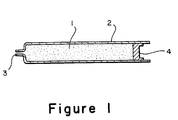
- Figure 1 illustrates a conventional caulking cartridge in which the present composition can be packaged.
- the present invention provides a non-aqueous refractory composition for use as an adhesive or filler, comprising refractory grain particles and a bonding material, characterised in that the bonding material comprises a liquid unsaturated drying oil reactable with oxygen for forming an air set bond when exposed to air, and a hydrocarbon solvent for said drying oil, said refractory grain particles being no larger than would pass through a mesh having one millimetre openings (16 Tyler mesh size) with at least 25% by weight of the particles being no larger than would pass through a mesh having 44 x 10 -6 metre openings (325 Tyler mesh size) and said drying oil and solvent being present in an amount to form an extrudable paste.
- the bonding material comprises a liquid unsaturated drying oil reactable with oxygen for forming an air set bond when exposed to air, and a hydrocarbon solvent for said drying oil
- the specific level of fineness is present to yield a product having the desired pliability and stickiness for use as an adhesive or filler particularly for the purposes of extrusion through a conventional hand-operated caulking gun.
- the above-mentioned particle size limitations are not only important for creating the desirable consistency which makes the product useful as an adhesive and filler.
- the above-mentioned particle size limitations also allows the composition to sinter rapidly for the formation of a monolithic ceramic matrix bond. The rapid formation of such a bond is important for use as a cement or filler material.
- the composition is formulated with a non-aqueous air-settable binder to avoid the problems associated with alkali silicate and alkali phosphate binders which contain water.
- the airsettable nature of the binder system utilized in the present invention allows the composition to form an air set bond having sufficient green strength to keep the shaped refractory articles together and to retain the composition in the cracks, gaps and the like without any special treatment steps, until the formation of a ceramic bond is formed upon firing.
- the binder system employs an unsaturated drying oil.
- oils such as tung oil and linseed oil, are well known. These oils form a solid matrix upon oxidative reaction with air due to oxygen cross-linking which takes place in the present of air.
- the composition may also include an organic solvent for use as a thinner and/or extender.
- an organic solvent for use as a thinner and/or extender.
- the binder system will harden due to a combination of solvent evaporation and oxygen cross-linking (oxygen polymerization) of the binder.
- oxygen cross-linking oxygen polymerization
- the composition may be heated to form a ceramic bond before or after an air set has been established. Upon heating to at least 371°C (700°F), a ceramic bond will develop and this ceramic bond will secure the compound to surrounding materials.
- the composition can be improved by the incorporation of additives such as rheological modifiers.
- additives such as rheological modifiers.
- the composition is desirably formulated with clay, such as bentonite clay ( e.g. , preferably hectorite) and fumed silica.
- the ceramic bond strength is greatly improved if the composition includes a small amount of LiF.
- the amount of liquid additive can be varied from about 5% to about 50% by weight in order to control the final viscosity of the composition.
- the consistency of the composition makes it useful for packaging in a conventional tubular caulking cartridge for application by extrusion. Such cartridges are well-known for use with other types of air setting caulking compositions such as silicone-based caulking compound.
- the use of the above-mentioned air setting binder does not require the incorporation of chemically reactive curing agents to effect the initial hardening of the composition, as is required for other types of adhesives such as epoxy resins and the like which require a resin and hardener.
- the present invention avoids the need for separate packaging of chemically reactive materials in the binder.
- composition of the present invention contains refractory aggregate which is no coarser than 1mm (16 mesh (Tyler)).
- refractory aggregate which is no coarser than 1mm (16 mesh (Tyler)
- at least 25% by weight of the refractory aggregate must be no coarser than 44 x 10 - 6 m, (i.e. , must pass through a 325 Tyler mesh screen.)
- the refractory materials which are useful include calcined or dead-burned dolomite which is a mixture of CaO and MgO. Pure calcined dolomite may be used as the aggregate. Alternatively, the aggregate may be limited to pure MgO (magnesia or calcined magnesite). Mixtures of calcined dolomite and MgO may also be used. Thus, the composition may contain any proportion of calcined dolomite and MgO as well as mixtures of CaO and MgO. Suitable sources of MgO include the mineral periclase.
- the binder includes a drying oil which is preferably tung oil or linseed oil. Also, it is desirable to combine the tung oil or linseed oil with a vinyl toluene/vegetable oil copolymer.
- the vinyl toluene/vegetable oil copolymer may be formulated with a hydrocarbon solvent such as naphtha.
- the vinyl toluene/vegetable oil copolymer is curable by oxidation. Conventional metallic dryers may be present to enhance oxidation.
- KELTROL® 1074 A suitable vinyl toluene/vegetable oil copolymer in a naphtha solvent is available from Reichhold Chemicals, Inc., Coating Polymers & Resin Division, Post Office Box 13582, Research Triangle Park, North Carolina under the trade name "KELTROL® 1074."
- "KELTROL® 1074” has the following physical characteristics: KELTROL ® 1074 SPECIFICATIONS Percent Solids, Weight 59 - 61 Viscosity @ 25°C Pa.S (Stokes) 150-250 (16.7 - 28.0) Gardner-Holdt Z ⁇ 1B approx. Color, Gardner 4 max.
- varnish which includes the above-mentioned vinyl toluene/vegetable oil copolymer or similar resin, may be used in the binder of the present invention.
- varnish sold under the trade name "PARKS Varnish” is suitable since it contains vinyl toluene/vegetable oil copolymer as a primary resin component.
- the "PARKS Varnish” is suitable due to its high naphtha content.
- the binder may contain organic solvents such as naphtha and fuel oil, especially number 2 fuel oil.
- the solvent content may be varied from about 5% to about 50% by weight in order to change the final viscosity of the composition.
- the composition contains a small amount of clay and fumed silica.
- a small amount of LiF is added.
- the incorporation of LiF into the composition results in enhanced strength. It has been observed that in the absence of LiF, the fired ceramic material is only one-third as strong in comparison to the same material formulated with LiF.
- An increase in the ceramic bond strength is observed when the composition contains at least about 0.10 by weight of LiF.
- a more significant increase in the ceramic bond strength is achieved when the composition contains at least about 0.2% Lif. Larger amounts of LiF may be added. However, amounts of LiF in excess of 0.2% by weight do not appreciably increase the bond strength beyond that achievable through the use of about 0.2% LiF. Thus, it is preferably to use about 0.2% by weight of LiF.
- composition There is no critical method to formulate the composition. When formulating the composition, it is only necessary to mix the ingredients by hand or by means of conventional mixing devices to obtain a uniform blend.
- EXAMPLE I 250x10 -6 m (-60 mesh (Tyler)) periclase (MgO) 40% by weight BMF (ball milled fines) calcined dolomite 40% by weight Clay (Bentonite) 1.65% by weight Fumed SiO 2 1.5% by weight LiF 0.2% by weight #2 fuel oil 4% by weight "PARKS Varnish” 8% by weight Tung oil 4.7% by weight
- EXAMPLE II 250x10 -6 m (-60 mesh (Tyler)) periclase (MgO) 40% by weight BMF (ball milled fines) periclase (MgO) 35% by weight BMF calcined dolomite 5% by weight Clay (Bentonite) 1.6% by weight Fumed SiO 2 1.5% by weight LiF 0.2% by weight #2 fuel oil 4% by weight "PARKS Varnish” 8% by weight Tung oil 4.7% by weight
- the composition of the present invention is particularly useful to join shaped refractory articles together.
- shaped refractory members may be adhesively secured to a refractory tundish lining to form dams, weirs and baffles therein.
- the composition is applied to at least one of the surfaces being joined and then the shaped members are joined together through the adhesive which may then be allowed to air set before firing.
- the tundish with the shaped member in place is subjected to a ceramic bonding temperature which is preferably at least about 371°C (700°F). This heat treatment causes the formation of a ceramic bond.
- the composition may be applied by any suitable method including extrusion, trowelling or parging.
- the adhesive composition is extruded onto the surface or surfaces to be secured by means of a caulking gun.
- a similar procedure is used when the composition is used to fill cracks, spaces or gaps in a shaped refractory article or when using the composition to patch a damaged shaped refractory article.
- the composition is applied to fill the cracks, spaces or gaps or is applied as a patch to the damaged portion of the shaped article. Suitable methods of application include extrusion, trowelling and parging.
- the composition is heated to the curing temperature to form a ceramic bond either before or after air-setting of the binder.
- composition is most useful with shaped refractory materials made from MgO and mixtures of MgO and CaO (including doloma).
- the composition may be effectively used wherever doloma or MgO-based cements are currently used.
- the composition may be easily packaged in a pre-mixed state in a single package such as a tubular caulking tube or flexible squeeze tube such as a tube used for pasty materials like toothpaste, glue and caulking compounds.
- the composition is premixed and packed in a sealed caulking tube as shown in Figure 1.
- the pre-mixed composition 1 is contained in tube 2.
- the composition is extruded through nozzle 3 by pressure which is developed when plunger 4 is moved against the composition in a direction toward the nozzle.
- the pre-mixed composition may also be conveniently packaged in a flexible tube which is closed at one end and which has an orifice at the other end for extrusion therethrough by the application of pressure on the flexible tube.
Landscapes
- Chemical & Material Sciences (AREA)
- Engineering & Computer Science (AREA)
- Ceramic Engineering (AREA)
- Manufacturing & Machinery (AREA)
- Materials Engineering (AREA)
- Structural Engineering (AREA)
- Organic Chemistry (AREA)
- Inorganic Chemistry (AREA)
- Adhesives Or Adhesive Processes (AREA)
Claims (15)
- Nicht-wässrige feuerfeste Mischung zur Verwendung als Kleber oder Füllmaterial, bestehend aus feuerfesten, körnigen Partikeln und einem Binder, dadurch gekennzeichnet, daß der Binder ein flüssiges, ungesättigtes trocknendes Öl enthält, das bei Exposition an Luft mit Sauerstoff eine lufthärtende Bindung bildet sowie ein Lösungsmittel auf Kohlenwasserstoffbasis für das trocknende Öl enthält, wobei die feuerfesten körnigen Partikel nicht größer sind als eine Maschenweite mit 1mm Öffnung (16 Tyler mesh size) und 25% Mass.% der Partikel nicht größer sind als eine Maschenweite mit 44x10-3mm Öffnung (325 Tyler mesh size), und daß das trocknende Öl und das Lösungsmittel in solchen Mengen enthalten ist, daß sich eine extrudierbare Paste bildet.
- Mischung nach Anspruch 1, dadurch gekennzeichnet, daß das feuerfeste Korn aus der Gruppe kalzinierter Dolomit, CaO, MgO ausgewählt ist oder aus Mischungen derselben besteht.
- Mischung nach Anspruch 1 und 2, dadurch gekennzeichnet, daß das trocknende Öl aus der Gruppe Tungöl und Leinöl ausgewählt ist.
- Mischung nach einem der Ansprüche 1 bis 3, dadurch gekennzeichnet, daß das Lösungsmittel auf Kohlenwasserstoffbasis Naphta ist.
- Mischung nach einem der Ansprüche 1 bis 4, gekennzeichnet durch den Zusatz eines Copolymers aus Venyltoluol/pflanzlichem Öl.
- Mischung nach einem der Ansprüche 1 bis 5, gekennzeichnet durch den Zusatz von Dieselöl No. 2 als Streckungsmittel.
- Mischung nach einem der Ansprüche 1 bis 6, gekennzeichnet durch die Zugabe von Ton und Siliziumdioxid (fumed silica).
- Mischung nach einem der Ansprüche 1 bis 7, gekennzeichnet durch die Zugabe von LiF.
- Mischung nach einem der Ansprüche 1 bis 7, dadurch gekennzeichnet, daß der Gesamtanteil an feuerfestem Korn bei ungefähr 80 Mass.% liegt.
- Mischung nach einem der Ansprüche 1 bis 9, dadurch gekennzeichnet, daß sie in einer dichten Tube verpackt ist.
- Verfahren zum haftenden Verbinden von feuerfesten Formkörpern, gekennzeichnet durch folgende Schritte:- Aufbringen der Mischung nach einem der Ansprüche 1 bis 10, zwischen den zu verbindenden Formkörpern derart daß die Mischung mit der Oberfläche der zu verbindenden Formkörper in Kontakt ist;- Härten der Mischung durch Abdampfen zumindest eines Teils des Lösungsmittels auf Kohlenwasserstoffbasis und Aussetzen der Mischung an Luft;- Aufheizen der Mischung auf mindestens 371°C (700° F), um eine keramische Bindung zu bilden, die die Formkörper miteinander verbindet.
- Verfahren nach Anspruch 11, dadurch gekennzeichnet, daß die Mischung durch Extrudieren, Spachteln oder Putzen aufgebracht wird.
- Verfahren nach Anspruch 12, dadurch gekennzeichnet, daß die Verbindung durch Extrusion aufgebracht wird.
- Verfahren zum Füllen von Spalten, Räumen und Lücken in einem feuerfesten Material, dadurch gekennzeichnet, daß die Spalten, Räume und Lücken mit der Mischung nach einem der Ansprüche 1 bis 10 gefüllt werden, die dann auf mindestens 371 °C (700° F) zum Bilden einer keramischen Verbindung aufgeheizt wird.
- Verfahren zum Instandsetzen beschädigter feuerfester Formkörper, gekennzeichnet dadurch, daß die Mischung nach einem der Ansprüche 1 bis 10 auf den beschädigten Bereich des Formkörpes aufgebracht wird und danach auf eine Temperatur von mindestens 371°C (700° F) zur Bildung einer keramischen Bindung aufgeheizt wird.
Applications Claiming Priority (2)
| Application Number | Priority Date | Filing Date | Title |
|---|---|---|---|
| US861010 | 1992-03-31 | ||
| US07/861,010 US5268338A (en) | 1992-03-31 | 1992-03-31 | Ceramic adhesive composition and use thereof |
Publications (3)
| Publication Number | Publication Date |
|---|---|
| EP0564196A2 EP0564196A2 (de) | 1993-10-06 |
| EP0564196A3 EP0564196A3 (en) | 1993-11-18 |
| EP0564196B1 true EP0564196B1 (de) | 1997-06-25 |
Family
ID=25334631
Family Applications (1)
| Application Number | Title | Priority Date | Filing Date |
|---|---|---|---|
| EP93302396A Expired - Lifetime EP0564196B1 (de) | 1992-03-31 | 1993-03-26 | Keramische Klebemittelzusammensetzung und Verfahren zu ihrer Anwendung |
Country Status (3)
| Country | Link |
|---|---|
| US (1) | US5268338A (de) |
| EP (1) | EP0564196B1 (de) |
| DE (1) | DE69311756T2 (de) |
Families Citing this family (6)
| Publication number | Priority date | Publication date | Assignee | Title |
|---|---|---|---|---|
| DE4437021C2 (de) * | 1993-10-08 | 2002-02-28 | Tokai Ind Sewing Machine | Näh-und/oder Stickmaschine |
| DE4429665C2 (de) * | 1994-08-12 | 1998-08-06 | Armin Voswinkel | Verfahren zur Herstellung eines Schmuckstücks |
| DE29702418U1 (de) * | 1997-02-13 | 1997-03-27 | Schott Glaswerke, 55122 Mainz | Kochgerät mit Glaskeramikkochfläche mit Schnellkochzone |
| US5928448A (en) * | 1997-11-01 | 1999-07-27 | Northrop Grumman Corporation | Dowel adhesive method for repair of ceramic matrix composites |
| US8252131B2 (en) * | 2009-07-02 | 2012-08-28 | The Boeing Company | Reworking ceramic structures |
| US10022921B2 (en) | 2013-12-19 | 2018-07-17 | General Electric Company | Turbine component patch delivery systems and methods |
Family Cites Families (18)
| Publication number | Priority date | Publication date | Assignee | Title |
|---|---|---|---|---|
| US1653344A (en) * | 1921-04-07 | 1927-12-20 | Monroe S Clawson | Casting mold and method of making same |
| US1616192A (en) * | 1926-05-06 | 1927-02-01 | Us Metals Refining Company | Unburned refractory brick and method of making it |
| US1616055A (en) * | 1926-06-08 | 1927-02-01 | Us Metals Refining Company | Magnesite refractory and method of making the same |
| US1912894A (en) * | 1930-09-13 | 1933-06-06 | Garnett Cecil Stevenson | Basic refractory brick or other article |
| US3368010A (en) * | 1965-12-27 | 1968-02-06 | John L. Cummings Sr. | Process for making hydration resistant refractory brick |
| US3414419A (en) * | 1966-10-03 | 1968-12-03 | Gen Refractories Co | Refractory ramming composition |
| US3468683A (en) * | 1966-11-03 | 1969-09-23 | Basic Inc | Dolomitic containing refractories and process of producing the same |
| US3578472A (en) * | 1967-11-03 | 1971-05-11 | Dresser Ind | Carbonaceous bonding system for regractories |
| US3632360A (en) * | 1969-01-24 | 1972-01-04 | Basic Inc | Refractory composition and method for the production of ceramically bonded refractories |
| US3634114A (en) * | 1969-01-24 | 1972-01-11 | Basic Inc | Composition and method for the production of ceramically bonded basic refractories |
| US3816157A (en) * | 1969-08-06 | 1974-06-11 | Xerox Corp | Toner reclaiming method |
| JPS5749511B2 (de) * | 1974-06-24 | 1982-10-22 | ||
| SE398498B (sv) * | 1976-05-03 | 1977-12-27 | Strabruken Ab | Eldfast massa avsedd for anvendning i metallurgiska ugnar som stamp- eller avlagningsmassa eller efter pressning och/eller vibrering som tegel, vilken massa bestar av en blandning omfattande eldfast material ... |
| DE3304119A1 (de) * | 1983-02-08 | 1984-08-09 | Dolomitwerke GmbH, 5603 Wülfrath | Basische feuerfeste massen und formkoerper |
| US4473654A (en) * | 1983-08-18 | 1984-09-25 | The J. E. Baker Company | Low temperature bonding of refractory aggregates and refractory products of improved cold strength |
| US4703022A (en) * | 1984-10-30 | 1987-10-27 | Consolidated Ceramic Products, Inc. | Alumina and MgO preheatable insulating refractory liners and methods of use thereof |
| DE3637720A1 (de) * | 1986-11-05 | 1988-05-11 | Ruetgerswerke Ag | Ungeformte, feuerfeste massen |
| US4981821A (en) * | 1988-06-16 | 1991-01-01 | Martin Marietta Magnesia Specialties Inc. | Low temperature binder compound for refractory aggregates and refractory products of improved cold strength |
-
1992
- 1992-03-31 US US07/861,010 patent/US5268338A/en not_active Expired - Lifetime
-
1993
- 1993-03-26 DE DE69311756T patent/DE69311756T2/de not_active Expired - Fee Related
- 1993-03-26 EP EP93302396A patent/EP0564196B1/de not_active Expired - Lifetime
Also Published As
| Publication number | Publication date |
|---|---|
| EP0564196A2 (de) | 1993-10-06 |
| DE69311756D1 (de) | 1997-07-31 |
| EP0564196A3 (en) | 1993-11-18 |
| US5268338A (en) | 1993-12-07 |
| DE69311756T2 (de) | 1998-02-05 |
Similar Documents
| Publication | Publication Date | Title |
|---|---|---|
| US20230312427A1 (en) | Stabilized refractory compositions | |
| US4255197A (en) | Process for obtaining refractory materials with controlled characteristics of porosity and density | |
| EA039586B1 (ru) | Материал для ремонта огнеупорной футеровки | |
| JPS5939389B2 (ja) | セメント組成物 | |
| CN102333740A (zh) | 陶瓷产品 | |
| US5268338A (en) | Ceramic adhesive composition and use thereof | |
| US3303031A (en) | Carbonaceous ramming paste | |
| US4533644A (en) | Mortar | |
| US3998648A (en) | Monolithic refractories | |
| GB2216117A (en) | Refractory compositions or cements | |
| US2425152A (en) | Plastic refractory | |
| BRPI0714034A2 (pt) | mistura refratária para a produção de um artigo refratário, artigo refratário, e, método para fabricar o artigo | |
| US3763085A (en) | Refractory composition | |
| JP2945170B2 (ja) | 不定形耐火物 | |
| US5000427A (en) | Injection material for use in blast furnace | |
| EP0010345B1 (de) | Verfahren zum Reparieren eines feuerfesten Mauerwerks | |
| US3943216A (en) | Production of periclase refractory utilizing alkyd resins | |
| CA1210785A (en) | Chromia-magnesia ramming cement | |
| KR100356369B1 (ko) | 고로 대풍구주변 충진용 완충모르타르 내화조성물 | |
| AU664706B2 (en) | Filler composition | |
| JP2826203B2 (ja) | 耐火物の製造方法 | |
| KR950007711B1 (ko) | 고 규산질 내화벽돌의 피복조성물 및 이를 이용한 피복방법 | |
| JPS63162579A (ja) | 熱硬性不定形耐火物 | |
| JPS61242962A (ja) | 窯炉の炉壁熱間補修材 | |
| JPH07133162A (ja) | 熱間焼付補修材 |
Legal Events
| Date | Code | Title | Description |
|---|---|---|---|
| PUAI | Public reference made under article 153(3) epc to a published international application that has entered the european phase |
Free format text: ORIGINAL CODE: 0009012 |
|
| PUAL | Search report despatched |
Free format text: ORIGINAL CODE: 0009013 |
|
| AK | Designated contracting states |
Kind code of ref document: A2 Designated state(s): DE FR GB IT |
|
| AK | Designated contracting states |
Kind code of ref document: A3 Designated state(s): DE FR GB IT |
|
| 17P | Request for examination filed |
Effective date: 19940506 |
|
| 17Q | First examination report despatched |
Effective date: 19951002 |
|
| GRAG | Despatch of communication of intention to grant |
Free format text: ORIGINAL CODE: EPIDOS AGRA |
|
| GRAH | Despatch of communication of intention to grant a patent |
Free format text: ORIGINAL CODE: EPIDOS IGRA |
|
| GRAH | Despatch of communication of intention to grant a patent |
Free format text: ORIGINAL CODE: EPIDOS IGRA |
|
| GRAA | (expected) grant |
Free format text: ORIGINAL CODE: 0009210 |
|
| AK | Designated contracting states |
Kind code of ref document: B1 Designated state(s): DE FR GB IT |
|
| REF | Corresponds to: |
Ref document number: 69311756 Country of ref document: DE Date of ref document: 19970731 |
|
| ITF | It: translation for a ep patent filed | ||
| ET | Fr: translation filed | ||
| PLBE | No opposition filed within time limit |
Free format text: ORIGINAL CODE: 0009261 |
|
| STAA | Information on the status of an ep patent application or granted ep patent |
Free format text: STATUS: NO OPPOSITION FILED WITHIN TIME LIMIT |
|
| 26N | No opposition filed | ||
| PGFP | Annual fee paid to national office [announced via postgrant information from national office to epo] |
Ref country code: GB Payment date: 20010202 Year of fee payment: 9 |
|
| PGFP | Annual fee paid to national office [announced via postgrant information from national office to epo] |
Ref country code: FR Payment date: 20010301 Year of fee payment: 9 |
|
| PGFP | Annual fee paid to national office [announced via postgrant information from national office to epo] |
Ref country code: DE Payment date: 20010330 Year of fee payment: 9 |
|
| REG | Reference to a national code |
Ref country code: GB Ref legal event code: IF02 |
|
| PG25 | Lapsed in a contracting state [announced via postgrant information from national office to epo] |
Ref country code: GB Free format text: LAPSE BECAUSE OF NON-PAYMENT OF DUE FEES Effective date: 20020326 |
|
| PG25 | Lapsed in a contracting state [announced via postgrant information from national office to epo] |
Ref country code: DE Free format text: LAPSE BECAUSE OF NON-PAYMENT OF DUE FEES Effective date: 20021001 |
|
| GBPC | Gb: european patent ceased through non-payment of renewal fee |
Effective date: 20020326 |
|
| PG25 | Lapsed in a contracting state [announced via postgrant information from national office to epo] |
Ref country code: FR Free format text: LAPSE BECAUSE OF NON-PAYMENT OF DUE FEES Effective date: 20021129 |
|
| REG | Reference to a national code |
Ref country code: FR Ref legal event code: ST |
|
| PG25 | Lapsed in a contracting state [announced via postgrant information from national office to epo] |
Ref country code: IT Free format text: LAPSE BECAUSE OF NON-PAYMENT OF DUE FEES;WARNING: LAPSES OF ITALIAN PATENTS WITH EFFECTIVE DATE BEFORE 2007 MAY HAVE OCCURRED AT ANY TIME BEFORE 2007. THE CORRECT EFFECTIVE DATE MAY BE DIFFERENT FROM THE ONE RECORDED. Effective date: 20050326 |