EP0556673B1 - Ortho-substituierte Benzoylguanidine, Verfahren zu ihrer Herstellung, ihre Verwendung als Medikament oder Diagnostikum sowie sie enthaltendes Medikament - Google Patents
Ortho-substituierte Benzoylguanidine, Verfahren zu ihrer Herstellung, ihre Verwendung als Medikament oder Diagnostikum sowie sie enthaltendes Medikament Download PDFInfo
- Publication number
- EP0556673B1 EP0556673B1 EP93101841A EP93101841A EP0556673B1 EP 0556673 B1 EP0556673 B1 EP 0556673B1 EP 93101841 A EP93101841 A EP 93101841A EP 93101841 A EP93101841 A EP 93101841A EP 0556673 B1 EP0556673 B1 EP 0556673B1
- Authority
- EP
- European Patent Office
- Prior art keywords
- alkyl
- methyl
- group
- phenyl
- substituted
- Prior art date
- Legal status (The legal status is an assumption and is not a legal conclusion. Google has not performed a legal analysis and makes no representation as to the accuracy of the status listed.)
- Expired - Lifetime
Links
Classifications
-
- C—CHEMISTRY; METALLURGY
- C07—ORGANIC CHEMISTRY
- C07D—HETEROCYCLIC COMPOUNDS
- C07D295/00—Heterocyclic compounds containing polymethylene-imine rings with at least five ring members, 3-azabicyclo [3.2.2] nonane, piperazine, morpholine or thiomorpholine rings, having only hydrogen atoms directly attached to the ring carbon atoms
- C07D295/22—Heterocyclic compounds containing polymethylene-imine rings with at least five ring members, 3-azabicyclo [3.2.2] nonane, piperazine, morpholine or thiomorpholine rings, having only hydrogen atoms directly attached to the ring carbon atoms with hetero atoms directly attached to ring nitrogen atoms
- C07D295/26—Sulfur atoms
-
- A—HUMAN NECESSITIES
- A61—MEDICAL OR VETERINARY SCIENCE; HYGIENE
- A61P—SPECIFIC THERAPEUTIC ACTIVITY OF CHEMICAL COMPOUNDS OR MEDICINAL PREPARATIONS
- A61P1/00—Drugs for disorders of the alimentary tract or the digestive system
- A61P1/16—Drugs for disorders of the alimentary tract or the digestive system for liver or gallbladder disorders, e.g. hepatoprotective agents, cholagogues, litholytics
-
- A—HUMAN NECESSITIES
- A61—MEDICAL OR VETERINARY SCIENCE; HYGIENE
- A61P—SPECIFIC THERAPEUTIC ACTIVITY OF CHEMICAL COMPOUNDS OR MEDICINAL PREPARATIONS
- A61P13/00—Drugs for disorders of the urinary system
- A61P13/02—Drugs for disorders of the urinary system of urine or of the urinary tract, e.g. urine acidifiers
-
- A—HUMAN NECESSITIES
- A61—MEDICAL OR VETERINARY SCIENCE; HYGIENE
- A61P—SPECIFIC THERAPEUTIC ACTIVITY OF CHEMICAL COMPOUNDS OR MEDICINAL PREPARATIONS
- A61P15/00—Drugs for genital or sexual disorders; Contraceptives
-
- A—HUMAN NECESSITIES
- A61—MEDICAL OR VETERINARY SCIENCE; HYGIENE
- A61P—SPECIFIC THERAPEUTIC ACTIVITY OF CHEMICAL COMPOUNDS OR MEDICINAL PREPARATIONS
- A61P3/00—Drugs for disorders of the metabolism
- A61P3/08—Drugs for disorders of the metabolism for glucose homeostasis
-
- A—HUMAN NECESSITIES
- A61—MEDICAL OR VETERINARY SCIENCE; HYGIENE
- A61P—SPECIFIC THERAPEUTIC ACTIVITY OF CHEMICAL COMPOUNDS OR MEDICINAL PREPARATIONS
- A61P3/00—Drugs for disorders of the metabolism
- A61P3/08—Drugs for disorders of the metabolism for glucose homeostasis
- A61P3/10—Drugs for disorders of the metabolism for glucose homeostasis for hyperglycaemia, e.g. antidiabetics
-
- A—HUMAN NECESSITIES
- A61—MEDICAL OR VETERINARY SCIENCE; HYGIENE
- A61P—SPECIFIC THERAPEUTIC ACTIVITY OF CHEMICAL COMPOUNDS OR MEDICINAL PREPARATIONS
- A61P35/00—Antineoplastic agents
-
- A—HUMAN NECESSITIES
- A61—MEDICAL OR VETERINARY SCIENCE; HYGIENE
- A61P—SPECIFIC THERAPEUTIC ACTIVITY OF CHEMICAL COMPOUNDS OR MEDICINAL PREPARATIONS
- A61P9/00—Drugs for disorders of the cardiovascular system
-
- A—HUMAN NECESSITIES
- A61—MEDICAL OR VETERINARY SCIENCE; HYGIENE
- A61P—SPECIFIC THERAPEUTIC ACTIVITY OF CHEMICAL COMPOUNDS OR MEDICINAL PREPARATIONS
- A61P9/00—Drugs for disorders of the cardiovascular system
- A61P9/04—Inotropic agents, i.e. stimulants of cardiac contraction; Drugs for heart failure
-
- A—HUMAN NECESSITIES
- A61—MEDICAL OR VETERINARY SCIENCE; HYGIENE
- A61P—SPECIFIC THERAPEUTIC ACTIVITY OF CHEMICAL COMPOUNDS OR MEDICINAL PREPARATIONS
- A61P9/00—Drugs for disorders of the cardiovascular system
- A61P9/06—Antiarrhythmics
-
- A—HUMAN NECESSITIES
- A61—MEDICAL OR VETERINARY SCIENCE; HYGIENE
- A61P—SPECIFIC THERAPEUTIC ACTIVITY OF CHEMICAL COMPOUNDS OR MEDICINAL PREPARATIONS
- A61P9/00—Drugs for disorders of the cardiovascular system
- A61P9/08—Vasodilators for multiple indications
-
- A—HUMAN NECESSITIES
- A61—MEDICAL OR VETERINARY SCIENCE; HYGIENE
- A61P—SPECIFIC THERAPEUTIC ACTIVITY OF CHEMICAL COMPOUNDS OR MEDICINAL PREPARATIONS
- A61P9/00—Drugs for disorders of the cardiovascular system
- A61P9/10—Drugs for disorders of the cardiovascular system for treating ischaemic or atherosclerotic diseases, e.g. antianginal drugs, coronary vasodilators, drugs for myocardial infarction, retinopathy, cerebrovascula insufficiency, renal arteriosclerosis
-
- A—HUMAN NECESSITIES
- A61—MEDICAL OR VETERINARY SCIENCE; HYGIENE
- A61P—SPECIFIC THERAPEUTIC ACTIVITY OF CHEMICAL COMPOUNDS OR MEDICINAL PREPARATIONS
- A61P9/00—Drugs for disorders of the cardiovascular system
- A61P9/12—Antihypertensives
-
- C—CHEMISTRY; METALLURGY
- C07—ORGANIC CHEMISTRY
- C07C—ACYCLIC OR CARBOCYCLIC COMPOUNDS
- C07C311/00—Amides of sulfonic acids, i.e. compounds having singly-bound oxygen atoms of sulfo groups replaced by nitrogen atoms, not being part of nitro or nitroso groups
- C07C311/15—Sulfonamides having sulfur atoms of sulfonamide groups bound to carbon atoms of six-membered aromatic rings
- C07C311/21—Sulfonamides having sulfur atoms of sulfonamide groups bound to carbon atoms of six-membered aromatic rings having the nitrogen atom of at least one of the sulfonamide groups bound to a carbon atom of a six-membered aromatic ring
-
- C—CHEMISTRY; METALLURGY
- C07—ORGANIC CHEMISTRY
- C07C—ACYCLIC OR CARBOCYCLIC COMPOUNDS
- C07C311/00—Amides of sulfonic acids, i.e. compounds having singly-bound oxygen atoms of sulfo groups replaced by nitrogen atoms, not being part of nitro or nitroso groups
- C07C311/30—Sulfonamides, the carbon skeleton of the acid part being further substituted by singly-bound nitrogen atoms, not being part of nitro or nitroso groups
- C07C311/37—Sulfonamides, the carbon skeleton of the acid part being further substituted by singly-bound nitrogen atoms, not being part of nitro or nitroso groups having the sulfur atom of at least one of the sulfonamide groups bound to a carbon atom of a six-membered aromatic ring
- C07C311/38—Sulfonamides, the carbon skeleton of the acid part being further substituted by singly-bound nitrogen atoms, not being part of nitro or nitroso groups having the sulfur atom of at least one of the sulfonamide groups bound to a carbon atom of a six-membered aromatic ring having sulfur atoms of sulfonamide groups and amino groups bound to carbon atoms of six-membered rings of the same carbon skeleton
- C07C311/39—Sulfonamides, the carbon skeleton of the acid part being further substituted by singly-bound nitrogen atoms, not being part of nitro or nitroso groups having the sulfur atom of at least one of the sulfonamide groups bound to a carbon atom of a six-membered aromatic ring having sulfur atoms of sulfonamide groups and amino groups bound to carbon atoms of six-membered rings of the same carbon skeleton having the nitrogen atom of at least one of the sulfonamide groups bound to hydrogen atoms or to an acyclic carbon atom
-
- C—CHEMISTRY; METALLURGY
- C07—ORGANIC CHEMISTRY
- C07C—ACYCLIC OR CARBOCYCLIC COMPOUNDS
- C07C317/00—Sulfones; Sulfoxides
- C07C317/44—Sulfones; Sulfoxides having sulfone or sulfoxide groups and carboxyl groups bound to the same carbon skeleton
-
- C—CHEMISTRY; METALLURGY
- C07—ORGANIC CHEMISTRY
- C07D—HETEROCYCLIC COMPOUNDS
- C07D295/00—Heterocyclic compounds containing polymethylene-imine rings with at least five ring members, 3-azabicyclo [3.2.2] nonane, piperazine, morpholine or thiomorpholine rings, having only hydrogen atoms directly attached to the ring carbon atoms
- C07D295/04—Heterocyclic compounds containing polymethylene-imine rings with at least five ring members, 3-azabicyclo [3.2.2] nonane, piperazine, morpholine or thiomorpholine rings, having only hydrogen atoms directly attached to the ring carbon atoms with substituted hydrocarbon radicals attached to ring nitrogen atoms
- C07D295/14—Heterocyclic compounds containing polymethylene-imine rings with at least five ring members, 3-azabicyclo [3.2.2] nonane, piperazine, morpholine or thiomorpholine rings, having only hydrogen atoms directly attached to the ring carbon atoms with substituted hydrocarbon radicals attached to ring nitrogen atoms substituted by carbon atoms having three bonds to hetero atoms with at the most one bond to halogen, e.g. ester or nitrile radicals
- C07D295/155—Heterocyclic compounds containing polymethylene-imine rings with at least five ring members, 3-azabicyclo [3.2.2] nonane, piperazine, morpholine or thiomorpholine rings, having only hydrogen atoms directly attached to the ring carbon atoms with substituted hydrocarbon radicals attached to ring nitrogen atoms substituted by carbon atoms having three bonds to hetero atoms with at the most one bond to halogen, e.g. ester or nitrile radicals with the ring nitrogen atoms and the carbon atoms with three bonds to hetero atoms separated by carbocyclic rings or by carbon chains interrupted by carbocyclic rings
Definitions
- both S and R configured compounds belong to the invention.
- the compounds can exist as optical isomers, as diastereomers, as racemates or as mixtures thereof.
- alkyl radicals can be either straight-chain or branched.
- the invention further relates to a process for the preparation of the compounds I, characterized in that compounds of the formula II reacted with guanidine, in which R (1) to R (5) have the meaning given and L represents an easily nucleophilically substitutable leaving group.
- benzoic acid derivatives of the formula II are known and described in the literature.
- the unknown compounds of the formula II can be prepared by methods known from the literature, for example by converting 2-chloro- or 2-fluoro-5-chlorosulfonyl-benzoic acid with ammonia or an amine into a 5-aminosulfonyl-2-chloro- or -fluorobenzoic acid or converted with a weak reducing agent such as sodium bisulfite and subsequent alkylation into a 5-alkylsulfonyl-2-chloro- or -2-fluorobenzoic acid and the benzoic acid derivatives thus obtained are converted into compounds I according to the invention by one of the process variants described above.
- Benzoylguanidines I are generally weak bases and can bind acid with the formation of salts.
- Suitable acid addition salts are salts of all pharmacologically acceptable acids, for example halides, in particular hydrochlorides, lactates, sulfates, citrates, tartrates, acetates, phosphates, methyl sulfonates, p-toluenesulfonates.
- the compounds I are substituted acylguanidines.
- European published patent application 416 499 (HOE 89 / F 288) describes benzoylguanidines which carry hydrogen in the positions corresponding to the radicals R (1) and R (2).
- U.S. Patent 3,780,027 describes acylguanidines which are structurally similar to the compounds of the formula I and are derived from commercially available loop diuretics, such as bumetanide. Accordingly, strong salidiuretic activity is reported for these compounds.
- the N-amidino-3-furfurylamino-4-chloro-5-methylsulfonyl-benzamide described in this patent was post-synthesized and showed no antiarrhythmic effect in our models.
- the compounds according to the invention do not have any undesirable and disadvantageous salidiuretic, but very good antiarrhythmic properties, such as occur, for example, in the case of oxygen deficiency symptoms.
- the compounds are outstandingly suitable as antiarrhythmic medicaments with cardioprotective components for the prevention of infarction and the treatment of infarction, and for the treatment of angina pectoris, and they also prevent or inhibit the pathophysiological processes in the occurrence of ischemically induced damage, particularly when triggering ischemically induced cardiac arrhythmias greatly decrease.
- the compounds of the formula I according to the invention can be used as a medicament for the treatment of all acute or chronic damage caused by ischemia or diseases primarily or secondarily induced thereby.
- This relates to their use as medicines for surgical interventions, for example in organ transplants, the compounds both for protecting the organs in the donor before and during removal, for protecting removed organs, for example during treatment with or their storage in physiological bath fluids, and also can be used for the transfer into the recipient organism.
- the compounds are also valuable, protective drugs when performing angioplasty surgery, for example on the heart as well as on peripheral vessels.
- the compounds are also suitable as medicaments for the treatment of ischemia of the nervous system, in particular of the CNS. whereby they are suitable, for example, for the treatment of stroke or cerebral edema.
- the compounds of the formula I according to the invention are also suitable for treating forms of shock, such as, for example, allergic, cardiogenic, hypovolemic and bacterial shock.
- the compounds of the formula I according to the invention are notable for a strong inhibitory action on the proliferation of cells, for example fibroblast cell proliferation and the proliferation of smooth vascular muscle cells.
- the compounds of the formula I are therefore useful therapeutic agents for diseases in which cell proliferation is a primary or secondary cause and can therefore be used as antiatherosclerotic agents, agents for late diabetic complications, cancer, fibrotic diseases such as pulmonary fibrosis, liver fibrosis or kidney fibrosis, organ hypertrophies and - hyperplasias, especially for prostate hyperplasia or prostate hypertrophy.
- the compounds according to the invention are effective inhibitors of the cellular sodium proton antiporter (Na + / H + exchanger), which is increased in numerous diseases (essential hypertension, atherosclerosis, diabetes, etc.) also in cells which are easily accessible, for example in erythrocytes, platelets or leukocytes.
- the compounds according to the invention are therefore suitable as excellent and simple scientific tools, for example in their use as diagnostics for determining and distinguishing certain forms of hypertension, but also atherosclerosis, diabetes, proliferative diseases, etc.
- the compounds of the formula I are for preventive therapy is suitable for preventing the genesis of high blood pressure, for example essential hypertension.
- Medicaments containing a compound I can be administered orally, parenterally, intravenously, rectally or by inhalation, the preferred application depending on the particular appearance of the disease.
- the Compounds I can be used alone or together with pharmaceutical excipients, in veterinary and human medicine.
- auxiliaries which are suitable for the desired pharmaceutical formulation on the basis of his specialist knowledge.
- solvents for example antioxidants, dispersants, emulsifiers, defoamers, taste correctives, preservatives, solubilizers or colorants can be used.
- the active compounds are mixed with the suitable additives, such as carriers, stabilizers or inert diluents, and brought into suitable dosage forms by the usual methods, such as tablets, dragées, push-fit capsules, aqueous, alcoholic or oily solutions.
- suitable additives such as carriers, stabilizers or inert diluents
- suitable dosage forms by the usual methods, such as tablets, dragées, push-fit capsules, aqueous, alcoholic or oily solutions.
- inert carriers e.g. Gum arabic, magnesia, magnesium carbonate, potassium phosphate, milk sugar, glucose or starch, especially corn starch
- the preparation can take place both as dry and as moist granules.
- Vegetable or animal oils such as sunflower oil or cod liver oil, are suitable as oily carriers or as solvents.
- the active compounds are brought into solution, suspension or emulsion, if desired with the usual substances such as solubilizers, emulsifiers or other auxiliaries.
- solvents are in question: water, physiological saline or alcohols, e.g. Ethanol, propanol, glycerin, as well as sugar solutions such as glucose or mannitol solutions, or a mixture of the various solvents mentioned.
- Suitable pharmaceutical formulations for administration in the form of aerosols or sprays are, for example, solutions, suspensions or emulsions of Active ingredient of formula I in a pharmaceutically acceptable solvent, such as in particular ethanol or water, or a mixture of such solvents.
- a pharmaceutically acceptable solvent such as in particular ethanol or water, or a mixture of such solvents.
- the formulation can also contain other pharmaceutical auxiliaries such as surfactants, emulsifiers and stabilizers and a propellant.
- Such a preparation usually contains the active ingredient in a concentration of approximately 0.1 to 10, in particular approximately 0.3 to 3% by weight.
- the dosage of the active ingredient of formula I to be administered and the frequency of administration depend on the potency and duration of action of the compounds used; also on the type and severity of the disease to be treated and on the sex, age, weight and individual responsiveness of the mammal to be treated.
- the daily dose of a compound of the formula I in a patient weighing approximately 75 kg is at least 0.001 mg / kg, preferably 0.01 mg / kg to 10 mg / kg, preferably 1 mg / kg body weight.
- more frequent doses may be necessary, e.g. up to 4 single doses per day.
- up to 200 mg per day may be necessary.
- 2-piperidyl-5-sulfamoylbenzoyl-guanidine colorless crystals, mp. 247 ° C, boil from 2-piperidyl-5-sulfamoylbenzoic acid (mp. 248 ° C., represented from 2-chloro-5-sulfamoylbenzoic acid in 10 mol piperidine under inert gas for 24 hours under reflux, distill off the excess piperidine and treat the residue with water / dilute hydrochloric acid at pH 1-2).
- 2-benzylamino-5-sulfamoylbenzoyl-guanidine colorless crystals, mp. 191-193 ° C, from 2-benzylamino-5-sulfamoylbenzoic acid (mp. 246 ° C, represented from 2-chloro-5-sulfamoylbenzoic acid in 20 equivalents of benzylamine over 8 hours at 130 ° C / inert gas and treatment with water / dilute HCl at pH 1-2)
- 5-methylsulfonyl-2-piperidinobenzoyl-guanidine hydrochloride colorless crystals, mp 124-130 ° C, prepared from 5-methylsulfonyl-2-piperidinobenzoic acid (mp. 198 ° C., representation by reaction of 2-chloro-5-methylsulfonylbenzoic acid by boiling in 10 equivalents of piperidine for several hours in a reflux condenser, evaporating the excess piperidine and then treating it with water / dilute HCl pH 1-2),
Landscapes
- Health & Medical Sciences (AREA)
- Chemical & Material Sciences (AREA)
- Organic Chemistry (AREA)
- Engineering & Computer Science (AREA)
- Bioinformatics & Cheminformatics (AREA)
- General Health & Medical Sciences (AREA)
- Chemical Kinetics & Catalysis (AREA)
- General Chemical & Material Sciences (AREA)
- Medicinal Chemistry (AREA)
- Nuclear Medicine, Radiotherapy & Molecular Imaging (AREA)
- Pharmacology & Pharmacy (AREA)
- Life Sciences & Earth Sciences (AREA)
- Animal Behavior & Ethology (AREA)
- Public Health (AREA)
- Veterinary Medicine (AREA)
- Cardiology (AREA)
- Heart & Thoracic Surgery (AREA)
- Diabetes (AREA)
- Endocrinology (AREA)
- Urology & Nephrology (AREA)
- Emergency Medicine (AREA)
- Hematology (AREA)
- Obesity (AREA)
- Vascular Medicine (AREA)
- Hospice & Palliative Care (AREA)
- Gastroenterology & Hepatology (AREA)
- Reproductive Health (AREA)
- Acyclic And Carbocyclic Compounds In Medicinal Compositions (AREA)
- Organic Low-Molecular-Weight Compounds And Preparation Thereof (AREA)
- Pharmaceuticals Containing Other Organic And Inorganic Compounds (AREA)
- Medicines Containing Antibodies Or Antigens For Use As Internal Diagnostic Agents (AREA)
Description
- Die Erfindung betrifft ortho-substituierte Benzoylguanidine der Formel I
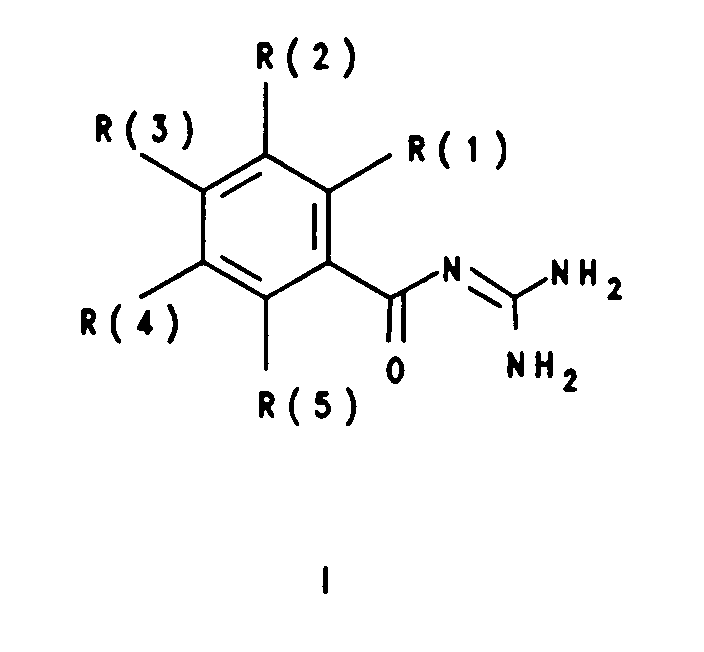
- R(1) gleich F, Cl, Br, J, C1-C6-Alkyl, -X-R(6),
- X gleich O, S, NR(7) oder Y-ZO und
- Y gleich O oder NR(7) und
- Z gleich C oder SO,
- R(6) gleich H, C1-C6-Alkyl, C5-C7-Cycloalkyl, Cyclohexylmethyl, Cyclopentylmethyl, -(CH2)mCpF2p+1, -CnH2n-R(8),
- m gleich Null oder 1,
- p gleich 1 - 3,
- n gleich Null bis 4,
- R(8) gleich Phenyl, das unsubstituiert ist oder substituiert mit 1-3 Substituenten aus den Gruppen F, Cl, CF3, Methyl, Methoxy oder NR(9)R(10) mit R(9) und R(10) in der Bedeutung von H oder C1-C4-Alkyl,
- R(7) gleich H oder C1-C3-Alkyl,
wobei R(6) und R(7) auch gemeinsam 4 oder 5 Methylengruppen sein können und eine CH2-Gruppe durch ein O, S, NH, N-CH3 oder N-Benzyl ersetzt sein kann,
- R(3) gleich H, -X-R(6) mit
- X gleich O, S, NR(7) oder Y-ZO,
- R(7) gleich H oder C1-C3-Alkyl,
- Y gleich O oder NR(7),
- Z gleich C oder SO,
wobei Y am Phenylrest der Formel I gebunden ist,
- R(6) gleich H, C1-C6-Alkyl, C5-C7-Cycloalkyl, Cyclohexylmethyl, Cyclopentylmethyl, -(CH2)mCpF2p+1, -CnH2n-R(8),
- m gleich null oder 1,
- p gleich 1 - 3,
- n gleich null bis 4,
- R(8) gleich Phenyl, das unsubstituiert ist oder substituiert mit 1-3 Substituenten aus der Gruppe F, Cl, CF3, Methyl, Methoxy, NR(9)R(10), R(9) und R(10) gleich H oder C1-C4-Alkyl,
- R(6) und R(7) auch gemeinsam 4 oder 5 Methylengruppen sein können und eine CH2-Gruppe durch ein O, S, NH, N-CH3 oder N-Benzyl ersetzt sein kann,
- X gleich O, S, NR(7) oder Y-ZO,
- R(2) und R(4) - gleich oder verschieden - gleich R(11)-SOq-, R(12)R(13)N-SO2-, mit
- q gleich null - 2,
- R(11) gleich C1-C4-Alkyl, das unsubstituiert ist oder Phenyl als Substituenten trägt, wobei Phenyl unsubstituiert ist oder substituiert mit 1 - 3 Substituenten aus der Gruppe F, Cl, CF3, Methyl, Methoxy oder NR(9)R(10) mit R(9) und R(10) gleich H oder C1-C4-Alkyl,
- R(12) und R(13) wie R(6) und R(7) definiert;
- R(5) H, Methyl, F, Cl, Methoxy,
- Bevorzugt sind Verbindungen der Formel I mit:
- R(1) gleich F, Cl, C1-C3-Alkyl, CF3, -X-R(6) mit
- X gleich O, S oder NR(7),
- R(6) gleich H, C1-C6-Alkyl, -(CH2)mCpF2p+1, -CnH2n-R(8),
- m gleich null oder 1,
- p gleich 1 - 3,
- n gleich Null bis 4,
- R(8) gleich Phenyl, das unsubstituiert ist oder substituiert mit 1 - 3 Substituenten aus der Gruppe F, Cl, CF3, Methyl, Methoxy, NR(9)R(10)
- mit R(9) und R(10) gleich H oder C1-C4-Alkyl,
- R(7) gleich H oder Methyl,
- R(3) gleich H,
- R(2) und R(4) - gleich oder verschieden - gleich CH3-SOq- oder R(12)R(13)N-SO2-,
- q gleich Null - 2,
- R(12) und R(13) gleich R(6) und R(7),
- R(5) gleich H,
- Besonders bevorzugt sind Verbindungen der Formel I mit:
- R(1) gleich F, Cl, C1-C3-Alkyl, Gruppe -X-R(6),
- X gleich O, S oder NR(7),
- R(6) gleich H, C1-C4-Alkyl, -CnH2n-R(8),
- n gleich null bis 3,
- R(8) gleich Phenyl, das unsubstituiert ist oder substituiert mit 1-3 Substituenten aus der Gruppe F, Cl, CF3, Methyl, Methoxy, NR(9)R(10) mit R(9) und R(10) gleich H oder Methyl,
- R(7) gleich H oder Methyl,
- R(2), R(3) und R(5) gleich Wasserstoff,
- R(4) gleich CH3-SO2- oder R(12)R(13)N-SO2- mit
- R(12) gleich -CnH2n-R(8),
- n gleich 1 bis 3,
- R(8) gleich Phenyl, das unsubstituiert ist oder substituiert mit 1-3 Substituenten aus den Gruppen F, Cl, CF3, Methyl, Methoxy oder NR(9)R(10) mit R(9) und R(10) in der Bedeutung von H oder Methyl,
- R(13) gleich H,
oder R(12) und R(13) können auch gemeinsam 4 oder 5 Methylengruppen sein,
- R(12) gleich -CnH2n-R(8),
- Enthält einer der Substituenten R(1) bis R(13) ein Asymmetriezentrum, so gehören sowohl S als auch R konfigurierte Verbindungen zur Erfindung. Die Verbindungen können als optische Isomere, als Diastereomere, als Racemate oder als Gemische derselben vorliegen.
- Die bezeichneten Alkylreste können sowohl geradkettig wie verzweigt vorliegen.
- Die Erfindung betrifft weiterhin ein Verfahren zur Herstellung der Verbindungen I, dadurch gekennzeichnet, daß man Verbindungen der Formel II

- Die aktivierten Säurederivate der Formel II, worin L eine Alkoxy-, vorzugsweise eine Methoxygruppe, eine Phenoxygruppe, Phenylthio-, Methylthio-, 2-Pyridylthiogruppe, einen Stickstoffheterocyclus, vorzugsweise 1-Imidazolyl, bedeutet, erhält man vorteilhaft in an sich bekannter Weise aus den zugrundeliegenden Carbonsäurechloriden (Formel II, L=Cl), die man ihrerseits wiederum in an sich bekannter Weise aus den zugrundeliegenden Carbonsäuren (Formel II, L= OH) beispielsweise mit Thionylchlorid herstellen kann.
- Neben den Carbonsäurechloriden der Formel II [L=Cl) lassen sich auch weitere aktivierte Säurederivate der Formel II in an sich bekannter Weise direkt aus den zugrundeliegenden Benzoesäure-derivaten (Formel II, L = OH) herstellen, wie beispielsweise die Methylester der Formel II mit L=OCH3 durch Behandeln mit gasförmigem HCl in Methanol, die Imidazolide der Formel II durch Behandeln mit Carbonyldiimidazol (L= 1-Imidazolyl, Staab, Angew. Chem. Int. Ed. Engl. 1, 351-367 (1962)], die gemischten Anhydride II mit Cl-COOC2H5 oder Tosylchlorid in Gegenwart von Triethylamin in einem inerten Lösungsmittel, wie auch die Aktivierungen von Benzoesäuren mit Dicyclohexylcarbodiimid (DCC) oder mit O-6[(Cyano(ethoxycarbonyl)methylen)amino]-1,1,3,3-tetramethyluronium-tetrafluo borat ("TOTU") (siehe Weiss und Krommer, Chemiker Zeitung 98, 817 (1974)). Eine Reihe geeigneter Methoden zur Herstellung von aktivierten Carbonsäurederivaten der Formel II sind unter Angabe von Quellenliteratur in J. March, Advanced Organic Chemistry, Third Edition (John Wiley & Sons, 1985), S. 350 angegeben.
- Die Umsetzung eines aktivierten Carbonsäurederivates der Formel I mit Guanidin erfolgt in an sich bekannter Weise in einem protischen oder aprotischen polaren, aber inerten organischen Lösungsmittel. Dabei haben sich bei der Umsetzung der Benzoesäuremethylester (II, L=OMe) mit Guanidin Methanol oder THF zwischen 20°C und Siedetemperatur dieser Lösungsmittel bewährt. Bei den meisten Umsetzungen von Verbindungen II mit salzfreiem Guanidin III wurde vorteilhaft in aprotischen inerten Lösungsmitteln, wie THF, Dimethoxyethan, Dioxan, gearbeitet. Aber auch Wasser kann als Lösungsmittel bei der Umsetzung von II mit Guanidin verwendet werden.
- Wenn L=Cl bedeutet, arbeitet man vorteilhaft unter Zusatz eines Säurefängers, z.B. in Form von überschüssigen Guanidin zur Abbindung der Halogenwasserstoffsäure.
- Ein Teil der zugrundeliegenden Benzoesäurederivate der Formel II ist bekannt und in der Literatur beschrieben. Die unbekannten Verbindungen der Formel II können nach literaturbekannten Methoden hergestellt werden, indem man beispielsweise 2-Chlor- oder 2-Fluor-5-chlorsulfonyl-benzoesäure mit Ammoniak oder einem Amin in eine 5-Aminosulfonyl-2-chlor- oder -fluorbenzoesäure bzw. mit einem schwachen Reduktionsmittel wie Natriumbisulfit und anschließender Alkylierung in eine 5-Alkylsulfonyl-2-chlor- oder -2-fluorbenzoesäure überführt und die so erhaltenen Benzoesäure-Derivate nach einer der oben beschriebenen Verfahrensvarianten zu erfindungsgemäßen Verbindungen I umgesetzt werden.
- Derartige Carbonsäuren oder deren Ester der Formel II mit L = -OH oder beispielsweise -O-Methyl und R(1) und/oder R(3) in der Bedeutung von Halogen können aber auch als Ausgangsverbindungen anderer Carbonsäuren dienen, wobei das Halogen in R(1)- und/oder R(4)-Position sehr bequem in bekannter Weise gegen zahlreiche nucleophile Reagenzien, wie Mercaptane R(6)-SH oder primäre Amine R(6)R(7)NH unter Bildung weiterer Benzoesäurederivate II mit L = -OH bzw. -O-Methyl ausgetauscht werden kann.
- In ähnlicher Weise können ausgehend von 5-Nitro-2-chlorbenzoesäure durch nucleophile Einführung eines Restes R(1) in Position 2 (Austausch gegen Cl) und weiterer Abwandlung der Nitrogruppe, wie Reduktion zu NH2 und nachfolgende Alkylierung oder Verdrängung, beispielsweise durch Diazotierung und Sandmeyer-Reaktion, weitere Benzoesäurederivate (II, L= -OH) hergestellt werden.
- Benzoylguanidine I sind im allgemeinen schwache Basen und können Säure unter Bildung von Salzen binden. Als Säureadditionssalze kommen Salze aller pharmakologisch verträglichen Säuren infrage, beispielsweise Halogenide, insbesondere Hydrochloride, Lactate, Sulfate, Citrate, Tartrate, Acetate, Phosphate, Methylsulfonate, p-Toluolsulfonate.
- Die Verbindungen I sind substituierte Acylguanidine.
- Prominentester Vertreter der Acylguanidine ist das Pyrazinderivat Amilorid, das als kaliumsparendes Diuretikum in der Therapie Verwendung findet. Zahlreiche weitere Verbindungen vom Amilorid-Typ werden in der Literatur beschrieben, wie beispielsweise Dimethylamilorid oder Ethylisopropylamilorid.

- Amilorid: R',R''= H
- Dimethylamilorid: R',R''= CH3
- Ethylisopropylamilorid: R'= C2H5, R''= CH(CH3)2
- Darüber hinaus sind Untersuchungen bekannt geworden, die auf antiarrhythmische Eigenschaften von Amilorid hinweisen (Circulation 79, 1257-63 (1989). Einer breiten Anwendung als Antiarrhythmikum steht jedoch entgegen, daß dieser Effekt nur schwach ausgeprägt ist und von einer blutdrucksenkenden und saluretischen Wirkung begleitet auftritt und diese Nebenwirkungen bei der Behandlung von Herz-Rhythmusstörungen unerwünscht sind.
- Hinweise auf antiarrhythmische Eigenschaften des Amilorids wurden auch bei Experimenten an isolierten Tierherzen erhalten (Eur. Heart J. 9 (suppl.1): 167 (1988) (book of abstracts). So wurde beispielsweise an Rattenherzen gefunden, daß ein künstlich ausgelöstes Kammerflimmern durch Amilorid völlig unterdrückt werden konnte. Noch potenter als Amilorid war in diesem Modell das oben erwähnte Amiloridderivat Ethylisopropylamilorid.
- In der europäischen Offenlegungsschrift 416 499 (HOE 89/F 288) werden Benzoylguanidine beschrieben, die in den den Resten R(1) und R(2) entsprechenden Stellungen Wasserstoff tragen. In der US-Patentschrift 3 780 027 werden Acylguanidine beschrieben, die strukturell den Verbindungen der Formel I ähnlich sind und sich von im Handel befindlichen Schleifendiuretika, wie Bumetanid, ableiten. Entsprechend wird für diese Verbindungen eine starke salidiuretische Wirksamkeit berichtet. Das in diesem Patent beschriebene N-Amidino-3-furfurylamino-4-Chlor-5-methylsulfonyl-benzamid wurde nachsynthetisiert und zeigte in unseren Modellen keine antiarrhythmische Wirkung.
- Es war daher überraschend, daß die erfindungsgemäßen Verbindungen keine unerwünschten und nachteiligen salidiuretischen, jedoch sehr gute antiarrhythmische Eigenschaften aufweisen, wie sie beispielsweise bei Sauerstoffmangelerscheinungen auftreten. Die Verbindungen sind infolge ihrer pharmakologischen Eigenschaften als antiarrhythmische Arzneimittel mit cardioprotektiver Komponente zur Infarktprophylaxe und der Infarktbehandlung sowie zur Behandlung der angina pectoris hervorragend geeignet, wobei sie auch präventiv die pathophysiologischen Vorgänge beim Entstehen ischämisch induzierter Schäden, insbesondere bei der Auslösung ischämisch induzierter Herzarrhythmien, inhibieren oder stark vermindern. Wegen ihrer schützenden Wirkungen gegen pathologische hypoxische und ischämische Situationen können die erfindungsgemäßen Verbindungen der Formel I infolge inhibition des zellulären Na+/H+ Austauschmechanismus als Arzneimittel zur Behandlung aller akuten oder chronischen durch Ischämie ausgelösten Schäden oder dadurch primär oder sekundär induzierten Krankheiten verwendet werden. Dies betrifft ihre Verwendung als Arzneimittel für operative Eingriffe, z.B. bei Organ-Transplantationen, wobei die Verbindungen sowohl für den Schutz der Organe im Spender vor und während der Entnahme, zum Schutz entnommener Organe beispielsweise bei Behandlung mit oder deren Lagerung in physiologischen Badflüssigkeiten, wie auch bei der Überführung in den Empfängerorganismus verwendet werden können. Die Verbindungen sind ebenfalls wertvolle, protektiv wirkende Arzneimittel bei der Durchführung angioplastischer operativer Eingriffe beispielsweise am Herzen wie auch an peripheren Gefäßen. Entsprechend ihrer protektiven Wirkung gegen ischämisch induzierte Schäden sind die Verbindungen auch als Arzneimittel zur Behandlung von Ischämien des Nervensystems, insbesondere des ZNS, geeignet, wobei sie z.B. zur Behandlung des Schlaganfalls oder des Hirnödems geeignet sind. Darüberhinaus eignen sich die erfindungsgemäßen Verbindungen der Formel I ebenfalls zur Behandlungen von Formen des Schocks, wie beispielweise des allergischen, cardiogenen, hypovolämischen und des bakteriellen Schocks.
- Darüberhinaus zeichnen sich die erfindungsgemäßen Verbindungen der Formel I durch starke inhibierende Wirkung auf die Proliferationen von Zellen, beispielsweise der Fibroblasten- Zellproliferation und der Proliferation der glatten Gefäßmuskelzellen, aus. Deshalb kommen die Verbindungen der Formel I als wertvolle Therapeutika für Krankheiten infrage, bei denen die Zellproliferation eine primäre oder sekundäre Ursache darstellt, und können deshalb als Antiatherosklerotika, Mittel gegen diabetische Spätkomplikationen, Krebserkrankungen, fibrotische Erkrankungen wie Lungenfibrose, Leberfibrose oder Nierenfibrose, Organhypertrophien und -hyperplasien, insbesondere bei Prostatahyperplasie bzw. Prostatahypertrophie verwendet werden.
- Die erfindungsgemäßen Verbindungen sind wirkungsvolle inhibitoren des zellulären Natrium-Protonen-Antiporters (Na+/H+ -Exchanger), der bei zahlreichen Erkrankungen (Essentielle Hypertonie, Atherosklerose, Diabetes usw.) auch in solchen Zellen erhöht ist, die Messungen leicht zugänglich sind, wie beispielsweise in Erythrocyten, Thrombocyten oder Leukozyten. Die erfindungsgemäßen Verbindungen eignen sich deshalb als hervorragende und einfache wissenschaftliche Werkzeuge, beispielsweise in ihrer Verwendung als Diagnostika zur Bestimmung und Unterscheidung bestimmter Formen der Hypertonie, aber auch der Atherosklerose, des Diabetes, proliferativer Erkrankungen usw.. Darüber hinaus sind die Verbindungen der Formel I für die präventive Therapie zur Verhinderung der Genese des Bluthochdrucks, beispielweise der essentiellen Hypertonie, geeignet.
- Arzneimittel, die eine Verbindung I enthalten, können dabei oral, parenteral, intravenös, rektal oder durch Inhalation appliziert werden, wobei die bevorzugte Applikation von dem jeweiligen Erscheinungsbild der Erkrankung abhängig ist. Die Verbindungen I können dabei allein oder zusammen mit galenischen Hilfsstoffen zur Anwendung kommen, und zwar in der Veterinär- als auch in der Humanmedizin.
- Welche Hilfsstoffe für die gewünschte Arzneimittelformulierung geeignet sind, ist dem Fachmann auf Grund seines Fachwissens geläufig. Neben Lösemitteln, Gelbildnern, Suppositoriengrundlagen, Tablettenhilfsstoffen und anderen Wirkstoffträgern können beispielsweise Antioxidantien, Dispergiermittel, Emulgatoren, Entschäumer, Geschmackskorrigentien, Konservierungsmittel, Lösungsvermittler oder Farbstoffe verwendet werden.
- Für eine orale Anwendungsform werden die aktiven Verbindungen mit den dafür geeigneten Zusatzstoffen, wie Trägerstoffen, Stabilisatoren oder inerten Verdünnungsmittel vermischt und durch die üblichen Methoden in die geeigneten Darreichungsformen gebracht, wie Tabletten, Dragees, Steckkapseln, wäßrige, alkoholische oder ölige Lösungen. Als inerte Träger können z.B. Gummi arabicum, Magnesia, Magnesiumcarbonat, Kaliumphosphat, Milchzucker, Glucose oder Stärke, insbesondere Maisstärke, verwendet werden. Dabei kann die Zubereitung sowohl als Trocken- als auch als Feuchtgranulat erfolgen. Als ölige Trägerstoffe oder als Lösemittel kommen beispielsweise pflanzliche oder tierische Öle in Betracht, wie Sonnenblumenöl oder Lebertran.
- Zur subkutanen oder intravenösen Applikation werden die aktiven Verbindungen, gewünschtenfalls mit den dafür üblichen Substanzen wie Lösungsvermittler, Emulgatoren oder weiteren Hilfsstoffen in Lösung, Suspension oder Emulsion gebracht. Als Lösungsmittel kommen z.B. in Frage: Wasser, physiologische Kochsalzlösung oder Alkohole, z.B. Ethanol, Propanol, Glycerin, daneben auch Zuckerlösungen wie Glucose- oder Mannitlösungen, oder auch eine Mischung aus den verschiedenen genannten Lösungsmitteln.
- Als pharmazeutische Formulierung für die Verabreichung in Form von Aerosolen oder Sprays sind geeignet z.B. Lösungen, Suspensionen oder Emulsionen des Wirkstoffes der Formel I in einem pharmazeutisch unbedenklichen Losungsmittels, wie insbesondere Ethanol oder Wasser, oder einem Gemisch solcher Lösungsmittel. Die Formulierung kann nach Bedarf auch noch andere pharmazeutische Hilfsstoffe wie Tenside, Emulgatoren und Stabilisatoren sowie ein Treibgas enthalten. Eine solche Zubereitung enthält den Wirkstoff üblicherweise in einer Konzentration von etwa 0,1 bis 10, insbesondere von etwa 0,3 bis 3 Gew.-%.
- Die Dosierung des zu verabreichenden Wirkstoffs der Formel I und die Häufigkeit der Verabreichung hängen von der Wirkstärke und Wirkdauer der verwendeten Verbindungen ab; außerdem auch von Art und Stärke der zu behandelnden Krankheit sowie von Geschlecht, Alter, Gewicht und individueller Ansprechbarkeit des zu behandelnden Säugers.
- Im Durchschnitt beträgt die tägliche Dosis einer Verbindung der Formel I bei einem etwa 75 kg schweren Patienten mindestens 0,001 mg/kg, vorzugsweise 0,01 mg/kg bis 10 mg/kg, vorzugsweise 1 mg/kg Körpergewicht. Bei akuten Ausbrüchen der Krankheit, etwa unmittelbar nach Erleiden eines Herzinfarkts, können auch noch höhere und vor allem häufigere Dosierungen notwendig sein, z.B. bis zu 4 Einzeldosen pro Tag. Insbesondere bei i.v. Anwendung, etwa bei einem Infarktpatienten auf der Intensivstation können bis zu 200 mg pro Tag notwendig werden.
- Man löst bzw. suspendiert 0,01 M des Benzoesäurederivates der Formel II in 60 ml wasserfreiem Tetrahydrofuran (THF) und versetzt sodann mit 1,78 g (0,011 M) Carbonyldiimidazol. Nach dem Rühren über 2 Stunden bei Zimmertemperatur werden 2,95 g (0,05 M) Guanidin in die Reaktionslösung eingetragen. Nach dem Rühren über Nacht destilliert man das THF unter vermindertem Druck (Rotavapor) ab, versetzt mit Wasser, stellt mit 2N HCL auf pH 6-7 und filtriert das entsprechende Benzoylguanidin (Formel I) ab.
Die so erhaltenen Benzoylguanidine können durch Behandeln mit wäßriger oder methanolischer Salzsäure oder anderen pharmakologisch verträglichen Säuren in die entsprechenden Salze übergeführt werden. - 2-Chlor-5-methylsulfonylbenzoyl-guanidin-hydrochlorid,

aus 2-Chlor-5-methylsulfonylbenzoesäure (Schmp. 182-186°C), - 2-Chlor-5-piperidylsulfonylbenzoyl-guanidin,

aus 2-Chlor-5-piperidylsulfonylbenzoesäure (Schmp. 207-210°C), - 2-Chlor-5-(1-pyrrolidinyl-sulfonyl)benzoyl-guanidin,

aus 2-Chlor-5-(1-pyrrolidinyl-sulfonyl)benzoesäure (Schmp. 205°C), - 2-Chlor-5-N-methylsulfamoylbenzoyl-guanidin-hydrochlorid,

aus 2-Chlor-5-N-methylsulfamoylbenzoesäure (Schmp. 169-170°C), - 2-Chlor-5-N,N-dipropylsulfamoylbenzoyl-guanidin-hydrochlorid,

aus 2-Chlor-5-N,N-dipropylsulfamoylbenzoesäure (Schmp. 102-104°C), - 2-Chlor-5-(2-phenylethyl-sulfamoyl)benzoyl-guanidin-hydrochlorid,

aus 2-Chlor-5-(2-phenylethyl-sulfamoyl)benzoesäure (Schmp. 160-163°C), - 2-Chlor-5-N-methyl-N-(2-phenylethyl)sulfamoyl-benzoyl-guanidin-hydrochlorid, farblose Kristalle, Schmp. 186-188°C,

- 2-Piperidyl-5-sulfamoylbenzoyl-guanidin,

aus 2-Piperidyl-5-sulfamoylbenzoesäure (Schmp. 248°C, dargestellt aus 2-Chlor-5-sulfamoylbenzoesäure in 10 Mol Piperidin unter Inertgas für 24 Stunden unter Rückfluß kochen, abdestillieren des überschüssigen Piperidins und Behandeln des Rückstandes mit Wasser/verdünnter Salzsäure bei pH 1-2). - 2-Benzylamino-5-sulfamoylbenzoyl-guanidin,

aus 2-Benzylamino-5-sulfamoylbenzoesäure (Schmp. 246°C, dargestellt aus 2-Chlor-5-sulfamoylbenzoesäure in 20 Äquivalenten Benzylamin über 8 Stunden bei 130°C/Inertgas und Behandeln mit Wasser/verdünnter HCl bei pH 1-2) - 2-N-Methyl-N-(2-phenylethyl)amino-5-sulfamoylbenzoylguanidin-hydrochlorid,

aus 2-N-Methyl-N-(2-phenylethyl)amino-5-sulfamoylbenzoesäure (Schmp. 240°C, Darstellung durch Erhitzen von 2-Fluor-5-sulfamoylbenzoesäure und N-Methyl-2-phenylethylamin über 10 -15 Stunden in Dimethylacetamid in Gegenwart von 4 Äquivalenten Ethyl-diisopropylamin auf 120°C, Verdampfen des Lösungsmittels und Behandeln des Rückstandes mit Wasser und verdünnter HCl bei pH 1-2), - 2-N-Methyl-N-(2-phenylethyl)amino-5-methylsulfonylbenzoyl-guanidin-hydrochlorid,

aus 2-N-Methyl-N-(2-phenylethyl)amino-5-methylsulfonylbenzoesäure (amorphes Öl, Darstellung aus 2-Chlor-5-methylsulfonylbenzoesäure und N-Methyl-2-phenylethylamin analog Beispiel 10 über 8 Stunden bei 140°C). - 5-N-Methyl-N-(2-phenylethyl)sulfamoyl-2-piperidinobenzoyl-guanidin,

aus 5-N-Methyl-N-(2-phenylethyl)sulfamoyl-2-piperidinobenzoesäure (amorphes Zwischenprodukt ohne definierten Schmp., Darstellung aus 2-Chlor-5-N-Methyl-N-(2-phenylethyl)sulfamoylbenzoesäure und Piperidin analog Beispiel 8), - 2-(2-Chlorphenylthio)-5-methylsulfonylbenzoyl-guanidin-hydrochlorid,

aus 2-(2-Chlorphenylthio)-5-methylsulfonylbenzoesäure (Schmp. 210-216°C, dargestellt durch Umsetzung von 2-Chlor-5-methylsulfonyl-benzoesäuremethylester mit 1 Äqu. 2-Chlorthiophenol und überschüssigem K2CO3 in DMF bei 90°C über 7 Stunden und Hydrolyse des so erhaltenen 2-(2-Chlorphenylthio)-5-methylsulfonyl-benzoesäuremethylesters (Schmp. 145°C) in einem Gemisch aus Dioxan und Natronlauge bei Zimmertemperatur). - 2-(2,6-Dichlorphenylthio)-5-methylsulfonylbenzoyl-guanidin-hydrochlorid,

aus 2-(2,6-Dichlorphenylthio)-5-methylsulfonylbenzoesäure (Schmp. 244°C, dargestellt analog Beispiel 13 aus 2-Chlor-5-methylsulfonyl-benzoesäuremethylester mit 1 Äqu. 2,6-Dichlorthiophenol und Hydrolyse des so erhaltenen 2-(2,6-Dichlorphenylthio)-5-methylsulfonyl-benzoesäuremethylesters (Schmp. 139°C) analog Beispiel 13. - 5-Methylsulfonyl-2-piperidinobenzoyl-guanidin-hydrochlorid,

dargestellt aus 5-Methylsulfonyl-2-piperidinobenzoesäure (Schmp. 198°C, Darstellung durch Umsetzung von 2-Chlor-5-methylsulfonylbenzoesäure durch mehrstündiges Kochen in 10 Äquivalenten Piperidin am Rückflußkühler, Verdampfen des überschüssigen Piperidins und nachfolgendes Behandeln mit Wasser/verdünnter HCl bei pH 1-2), - 5-Methylsulfamoyl-2-piperidylbenzoyl-guanidin-hydrochlorid

durch Umsetzung von 5-Methylsulfamoyl-2-piperidylbenzoesäure mit Guanidin gemäß der oben beschriebenen allgemeinen Vorschrift. - 2,3-Dichlor-5-methylsulfonylbenzoyl-guanidin-hydrochlorid,

durch Umsetzung von 2,3-Dichlor-5-methylsulfonylbenzoesäure mit Guanidin gemäß der oben beschriebenen allgemeinen Vorschrift. - 2-Methyl-5-methylsulfonylbenzoyl-guanidin-hydrochlorid

durch Umsetzung von 2-Methyl-5-methylsulfonylbenzoesäure mit Guanidin gemäß der oben beschriebenen allgemeinen Vorschrift. - 2-(2-Chlorbenzylamino)-5-sulfamoylbenzoyl-guanidin-hydrochlorid

durch Umsetzung von 2-(2-Chlorbenzylamino)-5-sulfamoylbenzoesäure mit Guanidin gemäß der oben beschriebenen allgemeinen Vorschrift.
Claims (8)
- Ortho-substituierte Benzoylguanidine der Formel I
 R(1) gleich F, Cl, Br, J, C1-C6-Alkyl, -X-R(6),X gleich O, S, NR(7) oder Y-ZO undY gleich O oder NR(7) undZ gleich C oder SO,R(6) gleich H, C1-C6-Alkyl, C5-C7-Cycloalkyl, Cyclohexylmethyl, Cyclopentylmethyl, -(CH2)mCpF2p+1, -CnH2n-R(8),m gleich Null oder 1,p gleich 1 - 3,n gleich Null bis 4,R(8) gleich Phenyl, das unsubstituiert ist oder substituiert mit 1-3 Substituenten aus den Gruppen F, Cl, CF3, Methyl, Methoxy oder NR(9)R(10) mit R(9) und R(10) in der Bedeutung von H oder C1-C4-Alkyl,R(7) gleich H oder C1-C3-Alkyl,
wobei R(6) und R(7) auch gemeinsam 4 oder 5 Methylengruppen sein können und eine CH2-Gruppe durch ein O, S, NH, N-CH3 oder N-Benzyl ersetzt sein kann,R(3) gleich H, -X-R(6) mitX gleich O, S, NR(7) oder Y-ZO,R(7) gleich H oder C1-C3-Alkyl,Y gleich O oder NR(7),Z gleich C oder SO,
wobei Y am Phenylrest der Formel I gebunden ist,R(6) gleich H, C1-C6-Alkyl, C5-C7-Cycloalkyl, Cyclohexylmethyl, Cyclopentylmethyl, -(CH2)mCpF2p+1, -CnH2n-R(8),m gleich null oder 1,p gleich 1 - 3,n gleich null bis 4,R(8) gleich Phenyl, das unsubstituiert ist oder substituiert mit 1-3 Substituenten aus der Gruppe F, Cl, CF3, Methyl, Methoxy, NR(9)R(10),R(9) und R(10) gleich H oder C1-C4-Alkyl,R(6) und R(7) auch gemeinsam 4 oder 5 Methylengruppen sein können und eine CH2-Gruppe durch ein O, S, NH, N-CH3 oder N-Benzyl ersetzt sein kann,R(2) und R(4) - gleich oder verschieden - gleich R(11)-SOq-, R(12)R(13)N-SO2-, mitq gleich null - 2,R(11) gleich C1-C4-Alkyl, das unsubstituiert ist oder Phenyl als Substituenten trägt, wobei Phenyl unsubstituiert ist oder substituiert mit 1 - 3 Substituenten aus der Gruppe F, Cl, CF3, Methyl, Methoxy oder NR(9)R(10) mit R(9) und R(10) gleich H oder C1-C4-Alkyl,R(12) und R(13) wie R(6) und R(7) definiert;oder einer der beiden Reste R(2) oder R(4) ist gleich Wasserstoff oder wie R(1) definiert,R(5) H, Methyl, F, Cl, Methoxy,sowie deren pharmazeutisch verträgliche Salze. - Verbindung nach Anspruch 1, dadurch gekennzeichnet, daß die Substituenten wie folgt definiert sind:R(1) gleich F, Cl, C1-C3-Alkyl, CF3, -X-R(6) mitX gleich O, S oder NR(7),R(6) gleich H, C1-C6-Alkyl, -(CH2)mCpF2p+1, -CnH2n-R(8),m gleich null oder 1,p gleich 1 - 3,n gleich Null bis 4,R(8) gleich Phenyl, das unsubstituiert ist oder substituiert mit 1 - 3 Substituenten aus der Gruppe F, Cl, CF3, Methyl, Methoxy, NR(9)R(10)mit R(9) und R(10) gleich H oder C1-C4-Alkyl,R(7) gleich H oder Methyl,wobei R(6) und R(7) auch gemeinsam 4 oder 5 Methylengruppen sein können und eine CH2-Gruppe durch ein O, S, NH, N-CH3 oder N-Benzyl ersetzt sein kann,R(3) gleich H,R(2) und R(4) - gleich oder verschieden - gleich CH3-SOq- oder R(12)R(13)N-SO2-,q gleich Null - 2,R(12) und R(13) gleich R(6) und R(7),oder einer der beiden Reste R(2) oder R(4) ist gleich H oder wie R(1) definiert,R(5) gleich H.
- Verbindung I nach Anspruch 1, dadurch gekennzeichnet, daß die Substituenten wie folgt definiert sind:R(1) gleich F, Cl, C1-C3-Alkyl, Gruppe -X-R(6),X gleich O, S oder NR(7),R(6) gleich H, C1-C4-Alkyl, -CnH2n-R(8),n gleich null bis 3,R(8) gleich Phenyl, das unsubstituiert ist oder substituiert mit 1-3 Substituenten aus der Gruppe F, Cl, CF3, Methyl, Methoxy, NR(9)R(10) mit R(9) und R(10) gleich H oder Methyl,R(7) gleich H oder Methyl,wobei R(6) und R(7) auch gemeinsam 4 oder 5 Methylengruppen sein können und eine CH2-Gruppe durch ein O, S, N-CH3 oder N-Benzyl ersetzt sein kann,R(2), R(3) und R(5) gleich Wasserstoff,R(4) gleich CH3SO2- oder R(12)R(13)N-SO2- mitR(12) gleich -CnH2n-R(8),n gleich 1 bis 3,R(8) gleich Phenyl, das unsubstituiert ist oder substituiert mit 1-3 Substituenten aus den Gruppen F, Cl, CF3, Methyl, Methoxy oder NR(9)R(10) mit R(9) und R(10) in der Bedeutung von H oder Methyl,R(13) gleich H,
oder R(12) und R(13) können auch gemeinsam 4 oder 5 Methylengruppen sein. - Verfahren zum Herstellen einer Verbindung I nach Anspruch 1, dadurch gekennzeichnet, daß man
Verbindungen der Formel II
- Verwendung einer Verbindung I nach Anspruch 1 zum Herstellen eines Medikaments zur Behandlung und zur Prophylaxe von Herz-Rhytmus-Störungen und von ischämisch induzierten Schäden.
- Verwendung einer Verbindung I nach Anspruch 1 zum Herstellen eines Medikaments zur Inhibition der Proliferation von Zellen.
- Medikament zum Behandeln und zur Prophylaxe von Herz-Rhytmus-Störungen und von ischämisch induzierten Schäden, dadurch gekennzeichnet, daß es eine wirksame Menge einer Verbindung I nach Anspruch 1 und pharmazeutisch übliche Zuschlagstoffe enthält.
- Medikament zur Inhibition der Proliferation von Zellen, dadurch gekennzeichnet, daß es eine wirksame Menge einer Verbindung I nach Anspruch 1 und pharmazeutisch übliche Zuschlagstoffe enthält.
Applications Claiming Priority (2)
| Application Number | Priority Date | Filing Date | Title |
|---|---|---|---|
| DE4204576 | 1992-02-15 | ||
| DE4204576 | 1992-02-15 |
Publications (2)
| Publication Number | Publication Date |
|---|---|
| EP0556673A1 EP0556673A1 (de) | 1993-08-25 |
| EP0556673B1 true EP0556673B1 (de) | 1997-09-17 |
Family
ID=6451808
Family Applications (1)
| Application Number | Title | Priority Date | Filing Date |
|---|---|---|---|
| EP93101841A Expired - Lifetime EP0556673B1 (de) | 1992-02-15 | 1993-02-05 | Ortho-substituierte Benzoylguanidine, Verfahren zu ihrer Herstellung, ihre Verwendung als Medikament oder Diagnostikum sowie sie enthaltendes Medikament |
Country Status (15)
| Country | Link |
|---|---|
| EP (1) | EP0556673B1 (de) |
| JP (1) | JP3558224B2 (de) |
| AT (1) | ATE158278T1 (de) |
| AU (1) | AU658262B2 (de) |
| CA (1) | CA2089440C (de) |
| DE (1) | DE59307360D1 (de) |
| DK (1) | DK0556673T3 (de) |
| ES (1) | ES2108144T3 (de) |
| FI (1) | FI112076B (de) |
| GR (1) | GR3025523T3 (de) |
| HU (1) | HU220219B (de) |
| IL (1) | IL104714A (de) |
| NO (1) | NO179002C (de) |
| NZ (1) | NZ245895A (de) |
| ZA (1) | ZA93985B (de) |
Cited By (5)
| Publication number | Priority date | Publication date | Assignee | Title |
|---|---|---|---|---|
| US6939885B2 (en) | 2002-11-18 | 2005-09-06 | Chemocentryx | Aryl sulfonamides |
| US7227035B2 (en) | 2002-11-18 | 2007-06-05 | Chemocentryx | Bis-aryl sulfonamides |
| US7420055B2 (en) | 2002-11-18 | 2008-09-02 | Chemocentryx, Inc. | Aryl sulfonamides |
| US7741519B2 (en) | 2007-04-23 | 2010-06-22 | Chemocentryx, Inc. | Bis-aryl sulfonamides |
| US7999109B2 (en) | 2002-05-24 | 2011-08-16 | Millennium Pharmaceuticals, Inc. | CCR9 inhibitors and methods of use thereof |
Families Citing this family (31)
| Publication number | Priority date | Publication date | Assignee | Title |
|---|---|---|---|---|
| CZ284456B6 (cs) * | 1992-02-15 | 1998-12-16 | Hoechst Aktiengesellschaft | Aminosubstituované benzoylguanidiny, způsob jejich přípravy, jejich použití jako léčiv a léčivo, které je obsahuje |
| US6169107B1 (en) | 1993-04-28 | 2001-01-02 | Sumitomo Pharmaceutical Co., Ltd. | Indoloylguanidine derivatives |
| IL109570A0 (en) * | 1993-05-17 | 1994-08-26 | Fujisawa Pharmaceutical Co | Guanidine derivatives, pharmaceutical compositions containing the same and processes for the preparation thereof |
| DE4318756A1 (de) * | 1993-06-05 | 1994-12-08 | Hoechst Ag | Substituierte Benzoylguanidine, Verfahren zu ihrer Herstellung, ihre Verwendung als Medikament oder Diagnostikum sowie sie enthaltendes Medikament |
| DE4328352A1 (de) | 1993-08-24 | 1995-03-02 | Hoechst Ag | Substituierte N,N'-Di-benzoylguanidine, Verfahren zu ihrer Herstellung, ihre Verwendung als Medikament oder Diagnostikum sowie sie enthaltendes Medikament |
| DE4328869A1 (de) * | 1993-08-27 | 1995-03-02 | Hoechst Ag | Ortho-substituierte Benzoylguanidine, Verfahren zu ihrer Herstellung, ihre Verwendung als Medikament oder Diagnostikum sowie sie enthaltendes Medikament |
| DE4412334A1 (de) * | 1994-04-11 | 1995-10-19 | Hoechst Ag | Substituierte N-Heteroaroylguanidine, Verfahren zu ihrer Herstellung, ihre Verwendung als Medikament oder Diagnostikum sowie sie enthaltendes Medikament |
| DE4415873A1 (de) * | 1994-05-05 | 1995-11-09 | Hoechst Ag | Substituierte bizyklische Heteroaroylguanidine, Verfahren zu ihrer Herstellung, ihre Verwendung als Medikament oder Diagnostikum sowie sie enthaltendes Medikament |
| DE4417004A1 (de) * | 1994-05-13 | 1995-11-16 | Hoechst Ag | Perfluoralkyl-substituierte Benzoylguanidine, Verfahren zu ihrer Herstellung, ihre Verwendung als Medikament oder Diagnostikum sowie sie enthaltendes Medikament |
| DE4422685A1 (de) * | 1994-06-29 | 1996-01-04 | Hoechst Ag | Ortho-amino-substituierte Benzoylguanidine, Verfahren zu ihrer Herstellung, ihre Verwendung als Medikament oder Diagnostikum sowie sie enthaltendes Medikament |
| IL114670A0 (en) * | 1994-08-05 | 1995-11-27 | Fujisawa Pharmaceutical Co | Guanidine derivatives pharmaceutical compositions containing the same and processes for the preparation thereof |
| DE4430212A1 (de) * | 1994-08-28 | 1996-02-29 | Merck Patent Gmbh | Ortho-substituierte Benzoesäure-Derivate |
| DE4430213A1 (de) * | 1994-08-28 | 1996-02-29 | Merck Patent Gmbh | Arylbenzoylguanidine |
| DE4430916A1 (de) * | 1994-08-31 | 1996-03-07 | Merck Patent Gmbh | Alkyl-benzoylguanidin-Derivate |
| DE4430861A1 (de) * | 1994-08-31 | 1996-03-07 | Merck Patent Gmbh | Heterocyclyl-benzoylguanidine |
| DE4432101A1 (de) * | 1994-09-09 | 1996-03-14 | Hoechst Ag | Aminosäure-substituierte Benzoylguanidine, Verfahren zu ihrer Herstellung, ihre Verwendung als Medikament oder Diagnostikum sowie sie enthaltendes Medikament |
| DE4432105A1 (de) * | 1994-09-09 | 1996-03-14 | Hoechst Ag | Fluoro-alkyl/alkenyl-substituierte Benzoylguanidine, Verfahren zu ihrer Herstellung, ihre Verwendung als Medikament oder Diagnostikum sowie sie enthaltendes Medikament |
| DE4437874A1 (de) * | 1994-10-22 | 1996-04-25 | Merck Patent Gmbh | Alkyl-5-methylsulfonyl-benzoylguanidin-Derivate |
| DE4441880A1 (de) * | 1994-11-24 | 1996-05-30 | Hoechst Ag | Substituierte Benzoylguanidine, Verfahren zu ihrer Herstellung, ihre Verwendung als Medikament oder Diagnostikum sowie sie enthaltendes Medikament |
| DE19502895A1 (de) * | 1995-01-31 | 1996-08-01 | Merck Patent Gmbh | 4-Mercapto-benzoylguanidin-Derivate |
| DK0738712T3 (da) * | 1995-04-18 | 2000-03-06 | Hoechst Ag | Substituerede indenoylguanidiner med antiarytmetisk kardioprotektiv virkning |
| DE19517848A1 (de) * | 1995-05-16 | 1996-11-21 | Merck Patent Gmbh | Fluorhaltige Benzoylguanidine |
| EP0765867A1 (de) * | 1995-09-27 | 1997-04-02 | Hoechst Aktiengesellschaft | Substituierte Benzoylguanidine, Verfahren zu ihrer Herstellung, ihre Verwendung als Antiarrhytmika oder Diagnostikum sowie sie enthaltendes Medikament |
| DE19540995A1 (de) * | 1995-11-03 | 1997-05-07 | Hoechst Ag | Substituierte Sulfonimidamide, Verfahren zu ihrer Herstellung, ihre Verwendung als Medikament oder Diagnostikum sowie sie enthaltendes Medikament |
| DE19542306A1 (de) * | 1995-11-14 | 1997-05-15 | Hoechst Ag | Sulfonylamino-substituierte Benzoylguanidine, Verfahren zu ihrer Herstellung, ihre Verwendung als Medikament oder Diagnostikum sowie sie enthaltendes Medikament |
| PL316439A1 (en) * | 1995-11-20 | 1997-05-26 | Hoechst Ag | Novel substituted derivatives of benzoyloguanidine, method of obtaining them, their application in production of pharmaceutic and diagnostic agents and pharmaceutic agent as such |
| DE19546736A1 (de) * | 1995-12-14 | 1997-06-19 | Hoechst Ag | Substituierte Chromanylsulfonyl(thio)harnstoffe, Verfahren zu ihrer Herstellung und ihre Verwendung zur Herstellung pharmazeutischer Präparate |
| CA2195697A1 (en) | 1996-02-02 | 1997-08-03 | Masahumi Kitano | Novel substituted guanidine derivatives, process for production thereof, and pharmaceutical uses thereof |
| DE19621319A1 (de) * | 1996-05-28 | 1997-12-04 | Hoechst Ag | Bis-ortho-substituierte Benzoylguanidine, Verfahren zu ihrer Herstellung, ihre Verwendung als Medikament oder Diagnostikum sowie sie enthaltendes Medikament |
| DE19737224A1 (de) | 1997-08-27 | 1999-03-18 | Hoechst Marion Roussel De Gmbh | Pharmazeutisches Kombinationspräparat aus einem Inhibitor des Natrium-Wasserstoff-Austauschers und einem Arzneimittel zur Behandlung von Herz-Kreislauferkrankungen |
| DE10001879A1 (de) * | 2000-01-19 | 2001-07-19 | Aventis Pharma Gmbh | Substituierte Benzoylguanidine, Verfahren zu ihrer Herstellung, ihre Verwendung als Medikament oder Diagnostikum sowie sie enthaltendes Medikament |
Family Cites Families (2)
| Publication number | Priority date | Publication date | Assignee | Title |
|---|---|---|---|---|
| US3780027A (en) * | 1970-04-29 | 1973-12-18 | Merck & Co Inc | Anthranilic acid derivatives |
| DE3929582A1 (de) * | 1989-09-06 | 1991-03-07 | Hoechst Ag | Benzoylguanidine, verfahren zu ihrer herstellung, ihre verwendung als medikament sowie sie enthaltendes medikament |
-
1993
- 1993-02-05 DK DK93101841.0T patent/DK0556673T3/da active
- 1993-02-05 AT AT93101841T patent/ATE158278T1/de active
- 1993-02-05 ES ES93101841T patent/ES2108144T3/es not_active Expired - Lifetime
- 1993-02-05 DE DE59307360T patent/DE59307360D1/de not_active Expired - Lifetime
- 1993-02-05 EP EP93101841A patent/EP0556673B1/de not_active Expired - Lifetime
- 1993-02-11 FI FI930602A patent/FI112076B/fi not_active IP Right Cessation
- 1993-02-12 NO NO930511A patent/NO179002C/no not_active IP Right Cessation
- 1993-02-12 CA CA002089440A patent/CA2089440C/en not_active Expired - Fee Related
- 1993-02-12 IL IL10471493A patent/IL104714A/en not_active IP Right Cessation
- 1993-02-12 HU HU9300369A patent/HU220219B/hu not_active IP Right Cessation
- 1993-02-12 ZA ZA93985A patent/ZA93985B/xx unknown
- 1993-02-12 JP JP02310893A patent/JP3558224B2/ja not_active Expired - Lifetime
- 1993-02-12 AU AU33014/93A patent/AU658262B2/en not_active Ceased
- 1993-02-12 NZ NZ245895A patent/NZ245895A/en not_active IP Right Cessation
-
1997
- 1997-11-26 GR GR970403172T patent/GR3025523T3/el unknown
Cited By (12)
| Publication number | Priority date | Publication date | Assignee | Title |
|---|---|---|---|---|
| US7999109B2 (en) | 2002-05-24 | 2011-08-16 | Millennium Pharmaceuticals, Inc. | CCR9 inhibitors and methods of use thereof |
| US8030517B2 (en) | 2002-05-24 | 2011-10-04 | Millennium Pharmaceuticals, Inc. | CCR9 inhibitors and methods of use thereof |
| US6939885B2 (en) | 2002-11-18 | 2005-09-06 | Chemocentryx | Aryl sulfonamides |
| US7227035B2 (en) | 2002-11-18 | 2007-06-05 | Chemocentryx | Bis-aryl sulfonamides |
| US7335653B2 (en) | 2002-11-18 | 2008-02-26 | Chemocentryx, Inc. | Bis-aryl sulfonamides |
| US7420055B2 (en) | 2002-11-18 | 2008-09-02 | Chemocentryx, Inc. | Aryl sulfonamides |
| US7582661B2 (en) | 2002-11-18 | 2009-09-01 | Chemocentryx, Inc. | Aryl sulfonamides |
| US8211896B2 (en) | 2002-11-18 | 2012-07-03 | Chemocentryx, Inc. | Aryl sulfonamides |
| US8642808B2 (en) | 2002-11-18 | 2014-02-04 | Chemocentryx, Inc. | Bis-aryl sulfonamides |
| US9890148B2 (en) | 2002-11-18 | 2018-02-13 | Chemocentryx, Inc. | Aryl sulfonamides |
| US10364240B2 (en) | 2002-11-18 | 2019-07-30 | ChemoCentryx. Inc. | Aryl sulfonamides |
| US7741519B2 (en) | 2007-04-23 | 2010-06-22 | Chemocentryx, Inc. | Bis-aryl sulfonamides |
Also Published As
| Publication number | Publication date |
|---|---|
| ZA93985B (en) | 1993-09-20 |
| NO179002B (no) | 1996-04-09 |
| ES2108144T3 (es) | 1997-12-16 |
| DK0556673T3 (da) | 1998-04-14 |
| NO179002C (no) | 1996-07-17 |
| CA2089440A1 (en) | 1993-08-16 |
| JP3558224B2 (ja) | 2004-08-25 |
| ATE158278T1 (de) | 1997-10-15 |
| EP0556673A1 (de) | 1993-08-25 |
| IL104714A0 (en) | 1993-06-10 |
| NO930511D0 (no) | 1993-02-12 |
| NO930511L (no) | 1993-08-16 |
| GR3025523T3 (en) | 1998-02-27 |
| FI930602A0 (fi) | 1993-02-11 |
| AU658262B2 (en) | 1995-04-06 |
| CA2089440C (en) | 2006-04-11 |
| JPH069545A (ja) | 1994-01-18 |
| HU220219B (hu) | 2001-11-28 |
| NZ245895A (en) | 1995-02-24 |
| HU9300369D0 (en) | 1993-04-28 |
| DE59307360D1 (de) | 1997-10-23 |
| HUT65868A (en) | 1994-07-28 |
| AU3301493A (en) | 1993-08-19 |
| IL104714A (en) | 1996-12-05 |
| FI930602L (fi) | 1993-08-16 |
| FI112076B (fi) | 2003-10-31 |
Similar Documents
| Publication | Publication Date | Title |
|---|---|---|
| EP0416499B1 (de) | Benzoylguanidine, Verfahren zu ihrer Herstellung, ihre Verwendung als Medikament sowie sie enthaltendes Medikament | |
| EP0556672B1 (de) | Aminosubstituierte Benzoylguanidine mit antiarrhythmischen Eigenschaften | |
| EP0556674B1 (de) | 3,5-Substituierte Benzoylguanidine, mit antiarrythmischer Wirkung und inhibierender Wirkung auf die Proliferationen von Zellen | |
| EP0589336B1 (de) | Benzoylguanidine, Verfahren zu ihrer Herstellung, sowie ihre Verwendung als Antiarrhythmika | |
| EP0556673A1 (de) | Ortho-substituierte Benzoylguanidine, zur Behandlung und zur Prophylaxe von Herz-Rhythmus-Störungen und von ischämisch induzierten Schäden sowie zur Inhibition der Proliferation von Zellen | |
| EP0612723B1 (de) | Substituierte Benzoylguanidine, Verfahren zu ihrer Herstellung, ihre Verwendung als Medikament, als Inhibitoren des zellulären Na+/H+-Austauschs oder als Diagnostikum sowie sie enthaltendes Medikament | |
| EP0577024B1 (de) | 3,4,5-Substituierte Benzoylguanidine, Verfahren zu ihrer Herstellung, ihre Verwendung als Medikament oder Diagnostikum sowie sie enthaltendes Medikament | |
| EP0686627B1 (de) | Perfluoralkyl-substituierte Benzoylguanidine, Verfahren zu ihrer Herstellung, ihre Verwendung als Medikament oder Diagnostikum sowie sie enthaltendes Medikament | |
| EP0603650B1 (de) | 3,5-Substituierte Aminobenzoylguanidine, Verfahren zu ihrer Herstellung, ihre Verwendung als Medikament oder Diagnostikum sowie sie enthaltendes Medikament | |
| EP0602523B1 (de) | Substituierte Benzoylguanidine, Verfahren zu ihrer Herstellung, ihre Verwendung als Medikament oder Diagnostikum sowie sie enthaltendes Medikament | |
| EP0659748B1 (de) | Substituierte 1,1-dioxo-2H-1,2-benzothiazinoylguanidine mit Na+/H+-Austausch inhibierender Wirkung | |
| DE4328869A1 (de) | Ortho-substituierte Benzoylguanidine, Verfahren zu ihrer Herstellung, ihre Verwendung als Medikament oder Diagnostikum sowie sie enthaltendes Medikament | |
| DE4318658A1 (de) | Substituierte Benzoylguanidine, Verfahren zu ihrer Herstellung, ihre Verwendung als Medikament oder Diagnostikum sowie sie enthaltendes Medikament | |
| EP0604852A1 (de) | 2,4-Substituierte 5-(N-substituierte-Sulfamoyl)-Benzoylguanidine, als Antiarrythmika, Inhibitoren der Proliferationen von Zellen, und Inhibitoren des Natrium-Protonen-Antiporters | |
| EP0602522B1 (de) | Substituierte Benzoylguanidine, Verfahren zu ihrer Herstellung, ihre Verwendung als Antiarrhythmika | |
| EP0638548B1 (de) | Harnstoffsubstituierte Benzoylguanidine, Verfahren zu ihrer Herstellung, ihre Verwendung als Medikament oder Diagnostikum sowie sie enthaltendes Medikament | |
| EP0700899B1 (de) | Substituierte Benzoylguanidine, Verfahren zu ihrer Herstellung, ihre Verwendung als Medikament oder Diagnostikum sowie sie enthaltendes Medikament | |
| EP0754680B1 (de) | 4-Fluoralkyl-substituierte Benzoylguandine, Verfahren zu ihrer Herstellung, ihre Verwendung als Medikament sowie sie enthaltendes Medikament | |
| EP0690048A1 (de) | Ortho-amino-substituierte Benzoylguanidine, Verfahren zu ihrer Herstellung, ihre Verwendung als Medikament oder Diagnostikum sowie sie enthaltendes Medikament | |
| EP0765867A1 (de) | Substituierte Benzoylguanidine, Verfahren zu ihrer Herstellung, ihre Verwendung als Antiarrhytmika oder Diagnostikum sowie sie enthaltendes Medikament | |
| DE19622370A1 (de) | Ortho-substituierte Benzoylguanidine, Verfahren zu ihrer Herstellung, ihre Verwendung als Medikament oder Diagnostikum sowie sie enthaltendes Medikament | |
| EP0702001B1 (de) | Trifluoropropyl-substituierte Benzoylguanidine und ihre Verwendung als Medikament oder Diagnostikum | |
| DE4441880A1 (de) | Substituierte Benzoylguanidine, Verfahren zu ihrer Herstellung, ihre Verwendung als Medikament oder Diagnostikum sowie sie enthaltendes Medikament | |
| DE19621482A1 (de) | Substituierte 1-Naphthoylguanidine, Verfahren zu ihrer Herstellung, ihre Verwendung als Medikament oder Diagnostikum sowie sie enthaltendes Medikament | |
| DE19624178A1 (de) | Ortho-substituierte Benzoylguanidine, Verfahren zu ihrer Herstellung ihre Verwendung als Medikament oder Diagnostikum sowie sie enthaltendes Medikament |
Legal Events
| Date | Code | Title | Description |
|---|---|---|---|
| PUAI | Public reference made under article 153(3) epc to a published international application that has entered the european phase |
Free format text: ORIGINAL CODE: 0009012 |
|
| AK | Designated contracting states |
Kind code of ref document: A1 Designated state(s): AT BE CH DE DK ES FR GB GR IE IT LI LU MC NL PT SE |
|
| 17P | Request for examination filed |
Effective date: 19931110 |
|
| 17Q | First examination report despatched |
Effective date: 19950906 |
|
| GRAG | Despatch of communication of intention to grant |
Free format text: ORIGINAL CODE: EPIDOS AGRA |
|
| GRAH | Despatch of communication of intention to grant a patent |
Free format text: ORIGINAL CODE: EPIDOS IGRA |
|
| GRAH | Despatch of communication of intention to grant a patent |
Free format text: ORIGINAL CODE: EPIDOS IGRA |
|
| GRAA | (expected) grant |
Free format text: ORIGINAL CODE: 0009210 |
|
| AK | Designated contracting states |
Kind code of ref document: B1 Designated state(s): AT BE CH DE DK ES FR GB GR IE IT LI LU MC NL PT SE |
|
| REF | Corresponds to: |
Ref document number: 158278 Country of ref document: AT Date of ref document: 19971015 Kind code of ref document: T |
|
| REG | Reference to a national code |
Ref country code: CH Ref legal event code: EP |
|
| REF | Corresponds to: |
Ref document number: 59307360 Country of ref document: DE Date of ref document: 19971023 |
|
| ET | Fr: translation filed | ||
| ITF | It: translation for a ep patent filed | ||
| REG | Reference to a national code |
Ref country code: ES Ref legal event code: FG2A Ref document number: 2108144 Country of ref document: ES Kind code of ref document: T3 |
|
| GBT | Gb: translation of ep patent filed (gb section 77(6)(a)/1977) |
Effective date: 19971120 |
|
| REG | Reference to a national code |
Ref country code: PT Ref legal event code: SC4A Free format text: AVAILABILITY OF NATIONAL TRANSLATION Effective date: 19971023 Ref country code: GR Ref legal event code: FG4A Free format text: 3025523 |
|
| REG | Reference to a national code |
Ref country code: IE Ref legal event code: FG4D Free format text: 76481 |
|
| REG | Reference to a national code |
Ref country code: DK Ref legal event code: T3 |
|
| PLBE | No opposition filed within time limit |
Free format text: ORIGINAL CODE: 0009261 |
|
| STAA | Information on the status of an ep patent application or granted ep patent |
Free format text: STATUS: NO OPPOSITION FILED WITHIN TIME LIMIT |
|
| 26N | No opposition filed | ||
| REG | Reference to a national code |
Ref country code: CH Ref legal event code: PUE Owner name: HOECHST AKTIENGESELLSCHAFT TRANSFER- AVENTIS PHARM Ref country code: PT Ref legal event code: PC4A Free format text: AVENTIS PHARMA DEUTSCHLAND GMBH DE Effective date: 20010322 |
|
| REG | Reference to a national code |
Ref country code: GB Ref legal event code: IF02 |
|
| NLS | Nl: assignments of ep-patents |
Owner name: AVENTIS PHARMA DEUTSCHLAND GMBH |
|
| REG | Reference to a national code |
Ref country code: FR Ref legal event code: TP |
|
| REG | Reference to a national code |
Ref country code: GB Ref legal event code: 732E |
|
| PG25 | Lapsed in a contracting state [announced via postgrant information from national office to epo] |
Ref country code: IT Free format text: LAPSE BECAUSE OF NON-PAYMENT OF DUE FEES;WARNING: LAPSES OF ITALIAN PATENTS WITH EFFECTIVE DATE BEFORE 2007 MAY HAVE OCCURRED AT ANY TIME BEFORE 2007. THE CORRECT EFFECTIVE DATE MAY BE DIFFERENT FROM THE ONE RECORDED. Effective date: 20050205 |
|
| REG | Reference to a national code |
Ref country code: CH Ref legal event code: PFA Owner name: SANOFI-AVENTIS DEUTSCHLAND GMBH Free format text: AVENTIS PHARMA DEUTSCHLAND GMBH#BRUENINGSTRASSE 50#65926 FRANKFURT AM MAIN (DE) -TRANSFER TO- SANOFI-AVENTIS DEUTSCHLAND GMBH##65926 FRANKFURT AM MAIN (DE) |
|
| NLT1 | Nl: modifications of names registered in virtue of documents presented to the patent office pursuant to art. 16 a, paragraph 1 |
Owner name: SANOFI-AVENTIS DEUTSCHLAND GMBH |
|
| REG | Reference to a national code |
Ref country code: FR Ref legal event code: CD Ref country code: FR Ref legal event code: CA |
|
| PGRI | Patent reinstated in contracting state [announced from national office to epo] |
Ref country code: IT Effective date: 20091201 |
|
| PGFP | Annual fee paid to national office [announced via postgrant information from national office to epo] |
Ref country code: MC Payment date: 20110126 Year of fee payment: 19 Ref country code: DK Payment date: 20110210 Year of fee payment: 19 Ref country code: IE Payment date: 20110210 Year of fee payment: 19 |
|
| PGFP | Annual fee paid to national office [announced via postgrant information from national office to epo] |
Ref country code: PT Payment date: 20110124 Year of fee payment: 19 Ref country code: SE Payment date: 20110211 Year of fee payment: 19 Ref country code: CH Payment date: 20110214 Year of fee payment: 19 Ref country code: AT Payment date: 20110126 Year of fee payment: 19 Ref country code: NL Payment date: 20110216 Year of fee payment: 19 Ref country code: LU Payment date: 20110330 Year of fee payment: 19 Ref country code: IT Payment date: 20110212 Year of fee payment: 19 Ref country code: FR Payment date: 20110218 Year of fee payment: 19 |
|
| PGFP | Annual fee paid to national office [announced via postgrant information from national office to epo] |
Ref country code: GR Payment date: 20110113 Year of fee payment: 19 |
|
| PGFP | Annual fee paid to national office [announced via postgrant information from national office to epo] |
Ref country code: GB Payment date: 20110209 Year of fee payment: 19 Ref country code: ES Payment date: 20110315 Year of fee payment: 19 |
|
| PGFP | Annual fee paid to national office [announced via postgrant information from national office to epo] |
Ref country code: BE Payment date: 20110722 Year of fee payment: 19 |
|
| PGFP | Annual fee paid to national office [announced via postgrant information from national office to epo] |
Ref country code: DE Payment date: 20120229 Year of fee payment: 20 |
|
| REG | Reference to a national code |
Ref country code: PT Ref legal event code: MM4A Free format text: LAPSE DUE TO NON-PAYMENT OF FEES Effective date: 20120806 |
|
| BERE | Be: lapsed |
Owner name: *SANOFI-AVENTIS DEUTSCHLAND G.M.B.H. Effective date: 20120228 |
|
| REG | Reference to a national code |
Ref country code: NL Ref legal event code: V1 Effective date: 20120901 |
|
| PG25 | Lapsed in a contracting state [announced via postgrant information from national office to epo] |
Ref country code: MC Free format text: LAPSE BECAUSE OF NON-PAYMENT OF DUE FEES Effective date: 20120229 |
|
| REG | Reference to a national code |
Ref country code: CH Ref legal event code: PL |
|
| GBPC | Gb: european patent ceased through non-payment of renewal fee |
Effective date: 20120205 |
|
| REG | Reference to a national code |
Ref country code: GR Ref legal event code: ML Ref document number: 970403172 Country of ref document: GR Effective date: 20120905 |
|
| PG25 | Lapsed in a contracting state [announced via postgrant information from national office to epo] |
Ref country code: LI Free format text: LAPSE BECAUSE OF NON-PAYMENT OF DUE FEES Effective date: 20120229 Ref country code: CH Free format text: LAPSE BECAUSE OF NON-PAYMENT OF DUE FEES Effective date: 20120229 Ref country code: SE Free format text: LAPSE BECAUSE OF NON-PAYMENT OF DUE FEES Effective date: 20120206 |
|
| REG | Reference to a national code |
Ref country code: DK Ref legal event code: EBP |
|
| REG | Reference to a national code |
Ref country code: IE Ref legal event code: MM4A |
|
| REG | Reference to a national code |
Ref country code: FR Ref legal event code: ST Effective date: 20121031 |
|
| PG25 | Lapsed in a contracting state [announced via postgrant information from national office to epo] |
Ref country code: GR Free format text: LAPSE BECAUSE OF NON-PAYMENT OF DUE FEES Effective date: 20120905 Ref country code: PT Free format text: LAPSE BECAUSE OF NON-PAYMENT OF DUE FEES Effective date: 20120806 Ref country code: IT Free format text: LAPSE BECAUSE OF NON-PAYMENT OF DUE FEES Effective date: 20120205 |
|
| REG | Reference to a national code |
Ref country code: AT Ref legal event code: MM01 Ref document number: 158278 Country of ref document: AT Kind code of ref document: T Effective date: 20120205 |
|
| PG25 | Lapsed in a contracting state [announced via postgrant information from national office to epo] |
Ref country code: BE Free format text: LAPSE BECAUSE OF NON-PAYMENT OF DUE FEES Effective date: 20120228 |
|
| PG25 | Lapsed in a contracting state [announced via postgrant information from national office to epo] |
Ref country code: AT Free format text: LAPSE BECAUSE OF NON-PAYMENT OF DUE FEES Effective date: 20120205 Ref country code: NL Free format text: LAPSE BECAUSE OF NON-PAYMENT OF DUE FEES Effective date: 20120901 Ref country code: FR Free format text: LAPSE BECAUSE OF NON-PAYMENT OF DUE FEES Effective date: 20120229 Ref country code: IE Free format text: LAPSE BECAUSE OF NON-PAYMENT OF DUE FEES Effective date: 20120205 Ref country code: GB Free format text: LAPSE BECAUSE OF NON-PAYMENT OF DUE FEES Effective date: 20120205 |
|
| REG | Reference to a national code |
Ref country code: DE Ref legal event code: R071 Ref document number: 59307360 Country of ref document: DE |
|
| REG | Reference to a national code |
Ref country code: PT Ref legal event code: MM4A Free format text: MAXIMUM VALIDITY LIMIT REACHED Effective date: 20130205 |
|
| PG25 | Lapsed in a contracting state [announced via postgrant information from national office to epo] |
Ref country code: DE Free format text: LAPSE BECAUSE OF EXPIRATION OF PROTECTION Effective date: 20130206 |
|
| PG25 | Lapsed in a contracting state [announced via postgrant information from national office to epo] |
Ref country code: PT Free format text: LAPSE BECAUSE OF EXPIRATION OF PROTECTION Effective date: 20130213 |
|
| REG | Reference to a national code |
Ref country code: ES Ref legal event code: FD2A Effective date: 20130708 |
|
| PG25 | Lapsed in a contracting state [announced via postgrant information from national office to epo] |
Ref country code: ES Free format text: LAPSE BECAUSE OF NON-PAYMENT OF DUE FEES Effective date: 20120206 |
|
| PG25 | Lapsed in a contracting state [announced via postgrant information from national office to epo] |
Ref country code: DK Free format text: LAPSE BECAUSE OF NON-PAYMENT OF DUE FEES Effective date: 20120229 |
|
| PG25 | Lapsed in a contracting state [announced via postgrant information from national office to epo] |
Ref country code: LU Free format text: LAPSE BECAUSE OF NON-PAYMENT OF DUE FEES Effective date: 20120205 |
|
| PG25 | Lapsed in a contracting state [announced via postgrant information from national office to epo] |
Ref country code: PT Free format text: LAPSE BECAUSE OF EXPIRATION OF PROTECTION Effective date: 20120205 |