EP0549776B1 - Systeme de sondes permettant d'effectuer le typage hla dr, et procede de typage utilisant lesdites sondes - Google Patents
Systeme de sondes permettant d'effectuer le typage hla dr, et procede de typage utilisant lesdites sondes Download PDFInfo
- Publication number
- EP0549776B1 EP0549776B1 EP92916146A EP92916146A EP0549776B1 EP 0549776 B1 EP0549776 B1 EP 0549776B1 EP 92916146 A EP92916146 A EP 92916146A EP 92916146 A EP92916146 A EP 92916146A EP 0549776 B1 EP0549776 B1 EP 0549776B1
- Authority
- EP
- European Patent Office
- Prior art keywords
- probes
- probe
- typing
- ligand
- hla
- Prior art date
- Legal status (The legal status is an assumption and is not a legal conclusion. Google has not performed a legal analysis and makes no representation as to the accuracy of the status listed.)
- Expired - Lifetime
Links
- 239000000523 sample Substances 0.000 title claims abstract description 159
- 238000000034 method Methods 0.000 title claims abstract description 65
- 108010058597 HLA-DR Antigens Proteins 0.000 title claims abstract description 18
- 102000006354 HLA-DR Antigens Human genes 0.000 title claims abstract description 16
- 108091034117 Oligonucleotide Proteins 0.000 claims abstract description 41
- 239000003446 ligand Substances 0.000 claims abstract description 40
- 239000002773 nucleotide Substances 0.000 claims abstract description 30
- 125000003729 nucleotide group Chemical group 0.000 claims abstract description 30
- JLCPHMBAVCMARE-UHFFFAOYSA-N [3-[[3-[[3-[[3-[[3-[[3-[[3-[[3-[[3-[[3-[[3-[[5-(2-amino-6-oxo-1H-purin-9-yl)-3-[[3-[[3-[[3-[[3-[[3-[[5-(2-amino-6-oxo-1H-purin-9-yl)-3-[[5-(2-amino-6-oxo-1H-purin-9-yl)-3-hydroxyoxolan-2-yl]methoxy-hydroxyphosphoryl]oxyoxolan-2-yl]methoxy-hydroxyphosphoryl]oxy-5-(5-methyl-2,4-dioxopyrimidin-1-yl)oxolan-2-yl]methoxy-hydroxyphosphoryl]oxy-5-(6-aminopurin-9-yl)oxolan-2-yl]methoxy-hydroxyphosphoryl]oxy-5-(6-aminopurin-9-yl)oxolan-2-yl]methoxy-hydroxyphosphoryl]oxy-5-(6-aminopurin-9-yl)oxolan-2-yl]methoxy-hydroxyphosphoryl]oxy-5-(6-aminopurin-9-yl)oxolan-2-yl]methoxy-hydroxyphosphoryl]oxyoxolan-2-yl]methoxy-hydroxyphosphoryl]oxy-5-(5-methyl-2,4-dioxopyrimidin-1-yl)oxolan-2-yl]methoxy-hydroxyphosphoryl]oxy-5-(4-amino-2-oxopyrimidin-1-yl)oxolan-2-yl]methoxy-hydroxyphosphoryl]oxy-5-(5-methyl-2,4-dioxopyrimidin-1-yl)oxolan-2-yl]methoxy-hydroxyphosphoryl]oxy-5-(5-methyl-2,4-dioxopyrimidin-1-yl)oxolan-2-yl]methoxy-hydroxyphosphoryl]oxy-5-(6-aminopurin-9-yl)oxolan-2-yl]methoxy-hydroxyphosphoryl]oxy-5-(6-aminopurin-9-yl)oxolan-2-yl]methoxy-hydroxyphosphoryl]oxy-5-(4-amino-2-oxopyrimidin-1-yl)oxolan-2-yl]methoxy-hydroxyphosphoryl]oxy-5-(4-amino-2-oxopyrimidin-1-yl)oxolan-2-yl]methoxy-hydroxyphosphoryl]oxy-5-(4-amino-2-oxopyrimidin-1-yl)oxolan-2-yl]methoxy-hydroxyphosphoryl]oxy-5-(6-aminopurin-9-yl)oxolan-2-yl]methoxy-hydroxyphosphoryl]oxy-5-(4-amino-2-oxopyrimidin-1-yl)oxolan-2-yl]methyl [5-(6-aminopurin-9-yl)-2-(hydroxymethyl)oxolan-3-yl] hydrogen phosphate Polymers Cc1cn(C2CC(OP(O)(=O)OCC3OC(CC3OP(O)(=O)OCC3OC(CC3O)n3cnc4c3nc(N)[nH]c4=O)n3cnc4c3nc(N)[nH]c4=O)C(COP(O)(=O)OC3CC(OC3COP(O)(=O)OC3CC(OC3COP(O)(=O)OC3CC(OC3COP(O)(=O)OC3CC(OC3COP(O)(=O)OC3CC(OC3COP(O)(=O)OC3CC(OC3COP(O)(=O)OC3CC(OC3COP(O)(=O)OC3CC(OC3COP(O)(=O)OC3CC(OC3COP(O)(=O)OC3CC(OC3COP(O)(=O)OC3CC(OC3COP(O)(=O)OC3CC(OC3COP(O)(=O)OC3CC(OC3COP(O)(=O)OC3CC(OC3COP(O)(=O)OC3CC(OC3COP(O)(=O)OC3CC(OC3COP(O)(=O)OC3CC(OC3CO)n3cnc4c(N)ncnc34)n3ccc(N)nc3=O)n3cnc4c(N)ncnc34)n3ccc(N)nc3=O)n3ccc(N)nc3=O)n3ccc(N)nc3=O)n3cnc4c(N)ncnc34)n3cnc4c(N)ncnc34)n3cc(C)c(=O)[nH]c3=O)n3cc(C)c(=O)[nH]c3=O)n3ccc(N)nc3=O)n3cc(C)c(=O)[nH]c3=O)n3cnc4c3nc(N)[nH]c4=O)n3cnc4c(N)ncnc34)n3cnc4c(N)ncnc34)n3cnc4c(N)ncnc34)n3cnc4c(N)ncnc34)O2)c(=O)[nH]c1=O JLCPHMBAVCMARE-UHFFFAOYSA-N 0.000 claims abstract description 18
- 239000007787 solid Substances 0.000 claims abstract description 18
- 238000009396 hybridization Methods 0.000 claims description 33
- 238000001514 detection method Methods 0.000 claims description 24
- 108090000623 proteins and genes Proteins 0.000 claims description 20
- 150000007523 nucleic acids Chemical group 0.000 claims description 17
- 230000000295 complement effect Effects 0.000 claims description 14
- 239000012634 fragment Substances 0.000 claims description 11
- 239000002585 base Substances 0.000 claims description 8
- 102000004169 proteins and genes Human genes 0.000 claims description 8
- 230000002209 hydrophobic effect Effects 0.000 claims description 5
- 125000003277 amino group Chemical group 0.000 claims description 4
- 125000000524 functional group Chemical group 0.000 claims description 4
- 238000001179 sorption measurement Methods 0.000 claims description 4
- 108010088751 Albumins Proteins 0.000 claims description 3
- 102000009027 Albumins Human genes 0.000 claims description 3
- 229930010555 Inosine Natural products 0.000 claims description 3
- UGQMRVRMYYASKQ-KQYNXXCUSA-N Inosine Chemical compound O[C@@H]1[C@H](O)[C@@H](CO)O[C@H]1N1C2=NC=NC(O)=C2N=C1 UGQMRVRMYYASKQ-KQYNXXCUSA-N 0.000 claims description 3
- 229960003786 inosine Drugs 0.000 claims description 3
- QGZKDVFQNNGYKY-UHFFFAOYSA-O Ammonium Chemical compound [NH4+] QGZKDVFQNNGYKY-UHFFFAOYSA-O 0.000 claims description 2
- 108091003079 Bovine Serum Albumin Proteins 0.000 claims description 2
- 125000000217 alkyl group Chemical group 0.000 claims description 2
- 229940098773 bovine serum albumin Drugs 0.000 claims description 2
- 125000004432 carbon atom Chemical group C* 0.000 claims description 2
- 239000007788 liquid Substances 0.000 claims description 2
- 238000010561 standard procedure Methods 0.000 claims 2
- 229910052783 alkali metal Inorganic materials 0.000 claims 1
- 150000001340 alkali metals Chemical class 0.000 claims 1
- 125000002887 hydroxy group Chemical group [H]O* 0.000 claims 1
- 108090000765 processed proteins & peptides Proteins 0.000 claims 1
- 108700028369 Alleles Proteins 0.000 description 39
- 108020004414 DNA Proteins 0.000 description 34
- 239000000872 buffer Substances 0.000 description 22
- FAPWRFPIFSIZLT-UHFFFAOYSA-M Sodium chloride Chemical compound [Na+].[Cl-] FAPWRFPIFSIZLT-UHFFFAOYSA-M 0.000 description 18
- 238000004458 analytical method Methods 0.000 description 16
- 108020004707 nucleic acids Proteins 0.000 description 15
- 102000039446 nucleic acids Human genes 0.000 description 15
- 230000003321 amplification Effects 0.000 description 11
- 238000003199 nucleic acid amplification method Methods 0.000 description 11
- 108091032973 (ribonucleotides)n+m Proteins 0.000 description 10
- 230000035772 mutation Effects 0.000 description 10
- 230000008569 process Effects 0.000 description 9
- 239000011780 sodium chloride Substances 0.000 description 9
- 101001100327 Homo sapiens RNA-binding protein 45 Proteins 0.000 description 7
- 108091028043 Nucleic acid sequence Proteins 0.000 description 7
- 102100038823 RNA-binding protein 45 Human genes 0.000 description 7
- 230000000405 serological effect Effects 0.000 description 7
- 239000000243 solution Substances 0.000 description 7
- ZHNUHDYFZUAESO-UHFFFAOYSA-N Formamide Chemical compound NC=O ZHNUHDYFZUAESO-UHFFFAOYSA-N 0.000 description 6
- PPBRXRYQALVLMV-UHFFFAOYSA-N Styrene Chemical compound C=CC1=CC=CC=C1 PPBRXRYQALVLMV-UHFFFAOYSA-N 0.000 description 6
- 150000001413 amino acids Chemical class 0.000 description 6
- 230000008859 change Effects 0.000 description 6
- 238000000605 extraction Methods 0.000 description 6
- 239000000203 mixture Substances 0.000 description 6
- QKNYBSVHEMOAJP-UHFFFAOYSA-N 2-amino-2-(hydroxymethyl)propane-1,3-diol;hydron;chloride Chemical compound Cl.OCC(N)(CO)CO QKNYBSVHEMOAJP-UHFFFAOYSA-N 0.000 description 5
- 150000001875 compounds Chemical class 0.000 description 5
- 229920001223 polyethylene glycol Polymers 0.000 description 5
- 238000007894 restriction fragment length polymorphism technique Methods 0.000 description 5
- 239000001488 sodium phosphate Substances 0.000 description 5
- 229910000162 sodium phosphate Inorganic materials 0.000 description 5
- RYFMWSXOAZQYPI-UHFFFAOYSA-K trisodium phosphate Chemical compound [Na+].[Na+].[Na+].[O-]P([O-])([O-])=O RYFMWSXOAZQYPI-UHFFFAOYSA-K 0.000 description 5
- WEVYAHXRMPXWCK-UHFFFAOYSA-N Acetonitrile Chemical compound CC#N WEVYAHXRMPXWCK-UHFFFAOYSA-N 0.000 description 4
- 239000002253 acid Substances 0.000 description 4
- 230000015572 biosynthetic process Effects 0.000 description 4
- 210000004027 cell Anatomy 0.000 description 4
- 201000010099 disease Diseases 0.000 description 4
- 208000037265 diseases, disorders, signs and symptoms Diseases 0.000 description 4
- 230000002255 enzymatic effect Effects 0.000 description 4
- 230000014509 gene expression Effects 0.000 description 4
- 210000003734 kidney Anatomy 0.000 description 4
- 238000003752 polymerase chain reaction Methods 0.000 description 4
- 238000003786 synthesis reaction Methods 0.000 description 4
- XLYOFNOQVPJJNP-UHFFFAOYSA-N water Substances O XLYOFNOQVPJJNP-UHFFFAOYSA-N 0.000 description 4
- VKIGAWAEXPTIOL-UHFFFAOYSA-N 2-hydroxyhexanenitrile Chemical compound CCCCC(O)C#N VKIGAWAEXPTIOL-UHFFFAOYSA-N 0.000 description 3
- QTBSBXVTEAMEQO-UHFFFAOYSA-N Acetic acid Chemical compound CC(O)=O QTBSBXVTEAMEQO-UHFFFAOYSA-N 0.000 description 3
- 101100284398 Bos taurus BoLA-DQB gene Proteins 0.000 description 3
- LFQSCWFLJHTTHZ-UHFFFAOYSA-N Ethanol Chemical compound CCO LFQSCWFLJHTTHZ-UHFFFAOYSA-N 0.000 description 3
- PEDCQBHIVMGVHV-UHFFFAOYSA-N Glycerine Chemical compound OCC(O)CO PEDCQBHIVMGVHV-UHFFFAOYSA-N 0.000 description 3
- 101000854908 Homo sapiens WD repeat-containing protein 11 Proteins 0.000 description 3
- 229920001213 Polysorbate 20 Polymers 0.000 description 3
- HEMHJVSKTPXQMS-UHFFFAOYSA-M Sodium hydroxide Chemical compound [OH-].[Na+] HEMHJVSKTPXQMS-UHFFFAOYSA-M 0.000 description 3
- 241001080024 Telles Species 0.000 description 3
- 102100020705 WD repeat-containing protein 11 Human genes 0.000 description 3
- -1 acids nucleic acids Chemical class 0.000 description 3
- 239000000427 antigen Substances 0.000 description 3
- 108091007433 antigens Proteins 0.000 description 3
- 102000036639 antigens Human genes 0.000 description 3
- 238000013459 approach Methods 0.000 description 3
- 210000001185 bone marrow Anatomy 0.000 description 3
- KRKNYBCHXYNGOX-UHFFFAOYSA-N citric acid Chemical compound OC(=O)CC(O)(C(O)=O)CC(O)=O KRKNYBCHXYNGOX-UHFFFAOYSA-N 0.000 description 3
- 230000008878 coupling Effects 0.000 description 3
- 238000010168 coupling process Methods 0.000 description 3
- 238000005859 coupling reaction Methods 0.000 description 3
- 238000010511 deprotection reaction Methods 0.000 description 3
- 238000004128 high performance liquid chromatography Methods 0.000 description 3
- 210000000056 organ Anatomy 0.000 description 3
- ISWSIDIOOBJBQZ-UHFFFAOYSA-N phenol group Chemical group C1(=CC=CC=C1)O ISWSIDIOOBJBQZ-UHFFFAOYSA-N 0.000 description 3
- 150000008300 phosphoramidites Chemical class 0.000 description 3
- 239000000256 polyoxyethylene sorbitan monolaurate Substances 0.000 description 3
- 235000010486 polyoxyethylene sorbitan monolaurate Nutrition 0.000 description 3
- 230000004044 response Effects 0.000 description 3
- 241000972773 Aulopiformes Species 0.000 description 2
- HEDRZPFGACZZDS-UHFFFAOYSA-N Chloroform Chemical compound ClC(Cl)Cl HEDRZPFGACZZDS-UHFFFAOYSA-N 0.000 description 2
- 101150034979 DRB3 gene Proteins 0.000 description 2
- 108090000790 Enzymes Proteins 0.000 description 2
- 102000004190 Enzymes Human genes 0.000 description 2
- KFZMGEQAYNKOFK-UHFFFAOYSA-N Isopropanol Chemical compound CC(C)O KFZMGEQAYNKOFK-UHFFFAOYSA-N 0.000 description 2
- TWRXJAOTZQYOKJ-UHFFFAOYSA-L Magnesium chloride Chemical compound [Mg+2].[Cl-].[Cl-] TWRXJAOTZQYOKJ-UHFFFAOYSA-L 0.000 description 2
- LRHPLDYGYMQRHN-UHFFFAOYSA-N N-Butanol Chemical compound CCCCO LRHPLDYGYMQRHN-UHFFFAOYSA-N 0.000 description 2
- 239000000020 Nitrocellulose Substances 0.000 description 2
- 239000004677 Nylon Substances 0.000 description 2
- 101100278514 Oryza sativa subsp. japonica DRB2 gene Proteins 0.000 description 2
- VYPSYNLAJGMNEJ-UHFFFAOYSA-N Silicium dioxide Chemical compound O=[Si]=O VYPSYNLAJGMNEJ-UHFFFAOYSA-N 0.000 description 2
- RZCIEJXAILMSQK-JXOAFFINSA-N TTP Chemical compound O=C1NC(=O)C(C)=CN1[C@H]1[C@H](O)[C@H](O)[C@@H](COP(O)(=O)OP(O)(=O)OP(O)(O)=O)O1 RZCIEJXAILMSQK-JXOAFFINSA-N 0.000 description 2
- 108010006785 Taq Polymerase Proteins 0.000 description 2
- 240000008042 Zea mays Species 0.000 description 2
- 230000000961 alloantigen Effects 0.000 description 2
- 239000008346 aqueous phase Substances 0.000 description 2
- 230000008901 benefit Effects 0.000 description 2
- 210000004369 blood Anatomy 0.000 description 2
- 239000008280 blood Substances 0.000 description 2
- 229910021538 borax Inorganic materials 0.000 description 2
- SUYVUBYJARFZHO-RRKCRQDMSA-N dATP Chemical compound C1=NC=2C(N)=NC=NC=2N1[C@H]1C[C@H](O)[C@@H](COP(O)(=O)OP(O)(=O)OP(O)(O)=O)O1 SUYVUBYJARFZHO-RRKCRQDMSA-N 0.000 description 2
- SUYVUBYJARFZHO-UHFFFAOYSA-N dATP Natural products C1=NC=2C(N)=NC=NC=2N1C1CC(O)C(COP(O)(=O)OP(O)(=O)OP(O)(O)=O)O1 SUYVUBYJARFZHO-UHFFFAOYSA-N 0.000 description 2
- RGWHQCVHVJXOKC-SHYZEUOFSA-J dCTP(4-) Chemical compound O=C1N=C(N)C=CN1[C@@H]1O[C@H](COP([O-])(=O)OP([O-])(=O)OP([O-])([O-])=O)[C@@H](O)C1 RGWHQCVHVJXOKC-SHYZEUOFSA-J 0.000 description 2
- HAAZLUGHYHWQIW-KVQBGUIXSA-N dGTP Chemical compound C1=NC=2C(=O)NC(N)=NC=2N1[C@H]1C[C@H](O)[C@@H](COP(O)(=O)OP(O)(=O)OP(O)(O)=O)O1 HAAZLUGHYHWQIW-KVQBGUIXSA-N 0.000 description 2
- 230000036425 denaturation Effects 0.000 description 2
- 238000004925 denaturation Methods 0.000 description 2
- 238000011161 development Methods 0.000 description 2
- 239000012153 distilled water Substances 0.000 description 2
- 239000003814 drug Substances 0.000 description 2
- 208000032839 leukemia Diseases 0.000 description 2
- 239000003550 marker Substances 0.000 description 2
- 239000000463 material Substances 0.000 description 2
- 239000012528 membrane Substances 0.000 description 2
- 238000012986 modification Methods 0.000 description 2
- 230000004048 modification Effects 0.000 description 2
- 229920001220 nitrocellulos Polymers 0.000 description 2
- 229920001778 nylon Polymers 0.000 description 2
- 229920000136 polysorbate Polymers 0.000 description 2
- 239000013641 positive control Substances 0.000 description 2
- 238000002360 preparation method Methods 0.000 description 2
- 238000011160 research Methods 0.000 description 2
- 108091008146 restriction endonucleases Proteins 0.000 description 2
- 235000019515 salmon Nutrition 0.000 description 2
- 230000035945 sensitivity Effects 0.000 description 2
- 239000011734 sodium Substances 0.000 description 2
- 235000010339 sodium tetraborate Nutrition 0.000 description 2
- 238000003756 stirring Methods 0.000 description 2
- 239000000126 substance Substances 0.000 description 2
- 238000012360 testing method Methods 0.000 description 2
- 210000001519 tissue Anatomy 0.000 description 2
- 238000002054 transplantation Methods 0.000 description 2
- BSVBQGMMJUBVOD-UHFFFAOYSA-N trisodium borate Chemical compound [Na+].[Na+].[Na+].[O-]B([O-])[O-] BSVBQGMMJUBVOD-UHFFFAOYSA-N 0.000 description 2
- GEYOCULIXLDCMW-UHFFFAOYSA-N 1,2-phenylenediamine Chemical compound NC1=CC=CC=C1N GEYOCULIXLDCMW-UHFFFAOYSA-N 0.000 description 1
- MXHRCPNRJAMMIM-SHYZEUOFSA-N 2'-deoxyuridine Chemical compound C1[C@H](O)[C@@H](CO)O[C@H]1N1C(=O)NC(=O)C=C1 MXHRCPNRJAMMIM-SHYZEUOFSA-N 0.000 description 1
- IJJWOSAXNHWBPR-HUBLWGQQSA-N 5-[(3as,4s,6ar)-2-oxo-1,3,3a,4,6,6a-hexahydrothieno[3,4-d]imidazol-4-yl]-n-(6-hydrazinyl-6-oxohexyl)pentanamide Chemical compound N1C(=O)N[C@@H]2[C@H](CCCCC(=O)NCCCCCC(=O)NN)SC[C@@H]21 IJJWOSAXNHWBPR-HUBLWGQQSA-N 0.000 description 1
- 241000937413 Axia Species 0.000 description 1
- BTBUEUYNUDRHOZ-UHFFFAOYSA-N Borate Chemical compound [O-]B([O-])[O-] BTBUEUYNUDRHOZ-UHFFFAOYSA-N 0.000 description 1
- 101100263837 Bovine ephemeral fever virus (strain BB7721) beta gene Proteins 0.000 description 1
- 108091026890 Coding region Proteins 0.000 description 1
- 101150082328 DRB5 gene Proteins 0.000 description 1
- KCXVZYZYPLLWCC-UHFFFAOYSA-N EDTA Chemical compound OC(=O)CN(CC(O)=O)CCN(CC(O)=O)CC(O)=O KCXVZYZYPLLWCC-UHFFFAOYSA-N 0.000 description 1
- 108010067770 Endopeptidase K Proteins 0.000 description 1
- 101100316840 Enterobacteria phage P4 Beta gene Proteins 0.000 description 1
- 108010010803 Gelatin Proteins 0.000 description 1
- 102100028972 HLA class I histocompatibility antigen, A alpha chain Human genes 0.000 description 1
- 102100031547 HLA class II histocompatibility antigen, DO alpha chain Human genes 0.000 description 1
- 102100036243 HLA class II histocompatibility antigen, DQ alpha 1 chain Human genes 0.000 description 1
- 108010075704 HLA-A Antigens Proteins 0.000 description 1
- 108010048896 HLA-D Antigens Proteins 0.000 description 1
- 102000009485 HLA-D Antigens Human genes 0.000 description 1
- 108010086786 HLA-DQA1 antigen Proteins 0.000 description 1
- 102000018713 Histocompatibility Antigens Class II Human genes 0.000 description 1
- 108010027412 Histocompatibility Antigens Class II Proteins 0.000 description 1
- 241000282412 Homo Species 0.000 description 1
- 101000866278 Homo sapiens HLA class II histocompatibility antigen, DO alpha chain Proteins 0.000 description 1
- 101000610640 Homo sapiens U4/U6 small nuclear ribonucleoprotein Prp3 Proteins 0.000 description 1
- 108010001336 Horseradish Peroxidase Proteins 0.000 description 1
- DGAQECJNVWCQMB-PUAWFVPOSA-M Ilexoside XXIX Chemical compound C[C@@H]1CC[C@@]2(CC[C@@]3(C(=CC[C@H]4[C@]3(CC[C@@H]5[C@@]4(CC[C@@H](C5(C)C)OS(=O)(=O)[O-])C)C)[C@@H]2[C@]1(C)O)C)C(=O)O[C@H]6[C@@H]([C@H]([C@@H]([C@H](O6)CO)O)O)O.[Na+] DGAQECJNVWCQMB-PUAWFVPOSA-M 0.000 description 1
- 108700005092 MHC Class II Genes Proteins 0.000 description 1
- 108700018351 Major Histocompatibility Complex Proteins 0.000 description 1
- 108020005187 Oligonucleotide Probes Proteins 0.000 description 1
- 101100117565 Oryza sativa subsp. japonica DRB4 gene Proteins 0.000 description 1
- 101100117569 Oryza sativa subsp. japonica DRB6 gene Proteins 0.000 description 1
- 229910019142 PO4 Inorganic materials 0.000 description 1
- 239000005662 Paraffin oil Substances 0.000 description 1
- 229920001030 Polyethylene Glycol 4000 Polymers 0.000 description 1
- 239000004793 Polystyrene Substances 0.000 description 1
- 101001110823 Saccharomyces cerevisiae (strain ATCC 204508 / S288c) 60S ribosomal protein L6-A Proteins 0.000 description 1
- 101000712176 Saccharomyces cerevisiae (strain ATCC 204508 / S288c) 60S ribosomal protein L6-B Proteins 0.000 description 1
- VMHLLURERBWHNL-UHFFFAOYSA-M Sodium acetate Chemical compound [Na+].CC([O-])=O VMHLLURERBWHNL-UHFFFAOYSA-M 0.000 description 1
- 206010052779 Transplant rejections Diseases 0.000 description 1
- 239000007984 Tris EDTA buffer Substances 0.000 description 1
- 206010067584 Type 1 diabetes mellitus Diseases 0.000 description 1
- 102100040374 U4/U6 small nuclear ribonucleoprotein Prp3 Human genes 0.000 description 1
- 150000007513 acids Chemical class 0.000 description 1
- 239000003513 alkali Substances 0.000 description 1
- 150000001412 amines Chemical class 0.000 description 1
- 208000005980 beta thalassemia Diseases 0.000 description 1
- OMWQUXGVXQELIX-UHFFFAOYSA-N bitoscanate Chemical compound S=C=NC1=CC=C(N=C=S)C=C1 OMWQUXGVXQELIX-UHFFFAOYSA-N 0.000 description 1
- 210000000988 bone and bone Anatomy 0.000 description 1
- 238000012512 characterization method Methods 0.000 description 1
- 238000006243 chemical reaction Methods 0.000 description 1
- 239000003795 chemical substances by application Substances 0.000 description 1
- VOAXAOULFRTTAM-UHFFFAOYSA-N chloroform phenol Chemical compound C1(=CC=CC=C1)O.C(Cl)(Cl)Cl.C1(=CC=CC=C1)O.C1(=CC=CC=C1)O VOAXAOULFRTTAM-UHFFFAOYSA-N 0.000 description 1
- 210000000349 chromosome Anatomy 0.000 description 1
- 238000003776 cleavage reaction Methods 0.000 description 1
- 229920001577 copolymer Polymers 0.000 description 1
- MXHRCPNRJAMMIM-UHFFFAOYSA-N desoxyuridine Natural products C1C(O)C(CO)OC1N1C(=O)NC(=O)C=C1 MXHRCPNRJAMMIM-UHFFFAOYSA-N 0.000 description 1
- 238000003745 diagnosis Methods 0.000 description 1
- 230000000694 effects Effects 0.000 description 1
- 238000001962 electrophoresis Methods 0.000 description 1
- 230000008030 elimination Effects 0.000 description 1
- 238000003379 elimination reaction Methods 0.000 description 1
- 239000004744 fabric Substances 0.000 description 1
- 229920000159 gelatin Polymers 0.000 description 1
- 239000008273 gelatin Substances 0.000 description 1
- 235000019322 gelatine Nutrition 0.000 description 1
- 235000011852 gelatine desserts Nutrition 0.000 description 1
- 230000002068 genetic effect Effects 0.000 description 1
- 229910052739 hydrogen Inorganic materials 0.000 description 1
- 239000001257 hydrogen Substances 0.000 description 1
- 125000004356 hydroxy functional group Chemical group O* 0.000 description 1
- 230000003100 immobilizing effect Effects 0.000 description 1
- 230000002998 immunogenetic effect Effects 0.000 description 1
- 238000010348 incorporation Methods 0.000 description 1
- 238000005342 ion exchange Methods 0.000 description 1
- 229910001629 magnesium chloride Inorganic materials 0.000 description 1
- 108020004999 messenger RNA Proteins 0.000 description 1
- MYWUZJCMWCOHBA-VIFPVBQESA-N methamphetamine Chemical compound CN[C@@H](C)CC1=CC=CC=C1 MYWUZJCMWCOHBA-VIFPVBQESA-N 0.000 description 1
- 239000002751 oligonucleotide probe Substances 0.000 description 1
- 238000000424 optical density measurement Methods 0.000 description 1
- 239000012074 organic phase Substances 0.000 description 1
- 239000000123 paper Substances 0.000 description 1
- 102000013415 peroxidase activity proteins Human genes 0.000 description 1
- 108040007629 peroxidase activity proteins Proteins 0.000 description 1
- 239000012071 phase Substances 0.000 description 1
- NBIIXXVUZAFLBC-UHFFFAOYSA-K phosphate Chemical compound [O-]P([O-])([O-])=O NBIIXXVUZAFLBC-UHFFFAOYSA-K 0.000 description 1
- 239000010452 phosphate Substances 0.000 description 1
- 229920000642 polymer Polymers 0.000 description 1
- 229920002223 polystyrene Polymers 0.000 description 1
- 238000001556 precipitation Methods 0.000 description 1
- 239000013615 primer Substances 0.000 description 1
- 239000002987 primer (paints) Substances 0.000 description 1
- 238000012545 processing Methods 0.000 description 1
- 230000001737 promoting effect Effects 0.000 description 1
- 230000001012 protector Effects 0.000 description 1
- 238000000746 purification Methods 0.000 description 1
- 238000011002 quantification Methods 0.000 description 1
- 230000002285 radioactive effect Effects 0.000 description 1
- 230000009257 reactivity Effects 0.000 description 1
- 230000007017 scission Effects 0.000 description 1
- 230000037432 silent mutation Effects 0.000 description 1
- 239000000377 silicon dioxide Substances 0.000 description 1
- 229910052708 sodium Inorganic materials 0.000 description 1
- 239000001632 sodium acetate Substances 0.000 description 1
- 235000017281 sodium acetate Nutrition 0.000 description 1
- 238000002798 spectrophotometry method Methods 0.000 description 1
- 239000000758 substrate Substances 0.000 description 1
- 230000020382 suppression by virus of host antigen processing and presentation of peptide antigen via MHC class I Effects 0.000 description 1
- 238000012546 transfer Methods 0.000 description 1
- YNJBWRMUSHSURL-UHFFFAOYSA-N trichloroacetic acid Chemical compound OC(=O)C(Cl)(Cl)Cl YNJBWRMUSHSURL-UHFFFAOYSA-N 0.000 description 1
- 125000002221 trityl group Chemical group [H]C1=C([H])C([H])=C([H])C([H])=C1C([*])(C1=C(C(=C(C(=C1[H])[H])[H])[H])[H])C1=C([H])C([H])=C([H])C([H])=C1[H] 0.000 description 1
- 230000002747 voluntary effect Effects 0.000 description 1
- 239000011534 wash buffer Substances 0.000 description 1
- 238000005406 washing Methods 0.000 description 1
Classifications
-
- C—CHEMISTRY; METALLURGY
- C12—BIOCHEMISTRY; BEER; SPIRITS; WINE; VINEGAR; MICROBIOLOGY; ENZYMOLOGY; MUTATION OR GENETIC ENGINEERING
- C12Q—MEASURING OR TESTING PROCESSES INVOLVING ENZYMES, NUCLEIC ACIDS OR MICROORGANISMS; COMPOSITIONS OR TEST PAPERS THEREFOR; PROCESSES OF PREPARING SUCH COMPOSITIONS; CONDITION-RESPONSIVE CONTROL IN MICROBIOLOGICAL OR ENZYMOLOGICAL PROCESSES
- C12Q1/00—Measuring or testing processes involving enzymes, nucleic acids or microorganisms; Compositions therefor; Processes of preparing such compositions
- C12Q1/68—Measuring or testing processes involving enzymes, nucleic acids or microorganisms; Compositions therefor; Processes of preparing such compositions involving nucleic acids
- C12Q1/6876—Nucleic acid products used in the analysis of nucleic acids, e.g. primers or probes
- C12Q1/6881—Nucleic acid products used in the analysis of nucleic acids, e.g. primers or probes for tissue or cell typing, e.g. human leukocyte antigen [HLA] probes
-
- C—CHEMISTRY; METALLURGY
- C12—BIOCHEMISTRY; BEER; SPIRITS; WINE; VINEGAR; MICROBIOLOGY; ENZYMOLOGY; MUTATION OR GENETIC ENGINEERING
- C12Q—MEASURING OR TESTING PROCESSES INVOLVING ENZYMES, NUCLEIC ACIDS OR MICROORGANISMS; COMPOSITIONS OR TEST PAPERS THEREFOR; PROCESSES OF PREPARING SUCH COMPOSITIONS; CONDITION-RESPONSIVE CONTROL IN MICROBIOLOGICAL OR ENZYMOLOGICAL PROCESSES
- C12Q2600/00—Oligonucleotides characterized by their use
- C12Q2600/156—Polymorphic or mutational markers
Definitions
- the subject of the present invention is a method for determining the HLA class II genotype of an individual and relates more particularly for the detection of HLA DR polymorphic genes. This process is applicable in particular to HLA typing in transplantation, medical diagnosis, forensic medicine, etc.
- the HLA (human lymphocyte antigen) system is coded by the major histocompatibility complex in humans. He makes a very important constraint during transplants organs between individuals by making a distinction between the self and non-self. In addition, HLA factors are involved in predisposition to a large number of diseases. Antigens HLA system have therefore been used in typing processes to determine the characteristics between donors and recipients when organ transplants (F. H. BACH and J.J. VAN ROOD, N. Engl. J. Med., 295, pages 806-13 (1976)), as well as the predisposition of a individual with certain diseases.
- the HLA system is well characterized and consists of a set of loci more or less polymorphs located in an interval of about 2 centimorgans (cM) on the short arm of chromosome 6.
- cM centimorgans
- Three loci in this system (HLA-A, B and C) code for a class of alloantigens expressed so co-dominant (class I).
- Another region (HLA-D) which contains makes several genes code for a second class of alloantigens co-dominantly expressed with a significant degree of polymorphism (class II).
- HLA-A, B and C code for a class of alloantigens expressed so co-dominant
- HLA-D Another region which contains makes several genes code for a second class of alloantigens co-dominantly expressed with a significant degree of polymorphism (class II).
- Several other loci that control in particular the components C2, C4 and the factor Bf of the cascade of complement also belong to the HLA
- the organ transplant success depends to a large extent on the HLA identity (classes I and II) between recipient and donor. In consequently, the HLA typing must be as exact as possible.
- the polymorphism of the expression products of the genes of the HLA D region is usually defined by techniques serological based on analysis by alloantisera products HLA genes expressed on the surface of cells (J.J. Van Rood and A. Van Leeuwen (1963) J. Clin. Invest. 42.1382 - J.J. Van Rood, A. Van Leeuwen, J.J. Koning, A.B. Van Oud Ablas (1975) Tissue Antigens 5, 73). Accuracy and reproducibility depend on batches of will be available. However, even under the best conditions, a very large number of existing alleles are not detectable by these serological techniques.
- the limits of serological analysis essentially result from the absence of mono-specific alloantisera, incomplete discrimination with reactivities crossed between very similar specificities, for example DR3 and DRw13 or an altered expression of HLA class II molecules on the surface of cells, for example leukemia cells.
- HLA class II polymorphism is distributed as follows: locus DRB1: 47 alleles, DRB3 locus: 4 alleles, DRB4 locus: 1 allele, DRB5 locus: 4 alleles, DQB1 locus: 17 alleles, DQA1 locus: 13 alleles, DPB1 locus: 21 alleles, DPA1 locus: 4 alleles.
- the specificity DRw6 which can be subdivided into DRw13 and DRw14 by some alloantisera, actually contains 10 allelic sequences (DRB1 * 1301-1305 and DRB1 * 1401-1405 (see Bodmer JG publication cited above) which, here too, cannot be discriminated only by genotypic analysis at the level of DNA sequence.
- Genotypic analysis is a new approach allowing analyze the diversity of the HLA class II system directly at the level of genes.
- Genotypic analysis is based on the principle of molecular hybridization and the first approach that was proposed is the technique called "RFLP" which consists in fragmenting DNA by use of restriction enzymes and analyze the size of specific DNA fragments generated by these enzymes (see C.T. Wake, E.O. Long and B. Mach (1982) Nature 300, 372 - J. B ⁇ hme, M; Andersson, G. Andersson, E. Miller, P.A. Peterson and L. Rask (1985) J. Immunol. 135, 2149 - J.L. Bidwell, E.A. Bidwell, D.A. Savage, D. Middleton, P.T. Klouda and B.A. Bradley (1988) Transplantation 45, 640).
- RFLP analysis only recognizes some of the allelic differences undetectable by serology, and this technique still has limitations. Indeed, an allele carrying a different sequence is identifiable only if the different nucleotide is in the enzyme recognition site restriction used in the analysis and therefore a lot HLA class II alleles will not be recognized by this analysis. Of more, the RFLP analysis rarely highlights a change in a coding sequence, and does not provide information on the nature exact change. Finally, this technique is long and cumbersome because it involves using relatively large amounts important nucleic acids that need to be digested with several restriction enzymes, electrophoresis and transfers on filters.
- HLA class II genotypic analysis technique which is the so-called "typing by oligonucleotides ". Thanks to the knowledge of the DNA sequences of HLA class II genes and in particular DR ⁇ genes, which are of by far the most polymorphic, we can use oligonucleotides which are specific to a given location in the gene sequence such as tracers for the analysis of polymorphism by hybridization. These oligonucleotides are chosen to be the most informative possible and allow the identification of the different alleles, based on their sequence differences. In practice, any sequence difference, even of a single nucleotide, can be detected.
- oligonucleotide typing technique can be applied to DNA as well, as described in the publication of Angelini et al., Proc. Natl. Acad. Sci. USA Vol. 83, pages 4489 - 4493 (1986), than to the RNA (see C. Ucla, J.J. Van Rood, J. Gorski and B. Mach (1987) J. Clin. Invest. 80, 1155).
- This new approach is based on the principle of molecular hybridization using the properties characteristics of nucleic acids which are the possibilities to interact with a complementary sequence through hydrogen bonds and thus form a stable hybrid, according to known pairing laws, i.e. A-T, G-C, for DNA and AU, G-C for RNA.
- So synthetic oligonucleotides corresponding to DNA or RNA sequences of known alleles can be used as probes to identify, in a sample, a nucleic sequence called target, containing a sequence complementary to that of the probe.
- the marking of the hybrid formed between the target and the probe allows the detection and quantification of the target in the sample. This marking is carried out by any known marker, such as an enzymatic marker, chemical or radioactive.
- HLA typing class II Another direct application to HLA typing class II is that described in the PCT WO patent application 89/11547 using the so-called "Dot-Blot” technique.
- Dot-Blot A modification to these techniques is represented by the method called “Reverse Dot Blot "which consists of fixing on a paper membrane, nitrocellulose or a mixture of the two, a nucleotide probe and carry out the detection of a hybridization with a labeled target.
- This technique was applied to HLA-DQA typing and detection Mediterranean ⁇ -thalassemia mutations (R.K. Saiki and al., Proc. Natl. Acad. Sci. USA, Vol 86, pages 6230-6234 (1989)).
- cell typing requires detection of point mutations in the genome and involves the development of probes sensitive enough to detect and differentiate sequences homologous to a nucleotide close up, and we found it necessary to use short probes size, usually less than 30 nucleotides, which gives the test a high specificity, while maintaining good sensitivity.
- short probes size usually less than 30 nucleotides, which gives the test a high specificity, while maintaining good sensitivity.
- the use of short oligonucleotides provides a wide range of selectivity.
- the method of the invention is implemented using a set of nucleotide probes chosen so as to allow a typing with a minimum number of probes.
- This set of probes has the particular advantage of making it possible to operate at a single temperature, especially at 37 ° C. (although it is possible to operate at another temperature, as we will see in the section below). Such a set of probes also makes part of the invention.
- Document JP-3-164 180 describes a set of probes nucleotides one of which has partial homology with one of the probes from the set of probes described in the present application.
- All the probes of the invention which will be defined below, can be used in the form of detection probes (marked with a usual tracing agent) in the Southern type techniques, or, preferably, in the form of capture probes (technique sandwich or reverse dot blot) immobilized on a solid support, either by passive fixation (adsorption) directly or by via a ligand), such as a hydrophobic ligand (see par example European patent application No. 0 405 913), either by establishing at least one covalent bond that can be made here again directly or via a ligand capable of attach covalently to the support (see for example the request PCT Patent No. WO 88/01302).
- the immobilization of the probes can be performed either using known methods or using other processes which will be described below.
- probes of the invention will be mainly described in the form of nucleotide sequences. It is obvious to those skilled in the art that even in the case of probes intended to detect point mutations, at a given temperature, it is possible to consider the use of probes of variable length (number of nucleotides), in a certain measure, thanks in particular to the use of solutions, buffers more or less promoting the stability of the hybridization complexes.
- the probes of the invention are therefore defined by a sequence which can generally be considered as maximum (in particular if you want to work at a relatively low temperature, for example at 37 ° C), with the indication of a minimum sequence which will be still usable at said temperature and which will be sensitive to a even a one-time mutation.
- the subject of the invention is therefore a set of probes making it possible to determine according to the typing techniques by oligonucleotides, the HLA DR ⁇ types and / or the associated subtypes, said set of probes comprising at least the following nucleotide probes (the underlined part corresponding to the optimum sequence): or probes containing sequences of at least five nucleotides, and in particular of at least eight nucleotides, said sequences being chosen from the optimum sequences; said probes can be in labeled form or covalently coupled to a ligand facilitating attachment to a solid support or fixed (directly or indirectly) to a solid support.
- the 34bis probe can be used in particular in the form:
- the invention relates in particular to a set of probes as defined below, characterized in that it further comprises the following probes (the underlined part corresponding to the optimum sequence): sequences 42 and 42bis, and / or the following : 52, 37, 55.
- the invention also relates to a method for determining the HLA DR ⁇ typing of an individual, according to the usual typing techniques by oligonucleotides, characterized in that one uses as capture or detection probes, either sequentially or simultaneously, at least part of the probes from the set of probes as defined above: In an automated process, all of the probes will be used. In other cases, it is obviously possible to use them one after the other, and to stop the process when the information collected is sufficient to determine the typing.
- the information collected is then used to determine the typing according to a pre-established typing plan, taking into account the probes used and the knowledge of the types HLA DR and / or associated sub-types listed.
- This work is simplified by the use of a typing plan, i.e. in practice an array giving directly the types and / or sub-types based on the positive responses (hybridization (s)) observed.
- a typing plan i.e. in practice an array giving directly the types and / or sub-types based on the positive responses (hybridization (s)) observed.
- s hybridization
- the probes of the invention make it possible to detect both target fragments of RNA and DNA. Furthermore, it is obvious that one can use as a detection probe in addition to the above probes, all appropriate probes, in particular one of the probes described below in Example 5.
- the capture probe When the capture probe is very short, i.e. less than 20 nucleotides and in particular less than 17 nucleotides, it becomes necessary to implement means to improve the fixation of the probe on a support solid.
- the fixing of the probe on the support is then carried out in the form of a derivative resulting from the covalent coupling of the probe with a ligand facilitating attachment to the solid support.
- the ligand which may include a hydrophobic part, is in particular a ligand comprising at least one polar functional group, for example an amino group.
- the functional grouping can be used to fix the probe on the solid support by establishing a covalent bond.
- the polar functional group does not does not react with the support, it improves the fixation by adsorption on the support, even if the support is hydrophobic.
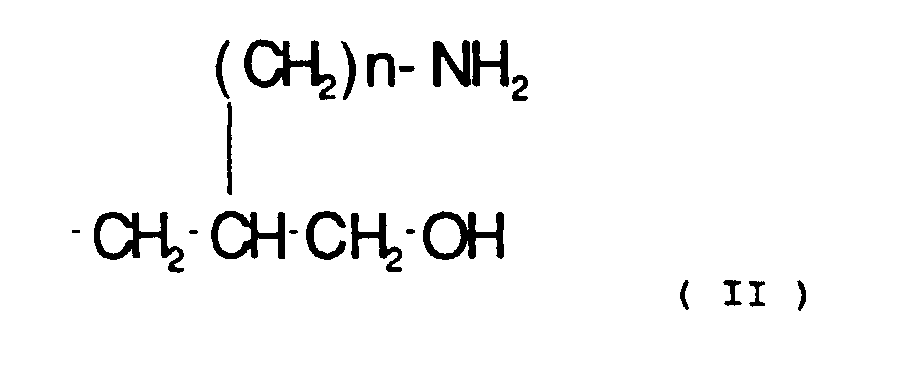
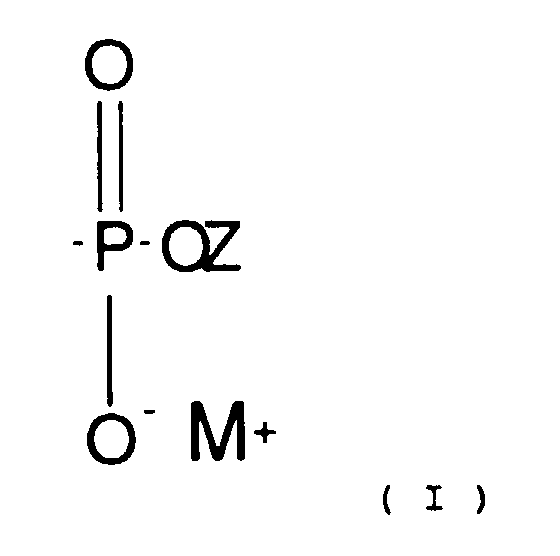
- the ligand is for example chosen from proteins and compounds as represented respectively by formulas I and II below: in which : Z represents an alkyl or alkenyl radical of 2 to 12 carbon atoms, linear or branched, unsubstituted or substituted by one or more groups chosen from hydroxy and / or amino groups, and m + represents in particular an alkali or ammonium ion.
- This ligand is preferably coupled to the 3 'end of the nucleotide sequence of the capture probe.
- the ligand is a protein, for example, a albumin, preferably bovine serum albumin, which may be coupled to the 5 'or 3' end of the nucleotide sequence of the capture probe.
- a albumin preferably bovine serum albumin
- the support of the present invention can be any support allowing to immobilize a nucleotide sequence or a derivative according to the invention, either by passive adsorption or by covalence.
- the supports can be made of any material usually used such as nitrocellulose, nylon, paper, or preferably in a hydrophobic material such as a styrene polymer or a styrene-based copolymer comprising at least 10% by weight of styrene patterns.
- the solid support according to the invention can be without limitation in the form of a microtiter plate, a sheet, a tube, cone, well or the like.
- a sample containing a nucleic acid is obtained from an individual whose the HLA DR genotype must be determined.
- Any type of fabric containing HLA DR nucleic acid can be used for present invention. It is thus possible to use fragments nucleic acid (DNA or RNA) obtained after cutting by route chemical, enzymatic or analog of the nucleic acid present in the individual's sample.
- Amplification can be obtained either from DNA or from from RNA. It is obvious to a person skilled in the art that amplification of the HLA DR target sequences in a sample can be accomplished by any known method which provides sufficient amplification for the target sequence to be able to be detected by hybridization of a nucleic acid to a probe.
- the nucleic acid in the sample will be DNA, most often genomic DNA.
- this invention can also be used with other acids nucleic acids such as messenger RNA or cloned DNA, and acid nucleic acid in the sample of the individual may be in the form single strand or double strand.
- acid nucleic acid when the acid nucleic acid is in double strand form, it is necessary to practice a denaturation step to obtain a nucleic acid single strand.
- the probes used in the present invention are sequence specific oligonucleotides (OSS) which, in appropriate conditions, may bind specifically to their complementary sequences. If a particular probe can be used to identify only one allele, the probe is then called OSA, that is to say an allele specific oligonucleotide. he a single probe may not be able to identify it alone has a specific DR ⁇ allele due to the nature different between various DR ⁇ alleles.
- OSS sequence specific oligonucleotides
- the identity of an allele is deduced from a binding model of a set of probes, each individual probe in the set being specific for different parts of the HLA DR gene. Thanks to the choice of multiple probes corresponding to the DNA sequences of known alleles, the specificity of the oligonucleotide typing method of the present invention makes it possible to identify all the alleles of the DRB1, DRB3 loci and DRBS. Of course, the process of the present invention could be used to identify alleles from other extremely loci polymorphs such as DQB1 and DPB1.
- allelic differences are essentially located in the exon coding for the first domain of HLA molecules (aa 5-94), the probes are chosen for be complementary to specific sequences located in this region. In case new alleles are discovered, these are immediately listed in an HLA sequence register class II, which updates the collection of tracers informative and therefore to adapt the methodology to the detection of everything new allele.
- Analysis of the specificities HLA-DR1-DRw18 by the technique of oligonucleotide typing can be applied in Histocompatibility laboratories for routine DR typing, in replacement of DR serology, in particular for typing DR of patients on the waiting list for a kidney transplant or typing of potential kidney donors, DR typing of patients leukemia patients for whom a bone marrow transplant is envisaged, as well as family members or donors unrelated potentials, large-scale DR typing for the constitution of voluntary marrow donor registers, for determine associations between diseases and the HLA system, for example in the case of insulin-dependent diabetes, for applications in predictive medicine or for research into paternity and other judicial identifications.
- sequences of capture probes are underlined, this represents the sequence optimal for typing according to the invention.
- these optimal sequences can be extended at the 3 'and / or 5' end by at least one base.
- some bases can be optionally added have been indicated in parentheses as we can see it for example by reading the description above.
- ligands used in the present invention can be commercially available compounds such as in Table 1 below:
- An oligonucleotide is synthesized on an automatic device 381 A from APPLIED BIOSYSTEMS using chemistry of phosphoramidites according to the manufacturer's protocol.
- the ligand phosphoramidite dissolved in anhydrous acetonitrile at one 0.2 M concentration, is placed in position X of the synthesizer and the ligand is added to the 5 'end of the oligonucleotide according to the standard protocol of automatic synthesis when the synthesis of the oligonucleotide is completed.
- the ligand carries a group dimethoxytrityl protector, such as for compound d, it is necessary to perform an additional deprotection step on the trityl grouping with trichloroacetic acid at the end of the synthesis.
- the oligonucleotide is dried under vacuum and taken up in 1 ml of H 2 O.
- an additional step of cleavage of the monomethoxytrityl group is carried out according to the manufacturer's protocol (CLONTECH and GLEN RESEARCH respectively) after deprotection.
- the automatic synthesis starts with silica grafted with ligand according to standard protocol.
- the ligand and oligonucleotide coupling takes place at the 3 'end of the latter.
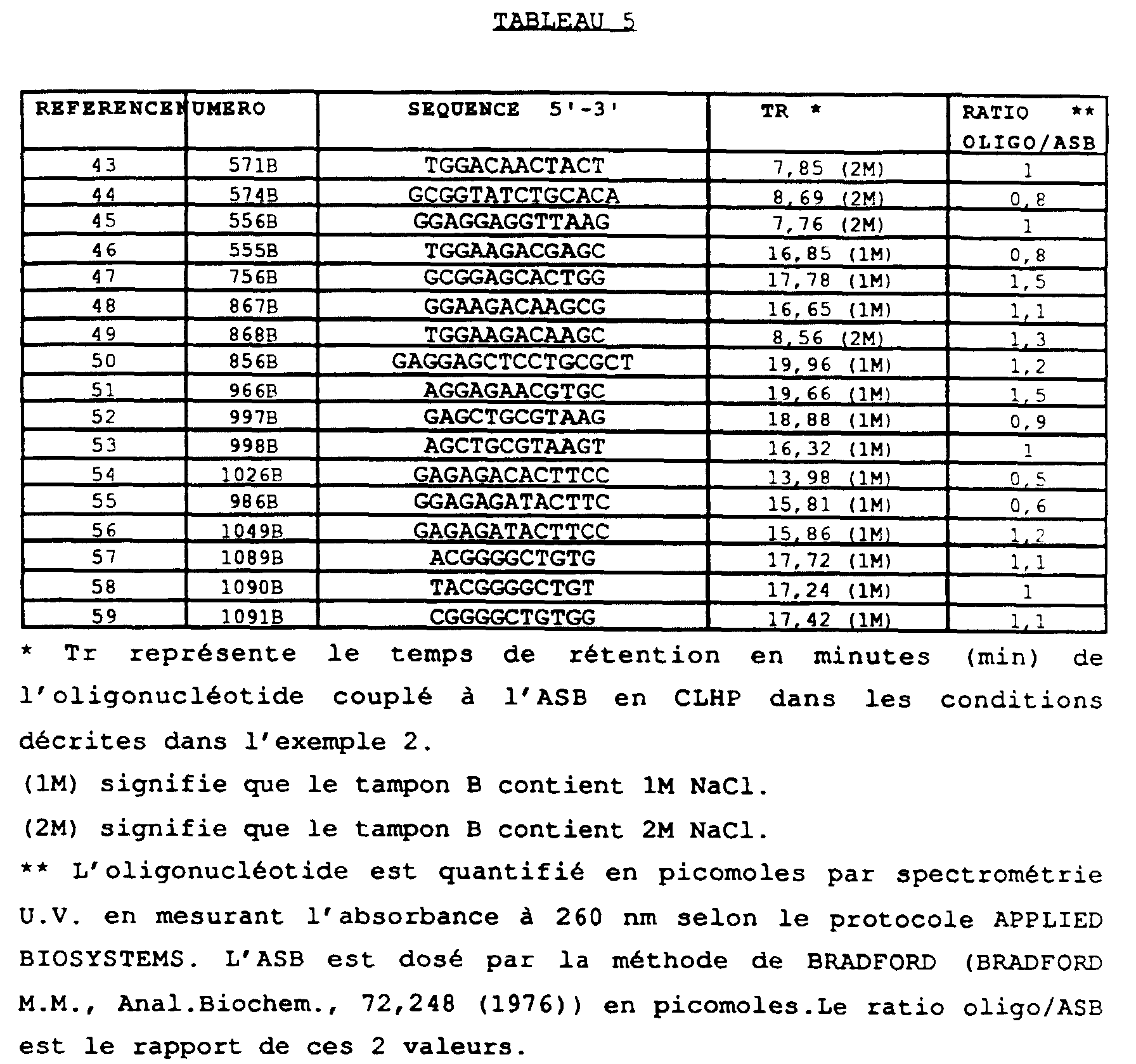
- oligonucleotides were synthesized carrying either a ligand, as described in example 1 and which are summarized in table 4, or coupled to ASB, as described in example 2 and which are summarized in Table 5
- capture oligonucleotides have been defined which can be synthesized, without ligand, with a ligand or else can be coupled, for example, to ASB.
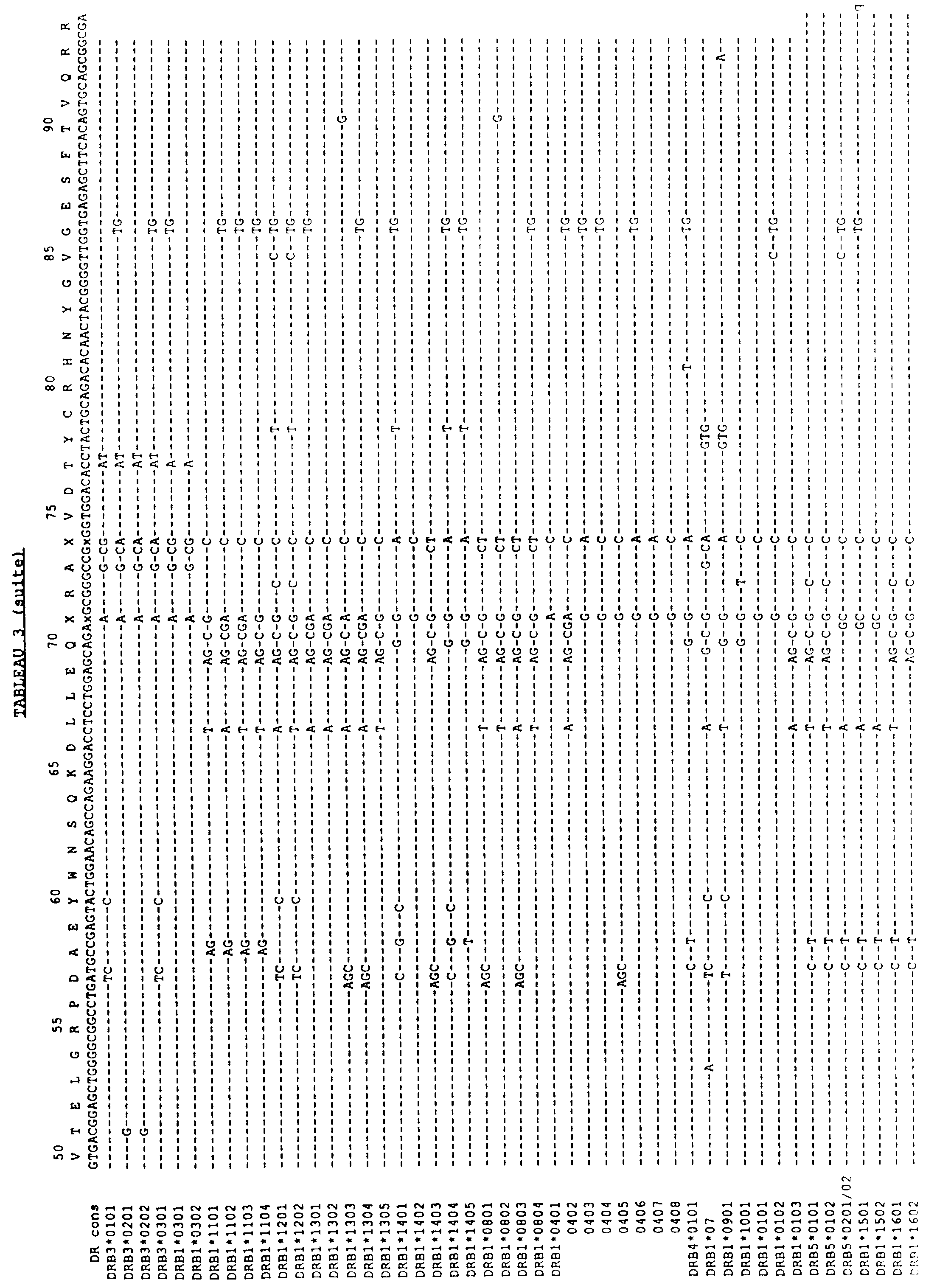
- the choice of the sequences of the oligonucleotides synthesized takes account of the alignment of the DNA sequences of the various alleles described in Table 3 of Example 3.
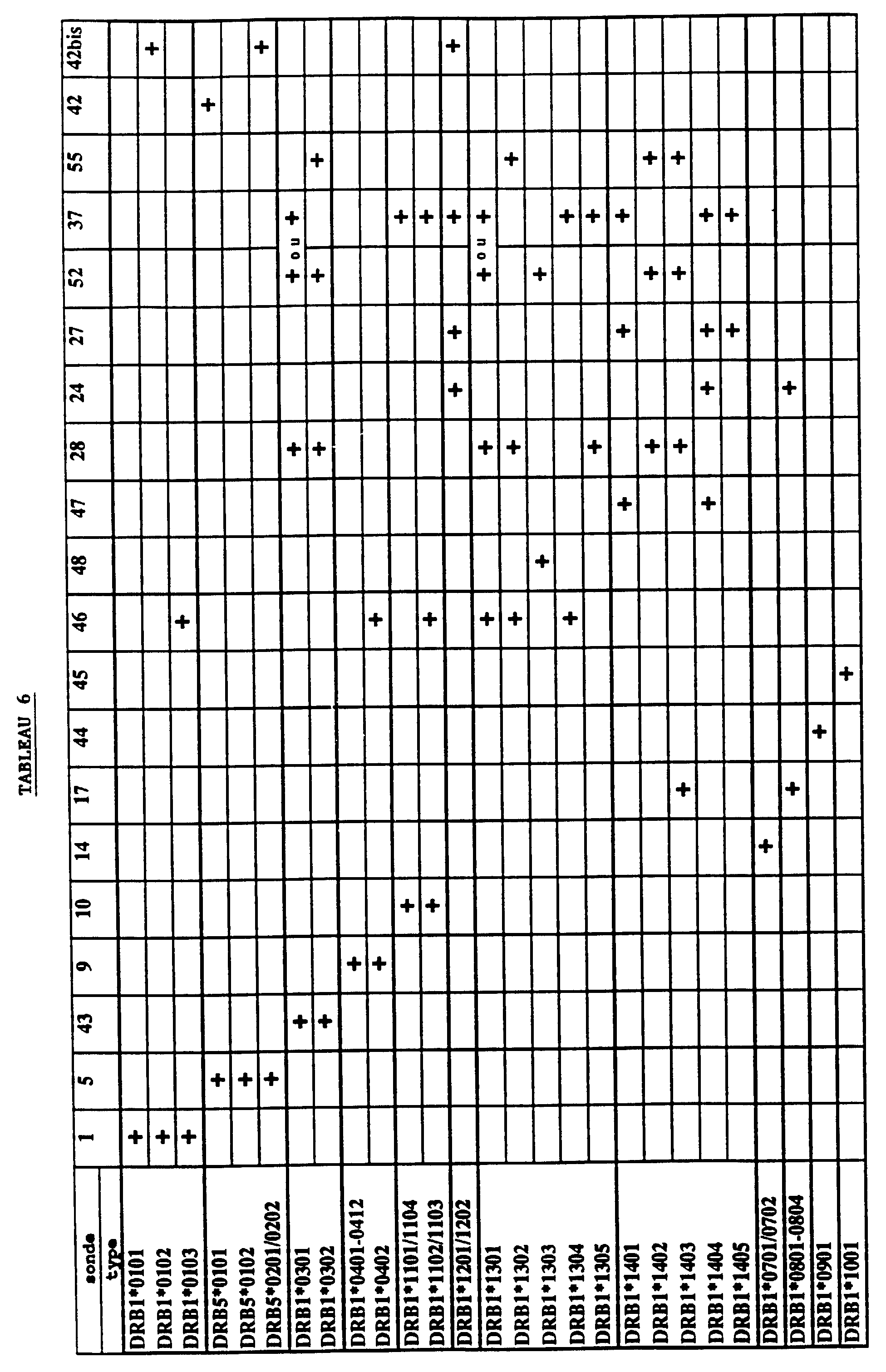
- the selected oligonucleotide probes, used for example as capture probes, make it possible to carry out a Typing plan as described in Table 6. It is obvious to those skilled in the art that other typing plans can be defined with other oligonucleotides.
- the sign + signifies that the subtype of the line considered of the table 6 gives a hybridization with the column probe corresponding.
- Example 2 the activated oligonucleotide, dried under vacuum, is taken up in 1.25 10 -7 mole (5 mg) of horseradish peroxidase (BOEHRINGER MANHEIM 413470) in 200 ⁇ l of 0.1M sodium borate buffer, pH 9. , 3.
- the purification protocol is identical: the conjugate is stored at -20 ° C in a 50 mM tris HCl buffer, pH 7.0, 40% glycerol.
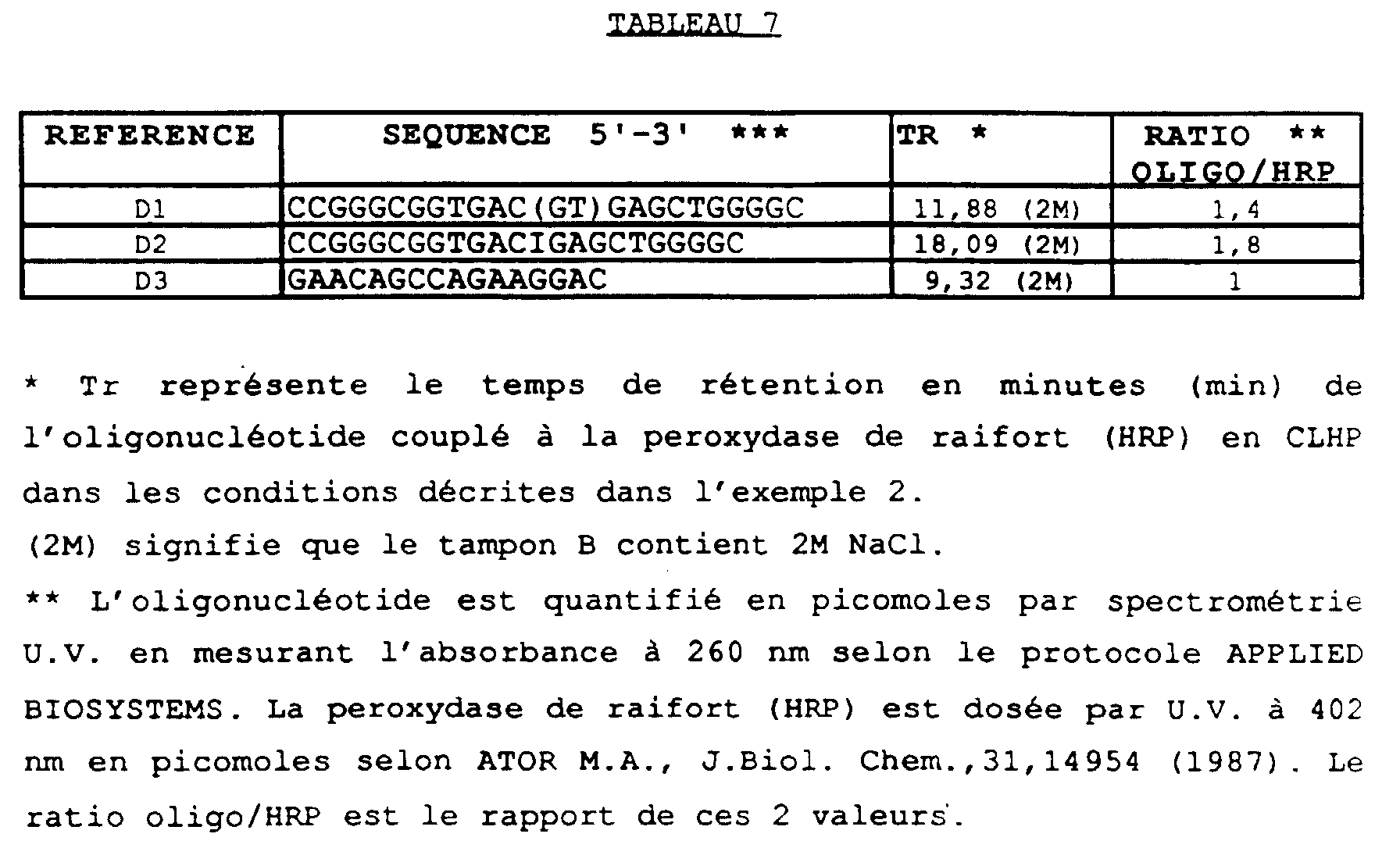
- Table 7 summarizes the different conjugates used for HLA DR detection.
- nucleic acids from whole blood is performed in an Applied Biosystems device according to the protocol next: 2 to 6 ml of whole blood are taken up in TE buffer (10 mM Tris-HCl pH 8.00, 1 mM EDTA) (sufficient quantity for 6 ml) and are placed in a 30 ml extraction vial. A solution of proteinase K (840 units in 20 mM Tris-HCl pH 8.5) is added. The whole is incubated for 1 hour at 55 ° C. with shaking. The excess of protein present is eliminated by 2 simultaneous extractions (8.5 ml) with a mixture of chloroform phenol. The whole is agitated for 20 minutes at 60 ° C.
- PCR polymerase chain reaction
- a well of a polystyrene microtiter plate (Nunc 439454) are deposited 100 ⁇ l of a solution of oligonucleotide for capturing a specificity DR given to a 0.15 ⁇ M concentration in 3 x PBS (0.45 M NaCl, 0.15 M sodium phosphate pH 7.0). There are as many wells filled as necessary for typing.
- the capture probe which is used as a positive control is present on all the alleles known to date and has the following sequence:
- the plate is washed 3 times with 300 ⁇ l of PBS Tween (0.15 M NaCl, 0.05 M sodium phosphate, pH 7.0; 0.5% Tween 20 (Merck 822184)).
- the amplification product (100 ⁇ l) as described in Example 7 is denatured with 10 ⁇ l of 2 N NaOH for 5 minutes with stirring at room temperature.
- nx 50 ⁇ l 10 ⁇ l of 2N acetic acid then a volume of PEG buffer (0.1 M sodium phosphate, pH 7.0, 0.5 M NaCl, 0.65% Tween 20, salmon sperm DNA (Sigma D 9156) 0.14 mg / ml, PEG 4,000 (Merck 807490) 2%) equivalent to nx 50 ⁇ l (n being the number of capture probes necessary for typing) are added successively to this solution. 50 ⁇ l of this solution are distributed per well followed by 50 ⁇ l of the detection probe (oligonucleotide peroxidase conjugate) at a concentration of 15 nM in the PEG buffer. The plate is incubated for 1 h at 37 ° C.
- PEG buffer 0.1 M sodium phosphate, pH 7.0, 0.5 M NaCl, 0.65% Tween 20, salmon sperm DNA (Sigma D 9156) 0.14 mg / ml, PEG 4,000 (Merck 807490) 2%) equivalent to nx 50
- DNAs prepared according to the method described in Example 6, are amplified according to the method described in Example 7.
- the typing protocol conforms to the general protocol described in Example 8.
- the probes D1 and D2 (table 7) are used in a 50% -50% mixture as detection probes.
- the 2 capture probes without ligand do not differentiate between specificities of DNA whereas the same sequences with ligand a identify the DR2 and DR4 specificities of DNA.
- the probes D1 and D2 (table 7) are used in a 50% -50% mixture as detection probes.
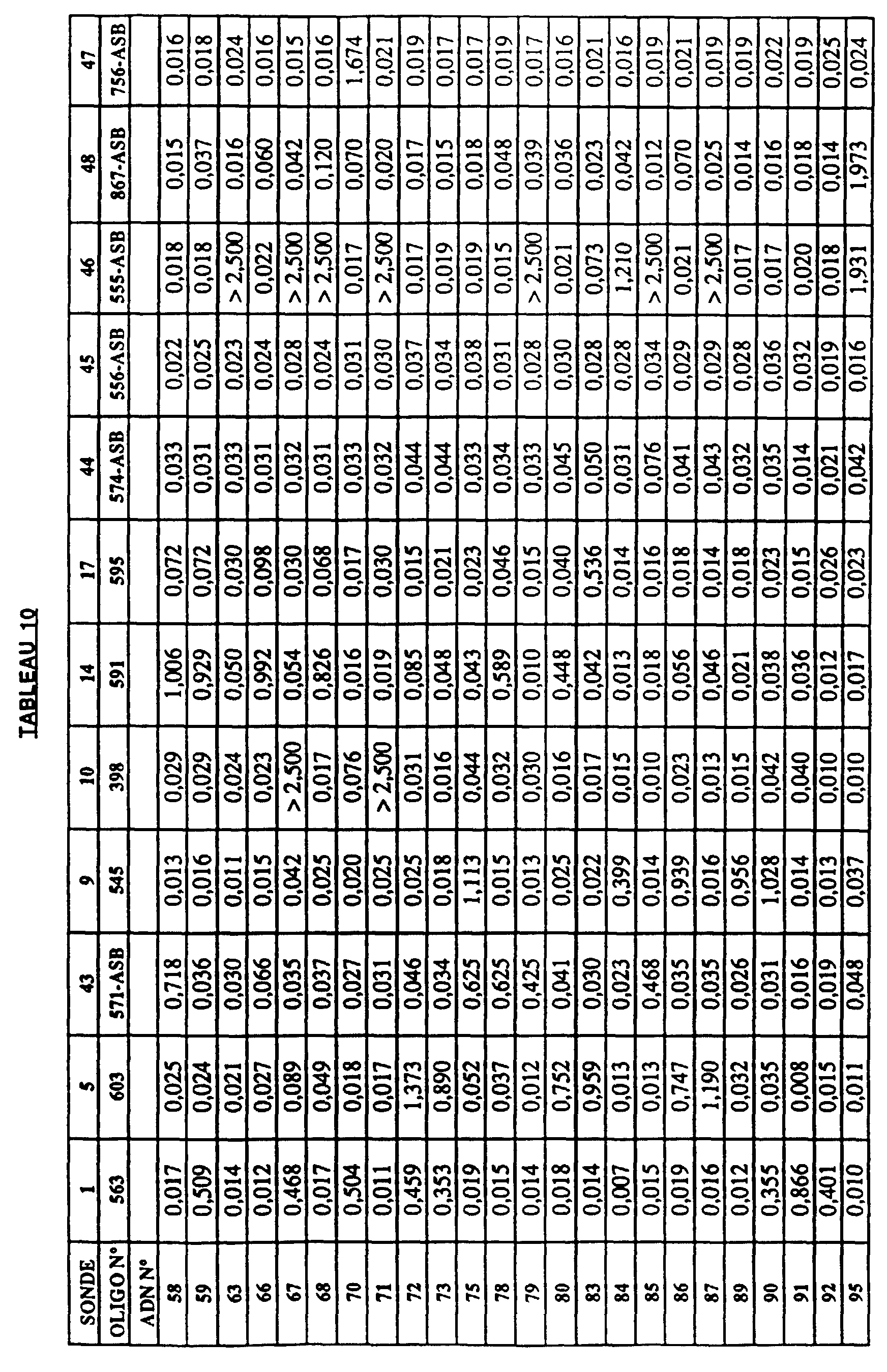
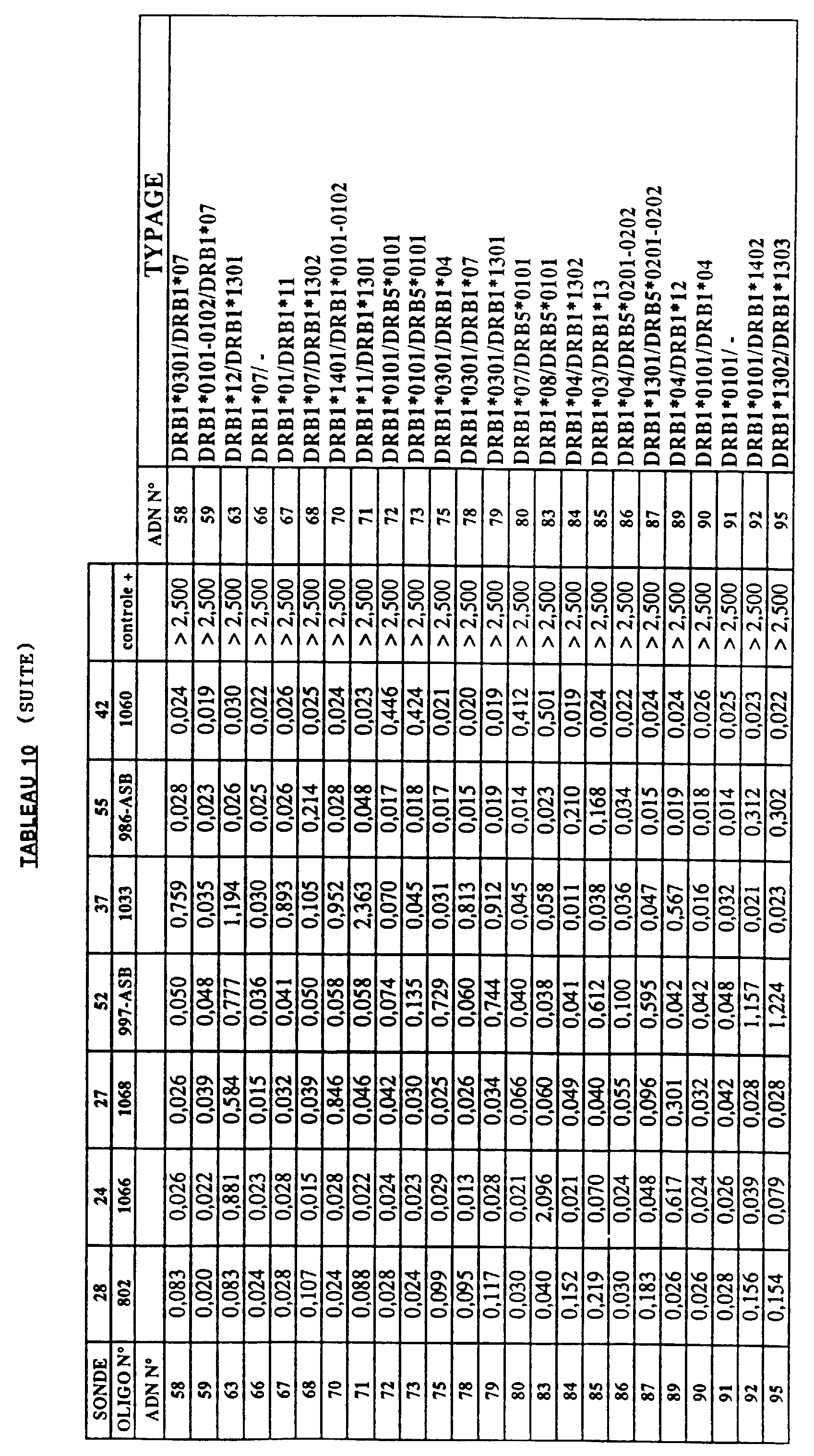
- the typing protocol includes the capture probes summarized in Table 9 below: The results of the typing are given in Table 10:
- the method described allows us to unambiguously type the 24 DNA tested.
- the preferred hybridization temperature for the HLA DR typing described in the present invention is 37 ° C. It is however possible to modify this hybridization temperature.
- Example 10 The following example is identical to Example 10 except the hybridization temperature which was changed from 37 ° C to 45 ° C. Typing is performed on 11 DNAs.
- the preferred hybridization buffer called PEG buffer used for HLA DR typing as described in Example 8 a following composition: 0.1 M sodium phosphate, pH 7, 0.5 M NaCl, Tween 20 0.65%, salmon sperm DNA (Sigma D 9156) 0.14 mg / ml, PEG 4000 (Merck 807490) 2%).
- the preferred hybridization temperature is 37 ° C and the preferred hybridization buffer is the PEG buffer but like the show the results of example 11 and 12, we see that it is possible to vary both the hybridization temperature and the hybridization buffer.
Landscapes
- Life Sciences & Earth Sciences (AREA)
- Chemical & Material Sciences (AREA)
- Organic Chemistry (AREA)
- Proteomics, Peptides & Aminoacids (AREA)
- Health & Medical Sciences (AREA)
- Zoology (AREA)
- Immunology (AREA)
- Analytical Chemistry (AREA)
- Wood Science & Technology (AREA)
- Engineering & Computer Science (AREA)
- Physics & Mathematics (AREA)
- Microbiology (AREA)
- Molecular Biology (AREA)
- Biotechnology (AREA)
- Biophysics (AREA)
- Cell Biology (AREA)
- Biochemistry (AREA)
- Bioinformatics & Cheminformatics (AREA)
- General Engineering & Computer Science (AREA)
- General Health & Medical Sciences (AREA)
- Genetics & Genomics (AREA)
- Measuring Or Testing Involving Enzymes Or Micro-Organisms (AREA)
- Ultra Sonic Daignosis Equipment (AREA)
- Tests Of Electronic Circuits (AREA)
- Addition Polymer Or Copolymer, Post-Treatments, Or Chemical Modifications (AREA)
- Testing Or Measuring Of Semiconductors Or The Like (AREA)
- Particle Formation And Scattering Control In Inkjet Printers (AREA)
- Compositions Of Macromolecular Compounds (AREA)
- Polymers With Sulfur, Phosphorus Or Metals In The Main Chain (AREA)
- Polyamides (AREA)
- Graft Or Block Polymers (AREA)
Description

lesdites sondes pouvant être sous forme marquées ou couplées de façon covalente à un ligand facilitant la fixation sur un support solide ou fixées (directement ou indirectement) sur un support solide.
La sonde 34bis peut être notamment utilisée sous la forme :


Dans un procédé automatisé, on utilisera l'ensemble des sondes. Dans d'autres cas, il est évidemment possible de les utiliser l'une après l'autre, et d'arrêter le procédé lorsque les renseignements recueillis suffisent à déterminer le typage.
- à mettre en contact selon une technique particulière choisie, des échantillons d'acides nucléiques cibles contenant les régions polymorphes du gène HLA DR d'un individu, avec au moins une partie de l'ensemble des sondes tel que défini ci-dessus,
- à faire incuber, selon les méthodes connues, dans des conditions prédéterminées telles que l'hybridation avec chaque sonde ne se produit que si la cible contient une séquence parfaitement complémentaire de celle de ladite sonde, et
- à déterminer, selon les techniques de détection usuelles, l'hybridation ou l'absence d'hybridation avec chacune des sondes utilisées.

Z représente un radical alkyle ou alcényle de 2 à 12 atomes de carbone, linéaire ou ramifié, non substitué ou substitué par un ou plusieurs groupements choisis parmi les groupements hydroxy et/ou amino, et m+ représente notamment un ion alcalin ou ammonium.


- Conditions :
- débit 4,6 ml/min
Gradient- 10 % à 35 % de tampon B en 30 min.
- 35 % à 100 % de tampon B en 3 min.
- Tampon A : 0.1 molaire Triethylammoniumacétate (TEAA) pH = 7,00
- Tampon B : 50 % Tampon A + 50 % CH3CN.
Conditions chromatographiques :
- Gradient de :
- 10 % B' à 56 % B' en 25 min.
56 % B' à 100 % B' en 2 min.





- 10µl de tampon de PCR 10 fois concentré (500 mM KCl, 100 mM Tris-HCl pH 8,3 (20°c), 15 mM MgCl2, 0,1% gélatine)
- 2 µl dNTP (dATP, dCTP, dGTP, TTP) 0,5 µM
- 2 µl de chaque amorce correspondant à 25 pmoles
- 1,5 unités de Taq polymerase (Perkin Elmer Cétus)
- eau distillée (quantité suffisante pour 100 µl)
- 50 µl d'huile de paraffine
- 0,5 minute de dénaturation à 95°C
- 0,5 minute d'hybridation à 55°C
- 0,5 minute d'élongation à 72°C



| ADN | TYPAGE | DR3 545 NU | DR3 545 | DR4 546 NU | DR4 546 |
| 1 | DR11/DR11 | 0,019 | 0,025 | 0,021 | 0,025 |
| 2 | DR4/DR4 | 0,018 | 0,021 | 0,021 | 0,138 |
| 3 | DR8/DR7 | 0,017 | 0,022 | 0,019 | 0,019 |
| 4 | DR3/DR11 | 0,026 | 0,423 | 0,021 | 0,027 |
| 5 | DR3/DR4 | 0,023 | 0,176 | 0,026 | 0,296 |
| 6 | DR3/DR3 | 0,023 | 0,387 | 0,023 | 0,018 |

Il est cependant possible de modifier cette température d'hybridation .


Claims (20)
- Ensemble de sondes nucléotidiques permettant de déterminer selon les techniques usuelles de typage par oligonucléotides, les types HLA DR et/ou sous types associés, ledit ensemble de sondes comprenant au moins les sondes nucléotidiques suivantes, ou leurs complémentaires (la partie soulignée correspondant à la séquence optimum, et la lettre I représentant l'inosine):et
 les bases entre parenthèses étant facultatives,
 ou des sondes contenant des séquences d'au moins cinq nucléotides consécutifs et en particulier d'au moins huit nucléotides consécutifs, lesdites séquences étant choisies dans les séquences optimum;lesdites sondes pouvant être sous forme marquée, ou couplées de façon covalente à un ligand facilitant leur fixation sur un support solide, ou fixées sur un support solide.
 - Ensemble de sondes selon la revendication 1 comprenant en outre les sondes suivantes (la partie soulignée correspondant à la séquence optimum)et/ou les sondes suivantes


- Ensemble de sondes selon la revendication 1 ou 2 caractérisé par le fait qu'il contient la sonde suivante:

- Ensemble de sondes selon l'une quelconque des revendications précédentes, caractérisé par le fait que lesdites sondes sont couplées de façon covalente avec un. ligand, en particulier avec un ligand comprenant au moins un groupement fonctionnel polaire.
- Ensemble de sondes selon la revendication 4, caractérisé par le fait que ledit groupement fonctionnel polaire est un groupement aminé.
- Ensemble de sondes selon l'une des revendications 4 à 5, caractérisé par le fait que ledit ligand comprend une partie hydrophobe.
- Ensemble de sondes selon l'une quelconques des revendications 4 à 6, caractérisé par le fait que ledit ligand comprend un groupement de formule générale (I)dans laquelle Z représente un radical alkyle ou alcényle de 2 à 12 atomes de carbone, linéaire ou ramifié, non substitué ou substitué par un ou plusieurs groupements hydroxy et/ou amino, et M+ représente notamment un cation alcalin ou ammonium .
- Ensemble de sondes selon l'une quelconques des revendications 4 à 6, caractérisé par le fait que ledit ligand comprend un groupement de formule générale (II)dans laquelle n est un nombre entier pouvant varier de 1 à 4

- Ensemble de sondes selon l'une quelconques des revendications 4 à 6, caractérisé par le fait que ledit ligand comprend un peptide ou une protéine.
- Ensemble de sondes selon la revendications 9, caractérisé par le fait que ladite protéine est une albumine
- Ensemble de sondes selon la revendications 10, caractérisé par le fait que ladite albumine est une albumine de sérum de bovin.
- Ensemble de sondes selon l'une quelconques des revendications précédentes, caractérisé par le fait que lesdites sondes sont fixées par adsorption passive sur ledit support solide.
- Procédé pour déterminer le typage HLA DR d'un individu à partir d'un échantillon de l'individu selon les techniques usuelles de typage par oligonucléotides caractérisé par le fait qu'on utilise comme sondes de capture ou de détection au moins une partie des sondes de l'ensemble de sondes défini dans l'une quelconque des revendications précédentes, ladite partie de l'ensemble de sondes contenant au moins une sonde définie par une des séquences représentées en (a) dans la revendication 1, ou sa séquence complémentaire.
- Procédé selon la revendication 13, caractérisé par le fait qu'il comprend les étapes consistant :à faire incuber, selon les méthodes connues, dans des conditions prédéterminées telles que l'hybridation avec chaque sonde ne se produit que si la cible contient une séquence parfaitement complémentaire de celle de ladite sonde, età déterminer, selon les techniques de détection usuelles, l'hybridation ou l'absence d'hybridation avec chacune des sondes utilisées.
- Procédé selon les revendications 13 et 14, caractérisé par le fait que l'on utilise lesdites sondes comme sondes de capture.
- Procédé selon la revendication 15, caractérisé par le fait qu'il comprend les étapes consistant à :immobiliser chaque sonde de capture sur un support solide,mettre en contact chaque sonde de capture immobilisée avec un milieu liquide contenant au moins un fragment d'acide nucléique cible, dans des conditions prédéterminées permettant l'hybridation si la séquence complémentaire de celle de la sonde est présente dans la cible, etdétecter la présence d'hybrides éventuellement formés.
- Procédé selon la revendication 16, caractérisé par le fait que ladite sonde de capture est telle que définie dans l'une quelconque des revendications 4 à 12.
- Procédé selon l'une quelconque des revendications 13 à 17, caractérisé par le fait que le fragment d'acides nucléiques cible est un fragment d'ADN ou d'ARN
- Procédé selon l'une des revendications 14 à 16, caractérisé par le fait que la détection des hybrides formés est effectuée à l'aide d'au moins l'une des sondes de détection suivantes :

- Sonde nucléotidique choisie parmi celles ayant les séquences suivantes, ou leurs complémentaires:
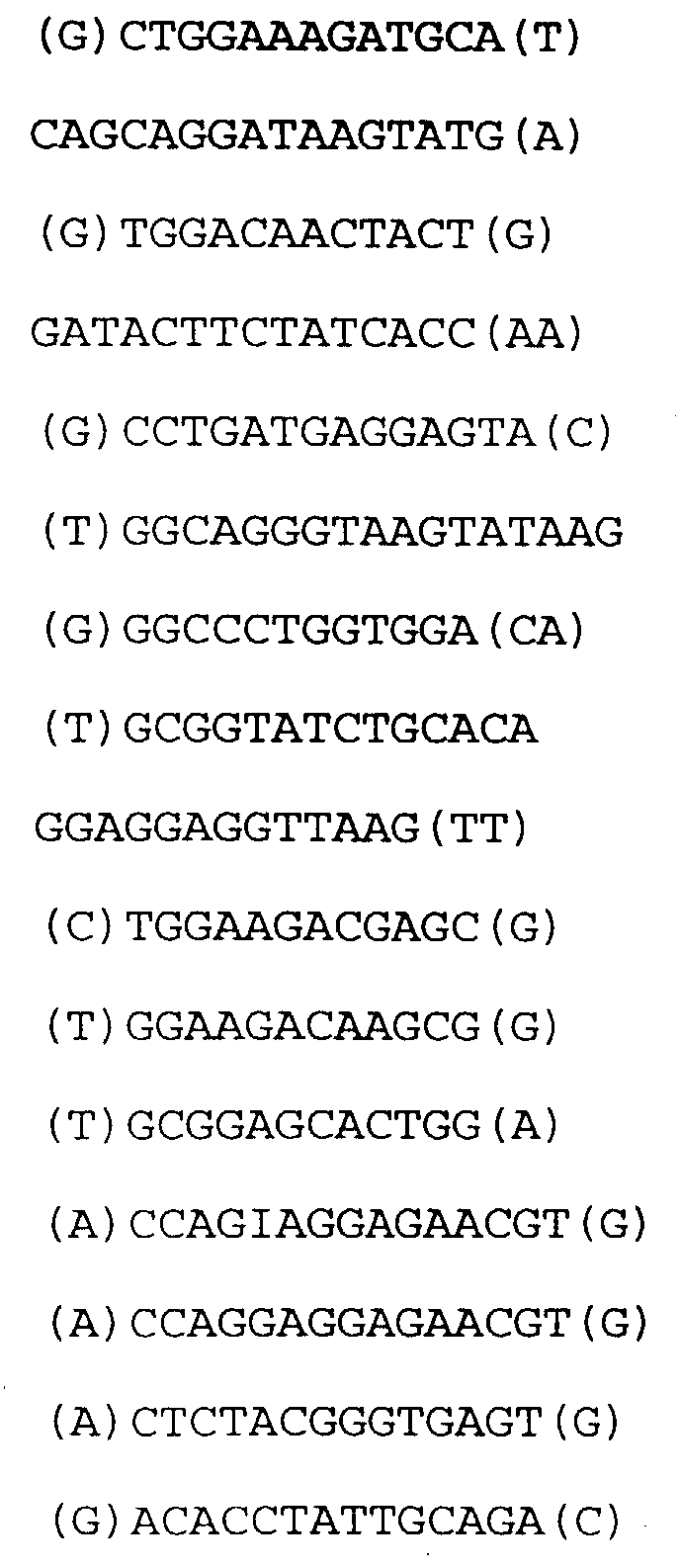 lesdites sondes pouvant être sous forme marquée, ou couplées de façon covalente à un ligand facilitant leur fixation sur un support solide, ou fixées sur un support solide.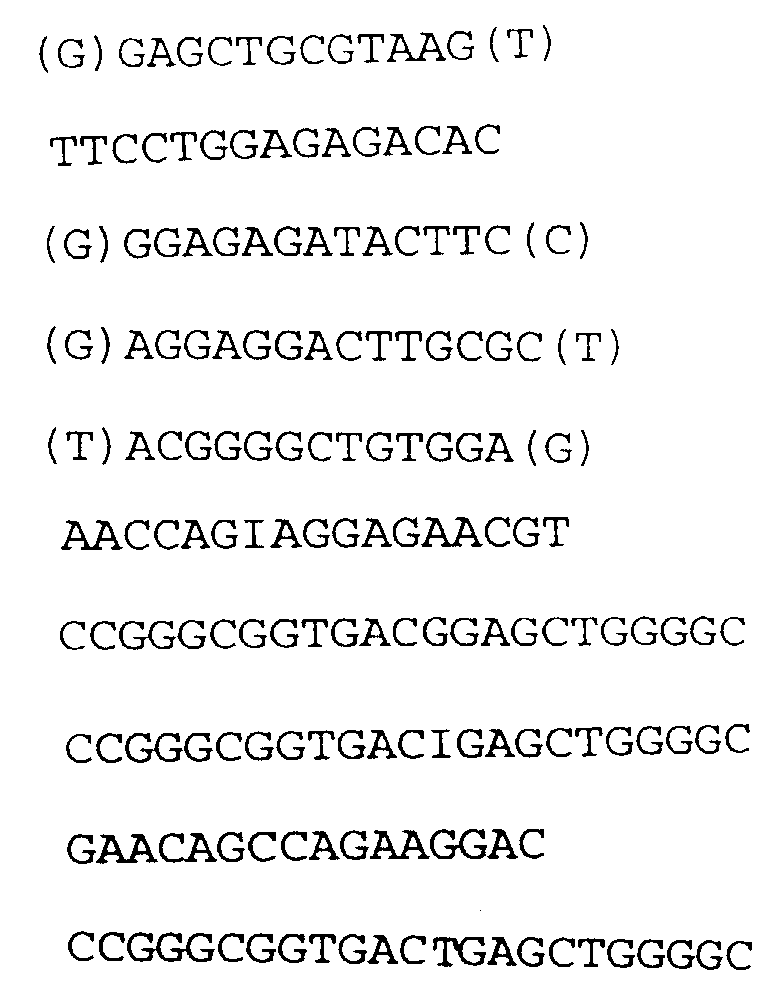
Applications Claiming Priority (3)
| Application Number | Priority Date | Filing Date | Title |
|---|---|---|---|
| FR9109058 | 1991-07-17 | ||
| FR9109058A FR2679252B1 (fr) | 1991-07-17 | 1991-07-17 | Systeme de sondes permettant d'effectuer le typage hla dr, et procede de typage utilisant lesdites sondes. |
| PCT/FR1992/000702 WO1993002213A1 (fr) | 1991-07-17 | 1992-07-17 | Systeme de sondes permettant d'effectuer le typage hla dr, et procede de typage utilisant lesdites sondes |
Publications (4)
| Publication Number | Publication Date |
|---|---|
| EP0549776A1 EP0549776A1 (fr) | 1993-07-07 |
| EP0549776B1 true EP0549776B1 (fr) | 1998-12-02 |
| EP0549776B2 EP0549776B2 (fr) | 2002-03-27 |
| EP0549776B9 EP0549776B9 (fr) | 2003-03-12 |
Family
ID=9415244
Family Applications (1)
| Application Number | Title | Priority Date | Filing Date |
|---|---|---|---|
| EP92916146A Expired - Lifetime EP0549776B9 (fr) | 1991-07-17 | 1992-07-17 | Systeme de sondes permettant d'effectuer le typage hla dr, et procede de typage utilisant lesdites sondes |
Country Status (10)
| Country | Link |
|---|---|
| EP (1) | EP0549776B9 (fr) |
| JP (1) | JPH06501622A (fr) |
| AT (1) | ATE174064T1 (fr) |
| AU (1) | AU659866B2 (fr) |
| CA (1) | CA2091775C (fr) |
| DE (1) | DE69227756T3 (fr) |
| DK (1) | DK0549776T4 (fr) |
| ES (1) | ES2126597T5 (fr) |
| FR (1) | FR2679252B1 (fr) |
| WO (1) | WO1993002213A1 (fr) |
Families Citing this family (9)
| Publication number | Priority date | Publication date | Assignee | Title |
|---|---|---|---|---|
| US5976789A (en) * | 1991-07-17 | 1999-11-02 | Bio Merieux | System of probes enabling HLA-DR typing to be performed, and typing method using said probes |
| FR2749308B1 (fr) * | 1996-06-03 | 1998-07-24 | Bio Merieux | Sondes nucleotidiques et procede pour determiner le typage hla dqb1 |
| WO1998036091A1 (fr) * | 1997-02-14 | 1998-08-20 | Medical Research Council | Methode permettant de determiner la sensibilite a la maladie d'alzheimer et a la demence avec corps de lewy, apparaissant tardivement |
| FR2793809B1 (fr) * | 1999-05-20 | 2006-07-28 | Biomerieux Sa | Procede d'analyse de la predisposition genetique d'un patient a au moins une maladie et amplification adaptee a un tel procede |
| FR2793808B1 (fr) * | 1999-05-20 | 2003-09-19 | Biomerieux Sa | Procede d'analyse de la predisposition genetique d'un patient a au moins une maladie |
| DE10032529A1 (de) * | 2000-06-30 | 2002-02-07 | Epigenomics Ag | Diagnose von bedeutenden genetischen Parametern innerhalb des Major Histocompatibility Complex (MHC) |
| GB0016836D0 (en) * | 2000-07-07 | 2000-08-30 | Lee Helen | Improved dipstick assays (1) |
| EP1536021A1 (fr) * | 2003-11-27 | 2005-06-01 | Consortium National de Recherche en Genomique (CNRG) | Méthode pour le typage de HLA |
| JP6734011B2 (ja) * | 2014-06-06 | 2020-08-05 | 古河電気工業株式会社 | 生体分子検出用試験キット、及びこれを用いた生体分子の検出方法、並びにこれらに用いられる生体分子検出用試験片及び生体分子検出用標識試薬 |
Family Cites Families (11)
| Publication number | Priority date | Publication date | Assignee | Title |
|---|---|---|---|---|
| US5310893A (en) * | 1986-03-31 | 1994-05-10 | Hoffmann-La Roche Inc. | Method for HLA DP typing |
| CA1284931C (fr) * | 1986-03-13 | 1991-06-18 | Henry A. Erlich | Procede de detection de variations specifiques de nucleotides et de polymorphismes genetiques dans les acides nucleiques |
| US6194561B1 (en) * | 1986-03-13 | 2001-02-27 | Roche Molecular Systems, Inc. | Characterization and detection of sequences associated with autoimmune diseases |
| US4965189A (en) * | 1986-07-01 | 1990-10-23 | University Of Massachusetts Medical School | Probes for the determination of the proclivity for development of autoimmune diseases |
| JPH03164180A (ja) * | 1989-08-10 | 1991-07-16 | Noboru Kashiwagi | 新規なdna塩基配列およびその用途 |
| GB9002625D0 (en) * | 1990-02-06 | 1990-04-04 | Univ Singapore | Human leukocyte antigen typing |
| US5387505A (en) * | 1990-05-04 | 1995-02-07 | Eastman Kodak Company | Preparation and isolation of single-stranded biotinylated nucleic acids by heat avidin-biotin cleavage |
| EP0466367B1 (fr) † | 1990-06-28 | 1995-08-23 | Wakunaga Seiyaku Kabushiki Kaisha | Méthode pour la détection d'acides nucléiques |
| JP2560160B2 (ja) † | 1990-08-20 | 1996-12-04 | 社団法人北里研究所 | 新規なdna塩基配列およびその用途 |
| ATE164630T1 (de) † | 1990-12-06 | 1998-04-15 | Hoffmann La Roche | Verfahren und reagenzien für die karakterisierung von hla-drbeta-dns |
| WO1993009245A1 (fr) † | 1991-10-31 | 1993-05-13 | University Of Pittsburgh | Hybridation inverse par buvardage en taches a l'aide de nomoneres tandem en tete-a-queue contenant des sondes synthesisees par des amorces complementaires decalees |
-
1991
- 1991-07-17 FR FR9109058A patent/FR2679252B1/fr not_active Expired - Fee Related
-
1992
- 1992-07-17 ES ES92916146T patent/ES2126597T5/es not_active Expired - Lifetime
- 1992-07-17 JP JP5502642A patent/JPH06501622A/ja active Pending
- 1992-07-17 DE DE69227756T patent/DE69227756T3/de not_active Expired - Fee Related
- 1992-07-17 AT AT92916146T patent/ATE174064T1/de not_active IP Right Cessation
- 1992-07-17 CA CA002091775A patent/CA2091775C/fr not_active Expired - Fee Related
- 1992-07-17 WO PCT/FR1992/000702 patent/WO1993002213A1/fr not_active Ceased
- 1992-07-17 AU AU23885/92A patent/AU659866B2/en not_active Ceased
- 1992-07-17 EP EP92916146A patent/EP0549776B9/fr not_active Expired - Lifetime
- 1992-07-17 DK DK92916146T patent/DK0549776T4/da active
Also Published As
| Publication number | Publication date |
|---|---|
| EP0549776B9 (fr) | 2003-03-12 |
| AU659866B2 (en) | 1995-06-01 |
| AU2388592A (en) | 1993-02-23 |
| ES2126597T5 (es) | 2002-11-01 |
| DK0549776T4 (da) | 2002-07-29 |
| ATE174064T1 (de) | 1998-12-15 |
| DE69227756D1 (de) | 1999-01-14 |
| CA2091775A1 (fr) | 1993-01-18 |
| FR2679252B1 (fr) | 1993-12-10 |
| WO1993002213A1 (fr) | 1993-02-04 |
| DE69227756T3 (de) | 2002-11-21 |
| JPH06501622A (ja) | 1994-02-24 |
| FR2679252A1 (fr) | 1993-01-22 |
| ES2126597T3 (es) | 1999-04-01 |
| CA2091775C (fr) | 2003-02-25 |
| EP0549776A1 (fr) | 1993-07-07 |
| EP0549776B2 (fr) | 2002-03-27 |
| DE69227756T2 (de) | 1999-07-29 |
| DK0549776T3 (da) | 1999-08-16 |
Similar Documents
| Publication | Publication Date | Title |
|---|---|---|
| EP0524864B1 (fr) | Procédé d'immobilisation d'un fragment d'acide nucléique par fixation passive sur un support solide, support solide ainsi obtenu et son utilisation | |
| EP1601798B1 (fr) | Biopuces a sondes et leurs methodes d'utilisation | |
| CA2103933A1 (fr) | Fragments d'adn de mycobacteries, amorces d'amplification, sondes d'hybridation, reactifs et procede de detection de mycobacteries | |
| FR2558172A1 (fr) | Sonde contenant un acide nucleique modifie et reconnaissance par des anticorps specifiques et utilisation de cette sonde et de ces anticorps specifiques pour detecter et caracteriser une sequence d'adn homologue | |
| EP0772694A1 (fr) | Systeme de sondes permettant d'effectuer le typage hla dr, et procede de typage utilisant lesdites sondes | |
| EP0549776B9 (fr) | Systeme de sondes permettant d'effectuer le typage hla dr, et procede de typage utilisant lesdites sondes | |
| FR2779154A1 (fr) | Procede d'amplification d'au moins une sequence nucleotidique particuliere et amorces de mise en oeuvre | |
| Collins et al. | High resolution molecular phototyping of MICA and MICB alleles using sequence specific primers | |
| EP1179091B2 (fr) | Procede d'analyse de la predisposition genetique d'un patient a au moins une maladie et amplification adaptee a un tel procede | |
| CA2075037C (fr) | Methode et reactifs pour le typage de l'adn hla drbeta | |
| EP0515660A1 (fr) | Typage d'adn hla dqbeta. | |
| FR2749308A1 (fr) | Sondes nucleotidiques et procede pour determiner le typage hla dqb1 | |
| Yang et al. | Recent advances of human leukocyte antigen (HLA) typing technology based on high-throughput sequencing | |
| EP1334211A1 (fr) | Procede d'analyse de la predisposition genetique d'un patient au diabete insulino-dependant, dispositif et jeu d'amorces | |
| EP0745691A2 (fr) | Fragment nucléotidique de l'ARN ribosomique 16s de corynébactéries, sondes et amorces dérivées, réactif et procédé de détection | |
| Lee et al. | Development and clinical evaluation of a microarray for HLA‐A and‐DRB1 genotyping | |
| CA2306445A1 (fr) | Moyens de documentation de repertoires en immunorecepteurs nkr et/ou en immunorecepteurs contreparties activatrices ou non inhibitrices d'immunorecepteurs nkr | |
| FR2793808A1 (fr) | Procede d'analyse de la predisposition genetique d'un patient a au moins une maladie | |
| JPH0552842A (ja) | Hla−dp抗原の型判定法 | |
| JP2010162020A (ja) | 新規hla−drb1遺伝子およびその用途 | |
| JPH03247300A (ja) | ヒト白血球抗原の型判定法 |
Legal Events
| Date | Code | Title | Description |
|---|---|---|---|
| PUAI | Public reference made under article 153(3) epc to a published international application that has entered the european phase |
Free format text: ORIGINAL CODE: 0009012 |
|
| AK | Designated contracting states |
Kind code of ref document: A1 Designated state(s): AT BE CH DE DK ES FR GB IT LI NL SE |
|
| 17P | Request for examination filed |
Effective date: 19930716 |
|
| 17Q | First examination report despatched |
Effective date: 19950822 |
|
| GRAG | Despatch of communication of intention to grant |
Free format text: ORIGINAL CODE: EPIDOS AGRA |
|
| GRAG | Despatch of communication of intention to grant |
Free format text: ORIGINAL CODE: EPIDOS AGRA |
|
| GRAH | Despatch of communication of intention to grant a patent |
Free format text: ORIGINAL CODE: EPIDOS IGRA |
|
| GRAH | Despatch of communication of intention to grant a patent |
Free format text: ORIGINAL CODE: EPIDOS IGRA |
|
| GRAA | (expected) grant |
Free format text: ORIGINAL CODE: 0009210 |
|
| AK | Designated contracting states |
Kind code of ref document: B1 Designated state(s): AT BE CH DE DK ES FR GB IT LI NL SE |
|
| REF | Corresponds to: |
Ref document number: 174064 Country of ref document: AT Date of ref document: 19981215 Kind code of ref document: T |
|
| REG | Reference to a national code |
Ref country code: CH Ref legal event code: EP |
|
| REF | Corresponds to: |
Ref document number: 69227756 Country of ref document: DE Date of ref document: 19990114 |
|
| GBT | Gb: translation of ep patent filed (gb section 77(6)(a)/1977) |
Effective date: 19990128 |
|
| ITF | It: translation for a ep patent filed | ||
| REG | Reference to a national code |
Ref country code: CH Ref legal event code: NV Representative=s name: KIRKER & CIE SA |
|
| REG | Reference to a national code |
Ref country code: ES Ref legal event code: FG2A Ref document number: 2126597 Country of ref document: ES Kind code of ref document: T3 |
|
| REG | Reference to a national code |
Ref country code: DK Ref legal event code: T3 |
|
| PLBI | Opposition filed |
Free format text: ORIGINAL CODE: 0009260 |
|
| PLBF | Reply of patent proprietor to notice(s) of opposition |
Free format text: ORIGINAL CODE: EPIDOS OBSO |
|
| 26 | Opposition filed |
Opponent name: INNOGENETICS NV Effective date: 19990902 |
|
| NLR1 | Nl: opposition has been filed with the epo |
Opponent name: INNOGENETICS NV |
|
| PLBF | Reply of patent proprietor to notice(s) of opposition |
Free format text: ORIGINAL CODE: EPIDOS OBSO |
|
| PLBF | Reply of patent proprietor to notice(s) of opposition |
Free format text: ORIGINAL CODE: EPIDOS OBSO |
|
| PLBQ | Unpublished change to opponent data |
Free format text: ORIGINAL CODE: EPIDOS OPPO |
|
| PLAB | Opposition data, opponent's data or that of the opponent's representative modified |
Free format text: ORIGINAL CODE: 0009299OPPO |
|
| R26 | Opposition filed (corrected) |
Opponent name: INNOGENETICS NV Effective date: 19990902 |
|
| NLR1 | Nl: opposition has been filed with the epo |
Opponent name: INNOGENETICS NV |
|
| PLAW | Interlocutory decision in opposition |
Free format text: ORIGINAL CODE: EPIDOS IDOP |
|
| PGFP | Annual fee paid to national office [announced via postgrant information from national office to epo] |
Ref country code: ES Payment date: 20010704 Year of fee payment: 10 |
|
| PLAW | Interlocutory decision in opposition |
Free format text: ORIGINAL CODE: EPIDOS IDOP |
|
| REG | Reference to a national code |
Ref country code: GB Ref legal event code: IF02 |
|
| PUAH | Patent maintained in amended form |
Free format text: ORIGINAL CODE: 0009272 |
|
| STAA | Information on the status of an ep patent application or granted ep patent |
Free format text: STATUS: PATENT MAINTAINED AS AMENDED |
|
| 27A | Patent maintained in amended form |
Effective date: 20020327 |
|
| AK | Designated contracting states |
Kind code of ref document: B2 Designated state(s): AT BE CH DE DK ES FR GB IT LI NL SE |
|
| REG | Reference to a national code |
Ref country code: CH Ref legal event code: AEN Free format text: MAINTIEN DU BREVET DONT L'ETENDUE A ETE MODIFIEE |
|
| NLR2 | Nl: decision of opposition | ||
| PGFP | Annual fee paid to national office [announced via postgrant information from national office to epo] |
Ref country code: FR Payment date: 20020716 Year of fee payment: 11 |
|
| PGFP | Annual fee paid to national office [announced via postgrant information from national office to epo] |
Ref country code: SE Payment date: 20020717 Year of fee payment: 11 Ref country code: GB Payment date: 20020717 Year of fee payment: 11 |
|
| PGFP | Annual fee paid to national office [announced via postgrant information from national office to epo] |
Ref country code: AT Payment date: 20020722 Year of fee payment: 11 |
|
| GBTA | Gb: translation of amended ep patent filed (gb section 77(6)(b)/1977) | ||
| REG | Reference to a national code |
Ref country code: DK Ref legal event code: T4 |
|
| PGFP | Annual fee paid to national office [announced via postgrant information from national office to epo] |
Ref country code: NL Payment date: 20020731 Year of fee payment: 11 Ref country code: DK Payment date: 20020731 Year of fee payment: 11 |
|
| PGFP | Annual fee paid to national office [announced via postgrant information from national office to epo] |
Ref country code: DE Payment date: 20020830 Year of fee payment: 11 Ref country code: BE Payment date: 20020830 Year of fee payment: 11 |
|
| NLR3 | Nl: receipt of modified translations in the netherlands language after an opposition procedure | ||
| PGFP | Annual fee paid to national office [announced via postgrant information from national office to epo] |
Ref country code: CH Payment date: 20021008 Year of fee payment: 11 |
|
| REG | Reference to a national code |
Ref country code: ES Ref legal event code: DC2A Kind code of ref document: T5 Effective date: 20020607 |
|
| NLR2 | Nl: decision of opposition |
Effective date: 20020327 |
|
| PG25 | Lapsed in a contracting state [announced via postgrant information from national office to epo] |
Ref country code: GB Free format text: LAPSE BECAUSE OF NON-PAYMENT OF DUE FEES Effective date: 20030717 Ref country code: AT Free format text: LAPSE BECAUSE OF NON-PAYMENT OF DUE FEES Effective date: 20030717 |
|
| PG25 | Lapsed in a contracting state [announced via postgrant information from national office to epo] |
Ref country code: SE Free format text: LAPSE BECAUSE OF NON-PAYMENT OF DUE FEES Effective date: 20030718 Ref country code: ES Free format text: LAPSE BECAUSE OF NON-PAYMENT OF DUE FEES Effective date: 20030718 |
|
| PG25 | Lapsed in a contracting state [announced via postgrant information from national office to epo] |
Ref country code: LI Free format text: LAPSE BECAUSE OF NON-PAYMENT OF DUE FEES Effective date: 20030731 Ref country code: DK Free format text: LAPSE BECAUSE OF NON-PAYMENT OF DUE FEES Effective date: 20030731 Ref country code: CH Free format text: LAPSE BECAUSE OF NON-PAYMENT OF DUE FEES Effective date: 20030731 Ref country code: BE Free format text: LAPSE BECAUSE OF NON-PAYMENT OF DUE FEES Effective date: 20030731 |
|
| BERE | Be: lapsed |
Owner name: S.A. *BIO MERIEUX Effective date: 20030731 |
|
| PG25 | Lapsed in a contracting state [announced via postgrant information from national office to epo] |
Ref country code: NL Free format text: LAPSE BECAUSE OF NON-PAYMENT OF DUE FEES Effective date: 20040201 |
|
| PG25 | Lapsed in a contracting state [announced via postgrant information from national office to epo] |
Ref country code: DE Free format text: LAPSE BECAUSE OF NON-PAYMENT OF DUE FEES Effective date: 20040203 |
|
| EUG | Se: european patent has lapsed | ||
| GBPC | Gb: european patent ceased through non-payment of renewal fee |
Effective date: 20030717 |
|
| REG | Reference to a national code |
Ref country code: CH Ref legal event code: PL Ref country code: DK Ref legal event code: EBP |
|
| PG25 | Lapsed in a contracting state [announced via postgrant information from national office to epo] |
Ref country code: FR Free format text: LAPSE BECAUSE OF NON-PAYMENT OF DUE FEES Effective date: 20040331 |
|
| NLV4 | Nl: lapsed or anulled due to non-payment of the annual fee |
Effective date: 20040201 |
|
| REG | Reference to a national code |
Ref country code: FR Ref legal event code: ST |
|
| REG | Reference to a national code |
Ref country code: ES Ref legal event code: FD2A Effective date: 20030718 |
|
| PG25 | Lapsed in a contracting state [announced via postgrant information from national office to epo] |
Ref country code: IT Free format text: LAPSE BECAUSE OF NON-PAYMENT OF DUE FEES;WARNING: LAPSES OF ITALIAN PATENTS WITH EFFECTIVE DATE BEFORE 2007 MAY HAVE OCCURRED AT ANY TIME BEFORE 2007. THE CORRECT EFFECTIVE DATE MAY BE DIFFERENT FROM THE ONE RECORDED. Effective date: 20050717 |