EP0541002B1 - Process for recovering sulfuric acid from metal sulfate-containing waste sulfuric acid - Google Patents
Process for recovering sulfuric acid from metal sulfate-containing waste sulfuric acid Download PDFInfo
- Publication number
- EP0541002B1 EP0541002B1 EP92118475A EP92118475A EP0541002B1 EP 0541002 B1 EP0541002 B1 EP 0541002B1 EP 92118475 A EP92118475 A EP 92118475A EP 92118475 A EP92118475 A EP 92118475A EP 0541002 B1 EP0541002 B1 EP 0541002B1
- Authority
- EP
- European Patent Office
- Prior art keywords
- sulfuric acid
- ions
- iron ions
- solution
- titanium
- Prior art date
- Legal status (The legal status is an assumption and is not a legal conclusion. Google has not performed a legal analysis and makes no representation as to the accuracy of the status listed.)
- Expired - Lifetime
Links
Images
Classifications
-
- C—CHEMISTRY; METALLURGY
- C01—INORGANIC CHEMISTRY
- C01G—COMPOUNDS CONTAINING METALS NOT COVERED BY SUBCLASSES C01D OR C01F
- C01G23/00—Compounds of titanium
- C01G23/001—Preparation involving a liquid-liquid extraction, an adsorption or an ion-exchange
-
- C—CHEMISTRY; METALLURGY
- C01—INORGANIC CHEMISTRY
- C01B—NON-METALLIC ELEMENTS; COMPOUNDS THEREOF; METALLOIDS OR COMPOUNDS THEREOF NOT COVERED BY SUBCLASS C01C
- C01B17/00—Sulfur; Compounds thereof
- C01B17/69—Sulfur trioxide; Sulfuric acid
- C01B17/90—Separation; Purification
-
- C—CHEMISTRY; METALLURGY
- C01—INORGANIC CHEMISTRY
- C01B—NON-METALLIC ELEMENTS; COMPOUNDS THEREOF; METALLOIDS OR COMPOUNDS THEREOF NOT COVERED BY SUBCLASS C01C
- C01B17/00—Sulfur; Compounds thereof
- C01B17/69—Sulfur trioxide; Sulfuric acid
- C01B17/90—Separation; Purification
- C01B17/901—Recovery from spent acids containing metallic ions, e.g. hydrolysis acids, pickling acids
- C01B17/903—Recovery from spent acids containing metallic ions, e.g. hydrolysis acids, pickling acids by liquid-liquid extraction
-
- C—CHEMISTRY; METALLURGY
- C22—METALLURGY; FERROUS OR NON-FERROUS ALLOYS; TREATMENT OF ALLOYS OR NON-FERROUS METALS
- C22B—PRODUCTION AND REFINING OF METALS; PRETREATMENT OF RAW MATERIALS
- C22B34/00—Obtaining refractory metals
- C22B34/10—Obtaining titanium, zirconium or hafnium
- C22B34/12—Obtaining titanium or titanium compounds from ores or scrap by metallurgical processing; preparation of titanium compounds from other titanium compounds see C01G23/00 - C01G23/08
- C22B34/1236—Obtaining titanium or titanium compounds from ores or scrap by metallurgical processing; preparation of titanium compounds from other titanium compounds see C01G23/00 - C01G23/08 obtaining titanium or titanium compounds from ores or scrap by wet processes, e.g. by leaching
- C22B34/124—Obtaining titanium or titanium compounds from ores or scrap by metallurgical processing; preparation of titanium compounds from other titanium compounds see C01G23/00 - C01G23/08 obtaining titanium or titanium compounds from ores or scrap by wet processes, e.g. by leaching using acidic solutions or liquors
- C22B34/125—Obtaining titanium or titanium compounds from ores or scrap by metallurgical processing; preparation of titanium compounds from other titanium compounds see C01G23/00 - C01G23/08 obtaining titanium or titanium compounds from ores or scrap by wet processes, e.g. by leaching using acidic solutions or liquors containing a sulfur ion as active agent
-
- Y—GENERAL TAGGING OF NEW TECHNOLOGICAL DEVELOPMENTS; GENERAL TAGGING OF CROSS-SECTIONAL TECHNOLOGIES SPANNING OVER SEVERAL SECTIONS OF THE IPC; TECHNICAL SUBJECTS COVERED BY FORMER USPC CROSS-REFERENCE ART COLLECTIONS [XRACs] AND DIGESTS
- Y10—TECHNICAL SUBJECTS COVERED BY FORMER USPC
- Y10S—TECHNICAL SUBJECTS COVERED BY FORMER USPC CROSS-REFERENCE ART COLLECTIONS [XRACs] AND DIGESTS
- Y10S423/00—Chemistry of inorganic compounds
- Y10S423/01—Waste acid containing iron
- Y10S423/02—Sulfuric acid
Definitions
- This invention relates to a process for recycling a spent sulfuric acid, for example, exhausted from the stage of producing titanium dioxide, by regeneration.
- Titanium dioxide has been used in a large quantity as a white pigment in paint industries and as a coloring material in various fields.
- a so-called "sulfate process” is most commonly known.
- ilmenite or titanium slag is milled into particles with particle sizes of not more than 200 mesh sieve pass, and then treated with concentrated sulfuric acid to give titanium sulfate solution.
- scrap iron is added thereto in order to prevent the precipitation of iron ions contained as impurities, thereby reducing trivalent iron ions to bivalent iron ions, followed by allowing to cool to separate out ferrous sulfate.
- hydrolysis of the titanium sulfate solution gives titanium hydroxide, which is then filtered, washed, and finally calcinated to obtain titanium dioxide.
- Japanese Patent Laid-Open Hei 3-80103 and JP-A-3088718 disclose processes for removing impurities with solvent extraction method. Nevertheless, since a strongly acidic sulfuric acid solution is treated by means of a solvent extraction as it is in these processes, the actual efficiency for extracting iron ions is not so good as described in these patent applications. Moreover, the iron content thus recovered has low purity. Furthermore, these applications suggest the recovery of iron ions using methyl isobutyl ketone, but it is impossible to directly extract trivalent iron ion with such a neutral extracting agent as methyl isobutyl ketone, in which case the iron is extracted as a complex such as a chloride complex. Also, in the case where an acidic extracting agent is utilized in order to directly extract trivalent iron ions from the sulfuric acid solution, multi-stage extraction is necessarily involved due to its low extraction ratio.
- EP-A-0 301 700 discloses a method for neutralization of sulfuric acid containing Fe ions, which method comprises adding ions selected from the group consisting of Na ions, K ions, Mg ions, Ca ions and NH 4 ions in the form of a compound containing chlorine to the sulfuric acid solution to be treated in an amount corresponding at least to the chemical equivalent to SO 4 2- , and bringing the resultant solution into contact with an organic solvent containing oxygen or comprising alkylamine for extracting Fe ions from said aqueous solution into the organic phase as chloride complex.
- Iron chloride can be recovered from the organic phase by distilling or evaporating the organic solvent or by extraction back into water.
- the document US-A-4 177 119 discloses a process for recovery of waste H 2 SO 4 and HCl which are used for pickling metallic materials and articles and contain a large quantities of Fe ions. Furthermore, it offers a process for the recovery of H 2 SO 4 and HCl from waste H 2 SO 4 which contains large amounts of Fe ions after removal of Ti ions by a hydrolysis process in the production of TiO 2 and also for the recovery of high-purity electrolytic iron or iron hydroxide.
- An object of the present invention is to solve the above-mentioned problems and to provide a process for regenerating highly concentrated sulfuric acid from a spent sulfuric acid containing metal sulfates which is discharged in a large quantity, for example, from a spent liquid of acid washing or in the case of producing titanium dioxide by the sulfuric acid method.
- Another object of the present invention is to attain the prevention of environmental pollution by effectively recovering a highly concentrated sulfuric acid from a spent sulfuric acid containing metal sulfates in a closed system.
- Still another object of the present invention is to designate an available utilization of resource by recovering iron, titanium, etc. as by-products.
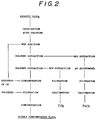
- the present invention suggests a first step of oxidization of divalent iron ions in a spent sulfuric acid containing metal sulfates to trivalent iron ions followed by a second step of addition of hydrochloric acid to such a liquid, wherein the molar ratio of chlorine to iron ions being at least 4 and the hydrochloric acid concentration being larger than 3 mol/l and then a third step of solvent extraction.
- said process further comprises a step for concentrating the solution after solvent extraction to a sulfuric acid concentration of 60-75% by weight to recover hydrochloric acid; a fifth step for separating metal sulfates deposited at this time; and a sixth step for concentrating the separated solution again to a sulfuric concentration of not less than 80% by weight.
- the basic conception of the process for regenerating spent sulfuric acid containing metal sulfates according to the present invention is to effectively remove main impure metal ions, such as iron, titanium, and manganese, contained in the spent sulfuric acid and to concentrate the solution to regenerate it into a highly concentrated sulfuric acid.
- iron ions exist in a large amount as divalent ions particularly.
- the removal of the divalent iron ions is essential for effective regeneration of the spent sulfuric acid.
- the divalent iron ions are first oxidized to the trivalent iron ions, and the trivalent iron ions are then removed by solvent extraction treatment.
- hydrochloric acid is added to the spent sulfuric acid to substitute the metal sulfates with chlorine ions, thereby giving an iron chloride complex, after which the solvent extraction is carried out. It has been found that such a procedure can extract more than 99% of iron ions, the extraction being more effective than the solvent extraction where the spent sulfuric acid is extracted as it is.
- iron ions and titanium ions can be individually separated when a plurality of extracting agents are used in the solvent extraction treatment.
- the method for oxidizing the divalent iron ions in the spent sulfuric acid either a usual oxidation with chlorine or an oxidation by electrolysis may be used. Furthermore, an oxidation with air may also be utilized.
- this oxidization step for example, in the case of the oxidation with chlorine, the following reaction takes place by blowing a chlorine gas into the spent sulfuric acid in a stoichiometric or excess amount relative to the divalent iron ions contained in the spent sulfuric acid, thereby oxidizing 99% or more of the divalent iron ions with ease.
- the chlorine ions dissolved in the solution are recovered in a concentration step and then recycled.
- the hydrochloric acid which has been added is recovered in the concentration step, and can be recycled.
- the organic solvents which can be used for extracting impure metal ions such as trivalent iron ions from the solution include acidic organophosphorus compounds, carboxylic acids, sulfonic acid, hydroxy oxime, oxine, beta-diketone, neutral phosphoric esters, phosphine oxide, ketones, alcohols, amines, and the like. These organic solvents can be used singly or in the mixture of them. In order to separate metal ions other than iron ions which are contained in a trace of amounts, it is very advantageous to jointly use several kinds of these solvents which may be used singly or in the mixture.
- benzene, chloroform, toluene, kerosine, n-hexane or the like may be utilized as a diluent to adjust the viscosity of the extracting agent.
- the choice of an appropriate diluent can improve the extracting ability of the organic solvent.
- the trivalent iron ions are first extracted from this solution with a ketone, an alcohol, a neutral phosphoric ester, or the like, and the titanium ions are then extracted with an acidic organophosphorus compound, a carboxylic acid, sulfonic acid, hydroxy oxime, or the like.
- ketones are used to carry out the extraction.
- methyl isobutyl ketone can particularly be used for the preferential extraction of the trivalent iron ions, but hardly extracts the titanium ions.
- acidic organophosphorus compounds are utilized to extract the titanium ions from the solution from which the trivalent iron ions have been extracted.
- di (2-ethylhexyl) phosphoric ester is particularly desirable.
- the trivalent iron ions extracted with methyl isobutyl ketone are stripped with water and recovered as the hydroxide thereof. After the recovery, iron oxides can be obtained by calcining. They can be used as coagulants or raw materials for ferrite.
- chlorine ions which are partially extracted together with the trivalent iron ions are also reversely extracted and are contained in the reversely extracted solution.
- the chlorine ions can be recovered as hydrochloric acid by adding sulfuric acid to the solution to carry out substitution followed by concentration.
- titanium ions extracted with di (2-ethylhexyl) phosphoric ester are stripped with a hydrofluoric acid solution or an alkaline solution such as sodium hydroxide, and are recovered as the hydroxide thereof, etc. After the recovery, titanium oxide can be obtained by calcination. This can be used as a raw material for titanium.
- the spent sulfuric acid from which impure metal ions such as iron ions have been removed is then recovered in two stages for concentration as a sulfuric acid having a concentration of not less than 80% by weight.
- Iron ions, titanium ions, as well as scandium can be removed by the above-mentioned solvent extraction treatment, but the removal of manganese ions, aluminum, etc. is difficult. They remain in the solution in considerable amounts. They are deposited as the corresponding metal sulfates, after hydrochloric acid is recovered by concentration the solution to a concentrating of sulfuric acid of 60-75% by weight, by allowing the solution to cool. In this case, manganese is removed as manganese sulfate monohydrate. Other metal ions contained in the solution in a trace of amounts are simultaneously removed as the corresponding metal sulfates. Subsequently, the concentration of the solution from which the metal sulfates are removed gives highly concentrated sulfuric acid having a concentration of sulfuric acid of not less than 80% by weight.
- the trivalent iron ions extracted with methyl isobutyl ketone were reversely extracted with 10 liters of water to obtain an aqueous solution having composition comprised of 19 g/l of iron and 49 g/l of chlorine, and recovered as hydroxide. After the recovery, about 270 g of iron was recovered as iron (III) oxide (Fe 2 O 3 ) by calcination. The recovery was about 97%.
- the titanium ions extracted with 1 mol/l solution of di(2-ethylhexyl) phosphoric acid in kerosine were reversely extracted with 10 liters of an aqueous 2 mol/l of sodium hydroxide solution, and the formed hydroxide was recovered, after which it was calcined to recover about 23 g of titanium (IV) oxide. The recovery was about 95%.
- the solution which had been treated with solvent extraction was concentrated at about 120°C and at 9866 Pa (74 mmHg) to sulfuric acid concentration of about 70% by weight to recover about 5.9 liters of hydrochloric acid (116 g/l as chlorine).
- the concentrated solution was allowed to cool, and about 70 g of deposited metal sulfates (chiefly manganese sulfate monohydrate) were separated.
- the solution was concentrated at about 180°C and at 1333 Pa (10 mmHg) to recover 1.1 liters of about 82 wt% strength sulfuric acid solution having composition comprised of 1510 g/l of sulfuric acid, 0.00 g/l of trivalent iron ions, 0.04 g/l of titanium, 3.5 g/l of manganese and 0.02 g/l or less of chlorine.
- this solution was brought into contact with 20 liters of methyl isobutyl ketone, whereby trivalent iron ions were selectively extracted and removed.
- the resulting solution was then brought into contact with 20 liters of 1 mol/l solution of di(2-ethylhexyl) phosphoric acid ester in kerosine, whereby titanium ions were extracted.
- These solvent extraction treatments gave 10 liters of solution having composition comprised of 315 g/l of sulfuric acid, 0.00 g/l of trivalent iron ions, 0.03 g/l of titanium, 3.6 g/l of manganese, and 50 g/l of chlorine.
- the trivalent iron ions extracted with methyl isobutyl ketone were reversely extracted with 30 liters of water to obtain an aqueous solution having composition comprised of 10 g/l of iron and 26 g/l of chlorine, and recovered as hydroxide. After the recovery, about 420 g of iron was recovered as iron (III) oxide (Fe 2 O 3 ) by calcination. The recovery was about 98%.
- the titanium ions extracted with 1 mol/l solution of di(2-ethylhexyl) phosphoric acid ester in kerosine were reversely extracted with 20 liters of an aqueous 2 mol/l of sodium hydroxide solution, and the formed hydroxide was recovered, after which it was calcined to recover about 60 g of titanium (IV) oxide. The recovery was about 97%.
- the solution which had been treated with solvent extraction was concentrated at about 110°C and at 9866 Pa (74 mmHg) to a sulfuric acid concentration of about 65% by weight to recover about 6.9 liters of hydrochloric acid (72 g/l as chlorine).
- the concentrated solution was allowed to cool, and about 94 g of deposited metal sulfates (chiefly manganese sulfate monohydrate) were separated.
- the solution was concentrated at about 180 °C and at 1333 Pa (10 mmHg) to recover 2.0 liters of about 81 wt% strength sulfuric acid solution having composition comprised of 1490 g/l of sulfuric acid, 0.1 g/l of titanium, 3.2 g/l of manganese and 0.02 g/l or less of chlorine.
- the recovery of sulfuric acid was about 95%.
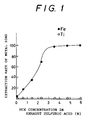
- Table 1 shows the conditions of extraction rate of trivalent iron ions varied by the addition of hydrochloric acid.
- the volumetric ratio of the organic phase to the aqueous phase was 1:1, and all diluents except for methyl isobutyl ketone were diluted with kerosine.
- the conditions were the same as those of Example 2.
Landscapes
- Chemical & Material Sciences (AREA)
- Organic Chemistry (AREA)
- Inorganic Chemistry (AREA)
- Geology (AREA)
- Environmental & Geological Engineering (AREA)
- General Life Sciences & Earth Sciences (AREA)
- Life Sciences & Earth Sciences (AREA)
- Engineering & Computer Science (AREA)
- Manufacturing & Machinery (AREA)
- Materials Engineering (AREA)
- Mechanical Engineering (AREA)
- Metallurgy (AREA)
- Inorganic Compounds Of Heavy Metals (AREA)
- Extraction Or Liquid Replacement (AREA)
- Manufacture And Refinement Of Metals (AREA)
Applications Claiming Priority (2)
| Application Number | Priority Date | Filing Date | Title |
|---|---|---|---|
| JP3293126A JP2968877B2 (ja) | 1991-11-08 | 1991-11-08 | 金属硫酸塩含有の廃硫酸から硫酸を回収する方法 |
| JP293126/91 | 1991-11-08 |
Publications (2)
| Publication Number | Publication Date |
|---|---|
| EP0541002A1 EP0541002A1 (en) | 1993-05-12 |
| EP0541002B1 true EP0541002B1 (en) | 1997-04-23 |
Family
ID=17790758
Family Applications (1)
| Application Number | Title | Priority Date | Filing Date |
|---|---|---|---|
| EP92118475A Expired - Lifetime EP0541002B1 (en) | 1991-11-08 | 1992-10-29 | Process for recovering sulfuric acid from metal sulfate-containing waste sulfuric acid |
Country Status (13)
| Country | Link |
|---|---|
| US (1) | US5489423A (enExample) |
| EP (1) | EP0541002B1 (enExample) |
| JP (1) | JP2968877B2 (enExample) |
| KR (1) | KR100260296B1 (enExample) |
| CN (1) | CN1041811C (enExample) |
| AU (1) | AU649573B2 (enExample) |
| CA (1) | CA2082256A1 (enExample) |
| DE (1) | DE69219274T2 (enExample) |
| FI (1) | FI925044A7 (enExample) |
| MY (1) | MY109068A (enExample) |
| RU (1) | RU2098349C1 (enExample) |
| SG (1) | SG46572A1 (enExample) |
| TW (1) | TW227989B (enExample) |
Families Citing this family (17)
| Publication number | Priority date | Publication date | Assignee | Title |
|---|---|---|---|---|
| JP2968913B2 (ja) * | 1993-07-30 | 1999-11-02 | 日鉄鉱業株式会社 | 金属硫酸塩含有の廃硫酸を再生する方法 |
| EP0638515B1 (de) * | 1993-08-12 | 2000-04-05 | Kerr-McGee Pigments GmbH & Co. KG | Verfahren zur Aufarbeitung von Dünnsäure |
| RU2149221C1 (ru) * | 1999-03-15 | 2000-05-20 | Нижегородский государственный технический университет | Способ регенерации отработанных растворов, содержащих серную кислоту |
| US7008602B2 (en) * | 2002-04-19 | 2006-03-07 | Millennium Inorganic Chemicals, Inc. | Beneficiation of titaniferous ore with sulfuric acid |
| ATE370097T1 (de) * | 2003-10-06 | 2007-09-15 | Kerr Mcgee Pigments Gmbh | Verfahren zur aufarbeitung eisenbelasteter gebrauchtschwefelsäure |
| CN100357176C (zh) * | 2005-10-19 | 2007-12-26 | 兰州大学 | 从含金属盐的废硫酸中回收硫酸的方法 |
| RU2311341C1 (ru) * | 2006-05-10 | 2007-11-27 | Юрий Борисович Данилов | Способ регенерации отработанной серной кислоты |
| CN101172647B (zh) * | 2007-10-19 | 2010-06-09 | 杨绍泉 | 硫酸法制备钛白粉的方法 |
| CN101759158B (zh) * | 2009-12-23 | 2011-06-29 | 河南豫光金铅股份有限公司 | 从废污酸中再生回收硫酸的方法 |
| CN102191387B (zh) * | 2010-03-08 | 2013-06-19 | 沙立林 | 钛液的提纯方法 |
| US9278860B2 (en) * | 2014-07-22 | 2016-03-08 | Taiwan Semiconductor Manufacturing Co., Ltd. | Method and apparatus for recycling waste sulfuric acid |
| CN104555949A (zh) * | 2014-12-28 | 2015-04-29 | 贵州兰鑫石墨机电设备制造有限公司 | 一种钛白废酸浓缩工艺 |
| CN104760938B (zh) * | 2015-03-18 | 2017-10-13 | 安庆师范学院 | 一种去除浓硫酸中铁离子的方法 |
| RU2651019C2 (ru) * | 2016-09-19 | 2018-04-18 | Федеральное государственное автономное образовательное учреждение высшего образования "Уральский федеральный университет имени первого Президента России Б.Н. Ельцина" | Способ переработки жидких отходов производства диоксида титана |
| CN109818099B (zh) * | 2019-01-31 | 2019-12-17 | 襄阳金湛技术开发有限公司 | 一种废旧硫酸回收再生系统及方法 |
| CN109987588A (zh) * | 2019-04-24 | 2019-07-09 | 成都先进金属材料产业技术研究院有限公司 | 利用焦磷酸钠处理废硫酸溶液的方法 |
| CN112923780B (zh) * | 2021-04-14 | 2022-06-21 | 唐山三友硅业有限责任公司 | 有机硅生产用石墨换热器的清洗方法 |
Family Cites Families (16)
| Publication number | Priority date | Publication date | Assignee | Title |
|---|---|---|---|---|
| US2344429A (en) * | 1940-05-04 | 1944-03-14 | Dirk Willem Van Gelder | Process of purifying sulphuric acid solutions |
| US3635664A (en) * | 1969-08-20 | 1972-01-18 | Daido Chem Eng Corp | REGENERATION OF HYDROCHLORIC ACID PICKLING WASTE BY H{11 SO{11 {0 ADDITION, DISTILLATION AND FeSO{11 {0 Precipitation |
| CH613913A5 (enExample) * | 1975-10-20 | 1979-10-31 | Pechiney Aluminium | |
| JPS5836677B2 (ja) * | 1976-01-16 | 1983-08-10 | 日本ソレックス株式会社 | 硫酸鉄溶液から硫酸及び含有金属を回収する方法 |
| US4177119A (en) * | 1976-03-09 | 1979-12-04 | Solex Research Corporation | Process for recovery of waste H2 SO4 and HCl |
| US4261959A (en) * | 1979-12-18 | 1981-04-14 | Gte Products Corporation | Process for extracting ferric iron from an aqueous solution |
| JPS56160326A (en) * | 1980-05-13 | 1981-12-10 | Nippon Soretsukusu Kk | Recovering method for acid containing titanium ion |
| FR2523466B1 (fr) * | 1982-03-19 | 1986-09-12 | Rhone Poulenc Sa | Procede de recuperation et de purification d'un acide sulfurique residuaire contenant des sels de titane |
| JPS62275018A (ja) * | 1986-05-23 | 1987-11-30 | Kimura Kakoki Kk | 酸性廃液から有価金属及び酸を回収する方法 |
| CA1303815C (en) * | 1987-06-30 | 1992-06-23 | Solex Research Corporation Of Japan | Method for neutralization treatment of sulfuric acid containing iron ions |
| EP0298763A3 (en) * | 1987-07-08 | 1990-01-10 | Solex Research Corporation of Japan | Method for recovering titanium |
| JPH02129010A (ja) * | 1988-11-08 | 1990-05-17 | Asahi Glass Co Ltd | チタン硫酸排液からの硫酸の回収方法 |
| JP2650065B2 (ja) * | 1989-08-21 | 1997-09-03 | ペルメレック電極株式会社 | 硫酸の回収方法 |
| DE3927751A1 (de) * | 1989-08-23 | 1991-02-28 | Bayer Ag | Verfahren zum konzentrieren metallsulfathaltiger schwefelsaeure |
| JPH0388718A (ja) * | 1989-08-31 | 1991-04-15 | Sanehisa Kodama | 硫酸法酸化チタン廃硫酸の処理方法 |
| US5015458A (en) * | 1990-04-04 | 1991-05-14 | Gte Products Corporation | Method for purifying sulfuric acid solutions |
-
1991
- 1991-11-08 JP JP3293126A patent/JP2968877B2/ja not_active Expired - Fee Related
-
1992
- 1992-10-16 TW TW081108245A patent/TW227989B/zh active
- 1992-10-29 US US07/968,099 patent/US5489423A/en not_active Expired - Lifetime
- 1992-10-29 DE DE69219274T patent/DE69219274T2/de not_active Expired - Fee Related
- 1992-10-29 SG SG1996006069A patent/SG46572A1/en unknown
- 1992-10-29 EP EP92118475A patent/EP0541002B1/en not_active Expired - Lifetime
- 1992-11-04 AU AU28133/92A patent/AU649573B2/en not_active Ceased
- 1992-11-05 CA CA002082256A patent/CA2082256A1/en not_active Abandoned
- 1992-11-06 KR KR1019920020843A patent/KR100260296B1/ko not_active Expired - Fee Related
- 1992-11-06 MY MYPI92002010A patent/MY109068A/en unknown
- 1992-11-06 FI FI925044A patent/FI925044A7/fi unknown
- 1992-11-06 RU RU9292004394A patent/RU2098349C1/ru active
- 1992-11-07 CN CN92113245A patent/CN1041811C/zh not_active Expired - Fee Related
Also Published As
| Publication number | Publication date |
|---|---|
| JPH05132304A (ja) | 1993-05-28 |
| AU649573B2 (en) | 1994-05-26 |
| CN1072154A (zh) | 1993-05-19 |
| US5489423A (en) | 1996-02-06 |
| JP2968877B2 (ja) | 1999-11-02 |
| KR930009915A (ko) | 1993-06-21 |
| CN1041811C (zh) | 1999-01-27 |
| FI925044L (fi) | 1993-05-09 |
| RU2098349C1 (ru) | 1997-12-10 |
| EP0541002A1 (en) | 1993-05-12 |
| KR100260296B1 (ko) | 2000-07-01 |
| SG46572A1 (en) | 1998-02-20 |
| DE69219274D1 (de) | 1997-05-28 |
| FI925044A0 (fi) | 1992-11-06 |
| CA2082256A1 (en) | 1993-05-09 |
| MY109068A (en) | 1996-11-30 |
| DE69219274T2 (de) | 1997-08-07 |
| AU2813392A (en) | 1993-05-13 |
| TW227989B (enExample) | 1994-08-11 |
| FI925044A7 (fi) | 1993-05-09 |
Similar Documents
| Publication | Publication Date | Title |
|---|---|---|
| EP0541002B1 (en) | Process for recovering sulfuric acid from metal sulfate-containing waste sulfuric acid | |
| US4986742A (en) | Process for the production of high-grade titanium dioxide by sulfate method | |
| CA2377261A1 (en) | Processing titaniferous ore to titanium dioxide pigment | |
| US5209910A (en) | Process for the recovery and separation of tantalum and niobium | |
| US4082832A (en) | Treatment of raw materials containing titanium | |
| EP0356132B1 (en) | A method for manufacturing titanium oxide | |
| EP0161050B1 (en) | Process for treating and recovering pickling waste liquids for stainless steel | |
| US5277816A (en) | Process for producing titanium dioxide | |
| CN1133346A (zh) | 一种从含氟硫酸稀土溶液中萃取分离铈的工艺 | |
| CA1303815C (en) | Method for neutralization treatment of sulfuric acid containing iron ions | |
| AU600541B2 (en) | A process for the production of high quality titanium dioxide by the sulfate method | |
| US4166098A (en) | Process for treating an acid waste liquid | |
| EP0298763A2 (en) | Method for recovering titanium | |
| US4908462A (en) | Cobalt recovery method | |
| US20070122336A1 (en) | Method for processing iron-laden spent sulfuric acid | |
| CA2035085A1 (en) | Process for producing titanium dioxide | |
| KR102505186B1 (ko) | 습식제련을 통한 티타늄(Ti)의 선택적 회수 방법 | |
| DE1947122B2 (de) | Verfahren zum gewinnen von titandioxyd und eisen-iii-chlorid | |
| Takahashi et al. | New solvent extraction process for zirconium and hafnium | |
| JPH01100025A (ja) | チタンの回収方法 | |
| CN1310242A (zh) | 处理锌钴渣的一种新方法 | |
| JPS6114130A (ja) | アルミニウム電解発生ダストからガリウムを回収する方法 | |
| JPH03223114A (ja) | 酸化チタンの製造方法 |
Legal Events
| Date | Code | Title | Description |
|---|---|---|---|
| PUAI | Public reference made under article 153(3) epc to a published international application that has entered the european phase |
Free format text: ORIGINAL CODE: 0009012 |
|
| AK | Designated contracting states |
Kind code of ref document: A1 Designated state(s): DE FR GB |
|
| 17P | Request for examination filed |
Effective date: 19931021 |
|
| 17Q | First examination report despatched |
Effective date: 19940629 |
|
| GRAG | Despatch of communication of intention to grant |
Free format text: ORIGINAL CODE: EPIDOS AGRA |
|
| GRAH | Despatch of communication of intention to grant a patent |
Free format text: ORIGINAL CODE: EPIDOS IGRA |
|
| GRAH | Despatch of communication of intention to grant a patent |
Free format text: ORIGINAL CODE: EPIDOS IGRA |
|
| GRAA | (expected) grant |
Free format text: ORIGINAL CODE: 0009210 |
|
| AK | Designated contracting states |
Kind code of ref document: B1 Designated state(s): DE FR GB |
|
| ET | Fr: translation filed | ||
| REF | Corresponds to: |
Ref document number: 69219274 Country of ref document: DE Date of ref document: 19970528 |
|
| PLBE | No opposition filed within time limit |
Free format text: ORIGINAL CODE: 0009261 |
|
| STAA | Information on the status of an ep patent application or granted ep patent |
Free format text: STATUS: NO OPPOSITION FILED WITHIN TIME LIMIT |
|
| 26N | No opposition filed | ||
| PGFP | Annual fee paid to national office [announced via postgrant information from national office to epo] |
Ref country code: FR Payment date: 20011010 Year of fee payment: 10 |
|
| PGFP | Annual fee paid to national office [announced via postgrant information from national office to epo] |
Ref country code: GB Payment date: 20011031 Year of fee payment: 10 |
|
| PGFP | Annual fee paid to national office [announced via postgrant information from national office to epo] |
Ref country code: DE Payment date: 20011112 Year of fee payment: 10 |
|
| REG | Reference to a national code |
Ref country code: GB Ref legal event code: IF02 |
|
| PG25 | Lapsed in a contracting state [announced via postgrant information from national office to epo] |
Ref country code: GB Free format text: LAPSE BECAUSE OF NON-PAYMENT OF DUE FEES Effective date: 20021029 |
|
| PG25 | Lapsed in a contracting state [announced via postgrant information from national office to epo] |
Ref country code: DE Free format text: LAPSE BECAUSE OF NON-PAYMENT OF DUE FEES Effective date: 20030501 |
|
| GBPC | Gb: european patent ceased through non-payment of renewal fee | ||
| PG25 | Lapsed in a contracting state [announced via postgrant information from national office to epo] |
Ref country code: FR Free format text: LAPSE BECAUSE OF NON-PAYMENT OF DUE FEES Effective date: 20030630 |
|
| REG | Reference to a national code |
Ref country code: FR Ref legal event code: ST |