EP0540314B1 - Monoklonale Antikörper gegen Polyacrylat-Polymeren - Google Patents
Monoklonale Antikörper gegen Polyacrylat-Polymeren Download PDFInfo
- Publication number
- EP0540314B1 EP0540314B1 EP92309880A EP92309880A EP0540314B1 EP 0540314 B1 EP0540314 B1 EP 0540314B1 EP 92309880 A EP92309880 A EP 92309880A EP 92309880 A EP92309880 A EP 92309880A EP 0540314 B1 EP0540314 B1 EP 0540314B1
- Authority
- EP
- European Patent Office
- Prior art keywords
- polyacrylate
- hybridoma cell
- monoclonal antibody
- antibody
- cell line
- Prior art date
- Legal status (The legal status is an assumption and is not a legal conclusion. Google has not performed a legal analysis and makes no representation as to the accuracy of the status listed.)
- Expired - Lifetime
Links
Images


Classifications
-
- C—CHEMISTRY; METALLURGY
- C07—ORGANIC CHEMISTRY
- C07K—PEPTIDES
- C07K16/00—Immunoglobulins [IG], e.g. monoclonal or polyclonal antibodies
- C07K16/44—Immunoglobulins [IG], e.g. monoclonal or polyclonal antibodies against material not provided for elsewhere, e.g. haptens, metals, DNA, RNA, amino acids
Definitions
- the invention relates generally to monoclonal antibodies directed toward polyacrylate and to antibody assays for the detection of polyacrylate.
- a method for the detection and monitoring of polyacrylate in commercial water systems is used to optimize treatment of the water to prevent mineral deposits.
- water-soluble sulfonated copolymers of acrylic acid and acrylamide are used in the treatment of industrial cooling water to prevent corrosion and mineral deposits (scale).
- sulfonated copolymers water-soluble sulfonated copolymers of acrylic acid and acrylamide
- the active sulfonated copolymers remove dissolved minerals from the cooling water by complexing with the mineral. over time, the complexation sites of the sulfonated copolymer molecules become saturated and the copolymer molecules become inactive, unable to remove any additional minerals from the cooling water.
- active sulfonated copolymer To prevent corrosion and scale damage to machinery, as the polymers are inactivated they must be removed and replaced by active sulfonated copolymer. Thus, active sulfonated copolymer must be continually fed into the cooling water to replace the inactive sulfonated copolymer. Maintaining the proper feed level for the active sulfonated copolymer is essential for optimum performance of the cooling water system. An improper feed rate can lead to serious problems. For example, insufficient active sulfonated copolymer can result in the water treatment being overwhelmed by dissolved minerals, thereby causing severe corrosion or scale deposit. On the other hand, maintaining too high a level of the active polymer is very expensive and is an inefficient method for treating industrial cooling water.
- polyacrylate water-soluble acrylate homopolymers
- polyacrylate water-soluble acrylate homopolymers
- one aspect of the present invention is directed to the use of a monoclonal antibody for detection or assay of polyacrylate homopolymer.
- the present monoclonal antibodies When used in some detection formats, the present monoclonal antibodies have an absolute specificity and a lower limit of detection in the femtogram per ml range.
- the monoclonal antibodies are produced by hybridoma cell lines.
- one preferred hybridoma cell line of the invention is hybridoma cell line 6E2-H1-G4.
- Another preferred hybridoma cell line of the invention is hybridoma cell line 4F12-C12.
- a still further preferred hybridoma cell line is 4B1-H6-E10.
- Another aspect of the invention is directed to a method of manufacturing a monoclonal antibody having an affinity to polyacrylate homopolymer.
- the inventive method including the steps of: a) immunizing a mammal with polyacrylate homopolymer attached to a carrier protein; b) preparing a hybridoma cell producing the monoclonal antibody from cells removed from the immunized mammal; c) cloning the hybridoma cell to produce a hybridoma cell line; and d) extracting the monoclonal antibody from the hybridoma cell line.
- hybridomas When sulfonated copolymers of acrylic acid and acrylamide were used for immunizing, various hybridomas can be obtained, in accordance with the present invention. These are a source of monoclonal antibodies, which complex with polyacrylate and are suitable for use in its detection. Using the methods disclosed herein, multiple hybridomas were produced which were suitable for use in the present invention. Therefore, it is to be expected that others may be readily produced using the disclosed methods. However, resultig antibodies vary in binding profiles and specificity.
- a preferred hybridoma cell line for this purpose is hybridoma cell line 6E2-H1-G4. Accordingly, in other preferred embodiments of the invention, the hybridoma cell line is hybridoma cell line 4F12-C12 or 4B1-H6-E10.
- a further aspect of the invention is directed to a process for the determination of the presence or concentration of polyacrylate homopolymer in a fluid.
- the inventive process including the step of incubating a sample of the fluid containing the polyacrylate homopolymer with a monoclonal antibody having an affinity for the polyacrylate homopolymer, the monoclonal antibody being bound to a solid carrier.
- the fluid is boiler water.
- Hybridoma cell lines producing monoclonal antibodies having an affinity for polyacrylate homopolymers have been invented and are herein described and claimed.
- the monoclonal antibodies of the invention bind to polyacrylate with varying degrees of specificity. By using two different assay formats, it has been determined that these monoclonal antibodies can recognize polyacrylate at concentrations ranging from zero to a few hundred parts per million. Examples described herein demonstrate the feasibility of using the monoclonal antibodies of the invention to determine the presence or concentration of polyacrylate in fluids, such as water samples from industrial boilers.
- a monoclonal antibody having an affinity to polyacrylate is used in an Enzyme Linked Immunosorbent Assay (ELISA) for determining the concentration of polyacrylate in a fluid sample.
- ELISA formats using the monoclonal antibodies of the invention are preferred for measuring the concentration of polyacrylate in fluid samples.
- Three preferred immunoassay strategies are sandwich ELISA, competition ELISA and indirect ELISA.
- the two most preferred monoclonal antibodies are those produced by hybridoma cell lines 6E2-H1-G4 (deposited as ATCC accession number HB 11015) and 4F12-C12 because these two clones have shown the greatest anti-polyacrylate specificity in indirect ELISAS.
- a sandwich ELISA will be used for measuring the concentration of polyacrylate.
- purified anti-polyacrylate antibody will be used as a capture antibody.
- the antibody will be adsorbed to wells of 96-well microtiter plates.
- Test samples containing polyacrylate will be added and allowed to bind to the capture antibody.
- enzyme-labelled anti-polyacrylate antibody will be added and allowed to bind to the exposed antigenic sites on the polyacrylate molecules captured by the coating antibody.
- the amount of enzyme labelled antibody retained after washing would therefore correlate directly with the amount of polyacrylate in the sample.
- the level of enzyme label bound in each well will be quantitated by incubation with a chromogenic enzyme substrate and measurement of the resulting color change.
- a standard curve will be generated using known concentrations of polyacrylate polymer. This approach has the advantage of higher sensitivity normally associated with sandwich ELISAs.
- a competition ELISA will be used to measure the polyacrylate for a fluid sample.
- purified antipolyacrylate antibody will be adsorbed onto wells of 96-well microtiter plates.
- Test samples containing polyacrylate will be added to the plates along with known quantities of enzyme-labelled polyacrylate polymer.
- the amount of enzyme-labelled polyacrylate retained after washing will be inversely proportional to the amount of polyacrylate originally present in the test samples.
- the amount of enzyme present will be measured by the addition of a suitable chromogenic substrate. Standard curves will be generated using known quantities of polyacrylate.
- This particular format has the advantage of being essentially a one-step assay with only one incubation period.
- indirect ELISA assay will be utilized to measure the concentration of polyacrylate in a fluid.
- known quantities of Bovine Serum Albumin (BSA-polyacrylate) conjugate will be adsorbed to replicate wells of 96 well microtiter plates.
- various dilutions of the anti-polyacrylate monoclonal antibody will be allowed to bind to the immobilized polyacrylate.
- Enzyme-labelled goat anti-mouse Ig will be added next and allowed to bind to the primary antibody.
- a chromogenic substrate will then be added which will be converted to a colored product by the bound enzyme.
- the resultant color change will be quantified by measuring the absorbance (optical density) at 492 mm.
- the amount of color change will be proportional to the amount of enzyme-labelled antibody retained and thus will correlate directly with the amount of anti-polyacrylate antibody which was able to initially bind to the immobilized polyacrylate.
- the results of this experiment will yield the optimal concentration of anti-polyacrylate antibody to use in the assay.
- any of the assays discussed above could be further developed and refined using other solid support systems such as coated tubes and polymer membranes.
- the sandwich ELISA or the competition ELISA formats are preferred since they could be designed as a "dipstick" assay. Nevertheless, any of the above assay formats are intended to be used with the monoclonal antibodies of the present invention to measure the concentration of polyacrylate in a fluid sample.
- the antigens were prepared as follows:
- the polyacrylate (35K) having a molecular weight of about 35KD was obtained from the Nalco Chemical Company.
- the polyacrylate was first derivatized with the coupling agent, 1-ethyl 3(3'-dimethylamino-propyl) carbodiimide (EDC) at a pH of 5.0. After a 15 minute incubation at room temperature, 10 mg of Bovine Serum Albumin (BSA) was added and allowed to react at pH 7.0 for 4 hours, also at room temperature. Small molecular weight side products were removed by overnight dialysis at 4°C. Gel electrophoresis of the BSA conjugate indicated successful conjugation with approximately one to four polymer molecules conjugated per molecule of BSA.
- EDC 1-ethyl 3(3'-dimethylamino-propyl) carbodiimide
- the BSA conjugates of the polyacrylate were tested for adsorption onto microtiter plates by performing an indirect ELISA using rabbit anti-BSA antiserum. Plates were coated with the conjugates at a concentration of 0.01 mg/ml (0.5 ⁇ g/well) in phosphate-buffered saline, pH 7.2 (PBS). Unoccupied sites on the plates were blocked with a 5% solution of non-fat milk in PBS. Dilutions of rabbit anti-BSA antiserum were incubated with the plate. Horseradish peroxidase (HRP) labelled goat anti-rabbit antibody was then allowed to bind to the primary anti-BSA antibody. The bound enzyme (HRP) was then quantitated with a chromogenic substrate.
- HRP horseradish peroxidase
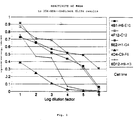
- Monoclonal antibodies produced by five cell lines were assayed by indirect ELISA for binding to polyacrylate-BSA conjugates.
- the five cell lines tested were:
- Hybridoma cell lines 6E2-H1-G4 and 4H2-C12 were scaled up by growing them in vitro for several passages and injecting them into a group of pristane-primed Balb/c mice.
- the cells grew as ascites tumors in these mice and the resultant fluid accumulated in their peritoneal cavities was harvested.
- the ascites fluid was enriched in the desired anti-polyacrylate antibody which was purified and used in the assays described below.
- antibodies will be required either as unpurified ascites or as a highly purified immunoglobulin preparation.
- Antibodies were purified from ascites fluid by a variety of methods, depending on the antibody isotype and the sensitivity of the antibody to various buffere.
- the clones 6E2-H1-G4 and 4F12-C12 identified in Example 3 are of the IgG isotype, and accordingly, they were purified by using the pseudo-affinity matrix Protein A.
- Mouse hybridoma cells 6E2-H1-G4 and 6D12-H9-G3 have been deposited at the American Type Culture Collection on 9 April 1992 and have been designated HB 11015 and HB 11016 respectively.
Landscapes
- Chemical & Material Sciences (AREA)
- Organic Chemistry (AREA)
- Health & Medical Sciences (AREA)
- Medicinal Chemistry (AREA)
- Biochemistry (AREA)
- Biophysics (AREA)
- General Health & Medical Sciences (AREA)
- Genetics & Genomics (AREA)
- Life Sciences & Earth Sciences (AREA)
- Molecular Biology (AREA)
- Proteomics, Peptides & Aminoacids (AREA)
- Immunology (AREA)
- Preparation Of Compounds By Using Micro-Organisms (AREA)
- Peptides Or Proteins (AREA)
- Addition Polymer Or Copolymer, Post-Treatments, Or Chemical Modifications (AREA)
- Micro-Organisms Or Cultivation Processes Thereof (AREA)
Claims (5)
- Verwendung eines von der Hybridoma-Zellinie 6E2-H1-G4 (ATCC HB 11015) hergestellten monoklonalen Antikörpers zur Detektion oder zum Assay von PolyacrylatHomopolymer.
- Verfahren zur Herstellung eines monoklonalen Antikörpers mit einer Affinität für Polyacrylat-Homopolymer, wobei das Verfahren folgende Schritte umfaßt:(a) das Immunisieren eines Säugetiers mit dem mit einem Trägerprotein konjugierten Polyacrylat-Homopolymer;(b) das Herstellen einer Hybridomazelle, die den monoklonalen Antikörper erzeugt, durch Verschmelzen von Splenozyten vom immunisierten Säugetier mit Plasmozytomazellen;(c) das Etablieren der Hybridomazelle, um eine Zellinie zu erzeugen; und(d) das Isolieren des monoklonalen Antikörpers aus der Hybridoma-Zellinie.
- Verfahren nach Anspruch 2, worin das Säugetier eine Maus ist und die Hybridoma-Zellinie die Hybridoma-Zellinie 6E2-H1-G4 (ATCC HB 11015) ist.
- Verfahren zur Ermittlung des Vorhandenseins oder der Konzentration eines polyacrylat-Homopolymers in einem Fluid, wobei das Verfahren den Schritt des Inkubierens einer Probe des das Polyacrylat-Homopolymer enthaltenden Fluids mit einem monoklonalen Antikörper mit einer Affinität für das Polyacrylat-Homopolymer, wobei der monoklonale Antikörper an einen festen Träger gebunden ist, sowie das Detektieren und Messen des Bindungsgrades des monoklonalen Antikörpers umfaßt, aus dem auf das Vorhandensein von Polyacrylat-Homopolymer geschlossen und die Konzentration des Polyacrylat-Homopolymers ermittelt werden kann.
- Verfahren nach Anspruch 4, worin die Antigen-Antikörper-Bindung durch ein enzymgebundenes Immunosorbens-Assay detektiert und gemessen wird.
Applications Claiming Priority (2)
| Application Number | Priority Date | Filing Date | Title |
|---|---|---|---|
| US78615491A | 1991-10-31 | 1991-10-31 | |
| US786154 | 1991-10-31 |
Publications (2)
| Publication Number | Publication Date |
|---|---|
| EP0540314A1 EP0540314A1 (de) | 1993-05-05 |
| EP0540314B1 true EP0540314B1 (de) | 1996-07-10 |
Family
ID=25137743
Family Applications (1)
| Application Number | Title | Priority Date | Filing Date |
|---|---|---|---|
| EP92309880A Expired - Lifetime EP0540314B1 (de) | 1991-10-31 | 1992-10-28 | Monoklonale Antikörper gegen Polyacrylat-Polymeren |
Country Status (4)
| Country | Link |
|---|---|
| EP (1) | EP0540314B1 (de) |
| JP (1) | JPH05260991A (de) |
| CA (1) | CA2081879C (de) |
| DE (1) | DE69212112T2 (de) |
Families Citing this family (3)
| Publication number | Priority date | Publication date | Assignee | Title |
|---|---|---|---|---|
| GB9204409D0 (en) * | 1992-02-29 | 1992-04-15 | Ciba Geigy Ag | Determination method |
| DE19518771C2 (de) * | 1995-05-22 | 1997-12-04 | Deutsches Krebsforsch | Mittel enthaltend einen Komplex aus einem polymeren Mediator und einem Peptid, sowie eine Trägeroberflächen zur adsorptiven Bindung des Komplexes |
| ZA97248B (en) | 1996-01-18 | 1997-07-18 | Rohm & Haas | Method for identifying and quantifying polymers utilizing immunoassay techniques |
Citations (1)
| Publication number | Priority date | Publication date | Assignee | Title |
|---|---|---|---|---|
| EP0535347A2 (de) * | 1991-08-30 | 1993-04-07 | Nalco Chemical Company | Monoklonale Antikörper gegen sulfonierte Polymere |
-
1992
- 1992-10-22 JP JP4284110A patent/JPH05260991A/ja active Pending
- 1992-10-28 DE DE1992612112 patent/DE69212112T2/de not_active Expired - Lifetime
- 1992-10-28 EP EP92309880A patent/EP0540314B1/de not_active Expired - Lifetime
- 1992-10-30 CA CA 2081879 patent/CA2081879C/en not_active Expired - Fee Related
Patent Citations (1)
| Publication number | Priority date | Publication date | Assignee | Title |
|---|---|---|---|---|
| EP0535347A2 (de) * | 1991-08-30 | 1993-04-07 | Nalco Chemical Company | Monoklonale Antikörper gegen sulfonierte Polymere |
Also Published As
| Publication number | Publication date |
|---|---|
| JPH05260991A (ja) | 1993-10-12 |
| EP0540314A1 (de) | 1993-05-05 |
| CA2081879A1 (en) | 1993-05-01 |
| DE69212112T2 (de) | 1996-12-05 |
| DE69212112D1 (de) | 1996-08-14 |
| CA2081879C (en) | 2003-06-10 |
Similar Documents
| Publication | Publication Date | Title |
|---|---|---|
| US5593850A (en) | Monitoring of industrial water quality using monoclonal antibodies to polymers | |
| CA1216808A (en) | Monoclonal antibody having specificity for the double -stranded conformation of native dna and diagnostic methods using same | |
| US4935343A (en) | Monoclonal antibodies for interleukin-1β | |
| US4665018A (en) | Methods and test kit for diagnosing/monitoring cancer in humans | |
| EP0255342A1 (de) | Methode zum Nachweis oder zur Abschätzung von biologischem Material | |
| EP0535347B1 (de) | Monoklonale Antikörper gegen sulfonierte Polymere | |
| US6911534B2 (en) | Method for determination of water treatment polymers | |
| EP0168422A1 (de) | Verfahren und materialien zum nachweis von mikroorganismen erzeugenden liposacchariden | |
| JPS63126494A (ja) | モノクロナル又はポリクロナル抗体 | |
| CA2081879C (en) | Monoclonal antibodies to polyacrylate polymers | |
| US20060073536A1 (en) | Immunoassays for determining vitamin B12, and reagents and kits therefor | |
| US5272058A (en) | Diagnostic methods for E. histolytica | |
| US5856182A (en) | Monoclonal antibodies specific for the PSA-ACT complex | |
| US5620861A (en) | Method and kit for pyridinium crosslink assay | |
| WO1992018535A1 (en) | Endometrial antigen, composition, test kit and method for endometrial antibody determination | |
| Dertzbaugh et al. | An enzyme immunoassay for the detection of staphylococcal protein A in affinity-purified products | |
| AU676907B2 (en) | Immunoassay and test kit for thrombin-antithrombin III complex | |
| US4929544A (en) | Reagents, methods, and test kit for diagnosing/monitoring cancer in humans | |
| US5736344A (en) | Serum pyridinium crosslinks assay | |
| Kenett | A simple ELISA for the classification of monoclonal antibodies according to their recognition of native epitopes | |
| JPWO1993003365A1 (ja) | 下痢性貝毒に特異的なモノクローナル抗体、ハイブリドーマ及び下痢性貝毒の検出方法 | |
| US6790625B1 (en) | Antibodies to placental protein 13 | |
| JPH01165960A (ja) | トランスフェリンの測定方法 | |
| Kuffner et al. | Two-site monoclonal antibody quantitative ELISA for toxic shock syndrome toxin-1 | |
| Ghosh et al. | Assay dependent specificities of monoclonal antibodies to bacterial antigens |
Legal Events
| Date | Code | Title | Description |
|---|---|---|---|
| PUAI | Public reference made under article 153(3) epc to a published international application that has entered the european phase |
Free format text: ORIGINAL CODE: 0009012 |
|
| AK | Designated contracting states |
Kind code of ref document: A1 Designated state(s): DE GB IT |
|
| 17P | Request for examination filed |
Effective date: 19930628 |
|
| 17Q | First examination report despatched |
Effective date: 19950503 |
|
| GRAH | Despatch of communication of intention to grant a patent |
Free format text: ORIGINAL CODE: EPIDOS IGRA |
|
| GRAH | Despatch of communication of intention to grant a patent |
Free format text: ORIGINAL CODE: EPIDOS IGRA |
|
| GRAA | (expected) grant |
Free format text: ORIGINAL CODE: 0009210 |
|
| AK | Designated contracting states |
Kind code of ref document: B1 Designated state(s): DE GB IT |
|
| REF | Corresponds to: |
Ref document number: 69212112 Country of ref document: DE Date of ref document: 19960814 |
|
| ITF | It: translation for a ep patent filed | ||
| PLBE | No opposition filed within time limit |
Free format text: ORIGINAL CODE: 0009261 |
|
| 26N | No opposition filed | ||
| REG | Reference to a national code |
Ref country code: GB Ref legal event code: IF02 |
|
| PGFP | Annual fee paid to national office [announced via postgrant information from national office to epo] |
Ref country code: DE Payment date: 20091028 Year of fee payment: 18 |
|
| PGFP | Annual fee paid to national office [announced via postgrant information from national office to epo] |
Ref country code: IT Payment date: 20091028 Year of fee payment: 18 Ref country code: GB Payment date: 20091026 Year of fee payment: 18 |
|
| GBPC | Gb: european patent ceased through non-payment of renewal fee |
Effective date: 20101028 |
|
| REG | Reference to a national code |
Ref country code: DE Ref legal event code: R119 Ref document number: 69212112 Country of ref document: DE Effective date: 20110502 |
|
| PG25 | Lapsed in a contracting state [announced via postgrant information from national office to epo] |
Ref country code: GB Free format text: LAPSE BECAUSE OF NON-PAYMENT OF DUE FEES Effective date: 20101028 |
|
| PG25 | Lapsed in a contracting state [announced via postgrant information from national office to epo] |
Ref country code: IT Free format text: LAPSE BECAUSE OF NON-PAYMENT OF DUE FEES Effective date: 20101028 |
|
| PG25 | Lapsed in a contracting state [announced via postgrant information from national office to epo] |
Ref country code: DE Free format text: LAPSE BECAUSE OF NON-PAYMENT OF DUE FEES Effective date: 20110502 |