EP0538732A1 - Verfahren zur Rückgewinnung von Rhodium aus den Reaktionsprodukten der Oxosynthese - Google Patents
Verfahren zur Rückgewinnung von Rhodium aus den Reaktionsprodukten der Oxosynthese Download PDFInfo
- Publication number
- EP0538732A1 EP0538732A1 EP19920117598 EP92117598A EP0538732A1 EP 0538732 A1 EP0538732 A1 EP 0538732A1 EP 19920117598 EP19920117598 EP 19920117598 EP 92117598 A EP92117598 A EP 92117598A EP 0538732 A1 EP0538732 A1 EP 0538732A1
- Authority
- EP
- European Patent Office
- Prior art keywords
- rhodium
- represent
- water
- complex
- phosphine
- Prior art date
- Legal status (The legal status is an assumption and is not a legal conclusion. Google has not performed a legal analysis and makes no representation as to the accuracy of the status listed.)
- Withdrawn
Links
- 239000010948 rhodium Substances 0.000 title claims abstract description 65
- 229910052703 rhodium Inorganic materials 0.000 title claims abstract description 63
- MHOVAHRLVXNVSD-UHFFFAOYSA-N rhodium atom Chemical compound [Rh] MHOVAHRLVXNVSD-UHFFFAOYSA-N 0.000 title claims abstract description 60
- 238000000034 method Methods 0.000 title claims abstract description 28
- 239000007795 chemical reaction product Substances 0.000 title claims abstract description 19
- 238000011084 recovery Methods 0.000 title claims description 7
- XYFCBTPGUUZFHI-UHFFFAOYSA-N Phosphine Chemical compound P XYFCBTPGUUZFHI-UHFFFAOYSA-N 0.000 claims abstract description 26
- 230000015572 biosynthetic process Effects 0.000 claims abstract description 15
- 238000003786 synthesis reaction Methods 0.000 claims abstract description 15
- 229910000073 phosphorus hydride Inorganic materials 0.000 claims abstract description 13
- 150000001875 compounds Chemical class 0.000 claims abstract description 10
- 239000007864 aqueous solution Substances 0.000 claims abstract description 6
- 238000000926 separation method Methods 0.000 claims abstract description 6
- 239000000047 product Substances 0.000 claims description 15
- 238000000605 extraction Methods 0.000 claims description 14
- UHOVQNZJYSORNB-UHFFFAOYSA-N Benzene Chemical compound C1=CC=CC=C1 UHOVQNZJYSORNB-UHFFFAOYSA-N 0.000 claims description 12
- 150000003003 phosphines Chemical class 0.000 claims description 11
- 238000007037 hydroformylation reaction Methods 0.000 claims description 10
- 239000002904 solvent Substances 0.000 claims description 10
- -1 phosphine-substituted rhodium carbonyl compound Chemical class 0.000 claims description 7
- 125000004432 carbon atom Chemical group C* 0.000 claims description 5
- 125000000217 alkyl group Chemical group 0.000 claims description 4
- 150000007942 carboxylates Chemical class 0.000 claims description 3
- HCHKCACWOHOZIP-UHFFFAOYSA-N Zinc Chemical compound [Zn] HCHKCACWOHOZIP-UHFFFAOYSA-N 0.000 claims description 2
- 229910052783 alkali metal Inorganic materials 0.000 claims description 2
- 229910001413 alkali metal ion Inorganic materials 0.000 claims description 2
- 150000001340 alkali metals Chemical class 0.000 claims description 2
- 229910052784 alkaline earth metal Inorganic materials 0.000 claims description 2
- 150000001342 alkaline earth metals Chemical class 0.000 claims description 2
- 125000003545 alkoxy group Chemical group 0.000 claims description 2
- 150000001768 cations Chemical class 0.000 claims description 2
- 125000005843 halogen group Chemical group 0.000 claims description 2
- 125000001624 naphthyl group Chemical group 0.000 claims description 2
- 229910001415 sodium ion Inorganic materials 0.000 claims description 2
- BDHFUVZGWQCTTF-UHFFFAOYSA-M sulfonate Chemical compound [O-]S(=O)=O BDHFUVZGWQCTTF-UHFFFAOYSA-M 0.000 claims description 2
- 229910052725 zinc Inorganic materials 0.000 claims description 2
- 239000011701 zinc Substances 0.000 claims description 2
- FKNQFGJONOIPTF-UHFFFAOYSA-N Sodium cation Chemical compound [Na+] FKNQFGJONOIPTF-UHFFFAOYSA-N 0.000 claims 1
- 239000008139 complexing agent Substances 0.000 abstract description 16
- 239000003054 catalyst Substances 0.000 abstract description 13
- 229910000510 noble metal Inorganic materials 0.000 abstract description 3
- 239000003446 ligand Substances 0.000 abstract 1
- 239000012071 phase Substances 0.000 description 12
- 239000000243 solution Substances 0.000 description 10
- 239000003153 chemical reaction reagent Substances 0.000 description 8
- 238000006243 chemical reaction Methods 0.000 description 7
- 239000000203 mixture Substances 0.000 description 6
- 239000012074 organic phase Substances 0.000 description 6
- 239000008346 aqueous phase Substances 0.000 description 5
- 239000007789 gas Substances 0.000 description 5
- 150000001298 alcohols Chemical class 0.000 description 4
- 230000000536 complexating effect Effects 0.000 description 4
- XLYOFNOQVPJJNP-UHFFFAOYSA-N water Substances O XLYOFNOQVPJJNP-UHFFFAOYSA-N 0.000 description 4
- HECLRDQVFMWTQS-RGOKHQFPSA-N 1755-01-7 Chemical compound C1[C@H]2[C@@H]3CC=C[C@@H]3[C@@H]1C=C2 HECLRDQVFMWTQS-RGOKHQFPSA-N 0.000 description 3
- OKKJLVBELUTLKV-UHFFFAOYSA-N Methanol Chemical compound OC OKKJLVBELUTLKV-UHFFFAOYSA-N 0.000 description 3
- 229910017052 cobalt Inorganic materials 0.000 description 3
- 239000010941 cobalt Substances 0.000 description 3
- GUTLYIVDDKVIGB-UHFFFAOYSA-N cobalt atom Chemical compound [Co] GUTLYIVDDKVIGB-UHFFFAOYSA-N 0.000 description 3
- AOHAPDDBNAPPIN-UHFFFAOYSA-N 3-Methoxy-4,5-methylenedioxybenzoic acid Chemical compound COC1=CC(C(O)=O)=CC2=C1OCO2 AOHAPDDBNAPPIN-UHFFFAOYSA-N 0.000 description 2
- 150000001299 aldehydes Chemical class 0.000 description 2
- 125000002915 carbonyl group Chemical group [*:2]C([*:1])=O 0.000 description 2
- 150000001735 carboxylic acids Chemical class 0.000 description 2
- POULHZVOKOAJMA-UHFFFAOYSA-N dodecanoic acid Chemical compound CCCCCCCCCCCC(O)=O POULHZVOKOAJMA-UHFFFAOYSA-N 0.000 description 2
- 230000000694 effects Effects 0.000 description 2
- 239000007788 liquid Substances 0.000 description 2
- 238000004519 manufacturing process Methods 0.000 description 2
- 229910052751 metal Inorganic materials 0.000 description 2
- 239000002184 metal Substances 0.000 description 2
- 239000010970 precious metal Substances 0.000 description 2
- 239000011541 reaction mixture Substances 0.000 description 2
- 150000003284 rhodium compounds Chemical class 0.000 description 2
- 150000003839 salts Chemical class 0.000 description 2
- 238000003756 stirring Methods 0.000 description 2
- MYAJTCUQMQREFZ-UHFFFAOYSA-K tppts Chemical compound [Na+].[Na+].[Na+].[O-]S(=O)(=O)C1=CC=CC(P(C=2C=C(C=CC=2)S([O-])(=O)=O)C=2C=C(C=CC=2)S([O-])(=O)=O)=C1 MYAJTCUQMQREFZ-UHFFFAOYSA-K 0.000 description 2
- 230000007704 transition Effects 0.000 description 2
- 238000005406 washing Methods 0.000 description 2
- GHJOEPMHSNXADF-UHFFFAOYSA-N 1-aminoicosan-2-ol Chemical compound CCCCCCCCCCCCCCCCCCC(O)CN GHJOEPMHSNXADF-UHFFFAOYSA-N 0.000 description 1
- UGFAIRIUMAVXCW-UHFFFAOYSA-N Carbon monoxide Chemical compound [O+]#[C-] UGFAIRIUMAVXCW-UHFFFAOYSA-N 0.000 description 1
- IAYPIBMASNFSPL-UHFFFAOYSA-N Ethylene oxide Chemical compound C1CO1 IAYPIBMASNFSPL-UHFFFAOYSA-N 0.000 description 1
- UFHFLCQGNIYNRP-UHFFFAOYSA-N Hydrogen Chemical compound [H][H] UFHFLCQGNIYNRP-UHFFFAOYSA-N 0.000 description 1
- 235000021355 Stearic acid Nutrition 0.000 description 1
- 125000002015 acyclic group Chemical group 0.000 description 1
- 150000001336 alkenes Chemical class 0.000 description 1
- 150000001412 amines Chemical class 0.000 description 1
- 238000004458 analytical method Methods 0.000 description 1
- 125000000129 anionic group Chemical group 0.000 description 1
- 229910002091 carbon monoxide Inorganic materials 0.000 description 1
- 125000002091 cationic group Chemical group 0.000 description 1
- 238000005119 centrifugation Methods 0.000 description 1
- 238000001311 chemical methods and process Methods 0.000 description 1
- 239000007810 chemical reaction solvent Substances 0.000 description 1
- 238000004140 cleaning Methods 0.000 description 1
- 150000001869 cobalt compounds Chemical class 0.000 description 1
- 238000001816 cooling Methods 0.000 description 1
- 239000012043 crude product Substances 0.000 description 1
- 238000000354 decomposition reaction Methods 0.000 description 1
- 150000001993 dienes Chemical class 0.000 description 1
- 235000014113 dietary fatty acids Nutrition 0.000 description 1
- 238000004821 distillation Methods 0.000 description 1
- 230000007717 exclusion Effects 0.000 description 1
- 229930195729 fatty acid Natural products 0.000 description 1
- 239000000194 fatty acid Substances 0.000 description 1
- 150000004665 fatty acids Chemical class 0.000 description 1
- 229930195733 hydrocarbon Natural products 0.000 description 1
- 150000002430 hydrocarbons Chemical class 0.000 description 1
- 229910052739 hydrogen Inorganic materials 0.000 description 1
- 239000001257 hydrogen Substances 0.000 description 1
- 230000001771 impaired effect Effects 0.000 description 1
- 239000007791 liquid phase Substances 0.000 description 1
- 150000002739 metals Chemical class 0.000 description 1
- MNOIOAHRVYPSPE-UHFFFAOYSA-N n,n-diethyloctadecan-1-amine Chemical compound CCCCCCCCCCCCCCCCCCN(CC)CC MNOIOAHRVYPSPE-UHFFFAOYSA-N 0.000 description 1
- 230000007935 neutral effect Effects 0.000 description 1
- QIQXTHQIDYTFRH-UHFFFAOYSA-N octadecanoic acid Chemical compound CCCCCCCCCCCCCCCCCC(O)=O QIQXTHQIDYTFRH-UHFFFAOYSA-N 0.000 description 1
- OQCDKBAXFALNLD-UHFFFAOYSA-N octadecanoic acid Natural products CCCCCCCC(C)CCCCCCCCC(O)=O OQCDKBAXFALNLD-UHFFFAOYSA-N 0.000 description 1
- JRZJOMJEPLMPRA-UHFFFAOYSA-N olefin Natural products CCCCCCCC=C JRZJOMJEPLMPRA-UHFFFAOYSA-N 0.000 description 1
- 238000006053 organic reaction Methods 0.000 description 1
- 230000035515 penetration Effects 0.000 description 1
- 230000000737 periodic effect Effects 0.000 description 1
- 238000005191 phase separation Methods 0.000 description 1
- 150000002989 phenols Chemical class 0.000 description 1
- WJIBZZVTNMAURL-UHFFFAOYSA-N phosphane;rhodium Chemical compound P.[Rh] WJIBZZVTNMAURL-UHFFFAOYSA-N 0.000 description 1
- AQSJGOWTSHOLKH-UHFFFAOYSA-N phosphite(3-) Chemical class [O-]P([O-])[O-] AQSJGOWTSHOLKH-UHFFFAOYSA-N 0.000 description 1
- 230000000704 physical effect Effects 0.000 description 1
- 229920006395 saturated elastomer Polymers 0.000 description 1
- NTUROZDXWLPVHB-UHFFFAOYSA-M sodium;3-diphenylphosphanylbenzenesulfonate Chemical compound [Na+].[O-]S(=O)(=O)C1=CC=CC(P(C=2C=CC=CC=2)C=2C=CC=CC=2)=C1 NTUROZDXWLPVHB-UHFFFAOYSA-M 0.000 description 1
- 239000007790 solid phase Substances 0.000 description 1
- 230000003381 solubilizing effect Effects 0.000 description 1
- 239000008117 stearic acid Substances 0.000 description 1
- 150000003871 sulfonates Chemical class 0.000 description 1
- 238000010626 work up procedure Methods 0.000 description 1
Images
Classifications
-
- B—PERFORMING OPERATIONS; TRANSPORTING
- B01—PHYSICAL OR CHEMICAL PROCESSES OR APPARATUS IN GENERAL
- B01J—CHEMICAL OR PHYSICAL PROCESSES, e.g. CATALYSIS OR COLLOID CHEMISTRY; THEIR RELEVANT APPARATUS
- B01J31/00—Catalysts comprising hydrides, coordination complexes or organic compounds
- B01J31/16—Catalysts comprising hydrides, coordination complexes or organic compounds containing coordination complexes
- B01J31/20—Carbonyls
-
- B—PERFORMING OPERATIONS; TRANSPORTING
- B01—PHYSICAL OR CHEMICAL PROCESSES OR APPARATUS IN GENERAL
- B01J—CHEMICAL OR PHYSICAL PROCESSES, e.g. CATALYSIS OR COLLOID CHEMISTRY; THEIR RELEVANT APPARATUS
- B01J38/00—Regeneration or reactivation of catalysts, in general
- B01J38/04—Gas or vapour treating; Treating by using liquids vaporisable upon contacting spent catalyst
- B01J38/12—Treating with free oxygen-containing gas
- B01J38/40—Treating with free oxygen-containing gas and forming useful by-products
-
- B—PERFORMING OPERATIONS; TRANSPORTING
- B01—PHYSICAL OR CHEMICAL PROCESSES OR APPARATUS IN GENERAL
- B01J—CHEMICAL OR PHYSICAL PROCESSES, e.g. CATALYSIS OR COLLOID CHEMISTRY; THEIR RELEVANT APPARATUS
- B01J31/00—Catalysts comprising hydrides, coordination complexes or organic compounds
- B01J31/16—Catalysts comprising hydrides, coordination complexes or organic compounds containing coordination complexes
- B01J31/24—Phosphines, i.e. phosphorus bonded to only carbon atoms, or to both carbon and hydrogen atoms, including e.g. sp2-hybridised phosphorus compounds such as phosphabenzene, phosphole or anionic phospholide ligands
- B01J31/2404—Cyclic ligands, including e.g. non-condensed polycyclic ligands, the phosphine-P atom being a ring member or a substituent on the ring
-
- B—PERFORMING OPERATIONS; TRANSPORTING
- B01—PHYSICAL OR CHEMICAL PROCESSES OR APPARATUS IN GENERAL
- B01J—CHEMICAL OR PHYSICAL PROCESSES, e.g. CATALYSIS OR COLLOID CHEMISTRY; THEIR RELEVANT APPARATUS
- B01J31/00—Catalysts comprising hydrides, coordination complexes or organic compounds
- B01J31/16—Catalysts comprising hydrides, coordination complexes or organic compounds containing coordination complexes
- B01J31/24—Phosphines, i.e. phosphorus bonded to only carbon atoms, or to both carbon and hydrogen atoms, including e.g. sp2-hybridised phosphorus compounds such as phosphabenzene, phosphole or anionic phospholide ligands
- B01J31/2404—Cyclic ligands, including e.g. non-condensed polycyclic ligands, the phosphine-P atom being a ring member or a substituent on the ring
- B01J31/2442—Cyclic ligands, including e.g. non-condensed polycyclic ligands, the phosphine-P atom being a ring member or a substituent on the ring comprising condensed ring systems
- B01J31/2447—Cyclic ligands, including e.g. non-condensed polycyclic ligands, the phosphine-P atom being a ring member or a substituent on the ring comprising condensed ring systems and phosphine-P atoms as substituents on a ring of the condensed system or on a further attached ring
-
- B—PERFORMING OPERATIONS; TRANSPORTING
- B01—PHYSICAL OR CHEMICAL PROCESSES OR APPARATUS IN GENERAL
- B01J—CHEMICAL OR PHYSICAL PROCESSES, e.g. CATALYSIS OR COLLOID CHEMISTRY; THEIR RELEVANT APPARATUS
- B01J31/00—Catalysts comprising hydrides, coordination complexes or organic compounds
- B01J31/40—Regeneration or reactivation
-
- B—PERFORMING OPERATIONS; TRANSPORTING
- B01—PHYSICAL OR CHEMICAL PROCESSES OR APPARATUS IN GENERAL
- B01J—CHEMICAL OR PHYSICAL PROCESSES, e.g. CATALYSIS OR COLLOID CHEMISTRY; THEIR RELEVANT APPARATUS
- B01J31/00—Catalysts comprising hydrides, coordination complexes or organic compounds
- B01J31/40—Regeneration or reactivation
- B01J31/4015—Regeneration or reactivation of catalysts containing metals
- B01J31/4023—Regeneration or reactivation of catalysts containing metals containing iron group metals, noble metals or copper
- B01J31/4038—Regeneration or reactivation of catalysts containing metals containing iron group metals, noble metals or copper containing noble metals
- B01J31/4046—Regeneration or reactivation of catalysts containing metals containing iron group metals, noble metals or copper containing noble metals containing rhodium
-
- B—PERFORMING OPERATIONS; TRANSPORTING
- B01—PHYSICAL OR CHEMICAL PROCESSES OR APPARATUS IN GENERAL
- B01J—CHEMICAL OR PHYSICAL PROCESSES, e.g. CATALYSIS OR COLLOID CHEMISTRY; THEIR RELEVANT APPARATUS
- B01J38/00—Regeneration or reactivation of catalysts, in general
- B01J38/48—Liquid treating or treating in liquid phase, e.g. dissolved or suspended
- B01J38/50—Liquid treating or treating in liquid phase, e.g. dissolved or suspended using organic liquids
-
- C—CHEMISTRY; METALLURGY
- C07—ORGANIC CHEMISTRY
- C07C—ACYCLIC OR CARBOCYCLIC COMPOUNDS
- C07C45/00—Preparation of compounds having >C = O groups bound only to carbon or hydrogen atoms; Preparation of chelates of such compounds
- C07C45/49—Preparation of compounds having >C = O groups bound only to carbon or hydrogen atoms; Preparation of chelates of such compounds by reaction with carbon monoxide
- C07C45/50—Preparation of compounds having >C = O groups bound only to carbon or hydrogen atoms; Preparation of chelates of such compounds by reaction with carbon monoxide by oxo-reactions
-
- C—CHEMISTRY; METALLURGY
- C07—ORGANIC CHEMISTRY
- C07C—ACYCLIC OR CARBOCYCLIC COMPOUNDS
- C07C45/00—Preparation of compounds having >C = O groups bound only to carbon or hydrogen atoms; Preparation of chelates of such compounds
- C07C45/78—Separation; Purification; Stabilisation; Use of additives
- C07C45/80—Separation; Purification; Stabilisation; Use of additives by liquid-liquid treatment
-
- C—CHEMISTRY; METALLURGY
- C22—METALLURGY; FERROUS OR NON-FERROUS ALLOYS; TREATMENT OF ALLOYS OR NON-FERROUS METALS
- C22B—PRODUCTION AND REFINING OF METALS; PRETREATMENT OF RAW MATERIALS
- C22B11/00—Obtaining noble metals
- C22B11/04—Obtaining noble metals by wet processes
- C22B11/042—Recovery of noble metals from waste materials
- C22B11/048—Recovery of noble metals from waste materials from spent catalysts
-
- B—PERFORMING OPERATIONS; TRANSPORTING
- B01—PHYSICAL OR CHEMICAL PROCESSES OR APPARATUS IN GENERAL
- B01J—CHEMICAL OR PHYSICAL PROCESSES, e.g. CATALYSIS OR COLLOID CHEMISTRY; THEIR RELEVANT APPARATUS
- B01J2231/00—Catalytic reactions performed with catalysts classified in B01J31/00
- B01J2231/30—Addition reactions at carbon centres, i.e. to either C-C or C-X multiple bonds
- B01J2231/32—Addition reactions to C=C or C-C triple bonds
- B01J2231/321—Hydroformylation, metalformylation, carbonylation or hydroaminomethylation
-
- B—PERFORMING OPERATIONS; TRANSPORTING
- B01—PHYSICAL OR CHEMICAL PROCESSES OR APPARATUS IN GENERAL
- B01J—CHEMICAL OR PHYSICAL PROCESSES, e.g. CATALYSIS OR COLLOID CHEMISTRY; THEIR RELEVANT APPARATUS
- B01J2531/00—Additional information regarding catalytic systems classified in B01J31/00
- B01J2531/80—Complexes comprising metals of Group VIII as the central metal
- B01J2531/82—Metals of the platinum group
- B01J2531/822—Rhodium
-
- C—CHEMISTRY; METALLURGY
- C07—ORGANIC CHEMISTRY
- C07C—ACYCLIC OR CARBOCYCLIC COMPOUNDS
- C07C2603/00—Systems containing at least three condensed rings
- C07C2603/56—Ring systems containing bridged rings
- C07C2603/58—Ring systems containing bridged rings containing three rings
- C07C2603/60—Ring systems containing bridged rings containing three rings containing at least one ring with less than six members
- C07C2603/66—Ring systems containing bridged rings containing three rings containing at least one ring with less than six members containing five-membered rings
- C07C2603/68—Dicyclopentadienes; Hydrogenated dicyclopentadienes
-
- Y—GENERAL TAGGING OF NEW TECHNOLOGICAL DEVELOPMENTS; GENERAL TAGGING OF CROSS-SECTIONAL TECHNOLOGIES SPANNING OVER SEVERAL SECTIONS OF THE IPC; TECHNICAL SUBJECTS COVERED BY FORMER USPC CROSS-REFERENCE ART COLLECTIONS [XRACs] AND DIGESTS
- Y02—TECHNOLOGIES OR APPLICATIONS FOR MITIGATION OR ADAPTATION AGAINST CLIMATE CHANGE
- Y02P—CLIMATE CHANGE MITIGATION TECHNOLOGIES IN THE PRODUCTION OR PROCESSING OF GOODS
- Y02P10/00—Technologies related to metal processing
- Y02P10/20—Recycling
-
- Y—GENERAL TAGGING OF NEW TECHNOLOGICAL DEVELOPMENTS; GENERAL TAGGING OF CROSS-SECTIONAL TECHNOLOGIES SPANNING OVER SEVERAL SECTIONS OF THE IPC; TECHNICAL SUBJECTS COVERED BY FORMER USPC CROSS-REFERENCE ART COLLECTIONS [XRACs] AND DIGESTS
- Y02—TECHNOLOGIES OR APPLICATIONS FOR MITIGATION OR ADAPTATION AGAINST CLIMATE CHANGE
- Y02P—CLIMATE CHANGE MITIGATION TECHNOLOGIES IN THE PRODUCTION OR PROCESSING OF GOODS
- Y02P20/00—Technologies relating to chemical industry
- Y02P20/50—Improvements relating to the production of bulk chemicals
- Y02P20/584—Recycling of catalysts
Definitions
- the invention relates to a process for the separation and recovery of rhodium from those reaction products of oxosynthesis, which were obtained using the noble metal without additional complexing agents as a catalyst.
- rhodium catalysts have higher activity and selectivity and moreover enable problem-free operation of the production plant, in particular with regard to the implementation of the synthesis and the discharge of the products from the reactor.
- the classic oxo process based on cobalt catalysts can In many cases, the use of the existing apparatus parts can be converted to rhodium catalysts with little investment.
- the reaction product of the oxo synthesis is usually expanded in at least two stages.
- the pressure is reduced from synthesis pressure, i.e. about 25 to 30 MPa, to 1.5 to 2.5 MPa, then reduced, if necessary via intermediate stages, to normal pressure.
- the rhodium compounds homogeneously dissolved in it which are present in a concentration of only a few ppm, must be separated off. It should be noted that the rhodium partially changes into a metallic form during the relaxation or forms multinuclear carbonyls. In both cases, a heterogeneous system is formed which consists of the liquid organic phase and the solid phase containing rhodium or rhodium compounds.
- the rhodium is separated and recovered from the crude product with the aid of complex-forming reagents, that is to say the reaction mixture obtained after relaxation and, if appropriate, cooling, under normal pressure.
- the complexing agent used is preferably sulfonates or carboxylates of organic phosphines which give the rhodium water-soluble complex compounds. Therefore, the precious metal can be mixed with aqueous Solutions of the phosphines are extracted. The rhodium then passes into the aqueous phase, which can be separated from the organic product mixture by simple decanting. By circulating the solution of the complexing agent, high rhodium concentrations in the aqueous phase can be achieved.
- a solubilizer is added to the aqueous solution of the complexing agent according to DE-A1 34 11 034. Its main effect is that it changes the physical properties of the interfaces between the two liquid phases and thereby accelerates the transition of the aqueous extractant into the product phase and of the rhodium from the product phase into the aqueous complexing agent phase.
- a solubilizer By using a solubilizer, the extraction is simplified and the outlay on equipment is reduced.
- the invention achieves these objects with the aid of a process for the separation and recovery of rhodium from the products of oxosynthesis by extraction with the aqueous solution of a complex-forming organic phosphine. It is characterized in that the rhodium is extracted from the pressurized reaction product as a water-soluble phosphine-substituted rhodium carbonyl compound.
- the proportion of the recovered rhodium, based on the metal used can be increased further by the process according to the invention compared to the prior art.
- a key feature of the new process is to extract the rhodium dissolved in the product of the oxo synthesis under increased pressure. This measure prevents the catalytically active rhodium carbonyl compound from decomposing and thereby withdrawing from the direct reaction with the water-soluble phosphine.
- rhodium hydridocarbonyl is the catalytically active compound in the hydroformylation catalyzed by rhodium (cf., for example, Greenwood, Earnshaw, Chemistry of the Elements, 1984, pp. 1317-1319).
- the process according to the invention when the process according to the invention is carried out in the reaction product after the synthesis, pressure conditions must be maintained under which the rhodium hydridocarbonyl is viable at the selected temperature. Maintaining temperatures between 0 and 200 ° C, preferably 20 to 130 ° C, has proven effective.
- the extraction with the water-soluble organic phosphine is carried out under the conditions of the hydroformylation, ie in the presence of synthesis gas and at the synthesis temperature and pressure. This procedure stands in contrast to the known work-up processes in which the reaction product is first depressurized and degassed before the rhodium is separated off.
- Water-soluble organic phosphines capable of complexing with rhodium are in particular compounds of the general formula wherein Ar1, Ar2, Ar3 each represent a benzene or naphthalene residue, Y1, Y2, Y3 each represent a straight-chain or branched alkyl group having 1 to 4 carbon atoms, an alkoxy group, a halogen atom, the OH, CN, NO2 or R1R2N group in the R1 and R2 each represent a straight-chain or branched alkyl group having 1 to 4 carbon atoms, mean, X1, X2, X3 are each a sulfonate - (- SO3 ⁇ ) or carboxylate - (- COO ⁇ ) radical, m1, m2, m3 are identical or different integers from 0 to 3 and at least one number m1, m2, m3 is equal to or greater than 1, n1, n2, n3 are identical or different integers from 0 to 5, n is
- Particularly suitable extractants in the context of the new procedure are phosphines of the general formula given above in which Ar1, Ar2, Ar3 each mean a benzene radical which is unsubstituted or substituted by a sulfonate radical, with the proviso that at least one benzene radical is substituted by a sulfonate radical, ie X1 , X2 and / or X3 represents -SO3 ⁇ , m1, m2, m3 is 0 or 1 and the sum of m1, m2 and m3 is 1, 2 or 3 and furthermore n1, n2 and n3 are each zero.
- Cations Z+ of the water-soluble organic phosphines are preferably alkali metal ions, especially sodium ions. It is not necessary to use the water-soluble organic phosphines as uniform compounds. Mixtures of different phosphines can also be used in the process according to the invention. Examples of phosphines which have proven themselves for the extraction of rhodium are the tri-Na-phenyltrisulfophenylphosphine (abbreviated to TPPTS), the Di-Na-phenyldisulfophenylphosphine (abbreviated to TPPDS) and the Mono-Na-diphenylsulfophenylphosphine (abbreviated to TPPMS). The compounds are used individually or, preferably, as a mixture.
- TPPTS tri-Na-phenyltrisulfophenylphosphine
- TPPDS Di-Na-phenyldisulfophenylphosphin
- phase transfer reagents phase transfer reagents
- anionic reagents such as lauric, myristic or stearic acid
- cationic reagents namely amines, such as octadecyldiethylamine, octadecylethanolamine and neutral reagents, for example adducts of ethylene oxide with higher molecular weight alcohols, with phenols and with fatty acids.
- the complex-forming phosphines are used in molar excess based on rhodium. Since it can be recirculated for renewed extraction, the amount of the excess is not critical, but at least 5 mol of complex-forming phosphine should be present per mole of rhodium. It has proven particularly useful to use 60 to 100 moles per mole of rhodium, and even up to 500 moles of complex-forming phosphine when recycled.
- the complex-forming phosphine is usually used in the form of a solution. Care must be taken here that, like the rhodium complex formed, it is largely insoluble in the reaction product, but is readily soluble in the solvent for the complex-forming reagent. Of course, the solvent must not be miscible with the reaction product, or only very little.
- a two-phase system which consists of the reaction product and the solution of the complex-forming phosphine or the rhodium complex compound formed.
- the complexing agent acts as an extractant, i.e. In the initial state, the rhodium is dissolved in the reaction product, in the final state in the solution of the complexing agent.
- the reaction product and rhodium-containing solution are separated according to the usual basic operations of chemical process engineering, e.g. by decanting or centrifuging.
- the preferred solvent for the complexing reagent and rhodium complex is water. Mixtures of water with other solvents, for example lower alcohols such as methanol, can also be used, provided that it is ensured that the oxo reaction product and solvent do not mix and the solubility of the rhodium-phosphine complex in the water phase is not impaired.
- the concentration of the complex-forming reagent in the solution is variable within wide limits. It depends in particular on the extent to which the rhodium is to be enriched. Accordingly, not only saturated, but even highly diluted solutions can be used. As a rule, solutions are used which contain 0.5 to 50% by weight and preferably 5 to 35% by weight (in each case based on the solution) of the complexing agent.
- the complexing agent is liquid under the extraction conditions and insoluble or poorly soluble in the hydroformylation product and the rhodium complex is still soluble in the complexing phosphine, the use of a solvent can also be dispensed with, ie the pure complexing agent can be used.
- the new process can be carried out batchwise or continuously.
- the rhodium can be prepared in a known manner, e.g. by conversion into the salt of a higher carboxylic acid, and again used as a catalyst.
- the phase consisting of solvent, rhodium and complexing agent directly as a catalyst system.
- the process according to the invention is for the separation and recovery of rhodium from a wide variety of products suitable for oxo synthesis. It can not only be used successfully in raw products which are formed by hydroformylation of straight-chain or branched acyclic, olefinic hydrocarbons, in particular those having 2 to 20 carbon atoms. It has also proven to be extremely useful in the removal of rhodium from hydroformylation products of other olefinically unsaturated compounds, for example unsaturated alcohols, aldehydes, carboxylic acids, and also diolefins, cyclic olefins such as dicyclopentadiene.
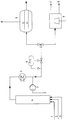
- a reactor 4 is fed via lines 1, 2 and 3 synthesis gas, olefin and rhodium catalyst homogeneously dissolved in an organic phase.
- the product which may have been cooled in a heat exchanger 5, is drawn off via a valve 6, a sufficient pressure being maintained with synthesis gas in order to prevent decomposition of the rhodium hydrocarbonyl.
- An aqueous phase containing the complexing agent is added to the product stream in a pipeline section by means of a pump 7. In this way, the phases are mixed thoroughly and the rhodium is almost completely extracted.
- Organic and aqueous phases are separated in the separation vessel 8 or in the centrifuge 9.
- the proportion of rhodium recovered could be increased to 97 to 98% (based on the amount of rhodium used in the hydroformylation), corresponding to a residual rhodium concentration in the organic phase of 0.7 to 0.9% by weight. ppm.
- the phases can be separated by centrifugation at room temperature; in this case, after-washing is not necessary.
- Example 1 was repeated under changed pressure and temperature conditions. Reaction conditions and extraction results are summarized in the table below.
Landscapes
- Chemical & Material Sciences (AREA)
- Organic Chemistry (AREA)
- Chemical Kinetics & Catalysis (AREA)
- Engineering & Computer Science (AREA)
- Materials Engineering (AREA)
- Inorganic Chemistry (AREA)
- Manufacturing & Machinery (AREA)
- Mechanical Engineering (AREA)
- Metallurgy (AREA)
- Organic Low-Molecular-Weight Compounds And Preparation Thereof (AREA)
- Low-Molecular Organic Synthesis Reactions Using Catalysts (AREA)
- Catalysts (AREA)
- Extraction Or Liquid Replacement (AREA)
Abstract
Die Erfindung betrifft ein Verfahren zur Abtrennung und Rückgewinnng von Rhodium aus Reaktionsprodukten der Oxosynthese, die unter Verwendung des Edelmetalls ohne zusätzliche Komplexbildner als Katalysator erhalten wurden. Die Abtrennung des Edelmetalls erfolgt mit der wäßrigen Lösung eines organischen Phosphins aus dem unter Druck stehenden Reaktionsprodukt in Form einer wasserlöslichen, das organische Phosphin als Ligand enthaltenden Rhodiumcarbonylverbindung.
Description
- Die Erfindung betrifft ein Verfahren zur Abtrennung und Rückgewinnung von Rhodium aus solchen Reaktionsprodukten der Oxosynthese, die unter Verwendung des Edelmetalls ohne zusätzliche Komplexbildner als Katalysator erhalten wurden.
- Die Herstellung von Aldehyden und Alkoholen durch Anlagerung von Kohlenmonoxid und Wasserstoff an olefinische Doppelbindungen (Hydroformylierung) ist bekannt. Die Reaktion wird durch Metalle der VIII. Gruppe des Periodensystems der Elemente oder deren Verbindungen katalysiert, die unter den Reaktionsbedingungen Carbonyle oder Hydrocarbonyle bilden. Während früher fast ausschließlich Kobalt und Kobaltverbindungen als Katalysatoren eingesetzt wurden, finden heute in zunehmendem Maße Rhodiumkatalysatoren Anwendung, obgleich Rhodium um ein Vielfaches teurer als Kobalt ist. Rhodium gelangt dabei allein oder in Kombination mit Komplexbildnern, z. B. organischen Phosphinen oder Phosphiten zum Einsatz. Während die Oxosynthese mit Rhodium als Katalysator Reaktionsdrücke von 25 bis 30 MPa erfordert, genügen bei Einsatz von Rhodium in Kombination mit Komplexbildnern Drücke von 1 bis 5 MPa.
- Für Rhodiumkatalysatoren ergeben sich in vielen Fällen deutliche Vorteile. Sie besitzen höhere Aktivität und Selektivität und ermöglichen überdies einen problemfreien Betrieb der Produktionsanlage, insbesondere hinsichtlich der Durchführung der Synthese und der Ausbringung der Produkte aus dem Reaktor. Schließlich kann das klassische Oxoverfahren auf Basis von Kobaltkatalysatoren unter Verwendung der vorhandenen Apparateteile in vielen Fällen mit nur geringen Investitionen auf Rhodiumkatalysatoren umgestellt werden.
- Erhebliche Schwierigkeiten bereitet es jedoch, das ohne Komplexbildner als Katalysator eingesetzte Rhodium unter Ausschluß von Verlusten aus dem Reaktionsprodukt abzutrennen und wiederzugewinnen.
- Entsprechend dem Stand der Technik wird das Reaktionsprodukt der Oxosynthese üblicherweise in mindestens zwei Stufen entspannt. Zunächst vermindert man, um gelöstes Synthesegas abzutrennen, den Druck von Synthesedruck, d.h. etwa 25 bis 30 MPa, auf 1,5 bis 2,5 MPa, anschließend reduziert man, gegebenenfalls über Zwischenstufen, auf Normaldruck. Vor der Reinigung des rohen Reaktionsproduktes, z.B. durch Destillation oder seiner Weiterverarbeitung zu Folgeprodukten, müssen die in ihm homogen gelösten Rhodiumverbindungen, die in einer Konzentration von nur wenigen ppm vorliegen, abgetrennt werden. Dabei ist zu beachten, daß das Rhodium bei der Entspannung teilweise in metallische Form übergeht oder mehrkernige Carbonyle bildet. In beiden Fällen kommt es dann zur Ausbildung eines heterogenen Systems, das aus der flüssigen organischen Phase und der festen, Rhodium oder Rhodiumverbindungen enthaltenden Phase, besteht.
- Nach dem Verfahren der DE-A1 33 47 406 wird das Rhodium mit Hilfe komplexbildender Reagenzien aus dem Rohprodukt, also dem nach Entspannen und gegebenenfalls Abkühlen anfallenden Reaktionsgemisch unter Normaldruck abgetrennt und wiedergewonnen. Vorzugsweise setzt man als Komplexbildner Sulfonate oder Carboxylate organischer Phosphine ein, die mit dem Rhodium wasserlösliche Komplexverbindungen ergeben. Daher kann das Edelmetall mit wäßrigen Lösungen der Phosphine extrahiert werden. Das Rhodium geht hierbei in die wäßrige Phase über, die sich durch einfaches Dekantieren vom organischen Produktgemisch abtrennen läßt. Durch Kreislaufführung der Lösung des Komplexbildners können hohe Rhodiumkonzentrationen in der wäßrigen Phase erreicht werden.
- Um die Extraktion des Rhodiums aus der organischen Phase und seinen Übergang in die wäßrige Phase zu beschleunigen und zu vervollständigen, setzt man nach der DE-A1 34 11 034 der wäßrigen Lösung des Komplexbildners einen Lösungsvermittler zu. Seine Wirkung besteht vor allem darin, daß er die physikalischen Eigenschaften der Grenzflächen zwischen den beiden flüssigen Phasen verändert und dadurch den Übergang des wäßrigen Extraktionsmittels in die Produktphase und des Rhodiums aus der Produktphase in die wäßrige Komplexbildnerphase beschleunigt. Durch Mitverwendung eines Lösungsvermittlers wird die Extraktion vereinfacht und der apparative Aufwand verringert.
- Eine Weiterentwicklung des vorstehenden Verfahrens ist in der DE-A1 34 43 474 beschrieben. Es verwendet zur Extraktion von Rhodium aus den Produkten der Oxosynthese Tetraorganylammoniumsalze sulfonierter Triarylphosphine, die sowohl komplexbildend wirken als auch lösungsvermittelnde Eigenschaften besitzen.
- Die bekannten Prozesse haben sich in der Praxis ausgezeichnet bewährt. Sie ermöglichen es im technischen Betrieb bis zu etwa 95 % des ursprünglich eingesetzten Rhodiums aus den Oxoreaktionsprodukten abzutrennen und wieder nutzbar zu machen. Im Hinblick auf den hohen Preis des Edelmetalls besteht jedoch Interesse daran, die Wiedergewinnung des Rhodiums weiter zu verbessern.
- Diese Aufgaben löst die Erfindung mit Hilfe eines Verfahrens zur Abtrennung und Wiedergewinnung von Rhodium aus den Produkten der Oxosynthese durch Extraktion mit der wäßrigen Lösung eines komplexbildenden organischen Phosphins. Es ist dadurch gekennzeichnet, daß das Rhodium aus dem unter Druck stehenden Reaktionsprodukt als wasserlösliche phosphinsubstituierte Rhodiumcarbonylverbindung extrahiert wird.
- Überraschenderweise kann durch den erfindungsgemäßen Prozess der Anteil des zurückgewonnenen Rhodiums, bezogen auf eingesetztes Metall, verglichen mit dem Stand der Technik, weiter erhöht werden.
- Ein wesentliches Merkmal des neuen Verfahrens ist es, das im Produkt der Oxosynthese gelöste Rhodium unter erhöhtem Druck zu extrahieren. Diese Maßnahme verhindert, daß sich die katalytisch wirksame Rhodiumcarbonylverbindung zersetzt und dadurch der unmittelbaren Reaktion mit dem wasserlöslichen Phosphin entzieht. Nach der von den Fachleuten überwiegend vertretenen Meinung ist Rhodiumhydridocarbonyl die katalytisch wirksame Verbindung bei der durch Rhodium katalysierten Hydroformylierung (vgl. z.B. Greenwood, Earnshaw, Chemistry of the Elements, 1984, S. 1317-1319). Daher sind bei Durchführung des erfindungsgemäßen Verfahrens im Reaktionsprodukt im Anschluß an die Synthese Druckbedingungen aufrechtzuerhalten, unter denen bei der gewählten Temperatur das Rhodiumhydridocarbonyl existenzfähig ist. Bewährt hat sich die Einhaltung von Temperaturen zwischen 0 und 200°C, bevorzugt 20 bis 130°C. Nach einer speziellen Ausführungsform der Erfindung führt man die Extraktion mit dem wasserlöslichen organischen Phosphin unter den Bedingungen der Hydroformylierung durch, d.h. in Anwesenheit von Synthesegas und bei Synthesetemperatur und -druck. Dieses Vorgehen steht im Gegensatz zu den bekannten Aufarbeitungsprozessen, bei denen das Reaktionsprodukt zunächst entspannt und entgast wird, bevor die Rhodiumabtrennung erfolgt.
- Zur Komplexbildung mit Rhodium befähigte wasserlösliche organische Phosphine sind insbesondere Verbindungen der allgemeinen Formel
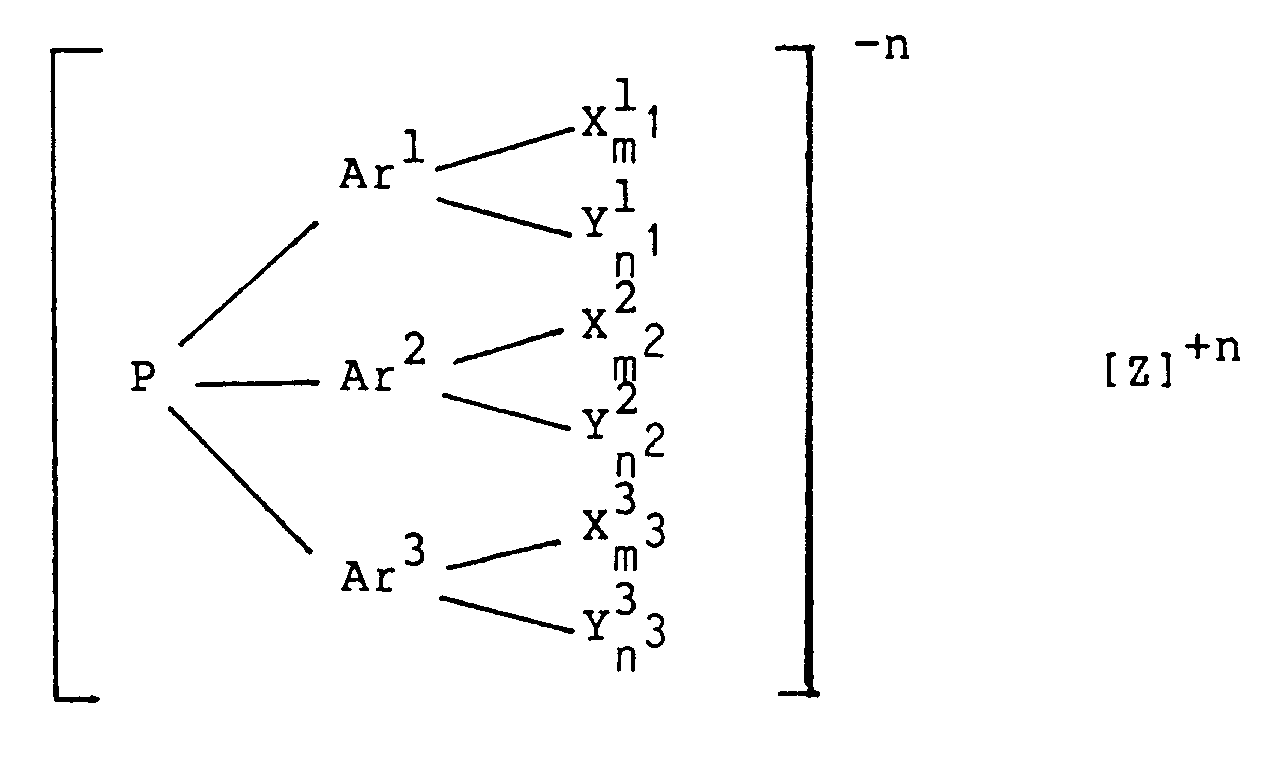
wobei Ar¹, Ar², Ar³ jeweils ein Benzol- oder Naphthalinrest, Y¹, Y², Y³ jeweils eine geradkettige oder verzweigte Alkylgruppe mit 1 bis 4 Kohlenstoffatomen, eine Alkoxygruppe, ein Halogenatom, die OH-, CN-, NO₂- oder R¹R²N-Gruppe in der R¹ und R² jeweils für eine geradkettige oder verzweigte Alkylgruppe mit 1 bis 4 Kohlenstoffatomen stehen, bedeuten, X¹, X², X³ jeweils ein Sulfonat-(-SO₃⁻) oder Carboxylat-(-COO⁻) Rest sind, m¹, m², m³ gleiche oder verschiedene ganze Zahlen von 0 bis 3 sind und mindestens eine Zahl m¹, m², m³ gleich oder größer 1 ist, n¹, n², n³ gleiche oder verschiedene ganze Zahlen von 0 bis 5 sind, n eine ganze Zahl von 1 bis 9 ist und Z für Alkalimetall-, Ammoniumionen oder für das Äquivalent eines Erdalkalimetalls oder des Zinks steht. - Als Extraktionsmittel im Rahmen der neuen Arbeitsweise besonders geeignet sind Phosphine der oben wiedergegebenen allgemeinen Formel in der Ar¹, Ar², Ar³ jeweils einen nicht oder durch einen Sulfonatrest substituierten Benzolrest bedeuten, mit der Maßgabe, daß mindestens ein Benzolrest durch einen Sulfonatrest substituiert ist, also X¹, X² und/oder X³ für -SO₃⁻ steht, m¹, m², m³ 0 oder 1 und die Summe von m¹, m² und m³ 1, 2 oder 3 ist und weiterhin n¹, n² und n³ jeweils Null sind. Kationen Z⁺ der wasserlöslichen organischen Phosphine sind vorzugsweise Alkalimetallionen, insbesondere Natriumionen. Es ist nicht erforderlich, die wasserlöslichen organischen Phosphine als einheitliche Verbindungen einzusetzen. Auch Gemische verschiedener Phosphine können im erfindungsgemäßen Verfahren angewandt werden. Beispiele für Phosphine, die sich zur Extraktion von Rhodium bewährt haben, sind das Tri-Na-phenyltrisulfophenylphosphin (abgekürzt TPPTS genannt), das Di-Na-phenyldisulfophenylphosphin (abgekürzt TPPDS genannt) und das Mono-Na-diphenylsulfophenylphosphin (abgekürzt TPPMS genannt). Die Verbindungen werden einzeln oder, bevorzugt, als Gemisch verwendet.
- Um das Eindringen der wäßrigen (Extraktions-) Phase in das organische Reaktionsprodukt zu erleichtern und dadurch Geschwindigkeit und Vollständigkeit der Extraktion zu erhöhen, kann man die Extraktion in Gegenwart handelsüblicher Lösungsvermittler (Phasentransferreagentien) vornehmen. Geeignet sind sowohl anionische Reagentien, wie Laurin-, Myristin- oder Stearinsäure, als auch kationische Reagentien, nämlich Amine, wie Octadecyldiethylamin, Octadecylethanolamin und neutrale Reagentien, z.B. Addukte des Ethylenoxids an höhermolekulare Alkohole, an Phenole und an Fettsäuren.
- Auf Rhodium bezogen werden die komplexbildenden Phosphine im molaren Überschuß angewendet. Da man sie zur erneuten Extraktion rezirkulieren kann, ist die Höhe des Überschusses unkritisch, jedoch sollen je mol Rhodium mindestens 5 mol komplexbildendes Phosphin vorhanden sein. Besonders bewährt hat es sich, je mol Rhodium 60 bis 100 mol, bei Rückführung sogar bis 500 mol komplexbildendes Phosphin zu verwenden.
- Üblicherweise wird das komplexbildende Phosphin in Form einer Lösung eingesetzt. Hierbei ist darauf zu achten, daß es ebenso wie der entstehende Rhodiumkomplex, im Reaktionsprodukt weitgehend unlöslich, dagegen im Lösungsmittel für das komplexbildende Reagenz gut löslich ist. Selbstverständlich darf auch das Lösungsmittel mit dem Reaktionsprodukt nicht oder nur sehr wenig mischbar sein.
- Bei Erfüllung dieser Bedingungen bildet sich ein Zweiphasensystem aus, das aus dem Reaktionsprodukt und der Lösung des komplexbildenden Phosphins bzw. der entstandenen Rhodium-Komplexverbindung besteht. Der Komplexbildner wirkt als Extraktionsmittel, d.h. im Anfangszustand befindet sich das Rhodium im Reaktionsprodukt gelöst, im Endzustand in der Lösung des Komplexbildners. Die Trennung von Reaktionsprodukt und Rhodium enthaltender Lösung erfolgt nach den hierfür üblichen Grundoperationen der chemischen Verfahrenstechnik z.B. durch Dekantieren oder Zentrifugieren.
- Das bevorzugte Lösungsmittel für das komplexbildende Reagenz und den Rhodiumkomplex ist Wasser. Es können auch Gemische von Wasser mit anderen Lösungsmitteln, z.B. niederen Alkoholen wie Methanol, verwendet werden, sofern sichergestellt ist, daß Oxoreaktionsprodukt und Lösungsmittel sich miteinander nicht mischen und die Löslichkeit des Rhodium-Phosphin-Komplexes in der Wasserphase nicht beeinträchtigt wird.
- Die Konzentration des komplexbildenden Reagenzes in der Lösung ist in weiten Grenzen variabel. Sie hängt insbesondere davon ab, in welchem Maße das Rhodium angereichert werden soll. Dementsprechend können nicht nur gesättigte, sondern sogar stark verdünnte Lösungen eingesetzt werden. In der Regel verwendet man Lösungen, die 0,5 bis 50 Gew.-% und vorzugsweise 5 bis 35 Gew.-% (jeweils bezogen auf die Lösung) des Komplexbildners enthalten.
- Sofern der Komplexbildner unter den Extraktionsbedingungen flüssig und im Hydroformylierungsprodukt unlöslich oder schwerlöslich und weiterhin der Rhodiumkomplex im komplexbildenden Phosphin löslich ist, kann auf die Mitverwendung eines Lösungsmittels auch verzichtet, also der reine Komplexbildner eingesetzt werden.
- Der neue Prozeß läßt sich sowohl absatzweise als auch kontinuierlich durchführen.
- Die Weiterbehandlung oder Weiterverwendung der das abgetrennte Rhodium enthaltenden Phase richtet sich nach den jeweiligen Gegebenheiten. So kann das Rhodium in bekannter Weise, z.B. durch Überführung in das Salz einer höheren Carbonsäure, abgetrennt und wiederum als Katalysator eingesetzt werden. Es ist aber auch möglich, die aus Lösungsmittel, Rhodium und Komplexbildner bestehende Phase unmittelbar als Katalysatorsystem zu verwenden.
- Das erfindungsgemäße Verfahren ist zur Abtrennung und Rückgewinnung von Rhodium aus den verschiedensten Produkten der Oxosynthese geeignet. Es kann nicht nur mit Erfolg bei Rohprodukten angewandt werden, die durch Hydroformylierung geradkettiger oder verzweigter acyclischer, olefinischer Kohlenwasserstoffe, insbesondere solcher mit 2 bis 20 Kohlenstoffatomen entstehen. Auch bei der Abtrennung von Rhodium aus Produkten der Hydroformylierung anderer olefinisch ungesättigter Verbindungen, z.B. ungesättigter Alkohole, Aldehye, Carbonsäuren, ferner Diolefine, cyclischer Olefine wie Dicyclopentadien, hat es sich ausgezeichent bewährt.
- Eine technische Ausführungsform der neuen Arbeitsweise ist in der beigefügten Abbildung dargestellt. Selbstverständlich läßt sich der erfindungsgemäße Prozeß auch in anderen Verfahrensvarianten realisieren.
- Einem Reaktor 4 werden über Leitungen 1, 2 und 3 Synthesegas, Olefin und in einer organischen Phase homogen gelöster Rhodiumkatalysator zugeführt. Das in einem Wärmetauscher 5 gegebenenfalls abgekühlte Produkt wird über ein Ventil 6 abgezogen, wobei mit Synthesegas ein ausreichender Druck aufrechterhalten wird, um eine Zersetzung des Rhodiumhydrocarbonyls zu verhindern. Dem Produktstrom wird in einem Rohrleitungsabschnitt über eine Pumpe 7 eine den Komplexbildner enthaltende wäßrige Phase zugemischt. Auf diese Weise erreicht man eine intensive Durchmischung der Phasen und eine nahezu vollständige Extraktion des Rhodiums. Organische und wäßrige Phase werden im Trenngefäß 8 oder in der Zentrifuge 9 getrennt.
- In den folgenden Beispielen wird die Erfindung näher beschrieben. Sie ist jedoch nicht auf diese speziellen Ausführungsformen beschränkt. Alle Konzentrationsangaben erfolgen in Gewichtsprozent (Gew.-%).
- In einem mit Magnetrührer ausgerüsteten Autoklaven wurde Dicyclopentadien bei 130°C und einem Synthesegasdruck (CO : H₂ = 1 : 1) von 27 MPa in Gegenwart von 60 Gew.-ppm Rhodium (bezogen auf Dicyclopentadien) als Katalysator hydroformyliert.
- Nach Beendigung der Reaktion wurde der Druck auf 25 MPa gesenkt, bei 130°C eine wäßrige TPPTS-Lösung in einer Menge zugepumpt, daß das P(III)/Rh-Molverhältnis 100 : 1 betrug und etwa 2 bis 3 min gerührt. Anschließend wurde das Reaktionsgemisch in einen Rührkolben mit Bodenablaß überführt und unter Rühren auf 60°C erwärmt. Nach Beendigung des Rührens setzte die Phasentrennung sofort ein, sie war nach etwa 30 min abgeschlossen. Die Analyse der Wasserphase ergeb, daß 94 bis 96 % des zur Hydroformylierung eingesetzten Rhodiums extrahiert worden waren. Durch eine Nachwäsche der organischen Phase konnte der Anteil des zurückgewonnenen Rhodiums auf 97 bis 98 % (bezogen auf die in die Hydroformylierung eingesetzte Rhodiummenge) erhöht werden, entsprechend einer Rhodium-Restkonzentration in der organischen Phase von 0,7 bis 0,9 Gew.-ppm. Alternativ können die Phasen durch Zentrifugieren bei Raumtemperatur getrennt werden; in diesem Fall ist eine Nachwäsche nicht erforderlich.
- Beispiel 1 wurde unter geänderten Druck- und Temperaturbedingungen wiederholt. Reaktionsbedingungen und Extraktionsergebnisse sind in der nachfolgenden Tabelle zusammengestellt.
Tabelle Temperatur (°C) Druck (MPa) Rh-Rückgewinnung* 80 27,0 98,6 80 5,0 97,0 130 5,0 97,8 * in %, bezogen auf in die Hydroformylierung eingesetztes Rhodium
Claims (9)
- Verfahren zur Abtrennung und Wiedergewinnung von Rhodium aus den Produkten der Oxosynthese durch Extraktion mit der wäßrigen Lösung eines komplexbildenden organischen Phosphins, dadurch gekennzeichnet, daß das Rhodium aus dem unter Druck stehenden Reaktionsprodukt als wasserlösliche phosphinsubstituierte Rhodiumcarbonylverbindung extrahiert wird.
- Verfahren nach Anspruch 1, dadurch gekennzeichnet, daß die komplexbildenden organischen Phosphine Verbindungen der allgemeinen Formel

- Verfahren nach Anspruch 2, dadurch gekennzeichnet, daß Ar¹, Ar², Ar³ jeweils einen Benzolrest bedeutet, X¹, X² und/oder X³ für den Sulfonatrest steht, die Summe von m¹, m² und m³ 1 bis 3 ist und n¹, n² und n³ jeweils Null sind.
- Verfahren nach Anspruch 2 oder 3, dadurch gekennzeichnet, daß das Kation Z+n vorzugsweise ein Alkalimetallion, insbesondere ein Natriumion ist.
- Verfahren nach einem oder mehreren der Ansprüche 1 bis 4, dadurch gekennzeichnet, daß das Rhodium bei Temperaturen zwischen 0 und 200°C, vorzugsweise 20 und 130°C, extrahiert wird.
- Verfahren nach einem oder mehreren der Ansprüche 1 bis 4, dadurch gekennzeichnet, daß das Rhodium unter den Temperatur- und Druckbedingungen der Hydroformylierung extrahiert wird.
- Verfahren nach einem oder mehreren der Ansprüche 1 bis 6, dadurch gekennzeichnet, daß je mol Rhodium mindestens 5, vorzugsweise 60 bis 100 mol wasserlösliches organisches Phosphin verwendet werden.
- Verfahren nach einem oder mehreren der Ansprüche 1 bis 7, dadurch gekennzeichnet, daß die Konzentration des wasserlöslichen organischen Phosphins in der wäßrigen Lösung 0,5 bis 50 Gew.-%, vorzugsweise 5 bis 35 Gew.-% beträgt.
- Verfahren nach einem oder mehreren der Ansprüche 1 bis 8, dadurch gekennzeichnet, daß die Extraktion des Rhodiums in Gegenwart eines Lösungvermittlers erfolgt.
Applications Claiming Priority (2)
| Application Number | Priority Date | Filing Date | Title |
|---|---|---|---|
| DE4135049 | 1991-10-24 | ||
| DE19914135049 DE4135049A1 (de) | 1991-10-24 | 1991-10-24 | Verfahren zur rueckgewinnung von rhodium aus den reaktionsprodukten der oxosynthese |
Publications (1)
| Publication Number | Publication Date |
|---|---|
| EP0538732A1 true EP0538732A1 (de) | 1993-04-28 |
Family
ID=6443285
Family Applications (1)
| Application Number | Title | Priority Date | Filing Date |
|---|---|---|---|
| EP19920117598 Withdrawn EP0538732A1 (de) | 1991-10-24 | 1992-10-15 | Verfahren zur Rückgewinnung von Rhodium aus den Reaktionsprodukten der Oxosynthese |
Country Status (12)
| Country | Link |
|---|---|
| US (1) | US5260490A (de) |
| EP (1) | EP0538732A1 (de) |
| JP (1) | JPH0736897B2 (de) |
| KR (1) | KR960006927B1 (de) |
| CN (1) | CN1071605A (de) |
| AU (1) | AU653072B2 (de) |
| BR (1) | BR9204067A (de) |
| CA (1) | CA2080747A1 (de) |
| DE (1) | DE4135049A1 (de) |
| MX (1) | MX9205983A (de) |
| TW (1) | TW210962B (de) |
| ZA (1) | ZA928027B (de) |
Cited By (1)
| Publication number | Priority date | Publication date | Assignee | Title |
|---|---|---|---|---|
| WO2001056932A1 (de) * | 2000-02-04 | 2001-08-09 | Celanese Chemicals Europe Gmbh | Verfahren zur wiedergewinnung von rhodium aus reaktionsprodukten der oxosynthese |
Families Citing this family (5)
| Publication number | Priority date | Publication date | Assignee | Title |
|---|---|---|---|---|
| GB9218346D0 (en) * | 1992-08-28 | 1992-10-14 | Bp Chem Int Ltd | Process |
| DE60002526T3 (de) | 1999-07-02 | 2007-08-09 | Mitsubishi Gas Chemical Co., Inc. | Herstellung von Tricyclodecandicarbaldehyd, Pentacyclopentadecandicarbaldehyd und der entsprechenden Dimethanole |
| DE10352263A1 (de) * | 2003-11-08 | 2005-06-23 | Celanese Chemicals Europe Gmbh | Verfahren zur Herstellung von TCD-Monenal |
| DE10352261B4 (de) * | 2003-11-08 | 2006-08-24 | Celanese Chemicals Europe Gmbh | Verfahren zur Herstellung von TCD-Dialdehyd |
| US7663002B2 (en) * | 2006-05-15 | 2010-02-16 | Dow Global Technologies, Inc. | Hydroformylation process and product separation with improved recovery of rhodium |
Citations (4)
| Publication number | Priority date | Publication date | Assignee | Title |
|---|---|---|---|---|
| EP0147824A2 (de) * | 1983-12-29 | 1985-07-10 | Hoechst Aktiengesellschaft | Verfahren zur Abtrennung und Wiedergewinnung von Rhodium aus den Produkten der Oxosynthese |
| US4537997A (en) * | 1982-12-15 | 1985-08-27 | Daicel Chemical Industries, Ltd. | Process for treating hydroformylation catalyst |
| EP0156253A2 (de) * | 1984-03-26 | 1985-10-02 | Hoechst Aktiengesellschaft | Verfahren zur Rückgewinnung von Rhodium aus Reaktionsprodukten der Oxosynthese |
| EP0348833A2 (de) * | 1988-06-30 | 1990-01-03 | Hoechst Aktiengesellschaft | Verfahren zur Abtrennung und Wiedergewinnung von Rhodium aus den Produkten der Oxosynthese |
Family Cites Families (4)
| Publication number | Priority date | Publication date | Assignee | Title |
|---|---|---|---|---|
| US5091350A (en) * | 1984-03-26 | 1992-02-25 | Hoechst Aktiengesellschaft | Process for hydroformylation with rhodium catalysts and the separation of rhodium therefrom |
| US5110990A (en) * | 1984-03-30 | 1992-05-05 | Union Carbide Chemicals & Plastics Technology Corporation | Process for recovery of phosphorus ligand from vaporized aldehyde |
| US4731485A (en) * | 1984-04-03 | 1988-03-15 | Ruhrchemie Aktiengesellschaft | Process for hydroformylation with rhodium catalysts and the separation of rhodium therefrom |
| US4871879A (en) * | 1987-10-27 | 1989-10-03 | Hoechst Celanese Corporation | Rhodium recovery from hydroformylation reaction product |
-
1991
- 1991-10-24 DE DE19914135049 patent/DE4135049A1/de not_active Withdrawn
-
1992
- 1992-09-24 TW TW81107546A patent/TW210962B/zh active
- 1992-10-14 US US07/960,897 patent/US5260490A/en not_active Expired - Lifetime
- 1992-10-14 KR KR1019920018917A patent/KR960006927B1/ko not_active Expired - Fee Related
- 1992-10-15 JP JP27752392A patent/JPH0736897B2/ja not_active Expired - Lifetime
- 1992-10-15 EP EP19920117598 patent/EP0538732A1/de not_active Withdrawn
- 1992-10-16 CA CA 2080747 patent/CA2080747A1/en not_active Abandoned
- 1992-10-16 MX MX9205983A patent/MX9205983A/es not_active IP Right Cessation
- 1992-10-16 ZA ZA928027A patent/ZA928027B/xx unknown
- 1992-10-17 CN CN92111679A patent/CN1071605A/zh active Pending
- 1992-10-20 BR BR9204067A patent/BR9204067A/pt not_active IP Right Cessation
- 1992-10-23 AU AU27316/92A patent/AU653072B2/en not_active Ceased
Patent Citations (4)
| Publication number | Priority date | Publication date | Assignee | Title |
|---|---|---|---|---|
| US4537997A (en) * | 1982-12-15 | 1985-08-27 | Daicel Chemical Industries, Ltd. | Process for treating hydroformylation catalyst |
| EP0147824A2 (de) * | 1983-12-29 | 1985-07-10 | Hoechst Aktiengesellschaft | Verfahren zur Abtrennung und Wiedergewinnung von Rhodium aus den Produkten der Oxosynthese |
| EP0156253A2 (de) * | 1984-03-26 | 1985-10-02 | Hoechst Aktiengesellschaft | Verfahren zur Rückgewinnung von Rhodium aus Reaktionsprodukten der Oxosynthese |
| EP0348833A2 (de) * | 1988-06-30 | 1990-01-03 | Hoechst Aktiengesellschaft | Verfahren zur Abtrennung und Wiedergewinnung von Rhodium aus den Produkten der Oxosynthese |
Cited By (2)
| Publication number | Priority date | Publication date | Assignee | Title |
|---|---|---|---|---|
| WO2001056932A1 (de) * | 2000-02-04 | 2001-08-09 | Celanese Chemicals Europe Gmbh | Verfahren zur wiedergewinnung von rhodium aus reaktionsprodukten der oxosynthese |
| US6685896B2 (en) | 2000-02-04 | 2004-02-03 | Celanese Chemicals Europe Gmbh | Method for recovering rhodium from reaction products of oxosynthesis |
Also Published As
| Publication number | Publication date |
|---|---|
| DE4135049A1 (de) | 1993-05-06 |
| AU2731692A (en) | 1993-04-29 |
| KR930007507A (ko) | 1993-05-20 |
| MX9205983A (es) | 1993-04-01 |
| JPH05261297A (ja) | 1993-10-12 |
| AU653072B2 (en) | 1994-09-15 |
| ZA928027B (en) | 1993-04-27 |
| US5260490A (en) | 1993-11-09 |
| JPH0736897B2 (ja) | 1995-04-26 |
| TW210962B (de) | 1993-08-11 |
| KR960006927B1 (ko) | 1996-05-25 |
| BR9204067A (pt) | 1993-05-04 |
| CN1071605A (zh) | 1993-05-05 |
| CA2080747A1 (en) | 1993-04-25 |
Similar Documents
| Publication | Publication Date | Title |
|---|---|---|
| EP0510358B1 (de) | Verfahren zur Wiedergewinnung von Rhodium aus den Rückständen der Destillation von Produkten der Oxosynthese | |
| DE69211116T2 (de) | Rückgewinnung von hochsiedenden aldehyden aus rhodium katalysierte hydroformylierungsverfahren | |
| EP0216315B1 (de) | Verfahren zur Herstellung von Aldehyden | |
| DE19654340A1 (de) | Verfahren zur Herstellung von höheren Oxo-Alkoholen | |
| DE3411034C2 (de) | ||
| EP0147824B1 (de) | Verfahren zur Abtrennung und Wiedergewinnung von Rhodium aus den Produkten der Oxosynthese | |
| EP0246475B1 (de) | Verfahren zur Herstellung von Aldehyden | |
| DE69603502T2 (de) | Verfahren zur herstellung von 1,3-propandiol | |
| EP0255673B1 (de) | Verfahren zur Rückgewinnung von Rhodium aus Rhodiumkomplex-verbindungen enthaltenden wässrigen Lösungen | |
| DE3141456A1 (de) | Verfahren zum abtrennen und gewinnen von festen komplexen von edelmetallen der gruppe viii | |
| EP0302375B1 (de) | Verfahren zur Herstellung von Aldehyden | |
| EP0183200B1 (de) | Verfahren zur Rückgewinnung von Rhodium aus Reaktionsprodukten der Oxosynthese | |
| EP1255697B1 (de) | Verfahren zur wiedergewinnung von rhodium aus reaktionsprodukten der oxosynthese | |
| DE4135049A1 (de) | Verfahren zur rueckgewinnung von rhodium aus den reaktionsprodukten der oxosynthese | |
| EP0424736B1 (de) | Verfahren zur Wiedergewinnung von Rhodium aus den Rückständen der Destillation von Produkten der Oxosynthese | |
| EP0348833B1 (de) | Verfahren zur Abtrennung und Wiedergewinnung von Rhodium aus den Produkten der Oxosynthese | |
| DE69309675T2 (de) | Katalysatorregenerierung | |
| EP0475036B1 (de) | Verfahren zur Wiedergewinnung von Rhodium aus den Rückständen der Destillation von Produkten der Oxosynthese | |
| EP0263953B1 (de) | Verfahren zur Abtrennung von Rhodiumkomplexverbindungen aus wässrigen Lösungen | |
| DE3534317A1 (de) | Verfahren zur herstellung von nonadecandiolen | |
| EP0186075B1 (de) | Verfahren zur Herstellung von 8- und 9-Formyl-tricyclo-(5,2,1,0, 2,6)-decen-3 | |
| EP0584720B1 (de) | Verfahren zur Wiedergewinnung von Rhodium aus den Destillationsrückständen von Produkten der Oxosynthese | |
| DE2045910A1 (en) | Cobalt and phosphine recovery - from distillation residues from oxo syntheses |
Legal Events
| Date | Code | Title | Description |
|---|---|---|---|
| PUAI | Public reference made under article 153(3) epc to a published international application that has entered the european phase |
Free format text: ORIGINAL CODE: 0009012 |
|
| AK | Designated contracting states |
Kind code of ref document: A1 Designated state(s): AT BE CH DE DK ES FR GB IT LI LU NL SE |
|
| 17P | Request for examination filed |
Effective date: 19930607 |
|
| 17Q | First examination report despatched |
Effective date: 19950509 |
|
| STAA | Information on the status of an ep patent application or granted ep patent |
Free format text: STATUS: THE APPLICATION IS DEEMED TO BE WITHDRAWN |
|
| 18D | Application deemed to be withdrawn |
Effective date: 19960402 |