EP0522645A2 - Medien Handhabungssystem - Google Patents
Medien Handhabungssystem Download PDFInfo
- Publication number
- EP0522645A2 EP0522645A2 EP92202027A EP92202027A EP0522645A2 EP 0522645 A2 EP0522645 A2 EP 0522645A2 EP 92202027 A EP92202027 A EP 92202027A EP 92202027 A EP92202027 A EP 92202027A EP 0522645 A2 EP0522645 A2 EP 0522645A2
- Authority
- EP
- European Patent Office
- Prior art keywords
- text
- fax
- audio
- processing system
- displayed
- Prior art date
- Legal status (The legal status is an assumption and is not a legal conclusion. Google has not performed a legal analysis and makes no representation as to the accuracy of the status listed.)
- Granted
Links
Images




Classifications
-
- G—PHYSICS
- G06—COMPUTING OR CALCULATING; COUNTING
- G06F—ELECTRIC DIGITAL DATA PROCESSING
- G06F16/00—Information retrieval; Database structures therefor; File system structures therefor
- G06F16/40—Information retrieval; Database structures therefor; File system structures therefor of multimedia data, e.g. slideshows comprising image and additional audio data
-
- G—PHYSICS
- G06—COMPUTING OR CALCULATING; COUNTING
- G06F—ELECTRIC DIGITAL DATA PROCESSING
- G06F40/00—Handling natural language data
- G06F40/10—Text processing
Definitions
- the invention relates to a text processing system comprising pagewise text display means as based on a character representability, supported by text processing means and text storage means and having a user interface featuring a set of text manipulating actions activatable through mechanical user actuation of an appropriate input means.
- Various professional and personal computer ranges have text processing systems.
- An exemplary reference is the "Common User Access Advanced Interface Design Guide" for the IBM Operating System/2, by IBM, June 1989, Document SY0328-300-R00-1089, pages 33-42.
- Text is represented as characters according to one or more formats, free-formatable, connected or non-connected. Manipulating actions have been designed in a wide variety as will be described hereinafter.
- the invention realizes this object by representing such media as a text metaphore in that said display means has an audio display mode as based on linewise pseudo character representation and in said audio display mode featuring at least a first subset of the set of text manipulating actions operating on displayed audio in similar way as on displayed text and each of the latter actions having a mapped effect on the actual stored audio corresponding to displayed pseudo characters.
- the time sequence of audio governs the progression of its display along successive lines.
- the audio signal is represented as pseudo-characters such as tiny blocks with height according to audio intensity.
- space characters function as delimiters between contiguous audio segments that are separated by a pause. Such a pause can be detected as occurring in the audio input, such as the end of a word or sentence.
- any pause character is a default item in that selectively, audio may be input into selective positions, i.e. time instants, such as in filling in a form or questionary with audio answers. In this way, audio is indeed processed as a text metaphore. The correspondence among the various activations makes life easier for any experienced user.
- the mapping of various manipulating operations on various input devices need not be uniform among text and audio. And een for a single object, certain manipulations may be restricted to a particular input device as differing for othe manipulations and/or another object.
- said audio is voice at a linewise display scale that is comparable to text display, and comprising delimiters as signalizations of detected silence instants.
- the duration of a word or line of text would then correspond in display space to the display of that many characters in textual representation. Their correspondence in physical space would be readily visible to a user.
- the silence delimiters correspond to ends of words or sentences in a written text.
- said display means has a fax display mode as based on linewise representation of said fax and in said fax mode featuring at least a second subset of the set of text manipulating actions operating on a displayed fax area in similar way as on displayed text.
- Fax is defined as a text represented by a bit map, wherein the character/word content or format may be uncertain in any degree, and wherein in principle, any two-dimensional format is allowable. It has been found that composing in a fax page would be advantageous as well, such as transmitting a text together with non-textual material, supplementing received fax with typewritten text, moving parts of a facsimile page with respect to other parts, and many others.
- the subsets of actions relating to audio and fax pages, respectively, may be, but need not be identical.
- the difference between text and fax information, is that the system does not know the meaning of the fax information. Even with a character recognition feature, only an approximate knowledge is present.
- said system has skew correcting means for under user control correcting skew of a particular line of fax.
- Word select is possible if the skew is small over the word length, which usually is the case.
- Line select is possible if the skew over the line length is small compared to the line height. If this is not the case, the operator may manually correct the skew; in-processor algorithms that are rather elementary have been described in US Patents 4,618,991 and 4,759,076. No editing in the sense of the present invention has been given by these references, however.
- said system has orientation detection means for detecting a local orientation of a displayed fax text line for allowing word and/or line select by said actions along a so detected line.
- orientation detection means for detecting a local orientation of a displayed fax text line for allowing word and/or line select by said actions along a so detected line.
- Figure 1 is a general diagram of a keyboard-oriented computer system.
- a page display 20 Shown are a foreground window 22, a partially covered window 24 and a cursor 26.
- the display may be based on a standard character set, or it may be high definition in that for each character an arbitrary bit map may be chosen.
- Processor 28 may execute text processing as well as system software.
- Memory 30 stores data to be displayed and other data.
- Keyboard 32 receives user actuations to be translated into system actions.
- Mouse 34 can be used to input absolute or differential positions in conjunction with clicking actions on any of four buttons 42.
- Block 44 represents a microphone with associated conversion mechanism to n-bit audio samples, that may be encoded, modulated, filtered, and, as the case may be, used in a voice recognition subsystem.
- Block 46 represents a loudspeaker that may output digital received audio samples via error correction, demodulation and digital-to-analog conversion to continuous audio.
- audio may remain analog if editably stored on a suitable medium.
- all audio editing may be done on an analog level, such as replacing, inserting, dubbing, fading and superposing, inasmuch as the invention proper relates to the interfacing with signalization of the audio.
- no analog storage has been provided and all operation is digital.
- Further communication lines 36, 38, 40 interconnect the subsystems shown. The configuration shown can be expanded or shrunk to any feasible degree, by means of:
- Figure 1 does not show the conversion of audio to pseudo characters.
- the pseudo-characters in the present embodiment may have any of four non-zero heights as shown in Figures 2-7. Of course, other numbers are feasible.
- the translation of a particular digitized amplitude to a geometric representation is by converting amplitude to an address code for a character generator that generates a pseudo-character in the same way as standard characters.
- Other representations are feasible, such as dots of various diameters (the diameter now linked to amplitude), blocks with various greyness levels and/or colours, or other.
- the mapping of the audio on the pseudo-characters may be two-dimensional, such as by discriminating both audio level and audio pitch. This would, for example, elucidate a dialog between a male voice and a female voice. The mapping coordinates could now be both size and colour of the pseudo-characters.
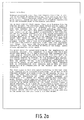
- Figures 2-7 show various display formats.
- Figure 2 is a text format, such as according to 53 rows of 65 characters each.
- characters are in print, with left-side and right-side registration, uniform periodicity and uniform line height
- the content of this page is irrelevant to the invention as well as to the disclosure thereof.
- the format need not be uniform. It may be given by a shape description instead of by the shape itself, such as in the well-known Postscript® system.
- Figure 3 is a voice format. Each character represents a voice period of about 1/20 of a second.
- the height of a block corresponds to the amplitude or energy of the voice segment.
- the pseudo characters have about the same width as the characters of Figure 2.
- An interrupted line indicates the connected sequence.
- Colour could indicate raised pitch such as at the end of a questioning phrase.
- other voice characteristics may be indicated such as the respective speakers in a conversation that each have their own colour.
- Apart from the height other shapes of the pseudo characters would be feasible to indicate various natural or artificial characteristics. Examples are marks for end-of-sentence, echo, machine generated speech versus recorded speech.
- the representation can be used for voice, music, animal sound, machine sound, background noise from machines, natural noise, and other.
- Figure 4 is a fax format that is organized according to standard horizontal lines and provided with word rasters.
- the fax may be represented as it is received or produced. Alternatively, it may be represented as a string of blocks of varying lengths. Such block that may itself be considered as a pseudo-character, may be detected by a known segmentation algoritm. These pseudo-characters may be represented in similar way as has been explained with respect to audio herebefore.
- the content of the fax message itself is irrelevant to the present invention as well as to the disclosure thereof.
- the advantage of using such pseudo characters is, for example that the content of the fax may remain unknown to an operator (who only selects particular parts, or executes other text processing for which the content of the text need not be known).
- the representation may be a combination of the fax text itself in combination with the block structure. It may be feasible to alternate between the two representations. The case of slanted lines has been discussed earlier.
- the fax may comprise a combination of text or texts (at respective slanting angles) and non-textual material such as Figures.
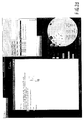
- Figure 5 shows at left a text page with a so-called audio sticker on it, representing a non-open voice sheet in iconized state. In this state, it is possible to play the stored voice relating to this sheet and also to record new voice (or other audio), which is thereupon joined to this sheet.
- the activating of this functionality is effected by accessing of icon 50 that shows a stylized quote mark. However, only an open sheet leads to full editing functionality.
- the right hand side of the display shows various items and windows that are irrelevant to the present invention and are mousewise accessible.
- Figure 6 shows an opened voice sheet, cf. the downstepping of the dark strip at right-hand side through the select column, with respect to Figure 5.
- This open sheet allows full-featured editing. Instead of a text font there is a block font indicating the amplitudes.
- a cursor in the left upper corner in the same way as a text cursor. New input (by recording) is inserted at its positions. Just as with text the user can select some part and use the cut, copy and paste operations. This makes it an audio editor, being much more than a cassette recorder.
- the cursor can be placed at a special position by a mouse click. But the user can also make use of the feature, that the cursor moves during play. Pressing "stop" will leave the cursor at the current position.
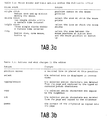
- Figures 8-9 show tables of various actions.
- Figure 8 shows the actions and extent of selection.
- selecting may be done by a particular clicking operation. Clicking a particular mouse button starts a brief delay, for example 500 milliseconds. If within this delay a further clicking occurs, the number of clicks is accumulated. If no clicking occurs within this delay, a subsequent clicking resets the accumulated sum (to one). The maximum accumulation is three in this example.
- the right column shows the effect. Single click selects the actual cursor position. Double click selects the word or pseudo word of the actual cursor position, that is, to left and to right the first space character act as delimiters to the selection. Triple click likewise selects the whole line of characters or pseudo characters. The last line shows the effect of dragging.
- Dragging is the same as clicking but holding the clicking button while moving the mouse (or rather, its on-screen representation) to an intended destination position. If the button is accidentally deactivated somewhere, that is the destination position. Dragging selects all (pseudo) characters between the start position and the destination position: this means all characters along the line of the start position to the right of the start position and all characters on the line of the destination position to the left of the destination position, and all intermediate lines completely. If the two positions are on one single line, only the interval on that line is selected. In principle, dragging could be combined with plural clicking, but this has not been considered.
- Figure 9 shows what happens with the amount of (pseudo) characters after selection according to the pattern of Figure 8.
- the set of commands in the left hand column may be activated by a particular dedicated key or button on the keyboard, by a software defined key on the keyboard, or by a soft key on a displayed soft keyboard.
- the set of commands is as follows:
- fax information may be underlined.
- audio information may be dubbed, loudness-clipped or other. This could be done, either in the context where the pseudo-characters of the associated communication medium occur, or in a completely separate setting.
Landscapes
- Engineering & Computer Science (AREA)
- Theoretical Computer Science (AREA)
- General Engineering & Computer Science (AREA)
- General Physics & Mathematics (AREA)
- Physics & Mathematics (AREA)
- Databases & Information Systems (AREA)
- Data Mining & Analysis (AREA)
- Multimedia (AREA)
- Health & Medical Sciences (AREA)
- Artificial Intelligence (AREA)
- Audiology, Speech & Language Pathology (AREA)
- Computational Linguistics (AREA)
- General Health & Medical Sciences (AREA)
- Processing Or Creating Images (AREA)
- Document Processing Apparatus (AREA)
Priority Applications (1)
| Application Number | Priority Date | Filing Date | Title |
|---|---|---|---|
| EP92202027A EP0522645B1 (de) | 1991-07-11 | 1992-07-03 | Medien Handhabungssystem |
Applications Claiming Priority (3)
| Application Number | Priority Date | Filing Date | Title |
|---|---|---|---|
| EP91201804 | 1991-07-11 | ||
| EP91201804 | 1991-07-11 | ||
| EP92202027A EP0522645B1 (de) | 1991-07-11 | 1992-07-03 | Medien Handhabungssystem |
Publications (3)
| Publication Number | Publication Date |
|---|---|
| EP0522645A2 true EP0522645A2 (de) | 1993-01-13 |
| EP0522645A3 EP0522645A3 (en) | 1993-11-10 |
| EP0522645B1 EP0522645B1 (de) | 2000-03-22 |
Family
ID=26129320
Family Applications (1)
| Application Number | Title | Priority Date | Filing Date |
|---|---|---|---|
| EP92202027A Expired - Lifetime EP0522645B1 (de) | 1991-07-11 | 1992-07-03 | Medien Handhabungssystem |
Country Status (1)
| Country | Link |
|---|---|
| EP (1) | EP0522645B1 (de) |
Cited By (2)
| Publication number | Priority date | Publication date | Assignee | Title |
|---|---|---|---|---|
| GB2297405A (en) * | 1995-01-30 | 1996-07-31 | Tektronix Inc | Multimedia programming |
| AU684422B2 (en) * | 1995-07-11 | 1997-12-11 | Matsushita Electric Industrial Co., Ltd. | Scenario editor for multimedia data and scenario reproducingapparatus |
Family Cites Families (1)
| Publication number | Priority date | Publication date | Assignee | Title |
|---|---|---|---|---|
| US4723297A (en) * | 1984-09-27 | 1988-02-02 | Siemens Aktiengesellschaft | Method for automatic correction of character skew in the acquisition of a text original in the form of digital scan results |
-
1992
- 1992-07-03 EP EP92202027A patent/EP0522645B1/de not_active Expired - Lifetime
Cited By (5)
| Publication number | Priority date | Publication date | Assignee | Title |
|---|---|---|---|---|
| GB2297405A (en) * | 1995-01-30 | 1996-07-31 | Tektronix Inc | Multimedia programming |
| US5642497A (en) * | 1995-01-30 | 1997-06-24 | Tektronix, Inc. | Digital disk recorder using a port clock having parallel tracks along a timeline with each track representing an independently accessible media stream |
| GB2297405B (en) * | 1995-01-30 | 1999-11-03 | Tektronix Inc | Application programming interface for a digital disk recorder |
| AU684422B2 (en) * | 1995-07-11 | 1997-12-11 | Matsushita Electric Industrial Co., Ltd. | Scenario editor for multimedia data and scenario reproducingapparatus |
| US5898430A (en) * | 1995-07-11 | 1999-04-27 | Matsushita Electric Industrial Co., Ltd. | Scenario editor for multimedia data and scenario reproducing apparatus |
Also Published As
| Publication number | Publication date |
|---|---|
| EP0522645A3 (en) | 1993-11-10 |
| EP0522645B1 (de) | 2000-03-22 |
Similar Documents
| Publication | Publication Date | Title |
|---|---|---|
| US6683600B1 (en) | Adaptive input pen mode selection | |
| US6683631B2 (en) | System and method for selecting and deselecting information in an electronic document | |
| US7215815B2 (en) | Handwriting information processing apparatus, handwriting information processing method, and storage medium having program stored therein for handwriting information processing | |
| US6891551B2 (en) | Selection handles in editing electronic documents | |
| US8913832B2 (en) | Method and device for interacting with a map | |
| JPS6180478A (ja) | デ−タ入力・表示システム | |
| JPS6330645B2 (de) | ||
| US6559869B1 (en) | Adaptive auto-scrolling merge for hand written input | |
| JP6543290B2 (ja) | 電子図書製作用プログラム | |
| KR20010102224A (ko) | 수기 입력 재생 장치 및 시스템 | |
| JP2021117750A (ja) | 情報処理装置、制御方法及びプログラム | |
| US6456274B1 (en) | Multi-media editing system for edting at least two types of information | |
| EP0226019A2 (de) | Anzeigesystem für graphische Daten | |
| JPH0221024B2 (de) | ||
| EP0522645B1 (de) | Medien Handhabungssystem | |
| US7185278B1 (en) | Separating and moving document objects using the movement of a wiper bar | |
| GB2509552A (en) | Entering handwritten musical notation on a touchscreen and providing editing capabilities | |
| US7925142B2 (en) | Apparatus for presenting information and method thereof | |
| JPS61228572A (ja) | 文書作成編集装置 | |
| Welbourn et al. | A gesture based text and diagram editor | |
| JP4036741B2 (ja) | テキスト読み上げシステム及び方法 | |
| JPH0575143B2 (de) | ||
| JPH04309B2 (de) | ||
| JPH0512264A (ja) | 文書作成装置 | |
| JPS61234464A (ja) | 文書作成装置 |
Legal Events
| Date | Code | Title | Description |
|---|---|---|---|
| PUAI | Public reference made under article 153(3) epc to a published international application that has entered the european phase |
Free format text: ORIGINAL CODE: 0009012 |
|
| AK | Designated contracting states |
Kind code of ref document: A2 Designated state(s): DE FR GB IT |
|
| PUAL | Search report despatched |
Free format text: ORIGINAL CODE: 0009013 |
|
| AK | Designated contracting states |
Kind code of ref document: A3 Designated state(s): DE FR GB IT |
|
| 17P | Request for examination filed |
Effective date: 19940509 |
|
| 17Q | First examination report despatched |
Effective date: 19980115 |
|
| RAP3 | Party data changed (applicant data changed or rights of an application transferred) |
Owner name: KONINKLIJKE PHILIPS ELECTRONICS N.V. |
|
| GRAG | Despatch of communication of intention to grant |
Free format text: ORIGINAL CODE: EPIDOS AGRA |
|
| RIC1 | Information provided on ipc code assigned before grant |
Free format text: 6G 06F 17/21 A, 6G 06F 17/30 B |
|
| RIC1 | Information provided on ipc code assigned before grant |
Free format text: 6G 06F 17/21 A, 6G 06F 17/30 B |
|
| GRAG | Despatch of communication of intention to grant |
Free format text: ORIGINAL CODE: EPIDOS AGRA |
|
| GRAH | Despatch of communication of intention to grant a patent |
Free format text: ORIGINAL CODE: EPIDOS IGRA |
|
| GRAH | Despatch of communication of intention to grant a patent |
Free format text: ORIGINAL CODE: EPIDOS IGRA |
|
| GRAA | (expected) grant |
Free format text: ORIGINAL CODE: 0009210 |
|
| AK | Designated contracting states |
Kind code of ref document: B1 Designated state(s): DE FR GB IT |
|
| REF | Corresponds to: |
Ref document number: 69230815 Country of ref document: DE Date of ref document: 20000427 |
|
| ITF | It: translation for a ep patent filed | ||
| ET | Fr: translation filed | ||
| PLBE | No opposition filed within time limit |
Free format text: ORIGINAL CODE: 0009261 |
|
| STAA | Information on the status of an ep patent application or granted ep patent |
Free format text: STATUS: NO OPPOSITION FILED WITHIN TIME LIMIT |
|
| 26N | No opposition filed | ||
| REG | Reference to a national code |
Ref country code: GB Ref legal event code: IF02 |
|
| PGFP | Annual fee paid to national office [announced via postgrant information from national office to epo] |
Ref country code: FR Payment date: 20040727 Year of fee payment: 13 |
|
| PGFP | Annual fee paid to national office [announced via postgrant information from national office to epo] |
Ref country code: GB Payment date: 20040729 Year of fee payment: 13 |
|
| PGFP | Annual fee paid to national office [announced via postgrant information from national office to epo] |
Ref country code: DE Payment date: 20040916 Year of fee payment: 13 |
|
| PG25 | Lapsed in a contracting state [announced via postgrant information from national office to epo] |
Ref country code: IT Free format text: LAPSE BECAUSE OF NON-PAYMENT OF DUE FEES Effective date: 20050703 Ref country code: GB Free format text: LAPSE BECAUSE OF NON-PAYMENT OF DUE FEES Effective date: 20050703 |
|
| PG25 | Lapsed in a contracting state [announced via postgrant information from national office to epo] |
Ref country code: DE Free format text: LAPSE BECAUSE OF NON-PAYMENT OF DUE FEES Effective date: 20060201 |
|
| GBPC | Gb: european patent ceased through non-payment of renewal fee |
Effective date: 20050703 |
|
| PG25 | Lapsed in a contracting state [announced via postgrant information from national office to epo] |
Ref country code: FR Free format text: LAPSE BECAUSE OF NON-PAYMENT OF DUE FEES Effective date: 20060331 |
|
| REG | Reference to a national code |
Ref country code: FR Ref legal event code: ST Effective date: 20060331 |