EP0521747B1 - Procédé pour intégrer de façon homogène une charge solide au sein d'un substrat poreux - Google Patents
Procédé pour intégrer de façon homogène une charge solide au sein d'un substrat poreux Download PDFInfo
- Publication number
- EP0521747B1 EP0521747B1 EP92401661A EP92401661A EP0521747B1 EP 0521747 B1 EP0521747 B1 EP 0521747B1 EP 92401661 A EP92401661 A EP 92401661A EP 92401661 A EP92401661 A EP 92401661A EP 0521747 B1 EP0521747 B1 EP 0521747B1
- Authority
- EP
- European Patent Office
- Prior art keywords
- substrate
- slip
- enclosure
- texture
- charge
- Prior art date
- Legal status (The legal status is an assumption and is not a legal conclusion. Google has not performed a legal analysis and makes no representation as to the accuracy of the status listed.)
- Expired - Lifetime
Links
- 239000000758 substrate Substances 0.000 title claims abstract description 30
- 239000007787 solid Substances 0.000 title claims abstract description 22
- 238000000034 method Methods 0.000 title claims description 21
- 239000002245 particle Substances 0.000 claims abstract description 9
- 239000007788 liquid Substances 0.000 claims abstract description 6
- 239000002002 slurry Substances 0.000 claims 5
- 150000002894 organic compounds Chemical class 0.000 claims 1
- 239000000945 filler Substances 0.000 abstract description 12
- 239000000843 powder Substances 0.000 description 15
- 239000011159 matrix material Substances 0.000 description 13
- 238000005470 impregnation Methods 0.000 description 11
- 230000002787 reinforcement Effects 0.000 description 11
- PNEYBMLMFCGWSK-UHFFFAOYSA-N aluminium oxide Inorganic materials [O-2].[O-2].[O-2].[Al+3].[Al+3] PNEYBMLMFCGWSK-UHFFFAOYSA-N 0.000 description 9
- OKTJSMMVPCPJKN-UHFFFAOYSA-N Carbon Chemical compound [C] OKTJSMMVPCPJKN-UHFFFAOYSA-N 0.000 description 8
- 229910052799 carbon Inorganic materials 0.000 description 8
- 239000000919 ceramic Substances 0.000 description 8
- 239000002131 composite material Substances 0.000 description 7
- 239000000203 mixture Substances 0.000 description 7
- 238000000280 densification Methods 0.000 description 6
- 239000000835 fiber Substances 0.000 description 6
- 239000002243 precursor Substances 0.000 description 6
- 238000009434 installation Methods 0.000 description 5
- 230000010354 integration Effects 0.000 description 5
- 230000003014 reinforcing effect Effects 0.000 description 5
- 239000000725 suspension Substances 0.000 description 5
- 229920000049 Carbon (fiber) Polymers 0.000 description 4
- 239000004917 carbon fiber Substances 0.000 description 4
- HBMJWWWQQXIZIP-UHFFFAOYSA-N silicon carbide Chemical compound [Si+]#[C-] HBMJWWWQQXIZIP-UHFFFAOYSA-N 0.000 description 4
- ZWEHNKRNPOVVGH-UHFFFAOYSA-N 2-Butanone Chemical compound CCC(C)=O ZWEHNKRNPOVVGH-UHFFFAOYSA-N 0.000 description 3
- -1 aluminum oxychloride Chemical compound 0.000 description 3
- 229910019142 PO4 Inorganic materials 0.000 description 2
- HIGRAKVNKLCVCA-UHFFFAOYSA-N alumine Chemical compound C1=CC=[Al]C=C1 HIGRAKVNKLCVCA-UHFFFAOYSA-N 0.000 description 2
- 150000001875 compounds Chemical class 0.000 description 2
- 239000000470 constituent Substances 0.000 description 2
- 238000009826 distribution Methods 0.000 description 2
- 239000004744 fabric Substances 0.000 description 2
- 238000004519 manufacturing process Methods 0.000 description 2
- 229910052751 metal Inorganic materials 0.000 description 2
- 239000002184 metal Substances 0.000 description 2
- VNWKTOKETHGBQD-UHFFFAOYSA-N methane Chemical compound C VNWKTOKETHGBQD-UHFFFAOYSA-N 0.000 description 2
- 239000010452 phosphate Substances 0.000 description 2
- 229910010271 silicon carbide Inorganic materials 0.000 description 2
- LFQSCWFLJHTTHZ-UHFFFAOYSA-N Ethanol Chemical compound CCO LFQSCWFLJHTTHZ-UHFFFAOYSA-N 0.000 description 1
- 241000287107 Passer Species 0.000 description 1
- XUIMIQQOPSSXEZ-UHFFFAOYSA-N Silicon Chemical compound [Si] XUIMIQQOPSSXEZ-UHFFFAOYSA-N 0.000 description 1
- 229910052782 aluminium Inorganic materials 0.000 description 1
- 239000004411 aluminium Substances 0.000 description 1
- XAGFODPZIPBFFR-UHFFFAOYSA-N aluminium Chemical compound [Al] XAGFODPZIPBFFR-UHFFFAOYSA-N 0.000 description 1
- CREMABGTGYGIQB-UHFFFAOYSA-N carbon carbon Chemical compound C.C CREMABGTGYGIQB-UHFFFAOYSA-N 0.000 description 1
- 239000011203 carbon fibre reinforced carbon Substances 0.000 description 1
- 238000002468 ceramisation Methods 0.000 description 1
- 230000000052 comparative effect Effects 0.000 description 1
- 238000010411 cooking Methods 0.000 description 1
- 238000001035 drying Methods 0.000 description 1
- 238000011049 filling Methods 0.000 description 1
- 239000012530 fluid Substances 0.000 description 1
- 230000005484 gravity Effects 0.000 description 1
- 238000010438 heat treatment Methods 0.000 description 1
- 238000005259 measurement Methods 0.000 description 1
- 229920003229 poly(methyl methacrylate) Polymers 0.000 description 1
- 239000004926 polymethyl methacrylate Substances 0.000 description 1
- 230000001681 protective effect Effects 0.000 description 1
- 230000000717 retained effect Effects 0.000 description 1
- 230000006641 stabilisation Effects 0.000 description 1
- 238000011105 stabilization Methods 0.000 description 1
- 230000001360 synchronised effect Effects 0.000 description 1
- 229920005992 thermoplastic resin Polymers 0.000 description 1
Images

Classifications
-
- C—CHEMISTRY; METALLURGY
- C04—CEMENTS; CONCRETE; ARTIFICIAL STONE; CERAMICS; REFRACTORIES
- C04B—LIME, MAGNESIA; SLAG; CEMENTS; COMPOSITIONS THEREOF, e.g. MORTARS, CONCRETE OR LIKE BUILDING MATERIALS; ARTIFICIAL STONE; CERAMICS; REFRACTORIES; TREATMENT OF NATURAL STONE
- C04B41/00—After-treatment of mortars, concrete, artificial stone or ceramics; Treatment of natural stone
- C04B41/009—After-treatment of mortars, concrete, artificial stone or ceramics; Treatment of natural stone characterised by the material treated
-
- B—PERFORMING OPERATIONS; TRANSPORTING
- B28—WORKING CEMENT, CLAY, OR STONE
- B28B—SHAPING CLAY OR OTHER CERAMIC COMPOSITIONS; SHAPING SLAG; SHAPING MIXTURES CONTAINING CEMENTITIOUS MATERIAL, e.g. PLASTER
- B28B1/00—Producing shaped prefabricated articles from the material
- B28B1/52—Producing shaped prefabricated articles from the material specially adapted for producing articles from mixtures containing fibres, e.g. asbestos cement
-
- B—PERFORMING OPERATIONS; TRANSPORTING
- B28—WORKING CEMENT, CLAY, OR STONE
- B28B—SHAPING CLAY OR OTHER CERAMIC COMPOSITIONS; SHAPING SLAG; SHAPING MIXTURES CONTAINING CEMENTITIOUS MATERIAL, e.g. PLASTER
- B28B23/00—Arrangements specially adapted for the production of shaped articles with elements wholly or partly embedded in the moulding material; Production of reinforced objects
- B28B23/0006—Arrangements specially adapted for the production of shaped articles with elements wholly or partly embedded in the moulding material; Production of reinforced objects the reinforcement consisting of aligned, non-metal reinforcing elements
-
- C—CHEMISTRY; METALLURGY
- C04—CEMENTS; CONCRETE; ARTIFICIAL STONE; CERAMICS; REFRACTORIES
- C04B—LIME, MAGNESIA; SLAG; CEMENTS; COMPOSITIONS THEREOF, e.g. MORTARS, CONCRETE OR LIKE BUILDING MATERIALS; ARTIFICIAL STONE; CERAMICS; REFRACTORIES; TREATMENT OF NATURAL STONE
- C04B35/00—Shaped ceramic products characterised by their composition; Ceramics compositions; Processing powders of inorganic compounds preparatory to the manufacturing of ceramic products
- C04B35/01—Shaped ceramic products characterised by their composition; Ceramics compositions; Processing powders of inorganic compounds preparatory to the manufacturing of ceramic products based on oxide ceramics
- C04B35/10—Shaped ceramic products characterised by their composition; Ceramics compositions; Processing powders of inorganic compounds preparatory to the manufacturing of ceramic products based on oxide ceramics based on aluminium oxide
- C04B35/111—Fine ceramics
-
- C—CHEMISTRY; METALLURGY
- C04—CEMENTS; CONCRETE; ARTIFICIAL STONE; CERAMICS; REFRACTORIES
- C04B—LIME, MAGNESIA; SLAG; CEMENTS; COMPOSITIONS THEREOF, e.g. MORTARS, CONCRETE OR LIKE BUILDING MATERIALS; ARTIFICIAL STONE; CERAMICS; REFRACTORIES; TREATMENT OF NATURAL STONE
- C04B35/00—Shaped ceramic products characterised by their composition; Ceramics compositions; Processing powders of inorganic compounds preparatory to the manufacturing of ceramic products
- C04B35/71—Ceramic products containing macroscopic reinforcing agents
- C04B35/78—Ceramic products containing macroscopic reinforcing agents containing non-metallic materials
- C04B35/80—Fibres, filaments, whiskers, platelets, or the like
-
- C—CHEMISTRY; METALLURGY
- C04—CEMENTS; CONCRETE; ARTIFICIAL STONE; CERAMICS; REFRACTORIES
- C04B—LIME, MAGNESIA; SLAG; CEMENTS; COMPOSITIONS THEREOF, e.g. MORTARS, CONCRETE OR LIKE BUILDING MATERIALS; ARTIFICIAL STONE; CERAMICS; REFRACTORIES; TREATMENT OF NATURAL STONE
- C04B41/00—After-treatment of mortars, concrete, artificial stone or ceramics; Treatment of natural stone
- C04B41/45—Coating or impregnating, e.g. injection in masonry, partial coating of green or fired ceramics, organic coating compositions for adhering together two concrete elements
- C04B41/4505—Coating or impregnating, e.g. injection in masonry, partial coating of green or fired ceramics, organic coating compositions for adhering together two concrete elements characterised by the method of application
-
- C—CHEMISTRY; METALLURGY
- C04—CEMENTS; CONCRETE; ARTIFICIAL STONE; CERAMICS; REFRACTORIES
- C04B—LIME, MAGNESIA; SLAG; CEMENTS; COMPOSITIONS THEREOF, e.g. MORTARS, CONCRETE OR LIKE BUILDING MATERIALS; ARTIFICIAL STONE; CERAMICS; REFRACTORIES; TREATMENT OF NATURAL STONE
- C04B41/00—After-treatment of mortars, concrete, artificial stone or ceramics; Treatment of natural stone
- C04B41/45—Coating or impregnating, e.g. injection in masonry, partial coating of green or fired ceramics, organic coating compositions for adhering together two concrete elements
- C04B41/50—Coating or impregnating, e.g. injection in masonry, partial coating of green or fired ceramics, organic coating compositions for adhering together two concrete elements with inorganic materials
- C04B41/5025—Coating or impregnating, e.g. injection in masonry, partial coating of green or fired ceramics, organic coating compositions for adhering together two concrete elements with inorganic materials with ceramic materials
- C04B41/5031—Alumina
-
- C—CHEMISTRY; METALLURGY
- C04—CEMENTS; CONCRETE; ARTIFICIAL STONE; CERAMICS; REFRACTORIES
- C04B—LIME, MAGNESIA; SLAG; CEMENTS; COMPOSITIONS THEREOF, e.g. MORTARS, CONCRETE OR LIKE BUILDING MATERIALS; ARTIFICIAL STONE; CERAMICS; REFRACTORIES; TREATMENT OF NATURAL STONE
- C04B41/00—After-treatment of mortars, concrete, artificial stone or ceramics; Treatment of natural stone
- C04B41/80—After-treatment of mortars, concrete, artificial stone or ceramics; Treatment of natural stone of only ceramics
- C04B41/81—Coating or impregnation
-
- C—CHEMISTRY; METALLURGY
- C04—CEMENTS; CONCRETE; ARTIFICIAL STONE; CERAMICS; REFRACTORIES
- C04B—LIME, MAGNESIA; SLAG; CEMENTS; COMPOSITIONS THEREOF, e.g. MORTARS, CONCRETE OR LIKE BUILDING MATERIALS; ARTIFICIAL STONE; CERAMICS; REFRACTORIES; TREATMENT OF NATURAL STONE
- C04B41/00—After-treatment of mortars, concrete, artificial stone or ceramics; Treatment of natural stone
- C04B41/80—After-treatment of mortars, concrete, artificial stone or ceramics; Treatment of natural stone of only ceramics
- C04B41/81—Coating or impregnation
- C04B41/85—Coating or impregnation with inorganic materials
- C04B41/87—Ceramics
Definitions
- the invention relates to a method for integrating a substantially homogeneous solid charge in the form of finely divided particles within a porous substrate.
- the field concerned by the invention is more particularly that of composite materials comprising a fibrous reinforcement texture densified by a matrix at least partially filling the initial porosity of the reinforcement texture.
- a known method for introducing a solid filler into a fibrous texture consists in impregnating the latter by means of a composition comprising the solid filler in the form of finely divided particles in suspension in a liquid vehicle.
- Document FR-A-2 655 977 describes a process of the same type in which impregnation with the slip containing the ceramic powder in suspension is carried out by establishing a pressure difference.
- the present invention aims to provide a method allowing '' integrate a solid filler into a porous substrate both in a controlled and homogeneous way.
- the forced passage of the slip through the substrate, in one direction and in the other, makes it possible to distribute the load uniformly within the substrate.
- the rate of charge introduced into the substrate is directly related to the concentration of the slip in particles of solid charge, so that a control of the volume percentage of charge in the substrate is achievable by correspondingly determining the concentration of the slip solid charge.
- the forced passage of the slip through the substrate is carried out in a simple manner by controlling the synchronized movement of two pistons forming two opposite walls of the enclosure.
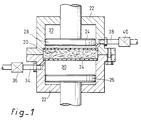
- FIG. 1 shows an installation making it possible to integrate a solid charge in a homogeneous and controlled manner within a porous substrate, in this case a fibrous texture 20 intended to constitute the reinforcement texture of a part made of composite material.
- the fibrous texture 20, in the form of a disc, is placed in an enclosure 22, between two grids 24 constituted by perforated sheets. Pistons 26, 28 slide in chambers 30, 32 delimited by the enclosure 22 and the texture 20, on each side of the latter.
- An impregnation composition intake pipe 34 provided with a stop valve 36 ends in one of the chambers, for example the chamber 30, through the wall of the enclosure, in the immediate vicinity of the location of the texture 20.
- a suction pipe 38 provided with a stop valve 40 and connected to a vacuum source (not shown) ends in the other chamber 32, in the immediate vicinity of the location of the texture 20, at through the wall of the enclosure, in a zone thereof opposite that where the pipe 34 opens.
- the installation illustrated in FIG. 1 is used to make a radome from an alumina / alumina composite material.
- the fibrous texture 20 consists of a mat of alumina fibers sold by the British company ICI under the name of mat "Saffil”.
- the vacuum is established in the enclosure, the valve 36 being closed and the valve 40 open. Then, the valve 36 is opened to admit into the chamber 30 a determined quantity of the impregnating composition. The latter is forced to pass through the reinforcing texture 20 by the depression which continues to be exerted in the chamber 32.
- valve 40 After a predetermined time sufficient for the texture 20 to have been completely traversed by the impregnating composition, the valve 40 is closed.
- the pistons 26, 28 are then placed in synchronism to force the impregnation composition to pass twice through the reinforcement texture 20 in one direction and in the other. In this way, a homogeneous impregnation of the texture is achieved.
- the grids 24 have openings of dimensions much greater than those of the alumina particles. None of the grids 24 provides a filter function in order to retain the alumina particles in the reinforcing texture, the role of the grids 24 being simply to maintain the reinforcing texture.
- the impregnated reinforcement texture is extracted from the enclosure to be subjected to a cooking cycle. This consists of placing the reinforcement texture in a press or in an autoclave and raising the temperature to approximately 250 to 300 ° C in a gradual manner and with intermediate bearings.
- a ceramization cycle is carried out in an oven where the temperature is gradually raised to 950 ° C., making it possible to obtain the radome made of the desired alumina / alumina composite material, after stabilization at 1400 ° C.
- the installation illustrated in FIG. 1 is used to integrate a determined quantity of solid filler, for example a silicon carbide powder, within the reinforcing texture of carbon fibers, before completing the densification thereof by a carbon matrix.
- a determined quantity of solid filler for example a silicon carbide powder
- the fibrous texture 20, or preform is constituted by two-dimensional layers of carbon fibers bonded together by needling.
- the strata are formed by layers of carbon fiber fabric. Layers formed of carbon fiber veil can be arranged between the layers of fabric to provide fibers which can be easily taken up by the needles, during needling, to be implanted through the strata.
- the preform 20 is placed in the enclosure 22 and, after a vacuum has been established therein, the above slip is introduced. As in Example 1, the slip is made to travel, by means of the pistons 26, 28, two return journeys through the preform. The residual slip is recovered and the impregnated texture is dried in an oven.
- Mcp 100 (dc.Vcp) / (d f .V f ), in which dc and d f are respectively the charge density and the fiber density.
- a test was carried out on a disc-shaped preform with a diameter of 80 mm and a thickness of 30 mm, the volume content of fibers being equal to 25.%.
- FIG. 2 shows a homogeneous distribution of the charge of silicon carbide in the preform.
- the method according to the invention thus makes it possible to carry out a metered and homogeneous integration of a solid charge within a porous substrate.
- Example 2 the procedure is as in Example 2, with the exception of the impregnation process, which is carried out at atmospheric pressure by passing the slip by gravity only once and in one direction through the preform, and dimensions of the preform, which is a parallelepiped of dimensions 55 x 55 x 36 mm.
- FIG. 3 shows an inhomogeneous integration of the solid charge, in contrast to FIG. 2.
- the invention is applicable to the integration of solid fillers of different natures, other than the ceramic powders envisaged in the examples above, and can be used on substrates which can be other than fibrous textures.
Landscapes
- Chemical & Material Sciences (AREA)
- Engineering & Computer Science (AREA)
- Ceramic Engineering (AREA)
- Materials Engineering (AREA)
- Structural Engineering (AREA)
- Organic Chemistry (AREA)
- Manufacturing & Machinery (AREA)
- Mechanical Engineering (AREA)
- Inorganic Chemistry (AREA)
- Chemical Kinetics & Catalysis (AREA)
- Reinforced Plastic Materials (AREA)
- Compositions Of Oxide Ceramics (AREA)
- Manufacture Of Alloys Or Alloy Compounds (AREA)
- Compounds Of Alkaline-Earth Elements, Aluminum Or Rare-Earth Metals (AREA)
- Compositions Of Macromolecular Compounds (AREA)
- Laminated Bodies (AREA)
- Physical Or Chemical Processes And Apparatus (AREA)
- Catalysts (AREA)
- Silicon Compounds (AREA)
- Pigments, Carbon Blacks, Or Wood Stains (AREA)
- Moulding By Coating Moulds (AREA)
- Powder Metallurgy (AREA)
- Immobilizing And Processing Of Enzymes And Microorganisms (AREA)
- Manufacture Of Porous Articles, And Recovery And Treatment Of Waste Products (AREA)
- Solid-Sorbent Or Filter-Aiding Compositions (AREA)
- Analysing Materials By The Use Of Radiation (AREA)
Description
- L'invention a pour objet un procédé permettant d'intégrer de façon sensiblement homogène une charge solide sous forme de particules finement divisées au sein d'un substrat poreux.
- Le domaine concerné par l'invention est plus particulièrement celui des matériaux composites comprenant une texture de renfort fibreuse densifiée par une matrice comblant au moins partiellement la porosité initiale de la texture de renfort.
- Un procédé connu pour introduire une charge solide au sein d'une texture fibreuse consiste à imprégner celle-ci au moyen d'une composition comprenant la charge solide sous forme de particules finement divisées en suspension dans un véhicule liquide.
- Ainsi, il est proposé dans le document EP-A-0 130 105 un procédé de fabrication d'un matériau composite à matrice céramique consistant à imprégner la texture fibreuse de renfort par une barbotine contenant une poudre céramique, puis par une composition fluide d'un précurseur donnant, après traitement thermique, un composé identique à la poudre céramique en suspension dans la barbotine. La matrice céramique est ainsi constituée par la poudre céramique et par le composé issu du précurseur. L'utilisation d'une poudre céramique en suspension dans une barbotine permet de combler une part importante de la porosité de la texture de renfort fibreuse, donc de densifier celle-ci plus rapidement en comparaison avec le processus classique d'imprégnations répétées par un précurseur de la matrice.
- Le document FR-A-2 655 977 décrit un procédé du même type dans lequel l'imprégnation par la barbotine contenant la poudre céramique en suspension est réalisée en établissant une différence de pression.
- Il est connu aussi du document FR-A-2 626 570 un procédé de fabrication de matériau composite carbone-carbone selon lequel une charge en carbure métallique est introduite dans la matrice carbone. A cet effet, la matrice carbone est obtenue par imprégnation de la texture de renfort en carbone au moyen d'un brai qui constitue un précurseur de la matrice carbone et qui est dopé avec le carbure métallique sous forme de poudre.
- Parmi les procédés connus évoqués ci-dessus, ceux utilisant une barbotine contenant une poudre en suspension en vue de densifier la texture fibreuse de renfort ne permettent pas un contrôle de la quantité de poudre intégrée à la texture fibreuse. En effet, celle-ci est généralement placée au-dessus d'un filtre, tandis que la barbotine est admise au-dessus de la texture fibreuse, éventuellement avec établissement d'une différence de pression. La poudre contenue dans la barbotine, et retenue par le filtre, comble progressivement la porosité de la texture fibreuse. L'imprégnation est arrêtée lorsque la poudre recouvre la surface supérieure de la texture. Ainsi, la porosité de la texture fibreuse est autant que possible comblée par la poudre. Une densification partielle par la poudre n'est pas réalisable de façon homogène, la poudre s'accumulant dans la partie de la texture bordée par le filtre.
- Quant au procédé consistant à incorporer une charge carbure dans un brai constituant un précurseur de matrice carbone, il ne permet pas d'assurer une répartition homogène de la charge dans la matrice obtenue.
- Aussi, que ce soit directement pour la densification d'un substrat poreux par une matrice, ou pour le dopage par une charge solide d'une matrice de densification d'un substrat poreux, la présente invention a pour but de fournir un procédé permettant d'intégrer une charge solide dans un substrat poreux à la fois de façon contrôlée et de façon homogène.
- Ce but est atteint au moyen d'un procédé comprenant les étapes qui consistent à :
- préparer une barbotine comportant la charge solide sous forme de particules finement divisées dispersées dans un véhicule liquide,
- placer le substrat dans une enceinte,
- mettre l'enceinte sous vide,
- admettre la barbotine dans l'enceinte, et
- faire passer la barbotine à travers le substrat par différence de pression, procédé dans lequel, conformément à l'invention, l'on force la barbotine à traverser le substrat plusieurs fois, dans un sens et dans l'autre.
- Le passage forcé de la barbotine à travers le substrat, dans un sens et dans l'autre, permet de répartir uniformément la charge au sein du substrat.
- Le taux de charge introduit dans le substrat est directement lié à la concentration de la barbotine en particules de charge solide, de sorte qu'un contrôle du pourcentage volumique de charge dans le substrat est réalisable en déterminant de façon correspondante la concentration de la barbotine en charge solide.
- Avantageusement, le passage forcé de la barbotine à travers le substrat est réalisé de façon simple en commandant le déplacement synchronisé de deux pistons formant deux parois opposées de l'enceinte.
- Des exemples de mise en oeuvre de l'invention seront donnés ci-après, à titre indicatif, mais non limitatif en référence aux dessins annexés sur lesquels :
- la figure 1 est une vue schématique en coupe d'une installation permettant la mise en oeuvre du procédé selon l'invention ; et
- les figures 2 et 3 sont des vues en coupe de substrats fibreux dans lesquels une charge solide a été intégrée par imprégnation, respectivement selon un procédé de l'art antérieur et selon le procédé conforme à l'invention.
- La figure 1 montre une installation permettant d'intégrer une charge solide de façon homogène et contrôlée au sein d'un substrat poreux, en l'espèce une texture fibreuse 20 destinée à constituer la texture de renfort d'une pièce en matériau composite.
- La texture fibreuse 20, en forme de disque, est placée dans une enceinte 22, entre deux grilles 24 constituées par des tôles perforées. Des pistons 26, 28 coulissent dans des chambres 30, 32 délimitées par l'enceinte 22 et la texture 20, de chaque côté de celle-ci. Une conduite 34 d'admission de composition d'imprégnation munie d'une vanne d'arrêt 36 aboutit dans une des chambres, par exemple la chambre 30, à travers la paroi de l'enceinte, à proximité immédiate de l'emplacement de la texture 20. Une conduite d'aspiration 38 munie d'une vanne d'arrêt 40 et raccordée à une source de vide (non représentée) aboutit dans l'autre chambre 32, à proximité immédiate de l'emplacement de la texture 20, à travers la paroi de l'enceinte, dans une zone de celle-ci opposée à celle où débouche la conduite 34.
- L'installation illustrée par la figure 1 est utilisée pour réaliser un radôme en matériau composite alumine/alumine.
- La texture fibreuse 20 est constituée par un mat de fibres d'alumine commercialisé par la société britannique ICI sous la dénomination mat "Saffil".
- La densification de la texture 20 est réalisée au moyen d'une composition d'imprégnation ou barbotine préparée avec les constituants suivants :
- 100 parties en poids de précurseur liquide d'alumine constitué par de l'oxychlorure d'aluminium,
- 70 parties en poids de poudre submicronique d'alumine,
- 15 parties en poids de résine thermoplastique constituée par du polyméthacrylate de méthyle.
- Après mise en place de la texture de renfort 20 avec les grilles 24, le vide est établi dans l'enceinte, la vanne 36 étant fermée et la vanne 40 ouverte. Ensuite, la vanne 36 est ouverte pour admettre dans la chambre 30 une quantité déterminée de la composition d'imprégnation. Celle-ci est forcée à traverser la texture de renfort 20 par la dépression qui continue à être exercée dans la chambre 32.
- Au bout d'un temps prédéterminé suffisant pour que la texture 20 ait été totalement traversée par la composition d'imprégnation, la vanne 40 est fermée.
- Les pistons 26, 28 sont alors mis en synchronisme pour forcer la composition d'imprégnation à traverser deux fois la texture de renfort 20 dans un sens et dans l'autre. De la sorte, une imprégnation homogène de la texture est réalisée.
- On notera que les grilles 24 présentent des ouvertures de dimensions largement supérieures à celles des particules d'alumine. Aucune des grilles 24 n'assure une fonction de filtre en vue de retenir les particules d'alumine dans la texture de renfort, le rôle des grilles 24 étant simplement de maintenir la texture de renfort.
- La texture de renfort imprégnée, maintenue entre les grilles 24, est extraite de l'enceinte pour être soumise à un cycle de cuisson. Celui-ci consiste à placer la texture de renfort sous presse ou dans un autoclave et à élever la température jusqu'à environ 250 à 300°C de façon progressive et avec des paliers intermédiaires.
- Un cycle de céramisation est réalisé dans un four où la température est élevée progressivement jusqu'à 950°C, permettant d'obtenir le radôme en matériau composite alumine/alumine recherché, après stabilisation à 1400°C.
- Des mesures effectuées sur plusieurs radômes réalisés de la même façon ont montré que les radômes présentent des mêmes caractéristiques électromagnétiques (permittivité réelle, tangente de perte,...), ce qui indique que la densification a été réalisée de façon reproductible et homogène au sein de la texture de renfort.
- Il s'agit dans cet exemple de réaliser un matériau composite pour disque de frein en carbone/carbone avec intégration d'une charge solide au sein de la matrice.
- L'installation illustrée par la figure 1 est utilisée pour intégrer une quantité déterminée de charge solide, par exemple une poudre de carbure de silicium, au sein de la texture de renfort en fibres de carbone, avant de terminer la densification de celle-ci par une matrice en carbone.
- La texture fibreuse 20, ou préforme, est constituée par des strates bidimensionnelles en fibres de carbone liées entre elles par aiguilletage. Les strates sont formées de couches de tissu en fibres de carbone. Des couches formées de voile de fibres de carbone peuvent être disposées entre les couches de tissu afin de procurer des fibres qui peuvent être aisément prélevées par les aiguilles, lors de l'aiguilletage, pour être implantées à travers les strates.
- L'intégration des particules de carbure de silicium est réalisée par imprégnation au moyen d'une barbotine préparée avec les constituants suivants :
- 21,8 % en masse de poudre de carbure de silicium,
- 0,4 % de défloculant (ester phosphate)
- 51,4 % de méthyl éthyl cétone,
- 26,4 % d'éthanol absolu.
- La préforme 20 est mise en place dans l'enceinte 22 et, après établissement d'un vide dans celle-ci, la barbotine ci-dessus est introduite. Comme dans l'exemple 1, on fait parcourir à la barbotine, au moyen des pistons 26, 28, deux trajets aller-retour à travers la préforme. La barbotine résiduelle est récupérée et la texture imprégnée est séchée dans une étuve.
- Le pourcentage volumique de charge dans la barbotine, Vcb, est déterminé en fonction du pourcentage volumique de charge désiré dans la préforme Vcp, par la relation :

- La prise de masse relative théorique de la préforme imprégnée et séchée Mcp est donnée par la relation :

- Un essai a été effectué sur une préforme en forme de disque de diamètre 80 mm et d'épaisseur 30 mm, le taux volumique de fibres étant égal à 25.%.
- Après séchage, la prise de masse mesurée est de 33 % pour une valeur théorique de 36,6 %.
- En outre, l'observation en coupe de la préforme imprégnée et séchée (figure 2) montre une répartition homogène de la charge en carbure de silicium dans la préforme.
- Le procédé selon l'invention permet ainsi de réaliser une intégration dosée et homogène d'une charge solide au sein d'un substrat poreux.
- A titre de comparaison, il est procédé comme dans l'exemple 2 à l'exception du processus d'imprégnation, qui est réalisé sous pression atmosphérique par passage de la barbotine par gravité une seule fois et dans un seul sens à travers la préforme, et des dimensions de la préforme, qui est un parallélépipède de dimensions 55 x 55 x 36 mm.
- Après séchage de la préforme imprégnée, l'observation en coupe (figure 3) montre une intégration inhomogène de la charge solide, par contraste avec la figure 2.
- Bien entendu, des variantes pourront être apportées aux modes de mise en oeuvre décrits ci-dessus du procédé conforme à l'invention sans sortir du cadre de protection défini par les revendication annexées.
- Ainsi, en particulier, il est possible, après avoir placé le substrat poreux dans une enceinte et établi le vide dans l'enceinte, d'admettre la barbotine de chaque côté du substrat avant de réaliser l'imprégnation forcée dans un sens et dans l'autre par des pistons mus en synchronisme.
- En outre, l'invention est applicable à l'intégration de charges solides de natures différentes, autres que les poudres céramiques envisagées dans les exemples ci-dessus, et peut être mis en oeuvre sur des substrats qui peuvent être autres que des textures fibreuses.
Claims (4)
- Procédé pour intégrer de façon homogène une charge solide au sein d'un substrat poreux, comprenant les étapes qui consistent à :- préparer une barbotine comportant la charge solide sous forme de particules finement divisées dispersées dans un véhicule liquide,- placer le substrat dans une enceinte,- mettre l'enceinte sous vide,- admettre la barbotine dans l'enceinte, et- faire passer la barbotine à travers le substrat par différence de pression, caractérisé en ce que l'on force la barbotine à traverser le substrat plusieurs fois, dans un sens et dans l'autre.
- Procédé selon la revendication 1, caractérisé en ce que la concentration de la barbotine en charge solide est déterminée en fonction du pourcentage volumique de charge désiré dans le substrat.
- Procédé selon l'une quelconque des revendications 1 et 2, caractérisé en ce que le véhicule liquide contient un composé organique.
- Procédé selon l'une quelconque des revendications 1 à 3, caractérisé en ce que l'on force la barbotine à traverser le substrat par déplacement synchronisé de deux pistons formant deux parois opposées de l'enceinte.
Applications Claiming Priority (2)
| Application Number | Priority Date | Filing Date | Title |
|---|---|---|---|
| FR9107393A FR2677641B1 (fr) | 1991-06-17 | 1991-06-17 | Procede d'elaboration de pieces en materiau composite a matrice alumine. |
| FR9107393 | 1991-06-17 |
Publications (2)
| Publication Number | Publication Date |
|---|---|
| EP0521747A1 EP0521747A1 (fr) | 1993-01-07 |
| EP0521747B1 true EP0521747B1 (fr) | 1995-12-13 |
Family
ID=9413927
Family Applications (2)
| Application Number | Title | Priority Date | Filing Date |
|---|---|---|---|
| EP92401647A Expired - Lifetime EP0522900B1 (fr) | 1991-06-17 | 1992-06-15 | Procédé d'élaboration de pièces en matériau composite à matrice alumine |
| EP92401661A Expired - Lifetime EP0521747B1 (fr) | 1991-06-17 | 1992-06-16 | Procédé pour intégrer de façon homogène une charge solide au sein d'un substrat poreux |
Family Applications Before (1)
| Application Number | Title | Priority Date | Filing Date |
|---|---|---|---|
| EP92401647A Expired - Lifetime EP0522900B1 (fr) | 1991-06-17 | 1992-06-15 | Procédé d'élaboration de pièces en matériau composite à matrice alumine |
Country Status (12)
| Country | Link |
|---|---|
| US (2) | US5281439A (fr) |
| EP (2) | EP0522900B1 (fr) |
| JP (2) | JP3310017B2 (fr) |
| AT (1) | ATE133643T1 (fr) |
| CA (2) | CA2071349C (fr) |
| DE (2) | DE69207972T2 (fr) |
| DK (1) | DK0522900T3 (fr) |
| ES (1) | ES2083705T3 (fr) |
| FI (1) | FI104630B (fr) |
| FR (1) | FR2677641B1 (fr) |
| IE (1) | IE72182B1 (fr) |
| NO (1) | NO306712B1 (fr) |
Families Citing this family (32)
| Publication number | Priority date | Publication date | Assignee | Title |
|---|---|---|---|---|
| US5308572A (en) * | 1992-11-17 | 1994-05-03 | Ribbon Technology Corporation | Method for manufacturing a reinforced cementitious structural member |
| US5489408A (en) * | 1993-03-08 | 1996-02-06 | Agency Of Industrial Science & Technology | Method for producing ceramics reinforced with three-dimensional fibers |
| FR2716189B1 (fr) * | 1994-02-17 | 1996-04-26 | Aerospatiale | Procédé de fabrication d'un matériau isolant thermique à base de fibres de silice. |
| WO1997022566A1 (fr) * | 1995-12-15 | 1997-06-26 | Westinghouse Electric Corporation | Composite de ceramique d'oxydes pour des composants exposes a des temperatures elevees, procede et systeme |
| US5840221A (en) | 1996-12-02 | 1998-11-24 | Saint-Gobain/Norton Industrial Ceramics Corporation | Process for making silicon carbide reinforced silicon carbide composite |
| US6969478B1 (en) * | 2000-10-12 | 2005-11-29 | Lion Apparel, Inc. | Fiberglass composite firefighting helmet and method for making a fiberglass composite firefighting helmet |
| US20020197465A1 (en) * | 2001-04-24 | 2002-12-26 | Butner Steven Carl | Damage tolerant CMC using sol-gel martix slurry |
| US20030022783A1 (en) * | 2001-07-30 | 2003-01-30 | Dichiara Robert A. | Oxide based ceramic matrix composites |
| GB2426756A (en) * | 2005-06-03 | 2006-12-06 | Huntercombe Consultancy Ltd | Porous body containing within its pores a chemically bonded phosphate ceramic |
| US8932971B2 (en) * | 2007-04-27 | 2015-01-13 | Ceramtec Gmbh | Ceramic material |
| DE102007020473B4 (de) * | 2007-04-27 | 2016-03-03 | Ceramtec Gmbh | Keramischer Werkstoff, seine Verwendung und Sinterformkörper |
| DE102008062190A1 (de) * | 2008-12-13 | 2010-06-17 | Valeo Schalter Und Sensoren Gmbh | Steckerverbindungen an Radarsensoren und Verfahren zu deren Herstellung |
| US8130167B2 (en) * | 2009-04-10 | 2012-03-06 | Coi Ceramics, Inc. | Radomes, aircraft and spacecraft including such radomes, and methods of forming radomes |
| FR2958933B1 (fr) | 2010-04-20 | 2015-08-07 | Onera (Off Nat Aerospatiale) | Procede d'elaboration d'une piece composite a matrice ceramique |
| GB201006625D0 (en) | 2010-04-21 | 2010-06-02 | Rolls Royce Plc | A method of manufacturing a ceramic matrix composite article |
| WO2012090152A2 (fr) * | 2010-12-27 | 2012-07-05 | Council Of Scientific & Industrial Research | Procédé de placage anélectrolytique |
| US8900661B2 (en) * | 2011-10-03 | 2014-12-02 | United Technologies Corporation | Method of filling porosity of ceramic component |
| US9180511B2 (en) | 2012-04-12 | 2015-11-10 | Rel, Inc. | Thermal isolation for casting articles |
| FR2996842B1 (fr) * | 2012-10-15 | 2014-12-26 | Snecma | Procede pour augmenter la tenue thermique d'un element resistif noye dans un depot d'alumine sur une surface d'un substrat et applications dudit procede |
| FR2998295B1 (fr) | 2012-11-20 | 2015-01-30 | Commissariat Energie Atomique | Materiau composite a matrice en aluminosilicate, notamment en aluminosilicate de baryum " bas " renforcee par des renforts en oxyde de metal, et son procede de preparation. |
| EP3000797B1 (fr) * | 2014-09-24 | 2019-11-27 | Rolls-Royce Corporation | Procédé de fabrication d'articles composites à matrice céramique utilisant la gelification |
| US10053608B2 (en) | 2017-01-06 | 2018-08-21 | United Technologies Corporation | Method to fabricate high temperature composite |
| FR3071257B1 (fr) * | 2017-09-19 | 2021-08-20 | Safran Ceram | Procede d'injection d'une suspension chargee dans une texture fibreuse et procede de fabrication d'une piece en materiau composite |
| FR3071245B1 (fr) * | 2017-09-21 | 2019-09-20 | Safran Ceramics | Procede d'injection d'une barbotine chargee dans une texture fibreuse |
| FR3078965B1 (fr) | 2018-03-13 | 2021-07-30 | Safran Ceram | Composite a matrice ceramique oxyde/oxyde |
| CN216873443U (zh) | 2019-01-04 | 2022-07-01 | 恩格特公司 | 精确对准的组件 |
| TR202021406A2 (tr) * | 2020-12-23 | 2022-07-21 | Aselsan Elektronik Sanayi Ve Ticaret As | Dielektriksel Olarak Derecelendirilmiş RF-Geçirgen Seramik Matris Kompozit Yapıların Üretimi |
| JP7629811B2 (ja) | 2021-06-25 | 2025-02-14 | 三菱重工業株式会社 | セラミックス基複合材の成形方法 |
| US20230192558A1 (en) * | 2021-12-20 | 2023-06-22 | Raytheon Technologies Corporation | Pva based binder application for cmcs |
| US12215062B2 (en) | 2022-11-10 | 2025-02-04 | Rolls-Royce Plc | Multi-stage consolidation process for ceramic matrix composite prepreg material |
| US12428349B2 (en) | 2022-11-10 | 2025-09-30 | Rolls-Royce Plc | Method of using permeable membrane in the debulking of cmc prepreg material |
| CN118005383B (zh) * | 2024-01-29 | 2025-10-21 | 中国人民解放军国防科技大学 | 一种氧化铝纤维增强氧化铝基复合材料的制备方法 |
Family Cites Families (18)
| Publication number | Priority date | Publication date | Assignee | Title |
|---|---|---|---|---|
| US2005637A (en) * | 1933-04-05 | 1935-06-18 | Filastic Holding S A | Impregnation of textile materials |
| US3513020A (en) * | 1964-10-12 | 1970-05-19 | Leesona Corp | Method of impregnating membranes |
| US3709717A (en) * | 1970-05-11 | 1973-01-09 | Union Carbide Corp | Ceramic coated articles |
| US4092194A (en) * | 1975-04-09 | 1978-05-30 | E. I. Du Pont De Nemours And Company | Process for making ceramic refractory oxide fiber-reinforced ceramic tube |
| FR2365539A1 (fr) * | 1976-09-24 | 1978-04-21 | Du Pont | Procede pour reduire la permeabilite d'articles carbones |
| US4311735A (en) * | 1980-06-24 | 1982-01-19 | Ultraseal International Limited | Impregnation of porous articles |
| FR2508999B1 (fr) * | 1981-07-01 | 1986-08-22 | Lorraine Carbone | Disque de frein en materiau composite carbone-carbone et modes de realisation |
| FR2626570A1 (fr) * | 1981-09-22 | 1989-08-04 | Onera (Off Nat Aerospatiale) | Perfectionnements aux materiaux composites carbone-carbone et a leur preparation |
| FR2526785B1 (fr) * | 1982-05-17 | 1988-04-08 | Onera (Off Nat Aerospatiale) | Nouveaux materiaux composites alumine-alumine a rupture fortement dissipative et leur preparation |
| FR2547577B1 (fr) * | 1983-06-20 | 1989-12-15 | Aerospatiale | Matiere refractaire composite renforcee de fibres refractaires et son procede de fabrication |
| US4609563A (en) * | 1985-02-28 | 1986-09-02 | Engelhard Corporation | Metered charge system for catalytic coating of a substrate |
| GB2175893A (en) * | 1985-04-02 | 1986-12-10 | Ae Plc | Fibre-reinforced ceramic materials |
| FR2589855B1 (fr) * | 1985-11-08 | 1992-03-06 | Europ Propulsion | Procede de fabrication d'une piece en materiau composite refractaire-refractaire |
| JPS62227702A (ja) * | 1986-03-31 | 1987-10-06 | アイシン精機株式会社 | 強化型セラミツクスの製造方法 |
| US4975261A (en) * | 1987-09-22 | 1990-12-04 | Petoca Ltd. | Process for producing high strength carbon-carbon composite |
| US4983422A (en) * | 1988-03-11 | 1991-01-08 | Kaiser Aerotech | Process for forming aluminum oxide ceramic composites |
| US5024978A (en) * | 1989-05-30 | 1991-06-18 | Corning Incorporated | Compositions and methods for making ceramic matrix composites |
| FR2655977B1 (fr) * | 1989-12-20 | 1993-07-09 | Onera (Off Nat Aerospatiale) | Procede d'elaboration d'un materiau composite ceramique fibres-matrice, et materiau composite obtenu par ce procede. |
-
1991
- 1991-06-17 FR FR9107393A patent/FR2677641B1/fr not_active Expired - Fee Related
-
1992
- 1992-06-15 EP EP92401647A patent/EP0522900B1/fr not_active Expired - Lifetime
- 1992-06-15 DK DK92401647.0T patent/DK0522900T3/da active
- 1992-06-15 ES ES92401647T patent/ES2083705T3/es not_active Expired - Lifetime
- 1992-06-15 DE DE69207972T patent/DE69207972T2/de not_active Expired - Fee Related
- 1992-06-15 AT AT92401647T patent/ATE133643T1/de not_active IP Right Cessation
- 1992-06-16 DE DE69206695T patent/DE69206695T2/de not_active Expired - Fee Related
- 1992-06-16 EP EP92401661A patent/EP0521747B1/fr not_active Expired - Lifetime
- 1992-06-16 NO NO922361A patent/NO306712B1/no not_active IP Right Cessation
- 1992-06-16 US US07/899,255 patent/US5281439A/en not_active Expired - Fee Related
- 1992-06-16 FI FI922789A patent/FI104630B/fi not_active IP Right Cessation
- 1992-06-16 JP JP15651092A patent/JP3310017B2/ja not_active Expired - Fee Related
- 1992-06-16 CA CA002071349A patent/CA2071349C/fr not_active Expired - Fee Related
- 1992-06-16 CA CA002071350A patent/CA2071350C/fr not_active Expired - Fee Related
- 1992-06-17 JP JP15797092A patent/JP3242991B2/ja not_active Expired - Fee Related
- 1992-07-01 IE IE921939A patent/IE72182B1/en not_active IP Right Cessation
-
1994
- 1994-03-18 US US08/210,646 patent/US5569422A/en not_active Expired - Fee Related
Also Published As
| Publication number | Publication date |
|---|---|
| EP0521747A1 (fr) | 1993-01-07 |
| FI104630B (fi) | 2000-03-15 |
| EP0522900A1 (fr) | 1993-01-13 |
| FR2677641A1 (fr) | 1992-12-18 |
| JP3310017B2 (ja) | 2002-07-29 |
| DK0522900T3 (da) | 1996-06-17 |
| CA2071349A1 (fr) | 1992-12-18 |
| FI922789L (fi) | 1992-12-18 |
| DE69207972D1 (de) | 1996-03-14 |
| FR2677641B1 (fr) | 1994-01-28 |
| DE69206695T2 (de) | 1996-07-04 |
| NO306712B1 (no) | 1999-12-13 |
| ES2083705T3 (es) | 1996-04-16 |
| CA2071350A1 (fr) | 1992-12-18 |
| NO922361L (no) | 1992-12-18 |
| ATE133643T1 (de) | 1996-02-15 |
| DE69207972T2 (de) | 1996-08-22 |
| FI922789A0 (fi) | 1992-06-16 |
| US5569422A (en) | 1996-10-29 |
| IE72182B1 (en) | 1997-03-26 |
| IE921939A1 (en) | 1992-12-30 |
| JP3242991B2 (ja) | 2001-12-25 |
| JPH05208864A (ja) | 1993-08-20 |
| US5281439A (en) | 1994-01-25 |
| CA2071349C (fr) | 2001-05-01 |
| CA2071350C (fr) | 2003-05-20 |
| DE69206695D1 (de) | 1996-01-25 |
| JPH05229878A (ja) | 1993-09-07 |
| EP0522900B1 (fr) | 1996-01-31 |
| NO922361D0 (no) | 1992-06-16 |
Similar Documents
| Publication | Publication Date | Title |
|---|---|---|
| EP0521747A1 (fr) | Procédé pour intégrer de façon homogène une charge solide au sein d'un substrat poreux | |
| EP3448829B1 (fr) | Procédé de fabrication d'une pièce en matériau composite par injection d'une barbotine chargée dans une texture fibreuse | |
| EP3237359B1 (fr) | Procédé de fabrication d'une pièce en matériau composite | |
| EP3237358B1 (fr) | Procédé de fabrication d'une pièce réfractaire en matériau composite | |
| EP3774690B1 (fr) | Procede de fabrication d'une piece en materiau composite par injection d'une barbotine ceramique chargee dans une texture fibreuse | |
| FR2741063A1 (fr) | Procede pour l'introduction dans des substrats poreux d'une composition en fusion a base de silicium | |
| EP3684575B1 (fr) | Procédé d'injection d'une barbotine chargée dans une texture fibreuse | |
| EP0495700B1 (fr) | Procédé de densification d'un substrat poreux par une matrice contenant du carbone | |
| EP3110774B1 (fr) | Pièce en matériau composite oxyde/oxyde a renfort 3d et son procédé de fabrication | |
| WO2019058050A1 (fr) | Procede d'injection d'une suspension chargee dans une texture fibreuse et procede de fabrication d'une piece en materiau composite | |
| EP0598631B1 (fr) | Pièce en matériau composite carbone-carbone à matrice dopée SiC, résistant à l'oxydation et son procédé de fabrication | |
| CA3001072A1 (fr) | Procede de fabrication d'un assemblage fibreux impregne | |
| WO2018234669A1 (fr) | Procede de fabrication d'une piece en materiau composite presentant une ou plusieurs variations locales d'epaisseur | |
| FR2672239A1 (fr) | Piece d'óoeuvre en ceramique renforcee par des fibres, concernant notamment pour des pieces constitutives a l'entree du propulseur d'un avion, des disques de freins, gaines d'etancheite d'arbres de pompes ou autres. | |
| FR3096299A1 (fr) | Procédé de fabrication d’une pièce en matériau composite par injection d’une barbotine chargée dans une texture fibreuse | |
| EP4355542A1 (fr) | Procede d'injection de poudres ceramiques avec filtre cree in situ dans la preforme fibreuse |
Legal Events
| Date | Code | Title | Description |
|---|---|---|---|
| PUAI | Public reference made under article 153(3) epc to a published international application that has entered the european phase |
Free format text: ORIGINAL CODE: 0009012 |
|
| AK | Designated contracting states |
Kind code of ref document: A1 Designated state(s): CH DE FR GB LI |
|
| 17P | Request for examination filed |
Effective date: 19930702 |
|
| 17Q | First examination report despatched |
Effective date: 19950126 |
|
| GRAA | (expected) grant |
Free format text: ORIGINAL CODE: 0009210 |
|
| AK | Designated contracting states |
Kind code of ref document: B1 Designated state(s): CH DE FR GB LI |
|
| REF | Corresponds to: |
Ref document number: 69206695 Country of ref document: DE Date of ref document: 19960125 |
|
| GBT | Gb: translation of ep patent filed (gb section 77(6)(a)/1977) |
Effective date: 19960115 |
|
| REG | Reference to a national code |
Ref country code: CH Ref legal event code: NV Representative=s name: MICHELI & CIE INGENIEURS-CONSEILS |
|
| PLBE | No opposition filed within time limit |
Free format text: ORIGINAL CODE: 0009261 |
|
| STAA | Information on the status of an ep patent application or granted ep patent |
Free format text: STATUS: NO OPPOSITION FILED WITHIN TIME LIMIT |
|
| 26N | No opposition filed | ||
| REG | Reference to a national code |
Ref country code: CH Ref legal event code: PUE Owner name: SOCIETE EUROPEENNE DE PROPULSION TRANSFER- SOCIETE |
|
| REG | Reference to a national code |
Ref country code: GB Ref legal event code: 732E |
|
| REG | Reference to a national code |
Ref country code: GB Ref legal event code: IF02 |
|
| REG | Reference to a national code |
Ref country code: FR Ref legal event code: TP Ref country code: FR Ref legal event code: CD |
|
| PGFP | Annual fee paid to national office [announced via postgrant information from national office to epo] |
Ref country code: CH Payment date: 20030616 Year of fee payment: 12 |
|
| PGFP | Annual fee paid to national office [announced via postgrant information from national office to epo] |
Ref country code: FR Payment date: 20040513 Year of fee payment: 13 |
|
| PGFP | Annual fee paid to national office [announced via postgrant information from national office to epo] |
Ref country code: DE Payment date: 20040526 Year of fee payment: 13 |
|
| PGFP | Annual fee paid to national office [announced via postgrant information from national office to epo] |
Ref country code: GB Payment date: 20040602 Year of fee payment: 13 |
|
| PG25 | Lapsed in a contracting state [announced via postgrant information from national office to epo] |
Ref country code: LI Free format text: LAPSE BECAUSE OF NON-PAYMENT OF DUE FEES Effective date: 20040630 Ref country code: CH Free format text: LAPSE BECAUSE OF NON-PAYMENT OF DUE FEES Effective date: 20040630 |
|
| REG | Reference to a national code |
Ref country code: CH Ref legal event code: PL |
|
| PG25 | Lapsed in a contracting state [announced via postgrant information from national office to epo] |
Ref country code: GB Free format text: LAPSE BECAUSE OF NON-PAYMENT OF DUE FEES Effective date: 20050616 |
|
| PG25 | Lapsed in a contracting state [announced via postgrant information from national office to epo] |
Ref country code: DE Free format text: LAPSE BECAUSE OF NON-PAYMENT OF DUE FEES Effective date: 20060103 |
|
| PG25 | Lapsed in a contracting state [announced via postgrant information from national office to epo] |
Ref country code: FR Free format text: LAPSE BECAUSE OF NON-PAYMENT OF DUE FEES Effective date: 20060228 |
|
| GBPC | Gb: european patent ceased through non-payment of renewal fee |
Effective date: 20050616 |
|
| REG | Reference to a national code |
Ref country code: FR Ref legal event code: ST Effective date: 20060228 |