EP0517455A2 - Non-destructive evaluation apparatus and method for superconducting materials - Google Patents
Non-destructive evaluation apparatus and method for superconducting materials Download PDFInfo
- Publication number
- EP0517455A2 EP0517455A2 EP92304974A EP92304974A EP0517455A2 EP 0517455 A2 EP0517455 A2 EP 0517455A2 EP 92304974 A EP92304974 A EP 92304974A EP 92304974 A EP92304974 A EP 92304974A EP 0517455 A2 EP0517455 A2 EP 0517455A2
- Authority
- EP
- European Patent Office
- Prior art keywords
- winding
- superconducting
- spool
- tape
- evaluation
- Prior art date
- Legal status (The legal status is an assumption and is not a legal conclusion. Google has not performed a legal analysis and makes no representation as to the accuracy of the status listed.)
- Granted
Links
Images




Classifications
-
- G—PHYSICS
- G01—MEASURING; TESTING
- G01R—MEASURING ELECTRIC VARIABLES; MEASURING MAGNETIC VARIABLES
- G01R33/00—Arrangements or instruments for measuring magnetic variables
- G01R33/12—Measuring magnetic properties of articles or specimens of solids or fluids
- G01R33/1238—Measuring superconductive properties
-
- G—PHYSICS
- G01—MEASURING; TESTING
- G01R—MEASURING ELECTRIC VARIABLES; MEASURING MAGNETIC VARIABLES
- G01R31/00—Arrangements for testing electric properties; Arrangements for locating electric faults; Arrangements for electrical testing characterised by what is being tested not provided for elsewhere
- G01R31/50—Testing of electric apparatus, lines, cables or components for short-circuits, continuity, leakage current or incorrect line connections
- G01R31/72—Testing of electric windings
-
- Y—GENERAL TAGGING OF NEW TECHNOLOGICAL DEVELOPMENTS; GENERAL TAGGING OF CROSS-SECTIONAL TECHNOLOGIES SPANNING OVER SEVERAL SECTIONS OF THE IPC; TECHNICAL SUBJECTS COVERED BY FORMER USPC CROSS-REFERENCE ART COLLECTIONS [XRACs] AND DIGESTS
- Y10—TECHNICAL SUBJECTS COVERED BY FORMER USPC
- Y10S—TECHNICAL SUBJECTS COVERED BY FORMER USPC CROSS-REFERENCE ART COLLECTIONS [XRACs] AND DIGESTS
- Y10S505/00—Superconductor technology: apparatus, material, process
- Y10S505/725—Process of making or treating high tc, above 30 k, superconducting shaped material, article, or device
- Y10S505/726—Measuring or testing of superconducting property
Definitions
- This invention relates to a non-destructive apparatus and method for evaluating the properties of superconducting materials.
- Such structures of this type generally allow the superconducting material to be tested without having to destroy the material or throw the material away.
- the current that is run through the short sample is varied to see at what value the short sample quenches, and the current is compared with the results of a graph much like the one in Figure 1 where current in amps is plotted against electromagnetic field strength (B). If the field strength is known and the temperature value is known, then the operator can extrapolate from the graph as to whether the short sample quenched is in agreement with the current at which a good tape should quench, given the same field strength and temperature values. If the short sample test falls within the guidelines as set forth in Figure 1 for a particular current, electro-magnetic field, and temperature, then it is assumed that the entire tape is good. If the short sample does not fall within the guidelines, then it is assumed that the entire tape is defective.
- the short sample method is a general way to determine if the entire tape is good or defective, the method is destructive because the sample must first be cut down and then thrown away after the testing. Also, the short sample only tests a little part of the entire tape, and maybe the rest of the tape is not defective even if the sample proves to be defective. Therefore, a more advantageous system, then, would be presented if the test could be performed in a non-destructive manner while testing a substantially longer portion of the tape or the entire tape.
- a long sample, destructive evaluation system was developed.
- a long sample of superconducting material typically, one inch wide is cut into 7 strips with each strip being approximately 3mm in width.
- the outer two strips along each edge of the material are then epoxy impregnated according to a conventional practice. The outer two strips were selected because it was determined by conventional statistical analysis that the edges of the material are the places where defects in the material are most likely to be located.
- the long sample has to be impregnated so that the sample could withstand the electromagnetic forces experienced by it when the current was run through the long sample.
- the impregnation provided the needed support for the sample so that the sample would not mechanically fail due to the current passing through it.
- These impregnated coils were then tested by using the same test procedure used to test the short samples except that a background electromagnetic field is not necessary. If the long samples fell within the guidelines as shown in Figure 1, it was assumed that the entire tape was good. If the long sample was bad, it was assumed that the entire tape was bad. This long sample test provided a more accurate test as to the quality of the entire tape but the long sample still had to be destroyed because it was impregnated. Consequently, a still more advantageous system, then, would be presented if the advantageous longer samples were used but without having to destroy the samples.
- Non-destructive tests for evaluating the quality of superconducting materials have been developed but, only for use in a non-cryogenic atmosphere, however. Beyond the obvious test of visually inspecting the tape, a conventional eddy current test or an ultrasound test was performed on the sample. While these tests pointed out obvious flaws in the tape, they did not test the actual superconducting characteristics of the tape because the superconducting characteristics should be determined at cryogenic temperatures. Consequently, a further more advantageous system, then, would be presented if the advantageous longer samples were used but were tested in an atmosphere in which a more accurate determination as to the quality of the sample could be attained.
- this invention fulfills these needs by providing an apparatus for evaluating the superconducting quality of a superconducting material, comprising a spool means having a bifilar winding substantially wrapped around said spool means, a cooling means for cooling said spool means to approximately cryogenic temperatures, a holding means for holding said spool means and said cooling means, and an evaluation means for testing said winding to determine if said winding has a predetermined superconducting value.
- the spool means includes an S-cut which allows the winding to be wound on the spool without having to cut the winding and which also allows the winding to be easily unwound onto another spool without adversely affecting the mechanical properties of the winding.
- the bifilar winding is used so that the currents which flow in opposite directions between adjacent tapes in a bifilar winding, cancel each other out which results in no net inductance in the bifilar winding which, in turn, eliminates the adverse electro-magnetic forces usually found in superconducting coils.
- the cooling means is liquid helium.
- the evaluation means imposes a known magnetic field in the winding and by either varying the current or the temperature one can determine if the entire winding is defective or not by comparing the results attained from the test with the predetermined results plotted on a well-known graph for a good superconducting tape.
- substantially the entire winding can be non-destructively evaluated in an atmosphere which will provide an accurate determination as to the superconducting qualities of the winding.
- the preferred superconducting materials evaluation system offers the following advantages: easy assembly; good stability; good durability; lack of destruction of the sample; increased size of the sample measured; good economy; improved testing conditions; and high strength for safety.
- these factors of lack of destruction of the sample, increased sample size and improved testing conditions are optimized to an extent considerably higher than heretofore achieved in prior, known superconducting material evaluation systems.
- Spool 2 includes flanges 4 and 14, bobbin 6, conventional fasteners 8, 12, and 16, and S-cut plate 10.
- Flanges 4 and 14, bobbin 6 and plate 10, preferably, are constructed of any suitable fiberglass filled epoxy material or copper.
- Flange 4 is rigidly attached to one end of bobbin 6 by fasteners 8.
- S-cut plate 10 is rigidly attached to the other end of bobbin 6 by fasteners 12.
- Flange 14 is rigidly attached to bobbin 6 and plate 10 by fasteners 16.
- plate 10 includes groove 18.
- Groove 18, preferably, is milled in plate 10 by conventional machining techniques to a depth of approximately 4mm.
- Groove 18 is provided to allow the continuous superconducting tape 24 (Fig. 3a) to be captured by flange 14 and which also provides the minimum radius to avoid damaging the tape and allows the tape to be bifilarly wound.
- Figures 3a-3d shows how spool 2 is bifilarly wound with superconducting tape 24 coming from a supply spool or superconducting tape 30 coming from an insulator.
- supply spools 20,22 which, typically, are wound with a niobium-tin, hereinafter referred to as Nb-Sn, tape conductor 24.
- Nb-Sn niobium-tin
- the ends of conductor 24 from spools 20,22 are, initially, welded together with either a conventional pig tail weld or an in-line weld and fed as a bifilar tape 28 over pulley 26.
- the bifilar tape 28 is attached to bobbin 6 ( Figure 2a) and in the case of in-line weld tape 28 is attached by conventional fastening techniques to groove 18 ( Figures 2b) in bifilar spool 2.
- Spool 2 is rotated clockwise by a conventional rotating mechanism (not shown) along arrow A.
- the rotation of spool 2 causes supply spools 20,22 to also rotate along the same direction A which, in turn, causes tape 24 to come off of spools 20,22, form bifilar tape 28, and become wound on spool 2 to form winding 37.
- a sufficient amount of tape preferably, 1000 to 30,000 feet, have been wound on spool 2, the winding process is stopped.
- Figure 3b shows how tapes 24 from a supply spool and 30 from a conventional insulator form a bifilar tape 32 which is wound on spool 2 to form winding 37 according to the same technique as used in Figure 3a.
- Figure 3c depicts the winding of bifilar tape 34 on spool 2 to form winding 37.
- Tape 34 is, preferably, constructed of two layers of tape 30 coming from insulator. It is to be understood that the winding techniques as shown in Figures 3a-3c require the use of a pig tail weld or in-line weld.
- Figures 4a and 4b illustrate another embodiment for winding tape 24 from spools or insulator 30 on spool 2.
- tape 24 will be discussed in this embodiment.
- a pig tail weld or in-line weld is not needed because in order to wind tape 24 on spool 2, approximately one-half of tape 24 from supply spool 20 is wound onto supply spool 22 in a counterclockwise direction along arrow B ( Figure 4a).
- a portion of tape 24 which spans between supply spools 20,22 is run over pulley 26 and placed in groove 18 ( Figure 2b) in spool 2 ( Figure 4b).
- FIGs 5a and 5b illustrate two methods for testing the superconducting quality of bifilar winding 37.
- a bifilar spool 2 which contains a superconducting winding 37 is placed in a container 46.
- Container 46 also holds a conventional electro-magnetic field generating superconductive coil 40, liquid helium 44, and a lid 48.
- Spool 2 and coil 40 are electrically connected to a conventional control mechanism (not shown) by wires 38,42, respectively.
- coil 40 is activated and a predetermined electromagnetic field or B field, typically, having a value of 0-7 Tesla, is placed on coil 40.
- B field typically, having a value of 0-7 Tesla
- the temperature of the spool 2 can be varied and the current through winding 37 can be kept constant, typically, at between 400 to 500 amps, until winding 37 quenches.
- the temperature at which coil 37 quenches is compared with the values given in Figure 1 for a given field strength and current value to determine if winding 37 is good. It is to be understood that the temperature could be kept constant and the current varied until coil 37 quenched in order to achieve the same quantitative analysis as to the superconducting quality of winding 37.
- Figure 5b shows another testing method for evaluating the superconducting quality of a superconducting tape.
- a bifilar spool 2 having a superconductor winding 37 is placed in container 46 along with liquid helium 44.
- either the current or temperature is varied until winding 37 quenches and the results are compared with Figure 1.
- electromagnetic field value equals 0 because no field is present in container 46.
- the testing apparatus embodied in Figures 5a and 5b are an improvement over the prior testing procedures because winding 37 operates most efficiently at cryogenic temperatures so it is apparent that the winding should be tested at cryogenic temperatures to determine if the winding is good.
- the preferred method of testing is to use the apparatus set forth in Figure 5b. This is because when coil 40 creates an electromagnetic field in winding 37, the field across the entire winding 37 is not uniform. Thus, when winding 37 quenches the quenching current and temperatures are fairly accurately determined but, it is difficult to determine at which point on winding 37 the winding was, for example, at a field value of 4T, when the quenching occurred. Assuming that 4T was the field value on coil 40. Consequently, in order to avoid the possible problems associated with the apparatus in figure 5a, Figure 5b is preferred because B always equals zero which eliminates one parameter.
- testing system embodied in Figure 5a may be used if, for example, it is difficult to stabilize the temperature within container 46 or if there are any characteristics of winding 37 or the joints in winding 37 which would be specific to the field created by coil 40.
- Figure 6 illustrates yet another system for testing the quality of the tapes.
- This system is similar to the apparatus embodied in Figure 5b, in that, no field is being used in container 46. However, in this particular testing embodiment, several windings 37a, 37b, 37c are placed in container 46.
- Container 46 also includes liquid helium 44. Spools 2a,2b,2c are retained in container 46 by a conventional holder 48. Holder 48 should be constructed as to allow helium 44 or its vapor to contact windings 37a, 37b, 37c but also strong enough to support spools 2a,2b,2c.
- holder 48 should allow the operator to be able to test the quality of winding 37a without adversely affecting the superconducting characteristics of windings 37b and 37c.
- the testing procedure for testing windings 37a, 37b, 37c is the same as discussed with reference to Figure 5b however, it is preferred that winding 37a be tested first then followed by winding 37b and, finally, winding 37c. After the quality of windings 37a, 37b and 37c is determined, spools 2a,2b,2c are removed.
- Figure 7 illustrates how winding 37 is unrolled from bifilar spool 2 after winding 37 has been tested and winding 37 was found to be good.
- tapes 24a and 24b are separated from bifilar winding 37.
- Tape 24a is then run over a conventional pulley 50 and wound on a conventional magnet cartridge 54.
- Tape 24b is placed on transition spool 52 and wound on spool 52 so that spool 52 rotates along arrow E.
- spool 52 is rotated by a conventional rotating device (not shown) in a counterclockwise direction along arrow E and cartridge 54 is rotated by a conventional rotating device (not shown) in a clockwise direction along arrow C, winding 37 becomes unwound from spool 2.
- tape 24a, 24b is unwound from spool 2
- cartridge 54 continues to rotate such that tape 24b is now being unwound directly from transition spool 52 so that spool 52 now rotates along arrow E.
- Tape 24b is capable of being directly unwound by cartridge 54 due to the groove 18 ( Figure 2b) in spool 2.
- Figure 8 is a graphical representation of the results from Figure 1 for a 48A/mm conducting tape using temperature in degrees K as the abscissa and current in amps as the ordinate.
- Figure 8 shows that for the same conditions, namely, the same B, T and current values, the 58A/mm tape is a better conducting tape because it quenches at a higher temperature and a higher current than a 48 A/mm tape.
Landscapes
- Physics & Mathematics (AREA)
- General Physics & Mathematics (AREA)
- Engineering & Computer Science (AREA)
- Power Engineering (AREA)
- Condensed Matter Physics & Semiconductors (AREA)
- Investigating Or Analyzing Materials By The Use Of Magnetic Means (AREA)
- Measuring Magnetic Variables (AREA)
- Testing Electric Properties And Detecting Electric Faults (AREA)
Abstract
Description
- This invention relates to a non-destructive apparatus and method for evaluating the properties of superconducting materials. Such structures of this type generally allow the superconducting material to be tested without having to destroy the material or throw the material away.
- It is known in prior superconducting material evaluation systems to use either destructive or non-destructive systems. In particular, a destructive system has been developed for both short sample tests and long sample tests. In the short sample tests, sections of superconducting material (here referred to as tape), usually, between 4 inches to 4 feet long are removed from the entire length of prepared superconducting tape and tested by conventional testing procedures using a background electromagnetic field with the tape being immersed in liquid helium. It is to be understood that while superconducting tape is discussed, superconducting wire could also be used. The current that is run through the short sample is varied to see at what value the short sample quenches, and the current is compared with the results of a graph much like the one in Figure 1 where current in amps is plotted against electromagnetic field strength (B). If the field strength is known and the temperature value is known, then the operator can extrapolate from the graph as to whether the short sample quenched is in agreement with the current at which a good tape should quench, given the same field strength and temperature values. If the short sample test falls within the guidelines as set forth in Figure 1 for a particular current, electro-magnetic field, and temperature, then it is assumed that the entire tape is good. If the short sample does not fall within the guidelines, then it is assumed that the entire tape is defective. While the short sample method is a general way to determine if the entire tape is good or defective, the method is destructive because the sample must first be cut down and then thrown away after the testing. Also, the short sample only tests a little part of the entire tape, and maybe the rest of the tape is not defective even if the sample proves to be defective. Therefore, a more advantageous system, then, would be presented if the test could be performed in a non-destructive manner while testing a substantially longer portion of the tape or the entire tape.
- In order to test a substantially longer portion of tape, usually, between 1000 to 7000 feet, a long sample, destructive evaluation system was developed. In this case, a long sample of superconducting material, typically, one inch wide is cut into 7 strips with each strip being approximately 3mm in width. The outer two strips along each edge of the material are then epoxy impregnated according to a conventional practice. The outer two strips were selected because it was determined by conventional statistical analysis that the edges of the material are the places where defects in the material are most likely to be located. Also, the long sample has to be impregnated so that the sample could withstand the electromagnetic forces experienced by it when the current was run through the long sample. In other words, the impregnation provided the needed support for the sample so that the sample would not mechanically fail due to the current passing through it. These impregnated coils were then tested by using the same test procedure used to test the short samples except that a background electromagnetic field is not necessary. If the long samples fell within the guidelines as shown in Figure 1, it was assumed that the entire tape was good. If the long sample was bad, it was assumed that the entire tape was bad. This long sample test provided a more accurate test as to the quality of the entire tape but the long sample still had to be destroyed because it was impregnated. Consequently, a still more advantageous system, then, would be presented if the advantageous longer samples were used but without having to destroy the samples.
- Non-destructive tests for evaluating the quality of superconducting materials have been developed but, only for use in a non-cryogenic atmosphere, however. Beyond the obvious test of visually inspecting the tape, a conventional eddy current test or an ultrasound test was performed on the sample. While these tests pointed out obvious flaws in the tape, they did not test the actual superconducting characteristics of the tape because the superconducting characteristics should be determined at cryogenic temperatures. Consequently, a further more advantageous system, then, would be presented if the advantageous longer samples were used but were tested in an atmosphere in which a more accurate determination as to the quality of the sample could be attained.
- It is apparent from the above that there exists a nerd in the art for an evaluation system for superconducting materials which determines the superconducting quality of the material, and which at least is capable of evaluating samples of a relatively long length, but which at the same time performs the evaluation in a non-destructive manner in an atmosphere that produces the most accurate information. It is a purpose of this invention to fulfill this and other needs in the art in a manner more apparent to the skilled artisan once given the following disclosure.
- Generally speaking, this invention fulfills these needs by providing an apparatus for evaluating the superconducting quality of a superconducting material, comprising a spool means having a bifilar winding substantially wrapped around said spool means, a cooling means for cooling said spool means to approximately cryogenic temperatures, a holding means for holding said spool means and said cooling means, and an evaluation means for testing said winding to determine if said winding has a predetermined superconducting value.
- In certain preferred embodiments, the spool means includes an S-cut which allows the winding to be wound on the spool without having to cut the winding and which also allows the winding to be easily unwound onto another spool without adversely affecting the mechanical properties of the winding. Secondly, the bifilar winding is used so that the currents which flow in opposite directions between adjacent tapes in a bifilar winding, cancel each other out which results in no net inductance in the bifilar winding which, in turn, eliminates the adverse electro-magnetic forces usually found in superconducting coils. Thirdly, the cooling means is liquid helium. Finally the evaluation means imposes a known magnetic field in the winding and by either varying the current or the temperature one can determine if the entire winding is defective or not by comparing the results attained from the test with the predetermined results plotted on a well-known graph for a good superconducting tape.
- In another further preferred embodiment, substantially the entire winding can be non-destructively evaluated in an atmosphere which will provide an accurate determination as to the superconducting qualities of the winding.
- The preferred superconducting materials evaluation system, according to this invention, offers the following advantages: easy assembly; good stability; good durability; lack of destruction of the sample; increased size of the sample measured; good economy; improved testing conditions; and high strength for safety. In fact, in many of the preferred embodiments, these factors of lack of destruction of the sample, increased sample size and improved testing conditions are optimized to an extent considerably higher than heretofore achieved in prior, known superconducting material evaluation systems.
- The above and other features of the present invention which will become more apparent as the description proceeds are best understood by considering the following detailed description in conjunction with the accompanying drawings wherein like characters represent like parts throughout the several views and in which:
- Figure 1 is a graphical representation of the performance characteristics for a 48A/mm superconducting tape for various critical currents, electro-magnetic field strengths and temperatures;
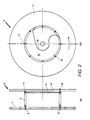
- Figure 2a is a side view of the S-cut bifilar spool, according to the present invention;
- Figure 2b is a front view of the S-cut bifilar spool, according to the present invention;
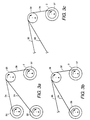
- Figures 3a-3c are various embodiments for winding superconducting tape from spools or insulator on the bifilar spool;
- Figures 4a and 4b are another embodiment for winding tape from spools or insulator on the bifilar spool;
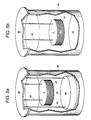
- Figure 5a is a schematic representation of the testing apparatus for evaluating the superconducting qualities of the bifilar winding while using an electro-magnetic field, according to the present invention;
- Figure 5b is a schematic representation of the testing apparatus which is similar to Figure 5a but without using an electro-magnetic field, according to the present invention;
- Figure 6 is another schematic representation of the testing apparatus which is similar to Figure 5b but where multiple bifilar windings are capable of being tested, according to the present invention;
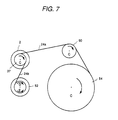
- Figure 7 is a schematic representation of the bifilar winding being unwound, according to the present invention; and
- Figure 8 is a graphical representation of the results attained from Figure 1 plotted against the results attained from using a superconducting tape having a rating of 58A/mm.
- With reference to Figures 2a and 2b, there is illustrated a
bifilar spool 2. Spool 2 includesflanges bobbin 6,conventional fasteners cut plate 10.Flanges bobbin 6 andplate 10, preferably, are constructed of any suitable fiberglass filled epoxy material or copper.Flange 4 is rigidly attached to one end ofbobbin 6 byfasteners 8. S-cut plate 10 is rigidly attached to the other end ofbobbin 6 byfasteners 12.Flange 14 is rigidly attached tobobbin 6 andplate 10 byfasteners 16. - With respect to S-
cut plate 10,plate 10 includesgroove 18. Groove 18, preferably, is milled inplate 10 by conventional machining techniques to a depth of approximately 4mm.Groove 18 is provided to allow the continuous superconducting tape 24 (Fig. 3a) to be captured byflange 14 and which also provides the minimum radius to avoid damaging the tape and allows the tape to be bifilarly wound. - Figures 3a-3d shows how
spool 2 is bifilarly wound withsuperconducting tape 24 coming from a supply spool orsuperconducting tape 30 coming from an insulator. In particular, with respect to Figure 3a, supply spools 20,22 which, typically, are wound with a niobium-tin, hereinafter referred to as Nb-Sn,tape conductor 24. The ends ofconductor 24 fromspools bifilar tape 28 overpulley 26. In the case of pig tail weld, thebifilar tape 28 is attached to bobbin 6 (Figure 2a) and in the case of in-line weld tape 28 is attached by conventional fastening techniques to groove 18 (Figures 2b) inbifilar spool 2.Spool 2 is rotated clockwise by a conventional rotating mechanism (not shown) along arrow A. The rotation ofspool 2 causes supply spools 20,22 to also rotate along the same direction A which, in turn, causestape 24 to come off ofspools bifilar tape 28, and become wound onspool 2 to form winding 37. After a sufficient amount of tape, preferably, 1000 to 30,000 feet, have been wound onspool 2, the winding process is stopped. Figure 3b shows howtapes 24 from a supply spool and 30 from a conventional insulator form abifilar tape 32 which is wound onspool 2 to form winding 37 according to the same technique as used in Figure 3a. Figure 3c depicts the winding ofbifilar tape 34 onspool 2 to form winding 37.Tape 34 is, preferably, constructed of two layers oftape 30 coming from insulator. It is to be understood that the winding techniques as shown in Figures 3a-3c require the use of a pig tail weld or in-line weld. - Figures 4a and 4b illustrate another embodiment for winding
tape 24 from spools orinsulator 30 onspool 2. However, only tape 24 will be discussed in this embodiment. In particular, a pig tail weld or in-line weld is not needed because in order to windtape 24 onspool 2, approximately one-half oftape 24 fromsupply spool 20 is wound ontosupply spool 22 in a counterclockwise direction along arrow B (Figure 4a). Next, a portion oftape 24 which spans between supply spools 20,22 is run overpulley 26 and placed in groove 18 (Figure 2b) in spool 2 (Figure 4b).Spool 2 is rotated in a clockwise direction along arrow A which now causesspool 20 to continue rotating along direction B andspool 22 to rotate along arrow A (Figure 4b). Again, once sufficient amount oftape 24 is wound onspool 2, the winding process is stopped. It is to be understood that Figures 4a and 4b represent the preferred method of winding bifilar tapes onspool 2 because no pig tail or in-line welds are used in the winding. It is well-known that welds or joints in the winding can adversely affect the superconducting properties of the winding so, if welds can be eliminated, it would be advantageous. - Figures 5a and 5b illustrate two methods for testing the superconducting quality of bifilar winding 37. With respect to Figure 5a, a
bifilar spool 2 which contains a superconducting winding 37 is placed in acontainer 46.Container 46 also holds a conventional electro-magnetic field generatingsuperconductive coil 40,liquid helium 44, and alid 48.Spool 2 andcoil 40 are electrically connected to a conventional control mechanism (not shown) bywires coil 40 is activated and a predetermined electromagnetic field or B field, typically, having a value of 0-7 Tesla, is placed oncoil 40. Once the field strength is known, the temperature of thespool 2 can be varied and the current through winding 37 can be kept constant, typically, at between 400 to 500 amps, until winding 37 quenches. Immediately aftercoil 37 quenches and as already discussed above, the temperature at whichcoil 37 quenches is compared with the values given in Figure 1 for a given field strength and current value to determine if winding 37 is good. It is to be understood that the temperature could be kept constant and the current varied untilcoil 37 quenched in order to achieve the same quantitative analysis as to the superconducting quality of winding 37. - Figure 5b shows another testing method for evaluating the superconducting quality of a superconducting tape. In this case, only a
bifilar spool 2 having a superconductor winding 37 is placed incontainer 46 along withliquid helium 44. As with the testing procedure carried out with Figure 5a, either the current or temperature is varied until winding 37 quenches and the results are compared with Figure 1. It is to be understood that in the particular testing apparatus set forth in Figure 5b, that electromagnetic field value equals 0 because no field is present incontainer 46. - The testing apparatus embodied in Figures 5a and 5b are an improvement over the prior testing procedures because winding 37 operates most efficiently at cryogenic temperatures so it is apparent that the winding should be tested at cryogenic temperatures to determine if the winding is good.
- The preferred method of testing is to use the apparatus set forth in Figure 5b. This is because when
coil 40 creates an electromagnetic field in winding 37, the field across the entire winding 37 is not uniform. Thus, when winding 37 quenches the quenching current and temperatures are fairly accurately determined but, it is difficult to determine at which point on winding 37 the winding was, for example, at a field value of 4T, when the quenching occurred. Assuming that 4T was the field value oncoil 40. Consequently, in order to avoid the possible problems associated with the apparatus in figure 5a, Figure 5b is preferred because B always equals zero which eliminates one parameter. It is to be understood though that the testing system embodied in Figure 5a may be used if, for example, it is difficult to stabilize the temperature withincontainer 46 or if there are any characteristics of winding 37 or the joints in winding 37 which would be specific to the field created bycoil 40. - Figure 6 illustrates yet another system for testing the quality of the tapes. This system is similar to the apparatus embodied in Figure 5b, in that, no field is being used in
container 46. However, in this particular testing embodiment,several windings container 46.Container 46 also includesliquid helium 44.Spools container 46 by aconventional holder 48.Holder 48 should be constructed as to allowhelium 44 or its vapor to contactwindings spools holder 48 should allow the operator to be able to test the quality of winding 37a without adversely affecting the superconducting characteristics ofwindings 37b and 37c. The testing procedure fortesting windings windings - Figure 7 illustrates how winding 37 is unrolled from
bifilar spool 2 after winding 37 has been tested and winding 37 was found to be good. In particular,tapes Tape 24a is then run over aconventional pulley 50 and wound on aconventional magnet cartridge 54.Tape 24b is placed ontransition spool 52 and wound onspool 52 so thatspool 52 rotates along arrow E. Asspool 52 is rotated by a conventional rotating device (not shown) in a counterclockwise direction along arrow E andcartridge 54 is rotated by a conventional rotating device (not shown) in a clockwise direction along arrow C, winding 37 becomes unwound fromspool 2. Once all thetape spool 2,cartridge 54 continues to rotate such thattape 24b is now being unwound directly fromtransition spool 52 so thatspool 52 now rotates alongarrow E. Tape 24b is capable of being directly unwound bycartridge 54 due to the groove 18 (Figure 2b) inspool 2. - Figure 8 is a graphical representation of the results from Figure 1 for a 48A/mm conducting tape using temperature in degrees K as the abscissa and current in amps as the ordinate. As can be seen when B=O for a 48A/mm tape, the values plotted follow a relatively straight line. This is important because when another tape, for example, a 58A/mm is used, the plotted values should also follow a straight line when B=O. Also, Figure 8 shows that for the same conditions, namely, the same B, T and current values, the 58A/mm tape is a better conducting tape because it quenches at a higher temperature and a higher current than a 48 A/mm tape.
- Once given the above disclosure, many other features, modifications or improvements will become apparent to the skilled artisan. Such features, modifications or improvements are, therefore, considered to be a part of this invention, the scope of which is to be determined by the following claims.
Claims (10)
- An apparatus for evaluating the superconducting quality of a superconducting material said apparatus is comprised of:
a spool means having a superconducting winding substantially wrapped around said spool means;
a cooling means for cooling said spool means to approximately cryogenic temperatures;
a holding means for holding said spool means and said cooling means; and
an evaluation means for testing said winding to determine if said winding has a predetermined superconducting value. - The evaluation apparatus, according to claim 1, wherein said spool means is further comprised of:
an S-cut groove means in which a portion of said winding is located. - The evaluation apparatus, according to claim 1, wherein said cooling means is further comprised of:
liquid helium. - The evaluation apparatus, according to claim 1, wherein said holding means is further comprised of:
a container, and
a first holder located within said container. - The evaluation apparatus, according to claim 1, wherein said evaluation means is further comprised of:
an electromagnetic field producing means;
a temperature sensing means; and
an electric current measuring means. - The evaluation apparatus, according to claim 1, wherein said superconducting winding is further comprised:
a bifilar winding. - A method for evaluating the superconducting quality of a superconducting material having a spool means including a bifilar winding, a cooling means, a holding means including a lid means and an evaluation means, said method comprised of the steps of:
placing said cooling means in said container means;
placing said spool means in said container means;
placing said lid means on said container means; and
testing said winding to determine if said winding has a predetermined superconducting value. - The evaluation method, according to claim 7, wherein said testing step is further comprised of the steps of:
placing a current in said winding; and
observing and recording a temperature of said winding until said winding substantially quenches. - The evaluation method, according to Claim 7, wherein said testing step is further comprised of the steps of :
regulating a temperature of said winding; and
observing and recording a current in said winding until said winding substantially quenches. - The evaluation method of Claim 1 wherein the superconducting material includes a coil means located adjacent to said winding, and wherein said testing step is (a) further comprised of the steps of :
placing a predetermined electro-magnetic field in said coil means;
placing a current in said winding; and
observing and recording a temperature of said winding until said winding substantially quenches;
or is (b) further comprised the steps of :
placing a predetermined electro-magnetic field in said coil means;
regulating a temperature of said winding; and
observing and recording a current in said winding until said winding substantially quenches.
Applications Claiming Priority (2)
| Application Number | Priority Date | Filing Date | Title |
|---|---|---|---|
| US710595 | 1991-06-05 | ||
| US07/710,595 US5140266A (en) | 1991-06-05 | 1991-06-05 | Apparatus and method for the non-destructive evaluation of a bifilar superconducting winding |
Publications (3)
| Publication Number | Publication Date |
|---|---|
| EP0517455A2 true EP0517455A2 (en) | 1992-12-09 |
| EP0517455A3 EP0517455A3 (en) | 1993-05-19 |
| EP0517455B1 EP0517455B1 (en) | 1999-09-08 |
Family
ID=24854699
Family Applications (1)
| Application Number | Title | Priority Date | Filing Date |
|---|---|---|---|
| EP92304974A Expired - Lifetime EP0517455B1 (en) | 1991-06-05 | 1992-06-01 | Non-destructive evaluation apparatus and method for superconducting materials |
Country Status (4)
| Country | Link |
|---|---|
| US (1) | US5140266A (en) |
| EP (1) | EP0517455B1 (en) |
| JP (1) | JPH0823550B2 (en) |
| DE (1) | DE69229933T2 (en) |
Families Citing this family (11)
| Publication number | Priority date | Publication date | Assignee | Title |
|---|---|---|---|---|
| US5227720A (en) * | 1992-04-02 | 1993-07-13 | General Electric Company | Apparatus and method using a bifilar coil with an integrated loop/switch for resistance measurement of superconductors |
| JP3705861B2 (en) * | 1996-03-21 | 2005-10-12 | 株式会社日立メディコ | Superconducting magnet device and method for adjusting magnetization thereof |
| US6275365B1 (en) * | 1998-02-09 | 2001-08-14 | American Superconductor Corporation | Resistive fault current limiter |
| US6900714B1 (en) * | 2004-06-30 | 2005-05-31 | General Electric Company | System and method for quench and over-current protection of superconductor |
| JP5696941B2 (en) * | 2011-08-08 | 2015-04-08 | 住友電気工業株式会社 | Measuring method of critical current |
| JP5696942B2 (en) * | 2011-08-08 | 2015-04-08 | 住友電気工業株式会社 | Test method for cable core for superconducting cable |
| JP2013036842A (en) * | 2011-08-08 | 2013-02-21 | Sumitomo Electric Ind Ltd | Method for testing cable core for superconductive cables and cooling container |
| JP2013036844A (en) * | 2011-08-08 | 2013-02-21 | Sumitomo Electric Ind Ltd | Method for testing cable core |
| JP2013036841A (en) * | 2011-08-08 | 2013-02-21 | Sumitomo Electric Ind Ltd | Method for testing cable core for superconductive cable |
| KR101296810B1 (en) * | 2011-11-03 | 2013-08-14 | 한국전기연구원 | a testing device of multi-superconducting coil |
| CN104718459A (en) * | 2012-10-11 | 2015-06-17 | 住友电气工业株式会社 | Method for testing cable core for superconducting cable, and cooling container |
Family Cites Families (6)
| Publication number | Priority date | Publication date | Assignee | Title |
|---|---|---|---|---|
| JPS61111588A (en) * | 1984-11-05 | 1986-05-29 | Toshiba Corp | Device for critical current measurement of superconductive wire |
| JPS6336506A (en) * | 1986-07-31 | 1988-02-17 | Hitachi Ltd | Method for detecting transition of superconducting winding to normal conduction |
| JPS6425488A (en) * | 1987-07-22 | 1989-01-27 | Toshiba Corp | Superconduction detector |
| US4803456A (en) * | 1987-12-22 | 1989-02-07 | General Electric Company | Superconductive switch |
| US4904970A (en) * | 1988-02-17 | 1990-02-27 | General Electric Company | Superconductive switch |
| US5204650A (en) * | 1990-04-27 | 1993-04-20 | Railway Technical Research Institute | Switch for controlling current flow in superconductors |
-
1991
- 1991-06-05 US US07/710,595 patent/US5140266A/en not_active Expired - Fee Related
-
1992
- 1992-06-01 EP EP92304974A patent/EP0517455B1/en not_active Expired - Lifetime
- 1992-06-01 DE DE69229933T patent/DE69229933T2/en not_active Expired - Fee Related
- 1992-06-04 JP JP4143935A patent/JPH0823550B2/en not_active Expired - Fee Related
Also Published As
| Publication number | Publication date |
|---|---|
| DE69229933T2 (en) | 2000-05-18 |
| EP0517455B1 (en) | 1999-09-08 |
| EP0517455A3 (en) | 1993-05-19 |
| DE69229933D1 (en) | 1999-10-14 |
| JPH05249213A (en) | 1993-09-28 |
| US5140266A (en) | 1992-08-18 |
| JPH0823550B2 (en) | 1996-03-06 |
Similar Documents
| Publication | Publication Date | Title |
|---|---|---|
| US5140266A (en) | Apparatus and method for the non-destructive evaluation of a bifilar superconducting winding | |
| EP0646790B1 (en) | Method and apparatus for detecting embrittlement of metal material | |
| US5793205A (en) | Coil and guide system for eddy current examination of pipe | |
| US3976934A (en) | Method and apparatus for the continuous, contactless testing of a long conductor which consists at least partially of superconductive material | |
| US4480225A (en) | Improved multi-directional eddy current inspection test apparatus for detecting flaws in metal articles | |
| US3940996A (en) | Method and device for remotely monitoring electrically conductive liquids | |
| KR20140077968A (en) | Method and apparatus for demagnetizing generator components prior to electromagnetic core imperfection testing or el-cid testing | |
| US4922200A (en) | Apparatus for measuring the hysteresis loop of magnetic film | |
| US5218296A (en) | Method and apparatus for determining at least one characteristic of a superconductive film | |
| EP0641433B1 (en) | Apparatus for non-destructive testing of dielectric/magnetic materials | |
| JPH11501401A (en) | Inspection method and inspection device for pipe by eddy current | |
| EP4209795B1 (en) | Optimizing transformer exciting current and loss test results by dynamically managing core magnetic state | |
| US5777469A (en) | Method and apparatus for detecting flaws in conductive material | |
| US4864236A (en) | Wire inhomogeneity detector having a core with opposing pole pieces and guide pieces adjacent the opposing pole pieces | |
| US20200200841A1 (en) | Method for evaluating the electrical properties of a hts superconductor | |
| US4132949A (en) | Method and apparatus for the continuous, contactless testing of an elongated conductor which consists at least partially of superconductive material | |
| KR920000712B1 (en) | An immediately testable superconductor joint | |
| US5648720A (en) | Apparatus and method for producing a magnetic image of a conductive pattern using eddy currents | |
| DE19638776A1 (en) | Process for the non-destructive testing of a test object with a weld seam made of magnetizable material | |
| US5907102A (en) | System and method for performing tensile stress-strain and fatigue tests | |
| JP3996830B2 (en) | Method and apparatus for measuring critical current characteristics of superconducting wire | |
| US5365170A (en) | Measurement of magnetic properties of electrical steels using a search coil partially defined by a fluid electrolyte | |
| JPH07167839A (en) | Inspection coil for electromagnetic induction flaw detection and flaw detection method | |
| Desportes et al. | General Design and Conductor Study for the" ALEPH" Superconducting Solenoid | |
| JPH04370906A (en) | Method and apparatus for winding of drawn wire |
Legal Events
| Date | Code | Title | Description |
|---|---|---|---|
| PUAI | Public reference made under article 153(3) epc to a published international application that has entered the european phase |
Free format text: ORIGINAL CODE: 0009012 |
|
| AK | Designated contracting states |
Kind code of ref document: A2 Designated state(s): DE GB NL |
|
| PUAL | Search report despatched |
Free format text: ORIGINAL CODE: 0009013 |
|
| AK | Designated contracting states |
Kind code of ref document: A3 Designated state(s): DE GB NL |
|
| 17P | Request for examination filed |
Effective date: 19931102 |
|
| 17Q | First examination report despatched |
Effective date: 19951220 |
|
| GRAG | Despatch of communication of intention to grant |
Free format text: ORIGINAL CODE: EPIDOS AGRA |
|
| GRAG | Despatch of communication of intention to grant |
Free format text: ORIGINAL CODE: EPIDOS AGRA |
|
| GRAH | Despatch of communication of intention to grant a patent |
Free format text: ORIGINAL CODE: EPIDOS IGRA |
|
| GRAH | Despatch of communication of intention to grant a patent |
Free format text: ORIGINAL CODE: EPIDOS IGRA |
|
| GRAA | (expected) grant |
Free format text: ORIGINAL CODE: 0009210 |
|
| AK | Designated contracting states |
Kind code of ref document: B1 Designated state(s): DE GB NL |
|
| REF | Corresponds to: |
Ref document number: 69229933 Country of ref document: DE Date of ref document: 19991014 |
|
| PLBE | No opposition filed within time limit |
Free format text: ORIGINAL CODE: 0009261 |
|
| STAA | Information on the status of an ep patent application or granted ep patent |
Free format text: STATUS: NO OPPOSITION FILED WITHIN TIME LIMIT |
|
| 26N | No opposition filed | ||
| REG | Reference to a national code |
Ref country code: GB Ref legal event code: IF02 |
|
| PGFP | Annual fee paid to national office [announced via postgrant information from national office to epo] |
Ref country code: NL Payment date: 20030522 Year of fee payment: 12 |
|
| PGFP | Annual fee paid to national office [announced via postgrant information from national office to epo] |
Ref country code: GB Payment date: 20030528 Year of fee payment: 12 |
|
| PGFP | Annual fee paid to national office [announced via postgrant information from national office to epo] |
Ref country code: DE Payment date: 20030630 Year of fee payment: 12 |
|
| PG25 | Lapsed in a contracting state [announced via postgrant information from national office to epo] |
Ref country code: GB Free format text: LAPSE BECAUSE OF NON-PAYMENT OF DUE FEES Effective date: 20040601 |
|
| PG25 | Lapsed in a contracting state [announced via postgrant information from national office to epo] |
Ref country code: NL Free format text: LAPSE BECAUSE OF NON-PAYMENT OF DUE FEES Effective date: 20050101 Ref country code: DE Free format text: LAPSE BECAUSE OF NON-PAYMENT OF DUE FEES Effective date: 20050101 |
|
| GBPC | Gb: european patent ceased through non-payment of renewal fee | ||
| NLV4 | Nl: lapsed or anulled due to non-payment of the annual fee |
Effective date: 20050101 |