EP0494376B1 - An improved process for the preparation of high chloride tabular grain emulsions - Google Patents
An improved process for the preparation of high chloride tabular grain emulsions Download PDFInfo
- Publication number
- EP0494376B1 EP0494376B1 EP91120903A EP91120903A EP0494376B1 EP 0494376 B1 EP0494376 B1 EP 0494376B1 EP 91120903 A EP91120903 A EP 91120903A EP 91120903 A EP91120903 A EP 91120903A EP 0494376 B1 EP0494376 B1 EP 0494376B1
- Authority
- EP
- European Patent Office
- Prior art keywords
- silver
- ion
- dispersing medium
- chloride
- process according
- Prior art date
- Legal status (The legal status is an assumption and is not a legal conclusion. Google has not performed a legal analysis and makes no representation as to the accuracy of the status listed.)
- Expired - Lifetime
Links
- 239000000839 emulsion Substances 0.000 title claims description 96
- VEXZGXHMUGYJMC-UHFFFAOYSA-M Chloride anion Chemical compound [Cl-] VEXZGXHMUGYJMC-UHFFFAOYSA-M 0.000 title claims description 72
- 238000000034 method Methods 0.000 title claims description 36
- 230000008569 process Effects 0.000 title claims description 32
- 238000002360 preparation method Methods 0.000 title description 9
- 229910052709 silver Inorganic materials 0.000 claims description 38
- 239000004332 silver Substances 0.000 claims description 38
- -1 silver halide Chemical class 0.000 claims description 38
- BQCADISMDOOEFD-UHFFFAOYSA-N Silver Chemical compound [Ag] BQCADISMDOOEFD-UHFFFAOYSA-N 0.000 claims description 27
- 239000013078 crystal Substances 0.000 claims description 27
- ZMZDMBWJUHKJPS-UHFFFAOYSA-N hydrogen thiocyanate Natural products SC#N ZMZDMBWJUHKJPS-UHFFFAOYSA-N 0.000 claims description 23
- 229910021607 Silver chloride Inorganic materials 0.000 claims description 21
- HKZLPVFGJNLROG-UHFFFAOYSA-M silver monochloride Chemical compound [Cl-].[Ag+] HKZLPVFGJNLROG-UHFFFAOYSA-M 0.000 claims description 21
- 230000006911 nucleation Effects 0.000 claims description 20
- 238000010899 nucleation Methods 0.000 claims description 20
- FOIXSVOLVBLSDH-UHFFFAOYSA-N Silver ion Chemical compound [Ag+] FOIXSVOLVBLSDH-UHFFFAOYSA-N 0.000 claims description 16
- 230000015572 biosynthetic process Effects 0.000 claims description 15
- CPELXLSAUQHCOX-UHFFFAOYSA-M Bromide Chemical compound [Br-] CPELXLSAUQHCOX-UHFFFAOYSA-M 0.000 claims description 7
- 230000005855 radiation Effects 0.000 claims description 6
- 229940006460 bromide ion Drugs 0.000 claims description 2
- XMBWDFGMSWQBCA-UHFFFAOYSA-M iodide Chemical compound [I-] XMBWDFGMSWQBCA-UHFFFAOYSA-M 0.000 claims 2
- 229940006461 iodide ion Drugs 0.000 claims 2
- 238000006243 chemical reaction Methods 0.000 description 24
- 238000001556 precipitation Methods 0.000 description 23
- ZMZDMBWJUHKJPS-UHFFFAOYSA-M Thiocyanate anion Chemical compound [S-]C#N ZMZDMBWJUHKJPS-UHFFFAOYSA-M 0.000 description 21
- SQGYOTSLMSWVJD-UHFFFAOYSA-N silver(1+) nitrate Chemical compound [Ag+].[O-]N(=O)=O SQGYOTSLMSWVJD-UHFFFAOYSA-N 0.000 description 21
- 239000003607 modifier Substances 0.000 description 14
- VGTPCRGMBIAPIM-UHFFFAOYSA-M sodium thiocyanate Chemical compound [Na+].[S-]C#N VGTPCRGMBIAPIM-UHFFFAOYSA-M 0.000 description 13
- 230000008901 benefit Effects 0.000 description 11
- 239000000243 solution Substances 0.000 description 10
- QGZKDVFQNNGYKY-UHFFFAOYSA-N Ammonia Chemical compound N QGZKDVFQNNGYKY-UHFFFAOYSA-N 0.000 description 8
- 108010010803 Gelatin Proteins 0.000 description 6
- FAPWRFPIFSIZLT-UHFFFAOYSA-M Sodium chloride Chemical compound [Na+].[Cl-] FAPWRFPIFSIZLT-UHFFFAOYSA-M 0.000 description 6
- 229920000159 gelatin Polymers 0.000 description 6
- 239000008273 gelatin Substances 0.000 description 6
- 235000019322 gelatine Nutrition 0.000 description 6
- 235000011852 gelatine desserts Nutrition 0.000 description 6
- FFEARJCKVFRZRR-BYPYZUCNSA-N L-methionine Chemical compound CSCC[C@H](N)C(O)=O FFEARJCKVFRZRR-BYPYZUCNSA-N 0.000 description 5
- 150000004820 halides Chemical class 0.000 description 5
- 229930182817 methionine Natural products 0.000 description 5
- 230000005070 ripening Effects 0.000 description 5
- 239000012266 salt solution Substances 0.000 description 5
- 229910021529 ammonia Inorganic materials 0.000 description 4
- 210000000988 bone and bone Anatomy 0.000 description 4
- 230000000694 effects Effects 0.000 description 4
- XMBWDFGMSWQBCA-UHFFFAOYSA-N hydrogen iodide Chemical compound I XMBWDFGMSWQBCA-UHFFFAOYSA-N 0.000 description 4
- 230000001965 increasing effect Effects 0.000 description 4
- 150000002500 ions Chemical class 0.000 description 4
- RHUVFRWZKMEWNS-UHFFFAOYSA-M silver thiocyanate Chemical compound [Ag+].[S-]C#N RHUVFRWZKMEWNS-UHFFFAOYSA-M 0.000 description 4
- GGCZERPQGJTIQP-UHFFFAOYSA-N sodium;9,10-dioxoanthracene-2-sulfonic acid Chemical compound [Na+].C1=CC=C2C(=O)C3=CC(S(=O)(=O)O)=CC=C3C(=O)C2=C1 GGCZERPQGJTIQP-UHFFFAOYSA-N 0.000 description 4
- XLYOFNOQVPJJNP-UHFFFAOYSA-N water Substances O XLYOFNOQVPJJNP-UHFFFAOYSA-N 0.000 description 4
- UXVMQQNJUSDDNG-UHFFFAOYSA-L Calcium chloride Chemical compound [Cl-].[Cl-].[Ca+2] UXVMQQNJUSDDNG-UHFFFAOYSA-L 0.000 description 3
- 239000001110 calcium chloride Substances 0.000 description 3
- 235000011148 calcium chloride Nutrition 0.000 description 3
- 229910001628 calcium chloride Inorganic materials 0.000 description 3
- 239000012153 distilled water Substances 0.000 description 3
- 230000001747 exhibiting effect Effects 0.000 description 3
- 238000011835 investigation Methods 0.000 description 3
- ADZWSOLPGZMUMY-UHFFFAOYSA-M silver bromide Chemical compound [Ag]Br ADZWSOLPGZMUMY-UHFFFAOYSA-M 0.000 description 3
- 229910001961 silver nitrate Inorganic materials 0.000 description 3
- 239000011780 sodium chloride Substances 0.000 description 3
- IHWDSEPNZDYMNF-UHFFFAOYSA-N 1H-indol-2-amine Chemical class C1=CC=C2NC(N)=CC2=C1 IHWDSEPNZDYMNF-UHFFFAOYSA-N 0.000 description 2
- SJOOOZPMQAWAOP-UHFFFAOYSA-N [Ag].BrCl Chemical compound [Ag].BrCl SJOOOZPMQAWAOP-UHFFFAOYSA-N 0.000 description 2
- 239000002253 acid Substances 0.000 description 2
- 229910052783 alkali metal Inorganic materials 0.000 description 2
- 150000001340 alkali metals Chemical class 0.000 description 2
- SOIFLUNRINLCBN-UHFFFAOYSA-N ammonium thiocyanate Chemical class [NH4+].[S-]C#N SOIFLUNRINLCBN-UHFFFAOYSA-N 0.000 description 2
- 239000003795 chemical substances by application Substances 0.000 description 2
- 150000003841 chloride salts Chemical class 0.000 description 2
- 239000011248 coating agent Substances 0.000 description 2
- 238000000576 coating method Methods 0.000 description 2
- 230000006870 function Effects 0.000 description 2
- 125000000623 heterocyclic group Chemical group 0.000 description 2
- CBEQRNSPHCCXSH-UHFFFAOYSA-N iodine monobromide Chemical compound IBr CBEQRNSPHCCXSH-UHFFFAOYSA-N 0.000 description 2
- 239000003446 ligand Substances 0.000 description 2
- 238000004519 manufacturing process Methods 0.000 description 2
- 239000007800 oxidant agent Substances 0.000 description 2
- 230000009467 reduction Effects 0.000 description 2
- 230000004044 response Effects 0.000 description 2
- JHJLBTNAGRQEKS-UHFFFAOYSA-M sodium bromide Chemical compound [Na+].[Br-] JHJLBTNAGRQEKS-UHFFFAOYSA-M 0.000 description 2
- 230000003595 spectral effect Effects 0.000 description 2
- UMGDCJDMYOKAJW-UHFFFAOYSA-N thiourea Chemical compound NC(N)=S UMGDCJDMYOKAJW-UHFFFAOYSA-N 0.000 description 2
- JKFYKCYQEWQPTM-UHFFFAOYSA-N 2-azaniumyl-2-(4-fluorophenyl)acetate Chemical compound OC(=O)C(N)C1=CC=C(F)C=C1 JKFYKCYQEWQPTM-UHFFFAOYSA-N 0.000 description 1
- QGZKDVFQNNGYKY-UHFFFAOYSA-O Ammonium Chemical compound [NH4+] QGZKDVFQNNGYKY-UHFFFAOYSA-O 0.000 description 1
- OYPRJOBELJOOCE-UHFFFAOYSA-N Calcium Chemical compound [Ca] OYPRJOBELJOOCE-UHFFFAOYSA-N 0.000 description 1
- DGAQECJNVWCQMB-PUAWFVPOSA-M Ilexoside XXIX Chemical compound C[C@@H]1CC[C@@]2(CC[C@@]3(C(=CC[C@H]4[C@]3(CC[C@@H]5[C@@]4(CC[C@@H](C5(C)C)OS(=O)(=O)[O-])C)C)[C@@H]2[C@]1(C)O)C)C(=O)O[C@H]6[C@@H]([C@H]([C@@H]([C@H](O6)CO)O)O)O.[Na+] DGAQECJNVWCQMB-PUAWFVPOSA-M 0.000 description 1
- WHXSMMKQMYFTQS-UHFFFAOYSA-N Lithium Chemical compound [Li] WHXSMMKQMYFTQS-UHFFFAOYSA-N 0.000 description 1
- FYYHWMGAXLPEAU-UHFFFAOYSA-N Magnesium Chemical compound [Mg] FYYHWMGAXLPEAU-UHFFFAOYSA-N 0.000 description 1
- GRYLNZFGIOXLOG-UHFFFAOYSA-N Nitric acid Chemical compound O[N+]([O-])=O GRYLNZFGIOXLOG-UHFFFAOYSA-N 0.000 description 1
- ZLMJMSJWJFRBEC-UHFFFAOYSA-N Potassium Chemical compound [K] ZLMJMSJWJFRBEC-UHFFFAOYSA-N 0.000 description 1
- 206010070834 Sensitisation Diseases 0.000 description 1
- 229910021612 Silver iodide Inorganic materials 0.000 description 1
- NINIDFKCEFEMDL-UHFFFAOYSA-N Sulfur Chemical group [S] NINIDFKCEFEMDL-UHFFFAOYSA-N 0.000 description 1
- XSQUKJJJFZCRTK-UHFFFAOYSA-N Urea Natural products NC(N)=O XSQUKJJJFZCRTK-UHFFFAOYSA-N 0.000 description 1
- HOLVRJRSWZOAJU-UHFFFAOYSA-N [Ag].ICl Chemical compound [Ag].ICl HOLVRJRSWZOAJU-UHFFFAOYSA-N 0.000 description 1
- 150000001260 acyclic compounds Chemical class 0.000 description 1
- 229910052784 alkaline earth metal Inorganic materials 0.000 description 1
- 150000001342 alkaline earth metals Chemical class 0.000 description 1
- 230000029936 alkylation Effects 0.000 description 1
- 238000005804 alkylation reaction Methods 0.000 description 1
- 239000007864 aqueous solution Substances 0.000 description 1
- 229910052788 barium Inorganic materials 0.000 description 1
- DSAJWYNOEDNPEQ-UHFFFAOYSA-N barium atom Chemical compound [Ba] DSAJWYNOEDNPEQ-UHFFFAOYSA-N 0.000 description 1
- 239000011230 binding agent Substances 0.000 description 1
- 229910052791 calcium Inorganic materials 0.000 description 1
- 239000011575 calcium Substances 0.000 description 1
- 230000015556 catabolic process Effects 0.000 description 1
- AGOYDEPGAOXOCK-KCBOHYOISA-N clarithromycin Chemical compound O([C@@H]1[C@@H](C)C(=O)O[C@@H]([C@@]([C@H](O)[C@@H](C)C(=O)[C@H](C)C[C@](C)([C@H](O[C@H]2[C@@H]([C@H](C[C@@H](C)O2)N(C)C)O)[C@H]1C)OC)(C)O)CC)[C@H]1C[C@@](C)(OC)[C@@H](O)[C@H](C)O1 AGOYDEPGAOXOCK-KCBOHYOISA-N 0.000 description 1
- 230000001186 cumulative effect Effects 0.000 description 1
- 238000006731 degradation reaction Methods 0.000 description 1
- 230000008021 deposition Effects 0.000 description 1
- 239000006185 dispersion Substances 0.000 description 1
- 239000000975 dye Substances 0.000 description 1
- 238000003384 imaging method Methods 0.000 description 1
- 230000006872 improvement Effects 0.000 description 1
- 230000001939 inductive effect Effects 0.000 description 1
- 229910052500 inorganic mineral Inorganic materials 0.000 description 1
- 230000002452 interceptive effect Effects 0.000 description 1
- 229910052744 lithium Inorganic materials 0.000 description 1
- 229910052749 magnesium Inorganic materials 0.000 description 1
- 239000011777 magnesium Substances 0.000 description 1
- 239000000463 material Substances 0.000 description 1
- 230000007246 mechanism Effects 0.000 description 1
- 239000011707 mineral Substances 0.000 description 1
- 235000010755 mineral Nutrition 0.000 description 1
- 239000000203 mixture Substances 0.000 description 1
- SCWKACOBHZIKDI-UHFFFAOYSA-N n-[3-(5-sulfanylidene-2h-tetrazol-1-yl)phenyl]acetamide Chemical compound CC(=O)NC1=CC=CC(N2C(N=NN2)=S)=C1 SCWKACOBHZIKDI-UHFFFAOYSA-N 0.000 description 1
- 229910017604 nitric acid Inorganic materials 0.000 description 1
- 239000002667 nucleating agent Substances 0.000 description 1
- 230000003287 optical effect Effects 0.000 description 1
- 230000003647 oxidation Effects 0.000 description 1
- 238000007254 oxidation reaction Methods 0.000 description 1
- 230000001590 oxidative effect Effects 0.000 description 1
- 230000000737 periodic effect Effects 0.000 description 1
- 229910052700 potassium Inorganic materials 0.000 description 1
- 239000011591 potassium Substances 0.000 description 1
- ZNNZYHKDIALBAK-UHFFFAOYSA-M potassium thiocyanate Chemical compound [K+].[S-]C#N ZNNZYHKDIALBAK-UHFFFAOYSA-M 0.000 description 1
- 238000000634 powder X-ray diffraction Methods 0.000 description 1
- 150000003839 salts Chemical class 0.000 description 1
- 230000008313 sensitization Effects 0.000 description 1
- 230000001235 sensitizing effect Effects 0.000 description 1
- 238000000926 separation method Methods 0.000 description 1
- 229940045105 silver iodide Drugs 0.000 description 1
- 239000010802 sludge Substances 0.000 description 1
- 229910052708 sodium Inorganic materials 0.000 description 1
- 239000011734 sodium Substances 0.000 description 1
- 238000001179 sorption measurement Methods 0.000 description 1
- 239000003381 stabilizer Substances 0.000 description 1
- 239000000126 substance Substances 0.000 description 1
- 229910052717 sulfur Inorganic materials 0.000 description 1
- 125000004434 sulfur atom Chemical group 0.000 description 1
- 239000006228 supernatant Substances 0.000 description 1
- 230000002459 sustained effect Effects 0.000 description 1
- 229920001059 synthetic polymer Polymers 0.000 description 1
Images
Classifications
-
- G—PHYSICS
- G03—PHOTOGRAPHY; CINEMATOGRAPHY; ANALOGOUS TECHNIQUES USING WAVES OTHER THAN OPTICAL WAVES; ELECTROGRAPHY; HOLOGRAPHY
- G03C—PHOTOSENSITIVE MATERIALS FOR PHOTOGRAPHIC PURPOSES; PHOTOGRAPHIC PROCESSES, e.g. CINE, X-RAY, COLOUR, STEREO-PHOTOGRAPHIC PROCESSES; AUXILIARY PROCESSES IN PHOTOGRAPHY
- G03C1/00—Photosensitive materials
- G03C1/005—Silver halide emulsions; Preparation thereof; Physical treatment thereof; Incorporation of additives therein
- G03C1/06—Silver halide emulsions; Preparation thereof; Physical treatment thereof; Incorporation of additives therein with non-macromolecular additives
- G03C1/07—Substances influencing grain growth during silver salt formation
-
- G—PHYSICS
- G03—PHOTOGRAPHY; CINEMATOGRAPHY; ANALOGOUS TECHNIQUES USING WAVES OTHER THAN OPTICAL WAVES; ELECTROGRAPHY; HOLOGRAPHY
- G03C—PHOTOSENSITIVE MATERIALS FOR PHOTOGRAPHIC PURPOSES; PHOTOGRAPHIC PROCESSES, e.g. CINE, X-RAY, COLOUR, STEREO-PHOTOGRAPHIC PROCESSES; AUXILIARY PROCESSES IN PHOTOGRAPHY
- G03C1/00—Photosensitive materials
- G03C1/005—Silver halide emulsions; Preparation thereof; Physical treatment thereof; Incorporation of additives therein
- G03C1/0051—Tabular grain emulsions
- G03C1/0053—Tabular grain emulsions with high content of silver chloride
-
- G—PHYSICS
- G03—PHOTOGRAPHY; CINEMATOGRAPHY; ANALOGOUS TECHNIQUES USING WAVES OTHER THAN OPTICAL WAVES; ELECTROGRAPHY; HOLOGRAPHY
- G03C—PHOTOSENSITIVE MATERIALS FOR PHOTOGRAPHIC PURPOSES; PHOTOGRAPHIC PROCESSES, e.g. CINE, X-RAY, COLOUR, STEREO-PHOTOGRAPHIC PROCESSES; AUXILIARY PROCESSES IN PHOTOGRAPHY
- G03C1/00—Photosensitive materials
- G03C1/005—Silver halide emulsions; Preparation thereof; Physical treatment thereof; Incorporation of additives therein
- G03C1/015—Apparatus or processes for the preparation of emulsions
-
- G—PHYSICS
- G03—PHOTOGRAPHY; CINEMATOGRAPHY; ANALOGOUS TECHNIQUES USING WAVES OTHER THAN OPTICAL WAVES; ELECTROGRAPHY; HOLOGRAPHY
- G03C—PHOTOSENSITIVE MATERIALS FOR PHOTOGRAPHIC PURPOSES; PHOTOGRAPHIC PROCESSES, e.g. CINE, X-RAY, COLOUR, STEREO-PHOTOGRAPHIC PROCESSES; AUXILIARY PROCESSES IN PHOTOGRAPHY
- G03C1/00—Photosensitive materials
- G03C1/005—Silver halide emulsions; Preparation thereof; Physical treatment thereof; Incorporation of additives therein
- G03C1/0051—Tabular grain emulsions
- G03C2001/0055—Aspect ratio of tabular grains in general; High aspect ratio; Intermediate aspect ratio; Low aspect ratio
-
- G—PHYSICS
- G03—PHOTOGRAPHY; CINEMATOGRAPHY; ANALOGOUS TECHNIQUES USING WAVES OTHER THAN OPTICAL WAVES; ELECTROGRAPHY; HOLOGRAPHY
- G03C—PHOTOSENSITIVE MATERIALS FOR PHOTOGRAPHIC PURPOSES; PHOTOGRAPHIC PROCESSES, e.g. CINE, X-RAY, COLOUR, STEREO-PHOTOGRAPHIC PROCESSES; AUXILIARY PROCESSES IN PHOTOGRAPHY
- G03C1/00—Photosensitive materials
- G03C1/005—Silver halide emulsions; Preparation thereof; Physical treatment thereof; Incorporation of additives therein
- G03C1/035—Silver halide emulsions; Preparation thereof; Physical treatment thereof; Incorporation of additives therein characterised by the crystal form or composition, e.g. mixed grain
- G03C2001/03511—Bromide content
-
- G—PHYSICS
- G03—PHOTOGRAPHY; CINEMATOGRAPHY; ANALOGOUS TECHNIQUES USING WAVES OTHER THAN OPTICAL WAVES; ELECTROGRAPHY; HOLOGRAPHY
- G03C—PHOTOSENSITIVE MATERIALS FOR PHOTOGRAPHIC PURPOSES; PHOTOGRAPHIC PROCESSES, e.g. CINE, X-RAY, COLOUR, STEREO-PHOTOGRAPHIC PROCESSES; AUXILIARY PROCESSES IN PHOTOGRAPHY
- G03C1/00—Photosensitive materials
- G03C1/005—Silver halide emulsions; Preparation thereof; Physical treatment thereof; Incorporation of additives therein
- G03C1/035—Silver halide emulsions; Preparation thereof; Physical treatment thereof; Incorporation of additives therein characterised by the crystal form or composition, e.g. mixed grain
- G03C2001/03517—Chloride content
-
- G—PHYSICS
- G03—PHOTOGRAPHY; CINEMATOGRAPHY; ANALOGOUS TECHNIQUES USING WAVES OTHER THAN OPTICAL WAVES; ELECTROGRAPHY; HOLOGRAPHY
- G03C—PHOTOSENSITIVE MATERIALS FOR PHOTOGRAPHIC PURPOSES; PHOTOGRAPHIC PROCESSES, e.g. CINE, X-RAY, COLOUR, STEREO-PHOTOGRAPHIC PROCESSES; AUXILIARY PROCESSES IN PHOTOGRAPHY
- G03C2200/00—Details
- G03C2200/03—111 crystal face
-
- G—PHYSICS
- G03—PHOTOGRAPHY; CINEMATOGRAPHY; ANALOGOUS TECHNIQUES USING WAVES OTHER THAN OPTICAL WAVES; ELECTROGRAPHY; HOLOGRAPHY
- G03C—PHOTOSENSITIVE MATERIALS FOR PHOTOGRAPHIC PURPOSES; PHOTOGRAPHIC PROCESSES, e.g. CINE, X-RAY, COLOUR, STEREO-PHOTOGRAPHIC PROCESSES; AUXILIARY PROCESSES IN PHOTOGRAPHY
- G03C2200/00—Details
- G03C2200/43—Process
Definitions
- the invention relates to an improved process for the preparation of photographic emulsions containing radiation-sensitive tabular grains. More specifically, the invention relates to an improved process for the preparation of high chloride tabular grain emulsions.
- tabularity The property of the selected tabular grain population which sets it apart from the remaining grains, if any, in the emulsion and predicts its advantages in relation to other selected tabular grain populations is herein referred to as "tabularity", where the mean tabularity of a selected tabular grain population is determined from the relationship: D/t 2 where
- Maskasky U.S. Patent 4,400,463 developed a strategy for preparing a high chloride, high aspect ratio tabular grain emulsion capable of tolerating significant inclusions of the other halides.
- the strategy was to use a particularly selected synthetic polymeric peptizer in combination with a grain growth modifier having as its function to promote the formation of ⁇ 111 ⁇ crystal faces. Adsorbed aminoazaindenes and iodide ions were disclosed to be useful grain growth modifiers. This work has stimulated further investigations of grain growth modifiers for preparing tabular grain high chloride emulsions, as illustrated by Takada et al U.S.
- Patent 4,783,398, which employs heterocycles containing a divalent sulfur ring atom which employs heterocycles containing a divalent sulfur ring atom
- Nishikawa et al U.S. Patent 4,952,491 which employs spectral sensitizing dyes during nucleation and divalent sulfur atom containing heterocycles and acyclic compounds during grain growth.
- K. Endo and M. Okaji "An Empirical Rule to Modify the Crystal Habit of Silver Chloride to Form Tabular Grains in an Emulsion", J. Photographic Science, 1988, Vol. 36, (1988), pp. 182-189, set out to produce an empirical rule for selecting materials for use as grain growth modifiers in preparing silver chloride tabular grain emulsions by double-jet precipitation.
- the rule was tested by adding various ligands, CN ⁇ , SCN ⁇ , I ⁇ , (S2O3) ⁇ , (SO3) ⁇ 3 and thiourea (including derivatives) to 3 M sodium chloride solutions at concentrations of 0.001, 0.005, 0.01 and 0.1 M.
- the objects of this invention were realized by controverting the teaching of Endo et al that thiocyanate ions are not useful for obtaining emulsions comprised of high chloride tabular grains with ⁇ 111 ⁇ major crystal faces.
- Endo et al investigated only thiocyanate ion concentrations in the chloride salt solution introduced during double-jet precipitations
- the present invention was achieved by instead investigating ranges of thiocyanate ion concentrations in the reaction vessel.
- the invention was realized by the discovery of a range of thiocyanate concentrations for each of grain nucleation and grain growth capable of facilitating the formation of high chloride tabular grain emulsions exhibiting high levels of tabularity.
- this invention is directed to an improvement in a process of preparing a photographic emulsion comprised of a dispersing medium and radiation-sensitive silver halide grains wherein at least 35 percent of the total grain projected area is accounted for by tabular grains having parallel ⁇ 111 ⁇ major crystal faces and containing at least 50 mole percent chloride, based on total silver, said emulsion being prepared by introducing silver ion into a dispersing medium containing chloride ion.
- the process is applicable to both single-jet and double-jet precipitation techniques.
- the process can be identical to conventional single-jet and double-jet techniques for preparing high chloride emulsions, except that the dispersing medium in which the high chloride grains are nucleated and grown is controlled in a novel manner to (a) favor the formation of ⁇ 111 ⁇ crystal faces during nucleation, (b) incorporate into the grains parallel twin planes, essential for tabularity, into the grains, and (c) control the growth of the tabular grains so that the emergence of parallel ⁇ 111 ⁇ major crystal faces is favored.
- the high chloride tabular grain emulsions are prepared by performing the step of grain nucleation under conditions that both (a) lead to the formation of ⁇ 111 ⁇ crystal faces and (b) introduce parallel twin planes into the grains as they are being formed.
- the thiocyanate ion can be introduced into the dispersing medium as an alkali metal (e.g., lithium, sodium or potassium), alkaline earth metal (e.g., magnesium, calcium or barium), or ammonium thiocyanate salt.
- alkali metal e.g., lithium, sodium or potassium
- alkaline earth metal e.g., magnesium, calcium or barium
- ammonium thiocyanate salt e.g., sodium, potassium
- alkaline earth metal e.g., magnesium, calcium or barium
- ammonium thiocyanate salt e.g., ammonium thiocyanate salt.
- ammonium counter ion in the dispersing medium does not give rise to ammonia ripening effects, since this occurs only under basic conditions, whereas emulsion precipitations, except where an ammonia ripening effect is specifically sought, are conducted under acid conditions--i.e, at a pH of less than 7.0, typically in the range of
- the chloride ion concentration in the dispersing medium prior to the introduction of silver ion to a concentration of at least 0.5 molar.
- the chloride ion in the reaction vessel can range upwardly to the saturation level of the soluble salt used to supply the chloride ion. In practice it is preferred to maintain the chloride ion concentration below saturation levels to avoid any tendency toward peptizer precipitation and elevated levels of viscosity of the aqueous solution in the reaction vessel.
- Preferred chloride ion concentration levels are in the range of from 0.5 to 4.0 molar, optimally from about 0.5 to 2.5 molar.
- the counter ion selection for the chloride ion present in the reaction vessel dispersing medium prior to silver ion introduction can be from the same group of counter ions noted above for the thiocyanate ions.
- tabular grain high chloride emulsions according to this invention can be prepared by single-jet precipitation merely by introducing a conventional water soluble silver salt, such as silver nitrate.
- bromide and/or iodide ions are incorporated into the grains in the presence to the chloride ions.
- the inclusion of bromide ions in even small amounts has been observed to improve the tabularities of the emulsions.
- Bromide ion concentrations of up to 50 mole percent, based on total silver are contemplated, but to increase the advantages of high chloride concentrations it is preferred to limit the presence of other halides so that chloride accounts for at least 80 mole percent, based on silver, of the completed emulsion.
- Iodide can be also incorporated into the grains as they are being formed.
- the process of the invention is capable of producing high chloride tabular grain emulsions in which the tabular grains consist essentially of silver chloride, silver chlorobromide, silver chloroiodide or silver chlorobromoiodide.
- Grain nucleation occurs instantaneously following the addition of silver ion to the dispersing medium. While sustained or periodic subsequent nucleation is possible, to avoid polydispersity and reduction of tabularity, once a stable grain population has been produced in the reaction vessel, it is preferred to precipitate additional silver halide onto the existing grain population. In other words, it is preferred to complete nucleation at the outset of precipitation and then to proceed to grain growth.
- the tabularity advantages resulting from even ideal nucleation conditions can be dissipated unless the growth of the tabular grain high chloride grains is controlled to favor preferential deposition of additional silver halide at the grain edges where the parallel twin planes emerge--i.e., the grain faces other than those forming the parallel[ 111 ⁇ major crystal faces of the tabular grains.
- This is accomplished by maintaining a concentration of thiocyanate ions in the dispersing medium in the range of from 0.2 to 10 mole percent, optimally 1.5 to 5.0 mole percent, based on total silver introduced.
- the total silver referred to is not the instantaneous concentration of the silver in the reaction vessel, but the total silver introduced during the nucleation and growth steps.
- Emulsions containing silver thiocyanate grains are known. It is believed that thiocyanate ions must be at least adsorbed to the grain surfaces if not incorporated into the crystal lattice structure of the grains to be effective in producing the desired crystal faces. Emulsions prepared according to the process of the invention have not exhibited detectable levels of silver thiocyanate incorporated within the high chloride tabular grain population.
- chloride ions because of their much smaller size, are preferentially incorporated into the crystal lattice, and the thiocyanate ions therefore remain at the grain surface as growth progresses, keeping their incorporated concentration levels undetectably low.
- the amount of thiocyanate ion in the dispersing medium at nucleation of the tabular grains can be sufficient to satisfy growth concentrations. It is also possible to introduce additional thiocyanate ion during growth, depending upon concentration levels sought to be maintained. All or any part of the thiocyanate and halide ions introduced concurrently with or following initial silver introduction into the dispersing medium can be in the form of a Lippmann emulsion--that is, a fine ( ⁇ 0.05 ⁇ m) grain dispersion of silver halide and/or silver thiocyanate.
- a very significant advantage of the present invention is that thiocyanate ions known to be compatible with and in many instances synergistically interactive with a very wide range of sensitizers and adsorbed addenda present in conventional emulsions of the highest photographic efficiencies.
- conventional high chloride tabular grain growth modifiers tend to restrict photographic utilities.
- Another important practical advantage of the process of the invention is that any conventional photographic peptizer known to be compatible with forming silver bromide, iodobromide or high chloride tabular grain emulsions can be employed.
- gelatino-peptizers which have not been treated with an oxidizing agent--i.e., those having methionine concentrations greater than 30 micromoles per gram--have been found just as effective as oxidized gelatino-peptizers.
- the processes of this invention are in all instances capable of producing high chloride tabular grain emulsions exhibiting tabularities (D/t, as defined above) of greater than 20. Tabularities of 100 or more are attainable, with tabularities in the range of from 30 to 50 being typical.
- precipitation according to the invention can take any convenient conventional form, such as disclosed in Research Disclosure Items 22534 and 308,119 (particularly Section I), Maskasky U.S. Patent 4,400,463; Wey et al U.S. Patent 4,414,306; and Maskasky U.S. Patent 4,713,323. It is typical practice to incorporate from about 20 to 80 percent of the total dispersing medium into the reaction vessel prior to nucleation. At the very outset of nucleation a peptizer is not essential, but it is usually most convenient and practical to place peptizer in the reaction vessel prior to nucleation. Peptizer concentrations of from about 0.2 to 10 (preferably 0.2 to 6) percent, based on the total weight of the contents of the reaction vessel are typical, with additional peptizer and other vehicles typically be added to emulsions after they are prepared to facilitate coating.
- the processes of the invention are in all instances capable of producing high chloride tabular grain emulsions in which the tabular grains account for greater than 35 percent of the total grain projected area. Typically the tabular grains account for more than 50 percent of the total grain projected area.
- the emulsions can be applied to photographic applications following conventional practices.
- the emulsions can be used as formed or further modified or blended to satisfy particular photographic aims. It is possible, for example, to practice the process of this invention and then to continue grain growth under conditions that degrade the tabularity of the grains and/or alter their halide content. It is also common practice to blend emulsions once formed with emulsions having differing grain compositions, grain shapes and/or grain tabularities.
- the reaction vessel equipped with a stirrer, was charged with 4 g deionized bone gelatin, 0.45 mole CaCl2, 7.37 mmoles NaSCN and distilled water to 545 g.
- the pH was adjusted to 5.6 at 55°C.
- a 2 M AgNO3 solution was added over a 30 sec period at a rate consuming 0.4% of the total Ag used.
- the addition was stopped for 2 min then resumed at the same addition rate for 1 min consuming 0.8% of the total Ag.
- the addition was then linearly accelerated over an additional period of 20 min (7.8X from start to finish) during which time 70.4% of the total Ag was consumed.
- the flow rate was then held constant until the remaining 28.4% of the silver was added requiring 5 min.
- a total of 0.25 M of AgCl was precipitated.
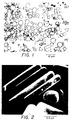
- the resulting emulsion is shown in Figure 1. It contained tabular grains having a mean diameter of 4 ⁇ m, a mean thickness of 0.4 ⁇ m, an average aspect ratio (D/t) of 10:1, and a mean tabularity (D/t) of 25.
- the tabular grain population consisted of 60% of the total projected area of the emulsion.
- This emulsion was prepared the same as that of Example 1A except that 6.10 mmoles NaSCN and low methionine gelatin were used, the pH was adjusted to 4.0 at 40°C, the precipitation temperature was 40°C and there was no initial 30 sec AgNO3 preaddition hold step.
- FIG. 2 A scanning electron photomicrograph of the resulting emulsion is shown in Figure 2.
- the emulsion contained AgCl tabular grains of a mean diameter of 2.3 ⁇ m, a mean thickness of 0.3 ⁇ m, an average aspect ratio of 7.7:1, and a mean tabularity of 25.7. More than 50% of the total projected area of the emulsion consisted of tabular grains.
- This emulsion was prepared the same as that of Example 1A except that 6.10 mmole NaSCN was used and there was no initial 30 sec AgNO3 preaddition hold step.
- the emulsion was poured into 6 L distilled water containing 15 g bone gelatin. It was allowed to gravity-settle overnight and then the clear supernatant was discarded and the sludge was resuspended in 75 g of 4% bone gelatin solution. The pAg of this emulsion was adjusted to 7.5 at 40°C with an NaCl solution.
- the emulsion contained AgCl tabular grains of a mean diameter of 3.3 ⁇ m, a mean thickness of 0.4 ⁇ m, an average aspect ratio of 8.3, and a mean tabularity of 20.8. Fifty five percent of the total projected area of the emulsion consisted of tabular grains. X-ray powder diffraction pattern of the emulsion showed that the AgCl lattice was not expanded relative to pure AgCl indicating that the SCN ⁇ used as a growth modifier was not detectably incorporated into the lattice ( ⁇ 0.3 mole %).
- This example illustrates that the AgCl tabular grain emulsions made by this invention are capable of producing a photographic response.
- Emulsion 1C was coated on Estar support at 4.3 g/m silver, 8.6 g/m gelatin, and 5.2 mg/m 1-(3-acetamidophenyl)-5-mercaptotetrazole.
- the resulting coating was exposed for 1 sec through a graduated density step tablet, developed for 5 min in KODAK Developer DK-50 TM , stopped, fixed, and washed.
- the resulting image contained 0.54 g/m developed silver in the area of minimum exposure (fog) and 3.9 g/m silver in the area of maximum exposure.
- This example illustrates the preparation of a tabular grain emulsion consisting of 40 mole % Br, AgBrCl tabular grains.
- the resulting AgBrCl (40 mole % Br) emulsion contained tabular grains which accounted for 70% of the total projected area of the emulsion grains. These tabular grains had an average diameter of 3.7 ⁇ m and an average thickness of 0.23 ⁇ m, thus exhibiting an average aspect ratio of 16.1 and a mean tabularity of 70.
- An AgBrCl emulsion was made similar to that of Example 3 except no NaSCN was added to the reaction vessel or to the halide solution.
- the resulting AgBrCl (40 mole % Br) emulsion consisted of non-tabular grains having an average diameter of 1.0 ⁇ m. Tabular grains were not present.
- Example 5A before the start of precipitation, Example 5B after nucleation, Example 5C with the introduction of the salt solution. Only Example 5A produced a tabular grain emulsion.
- This emulsion was prepared similarly to the emulsion of Example 3, except that 0.003 mole NaSCN was added to the reaction vessel prior to silver salt introduction and no additional NaSCN was added during the precipitation.
- the resulting AgBrCl (40 mole % Br) emulsion contained tabular grains making up 65% of the total grain projected area.
- the tabular grains had an ECD of 3.6 ⁇ m and an average thickness of 0.24 ⁇ m, providing an average aspect ratio of 15 and a mean tabularity of 62.5.
- Example 5A This example was prepared similarly as Example 5A, except that no NaSCN was in the reaction vessel at the start of the precipitation, and 0.003 mole NaSCN was added after 2% of the AgNO3 had been added to the reaction vessel.
- the emulsion contained some tabular grains, but not enough to be considered a tabular grain emulsion. Tabular grains made up only 10% of the total grain projected area.
- This emulsion was prepared similarly as Example 5A, except that no NaSCN was in the reaction vessel at the start of the precipitation, the halide ion salt solution was made 0.024 M in NaSCN so that by the end of the precipitation, 0.003 mole of NaSCN was added to the reaction vessel.
- the emulsion contained some tabular grains, but not enough to be considered a tabular grain emulsion. Tabular grains made up only 20% of the total grain projected area.
Landscapes
- Chemical & Material Sciences (AREA)
- Physics & Mathematics (AREA)
- Chemical Kinetics & Catalysis (AREA)
- Engineering & Computer Science (AREA)
- Materials Engineering (AREA)
- General Physics & Mathematics (AREA)
- Spectroscopy & Molecular Physics (AREA)
- Silver Salt Photography Or Processing Solution Therefor (AREA)
Applications Claiming Priority (2)
| Application Number | Priority Date | Filing Date | Title |
|---|---|---|---|
| US07/623,839 US5061617A (en) | 1990-12-07 | 1990-12-07 | Process for the preparation of high chloride tabular grain emulsions |
| US623839 | 1990-12-07 |
Publications (2)
| Publication Number | Publication Date |
|---|---|
| EP0494376A1 EP0494376A1 (en) | 1992-07-15 |
| EP0494376B1 true EP0494376B1 (en) | 1996-02-21 |
Family
ID=24499594
Family Applications (1)
| Application Number | Title | Priority Date | Filing Date |
|---|---|---|---|
| EP91120903A Expired - Lifetime EP0494376B1 (en) | 1990-12-07 | 1991-12-05 | An improved process for the preparation of high chloride tabular grain emulsions |
Country Status (5)
| Country | Link |
|---|---|
| US (1) | US5061617A (enExample) |
| EP (1) | EP0494376B1 (enExample) |
| JP (1) | JP3055727B2 (enExample) |
| CA (1) | CA2055354A1 (enExample) |
| DE (1) | DE69117274T2 (enExample) |
Families Citing this family (46)
| Publication number | Priority date | Publication date | Assignee | Title |
|---|---|---|---|---|
| US5061617A (en) * | 1990-12-07 | 1991-10-29 | Eastman Kodak Company | Process for the preparation of high chloride tabular grain emulsions |
| USH1323H (en) | 1991-12-26 | 1994-06-07 | Fuji Photo Film Co., Ltd. | Silver halide photographic material |
| US5294869A (en) * | 1991-12-30 | 1994-03-15 | Eastman Kodak Company | Organic electroluminescent multicolor image display device |
| US5395746A (en) * | 1994-02-25 | 1995-03-07 | Eastman Kodak Company | Inherently stable high chloride tabular grains with improved blue absorption |
| US5558982A (en) * | 1994-12-21 | 1996-09-24 | Eastman Kodak Company | High chloride (100) tabular grain emulsions with modified edge structures |
| US5512427A (en) * | 1995-02-27 | 1996-04-30 | Eastman Kodak Company | Tabularly banded emulsions with high bromide central grain portions |
| US5508160A (en) * | 1995-02-27 | 1996-04-16 | Eastman Kodak Company | Tabularly banded emulsions with high chloride central grain portions |
| US5688551A (en) | 1995-11-13 | 1997-11-18 | Eastman Kodak Company | Method of forming an organic electroluminescent display panel |
| EP0809135A1 (en) * | 1996-05-21 | 1997-11-26 | Agfa-Gevaert N.V. | Process for the preparation of a photographic tabular emulsion rich in chloride |
| JPH10104663A (ja) | 1996-09-27 | 1998-04-24 | Semiconductor Energy Lab Co Ltd | 電気光学装置およびその作製方法 |
| US5904961A (en) * | 1997-01-24 | 1999-05-18 | Eastman Kodak Company | Method of depositing organic layers in organic light emitting devices |
| US6175345B1 (en) | 1997-06-02 | 2001-01-16 | Canon Kabushiki Kaisha | Electroluminescence device, electroluminescence apparatus, and production methods thereof |
| JPH11138899A (ja) | 1997-11-11 | 1999-05-25 | Canon Inc | 画像形成装置 |
| JP3039778B2 (ja) | 1998-01-05 | 2000-05-08 | キヤノン株式会社 | 画像形成装置 |
| JP2942230B2 (ja) * | 1998-01-12 | 1999-08-30 | キヤノン株式会社 | 画像形成装置及び発光装置 |
| US6005344A (en) * | 1998-02-18 | 1999-12-21 | Eastman Kodak Company | Organic electroluminescent image display panel with multiple barriers |
| JP4053136B2 (ja) * | 1998-06-17 | 2008-02-27 | 株式会社半導体エネルギー研究所 | 反射型半導体表示装置 |
| US6111357A (en) * | 1998-07-09 | 2000-08-29 | Eastman Kodak Company | Organic electroluminescent display panel having a cover with radiation-cured perimeter seal |
| US6512504B1 (en) | 1999-04-27 | 2003-01-28 | Semiconductor Energy Laborayory Co., Ltd. | Electronic device and electronic apparatus |
| TWI232595B (en) * | 1999-06-04 | 2005-05-11 | Semiconductor Energy Lab | Electroluminescence display device and electronic device |
| US7288420B1 (en) * | 1999-06-04 | 2007-10-30 | Semiconductor Energy Laboratory Co., Ltd. | Method for manufacturing an electro-optical device |
| US8853696B1 (en) | 1999-06-04 | 2014-10-07 | Semiconductor Energy Laboratory Co., Ltd. | Electro-optical device and electronic device |
| TW483287B (en) | 1999-06-21 | 2002-04-11 | Semiconductor Energy Lab | EL display device, driving method thereof, and electronic equipment provided with the EL display device |
| JP4627822B2 (ja) * | 1999-06-23 | 2011-02-09 | 株式会社半導体エネルギー研究所 | 表示装置 |
| TW515109B (en) * | 1999-06-28 | 2002-12-21 | Semiconductor Energy Lab | EL display device and electronic device |
| US6221563B1 (en) | 1999-08-12 | 2001-04-24 | Eastman Kodak Company | Method of making an organic electroluminescent device |
| TW480722B (en) | 1999-10-12 | 2002-03-21 | Semiconductor Energy Lab | Manufacturing method of electro-optical device |
| TW591584B (en) | 1999-10-21 | 2004-06-11 | Semiconductor Energy Lab | Active matrix type display device |
| US6587086B1 (en) * | 1999-10-26 | 2003-07-01 | Semiconductor Energy Laboratory Co., Ltd. | Electro-optical device |
| JP4727029B2 (ja) | 1999-11-29 | 2011-07-20 | 株式会社半導体エネルギー研究所 | El表示装置、電気器具及びel表示装置用の半導体素子基板 |
| TW587239B (en) * | 1999-11-30 | 2004-05-11 | Semiconductor Energy Lab | Electric device |
| TWM244584U (en) | 2000-01-17 | 2004-09-21 | Semiconductor Energy Lab | Display system and electrical appliance |
| TW493282B (en) * | 2000-04-17 | 2002-07-01 | Semiconductor Energy Lab | Self-luminous device and electric machine using the same |
| US6630292B2 (en) | 2000-04-25 | 2003-10-07 | Fuji Photo Film B.V. | Method for producing a silver halide photographic emulsion |
| US6995753B2 (en) * | 2000-06-06 | 2006-02-07 | Semiconductor Energy Laboratory Co., Ltd. | Display device and method of manufacturing the same |
| JP2002072963A (ja) * | 2000-06-12 | 2002-03-12 | Semiconductor Energy Lab Co Ltd | 発光モジュールおよびその駆動方法並びに光センサ |
| US6528824B2 (en) | 2000-06-29 | 2003-03-04 | Semiconductor Energy Laboratory Co., Ltd. | Light emitting device |
| US6879110B2 (en) | 2000-07-27 | 2005-04-12 | Semiconductor Energy Laboratory Co., Ltd. | Method of driving display device |
| US6956324B2 (en) * | 2000-08-04 | 2005-10-18 | Semiconductor Energy Laboratory Co., Ltd. | Semiconductor device and manufacturing method therefor |
| US6605826B2 (en) | 2000-08-18 | 2003-08-12 | Semiconductor Energy Laboratory Co., Ltd. | Light-emitting device and display device |
| US6739931B2 (en) | 2000-09-18 | 2004-05-25 | Semiconductor Energy Laboratory Co., Ltd. | Display device and method of fabricating the display device |
| JP2002358031A (ja) | 2001-06-01 | 2002-12-13 | Semiconductor Energy Lab Co Ltd | 発光装置及びその駆動方法 |
| TWI264244B (en) * | 2001-06-18 | 2006-10-11 | Semiconductor Energy Lab | Light emitting device and method of fabricating the same |
| EP1343206B1 (en) * | 2002-03-07 | 2016-10-26 | Semiconductor Energy Laboratory Co., Ltd. | Light emitting apparatus, electronic apparatus, illuminating device and method of fabricating the light emitting apparatus |
| TWI362128B (en) * | 2002-03-26 | 2012-04-11 | Semiconductor Energy Lab | Light emitting device and method of manufacturing the same |
| JP4574127B2 (ja) | 2003-03-26 | 2010-11-04 | 株式会社半導体エネルギー研究所 | 素子基板及び発光装置 |
Family Cites Families (12)
| Publication number | Priority date | Publication date | Assignee | Title |
|---|---|---|---|---|
| BE437840A (enExample) * | 1939-02-02 | |||
| US4414306A (en) * | 1981-11-12 | 1983-11-08 | Eastman Kodak Company | Silver chlorobromide emulsions and processes for their preparation |
| US4439520A (en) * | 1981-11-12 | 1984-03-27 | Eastman Kodak Company | Sensitized high aspect ratio silver halide emulsions and photographic elements |
| US4400463A (en) * | 1981-11-12 | 1983-08-23 | Eastman Kodak Company | Silver chloride emulsions of modified crystal habit and processes for their preparation |
| US4399215A (en) * | 1981-11-12 | 1983-08-16 | Eastman Kodak Company | Double-jet precipitation processes and products thereof |
| JPS613134A (ja) * | 1984-06-15 | 1986-01-09 | Fuji Photo Film Co Ltd | ハロゲン化銀乳剤の製造方法およびハロゲン化銀写真感光材料 |
| CA1284051C (en) * | 1985-12-19 | 1991-05-14 | Joe E. Maskasky | Chloride containing emulsion and a process for emulsion preparation |
| JPH0656474B2 (ja) * | 1986-06-20 | 1994-07-27 | 富士写真フイルム株式会社 | 写真用ハロゲン化銀乳剤 |
| US4804621A (en) * | 1987-04-27 | 1989-02-14 | E. I. Du Pont De Nemours And Company | Process for the preparation of tabular silver chloride emulsions using a grain growth modifier |
| JPH0750310B2 (ja) * | 1987-09-10 | 1995-05-31 | 富士写真フイルム株式会社 | 写真感光材料およびその処理方法 |
| US4942120A (en) * | 1989-04-28 | 1990-07-17 | Eastman Kodak Company | Modified peptizer twinned grain silver halide emulsions and processes for their preparation |
| US5061617A (en) * | 1990-12-07 | 1991-10-29 | Eastman Kodak Company | Process for the preparation of high chloride tabular grain emulsions |
-
1990
- 1990-12-07 US US07/623,839 patent/US5061617A/en not_active Expired - Fee Related
-
1991
- 1991-11-13 CA CA002055354A patent/CA2055354A1/en not_active Abandoned
- 1991-12-05 DE DE69117274T patent/DE69117274T2/de not_active Expired - Fee Related
- 1991-12-05 EP EP91120903A patent/EP0494376B1/en not_active Expired - Lifetime
- 1991-12-06 JP JP3348517A patent/JP3055727B2/ja not_active Expired - Lifetime
Also Published As
| Publication number | Publication date |
|---|---|
| CA2055354A1 (en) | 1992-06-08 |
| US5061617A (en) | 1991-10-29 |
| DE69117274T2 (de) | 1996-08-14 |
| DE69117274D1 (de) | 1996-03-28 |
| EP0494376A1 (en) | 1992-07-15 |
| JP3055727B2 (ja) | 2000-06-26 |
| JPH05181219A (ja) | 1993-07-23 |
Similar Documents
| Publication | Publication Date | Title |
|---|---|---|
| US5061617A (en) | Process for the preparation of high chloride tabular grain emulsions | |
| EP0423840B1 (en) | A chloride containing emulsion | |
| US4942120A (en) | Modified peptizer twinned grain silver halide emulsions and processes for their preparation | |
| EP0534395B1 (en) | High tabularity high chloride emulsions of exceptional stability | |
| US4804621A (en) | Process for the preparation of tabular silver chloride emulsions using a grain growth modifier | |
| EP0534325B1 (en) | Ultrathin high chloride tabular grain emulsions | |
| US5185239A (en) | Process for the preparation of high chloride tabular grain emulsions (iv) | |
| US5389509A (en) | Ultrathin high chloride tabular grain emulsions | |
| US5183732A (en) | Process for the preparation of high chloride tabular grain emulsions (V) | |
| EP0535467A1 (en) | Process for the preparation of high chloride tabular grain emulsions (III) | |
| EP0606894B1 (en) | Photographic emulsions containing internally and externally modified silver halide grains | |
| EP0606895B1 (en) | Photographic emulsions containing internally and externally modified silver halide grains | |
| US5411852A (en) | Class of grain growth modifiers for the preparation of high chloride (111) tabular grain emulsions (II) | |
| EP0606893B1 (en) | Photographic silver halide emulsion containing contrast improving grain surface modifiers | |
| EP0699948B1 (en) | Epitaxially sensitized ultrathin dump iodide tabular grain emulsions | |
| EP0732617B1 (en) | Photographic emulsions containing tabular grains with a band structure and a central grain portion of high chloride concentration | |
| US6043019A (en) | Robust method for the preparation of high bromide tabular grain emulsions | |
| US5879873A (en) | Process of preparing high bromide (100) tabular grain emulsions | |
| US6228573B1 (en) | Process for the preparation of high bromide ultrathin tabular grain emulsions | |
| EP0577173B1 (en) | High-chloride folded tabular grain emulsions and process for their preparation | |
| US5558982A (en) | High chloride (100) tabular grain emulsions with modified edge structures | |
| JPH11218862A (ja) | 平板状粒子乳剤の調製方法 | |
| US5905022A (en) | Chloride bromide and iodide nucleation of high chloride (100) tabular grain emulsion |
Legal Events
| Date | Code | Title | Description |
|---|---|---|---|
| PUAI | Public reference made under article 153(3) epc to a published international application that has entered the european phase |
Free format text: ORIGINAL CODE: 0009012 |
|
| AK | Designated contracting states |
Kind code of ref document: A1 Designated state(s): BE DE FR GB NL |
|
| 17P | Request for examination filed |
Effective date: 19920907 |
|
| 17Q | First examination report despatched |
Effective date: 19941207 |
|
| RBV | Designated contracting states (corrected) |
Designated state(s): DE FR GB |
|
| GRAA | (expected) grant |
Free format text: ORIGINAL CODE: 0009210 |
|
| AK | Designated contracting states |
Kind code of ref document: B1 Designated state(s): DE FR GB |
|
| REF | Corresponds to: |
Ref document number: 69117274 Country of ref document: DE Date of ref document: 19960328 |
|
| ET | Fr: translation filed | ||
| PLBE | No opposition filed within time limit |
Free format text: ORIGINAL CODE: 0009261 |
|
| STAA | Information on the status of an ep patent application or granted ep patent |
Free format text: STATUS: NO OPPOSITION FILED WITHIN TIME LIMIT |
|
| 26N | No opposition filed | ||
| PGFP | Annual fee paid to national office [announced via postgrant information from national office to epo] |
Ref country code: GB Payment date: 19991112 Year of fee payment: 9 |
|
| PGFP | Annual fee paid to national office [announced via postgrant information from national office to epo] |
Ref country code: FR Payment date: 19991202 Year of fee payment: 9 |
|
| PGFP | Annual fee paid to national office [announced via postgrant information from national office to epo] |
Ref country code: DE Payment date: 19991222 Year of fee payment: 9 |
|
| PG25 | Lapsed in a contracting state [announced via postgrant information from national office to epo] |
Ref country code: GB Free format text: LAPSE BECAUSE OF NON-PAYMENT OF DUE FEES Effective date: 20001205 |
|
| GBPC | Gb: european patent ceased through non-payment of renewal fee |
Effective date: 20001205 |
|
| PG25 | Lapsed in a contracting state [announced via postgrant information from national office to epo] |
Ref country code: FR Free format text: LAPSE BECAUSE OF NON-PAYMENT OF DUE FEES Effective date: 20010831 |
|
| REG | Reference to a national code |
Ref country code: FR Ref legal event code: ST |
|
| PG25 | Lapsed in a contracting state [announced via postgrant information from national office to epo] |
Ref country code: DE Free format text: LAPSE BECAUSE OF NON-PAYMENT OF DUE FEES Effective date: 20011002 |