EP0490201B1 - Magnetische Aufzeichnungsträger - Google Patents
Magnetische Aufzeichnungsträger Download PDFInfo
- Publication number
- EP0490201B1 EP0490201B1 EP19910120616 EP91120616A EP0490201B1 EP 0490201 B1 EP0490201 B1 EP 0490201B1 EP 19910120616 EP19910120616 EP 19910120616 EP 91120616 A EP91120616 A EP 91120616A EP 0490201 B1 EP0490201 B1 EP 0490201B1
- Authority
- EP
- European Patent Office
- Prior art keywords
- groups
- carbon atoms
- mol
- recording medium
- molecular weight
- Prior art date
- Legal status (The legal status is an assumption and is not a legal conclusion. Google has not performed a legal analysis and makes no representation as to the accuracy of the status listed.)
- Expired - Lifetime
Links
- 230000005291 magnetic effect Effects 0.000 title claims description 56
- WYURNTSHIVDZCO-UHFFFAOYSA-N Tetrahydrofuran Chemical compound C1CCOC1 WYURNTSHIVDZCO-UHFFFAOYSA-N 0.000 claims description 46
- 239000011230 binding agent Substances 0.000 claims description 37
- 229920002635 polyurethane Polymers 0.000 claims description 37
- 239000004814 polyurethane Substances 0.000 claims description 37
- 125000004432 carbon atom Chemical group C* 0.000 claims description 30
- 150000002009 diols Chemical class 0.000 claims description 27
- 239000000203 mixture Substances 0.000 claims description 26
- YLQBMQCUIZJEEH-UHFFFAOYSA-N tetrahydrofuran Natural products C=1C=COC=1 YLQBMQCUIZJEEH-UHFFFAOYSA-N 0.000 claims description 21
- 239000000696 magnetic material Substances 0.000 claims description 16
- 125000002887 hydroxy group Chemical group [H]O* 0.000 claims description 12
- XSQUKJJJFZCRTK-UHFFFAOYSA-N urea group Chemical group NC(=O)N XSQUKJJJFZCRTK-UHFFFAOYSA-N 0.000 claims description 12
- 239000005056 polyisocyanate Substances 0.000 claims description 10
- 229920001228 polyisocyanate Polymers 0.000 claims description 10
- UPMLOUAZCHDJJD-UHFFFAOYSA-N 4,4'-Diphenylmethane Diisocyanate Chemical compound C1=CC(N=C=O)=CC=C1CC1=CC=C(N=C=O)C=C1 UPMLOUAZCHDJJD-UHFFFAOYSA-N 0.000 claims description 8
- 125000005442 diisocyanate group Chemical group 0.000 claims description 8
- 239000012948 isocyanate Substances 0.000 claims description 8
- QGZKDVFQNNGYKY-UHFFFAOYSA-O Ammonium Chemical compound [NH4+] QGZKDVFQNNGYKY-UHFFFAOYSA-O 0.000 claims description 7
- 150000001414 amino alcohols Chemical class 0.000 claims description 7
- 150000002513 isocyanates Chemical class 0.000 claims description 7
- 239000004433 Thermoplastic polyurethane Substances 0.000 claims description 6
- 229920002803 thermoplastic polyurethane Polymers 0.000 claims description 6
- 150000001875 compounds Chemical class 0.000 claims description 5
- 229920005862 polyol Polymers 0.000 claims description 5
- 150000003077 polyols Chemical class 0.000 claims description 5
- 125000001273 sulfonato group Chemical group [O-]S(*)(=O)=O 0.000 claims description 5
- 229910052739 hydrogen Inorganic materials 0.000 claims description 4
- 229910052744 lithium Inorganic materials 0.000 claims description 4
- 229910052700 potassium Inorganic materials 0.000 claims description 4
- 229910052708 sodium Inorganic materials 0.000 claims description 4
- 125000000217 alkyl group Chemical group 0.000 claims description 3
- 125000003277 amino group Chemical group 0.000 claims description 3
- 229910006127 SO3X Inorganic materials 0.000 claims 2
- 229910052783 alkali metal Inorganic materials 0.000 claims 2
- 150000001340 alkali metals Chemical class 0.000 claims 2
- 239000000758 substrate Substances 0.000 claims 2
- 229920000642 polymer Polymers 0.000 description 36
- ZMXDDKWLCZADIW-UHFFFAOYSA-N N,N-Dimethylformamide Chemical compound CN(C)C=O ZMXDDKWLCZADIW-UHFFFAOYSA-N 0.000 description 28
- WERYXYBDKMZEQL-UHFFFAOYSA-N butane-1,4-diol Chemical compound OCCCCO WERYXYBDKMZEQL-UHFFFAOYSA-N 0.000 description 23
- 238000000034 method Methods 0.000 description 22
- 238000006243 chemical reaction Methods 0.000 description 21
- 239000006185 dispersion Substances 0.000 description 16
- -1 aromatic dicarboxylic acids Chemical class 0.000 description 14
- WNLRTRBMVRJNCN-UHFFFAOYSA-N adipic acid Chemical compound OC(=O)CCCCC(O)=O WNLRTRBMVRJNCN-UHFFFAOYSA-N 0.000 description 12
- 230000008569 process Effects 0.000 description 11
- 238000005299 abrasion Methods 0.000 description 10
- 238000004519 manufacturing process Methods 0.000 description 10
- 229920002554 vinyl polymer Polymers 0.000 description 10
- ZJCCRDAZUWHFQH-UHFFFAOYSA-N Trimethylolpropane Chemical compound CCC(CO)(CO)CO ZJCCRDAZUWHFQH-UHFFFAOYSA-N 0.000 description 9
- 230000000052 comparative effect Effects 0.000 description 9
- MTHSVFCYNBDYFN-UHFFFAOYSA-N diethylene glycol Chemical compound OCCOCCO MTHSVFCYNBDYFN-UHFFFAOYSA-N 0.000 description 9
- 229920000728 polyester Polymers 0.000 description 9
- 239000000047 product Substances 0.000 description 9
- 239000002904 solvent Substances 0.000 description 9
- ZBCBWPMODOFKDW-UHFFFAOYSA-N diethanolamine Chemical compound OCCNCCO ZBCBWPMODOFKDW-UHFFFAOYSA-N 0.000 description 8
- 239000002270 dispersing agent Substances 0.000 description 8
- 239000000049 pigment Substances 0.000 description 8
- LYCAIKOWRPUZTN-UHFFFAOYSA-N Ethylene glycol Chemical compound OCCO LYCAIKOWRPUZTN-UHFFFAOYSA-N 0.000 description 7
- 229920001577 copolymer Polymers 0.000 description 7
- 229920003225 polyurethane elastomer Polymers 0.000 description 7
- 239000007787 solid Substances 0.000 description 7
- 239000000654 additive Substances 0.000 description 6
- 239000001361 adipic acid Substances 0.000 description 6
- 235000011037 adipic acid Nutrition 0.000 description 6
- 239000003054 catalyst Substances 0.000 description 6
- 238000004132 cross linking Methods 0.000 description 6
- QQVIHTHCMHWDBS-UHFFFAOYSA-N isophthalic acid Chemical compound OC(=O)C1=CC=CC(C(O)=O)=C1 QQVIHTHCMHWDBS-UHFFFAOYSA-N 0.000 description 6
- 238000002474 experimental method Methods 0.000 description 5
- XXMIOPMDWAUFGU-UHFFFAOYSA-N hexane-1,6-diol Chemical compound OCCCCCCO XXMIOPMDWAUFGU-UHFFFAOYSA-N 0.000 description 5
- 229910052751 metal Inorganic materials 0.000 description 5
- 239000002184 metal Substances 0.000 description 5
- 238000010992 reflux Methods 0.000 description 5
- 239000000126 substance Substances 0.000 description 5
- HZAXFHJVJLSVMW-UHFFFAOYSA-N 2-Aminoethan-1-ol Chemical compound NCCO HZAXFHJVJLSVMW-UHFFFAOYSA-N 0.000 description 4
- DNIAPMSPPWPWGF-UHFFFAOYSA-N Propylene glycol Chemical compound CC(O)CO DNIAPMSPPWPWGF-UHFFFAOYSA-N 0.000 description 4
- KKEYFWRCBNTPAC-UHFFFAOYSA-N Terephthalic acid Chemical compound OC(=O)C1=CC=C(C(O)=O)C=C1 KKEYFWRCBNTPAC-UHFFFAOYSA-N 0.000 description 4
- 239000002253 acid Substances 0.000 description 4
- 229920002678 cellulose Polymers 0.000 description 4
- NAQMVNRVTILPCV-UHFFFAOYSA-N hexane-1,6-diamine Chemical compound NCCCCCCN NAQMVNRVTILPCV-UHFFFAOYSA-N 0.000 description 4
- JEIPFZHSYJVQDO-UHFFFAOYSA-N iron(III) oxide Inorganic materials O=[Fe]O[Fe]=O JEIPFZHSYJVQDO-UHFFFAOYSA-N 0.000 description 4
- 229920000515 polycarbonate Polymers 0.000 description 4
- 239000004417 polycarbonate Substances 0.000 description 4
- 229920005989 resin Polymers 0.000 description 4
- 239000011347 resin Substances 0.000 description 4
- ZWEHNKRNPOVVGH-UHFFFAOYSA-N 2-Butanone Chemical compound CCC(C)=O ZWEHNKRNPOVVGH-UHFFFAOYSA-N 0.000 description 3
- IAYPIBMASNFSPL-UHFFFAOYSA-N Ethylene oxide Chemical compound C1CO1 IAYPIBMASNFSPL-UHFFFAOYSA-N 0.000 description 3
- WSFSSNUMVMOOMR-UHFFFAOYSA-N Formaldehyde Chemical compound O=C WSFSSNUMVMOOMR-UHFFFAOYSA-N 0.000 description 3
- PEDCQBHIVMGVHV-UHFFFAOYSA-N Glycerine Chemical compound OCC(O)CO PEDCQBHIVMGVHV-UHFFFAOYSA-N 0.000 description 3
- SJRJJKPEHAURKC-UHFFFAOYSA-N N-Methylmorpholine Chemical compound CN1CCOCC1 SJRJJKPEHAURKC-UHFFFAOYSA-N 0.000 description 3
- YXFVVABEGXRONW-UHFFFAOYSA-N Toluene Chemical compound CC1=CC=CC=C1 YXFVVABEGXRONW-UHFFFAOYSA-N 0.000 description 3
- ZMANZCXQSJIPKH-UHFFFAOYSA-N Triethylamine Chemical compound CCN(CC)CC ZMANZCXQSJIPKH-UHFFFAOYSA-N 0.000 description 3
- BZHJMEDXRYGGRV-UHFFFAOYSA-N Vinyl chloride Chemical compound ClC=C BZHJMEDXRYGGRV-UHFFFAOYSA-N 0.000 description 3
- 239000002390 adhesive tape Substances 0.000 description 3
- 125000001931 aliphatic group Chemical group 0.000 description 3
- 125000002947 alkylene group Chemical group 0.000 description 3
- 150000001412 amines Chemical class 0.000 description 3
- 230000008901 benefit Effects 0.000 description 3
- IISBACLAFKSPIT-UHFFFAOYSA-N bisphenol A Chemical compound C=1C=C(O)C=CC=1C(C)(C)C1=CC=C(O)C=C1 IISBACLAFKSPIT-UHFFFAOYSA-N 0.000 description 3
- 239000012876 carrier material Substances 0.000 description 3
- 239000001913 cellulose Substances 0.000 description 3
- 229940090961 chromium dioxide Drugs 0.000 description 3
- IAQWMWUKBQPOIY-UHFFFAOYSA-N chromium(4+);oxygen(2-) Chemical compound [O-2].[O-2].[Cr+4] IAQWMWUKBQPOIY-UHFFFAOYSA-N 0.000 description 3
- AYTAKQFHWFYBMA-UHFFFAOYSA-N chromium(IV) oxide Inorganic materials O=[Cr]=O AYTAKQFHWFYBMA-UHFFFAOYSA-N 0.000 description 3
- 239000011248 coating agent Substances 0.000 description 3
- 238000000576 coating method Methods 0.000 description 3
- 150000001991 dicarboxylic acids Chemical class 0.000 description 3
- 235000014113 dietary fatty acids Nutrition 0.000 description 3
- 230000032050 esterification Effects 0.000 description 3
- 238000005886 esterification reaction Methods 0.000 description 3
- 125000001495 ethyl group Chemical group [H]C([H])([H])C([H])([H])* 0.000 description 3
- 229930195729 fatty acid Natural products 0.000 description 3
- 239000000194 fatty acid Substances 0.000 description 3
- 230000005294 ferromagnetic effect Effects 0.000 description 3
- 150000002334 glycols Chemical class 0.000 description 3
- 239000002245 particle Substances 0.000 description 3
- 229920000139 polyethylene terephthalate Polymers 0.000 description 3
- 239000005020 polyethylene terephthalate Substances 0.000 description 3
- 150000003839 salts Chemical class 0.000 description 3
- DVKJHBMWWAPEIU-UHFFFAOYSA-N toluene 2,4-diisocyanate Chemical compound CC1=CC=C(N=C=O)C=C1N=C=O DVKJHBMWWAPEIU-UHFFFAOYSA-N 0.000 description 3
- 150000004072 triols Chemical class 0.000 description 3
- 125000000391 vinyl group Chemical group [H]C([*])=C([H])[H] 0.000 description 3
- DNIAPMSPPWPWGF-VKHMYHEASA-N (+)-propylene glycol Chemical compound C[C@H](O)CO DNIAPMSPPWPWGF-VKHMYHEASA-N 0.000 description 2
- YPFDHNVEDLHUCE-UHFFFAOYSA-N 1,3-propanediol Substances OCCCO YPFDHNVEDLHUCE-UHFFFAOYSA-N 0.000 description 2
- RYHBNJHYFVUHQT-UHFFFAOYSA-N 1,4-Dioxane Chemical compound C1COCCO1 RYHBNJHYFVUHQT-UHFFFAOYSA-N 0.000 description 2
- YEJRWHAVMIAJKC-UHFFFAOYSA-N 4-Butyrolactone Chemical compound O=C1CCCO1 YEJRWHAVMIAJKC-UHFFFAOYSA-N 0.000 description 2
- IAZDPXIOMUYVGZ-UHFFFAOYSA-N Dimethylsulphoxide Chemical compound CS(C)=O IAZDPXIOMUYVGZ-UHFFFAOYSA-N 0.000 description 2
- IMROMDMJAWUWLK-UHFFFAOYSA-N Ethenol Chemical group OC=C IMROMDMJAWUWLK-UHFFFAOYSA-N 0.000 description 2
- PIICEJLVQHRZGT-UHFFFAOYSA-N Ethylenediamine Chemical compound NCCN PIICEJLVQHRZGT-UHFFFAOYSA-N 0.000 description 2
- 239000005057 Hexamethylene diisocyanate Substances 0.000 description 2
- QIGBRXMKCJKVMJ-UHFFFAOYSA-N Hydroquinone Chemical compound OC1=CC=C(O)C=C1 QIGBRXMKCJKVMJ-UHFFFAOYSA-N 0.000 description 2
- 239000005058 Isophorone diisocyanate Substances 0.000 description 2
- CERQOIWHTDAKMF-UHFFFAOYSA-M Methacrylate Chemical compound CC(=C)C([O-])=O CERQOIWHTDAKMF-UHFFFAOYSA-M 0.000 description 2
- 239000004721 Polyphenylene oxide Substances 0.000 description 2
- GOOHAUXETOMSMM-UHFFFAOYSA-N Propylene oxide Chemical compound CC1CO1 GOOHAUXETOMSMM-UHFFFAOYSA-N 0.000 description 2
- 229910000831 Steel Inorganic materials 0.000 description 2
- XSTXAVWGXDQKEL-UHFFFAOYSA-N Trichloroethylene Chemical compound ClC=C(Cl)Cl XSTXAVWGXDQKEL-UHFFFAOYSA-N 0.000 description 2
- YIMQCDZDWXUDCA-UHFFFAOYSA-N [4-(hydroxymethyl)cyclohexyl]methanol Chemical compound OCC1CCC(CO)CC1 YIMQCDZDWXUDCA-UHFFFAOYSA-N 0.000 description 2
- 150000007513 acids Chemical class 0.000 description 2
- 230000002411 adverse Effects 0.000 description 2
- 230000032683 aging Effects 0.000 description 2
- 239000007795 chemical reaction product Substances 0.000 description 2
- 238000007334 copolymerization reaction Methods 0.000 description 2
- JHIVVAPYMSGYDF-UHFFFAOYSA-N cyclohexanone Chemical compound O=C1CCCCC1 JHIVVAPYMSGYDF-UHFFFAOYSA-N 0.000 description 2
- JQVDAXLFBXTEQA-UHFFFAOYSA-N dibutylamine Chemical compound CCCCNCCCC JQVDAXLFBXTEQA-UHFFFAOYSA-N 0.000 description 2
- POULHZVOKOAJMA-UHFFFAOYSA-N dodecanoic acid Chemical compound CCCCCCCCCCCC(O)=O POULHZVOKOAJMA-UHFFFAOYSA-N 0.000 description 2
- 230000000694 effects Effects 0.000 description 2
- 150000002148 esters Chemical class 0.000 description 2
- 150000002170 ethers Chemical class 0.000 description 2
- 150000004665 fatty acids Chemical class 0.000 description 2
- 230000002349 favourable effect Effects 0.000 description 2
- RRAMGCGOFNQTLD-UHFFFAOYSA-N hexamethylene diisocyanate Chemical compound O=C=NCCCCCCN=C=O RRAMGCGOFNQTLD-UHFFFAOYSA-N 0.000 description 2
- 230000006872 improvement Effects 0.000 description 2
- 238000010348 incorporation Methods 0.000 description 2
- 239000000543 intermediate Substances 0.000 description 2
- NIMLQBUJDJZYEJ-UHFFFAOYSA-N isophorone diisocyanate Chemical compound CC1(C)CC(N=C=O)CC(C)(CN=C=O)C1 NIMLQBUJDJZYEJ-UHFFFAOYSA-N 0.000 description 2
- 150000002576 ketones Chemical class 0.000 description 2
- 150000002596 lactones Chemical class 0.000 description 2
- 230000005415 magnetization Effects 0.000 description 2
- 239000000463 material Substances 0.000 description 2
- 150000002739 metals Chemical class 0.000 description 2
- 238000012856 packing Methods 0.000 description 2
- 230000000737 periodic effect Effects 0.000 description 2
- 229920006287 phenoxy resin Polymers 0.000 description 2
- 239000013034 phenoxy resin Substances 0.000 description 2
- WLJVNTCWHIRURA-UHFFFAOYSA-N pimelic acid Chemical compound OC(=O)CCCCCC(O)=O WLJVNTCWHIRURA-UHFFFAOYSA-N 0.000 description 2
- 229920000570 polyether Polymers 0.000 description 2
- 229920000166 polytrimethylene carbonate Polymers 0.000 description 2
- 238000002360 preparation method Methods 0.000 description 2
- ULWHHBHJGPPBCO-UHFFFAOYSA-N propane-1,1-diol Chemical compound CCC(O)O ULWHHBHJGPPBCO-UHFFFAOYSA-N 0.000 description 2
- 235000013772 propylene glycol Nutrition 0.000 description 2
- CXMXRPHRNRROMY-UHFFFAOYSA-N sebacic acid Chemical compound OC(=O)CCCCCCCCC(O)=O CXMXRPHRNRROMY-UHFFFAOYSA-N 0.000 description 2
- 239000007858 starting material Substances 0.000 description 2
- 239000010959 steel Substances 0.000 description 2
- TYFQFVWCELRYAO-UHFFFAOYSA-N suberic acid Chemical compound OC(=O)CCCCCCC(O)=O TYFQFVWCELRYAO-UHFFFAOYSA-N 0.000 description 2
- KDYFGRWQOYBRFD-UHFFFAOYSA-N succinic acid Chemical compound OC(=O)CCC(O)=O KDYFGRWQOYBRFD-UHFFFAOYSA-N 0.000 description 2
- 239000003760 tallow Substances 0.000 description 2
- 238000012360 testing method Methods 0.000 description 2
- 229920001169 thermoplastic Polymers 0.000 description 2
- 239000004416 thermosoftening plastic Substances 0.000 description 2
- IMNIMPAHZVJRPE-UHFFFAOYSA-N triethylenediamine Chemical compound C1CN2CCN1CC2 IMNIMPAHZVJRPE-UHFFFAOYSA-N 0.000 description 2
- XLYOFNOQVPJJNP-UHFFFAOYSA-N water Substances O XLYOFNOQVPJJNP-UHFFFAOYSA-N 0.000 description 2
- XOOUIPVCVHRTMJ-UHFFFAOYSA-L zinc stearate Chemical compound [Zn+2].CCCCCCCCCCCCCCCCCC([O-])=O.CCCCCCCCCCCCCCCCCC([O-])=O XOOUIPVCVHRTMJ-UHFFFAOYSA-L 0.000 description 2
- 229910000859 α-Fe Inorganic materials 0.000 description 2
- PUPZLCDOIYMWBV-UHFFFAOYSA-N (+/-)-1,3-Butanediol Chemical compound CC(O)CCO PUPZLCDOIYMWBV-UHFFFAOYSA-N 0.000 description 1
- SZCWBURCISJFEZ-UHFFFAOYSA-N (3-hydroxy-2,2-dimethylpropyl) 3-hydroxy-2,2-dimethylpropanoate Chemical compound OCC(C)(C)COC(=O)C(C)(C)CO SZCWBURCISJFEZ-UHFFFAOYSA-N 0.000 description 1
- DNIAPMSPPWPWGF-GSVOUGTGSA-N (R)-(-)-Propylene glycol Chemical compound C[C@@H](O)CO DNIAPMSPPWPWGF-GSVOUGTGSA-N 0.000 description 1
- PHVRKFUGOYTAKT-UHFFFAOYSA-N 1,12-diaminododecane-4,9-dione Chemical compound NCCCC(=O)CCCCC(=O)CCCN PHVRKFUGOYTAKT-UHFFFAOYSA-N 0.000 description 1
- VGHSXKTVMPXHNG-UHFFFAOYSA-N 1,3-diisocyanatobenzene Chemical compound O=C=NC1=CC=CC(N=C=O)=C1 VGHSXKTVMPXHNG-UHFFFAOYSA-N 0.000 description 1
- CDMDQYCEEKCBGR-UHFFFAOYSA-N 1,4-diisocyanatocyclohexane Chemical compound O=C=NC1CCC(N=C=O)CC1 CDMDQYCEEKCBGR-UHFFFAOYSA-N 0.000 description 1
- SBJCUZQNHOLYMD-UHFFFAOYSA-N 1,5-Naphthalene diisocyanate Chemical compound C1=CC=C2C(N=C=O)=CC=CC2=C1N=C=O SBJCUZQNHOLYMD-UHFFFAOYSA-N 0.000 description 1
- 229940008841 1,6-hexamethylene diisocyanate Drugs 0.000 description 1
- HXKKHQJGJAFBHI-UHFFFAOYSA-N 1-aminopropan-2-ol Chemical compound CC(O)CN HXKKHQJGJAFBHI-UHFFFAOYSA-N 0.000 description 1
- SZBXTBGNJLZMHB-UHFFFAOYSA-N 1-chloro-2,4-diisocyanatobenzene Chemical compound ClC1=CC=C(N=C=O)C=C1N=C=O SZBXTBGNJLZMHB-UHFFFAOYSA-N 0.000 description 1
- HZONRRHNQILCNO-UHFFFAOYSA-N 1-methyl-2h-pyridine Chemical compound CN1CC=CC=C1 HZONRRHNQILCNO-UHFFFAOYSA-N 0.000 description 1
- RTBFRGCFXZNCOE-UHFFFAOYSA-N 1-methylsulfonylpiperidin-4-one Chemical compound CS(=O)(=O)N1CCC(=O)CC1 RTBFRGCFXZNCOE-UHFFFAOYSA-N 0.000 description 1
- SRBSSROHORQGBO-UHFFFAOYSA-N 11-methyldodecyl octadecanoate Chemical compound CCCCCCCCCCCCCCCCCC(=O)OCCCCCCCCCCC(C)C SRBSSROHORQGBO-UHFFFAOYSA-N 0.000 description 1
- GQSZUUPRBBBHRI-UHFFFAOYSA-N 2,2-dimethylbutane-1,4-diol Chemical compound OCC(C)(C)CCO GQSZUUPRBBBHRI-UHFFFAOYSA-N 0.000 description 1
- PQXKWPLDPFFDJP-UHFFFAOYSA-N 2,3-dimethyloxirane Chemical compound CC1OC1C PQXKWPLDPFFDJP-UHFFFAOYSA-N 0.000 description 1
- SMZOUWXMTYCWNB-UHFFFAOYSA-N 2-(2-methoxy-5-methylphenyl)ethanamine Chemical compound COC1=CC=C(C)C=C1CCN SMZOUWXMTYCWNB-UHFFFAOYSA-N 0.000 description 1
- CMWUSCNTMPWOKZ-UHFFFAOYSA-N 2-(methylamino)propan-2-ol Chemical compound CNC(C)(C)O CMWUSCNTMPWOKZ-UHFFFAOYSA-N 0.000 description 1
- NIXOWILDQLNWCW-UHFFFAOYSA-N 2-Propenoic acid Natural products OC(=O)C=C NIXOWILDQLNWCW-UHFFFAOYSA-N 0.000 description 1
- MWGATWIBSKHFMR-UHFFFAOYSA-N 2-anilinoethanol Chemical compound OCCNC1=CC=CC=C1 MWGATWIBSKHFMR-UHFFFAOYSA-N 0.000 description 1
- QOOXGUCQYVVEFD-UHFFFAOYSA-N 2-butyl-2-methylpropane-1,3-diol Chemical compound CCCCC(C)(CO)CO QOOXGUCQYVVEFD-UHFFFAOYSA-N 0.000 description 1
- TWJNQYPJQDRXPH-UHFFFAOYSA-N 2-cyanobenzohydrazide Chemical compound NNC(=O)C1=CC=CC=C1C#N TWJNQYPJQDRXPH-UHFFFAOYSA-N 0.000 description 1
- SVONRAPFKPVNKG-UHFFFAOYSA-N 2-ethoxyethyl acetate Chemical compound CCOCCOC(C)=O SVONRAPFKPVNKG-UHFFFAOYSA-N 0.000 description 1
- QWGRWMMWNDWRQN-UHFFFAOYSA-N 2-methylpropane-1,3-diol Chemical compound OCC(C)CO QWGRWMMWNDWRQN-UHFFFAOYSA-N 0.000 description 1
- ULKFLOVGORAZDI-UHFFFAOYSA-N 3,3-dimethyloxetan-2-one Chemical compound CC1(C)COC1=O ULKFLOVGORAZDI-UHFFFAOYSA-N 0.000 description 1
- YBRVSVVVWCFQMG-UHFFFAOYSA-N 4,4'-diaminodiphenylmethane Chemical compound C1=CC(N)=CC=C1CC1=CC=C(N)C=C1 YBRVSVVVWCFQMG-UHFFFAOYSA-N 0.000 description 1
- DKPFZGUDAPQIHT-UHFFFAOYSA-N Butyl acetate Natural products CCCCOC(C)=O DKPFZGUDAPQIHT-UHFFFAOYSA-N 0.000 description 1
- 229920002284 Cellulose triacetate Polymers 0.000 description 1
- FBPFZTCFMRRESA-FSIIMWSLSA-N D-Glucitol Natural products OC[C@H](O)[C@H](O)[C@@H](O)[C@H](O)CO FBPFZTCFMRRESA-FSIIMWSLSA-N 0.000 description 1
- FBPFZTCFMRRESA-JGWLITMVSA-N D-glucitol Chemical compound OC[C@H](O)[C@@H](O)[C@H](O)[C@H](O)CO FBPFZTCFMRRESA-JGWLITMVSA-N 0.000 description 1
- 102000016662 ELAV Proteins Human genes 0.000 description 1
- 108010053101 ELAV Proteins Proteins 0.000 description 1
- BRLQWZUYTZBJKN-UHFFFAOYSA-N Epichlorohydrin Chemical compound ClCC1CO1 BRLQWZUYTZBJKN-UHFFFAOYSA-N 0.000 description 1
- 239000004386 Erythritol Substances 0.000 description 1
- UNXHWFMMPAWVPI-UHFFFAOYSA-N Erythritol Natural products OCC(O)C(O)CO UNXHWFMMPAWVPI-UHFFFAOYSA-N 0.000 description 1
- VGGSQFUCUMXWEO-UHFFFAOYSA-N Ethene Chemical compound C=C VGGSQFUCUMXWEO-UHFFFAOYSA-N 0.000 description 1
- XEKOWRVHYACXOJ-UHFFFAOYSA-N Ethyl acetate Natural products CCOC(C)=O XEKOWRVHYACXOJ-UHFFFAOYSA-N 0.000 description 1
- JOYRKODLDBILNP-UHFFFAOYSA-N Ethyl urethane Chemical compound CCOC(N)=O JOYRKODLDBILNP-UHFFFAOYSA-N 0.000 description 1
- 239000005977 Ethylene Substances 0.000 description 1
- AVXURJPOCDRRFD-UHFFFAOYSA-N Hydroxylamine Chemical class ON AVXURJPOCDRRFD-UHFFFAOYSA-N 0.000 description 1
- CERQOIWHTDAKMF-UHFFFAOYSA-N Methacrylic acid Chemical compound CC(=C)C(O)=O CERQOIWHTDAKMF-UHFFFAOYSA-N 0.000 description 1
- 235000021360 Myristic acid Nutrition 0.000 description 1
- TUNFSRHWOTWDNC-UHFFFAOYSA-N Myristic acid Natural products CCCCCCCCCCCCCC(O)=O TUNFSRHWOTWDNC-UHFFFAOYSA-N 0.000 description 1
- SECXISVLQFMRJM-UHFFFAOYSA-N N-Methylpyrrolidone Chemical compound CN1CCCC1=O SECXISVLQFMRJM-UHFFFAOYSA-N 0.000 description 1
- OPKOKAMJFNKNAS-UHFFFAOYSA-N N-methylethanolamine Chemical compound CNCCO OPKOKAMJFNKNAS-UHFFFAOYSA-N 0.000 description 1
- CTQNGGLPUBDAKN-UHFFFAOYSA-N O-Xylene Chemical compound CC1=CC=CC=C1C CTQNGGLPUBDAKN-UHFFFAOYSA-N 0.000 description 1
- ALQSHHUCVQOPAS-UHFFFAOYSA-N Pentane-1,5-diol Chemical compound OCCCCCO ALQSHHUCVQOPAS-UHFFFAOYSA-N 0.000 description 1
- WUGQZFFCHPXWKQ-UHFFFAOYSA-N Propanolamine Chemical compound NCCCO WUGQZFFCHPXWKQ-UHFFFAOYSA-N 0.000 description 1
- 235000021355 Stearic acid Nutrition 0.000 description 1
- XTXRWKRVRITETP-UHFFFAOYSA-N Vinyl acetate Chemical compound CC(=O)OC=C XTXRWKRVRITETP-UHFFFAOYSA-N 0.000 description 1
- NNLVGZFZQQXQNW-ADJNRHBOSA-N [(2r,3r,4s,5r,6s)-4,5-diacetyloxy-3-[(2s,3r,4s,5r,6r)-3,4,5-triacetyloxy-6-(acetyloxymethyl)oxan-2-yl]oxy-6-[(2r,3r,4s,5r,6s)-4,5,6-triacetyloxy-2-(acetyloxymethyl)oxan-3-yl]oxyoxan-2-yl]methyl acetate Chemical compound O([C@@H]1O[C@@H]([C@H]([C@H](OC(C)=O)[C@H]1OC(C)=O)O[C@H]1[C@@H]([C@@H](OC(C)=O)[C@H](OC(C)=O)[C@@H](COC(C)=O)O1)OC(C)=O)COC(=O)C)[C@@H]1[C@@H](COC(C)=O)O[C@@H](OC(C)=O)[C@H](OC(C)=O)[C@H]1OC(C)=O NNLVGZFZQQXQNW-ADJNRHBOSA-N 0.000 description 1
- KXBFLNPZHXDQLV-UHFFFAOYSA-N [cyclohexyl(diisocyanato)methyl]cyclohexane Chemical compound C1CCCCC1C(N=C=O)(N=C=O)C1CCCCC1 KXBFLNPZHXDQLV-UHFFFAOYSA-N 0.000 description 1
- UKLDJPRMSDWDSL-UHFFFAOYSA-L [dibutyl(dodecanoyloxy)stannyl] dodecanoate Chemical compound CCCCCCCCCCCC(=O)O[Sn](CCCC)(CCCC)OC(=O)CCCCCCCCCCC UKLDJPRMSDWDSL-UHFFFAOYSA-L 0.000 description 1
- 238000005054 agglomeration Methods 0.000 description 1
- 230000002776 aggregation Effects 0.000 description 1
- 239000003513 alkali Substances 0.000 description 1
- JZQOJFLIJNRDHK-CMDGGOBGSA-N alpha-irone Chemical compound CC1CC=C(C)C(\C=C\C(C)=O)C1(C)C JZQOJFLIJNRDHK-CMDGGOBGSA-N 0.000 description 1
- JFCQEDHGNNZCLN-UHFFFAOYSA-N anhydrous glutaric acid Natural products OC(=O)CCCC(O)=O JFCQEDHGNNZCLN-UHFFFAOYSA-N 0.000 description 1
- 238000010923 batch production Methods 0.000 description 1
- 230000015572 biosynthetic process Effects 0.000 description 1
- OHJMTUPIZMNBFR-UHFFFAOYSA-N biuret Chemical compound NC(=O)NC(N)=O OHJMTUPIZMNBFR-UHFFFAOYSA-N 0.000 description 1
- 230000000903 blocking effect Effects 0.000 description 1
- 229930188620 butyrolactone Natural products 0.000 description 1
- 238000003490 calendering Methods 0.000 description 1
- 239000006229 carbon black Substances 0.000 description 1
- 150000001244 carboxylic acid anhydrides Chemical class 0.000 description 1
- 150000001735 carboxylic acids Chemical class 0.000 description 1
- 239000000969 carrier Substances 0.000 description 1
- 229920002301 cellulose acetate Polymers 0.000 description 1
- SQNNHEYXAJPPKH-UHFFFAOYSA-N chloroethene;prop-2-enoic acid Chemical compound ClC=C.OC(=O)C=C SQNNHEYXAJPPKH-UHFFFAOYSA-N 0.000 description 1
- AXTNPHLCOKUMDY-UHFFFAOYSA-N chromium cobalt Chemical compound [Co][Cr][Co] AXTNPHLCOKUMDY-UHFFFAOYSA-N 0.000 description 1
- 238000004140 cleaning Methods 0.000 description 1
- 239000008199 coating composition Substances 0.000 description 1
- 238000009833 condensation Methods 0.000 description 1
- 229920006037 cross link polymer Polymers 0.000 description 1
- 239000003431 cross linking reagent Substances 0.000 description 1
- 150000004292 cyclic ethers Chemical class 0.000 description 1
- FOTKYAAJKYLFFN-UHFFFAOYSA-N decane-1,10-diol Chemical compound OCCCCCCCCCCO FOTKYAAJKYLFFN-UHFFFAOYSA-N 0.000 description 1
- 230000006866 deterioration Effects 0.000 description 1
- 230000002542 deteriorative effect Effects 0.000 description 1
- 150000004985 diamines Chemical class 0.000 description 1
- LVTYICIALWPMFW-UHFFFAOYSA-N diisopropanolamine Chemical compound CC(O)CNCC(C)O LVTYICIALWPMFW-UHFFFAOYSA-N 0.000 description 1
- 229940043276 diisopropanolamine Drugs 0.000 description 1
- 238000009826 distribution Methods 0.000 description 1
- 238000001035 drying Methods 0.000 description 1
- 229920001971 elastomer Polymers 0.000 description 1
- 239000000806 elastomer Substances 0.000 description 1
- UNXHWFMMPAWVPI-ZXZARUISSA-N erythritol Chemical compound OC[C@H](O)[C@H](O)CO UNXHWFMMPAWVPI-ZXZARUISSA-N 0.000 description 1
- 229940009714 erythritol Drugs 0.000 description 1
- 235000019414 erythritol Nutrition 0.000 description 1
- RTZKZFJDLAIYFH-UHFFFAOYSA-N ether Substances CCOCC RTZKZFJDLAIYFH-UHFFFAOYSA-N 0.000 description 1
- 239000000945 filler Substances 0.000 description 1
- 239000011888 foil Substances 0.000 description 1
- 238000000227 grinding Methods 0.000 description 1
- FUZZWVXGSFPDMH-UHFFFAOYSA-N hexanoic acid Chemical compound CCCCCC(O)=O FUZZWVXGSFPDMH-UHFFFAOYSA-N 0.000 description 1
- 125000004435 hydrogen atom Chemical group [H]* 0.000 description 1
- 230000007062 hydrolysis Effects 0.000 description 1
- 238000006460 hydrolysis reaction Methods 0.000 description 1
- LIKBJVNGSGBSGK-UHFFFAOYSA-N iron(3+);oxygen(2-) Chemical compound [O-2].[O-2].[O-2].[Fe+3].[Fe+3] LIKBJVNGSGBSGK-UHFFFAOYSA-N 0.000 description 1
- SZVJSHCCFOBDDC-UHFFFAOYSA-N iron(II,III) oxide Inorganic materials O=[Fe]O[Fe]O[Fe]=O SZVJSHCCFOBDDC-UHFFFAOYSA-N 0.000 description 1
- IQPQWNKOIGAROB-UHFFFAOYSA-N isocyanate group Chemical group [N-]=C=O IQPQWNKOIGAROB-UHFFFAOYSA-N 0.000 description 1
- ZFSLODLOARCGLH-UHFFFAOYSA-N isocyanuric acid Chemical compound OC1=NC(O)=NC(O)=N1 ZFSLODLOARCGLH-UHFFFAOYSA-N 0.000 description 1
- VQPKAMAVKYTPLB-UHFFFAOYSA-N lead;octanoic acid Chemical compound [Pb].CCCCCCCC(O)=O VQPKAMAVKYTPLB-UHFFFAOYSA-N 0.000 description 1
- 239000000787 lecithin Substances 0.000 description 1
- 235000010445 lecithin Nutrition 0.000 description 1
- 239000007788 liquid Substances 0.000 description 1
- 239000000314 lubricant Substances 0.000 description 1
- 239000006249 magnetic particle Substances 0.000 description 1
- 150000002736 metal compounds Chemical class 0.000 description 1
- CRVGTESFCCXCTH-UHFFFAOYSA-N methyl diethanolamine Chemical compound OCCN(C)CCO CRVGTESFCCXCTH-UHFFFAOYSA-N 0.000 description 1
- 238000002156 mixing Methods 0.000 description 1
- QIQXTHQIDYTFRH-UHFFFAOYSA-N octadecanoic acid Chemical compound CCCCCCCCCCCCCCCCCC(O)=O QIQXTHQIDYTFRH-UHFFFAOYSA-N 0.000 description 1
- OQCDKBAXFALNLD-UHFFFAOYSA-N octadecanoic acid Natural products CCCCCCCC(C)CCCCCCCCC(O)=O OQCDKBAXFALNLD-UHFFFAOYSA-N 0.000 description 1
- 239000003973 paint Substances 0.000 description 1
- WXZMFSXDPGVJKK-UHFFFAOYSA-N pentaerythritol Chemical compound OCC(CO)(CO)CO WXZMFSXDPGVJKK-UHFFFAOYSA-N 0.000 description 1
- UWJJYHHHVWZFEP-UHFFFAOYSA-N pentane-1,1-diol Chemical compound CCCCC(O)O UWJJYHHHVWZFEP-UHFFFAOYSA-N 0.000 description 1
- FITXJLJVGCNARJ-UHFFFAOYSA-N phenol toluene Chemical compound C1(=CC=CC=C1)C.C1(=CC=CC=C1)O.C1(=CC=CC=C1)C.C1(=CC=CC=C1)O FITXJLJVGCNARJ-UHFFFAOYSA-N 0.000 description 1
- 235000011007 phosphoric acid Nutrition 0.000 description 1
- 150000003016 phosphoric acids Chemical class 0.000 description 1
- 239000002798 polar solvent Substances 0.000 description 1
- 229920001225 polyester resin Polymers 0.000 description 1
- 239000004645 polyester resin Substances 0.000 description 1
- 238000006116 polymerization reaction Methods 0.000 description 1
- 230000000379 polymerizing effect Effects 0.000 description 1
- 229920003226 polyurethane urea Polymers 0.000 description 1
- 229920002451 polyvinyl alcohol Polymers 0.000 description 1
- 239000011148 porous material Substances 0.000 description 1
- 230000008092 positive effect Effects 0.000 description 1
- 238000012545 processing Methods 0.000 description 1
- 125000004805 propylene group Chemical group [H]C([H])([H])C([H])([*:1])C([H])([H])[*:2] 0.000 description 1
- 239000000376 reactant Substances 0.000 description 1
- 239000011541 reaction mixture Substances 0.000 description 1
- 230000009467 reduction Effects 0.000 description 1
- 230000035945 sensitivity Effects 0.000 description 1
- 229920002545 silicone oil Polymers 0.000 description 1
- 238000005245 sintering Methods 0.000 description 1
- 239000000600 sorbitol Substances 0.000 description 1
- 239000008117 stearic acid Substances 0.000 description 1
- 238000003756 stirring Methods 0.000 description 1
- 230000035882 stress Effects 0.000 description 1
- 239000001384 succinic acid Substances 0.000 description 1
- 239000000725 suspension Substances 0.000 description 1
- WFRBDWRZVBPBDO-UHFFFAOYSA-N tert-hexyl alcohol Natural products CCCC(C)(C)O WFRBDWRZVBPBDO-UHFFFAOYSA-N 0.000 description 1
- KSBAEPSJVUENNK-UHFFFAOYSA-L tin(ii) 2-ethylhexanoate Chemical compound [Sn+2].CCCCC(CC)C([O-])=O.CCCCC(CC)C([O-])=O KSBAEPSJVUENNK-UHFFFAOYSA-L 0.000 description 1
- ZIBGPFATKBEMQZ-UHFFFAOYSA-N triethylene glycol Chemical compound OCCOCCOCCO ZIBGPFATKBEMQZ-UHFFFAOYSA-N 0.000 description 1
- 150000003673 urethanes Chemical class 0.000 description 1
- 229920001567 vinyl ester resin Polymers 0.000 description 1
- 239000001993 wax Substances 0.000 description 1
- 238000009736 wetting Methods 0.000 description 1
- 239000008096 xylene Substances 0.000 description 1
- PAPBSGBWRJIAAV-UHFFFAOYSA-N ε-Caprolactone Chemical compound O=C1CCCCCO1 PAPBSGBWRJIAAV-UHFFFAOYSA-N 0.000 description 1
Classifications
-
- G—PHYSICS
- G11—INFORMATION STORAGE
- G11B—INFORMATION STORAGE BASED ON RELATIVE MOVEMENT BETWEEN RECORD CARRIER AND TRANSDUCER
- G11B5/00—Recording by magnetisation or demagnetisation of a record carrier; Reproducing by magnetic means; Record carriers therefor
- G11B5/62—Record carriers characterised by the selection of the material
-
- G—PHYSICS
- G11—INFORMATION STORAGE
- G11B—INFORMATION STORAGE BASED ON RELATIVE MOVEMENT BETWEEN RECORD CARRIER AND TRANSDUCER
- G11B5/00—Recording by magnetisation or demagnetisation of a record carrier; Reproducing by magnetic means; Record carriers therefor
- G11B5/62—Record carriers characterised by the selection of the material
- G11B5/68—Record carriers characterised by the selection of the material comprising one or more layers of magnetisable material homogeneously mixed with a bonding agent
- G11B5/70—Record carriers characterised by the selection of the material comprising one or more layers of magnetisable material homogeneously mixed with a bonding agent on a base layer
- G11B5/702—Record carriers characterised by the selection of the material comprising one or more layers of magnetisable material homogeneously mixed with a bonding agent on a base layer characterised by the bonding agent
- G11B5/7021—Record carriers characterised by the selection of the material comprising one or more layers of magnetisable material homogeneously mixed with a bonding agent on a base layer characterised by the bonding agent containing a polyurethane or a polyisocyanate
-
- C—CHEMISTRY; METALLURGY
- C08—ORGANIC MACROMOLECULAR COMPOUNDS; THEIR PREPARATION OR CHEMICAL WORKING-UP; COMPOSITIONS BASED THEREON
- C08G—MACROMOLECULAR COMPOUNDS OBTAINED OTHERWISE THAN BY REACTIONS ONLY INVOLVING UNSATURATED CARBON-TO-CARBON BONDS
- C08G18/00—Polymeric products of isocyanates or isothiocyanates
- C08G18/06—Polymeric products of isocyanates or isothiocyanates with compounds having active hydrogen
- C08G18/08—Processes
- C08G18/0804—Manufacture of polymers containing ionic or ionogenic groups
- C08G18/0819—Manufacture of polymers containing ionic or ionogenic groups containing anionic or anionogenic groups
- C08G18/0828—Manufacture of polymers containing ionic or ionogenic groups containing anionic or anionogenic groups containing sulfonate groups or groups forming them
-
- C—CHEMISTRY; METALLURGY
- C08—ORGANIC MACROMOLECULAR COMPOUNDS; THEIR PREPARATION OR CHEMICAL WORKING-UP; COMPOSITIONS BASED THEREON
- C08G—MACROMOLECULAR COMPOUNDS OBTAINED OTHERWISE THAN BY REACTIONS ONLY INVOLVING UNSATURATED CARBON-TO-CARBON BONDS
- C08G18/00—Polymeric products of isocyanates or isothiocyanates
- C08G18/06—Polymeric products of isocyanates or isothiocyanates with compounds having active hydrogen
- C08G18/08—Processes
- C08G18/10—Prepolymer processes involving reaction of isocyanates or isothiocyanates with compounds having active hydrogen in a first reaction step
- C08G18/12—Prepolymer processes involving reaction of isocyanates or isothiocyanates with compounds having active hydrogen in a first reaction step using two or more compounds having active hydrogen in the first polymerisation step
-
- G—PHYSICS
- G11—INFORMATION STORAGE
- G11B—INFORMATION STORAGE BASED ON RELATIVE MOVEMENT BETWEEN RECORD CARRIER AND TRANSDUCER
- G11B5/00—Recording by magnetisation or demagnetisation of a record carrier; Reproducing by magnetic means; Record carriers therefor
- G11B5/62—Record carriers characterised by the selection of the material
- G11B5/64—Record carriers characterised by the selection of the material comprising only the magnetic material without bonding agent
- G11B5/66—Record carriers characterised by the selection of the material comprising only the magnetic material without bonding agent the record carriers consisting of several layers
-
- Y—GENERAL TAGGING OF NEW TECHNOLOGICAL DEVELOPMENTS; GENERAL TAGGING OF CROSS-SECTIONAL TECHNOLOGIES SPANNING OVER SEVERAL SECTIONS OF THE IPC; TECHNICAL SUBJECTS COVERED BY FORMER USPC CROSS-REFERENCE ART COLLECTIONS [XRACs] AND DIGESTS
- Y10—TECHNICAL SUBJECTS COVERED BY FORMER USPC
- Y10S—TECHNICAL SUBJECTS COVERED BY FORMER USPC CROSS-REFERENCE ART COLLECTIONS [XRACs] AND DIGESTS
- Y10S428/00—Stock material or miscellaneous articles
- Y10S428/90—Magnetic feature
-
- Y—GENERAL TAGGING OF NEW TECHNOLOGICAL DEVELOPMENTS; GENERAL TAGGING OF CROSS-SECTIONAL TECHNOLOGIES SPANNING OVER SEVERAL SECTIONS OF THE IPC; TECHNICAL SUBJECTS COVERED BY FORMER USPC CROSS-REFERENCE ART COLLECTIONS [XRACs] AND DIGESTS
- Y10—TECHNICAL SUBJECTS COVERED BY FORMER USPC
- Y10T—TECHNICAL SUBJECTS COVERED BY FORMER US CLASSIFICATION
- Y10T428/00—Stock material or miscellaneous articles
- Y10T428/31504—Composite [nonstructural laminate]
- Y10T428/31551—Of polyamidoester [polyurethane, polyisocyanate, polycarbamate, etc.]
- Y10T428/31609—Particulate metal or metal compound-containing
Definitions
- the invention relates to magnetic recording media, consisting of a non-magnetic carrier material and at least one magnetizable layer based thereon, based on a polyurethane binder, the binder consisting of at least 50% by weight of a branched polyurethane elastomer containing metal sulfonate groups with urea groups at the chain ends.
- Magnetic recording media are subject to ever increasing demands with regard to recording, reproduction and aging resistance. In order to meet these requirements, the binder is becoming increasingly important.
- the aim is to increase the packing density of the magnetic material in the layer, which results in a reduction in the proportion of binder in the layer. Attempts are also being made to achieve an improved signal-to-noise ratio by using increasingly finely divided magnetic materials with a pronounced needle shape. These materials are also very often surface-modified to reduce the signs of aging. Due to such measures, both the division of the pigments in the dispersion process and the achievement of good dispersion stability are made considerably more difficult.
- the magnetic layers have to be very flexible, have a high elasticity and have a high tear resistance.
- the mechanical stability of the magnetic layer must also be ensured, in particular at high temperature and high air humidity.
- polyester urethanes such as those described in DE-B 1 106 959, DE-B 2 753 694, EP-A 0 069 955 or in US-A 2 899 411 have proven particularly useful.
- Proposed binder combinations are e.g. B. Mixtures of polyurethanes with phenoxy resins, with vinylidene chloride-acrylonitrile copolymers, with vinyl chloride-acrylic acid ester copolymers, with polycarbonates or polyesters.
- DE-A 32 39 160 may be mentioned as an example.
- these binder combinations lead to an improvement in the mechanical properties of the magnetic layer, the dispersing behavior of such a combination is reduced. As a result, the special properties of the magnetic materials only have an unsatisfactory effect. This is shown by a lower guideline factor, a lower remanence and thus by a lower sensitivity to height and depth as well as an unsatisfactory controllability of the resulting recording media.
- thermoplastic and elastic polyurethanes which are readily soluble in ethers and / or ketones and which have excellent dispersing properties and the use of which makes it possible to produce magnetic layers with high mechanical stability and also with improved recording properties.
- the branched polyurethane used in the recording media according to the invention accordingly has between 4 and 30, in particular between 6 and 24 and preferably between 8 and 24 OH groups per molecule which are linked to the chain ends via urea groups. At least a molecular weight (weight average) of 30,000 and at most 200,000 is required to achieve the required mechanical properties. Molecular weights of 60,000 to 110,000 are preferably suitable. However, an OH number of greater than 30 is disadvantageous in the case of high molecular weights, since the molecules are branched too much when the OH numbers are too high, which makes production and use more difficult because too high branching leads to molecular balls and to cross-linked polymers. 1 to 15, in particular 2 to 10 branches with a calculated average chain length of over 10,000 lead to the desired polyurethane elastomers.
- the polyurethanes constructed in this way generally have a hardness according to DIN 53 157 of 18-140 s in the uncrosslinked state. They also have an elastic modulus (modulus of elasticity according to DIN 53 457) of 20 - 2500 N / mm2, an elongation at break of> 100% (DIN 53 455) and a tensile strength of> 30 N / mm2 (DIN 53 455).
- the softening point is between 80 and 180 ° C.
- a polyisocyanate can be added to the dispersion, consisting essentially of the magnetic material and the special polyurethane, even before it is applied to the medium.
- a large number of organic di-, tri- or polyisocyanates or isocyanate prepolymers up to a molecular weight of 10,000, preferably between 500 and 3,000, can be used for this crosslinking. Polyisocyanates or isocyanate prepolymers which carry more than 2 NCO groups per molecule are preferred.
- the polyurethane characterizing the recording media according to the invention is constructed from components known per se.
- the polydiols are advantageously predominantly linear polymers with two terminal OH groups.
- the acid number of the polydiols is less than 10 and preferably less than 3.
- the polyesterols can be easily obtained by esterification of aliphatic or aromatic dicarboxylic acids with 4 to 15 C atoms, preferably 4 to 8 C atoms, with aliphatic or cycloaliphatic glycols. preferably with 2 to 20 carbon atoms or by polymerization of lactone with 3 to 10 carbon atoms.
- dicarboxylic acids which can be used are glutaric acid, pimelic acid, suberic acid, sebacic acid, dodecanoic acid, terephthalic acid, isophthalic acid and preferably adipic acid, succinic acid and terephthalic acid.
- the dicarboxylic acids can be used individually or as mixtures.
- To prepare the polyesterols it may be advantageous to use the corresponding acid derivatives, such as carboxylic acid anhydrides or carboxylic acid chlorides, instead of the dicarboxylic acids.
- suitable glycols are diethylene glycol, pentanediol, decanediol-1,10 and 2,2,4-trimethylpentanediol-1,5.
- Ethanediol-1,2, butanediol-1,4, hexanediol-1,6 and 2,2-dimethylpropanediol-1,3, 1,4-dimethylolcyclohexane, 1,4-diethanolcyclohexane, 1,4-diethanolpropane are preferably used.
- Suitable lactones for the preparation of the polyesterols are, for. B. ⁇ , ⁇ -dimethyl- ⁇ -propiolactone, butyrolactone and preferably caprolactone.
- the polycarbonates are generally based on 1,6-hexanediol.
- the polyetherols are essentially linear, terminal hydroxyl-containing substances which contain ether bonds and have a molecular weight of about 600 to 4000, preferably 1000 to 2000.
- Suitable polyetherols can easily be prepared by polymerizing cyclic ethers, such as tetrahydrofuran, or by reacting one or more alkylene oxides having 2 to 4 carbon atoms in the alkylene radical with a starter molecule which contains two active hydrogen atoms bound in the alkylene radical.
- alkylene oxides are: ethylene oxide, 1,2-propylene oxide, epichlorohydrin, 1,2- and 2,3-butylene oxide.
- the alkylene oxides can be used individually, alternately in succession or as a mixture.
- starter molecules are: water, glycols, such as ethylene glycol, propylene glycol, 1,4-butanediol and 1,6-hexanediol, amines, such as ethylenediamine, hexamethylenediamine and 4,4'-diamino-diphenylmethane, and amino alcohols, such as ethanolamine.
- glycols such as ethylene glycol, propylene glycol, 1,4-butanediol and 1,6-hexanediol
- amines such as ethylenediamine, hexamethylenediamine and 4,4'-diamino-diphenylmethane
- amino alcohols such as ethanolamine.
- the polyetherols can also be used alone or in mixtures.
- component B 1) either aliphatic diols having 2 to 10 carbon atoms, preferably 4 to 6 carbon atoms, are used, for.
- B. 1,2-ethanediol, 1,3-propanediol, 1,4-butanediol, 1,6-hexanediol, 1,5-pentanediol, 1,10-decanediol, 2-methyl-1,3-propanediol, 2- Methyl-2-butyl-1,3-propanediol, 2,2-dimethyl-1,4-butanediol, hydroxypivalic acid neopentylglycol ester, diethylene glycol, triethylene glycol and methyldiethanolamine, 1,4-dimethylolcyclohexane, 1,4-diethanolcyclohexane, or aromatic diols such as, for example Ethylene or propylene adducts of bisphenol A or ethylene
- the diols can be used individually or as mixtures.
- Diamines with 2 to 15 carbon atoms such as ethylenediamine, 1,6-hexamethylenediamine, 4,9-dioxododecane-1,12-diamine, 4,4'-dimaminodiphenylmethane or amino alcohols such as monoethanolamine, monoisopropanolamine and 2-amino- 2-methylpentan-2-ol can be used. It has proven to be advantageous here to incorporate the resulting urea groups into the polymer chain. The urea groups at the chain end are of minor importance.
- the above-mentioned diols can also be completely or partially replaced by water as building blocks B1.
- the component B 2) forming diols contain at least one -SO3M group.
- Compounds of the formula (I) as described in DE 34 07 562 may be mentioned as examples.
- the ratio of components B1 and B2 to one another is expediently chosen in accordance with the specific surface of the magnetic material used.
- the triols for component C) are compounds having 3 to 10, preferably 3 to 6, carbon atoms.
- Examples of corresponding triols are glycerol or trimethylolpropane.
- the presence of triplets in the polyaddition leads to branching of the end product, which, provided there is no local crosslinking, has a positive effect on the mechanical properties of the polyurethane.
- erythritol, pentaerythritol and sorbitol can be used as polyols.
- NCO-containing intermediates the components mentioned under A, B and C are reacted with aliphatic, cycloaliphatic or aromatic diisocyanates having 6 to 30 C atoms (component D).
- Compounds such as tolylene-2,4-diisocyanate, toluene-2,6-di-isocyanate, m- or p-tetramethylylene diisocyanate, m-phenylene diisocyanate, 4-chloro-1,3-phenylene diisocyanate, 1,5-naphthylene diisocyanate are suitable for this ; 1,5-hexamethylene diisocyanate, 1,6-hexamethylene diisocyanate, 1,4-cyclohexylene diisocyanate and 1,5-tetrahydronaphthylene diisocyanate, 4,4'-diphenylmethane diisocyanate, dicyclohexylmethane diisocyanate, isophorone
- NCO-containing intermediates from components A to D are then reacted with the amino alcohols (component E) to give the OH-group-containing polyurethane urea elastomers.
- amino alcohols having 2 to 16, preferably 3 to 6, carbon atoms include monoethanolamine, Methylisopropanolamine, ethylisopropanolamine, methylethanolamine, 3-aminopropanol, 1-ethylaminobutanol-2, 4-methyl-4-aminopentanol-2, N- (2-hydroxyethyl) aniline.
- Diolamines are particularly suitable because their addition to the chain end doubles the OH number of the polymers. Diethanolamine and diisopropanolamine have proven to be particularly favorable.
- the ratio of components A) to D) is 1.35 to 13 moles of diisocyanate per mole of polydiol when using 0.3 to 10 moles of the diol having 2 to 20 carbon atoms and 0.05 to 0.5 mole of triol, where the amount of diol used depends in part on the molecular weight of the polydiol used. For practical reasons, however, it is expedient to use a diisocyanate excess of at least 3% above the amount required for the complete reaction of the reactants, so that the ratio of the number of isocyanate groups used to the number of hydroxyl groups in the reaction mixture is 1.03 to 1.3. is preferably 1.05 to 1.15.
- thermoplastic, elastic OH group-containing polyurethanes thus constructed are prepared in solution by the 2-stage process, if appropriate in the presence of catalysts and other auxiliaries and / or additives. It is not possible to manufacture these products using the solvent-free batch process. Since, due to the presence of the triol and the reaction of amine with NCO groups, substance particles are at least partially formed during substance polyaddition, work is carried out in solution. In general, with solution polyaddition, the risk of local overcrosslinking, as occurs with substance polyaddition, is avoided.
- Procedure 1 The diisocyanate is initially charged with a little solvent, then components A, B, C and, if appropriate, the catalyst and the auxiliaries and additives are dissolved in solvent at temperatures from 20 to 90 ° C., preferably 30 to 70 ° C. , 2 to 5 hours added. The components are reacted to the desired NCO content, then component E is added in the second stage.
- Procedure 2 In this process, all starting components A to D are dissolved in part of the solvent, so that a solution with a solids content of 15 to 50% by weight is formed. The solution is then heated with stirring to a temperature between 20 and 90 ° C., preferably between 30 and 70 ° C., optionally after the addition of the catalyst. Then the components are reacted to the desired NCO content, then component E is added in the second stage.
- Tetrahydrofuran is preferably used as the solvent for the production of the polyurethanes.
- the polyurethanes can also be prepared in other polar solvents, such as dioxane, cyclohexanone, methyl ethyl ketone, dimethylformamide, N-methylpyrrolidone, dimethyl sulfoxide or ethyl glycol acetate. It is also possible to mix the solvents mentioned with aromatics, such as toluene or xylene, and esters, such as ethyl or butyl acetate.
- Suitable catalysts for the preparation of the polyurethanes and for the crosslinking reaction are: tert. Amines such as triethylamine, triethylenediamine, N-methyl-pyridine and N-methyl-morpholine, metal salts such as tin octoate, lead octoate and zinc stearate and organic metal compounds such as dibutyltin laurate.
- Amines such as triethylamine, triethylenediamine, N-methyl-pyridine and N-methyl-morpholine
- metal salts such as tin octoate, lead octoate and zinc stearate
- organic metal compounds such as dibutyltin laurate.
- the appropriate amount of catalyst depends on the effectiveness of the catalyst in question. In general, it has proven advantageous to use 0.005 to 0.3 part by weight for every 100 parts by weight, preferably 0.01 to 0.1 part by weight for every 100 parts by weight of polyurethane.
- the polyurethanes characterizing the recording media according to the invention can be used as the sole binders for the production of magnetic layers. However, it may be expedient for special applications for magnetic recording media to add a second binder component in amounts of 5 to 50 parts by weight, preferably 10 to 40 parts by weight, based on the resulting total amount of binder.
- the physically drying binders containing the specified special polyurethanes in the binder mixture are known. It is a polyvinyl formal binder, which by Hydrolysis of a polymer of a vinyl ester and subsequent reaction of the vinyl alcohol polymer with formaldehyde was produced.
- the polyvinyl formals expediently have a vinyl formal group content of at least 65% by weight and in particular at least 80% by weight.
- Suitable polyvinyl formals have a vinyl alcohol group content of 5 to 13% by weight, a vinyl formal group content of 80 to 88% by weight, a specific weight of about 1.2 and a viscosity of 50 to 120 mPas at 20 ° C with a solution of 5 g of polyvinyl formal in 100 ml of phenol-toluene (1: 1) with a Fikentscher K value of 40 to 70 (1% in DMF).
- vinyl chloride diol mono- or di (meth) acrylate copolymers are suitable, which, for. B.
- the diol mono- or di-acrylate or methacrylate used for this is an esterification product of acrylic acid or methacrylic acid with the corresponding molar amount of aliphatic diol with 2 to 4 carbon atoms, such as ethylene glycol, 1,4-butanediol and preferably propanediol, the propanediol preferably consisting of 1,3-propanediol and 0 to 50% by weight of 1,2-propanediol.
- the copolymers advantageously have a vinyl chloride content of 50 to 95% by weight and a diol acrylate or methacrylate content of 5 to 50% by weight.
- Particularly suitable copolymers preferably have a content of 70 to 90% by weight of vinyl chloride and 10 to 30% by weight of diol monoacrylate or diol monomethacrylate.
- a 15% solution of particularly suitable copolymers such as the vinyl chloride-propanediol monoacrylate copolymers in a mixture of equal parts by volume of tetrahydrofuran and dioxane has a viscosity of about 30 mPas at 25 ° C.
- phenoxy resins can also be used, the constitution of which is the formula with p approximately equal to 100.
- polymers such as z. B. are described in DE-B 1 295 011.
- Cellulose ester binders in the designated mixture of binders are equally suitable. These are esterification products of cellulose with carboxylic acids with 1 to 4 carbon atoms, such as. B. cellulose acetate, cellulose triacetate, cellulose acetopropionate, cellulose acetobutyrate.
- the pigments known per se can be used, which significantly influence the properties of the resulting magnetic layers, such as, for. B. gamma-iron (III) oxide, finely divided magnetite, ferromagnetic undoped or doped chromium dioxide or cobalt-modified gamma-iron (III) oxide as well as ferrites and metal pigments. Needle-shaped gamma-iron (III) oxide, co-doped iron (III) oxide and ferromagnetic chromium dioxide are preferred. The particle size is generally 0.15 to 2 ⁇ m, the range from 0.15 to 0.8 ⁇ m is preferred.
- the binders contained in the magnetic recording media according to the invention do not require any additional low molecular weight dispersants.
- dispersants in small amounts compared to the prior art, e.g. Lecithins, N-tallow fat 1,3-diaminodioleate, polycarboxylic acids, mono-, di- or polysulfonic acids, phosphoric acids and their mixtures or esters or salts with metals of the first to fourth groups in the periodic table.
- the magnetic layers contain small amounts of additives such as lubricants, but also fillers, which are mixed in during the dispersion of the magnetic materials or in the manufacture of the magnetic layer.
- additives such as lubricants, but also fillers, which are mixed in during the dispersion of the magnetic materials or in the manufacture of the magnetic layer.
- additives are fatty acids or isomerized fatty acids, such as stearic acid or its salts with metals from the first to fourth main groups of the Periodic Table of the Elements, as well as fatty acid esters or waxes, silicone oils, carbon black etc.
- the amount of the additives is the usual per se. It is generally below 10% by weight, based on the magnetic layer.
- the quantitative ratio of magnetic material to binder in the recording materials according to the invention is between 1 to 10 and in particular 3 to 6 parts by weight of magnetic material to one part by weight of the binder mixture. It is a particular advantage that, due to the excellent pigment binding capacity of the special polyurethanes, high magnetic material concentrations in the magnetic layers are possible without the mechanical-elastic properties deteriorating or the application properties being adversely affected.
- the usual rigid or flexible carrier materials can be used as non-magnetic and non-magnetizable carriers, in particular films made of linear polyesters, such as polyethylene terephthalate, in general in thicknesses from 4 to 200 ⁇ m and especially from 6 to 36 ⁇ m.
- films made of linear polyesters such as polyethylene terephthalate
- the coating compositions of the invention can also be used advantageously for this purpose.
- the magnetic recording media according to the invention can be produced in a known manner.
- a dispersing machine for. B. a pot ball mill or an agitator mill, magnetic pigment dispersion produced from the magnetic material and a solution of the binders with the addition of dispersing agents and other additives, optionally after admixing the polyisocyanate crosslinking agent, and filtered with the usual coating machine, e.g. B. applied by means of a ruler, on the non-magnetic carrier.
- Magnetic alignment is usually carried out before the liquid coating mixture is dried on the carrier; the latter is conveniently done in 10 to 200 seconds at temperatures of 50 to 90 ° C.
- the magnetic layers can be smoothed and compacted on conventional machines by passing them between heated and polished rollers, if appropriate using pressure and temperatures of 25 to 100 ° C., preferably 60 to 80 ° C.
- the thickness of the magnetic layer is generally 0.5 to 20 ⁇ m, preferably 1 to 10 ⁇ m.
- the coated foils are cut in the longitudinal direction in the usual widths, which are usually determined by inches.
- the known magnetic materials can be processed easily and above all with very little expenditure of time and energy to form homogeneous, highly pigmented dispersions in comparison with the polyurethanes corresponding to the prior art.
- the magnetic recording media according to the invention have improved ELAV data and abrasion resistance compared to those which are produced using the polyurethanes or polyurethane mixtures corresponding to the prior art with suitable harder paint resin components as binders.
- suitable harder paint resin components as binders.
- Polyisocyanate crosslinked OH group-containing polyurethane binders can be obtained in a simplified and shortened procedure magnetically and thus electro-acoustically improved magnetic recording media.
- a further advantage is that the crosslinking results in the polymers suitable for the magnetic recording media according to the invention producing magnetic layers which are stable even at elevated temperature and atmospheric humidity.
- the NCO content is 0.03%.
- the mixture is then diluted with 50 380 parts of tetrahydrofuran to a solids content of 12.5%.
- the reaction is stopped by adding 127 parts of diethanolamine.
- the K value of the polymer formed is 59.1, measured as a 1% solution in dimethylformamide.
- composition and manufacture is as described for polymer A. However, the components are only converted up to a final viscosity of 0.5 Pas (at 60 ° C).
- the NCO content is 0.1%.
- the K value of the polymer formed is 52.3, measured as a 1% solution in dimethylformamide.
- the NCO content is 0.03%.
- the mixture is then diluted to a solids content of 12.5% with 50,383 parts of tetrahydrofuran.
- the reaction is stopped by adding 128 parts of diethanolamine.
- the K value of the polymer formed is 58.3, measured as a 1% solution in dimethylformamide.
- the components are converted up to a final viscosity of 250 mPas (at 60 ° C).
- the NCO content is 0.09%.
- the mixture is then diluted to a solids content of 16.5% with 34,472 parts of tetrahydrofuran.
- the reaction is stopped by adding 180 parts of diethanolamine.
- the K value of the polymer formed is 50.1, measured as a 1% solution in dimethylformamide.
- composition and manufacture is as described for polymer D. However, the reaction is stopped with 222 parts of dibutylamine instead of with diethanolamine.
- the mixture is then diluted to a solids content of 12.5% with 50,393 parts of tetrahydrofuran. At the same time, the reaction is stopped by adding 131 parts of diethanolamine.
- the K value of the polymer formed is 59.8, measured as a 1% solution in dimethylformamide.
- the mixture is then diluted to a solids content of 16.5% with 34,474 parts of tetrahydrofuran. At the same time, the reaction is stopped by adding 189 parts of diethanolamine.
- the K value of the polymer formed is 58.7, measured as a 1% solution in dimethylformamide.
- phase I 100 parts of a ferromagnetic chromium dioxide pigment with a coercive field strength (Hc) of 41.5 kA / m and a specific surface area (SSA) of 26.5 m2 / g and 3 are placed in a steel ball mill with a volume of 6 l, filled with 890 parts of steel balls Parts of an ⁇ -iron oxide with a specific surface area of 3 m 2 / g as well as 8.33 parts of polymer B and 160 parts of tetrahydrofuran were added and, after intensive mixing, dispersed for 72 hours.
- Hc coercive field strength
- SSA specific surface area
- a further 13.88 parts of polymer B, 1 part of isotridecyl stearate, 0.5 part of myristic acid and 102 parts of THF were added and the mixture was dispersed for a further 72 hours.
- the dispersion was then filtered under pressure through a 5 ⁇ m pore filter.
- a 23.5 ⁇ m thick polyethylene terephthalate film was coated with the dispersion using a straight edge caster and, after passing through a magnetic field, the coating was dried at temperatures between 60 and 100 ° C. By passing between heated rollers (90 ° C, line pressure 200 kg / cm) the magnetic layer was compacted and smoothed. The resulting thickness was 3.5 ⁇ m.
- the coated film was then cut into 12.65 mm wide tapes.
- Example 2 The process is carried out as described in Example 1, but with the exception that a product is used as the polyurethane elastomer which is produced by the melt-condensation process and as described, for example, in DE-AS 12 95 001.
- the gloss was determined with a Dr. Lange reflectometer at an angle of 60 ° from a hand smear. The higher the gloss values, the better the dispersion.
- the hand smear is applied to a 24 ⁇ m thick polyethylene terephthalate film with a 40 ⁇ m doctor blade at a peeling speed of 1 m / s.
- the magnetic properties were measured with a vibration magnetometer in a measuring field of 100 kA / m.
- the remanent magnetization M r in [mT] and the guideline factor RF were determined, which is the ratio of the remanent magnetization along the direction of travel to that across it.
- Example 1 The procedure is as described in Example 1, except that in phase I instead of polymer B, a mixture of 78 parts of polymer H and 22 parts of a polyvinyl formal, consisting of 82% vinyl formal, 12% vinyl acetate and 6% Vinyl alcohol units and that in phase II, polymer H is used instead of polymer B. In addition, 0.5 part of N-tallow fat-1,3-di-aminodioleate and 1 part of zinc stearate are added as a dispersant in phase I. All other components and the procedure are as described in Example 1.
- the abrasion behavior in the application is determined as follows:
- the magnetic tapes are assembled in computer tape cassettes for IBM 3480 cassette drives.
- the computer tape cassette is labeled on a cassette drive (eg IBM-3480 or Comparex 6380) from the beginning of the tape to the end of the tape. Then the tape is rewound to the beginning. This process is repeated 400 times. There is no cleaning of the read / write head between runs.
- a transparent adhesive tape is stuck to the read / write head.
- the abrasion deposited on the read / write head during the 400 cycles is thus absorbed by the adhesive tape.
- the adhesive tape is then stuck to white paper and the abrasion is assessed visually. Grades are awarded as follows:
Landscapes
- Chemical & Material Sciences (AREA)
- Health & Medical Sciences (AREA)
- Chemical Kinetics & Catalysis (AREA)
- Medicinal Chemistry (AREA)
- Polymers & Plastics (AREA)
- Organic Chemistry (AREA)
- Engineering & Computer Science (AREA)
- Manufacturing & Machinery (AREA)
- Paints Or Removers (AREA)
- Magnetic Record Carriers (AREA)
- Polyurethanes Or Polyureas (AREA)
Description
- Die Erfindung betrifft magnetische Aufzeichnungsträger, bestehend aus einem nichtmagnetischen Trägermaterial und mindestens einer darauf haftfest aufgebrachten magnetisierbaren Schicht auf Basis eines Polyurethanbindemittels, wobei das Bindemittel zu mindestens 50 Gew.% aus einem Metallsulfonatgruppen aufweisenden, verzweigten Polyurethanelastomeren mit Harnstoffgruppen an den Kettenenden besteht.
- An magnetische Aufzeichnungsträger werden hinsichtlich der Aufzeichnung, der Wiedergabe und auch der Alterungsbeständigkeit immer höhere Anforderungen gestellt. Um diesen Anforderungen gerecht zu werden, kommt dem Bindemittel eine zunehmende Bedeutung zu.
- So wird zur Verbesserung der magnetischen Eigenschaften eine erhöhte Packungsdichte des magnetischen Materials in der Schicht angestrebt, was eine Verringerung des Bindemittelanteils in der Schicht zur Folge hat. Ebenso wird versucht, ein verbessertes Signal-Rausch-Verhältnis durch die Verwendung immer feinteiligerer magnetischer Materialien mit ausgeprägter Nadelform zu erzielen. Diese Materialien werden zudem zur Verringerung von Alterserscheinungen sehr oft oberflächenmodifiziert. Bedingt durch solche Maßnahmen wird sowohl die Aufteilung der Pigmente im Dispergierprozeß als auch das Erreichen einer guten Dispersionsstabilität erheblich erschwert. Insgesamt müssen die Magnetschichten aber sehr flexibel sein, eine hohe Elastizität aufweisen und eine hohe Reißfestigkeit besitzen. Daneben wird, zur Vermeidung von Pegeleinbrüchen, zunehmend eine Verringerung der Reibungswerte sowie eine Erhöhung der Abrieb- und der Verschleißfestigkeit gefordert. Des weiteren gilt, daß die mechanische Stabilität der Magnetschicht insbesondere bei hoher Temperatur und hoher Luftfeuchte ebenfalls gewährleistet sein muß.
- Es ist bekannt, daß Magnetschichten, die starken mechanischen Beanspruchungen unterworfen werden, als Bindemittel sich vorteilhaft erweisende Polyurethanelastomere enthalten. Besonders bewährt haben sich Polyesterurethane, wie sie in der DE-B 1 106 959, DE-B 2 753 694, EP-A 0 069 955 oder in der US-A 2 899 411 beschrieben sind.
- Diese Bindemittel sind jedoch im Zusammenhang mit den oben beschriebenen Forderungen und Maßnahmen nicht verwendbar. In vielen Fällen wird die Pigmentbenetzung und -dispergierung ungünstig beeinflußt, so daß eventuelle Versinterungen beim Mahlprozeß nur ungenügend zerteilt werden oder eine Agglomeration der Pigmentteilchen nicht ausreichend verhindert wird, was zu schlechter Ausrichtbarkeit und damit zu verringerten Packungsdichten führt. Aus diesem Grund werden zur Erleichterung des Dispergiervorgangs niedermolekulare Dispergiermittel in kleineren Mengen hinzugefügt. Diese Dispergiermittel zeigen zwar ein gutes Aufteilungsverhalten, stabilisieren jedoch die Dispersion nur schlecht. Daher werden oft noch höhermolekulare Dispergierharze als zusätzliche Komponente verwendet. In DE-A 30 26 357 oder DE 31 37 293 wird beispielsweise der Zusatz von Polyesterharzen, die SO₃M-Gruppen aufweisen, beschrieben.
- Diese Verfahren zur Verbesserung des Dispergiervorgangs weisen jedoch Nachteile auf. So können niedermolekulare Dispergiermittel bei ungünstigen Klimabedingungen, wie hohe Temperatur und/oder hohe Luftfeuchtigkeit leicht ausschwitzen. Dadurch kommt es in Aufnahme- bzw. Wiedergabegeräten zu Ablagerungen an allen bandberührenden Teilen, besonders am Kopf, wodurch Pegeleinbrüche verursacht werden. Beim Einsatz von Dispergierharzen kann es andererseits zu Verträglichkeitsproblemen in der Dispersion kommen. Diese Stoffe sind oft auch keine Filmbildner und bewirken daher ebenfalls ein Blocken. Weiterhin sind die mechanischen Eigenschaften dieser Dispergierharze oft nicht an das Eigenschaftsniveau des als Hauptbindemittel verwendete Polyurethans angepaßt. Eine Verschlechterung der mechanischen Eigenschaften bedeutet immer auch eine Erhöhung des Abriebs.
- Zur Verbesserung der Dispergiereigenschaften des Polyurethanbindemittels selbst wurde schon frühzeitig der Vorschlag gemacht, polare Gruppen in das Bindemittel einzubauen. Diese polaren Gruppen können prinzipiell über jede Komponente, die bei der Herstellung des Polyurethans verwendet wird, eingeführt werden. Am häufigsten ist die Verwendung von Polyestern mit polaren Gruppen (u.a. DE-A 28 33 845). Der Einbau von Diolen, die zusätzlich polare Gruppen tragen, wird beispielsweise in der JP-A 57 092 421, der DE-OS 38 14 536 oder der EP-A 193 084 beschrieben. Der nachträgliche Einbau der polaren Gruppen durch SN-Reaktion an den OH-Endgruppen der Polyurethane wird in JP-A 57 092 422 offenbart. Die bisher beschriebenen, polare Gruppen tragenden Polyurethane zeigen zwar ein verbessertes Dispergierverhalten, die Verbesserung ist aber für viele Ansprüche noch nicht ausreichend.
- Weiterer Nachteil aller beschriebenen Polyurethane ist, daß die erforderliche Elastizität häufig mit einer zu geringen Härte und einer Tendenz zur Oberflächenklebrigkeit einhergeht. Es ist daher Stand der Technik, entsprechende Polyurethane mit anderen Bindemitteln zu kombinieren.
- Vorgeschlagene Bindemittel-Kombinationen sind z. B. Mischungen aus Polyurethanen mit Phenoxyharzen, mit Vinylidenchlorid-Acrylnitril-Copolymerisaten, mit Vinylchlorid-Acrylsäureester-Copolymerisaten, mit Polycarbonaten oder Polyestern. Beispielhaft sei die DE-A 32 39 160 erwähnt. Diese Bindemittelkombinationen führen zwar zu einer Verbesserung der mechanischen Eigenschaften der Magnetschicht, das Dispergierverhalten einer derartigen Kombination ist aber verringert. Dadurch wirken sich die besonderen Eigenschaften der magnetischen Materialien nur noch unbefriedigend aus. Dies zeigt sich durch einen niedrigeren Richtfaktor, eine geringere Remanenz und damit durch eine geringere Höhen- und Tiefenempfindlichkeit sowie eine unbefriedigendere Aussteuerbarkeit der resultierenden Aufzeichnungsträger.
- Eine Möglichkeit, die Härte der Polyurethane zu erhöhen, ist die Erhöhung der Urethan- und Harnstoffgruppenkonzentration. Derartige Maßnahmen führen jedoch sehr schnell zu Produkten, die in gängigen Lösungsmitteln, wie z. B. THF, unlöslich werden (EP-A 01 43 337). Gemäß der DE-A 31 37 293 werden zur Erhöhung der Härte nichtmagnetische Teilchen zugemischt.
- Diese beschriebenen Maßnahmen reichen jedoch nicht aus, die angestiegenen Anforderungen an das Bindemittelsystem gleichzeitig zu erfüllen. Zudem ist zum Erreichen einzelner Effekte oft eine Kombination der Polyurethane mit anderen Bindemitteln zwingend notwendig.
- Es war somit Aufgabe der Erfindung, thermoplastische und elastische in Ethern und/oder Ketonen gut lösliche Polyurethane bereitzustellen, die hervorragende Dispergiereigenschaften aufweisen und durch deren Einsatz die Herstellung von Magnetschichten mit hoher mechanischer Stabilität und auch mit verbesserten Aufzeichnungseigenschaften möglich wird.
- Es wurde nun gefunden, daß magnetische Aufzeichnungsträger, bestehend aus einem nichtmagnetischen Trägermaterial und mindestens einer haftfest darauf aufgebrachten Magnetschicht auf der Basis eines in einem mindestens zu 50 Gew.% aus einem thermoplastischen Polyurethan bestehenden Bindemittel feinverteilten magnetischen Materials, die aufgabengemäß geforderten Eigenschaften haben, wenn als thermoplastisches Polyurethan ein in Ethern bzw. Ketonen lösliches, isocyanatgruppenfreies, verzweigtes Polyurethan mit OH-gruppenhaltigen oder OH-gruppenfreien Harnstoffgruppen an den Kettenenden und einem Molekulargewicht zwischen 30 000 und 200 000 eingesetzt wird, welches aus
- A) 1 Mol eines Polydiols mit einem Molekulargewicht zwischen 400 und 10 000
- B) 0,3 bis 10 Mol eines Gemisches aus
- B1) mindestens einem Diol mit 2 bis 18 Kohlenstoffatomen und
- B2) einem mindestens eine Sulfonatgruppe aufweisenden Diol,
- C) 0,01 bis 1 Mol eines Tri- oder Polyols mit 3 bis 25 Kohlenstoffatomen,
- D) 1,3 bis 13 Mol mindestens eines Diisocyanats mit 6 bis 30 Kohlenstoffatomen und
- E) 0,09 bis 2 Mol eines Aminoalkohols oder eines OH-gruppenfreien Monoamins mit 2 bis 16 Kohlenstoffatomen
- Das in den erfindungsgemäßen Aufzeichnungsträgern eingesetzte verzweigte Polyurethan weist demnach zwischen 4 und 30, insbesondere zwischen 6 und 24 und bevorzugt zwischen 8 und 24 OH-Gruppen pro Molekül auf, die über Harnstoffgruppen mit den Kettenenden verknüpft sind. Dabei ist zur Erzielung der erforderlichen mechanischen Eigenschaften mindestens ein Molekulargewicht (Gewichtsmittel) von 30 000 und höchstens von 200 000 erforderlich. Bevorzugt eignen sich Molekulargewichte von 60 000 bis 110 000. Eine OH-Zahl von größer 30 ist bei hohen Molekulargewichten jedoch von Nachteil, da bei zu hohen OH-Zahlen die Moleküle zu stark verzweigt sind, wodurch die Herstellung und Verwendung erschwert wird, denn eine zu hohe Verzweigung führt zu Molekülknäueln und zu anvernetzten Polymeren. 1 bis 15, insbesondere 2 bis 10 Verzweigungen mit einer rechnerisch mittleren Kettenlänge von über 10 000 führen zu den angestrebten Polyurethanelastomeren.
- Die derart aufgebauten Polyurethane haben im allgemeinen im unvernetzten Zustand eine Härte nach DIN 53 157 von 18 - 140 s. Sie haben ferner einen E-Modul (Elastizitätsmodul gemäß DIN 53 457) von 20 - 2500 N/mm², eine Reißdehnung von > 100 % (DIN 53 455) und eine Reißfestigkeit von > 30 N/mm² (DIN 53 455). Der Erweichungspunkt liegt zwischen 80 und 180°C.
- In einer weiteren Ausgestaltung des erfindungsgemäßen Aufzeichnungsträgers kann der Dispersion, im wesentlichen bestehend aus dem magnetischen Material und dem speziellen Polyurethan, noch vor dem Auftragen auf das Trägermaterial ein Polyisocyanat zugesetzt werden. Für diese Vernetzung kann eine Vielzahl organischer Di-, Tri- oder Polyisocyanate oder Isocyanatprepolymerer bis zu einem Molgewicht von 10 000, vorzugsweise zwischen 500 und 3 000, verwendet werden. Bevorzugt sind Polyisocyanate bzw. Isocyanatprepolymere, die mehr als 2 NCO-Gruppen pro Molekül tragen. Als besonders geeignet haben sich Polyisocyanate auf Basis von Toluylendiisocyanat, Hexamethylendiisocyanat oder Isophorondiisocyanat, die durch Polyaddition an Di- und Triole oder durch Biuret- und Isocyanuratbildung entstehen, erwiesen. Besonders günstig ist ein Additionsprodukt von Toluylendiisocyanat an Trimethylolpropan und Diethylenglykol. Durch das Zumischen der vorgenannten Polyisocyanate bevorzugt zur fertigen Magnetdispersion vor dem Auftragen auf den Träger, werden die mechanischen Eigenschaften der erfindungsgemäßen Aufzeichnungsträger bei Verringerung der Thermoplastizität der Magnetschicht in ihrer Abriebfestigkeit nochmals sehr wesentlich verbessert. Die Menge der dafür zugesetzten Polyisocyanate beträgt im allgemeinen etwa 1 bis 20 Gew.%, bevorzugt 4 bis 15 %, bezogen auf die Gesamtmenge des Bindemittels.
- Das die erfindungsgemäßen Aufzeichnungsträger charakterisierende Polyurethan wird aus an sich bekannten Komponenten aufgebaut.
- Als Komponente A) wird ein Polyesterol, Polyetherol oder Polycarbonat mit einem Molekulargewicht von 400 bis 10.000, bevorzugt von 500 bis 2.500, eingesetzt. Die Polydiole sind zweckmäßigerweise überwiegend lineare Polymere mit zwei endständigen OH-Gruppen. Die Säurezahl der Polydiole ist kleiner als 10 und vorzugsweise kleiner als 3. Die Polyesterole lassen sich in einfacher Weise durch Veresterung von aliphatischen oder aromatischen Dicarbonsäuren mit 4 bis 15 C-Atomen, vorzugsweise 4 bis 8 C-Atomen, mit aliphatischen oder cycloaliphatischen Glykolen, bevorzugt mit 2 bis 20 C-Atomen oder durch Polymerisation von Lacton mit 3 bis 10 C-Atomen herstellen. Als Dicarbonsäuren lassen sich beispielsweise Glutarsäure, Pimelinsäure, Korksäure, Sebacinsäure, Dodecansäure, Terephthalsäure, Isophthalsäure und vorzugsweise Adipinsäure, Bernsteinsäure und Terephthalsäure einsetzen. Die Dicarbonsäuren können einzeln oder als Gemische verwendet werden. Zur Herstellung der Polyesterole kann es gegebenenfalls vorteilhaft sein, anstelle der Dicarbonsäuren die entsprechenden Säurederivate, wie Carbonsäureanhydride oder Carbonsäurechloride zu verwenden. Beispiele für geeignete Glykole sind Diethylenglykol, Pentandiol, Decandiol-1,10 und 2,2,4-Trimethylpentandiol-1,5. Vorzugsweise verwendet werden Ethandiol-1,2, Butandiol-1,4, Hexandiol-1,6 und 2,2-Dimethylpropandiol-1,3, 1,4-Dimethylolcyclohexan, 1,4-Diethanolcyclohexan, 1,4-Diethanolpropan. Als Lactone für die Herstellung der Polyesterole eignen sich z. B. α,α-Dimethyl-β-propiolacton, Butyrolacton und vorzugsweise Caprolacton. Die Polycarbonate sind im allgemeinen auf Hexandiol-1,6-Basis aufgebaut.
- Die Polyetherole sind im wesentlichen lineare, endständige Hydroxylgruppen aufweisende Substanzen, die Etherbindungen enthalten und ein Molekulargewicht von etwa 600 bis 4000, vorzugsweise von 1000 bis 2000, besitzen. Geeignete Polyetherole können leicht durch Polymerisation von cyclischen Ethern, wie Tetrahydrofuran, oder durch Umsetzung von einem oder mehreren Alkylenoxiden mit 2 bis 4 Kohlenstoffatomen im Alkylenrest mit einem Startermolekül, das zwei aktive Wasserstoffatome im Alkylenrest gebunden enthält, hergestellt werden. Als Alkylenoxide seien beispielsweise genannt: Ethylenoxid, 1,2-Propylenoxid, Epichlorhydrin, 1,2- und 2,3-Butylenoxid. Die Alkylenoxide können einzeln, alternierend nacheinander oder als Mischung verwendet werden. Als Startermoleküle kommen beispielsweise in Betracht: Wasser, Glykole, wie Ethylenglykol, Propylenglykol, 1,4-Butandiol und 1,6-Hexandiol, Amine, wie Ethylendiamin, Hexamethylendiamin und 4,4'-Diamino-diphenylmethan und Aminoalkohole, wie Ethanolamin. Ebenso wie die Polyesterole können auch die Polyetherole allein oder in Mischungen verwendet werden.
- Als Komponente B 1) werden entweder aliphatische Diole mit 2 bis 10 C-Atomen, vorzugsweise 4 bis 6 C-Atomen, eingesetzt, so z. B. Ethandiol-1,2, Propandiol-1,3, Butandiol-1,4, Hexandiol-1,6, Pentandiol-1,5, Decandiol-1,10, 2-Methyl-1,3-Propandiol, 2-Methyl-2-butyl-1,3-propandiol, 2,2-Dimethyl-1,4-butandiol, Hydroxypivalinsäureneopentylglykolester, Diethylenglykol, Triethylenglykol und Methyldiethanolamin, 1,4-Dimethylolcyclohexan, 1,4-Diethanolcyclohexan, oder aromatische Diole wie z.B. Ethylen- oder Propylenaddukte des Bisphenols A oder Ethylenoxid-Addukte des Hydrochinons.
- Die Diole können einzeln oder als Gemische verwendet werden. In untergeordnetem Maße können auch Diamine mit 2 bis 15 Kohlenstoffatomen wie Ethylendiamin, 1,6-Hexamethylendiamin, 4,9-Dioxododecan-1,12-diamin, 4,4'-Dimaminodiphenylmethan oder Aminoalkohole wie z.B. Monoethanolamin, Monoisopropanolamin und 2-Amino-2-methylpentan-2-ol eingesetzt werden. Hierbei hat es sich als vorteilhaft erwiesen, die dabei entstehenden Harnstoffgruppen in die Polymerkette einzubauen. Die Harnstoffgruppen am Kettenende sind hierbei von untergeordneter Bedeutung.
- In gleicher Weise können als Bausteine B1 die genannten Diole auch ganz oder teilweise durch Wasser ersetzt werden.
- Die die Komponente B 2) bildenden Diole enthalten mindestens eine -SO₃M-Gruppe. Beispielhaft seien hierfür Verbindungen der Formel (I) genannt, wie sie in DE 34 07 562 beschrieben sind.
- Formel I:
R¹CH₂O-(C₂H₄O-)n(C₃H₇O-)mCH₂CHR³CH₂SO₃X ,
wobei - R¹ =
-
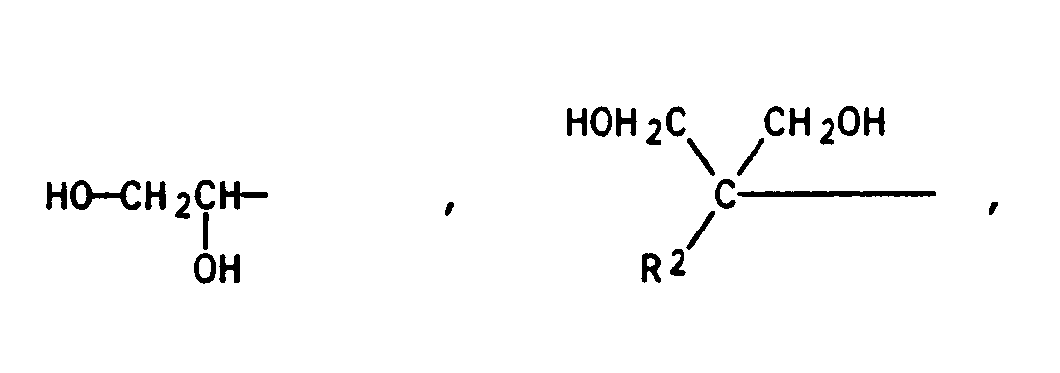
- R²
- = CH₃-, C₂H₅-, C₃H₇-,
- R³
- = H- oder CH₃-,
- X
- = H-, Alkali- oder Ammonium,
- n
- = 0 bis 100,
- m
- = 0 bis 50 und
- R¹
- einen geradkettigen oder verzweigten oder cyclischen Rest mit 1 bis 40 Kohlenstoffatomen und mit einem gewichtsmäßigen Anteil der Kohlenstoffatome zwischen 20 und 86 % bedeutet oder
- R³
- = H oder CH₃
- n
- = 0 bis 100
- m
- = 0 bis 50
- X
- = -SO₃M
- Das Verhältnis der Komponenten B1 und B2 zueinander wird zweckmäßigerweise entsprechend der spezifischen Oberfläche des eingesetzten magnetischen Materials gewählt.
- Die Triole für die Komponente C) sind Verbindungen mit 3 bis 10, vorzugsweise 3 bis 6 C-Atomen. Beispiele für entsprechende Triole sind Glycerin oder Trimethylolpropan. Geeignet sind auch niedermolekulare Umsetzungsprodukte von z. B. Trimethylolpropan mit Ethylenoxid und/oder Propylenoxid. Das Vorhandensein von Triolen bei der Polyaddition führt zu einer Verzweigung des Endprodukts, was sich, sofern keine örtliche Vernetzung auftritt, positiv auf die mechanischen Eigenschaften des Polyurethans auswirkt. Als Polyole lassen sich hierbei beispielsweise Erythrit, Pentaerythrit und Sorbit einsetzen.
- Zur Bildung der NCO-gruppenhaltigen Zwischenprodukte werden die unter A, B und C genannten Komponenten mit aliphatischen, cycloaliphatischen oder aromatischen Diisocyanaten mit 6 bis 30 C-Atomen (Komponente D) umgesetzt. Hierfür eignen sich Verbindungen wie Toluylen-2,4-diisocyanat, Toluylen-2,6-di-isocyanat, m- bzw. p-Tetramethylyloldiisocyanat, m-Phenylendiisocyanat, 4-Chlor-1,3-phenylendiisocyanat, 1,5-Naphthylendiisocyanat; 1,5-Hexamethylendiisocyanat, 1,6-Hexamethylendiisocyanat, 1,4-Cyclohexylendiisocyanat und 1,5-Tetrahydronaphthylendiisocyanat, 4,4'-Diphenylmethandiisocyanat, Dicyclohexylmethandiisocyanat, Isophorondiisocyanat oder Gemische davon.
- Danach werden die NCO-gruppenhaltigen Zwischenprodukte aus den Komponenten A bis D mit den Aminoalkoholen (Komponente E) zu den OH-gruppenhaltigen Polyurethanharnstoffelastomeren umgesetzt. Diese Aminoalkohole mit 2 bis 16, vorzugsweise 3 bis 6 C-Atomen sind u. a. Monoethanolamin, Methylisopropanolamin, Ethylisopropanolamin Methylethanolamin, 3-Aminopropanol, 1-Ethylaminobutanol-2, 4-Methyl-4-aminopentanol-2, N-(2-Hydroxyethyl)anilin. Diolamine sind besonders geeignet, da durch ihre Anlagerung am Kettenende die OH-Zahl der Polymeren verdoppelt wird. Als besonders günstig haben sich Diethanolamin und Diisopropanolamin erwiesen.
- Das Verhältnis der Komponente A) bis D) beträgt 1,35 bis 13 Mol Diisocyanat je Mol Polydiol bei Verwendung von 0,3 bis 10 Mol des Diols mit 2 bis 20 C-Atomen und 0,05 bis 0,5 Mol Triol, wobei die Menge des verwendeten Diols teilweise von dem Molekulargewicht des verwendeten Polydiols abhängt. Aus praktischen Gründen ist es jedoch zweckmäßig, einen Diisocyanatüberschuß von mindestens 3 % über der zur vollständigen Umsetzung der Reaktionsteilnehmer erforderlichen Menge zu verwenden, so daß das Verhältnis der Zahl der eingesetzten Isocyanatgruppen zur Zahl der Hydroxylgruppen in der Reaktionsmischung 1,03 bis 1,3, vorzugsweise 1,05 bis 1,15 beträgt. Der NCO-Überschuß wird dann stöchiometrisch mit den NH-Gruppen des Aminoalkohols umgesetzt, so daß das Verhältnis der Komponenten A) bis C) : D : E wie 1 : 1,03 bis 1,3 : 0,03 bis 0,3, bevorzugt 1 : 1,05 bis 1,15 : 0,05 bis 0,15 beträgt.
- Die so aufgebauten thermoplastischen, elastischen OH-gruppenhaltigen Polyurethane werden in Lösung nach dem 2-Stufenverfahren, gegebenenfalls in Gegenwart von Katalysatoren und anderen Hilfsmitteln und/oder Zusatzstoffen hergestellt. Diese Produkte nach dem lösungsmittelfreien Batch-Verfahren herzustellen, ist nicht möglich. Da sich aufgrund der Anwesenheit des Triols und der Reaktion von Amin mit NCO-Gruppen bei der Substanzpolyaddition zumindest teilweise Gel-Teilchen bilden, wird in Lösung gearbeitet. Allgemein wird bei der Lösungspolyaddition die Gefahr einer örtlichen Übervernetzung, wie sie bei der Substanzpolyaddition auftritt, vermieden.
- Beim 2-Stufenverfahren sind je nach Reaktionsbedingungen (Lösungsmittelmenge, Reaktionswärme) zwei unterschiedliche Fahrweisen möglich.
- Fahrweise 1: Das Diisocyanat wird mit etwas Lösungsmittel vorgelegt, dann werden die Komponenten A, B, C und gegebenenfalls der Katalysator und die Hilfs- und Zusatzstoffe in Lösungsmittel bei Temperaturen von 20 bis 90°C, vorzugsweise 30 bis 70°C, in 0,2 bis 5 Stunden zugegeben. Die Komponenten werden bis zum gewünschten NCO-Gehalt umgesetzt, dann wird in der 2. Stufe die Komponente E zugesetzt.
- Fahrweise 2: Bei diesem Verfahren werden alle Ausgangskomponenten A bis D in einem Teil des Lösungsmittels gelöst, so daß eine Lösung mit einem Feststoffgehalt von 15 bis 50 Gew.% gebildet wird. Anschließend wird die Lösung unter Rühren auf eine Temperatur zwischen 20 und 90°C, vorzugsweise zwischen 30 und 70°C, gegebenenfalls nach der Katalysatorzugabe, erwärmt. Dann werden die Komponenten bis zum gewünschten NCO-Gehalt umgesetzt, danach in der 2. Stufe die Komponente E zugegeben.
- Beim 2-Stufenverfahren wird in der ersten Stufe mit einem NCO-Überschuß, gegenüber den Komponenten A bis C gearbeitet. Bei beiden Fahrweisen ist es möglich, in einem Teil des Lösungsmittels die Reaktion zu beginnen und das restliche Lösungsmittel während oder nach der Reaktion zuzugeben.
- Als Lösungsmittel für die Herstellung der Polyurethane werden vorzugsweise Tetrahydrofuran verwendet. Selbstverständlich können je nach Anwendungsgebiet die Polyurethane auch in anderen polaren Lösungsmitteln, wie Dioxan, Cyclohexanon, Methylethylketon, Dimethylformamid, N-Methylpyrrolidon, Dimethylsulfoxid oder Ethylglykolacetat hergestellt werden. Ebenso ist es möglich, die genannten Lösungsmittel mit Aromaten, wie Toluol oder Xylol und Estern, wie Ethyl- oder Butylacetat, zu mischen.
- Als geeignete Katalysatoren zur Herstellung der Polyurethane und für die Vernetzungsreaktion seien beispielhaft genannt: tert. Amine, wie Triethylamin, Triethylendiamin, N-Methyl-pyridin und N-Methyl-morpholin, Metallsalze, wie Zinnoctoat, Bleioctoat und Zinkstearat und organische Metallverbindungen, wie Dibutylzinnlaurat. Die geeignete Katalysatormenge ist abhängig von der Wirksamkeit des in Frage kommenden Katalysators. Im allgemeinen hat es sich zweckmäßig erwiesen, 0,005 bis 0,3 Gewichtsteile für jeweils 100 Gewichtsteile, vorzugsweise 0,01 bis 0,1 Gewichtsteile für jeweils 100 Gewichtsteile Polyurethan zu verwenden.
- Die die erfindungsgemäßen Aufzeichnungsträger kennzeichnenden Polyurethane lassen sich als alleinige Bindemittel für die Herstellung von Magnetschichten verwenden. Es kann jedoch für spezielle Anwendungszwecke bei magnetischen Aufzeichnungsträgern zweckmäßig sein, eine zweite Bindemittelkomponente in Mengen von 5 bis zu 50 Gewichtsteilen, vorzugsweise von 10 bis 40 Gewichtsteilen, bezogen auf die resultierende Gesamtbindemittelmenge, zuzusetzen.
- Die im Bindemittelgemisch mit den angegebenen speziellen Polyurethanen enthaltenden physikalisch trocknenden Bindemitteln sind bekannt. Es handelt sich hierbei um ein Polyvinylformal-Bindemittel, welches durch Hydrolyse eines Polymerisats eines Vinylesters und anschließende Umsetzung des Vinylalkohol-Polymeren mit Formaldehyd hergestellt wurde. Die Polyvinylformale haben zweckmäßigerweise einen Vinylformalgruppengehalt von mindestens 65 Gew.% und insbesondere mindestens 80 Gew.%. Geeignete Polyvinylformale haben eine Gehalt an Vinylalkohol-Gruppen von 5 bis 13 Gew.%, einen Gehalt an Vinylformal-Gruppen von 80 bis 88 Gew.%, ein spezifisches Gewicht von ca. 1,2 und eine Viskosität von 50 bis 120 mPas, gemessen bei 20°C mit einer Lösung von 5 g Polyvinylformal in 100 ml Phenol-Toluol (1 : 1) mit einem K-Wert nach Fikentscher von 40 bis 70 (1 %ig in DMF). In gleicher Weise geeignet sind neben dem Polyvinylformal Vinylchlorid-diol-mono- oder -di(meth)acrylat-Copolymerisate, die sich z. B. in an sich bekannter weise durch Lösungscopolymerisation oder Suspensionscopolymerisation von Vinylchlorid und dem Diol-monomethacrylat oder -monoacrylat herstellen lassen. Das hierfür zum Einsatz gelangende Diolmono- oder -di-acrylat oder -methacrylat ist ein Veresterungsprodukt von Acrylsäure oder Methacrylsäure mit der entsprechenden molaren Menge an aliphatischem Diol mit 2 bis 4 C-Atomen, wie Ethylenglycol, 1,4-Butandiol und bevorzugt Propandiol, wobei das Propandiol vorzugsweise aus 1,3-Propandiol und 0 bis 50 Gew.% 1,2-Propandiol besteht. Die Copolymerisate haben zweckmäßigerweise einen Vinylchloridgehalt von 50 bis 95 Gew.% und einen Diolacrylat- oder -methacrylat-Gehalt von 5 bis 50 Gew.%. Besonders geeignete Copolymerisate besitzen vorzugsweise einen Gehalt von 70 bis 90 Gew.% vinylchlorid und 10 bis 30 Gew.% Diolmonoacrylat bzw. Diolmonomethacrylat. Eine 15 %ige Lösung besonders geeigneter Copolymerisate wie der Vinylchlorid-Propandiolmonoacrylat-Copolymerisate in einem Gemisch aus gleichen Volumenteilen von Tetrahydrofuran und Dioxan weist bei 25°C eine Viskosität von etwa 30 mPas auf. Der K-Wert nach H. Fikentscher (Cellulosechemie 13 (1932), S. 58 ff.) der besonders geeigneten Produkte liegt zwischen 30 und 50, vorzugsweise bei etwa 40 (1 % in DMF). Außerdem lassen sich auch Phenoxyharze einsetzen, deren Konstitution der Formel
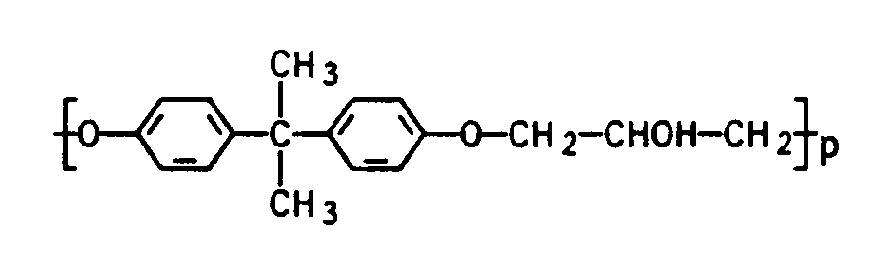
mit p annähernd gleich 100 entspricht. Es handelt sich hierbei um Polymere wie sie z. B. in der DE-B 1 295 011 beschrieben sind. In gleicher Weise eignen sich Celluloseester-Bindemittel in dem bezeichneten Bindemittelgemisch. Dies sind Veresterungsprodukte der Cellulose mit Carbonsäuren mit 1 bis 4 Kohlenstoffatomen, wie z. B. Celluloseacetat, Cellulosetriacetat, Celluloseacetopropionat, Celluloseacetobutyrat. - Die Verarbeitung der speziellen verzweigten Polyurethane mit den OH-gruppenhaltigen Harnstoffgruppen an den Kettenenden ggf. in Abmischung mit anderen Bindemitteln, zusammen mit dem magnetischen Material und den üblichen Hilfsstoffen zu den erfindungsgemäßen Aufzeichnungsträgern erfolgt in der an sich bekannten Weise.
- Als anisotrope magnetische Materialien können die an sich bekannten Pigmente verwendet werden, die die Eigenschaften der resultierenden Magnetschichten wesentlich beeinflussen, wie z. B. Gamma-Eisen(III)-oxid, feinteiliger Magnetit, ferromagnetisches undotiertes oder dotiertes Chromdioxid oder kobaltmodifiziertes Gamma-Eisen(III)-oxid sowie Ferrite und Metallpigmente. Bevorzugt sind nadelförmiges Gamma-Eisen(III)-oxid, Co-dotiertes Eisen(III)oxid, sowie ferromagnetisches Chromdioxid. Die Teilchengröße beträgt im allgemeinen 0,15 bis 2 µm, bevorzugt ist der Bereich von 0,15 bis 0,8 µm.
- Die in den erfindungsgemäßen magnetischen Aufzeichnungsträgern enthaltenen Bindemittel erfordern keine zusätzlichen niedermolekularen Dispergiermittel. Es ist aber möglich Dispergiermittel in im Vergleich zum Stand der Technik geringen Mengen zuzugegeben, wie z.B. Lecithine, N-Talgfett-1,3-diaminodioleat, Polycarbonsäuren, Mono-, Di- oder Polysulfonsäuren, Phosphorsäuren sowie deren Gemische oder Ester oder Salze mit Metallen der ersten bis vierten Gruppe im Periodensystem.
- Ferner enthalten die Magnetschichten in kleinen Mengen Zusätze wie Gleitmittel, aber auch Füllstoffe, die bei der Dispergierung der magnetischen Materialien oder bei der Herstellung der Magnetschicht zugemischt werden. Beispiele solcher Zusätze sind Fettsäuren oder isomerisierte Fettsäuren, wie Stearinsäure oder deren Salze mit Metallen der ersten bis vierten Hauptgruppe des Periodensystems der Elemente sowie Fettsäureester oder Wachse, Siliconöle, Ruß usw. Die Menge der Zusätze ist die an sich übliche. Sie liegt im allgemeinen unter 10 Gew.%, bezogen auf die Magnetschicht.
- Das Mengenverhältnis von magnetischem Material zu Bindemittel in den erfindungsgemäßen Aufzeichnungsmaterialien beträgt zwischen 1 bis 10 und insbesondere 3 bis 6 Gewichtsteile magnetisches Material auf ein Gewichtsteil des Bindemittelgemisches. Es ist ein besonderer Vorteil, daß aufgrund des vorzüglichen Pigmentbindevermögens der speziellen Polyurethane hohe Magnetmaterialkonzentrationen in den Magnetschichten möglich sind, ohne daß die mechanisch-elastischen Eigenschaften verschlechtert oder die Anwendungseigenschaften in Mitleidenschaft gezogen werden.
- Als nichtmagnetische und nichtmagnetisierbare Träger lassen sich die üblichen starren oder flexiblen Trägermaterialien verwenden, insbesondere Folien aus linearen Polyestern, wie Polyethylenterephthalat, im allgemeinen in Stärken von 4 bis 200 µm und insbesondere von 6 bis 36 µm. In neuerer Zeit ist auch die Anwendung der Magnetschichten auf Papierträgern für Zwecke der mittleren Datentechnik bedeutend geworden; auch hierfür lassen sich die erfindungsgemäßen Beschichtungsmassen vorteilhaft verwenden.
- Die Herstellung der erfindungsgemäßen magnetischen Aufzeichnungsträger kann in bekannter Weise erfolgen. Zweckmäßig wird die in einer Dispergiermaschine, z. B. einer Topfkugelmühle oder einer Rührwerksmühle, aus dem magnetischen Material und einer Lösung der Bindemittel unter Zusatz von Dispergiermitteln und anderen Zusätzen hergestellte Magnetpigmentdispersion gegebenenfalls nach dem Zumischen des Polyisocyanatvernetzers filtriert und mit der üblichen Beschichtungsmaschine, z. B. mittels eines Linealgießers, auf den nichtmagnetischen Träger aufgetragen. In der Regel erfolgt eine magnetische Ausrichtung, bevor die flüssige Beschichtungsmischung auf dem Träger getrocknet wird; letzteres geschieht zweckmäßigerweise in 10 bis 200 Sekunden bei Temperaturen von 50 bis 90°C. Die Magnetschichten können auf üblichen Maschinen mittels Hindurchführen zwischen geheizten und polierten Walzen, gegebenenfalls bei Anwendung von Druck und Temperaturen von 25 bis 100°C, vorzugsweise 60 bis 80°C, geglättet und verdichtet werden.
- Dabei hat es sich bei der ggf. zusätzlich durchgeführten Vernetzung der Bindemitteln sehr vorteilhaft erwiesen, die Kalandrierung vorzunehmen bevor die Vernetzung abgeschlossen ist, da die OH-haltigen Polymeren in unvernetztem Zustand sehr gut verdichtet werden können, ohne hierbei zu verkleben. Die Dicke der Magnetschicht beträgt im allgemeinen 0,5 bis 20 µm, vorzugsweise 1 bis 10 µm. Im Falle der Herstellung von Magnetbändern werden die beschichteten Folien in der Längsrichtung in den üblichen, meist nach Zoll festgelegten Breiten geschnitten.
- In den erfindungsgemäßen Sulfonatgruppen aufweisenden Polyurethanen sind gegenüber den dem Stand der Technik entsprechenden Polyurethanen die bekannten magnetischen Materialien in üblichen Dispergiereinrichtungen leicht und vor allem mit sehr geringem Zeit- und Energieaufwand zu homogenen hochpigmentierten Dispersionen zu verarbeiten.
- Außerdem weisen die erfindungsgemäßen magnetischen Aufzeichnungsträger gegenüber solchen, welche mit den dem Stand der Technik entsprechenden Polyurethanen bzw. Polyurethanmischungen mit geeigneten härteren Lackharzkomponenten als Bindemittel hergestellt sind, verbesserte ELAV-Daten sowie Abriebfestigkeit auf. Zusätzlich können mit Hilfe des mit Polyisocyanat vernetzten OH-gruppenhaltigen Polyurethanbindemittels in vereinfachter und verkürzter Arbeitsweise magnetisch und damit elektroakustisch verbesserte magnetische Aufzeichnungsträger erhalten werden. Ein weiterer Vorteil ist dabei, daß die für die erfindungsgemäßen magnetischen Aufzeichnungsträger geeigneten Polymeren durch die Vernetzung Magnetschichten ergeben, welche auch bei erhöhter Temperatur und Luftfeuchtigkeit beständig sind.
- Die in den nachstehenden Beispielen und Vergleichsversuchen genannten Teile und Prozente beziehen sich, soweit nicht anders angegeben, auf das Gewicht. Volumenteile verhalten sich zu Gewichtsteilen wie Liter zu Kilogramm.
- In einem beheizbaren Reaktionsgefäß von 150 000 Volumenteilen Inhalt, ausgerüstet mit Rührer und Rückflußkühler, werden 6 841 Teile eines Polyesterdiols aus Adipinsäure und 1,4-Butandiol (Molekulargewicht ca. 1 000), 777 Teile 1,4-Butandiol, 437 Teile eines Polyether-1,3-diolsulfonats (Molekulargewicht 1 340) und 44 Teile Trimethylolpropan zusammen mit 4 275 Teilen 4,4'-Diphenylmethandiisocyanat in 37 120 Teilen Tetrahydrofuran gelöst und auf 60°C erwärmt. Die Komponenten werden bis zu einer Endviskosität von 2 Pas (bei 60°C) umgesetzt. Der NCO-Gehalt beträgt 0,03 %. Anschließend wird mit 50 380 Teilen Tetrahydrofuran auf einen Feststoffgehalt von 12,5 % verdünnt. Gleichzeitig wird die Reaktion durch Zugabe von 127 Teilen Diethanolamin abgestoppt. Der K-Wert des gebildeten Polymeren beträgt 59,1, gemessen als 1%ige Lösung in Dimethylformamid.
- Die Zusammensetzung und Herstellung erfolgt wie bei Polymer A beschrieben. Die Komponenten werden jedoch nur bis zu einer Endviskosität von 0,5 Pas (bei 60°C) umgesetzt. Der NCO-Gehalt beträgt 0,1 %. Der K-Wert des gebildeten Polymeren beträgt 52,3, gemessen als 1%ige Lösung in Dimethylformamid.
- In einem beheizbaren Reaktionsgefäß von 150 000 Volumenteilen Inhalt, ausgerüstet mit Rührer und Rückflußkühler, werden 6 897 Teile eines Polyesterdiols aus Adipinsäure und 1,4-Butandiol (Molekulargewicht ca. 1 000), 791 Teile 1,4-Butandiol, 330 Teile eines Polyether-1,3-diolsulfonats (Molekulargewicht 1340) und 44 Teile Trimethylolpropan zusammen mit 4 311 Teilen 4,4'-Diphenylmethandiisocyanat in 371 217 Teilen Tetrahydrofuran gelöst und auf 60°C erwärmt. Die Komponenten werden bis zu einer Endviskosität von 2 Pas (bei 60°C) umgesetzt. Der NCO-Gehalt beträgt 0,03 %. Anschließend wird mit 50 383 Teilen Tetrahydrofuran auf einen Feststoffgehalt von 12,5 % verdünnt. Gleichzeitig wird die Reaktion durch Zugabe von 128 Teilen Diethanolamin abgestoppt. Der K-Wert des gebildeten Polymeren beträgt 58,3, gemessen als 1%ige Lösung in Dimethylformamid.
- In einem beheizbaren Reaktionsgefäß von 150 000 Volumenteilen Inhalt, ausgerüstet mit Rührer und Rückflußkühler, werden 8 912 Teile eines Polyesterdiols aus Adipinsäure, Isophthalsäure und 1,6-Hexandiol (Molekulargewicht ca. 1 000), 1 021 Teile 1,4-Butandiol, 574 Teile eines Polyether-1,3-diolsulfonats (Molekulargewicht 1 340) und 57 Teile Trimethylolpropan zusammen mit 5 721 Teilen 4,4'-Diphenyl-methandiisocyanat in 48 357 Teilen Tetrahydrofuran gelöst und auf 60°C erwärmt. Die Komponenten werden bis zu einer Endviskosität von 250 mPas (bei 60°C) umgesetzt. Der NCO-Gehalt beträgt 0,09 %. Anschließend wird mit 34 472 Teilen Tetrahydrofuran auf einen Feststoffgehalt von 16,5 % verdünnt. Gleichzeitig wird die Reaktion durch Zugabe von 180 Teilen Diethanolamin abgestoppt. Der K-Wert des gebildeten Polymeren beträgt 50,1, gemessen als 1%ige Lösung in Dimethylformamid.
- Die Zusammensetzung und Herstellung erfolgt wie Polymer D beschrieben. Die Reaktion wird jedoch statt mit Diethanolamin mit 222 Teilen Dibutylamin abgestoppt.
- In einem beheizbaren Reaktionsgefäß von 150 000 Volumenteilen Inhalt, ausgerüstet mit Rührer und Rückflußkühler, werden 6 637 Teile eines Polycarbonatdiols (Molekulargewicht ca. 2 000), 4 195 Teile ethoxyliertes 2,2-Bis(4-hydroxyphenyl)-propan, 560 Teile eines Polyether-1,3-diolsulfonat (Molekulargewicht 1340) und 74 Teile Trimethylolpropan zusammen mit 4 818 Teilen 4,4'-Diphenylmethandiisocyanat in 48 194 Teilen Tetrahydrofuran gelöst und auf 60°C erwärmt. Die Komponenten werden bis zu einer Endviskosität von 250 mPas (bei 60°C) umgesetzt. Der NCO-Gehalt beträgt 0,06 %. Anschließend wird mit 34 470 Teilen Tetrahydrofuran auf einen Feststoffgehalt von 16,5 % verdünnt. Gleichzeitig wird die Reaktion durch Zugabe von 179 Teilen Diethanolamin abgestoppt. Der K-Wert des gebildeten Polymeren beträgt 51,3, gemessen als 1%ige Lösung in Dimethylformamid.
- In einem beheizbaren Reaktionsgefäß von 150 000 Volumenteilen Inhalt, ausgerüstet mit Rührer und Rückflußkühler, werden 7 071 Teile eines Polyesterdiols aus Adipinsäure und 1,4-Butandiol (Molekulargewicht ca. 1 000), 833 Teile 1,4-Butandiol und 45 Teile Trimethylolpropan zusammen mit 4 419 Teilen 4,4'-Diphenylmethandiisocyanat in 37 107 Teilen Tetrahydrofuran gelöst und auf 60°C erwärmt. Die Komponenten werden bis zu einer Endviskosität von 2 Pas (bei 60°C) umgesetzt. Der NCO-Gehalt beträgt 0,05 %. Anschließend wird mit 50 393 Teilen Tetrahydrofuran auf einen Feststoffgehalt von 12,5 % verdünnt. Gleichzeitig wird die Reaktion durch Zugabe von 131 Teilen Diethanolamin abgestoppt. Der K-Wert des gebildeten Polymeren beträgt 59,8, gemessen als 1%ige Lösung in Dimethylformamid.
- In einem beheizbaren Reaktionsgefäß von 150 000 Volumenteilen Inhalt, ausgerüstet mit Rührer und Rückflußkühler, werden 9 273 Teile eines Polyesterdiols aus Adipinsäure, Isophthalsäure und 1,6-Hexandiol (Molekulargewicht ca. 1 000), 1 103 Teile 1,4-Butandiol und 60 Teile Trimethylolpropan zusammen mit 5 847 Teilen 4,4'-Diphenyl-methandiisocyanat in 48 847 Teilen Tetrahydrofuran gelöst und auf 60°C erwärmt. Die Komponenten werden bis zu einer Endviskosität von 2 Pas (bei 60°C) umgesetzt. Der NCO-Gehalt beträgt 0,03 %. Anschließend wird mit 34 474 Teilen Tetrahydrofuran auf einen Feststoffgehalt von 16,5 % verdünnt. Gleichzeitig wird die Reaktion durch Zugabe von 189 Teilen Diethanolamin abgestoppt. Der K-Wert des gebildeten Polymeren beträgt 58,7, gemessen als 1%ige Lösung in Dimethylformamid.
- In eine Stahlkugelmühle von 6 l Rauminhalt, gefüllt mit 890 Teilen Stahlkugeln werden in Phase I 100 Teile eines ferromagnetischen Chromdioxidpigments mit einer Koerzitivfeldstärke (Hc) von 41,5 kA/m und spezifischer Oberfläche (SSA) von 26,5 m²/g und 3 Teile eines α-Eisenoxids mit einer spezifischen Oberfläche von 3 m²/g sowie 8,33 Teile Polymer B und 160 Teile Tetrahydrofuran eingefüllt und nach intensivem Mischen 72 Stunden dispergiert. Anschließend werden in Phase II weitere 13,88 Teile Polymer B, 1 Teil Isotridecylstearat, 0,5 Teile Myristinsäure sowie 102 Teile THF hinzugefügt und weitere 72 Stunden dispergiert. Die Dispersion wurde sodann unter Druck durch einen Filter von 5 µm Porenweite filtriert. Mit einem Linealgießer wurde eine 23,5 µm starke Polyethylenterephthalatfolie mit der Dispersion beschichtet und nach Durchlaufen eines Magnetfeldes die Beschichtung bei Temperaturen zwischen 60 und 100°C getrocknet. Durch Hindurchführen zwischen beheizten Walzen (90°C, Liniendruck 200 kg/cm) wurde die Magnetschicht verdichtet und geglättet. Die resultierende Dicke betrug 3,5 µm. Die beschichtete Folie wurde anschließend in Bänder von 12,65 mm Breite geschnitten.
- Das Verfahren erfolgt wie in Beispiel 1 beschrieben, jedoch mit der Ausnahme, daß als Polyurethanelastomer das Polymer G eingesetzt wird.
- Das Verfahren erfolgt wie in Beispiel 1 beschrieben, jedoch mit der Ausnahme, daß als Polyurethanelastomer ein Produkt eingesetzt wird, das nach dem Schmelzkondensationsverfahren hergestellt wird und wie es beispielsweise in DE-AS 12 95 001 beschrieben ist.
- Der Glanz wurde mit einem Dr.-Lange-Reflektometer unter einem Winkel von 60° von einem Handabstrich ermittelt. Je höher die Glanzwerte liegen, desto besser ist die Dispergierung ausgefallen.
- Hierzu wird der Handabstrich mit einem 40-µm-Rakel bei einer Abzugsgeschwindigkeit von 1 m/s auf eine 24 µm dicke Polyethylenterephthalatfolie aufgebracht.
- Die Messung der magnetischen Eigenschaften erfolgte mit einem Schwingmagnetometer in einem Meßfeld von 100 kA/m. Bestimmt wurde die remanente Magnetisierung Mr in [mT] sowie der Richtfaktor RF, das ist das Verhältnis der remanenten Magnetisierung längs zur Laufrichtung zu derjenigen quer dazu.

- Das Verfahren erfolgt wie in Beispiel 1 beschrieben, jedoch mit der Ausnahme, daß als Polyurethanelastomer die entsprechenden Polymere D, E bzw. F eingesetzt werden.
- Das Verfahren erfolgt wie in Beispiel 1 beschrieben, jedoch mit der Ausnahme, daß als Polyurethanelastomer das Polymer H eingesetzt wird.
- Das Verfahren erfolgt wie in Beispiel 1 beschrieben, jedoch mit der Ausnahme, daß in Phase I statt des Polymers B ein Gemisch aus 78 Teilen des Polymers H und 22 Teilen eines Polyvinylformals, bestehend aus 82 % Vinylformal-, 12 % Vinylacetat- und 6 % Vinylalkoholeinheiten und daß in Phase II statt des Polymers B das Polymer H eingesetzt werden. Weiterhin werden noch in die Phase I als Dispergiermittel 0,5 Teile N-Talgfett-1,3-di-aminodioleat und 1 Teil Zinkstearat hinzugegeben. Alle übrigen Komponenten sowie die Verfahrensweise sind wie in Beispiel 1 beschrieben.
- In nachstehender Tabelle sind die Testresultate zusammengefaßt. Die Vorteile der erfindungsgemäßen Polymere D, E und F gegenüber dem nicht erfindungsgemäßen Polymeren H sind einmal im Dispergierergebnis zu sehen. Bei der Verwendung von Polymer H ohne zusätzliche Hilfsmittel ist keine ordnungsgemäße Dispergierung möglich (Vergleichsversuch 3). Erst der Zusatz von Polyvinylformal sowie von Dispergiermitteln ermöglicht die Herstellung von Dispersionen, mit denen Magnetbänder erhalten werden können.

- Die deutliche Überlegenheit der Magnetbänder gemäß den Beispielen 2 bis 4 gegenüber einem nicht erfindungsgemäßen Band gemäß Vergleichsbeispiel 4 ist auch aus dem Abriebverhalten zu ersehen, das ein Maß für die mechanische Stabilität der Magnetschicht darstellt.
- Das Abriebverhalten in der Anwendung wird wie folgt bestimmt: Die Magnetbänder werden in Computerband-Kassetten für IBM-3480-Kassettenlaufwerke konfektioniert. Die Computerband-Kassette wird auf einem Kassettenlaufwerk (z.B. IBM-3480 oder Comparex 6380) vom Anfang des Bandes bis zum Ende des Bandes beschriftet. Danach wird das Band zum Anfang zurückgespult. Dieser Vorgang wird 400mal wiederholt. Zwischen den Durchläufen erfolgt keine Reinigung des Schreib-/Lesekopfes. Nach Beendigung der 400 Zyklen wird ein transparentes Klebeband auf den Schreib-/Lesekopf geklebt. Der während der 400 Zyklen am Schreib-/Lesekopf abgelagerte Abrieb wird so von dem Klebeband aufgenommen. Das Klebeband wird anschließend auf ein weißes Papier geklebt und der Abrieb wird visuell beurteilt. Hierfür werden, wie folgt, Noten vergeben:

- Während das mit dem herkömmlichen Bindemittel hergestellte Magnetband im Vergleichsbeispiel 4 Abriebspuren mit deutlich abgebildeter Kopfstruktur zeigt, ist bei den mit den erfindungsgemäßen Bindemitteln hergestellten Magnetbandkassetten praktisch kein Abrieb festzustellen:

hergestellt wird, mit der Maßgabe, daß das Verhältnis der OH-Gruppen der Komponenten A bis C zu den NCO-Gruppen der Komponente D zu den Amingruppen der Komponente E wie 1 : 1,03 bis 1,3 : 0,03 bis 0,3 beträgt.
n + m ≧ 1
ist,
sowie Diole der Formel (II), wie sie teilweise in der DE-A-39 27 630 beschrieben sind:

in welcher

n + m ≧ 1 und
worin M für H, Li, Na, K, Ammonium oder Alkyl steht, darstellt.
Claims (9)
- Magnetische Aufzeichnungsträger, bestehend aus einem nichtmagnetischen Trägermaterial und mindestens einer haftfest darauf aufgebrachten Magnetschicht auf der Basis eines in einem mindestens zu 50 Gew.% aus einem thermoplastischen Polyurethan bestehenden Bindemittel feinverteilten magnetischen Materials, dadurch gekennzeichnet, daß als thermoplastisches Polyurethan ein in Tetrahydrofuran lösliches, isocyanatgruppenfreies, verzweigtes Polyurethan mit OH-gruppenhaltigen Harnstoffgruppen an den Kettenenden und einem Molekulargewicht zwischen 30 000 und 200 000 eingesetzt wird, welches ausA) 1 Mol eines Polydiols mit einem Molekulargewicht zwischen 400 und 10 000B) 0,3 bis 10 Mol eines Gemisches ausB1) mindestens einem Diol mit 2 bis 18 Kohlenstoffatomen undB2) einem mindestens eine Sulfonatgruppe aufweisenden Diol,C) 0,01 bis 1 Mol eines Tri- oder Polyols mit 3 bis 25 Kohlenstoffatomen,D) 1,3 bis 13 Mol mindestens eines Diisocyanats mit 6 bis 30 Kohlenstoffatomen undE) 0,09 bis 2 Mol eines Aminoalkohols mit 2 bis 16 Kohlenstoffatomenhergestellt wird, mit der Maßgabe, daß das Verhältnis der OH-Gruppen der Komponenten A bis C zu den NCO-Gruppen der Komponente D zu den Amingruppen der Komponente E wie 1 : 1,03 bis 1,3 : 0,03 bis 0,3 beträgt.
- Magnetische Aufzeichnungsträger, bestehend aus einem nichtmagnetischen Trägermaterial und mindestens einer haftfest darauf aufgebrachten Magnetschicht auf der Basis eines in einem mindestens zu 50 Gew.% aus einem thermoplastischen Polyurethan bestehenden Bindemittel feinverteilten magnetischen Materials, dadurch gekennzeichnet, daß als thermoplastisches Polyurethan ein in Tetrahydrofuran lösliches, isocyanatgruppenfreies, verzweigtes Polyurethan mit OH-gruppenfreien Harnstoffgruppen an den Kettenenden und einem Molekulargewicht zwischen 30 000 und 200 000 eingesetzt wird, welches ausA) 1 Mol eines Polydiols mit einem Molekulargewicht zwischen 400 und 10 000B) 0,3 bis 10 Mol eines Gemisches ausB1) mindestens einem Diol mit 2 bis 18 Kohlenstoffatomen undB2) einem mindestens eine Sulfonatgruppe aufweisenden Diol,C) 0,01 bis 1 Mol eines Tri- oder Polyols mit 3 bis 10 Kohlenstoffatomen,D) 1,3 bis 13 Mol mindestens eines Diisocyanats mit 6 bis 30 Kohlenstoffatomen undE) 0,09 bis 2 Mol eines OH-gruppenfreien Monoamins mit 2 bis 16 Kohlenstoffatomenhergestellt wird, mit der Maßgabe, daß das Verhältnis der OH-Gruppen der Komponenten A bis C zu den NCO-Gruppen der Komponente D zu den Amingruppen der Komponente E wie 1 : 1,03 bis 1,3 : 0,03 bis 0,3 beträgt.
- Magnetischer Aufzeichnungsträger gemäß Anspruch 2, dadurch gekennzeichnet, daß das in Tetrahydrofuran lösliche, isocyanatgruppenfreie, verzweigte Polyurethan mit OH-gruppenhaltigen Harnstoffgruppen an den Kettenenden mit einem Molekulargewicht zwischen 30 000 und 200 000 mit einem Isocyanat aus der Gruppen der Di-, Tri- und Polyisocyante und der Isocyanatprepolymere mit einem Molgewicht bis zu 10 000 vernetzt wird.
- Magnetischer Aufzeichnungsträger gemäß Anspruch 1, dadurch gekennzeichnet, daß das in Tetrahydrofuran lösliche, isocyanatgruppenfreie, verzweigte Polyurethan mit OH-gruppenfreien Harnstoffgruppen an den Kettenenden mit einem Molekulargewicht zwischen 40 000 und 200 000 zusammen mit einem Isocyanat aus der Gruppen der Di-, Tri- und Polyisocyanate und der Isocyanatprepolymere mit einem Molgewicht bis zu 10 000 eingesetzt wird.
- Magnetische Aufzeichnungsträger gemäß Anspruch 1, 2, 3 oder 4, dadurch gekennzeichnet, daß die Komponente B 2) eine Verbindung der Formel (I) ist
Formel I:
R¹CH₂O-(C₂H₄O-)n(C₃H₇O-)mCH₂CHR³CH₂-SO₃X ,
wobeiR¹ =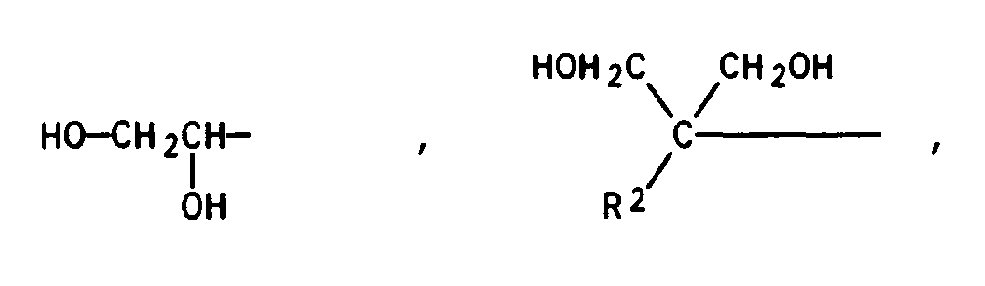 R² = CH₃-, C₂H₅-, C₃H₇-,R³ = H- oder CH₃-,X = H-, Alkali- oder Ammonium,n = 0 bis 100,m = 0 bis 50 undn + m ≧ 1
ist. - Magnetischer Aufzeichnungsträger gemäß Anspruch 1, 2, 3 oder 4, dadurch gekennzeichnet, daß die Komponente B 2) eine Verbindung der Formel (I) ist
Formel I:
R¹CH₂O-(C₂H₄O-)n(C₃H₇O-)mCH₂CHR³CH₂-SO₃X ,
wobeiR¹ = R² = CH₃-, C₂H₅-, C₃H₇-,R³ = H- oder CH₃-,X = H-, Alkali- oder Ammonium,n = 0 bis 100,m = 0 bis 50 undn + m ≧ 1
ist,
und als Komponente D) 4,4'-Diphenylmethandiisocyanat eingesetzt wird. - Magnetischer Aufzeichnungsträger gemäß Anspruch 1, 2, 3 oder 4, dadurch gekennzeichnet, daß die Komponente B 2) ein Diol der Formel (II) ist
 R¹ einen geradkettigen oder verzweigten oder cyclischen Rest mit 1 bis 40 Kohlenstoffatomen und mit einem gewichtsmäßigen Anteil der Kohlenstoffatome zwischen 20 und 86 % bedeutet oder
 R³ = H oder CH₃n = 0 bis 100m = 0 bis 50n + m ≧ 1 undX = -SO₃Mworin M für H, Li, Na, K, Ammonium oder Akyl steht, darstellt.
 - Magnetischer Aufzeichnungsträger gemäß Anspruch 1, 2, 5, 6 oder 7, dadurch gekennzeichnet, daß die OH-Endgruppen zu mehr als 80 % aus einer
 R¹ = (CH₂)n-,R² = H, -CH₃, -(CH₂)n-CH₃ undn = 1 bis 10bedeuten.
 - Magnetischer Aufzeichnungsträger gemäß einem der Ansprüche 1 bis 8, dadurch gekennzeichnet, daß das in Tetrahydrofuran lösliche, isocyanatgruppenfreie, verzweigte Polyurethan mit Harnstoffgruppen an den Kettenenden als alleiniges Bindemittel eingesetzt wird.
Applications Claiming Priority (2)
| Application Number | Priority Date | Filing Date | Title |
|---|---|---|---|
| DE4039749 | 1990-12-13 | ||
| DE4039749A DE4039749A1 (de) | 1990-12-13 | 1990-12-13 | Magnetische aufzeichnungstraeger |
Publications (2)
| Publication Number | Publication Date |
|---|---|
| EP0490201A1 EP0490201A1 (de) | 1992-06-17 |
| EP0490201B1 true EP0490201B1 (de) | 1994-05-18 |
Family
ID=6420194
Family Applications (1)
| Application Number | Title | Priority Date | Filing Date |
|---|---|---|---|
| EP19910120616 Expired - Lifetime EP0490201B1 (de) | 1990-12-13 | 1991-11-29 | Magnetische Aufzeichnungsträger |
Country Status (5)
| Country | Link |
|---|---|
| US (1) | US5266408A (de) |
| EP (1) | EP0490201B1 (de) |
| JP (1) | JP3231372B2 (de) |
| KR (1) | KR920013347A (de) |
| DE (2) | DE4039749A1 (de) |
Families Citing this family (5)
| Publication number | Priority date | Publication date | Assignee | Title |
|---|---|---|---|---|
| GB2282338B (en) * | 1993-09-30 | 1997-08-20 | Basf Magnetics Gmbh | Magnetic recording media |
| US5567512A (en) * | 1993-10-08 | 1996-10-22 | Hmt Technology Corporation | Thin carbon overcoat and method of its making |
| DE4424261A1 (de) | 1994-07-09 | 1996-01-11 | Basf Magnetics Gmbh | Magnetischer Aufzeichnungsträger |
| KR0163094B1 (ko) * | 1995-10-18 | 1999-01-15 | 이웅열 | 자기기록매체 |
| DE19734893A1 (de) * | 1997-08-12 | 1999-02-18 | Emtec Magnetics Gmbh | Lösungsmittelfrei herstellbare Polyurethane und ihre Verwendung als Bindemittel für magnetische Aufzeichnungsträger |
Family Cites Families (13)
| Publication number | Priority date | Publication date | Assignee | Title |
|---|---|---|---|---|
| US2871218A (en) * | 1955-12-01 | 1959-01-27 | Goodrich Co B F | Simulated vulcanizates of polyurethane elastomers |
| US2899411A (en) * | 1956-07-30 | 1959-08-11 | Polyurethane elastomers from hy- | |
| US3320090A (en) * | 1964-07-30 | 1967-05-16 | Ampex | Phenoxy-polyurethane magnetic tape binder |
| US4152485A (en) * | 1977-08-05 | 1979-05-01 | Toyo Boseki Kabushiki Kaisha | Magnetic recording medium |
| DE2753694C3 (de) * | 1977-12-02 | 1982-05-13 | Basf Ag, 6700 Ludwigshafen | Magnetische Aufzeichnungsträger mit Polyurethanelastomer-Bindemitteln in der Magnetschicht |
| GB2054622B (en) * | 1979-07-12 | 1983-04-07 | Tdk Electronics Co Ltd | Magnetic recording medium |
| JPS5758227A (en) * | 1980-09-25 | 1982-04-07 | Tdk Corp | Magnetic recording medium |
| DE3127884A1 (de) * | 1981-07-15 | 1983-02-03 | Agfa-Gevaert Ag, 5090 Leverkusen | Magnetisches speichermedium |
| US4423115A (en) * | 1981-10-23 | 1983-12-27 | Tdk Electronics Co., Ltd. | Magnetic recording medium |
| JPS6095722A (ja) * | 1983-10-28 | 1985-05-29 | Sony Corp | 磁気記録媒体 |
| DE3660144D1 (en) * | 1985-03-01 | 1988-05-26 | Sumitomo Bayer Urethane Co | Magnetic recording medium, a process for preparing a magnetic recording medium and a binder composition therefor |
| JPS63275024A (ja) * | 1987-05-02 | 1988-11-11 | Hitachi Maxell Ltd | 無機顔料用結合剤とこれを用いた磁気記録媒体 |
| DE3929165A1 (de) * | 1989-09-02 | 1991-03-07 | Basf Ag | Magnetische aufzeichnungstraeger |
-
1990
- 1990-12-13 DE DE4039749A patent/DE4039749A1/de not_active Withdrawn
-
1991
- 1991-11-29 DE DE59101674T patent/DE59101674D1/de not_active Expired - Fee Related
- 1991-11-29 EP EP19910120616 patent/EP0490201B1/de not_active Expired - Lifetime
- 1991-12-11 US US07/804,658 patent/US5266408A/en not_active Expired - Fee Related
- 1991-12-12 JP JP32871091A patent/JP3231372B2/ja not_active Expired - Fee Related
- 1991-12-13 KR KR1019910022984A patent/KR920013347A/ko not_active Withdrawn
Also Published As
| Publication number | Publication date |
|---|---|
| US5266408A (en) | 1993-11-30 |
| EP0490201A1 (de) | 1992-06-17 |
| KR920013347A (ko) | 1992-07-28 |
| DE59101674D1 (de) | 1994-06-23 |
| JPH04298818A (ja) | 1992-10-22 |
| DE4039749A1 (de) | 1992-06-17 |
| JP3231372B2 (ja) | 2001-11-19 |
Similar Documents
| Publication | Publication Date | Title |
|---|---|---|
| EP0099533B1 (de) | Magnetische Aufzeichnungsträger | |
| EP0002241B1 (de) | Magnetische Aufzeichnungsträger mit Polyurethanelastomer-Bindemitteln in der Magnetschicht | |
| DE4445174A1 (de) | Als vernetzbare Bindemittelkomponente geeignete Massen | |
| DE2442762A1 (de) | Schichtmagnetogrammtraeger mit polyurethanelastomer-bindemitteln in der magnetschicht | |
| EP0416386B1 (de) | Magnetische Aufzeichnungsträger | |
| EP0100017B1 (de) | Magnetische Aufzeichnungsträger | |
| EP0142798B1 (de) | Magnetische Aufzeichnungsträger | |
| EP0142796B1 (de) | Magnetische Aufzeichnungsträger | |
| DE3227161A1 (de) | Magnetische aufzeichnungstraeger | |
| EP0490223B1 (de) | Magnetische Aufzeichnungsträger | |
| EP0490201A1 (de) | Magnetische Aufzeichnungsträger | |
| EP0414111B1 (de) | Magnetischer Aufzeichnungsträger | |
| DE2255802C3 (de) | Schichtmagnetogrammträger | |
| EP0173213B1 (de) | Verfahren zur Herstellung von magnetischen Aufzeichnungsträgern | |
| EP0083011B1 (de) | Verfahren zur Herstellung magnetischer Aufzeichnungsträger | |
| EP0281873B1 (de) | Magnetische Aufzeichnungsträger | |
| EP0601472A1 (de) | Magnetische Aufzeichnungsträger | |
| EP1086967A2 (de) | Blockcopolymeres Polyurethan, Verfahren zu dessen Herstellung sowie daraus hergestellte Bindemittel und Formkörper | |
| EP1042748B1 (de) | Magnetischer aufzeichnungsträger auf der basis eines hydroxyl- und aminogruppenhaltigen polyurethanpräpolymers | |
| EP0416387A2 (de) | Magnetische Aufzeichnungsträger | |
| EP0896970A1 (de) | Lösungsmittelfrei herstellbare Polyurethane und ihre Verwendung als Bindemittel für magnetische Aufzeichnungsträger | |
| DE3227163A1 (de) | Magnetische aufzeichnungstraeger | |
| EP0601471A1 (de) | Magnetische Aufzeichnungsträger | |
| EP0691644B1 (de) | Magnetischer Aufzeichnungsträger | |
| EP0416388A2 (de) | Magnetische Aufzeichnungsträger |
Legal Events
| Date | Code | Title | Description |
|---|---|---|---|
| PUAI | Public reference made under article 153(3) epc to a published international application that has entered the european phase |
Free format text: ORIGINAL CODE: 0009012 |
|
| 17P | Request for examination filed |
Effective date: 19920226 |
|
| AK | Designated contracting states |
Kind code of ref document: A1 Designated state(s): DE FR GB NL |
|
| 17Q | First examination report despatched |
Effective date: 19930831 |
|
| GRAA | (expected) grant |
Free format text: ORIGINAL CODE: 0009210 |
|
| AK | Designated contracting states |
Kind code of ref document: B1 Designated state(s): DE FR GB NL |
|
| REF | Corresponds to: |
Ref document number: 59101674 Country of ref document: DE Date of ref document: 19940623 |
|
| GBT | Gb: translation of ep patent filed (gb section 77(6)(a)/1977) |
Effective date: 19940602 |
|
| ET | Fr: translation filed | ||
| PLBE | No opposition filed within time limit |
Free format text: ORIGINAL CODE: 0009261 |
|
| STAA | Information on the status of an ep patent application or granted ep patent |
Free format text: STATUS: NO OPPOSITION FILED WITHIN TIME LIMIT |
|
| 26N | No opposition filed | ||
| PG25 | Lapsed in a contracting state [announced via postgrant information from national office to epo] |
Ref country code: NL Effective date: 19950601 |
|
| NLV4 | Nl: lapsed or anulled due to non-payment of the annual fee | ||
| PG25 | Lapsed in a contracting state [announced via postgrant information from national office to epo] |
Ref country code: FR Effective date: 19950731 |
|
| REG | Reference to a national code |
Ref country code: FR Ref legal event code: ST |
|
| PG25 | Lapsed in a contracting state [announced via postgrant information from national office to epo] |
Ref country code: GB Effective date: 19951129 |
|
| GBPC | Gb: european patent ceased through non-payment of renewal fee |
Effective date: 19951129 |
|
| PGFP | Annual fee paid to national office [announced via postgrant information from national office to epo] |
Ref country code: DE Payment date: 20011102 Year of fee payment: 11 |
|
| PG25 | Lapsed in a contracting state [announced via postgrant information from national office to epo] |
Ref country code: DE Free format text: LAPSE BECAUSE OF NON-PAYMENT OF DUE FEES Effective date: 20041118 |