EP0487828A2 - Metallfilm-Kondensatorkonstruktion - Google Patents
Metallfilm-Kondensatorkonstruktion Download PDFInfo
- Publication number
- EP0487828A2 EP0487828A2 EP91113067A EP91113067A EP0487828A2 EP 0487828 A2 EP0487828 A2 EP 0487828A2 EP 91113067 A EP91113067 A EP 91113067A EP 91113067 A EP91113067 A EP 91113067A EP 0487828 A2 EP0487828 A2 EP 0487828A2
- Authority
- EP
- European Patent Office
- Prior art keywords
- capacitor
- section
- tab
- liner
- cover
- Prior art date
- Legal status (The legal status is an assumption and is not a legal conclusion. Google has not performed a legal analysis and makes no representation as to the accuracy of the status listed.)
- Ceased
Links
Images
Classifications
-
- H—ELECTRICITY
- H01—ELECTRIC ELEMENTS
- H01G—CAPACITORS; CAPACITORS, RECTIFIERS, DETECTORS, SWITCHING DEVICES, LIGHT-SENSITIVE OR TEMPERATURE-SENSITIVE DEVICES OF THE ELECTROLYTIC TYPE
- H01G4/00—Fixed capacitors; Processes of their manufacture
- H01G4/002—Details
- H01G4/228—Terminals
- H01G4/236—Terminals leading through the housing, i.e. lead-through
-
- H—ELECTRICITY
- H01—ELECTRIC ELEMENTS
- H01G—CAPACITORS; CAPACITORS, RECTIFIERS, DETECTORS, SWITCHING DEVICES, LIGHT-SENSITIVE OR TEMPERATURE-SENSITIVE DEVICES OF THE ELECTROLYTIC TYPE
- H01G2/00—Details of capacitors not covered by a single one of groups H01G4/00-H01G11/00
- H01G2/10—Housing; Encapsulation
- H01G2/103—Sealings, e.g. for lead-in wires; Covers
-
- H—ELECTRICITY
- H01—ELECTRIC ELEMENTS
- H01G—CAPACITORS; CAPACITORS, RECTIFIERS, DETECTORS, SWITCHING DEVICES, LIGHT-SENSITIVE OR TEMPERATURE-SENSITIVE DEVICES OF THE ELECTROLYTIC TYPE
- H01G4/00—Fixed capacitors; Processes of their manufacture
- H01G4/002—Details
- H01G4/228—Terminals
Definitions
- Metallized film capacitors are widely used in various types of products, for example, ballasts for fluorescent and high intensity discharge lamps, motors, etc. It is always an object to manufacture such capacitors as inexpensively as possible. To accomplish this, would include any one or more of the reduction of parts and assembly steps and the reduction of rejects of the manufactured parts. All of these serve to decrease the final manufacturing cost.
- An existing arrangement for manufacturing a metallized film capacitor includes winding the film capacitor section on a bobbin in the usual roll and providing a plastic insulating wrap around the film roll. Thereafter, a bottom end cup of Kraft paper or a plastic insulator is placed within the capacitor metal outer can, and a plastic terminal insulator and a liner piece is provided for the can cover. A tab is provided to connect an electrode on each end of the capacitor section to a respective terminal on the can cover. The capacitor film section is wrapped in the plastic insulator wrap in such a fashion that the electrodes and their respective tabs are insulated from each other. The wrapped capacitor section is placed within a tube of paper or cardboard to insulate the tab from the can. The cover liner section insulates the tabs at the points of connection to the terminals.
- the present invention utilizes a paper insulating tube in the capacitor can into which the capacitor section without a plastic wrapping, is inserted.
- the tube fits within the can on top of an insulating paper liner at the bottom of this can.
- the tab connected to the electrode at the bottom of the capacitor section and which extends upwardly along the side of the capacitor section in the can is covered by an insulating sleeve, preferably of a tape of suitable material.
- a specially constructed insulating paper liner with a foldable section is provided between the capacitor section top electrode and the inside of the can cover.
- the paper tube with the capacitor section and its attached electrodes and connecting tabs, the tab from the bottom electrode being within its insulating sleeve, are placed into the can.
- the uninsulated tab from the top capacitor section electrode and the uninsulated end of the tab connected to the bottom electrode are already connected to the terminal studs on the inside of the can cover.
- the cover liner is then folded over the exposed uninsulated tab portions to protect and insulate them from the cover. The cover is then fastened to the container.
- capacitors can be manufactured in a more simplified manner with fewer rejects. This substantially reduces the manufacturing cost.
- Another object is to provide a metallized film capacitor which can be assembled without wrapping the capacitor section in a plastic wrap to provide insulation from the connecting tab.
- Still a further object is to provide a metallized film capacitor in which the tab extending along the side of the capacitor section is protected by an insulating sleeve.
- An additional object is to provide a metallized film capacitor in which the uninsulated parts of the tab from the bottom electrode and the tab connected to the top capacitor section electrode are protected by a foldable liner between the inside of the can cover and the capacitor section top electrode.
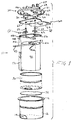
- the capacitor 10 has the usual outer metal can 12 which can be of circular, oval or other desired shape.
- the lower end of the can 12 has a bottom wall 14 and a lip 16 is formed around its open upper end to which the can cover 20 is to be sealed, as described in detail below.
- the can cover 20 has the same overall shape as the can 12.
- a circular can 12 is shown so that the cover 20 is also circular. It should be understood that if the can 12 were oval or elliptical, then the cover would have a similar shape.
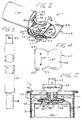
- the cover 20 has a central reduced size depressed portion 21, of the same general overall shape as that of the cover and a peripheral rim 22 which is used to seal the cover to the can lip 16 as shown in Fig. 5.
- the insulator 30 can be of rubber, phenolic or other suitable material.
- each stud 29 has a terminal 27 to which various wires (not shown) are to be connected.
- the stud 29 is welded to terminal 27 while under pressure.
- Each terminal 27 is surrounded by a generally frusto-conical plastic insulating cup 24 whose lower neck end is held by force fit within the upper part of the punched out cover neck 26.
- the bottom end 32 of each stud 29 is to be connected to an end of one of the tabs which is connected to a respective capacitor section electrode, as described below.
- the capacitor also includes the usual section 40 of the metallized film material wound around a central core, or bobbin, 42 of insulating material.
- the size of the section both in height and in a number of film material turns is determined by the amount of capacitance to be provided by the capacitor.
- An electrically conductive electrode 44 is connected to each of the upper and lower ends of the capacitor section to make the necessary electrical connection to the capacitor section 40.
- the electrode 44 at the upper end of the capacitor section is seen most clearly in Figs, 1, 2 and 5.
- First and second electrical tab members 46 and 48 are provided to connect the upper and lower electrodes 44 to their respective terminal studs 29.
- the tabs are elongated, electrically conductive metallic foil members of suitable width and thickness depending upon the capacitor current and voltage rating.
- Tab 46 has one end connected to the upper capacitor electrode 44 and tab 48 has one end (not shown) connected to the lower electrode.
- the connection from a tab end to the respective electrode is usually by spot welding, such as shown at points 46a in Fig. 1.
- Tab 46 connected to the upper electrode 44 is uninsulated along its length.
- a sleeve 50 of polypropylene tape or polyester tape is formed around a majority of the length of tab 48, leaving an uninsulated region at the bottom thereof for connection to the lower electrode 44 and an another uninsulated region at the upper tab end where it is to be connected to a terminal stud 29.
- a liner member 60 of paper, cardboard or other suitable insulating material is also provided between the interrupter 56 and the undersurface of the can cover 20 .
- the liner 60 has a first section 62 with a pair of holes 64 therein, which also can accommodate passage of the ends 32 of the studs 29, and a second section 66.
- the liner is held to the can cover by a washer 67 near the lower end of each stud 29.
- the washers 67 engage the lower face of liner section 62 and old the liner to the studs.
- the assembly for the cover 20 also includes an interrupter bridge 56 which is of phenolic insulating material.
- Interrupter 56 has a pair of holes 58 therein through which the ends 32 of the studs 29 below the washers 67 pass.
- the first and second sections 62 and 66 of the liner 60 are adapted to be folded with respect to each other along a fold line 65.
- the fold line can be pre-formed on the liner to facilitate accuracy during assembly.
- Each of the liner sections 62 and 66 is shown as having approximately the same size and shape as the spacer 56, although this is not necessary.
- Section 62 also has bent ear 63 at each end thereof. The outer surface of each ear 63 is at an angle with respect to the length of liner section 62. The purpose of the ears is to lock the cover to can during processing before the cover is seamed to the can.
- the remaining components of the capacitor assembly includes a tube 70 of suitable insulating material such as paper or cardboard and of a shape corresponding to the capacitor section 40.
- Tube 70 can be of a collapsed material which is expanded to cylindrical shape.
- bottom insulator 72 which has a shape corresponding to that of the lower end of the capacitor section and its connected electrode and the can bottom.
- the assembly of the capacitor of the subject invention proceeds as follows. Several of the components are formed separately. That is, tabs 46 and 48 are made as separate components, the tab 48 being covered by the insulating tape 50 or sleeve along a part of its length.
- the capacitor section 40 is wound around core 42 and the electrodes 44 are attached at the top and bottom of the capacitor section.
- the lower end of the tab 46 is connected to the top electrode 44 at points 46a and the uninsulated lower end of the tab 48 (not shown) is electrically connected to the bottom electrode 44 of the capacitor section in a similar fashion.
- the cover sub-assembly is also separately formed by first punching out the openings 26 and then assembling the terminal-electrodes 27, the insulator 30 and the insulating cups 24.
- the studs 29 are passed through the holes 64 of liner section 62 until the washers 67 engage the liner and press it against the insulators 36.
- the top ends of the studs 29 are electrically connected to the terminals 27 on the cover.
- the interrupter 56 is then placed over the liner section 62 by placing the stud ends 32 through its holes 58.
- each electrode 46, 48 is placed over the lower end 32 of its respective stud 29 extending below the bridge 56 and is staked thereto, such as by welding or soldering.
- the insulated sleeve 50 of the tab 48 lies along the side of the capacitor section and electrically insulates the tab 48 from the capacitor for the part of its length which lies along the capacitor.
- the uninsulated upper end of each tab lies on the insulated bridge 56.
- the second section 66 of the liner 60 is then bent back along the fold line 65 and over the bridge 56 to cover the uninsulated tab ends of the bridge. As shown in Fig. 5, the second section 66 covers the uninsulated ends of the tabs 46, 48 which are sandwiched between the folded second section 66 and the bridge 56.
- the bottom insulator piece 72 is placed into the can as is the insulator tube 70.
- the capacitor section 40 the cover 20 being attached via the tabs being connected to the stud ends 32 as previously described, is inserted into tube 70.
- the tube 70 can first be placed into the can and the capacitor section inserted or the tube and capacitor section assembled outside of the can.
- the can cover 20 is then bent back by about 90 degrees as the capacitor section is being inserted in the can so that the cover will have the proper position lying on the top of the can.
- the cover 20 is then placed on the can.
- the ears 63 on liner 60 engage the inside of the can to hold the cover during processing.
- the cover peripheral edge 22 is seamed around the can lip 16.
- the cover originally has a hole (not shown) through which the capacitor impregnant is added to the can. This can be carried out in an inert atmosphere environment if needed. The hole is sealed. Any baking or drying steps can be carried out as needed.
- the liner second section 66 lies over the uninsulated ends of the tabs 46, 48.
- the liner second section 66 also rests on the top end of the capacitor section core 46.
- the uninsulated ends of the tabs are sandwiched between the folded section 66 of the liner and the bridge 56. This fully protects and insulates the tab to terminal connections from the capacitor section upper electrode 44 even if the capacitor is turned upside down and the capacitor section shifts toward the cover.
- the tab 48 is protected from the capacitor section by its sleeve 50 and there is no need to wrap the section.
- the section 40 is insulated from the can by the tube 70.
Landscapes
- Engineering & Computer Science (AREA)
- Power Engineering (AREA)
- Microelectronics & Electronic Packaging (AREA)
- Manufacturing & Machinery (AREA)
- Fixed Capacitors And Capacitor Manufacturing Machines (AREA)
Applications Claiming Priority (2)
| Application Number | Priority Date | Filing Date | Title |
|---|---|---|---|
| US624695 | 1990-11-28 | ||
| US07/624,695 US5107393A (en) | 1990-11-28 | 1990-11-28 | Metallized film capacitor construction |
Publications (2)
| Publication Number | Publication Date |
|---|---|
| EP0487828A2 true EP0487828A2 (de) | 1992-06-03 |
| EP0487828A3 EP0487828A3 (en) | 1993-02-03 |
Family
ID=24502969
Family Applications (1)
| Application Number | Title | Priority Date | Filing Date |
|---|---|---|---|
| EP19910113067 Ceased EP0487828A3 (en) | 1990-11-28 | 1991-08-02 | Metallized film capacitor construction |
Country Status (4)
| Country | Link |
|---|---|
| US (1) | US5107393A (de) |
| EP (1) | EP0487828A3 (de) |
| CA (1) | CA2046227A1 (de) |
| MX (1) | MX9102163A (de) |
Families Citing this family (4)
| Publication number | Priority date | Publication date | Assignee | Title |
|---|---|---|---|---|
| US6411493B2 (en) * | 2000-03-08 | 2002-06-25 | The United States Of America As Represented By The Administrator Of The National Aeronautics And Space Administration | Apparatus for generating thrust using a two dimensional, asymmetrical capacitor module |
| US6603652B1 (en) * | 2000-11-28 | 2003-08-05 | Howell Electric Motors | Motor capacitor protective assembly |
| ITMI20021202A1 (it) * | 2002-06-04 | 2003-12-04 | Ausimont Spa | Composizioni di fluoropolimeri e particelle inorganiche nanometriche |
| US6631068B1 (en) | 2002-09-17 | 2003-10-07 | Parallax Power Components Llc | Segmented metallized film |
Family Cites Families (8)
| Publication number | Priority date | Publication date | Assignee | Title |
|---|---|---|---|---|
| GB482053A (en) * | 1936-11-04 | 1938-03-23 | Gen Electric Co Ltd | Improvements in or relating to electric condensers |
| US2246933A (en) * | 1939-04-05 | 1941-06-24 | Cornell Dubilier Electric | Electrical capacitor |
| US2332891A (en) * | 1942-01-29 | 1943-10-26 | Gen Electric | Migrationproof electric device |
| GB1149984A (en) * | 1967-08-09 | 1969-04-23 | Tobe Deutschmann Lab Inc | Low inductance capacitor |
| US4236038A (en) * | 1979-07-19 | 1980-11-25 | Rogers Corporation | High capacitance multilayer bus bar and method of manufacture thereof |
| SE419805B (sv) * | 1979-12-13 | 1981-08-24 | Ericsson Telefon Ab L M | Elektrisk kondensator |
| US4502096A (en) * | 1983-08-11 | 1985-02-26 | Reynolds Industries Inc. | Low-inductance capacitor |
| IT1220860B (it) * | 1988-03-25 | 1990-06-21 | Ducati Energia Spa | Condensatore con morsettiera incorporata con o senza dispositivo antiscoppio a porzione flettibile |
-
1990
- 1990-11-28 US US07/624,695 patent/US5107393A/en not_active Expired - Lifetime
-
1991
- 1991-07-04 CA CA002046227A patent/CA2046227A1/en not_active Abandoned
- 1991-08-02 EP EP19910113067 patent/EP0487828A3/en not_active Ceased
- 1991-11-21 MX MX9102163A patent/MX9102163A/es unknown
Also Published As
| Publication number | Publication date |
|---|---|
| MX9102163A (es) | 1992-06-01 |
| CA2046227A1 (en) | 1992-05-29 |
| US5107393A (en) | 1992-04-21 |
| EP0487828A3 (en) | 1993-02-03 |
Similar Documents
| Publication | Publication Date | Title |
|---|---|---|
| US4053687A (en) | Electrochemical cell | |
| US5019934A (en) | Capacitor circuit interruption | |
| US3946350A (en) | Coil assembly for bobbin wound transformer | |
| CA1060555A (en) | Wound capacitor comprising an excess-pressure safety device | |
| EP0026842B1 (de) | Elektrolyt-Kondensator mit niedriger Induktivität | |
| US5107393A (en) | Metallized film capacitor construction | |
| US4452869A (en) | Battery with improved terminal structure | |
| JP3587333B2 (ja) | コンデンサ素子の端子構造 | |
| JPH0315815B2 (de) | ||
| CA1291227C (en) | Capacitor circuit interruption | |
| US4814939A (en) | Capacitor with integral tab arbor | |
| JP2001093782A (ja) | 電解コンデンサ | |
| JPS61139020A (ja) | コンデンサ | |
| US2498053A (en) | Capacitor housing | |
| US4213106A (en) | Tuning apparatus and method of producing the same | |
| JPH0543166B2 (de) | ||
| JPH04209510A (ja) | トランス | |
| JPH06112065A (ja) | 昇圧トランスとその製造方法 | |
| US4870537A (en) | Breakage-resistant capacitor leads | |
| US4554612A (en) | AC Metallized film capacitor | |
| JPS605559Y2 (ja) | 円筒型コンデンサ | |
| JPH03279167A (ja) | トランス用ボビン | |
| JPS6028124Y2 (ja) | 低インピ−ダンス並列電解コンデンサ組立体 | |
| JPH0310665Y2 (de) | ||
| JPS5927051Y2 (ja) | 複合電気部品 |
Legal Events
| Date | Code | Title | Description |
|---|---|---|---|
| PUAI | Public reference made under article 153(3) epc to a published international application that has entered the european phase |
Free format text: ORIGINAL CODE: 0009012 |
|
| AK | Designated contracting states |
Kind code of ref document: A2 Designated state(s): DE FR GB IT |
|
| PUAL | Search report despatched |
Free format text: ORIGINAL CODE: 0009013 |
|
| AK | Designated contracting states |
Kind code of ref document: A3 Designated state(s): DE FR GB IT |
|
| 17P | Request for examination filed |
Effective date: 19930219 |
|
| 17Q | First examination report despatched |
Effective date: 19940329 |
|
| STAA | Information on the status of an ep patent application or granted ep patent |
Free format text: STATUS: THE APPLICATION HAS BEEN REFUSED |
|
| 18R | Application refused |
Effective date: 19950601 |