EP0486243A2 - Machine for acceleration in a gravitational field - Google Patents
Machine for acceleration in a gravitational field Download PDFInfo
- Publication number
- EP0486243A2 EP0486243A2 EP91310395A EP91310395A EP0486243A2 EP 0486243 A2 EP0486243 A2 EP 0486243A2 EP 91310395 A EP91310395 A EP 91310395A EP 91310395 A EP91310395 A EP 91310395A EP 0486243 A2 EP0486243 A2 EP 0486243A2
- Authority
- EP
- European Patent Office
- Prior art keywords
- rotor
- machine
- set forth
- acceleration
- power
- Prior art date
- Legal status (The legal status is an assumption and is not a legal conclusion. Google has not performed a legal analysis and makes no representation as to the accuracy of the status listed.)
- Withdrawn
Links
- 230000001133 acceleration Effects 0.000 title claims description 10
- 230000002441 reversible effect Effects 0.000 claims description 5
- 230000010287 polarization Effects 0.000 claims description 3
- 230000003993 interaction Effects 0.000 abstract description 3
- 238000002474 experimental method Methods 0.000 description 17
- 239000004020 conductor Substances 0.000 description 8
- 238000005303 weighing Methods 0.000 description 7
- 238000005259 measurement Methods 0.000 description 5
- XAGFODPZIPBFFR-UHFFFAOYSA-N aluminium Chemical compound [Al] XAGFODPZIPBFFR-UHFFFAOYSA-N 0.000 description 3
- 229910052782 aluminium Inorganic materials 0.000 description 3
- 241000282414 Homo sapiens Species 0.000 description 2
- 230000003247 decreasing effect Effects 0.000 description 2
- 230000005484 gravity Effects 0.000 description 2
- 230000006641 stabilisation Effects 0.000 description 2
- 238000011105 stabilization Methods 0.000 description 2
- 241000282412 Homo Species 0.000 description 1
- 229910000831 Steel Inorganic materials 0.000 description 1
- 239000003989 dielectric material Substances 0.000 description 1
- 238000005516 engineering process Methods 0.000 description 1
- 238000000034 method Methods 0.000 description 1
- 239000002245 particle Substances 0.000 description 1
- 229920006327 polystyrene foam Polymers 0.000 description 1
- 239000010959 steel Substances 0.000 description 1
- 239000013585 weight reducing agent Substances 0.000 description 1
Images

Classifications
-
- F—MECHANICAL ENGINEERING; LIGHTING; HEATING; WEAPONS; BLASTING
- F03—MACHINES OR ENGINES FOR LIQUIDS; WIND, SPRING, OR WEIGHT MOTORS; PRODUCING MECHANICAL POWER OR A REACTIVE PROPULSIVE THRUST, NOT OTHERWISE PROVIDED FOR
- F03H—PRODUCING A REACTIVE PROPULSIVE THRUST, NOT OTHERWISE PROVIDED FOR
- F03H99/00—Subject matter not provided for in other groups of this subclass
Definitions
- a machine constructed in accordance with the present invention comprises an electrically polarized body, and means for moving the body in one direction to accelerate electrons, thereby generating an accelerating force in another direction due to an interaction between the accelerated electrons and the gravitational field.
- Fig. 1 shows an embodiment of this invention wherein a machine is arranged for producing thrust or acceleration in the downward direction of gravity F of the earth.
- An outer cylindrical electrode 2 is mounted on a base 1 via an insulating ring 2a.
- a cylindrical rotor 3 is provided inside the electrode 2.
- the electrode 2 comprises an outer conductor layer 2A and an inner dielectric layer 2B.
- the rotor 3 comprises an inner conductor layer 3A and an outer dielectric layer 3B. There is a gap between the electrode 2 and the rotor 3 so that they do not touch.
- the rotor 3 is attached to an electrically conductive shaft 5 of a motor 4 through a conductive coupler 6.
- the motor 4 controls the revolution of the shaft 5 and the rotor 3, and a power supply 7 feeds power to the motor 4 through power lines 4a.
- a generator 8 is electrically connected to the power supply 7. In the event the motor 4 is an AC type and a DC generator 8 is provided, a DC-AC converter is included in the power supply 7.
- the generator 8 includes an electrical generator driven by, for example, a gas engine, solar power, man power, etc.
- the motor 4, the power supply 7, and the generator 8 are mounted on the base 1.
- An electric charge supply 9 is also mounted on the base 1 and receives energy from the power supply 7 or the generator 8.
- the electrodes 9a and 9b of the electric charge supply 9 are electrically connected to the electrode 2 and the rotor 3 respectively.
- the polarity of the electric charge supply 9 is preferably reversible.
- the generator 8 supplies power for the power supply 7 and the electric charge supply 9.
- the electric charge supply 9 provides a positive electric charge to the electrode 2, it provides a negative electric charge to the rotor 3 through the motor 4, the shaft 5, and the coupler 6, vice versa.
- the electrode 9b may be connected to the shaft 5 by conductive bearings or slip rings, for example.
- the amount of the generated vertical force or thrust depends on the magnitude of the charges and/or the rotational speed. Whether the generated vertical force or thrust is directed upwardly or downwardly depends on the polarity of the electric charge generator 9 but does not depend on the direction of rotation of the rotor 3.
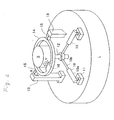
- Fig. 2 shows another embodiment of this invention, wherein a machine comprises a larger-power machine L and a smaller-power machine S.
- the larger-power machine L and the smaller-power machine S are each functionally identical to the machine in Fig. 1, but differ only in the amount of power.
- the smaller-power machine S is connected to the larger-power machine L in such a manner that the axis of the smaller-power machine S can be oriented to any desired direction within a range of 45 degrees around the axis of the larger-power machine L, and can be fixed in that direction.
- the rotor is turned in a preset plane, its axis being perpendicular to the plane, and the electric charges established by the two electrodes are rotated in the plane, causing a force or thrust to be produced in the direction which is perpendicular to the preset plane and parallel with the axis of rotation of the charges and the rotor.
- Two cylinders 10 are universally jointed to bases 11 mounted on the larger power machine L.
- the rod 10b of each cylinder 10 is connected to the lower part of a central shaft 12 of the smaller power machine S.
- a pair of support pillars 13 stand on the larger machine L.
- a ring 14 is mounted rotatably in a direction shown by an arrow X on the upper part of the pillars 13 through pins 15.
- the smaller machine S is rotatably mounted in a direction as shown by an arrow Y inside the ring 14 through pins 16.
- the smaller-power machine S serves for attitude stabilization, selection of the accelerating direction and/or adjustment of the accelerating power.
- the larger-power machine L contributes mainly to the vertical thrust.
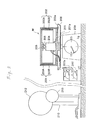
- Fig. 3 shows apparatus for conducting an experiment, which was carried out to show the vertical force generated by rotating electric charges in a horizontal plane. This experiment uses a machine described below, which is called a machine for experiment in order to distinguish it from the machine shown in Fig. 1.
- An outer electrode 202 is mounted on a base 201 via an insulating ring 202a.
- a rotor 203 is provided inside the electrode 202.
- the electrode 202 comprises an outer conductor layer 202A and an inner dielectric layer 202B, and the rotor 203 comprises an inner conductor layer 203A and an outer dielectric layer 203B. There is a gap between the electrode 202 and the rotor 203.
- the rotor 203 is connected to the conductive shaft 205 of a motor 204 through a conductive coupler 206.
- the motor 204 is fixed on the base 201 which has a cylindrical projection 201a.
- the motor controls the revolution of the conductor shaft 205 and the rotor, and constant-current power supply 207 feeds power to the motor 204.
- the base 201 is placed on a plate 208 of a weighing machine 209.
- An electric charge supply 210 such as a Van de Graaff generator, and a small spherical conductor 213 which does not have a charge generating function are not placed on the plate 208 of the weighing machine 209, but they are placed far from the electrode 202.
- the electric charge supply 210 has a spherical negative electrode 212.
- the minimum graduation of the weight indicator of the weighing machine 209 is 10 grams, and the distance between adjacent graduation lines is 1.5 mm.
- the weight of the machine for experiment was measured, and it turned out to be 1300 grams. This measurement was made several times while swinging the two wires connecting the motor 204 and the power supply 207, and no visible changes were detected. The total weight of the two wires is less than 1 gram. Therefore it can be said that the wires do not affect the results of the experiment.
- the power supply 207 was turned on, and fed a current of 3 A to the motor 204 in order to accelerate the rotor 203 rapidly.
- the result was that the reading of the weighing machine 209 fluctuated within a range of ⁇ 3 grams in the course of acceleration.
- the change in the weighing machine reading was checked at the top speed of the rotor 203 with the motor supplied with a current of 0.5 A.
- the difference between the reading at the top speed and that at rest was less than 1 gram. This difference can be considered to be caused by an interaction between the rotor rotation and the surrounding air.
- the charge supply 210 was turned on and was brought to a place near the machine for experiment so that the spherical electrode 212 touched the outer electrode 202. After one minute, the charge supply 210 was taken away to a place far from the machine, and was turned off.
- the positive terminal of the charge supply 210 was connected to the small spherical conductor 213, and the above measurements were repeated using this small spherical conductor 213, instead of the spherical negative electrode 212, as a source to charge the electrode 202.
- the reading of the weighing machine 209 was 1304 grams, indicating a weight increase of 4 grams. The same result was obtained when the rotor 203 was turned in the opposite direction.
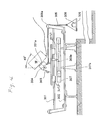
- Fig. 4 shows another system for an experiment, which was carried out to show a horizontal force generated by rotating electric charges around a tilted axis. This experiment uses the same machine M as that in experiment 1.
- Two parallel steel rod rails 301 are supported at both ends by a supporting frame 302 placed on a rigid table.
- a sliding mount 303 with a fixed needle 303a attached thereto is movably mounted on the rails 301 through four thrust-ball-bearings 303b. This sliding mount 303 can therefore roll freely along the straight rails 301.
- the cylindrical projection 201a of the machine for experiment is inserted with a tight fit in the cylindrical hole of a coupler 304, which is mounted on the sliding mount 303 at an angle of 45 degrees to the vertical.
- the sliding mount 303 is pulled toward the right by a cord 305, one end of which is connected to the sliding mount 303 and the other end of which is connected to a plate 306 loaded with a weight 308.
- a scale 307 of one-meter length is provided just behind the moving path of the needle 303a.
- the sliding mount 303 mounting the machine When the sliding mount 303 mounting the machine is brought to the left end of the rails 301 by hand and then is released, the sliding mount 303 is pulled by the weight 308 toward the right, and slides along the rails 301. As the sliding mount 303 moves, the reading of the scale 307, indicated by the needle 303a, changes. This process is repeated with various conditions and the time interval between the time when the reading of the scale 307 is 10 cm and that when the reading is 60 cm is measured.
- the time interval was measured with the rotor 203 of the machine M at rest and not charged. The time of movement between 10 cm. and 60 cm. was 3.8 seconds. Second, the time interval was measured with the rotor 203 in rotation and not charged. At the top speed of rotation, the measured time interval was again 3.8 seconds.
- the time interval was measured with the rotor 203 rotating and charged. As the rotational speed of the rotor 203 increased, the measured time interval decreased. At the top speed of rotation, the time interval between 10 cm. and 60 cm. was 3.4 seconds.
- the machine of this invention can generate not only a vertical force but also a horizontal force simply by tilting the rotational axis of the rotor.
- the machine generates a vertical or a horizontal acceleration or thrust, or in any desired direction.
- the machine is also useful for attitude stabilization of a craft.
- the machine generates acceleration in a direction by accelerating a polarized body in another direction, particularly one where the polarized body is a rotor that is rotatable in a gravitational field.
- the rotor may be oriented in a non-vertical direction, the rotor axis being variable and the rotor being electrically charged or magnetized.
- the rotational speed of the rotor is variable and/or reversible, and the degree of polarization is variable and/or reversible.
- the number of rotors may be two or more, and has at least one rotor whose axial direction is variable.
Landscapes
- Engineering & Computer Science (AREA)
- Chemical & Material Sciences (AREA)
- Combustion & Propulsion (AREA)
- Mechanical Engineering (AREA)
- General Engineering & Computer Science (AREA)
- Connection Of Motors, Electrical Generators, Mechanical Devices, And The Like (AREA)
Abstract
A machine comprising an electrically polarized body, and means for moving the body in one direction to accelerate electrons, thereby generating an accelerating force in another direction due to an interaction between the accelerated electrons and the gravitational field.
Description
- The development of science and technology in the twentieth century has revealed that the earth is too small for the human race to survive. Population growth is far beyond predictions, and it will become almost impossible in the nearfuture to sustain all humans and maintain the environment on the earth in a liveable condition. Therefore an improved propulsion engine to facilitate travel is needed, which does little or no harm to the environment.
- A machine constructed in accordance with the present invention comprises an electrically polarized body, and means for moving the body in one direction to accelerate electrons, thereby generating an accelerating force in another direction due to an interaction between the accelerated electrons and the gravitational field.
- The invention will be better understood from the following detailed description taken in conjunction with the accompanying figures of the drawings, wherein:
- Fig. 1 is a sectional view of a machine in accordance with a first embodiment of this invention;
- Fig. 2 is a perspective view of a machine in accordance with a second embodiment of this invention;
- Fig. 3 is a sectional view of apparatus for conducting a first experiment; and
- Fig. 4 is a view of apparatus for conducting a second experiment.
- Fig. 1 shows an embodiment of this invention wherein a machine is arranged for producing thrust or acceleration in the downward direction of gravity F of the earth.
- An outer
cylindrical electrode 2 is mounted on abase 1 via aninsulating ring 2a. Acylindrical rotor 3 is provided inside theelectrode 2. - The
electrode 2 comprises anouter conductor layer 2A and an innerdielectric layer 2B. Therotor 3 comprises aninner conductor layer 3A and an outerdielectric layer 3B. There is a gap between theelectrode 2 and therotor 3 so that they do not touch. - The
rotor 3 is attached to an electricallyconductive shaft 5 of amotor 4 through aconductive coupler 6. Themotor 4 controls the revolution of theshaft 5 and therotor 3, and apower supply 7 feeds power to themotor 4 through power lines 4a. Agenerator 8 is electrically connected to thepower supply 7. In the event themotor 4 is an AC type and aDC generator 8 is provided, a DC-AC converter is included in thepower supply 7. Thegenerator 8 includes an electrical generator driven by, for example, a gas engine, solar power, man power, etc. Themotor 4, thepower supply 7, and thegenerator 8 are mounted on thebase 1. - An
electric charge supply 9 is also mounted on thebase 1 and receives energy from thepower supply 7 or thegenerator 8. Theelectrodes electric charge supply 9 are electrically connected to theelectrode 2 and therotor 3 respectively. The polarity of theelectric charge supply 9 is preferably reversible. - In the above embodiment, the
generator 8 supplies power for thepower supply 7 and theelectric charge supply 9. When theelectric charge supply 9 provides a positive electric charge to theelectrode 2, it provides a negative electric charge to therotor 3 through themotor 4, theshaft 5, and thecoupler 6, vice versa. Theelectrode 9b may be connected to theshaft 5 by conductive bearings or slip rings, for example. - When the
motor 4, supplied with the power from thepower supply 7, drives therotor 3, electric charges (charged particles) of therotor 3 are horizontally accelerated in the gravitational field, and generate a vertical force as described herein-after in the experiments. The accelerated electrons interact with a curved space, i.e., a gravitational field, and the physical relation between the space curvature of the electrons, i.e., each electron as a curvature of the space and/or the space curvature caused by each rotating electron, and the space curvature caused by gravity, produces a force on the machine. As a result, the machine having therotor 3 produces a vertical thrust. - The amount of the generated vertical force or thrust depends on the magnitude of the charges and/or the rotational speed. Whether the generated vertical force or thrust is directed upwardly or downwardly depends on the polarity of the
electric charge generator 9 but does not depend on the direction of rotation of therotor 3. - Fig. 2 shows another embodiment of this invention, wherein a machine comprises a larger-power machine L and a smaller-power machine S. The larger-power machine L and the smaller-power machine S are each functionally identical to the machine in Fig. 1, but differ only in the amount of power.
- The smaller-power machine S is connected to the larger-power machine L in such a manner that the axis of the smaller-power machine S can be oriented to any desired direction within a range of 45 degrees around the axis of the larger-power machine L, and can be fixed in that direction. In each the larger and the smaller machines, the rotor is turned in a preset plane, its axis being perpendicular to the plane, and the electric charges established by the two electrodes are rotated in the plane, causing a force or thrust to be produced in the direction which is perpendicular to the preset plane and parallel with the axis of rotation of the charges and the rotor.
- Two
cylinders 10 are universally jointed tobases 11 mounted on the larger power machine L. Therod 10b of eachcylinder 10 is connected to the lower part of acentral shaft 12 of the smaller power machine S. A pair ofsupport pillars 13 stand on the larger machineL. A ring 14 is mounted rotatably in a direction shown by an arrow X on the upper part of thepillars 13 throughpins 15. The smaller machine S is rotatably mounted in a direction as shown by an arrow Y inside thering 14 throughpins 16. By extending or contracting thecylinder rods 10b, the axis of theshaft 12 and the machine S may be adjusted. - In the embodiment of Fig. 2, the smaller-power machine S serves for attitude stabilization, selection of the accelerating direction and/or adjustment of the accelerating power. The larger-power machine L contributes mainly to the vertical thrust.
- This invention is based on and substantiated by the following experiments:
- Fig. 3 shows apparatus for conducting an experiment, which was carried out to show the vertical force generated by rotating electric charges in a horizontal plane. This experiment uses a machine described below, which is called a machine for experiment in order to distinguish it from the machine shown in Fig. 1.
- An
outer electrode 202 is mounted on abase 201 via aninsulating ring 202a. Arotor 203 is provided inside theelectrode 202. Theelectrode 202 comprises anouter conductor layer 202A and an innerdielectric layer 202B, and therotor 203 comprises aninner conductor layer 203A and an outerdielectric layer 203B. There is a gap between theelectrode 202 and therotor 203. - The
rotor 203 is connected to theconductive shaft 205 of amotor 204 through aconductive coupler 206. Themotor 204 is fixed on thebase 201 which has acylindrical projection 201a. The motor controls the revolution of theconductor shaft 205 and the rotor, and constant-current power supply 207 feeds power to themotor 204. Thebase 201 is placed on aplate 208 of aweighing machine 209. - An electric charge supply 210, such as a Van de Graaff generator, and a small
spherical conductor 213 which does not have a charge generating function are not placed on theplate 208 of theweighing machine 209, but they are placed far from theelectrode 202. Theelectric charge supply 210 has a sphericalnegative electrode 212. The minimum graduation of the weight indicator of theweighing machine 209 is 10 grams, and the distance between adjacent graduation lines is 1.5 mm. - With the
power supply 207 and the charge supply 210 off, the weight of the machine for experiment was measured, and it turned out to be 1300 grams. This measurement was made several times while swinging the two wires connecting themotor 204 and thepower supply 207, and no visible changes were detected. The total weight of the two wires is less than 1 gram. Therefore it can be said that the wires do not affect the results of the experiment. - Then the
power supply 207 was turned on, and fed a current of 3 A to themotor 204 in order to accelerate therotor 203 rapidly. The result was that the reading of the weighingmachine 209 fluctuated within a range of ±3 grams in the course of acceleration. - Then we turned off the supply current, waited for the
rotor 203 to stop, and then set the supply current to 1 A in order to accelerate therotor 203 gradually. - The result was that there was no visible fluctuation of weight in the course of acceleration. This means that the
rotor 203 must be accelerated with a current less than 1 A in order to avoid fluctuation due to rapid acceleration. - Then the change in the weighing machine reading was checked at the top speed of the
rotor 203 with the motor supplied with a current of 0.5 A. The difference between the reading at the top speed and that at rest was less than 1 gram. This difference can be considered to be caused by an interaction between the rotor rotation and the surrounding air. - Then with the
rotor 203 at rest, thecharge supply 210 was turned on and was brought to a place near the machine for experiment so that thespherical electrode 212 touched theouter electrode 202. After one minute, thecharge supply 210 was taken away to a place far from the machine, and was turned off. - Then we started acceleration of the
rotor 203 with a supplied current of 0.5A. The reading of the weighingmachine 209 decreased with increase in the rotational speed of therotor 203. At the top speed, the reading was 1289 grams, indicating a weight reduction of 11 grams. The same measurement was repeated with therotor 203 turning in the opposite direction, and obtained the same result. - Then the positive terminal of the
charge supply 210 was connected to the smallspherical conductor 213, and the above measurements were repeated using this smallspherical conductor 213, instead of the sphericalnegative electrode 212, as a source to charge theelectrode 202. At the top speed, the reading of the weighingmachine 209 was 1304 grams, indicating a weight increase of 4 grams. The same result was obtained when therotor 203 was turned in the opposite direction. - Further all of the above measurements were repeated with another rotor made of dielectric material (such as polystyrene foam). The Van de Graaff generator charged electrode was touched to the rotor and then the Van de Graaff generator was turned off and removed away immediately after the rotor was electrically charged. Similar results were obtained.
- From the above, one can conclude:
- 1. Horizontal rotation of a charged body generates a vertical force.
- 2. When the polarity of the charges supplied to the rotating body is reversed, the direction of the generated vertical force is also reversed.
- 3. The faster the body is rotated, the stronger is the generated vertical force.
- 4. The direction and strength of the generated vertical force do not depend on the direction of the body.
- Fig. 4 shows another system for an experiment, which was carried out to show a horizontal force generated by rotating electric charges around a tilted axis. This experiment uses the same machine M as that in
experiment 1. - Two parallel steel rod rails 301 are supported at both ends by a supporting
frame 302 placed on a rigid table. A slidingmount 303 with a fixedneedle 303a attached thereto is movably mounted on therails 301 through four thrust-ball-bearings 303b. This slidingmount 303 can therefore roll freely along the straight rails 301. - The
cylindrical projection 201a of the machine for experiment is inserted with a tight fit in the cylindrical hole of acoupler 304, which is mounted on the slidingmount 303 at an angle of 45 degrees to the vertical. - The sliding
mount 303 is pulled toward the right by acord 305, one end of which is connected to the slidingmount 303 and the other end of which is connected to aplate 306 loaded with aweight 308. - A
scale 307 of one-meter length is provided just behind the moving path of theneedle 303a. - When the sliding
mount 303 mounting the machine is brought to the left end of therails 301 by hand and then is released, the slidingmount 303 is pulled by theweight 308 toward the right, and slides along therails 301. As the slidingmount 303 moves, the reading of thescale 307, indicated by theneedle 303a, changes. This process is repeated with various conditions and the time interval between the time when the reading of thescale 307 is 10 cm and that when the reading is 60 cm is measured. - First, the time interval was measured with the
rotor 203 of the machine M at rest and not charged. The time of movement between 10 cm. and 60 cm. was 3.8 seconds. Second, the time interval was measured with therotor 203 in rotation and not charged. At the top speed of rotation, the measured time interval was again 3.8 seconds. - Third, the time interval was measured with the
rotor 203 rotating and charged. As the rotational speed of therotor 203 increased, the measured time interval decreased. At the top speed of rotation, the time interval between 10 cm. and 60 cm. was 3.4 seconds. - This measurement was repeated for both rotational directions of the rotor and the same result of 3.4 seconds was obtained.
- Also measured was the time interval from the starting point of the sliding mount to the point where the reading of the scale was 60 cm., and the acceleration of the sliding
mount 303 was calculated. The result is that when the rotor is not charged, the horizontal accelerating force is 4.0 grams weight, and when the rotor is charged, the horizontal accelerating force is 5.6 grams weight. - From the above, one can conclude that the machine of this invention can generate not only a vertical force but also a horizontal force simply by tilting the rotational axis of the rotor.
- Specifications of the experimental apparatus are as follows:
-
Base 201a: Made of Aluminum - Electrode 202: Made of aluminum with an inner dielectric layer, 130 mm in diameter, 5 mm thick, 7 cm high
- Rotor 203: Made of aluminum with an outer dielectric layer, 127 mm in diameter, 5 mm thick, 6 cm high
- Motor 4: Rated maximum number of revolutions: 50/sec
- Weight of machine: 1300 grams
- Weight of the sliding
mount 303 including the coupler - 304: 700 grams
- Power supply 207: Rated maximum output voltage: 25
- volts
- From the foregoing it will be apparent that an improved machine has been provided. The machine generates a vertical or a horizontal acceleration or thrust, or in any desired direction. The machine is also useful for attitude stabilization of a craft. The machine generates acceleration in a direction by accelerating a polarized body in another direction, particularly one where the polarized body is a rotor that is rotatable in a gravitational field. The rotor may be oriented in a non-vertical direction, the rotor axis being variable and the rotor being electrically charged or magnetized. The rotational speed of the rotor is variable and/or reversible, and the degree of polarization is variable and/or reversible. The number of rotors may be two or more, and has at least one rotor whose axial direction is variable.
Claims (12)
1. Apparatus for acceleration in a gravitational field, comprising an electrically polarized body, and means for moving said body in one direction, thereby generating an accelerating force in another direction.
2. Apparatus as set forth in Claim 1, in which said polarized body comprises a rotor that is rotatably placed in the gravitational field.
3. Apparatus as set forth in Claim 2, in which said rotor has an axis which is oriented to a non-vertical direction.
4. Apparatus as set forth in Claim 2, in which said rotor is electrically charged or magnetized.
5. Apparatus as set forth in Claim 2, in which the rotational speed of said rotor is variable.
6. Apparatus as set forth in Claim 2, in which the rotational direction of said rotor is reversible.
7. Apparatus as set forth in Claim 2 in which the degree of polarization of said rotor is variable.
8. Apparatus as set forth in Claim 2, in which the direction of the rotor axis is variable.
9. Apparatus as set forth in Claim 2, in which at least two rotors are provided.
10. Apparatus as set forth in Claim 9, wherein at least one of said rotors has an axial direction which is variable.
11. Apparatus as set forth in Claim 1, wherein the polarization is reversible.
12. A machine comprising an outer cylindrical electrode, an inner cylindrical electrode, means for rotating one of said electrodes relative to the other of said electrodes, and means for placing oppositely polarized charges on said inner and outer electrodes.
Applications Claiming Priority (1)
| Application Number | Priority Date | Filing Date | Title |
|---|---|---|---|
| JP31213490 | 1990-11-16 |
Publications (2)
| Publication Number | Publication Date |
|---|---|
| EP0486243A2 true EP0486243A2 (en) | 1992-05-20 |
| EP0486243A3 EP0486243A3 (en) | 1994-03-16 |
Family
ID=18025665
Family Applications (1)
| Application Number | Title | Priority Date | Filing Date |
|---|---|---|---|
| EP91310395A Withdrawn EP0486243A2 (en) | 1990-11-16 | 1991-11-11 | Machine for acceleration in a gravitational field |
Country Status (1)
| Country | Link |
|---|---|
| EP (1) | EP0486243A2 (en) |
Cited By (4)
| Publication number | Priority date | Publication date | Assignee | Title |
|---|---|---|---|---|
| RU2185526C1 (en) * | 2001-05-21 | 2002-07-20 | Леонов Владимир Семенович | Method of creating thrust in vacuum and field engine for spacecraft (versions) |
| RU2200875C2 (en) * | 2000-05-17 | 2003-03-20 | Богданов Игорь Глебович | Electromagnetic engine designed for creating thrust basing on new physical principles |
| US9337752B2 (en) | 2012-07-06 | 2016-05-10 | Richard Banduric | Interacting complex electric fields and static electric fields to effect motion |
| US10320312B2 (en) | 2012-07-06 | 2019-06-11 | Richard Banduric | Complex electric fields and static electric fields to effect motion with conduction currents and magnetic materials |
Families Citing this family (1)
| Publication number | Priority date | Publication date | Assignee | Title |
|---|---|---|---|---|
| RU2252335C2 (en) * | 2003-04-29 | 2005-05-20 | Саратовский государственный технический университет | Method of receiving ecologically clean energy from gravitational field |
Family Cites Families (4)
| Publication number | Priority date | Publication date | Assignee | Title |
|---|---|---|---|---|
| FR2619861A1 (en) * | 1971-04-08 | 1989-03-03 | Paraire Camille | Method and devices intended for moving and possibly supporting a vehicle |
| US4663932A (en) * | 1982-07-26 | 1987-05-12 | Cox James E | Dipolar force field propulsion system |
| DE3608499A1 (en) * | 1986-03-14 | 1987-09-24 | Michael Schmid | Electrical energy transducer (converter) |
| CA2053881A1 (en) * | 1989-06-14 | 1990-12-15 | Randell L. Mills | Apparatus and method for providing an antigravational force |
-
1991
- 1991-11-11 EP EP91310395A patent/EP0486243A2/en not_active Withdrawn
Cited By (7)
| Publication number | Priority date | Publication date | Assignee | Title |
|---|---|---|---|---|
| RU2200875C2 (en) * | 2000-05-17 | 2003-03-20 | Богданов Игорь Глебович | Electromagnetic engine designed for creating thrust basing on new physical principles |
| RU2185526C1 (en) * | 2001-05-21 | 2002-07-20 | Леонов Владимир Семенович | Method of creating thrust in vacuum and field engine for spacecraft (versions) |
| WO2002095225A1 (en) * | 2001-05-21 | 2002-11-28 | Pilkin, Vitaly Evgenievich | Method for producing propulsion in a vacuum and a field engine for space vehicle (variants) |
| US9337752B2 (en) | 2012-07-06 | 2016-05-10 | Richard Banduric | Interacting complex electric fields and static electric fields to effect motion |
| US10027257B2 (en) | 2012-07-06 | 2018-07-17 | Richard Banduric | Interacting complex electric fields and static electric fields to effect motion |
| US10320312B2 (en) | 2012-07-06 | 2019-06-11 | Richard Banduric | Complex electric fields and static electric fields to effect motion with conduction currents and magnetic materials |
| US10855210B2 (en) | 2012-07-06 | 2020-12-01 | Richard Banduric | Complex electric fields and static electric fields to effect motion with conduction currents and magnetic materials |
Also Published As
| Publication number | Publication date |
|---|---|
| EP0486243A3 (en) | 1994-03-16 |
Similar Documents
| Publication | Publication Date | Title |
|---|---|---|
| WO2011031596A1 (en) | Static eliminator | |
| KR20140078251A (en) | Charging equipment of flight vehicle and charging method | |
| JPS5829379A (en) | Electrostatic generator | |
| US5506491A (en) | Electrostatic generator apparatus | |
| CN106253738B (en) | A kind of High Density Charge electric field generator | |
| US5473957A (en) | System for generating controllable reference environment and steerable translational force from interaction therewith | |
| JPH05118271A (en) | Method and machine for accelerating objects in gravitational field | |
| US2958790A (en) | Electrical thrust producing device | |
| CN110736903B (en) | A corona discharge research device | |
| JP3311988B2 (en) | Electrostatic high voltage generator | |
| JP2832216B2 (en) | Power generation device using electrostatic force | |
| CN212745763U (en) | Camera stabilizing device | |
| JPS6023514Y2 (en) | thrust generator | |
| JP2022069402A (en) | Electrostatic motor | |
| KR20020050318A (en) | High Voltage Generation Equipment by Electrostatic Generator Type | |
| JP5254190B2 (en) | Inverted pendulum type charging system | |
| JP2005039949A (en) | Ring-shaped generation system | |
| CN215272859U (en) | Cone beam CT scanning system | |
| CN119400049A (en) | An experimental system for interfering with the gravitational field by using a rotating coil that blocks oscillating electric charges | |
| CN210179231U (en) | New structure marine self-stabilizing gimbal | |
| JP2020150780A (en) | Charge injection type electrostatic application device driven by mirror image power | |
| CN213472859U (en) | Charging device | |
| US634467A (en) | Electrical influence-machine. | |
| SU558146A1 (en) | Tiltmeter | |
| JPH05248436A (en) | Superconduction magnetic bvearing device |
Legal Events
| Date | Code | Title | Description |
|---|---|---|---|
| PUAI | Public reference made under article 153(3) epc to a published international application that has entered the european phase |
Free format text: ORIGINAL CODE: 0009012 |
|
| AK | Designated contracting states |
Kind code of ref document: A2 Designated state(s): DE FR GB |
|
| PUAL | Search report despatched |
Free format text: ORIGINAL CODE: 0009013 |
|
| AK | Designated contracting states |
Kind code of ref document: A3 Designated state(s): DE FR GB |
|
| STAA | Information on the status of an ep patent application or granted ep patent |
Free format text: STATUS: THE APPLICATION IS DEEMED TO BE WITHDRAWN |
|
| 18D | Application deemed to be withdrawn |
Effective date: 19931201 |