EP0484273A1 - Polyarylensulfidzusammensetzungen - Google Patents
Polyarylensulfidzusammensetzungen Download PDFInfo
- Publication number
- EP0484273A1 EP0484273A1 EP91810769A EP91810769A EP0484273A1 EP 0484273 A1 EP0484273 A1 EP 0484273A1 EP 91810769 A EP91810769 A EP 91810769A EP 91810769 A EP91810769 A EP 91810769A EP 0484273 A1 EP0484273 A1 EP 0484273A1
- Authority
- EP
- European Patent Office
- Prior art keywords
- component
- compositions according
- weight
- compositions
- methacrylate
- Prior art date
- Legal status (The legal status is an assumption and is not a legal conclusion. Google has not performed a legal analysis and makes no representation as to the accuracy of the status listed.)
- Withdrawn
Links
- 239000000203 mixture Substances 0.000 title claims abstract description 52
- UCKMPCXJQFINFW-UHFFFAOYSA-N Sulphide Chemical compound [S-2] UCKMPCXJQFINFW-UHFFFAOYSA-N 0.000 title claims abstract description 9
- 229920001897 terpolymer Polymers 0.000 claims abstract description 13
- 229920000412 polyarylene Polymers 0.000 claims abstract description 12
- 239000000155 melt Substances 0.000 claims abstract description 11
- CERQOIWHTDAKMF-UHFFFAOYSA-M Methacrylate Chemical compound CC(=C)C([O-])=O CERQOIWHTDAKMF-UHFFFAOYSA-M 0.000 claims abstract description 7
- VGGSQFUCUMXWEO-UHFFFAOYSA-N Ethene Chemical compound C=C VGGSQFUCUMXWEO-UHFFFAOYSA-N 0.000 claims abstract description 6
- 150000001875 compounds Chemical class 0.000 claims abstract description 6
- 238000001746 injection moulding Methods 0.000 claims abstract description 6
- 239000004593 Epoxy Substances 0.000 claims abstract description 5
- 239000005977 Ethylene Substances 0.000 claims abstract description 5
- 239000004734 Polyphenylene sulfide Substances 0.000 claims description 11
- 229920000069 polyphenylene sulfide Polymers 0.000 claims description 11
- -1 cycloalkyl acrylate Chemical compound 0.000 claims description 7
- 239000003365 glass fiber Substances 0.000 claims description 5
- 239000012744 reinforcing agent Substances 0.000 claims description 5
- 239000000945 filler Substances 0.000 claims description 4
- 229920006226 ethylene-acrylic acid Polymers 0.000 claims description 3
- VOZRXNHHFUQHIL-UHFFFAOYSA-N glycidyl methacrylate Chemical compound CC(=C)C(=O)OCC1CO1 VOZRXNHHFUQHIL-UHFFFAOYSA-N 0.000 claims description 3
- 125000006528 (C2-C6) alkyl group Chemical group 0.000 claims description 2
- JIGUQPWFLRLWPJ-UHFFFAOYSA-N Ethyl acrylate Chemical compound CCOC(=O)C=C JIGUQPWFLRLWPJ-UHFFFAOYSA-N 0.000 claims description 2
- RPQRDASANLAFCM-UHFFFAOYSA-N oxiran-2-ylmethyl prop-2-enoate Chemical compound C=CC(=O)OCC1CO1 RPQRDASANLAFCM-UHFFFAOYSA-N 0.000 claims description 2
- PNJWIWWMYCMZRO-UHFFFAOYSA-N pent‐4‐en‐2‐one Natural products CC(=O)CC=C PNJWIWWMYCMZRO-UHFFFAOYSA-N 0.000 claims description 2
- RTZKZFJDLAIYFH-UHFFFAOYSA-N Diethyl ether Chemical compound CCOCC RTZKZFJDLAIYFH-UHFFFAOYSA-N 0.000 description 4
- 150000002148 esters Chemical class 0.000 description 4
- 150000002734 metacrylic acid derivatives Chemical class 0.000 description 4
- 238000000034 method Methods 0.000 description 4
- 150000003568 thioethers Chemical class 0.000 description 4
- 230000000694 effects Effects 0.000 description 3
- 229920001169 thermoplastic Polymers 0.000 description 3
- 239000004416 thermosoftening plastic Substances 0.000 description 3
- STMDPCBYJCIZOD-UHFFFAOYSA-N 2-(2,4-dinitroanilino)-4-methylpentanoic acid Chemical compound CC(C)CC(C(O)=O)NC1=CC=C([N+]([O-])=O)C=C1[N+]([O-])=O STMDPCBYJCIZOD-UHFFFAOYSA-N 0.000 description 2
- JJRUAPNVLBABCN-UHFFFAOYSA-N 2-(ethenoxymethyl)oxirane Chemical compound C=COCC1CO1 JJRUAPNVLBABCN-UHFFFAOYSA-N 0.000 description 2
- 239000000654 additive Substances 0.000 description 2
- 239000002318 adhesion promoter Substances 0.000 description 2
- 229920001577 copolymer Polymers 0.000 description 2
- 150000002170 ethers Chemical class 0.000 description 2
- 238000004519 manufacturing process Methods 0.000 description 2
- 229920000642 polymer Polymers 0.000 description 2
- URUDUSNEBVXHDF-RQOWECAXSA-N (z)-2-(oxiran-2-ylmethyl)but-2-enedioic acid Chemical compound OC(=O)\C=C(C(O)=O)\CC1CO1 URUDUSNEBVXHDF-RQOWECAXSA-N 0.000 description 1
- WLQXEFXDBYHMRG-UPHRSURJSA-N (z)-4-(oxiran-2-ylmethoxy)-4-oxobut-2-enoic acid Chemical compound OC(=O)\C=C/C(=O)OCC1CO1 WLQXEFXDBYHMRG-UPHRSURJSA-N 0.000 description 1
- RNFJDJUURJAICM-UHFFFAOYSA-N 2,2,4,4,6,6-hexaphenoxy-1,3,5-triaza-2$l^{5},4$l^{5},6$l^{5}-triphosphacyclohexa-1,3,5-triene Chemical compound N=1P(OC=2C=CC=CC=2)(OC=2C=CC=CC=2)=NP(OC=2C=CC=CC=2)(OC=2C=CC=CC=2)=NP=1(OC=1C=CC=CC=1)OC1=CC=CC=C1 RNFJDJUURJAICM-UHFFFAOYSA-N 0.000 description 1
- XWUCFAJNVTZRLE-UHFFFAOYSA-N 7-thiabicyclo[2.2.1]hepta-1,3,5-triene Chemical group C1=C(S2)C=CC2=C1 XWUCFAJNVTZRLE-UHFFFAOYSA-N 0.000 description 1
- ODPYDILFQYARBK-UHFFFAOYSA-N 7-thiabicyclo[4.1.0]hepta-1,3,5-triene Chemical group C1=CC=C2SC2=C1 ODPYDILFQYARBK-UHFFFAOYSA-N 0.000 description 1
- NIXOWILDQLNWCW-UHFFFAOYSA-M Acrylate Chemical compound [O-]C(=O)C=C NIXOWILDQLNWCW-UHFFFAOYSA-M 0.000 description 1
- 239000005995 Aluminium silicate Substances 0.000 description 1
- OKTJSMMVPCPJKN-UHFFFAOYSA-N Carbon Chemical compound [C] OKTJSMMVPCPJKN-UHFFFAOYSA-N 0.000 description 1
- 229920000049 Carbon (fiber) Polymers 0.000 description 1
- 229920000181 Ethylene propylene rubber Polymers 0.000 description 1
- 229920000271 Kevlar® Polymers 0.000 description 1
- 239000006057 Non-nutritive feed additive Substances 0.000 description 1
- 239000004698 Polyethylene Substances 0.000 description 1
- 125000005250 alkyl acrylate group Chemical group 0.000 description 1
- 125000005599 alkyl carboxylate group Chemical group 0.000 description 1
- 235000012211 aluminium silicate Nutrition 0.000 description 1
- 239000004760 aramid Substances 0.000 description 1
- 229920006231 aramid fiber Polymers 0.000 description 1
- 125000000732 arylene group Chemical group 0.000 description 1
- QVGXLLKOCUKJST-UHFFFAOYSA-N atomic oxygen Chemical compound [O] QVGXLLKOCUKJST-UHFFFAOYSA-N 0.000 description 1
- 125000002529 biphenylenyl group Chemical group C1(=CC=CC=2C3=CC=CC=C3C12)* 0.000 description 1
- 125000000484 butyl group Chemical group [H]C([*])([H])C([H])([H])C([H])([H])C([H])([H])[H] 0.000 description 1
- 229910052799 carbon Inorganic materials 0.000 description 1
- 239000004917 carbon fiber Substances 0.000 description 1
- 125000002915 carbonyl group Chemical group [*:2]C([*:1])=O 0.000 description 1
- 150000007942 carboxylates Chemical class 0.000 description 1
- 239000004035 construction material Substances 0.000 description 1
- 238000005260 corrosion Methods 0.000 description 1
- 230000007797 corrosion Effects 0.000 description 1
- 238000004132 cross linking Methods 0.000 description 1
- 239000003484 crystal nucleating agent Substances 0.000 description 1
- 125000001995 cyclobutyl group Chemical group [H]C1([H])C([H])([H])C([H])(*)C1([H])[H] 0.000 description 1
- 125000000582 cycloheptyl group Chemical group [H]C1([H])C([H])([H])C([H])([H])C([H])([H])C([H])(*)C([H])([H])C1([H])[H] 0.000 description 1
- JXVKENWQKWGKOL-UHFFFAOYSA-N cyclooctyl prop-2-enoate Chemical class C=CC(=O)OC1CCCCCCC1 JXVKENWQKWGKOL-UHFFFAOYSA-N 0.000 description 1
- 125000001511 cyclopentyl group Chemical group [H]C1([H])C([H])([H])C([H])([H])C([H])(*)C1([H])[H] 0.000 description 1
- 125000001559 cyclopropyl group Chemical group [H]C1([H])C([H])([H])C1([H])* 0.000 description 1
- FWLDHHJLVGRRHD-UHFFFAOYSA-N decyl prop-2-enoate Chemical compound CCCCCCCCCCOC(=O)C=C FWLDHHJLVGRRHD-UHFFFAOYSA-N 0.000 description 1
- GDVKFRBCXAPAQJ-UHFFFAOYSA-A dialuminum;hexamagnesium;carbonate;hexadecahydroxide Chemical compound [OH-].[OH-].[OH-].[OH-].[OH-].[OH-].[OH-].[OH-].[OH-].[OH-].[OH-].[OH-].[OH-].[OH-].[OH-].[OH-].[Mg+2].[Mg+2].[Mg+2].[Mg+2].[Mg+2].[Mg+2].[Al+3].[Al+3].[O-]C([O-])=O GDVKFRBCXAPAQJ-UHFFFAOYSA-A 0.000 description 1
- OTARVPUIYXHRRB-UHFFFAOYSA-N diethoxy-methyl-[3-(oxiran-2-ylmethoxy)propyl]silane Chemical compound CCO[Si](C)(OCC)CCCOCC1CO1 OTARVPUIYXHRRB-UHFFFAOYSA-N 0.000 description 1
- 238000001035 drying Methods 0.000 description 1
- 229920001971 elastomer Polymers 0.000 description 1
- 125000001033 ether group Chemical group 0.000 description 1
- 125000001495 ethyl group Chemical group [H]C([H])([H])C([H])([H])* 0.000 description 1
- 239000003063 flame retardant Substances 0.000 description 1
- 229920000578 graft copolymer Polymers 0.000 description 1
- 125000003187 heptyl group Chemical group [H]C([*])([H])C([H])([H])C([H])([H])C([H])([H])C([H])([H])C([H])([H])C([H])([H])[H] 0.000 description 1
- 125000004051 hexyl group Chemical group [H]C([H])([H])C([H])([H])C([H])([H])C([H])([H])C([H])([H])C([H])([H])* 0.000 description 1
- 229920001903 high density polyethylene Polymers 0.000 description 1
- 239000004700 high-density polyethylene Substances 0.000 description 1
- 229960001545 hydrotalcite Drugs 0.000 description 1
- 229910001701 hydrotalcite Inorganic materials 0.000 description 1
- 239000003112 inhibitor Substances 0.000 description 1
- 125000000959 isobutyl group Chemical group [H]C([H])([H])C([H])(C([H])([H])[H])C([H])([H])* 0.000 description 1
- LVHBHZANLOWSRM-UHFFFAOYSA-N itaconic acid Chemical compound OC(=O)CC(=C)C(O)=O LVHBHZANLOWSRM-UHFFFAOYSA-N 0.000 description 1
- NLYAJNPCOHFWQQ-UHFFFAOYSA-N kaolin Chemical compound O.O.O=[Al]O[Si](=O)O[Si](=O)O[Al]=O NLYAJNPCOHFWQQ-UHFFFAOYSA-N 0.000 description 1
- 239000004611 light stabiliser Substances 0.000 description 1
- XGZVUEUWXADBQD-UHFFFAOYSA-L lithium carbonate Chemical compound [Li+].[Li+].[O-]C([O-])=O XGZVUEUWXADBQD-UHFFFAOYSA-L 0.000 description 1
- 229910052808 lithium carbonate Inorganic materials 0.000 description 1
- FPYJFEHAWHCUMM-UHFFFAOYSA-N maleic anhydride Chemical group O=C1OC(=O)C=C1 FPYJFEHAWHCUMM-UHFFFAOYSA-N 0.000 description 1
- 239000010445 mica Substances 0.000 description 1
- 229910052618 mica group Inorganic materials 0.000 description 1
- 238000000465 moulding Methods 0.000 description 1
- 125000004957 naphthylene group Chemical group 0.000 description 1
- 125000001400 nonyl group Chemical group [H]C([*])([H])C([H])([H])C([H])([H])C([H])([H])C([H])([H])C([H])([H])C([H])([H])C([H])([H])C([H])([H])[H] 0.000 description 1
- 125000002347 octyl group Chemical group [H]C([*])([H])C([H])([H])C([H])([H])C([H])([H])C([H])([H])C([H])([H])C([H])([H])C([H])([H])[H] 0.000 description 1
- 150000001282 organosilanes Chemical class 0.000 description 1
- 229910052760 oxygen Inorganic materials 0.000 description 1
- 239000001301 oxygen Substances 0.000 description 1
- 125000001147 pentyl group Chemical group C(CCCC)* 0.000 description 1
- 125000000843 phenylene group Chemical class C1(=C(C=CC=C1)*)* 0.000 description 1
- 239000000049 pigment Substances 0.000 description 1
- 229920000573 polyethylene Polymers 0.000 description 1
- 229920001021 polysulfide Polymers 0.000 description 1
- 239000005077 polysulfide Substances 0.000 description 1
- 150000008117 polysulfides Polymers 0.000 description 1
- 125000001436 propyl group Chemical group [H]C([*])([H])C([H])([H])C([H])([H])[H] 0.000 description 1
- 239000010453 quartz Substances 0.000 description 1
- 229920005989 resin Polymers 0.000 description 1
- 239000011347 resin Substances 0.000 description 1
- 239000005060 rubber Substances 0.000 description 1
- 230000035945 sensitivity Effects 0.000 description 1
- FZHAPNGMFPVSLP-UHFFFAOYSA-N silanamine Chemical class [SiH3]N FZHAPNGMFPVSLP-UHFFFAOYSA-N 0.000 description 1
- 150000004756 silanes Chemical class 0.000 description 1
- VYPSYNLAJGMNEJ-UHFFFAOYSA-N silicon dioxide Inorganic materials O=[Si]=O VYPSYNLAJGMNEJ-UHFFFAOYSA-N 0.000 description 1
- 229920002379 silicone rubber Polymers 0.000 description 1
- 239000003381 stabilizer Substances 0.000 description 1
- 239000000126 substance Substances 0.000 description 1
- 239000000454 talc Substances 0.000 description 1
- 229910052623 talc Inorganic materials 0.000 description 1
- 239000012815 thermoplastic material Substances 0.000 description 1
- JXUKBNICSRJFAP-UHFFFAOYSA-N triethoxy-[3-(oxiran-2-ylmethoxy)propyl]silane Chemical compound CCO[Si](OCC)(OCC)CCCOCC1CO1 JXUKBNICSRJFAP-UHFFFAOYSA-N 0.000 description 1
- BPSIOYPQMFLKFR-UHFFFAOYSA-N trimethoxy-[3-(oxiran-2-ylmethoxy)propyl]silane Chemical compound CO[Si](OC)(OC)CCCOCC1CO1 BPSIOYPQMFLKFR-UHFFFAOYSA-N 0.000 description 1
Classifications
-
- C—CHEMISTRY; METALLURGY
- C08—ORGANIC MACROMOLECULAR COMPOUNDS; THEIR PREPARATION OR CHEMICAL WORKING-UP; COMPOSITIONS BASED THEREON
- C08L—COMPOSITIONS OF MACROMOLECULAR COMPOUNDS
- C08L81/00—Compositions of macromolecular compounds obtained by reactions forming in the main chain of the macromolecule a linkage containing sulfur with or without nitrogen, oxygen or carbon only; Compositions of polysulfones; Compositions of derivatives of such polymers
- C08L81/02—Polythioethers; Polythioether-ethers
-
- C—CHEMISTRY; METALLURGY
- C08—ORGANIC MACROMOLECULAR COMPOUNDS; THEIR PREPARATION OR CHEMICAL WORKING-UP; COMPOSITIONS BASED THEREON
- C08L—COMPOSITIONS OF MACROMOLECULAR COMPOUNDS
- C08L63/00—Compositions of epoxy resins; Compositions of derivatives of epoxy resins
Definitions
- the present invention relates to new polyarylene sulfide compositions with improved toughness in application and the use of these compositions as injection molding compositions.
- Polyarylene sulfides are characterized by high strength, high heat resistance, flame resistance and good resistance to chemicals, which is why they are considered to be interesting construction materials. Disadvantages are the relatively poor toughness properties and the sensitivity to fracture.
- US Pat. No. 4,581,411 describes the increase in the impact strength of polyarylene sulfides, for example by adding silicone rubbers, ethylene-propylene rubbers and ethylene-acrylic acid rubbers.
- DE-A 36 16 131 describes the improvement in the impact resistance and / or crack resistance of polyarylene sulfides by adding certain acrylate graft copolymers while at the same time increasing the flowability and phase compatibility.
- JP-A 62-151 460 describes copolymers of ⁇ , ⁇ -unsaturated alkyl carboxylate, ethylene and maleic anhydride units which can be used to modify polyarylene sulfides.
- polyarylene sulfide compositions modified in this way do not meet the high demands placed on thermoplastic materials in every respect in every respect.
- any linear or curable polyphenylene sulfide can be used for the purposes of the invention.
- the PPS to be used according to the invention consist entirely or essentially of p-phenylene sulfide units, but the polyphenylene sulfides can also, up to about 10 mol%, o-phenylene sulfide units or other arylene sulfide units, in which, for example, arylene is an alkyl-substituted phenylene, is a p, p'-diphenylene sulfone group, a p, p'-diphenylene ether group, a p, p'-diphenylene carbonyl group, a biphenylene or naphthylene.
- melt flow index is a measure of the melt viscosity of thermoplastics and thus also of the PPS to be used according to the invention.
- the melt index is the amount of thermoplastic that is squeezed through a standardized nozzle in 10 minutes under the effect of a specified force. The smaller the melt index, the greater the molecular weight of the thermoplastic.
- the melt index of the PPS to be used according to the invention is determined at 315 ° C. and a load of 5 kg.
- compositions containing as component A are preferred a polyphenylene sulfide with a melt index of 50 to 800 g / 10 minutes.
- the PPS to be used according to the invention are polymers whose molecular weight can be increased by supplying sufficient energy, such as heat, preferably in the presence of oxygen, either by chain extension or by crosslinking or by a combination of the two.
- the aftertreatment process that increases the molecular weight of the polymers can be referred to as the curing process.
- the post-treatment of the PPS is described in JMS-Rev. Macromol. Chem. Phys. C 29 (1), 1989, page 97 ff, described in more detail using several methods.
- terpolymers according to component B in the compositions according to the invention Find use, are copolymers of 1.) ethylene, 2.) C2-C10 alkyl acrylates or methacrylates and / or C3-C10 cycloalkylacrylates or methacrylates and 3.) unsaturated epoxy compounds.
- Alkyl acrylates and methacrylates are, for example, ethyl, propyl, butyl, isobutyl, pentyl, hexyl, heptyl, octyl, nonyl or decyl acrylate and methacrylate.
- Cycloalkyl acrylates are, for example, cyclopropyl, cyclobutyl, cyclopentyl, methylcyclohexyl, cycloheptyl or cyclooctyl acrylates and methacrylates.
- compositions according to the invention are preferred in which component B contains C2-C6-alkyl acrylate structural units.
- compositions according to the invention in which component B contains ethyl acrylate structural units are particularly preferred.
- compositions according to the invention are further preferred in which component B contains glycidyl acrylate and / or glycidyl methacrylate structural units.
- compositions in which component B is an ethylene-acrylic acid ethyl ester glycidyl methacrylate terpolymer are particularly preferred.
- Terpolymers according to component B which are used in the compositions according to the invention, are known and some are commercially available (e.g. Lotader AX 8660 from Orkem).
- compositions according to the invention preferably contain 99 to 70% by weight of a component A and 1 to 30% by weight of a component B, based on the total mass of components A and B.
- compositions according to the invention are particularly preferred 98 to 80% by weight of a component A and 2 to 20% by weight of a component B, based on the total mass of components A and B.
- compositions according to the invention can furthermore C) fillers and / or reinforcing agents contain.
- Fillers and / or reinforcing agents which can be used in polyarylene sulfide compositions are generally known to the person skilled in the art.
- fillers are quartz, talc, mica or kaolin.
- reinforcing agents are glass, carbon or aramid fibers (e.g. Kevlar®).
- compositions according to the invention in which component C contains glass fibers are particularly preferred.
- compositions according to the invention preferably contain 5 to 65% by weight of a component C, based on the total mass of the composition.
- compositions according to the invention are particularly preferred 30 to 60% by weight of a component C, based on the total mass of the composition.
- compositions according to the invention can contain additional additives such as, for example, pigments, crystal nucleating agents, processing aids such as polyethylene, in particular high-density polyethylene, furthermore light stabilizers, stabilizers and flame-retardant additives to further increase the flame resistance.
- Corrosion inhibitors such as, for example, lithium carbonate or hydrotalcite (Mg 4.5 Al2 (OH) 13CO3 ⁇ 3.5 H2O) are usually added to the compositions according to the invention.
- compositions according to the invention can also contain adhesion promoters such as silanes or titanates.
- adhesion promoters such as silanes or titanates.
- examples include epoxysilanes such as 3-glycidyloxypropyltrimethoxysilane, 3-glycidyloxypropylmethyldiethoxysilane and 3-glycidyloxypropyltriethoxysilane.
- Aminosilanes or polysulfide organosilanes are also examples of suitable adhesion promoters.
- compositions according to the invention can be produced in a manner known per se using commercially available mixing devices. Kneaders, single-screw or twin-screw extruders are suitable as such. For further processing, the mixture obtained can be granulated after the melt has solidified.
- the molded articles produced from the compositions according to the invention by processes known per se are distinguished in particular by improved toughness properties and improved elongation at break, while the dimensional stability in the heat remains practically unaffected.
- the present invention therefore also relates to the use of the compositions according to the invention as injection molding compositions.
- test specimens according to the invention with a terpolymer component also differ from the respective control test specimen (without terpolymer component, Examples 1, 7, 12 and 13) characterized by improved toughness properties and improved elongation at break without the addition of reinforcing agents such as glass fibers.
- This effect can be seen both with linear polyphenylene sulfide and with cured base resin. This tendency is also given by the addition of glass fibers. The heat resistance remains practically unchanged. It should also be noted that this improvement effect is obtained even with higher proportions of the terpolymer component.
Landscapes
- Chemical & Material Sciences (AREA)
- Health & Medical Sciences (AREA)
- Chemical Kinetics & Catalysis (AREA)
- Medicinal Chemistry (AREA)
- Polymers & Plastics (AREA)
- Organic Chemistry (AREA)
- Compositions Of Macromolecular Compounds (AREA)
- Manufacture Of Macromolecular Shaped Articles (AREA)
- Injection Moulding Of Plastics Or The Like (AREA)
Abstract
Zusammensetzungen enthaltend A) mindestens ein Polyarylensulfid mit einem Schmelzindex von kleiner als 1000 g/10 Minuten und B) mindestens ein Terpolymer mit einer Zusammensetzung von 94 bis 60 Gew. % Ethylen, 5 bis 25 Gew. % eines C2-C10-Alkylacrylates oder -methacrylates und/oder C3-C10-Cycloalkylacrylat oder -methacrylates und 1 bis 15 Gew. % einer ungesättigte Epoxyverbindung, die beispielsweise als Spritzgiessmassen verwendet werden können.
Description
- Die vorliegende Erfindung betrifft neue Polyarylensulfidzusammensetzungen mit verbesserter Zähigkeit in der Applikation und die Verwendung dieser Zusammensetzungen als Spritzgiessmassen.
- Polyarylensulfide zeichnen sich durch hohe Festigkeit, hohe Wärmeformbeständigkeit, Flammwidrigkeit und gute Beständigkeit gegen Chemikalien aus, weshalb sie als interessante Konstruktionswerkstoffe gelten. Nachteile sind jedoch die relativ schlechten Zähigkeitseigenschaften und die Bruchempfindlichkeit.
- In US-A 4,581,411 wird die Anhebung der Schlagzähigkeit von Polyarylensulfiden beispielsweise durch Zusatz von Silikonkautschuken, Ethylen-Propylenkautschuken und Ethylen-Acrylsäurekautschuken beschrieben.
- In der DE-A 36 16 131 wird die Verbesserung der Schlagzähigkeit und/oder Rissbeständigkeit von Polyarylensulfiden durch Zusatz von bestimmten Acrylatpfropfcopolymeren bei gleichzeitiger Anhebung der Fliessfähigkeit und Phasenverträglichkeit beschrieben.
- In JP-A 62-151 460 werden Copolymere aus α,β-ungesättigten Alkylcarboxylat-, Ethylen- und Maleinsäureanhydrid-Einheiten beschrieben, die sich zur Modifizierung von Polyarylensulfiden einsetzen lassen.
- Die so modifizierten Polyarylensulfid-Massen genügen jedoch nicht in jeder Beziehung den heute gestellten hohen Anforderungen an thermoplastische Werkstoffe.
- Es wurde nun überraschend gefunden, dass durch die Verwendung bestimmter Terpolymere in Polyarylensulfidzusammensetzungen die Zähigkeit verbessert und die Bruchanfälligkeit reduziert werden kann, ohne die übrigen Eigenschaften der Polyarylensulfide wesentlich zu beeinflussen.
- Gegenstand der vorliegenden Erfindung sind somit Zusammensetzungen enthaltend
- A) mindestens ein Polyarylensulfid mit einem Schmelzindex von kleiner als 1000 g/10 Minuten und
- B) mindestens ein Terpolymer mit einer Zusammensetzung von
94 bis 60 Gew. % Ethylen,
5 bis 25 Gew. % eines C₂-C₁₀-Alkylacrylates oder -methacrylates und/oder C₃-C₁₀-Cycloalkylacrylates oder -methacrylates und
1 bis 15 Gew. % einer ungesättigten Epoxyverbindung. - Für die Zwecke der Erfindung kann jedes lineare oder nach dem Curing-Verfahren hergestellte Polyphenylensulfid (PPS) eingesetzt werden. Die erfindungsgemäss zu verwendenden PPS bestehen ganz oder im wesentlichen aus p-Phenylensulfid-Einheiten, doch können die Polyphenylensulfide auch, etwa bis zu 10 Mol-%, o-Phenylensulfid-Einheiten oder andere Arylensulfid-Einheiten, worin beispielsweise das Arylen ein alkylsubstituiertes Phenylen, eine p,p′-Diphenylensulfongruppe, eine p,p′-Diphenylenethergruppe, eine p,p′-Diphenylencarbonylgruppe, ein Biphenylen oder Naphthylen ist, enthalten.
- Bekanntlich ist der Schmelzindex (Melt flow index = MFI) ein Mass für die Schmelzviskosität von Thermoplasten und somit auch für die erfindungsgemäss zu verwendenden PPS. Gemäss DIN 53 735 ist der Schmelzindex die Menge des Thermoplasten, die in 10 Minuten unter der Wirkung einer festgelegten Kraft durch eine genormte Düse ausgepresst wird. Je kleiner der Schmelzindex ist, um so grösser ist das Molekulargewicht des Thermoplasten. Der Schmelzindex der erfindungsgemäss zu verwendenden PPS wird bei 315 °C und einer Belastung von 5 kg bestimmt.
- Bevorzugt sind Zusammensetzungen enthaltend als Komponente A ein Polyphenylensulfid mit einem Schmelzindex von 50 bis 800 g/10 Minuten.
- Die erfindungsgemäss zu verwendenden PPS sind Polymere, deren Molekulargewicht durch Zufuhr ausreichender Energie, wie beispielsweise Wärme, bevorzugt in Gegenwart von Sauerstoff, erhöht werden kann, entweder durch Kettenverlängerung oder durch Vernetzen oder durch Kombination von beiden. Das Nachbehandlungsverfahren, durch das das Molekulargewicht der Polymeren erhöht wird, kann als Curing-Verfahren bezeichnet werden. Die Nachbehandlung der PPS wird in JMS-Rev. Macromol. Chem. Phys. C 29(1), 1989, Seite 97 ff, anhand von mehreren Verfahren näher beschrieben.
- Bei den Terpolymeren gemäss Komponente B, die in den erfindungsgemässen Zusammensetzungen Verwendung finden, handelt es sich um Copolymere aus 1.) Ethylen, 2.) C₂-C₁₀-Alkylacrylate oder -methacrylate und/oder C₃-C₁₀-Cycloalkylacrylate oder -methacrylate und 3.) ungesättigte Epoxyverbindungen.
- Alkylacrylate und -methacrylate sind beispielsweise Ethyl-, Propyl-, Butyl-, iso-Butyl-, Pentyl-, Hexyl-, Heptyl-, Octyl-, Nonyl- oder Decylacrylat und -methacrylat. Cycloalkylacrylate sind beispielsweise Cyclopropyl-, Cyclobutyl-, Cyclopentyl-, Methyl-cyclohexyl-, Cycloheptyl oder Cyclooctylacrylate und -methacrylate.
- Beispielhaft für die ungesättigten Epoxyverbindungen, die zur Herstellung der Terpolymere gemäss Komponente B verwendet werden können, seien genannt:
- Ester und Ether von glycidylaliphatischen Verbindungen, wie Allylglycidylether, Vinylglycidylether, Glycidylmaleat oder -itaconat
- Ester und Ether von glycidylalicyclischen Verbindungen, wie 2-Cyclohexen- 1-glycidylether, Cyclohexen-4,5-diglycidylcarboxylat, 5-Norbonen-2-methyl-2-glycidylcarboxylat und endo-cis-Bicyclo[2,2,1]-5-hepten-2,3-diglycidyldicarboxylat.
- Bevorzugt sind erfindungsgemässe Zusammensetzungen, in denen Komponente B C₂-C₆-Alkylacrylsäureester-Struktureinheiten enthält.
- Besonders bevorzugt sind erfindungsgemässe Zusammensetzungen, in denen Komponente B Ethylacrylsäureester-Struktureinheiten enthält.
- Weiterhin bevorzugt sind erfindungsgemässe Zusammensetzungen, in denen Komponente B Glycidylacrylat- und/oder Glycidylmethacrylat-Struktureinheiten enthält.
- Insbesondere bevorzugt sind Zusammensetzungen, worin die Komponente B ein Ethylen-Acrylsäureethylester-Glycidylmethacrylat Terpolymer ist.
- Terpolymere gemäss Komponente B, die in den erfindungsgemässen Zusammensetzungen Verwendung finden, sind bekannt und teilweise im Handel erhältlich (z.B. Lotader AX 8660 der Fa. Orkem).
- Vorzugsweise enthalten die erfindungsgemässen Zusammensetzungen
99 bis 70 Gew.% einer Komponente A und
1 bis 30 Gew.% einer Komponente B,
bezogen auf die Gesamtmasse der Komponenten A und B. - Besonders bevorzugt sind erfindungsgemässe Zusammensetzungen enthaltend
98 bis 80 Gew.% einer Komponente A und
2 bis 20 Gew.% einer Komponente B,
bezogen auf die Gesamtmasse der Komponenten A und B. - Die erfindungsgemässen Zusammensetzungen können weiterhin
C) Füll- und/oder Verstärkungsmittel
enthalten. - Füll- und/oder Verstärkungsmittel, die in Polyarylensulfidmassen verwendet werden können, sind dem Fachmann allgemein bekannt. Beispiele für Füllstoffe sind Quarz, Talk, Glimmer oder Kaolin. Beispiele für Verstärkungsmittel sind Glas-, Kohle- oder Aramidfasern (z.B. Kevlar®).
- Insbesondere bevorzugt sind erfindungsgemässe Zusammensetzungen, in denen die Komponente C Glasfasern enthält.
- Vorzugsweise enthalten die erfindungsgemässen Zusammensetzungen
5 bis 65 Gew.% einer Komponente C,
bezogen auf die Gesamtmasse der Zusammensetzung. - Besonders bevorzugt sind erfindungsgemässe Zusammensetzungen enthaltend
30 bis 60 Gew.% einer Komponente C,
bezogen auf die Gesamtmasse der Zusammensetzung. - Weiterhin können die erfindungsgemässen Zusammensetzungen zusätzliche Additive wie z.B. Pigmente, Kristallkeimbildner, Verarbeitungshilfsmittel, wie Polyethylen, insbesondere Polyethylen hoher Dichte, ferner Lichtschutzmittel, Stabilisatoren und flammhemmende Zusätze zur weiteren Erhöhung der Flammwidrigkeit enthalten. Den erfindungsgemässen Zusammensetzungen werden üblicherweise auch Korrosionsinhibitoren, wie zum Beispiel Lithiumcarbonat oder Hydrotalcit (Mg4,5Al₂(OH)₁₃CO₃·3,5 H₂O) zugesetzt.
- Die erfindungsgemässen Zusammensetzungen können auch Haftvermittler wie Silane oder Titanate enthalten. Beispiele hierfür sind Epoxisilane wie 3-Glycidyloxypropyltrimethoxysilan, 3-Glycidyloxypropylmethyldiethoxysilan und 3-Glycidyloxypropyltriethoxysilan. Ebenso stellen Aminosilane oder Polysulfidorganosilane Beispiele für geeignete Haftvermittler dar.
- Die Herstellung der erfindungsgemässen Zusammensetzungen kann auf an sich bekannte Weise mit handelsüblichen Mischgeräten durchgeführt werden. Als solche eignen sich beispielsweise Kneter, Einwellen- oder Zweiwellenextruder. Für die weitere Verarbeitung kann die erhaltene Mischung nach dem Erstarren der Schmelze granuliert werden.
- Die aus den erfindungsgemässen Zusammensetzungen nach an und für sich bekannten Verfahren hergestellten Formkörper zeichnen sich insbesondere durch verbesserte Zähigkeitseigenschaften und verbesserte Bruchdehnung aus, während die Formbeständigkeit in der Wärme praktisch unbeeinflusst bleibt.
- Gegenstand der vorliegenden Erfindung ist daher auch die Verwendung der erfindungsgemässen Zusammensetzungen als Spritzgiessmassen.
- In den folgenden Beispielen sind einige bevorzugte Ausführungsformen der vorliegenden Erfindung beschrieben.
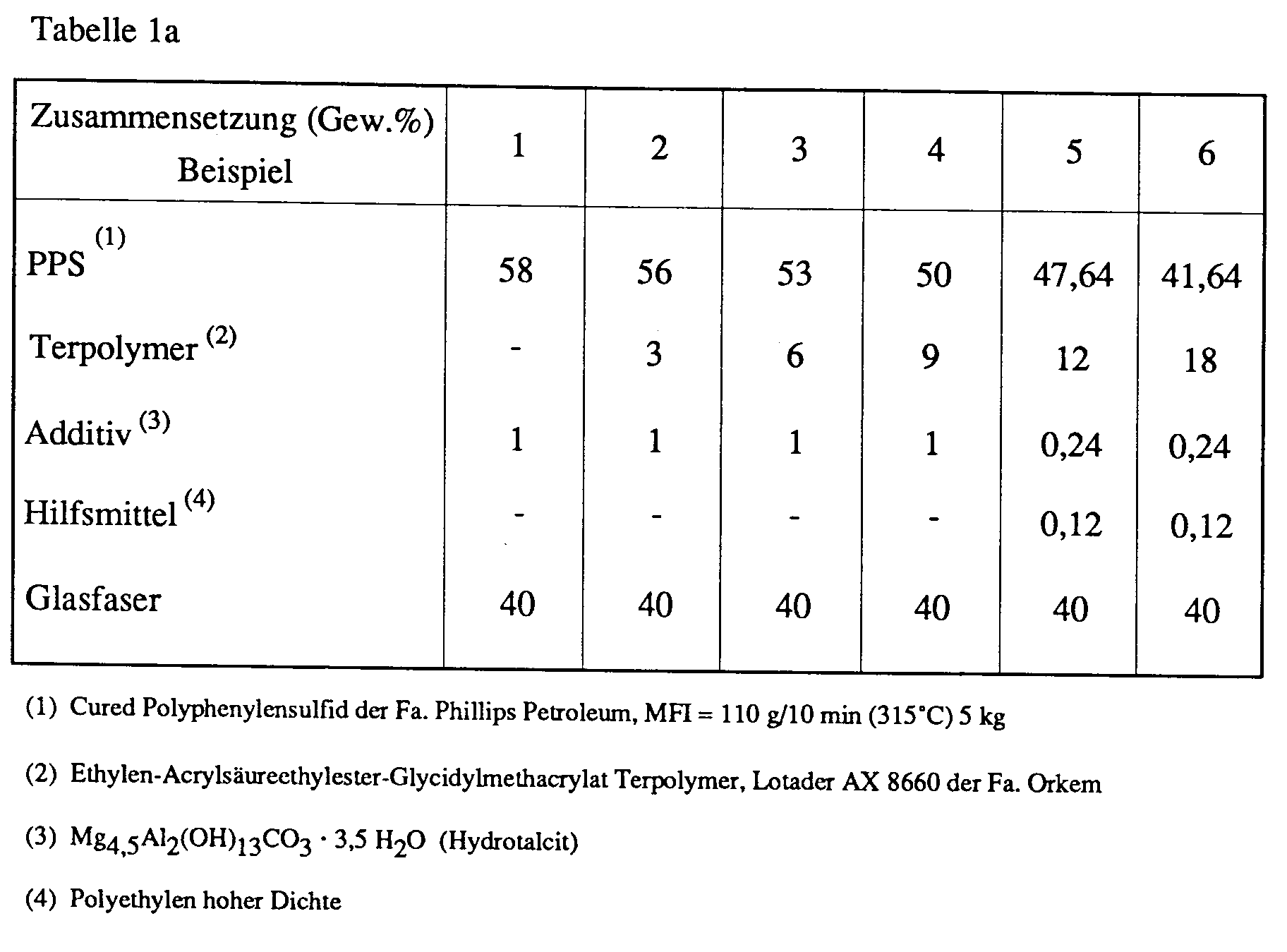
- Mit Hilfe eines Labor-Kokneters mit 46 mm Schneckendurchmesser werden die in den Tabellen 1a bis 1c angeführten Komponenten bei einer Temperatur von 320-330 °C compoundiert und granuliert.
- Nach einer Trocknung von 4 Stunden bei 140 °C erfolgt die Verarbeitung zu Spritzgiessformkörpern auf einer Schnecken-Spritzgiessmaschine Arburg-Allrounder Typ 270-210-500.
- Die Herstellbedingungen der Probekörper betragen:
- Zylinder-Temperatur:
- 300-315 °C
- Werkzeug-Temperatur:
- 130 °C
- Zykluszeit:
- 35 s
- An den Formkörpern werden die in den Tabellen 2a bis 2c angeführten Eigenschaften gemessen. Man erkennt daraus, dass sich die erfindungsgemässen Probekörper mit einer Terpolymerkomponente (Beispiele 2-6, 8-11, 14-15 und 16-17) gegenüber dem jeweiligen Kontroll-Probekörper (ohne Terpolymerkomponente, Beispiele 1, 7, 12 und 13) auch ohne den Zusatz von Verstärkungsmitteln, wie Glasfasern, durch verbesserte Zähigkeitseigenschaften und verbesserte Bruchdehnung auszeichnen. Diese Wirkung ist sowohl bei linearem Polyphenylensulfid als auch bei gecuredtem Grundharz zu festzustellen. Durch den Glasfaserzusatz ist diese Tendenz ebenso gegeben. Die Wärmeformbeständigkeit bleibt hierbei ebenso praktisch unverändert. Weiterhin ist festzustellen, dass auch bei höheren Anteilen der Terpolymerkomponente diese verbessernde Wirkung erhalten wird.




Claims (13)
- Zusammensetzungen enthaltendA) mindestens ein Polyarylensulfid mit einem Schmelzindex von kleiner als 1000 g/10 Minuten undB) mindestens ein Terpolymer mit einer Zusammensetzung von
94 bis 60 Gew. % Ethylen,
5 bis 25 Gew. % eines C₂-C₁₀-Alkylacrylates oder -methacrylates und/oder C₃-C₁₀-Cycloalkylacrylates oder -methacrylates und
1 bis 15 Gew. % einer ungesättigte Epoxyverbindung. - Zusammensetzungen gemäss Anspruch 1, dadurch gekennzeichet, dass sie als Komponente A ein Polyphenylensulfid mit einem Schmelzindex von 50 bis 800 g/10 Minuten enthalten.
- Zusammensetzungen gemäss Anspruch 1, dadurch gekennzeichnet, dass die Komponente B C₂-C₆-Alkylacrylsäureester-Struktureinheiten enthält.
- Zusammensetzungen gemäss Anspruch 3, dadurch gekennzeichnet, dass die Komponente B Ethylacrylsäureester-Struktureinheiten enthält.
- Zusammensetzungen gemäss Anspruch 1, dadurch gekennzeichnet, dass die Komponente B Glycidylacrylat- und/oder Glycidylmethacrylat-Struktureinheiten enthält.
- Zusammensetzungen gemäss Anspruch 1, dadurch gekennzeichnet, dass die Komponente B ein Ethylen-Acrylsäureethylester-Glycidylmethacrylat Terpolymer ist.
- Zusammensetzungen gemäss Anspruch 1 enthaltend
99 bis 70 Gew.% einer Komponente A und
1 bis 30 Gew.% einer Komponente B,
bezogen auf die Gesamtmasse der Komponenten A und B. - Zusammensetzungen gemäss Anspruch 1 enthaltend
98 bis 80 Gew.% einer Komponente A und
2 bis 20 Gew.% einer Komponente B,
bezogen auf die Gesamtmasse der Komponenten A und B. - Zusammensetzungen gemäss Anspruch 1 enthaltend
C) Füll- und/oder Verstärkungsmittel. - Zusammensetzungen gemäss Anspruch 9, dadurch gekennzeichnet, dass die Komponente C Glasfasern enthält.
- Zusammensetzungen gemäss Anspruch 9 enthaltend
5 bis 65 Gew.% der Komponente C,
bezogen auf die Gesamtmasse der Zusammensetzung. - Zusammensetzungen gemäss Anspruch 9 enthaltend
30 bis 60 Gew.% der Komponente C,
bezogen auf die Gesamtmasse der Zusammensetzung. - Verwendung der Zusammensetzungen gemäss Anspruch 1 als Spritzgiessmassen.
Applications Claiming Priority (2)
| Application Number | Priority Date | Filing Date | Title |
|---|---|---|---|
| CH323590 | 1990-10-08 | ||
| CH3235/90 | 1990-10-08 |
Publications (1)
| Publication Number | Publication Date |
|---|---|
| EP0484273A1 true EP0484273A1 (de) | 1992-05-06 |
Family
ID=4251574
Family Applications (1)
| Application Number | Title | Priority Date | Filing Date |
|---|---|---|---|
| EP91810769A Withdrawn EP0484273A1 (de) | 1990-10-08 | 1991-10-01 | Polyarylensulfidzusammensetzungen |
Country Status (2)
| Country | Link |
|---|---|
| EP (1) | EP0484273A1 (de) |
| JP (1) | JPH04264163A (de) |
Cited By (4)
| Publication number | Priority date | Publication date | Assignee | Title |
|---|---|---|---|---|
| EP0560046A1 (de) * | 1992-03-10 | 1993-09-15 | General Electric Company | Polymermischung aus Polyarylensulfid, Elastomer und Metallsalz |
| FR2711661A1 (fr) * | 1993-10-21 | 1995-05-05 | Solvay | Compositions à base de polysulfure de phénylène de résistance au choc améliorée et procédé pour les préparer. |
| EP0678114A4 (de) * | 1993-01-08 | 1995-12-06 | ||
| EP1229082A1 (de) * | 2001-01-31 | 2002-08-07 | Toyoda Gosei Co., Ltd. | Harzformkörper mit einer Schweissnaht |
Families Citing this family (5)
| Publication number | Priority date | Publication date | Assignee | Title |
|---|---|---|---|---|
| US6303708B1 (en) | 1995-03-17 | 2001-10-16 | General Electric Company | Functional poly(phenylene ether)/poly(arylene sulfide)/epoxy function alpha olefin elastomer/elastomeric block copolymer/metal salt compositions and process for making thereof |
| US5504165A (en) * | 1995-03-17 | 1996-04-02 | General Electric Company | Poly(phenylene ether)-poly(arylene sulfide)resin compositions. |
| SG74539A1 (en) * | 1995-03-17 | 2000-08-22 | Gen Electric | Compositions of poly (phenylene ether) poly (arylene sulfide) polyester resins and a comptibilizer compound |
| JPH09124931A (ja) * | 1995-06-07 | 1997-05-13 | General Electric Co <Ge> | ポリ(フェニレンエーテル)、ポリ(アリーレンスルフィド)及びオルトエステル化合物からなる組成物 |
| JP2002003716A (ja) * | 2000-06-16 | 2002-01-09 | Toray Ind Inc | ポリフェニレンスルフィド樹脂組成物及び射出成形品 |
Citations (1)
| Publication number | Priority date | Publication date | Assignee | Title |
|---|---|---|---|---|
| EP0228268B1 (de) * | 1985-12-27 | 1990-05-23 | Toray Industries, Inc. | Polyphenylensulfidharzzusammensetzung und Verfahren zu ihrer Herstellung |
-
1991
- 1991-10-01 EP EP91810769A patent/EP0484273A1/de not_active Withdrawn
- 1991-10-07 JP JP28698491A patent/JPH04264163A/ja active Pending
Patent Citations (1)
| Publication number | Priority date | Publication date | Assignee | Title |
|---|---|---|---|---|
| EP0228268B1 (de) * | 1985-12-27 | 1990-05-23 | Toray Industries, Inc. | Polyphenylensulfidharzzusammensetzung und Verfahren zu ihrer Herstellung |
Non-Patent Citations (6)
| Title |
|---|
| WORLD PATENTS INDEX LATEST Derwent Publications Ltd., London, GB; AN 84-303752 & JP-A-59 189 166 (SUMITOMO CHEMICAL) 26 October 1984 * |
| WORLD PATENTS INDEX LATEST Derwent Publications Ltd., London, GB; AN 84-305000 & JP-A-59 191 761 (SUMITOMO CHEMICAL) 30 October 1984 * |
| WORLD PATENTS INDEX LATEST Derwent Publications Ltd., London, GB; AN 86-71993 & JP-A-61 021 156 (DAINIPPON INK) 29 January 1986 * |
| WORLD PATENTS INDEX LATEST, AN=84-303752 [49], Derwent Publications Ltd, London, GB; & JP-A-59 189 166 (SUMITOMO CHEMICAL) 26. Oktober 1984 * |
| WORLD PATENTS INDEX LATEST, AN=84-305000 [49], Derwent Publications Ltd, London, GB; & JP-A-59 191 761 (SUMITOMO CHEMICAL) 30. Oktober 1984 * |
| WORLD PATENTS INDEX LATEST, AN=86-71993, Derwent Publications Ltd, London, GB; & JP-A-61 021 156 (DAINIPPON INK) 29. Januar 1986 * |
Cited By (9)
| Publication number | Priority date | Publication date | Assignee | Title |
|---|---|---|---|---|
| EP0560046A1 (de) * | 1992-03-10 | 1993-09-15 | General Electric Company | Polymermischung aus Polyarylensulfid, Elastomer und Metallsalz |
| WO1993018091A1 (en) * | 1992-03-10 | 1993-09-16 | General Electric Company | Polymer mixture comprising polyarylene sulphide, elastomer and metal salt |
| US5681893A (en) * | 1992-03-10 | 1997-10-28 | General Electric Company | Polymer mixture comprising polyarylene sulphide elastomeric polymer and metal salt |
| EP0678114A4 (de) * | 1993-01-08 | 1995-12-06 | ||
| FR2711661A1 (fr) * | 1993-10-21 | 1995-05-05 | Solvay | Compositions à base de polysulfure de phénylène de résistance au choc améliorée et procédé pour les préparer. |
| BE1007649A3 (fr) * | 1993-10-21 | 1995-09-05 | Solvay | Compositions a base de polysulfure de phenylene de resistance au choc amelioree et procede pour les preparer. |
| US5504141A (en) * | 1993-10-21 | 1996-04-02 | Solvay (Societe Anonyme) | Polyphenylene sulphide-based compositions with improved impact strength and process for preparing them |
| EP1229082A1 (de) * | 2001-01-31 | 2002-08-07 | Toyoda Gosei Co., Ltd. | Harzformkörper mit einer Schweissnaht |
| US6740709B2 (en) | 2001-01-31 | 2004-05-25 | Toyoda Gosei Co., Ltd. | Resin molding |
Also Published As
| Publication number | Publication date |
|---|---|
| JPH04264163A (ja) | 1992-09-18 |
Similar Documents
| Publication | Publication Date | Title |
|---|---|---|
| DE69309744T2 (de) | Polyarylensulfid-Harzzusammensetzung | |
| DE69222201T2 (de) | Verfahren zur Herstellung einer Polyphenylensulfidharz- zusammensetzung | |
| DE3485944T2 (de) | Flammfeste polyamidzusammensetzungen. | |
| DE69833267T2 (de) | Thermoplastische harzzusammensetzung | |
| DE102011118490B4 (de) | Halogenfreie, flammfeste Epoxidharz-Zusammensetzungen und deren Verwendung | |
| EP0335165A1 (de) | Durch Magnesiumhydroxid flammhemmend eingestellte faserverstärkte thermoplastisch verarbeitbare Polyamidformmasse, Verfahren zu ihrer Herstellung und ihre Verwendung | |
| DE68926128T2 (de) | Polyarylensulfid-Harzzusammensetzung | |
| DE4437730B4 (de) | Zusammensetzungen auf der Basis von Polyphenylensulfid mit verbesserter Stoßfestigkeit und Verfahren zu ihrer Herstellung | |
| DE69528877T2 (de) | Polyarylensulfidharzzusammensetzung | |
| EP0428020B1 (de) | Mischungen aus Polyarylensulfiden, nitrogruppenhaltigen Vernetzern und Glasfasern | |
| JPH04264163A (ja) | 新規ポリアリーレンスルフィド組成物 | |
| DE69028576T2 (de) | Glasgefüllte Polyarylensulfidmischungen | |
| CA2220531C (en) | Flame resistant polyester resin composition | |
| DE69025303T2 (de) | Harzmaterial zum Einfügen eines Leiterrahmens und damit vergossenes Bauelement | |
| EP0447668A2 (de) | Mischungen aus Polyarylensulfiden, Epoxiden, Säureanhydriden, Glasfasern und gegebenenfalls weiteren Füllstoffen | |
| DE68907819T2 (de) | Haftaktivatore für thiolene klebstoff-formulierungen. | |
| DE2654346A1 (de) | Polyamid-formmassen | |
| DE69325530T2 (de) | Polymermischung aus Polyarylensulfid, Elastomer und Metallsalz | |
| DE112023003061T5 (de) | Polyarylensulfidharz-zusammensetzung | |
| EP0304785B1 (de) | Polyphenylensulfid-Formmassen mit verbesserten elektrischen Eigenschaften | |
| DE69122347T2 (de) | Mischungen aus amino-funktionalisierten polyphenylenharzen und ethylen-glycidyl-methacrylat-copolymeren | |
| EP0501230B1 (de) | Mischungen aus Polyarylensulfiden, min. Füll-, bzw. anorg. oder org. Hilfsstoffen und Polymaleimiden | |
| DE4008461A1 (de) | Mischungen aus polyarylensulfiden, epoxiden, glasfasern, gegebenenfalls saeureanhydridhaltigen polymeren und gegebenenfalls weiteren zusaetzen | |
| EP0296493A2 (de) | Epoxidharze | |
| DE4016059A1 (de) | Mischungen aus polyarylensulfiden, silicon-epoxid-harzen und glasfasern |
Legal Events
| Date | Code | Title | Description |
|---|---|---|---|
| PUAI | Public reference made under article 153(3) epc to a published international application that has entered the european phase |
Free format text: ORIGINAL CODE: 0009012 |
|
| 17P | Request for examination filed |
Effective date: 19911004 |
|
| AK | Designated contracting states |
Kind code of ref document: A1 Designated state(s): CH DE FR GB IT LI NL |
|
| STAA | Information on the status of an ep patent application or granted ep patent |
Free format text: STATUS: THE APPLICATION IS DEEMED TO BE WITHDRAWN |
|
| 18D | Application deemed to be withdrawn |
Effective date: 19940503 |