EP0482483A2 - Heisssiegeln von Textilien - Google Patents
Heisssiegeln von Textilien Download PDFInfo
- Publication number
- EP0482483A2 EP0482483A2 EP91117602A EP91117602A EP0482483A2 EP 0482483 A2 EP0482483 A2 EP 0482483A2 EP 91117602 A EP91117602 A EP 91117602A EP 91117602 A EP91117602 A EP 91117602A EP 0482483 A2 EP0482483 A2 EP 0482483A2
- Authority
- EP
- European Patent Office
- Prior art keywords
- molecular weight
- polyamides
- diepoxides
- use according
- low molecular
- Prior art date
- Legal status (The legal status is an assumption and is not a legal conclusion. Google has not performed a legal analysis and makes no representation as to the accuracy of the status listed.)
- Withdrawn
Links
- 239000004753 textile Substances 0.000 title claims abstract description 35
- 238000007789 sealing Methods 0.000 title claims abstract description 15
- 239000004952 Polyamide Substances 0.000 claims abstract description 47
- 229920002647 polyamide Polymers 0.000 claims abstract description 47
- 239000007795 chemical reaction product Substances 0.000 claims abstract description 14
- 239000000203 mixture Substances 0.000 claims description 27
- 239000004831 Hot glue Substances 0.000 claims description 22
- -1 ether diamines Chemical class 0.000 claims description 18
- IISBACLAFKSPIT-UHFFFAOYSA-N bisphenol A Chemical compound C=1C=C(O)C=CC=1C(C)(C)C1=CC=C(O)C=C1 IISBACLAFKSPIT-UHFFFAOYSA-N 0.000 claims description 16
- 125000004432 carbon atom Chemical group C* 0.000 claims description 13
- 125000003277 amino group Chemical group 0.000 claims description 11
- JHWNWJKBPDFINM-UHFFFAOYSA-N Laurolactam Chemical compound O=C1CCCCCCCCCCCN1 JHWNWJKBPDFINM-UHFFFAOYSA-N 0.000 claims description 10
- 238000006243 chemical reaction Methods 0.000 claims description 10
- GUOSQNAUYHMCRU-UHFFFAOYSA-N 11-Aminoundecanoic acid Chemical compound NCCCCCCCCCCC(O)=O GUOSQNAUYHMCRU-UHFFFAOYSA-N 0.000 claims description 7
- BRLQWZUYTZBJKN-UHFFFAOYSA-N Epichlorohydrin Chemical compound ClCC1CO1 BRLQWZUYTZBJKN-UHFFFAOYSA-N 0.000 claims description 7
- 239000004593 Epoxy Substances 0.000 claims description 7
- 150000001991 dicarboxylic acids Chemical class 0.000 claims description 7
- 238000002844 melting Methods 0.000 claims description 6
- 230000008018 melting Effects 0.000 claims description 6
- 125000003700 epoxy group Chemical group 0.000 claims description 5
- 150000003951 lactams Chemical group 0.000 claims description 5
- 150000003141 primary amines Chemical class 0.000 claims description 5
- RTZKZFJDLAIYFH-UHFFFAOYSA-N ether Substances CCOCC RTZKZFJDLAIYFH-UHFFFAOYSA-N 0.000 claims description 4
- 125000001931 aliphatic group Chemical group 0.000 claims description 3
- 150000001412 amines Chemical class 0.000 claims description 3
- 125000003118 aryl group Chemical group 0.000 claims description 3
- 125000002924 primary amino group Chemical group [H]N([H])* 0.000 claims description 3
- 125000000467 secondary amino group Chemical group [H]N([*:1])[*:2] 0.000 claims description 3
- SLXKOJJOQWFEFD-UHFFFAOYSA-N 6-aminohexanoic acid Chemical compound NCCCCCC(O)=O SLXKOJJOQWFEFD-UHFFFAOYSA-N 0.000 claims description 2
- LYCAIKOWRPUZTN-UHFFFAOYSA-N Ethylene glycol Chemical class OCCO LYCAIKOWRPUZTN-UHFFFAOYSA-N 0.000 claims description 2
- 229960002684 aminocaproic acid Drugs 0.000 claims description 2
- JBKVHLHDHHXQEQ-UHFFFAOYSA-N epsilon-caprolactam Chemical compound O=C1CCCCCN1 JBKVHLHDHHXQEQ-UHFFFAOYSA-N 0.000 description 16
- NAQMVNRVTILPCV-UHFFFAOYSA-N hexane-1,6-diamine Chemical compound NCCCCCCN NAQMVNRVTILPCV-UHFFFAOYSA-N 0.000 description 11
- 238000009833 condensation Methods 0.000 description 10
- BDJRBEYXGGNYIS-UHFFFAOYSA-N nonanedioic acid Chemical compound OC(=O)CCCCCCCC(O)=O BDJRBEYXGGNYIS-UHFFFAOYSA-N 0.000 description 10
- 239000000126 substance Substances 0.000 description 10
- REYJJPSVUYRZGE-UHFFFAOYSA-N Octadecylamine Chemical compound CCCCCCCCCCCCCCCCCCN REYJJPSVUYRZGE-UHFFFAOYSA-N 0.000 description 8
- 230000001070 adhesive effect Effects 0.000 description 8
- 150000004985 diamines Chemical class 0.000 description 8
- XLYOFNOQVPJJNP-UHFFFAOYSA-N water Substances O XLYOFNOQVPJJNP-UHFFFAOYSA-N 0.000 description 8
- IJGRMHOSHXDMSA-UHFFFAOYSA-N Atomic nitrogen Chemical compound N#N IJGRMHOSHXDMSA-UHFFFAOYSA-N 0.000 description 7
- GLUUGHFHXGJENI-UHFFFAOYSA-N Piperazine Chemical compound C1CNCCN1 GLUUGHFHXGJENI-UHFFFAOYSA-N 0.000 description 7
- 229940106691 bisphenol a Drugs 0.000 description 7
- 150000001875 compounds Chemical class 0.000 description 7
- 239000000178 monomer Substances 0.000 description 7
- 230000005494 condensation Effects 0.000 description 6
- 238000004519 manufacturing process Methods 0.000 description 6
- WNLRTRBMVRJNCN-UHFFFAOYSA-N adipic acid Chemical compound OC(=O)CCCCC(O)=O WNLRTRBMVRJNCN-UHFFFAOYSA-N 0.000 description 5
- 230000000052 comparative effect Effects 0.000 description 5
- 239000006185 dispersion Substances 0.000 description 5
- 238000005516 engineering process Methods 0.000 description 5
- 239000008187 granular material Substances 0.000 description 5
- 238000000034 method Methods 0.000 description 5
- 239000000047 product Substances 0.000 description 5
- CXMXRPHRNRROMY-UHFFFAOYSA-N sebacic acid Chemical compound OC(=O)CCCCCCCCC(O)=O CXMXRPHRNRROMY-UHFFFAOYSA-N 0.000 description 5
- 239000011248 coating agent Substances 0.000 description 4
- 239000000463 material Substances 0.000 description 4
- 238000006116 polymerization reaction Methods 0.000 description 4
- 239000000843 powder Substances 0.000 description 4
- 150000003335 secondary amines Chemical class 0.000 description 4
- 238000000576 coating method Methods 0.000 description 3
- GYZLOYUZLJXAJU-UHFFFAOYSA-N diglycidyl ether Chemical class C1OC1COCC1CO1 GYZLOYUZLJXAJU-UHFFFAOYSA-N 0.000 description 3
- 150000002118 epoxides Chemical class 0.000 description 3
- 239000004744 fabric Substances 0.000 description 3
- 239000000155 melt Substances 0.000 description 3
- 229910052757 nitrogen Inorganic materials 0.000 description 3
- 229920000642 polymer Polymers 0.000 description 3
- 238000003756 stirring Methods 0.000 description 3
- ATUOYWHBWRKTHZ-UHFFFAOYSA-N Propane Chemical compound CCC ATUOYWHBWRKTHZ-UHFFFAOYSA-N 0.000 description 2
- KKEYFWRCBNTPAC-UHFFFAOYSA-N Terephthalic acid Chemical compound OC(=O)C1=CC=C(C(O)=O)C=C1 KKEYFWRCBNTPAC-UHFFFAOYSA-N 0.000 description 2
- 239000002253 acid Substances 0.000 description 2
- 150000007513 acids Chemical class 0.000 description 2
- 239000000853 adhesive Substances 0.000 description 2
- 235000011037 adipic acid Nutrition 0.000 description 2
- 239000001361 adipic acid Substances 0.000 description 2
- QVGXLLKOCUKJST-UHFFFAOYSA-N atomic oxygen Chemical compound [O] QVGXLLKOCUKJST-UHFFFAOYSA-N 0.000 description 2
- HFACYLZERDEVSX-UHFFFAOYSA-N benzidine Chemical group C1=CC(N)=CC=C1C1=CC=C(N)C=C1 HFACYLZERDEVSX-UHFFFAOYSA-N 0.000 description 2
- 230000001588 bifunctional effect Effects 0.000 description 2
- 230000015572 biosynthetic process Effects 0.000 description 2
- 229920001577 copolymer Polymers 0.000 description 2
- 235000014113 dietary fatty acids Nutrition 0.000 description 2
- KPUWHANPEXNPJT-UHFFFAOYSA-N disiloxane Chemical class [SiH3]O[SiH3] KPUWHANPEXNPJT-UHFFFAOYSA-N 0.000 description 2
- 239000000194 fatty acid Substances 0.000 description 2
- 229930195729 fatty acid Natural products 0.000 description 2
- 150000004665 fatty acids Chemical class 0.000 description 2
- 238000011835 investigation Methods 0.000 description 2
- QQVIHTHCMHWDBS-UHFFFAOYSA-N isophthalic acid Chemical compound OC(=O)C1=CC=CC(C(O)=O)=C1 QQVIHTHCMHWDBS-UHFFFAOYSA-N 0.000 description 2
- 125000002496 methyl group Chemical group [H]C([H])([H])* 0.000 description 2
- 239000001301 oxygen Substances 0.000 description 2
- 229910052760 oxygen Inorganic materials 0.000 description 2
- XNGIFLGASWRNHJ-UHFFFAOYSA-N phthalic acid Chemical compound OC(=O)C1=CC=CC=C1C(O)=O XNGIFLGASWRNHJ-UHFFFAOYSA-N 0.000 description 2
- 239000011541 reaction mixture Substances 0.000 description 2
- 238000007873 sieving Methods 0.000 description 2
- 239000000243 solution Substances 0.000 description 2
- 238000003786 synthesis reaction Methods 0.000 description 2
- 238000012360 testing method Methods 0.000 description 2
- 229920001169 thermoplastic Polymers 0.000 description 2
- CBCKQZAAMUWICA-UHFFFAOYSA-N 1,4-phenylenediamine Chemical compound NC1=CC=C(N)C=C1 CBCKQZAAMUWICA-UHFFFAOYSA-N 0.000 description 1
- KUBDPQJOLOUJRM-UHFFFAOYSA-N 2-(chloromethyl)oxirane;4-[2-(4-hydroxyphenyl)propan-2-yl]phenol Chemical compound ClCC1CO1.C=1C=C(O)C=CC=1C(C)(C)C1=CC=C(O)C=C1 KUBDPQJOLOUJRM-UHFFFAOYSA-N 0.000 description 1
- LRQKBLKVPFOOQJ-UHFFFAOYSA-N 2-aminohexanoic acid Chemical compound CCCCC(N)C(O)=O LRQKBLKVPFOOQJ-UHFFFAOYSA-N 0.000 description 1
- HASUJDLTAYUWCO-UHFFFAOYSA-N 2-aminoundecanoic acid Chemical compound CCCCCCCCCC(N)C(O)=O HASUJDLTAYUWCO-UHFFFAOYSA-N 0.000 description 1
- JZUHIOJYCPIVLQ-UHFFFAOYSA-N 2-methylpentane-1,5-diamine Chemical compound NCC(C)CCCN JZUHIOJYCPIVLQ-UHFFFAOYSA-N 0.000 description 1
- RNLHGQLZWXBQNY-UHFFFAOYSA-N 3-(aminomethyl)-3,5,5-trimethylcyclohexan-1-amine Chemical compound CC1(C)CC(N)CC(C)(CN)C1 RNLHGQLZWXBQNY-UHFFFAOYSA-N 0.000 description 1
- YBRVSVVVWCFQMG-UHFFFAOYSA-N 4,4'-diaminodiphenylmethane Chemical compound C1=CC(N)=CC=C1CC1=CC=C(N)C=C1 YBRVSVVVWCFQMG-UHFFFAOYSA-N 0.000 description 1
- KSMVBYPXNKCPAJ-UHFFFAOYSA-N 4-Methylcyclohexylamine Chemical compound CC1CCC(N)CC1 KSMVBYPXNKCPAJ-UHFFFAOYSA-N 0.000 description 1
- DZIHTWJGPDVSGE-UHFFFAOYSA-N 4-[(4-aminocyclohexyl)methyl]cyclohexan-1-amine Chemical compound C1CC(N)CCC1CC1CCC(N)CC1 DZIHTWJGPDVSGE-UHFFFAOYSA-N 0.000 description 1
- BDBZTOMUANOKRT-UHFFFAOYSA-N 4-[2-(4-aminocyclohexyl)propan-2-yl]cyclohexan-1-amine Chemical compound C1CC(N)CCC1C(C)(C)C1CCC(N)CC1 BDBZTOMUANOKRT-UHFFFAOYSA-N 0.000 description 1
- KXDHJXZQYSOELW-UHFFFAOYSA-N Carbamic acid Chemical compound NC(O)=O KXDHJXZQYSOELW-UHFFFAOYSA-N 0.000 description 1
- 229920000742 Cotton Polymers 0.000 description 1
- OTMSDBZUPAUEDD-UHFFFAOYSA-N Ethane Chemical compound CC OTMSDBZUPAUEDD-UHFFFAOYSA-N 0.000 description 1
- 241001295925 Gegenes Species 0.000 description 1
- OFOBLEOULBTSOW-UHFFFAOYSA-N Malonic acid Chemical compound OC(=O)CC(O)=O OFOBLEOULBTSOW-UHFFFAOYSA-N 0.000 description 1
- 229920000305 Nylon 6,10 Polymers 0.000 description 1
- 239000000654 additive Substances 0.000 description 1
- 238000004026 adhesive bonding Methods 0.000 description 1
- 150000001408 amides Chemical class 0.000 description 1
- 239000003963 antioxidant agent Substances 0.000 description 1
- 239000007864 aqueous solution Substances 0.000 description 1
- 150000004984 aromatic diamines Chemical class 0.000 description 1
- 150000001555 benzenes Chemical class 0.000 description 1
- 125000005521 carbonamide group Chemical group 0.000 description 1
- 125000003178 carboxy group Chemical group [H]OC(*)=O 0.000 description 1
- 239000000969 carrier Substances 0.000 description 1
- 238000004140 cleaning Methods 0.000 description 1
- 238000013329 compounding Methods 0.000 description 1
- 239000000470 constituent Substances 0.000 description 1
- 238000004132 cross linking Methods 0.000 description 1
- 125000004122 cyclic group Chemical group 0.000 description 1
- 239000004205 dimethyl polysiloxane Substances 0.000 description 1
- 235000013870 dimethyl polysiloxane Nutrition 0.000 description 1
- 229910001873 dinitrogen Inorganic materials 0.000 description 1
- 238000009826 distribution Methods 0.000 description 1
- JMLPVHXESHXUSV-UHFFFAOYSA-N dodecane-1,1-diamine Chemical compound CCCCCCCCCCCC(N)N JMLPVHXESHXUSV-UHFFFAOYSA-N 0.000 description 1
- 239000000975 dye Substances 0.000 description 1
- 229920001971 elastomer Polymers 0.000 description 1
- 239000000806 elastomer Substances 0.000 description 1
- 150000002148 esters Chemical class 0.000 description 1
- 238000002474 experimental method Methods 0.000 description 1
- 238000011010 flushing procedure Methods 0.000 description 1
- 238000005469 granulation Methods 0.000 description 1
- 230000003179 granulation Effects 0.000 description 1
- 238000000227 grinding Methods 0.000 description 1
- 238000010438 heat treatment Methods 0.000 description 1
- 239000008240 homogeneous mixture Substances 0.000 description 1
- 230000007062 hydrolysis Effects 0.000 description 1
- 238000006460 hydrolysis reaction Methods 0.000 description 1
- 238000010348 incorporation Methods 0.000 description 1
- 239000000314 lubricant Substances 0.000 description 1
- 125000000325 methylidene group Chemical group [H]C([H])=* 0.000 description 1
- 238000000465 moulding Methods 0.000 description 1
- ZETYUTMSJWMKNQ-UHFFFAOYSA-N n,n',n'-trimethylhexane-1,6-diamine Chemical compound CNCCCCCCN(C)C ZETYUTMSJWMKNQ-UHFFFAOYSA-N 0.000 description 1
- 239000005445 natural material Substances 0.000 description 1
- 230000003287 optical effect Effects 0.000 description 1
- 150000002894 organic compounds Chemical class 0.000 description 1
- 239000004033 plastic Substances 0.000 description 1
- 239000004014 plasticizer Substances 0.000 description 1
- 229920000435 poly(dimethylsiloxane) Polymers 0.000 description 1
- 229920000647 polyepoxide Polymers 0.000 description 1
- 229920000728 polyester Polymers 0.000 description 1
- 229920001296 polysiloxane Polymers 0.000 description 1
- 238000003825 pressing Methods 0.000 description 1
- 239000001294 propane Substances 0.000 description 1
- 238000010926 purge Methods 0.000 description 1
- 239000005871 repellent Substances 0.000 description 1
- 229920006114 semi-crystalline semi-aromatic polyamide Polymers 0.000 description 1
- 230000035945 sensitivity Effects 0.000 description 1
- 238000005475 siliconizing Methods 0.000 description 1
- 238000007711 solidification Methods 0.000 description 1
- 230000008023 solidification Effects 0.000 description 1
- 239000000758 substrate Substances 0.000 description 1
- 229920006345 thermoplastic polyamide Polymers 0.000 description 1
- 239000004416 thermosoftening plastic Substances 0.000 description 1
- 239000002562 thickening agent Substances 0.000 description 1
- 238000005406 washing Methods 0.000 description 1
- 210000002268 wool Anatomy 0.000 description 1
Classifications
-
- D—TEXTILES; PAPER
- D06—TREATMENT OF TEXTILES OR THE LIKE; LAUNDERING; FLEXIBLE MATERIALS NOT OTHERWISE PROVIDED FOR
- D06M—TREATMENT, NOT PROVIDED FOR ELSEWHERE IN CLASS D06, OF FIBRES, THREADS, YARNS, FABRICS, FEATHERS OR FIBROUS GOODS MADE FROM SUCH MATERIALS
- D06M17/00—Producing multi-layer textile fabrics
- D06M17/04—Producing multi-layer textile fabrics by applying synthetic resins as adhesives
- D06M17/08—Polyamides polyimides
-
- C—CHEMISTRY; METALLURGY
- C08—ORGANIC MACROMOLECULAR COMPOUNDS; THEIR PREPARATION OR CHEMICAL WORKING-UP; COMPOSITIONS BASED THEREON
- C08L—COMPOSITIONS OF MACROMOLECULAR COMPOUNDS
- C08L63/00—Compositions of epoxy resins; Compositions of derivatives of epoxy resins
-
- C—CHEMISTRY; METALLURGY
- C08—ORGANIC MACROMOLECULAR COMPOUNDS; THEIR PREPARATION OR CHEMICAL WORKING-UP; COMPOSITIONS BASED THEREON
- C08L—COMPOSITIONS OF MACROMOLECULAR COMPOUNDS
- C08L77/00—Compositions of polyamides obtained by reactions forming a carboxylic amide link in the main chain; Compositions of derivatives of such polymers
-
- C—CHEMISTRY; METALLURGY
- C09—DYES; PAINTS; POLISHES; NATURAL RESINS; ADHESIVES; COMPOSITIONS NOT OTHERWISE PROVIDED FOR; APPLICATIONS OF MATERIALS NOT OTHERWISE PROVIDED FOR
- C09J—ADHESIVES; NON-MECHANICAL ASPECTS OF ADHESIVE PROCESSES IN GENERAL; ADHESIVE PROCESSES NOT PROVIDED FOR ELSEWHERE; USE OF MATERIALS AS ADHESIVES
- C09J163/00—Adhesives based on epoxy resins; Adhesives based on derivatives of epoxy resins
-
- C—CHEMISTRY; METALLURGY
- C09—DYES; PAINTS; POLISHES; NATURAL RESINS; ADHESIVES; COMPOSITIONS NOT OTHERWISE PROVIDED FOR; APPLICATIONS OF MATERIALS NOT OTHERWISE PROVIDED FOR
- C09J—ADHESIVES; NON-MECHANICAL ASPECTS OF ADHESIVE PROCESSES IN GENERAL; ADHESIVE PROCESSES NOT PROVIDED FOR ELSEWHERE; USE OF MATERIALS AS ADHESIVES
- C09J177/00—Adhesives based on polyamides obtained by reactions forming a carboxylic amide link in the main chain; Adhesives based on derivatives of such polymers
-
- C—CHEMISTRY; METALLURGY
- C09—DYES; PAINTS; POLISHES; NATURAL RESINS; ADHESIVES; COMPOSITIONS NOT OTHERWISE PROVIDED FOR; APPLICATIONS OF MATERIALS NOT OTHERWISE PROVIDED FOR
- C09J—ADHESIVES; NON-MECHANICAL ASPECTS OF ADHESIVE PROCESSES IN GENERAL; ADHESIVE PROCESSES NOT PROVIDED FOR ELSEWHERE; USE OF MATERIALS AS ADHESIVES
- C09J183/00—Adhesives based on macromolecular compounds obtained by reactions forming in the main chain of the macromolecule a linkage containing silicon, with or without sulfur, nitrogen, oxygen, or carbon only; Adhesives based on derivatives of such polymers
- C09J183/10—Block or graft copolymers containing polysiloxane sequences
-
- D—TEXTILES; PAPER
- D06—TREATMENT OF TEXTILES OR THE LIKE; LAUNDERING; FLEXIBLE MATERIALS NOT OTHERWISE PROVIDED FOR
- D06M—TREATMENT, NOT PROVIDED FOR ELSEWHERE IN CLASS D06, OF FIBRES, THREADS, YARNS, FABRICS, FEATHERS OR FIBROUS GOODS MADE FROM SUCH MATERIALS
- D06M17/00—Producing multi-layer textile fabrics
- D06M17/04—Producing multi-layer textile fabrics by applying synthetic resins as adhesives
-
- C—CHEMISTRY; METALLURGY
- C08—ORGANIC MACROMOLECULAR COMPOUNDS; THEIR PREPARATION OR CHEMICAL WORKING-UP; COMPOSITIONS BASED THEREON
- C08L—COMPOSITIONS OF MACROMOLECULAR COMPOUNDS
- C08L2666/00—Composition of polymers characterized by a further compound in the blend, being organic macromolecular compounds, natural resins, waxes or and bituminous materials, non-macromolecular organic substances, inorganic substances or characterized by their function in the composition
- C08L2666/02—Organic macromolecular compounds, natural resins, waxes or and bituminous materials
- C08L2666/14—Macromolecular compounds according to C08L59/00 - C08L87/00; Derivatives thereof
- C08L2666/22—Macromolecular compounds not provided for in C08L2666/16 - C08L2666/20
Definitions
- the present invention relates to the use of a reaction product made of low molecular weight polyamides and diepoxides for heat sealing textiles.
- Hot melt adhesives are widely used in the textile industry for the bonding of textile materials.
- the textiles to be bonded are provided with coating agents which, for example, give the fabric a better grip or make them water-repellent.
- the latter property is achieved, for example, by siliconizing the tissue.
- this type of coating results in a reduction in the adhesive properties of the hot-melt adhesive on the coated fabric. Attempts to improve the adhesion to siliconized substances have been published in DE-B-29 20 416 and DE-A-32 48 776.
- DE-B-29 20 416 describes a powder-form hot melt adhesive for heat sealing textiles, which consists of a mixture of selected polyamides with higher and lower melting points in certain proportions.
- DE-A-32 48 776 are used for the production of hot melt adhesives in addition to lactams C6 to C12 dicarboxylic acids and aliphatic C6 to C12 diamines, at least 30 wt .-% of these diamines consist of single-branched aliphatic diamines with 6 carbon atoms.
- Cocondensates of polyamides with certain organofunctional polysiloxanes are known.
- US Pat. No. 4,346,200 describes the improved tensile strength and impact strength of molding compositions made from polyamides and elastomeric block polyamides, the elastomer segments of which also contain poly-C1 to C bis-dialkylene siloxanes.
- EP-A-54 426 and DE-A-2 120 961 the surface properties and processability of polyamides can be favorably influenced by the incorporation of siloxane sequences.
- EP-A-269 833 discloses thermoplastic polyamide compositions made from copolyamides which contain relatively long-chain polydiorganosiloxane carbonamide units in which the organofunctional radicals are bonded to the siloxane radicals via oxygen.
- polyamide-siloxane copolymers which are obtainable by condensation and polymerization together in a manner known per se from ⁇ -amino -Alkylcarboxylic acids with 6, 11 or 12 carbon atoms and / or their lactams, of equimolar amounts of diamines and dicarboxylic acids and in an amount of 0.5% by weight up to 15% by weight, based on the total weight of the components used in the Starting mixture instead of the corresponding equivalent amount of diamines, of copolymerizable siloxane monomers.
- EP-B-174 225 discloses a reactive composition which contains a polyepoxide compound and a semicrystalline polyamide oligomer as reactive constituents. However, it contains no indication that a copolymer of polyamides and diepoxides is suitable for heat sealing textiles.
- the object of the present invention was to solve the problem of the deteriorated adhesive properties of copolyamides or copolyamide-containing hot-melt adhesive compositions on textiles, in particular on siliconized or otherwise coated textiles.
- thermoforming a hot-melt adhesive composition of low molecular weight polyamides and diepoxides can be used outstandingly for heat sealing textiles, in particular for heat sealing coated, in particular siliconized, fabrics.
- the melting point of the polyamides (A) is determined in accordance with DIN 53736 / B.
- the lower limit of the melting point is preferably around 80 ° C.
- the upper limit is preferably around 130 ° C.
- the amount of component (B) must be calculated in accordance with the above definition, so that on the amount of primary amines used is the corresponding amount of component (B) and, for the amount of secondary amines used, the corresponding amount of component (B) is used.
- the low molecular weight polyamides (A) are prepolymerized in a manner known per se.
- the individual components (A1) to (A4), if used, are introduced in the appropriate proportions and a suitable amount of monofunctional amines to adjust the desired molecular weight in the reaction vessel and condensed and polymerized under the conditions customary in the production of polyamides. so that there is a statistical distribution of the individual monomer components over the polymer molecule.
- the starting components can also be used in the appropriate proportions in an aqueous dispersion or in the form of an aqueous solution.
- the techniques and process steps used are common in the field of polyamide synthesis. It is carried out under the usual reaction conditions using elevated temperature and pressure.
- the post-condensation phase is carried out at temperatures of 220 to 300 o C under normal pressure or reduced pressure.
- the precondensation phase is the phase of the reaction in which the condensation and polymerization of the starting components only take place to a certain degree of polymerization, but starting components which have not yet reacted in the reaction mixture are present as monomers or oligomers.
- the post-condensation phase is related to the pre-condensation phase Subsequent phase until the condensation and polymerization has proceeded to the desired molecular weight.
- component (A1) Up to 40% by weight of aminocarboxylic acid and / or its lactam form as component (A1), up to 45% by weight of 11-aminoundecanoic acid as component (A2) and up to 45 are used as basic building blocks for the production of the low molecular weight polyamides (A) Wt .-% Laurinlactam used as component (A3).
- component (A4) are used in an amount of up to 85 wt .-% equimolar amounts of bifunctional primary and / or secondary C2-C20 diamines and / or ether amines and bifunctional primary C2-C44 polycarboxylic acids.
- Cyclic and acyclic aliphatic diamines and dicyclic aliphatic diamines, the rings of which can be linked via branched or straight-chain alkylene radicals having 1 to 6 carbon atoms, and corresponding ether amines can be used as the diamine component of component (A4).
- Examples are hexamethylenediamine, piperazine, isophoronediamine, dodecanediamine, methylpentamethylenediamine, trimethylhexamethylenediamine and di (4-aminocyclohexyl) methane, 1,2-di (4-aminocyclohexyl) methane, 2,2-di (4-aminocyclohexyl) propane.
- Aromatic diamines such as diaminoalkyl-substituted benzene derivatives such as diamino-p-xylylene, orthophenylene diamine, methaphenylene diamine, paraphenylene diamine, 4,4'-diamino-diphenyl methane, 1,2- (4,4'-diaminodiphenyl) ethane, 2,2 can also be used as diamines - (4,4'-Diaminodiphenyl) propane can be used.
- diaminoalkyl-substituted benzene derivatives such as diamino-p-xylylene, orthophenylene diamine, methaphenylene diamine, paraphenylene diamine, 4,4'-diamino-diphenyl methane, 1,2- (4,4'-diaminodiphenyl) ethane, 2,2 can also be used as diamines - (4,4'-Diaminodipheny
- component (A4) the diamines are used in an equimolar amount to the dicarboxylic acids. This means that there is one carboxyl group in the dicarboxylic acid for each amino group of the diamine component.
- Dicarboxylic acids which can be used are the straight-chain dicarboxylic acids usually used in the production of polyamides. Examples include alkylene dicarboxylic acids with 4 to 10 methylene units such as adipic acid, azelaic acid, sebacic acid and decanedicarboxylic acid, dimerized fatty acids with up to 44 carbon atoms, and aromatic dicarboxylic acids such as phthalic acid, isophthalic acid and terephthalic acid.
- the prepolymerized low molecular weight polyamides (A) are reacted with diepoxides.
- Diepoxides of the general formula can be used as component (B1) for the reaction product used according to the invention EDE
- E is an epoxy radical with 2 to 4 carbon atoms
- D is an aliphatic radical with 2 to 20 carbon atoms, an aromatic and / or alicyclic radical with 6 to 30 carbon atoms or means, where R for wherein n is a number from 5 to 30, or -C (CH3) 2-, -C m H 2m - or - (C m H 2m ) -O-, where m is a number from 2 to 4; be used.
- E is preferably an epoxyethylene radical or an epoxycyclobutyl radical.
- diepoxide component (B1) examples of which are RÜTAPOX CY 151® (RÜTGERSWERKE) (diglycidyl ether of 4,4'-dihydroxydieyelohexylpropane (1,2)).
- Tegomer® OF 3025 and 3010 from Goldschmidt KG can be mentioned as examples of commercially available diepoxypolydimethylsiloxanes.
- Diepoxyhexane diglycidyl ether with a molecular weight in the range from 500 to 3000 can be used as component (B1).
- the thinner H from Schering AG is mentioned as an example.
- Diepoxy compounds based on bisphenol-A and epichlorohydrin with a molecular weight in the range from 300 to 3000 can be used as component (B2). These include, for example, the commercially available products from Shell under the name Epicote® 828, from Dow Chemical under the names DER 332® or DER 331® and from the company Ciba-Geigy Araldid® GY 260.
- component (B3) The components DER B32 or DER 736 from Dow Chemical and the thinner F from Schering AG are mentioned as examples of component (B3).
- the reaction products are expediently prepared in what is known as the two-stage process.
- the diepoxides are added to the low molecular weight polyamides and the addition of the diepoxides to the polyamides is carried out in the conventional plants for the synthesis of polyamides.
- the second step can also be carried out in suitable melt compounding machines or reaction extruders, such as twin-screw extruders.
- the final reaction products are thermoplastic polymers.
- the quantitative ratio of the low molecular weight polyamides (A) and the diepoxides (B) is selected when the diepoxide component is added to the copolyamide such that the molecular ratio of the reactive amino groups of the polyamides (A) to the epoxy groups of the diepoxides (B) reacting with the amino groups is in the defined range.
- the number of epoxy groups of component (B) reacting with the amino groups in relation to the amino groups increases, there is more crosslinking and the thermoplastic properties of the hot-melt adhesive composition deteriorate.
- Low molecular weight polyamides with a molecular weight of 2,000 to 6,000 are preferably used to produce the reaction products from low molecular weight polyamides and diepoxides.
- the molecular weight of the low molecular weight polyamides is preferably adjusted by adding monofunctional C10-C18 amines.
- Diepoxypolydimethylsiloxanes with a molecular weight in the range from 800 to 2100 are preferably used as the diepoxide compound (B4).
- the diepoxide compounds (B2) based on bisphenol-A and epichlorohydrin are preferably those with a molecular weight in the range from 340 to 1000.
- diepoxide compound (B3) those having a molecular weight in the range from 800 to 2100 are preferably used.
- the molecular ratio of reacting amino groups of component (A) to the epoxy groups of component (B) reacting with the amino groups is preferably at least 1: 0.8 in the case of primary amines. In the case of secondary amines, the upper limit is preferably 1: 1.4.
- reaction products used for heat sealing in accordance with the invention are used for this purpose in most cases of compositions suitable for this purpose which, in addition to the reaction products, contain customary auxiliaries and / or carriers.
- customary auxiliaries and additives used, for example plasticizers, optical brighteners, dyes, thickeners, lubricants, antioxidants.
- such a hot-melt adhesive composition advantageously in the form of a powder or a dispersion, as is customary for hot-melt adhesive, is added between the surfaces to be bonded.
- the textiles are then pressed with the hot-melt adhesive composition using an elevated temperature.
- the pressing temperature depends primarily on the temperature sensitivity of the substrate. Since the hot-melt adhesive composition according to the invention can be used even at low temperatures with excellent adhesive strength, particularly in the case of coated textiles, low sealing temperatures can be used which only need to be slightly higher than the temperatures in the melting range of the hot-melt adhesive composition.
- the hot-melt adhesive composition can be applied to textiles to be bonded in the form of powders using powder application machines customary in the coating industry, or in the form of heat-seal dispersions using the paste point method. It is also possible to provide only selected areas of the textiles with the hot-melt adhesive composition. It was surprisingly found on the part of the inventors that the hot-melt adhesive composition to be used according to the invention has, in addition to the excellent adhesive properties for coated textiles, also excellent running properties when coating with the powder point method.
- textile materials to be glued are, in addition to the coated materials, also natural substances such as wool, silk and cotton, or plastic polyesters and polyamides and textile blends containing them, as well as the correspondingly coated textiles made from the same materials as mentioned above.
- the use according to the invention for heat sealing textiles is preferably in the form of dispersions.
- Such - essentially aqueous - dispersions are generally known in the field of textile hot melt adhesives. Reference is made to DE-A-24 07 505 and the publications mentioned therein as prior art.
- the ratio of the NH2 groups in the polyamide to diepoxide groups is 1: 0.8.
- the stirring speed was increased to 100 rpm and the condensation was continued for a further 60 minutes. It was then spun out at 220 ° C. in a water bath and granulated.
- the product obtained had the measured values listed in the table below.
- the granules were ground and sieved.
- the grain fraction 80 to 200 ⁇ m was examined by textile technology. The results can be found in the table below.
- Example 1 After increasing the speed to 100 rpm, the condensation was continued for 20 minutes. It was then spun out, granulated and ground. After sieving, textile technology was used as described in Example 1. The values determined can be found in the table below.
- Example 1 The mixture was then granulated, ground, sieved and examined as described in Example 1. The values can be found in the table below.
- Example 2 granulation, grinding, sieving and testing were carried out.
- the values can be found in the table below.
- the hot melt adhesive of Comparative Example 2 had the following composition, based on parts by weight of monomers: 25 parts by weight of caprolactam 25 parts by weight equimolar adduct of hexamethylenediamine / azelaic acid 25 parts by weight of 11-aminoundecanoic acid 25 parts by weight of laurolactam.
- the setback values for the hot-melt adhesive compositions used according to the invention are not included in the table, since no setback was found in the bonds according to the invention.
Landscapes
- Chemical & Material Sciences (AREA)
- Organic Chemistry (AREA)
- Chemical Kinetics & Catalysis (AREA)
- Engineering & Computer Science (AREA)
- Textile Engineering (AREA)
- Health & Medical Sciences (AREA)
- Medicinal Chemistry (AREA)
- Polymers & Plastics (AREA)
- Adhesives Or Adhesive Processes (AREA)
- Polyamides (AREA)
- Epoxy Resins (AREA)
- Treatments For Attaching Organic Compounds To Fibrous Goods (AREA)
Abstract
Description
- Die vorliegende Erfindung betrifft die Verwendung eines Reaktionsproduktes aus niedrigmolekularen Polyamiden und Diepoxiden zum Heißsiegeln von Textilien.
- In der Textilindustrie finden Heißschmelzkleber bei der Verklebung von textilen Materialien breite Verwendung. In den meisten Fällen werden die zu verklebenden Textilien mit Beschichtungsmitteln versehen, die dem Gewebe beispielsweise einen besseren Griff geben oder sie wasserabstoßend machen. Letztere Eigenschaft wird beispielsweise durch Silikonisieren des Gewebes erreicht. Diese Art der Beschichtung hat jedoch eine Verringerung der Hafteigenschaften der Heißschmelzkleber auf dem beschichteten Gewebe zur Folge. Versuche zur Verbesserung der Haftung auf silikonisierten Stoffen wurden in der DE-B-29 20 416 und DE-A-32 48 776 veröffentlicht.
- DE-B-29 20 416 beschreibt einen pulverförmig einsetzbaren Schmelzkleber zum Heißsiegeln von Textilien, der aus einem Gemisch von ausgewählten Polyamiden mit höherem und niedrigerem Schmelzpunkt in bestimmten Anteilen besteht.
- In der DE-A-32 48 776 werden zur Herstellung von Heißschmelzklebern neben Lactamen C₆ bis C₁₂-Dicarbonsäuren und aliphatische C₆ bis C₁₂-Diamine verwendet, wobei mindestens 30 Gew.-% dieser Diamine aus einfachverzweigten aliphatischen Diaminen mit 6 Kohlenstoffatomen bestehen.
- Eine Verbesserung der Hafteigenschaften an silikonisiertem Gewebe wird in der DE-A-37 30 504 offenbart, worin Polyamide aus Caprolactam, Laurinlactam und einem Addukt aus äquimolaren Mengen Piperazin und C₆ bis C₁₃-Dicarbonsäuren oder C₃₆-dimerisierten Fettsäuren beschrieben sind, die als Heißschmelzkleber verwendet werden können.
- Cokondensate von Polyamiden mit bestimmten organofunktionellen Polysiloxanen sind bekannt. So werden in der US-A-4 346 200 die verbesserte Zugfestigkeit und Kerbschlagzähigkeit von Formmassen aus Polyamiden und elastomeren Blockpolyamiden beschrieben, wobei deren Elastomersegmente auch Poly-C₁ bis C₄-Dialkylen-Siloxane enthalten. Nach EP-A-54 426 und DE-A-2 120 961 lassen sich die Oberflächeneigenschaften und Verarbeitbarkeit von Polyamiden durch den Einbau von Siloxansequenzen günstig beeinflussen.
- Die DE-A-35 45 905 beschreibt die Ester- oder Amid-Verknüpfung von Polyamid- und Siloxanblöcken mit einer maximalen (SiR₂O)n Kettenlänge von n = 50 (gegebenenfalls sind mehrere dieser Blöcke über Sauerstoff und organische Reste zu längeren Einheiten verknüpft), zu Polymeren mit einem I-Wert von 10 bis 600, die unter anderem zu verbesserter Festigkeit, Hydrolyse- und Chemikalienbeständigkeit in den Polymeren führen soll.
- Die EP-A-269 833 offenbart thermoplastische Polyamidmassen aus Copolyamiden, die relativ langkettige Polydiorganosiloxancarbonamid-Einheiten eingebaut enthalten, bei welchen die organofunktionellen Reste über Sauerstoff an die Siloxanreste gebunden sind.
- Alle zuvor genannten Schriften offenbaren die Verwendung von oligomeren Basiskomponenten, und ihnen lagen als Aufgabenstellung im weiteren die Verbesserung der Hafteigenschaften bei unbeschichteten Stoffen zugrunde.
- Eine Verbesserung der Hafteigenschaften der Polyamide an silikonisierten und andersartig beschichteten Stoffen wird beschrieben in der DE-A-39 08 954. Deren Gegenstand sind Polyamid-Siloxan-Copolymere, die erhältlich sind durch gemeinsame Kondensation und Polymerisation auf an sich bekannte Weise von ω-Amino-Alkylcarbonsäuren mit 6, 11 oder 12 Kohlenstoffatomen und/oder deren Lactamen, von äquimolaren Mengen von Diaminen und Dicarbonsäuren und in einer Menge von 0,5 Gew.-% bis zu 15 Gew.-%, bezogen auf das Gesamtgewicht der eingesetzten Komponenten im Ausgangsgemisch anstelle der entsprechenden äquivalenten Menge Diamine, von copolymerisierbaren Siloxanmonomeren.
- Die EP-B-174 225 offenbart eine reaktive Zusammensetzung, die als reaktive Bestandteile eine Polyepoxidverbindung und ein semikristallines Polyamid-Oligomer enthält. Sie enthält jedoch keinen Hinweis darauf, daß ein Copolymer aus Polyamiden und Diepoxiden geeignet zum Heißsiegeln von Textilien ist.
- Die Aufgabe der vorliegenden Erfindung bestand nun darin, das Problem der verschlechterten Hafteigenschaften von Copolyamiden oder copolyamidhaltigen Heißschmelzkleber-Zusammensetzungen auf Textilien, insbesondere auf silikonisierten oder anders beschichteten Textilien, zu lösen.
- Seitens der Erfinder wurde nun überraschend gefunden, daß eine Heißschmelzkleber-Zusammensetzung aus niedrigmolekularen Polyamiden und Diepoxiden zum Heißsiegeln von Textilien, insbesondere zum Heißsiegeln von beschichteten, insbesondere silikonisierten Geweben hervorragend zu verwenden ist.
- Gegenstand der Erfindung ist daher die Verwendung eines Reaktionsproduktes aus niedrigmolekularen Polyamiden und Diepoxiden zum Heißsiegeln von Textilien, das dadurch gekennzeichnet ist, daß das Reaktionsprodukt erhältlich ist durch Umsetzung von folgenden Komponenten:
- (A) Polyamiden mit einem Schmelzpunkt von 70 bis 140oC und mit nur einer terminalen primären oder sekundären Aminogruppe pro Molekül, die folgende Grundbausteine enthält:
- 1. bis zu 40 Gew.-% Aminocapronsäure und/oder deren Lactamform
- 2. bis zu 45 Gew.-% Aminoundekansäure
- 3. bis zu 45 Gew.-% Laurinlactam
- 4. bis zu 85 Gew.-% äquimolaren Mengen primärer und/oder sekundärer C₂ - C₂₀-Diamine und/oder Etherdiamine und aliphatischer C₂ - C₄₄-Dicarbonsäuren, die in einer Menge von bis zu 20 Gew.%, bezogen auf das Gesamtgewicht der Dicarbonsäuren, durch aromatische Dicarbonsäuren ersetzt sein können,

- (B) Diepoxiden, die ausgewählt werden aus der Gruppe, die besteht aus
- 1. Diepoxiden der allgemeinen Formel
E - D - E
wobei E ein Epoxidrest mit 2 bis 10 Kohlenstoffatomen bedeutet, und D ein aliphatischer Rest mit 2 bis 20 Kohlenstoffatomen, ein aromatischer und/oder alicyclischer Rest mit 6 bis 30 Kohlenstoffatomen oder

- 2. Diepoxiden auf Basis von Bisphenol A und Epichlorhydrin mit einem Molekulargewicht (M

- 3. α,ω-Diepoxipolypropylen- oder -ethylenglykolen mit einem Molekulargewicht (M

- 4. α,ω-Diglycidylpolydimethylsiloxanen mit einem Molekulargewicht (M

- 1. Diepoxiden der allgemeinen Formel
- Der Schmelzpunkt der Polyamide (A) wird bestimmt nach DIN 53736/B. Die untere Grenze des Schmelzpunktes liegt bevorzugt bei etwa 80oC. Andererseits liegt die obere Grenze bevorzugt bei etwa 130oC.
- Bei Einsatz eines Gemisches von primären und sekundären Aminen muß unter Berücksichtigung von deren Mengen und der obigen Definition hinsichtlich der Mengenverhältnisse der Komponente (A) zur Komponente (B) die Menge der Komponente (B) entsprechend der obigen Definition ausgerechnet werden, so daß also auf die eingesetzte Menge von primären Aminen die entsprechende Menge Komponente (B) und auf die eingesetzte Menge von sekundären Aminen die dazugehörige Menge der Komponente (B) eingesetzt wird.
- Die niedrigmolekularen Polyamide (A) werden dabei auf an sich bekannte Weise vorpolymerisiert. Dazu werden die einzelnen Komponenten (A1) bis (A4), soweit eingesetzt, in den entsprechenden Mengenverhältnissen, sowie eine geeignete Menge an monofunktionellen Aminen zur Einstellung des gewünschten Molekulargewichts im Reaktionsgefäß vorgelegt und unter den bei der Herstellung von Polyamiden üblichen Bedingungen kondensiert und polymerisiert, so daß sich eine statistische Verteilung der einzelnen Monomerbestandteile über das Polymermolekül ergibt. Dabei können die Ausgangskomponenten auch in den entsprechenden Mengenverhältnissen in einer wässrigen Dispersion, bzw. in Form einer wässrigen Lösung eingesetzt werden. Die benutzten Techniken und Verfahrensschritte sind auf dem Gebiet der Polyamidsynthesen üblich. Es wird dabei unter den üblichen Reaktionsbedingungen unter Anwendung von erhöhter Temperatur und Druck gearbeitet. Bevorzugt wird dabei die Vorkondensationsphase, bei der sich im Autoklaven als Reaktionsgefäß bei den angewandten Temperaturen durch das im Reaktionsgemisch vorhandene und/oder daß bei der Reaktion abgespaltene Wasser ein erhöhter Druck einstellt, wobei Temperaturen von 220 bis 300oC angewandt werden. Die Nachkondensationsphase wird bei Temperaturen von 220 bis 300oC unter Normaldruck oder vermindertem Druck durchgeführt. Als Vorkondensationsphase wird dabei die Phase der Reaktion bezeichnet, innerhalb der die Kondensation und Polymerisation der Ausgangskomponenten nur bis zu einem bestimmten Polymerisationsgrad abläuft, im Reaktionsgemisch aber noch nicht abreagierte Ausgangskomponenten als Monomere oder Oligomere vorliegen. Die Nachkondensationsphase ist die sich an die Vorkondensationsphase anschließende, bis zum vollständigen Ablauf der Kondensation und Polymerisation bis zum gewünschten Molekulargewicht ablaufende Phase.
- Zur Herstellung der niedrigmolekularen Polyamide (A) werden dabei als Grundbausteine bis zu 40 Gew.-% Aminocarbonsäure und/oder deren Lactamform als Komponente (A1), bis zu 45 Gew.-% 11-Aminoundekansäure als Komponente (A2) und bis zu 45 Gew.-% Laurinlactam als Komponente (A3) eingesetzt. Als Komponente (A4) werden dabei in einer Menge von bis zu 85 Gew.-% äquimolare Mengen bifunktioneller primärer und/oder sekundärer C₂-C₂₀ Diamine und/oder Etheramine und bifunktionelle primäre C₂-C₄₄ Polycarbonsäuren eingesetzt. Als Diaminkomponente der Komponente (A4) sind cyclische und acyclische aliphatische Diamine, sowie dicyclische aliphatische Diamine, deren Ringe über verzweigte oder gradkettige Alkylenreste mit 1 bis 6 Kohlenstoffatomen verknüpft sein können, sowie entsprechende Etheramine verwendbar. Beispiele sind Hexamethylendiamin, Piperazin, Isophorondiamin, Dodecandiamin, Methylpentamethylendiamin, Trimethylhexamethylendiamin sowie Di(4-Aminocyclohexyl)methan, 1,2-Di(4-Aminocyclohexyl)methan, 2,2-Di(4-Aminocyclohexyl)propan. Als Diamine können ebenso aromatische Diamine wie Diaminoalkyl-substituierte Benzolderivate wie Diamino-p-Xylylen, Orthophenylendiamin, Methaphenylendiamin, Paraphenylendiamin, 4,4'-Diamino-Diphenylmethan, 1,2-(4,4'-Diaminodiphenyl)ethan, 2,2-(4,4'-Diaminodiphenyl)propan eingesetzt werden.
- In der Komponente (A4) werden die Diamine in äquimolarer Menge zu den Dicarbonsäuren eingesetzt. Das bedeutet, daß für jede Aminogruppe der Diaminkomponente eine Carboxylgruppe in der Dicarbonsäure vorhanden ist.
- Als Dicarbonsäuren können die üblicherweise bei der Herstellung von Polyamiden eingesetzten, vorzugsweise gradkettigen Dicarbonsäuren verwendet werden. Beispielhaft werden hier genannt Alkylendicarbonsäuren mit 4 bis 10 Methyleneinheiten wie Adipinsäure, Azelainsäure, Sebacinsäure und Decandicarbonsäure, dimerisierte Fettsäuren mit bis zu 44 Kohlenstoffatomen, sowie aromatische Dicarbonsäuren wie Phthalsäure, Isophthalsäure und Terephthalsäure.
- In einem zweiten Schritt werden die vorpolymerisierten niedrigmolekularen Polyamide (A) mit Diepoxiden umgesetzt.
- Gegenwärtig ist eine große Anzahl an organischen Verbindungen im Handel und in der wissenschaftlichen und technischen Literatur bekannt, die dieser Definition entsprechen und deren Strukturen sehr vielfältig sind. Die am häufigsten verwendeten Verbindungen sind solche, die aus der Reaktion von Bisphenol-A mit Epichlorhydrin sich ableiten, und im besonderen die Verbindungen, die aus der Addition von zwei Molekülen Epichlorhydrin zu einem Molekül Bisphenol-A resultieren; das sind die Diglycidylether von Bisphenol-A (DGEBA).
- Für das erfindungsgemäß verwendete Reaktionsprodukt können als Komponente (B1) Diepoxide der allgemeinen Formel
E-D-E
wobei E ein Epoxidrest mit 2 bis 4 Kohlenstoffatomen bedeutet, und D ein aliphatischer Rest mit 2 bis 20 Kohlenstoffatomen, ein aromatischer und/oder alicyclischer Rest mit 6 bis 30 Kohlenstoffatomen oder
bedeutet, wobei R für
worin n eine Zahl von 5 bis 30 ist, oder -C(CH₃)₂-, -CmH2m- oder -(CmH2m)-O-, worin m eine Zahl von 2 bis 4 ist; verwendet werden.
Dabei ist E bevorzugt ein Epoxyethylenrest oder ein Epoxycyclobutylrest. Als Diepoxidkomponente (B1) können verschiedene, im Handel erhältliche, Produkte verwendet werden, von denen beispielhaft genannt werden RÜTAPOX CY 151® (RÜTGERSWERKE) (Diglycidyläther des 4,4'-Dihydroxydieyelohexylpropan(1,2)). - Als Beispiele für im Handel erhältliche Diepoxypolydimethylsiloxane sind Tegomer® OF 3025 und 3010 der Firma Goldschmidt KG zu nennen.
- Als Komponente (B1) können Diepoxyhexandiglycidylether mit einem Molekulargewicht im Bereich von 500 bis 3000 verwendet werden. Beispielhaft wird genannt der Verdünner H der Schering AG.
- Als Komponente (B2) können Diepoxyverbindungen auf Basis von Bisphenol-A und Epichlorhydrin mit einem Molekulargewicht im Bereich von 300 bis 3000 eingesetzt werden. Darunter fallen beispielsweise die im Handel erhältlichen Produkte der Firma Shell unter dem Namen Epicote® 828, oder von Dow Chemical unter dem Namen DER 332® oder DER 331® sowie von der Firma Ciba-Geigy Araldid® GY 260.
- Als Komponente (B3) werden beispielhaft die Produkte DER 732 oder DER 736 der Firma Dow Chemical sowie der Verdünner F der Schering AG genannt.
- Im Rahmen der Herstellung des erfindungsgemäß zu verwendenden Reaktionsproduktes können selbstverständlich weitere im Handel erhältliche Diepoxide verwendet werden, wobei die Aufzählung der oben erwähnten Handelsprodukte nur beispielhaft ist.
- Die Herstellung der Reaktionsprodukte erfolgt zweckmäßig, wie oben bereits erwähnt, im sogenannten Zwei-Stufen-Verfahren. Danach werden nach dem ersten Schritt der Herstellung der niedermolekularen Polyamide die Diepoxide zu den niedrigmolekularen Polyamiden hinzugegeben und in den üblichen Anlagen zur Synthese von Polyamiden die Addition der Diepoxide an die Polyamide durchgeführt. Der zweite Schritt ist jedoch auch in geeigneten Schmelzcompoundiermaschinen oder Reaktionsextrudern, wie Doppelschneckenextrudern, durchführbar. In jedem Fall handelt es sich bei den Reaktionsendprodukten um thermoplastische Polymere.
- Das Mengenverhältnis der niedrigmolekularen Polyamide (A) und der Diepoxide (B) wird bei der Zugabe der Diepoxidkomponente zu dem Copolyamid so ausgewählt, daß das molekulare Verhältnis der reagierenden Aminogruppen der Polyamide (A) zu den mit den Aminogruppen reagierenden Epoxygruppen der Diepoxide (B) in dem definierten Bereich liegt. Wenn die Zahl der mit den Aminogruppen reagierenden Epoxygruppen der Komponente (B) im Verhältnis zu den Aminogruppen zunimmt, findet eine stärkere Vernetzung statt, und die thermoplastischen Eigenschaften der Heißschmelzkleber-Zusammensetzung verschlechtern sich.
- Zur Herstellung der Reaktionsprodukte aus niedrigmolekularen Polyamiden und Diepoxiden werden bevorzugt niedrigmolekulare Polyamide mit einem Molekulargewicht von 2000 bis 6000 eingesetzt. Die Einstellung des Molekulargewichtes der niedrigmolekularen Polyamide erfolgt bevorzugt durch Zusatz von monofunktionellen C10 - C18-Aminen.
- Als Diepoxid-Verbindung (B4) werden bevorzugt Diepoxypolydimethylsiloxane mit einem Molekulargewicht im Bereich von 800 bis 2100 verwendet.
- Als Diepoxidverbindungen (B2) auf Basis von Bisphenol-A und Epichlorhydrin werden bevorzugt solche mit einem Molekulargewicht im Bereich von 340 bis 1000 verwendet.
- Als Diepoxidverbindung (B3) werden bevorzugt solche mit einem Molekulargewicht im Bereich von 800 bis 2100 verwendet.
- Das molekulare Verhältnis von reagierenden Aminogruppen der Komponente (A) zu den mit den Aminogruppen reagierenden Epoxidgruppen der Komponente (B) beträgt im Falle von primären Aminen bevorzugt mindestens 1:0,8. Im Falle von sekundären Aminen beträgt der obere Grenzwert bevorzugt 1:1,4.
- Überraschenderweise zeigte die textiltechnische Untersuchung der erfindungsgemäß verwendeten Reaktionsprodukte, daß sich beschichtete Textilien, besonders vorteilhaft temperaturempfindliche beschichtete Textilien, mit Textilien gleicher oder verschiedener Art verklebt werden können. Gleichzeitig wurde festgestellt, daß auch bei erhöhter Siegeltemperatur gar keiner oder nur ein schwacher Rückschlag auftrat, verbunden mit einer nur geringen oder keiner Abnahme der Schäl-Festigkeit nach dreimaligem Waschen bzw. fünfmaliger chemischer Reinigung im Gegensatz zu den Ergebnissen der Vergleichsversuche.
- Die erfindungsgemäß zum Heißsiegeln verwendeten Reaktionsprodukte werden für diesen Zweck in den meisten Fällen von hierfür geeigneten Zusammensetzungen eingesetzt, die neben den Reaktionsprodukten übliche Hilfs- und/oder Trägerstoffe enthalten. Als übliche Hilfs- und Zusatzstoffe werden die aus dem Stand der Technik bekannten Stoffe eingesetzt, z.B. Weichmacher, optische Aufheller, Farbstoffe, Verdickungsmittel, Gleitmittel, Antioxidantien.
- Bei der Verklebung wird zwischen die zu verklebenden Flächen eine solche Heißschmelzkleber-Zusammensetzung, zweckmäßig in Form eines Pulvers oder einer Dispersion, wie sie für Heißschmelzkleber üblich ist, gegeben. Anschließend werden die Textilien mit der Heißschmelzkleber-Zusammensetzung unter Anwendung von erhöhter Temperatur verpreßt. Die Preßtemperatur richtet sich dabei in erster Linie nach der Temperaturempfindlichkeit des Substrates. Da die Heißschmelzkleber-Zusammensetzung erfindungsgemäß auch schon bei niedrigen Temperaturen mit einer vorzüglichen Klebkraft besonders bei beschichteten Textilien verwendet werden kann, können niedrige Siegeltemperaturen angewendet werden, die nur geringfügig höher als die Temperaturen des Schmelzbereichs der Heißschmelzkleber-Zusammensetzung zu sein brauchen.
- Beim Erkalten auf Raumtemperatur tritt Verfestigung unter Verbindung der verklebten Textilien ein. Die Heißschmelzkleber-Zusammensetzung kann in Form von Pulvern mit in der Beschichtungsindustrie üblichen Pulverauftragsmaschinen, oder in Form von Heißsiegeldispersionen nach dem Pastenpunkt-Verfahren auf zu verklebende Textilien aufgebracht werden. Dabei ist es auch möglich, nur ausgewählte Flächenbereiche der Textilien mit der Heißschmelzkleber-Zusammensetzung zu versehen. Seitens der Erfinder wurde überraschend gefunden, daß die erfindungsgemäß zu verwendende Heißschmelzkleber-Zusammensetzung neben den hervorragenden Klebeeigenschaften zu beschichteten Textilien auch hervorragende Laufeigenschaften bei der Beschichtung mit dem Pulverpunkt-Verfahren besitzt.
- Beispiele für die zu verklebenden Textilmaterialien sind neben den beschichteten Stoffen auch Naturstoffe wie Wolle, Seide und Baumwolle, bzw. Kunststoffpolyester und Polyamide und diese enthaltende Textilmischgewebe, sowie die entsprechend beschichteten Textilien aus den gleichen Materialien wie zuvor genannt.
- Die erfindungsgemäße Verwendung zum Heißsiegeln von Textilien erfolgt vorzugsweise in Form von Dispersionen. Solche -im wesentlichen wässrigen-Dispersionen sind auf dem Gebiet der Textil-Heißschmelzkleber allgemein bekannt. Es wird Bezug genommen auf die DE-A-24 07 505 und die darin als Stand der Technik genannten Druckschriften.
- Die folgenden Beispiele erläutern die vorliegende Erfindung.
- Die Vergleichsversuche sind unter Verwendung von Reaktionsbedingungen bzw. Reaktionspartnern aus dem nächstliegenden Stand der Technik durchgeführt worden.
- In einen handelsüblichen Autoklaven wurden folgende Monomere eingewogen:
- 3000 g
- Caprolactam
- 1138,5 g
- Hexamethylendiamin
- 3000 g
- 11-Aminoundekansäure
- 3000 g
- Laurinlactam
- 1861,4 g
- Azelainsäure
- 545 g
- Octadecylamin
- 500 g
- Wasser
- Das Verhältnis der NH₂-Gruppen im Polyamid zu Diepoxid-Gruppen beträgt 1 : 0,8.
- Nach der Zugabe des diprimären Epoxides wurde die Rührdrehzahl auf 100 UpM erhöht und weitere 60 Minuten nachkondensiert. Anschließend wurde bei 220oC in einem Wasserbad ausgesponnen und granuliert.
- Das erhaltene Produkt hatte die in der nachfolgenden Tabelle aufgeführten Meßwerte Das Granulat wurde vermahlen und gesiebt. Die Kornfraktion 80 bis 200 µm wurde textiltechnologisch untersucht. Die Ergebnisse finden sich in der nachfolgenden Tabelle.
- Wie im Beispiel 1 beschrieben wurden folgende Komponenten eingewogen:
- 10000 g
- Caprolactam
- 10000 g
- 11-Aminoundekansäure
- 10000 g
- Laurinlactam
- 4757 g
- 82%ige wäßrige Hexamethylendiaminlösung
- 6205 g
- Azelainsäure
- 1800 g
- Octadecylamin
- 200 g
- Wasser
- Nach dem Trocknen des Granulates wurden
13050 g unter Stickstoffspülung aufgeschmolzen und auf 190oC erwärmt. - Zu dieser Schmelze wurden innerhalb von 30 Minuten unter Rühren bei 50 UpM
467 g des Epoxides des Beispiels 1 gegeben (Molverhältnis NH₂/Epoxid = 1/0,924). - Nach Erhöhung der Drehzahl auf 100 UpM wurde noch 20 Minuten nachkondensiert. Anschließend wurde ausgesponnen, granuliert und vermahlen. Nach dem Absieben wurde wie im Beispiel 1 beschrieben textiltechnologisch untersucht. Die ermittelten Werte finden sich in der nachfolgenden Tabelle.
- Wie im Beispiel 1 beschrieben wurden folgende Komponenten eingewogen:
- 2849 g
- Piperazin
- 6116 g
- Dekandisäure
- 1239 g
- Azelainsäure
- 1800 g
- 11-Aminoundekansäure
- 541 g
- Octadecylamin
- 200 g
- Wasser
- Anschließend wurde wie im Beispiel 1 beschrieben granuliert, vermahlen, gesiebt und untersucht. Die Werte finden sich in nachfolgender Tabelle.
- Wie im Beispiel 1 beschrieben wurden folgende Komponenten eingewogen:
- 3600 g
- Caprolactam
- 4400 g
- 11-Aminoundekansäure
- 1111 g
- 80%ige Hexamethylendiaminlösung
- 1114 g
- Adipinsäure
- 900 g
- Octadecylamin
- 300 g des getrockneten Granulates wurden aufgeschmolzen und unter Rühren bei 200oC und 100 UpM innerhalb von 10 Minuten mit 44,3 g α,α-Diepoxiddimethylpolysiloxan (Molgewicht = 850) versetzt und 90 Minuten bei 220oC gerührt (Molverhältnis NH₂/Epoxid: 1/1,0).
- Anschließend wurde, wie im Beispiel 1 beschrieben, granuliert, vermahlen, gesiebt und untersucht. Die Werte finden sich in nachfolgender Tabelle.
- Wie im Beispiel 2 der EP-B-174 225 beschrieben wurden die gleichen Monomeren und Monomermengen eingewogen und polykondensiert.
- 1000 g des trocknen Granulates wurden mit 79,5 g des unter Beispiel 2 der EP-B-174 225 beschriebenen Diepoxides in der Schmelze bei 190oC polykondensiert (das Molverhältnis Polyamid:Diepoxid = 1:2): Es ließ sich keine homogene Mischung Polyamid/Epoxid herstellen, da die Schmelze innerhalb von 5 Minuten vernetzte. Da sehr hochviskose (vernetzte) Produkte textiltechnisch nicht als Klebstoffe einsetzbar sind, wurde von einer weiteren Untersuchung abgesehen.
- Ein handelsüblicher Textil-Heißschmelzkleber auf Basis eines Polyamids mit der folgenden Zusammensetzung wurde textiltechnologisch untersucht und mit dem erfindungsgemäß verwendeten Heißschmelzkleber verglichen. Die Werte sind in der nachfolgenden Tabelle angegeben.
- Der Heißschmelzkleber des Vergleichsbeispieles 2 hatte die folgende Zusammensetzung, bezogen auf Gewichtsteile an Monomeren:
25 Gew.-Teile Caprolactam
25 Gew.-Teile äquimolares Addukt aus Hexamethylendiamin/Azelainsäure
25 Gew.-Teile 11-Aminoundekansäure
25 Gew.-Teile Laurinlactam. - Die Ergebnisse der textiltechnologischen Untersuchungen sind in der folgenden Tabelle gezeigt.

- In der obigen Tabelle haben die Abkürzungen die folgende Bedeutung:
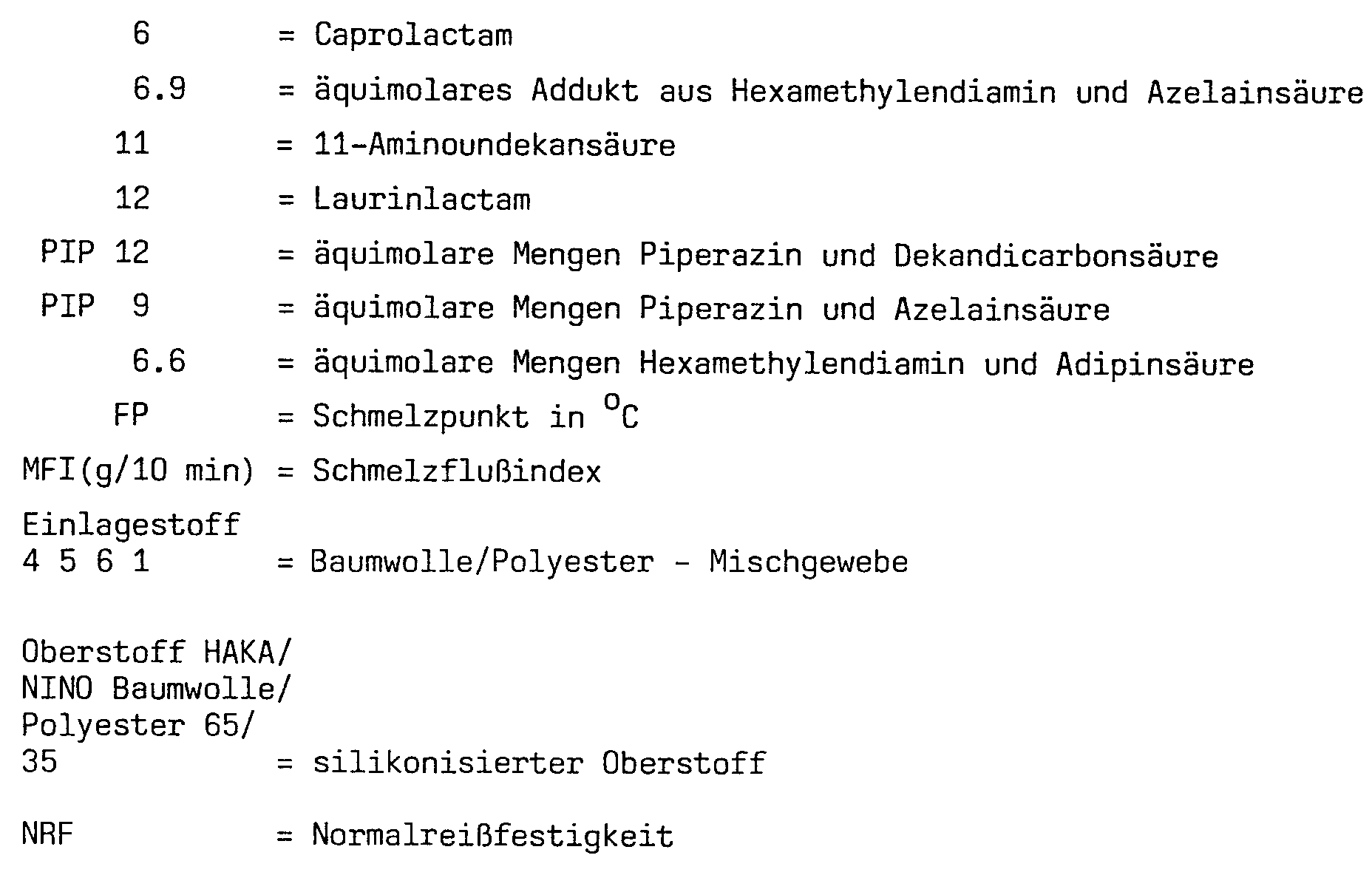
- In der Tabelle sind die Rückschlagswerte für die erfindungsgemäßen verwendeten Heißschmelzkleberzusammensetzungen nicht enthalten, da kein Rückschlag bei den erfindungsgemäßen Verklebungen festzustellen war.
294 g Diepoxid DER 921 der Fa. Dow Chemicals
zu der im Autoklaven befindlichen Polyamidschmelze mit einem Molekulargewicht von 6300 zugegeben.
374 g Epoxid entsprechend Beispiel 1
bei 100 UpM zugegeben und unter Stickstoffstrom weitere 60 Minuten gerührt (Molverhältnis NH₂/Epoxid: 1/1,4).
Claims (9)
- Verwendung eines Reaktionsproduktes aus niedrigmolekularen Polyamiden und Diepoxiden zum Heißsiegeln von Textilien, dadurch gekennzeichnet, daß das Reaktionsprodukt erhältlich ist durch Umsetzung von folgenden Komponenten:(A) Polyamiden mit einem Schmelzpunkt von 70 bis 140oC und mit nur einer terminalen primären oder sekundären Aminogruppe pro Molekül, die folgende Grundbausteine enthält:1. bis zu 40 Gew.-% Aminocapronsäure und/oder deren Lactamform2. bis zu 45 Gew.-% 11-Aminoundekansäure3. bis zu 45 Gew.-% Laurinlactam4. bis zu 85 Gew.-% äquimolaren Mengen primärer und/oder sekundärer C₂-C₂₀-Diamine und/oder Etherdiamine und aliphatischer C₂-C₄₄-Dicarbonsäuren, die in einer Menge von bis zu 20 Gew.%, bezogen auf das Gesamtgewicht der Dicarbonsäuren, durch aromatische Dicarbonsäuren ersetzt sein können,wobei die niedrigmolekularen Polyamide (A) ein Molekulargewicht (Mn) von 1000 bis 10000 haben, das durch Zusatz von monofunktionellen C₄-C₂₄ Aminen zur Ausgangsmischung der Grundbausteine eingestellt wird, und zwei, drei oder vier Grundbausteine zur Herstellung der Copolyamide verwendet werden, wobei die Grundbausteine A1 bis A4
zusammen 100 Gew.-% der Komponente A) ergeben, und(B) Diepoxiden, die ausgewählt werden aus der Gruppe, die besteht aus1. Diepoxiden der allgemeinen Formel
E - D - E
wobei E ein Epoxidrest mit 2 bis 10 Kohlenstoffatomen bedeutet, und D ein aliphatischer Rest mit 2 bis 20 Kohlenstoffatomen, ein aromatischer und/oder alicyclischer Rest mit 6 bis 30 Kohlenstoffatomen oder
 2. Diepoxiden auf Basis von Bisphenol A und Epichlorhydrin mit einem Molekulargewicht (Mn) von 340 bis 3000;3. α,ω-Diepoxipolypropylen- oder -ethylenglykolen mit einem Molekulargewicht (Mn) von 500 bis 3000;4. α,ω-Diglycidilpolydimethylsiloxanen mit einem Molekulargewicht (Mn) von 800 bis 5000;und das Mengenverhältnis der niedrigmolekularen Polyamide (A) zu den Diepoxiden (B) so ausgewählt wird, daß das molekulare Verhältnis von reagierenden Aminogruppen der Komponente (A) zu den mit den Aminogruppen reagierenden Epoxidgruppen der Komponente (B) im Falle von primären Aminen 1:0,5 bis 1:1 und im Falle von sekundären Aminen 1:0,8 bis 1:2 beträgt.
 - Verwendung nach Anspruch 1, dadurch gekennzeichnet, daß die niedrigmolekularen Polyamide (A) ein Molekulargewicht (Mn) von 2000 bis 6000 besitzen.
- Verwendung nach Anspruch 1 oder 2, dadurch gekennzeichnet, daß das Molekulargewicht (M

- Verwendung nach einem der Ansprüche 1 bis 3, dadurch gekennzeichnet, daß die Diepoxide (B2) solche mit einem Molekulargewicht (M

- Verwendung nach einem der Ansprüche 1 bis 3, dadurch gekennzeichnet, daß die Diepoxide (B4) solche mit einem Molekulargewicht (M

- Verwendung nach einem der Ansprüche 1 bis 3, dadurch gekennzeichnet, daß die Diepoxide (B3) solche mit einem Molekulargewicht (M

- Verwendung nach einem der Ansprüche 1 bis 6, dadurch gekennzeichnet, daß die niedrigmolekularen Polyamide (A) dadurch erhältlich sind, daß die Grundbausteine in den im Anspruch 1 genannten Mengenverhältnissen unter Druck und erhöhter Temperatur in an sich bekannter Weise vorpolymerisiert und danach mit Diepoxiden (B) umgesetzt werden.
- Verwendung nach Anspruch 7, dadurch gekennzeichnet, daß die Heißschmelzkleber-Zusammensetzung durch Umsetzung der Komponenten (A) und (B) in einem Reaktionsextruder erhältlich ist.
- Verwendung nach einem der Ansprüche 1 bis 8 zum Heißsiegeln von silikonisierten Textilien.
Applications Claiming Priority (2)
| Application Number | Priority Date | Filing Date | Title |
|---|---|---|---|
| DE4033480 | 1990-10-20 | ||
| DE4033480A DE4033480C2 (de) | 1990-10-20 | 1990-10-20 | Heißsiegeln von Textilien |
Publications (2)
| Publication Number | Publication Date |
|---|---|
| EP0482483A2 true EP0482483A2 (de) | 1992-04-29 |
| EP0482483A3 EP0482483A3 (en) | 1993-03-10 |
Family
ID=6416767
Family Applications (1)
| Application Number | Title | Priority Date | Filing Date |
|---|---|---|---|
| EP19910117602 Withdrawn EP0482483A3 (en) | 1990-10-20 | 1991-10-16 | Heat sealing of textiles |
Country Status (3)
| Country | Link |
|---|---|
| EP (1) | EP0482483A3 (de) |
| JP (1) | JPH04306284A (de) |
| DE (1) | DE4033480C2 (de) |
Cited By (2)
| Publication number | Priority date | Publication date | Assignee | Title |
|---|---|---|---|---|
| EP0685528A1 (de) * | 1994-06-03 | 1995-12-06 | Bayer Ag | Polyamidcompounds mit erhöhter Schmelzeviskosität, Verfahren zur Herstellung und ihre Verwendung |
| CN117071165A (zh) * | 2023-08-24 | 2023-11-17 | 安徽华超新材料科技有限公司 | 一种玻璃纤维短切毡的生产方法 |
Families Citing this family (3)
| Publication number | Priority date | Publication date | Assignee | Title |
|---|---|---|---|---|
| DE4231693A1 (de) * | 1992-09-22 | 1994-03-24 | Iduso Gmbh | Randarmierung z.B. für Glasgewebe |
| DE19510316A1 (de) * | 1995-03-22 | 1996-09-26 | Huels Chemische Werke Ag | Schmelzklebermasse zur Beschichtung von Einlagenstoff |
| ES2878166T3 (es) * | 2015-12-02 | 2021-11-18 | Invista Textiles Uk Ltd | Preparación mejorada de polímero |
Family Cites Families (3)
| Publication number | Priority date | Publication date | Assignee | Title |
|---|---|---|---|---|
| GB1266688A (de) * | 1968-07-25 | 1972-03-15 | ||
| FR2239492A1 (en) * | 1973-07-11 | 1975-02-28 | Aquitaine Total Organico | Crosslinked polyamides with thermosetting properties - by treating polyamide prepolymer with epoxy resins |
| FR2569413B1 (fr) * | 1984-08-27 | 1986-11-28 | Atochem | Compositions reactives a base d'oligomeres de polyamides et de resines epoxydes |
-
1990
- 1990-10-20 DE DE4033480A patent/DE4033480C2/de not_active Expired - Fee Related
-
1991
- 1991-10-16 EP EP19910117602 patent/EP0482483A3/de not_active Withdrawn
- 1991-10-18 JP JP3271177A patent/JPH04306284A/ja active Pending
Cited By (3)
| Publication number | Priority date | Publication date | Assignee | Title |
|---|---|---|---|---|
| EP0685528A1 (de) * | 1994-06-03 | 1995-12-06 | Bayer Ag | Polyamidcompounds mit erhöhter Schmelzeviskosität, Verfahren zur Herstellung und ihre Verwendung |
| US5605945A (en) * | 1994-06-03 | 1997-02-25 | Bayer Aktiengesellschaft | Polyamide compounds containing diepoxide and having high viscosity |
| CN117071165A (zh) * | 2023-08-24 | 2023-11-17 | 安徽华超新材料科技有限公司 | 一种玻璃纤维短切毡的生产方法 |
Also Published As
| Publication number | Publication date |
|---|---|
| EP0482483A3 (en) | 1993-03-10 |
| DE4033480C2 (de) | 1994-06-16 |
| JPH04306284A (ja) | 1992-10-29 |
| DE4033480A1 (de) | 1992-04-23 |
Similar Documents
| Publication | Publication Date | Title |
|---|---|---|
| DE3600015C2 (de) | ||
| EP3369761B1 (de) | Copolyamide enthaltend dimere fettsäure als monomer | |
| EP0469435B1 (de) | Copolyamide, Verfahren zu ihrer Herstellung und ihre Verwendung | |
| DE69225946T2 (de) | Transparente Polyamid-Mischungen mit hoher Beständigkeit gegenüber chemischen Mitteln | |
| DE4318047C2 (de) | Verwendung von Copolyamiden als Schmelzkleber zum Heißsiegeln | |
| EP0025487B1 (de) | Verfahren zur Herstellung von Polyether(ester)amiden | |
| EP0027852A1 (de) | Transparente Copolyamide und deren Verwendung zur Herstellung transparenter schlagzäher Formkörper | |
| EP3369760A1 (de) | Mikrowellenbeständige formkörper | |
| DE2936977A1 (de) | Verfahren zur herstellung von polyether(ester)amiden | |
| CA1259742A (fr) | Compositions reactives a base d'oligomeres de polyamides et de resines epoxydes | |
| EP0469436A1 (de) | Copolyamide, Verfahren zu ihrer Herstellung und ihre Verwendung | |
| DE69903197T2 (de) | Intrinsisch gelfreies, zuffällig verzweigtes polyamid | |
| DE4033480C2 (de) | Heißsiegeln von Textilien | |
| EP0017112A1 (de) | Estermodifizierte Polyamide und ihre Verwendung als Schmelzkleber | |
| DE2930343A1 (de) | Formmasse aus einem hochmolekularen linearen polyester | |
| DE1520924A1 (de) | Verfahren zur Herstellung von Polyamiden | |
| EP0000492B1 (de) | Transparente Polyamide und deren Verwendung zur Herstellung von Formkörpern | |
| EP0001039B1 (de) | Transparente Polyamide | |
| EP0388730B1 (de) | Polyamid-Siloxan-Copolymer | |
| DE4108874A1 (de) | Polyetheresteramide, verfahren zu ihrer herstellung und deren verwendung | |
| DE69919522T2 (de) | Heissschmelzendes und vernetzbares polyamid, herstellungsverfahren und verwendung als klebemittel | |
| EP0001786A1 (de) | Kristallines Polyamid, seine Verwendung und Diamine | |
| EP0409115B1 (de) | Thermoplastisch verarbeitbare Pfropfpolymere | |
| EP0503235B1 (de) | Polyamide und Polyesteramide auf Basis von trimerisierten Fettsäuren, Verfahren zu ihrer Herstellung und ihre Verwendung als Schmelzklebstoffe | |
| AT352237B (de) | Verfahren zum heissiegeln |
Legal Events
| Date | Code | Title | Description |
|---|---|---|---|
| PUAI | Public reference made under article 153(3) epc to a published international application that has entered the european phase |
Free format text: ORIGINAL CODE: 0009012 |
|
| AK | Designated contracting states |
Kind code of ref document: A2 Designated state(s): CH DE FR GB IT LI NL |
|
| PUAL | Search report despatched |
Free format text: ORIGINAL CODE: 0009013 |
|
| AK | Designated contracting states |
Kind code of ref document: A3 Designated state(s): CH DE FR GB IT LI NL |
|
| 17P | Request for examination filed |
Effective date: 19930906 |
|
| RAP1 | Party data changed (applicant data changed or rights of an application transferred) |
Owner name: ELF ATOCHEM DEUTSCHLAND GMBH |
|
| STAA | Information on the status of an ep patent application or granted ep patent |
Free format text: STATUS: THE APPLICATION HAS BEEN WITHDRAWN |
|
| 18W | Application withdrawn |
Withdrawal date: 19940315 |