EP0478968A2 - Servoregler für vorwärts-rückwärts Schaltmechanismus - Google Patents
Servoregler für vorwärts-rückwärts Schaltmechanismus Download PDFInfo
- Publication number
- EP0478968A2 EP0478968A2 EP91114816A EP91114816A EP0478968A2 EP 0478968 A2 EP0478968 A2 EP 0478968A2 EP 91114816 A EP91114816 A EP 91114816A EP 91114816 A EP91114816 A EP 91114816A EP 0478968 A2 EP0478968 A2 EP 0478968A2
- Authority
- EP
- European Patent Office
- Prior art keywords
- fluid
- piston
- reverse
- chamber
- pressure
- Prior art date
- Legal status (The legal status is an assumption and is not a legal conclusion. Google has not performed a legal analysis and makes no representation as to the accuracy of the status listed.)
- Withdrawn
Links
- 230000007246 mechanism Effects 0.000 title claims description 8
- 239000012530 fluid Substances 0.000 claims abstract description 67
- 230000005540 biological transmission Effects 0.000 claims abstract description 27
- 238000004891 communication Methods 0.000 claims abstract description 10
- 238000000034 method Methods 0.000 description 3
- 230000007935 neutral effect Effects 0.000 description 2
- 238000007789 sealing Methods 0.000 description 2
- 230000006835 compression Effects 0.000 description 1
- 238000007906 compression Methods 0.000 description 1
- 230000007423 decrease Effects 0.000 description 1
- 238000010586 diagram Methods 0.000 description 1
- 238000006073 displacement reaction Methods 0.000 description 1
- 230000009977 dual effect Effects 0.000 description 1
- 238000011156 evaluation Methods 0.000 description 1
- 230000035939 shock Effects 0.000 description 1
Images


Classifications
-
- F—MECHANICAL ENGINEERING; LIGHTING; HEATING; WEAPONS; BLASTING
- F16—ENGINEERING ELEMENTS AND UNITS; GENERAL MEASURES FOR PRODUCING AND MAINTAINING EFFECTIVE FUNCTIONING OF MACHINES OR INSTALLATIONS; THERMAL INSULATION IN GENERAL
- F16D—COUPLINGS FOR TRANSMITTING ROTATION; CLUTCHES; BRAKES
- F16D67/00—Combinations of couplings and brakes; Combinations of clutches and brakes
-
- F—MECHANICAL ENGINEERING; LIGHTING; HEATING; WEAPONS; BLASTING
- F16—ENGINEERING ELEMENTS AND UNITS; GENERAL MEASURES FOR PRODUCING AND MAINTAINING EFFECTIVE FUNCTIONING OF MACHINES OR INSTALLATIONS; THERMAL INSULATION IN GENERAL
- F16H—GEARING
- F16H63/00—Control outputs from the control unit to change-speed- or reversing-gearings for conveying rotary motion or to other devices than the final output mechanism
- F16H63/02—Final output mechanisms therefor; Actuating means for the final output mechanisms
- F16H63/30—Constructional features of the final output mechanisms
- F16H63/3023—Constructional features of the final output mechanisms the final output mechanisms comprising elements moved by fluid pressure
-
- F—MECHANICAL ENGINEERING; LIGHTING; HEATING; WEAPONS; BLASTING
- F16—ENGINEERING ELEMENTS AND UNITS; GENERAL MEASURES FOR PRODUCING AND MAINTAINING EFFECTIVE FUNCTIONING OF MACHINES OR INSTALLATIONS; THERMAL INSULATION IN GENERAL
- F16H—GEARING
- F16H61/00—Control functions within control units of change-speed- or reversing-gearings for conveying rotary motion ; Control of exclusively fluid gearing, friction gearing, gearings with endless flexible members or other particular types of gearing
- F16H61/02—Control functions within control units of change-speed- or reversing-gearings for conveying rotary motion ; Control of exclusively fluid gearing, friction gearing, gearings with endless flexible members or other particular types of gearing characterised by the signals used
- F16H61/0202—Control functions within control units of change-speed- or reversing-gearings for conveying rotary motion ; Control of exclusively fluid gearing, friction gearing, gearings with endless flexible members or other particular types of gearing characterised by the signals used the signals being electric
- F16H61/0204—Control functions within control units of change-speed- or reversing-gearings for conveying rotary motion ; Control of exclusively fluid gearing, friction gearing, gearings with endless flexible members or other particular types of gearing characterised by the signals used the signals being electric for gearshift control, e.g. control functions for performing shifting or generation of shift signal
- F16H61/0246—Control functions within control units of change-speed- or reversing-gearings for conveying rotary motion ; Control of exclusively fluid gearing, friction gearing, gearings with endless flexible members or other particular types of gearing characterised by the signals used the signals being electric for gearshift control, e.g. control functions for performing shifting or generation of shift signal characterised by initiating reverse gearshift
-
- F—MECHANICAL ENGINEERING; LIGHTING; HEATING; WEAPONS; BLASTING
- F16—ENGINEERING ELEMENTS AND UNITS; GENERAL MEASURES FOR PRODUCING AND MAINTAINING EFFECTIVE FUNCTIONING OF MACHINES OR INSTALLATIONS; THERMAL INSULATION IN GENERAL
- F16H—GEARING
- F16H61/00—Control functions within control units of change-speed- or reversing-gearings for conveying rotary motion ; Control of exclusively fluid gearing, friction gearing, gearings with endless flexible members or other particular types of gearing
- F16H61/02—Control functions within control units of change-speed- or reversing-gearings for conveying rotary motion ; Control of exclusively fluid gearing, friction gearing, gearings with endless flexible members or other particular types of gearing characterised by the signals used
- F16H61/0202—Control functions within control units of change-speed- or reversing-gearings for conveying rotary motion ; Control of exclusively fluid gearing, friction gearing, gearings with endless flexible members or other particular types of gearing characterised by the signals used the signals being electric
- F16H61/0251—Elements specially adapted for electric control units, e.g. valves for converting electrical signals to fluid signals
- F16H2061/0255—Solenoid valve using PWM or duty-cycle control
-
- F—MECHANICAL ENGINEERING; LIGHTING; HEATING; WEAPONS; BLASTING
- F16—ENGINEERING ELEMENTS AND UNITS; GENERAL MEASURES FOR PRODUCING AND MAINTAINING EFFECTIVE FUNCTIONING OF MACHINES OR INSTALLATIONS; THERMAL INSULATION IN GENERAL
- F16H—GEARING
- F16H61/00—Control functions within control units of change-speed- or reversing-gearings for conveying rotary motion ; Control of exclusively fluid gearing, friction gearing, gearings with endless flexible members or other particular types of gearing
- F16H61/68—Control functions within control units of change-speed- or reversing-gearings for conveying rotary motion ; Control of exclusively fluid gearing, friction gearing, gearings with endless flexible members or other particular types of gearing specially adapted for stepped gearings
- F16H61/682—Control functions within control units of change-speed- or reversing-gearings for conveying rotary motion ; Control of exclusively fluid gearing, friction gearing, gearings with endless flexible members or other particular types of gearing specially adapted for stepped gearings with interruption of drive
-
- Y—GENERAL TAGGING OF NEW TECHNOLOGICAL DEVELOPMENTS; GENERAL TAGGING OF CROSS-SECTIONAL TECHNOLOGIES SPANNING OVER SEVERAL SECTIONS OF THE IPC; TECHNICAL SUBJECTS COVERED BY FORMER USPC CROSS-REFERENCE ART COLLECTIONS [XRACs] AND DIGESTS
- Y10—TECHNICAL SUBJECTS COVERED BY FORMER USPC
- Y10T—TECHNICAL SUBJECTS COVERED BY FORMER US CLASSIFICATION
- Y10T74/00—Machine element or mechanism
- Y10T74/19—Gearing
- Y10T74/19219—Interchangeably locked
- Y10T74/19377—Slidable keys or clutches
- Y10T74/19414—Single clutch shaft
- Y10T74/19484—Single speed forward and reverse
- Y10T74/19488—Spur gears
Definitions
- This invention relates to servo mechanisms, and more particularly, to servo mechanisms for controlling the shifting of a transmission between a forward ratio and a reverse ratio.
- a forward/reverse servo controller in accordance with the present invention is characterised by the features specified in the characterising portion of claim 1.
- the present invention provides a control system and a mechanical forward/reverse clutch mechanism which ensures that a minimum speed differential, between a reverse gear member and a transmission shaft, is present prior to engaging the mechanical clutch between the transmission shaft and the reverse gear member.
- a shift control structure includes a servo member operatively connected with a portion of the mechanical clutch to provide for the shifting of the clutch.
- the servo includes a piston which cooperates with a housing to provide two fluid chambers which are selectively disposed for controlled fluid communication.
- the chambers are disconnected and in the reverse select position, the chambers are interconnected.
- the servo is urged to the forward select position by a spring which has sufficient precompression to resist the movement of the piston to the reverse select position prior to the fluid pressure in one of the chambers being increased above a desired threshold level.
- the fluid pressure which is supplied to the chamber is preferably provided by an electro-hydraulic control system which includes a microprocessor and a line pressure regulator.
- the microprocessor evaluates various vehicle parameters including engine speed, engine torque and vehicle speed. These parameters are evaluated by the microprocessor in a manner to establish a voltage signal to a pulse-width-modulated solenoid valve which controls the line pressure for the transmission hydraulic components in accordance with the duty cycle of the signal.
- the line pressure will not be sufficient to cause the piston to move against the spring. Accordingly, a forward/reverse shift will not occur and, as a general rule, the transmission will be placed in neutral by exhausting the various friction clutches.
- the microprocessor continuously monitors the operating parameters and the operating requests, such that when the vehicle speed, for example, has been reduced below a threshold value, the line pressure will be increased sufficiently to cause the servo piston to move to the reverse select position and therefore selectively clutch the transmission shaft to the reverse gear.
- the two chambers are fluidly interconnected and a fluid pressure in the second chamber is directed to a friction clutch and a control valve to establish or otherwise enforce the engagement of the friction clutch which will condition the transmission for reverse drive operation.
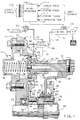
- a forward/reverse servo controller hereinafter referred to as servo 10, generally designated 10, which includes a casing or housing 12, an end cover 14, a piston 16 and a compression spring 18.
- the piston 16 is slidably disposed in the housing 12 and is urged rightward to the position shown in Figure 1 by the spring 18 which is compressed between the housing 12 and the end cover 14.
- the piston 16 has three circumferentially extending surfaces 20, 22 and 24.
- Circumferential surface 20 is slidably sealingly engaged in a bore 26 formed in the housing 12 and forms the outer surface for a piston rod 28, which has secured thereto a shift fork 30 by means of a threaded fastener 32.
- the circumferential surface 22 sealingly engages a surface 34 formed on the housing 12 and cooperates therewith to define a first fluid chamber 36.
- the circumferential surface 24 has disposed thereon a seal member 38 which cooperates with a surface 40 formed on the housing 12 to define a second fluid chamber 42 and a third fluid chamber 44.
- the second fluid chamber 42 is formed on the same side of the piston 16 as the first fluid chamber 36 and the third fluid chamber 44 is disposed on the opposite side of the piston 16.
- the circumferential surface 22 is in fluid communication with a radial passage 46, an axial passage 48 and another radial passage 50.
- the radial passage 50 is open to exhaust in the position shown in Figure 1, which thereby exhausts the fluid pressure in the second fluid chamber 42.
- the radial passage 50 is sealed by the sealing engagement between the circumferential surface 20 and bore 26.
- the radial passage 50 is disposed to be closed from atmosphere when the circumferential surface 22 is moved out of sealing engagement with the surface 34.
- the shift fork 30 is operatively connected to an annular clutch sleeve 52 which has a splined inner diameter 54.
- the splined inner diameter 54 is adapted to mesh continuously with a splined outer diameter 56 of a clutch hub 58, which in turn, is drivingly connected through a splined connection 60 with a transmission shaft 62.
- the splined inner diameter 54 of clutch sleeve 52 is also selectively engageable with a spline 64 formed on a forward gear 66, as seen in Figure 1, and with a spline 68 formed on a reverse gear 70, as seen in Figure 2.
- the forward and reverse gears 66 and 70 respectively are rotatably supported on the transmission shaft 62 by bearing members 72 and 74, respectively.
- the forward gear 66 is drivingly connected with the transmission shaft 62 when the servo 10 is in the forward select position shown in Figure 1. It should also be obvious that in this position, the reverse gear 70 is freely rotatable on the transmission shaft 62. It should likewise be apparent that when the servo 10 is moved to the reverse select position shown in Figure 2, that the reverse gear 70 is drivingly connected to the transmission shaft 62 while the forward gear 66 is freely rotatable on the transmission shaft 62.
- the forward and reverse gears 66 and 70 respectively, and clutch hub 58 are controlled to their axial positions on the transmission shaft 62 by a pair of thrust bearings 76 and 78 which are disposed between a sleeve shaft 80 and bearing 82, respectively.
- the first fluid chamber 36 is in fluid communication with a reverse shift signal passage 84 which receives a selective signal from a conventional shift controller 86.
- the second fluid chamber 42 is in fluid communication with a clutch fill passage 88 which is in fluid communication through a one-way or check valve 90 with a clutch valve passage 92.
- the clutch valve passage 92 is selectively pressurizable to control the engagement of a conventional, fluid operated, friction clutch 94.
- the fluid pressure in the friction clutch 94 is controlled by a conventional pulse-width-modulator type solenoid valve 96 (PWM).
- PWM pulse-width-modulator type solenoid valve 96
- the check valve 90 will prevent fluid flow from the clutch valve passage 92 to exhaust through the passages in the piston rod 28 when the forward select position is established.
- the friction clutch 94 can also be used for a forward ratio.
- the third fluid chamber 44 is in fluid communicatoin with a pressure passage 98 which is pressurized by the shift controller 86 and at least the first or lowest forward speed transmission operation.
- the shift controller 86 receives fluid pressure from a line pressure regulator valve 100 which is supplied by a conventional positive displacement pump 102.
- the line pressure regulator valve 100 is a conventional valve which is controlled by a conventional pulse-width-modulated solenoid valve 104 (PWM) to establish a controlled pressure level in a passage 106 which is connected with the shift controller 86.
- PWM pulse-width-modulated solenoid valve
- the pulse-width-modulated solenoid valves 96 and 104 are controlled by a conventional microprocessor or digital computer 108.
- the microprocessor 108 is effective to receive input signals, such as vehicle speed 110, engine speed 112, engine torque 114 and operating temperature 116. Obviously, other vehicle parameters can be input to the microprocessor 108 depending upon the program which is to be executed by the microprocessor 108.
- the microprocessor 108 is effective to provide output signals, in accordance with its programming, and input signals which can be utilized to control the pulse-width-modulated solenoid valves 104 and 96, as well as shift control functions, which are represented by a variety of output signals 118.
- the microprocessor 108 is effective to control the line pressure regulator valve 100 to establish at least two distinct pressure levels in the passage 106 and therefore in the reverse shift signal passage 84.
- the pressure level in passage 84 can be controlled at a low level, for example, 450 kpa, and at a high level, for example, 900 kpa.
- the fluid pressure in fluid chamber 36 is not sufficient to overcome the precompression force in spring 18 and therefore servo 10 will remain in the forward select position shown in Figure 1.
- the pressure level in reverse shift signal passage 84 is at the higher level, the fluid pressure in the fluid chamber 36 is sufficient to cause movement of the servo 10 from the forward select position of Figure 1 to the reverse position of Figure 2.
- the fluid in fluid chamber 36 is connected to the fluid in chamber 42 and via clutch fill and clutch valve passages 88 and 92, to the friction clutch 94.
- the friction clutch 94 will in turn be selectively engaged at a pressure level established by the pulse-width-modulated solenoid valve 96.
- the fluid pressure in reverse shift signal passage 84 can, if desired, be reduced to the low level since the combined area of the first and second fluid chambers 36 and 42 will be sufficient at the low pressure level to resist the force in spring 18.
- the pressure level in reverse shift signal passage 84 is controlled such that if the operator commands or requests a forward to reverse shift, the command will not be acted upon unless certain vehicle parameters are at or below a predetermined threshold.
- the microprocessor 108 operates in accordance with its programming to establish the pressure level in passage 106 and therefore reverse shift signal passage 84.
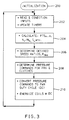
- the process of the algorithms for the microprocessor 108 is shown in Figures 3 to 6 and is somewhat self-explanatory. As seen in Figure 3, the microprocessor undergoes an initialization process at start up (step 200) which establishes the various constants in the parameters needed within the system. The microprocessor 108 then evaluates or interrogates the input signals (step 202) and calculates (step 204) various operating parameters.
- the microprocessor 108 then evaluates any operator commands which might be requesting a ratio change (step 206). Following the evaluation of these commands, the microprocessor 108 establishes (step 208) the pressure levels for the active clutches and then provides for these pressure levels by energizing (step 210) the required pulse-width-modulated solenoid valves 96, 104. This process is repeated on a conventional interrupt basis.
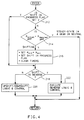
- the microprocessor 108 will follow the programming steps shown in Figure 4 in which it is determined whether the shift command was a forward to reverse command. This involves determining if a shift is in progress (step 212), and where not, determining if the requested gear is the gear actually in use (step 214). If it is, the routine of Figure 4 is left. If not, then the requested gear reading is reset, the shift in progress flag is set, and the timers are cleared at step 216. Then, or if a shift is in progress (step 212), determining if a shift to reverse is required (step 218). If not, the routine of Figure 4 is left after the logic and control sequence are upshifted/downshifted at step 220. If a forward/reverse command is present, the microprocessor performs the control steps (step 222) shown in Figure 5.
- the microprocessor 108 evaluates the vehicle speed to determined if, in fact, the speed is below a threshold value (step 224). If the vehicle speed is above the threshold value, the microprocessor sets a reverse inhibit flag (step 226) and commands a neutral condition (step 228) within the transmission.
- the microprocessor 108 then executes the commands, as shown in Figure 6, and with a reverse inhibit flag set (step 230), the pulse-width-modulated solenoid valve 96 will be set to establish a zero or exhaust pressure level (step 232) and the pulse-width-modulated solenoid valve 104 will be set to establish a low level pressure at passage 106 (step 234).
- the microprocessor 108 will complete the steps shown in Figure 3 and proceed to re-evaluate the system.
- the microprocessor 108 will perform the steps shown in Figure 5 in which the direction (in reverse) flag is set (step 236), the reverse inhibit flag is cleared (step 238) and a command for reverse shift is set (step 240). With this condition, the microprocessor 108 will evaluate the steps shown in Figure 6 of normal clutch pressure control (step 242) and line pressure (step 244) which will result in the higher pressure level being established in passage 106 and reverse shift signal passage 84. The microprocessor 108 will then adjust the duty cycles of the pulse-width-modulated solenoid valves 96 and 104 accordingly, so that a forward to reverse shift will occur.
Landscapes
- Engineering & Computer Science (AREA)
- General Engineering & Computer Science (AREA)
- Mechanical Engineering (AREA)
- Physics & Mathematics (AREA)
- Fluid Mechanics (AREA)
- Gear-Shifting Mechanisms (AREA)
- Control Of Transmission Device (AREA)
- Arrangement And Mounting Of Devices That Control Transmission Of Motive Force (AREA)
Applications Claiming Priority (2)
| Application Number | Priority Date | Filing Date | Title |
|---|---|---|---|
| US07/593,728 US5046592A (en) | 1990-10-05 | 1990-10-05 | Servo shift control for a forward/reverse mechanism |
| US593728 | 2000-06-13 |
Publications (2)
| Publication Number | Publication Date |
|---|---|
| EP0478968A2 true EP0478968A2 (de) | 1992-04-08 |
| EP0478968A3 EP0478968A3 (en) | 1992-12-23 |
Family
ID=24375903
Family Applications (1)
| Application Number | Title | Priority Date | Filing Date |
|---|---|---|---|
| EP19910114816 Withdrawn EP0478968A3 (en) | 1990-10-05 | 1991-09-03 | Servo controller for a forward/reverse mechanism |
Country Status (5)
| Country | Link |
|---|---|
| US (1) | US5046592A (de) |
| EP (1) | EP0478968A3 (de) |
| JP (1) | JPH0674332A (de) |
| KR (1) | KR940001995B1 (de) |
| CA (1) | CA2043634C (de) |
Cited By (1)
| Publication number | Priority date | Publication date | Assignee | Title |
|---|---|---|---|---|
| EP0681120A1 (de) * | 1994-05-05 | 1995-11-08 | Eaton Corporation | Steuerungsverfahren zum Verhindern des Einlegens des Rückwärtsganges |
Families Citing this family (12)
| Publication number | Priority date | Publication date | Assignee | Title |
|---|---|---|---|---|
| US5476164A (en) * | 1994-09-12 | 1995-12-19 | Regal-Beloit Corporation | Solenoid actuated mechanical clutch |
| AT401964B (de) * | 1995-04-26 | 1997-01-27 | Steyr Daimler Puch Ag | Hydraulischer aktuator und damit ausgestattete kupplung |
| US6450051B1 (en) * | 2000-09-01 | 2002-09-17 | Zf Meritor, Llc | Spring loaded transmission auxiliary piston |
| US7048104B2 (en) * | 2003-09-12 | 2006-05-23 | Ford Global Technologies, Llc | Selective bypass of solenoid-controlled supply to friction elements of an automatic transmission |
| US8661925B2 (en) * | 2007-04-30 | 2014-03-04 | Parker Hannifin Corporation | Hydraulically operated shifter for power take-off |
| DE102014011176A1 (de) * | 2014-07-31 | 2016-02-04 | Fte Automotive Gmbh | Hydraulische Betätigungsvorrichtung für die Betätigung von Stellgliedern in einem Kraftfahrzeuggetriebe |
| DE102014218311A1 (de) * | 2014-09-12 | 2016-03-17 | Volkswagen Aktiengesellschaft | Zwischenradanordnung für ein Kraftfahrzeuggetriebe |
| US9631723B2 (en) | 2015-01-26 | 2017-04-25 | Ford Global Technologies, Llc | Vehicle and method to control rolling engagements |
| CN105065653B (zh) * | 2015-07-15 | 2017-09-01 | 徐州南普机电科技有限公司 | 一种电动车两档变速器的选档机构 |
| DE102015221999A1 (de) * | 2015-11-09 | 2017-05-11 | Zf Friedrichshafen Ag | Anordnung zum Betätigen zumindest eines Schaltelementes |
| US10612650B2 (en) | 2016-02-22 | 2020-04-07 | Deere & Company | Double disconnect transmission reverser with disconnect synchronizer |
| US10330191B2 (en) | 2016-02-22 | 2019-06-25 | Deere & Company | Double disconnect transmission reverser with disconnect synchronizer |
Family Cites Families (12)
| Publication number | Priority date | Publication date | Assignee | Title |
|---|---|---|---|---|
| US2189679A (en) * | 1935-06-25 | 1940-02-06 | Bendix Westinghouse Automotive | Gear shifting mechanism |
| US2137959A (en) * | 1936-01-03 | 1938-11-22 | Bendix Westinghouse Automotive | Gear shifting mechanism |
| US2137953A (en) * | 1936-11-04 | 1938-11-22 | Bendix Westinghouse Automotive | Control mechanism |
| CH238203A (de) * | 1942-09-21 | 1945-06-30 | Boehringer Gmbh Geb | Antriebsvorrichtung. |
| US3001413A (en) * | 1957-06-26 | 1961-09-26 | Daimler Benz Ag | Transmission including disengaging clutch construction |
| US3386543A (en) * | 1965-09-08 | 1968-06-04 | Kearney & Trecker Corp | Machine tool transmission and control mechanism |
| BE691051A (de) * | 1965-12-23 | 1967-05-16 | ||
| GB1142506A (en) * | 1966-04-04 | 1969-02-12 | Dewandre Co Ltd C | Improvements in or relating to air pressure actuators for gear change mechanisms |
| US3557918A (en) * | 1969-02-26 | 1971-01-26 | Honda Motor Co Ltd | Apparatus for controlling the operation of a shift member and input clutch in a gear type transmission |
| DE2104934A1 (de) * | 1971-02-03 | 1972-08-17 | Bosch Gmbh Robert | Steuereinrichtung zum Betätigen einer Fahrzeug-Reibungskupplung |
| SE8403347L (sv) * | 1984-06-21 | 1985-12-22 | Volvo Ab | Motorfordonskoppling for en mekanisk, stegvexlad automatvexellada |
| JPH0619192B2 (ja) * | 1985-05-07 | 1994-03-16 | 自動車機器株式会社 | 自動クラツチ装置 |
-
1990
- 1990-10-05 US US07/593,728 patent/US5046592A/en not_active Expired - Lifetime
-
1991
- 1991-06-05 CA CA002043634A patent/CA2043634C/en not_active Expired - Fee Related
- 1991-09-03 EP EP19910114816 patent/EP0478968A3/en not_active Withdrawn
- 1991-09-27 KR KR1019910016889A patent/KR940001995B1/ko not_active Expired - Fee Related
- 1991-10-04 JP JP3258034A patent/JPH0674332A/ja active Pending
Cited By (1)
| Publication number | Priority date | Publication date | Assignee | Title |
|---|---|---|---|---|
| EP0681120A1 (de) * | 1994-05-05 | 1995-11-08 | Eaton Corporation | Steuerungsverfahren zum Verhindern des Einlegens des Rückwärtsganges |
Also Published As
| Publication number | Publication date |
|---|---|
| CA2043634A1 (en) | 1992-04-06 |
| US5046592A (en) | 1991-09-10 |
| EP0478968A3 (en) | 1992-12-23 |
| KR920008374A (ko) | 1992-05-27 |
| CA2043634C (en) | 1994-10-04 |
| JPH0674332A (ja) | 1994-03-15 |
| KR940001995B1 (ko) | 1994-03-12 |
Similar Documents
| Publication | Publication Date | Title |
|---|---|---|
| US4547178A (en) | Control system for an automatic transmission for a vehicle | |
| US4867732A (en) | Control device for belt-and-pulley type continuously variable transmission for a vehicle | |
| KR920005482B1 (ko) | 차량용 자동 변속기의 제어장치 | |
| US5345843A (en) | Speed change control apparatus and method for an automotive automatic transmission | |
| EP3217041B1 (de) | Schmierungssystem für kupplungsmechanismus | |
| US5046592A (en) | Servo shift control for a forward/reverse mechanism | |
| EP1271006B1 (de) | Steuerung für automatische Getriebe | |
| EP1205690B1 (de) | Steuerung für ein automatisiertes, manuelles Getriebe | |
| US3688607A (en) | Transmission and control | |
| JPH11230332A (ja) | 機械式変速機の流体補助シフト装置および方法 | |
| KR20080027738A (ko) | 자동 변속기의 변속 제어 장치 | |
| US10738883B2 (en) | Controller of power transmission system for vehicle | |
| EP0051918B1 (de) | Getriebe mit veränderbarer Übersetzung | |
| US5643123A (en) | Electronic and hydraulic control system of a 4-speed automatic transmission for automotive vehicle and method for controlling hydraulic pressure | |
| US4785690A (en) | Pressure regulating system for use in an automatic transmission | |
| JPH05248534A (ja) | 自動変速機の油圧制御装置の変速バルブ | |
| US5143191A (en) | Coupling force control system for fluid coupling | |
| CA2078385C (en) | Control method for the engagement of a torque converter clutch | |
| US5157993A (en) | Hybrid continuously variable transmission with electronically controlled clutch | |
| US4787471A (en) | Power transmitting system for a four-wheel drive vehicle | |
| US4623053A (en) | Control device for a direct-coupling hydraulic clutch in a hydraulic torque converter | |
| EP0477545B1 (de) | Gangwechseleinrichtung eines automatischen Getriebes | |
| GB2152162A (en) | Control system for an automatic continuously variable transmission for a vehicle | |
| US3618727A (en) | Overlap valve | |
| EP0684910B1 (de) | Hydraulisches kontrollsystem für ein automatisches getriebe |
Legal Events
| Date | Code | Title | Description |
|---|---|---|---|
| PUAI | Public reference made under article 153(3) epc to a published international application that has entered the european phase |
Free format text: ORIGINAL CODE: 0009012 |
|
| AK | Designated contracting states |
Kind code of ref document: A2 Designated state(s): DE FR GB |
|
| PUAL | Search report despatched |
Free format text: ORIGINAL CODE: 0009013 |
|
| AK | Designated contracting states |
Kind code of ref document: A3 Designated state(s): DE FR GB |
|
| 17P | Request for examination filed |
Effective date: 19921124 |
|
| 17Q | First examination report despatched |
Effective date: 19940420 |
|
| STAA | Information on the status of an ep patent application or granted ep patent |
Free format text: STATUS: THE APPLICATION IS DEEMED TO BE WITHDRAWN |
|
| 18D | Application deemed to be withdrawn |
Effective date: 19950404 |