EP0476469A2 - Verfahren zum Aufbringen eines abbaubaren Proteinschaums auf eine Unterlage - Google Patents
Verfahren zum Aufbringen eines abbaubaren Proteinschaums auf eine Unterlage Download PDFInfo
- Publication number
- EP0476469A2 EP0476469A2 EP91115170A EP91115170A EP0476469A2 EP 0476469 A2 EP0476469 A2 EP 0476469A2 EP 91115170 A EP91115170 A EP 91115170A EP 91115170 A EP91115170 A EP 91115170A EP 0476469 A2 EP0476469 A2 EP 0476469A2
- Authority
- EP
- European Patent Office
- Prior art keywords
- foam
- solution
- dispersion
- concentrate
- landfill
- Prior art date
- Legal status (The legal status is an assumption and is not a legal conclusion. Google has not performed a legal analysis and makes no representation as to the accuracy of the status listed.)
- Withdrawn
Links
Images
Classifications
-
- C—CHEMISTRY; METALLURGY
- C09—DYES; PAINTS; POLISHES; NATURAL RESINS; ADHESIVES; COMPOSITIONS NOT OTHERWISE PROVIDED FOR; APPLICATIONS OF MATERIALS NOT OTHERWISE PROVIDED FOR
- C09K—MATERIALS FOR MISCELLANEOUS APPLICATIONS, NOT PROVIDED FOR ELSEWHERE
- C09K17/00—Soil-conditioning materials or soil-stabilising materials
- C09K17/14—Soil-conditioning materials or soil-stabilising materials containing organic compounds only
- C09K17/18—Prepolymers; Macromolecular compounds
- C09K17/32—Prepolymers; Macromolecular compounds of natural origin, e.g. cellulosic materials
-
- B—PERFORMING OPERATIONS; TRANSPORTING
- B09—DISPOSAL OF SOLID WASTE; RECLAMATION OF CONTAMINATED SOIL
- B09B—DISPOSAL OF SOLID WASTE NOT OTHERWISE PROVIDED FOR
- B09B1/00—Dumping solid waste
- B09B1/004—Covering of dumping sites
-
- B—PERFORMING OPERATIONS; TRANSPORTING
- B09—DISPOSAL OF SOLID WASTE; RECLAMATION OF CONTAMINATED SOIL
- B09C—RECLAMATION OF CONTAMINATED SOIL
- B09C1/00—Reclamation of contaminated soil
-
- Y—GENERAL TAGGING OF NEW TECHNOLOGICAL DEVELOPMENTS; GENERAL TAGGING OF CROSS-SECTIONAL TECHNOLOGIES SPANNING OVER SEVERAL SECTIONS OF THE IPC; TECHNICAL SUBJECTS COVERED BY FORMER USPC CROSS-REFERENCE ART COLLECTIONS [XRACs] AND DIGESTS
- Y02—TECHNOLOGIES OR APPLICATIONS FOR MITIGATION OR ADAPTATION AGAINST CLIMATE CHANGE
- Y02W—CLIMATE CHANGE MITIGATION TECHNOLOGIES RELATED TO WASTEWATER TREATMENT OR WASTE MANAGEMENT
- Y02W30/00—Technologies for solid waste management
- Y02W30/30—Landfill technologies aiming to mitigate methane emissions
Definitions
- the present invention relates to a method for covering a substrate with an essentially biodegradable protein foam barrier. More particularly, the present invention relates to a method for providing protein containing foam coverings to substrates such as landfills, sewage holding tanks, contaminated soil sites, sludge deposits, compost piles and the like, to effectively form a semi-permanent foam layer between the exposed surfaces of such substrates and the environment surrounding them.
- the present invention also relates to a method for providing a foam covering to substrates such as buildings and other natural and artificial structures to protect such substrates from adverse environmental conditions such as polluted air or water, insects, extreme hot and cold temperatures, toxic vapors and the like.
- substrates such as buildings and other natural and artificial structures
- adverse environmental conditions such as polluted air or water, insects, extreme hot and cold temperatures, toxic vapors and the like.
- the present invention can be used to enhance the action of "oil-eating" bacteria used in the clean-up of petroleum spills by acting as a medium to hold the bacteria in contact with the spilled oil.
- Protein based foam has been used for fire fighting and treatment of hazardous material spills in the past. It is known to use xanthan gums as an additive to such foams as for example described in U.S. Patent No. 4,424,133 to Mulligan. However, the foam described in this patent is not suitable for use as a temporary cover for the substrates described herein because it lacks the long term stability and is less resistant to rain and wind.
- the present invention addresses these needs by providing an improved method and apparatus for covering substrates such as landfills using a protein foam.
- this composition may actually add to the nutrient value of the soil and help promote biodegradation of the landfill waste as well as adding substantial moisture and some aeration.
- a foam is produced which is capable of working in harmony with nature.
- the present invention provides a method for covering a substrate having one or more surfaces exposed to the environment to provide a temporary or semipermanent foam barrier layer between the substrate and the environment.
- This method comprises in combination, the steps of providing an aqueous solution or dispersion containing an essentially biodegradable protein base material and one or more foam stabilizing agents; mixing this solution or dispersion with air (as by mechanical manipulation) to produce a foam; and thereafter applying the foam to the exposed surface or surfaces of the substrate to be covered.
- the foamed surface thus produced may be leveled to produce a substantially uniform layer thickness.
- a method and apparatus are provided for treating landfill waste wherein a protein based solution, preferably diluted from a concentrate using the landfill's own treated leachate, is mixed with air in a foam production nozzle and then spread to an approximately uniform thickness over the surface of the landfill.
- the foam is spread by an applicator followed by an integral leveler which scrapes the surface of the foam to produce a relatively uniform foam layer approximately four to six inches deep.
- the protein foam layer can be formulated to last for several days and serves to keep animals out of the refuse and reduces emission of vapors while eliminating the need for a daily cover of earth over the refuse. This provides substantial economic benefits while reducing the wasted volume of the landfill previously occupied by soil to a negligible amount.
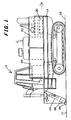
- FIGURE 1 shows a side view of a foam application apparatus of the present invention.
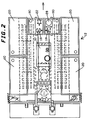
- FIGURE 2 shows a top view of the foam application apparatus of FIGURE 1.
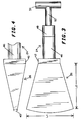
- FIGURE 3 shows a top view of a turbulator and nozzle assembly used for foam production.
- FIGURE 4 show a side view of a portion of the assembly of FIGURE 3.
- a protein based foam is used as a cover material for the so called "working face" of a landfill or other surface.
- the preferred foam is made from concentrated solution derived from a hydrolysed protein concentrate base.
- hydrolysed protein bases are well known in the fire fighting foam art. They are produced by hydrolysing keratin containing materials such as animal hooves and horns, fish scales, hair or feathers.
- Albumen, bloodmeal, dairy derived proteins or proteins from vegetables such as soy bean meal, etc are other sources of proteinaceous starting materials.
- One or more foam stabilizing agents is added to enhance the bubble stability of the foam.
- foam stabilizing agents such as polyvalent metal salts, gums, polysaccharides, soluble starches, starch polymers and deliquescents.
- Freezing point depressants such as polyglycols or other glycol ethers may be added in small quantities to retard freezing of the concentrate in colder weather but are not necessary. A concentrate of this mixture is added to water at the time of use, or possibly as much as a few hours before, to produce a foam solution.
- the present foam is not a plastic, gelled or cured foam product. It is derived from natural animal wastes rich in protein. Moreover, it contains no phosphates, mercury or other materials identified as contaminants or pollutants, and is essentially biodegradable.
- the proteinaceous materials may be broken down into peptides, polypeptides and salts of amino acids via alkaline hydrolysis with lime or caustic sodium hydroxide (NaOH).
- the resulting protein hydrolysate is a major component of the foam concentrate.
- Other methods for producing the protein hydrolysate may equally well be used.
- the naturally derived protein base has been shown to be non-toxic, non-polluting and completely biodegradable, it is believed to be a superior covering material for landfills. Because of these attributes, the use of such foam is perceived to be more biologically compatible with nature, thus overcoming the otherwise environmentally objectionable aspects normally associated with landfills, municipal waste and land reclamation projects in general.
- the basic composition of the protein foam concentrate of the preferred embodiment is shown in Table 1 below: TABLE 1 COMPONENT APPROX.
- PERCENTAGE protein hydrolysate (concentrate) 35-70 polyvalent metallic salt 1.0-2.5 foam booster 3-7 bactericide 0.1-0.2 dispersant 10-14 water balance with all percentages being by weight unless otherwise stated.
- a more preferred formulation of the foam concentrate is shown in Table 2 below: TABLE 2 COMPONENT PERCENTAGE protein hydrolysate (concentrate) 35-70 iron salt (Ferrous Chloride) 1.0-2.5 foam booster 3-7 bactericide 0.1-0.2 sodium lignosulfonate 10-14 water balance
- a still more preferred composition of the foam concentrate is shown in Table 3 below: TABLE 3 COMPONENT PERCENTAGE protein hydrolysate (concentrate) 61.70 iron salt (Ferrous Chloride) 1.80 hexylene glycol 3.24 Nipacide BCP 0.18 sodium lignosulfonate (Marasperse N-22) 12.98 water 17.80
- the protein hydrolysate is commercially available as a 35-50% concentrate having a pH from approximately 7 to 8 and a specific gravity of 1.148 to 1.152. It can be obtained from any of a number of manufacturers of protein based fire fighting foam or it may be hydrolyzed, as previously described, from the protein found in animal hooves, horns, etc.
- the concentrate can be made, for example, by lime hydrolysis.
- a polyvalent metal salt is added preferably to provide a level of foam stabilization by bonding the reactive sites on the protein residue, gums or other polyelectrolytes in the formula.
- Ferrous chloride is the agent of choice as it is relatively inexpensive and is not considered to be environmentally hazardous.
- any number of known freezing point depressants may be added to the basic formulation if needed.
- Hexylene glycol is preferred and is added primarily as a foam booster, although it also serves as a freezing point depressant.
- Other foam boosters suitable for use include diethylene glycol, dipropylene glycol and glycol ethers such as 2-ethoxyethanol, 2-butoxyethanol and 2-(butoxyethoxy) ethanol.
- a bactericide is added as a preservative to prevent the decomposition of the foam concentrate by bacteria.
- Any number of bactericides may be used such as Kathon, available from Rohm & Haas Co., Nipacide BCP or Nipacide MX available from Nipa Laboratories, and the proportions adjusted according to need. The proportion recited in Table 3 is suitable when the bactericide used is Nipacide BCP. Because protein hydrolysates are excellent nutrient sources for microbiological life forms, a low level toxicity biocide should be added to preserve the concentrate. However, when the concentrate is diluted for use, the concentration of the biocide becomes so small that it can no longer provide the preservative effect. Thus, long term holding of premixed solution is not advised.
- dispersants may also optionally be added to enhance the dispersion of ingredients and to provide additional foamability and foam stability.
- Sodium lignosulfonate sold as Marasperse N-22, available from Daishowa Chemicals is preferred, but other dispersants such as lignosulfonate and alkyl naphthalene sulfonates may also be used.
- the basic foam concentrate formula is diluted to approximately 2.0 to 3.5% with water prior to turbulation to produce foam.
- the preferred dilution is approximately 3% but a relatively wide range is functional. At 3% (i.e. 97 parts by volume of water), dilution, the solution produces a high quality foam which is highly cost effective.
- an additional foam stabilizer may optionally be added to improve the resistance to rain and/or wind and to improve the long term (measured in days) stability of the foam blanket when applied.
- a number of materials can be used for this purpose.
- the addition of a polysaccharide xanthan gum commercially available under the trade name Rhodopol 23, manufactured by Rhone-Poulene can increase the foam stability and minimize surface erosion of an aging foam blanket by wind.
- the basic formulation of the foam with the addition of a 0.08% portion by weight of xanthan gum may result in an increase in the life of the foam blanket from approximately 48 hours to beyond 72 hours. Suitable ranges of xanthan gum are from roughly 0.03 to 0.1% by weight depending upon the stability of the foam desired. Optimum, foam stability appears to occur with the addition of approximately 0.05 to 0.1% xanthan gum.
- humectant gums in place of the xanthan gum, other known humectant gums, thickening agents and foam stabilizers may be used.
- potential candidates are such water soluble polymers as Macol 108 POE/POP block copolymer, Peg 600 Polyoxyethylene Monolaurate and Tetronic 904 POE/POP block copolymer.
- foam stabilizers such as polyacrylamide, polyacrylamide/vinyl acetate - methyl pyrrolidone copolymer, polyvinyl alcohol and water soluble cellulose and derivatives therof may be added directly to the concentrate. Suitable concentrations in the range of about 1% to 20% are desirable when these agents are added to the concentrate. After dilution , they will be present in the solution in the range of about 0.1% to 2%.
- the water used to mix with the concentrate to produce a dilute solution is actually a potable water.
- the treated leachate of the landfill singly or mixed with potable water may be suitable.
- Many modern landfills have a sealed bottom to prevent waste from passing into the groundwater below thus causing pollution.
- the most common form of treatment is simply to aerate the leachate.
- more elaborate purification of the leachate is performed.
- the leachate may contain materials which will impair or perhaps even totally inhibit the performance of the foam, this can be determined experimentally to determine the extent to which such leachate can be used.
- the leachate reservoir as a source of the water for dilution of the concentrate, several advantages are achieved.
- the leachate will likely contain numerous microorganisms of whichever strains tend to thrive in the environment of the particular landfill at hand.
- this leachate and reintroducing the microorganisms suspended in the foam blanket it is believed that enhanced decomposition of the waste material will be achieved.
- the natural selection process which determines which strains of microorganisms thrive in a particular landfill environment will provide a tailor made culture which is more likely to survive in the landfill to do its job. While, presumably, such microorganisms could be introduced into the foam compositions artificially, there is a lower probability that they could survive unless they were properly selected for the particular environment.
- the landfill leachate reservoir was used as a source of 160 gallons of treated (by aeration) leachate (water). This was mixed with 5 gallons of foam concentrate, recirculated to mix and applied as in example 1. The appearance of the foam initially appeared normal, but within 3 to 4 hours of application, run off drainage solution was noted. This did not occur with example 1 or 2. 24 hours later the foam blanket had shrunk and the residue was dry and powdery and easily collapsed in the wind. This solution may be acceptable where short foam life can be tolerated such as for an overnight blanket. Additional life may be possible with addition of foam stabilizers. Different results can be expected depending on the composition of the leachate.
- a 6.25% solution was prepared using 75 gallons of potable water with 2.5 gallons of concentrate and 2.5 gallons of Chubb National Foam Aer-O-Foam XL-3 (a fluoroprotein fire fighting foam concentrate). The mixture was mixed and applied as in example 1. This formulation provides an excellent 24 hour blanket.
- a 6% solution was prepared using 155 gallons of potable water and 10 gallons of Chubb National Foam Aer-O-Foam XL-3.
- the mixture was mixed and applied as in example 1 and provided a blanket with an appearance similar to that of example 1 but which set more quickly and was stiffer (in part because of the higher concentration).
- the blanket lasted for about 24 hours but at that point the top surface was dry and drainage was noted. Rain simulated by gentle fog spray of water collapsed the 24 hour blanket.
- composition of Table 3 is diluted with water to a concentration of 3% and foamed by use of a CAFS (compressed air foaming system) machine such as those in common use in wildland fire fighting .
- CAFS compressed air foaming system
- These machines deliver the foam through a hose with sufficient velocity that the foam may be projected as far as 100 ft.
- the foam so generated is of a stiff consistency and adheres to vertical surfaces. Thus it is used to cover walls and roofs of buildings and other structures to protect them against ignition from the radiant heat and firebrands generated by the passage of the fire front of forest or brush fires. This protection lasts for up to 48 hours.
- foam is used to coat vegetation for the establishment of "wet lines" to prevent the spread of forest or brush fires.
- Foam generated in the manner described in example 7 is also used to coat the working face and excavated contaminated soil in hazardous waste site clean-ups to prevent the release of hazardous and nuisance vapors.
- the working face may be coated in the manner described in examples 1 and 2.
- the working life of the foam cover is 24-48 hours. This life is extended by the addition of previously described foam stabilizers to the foam solution. Prior to transportation of the contaminated soil by truck or rail car, the surface of the soil is coated with 6-8 inches of foam to prevent the release of vapors enroute.
- the foam of examples 1, 2, or 7 is applied to windrows of contaminated soil excavated from hazardous waste clean-ups where the soil is undergoing bioremediation.
- the foam prevents the release of vapors and odors, maintains an effective moisture content in the windrows and supplies a nutrient broth to the bacteria as it breaks down.
- Bacterial cultures of the type which are used to break down spilled crude oil or other forms of petroleum are mixed with a 3% solution of the composition of Table 3 in either fresh or sea water.
- the resultant solution is foamed by the method described in example 7 and projected on to the surface of the spill.
- the foam acts as a broadcasting medium to aid in even distribution of the bacteria and enhances the effectiveness of the bacteria by holding them in intimate contact with the spilled petroleum.
- the protein content of the foam also serves as a source of nutrients to the bacteria.
- the above examples demonstrate that by blending the basic formula and/or other protein foam concentrates it is possible to engineer a foam with varying properties such as service life, cost, etc. Further, the actual mechanical manipulation of the foam solution and air to produce the foam blanket can have substantial impact on the life of the blanket. For example, if the foam is turbulated and applied directly to the surface without being sprayed over substantial distances, the foam tends to last significantly longer due to the energy being expended to propel the foam being better utilized to better mix the foam solution with air. Also the propelling of the foam may actually weaken the blanket in some manner.
- the process may be carried out using a pre-mix batch, applied by any conventional compressed air foaming system or by a turbulator foam generator nozzle.
- systems using precise proportioning techniques may also be used to balance the foam concentrate with the dilutant. By using proportioning techniques, there is no left over premix to dispose of and thus these techniques are generally preferable.
- the performance of the system is based on composition(s) of the foam concentrate(s) and the mechanical manipulation of the foam solution.
- the foam solution conversion which optimizes air (or gas) entrained and minimizes unconverted solution or interstitial liquid gives best results.
- wet densities should range from approximately 3 to 5.2 lbs / cubic foot with expansions of from 20 to 1 through 12 to 1 respectively.
- a foam blanket 6 inches in thickness has a wet density of 1.5 lbs to 2.6 lbs / square foot depending on expansion.
- Foam stability is a direct function of bubble size and consistency of bubble size.
- a homogeneous foam that would allow formation of polyhedrons having flat faces in the shape of a pentagon, such as dodecahedron would be ideal.
- Bubble sizes of 0.050 to 0.25 inches but in any case less than about 0.5 inches in diameter appear to give the most acceptable blanket performance.
- Consistency in bubble size is more important than actual size, but for the solutions of the present invention, smaller bubble sizes are generally better.
- the wet density of landfill foams, hence small bubble sizes is more desirable because it adds mass to hold down debris and resist surface erosion by moderate winds and holds water.
- the foam spreading device is mounted to a bulldozer or similar land vehicle such as a Caterpillar 40" triple grouser track loader undercarriage or other low profile wide tread vehicle for traveling over the compressed surface of the landfill (working face) 10.
- a vehicle is shown as 12 in the figures.
- the vehicle may be a special purpose vehicle used primarily for application of the foam.
- the foam production equipment may be temporarily mounted in the bucket of a bulldozer or similar machine or may be towed behind the vehicle. The forward direction of movement of the vehicle is shown by the arrow in FIGURE 1 and FIGURE 2.
- the bed 14 of the vehicle 12 Carries an air compressor 16 (or possibly a tank of compressed air) driven by a motor 18 to provide air for mixing with the foam solution.
- the water or leachate is carried in a plurality of tanks 20. Solution is made from the above foam concentrate and water in a proportioner. Total tank capacities of approximately 1000 to 3000 gallons are generally satisfactory.
- a water pump 22 preferably a positive displacement water pump, pumps the water from the tanks 20 into a proportioner and then to a manifold feeding a plurality of turbulators 24 and foam production nozzles 26 mounted at the rear of vehicle 12.
- the water pump 22 may be driven by an independent power source such as an electric generator or may tap into the power train of the vehicle to operate the pump.
- An oil recovery unit 28 is used to recover oil from the air compressor in a known manner.
- a pair of tanks 30 to carry foam concentrate are mounted to either side of the compressor 16 and motor 18.
- the vehicle's engine 32 and associated hardware is positioned at a central area of the vehicle 12.
- the water or leachate and foam concentrate may be mixed in a known manner using known proportioning techniques such as those used in proportioning foam generation equipment used for fire fighting to produce the proper percentage solution.
- Stabilizer can be added to the water or leachate, or if the stabilizer does not cause long term storage problems, it can be added or provided in the concentrate.
- the solution is then supplied to a manifold connecting a plurality of turbulator - nozzle assemblies. In the embodiment shown, seven such turbulator - nozzle assemblies are connected together on 20 inch centers to provide a path of foam approximately 12 feet wide. When the foam is dispensed from the spreader portion 26 of the nozzle, it is wiped to a consistent height by a plastic (or metal or other suitable material) screed 34.
- the turbulator - nozzle assembly of a preferred embodiment is shown in FIGURE 3 and FIGURE 4.
- This assembly is made of 3/8" thick standard metal or steel tubing which is shaped and welded into the configuration shown.
- the spreader 26 is approximately 15 inches in dimensions L1 and L2 and tapers to an opening 40 of about 1 3/8" at the tip.
- the top 42 of the spreader is approximately 6" square. Top portion 42 is mated to the turbulator 24 portion of the turbulator -nozzle assembly which is made of three series connected sections.
- the bottom-most section 46 is a Raschig ring packed turbulator made of a pipe of approximately 4" diameter which is packed with 3/8" OD X 3/16" ID X 3/8" long plastic (polypropylene) Raschig rings. At both ends of the Raschig ring turbulator 46 is a screen with mesh small enough to contain the Raschig rings. This turbulator is approximately 12 inches in length.
- the middle section 48 is a sphere packed turbulator which is approximately 6 inches in length. This section is similarly made of pipe of approximately 4 inch diameter which is packed with 1/2" or 3/8" polypropylene spheres. Once again, screens are used to contain the spheres of the turbulator.
- the uppermost section 52 forms a turbulator and is made of narrower diameter pipe having a one inch inner diameter and approximately 6 inches length. This section 52 is loosely packed with stainless steel turnings such as those used for scouring pads (e.g. Chore-BoyTM brand scouring pads).
- the upper end of the packed turbulator 52 is attached to a mixing chamber 56. Air and foam solution are injected into this mixing chamber 56 through internal orifices (not shown). The solution pressure at this point is approximately 80-95 psi with a feed rate of 12-16 gallons of solution per minute per nozzle. Air is injected at approximately 80-95 psi at this point to provide an expansion of approximately 12-16 times.
- the foam solution and air mixture are delivered to the turbulator - nozzle assembly where three stages of turbulation take place. First in the steel turnings packed turbulator 52, second in the sphere packed turbulator 48 and finally in the Raschig ring turbulator 46. Finally, the foam is delivered to the duck bill shaped spreader 26 where it comes out and is spread over the landfill.
- the thickness of the blanket can be controlled by the speed of the vehicle, the height and rigidity of the screed 34 and the delivery rate of the foam.
- the solution is applied at a rate of approximately 300 to 500 square feet per 100 gallons of 3% solution for a covering of approximately six inches in depth.
- the trash should preferably be compacted prior to application of the foam in order to more easily cover the surface. This is generally no problem since the surface of the landfill is more or less constantly being worked as new trash is added to maximize use of the landfill.
- a premix process just prior to application of the foam, the solution is mixed from a concentrate with an appropriate amount of water to form a solution of approximately 3% by volume (that is 3 parts of the concentrate is diluted with 97 parts of water by volume to produce a 3% solution.
- the stabilizer is added and this solution is mixed and then applied as described above.
- the protein foam remains soft and foamy for some time after application which allows for some settling into cracks and crevices which form in the surface of the working face.
- the foam blanket therefore ultimately occupies essentially no space within the landfill.
- the mechanical manipulation of the foam mass as described is accomplished by metering compressed air (or other gas) to a mixing point where metered foam solution is likewise directed. Sizing the orifices of the applicator 28, or using valves, to maintain and balance the operating pressures provides optimum air-solution mixture.
- the foam coating produced by this process is readily degradable and may actually improve the degradation of other materials in the landfill.
- the foam can be formulated to remain soft throughout its useful life and therefor provides little in the way of a physical barrier to wildlife, but nonetheless seems to provide enough of a barrier to effectively thwart birds and other wildlife.
- the foam is relatively harmless to wildlife if ingested or breathed in small quantities and birds appear to be repelled somewhat by it.
Landscapes
- Engineering & Computer Science (AREA)
- Life Sciences & Earth Sciences (AREA)
- Soil Sciences (AREA)
- Environmental & Geological Engineering (AREA)
- Chemical & Material Sciences (AREA)
- General Life Sciences & Earth Sciences (AREA)
- Materials Engineering (AREA)
- Organic Chemistry (AREA)
- Processing Of Solid Wastes (AREA)
Applications Claiming Priority (2)
| Application Number | Priority Date | Filing Date | Title |
|---|---|---|---|
| US584007 | 1990-09-18 | ||
| US07/584,007 US5133991A (en) | 1990-09-18 | 1990-09-18 | Method for applying a biodegradable protein foam to a substrate |
Publications (2)
| Publication Number | Publication Date |
|---|---|
| EP0476469A2 true EP0476469A2 (de) | 1992-03-25 |
| EP0476469A3 EP0476469A3 (en) | 1993-01-20 |
Family
ID=24335503
Family Applications (1)
| Application Number | Title | Priority Date | Filing Date |
|---|---|---|---|
| EP19910115170 Withdrawn EP0476469A3 (en) | 1990-09-18 | 1991-09-07 | Method for applying a biodegradable protein foam to a substrate |
Country Status (3)
| Country | Link |
|---|---|
| US (1) | US5133991A (de) |
| EP (1) | EP0476469A3 (de) |
| GB (1) | GB2248064B (de) |
Cited By (7)
| Publication number | Priority date | Publication date | Assignee | Title |
|---|---|---|---|---|
| EP0537999A3 (en) * | 1991-10-15 | 1993-09-15 | Merck & Co. Inc. | Gelled foams |
| WO2002009819A3 (en) * | 2000-07-28 | 2002-04-18 | Ansul Inc | Aqueous foamable concentrates and methods |
| NL1031469C2 (nl) * | 2006-03-30 | 2007-10-03 | Asepta B V | Antistuifmiddel. |
| RU2332363C2 (ru) * | 2002-10-16 | 2008-08-27 | Солвей (Сосьете Аноним) | Способ обработки донных илистых отложений |
| RU2388706C2 (ru) * | 2004-04-14 | 2010-05-10 | Солвей (Сосьете Аноним) | Способ обработки шлама |
| FR2966477A1 (fr) * | 2010-10-25 | 2012-04-27 | Olivier Bertron | Composition et procede destines a traiter la cause du phenomene d'erosion dans un rivage sedimenteux et ameliorer la vie benthique. |
| CN108315015A (zh) * | 2018-02-02 | 2018-07-24 | 刘二丽 | 用于清理受石油污染土壤的复配修复剂及其修复方法 |
Families Citing this family (21)
| Publication number | Priority date | Publication date | Assignee | Title |
|---|---|---|---|---|
| US5658961A (en) * | 1994-08-04 | 1997-08-19 | Cox, Sr.; Charles S. | Microbiological fire-fighting formulation |
| US6527970B1 (en) | 1994-08-04 | 2003-03-04 | Verde Environmental, Inc. | Microbiological aqueous film forming foam (AFFF) fire-fighting formulation |
| US5942552A (en) * | 1994-08-04 | 1999-08-24 | Cox; Charles S. | Microbiological fire-fighting formulation |
| US6225362B1 (en) | 1994-08-04 | 2001-05-01 | Verde Enviromental, Inc. | Microbiological fire-fighting formulation |
| US5690448A (en) * | 1994-10-21 | 1997-11-25 | E. I. Du Pont De Nemours And Company | Landfill closure system |
| US5695641A (en) * | 1996-02-14 | 1997-12-09 | Cosulich; John P. | Method and apparatus for enhancing methane production |
| US5853050A (en) * | 1997-05-07 | 1998-12-29 | Rusmar Incorporated | Composition and method for generating a foam barrier and methods of use thereof |
| US6262128B1 (en) | 1998-12-16 | 2001-07-17 | 3M Innovative Properties Company | Aqueous foaming compositions, foam compositions, and preparation of foam compositions |
| KR100478403B1 (ko) * | 2000-11-13 | 2005-03-23 | 이엔브이이십일(주) | 다층 반응조 개념을 도입한 매립지의 매립구조와 이를이용한 매립지 운용방법 |
| CA2445675A1 (en) * | 2003-10-20 | 2005-04-20 | Yanzhong Wu | Composition and method for forming a sprayable materials cover |
| WO2009097541A1 (en) * | 2008-02-01 | 2009-08-06 | Rich Products Corporation | Foam compositions |
| CN101371944B (zh) * | 2008-08-22 | 2012-01-11 | 杭州新纪元安全产品有限公司 | 用洁净气体作为发泡剂的灭火产品及制作方法和灭火系统 |
| CN102439058B (zh) | 2009-03-06 | 2015-07-29 | 生物高聚物技术有限公司 | 含有蛋白的泡沫材料,它们的制造与用途 |
| NZ594868A (en) * | 2009-03-06 | 2014-01-31 | Biopolymer Technologies Ltd | Protein-containing emulsions and adhesives, and manufacture and use thereof |
| US20110048085A1 (en) * | 2009-09-02 | 2011-03-03 | Mr. H Keith Otsuki | Temporary slurry sprayed permeable cover design for erosion protection and passive biofiltration of methane, volatile organic compounds (VOCs) and odors from area sources. |
| US8916668B2 (en) | 2010-06-07 | 2014-12-23 | Biopolymer Technologies, Ltd. | Protein-containing adhesives, and manufacture and use thereof |
| EP2753633B1 (de) | 2011-09-09 | 2016-12-28 | Evertree | Proteinhaltige haftstoffe, ihre herstellung und verwendung |
| WO2013036739A1 (en) | 2011-09-09 | 2013-03-14 | Biopolymer Technologies, Ltd. | Protein-containing adhesives, and manufacture and use thereof |
| WO2014020447A2 (en) | 2012-07-30 | 2014-02-06 | Biopolymer Tecnologies, Ltd. | Protein adhesives containing an anhydride, carboxylic acid, and/or carboxylate salt compound and their use |
| US9051196B2 (en) * | 2013-03-15 | 2015-06-09 | Clack Corporation | Baffle plate for a water treatment device |
| US10399130B2 (en) * | 2015-07-22 | 2019-09-03 | Arizona Board Of Regents On Behalf Of Arizona State University | Methods and systems for in situ temporary containment of shallow contaminated soils |
Family Cites Families (19)
| Publication number | Priority date | Publication date | Assignee | Title |
|---|---|---|---|---|
| NL131345C (de) * | 1964-05-19 | |||
| NO129857B (de) * | 1964-07-10 | 1974-06-04 | Mitsubishi Heavy Ind Ltd | |
| CA850049A (en) * | 1968-12-12 | 1970-08-25 | Laurentian Concentrates Limited | Foam protection of plant life |
| US3790395A (en) * | 1971-11-01 | 1974-02-05 | R Eron | Foamed cover composition |
| US3856700A (en) * | 1972-12-04 | 1974-12-24 | Us Agriculture | Percursor compositions from animal hide glues for dry-structured foams |
| DE2326623A1 (de) * | 1973-05-25 | 1974-12-12 | Hoechst Ag | Feuerloeschmittel |
| US3850375A (en) * | 1974-01-11 | 1974-11-26 | F Ford | Mobile shredder |
| US4107075A (en) * | 1974-12-09 | 1978-08-15 | Fritz Kramer | Apparatus for spraying plastic foam |
| SU582787A1 (ru) * | 1975-07-11 | 1977-12-05 | Московская Ордена Ленина И Ордена Трудового Красного Знамени Сельскохозяйственная Академия Им.К.А.Тимирязева | Способ кратковременного хранени навоза в открытой емкости |
| JPS54402A (en) * | 1977-06-02 | 1979-01-05 | Kokusai Kikou Kk | Work of protecting normal plane suitable for planting and its method of construction |
| GB2073757B (en) * | 1980-02-12 | 1983-09-21 | Dunlop Ltd | Foamed gel compositions |
| EP0049958B1 (de) * | 1980-09-30 | 1986-11-05 | Angus Fire Armour Limited | Zusammensetzungen für die Brandbekämpfung |
| US4421788A (en) * | 1982-02-22 | 1983-12-20 | Sanifoam, Inc. | Method and apparatus for coating a substrate with foamed plastic |
| US4483641A (en) * | 1983-01-27 | 1984-11-20 | Stoll Ulrich W | Waste disposal landfill |
| US4487054A (en) * | 1983-06-08 | 1984-12-11 | Getty Synthetic Fuels, Inc. | Method for projecting landfill gas collection rate of a surface collector |
| US4519338A (en) * | 1983-10-20 | 1985-05-28 | Sanifoam, Inc. | Apparatus and method for applying a foam layer to cover and seal dumped waste |
| US4795590A (en) * | 1985-05-28 | 1989-01-03 | Minnesota Mining And Manufacturing Company | Treatment of hazardous material with vapor suppressing, persistent, water-containing, polymeric air foam |
| US4874641A (en) * | 1987-11-24 | 1989-10-17 | Rusmar Incorporated | Method of providing a barrier between a substrate and the atmosphere and compositions therefor |
| DE68923486T2 (de) * | 1988-06-08 | 1996-04-04 | Minnesota Mining & Mfg | Behandlung gefährlicher Stoffe mit wässerigem Luftschaum von Polyhydroxypolymer. |
-
1990
- 1990-09-18 US US07/584,007 patent/US5133991A/en not_active Expired - Fee Related
-
1991
- 1991-03-06 GB GB9104724A patent/GB2248064B/en not_active Expired - Fee Related
- 1991-09-07 EP EP19910115170 patent/EP0476469A3/en not_active Withdrawn
Cited By (9)
| Publication number | Priority date | Publication date | Assignee | Title |
|---|---|---|---|---|
| EP0537999A3 (en) * | 1991-10-15 | 1993-09-15 | Merck & Co. Inc. | Gelled foams |
| WO2002009819A3 (en) * | 2000-07-28 | 2002-04-18 | Ansul Inc | Aqueous foamable concentrates and methods |
| US6599872B1 (en) | 2000-07-28 | 2003-07-29 | Ansul, Incorporated | Aqueous foamable concentrates and methods |
| RU2332363C2 (ru) * | 2002-10-16 | 2008-08-27 | Солвей (Сосьете Аноним) | Способ обработки донных илистых отложений |
| RU2388706C2 (ru) * | 2004-04-14 | 2010-05-10 | Солвей (Сосьете Аноним) | Способ обработки шлама |
| NL1031469C2 (nl) * | 2006-03-30 | 2007-10-03 | Asepta B V | Antistuifmiddel. |
| FR2966477A1 (fr) * | 2010-10-25 | 2012-04-27 | Olivier Bertron | Composition et procede destines a traiter la cause du phenomene d'erosion dans un rivage sedimenteux et ameliorer la vie benthique. |
| WO2012055740A1 (fr) * | 2010-10-25 | 2012-05-03 | Olivier Bertron | Composition et procédé destinés à traiter la cause du phénomène d'érosion dans un rivage sédimenteux et améliorer la vie benthique |
| CN108315015A (zh) * | 2018-02-02 | 2018-07-24 | 刘二丽 | 用于清理受石油污染土壤的复配修复剂及其修复方法 |
Also Published As
| Publication number | Publication date |
|---|---|
| US5133991A (en) | 1992-07-28 |
| GB2248064B (en) | 1994-09-21 |
| GB2248064A (en) | 1992-03-25 |
| EP0476469A3 (en) | 1993-01-20 |
| GB9104724D0 (en) | 1991-04-17 |
Similar Documents
| Publication | Publication Date | Title |
|---|---|---|
| US5133991A (en) | Method for applying a biodegradable protein foam to a substrate | |
| CN1107655C (zh) | 用于提高生物清除的包覆层组合物 | |
| EP0446307B1 (de) | Verfahren zur schaffung einer grenzschicht zwischen substrat und atmosphäre | |
| US6096373A (en) | Sprayable composition and method for forming a foamed outdoor protective cover layer | |
| US5026735A (en) | Treatment of hazardous materials with aqueous air foam of polyhydroxy polymer | |
| US5124363A (en) | Aqueous air foams of polyhydroxy polymer | |
| US3900421A (en) | Method of accelerating the biodegradation of petroleum products | |
| CA1333693C (en) | Deodorant composition for abating the odor of organic refuse | |
| US4990373A (en) | Membrane-forming foam composition and method | |
| US5215786A (en) | Composition for providing a foam barrier between a substrate and the atmosphere and the method of use | |
| CN104907330B (zh) | 一种硝基化合物污染土壤的原位生物修复方法 | |
| EP0537999A2 (de) | Gelförmige Schäume | |
| US6649740B1 (en) | Hydratable form of keratin for use as a soil amendment | |
| US5676876A (en) | Fire fighting foam and method | |
| CN101619205B (zh) | 改性明胶抑尘剂及其制备方法 | |
| RU2030851C1 (ru) | Способ восстановления нарушенных земель | |
| US5658961A (en) | Microbiological fire-fighting formulation | |
| JP2001087754A (ja) | 汚染土壌の生物的修復用粉状組成物 | |
| US5942552A (en) | Microbiological fire-fighting formulation | |
| US6806298B1 (en) | Sprayable composition and method for forming a foamed outdoor protective cover layer | |
| JP3699476B2 (ja) | スプレー可能な組成物および屋外用発泡保護被覆層形成方法 | |
| KR102281244B1 (ko) | 고분자침식방지안정제가 희석된 유기유황발효액과, 생왕겨 및 임목폐기물 또는 우드칩의 재가 첨가된 녹화배합토를 이용한 법면녹화공법 | |
| EP0345967B1 (de) | Behandlung gefährlicher Stoffe mit wässerigem Luftschaum von Polyhydroxypolymer | |
| CN1269738A (zh) | 一种对受基于矿物油污染物长期污染的土地简便生物恢复的方法 | |
| US6225362B1 (en) | Microbiological fire-fighting formulation |
Legal Events
| Date | Code | Title | Description |
|---|---|---|---|
| PUAI | Public reference made under article 153(3) epc to a published international application that has entered the european phase |
Free format text: ORIGINAL CODE: 0009012 |
|
| AK | Designated contracting states |
Kind code of ref document: A2 Designated state(s): AT BE CH DE DK ES FR GR IT LI LU NL SE |
|
| PUAL | Search report despatched |
Free format text: ORIGINAL CODE: 0009013 |
|
| AK | Designated contracting states |
Kind code of ref document: A3 Designated state(s): AT BE CH DE DK ES FR GR IT LI LU NL SE |
|
| 17P | Request for examination filed |
Effective date: 19930619 |
|
| 17Q | First examination report despatched |
Effective date: 19950407 |
|
| GRAG | Despatch of communication of intention to grant |
Free format text: ORIGINAL CODE: EPIDOS AGRA |
|
| GRAH | Despatch of communication of intention to grant a patent |
Free format text: ORIGINAL CODE: EPIDOS IGRA |
|
| STAA | Information on the status of an ep patent application or granted ep patent |
Free format text: STATUS: THE APPLICATION IS DEEMED TO BE WITHDRAWN |
|
| 18D | Application deemed to be withdrawn |
Effective date: 19960909 |